Connect with us
DAPA Banner

Tech

A nuclear first: TerraPower officially starts construction on next-gen Natrium plant in Wyoming

Published

on

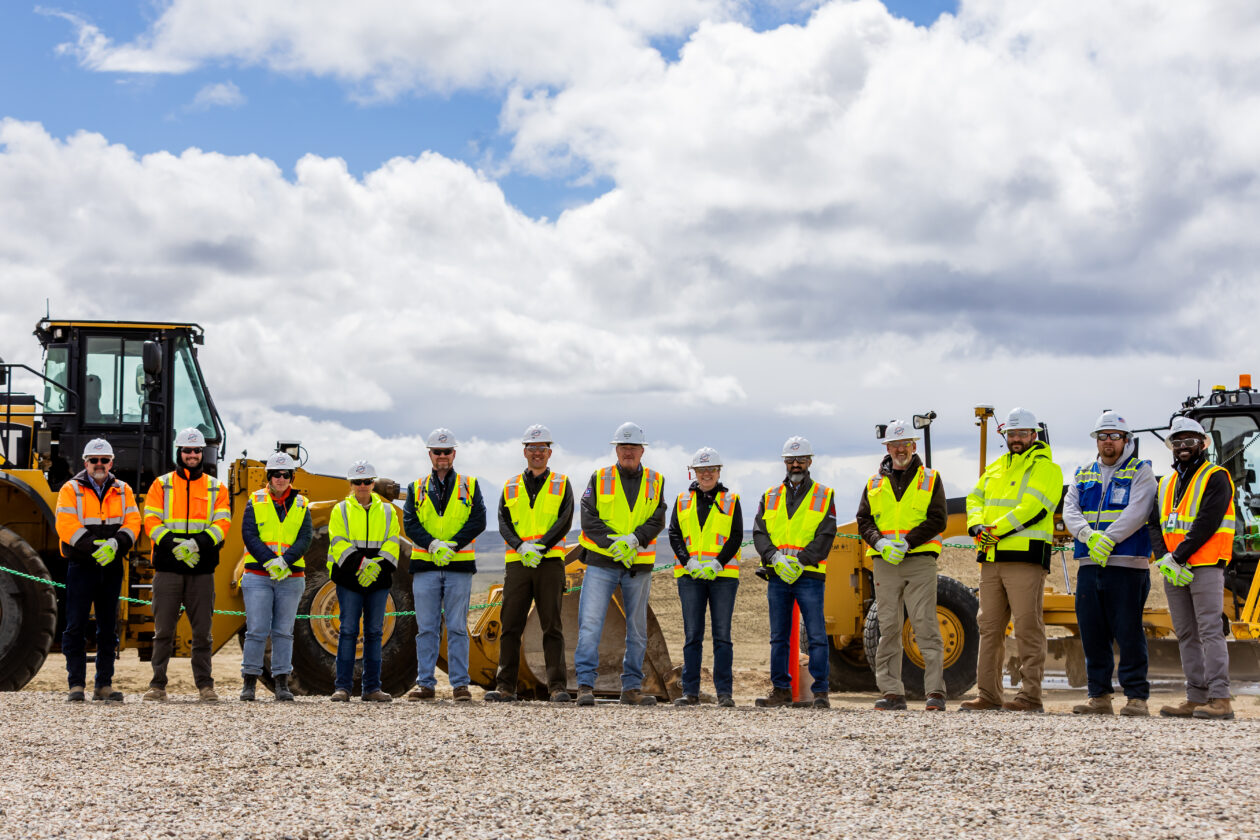
TerraPower is celebrating the start of construction on its nuclear plant in Kemmerer, Wyo. (TerraPower Photo)

TerraPower announced Thursday that it has started construction on its Natrium plant, making it the first company in the U.S. to break ground on an advanced nuclear power facility.

“This is the moment our industry has been working toward for a generation. We’re not just breaking new ground on a first-of-a-kind nuclear plant in Wyoming; we’re building the next generation of America’s energy infrastructure,” said Chris Levesque, CEO of TerraPower, in a statement.

The Bellevue, Wash.-based company began building its demonstration plant in Kemmerer, Wyo., in 2024, starting with construction of non-nuclear features. Last month, TerraPower received unanimous approval from the Nuclear Regulatory Commission (NRC) to proceed with the nuclear components.

The facility includes a 345-megawatt, sodium-cooled fast reactor paired with a system that holds excess heat inside of molten salt. Tapping the thermal salt battery can boost the plant’s power output to 500 megawatts for more than five hours. By comparison, Seattle uses around 2,000 megawatts during extreme weather events.

TerraPower aims to have the reactor splitting atoms by the end of 2030. Roughly 1,600 workers will be hired during construction, with approximately 250 full-time staff employed once the facility is operational.

Advertisement

The Wyoming plant was estimated in 2021 to cost about $4 billion; no updated figures have been provided. Levesque previously told GeekWire that private investments from Bill Gates and others as well as $2 billion federal grant mean “we’re building that project without burdening the ratepayers.”

The milestone comes as America’s nuclear sector has surged back to life after decades of stagnation, driven by tech giants scrambling to power data centers nationwide and rising energy demands across commercial, residential and industrial sectors.

Founded 20 years ago, TerraPower plans to build hundreds of its reactors, which are smaller and less costly than conventional facilities. Using prefabricated components, the company believes it can compress construction timelines to just three years — a fraction of the time required for traditional plants. The most recently completed conventional nuclear facility in the U.S. — the Plant Vogtle site in Georgia — took more than a decade to build.

TerraPower is already signing customers. In January, the company reached a deal with Meta to build up to eight Natrium reactors in the U.S. with the first two targeted to come online by 2032. If the full order is fulfilled, the additional reactors will be operating by 2035. The company also has memorandums of understanding with government agencies in Utah and Kansas to explore potential sites in those states.

Advertisement

“The start of construction on TerraPower’s Natrium plant in Kemmerer marks a major milestone not just for Wyoming, but for the future of American energy,” said Wyoming Gov. Mark Gordon. “I want to thank everyone at TerraPower for their work getting to this day.”

Source link

Continue Reading
Click to comment

You must be logged in to post a comment Login

Leave a Reply

Tech

One Maker Turned a Decade-Old Dream Into a Working EMP Rifle

Published

on

Homemade Custom EMP Rifle
Years ago, a teenager became obsessed with basic high-voltage gear and dreamed about something bigger. Fast forward to now, and the maker known as Schizo, has just finished building a full-sized handheld device that emits a strong electromagnetic pulse.


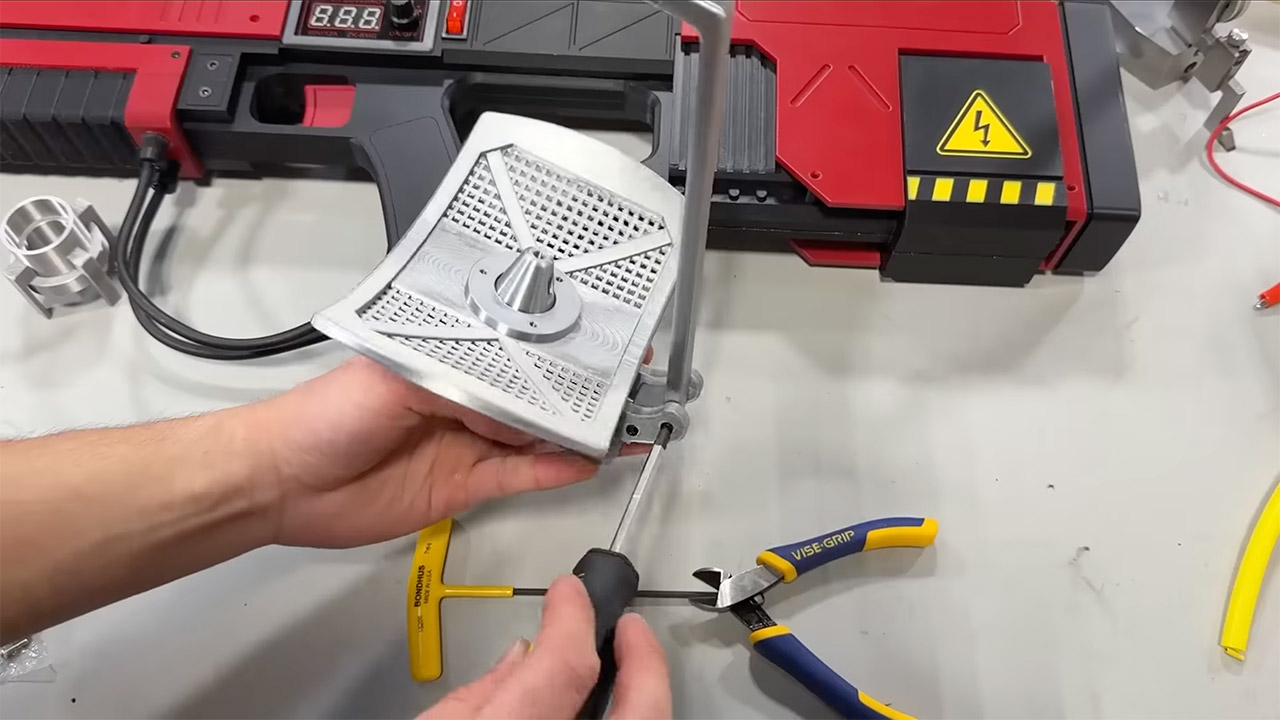
Before he could print anything, Fusion software had meticulously planned out the entire project. He’s also made certain that the high-voltage components do not come into contact with the grip while it is in place. The ground wire exit is securely hidden away in an exterior tube to prevent accidental shorting, and slots around the top allow an insulated screwdriver to bleed off any stray charge once he turns it off. That’s because this machine handles with so many volts that you’d be crazy to feel safe at any time.


Bambu Lab A1 3D Printer, Support Multi-Color 3D Printing, High Speed & Precision, Full-Auto Calibration…
  • High-Speed Precision: Experience unparalleled speed and precision with the Bambu Lab A1 3D Printer. With an impressive acceleration of 10,000 mm/s…
  • Multi-Color Printing with AMS lite: Unlock your creativity with vibrant and multi-colored 3D prints. The Bambu Lab A1 3D printers make multi-color…
  • Full-Auto Calibration: Say goodbye to manual calibration hassles. The A1 3D printer takes care of all the calibration processes automatically…

Bambu Lab’s A1 Combo printer turned the digital files into actual pieces, giving the gun the smooth, clean finish you’d expect from a professional. The way everything came together was also seamless, as the rifle houses everything from the batteries in the foregrip to the main pulse components by the muzzle. Metric screws are all over the place, holding everything together while also allowing him to make adjustments on the fly. There’s no fancy work or frills here; simply sensible, utilitarian design that keeps everything balanced and ready to go.

Homemade Custom EMP Rifle
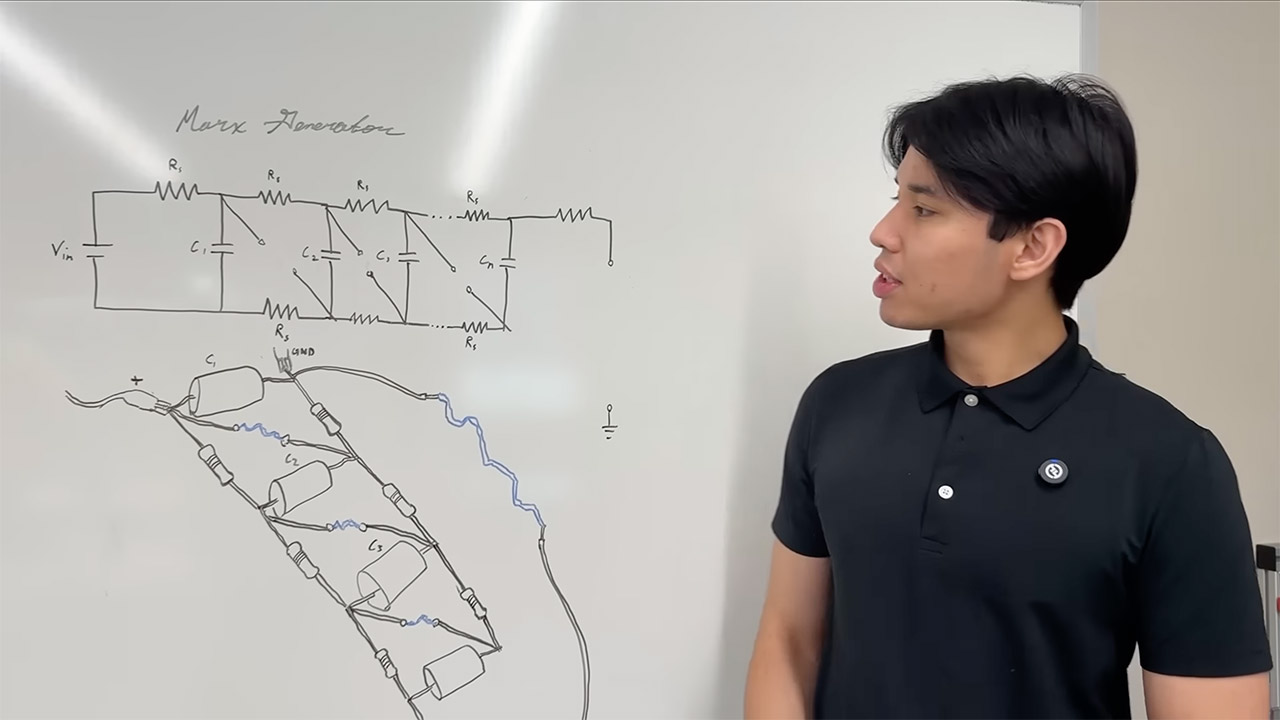
At the center is a Marx generator made up of several stages, each with two 15kv ceramic caps wired in series to relieve some pressure. Resistors snaffle the charge for the capacitors from a flyback transformer powered by a ZVS circuit. When the voltage reaches a certain level, the first spark gap fires, followed by the others, and suddenly, whoosh, everything releases as a single, quick hit rather than a trickle. The end result is a bloody intense pulse that travels through a copper coil at the front, creating a shifting magnetic field all around the gun.

Homemade Custom EMP Rifle
He gets the show started with two 3 cell lithium ion batteries, and a safety switch and spring-loaded trigger are linked to a limit switch that controls when it fires. A motor governor regulates the voltage, allowing the generator to operate smoothly.It’s also worth mentioning that he’s taken great care in routing the wires and has even gone above and beyond to smooth out all of the solder connections after spotting tiny corona discharges leaking energy during early tests, which improves performance and keeps it from getting too bulky.

Homemade Custom EMP Rifle
Electricity and magnetism interact in relatively simple ways that anyone can understand. A changing magnetic field induces current in any nearby conductor. The faster the magnetic field changes, the more of a push you receive. The Marx generator is one of the devices capable of delivering such a quick shift. When the coil lets go of its charge, the pulse radiates out and produces voltages in any neighboring circuits. Sensitive chips are the first to notice the effect because they typically operate at extremely low voltages and cannot simply ignore the additional energy. It all comes together with Maxwell’s equations, but the basic calculation is rather simple: a rapid pulse indicates a broader disruption.

Homemade Custom EMP Rifle
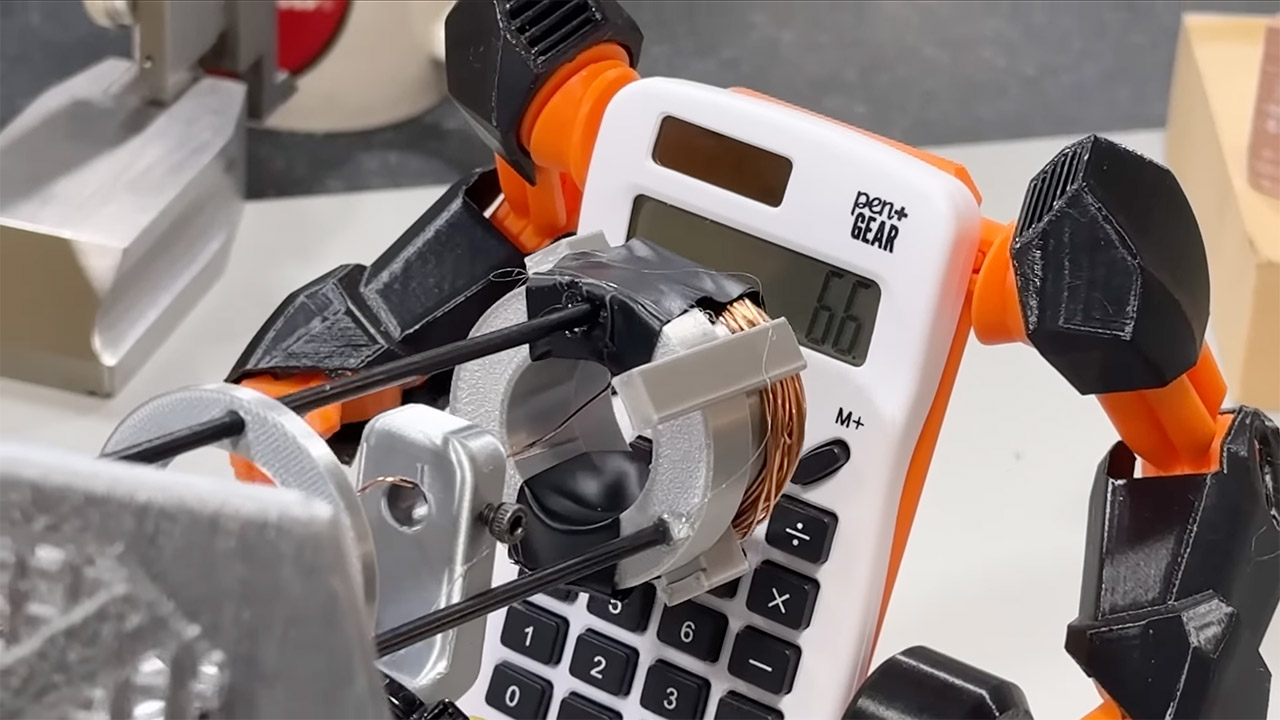
Testing began cautiously, as the first shots from the coil caused a pocket calculator resting just a few inches away to flicker and reset, for example. Next, a multimeter detected the induced voltage from a distance but eventually failed when brought closer. A desktop computer, on the other hand, felt the effects through its glass case from more than four feet away, but only had occasional faults on screen. In a darkened environment, you could see the spark gaps inside the cannon illuminate in fast small flashes through the printed infill. Intermittent results improved slightly, but the overall range remained rather small. Nonetheless, it was evident that the gadget operated far better than the maker’s previous attempts.

Advertisement

Source link

Continue Reading

Tech

Encrypting Encrypted Traffic To Get Around VPN Bans

Published

on

VPNs, Virtual Private Networks, aren’t just a good idea to keep your data secure: for millions of people living under restrictive regimes they’re the only way to ensure full access to the internet. What do you do when your government orders ISPs to ban VPNs, like Russia has done recently?  [LaserHelix] shows us one way Gopniks cope, which is to use a ShadowSocks proxy.

If you’re not deep into network traffic, you might be wondering: how can an ISP block VPN traffic? Isn’t that stuff encrypted? Yes, but while the traffic going over the VPN is encrypted, you still need to connect to your VPN’s servers– and those handshake packets are easy enough to detect. You can do it at home with Wireshark, a tool that shows up fairly often on these pages. Of course if they can ID those packets, they can block them.

So, you just need a way to obfuscate what exactly the encrypted traffic you’re sending is. Luckily that’s a solved problem: Chinese hackers came up with something called Shadowsocks back in 2012 to help get around the Great Firewall, and have been in an arms-race with their authorities ever since.

Shadowsocks is not, in fact, a sibling of Gandalf’s horse as the name might suggest, but a tool to obfuscate the traffic going to your VPN. To invert a meme, you’re telling the authorities: we heard you don’t like encrypted traffic, so we put encryption in your encrypted traffic so you have to decrypt the packets before you recognize the encrypted packets.

Advertisement

What about the VPN? Well, some run their own shadowsocks service, while others will need to be accessed via a shadowsocks bridge: in effect, a proxy that then connects to the VPN for you. That means of course you’re bouncing through two servers you need to trust not to glow in the dark, but if you have to trust someone– otherwise it’s off to a shack in the woods, which never ends well.

Don’t forget that while VPNs can get you around government censorship, they do not provide anonymity on their own. If, like tipster [Keith Olson] –thanks for the tip, [Keith]!– you’re looking side-eyed at your government’s “think of the children!” rhetoric but don’t know where to start, we had a discussion about which VPNs to use last year.

Source link

Advertisement
Continue Reading

Tech

Microsoft Gaming is dead, long live Xbox

Published

on

Microsoft just hit reset on its gaming identity, and in a way, it feels like going back to basics. Because “Microsoft Gaming” is out, and Xbox is officially back at the center of everything.

Why is Microsoft ditching “Microsoft Gaming” for Xbox again?

In a recent internal shift, Microsoft has rebranded its entire gaming division back to Xbox, effectively dropping the “Microsoft Gaming” label altogether.

This isn’t just a cosmetic change. The new CEO, Asha Sharma, has made it clear that “Xbox needs to be the identity”, signaling a move away from the broader, corporate-sounding branding toward something more focused and recognizable.

The “Microsoft Gaming” name originally came into play during the Activision Blizzard acquisition era under Phil Spencer, when the company was positioning gaming as a larger business unit. Now, the shift suggests a return to a more gamer-first identity, with Xbox once again leading the narrative.

What does “We Are Xbox” actually mean for the future?

Alongside the rebrand, Microsoft has outlined a new direction internally under the message “We Are Xbox.” The focus is shifting toward a few core pillars like hardware, content, services, and overall player experience. 

There is also a noticeable change in how success is being measured. Instead of just sales or subscriptions, the company is now prioritizing daily active players, which shows a stronger emphasis on engagement over raw numbers. 

At the same time, Xbox is reevaluating its strategy around exclusivity, cloud gaming, and even AI integration. The goal seems to be building a more flexible ecosystem that works across console, PC, mobile, and cloud rather than locking players into one platform. 

This may look like a simple rebrand, but it feels more like a reset. With next-gen hardware on the horizon, Microsoft is streamlining its identity around Xbox while doubling down on cloud, multiplatform play, and engagement. In the end, it is less about changing the name and more about returning to what already works.

Advertisement

Source link

Continue Reading

Tech

Meta to cut 8,000 jobs to bankroll its AI ambitions

Published

on


The move reflects a broader pattern across major technology companies, where AI spending is rising even as headcount declines. Meta has projected record capital expenditures this year and announced several multibillion-dollar AI partnerships in recent months. Internally, employees have been encouraged to use AI agents in day-to-day work, including software…
Read Entire Article
Source link

Continue Reading

Tech

Authorities arrest special forces soldier who allegedly made $400K on Polymarket bet involving Maduro operation

Published

on

A special forces soldier involved in the operation that captured Venezuelan President Nicolás Maduro has been indicted by the U.S. Justice Department. His alleged crime? Making numerous bets on the prediction market Polymarket that Maduro would be removed from power, for which he is said to have made upwards of $400,000.

Authorities claim Gannon Ken Van Dyke, who was involved in the “planning and execution” of Operation Absolute Resolve (the stratagem that toppled and captured the Venezuelan leader), made bets on Polymarket about whether the U.S. would deploy forces into Venezuela and remove Maduro from power.

Van Dyke was arrested on Thursday, CBS reports, citing a law enforcement source.

Federal officials say that Van Dyke’s wagers were informed by classified information he had access to as a result of being a government insider. The government notes that Van Dyke signed nondisclosure agreements prohibiting him from ever divulging, publishing, or revealing “by writing, words, conduct, or otherwise . . . any classified or sensitive information” related to the military operations he was involved with.

Advertisement

In December, Van Dyke created a Polymarket account and began making wagers involving “Maduro- and Venezuela-related markets,” officials say. Between December 27, 2025 and January 26 of this year, he allegedly made 13 bets totaling some $33,034 in total on things like “U.S. Forces in Venezuela . . . by January 31, 2026” and “Maduro out by . . . January 31, 2026.” Officials say that, after collecting his winnings, Van Dyke also took steps to cover up his ties to the account that made the wagers.

Van Dyke faces a variety of charges, including violating the Commodity Exchange Act, wire fraud, and making an unlawful monetary transaction.

“Our men and women in uniform are trusted with classified information in order to accomplish their mission as safely and effectively as possible, and are prohibited from using this highly sensitive information for personal financial gain,” said Acting Attorney General Todd Blanche. “Widespread access to prediction markets is a relatively new phenomenon, but federal laws protecting national security information fully apply.”

Techcrunch event

Advertisement

San Francisco, CA
|
October 13-15, 2026

Prediction markets have inspired controversy ever since their launch. But over the past year, the sites have grown in prominence and influence, striking deals with media outlets and sports organizations while also seeing widespread use, including by public officials. Legislation is currently being mulled that would ban public officials from using nonpublic information to make bets on prediction sites.

Advertisement

When you purchase through links in our articles, we may earn a small commission. This doesn’t affect our editorial independence.

Source link

Continue Reading

Tech

How This Former Roboticist’s Students Rebuilt ENIAC

Published

on

Tom Burick has always considered himself a builder. Over the years he’s designed robots, constructed a vintage teardrop trailer, and most recently, led a group of students in building a full-scale replica of a pivotal 1940s computer.

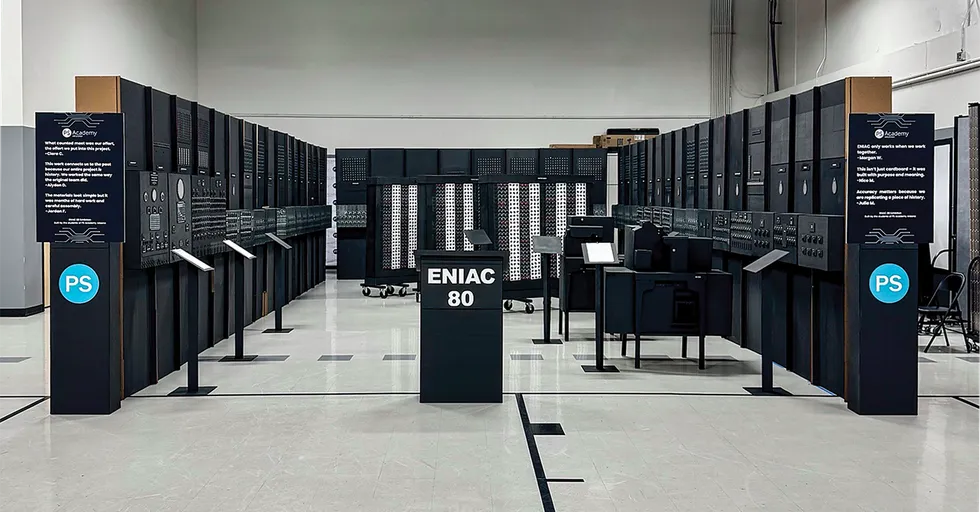
Burick is a technology instructor at PS Academy in Gilbert, Ariz., a middle and high school for students with autism and other specialized learning needs. At the start of the 2025–26 school year, he began a project with his students to build a full-scale replica of the Electronic Numerical Integrator and Computer, or ENIAC, for the 80th anniversary of the historic computer’s construction. ENIAC was one of the world’s first programmable electronic computers. When it was built, it was about one thousand times as fast as other machines.

Before becoming a teacher, Burick owned a robotics company for a decade in the 2000s. But when a financial downturn forced him to close the business, he turned to teaching. “I had so many amazing people help me when I was young [who] really gave me their time and resources, and really changed the trajectory of my life,” Burick says. “I thought I need to pay that forward.”

Becoming a Roboticist

As a young child in Latrobe, Pa., Burick watched the television show Lost in Space, which includes a robot character who protects the family. “He was the young boy’s best friend, and I was so captivated by that. I remember thinking to myself, I want that in my life. And that started that lifelong love affair with robotics and technology.”

Advertisement

He started building toy robots out of anything he could find, and in junior high school, he began adding electronics. “By early high school, I was building full-fledged autonomous, microprocessor-controlled machines,” he says. At age 15, he built a 150-pound steel firefighting robot, for which he won awards from IEEE and other organizations.

Burick kept building robots and reached out for help from local colleges and universities. He first got in touch with a student at Carnegie Mellon University, who invited him to visit campus. “My parents drove me down the next weekend, and he gave me a tour of the robotics lab. I was mesmerized. He sent me home with college textbooks and piles of metal and gears and wires,” Burick says. He would read the textbook a page at a time, reading it again and again until he felt he had an understanding of it. Then, to help fill gaps in his understanding, he got in touch with a robotics instructor at Saint Vincent College, in his hometown of Latrobe, who let him sit in on classes. Each of these adults, he says, “helped change the trajectory of my life.”

Toward the end of high school, Burick realized that college wouldn’t be the right environment for him. “I was drawn to real-world problem-solving rather than structured coursework and I chose to continue along that path,” he says. Additionally, Burick has dyscalculia, which makes traditional mathematics more challenging for him. “It pushed me to develop alternative methods of engineering.”

recreation of a large machine arranged in a U shape. A podium in the middle reads \u201cENIAC 80\u201d The ENIAC replica Burick’s students built precisely matches what the original computer would have looked like before it was disassembled in the 1950s. Robert Gamboa

When he graduated, he worked in several tech jobs before starting his own company. In 2000, he opened a computer retail store and adjacent robotics business, White Box Robotics. The idea for the company came when Burick was building a “white box” PC from standard, off-the-shelf components, and realized there was no comparable product for robotics.

Advertisement

So, he started developing a modular, general-purpose platform that applied white box PC standards to mobile robots. “The robot’s chassis was like a box of Legos,” he says. You could click together two torsos to double its payload, switch out the drive system, or swap its head for a different set of sensors. He filed utility and design patents for the platform, called the 914 PC-Bot, and after merging with a Canadian defense robotics company called Frontline Robotics, started production. They sold about 200 robots in 17 countries, Burick says.

Then the 2008 financial crisis hit. White Box Robotics held on for a couple of years, shuttering in late 2010. “I got to live my life’s dream for 10 years,” he says. After closing White Box, “there was some soul searching” about what to do next. He recalled the impact his own mentors had, and decided to pay it forward by teaching.

Neurodiversity as a Superpower

In 2013, Burick started working in a vocational training program for young adults living with autism. The program didn’t have a technical arm, so he started one and ran it until 2019, when he was hired to be a technology instructor at PS Academy Arizona.

Student using power drill on wood under instructor\u2019s guidance in workshop. Burick and one of his students assemble the base for one of ENIAC’s three portable function tables, which contained banks of switches that stored numerical constants. Bri Mason

Burick feels he can connect with his students, because he is also neurodivergent. Throughout his childhood, he was told what he wasn’t able to do because of his dyscalculia diagnosis. “People tell you what it takes, but they never tell you what it gives,” Burick says.

Advertisement

In adulthood, he realized that some of his strengths are linked to dyscalculia, too, like strong 3D spatial reasoning. “I have this CAD program that runs in my head 24 hours a day,” he says. “I think the reason I was successful in robotics, truly, was because of the dyscalculia…. To me, [it] has always been a superpower.”

Whenever his students say something disparaging about living with autism, he shares his own experience. “You need to have maybe just a bit more tenacity than others, because there are parts of it you do have to fight through, but you come through with gifts and strengths,” he tells them.

And Burick’s classes aim to play to those strengths. “I didn’t want my technology program to feel like craft hour,” he says. Instead, through projects like the ENIAC replica, students can leverage traits many of them share, like the abilities to hyperfocus and to precisely repeat tasks.

Recreating ENIAC

Burick has taught his students about ENIAC for several years. While reading about it, he learned that the massive, 27-tonne computer was dismantled and partially destroyed after being decommissioned in 1955. Although a few of ENIAC’s 40 original panels are on display at museums, “there was no hope of ever seeing it together again. We wanted to give the world that experience,” Burick says.

Advertisement

He and his students started by learning about ENIAC, and even Burick was surprised by how complex the 80-year-old computer was. They built a one-twelfth scale model to help the students better understand what it looked like. Seeing the students light up, Burick became confident in their ability to move onto the full-scale model, and he started ordering supplies.

ENIAC was composed of 40 large metal panels arranged in a U-shape that housed its many vacuum tubes, resistors, capacitors, and switches. Twenty of the panels were accumulators with the same design, so the students started with these, then worked through smaller groupings of panels. The repeating panels brought symmetry to ENIAC, Burick says, but it was also one of the main challenges of recreating it. If one part was slightly out of place, the next one would be too and the mistake would compound.

Group of students in a gym holding large silver patterned boards facing the camera. The students installed 500 simulated vacuum tubes in each of the panels here, for a total of 18,000 vacuum tubes.Robert Gamboa

Once they constructed the panels, they added ENIAC’s three function tables, which stored numerical constants in banks of switches, then two punch-card machines. Finally, they installed 18,000 simulated vacuum tubes. In total, the project used nearly 300 square meters of thick-ream cardboard, 1,600 hot-glue-gun sticks, and 7 gallons of black paint.

The scale of the machine—and his students’ work—left Burick in awe. “By the time we were done, I felt like I was in a room full of scientists,” he says.

Advertisement

Previously, Burick’s students built an 8-foot-long drivable Tesla Cybertruck (“complete with a 400-watt stereo system and a subwoofer”) and he plans to keep the momentum with another recreation—maybe from the Apollo moon missions.

“I go to work every day, and I feel passionate about robotics [and] technology. I get to share that passion with the students,” Burick says. “I get to feel what it’s like to be in the position of the people that helped me. It closes that loop, and I find that really rewarding.”

From Your Site Articles

Related Articles Around the Web

Advertisement

Source link

Continue Reading

Tech

Apple’s Next Chapter, SpaceX and Cursor Strike a Deal, and Palantir’s Controversial Manifesto

Published

on

Brian Barrett: In terms of making things happen, so this deal’s not going to happen until later this year. It was reported recently that the reason was, then this part makes it, this is what makes most sense to me is, SpaceX is gearing up for an IPO. They’re getting close to it, and they didn’t want to close this deal because it would delay the IPO. So there’s sort of an order of operation things, like, “We need to go public before we try to close a $60 billion deal,” which again feels, like everything about these feels, I’m not going to say cursed, it just feels likely to derail at some point.

Zoë Schiffer: Yeah. The reporter in me is really excited for IPO year because I feel like this is when companies really need to get their act together.They need to have their operations, internal processes really, really, really, really dialed. You’re going public, there’s going to be a lot of scrutiny. There’s going to be a lot of shareholders. SpaceX is trying to do it. Anthropic is trying to do it. OpenAI is trying to do it. I think it’s going to be a wild, wild time, and stuff’s going to get weird along the way.

Brian Barrett: Have either of you read Palantir’s CEO Alex Karp’s book The Technological Republic or rather how many times have you read it?

Zoë Schiffer: Right. That’s the operative question.

Advertisement

Leah Feiger: I have to admit I haven’t read it, but I have read way too many things about it. Unfortunately, I feel like I’ve read it at this point.

Brian Barrett: Well, and everybody sort of should by now if you follow Palantir on X, and if you don’t, that’s OK. Just to be clear, it’s not an endorsement. But this week, Palantir on X, unprompted, nobody asked them to, but they shared a 22-point summary of Alex Karp’s book. They prefaced it with, “Because we get asked a lot, here’s the technological republic in brief.” And it goes on to list Karp’s ideal vision of tech and the state working as one. There’s some points in there, some highlights, quote, “The engineering elite of Silicon Valley has an affirmative obligation to participate in the defense of the nation.” And also quote, “No other country in the history of the world has advanced progressive values more than this one.” There’s one more in there that I do want to call out.

Leah Feiger: The draft? You got to talk about the draft.

Brian Barrett: The draft is a good one. I was going to go with, “Some cultures have produced vital advances, others remain dysfunctional and regressive.”

Advertisement

Leah Feiger: Yes. It’s hard to not read every single point of this manifesto out loud. By saying strong reactions ensued, though we’re kind of missing the big one, which is critics online called this fascist. They were like, “You are just giving us the point-by-point of Palantir’s dissent into fascism basically.” We spend a lot of time talking about this company. We don’t really talk a lot about its origins and how it views itself in the entire American dream or whatever that means. It was founded after 9/11. It was supposed to be after this big national consensus where fighting terrorism abroad was the be-all, end-all. The company was cofounded by tech billionaire Peter Thiel. Data aggregation analysis tool powers everything from businesses to the US military’s targeting systems, and more recently, that’s meant like targeting systems specifically on immigrants. So the way that CEO Alex Karp talks about this company as this extended arm of the US government isn’t necessarily new. I think that it’s just hitting this very specific point for critics, and critics internally as well that are going, “Wait a second, that’s not the country that I actually signed up on.” Specially this year, ICE and DHS surveillance, its support of military actions in Iran, the company has doubled down on all of these positions. We actually have a story coming tomorrow from politics reporter Makena Kelly about how internally that’s not being received super well either. And then you have Alex Karp who kind of doesn’t really appear to care, and he’s like, “No, no, no, we’re on track. We’re going to keep going here.”

Source link

Continue Reading

Tech

Bob Iger rejoins Thrive Capital as advisor after Disney exit

Published

on

Bob Iger is returning to Thrive Capital as an advisor, just one month after stepping down as CEO of Disney, a role he held for nearly two decades.

Iger previously served a two-month stint as a venture partner at the firm in late 2022, but left when the Disney board asked him to retake the helm of the media conglomerate, following his initial departure from the company in 2020.

“Bob leads with boldness and conviction because he knows what he is building and why. He is rejoining Thrive at a time when that kind of leadership matters most,” Thrive’s founder Josh Kushner posted on X.

Iger, who already owns a stake in the firm, will work with Thrive’s investment staff and portfolio founders, the Wall Street Journal reported. However, his advisory role will likely not require a full-time commitment.

Advertisement

Thrive manages over $50 billion in assets, according to PitchBook. In February, the firm announced that it raised $10 billion in capital commitments for its 10th fund, the largest in the firm’s 17-year history. Thrive holds significant stakes in OpenAI, Stripe, and SpaceX. The firm also amassed a 7% ownership stake in Cursor, whose potential sale to SpaceX could be worth about $4.2 billion, Bloomberg reported.

Source link

Continue Reading

Tech

In a first, a ransomware family is confirmed to be quantum-safe

Published

on

There is no practical benefit for Kyber developers to have chosen a PQC key-exchange algorithm. The Kyber ransom note gives victims one week to respond. Quantum computers capable of running Shor’s algorithm—the series of mathematical equations that allow the breakage of RSA and ECC (elliptic curve cryptography)—are, at a minimum, three years away and likely much further.

A Kyber variant that targets systems running VMware,  meanwhile, claims to use ML-KEM as well. Rapid7 said its look under the hood revealed that, in fact, it uses RSA with 4096-bit keys, a strength that will take even longer for Shor’s algorithm to break. Anna Širokova, a Rapid7 senior security researcher and the author of Tuesday’s post, said the use or claimed use of ML-KEM is likely just a branding gimmick and that implementing it required relatively little work by Kyber developers.

In an email, Širokova wrote:

First, it’s marketing to the victim. “Post-quantum encryption” sounds a lot scarier than “we used AES,” especially to non-technical decision-makers who might be evaluating whether to pay. It’s a psychological trick. They’re not worried about someone breaking the encryption a decade from now. They want payment within 72 hours.

Second, implementation cost is low. Kyber1024 libraries (renamed to ML-KEM) are available and well-documented. Ransomware doesn’t encrypt your files directly with Kyber1024. That would be slow. Instead, it:

Advertisement
  1. Generates a random AES key
  2. Encrypts your files with that AES key (fast)
  3. Encrypts that AES key with Kyber1024 (so only the attacker can decrypt it)

In Rust, there are already libraries that do Kyber1024. The developer just adds it to their dependencies and calls a function to wrap the key.

Despite the hype, Kyber suggests that PQC is attracting the attention of less technically inclined attorneys and executives deciding how to respond to ransom demands. Kyber developers are hoping the impression that the encryption has overwhelming strength will sway people to pay.

Source link

Advertisement
Continue Reading

Tech

Rednote Draws a Line Between China and the World

Published

on

Some Rednote users have reported that their accounts were automatically converted from the Chinese to the international version of the website recently. One American user, who asked to remain anonymous to avoid being punished by the platform, shared a screenshot with WIRED showing that when he logged into the platform in April, a banner appeared that read “Your account is a rednote account. We have automatically redirected you to rednote.com.”

The user says he registered his account with a Chinese phone number years ago, but suspects his account was converted because of using a non-Chinese IP address. “I have never posted from China. It’s always been in the United States. Obviously, in one glance, they can see this is an American posting in English,” he says.

Looming Split

After TikTok sidestepped a US shutdown by selling a majority stake in its American business, most of the “refugees” who had fled to Rednote went back to the video app or to other platforms. Those who stayed often did so because they value reading about and talking directly with Chinese people living in China. They now worry that a corporate split could destroy what had been one of the strongest bridges between the Chinese internet and the wider world.

Jerry Liu, a Vancouver-based TikTok influencer known for sharing funny content about Rednote itself, said in a November video that he was told by staff at the company’s Shanghai office that international users should expect to see less Chinese content and more North American content in the future. “I feel frustrated. I think it’s just gonna be less fun,” he said in the video.

Advertisement

Rednote had tried the TikTok localization playbook before—it launched a slew of regionally focused apps roughly three years ago with names like Uniik, Spark, Catalog, Takib, habU, and S’More that each catered to specific countries outside China, but they failed to catch on. The effort could have been a lesson for the company about the value of its massive Chinese content ecosystem to people in other countries, but as is often the case, regulatory and political considerations appear to have taken priority.

“I don’t want to see Americans talking about Coachella. I did that on Instagram, I didn’t join Xiaohongshu to see Instagram,” says the American user who was recently redirected to Rednote.

Security Concerns

As Rednote goes global, the company is no doubt looking to Chinese predecessors like WeChat and TikTok for ideas about how to navigate the minefield of content moderation and data privacy. So far, its approach looks to more closely resemble that of WeChat.

For over a decade, WeChat has sorted users based largely on one criterion: whether they used a Chinese or a foreign number to sign up. That has allowed users to cross Tencent’s digital border by unlinking and relinking their WeChat accounts to different mobile numbers.

Advertisement

Jeffrey Knockel, an assistant professor of computer science at Bowdoin College, found that Tencent censors content on WeChat and Weixin differently, even though the two platforms are integrated with one another and users can communicate across them. He says Chinese users are subject to a real-time keyword-matching filter to censor politically sensitive speech, but “if you registered for WeChat using a Canadian or an American phone number, your messages aren’t necessarily under that kind of censorship.”

Knockel says WeChat’s blended content moderation approach may have made some people wary about using the app. “Users are generally distrustful of the platform. They don’t know if they’re being watched and censored,” he says. As Rednote moves in a similar direction, it will be worth watching whether international audiences end up having similar misgivings.


This is an edition of Zeyi Yang and Louise Matsakis Made in China newsletter. Read previous newsletters here.

Advertisement

Source link

Continue Reading

Trending

Copyright © 2025