
Security teams log 54% of successful attacks and alert on just 14%. The rest move through your environment unseen.
The Picus whitepaper shows how breach and attack simulation tests your SIEM and EDR rules so threats stop slipping by detection.





The details are beyond fuzzy, so don’t hold your breath for this one.
Tilly Norwood is an AI “actor” that pops up every now and again in various marketing stunts. Now she’s starring in her own movie, according to a report by Variety. It’s called Misaligned and is being made by Particle6 Productions, the same company behind the uncanny valley-adjacent Norwood.
It’s being described as a “coming-of-age story infused with existential AI chaos.” It’s set in, and this is not a joke, the “Tillyverse” and involves Norwood trying to become more human as she encounters a “seductive rogue bot from the dark web.” CEO Eline van der Velden says “the film will absolutely be funny, chaotic and self-aware — very Tilly.”
This would be the first full-length feature film from Particle6. Particle6 thus far has specialized in short-form AI marketing videos that are fairly heavy on the slop.
I’m no expert, but I happen to think there’s a wide gulf between a 15 second AI-generated perfume ad on Instagram and a feature-length movie. The company does offer a service to film studios that leverages AI for landscape generation and VFX, but we aren’t sure how successful it’s been. It did recently make this Tilly Norwood music video that made me feel trapped inside of a nightmare, so there’s that.
The company hasn’t announced any human collaborators from the film industry, but has suggested it’ll be a hybrid production that pairs traditional filmmakers with “AI specialists.” We don’t know if there’s a script or anything like that.
I am highly skeptical this will ever get made, and this isn’t me railing against AI. It’s me railing against Tilly Norwood. The AI-generated character has always seemed more like a ragebait machine than a serious attempt to bring this technology to the film industry.
When Norwood was first introduced via a publicity stunt at the Zurich Film Festival, it stirred up real fear in Hollywood. Particle6 responded to this with some short-form videos and captions that seemed to mock those fears.
I’m not sure Particle6 is interested in doing anything with Norwood other than making announcements that, in turn, grab headlines. It definitely worked today. In any event, we’ll have to wait and see if Misaligned actually gets made.


Businesses looking to modernize their payment systems may want to learn what a crypto payment processor is, how it works, and why it matters.
Cryptocurrency and the crypto industry at large often appear most prominently in investing circles, but recent advancements in blockchain, the technology that supports crypto, have expanded crypto’s usefulness. Today, businesses across industries can make practical use of crypto thanks to the advent of crypto payment processors like 0xProcessing, tools that allow them to accept crypto payments without holding crypto themselves.
Crypto and related technologies remain something of a mystery for many companies, however, so to better determine whether adopting a crypto payment processor is the right move for them, businesses should learn more about what these tools are, how they work, and why they may prove useful.
Put simply, a crypto payment processor is a tool that allows businesses to accept various cryptocurrencies as payment. When a customer selects crypto at checkout, the processor generates a unique wallet address or QR code for that transaction. The customer sends their payment to that address for verification, and upon successful verification, the processor either converts the funds to the business’s preferred fiat currency or deposits them directly into the business’s crypto wallet.
Note that this approach means businesses do not have to accept crypto if they do not want to; if a company would prefer not to deal with the volatility of managing Bitcoin, for instance, they can simply convert it to USD at the counter, minimizing the risk of the payment losing value.
Transactions made using crypto can take anywhere from a few seconds to a few minutes, depending on the cryptocurrency used, so businesses should prepare accordingly.
Aside from expanding payment options, there are several potential benefits to using a crypto payment processor. For businesses that operate online, accepting crypto may give them access to global customers, since most cryptocurrencies can be used from almost anywhere.
According to Deloitte, “Using crypto as a form of payment could reduce transaction fees and possibly eliminate the cost of float and the need to wait multiple days for cash settlement.”
This could be particularly true for cross-border payments, which have historically been more costly and take longer to process than domestic payments.
In more urban regions where competition between businesses tends to be fiercer, expanding the currencies they accept can make a given business appear more innovative, making it more appealing to tech-savvy consumers and other customers who may prefer to pay in alternative currencies.
Although crypto payment processors generally have benefits, businesses should be mindful of the specific processor they adopt, as they vary in overall quality and security.
On the whole, reliable crypto payment processors employ security features such as blockchain transparency, fraud prevention, wallet security, and compliance and KYC/AML measures. No security feature is foolproof, but these protocols may help businesses keep both their data and their customers’ data safe from fraud. This priority will likely become increasingly important as more purchases are made digitally.
Before adopting a crypto payment processor, businesses should thoroughly assess whether it would benefit them. If they serve an audience that is not interested in paying with crypto, chances are that tools to help them do so would have limited use.
Though cryptocurrency is by no means ubiquitous as a regular form of payment, its increasing popularity could prompt businesses that previously disregarded it to consider its implications for their future. For businesses that see crypto as a practical asset in the years to come, adopting a crypto payment processor could be a solid first step in preparing their operations for that future.
Q: What is a crypto payment processor?
A: A crypto payment processor enables businesses to accept cryptocurrency payments while simplifying transaction management and settlement.
Q: Is it safe to accept cryptocurrencies as payment?
A: Generally yes, as reputable processors use blockchain verification, security controls, and compliance measures to help protect transactions.
Q: Can businesses receive fiat instead of cryptocurrency?
A: Indirectly, yes. Many crypto payment processors automatically convert crypto payments into traditional currencies.
Q: Which industries benefit most from crypto payments?
A: E-commerce, SaaS, gaming, travel, and digital service providers often see the greatest benefits from accepting cryptocurrency payment

Known for its cloud infrastructure that allows developers to deploy agents without managing servers, Vercel has quietly become one of the most central companies in AI software. The company currently sees 6 million deployments a day, half of them triggered by coding agents, and more than 1 trillion tokens flow through the company’s AI gateway daily.
After the company’s ShipNYC conference last week, we sat down with Vercel CEO Guillermo Rauch for his take on this moment in AI, and how platform companies like Vercel end up competing with major labs. Here’s a lightly edited transcript.
It feels like there’s a different energy in the community this year, fewer pilot programs and more focus on how to make things work well in practice. I’m sure you’ve seen that a lot with clients, but I’m curious what that journey has looked like within Vercel.
Last year was about prototyping. The sky’s the limit, unleash the agents, everyone can build, and so on. We did that, and we learned a lot because we had hundreds of agents organically developed and deployed within the company, and then you started getting into the realities of agents in production, and some of the challenges.
The biggest lesson for me was the home-run use cases, the two killer apps of agents. One is the coding agent, of course. That’s driving a lot of the token utilization in the world, but when you produce so much software, you need somewhere to put it. The second killer app of agents is the internal agent that helps you run the company. The challenge there is, how do you securely access data? How do you audit what the agent is doing? How do you get a trail of all of the tool calls and access controls that the agent had to incur in order to get a job done?
To solve that, we came up with this framework called Eve, where you can lay out an agents’ instructions and skills in natural language. And another tool is Vercel Sandbox, where you put the agent in a little cage. It can have the freedom still to express its intelligence, but then you can apply policy on what data it can access and what data can leave the sandbox.
What sort of problems does that help you avoid?
For [the] sandbox, the biggest advantage is data control. A real risk of AI that I always think about is, when you get a coding IDE like Devin or Cursor, if you’re in the wrong setting, they may train on your entire codebase. I remember talking to the president of Airbus about this. You have decades of wealth of very specific C++ code for aerospace engineering. Someone comes in and installs the wrong developer tool and boom, all the code goes out to the cloud for training.
I’m curious to hear more about that second killer use case. We all know about coding agents, but what does an internal corporate agent look like in practice?
So, there’s a sales rep sitting out there [in Vercel’s office]. She works on install base. Her job is to grow existing accounts. The bottleneck for people like her has not been her creativity, intelligence, ability to build relationships, it’s been data. “I don’t understand what accounts are growing faster. Give me the five accounts that have added the most seats in the last two weeks, so that I can prioritize my work.” She couldn’t ask that question in the past. She needed to wait until a Q1 project for a new sales dashboard completed.
We were in that bottleneck for years at Vercel, and it was really frustrating because on the R&D side, we’re the fastest-moving company in the world. But on the sales engine, the Salesforce engineering [side], I was so incompetent. I had never opened Salesforce in my life when I started.
Now I feel like I can actually have impact across the entire company, because Eve can be used for our customer-facing agents and can be used to improve productivity. Same technology, it’s just APIs. Agents are forcing companies to open up, and that will have dramatic long-term implications. So many of these SaaS giants build their entire kingdoms on trapping your data, and that’s incompatible with agents.
How do you see client relationships with the big AI labs changing?
Last year there were a lot of people picking one lab partner — saying they would build everything on OpenAI or Anthropic. Now they’re saying, I understand how this all works — model, harness, data platform, sandbox, gateway — every piece is plug and play. You can use OpenAI, you can use Anthropic, or you can use Gemini. We’re seeing a lot of growth of Gemini, even though it’s not on the news as much, because people are optimizing for production now. The reality is, when you’re optimizing for production, you start looking at a price/performance, and Gemini models have awesome price/performance characteristics. You also bring in open models, so DeepSeek and GLM-5.2 are taking off. The data doesn’t lie.
There are places where you’re in direct competition with the labs too, right? Just the other week, OpenAI released a new set of tools that publish directly to the web without having to leave the OpenAI enclave.
It’s a natural next step for them to host little websites. And it’s a great opening for us, because now people will think of ChatGPT as a tool for making websites. And then if they keep asking the model questions about web hosting, the model recommends us. But you’re right, as the models or platforms add more capabilities, they come in direct competition with the infrastructure platforms that already exist.
I really think at this point we’re deciding on whether the model and the agent are going to be coupled.
Do you get all your intelligence from one place? Or do you get a module or a library or a building block from one provider, and then you build on top of it. That’s more like software engineering has always been, and that’s really what we’re bringing to market. We’re going to be the AWS of this generation, so obviously we’re fighting for a world of open protocols.
When you purchase through links in our articles, we may earn a small commission. This doesn’t affect our editorial independence.


Engineers at Nanyang Technological University in Singapore, working with colleagues at Waseda University in Japan, have added a working underwater capability to remote-controlled cockroaches. The insects already carry small electronic packs that let operators steer them through rubble and tight spaces. A new 3D-printed attachment now supplies oxygen so the same insects can keep moving when those spaces fill with water.
Madagascar hissing cockroaches serve as the platform, as previous iterations of this technology proved effective after real disasters because the insects can fit through gaps too narrow for most robots and climb over uneven debris without requiring extensive programming. Operators transmit wireless impulses to electrodes on the antennas or surrounding nerves. Gentle pulses move the insect left or right while it maintains its own balance and obstacle avoidance.
Sale

Water always halted the earlier systems because cockroaches draw air in through tiny openings called spiracles on the sides of their bodies. Once submerged, the holes fill and the insect runs out of air in minutes. The new component overcomes this limitation by incorporating a tiny chemical oxygen generator into a 3D-printed backpack. The primary housing is approximately 10 by 10 millimeters and sits on the insect’s back. Inside, there is a sponge coated with manganese dioxide. When a small amount of liquid hydrogen peroxide enters the chamber, the catalyst degrades the liquid and produces oxygen gas. Four flexible silicone tubes deliver the gas directly to the cockroach’s thoracic spiracles. A flexible waterproof casing composed of printed resin closes the area and creates a pocket of breathable air around the ventilation openings.
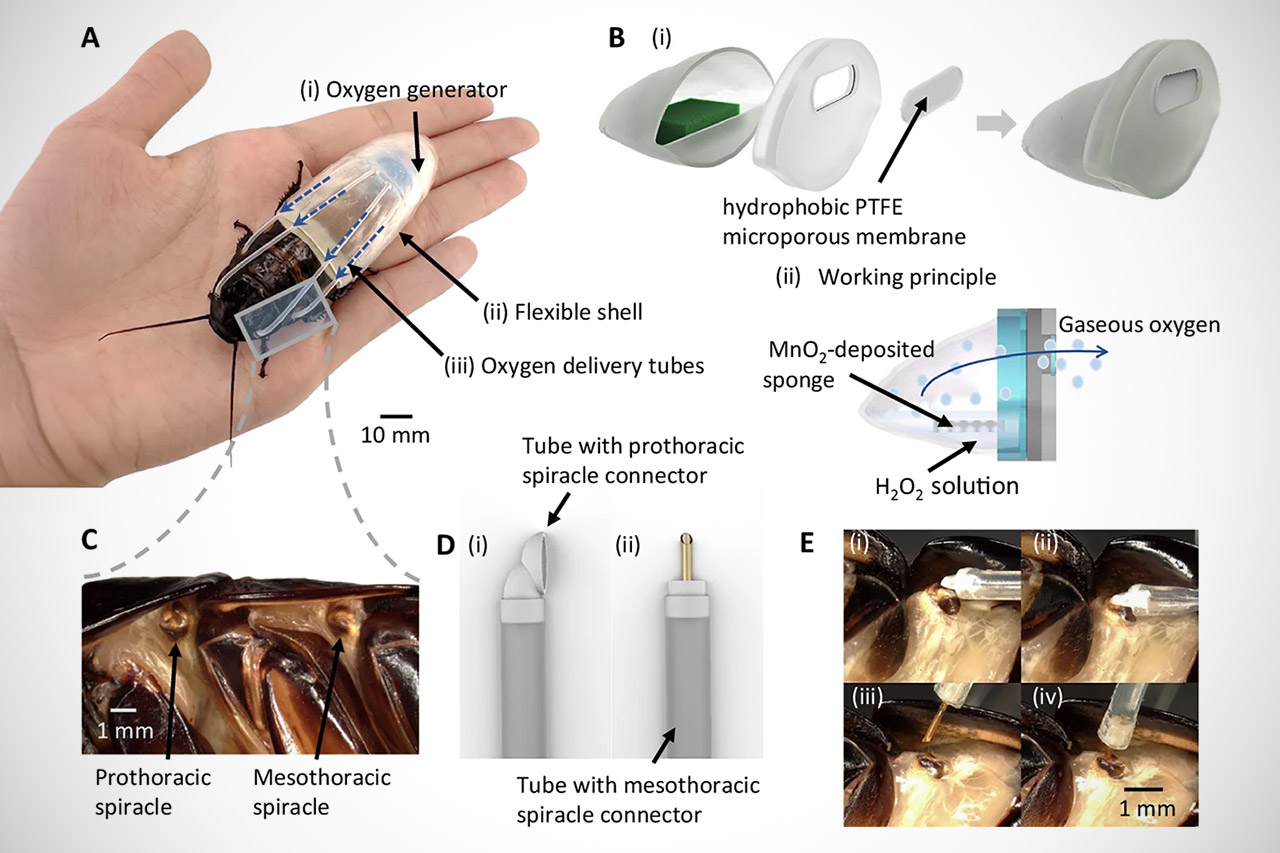
The entire structure is light and flexible enough that the insect’s usual walk remains nearly intact. Early versions put additional mass on top, causing the cockroach to flip over underwater. Moving the generator and adjusting the shell shape resolved the stability issue. The equipped insects were tested in water-filled tubes and bespoke 3D-printed obstacle courses that simulated flooded pipes or collapsed building portions. Without the oxygen module, the roaches went inactive in minutes. It allowed them to remain responsive and mobile for up to three hours. On dry surfaces, they traveled at about 87 millimeters per second. As they went down the bottom and through submerged channels, their pace fell just slightly to around 78 millimeters per second.

The project builds on years of work by the same research groups. Previously, cyborg cockroaches helped with search efforts following a severe earthquake in Myanmar, reaching locations where human teams and conventional machines couldn’t. Adding reliable underwater operation allows for similar access to areas where flooding has obstructed typical pathways, such as storm sewers, half-submerged basements, or earthquake rubble drenched by burst pipes.
[Source]


Vietnamese authorities have arrested and are prosecuting seven suspects believed to have run HiAnime, the largest anime piracy streaming service before its shutdown in June.
HiAnime provided access to a massive library of English-subbed and dubbed anime without subscription fees, attracting several hundred million visitors each month and temporarily surpassing legal streaming platforms like Disney+ and Crunchyroll in web traffic between late 2024 and 2025.
It was launched on the Zoro.to domain, rebranded to Aniwatch (and switched to Aniwatch.to) in July 2023, and again in March 2024 as HiAnime/H!Anime (using the HiAnime.to domain).

After becoming massively popular, HiAnime was also placed on the European Commission’s Counterfeit and Piracy Watch List and the United States Trade Representative’s (USTR) Notorious Markets list.
The seven defendants have been charged with infringing copyright and related rights and with money laundering, with four of them detained and the other three placed under house arrest.
They have been accused of creating more than 100 websites to upload over 26,000 pirated anime films, generating approximately $12.85 million in illegal advertising revenue between 2020 and April 2026.
The Alliance for Creativity and Entertainment (ACE), a coalition of over 50 media and entertainment companies, including the world’s largest film studios and television networks, focused on shuttering illegal streaming services, confirmed the law enforcement action on Thursday and thanked U.S. authorities for their support throughout a multi-year investigation that led to the suspects’ arrests.

”ACE applauds the actions of Vietnam’s Ministry of Public Security (MPS), in particular C03, the Economic Crimes Investigation Department, and A05, the Department of Cybersecurity and High-Tech Crime Prevention, in arresting and prosecuting seven operators believed to be behind Hianime and related piracy services,” said the Alliance for Creativity and Entertainment on Thursday.
“ACE would also like to thank its partners, Homeland Security Investigations and the U.S. Department of Justice, for their continued support in this multi-year investigation and action. ACE looks forward to continuing to support the MPS and its relevant agencies, and to working even more closely with them on future actions against piracy services.”
Earlier this year, in March, ACE also announced the shutdown of AnimePlay, another major anime streaming platform that hosted more than 60 terabytes of anime TV shows and movies and had over 5 million registered users.
The anti-piracy coalition dismantled AnimePlay by taking all infrastructure offline, including its hosting servers and web domains.

Security teams log 54% of successful attacks and alert on just 14%. The rest move through your environment unseen.
The Picus whitepaper shows how breach and attack simulation tests your SIEM and EDR rules so threats stop slipping by detection.


It is too early to say whether Valve’s Steam Machine will suffer from widespread reliability issues comparable to Xbox’s Red Ring of Death or other notorious hardware failures seen in past console generations. However, the recently launched, relatively expensive, and currently hard-to-find device has already been linked to alleged “GPU…
Read Entire Article
Source link


A few simple adjustments to your settings will opt you out.
Google is at it again. The company recently, and quietly, introduced a change to how it hoovers up our data to train its AI platforms. It can now scoop up media you upload to its various search tools for training purposes, according to a report by TechCrunch.
This includes “images, files and audio and video recordings.” That’s pretty much everything. What does this mean exactly? If you upload a photo to Google Lens to search for something visually, the company can take it. The same goes for the audio accompanying any Google voice search and anything uploaded to Google Translate. This applies to all Search-related products, so stuff like your personal Google Photos are safe for now.
Every user is automatically opted in, as the gaping maw of generative AI needs data to feed on and it’s running out. There is, however, a solution for those who don’t like random mega-corporations poring through their images and videos.
You can opt out of this by changing some particular settings. First, head to the dedicated Search Services History page and uncheck the “Save Media” box. Next, head to this Search Services Personalization page and make sure that it’s not saving anything. That should do it. As an aside, you can turn off AI overview results by popping in “-AI” before a query.
Of course, this is modern AI; it doesn’t always need permission to get to our data. Just ask some musicians.


DEVOPS
A purported jab of Sony’s physical media phase-out blows up on GitHub itself.
You’re too late! Monday was the last day to score your own free CD of your GitHub repository, which the Microsoft-owned subsidiary offered to mail to the first 1,000 people who asked.
But as of noon eastern time, that offer has been withdrawn (if it was ever genuine) after sparking confusion and ridicule.
Last Thursday, GitHub issued a short notice on X extending an offer:
In light of recent developments in physical media, GitHub is proud to announce that you can now obtain your public repo on CD-ROM.
Keep it. Lend it to friends. Pass it on to your children.
Your code is physically yours, forever. Until you lose it, let’s be real.
Order yours today.
What “recent developments” the company referred to is anyone’s guess, though it implied that it came about as some sort of public pressure: “We heard you. And we agree,” the X missive began. (“No one fucking asked for this” one commenter retorted).
Many media outlets, including Tom’s Hardware and Destructoid, speculated that GitHub’s offer was actually a jab at Sony for discontinuing optical media for its PlayStation consoles in 2028.
GitHub was not alone in its mockery of the Sony announcement. Nintendo and other companies responded. Even the Spanish arm of the KFC fast food chain took aim at Sony on social media, mockingly announcing it would no longer offer its “physical format” (“ÚLTIMA HORA: KFC dejará de ofrecer su formato físico a partir de hoy.”).
But the GitHub joke came with an action item, and that’s where the trouble started.
The original GitHub message included a link to a Microsoft form (gh.io/cd) where one could provide details as to where to send their CD.
The form stated that it would accept applications for the first 1,000 people who applied, until July 6. It asked for a GitHub user name, repo URL, and the requester’s shipping address and phone number.
The form was taken offline as of press time, though the tweet (or X post) remains intact.
GitHub did not immediately respond to requests for comment.
If the offer is indeed a troll on the part of GitHub and Microsoft, it is indeed an odd one, and not just because fulfilling the requests would involve a lot of work on the part of GitHub’s mail room and the troll-master’s minions who would presumably be responsible for burning all those CDs. Does anyone at GitHub even have a CD burner? That was one of the questions we wanted to ask Github.
And GitHub/Microsoft best be careful about throwing disks around. However controversial its decision, Sony does have the velocity of technology development behind its decision.
“This transition will enable us to align more closely with how most of our community prefers to access and play games today,” read a Sony statement.
Today, about 85% of all games sold are downloads, Sony has reported in its financials.
The original announcement quickly got ratioed, as the kids are wont to say, by mockery of GitHub’s many recent outages.
“They have to ship you CDs because the website is barely up,” one commenter wrote.
“Why we need github when you can run remote repo on CD” another piped in.
Also, the CD format is an oddly archaic format to base a protest from, especially coming from a parent company that got its start distributing OSes by floppy discs.
Moreover, there are plenty of open source projects whose repos could easily overfill the 700 MB limit of a burnable CD.
One, for instance, is Google Chrome repo, which open source developer Dmitriy Kovalenko said he requested a copy of. “Let’s see how they ship 66G repo on a CD,” he wrote on X.
Far more problematic is that GitHub also faces the very real danger that users – those still with disc readers – would actually find such an artifact genuinely useful.
“Stop taunting people for desiring physical media that they control” someone else commented. ®


VHF frequencies (30–300 MHz) support broadcasting, voice communications, aviation navigation, and defense radar. Yet VHF propagation is widely misunderstood. The common assumption of “line of sight” oversimplifies how signals behave in practice. In terrestrial environments, VHF signals interact with the atmosphere and physical objects continuously. Refraction in the troposphere bends signals beyond the geometric horizon. Reflections from buildings and terrain create multipath interference. Diffraction carries signals into shadow zones behind obstacles. Beyond these everyday effects, several uncommon modes can extend VHF range dramatically. Tropospheric ducts formed by temperature inversions can channel signals over 1,500 km. Sporadic E events create temporary ionospheric patches reflecting lower VHF signals up to 2,500 km. Meteor ionization trails offer brief but reliable reflectors for data telemetry. EME (Earth-Moon-Earth) communication uses the moon as a passive reflector for worldwide coverage. This white paper covers the physics, practical characteristics, and operational significance of each mode. It equips engineers and planners with the knowledge needed for effective VHF system design.

The third developer beta of iOS 27 is here, with added customization options for Siri AI, visual tweaks, and more. Here’s what’s new.

On Monday, two weeks after the arrival of iOS 27 beta 2, Apple made the third developer beta available for download. While iOS 27 beta 1 delivered the long-overdue Siri AI, the second beta included enhancements for the Apple Home and Apple Wallet apps.
Notably, for most, the entire Siri AI model needs to be redownloaded between beta 2 and beta 3. For some users, this has made the features gated behind a wait-list again.
Continue Reading on AppleInsider | Discuss on our Forums


You may be noticing something while out and about: people are wearing wired headphones again. After years of declining sales, wired headphones are back in a major way. Sales surged throughout the latter half of 2025 and this trend continues today. What’s going on? Why are people ditching Bluetooth headphones in favor of wires? Let’s take a look at the issues impacting wireless headphones and what factors may be playing into this shift.
Modern wireless headphones and earbuds can sound absolutely fantastic, but not everyone can afford the latest Bowers & Wilkins product or Apple’s AirPods Max. Many wired headphones offer similar sonic performance to high-end Bluetooth products, but don’t cost $400 to $500. For instance, Sennheiser’s latest HD400U wired headphones cost $100 and handle 24-bit audio at a sample rate of 96kHz. That’s the same metric as the wireless Bowers & Wilkins Px7 S3, which costs $450. Money is tight nowadays.
Bluetooth headphones are often advertised as the easiest and simplest way to listen to music. There are no wires, so no headaches, right? However, that’s not exactly true in real life. Battery life can be a real sticking point for some, myself included. The juice always seems to run out right when I’m in the middle of a walk, forcing me to pay attention to the (yuck) outside world.
This is compounded by the audio source. Bluetooth drains a phone’s battery, which could also cut the music short. Wired headphones offer a solution to both of these battery issues. Batteries also decay and fail, and most headphones aren’t designed for them to be user-replaceable. When the battery goes, the headphones tend to hit the trash heap.
Bluetooth devices also rely on the crowded 2.4GHz frequency band for transmission. In other words, they are prone to signal interference, audio stuttering, lag and dropped connections. Once again, wired headphones don’t experience any of that, unless the wire gets frayed or something. (Keep wired headphones away from cats. Trust me on this one.)
We all feel it. People are getting a little sick of modern tech and opting for vintage-style substitutes. Dedicated point-and-shoot cameras surged in sales throughout 2025, even more so than wired headphones. Vinyl records have been in the midst of a comeback for years now, surpassing $1 billion in sales in 2025. Even mechanical watches are in the middle of a resurgence.
There’s no one reason for this. Some people are turned off by AI being stuffed into everything, while others are turned off by the unsavory people doing the stuffing. Economic factors also come into play here. It’s simply too expensive for a regular person to stay on top of the latest tech trends, especially given how prices have been skyrocketing on just about everything. For wired headphones and old-school gadgets that don’t use RAM or any of the other components AI continues to gobble up, prices have remained fairly static.
Others are simply tired of predatory algorithms, IP theft and surveillance machines disguised as must-have fashion accessories. All of this taken together kind of puts a patina of ooze on the whole industry, especially for younger generations. Tech is perceived as kind of lame right now.
There’s one final piece of the puzzle here. Celebrities and influencers have jumped into the wired headphone thing pretty aggressively, turning them into something of a fashion statement.
Celebrities like Ariana Grande, Charli XCX, Robert Pattinson and Lily-Rose Depp have all been spotted wearing wired headphones in recent months, among others. There’s even a popular Instagram account called Wired It Girls that shows off women wearing this type of headphone.
It’s not all sunshine and roses in wired headphone land. There’s the issue of interoperability. Modern gadgets typically offer a USB-C port, and there are newer wired headphones that take advantage of this. However, many devices still use traditional headphone jacks, USB-A ports and Lightning ports. It’s highly unlikely you’ll be able to use a pair of wired headphones with every gadget in the home without springing for a dongle or two.
In the case of modern smartphones, you likely won’t be able to listen to music via a wired connection and charge the device at the same time. This is the kind of thing that caused Bluetooth headphones to blow up in the first place.
It’s also worth noting that despite the recent spike in popularity, wired headphones are still a niche product, especially when compared to wireless models. Wireless headphones still account for around 60 to 72 percent of the market, depending on the study. Wired models have, however, taken a bite into that over the past year or so.





Weekend Open Thread: High Hopes


The House | “Reframing the debate from a binary discussion of winners and losers”: Yuan Yang reviews ‘We Are Not Machines’


Strategy authorizes up to $1.25B in Bitcoin sales under new capital plan


How to Build INSANE Live Financial Dashboards With Claude


Anonymous researcher drops 0-day ‘exploitarium’ repo

Taylor Swift and Travis Kelce wedding staffer hilariously struggles to keep her cool while checking in megastars


Open Thread: What Great Books Have You Read Recently?


Australia treasurer says alleged access of prime minister’s bank data ’incredibly concerning’

Airdrop Registration Becomes Key Focus For Remittix As RTX Launch Updates Approach


Broncos roster: OL Ben Powers (No. 74) entering final year of contract


Binance stock trading tops $1B in first month after launch


Presenter Caroline Flack’s brother Paul Flack dies aged 55


Alibaba-affiliate Ant Group enters the humanoid robot market with 12 deals


Standard Chartered Secures MiCA License as ESMA Adds 37 New Crypto Firms


South Africa proposes crypto tax guidance under existing rules


Best Time to Enter Small Caps Right Now? Another Bull Run? | Financially Free

New exhibition reflects five decades of movement between island of Ireland and GB


Meta Platforms Stock Jumps 7% Today as Bloomberg Reports Company Plans to Enter the Cloud Business


Lenovo laptops are now shipping with YMTC SSDs, a sign of Chinese NAND entering the mainstream


What a 10 Percent Drop Means for Buyers, Sellers and Renters
You must be logged in to post a comment Login