The surveillance infrastructure tracking American drivers has grown far more sophisticated than most people realize. What began as simple plate-logging technology has evolved into AI systems capable of identifying faces, flagging unusual travel patterns and building detailed movement profiles — all without the knowledge of the people being watched. Companies such as Flock Safety now operate in communities across 49 states, and their data is accessible to thousands of law enforcement agencies, including federal immigration enforcement, according to civil liberties groups. State legislatures are among the few institutions actively writing rules around how these systems can be used, and what those rules say (or don’t say) have real consequences for your privacy on the road.
That raises a large question: What are the best privacy protection laws? I wanted to provide more details for anyone wondering what to support or what their state is currently doing. One challenge is that every state is different, and there’s no clear guide on what privacy laws work and which have flaws.
I spoke to Chad Marlow, senior policy counsel and lead for the American Civil Liberties Union’s surveillance work, to find the best examples. These laws are making the biggest difference in our privacy.
Advertisement
“Collective action, rather than individual action, is required,” Marlow told me. “I would caution that while Flock is the most problematic ALPR company in America, there are many other ALPR companies, like Axon and Motorola, that present serious privacy risks, so switching from Flock to Axon/Motorola ALPRs at best may constitute minimal harm reduction, but it is far from a solution.”
Which of today’s laws are a better solution? This is a “throw everything against the wall and see what sticks” situation. Let’s talk about what’s sticking.
The best laws on the books for limiting new surveillance technology
The details matter when it comes to laws against surveillance.
Advertisement
Lawrence Glass/Getty
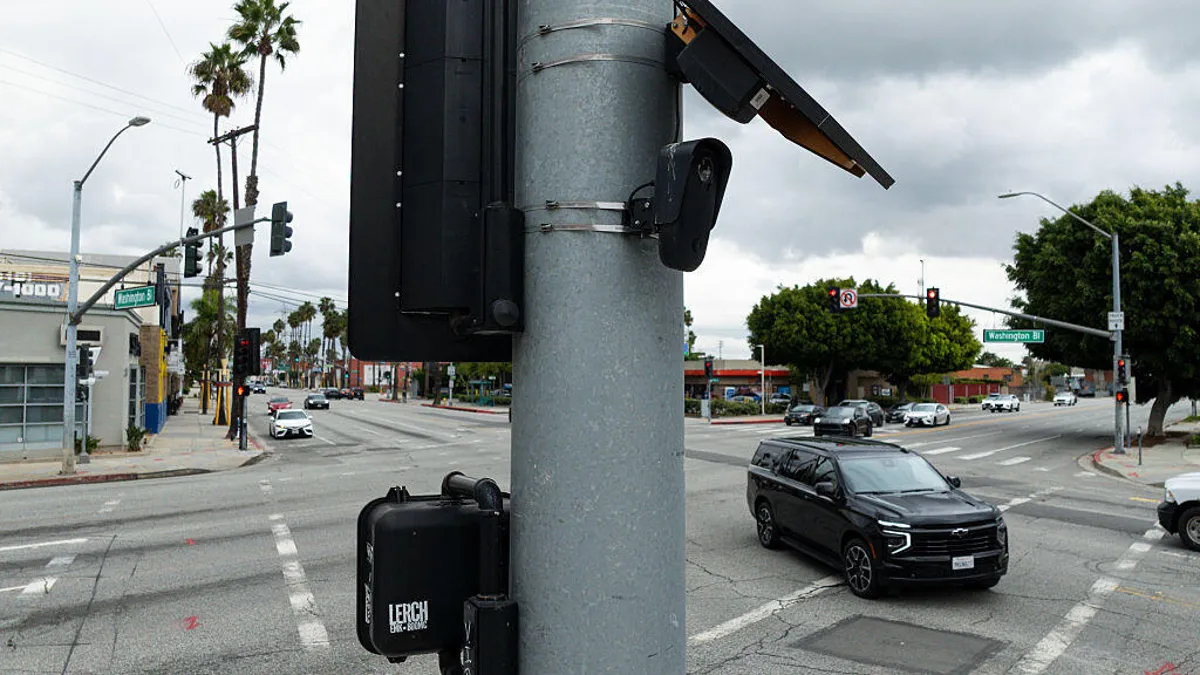
Current privacy laws focus on two recent capabilities of local law enforcement: ALPRs, or automatic license plate readers, that can identify and track cars, and drone surveillance equipped with AI cameras. Security companies, such as Flock, are also starting to offer more traditional cameras that can provide live views and track people from the ground.
With AI features like Flock’s “Freeform” technology that let police enter any type of search they like to see what cameras bring up, these are powerful tools, and new legislation is required to address them. Let’s go over several categories of laws that make a difference.
Laws restricting the use of AI detection features
Some of the broadest laws tackle what AI cameras are allowed to do at all. These laws don’t specifically target ALPR cams or drones, but they do limit the searches that police and commercial entities can make.
Illinois has long been the best example of these privacy laws with its BIPA, or Biometric Information Privacy Act that protects personal ID like fingerprints and facial data, and requires written consent if a company wants to use them.
Advertisement
That law is so far-reaching that certain camera features like Google Nest’s Familiar Faces technology is completely blocked in Illinois, along with some of Flock’s recognition features. Cities can pass similar legislation, too: Travel to Portland, Oregon and you’ll find that certain facial recognition features won’t work there, either.
The one issue with laws like these is that they don’t include license plate and vehicle data, at least not yet. That information, which is closely tied to your name and address, needs to be protected by additional legislation or added onto existing biometric laws. So far, the former is more common: California is the only state I’ve noticed that now includes ALPR data as “personal information” for its privacy laws.
Laws that ban what details police cameras can see
States are also passing new types of laws that allow the use of ALPR cameras, but ban those cameras from being able to record and pass along personal information, or at least make that information confidential in some way — including Florida and New Hampshire.
These laws can ban cameras from seeing details like the people inside a car, for example, limiting them only to a license plate. Companies like Flock advertise the ability of their cameras to notice other descriptive details above a vehicle such as bumper stickers or roof racks, so laws like these can hamper the use of such AI detection.
Advertisement
In a related note, states may add stricter authorization steps for police cameras. For example, rules that require the police chief to sign off on any search using ALPRs make it less likely that the data is misused when collected.
Police have free reign over AI searches unless constrained by laws and policies.
EvgeniyShkolenko/Getty
Laws that limit the use of ALPRs to certain police activities
A number of states have created laws that allow the use of license plate and AI cameras, but only for specific purposes, such as ongoing investigations involving a murder or kidnapping. Some states have very strict limits on how these cameras can be used, while others have much broader descriptions.
Advertisement
Laws like these keep ALPR cameras out of the hands of businesses, HOAs and similar organizations, who would otherwise be able to contract with companies like Flock Safety. They may also block cameras from being used in certain areas, such as on public highways.
Laws requiring that any data collected by cameras be deleted within a certain timeframe
One of the most effective surveillance laws for protecting privacy is the requirement to delete any footage caught by these cameras unless its actively being used in a confirmed investigation. That means police can’t make unauthorized searches or share that data with outside organizations after a certain time.
Laws like these also prevent police departments from creating long-term files about people they want to keep an eye on and note their routines and behaviors. As Marlow said, “The idea of keeping a location dossier on every single person just in case one of us turns out to be a criminal is just about the most un-American approach to privacy I can imagine.”
New Hampshire has the most stringent laws here, requiring the collected data to be deleted within 3 minutes if not used, a far shorter timeline than most, but one the ACLU agrees with.
Advertisement
“For states that want a little more time to see if captured ALPR data is relevant to an ongoing investigation, keeping the data for a few days is sufficient,” Marlow told me. “Some states, like Washington and Virginia, recently adopted 21-day limits, which is the very outermost acceptable limit.” Marlow warned that the longer police keep this data, the easier it is to build patterns of life “that can eviscerate individual privacy.”
I’ve also seen states with laws that require ALPR data deleted after several years, but at that point it’s largely useless, as the data could easily be compiled and moved to other platforms by then.
Laws banning police from sharing data outside of the state
States like Virginia and Illinois have passed laws making it illegal to share any ALPR or related data outside the state, including with federal agencies. These laws are typically targeted at the Department of Homeland Security and ICE, which (along with the FBI and other agencies) have been known to request data from local police Flock cameras or be granted backdoor access to Flock search systems.
Laws that keep data from going out of state prevent that — as long as there are ways to track data transmission and enforce the law — which is difficult. “Ideally, no data should be shared outside the collecting agency without a warrant,” Marlow said, “But some states have chosen to prohibit data sharing outside of the state, which is better than nothing, and does limit some risks.”
Advertisement
States like Minnesota have also added requirements to make ALPR searches public so that citizens can check what searches the police have made, an important step for accountability that’s still rare for this technology.
State laws are on the rise to limit the use of surveillance drones, too.
picture alliance/Contributor/Getty
Laws requiring state approval and office certifications for any ALPR camera
There’s another option to manage these high-powered cameras — subject them to an approval process by the state before contracts and installation. The tricky part is that approval process can look completely different depending on the state.
Vermont, however, enacted a series of laws to create a lengthy approval process to ensure ALPR cameras could only be used in certain circumstances and that the data was tightly controlled. This approval process was so thorough that local organizations decided to pass altogether: By 2025, no law enforcement agency in the state was using ALPR cams.
Laws requiring warrants before launching surveillance drones
In the past year, I’ve seen a new concern on the rise in neighborhoods in addition to ALPR cameras. There are now surveillance drones equipped with cams that can recognize vehicles or human features (beards, hats, shirt colors and so on) and follow people automatically. Those have required a further set of laws to address.
States including Alaska, Idaho, Utah and Texas have laws specifically requiring a warrant before drones are used for surveillance. Technically, this should prevent the use of Flock’s automatic drone launches for things like gunshot detection or 911 calls, but local law enforcement appears to have found ways around these laws due to exemptions and other loopholes.
Advertisement
It’s worth noting my state nearly nuked its drone warrant requirements with new legislation in 2025, which ultimately failed to pass, a reminder that the rules are always up for change.
Keep an eye on the legislation in your state
State legislation can change, be repealed or added onto — and the details are important.
John Elk/Getty
New laws are subject to frequent challenges, including companies such as Flock or local police departments outright ignoring them. That requires extensive legal action to address and a buildup of case law that can take years, not mention methods of investigation and enforcement by the state that may not currently exist.
Advertisement
Proposed legislation can also be subject to many changes, even if it’s likely to be passed, so the details can shift. That means if you want to see specific bans or privacy requirements in your state, you should track ongoing legislation as it passes through approval stages, and continue to contact your senators and representatives.
If you’re not sure what’s in a law, it’s important to read it carefully or find analysis by a legal expert to learn more. Many lesser laws I didn’t include on this list have lots of carveouts, exceptions and latitude in how surveillance cameras can be used, rendering them fangless for privacy purposes.
But that’s not all you can do. I’ve also seen the rise of advocacy initiatives like The Plate Project from the Institute of Justice that you can join, contribute to or just read up on to do more. And don’t forget about the local level — voicing concerns at a city council forum could help limit surveillance contracts before they even begin.
Here’s what Shopee collection point hosts really deal with
Shopee’s neighbourhood collection point network has quietly become part of Singapore’s daily landscape since 2023.
The e-commerce firm has established over 2,800 collection points across Singapore as of today, including residential addresses, convenience stores, and lockers—placing most homes within 250m of their nearest pickup option.
This kills two birds with one stone.
For customers, it offers a more affordable and convenient delivery option, with savings of up to S$1.99 in delivery fees per item. For ordinary Singaporeans, it creates an opportunity to earn passive income by turning their homes or businesses into micro logistics hubs.
Advertisement
But what does running a Shopee collection point actually look like behind the scenes?
Easy passive income?
Image Credit: Andrew Koay
Shopee’s logistics arm, SPX Express, delivers parcels in bulk to registered collection points. For locker locations, customers can collect their orders independently.
At manned collection points—typically neighbourhood shops or residential addresses—the host stores the parcels, verifies customers’ identities using the Shopee app when they arrive, and hands over the items.
In return, hosts earn a fee for each parcel distributed. The role requires seemingly little: just sufficient storage space, an internet-connected device, and a commitment to the collection point’s operating hours.
At the higher end, promotional information on Shopee’s app states that collection points that distribute up to 900 parcels a day can earn up to S$5,400 monthly, while 60 parcels daily can bring S$360 monthly.
Sounds like easy passive income, right? Wrong.
The fine print
The commitment to turning your house into a Shopee collection point is far from passive.
Hosts must be open at least six days a week, for a minimum of 36 hours. On top of that, they must be present during operating hours to receive and hand over parcels, effectively tying the role to someone being at home consistently.
Advertisement
Image Credit: Andrew Koay
At first glance, the economics can look appealing. But at S$0.30 per parcel, the numbers only start to make sense at scale.
For example, handling 30 parcels a day translates to just S$9 in daily earnings. That’s already 30 separate customer handovers—yet it remains a modest payout for the time and space involved. Scaling up is where the workload intensifies significantly, with hundreds of daily parcels required to generate meaningful income.
Space is another major constraint. Many HDB flats have limited storage capacity, which can quickly become a bottleneck during peak delivery periods.
There is also little flexibility in scheduling. If hosts miss their operating hours, Shopee can impose penalties for non-compliance. At S$0.30 per parcel, even a S$50 fine effectively wipes out the earnings from more than 160 parcels.
Workload, risks & disruptions
Image Credit: sahmjann via TikTok
Running a Shopee collection point means juggling the expectations of multiple parties: Shopee, customers, and even neighbours.
Parcels arrive daily and are often left at the doorstep, making the host responsible for their safekeeping. Despite a stated weight limit of 6kg, some hosts have reportedly received bulkier items such as dumbbells, adding to storage and handling strain.
Some customers also arrive outside operating hours—occasionally as late as after 10PM—expecting collections regardless of the stated timing. Others treat the collection point like an extension of Shopee’s customer service, seeking assistance with orders, returns, and complaints that have nothing to do with the host.
“Operating a collection point is hard work and not a passive job like many think,” wrote the child of elderly parents who previously hosted a Shopee collection point at their home in a Reddit post.
Beyond the operational burden, some neighbours of residential collection points have also raised concerns about increased foot traffic outside their homes, citing potential security risks and a loss of privacy. The host is therefore not only managing their own household space, but also the flow of people in shared residential corridors.
Advertisement
“My post is just to let people know the realities of operating a collection point and not to trust the rosy picture that Shopee painted,” the same Reddit user added.
Who it actually makes sense for & why Shopee wins either way
Image Credit: Andrew Koay
It is important to note, however, that not everyone has the same negative experience.
Generally, running a Shopee collection point would make more sense for shop owners. Two store owners whose shops became Shopee collection points in 2023 reported more customers than before.
At one store, many parcel collectors became regulars, while the other attracted new customers beyond its usual base. With the hours and foot traffic already there, the parcels become a free customer acquisition channel for their products on top of the per-parcel income.
But for someone already working or with young children at home, the intrusions can outweigh the returns quickly.
From Shopee’s perspective, the firm wins either way: collection points are an efficient logistics solution.
The company can expand its last-mile network without building warehouses or employing delivery staff as hosts absorb that cost in time and space, in exchange for a small per-parcel fee.
For customers, collection points offer free shipping with no minimum spend, along with the convenience of a nearby pickup point—often just a short walk away.
Advertisement
While the model works for both Shopee and its customers, the question remains whether it works as well for those turning their homes or shops into collection points.
Read other articles we’ve written on Singaporean businesses here.
Something to look forward to: Searching local files should be one of the simplest and most basic features an operating system offers, but Windows 11 still makes the process unnecessarily awkward. However, that may soon change for the better.
During a recent meetup with Windows enthusiasts enrolled in the Windows Insiders program, Microsoft showcased several search-related changes that are expected to arrive in a future update to Windows. Redmond engineers are working on a set of relatively small features that could have a significant impact, starting with the ability to disable Bing integration in local Windows search.
One of the longest-standing complaints about Windows 11 is that it does not allow users to easily search only locally stored content from the Start menu. Instead, search results are often mixed with web content and even Microsoft Store listings, adding extra layers that many users find unnecessary when they are simply looking for files on their own device.
According to a recent confidential preview, Microsoft is expected to add a new option in the Settings app that disables web (Bing) integration in search. In addition, the “Privacy & security” section may also include an option to exclude Microsoft Store apps from search results.
Advertisement
Microsoft’s decision to closely integrate Bing into Windows 11 has long been considered controversial among users. Power users have often resorted to workarounds, such as editing the Windows Registry, to reduce or remove web search integration from their PC experience, while Microsoft has continued efforts to expand Bing’s role within the operating system.
Microsoft is now aiming to regain goodwill among Windows users, which could signal a shift away from pushing Bing integration on those who prefer not to use it. The new search customization options are expected to arrive in a future Windows 11 Insider preview build, although no specific timeline has been confirmed.
During the meetup, Microsoft also confirmed that local search will be significantly faster, along with improvements to the File Explorer shell. The company said bulk delete operations have already achieved a 30% performance improvement in internal Windows builds. The new search changes are expected to complement previously introduced speed and taskbar customization improvements.
The race to secure power for AI data centers has spilled over into some unusual places, including the automotive world.
Battery recycler Redwood Materials kicked off the trend last year with a new energy storage division and a project that attached old EV packs to a Crusoe data center in Nevada. Then, Ford said it was repurposing some of its battery manufacturing capacity to make grid-scale batteries. And now GM is announcing its own — arguably more ambitious — plans for an energy storage system (ESS).
GM unveiled on Tuesday two new phases in its attack on the energy storage market. The biggest swing by far is GM’s new partnership with energy storage startup Peak Energy. For that partnership, GM is developing an entirely new sodium-ion battery chemistry tailored for grid-scale deployments.
Outside of China, no automaker has announced plans to build sodium-ion cells.
Advertisement
“The way we’re getting into the market is the easy way, through ESS,” Kurt Kelty, vice president of battery and sustainability at GM, told TechCrunch. “The performance characteristics are just what is needed in that market.”
GM wouldn’t share with TechCrunch how much money it is investing in this energy storage effort. But we do know the company has committed $900 million to commercialize new battery chemistries, an investment that includes a new battery development center.
Sodium-ion batteries work similarly to lithium-ion, but they swap out key materials to make the cells cheaper, longer lasting, and less prone to overheating. The tradeoff is that sodium-ion batteries need to be larger and heavier to store the same amount of electricity.
Peak Energy has already been working on energy storage systems that use sodium-ion batteries. Because sodium-ion batteries behave differently from lithium-ion, Peak has developed an energy storage system with that in mind. Its grid-scale batteries don’t have cooling systems or fire suppression systems because there’s less risk of overheating. The setup reduces upfront costs, and it should also eliminate costly maintenance, Paul Menson, director of energy storage commercialization at GM, told TechCrunch.
Advertisement
“This is the manifestation of the hardest part to engineer is no part at all,” he said. “Eliminate the part, eliminate the problem.”
GM plans to sell sodium-ions cells to the startup, which will then integrate them into its products. But that won’t happen right away.
The first GM cells are expected to enter trial production at the company’s Battery Cell Development Center in 2028. TechCrunch was recently given an exclusive look at the new facility, which GM expects will cut about a year from the commercialization process for sodium-ion batteries, reducing costs in the process.
GM’s sodium-ion cells are still years away from commercial production, however. In the meantime, the automaker will sell lithium iron phosphate (LFP) cells to LG Energy Solution for use in its energy storage systems. LG Energy Solution already works with GM through its Ultium joint venture, which makes batteries for the automaker’s EVs.
Advertisement
Alongside the partnerships with LG and Peak, GM announced that it was expanding its work with Redwood Materials, the battery recycling and energy storage startup founded by former Tesla executive J.B. Straubel.
Redwood already buys scrap from GM’s battery factories and used battery packs from its EVs. GM has a pipeline of around 10,000 packs it’s sending to Redwood, and the startup has been operating a 12 megawatt/63-megawatt-hour migrogrid using second-life packs at a Crusoe data center in Sparks, Nevada. GM said it is buying a 7.2 megawatt-hour Redwood system for use at one of its plants in Michigan, which it estimates will save it around $3 million over its lifetime.
The GM installation is “a step one” for Redwood, Cal Lankton, chief commercial officer for Redwood, told TechCrunch.
Data centers, where Redwood already operates, and industrial sites like GM’s are “vastly different things,” he said. Where data centers might use batteries nearly continuously to absorb some of the power fluctuations from GPUs, industrial sites are more likely to use them to shave off peaks in power demand, which can lower monthly power bills, and use them to provide backup power in case of an outage.
Advertisement
“The factory is really excited because now we’ve got a more reliable factory,” Kelty said. “Ultimately, we’ll be having similar installations like this at all of our factories. It just makes good economic sense.”
When you purchase through links in our articles, we may earn a small commission. This doesn’t affect our editorial independence.
Sony Electronics is making a massive upgrade to the humble meeting room screen. The company has just unveiled Crystal LED UNIFY, a massive 135-inch all-in-one direct-view LED display designed for boardrooms, meeting rooms, community spaces, and higher education environments.
At a glance, it might look like Sony’s next massive flagship living room TV, but it’s cutting edge display tech arriving to the office space. It is part of Sony’s professional display lineup and sits alongside its existing BRAVIA Professional Displays and Crystal LED portfolio. The model number is ZRL-135SG, and Sony is positioning it as a simpler way for organizations to add a large dvLED display without dealing with the usual complexity of custom LED wall projects.
Sony
An easy to setup up giant wall of screen
One of the biggest selling points for the Crystal LED UNIFY is its convenience. It arrives as a complete package with five pre-assembled display units and a control unit. So installation is a relatively straightforward process that can be completed by two people in about an hour. Since direct-view LED installations can get complicated, Sony’s version of the tech isn’t just promising solid visuals. The appeal is the simplified ordering, installation, maintenance, and day-to-day use.
The display units are mounted on wall brackets and connected to the included control unit, while a slide-out, front-serviceable design should make maintenance easier after installation.
Built for big bright rooms
Coming to the fun part, Crystal LED UNIFY uses a 1.5mm pixel pitch, Full HD resolution, and 800 cd/m² brightness. Sony has also added Anti-Reflection Surface Technology, which should help visibility in brightly lit rooms where projectors often struggle. The display also supports 4K input, works with Sony’s Device Management Platform, and offers a familiar interface for organizations already using Pro BRAVIA displays. In other words, it should also slot into conference rooms or multi-display setups with needing an IT team to learn an entirely new ecosystem.
Advertisement
Sony
Sony has also put effort in making it look clean on a wall. The Crystal LED UNIFY has ultra-slim bezels, a concealed slide-out control unit, and a depth of under 100mm, or less than four inches, when used with the included wall-mount brackets. So it should fit seamlessly in professional spaces.
The company expects Crystal LED UNIFY to be available in early 2027, with plans for an early showcase at the upcoming InfoComm 2026 event in Las Vegas from June 17 to June 19. Pricing has not been announced yet, but this is clearly aimed at businesses, institutions, and premium professional spaces rather than home theater shoppers with unusually large walls.
On-device AI models have stayed small because the entire weight set has to live in DRAM, capping practical parameter counts well below what server-side deployments use. Enterprise architects evaluating agentic workloads have had to choose between capable cloud-dependent models and limited on-device ones. Apple’s third-generation foundation models, announced at WWDC26, break that constraint by moving the weight set off DRAM entirely.
The AFM 3 family was developed in collaboration with Google and spans five models: two on-device and three server-based, all running within Apple’s Private Cloud Compute boundary. The server-side models, including AFM 3 Cloud Pro for agentic tool use and complex reasoning, run on Nvidia GPUs in Google Cloud. The on-device architecture is Apple’s own. AFM 3 Core Advanced is a 20-billion-parameter model that stores weights in NAND flash rather than DRAM.
“Instead of forcing the entire model into DRAM, the full model is stored in flash memory,” Apple’s research team wrote. “Because NAND-to-DRAM bandwidth is too slow to swap weights token by token, as standard MoE models require, AFM 3 Core Advanced makes routing decisions per prompt.”
How the architecture actually works
The memory wall Apple is working around is one every local AI developer runs into.
Advertisement
“You can’t put 20B parameters in RAM at any reasonable precision,” Awni Hannun, a researcher at Anthropic and former Apple research scientist, posted on X. “To make it work they are using pretty exotic architecture by today’s standards. A small model predicts from the query (or prompt) which experts to load from NAND into RAM.”
That prediction-and-load mechanism has three distinct components, each driven by the hardware constraints of consumer silicon.
The full 20B weight set lives in flash, not DRAM. AFM 3 Core Advanced stores its entire parameter set in NAND flash rather than active memory. Standard on-device deployments require the full model to fit in DRAM, which is what caps their parameter counts. Apple’s approach, which it calls Instruction-Following Pruning (IFP) and developed with its own researchers, treats flash as the model’s permanent home and DRAM as a working buffer for whichever experts a given prompt requires.
Expert routing happens once per prompt, not per token. In a conventional Mixture of Experts model, a router selects different experts for every token generated — which would require continuous weight movement between flash and DRAM at inference speed. NAND-to-DRAM bandwidth cannot support that. AFM 3 Core Advanced routes once at prompt time, selects a fixed expert set, loads it into DRAM alongside always-active shared experts, and generates all tokens from that same configuration.
Advertisement
“The key distinction from a typical MoE is that you do this once per query and then generate all the tokens with the same experts,” Hannun wrote.
Source: Apple Machine Learning Research, June 8, 2026.
Active parameter count scales from 1B to 4B depending on task complexity. Rather than running a fixed model size for every request, AFM 3 Core Advanced adjusts how many parameters it activates based on what the task requires — 1 billion for simpler operations, up to 4 billion for harder ones, all drawn from the 20-billion-parameter pool in flash.
What Apple has and hasn’t disclosed
The architecture paper is detailed on the memory design and sparse activation mechanism. It is less forthcoming on practical deployment constraints.
Advertisement
Apple’s profiling tools expose timing but not the metrics that decide production viability. “Energy, memory bandwidth, thermal? Not in the docs,” Marco Abis, who is building Ziraph, a profiler for local AI on Apple silicon, posted on X. “A notable gap, given those decide most of on-device performance.”
Abis also did not find a statement in Apple’s documentation — across the Core AI docs, the Foundation Models docs or the Private Cloud Compute security post — of when an on-device request transparently offloads, or whether that routing is visible to the developer or the user. For enterprises that need to document where inference runs, that is a direct compliance problem.
Not all the information is currently available. Apple has indicated a full technical report with benchmarks is coming later this summer.
What this means for enterprise architects
Regulated industries evaluating agentic AI deployments now have a concrete architectural decision to make.
Advertisement
The DRAM wall for on-device agents just moved. Enterprises evaluating agents that need to run without a cloud round-trip now have a 20-billion-parameter local option to evaluate. The constraint shifts from model capability to device hardware.
The private/cloud boundary is now an architectural decision, not a default. Simpler requests stay on-device; complex agentic tasks route to AFM 3 Cloud Pro on Private Cloud Compute. Apple has not publicly specified when a request offloads or whether that routing is visible to the developer — a gap that complicates policy decisions for organizations that need to document where inference runs.
The agentic server tier depends on Google Cloud. AFM 3 Cloud Pro runs on Nvidia GPUs in Google Cloud. The Private Cloud Compute guarantee covers data privacy. It does not eliminate the Google Cloud dependency for server-side inference.
AFM 3 Core Advanced gives enterprises a 20-billion-parameter on-device option that did not exist before WWDC26. Whether it is deployable at scale depends on answers Apple has not yet published. Those details are due in the summer technical report.
It’s also rolling out a vehicle-to-grid firmware update.
GM
GM shared two announcements today about its electric vehicle program. The most notable news for consumers is the launch of Energy Pass, a universal interface for public charging across multiple different brands’ stations. Tesla, Electrify America and IONNA will be supported at launch, with EVgo and ChargePoint to be added “soon.” Energy Pass will allow owners of GM EVs to take advantage of a larger percentage of the existing charging network in the US, as well as helping to easily find and pay for a vehicle’s electricity within a single app.
The second item is a firmware update that will bring full vehicle-to-grid functionality to GM Energy’s vehicle-to-home systems. As the name suggests, V2G means that an EV can contribute power back to the local electrical infrastructure. This development is for a more niche audience since it requires people to have the correct setup in their homes and a vehicle that supports this bidirectional charging. But for those customers, having an EV that can essentially act as a backup generator during a power outage is a welcome improvement.
An anonymous reader quotes a report from Ars Technica: Researchers have analyzed a high-severity vulnerability in Linux that’s able to escalate untrusted users to root by exploiting a bug you don’t often see: a single errant character inside the kernel. The vulnerability, tracked as CVE-2026-23111, is located in nf_tables, a subsystem of the Linux kernel that provides packet filtering capabilities. It’s used to manage firewall rules and replaces older subsystems such as iptables, ip6tables, arptables, and ebtables.
The presence of a single mis-issued exclamation point in code implementing nf_tables introduced a use-after-free, a class of vulnerability that corrupts memory by placing malicious code at memory addresses that haven’t been properly freed of their previous contents. CVE-2026-23111 can be exploited by an unprivileged user or process to elevate system rights to root. The exploit works by disrupting the deletion of verdicts — a determination within the nf_tables framework that determines if a packet matches a rule calling for a certain action to be performed. This process can use what are known as catchall elements, which act as a wildcard in the event a lookup doesn’t match any other element in the set.
When a verdict map is deleted from memory, catchall elements are deactivated and a chain’s reference counter is decremented. When errors occur the deletion can be reversed and the counter incremented. CVE-2026-53111 allows for that process to be altered. As a result, the exploit can decrement the variable an arbitrary number of times and then delete and free the chain when some objects still point to it. Although the kernel vulnerability was fixed in February, multiple proof-of-concept exploits have since emerged, including one from FuzzingLabs in April and another from Exodus Intelligence that works on Debian and Ubuntu.
OpenAI is preparing a significant overhaul of ChatGPT that shifts the platform’s emphasis away from conversational AI and towards agentic tools and coding capabilities, according to a report from the Financial Times.
The redesign, which the Financial Times reports could arrive within weeks, reflects a growing internal conviction at OpenAI that the chatbot format has run its course as the company’s primary product focus.
That conviction reportedly extends to at least one OpenAI employee describing the situation in stark terms, with the phrase “chat is dead” circulating internally as shorthand for the belief that AI agents represent a more commercially valuable direction than the text-based exchanges ChatGPT built its reputation on.
The revamped platform would consolidate OpenAI’s Codex coding toolset alongside its AI agent capabilities into what the company is internally calling a “superapp,” with the unified interface expected to launch first across web and mobile.
Advertisement
Codex stands to gain notably from the restructure, with OpenAI reportedly allocating greater resources and more prominent placement to the tool as part of its effort to close ground on Anthropic, whose Claude has drawn considerable developer attention as an agentic and coding-capable model.
Advertisement
The shift also arrives as OpenAI works towards an initial public offering, a commercial context that places pressure on the company to demonstrate revenue from its AI products rather than simply user volume from a free or low-cost chatbot experience.
The monetisation challenge that chatbots present reflects a structural tension familiar across the AI industry, where high infrastructure costs and freely accessible interfaces have historically made it difficult for companies to convert large user bases into reliable subscription or transaction revenue.
Advertisement
ChatGPT’s trajectory towards advertising further underlines that commercial calculus, with OpenAI having confirmed earlier in 2026 that the platform would begin serving ads to users.
OpenAI has not confirmed a specific launch date for the redesigned platform, though the Financial Times report suggests the rollout timeline sits within the next few weeks.
In a nutshell: Nintendo is bringing back one of its most popular games for a new run on its latest handheld, nearly 30 years after the original. The Legend of Zelda: Ocarina of Time was announced during the Nintendo Direct presentation on June 9, and will be out later this year on the Switch 2.
The minute-and-a-half teaser doesn’t show any actual gameplay, nor does it provide a launch window outside of 2026. We also don’t know how much Nintendo is planning to charge for the game, although it’s probably a safe bet to assume this will be a premium title with a matching price tag. All we really know at this hour is that the game is indeed in the works and is destined for the Switch 2 later this year.
The Legend of Zelda: Ocarina of Time arrived on the Nintendo 64 in late 1998 and was unlike anything seen up to that point. The 3D action adventure game was initially planned for the 64DD, but was eventually moved to cartridge when that peripheral was canceled. Despite having just 32MB of memory to work with, Nintendo put out a masterpiece that pushed the limits of storytelling, puzzle-solving, and combat to new heights.
Nintendo sold roughly 7.6 million copies of Ocarina of Time during its run, good enough for fourth on the list of best-selling N64 games behind GoldenEye 007, Mario Kart 64, and Super Mario 64. In 2022, the game was inducted into the Strong National Museum of Play’s video game hall of fame alongside Dance Dance Revolution, Ms. Pacman, and Sid Meier’s Civilization, cementing its place in history as one of the greatest video games of all time.
Advertisement
The remake is part of Nintendo’s 40th annual franchise celebration, and adds to an already stacked 2026 that includes several high-profile game launches culminating with the release of Grand Theft Auto VI this fall.
For those needing to scratch their Ocarina of Time itch a bit sooner, Nintendo already offers a version of the original game through its Switch Online subscription service.
Killian O’Driscoll, the chief commercial officer at NIBRT, said, ‘The NIBRT team is delighted to be involved in this key WHO initiative to help make the world safer from future emergencies and pandemics.’
The World Health Organization (WHO) has selected NIBRT, Ireland’s National Institute for Bioprocessing Research and Training, as its Regional Training Centre for Biomanufacturing for Europe. It will be one of seven such establishments globally forming part of the WHO’s Biomanufacturing Workforce Training Initiative (BWTI).
BWTI was first set up in 2023 as a means of addressing critical skills gaps evident in the biomanufacturing chain, and enabling countries to turn technological innovation into localised and sustainable production – particularly in areas concerning medicines and other healthcare technologies.
Commenting on the announcement, which was first made at a media briefing in late April, Dr Tedros Adhanom Ghebreyesus, director general of the WHO, said, “Over the past few years, WHO has taken several steps to make the world safer from future emergencies and pandemics. Today, WHO announced that we have designated regional training centres in each of WHO’s six regions, to build the skilled workforce needed to sustain local production of vaccines and biologics.
Advertisement
“The new training centres are in Brazil, China, Egypt, India, Ireland, Senegal and South Africa. They will operate as part of a coordinated global network, delivering context-specific training aligned with regional priorities, regulatory environments and languages.”
Future responsibilities
As the designated Regional Training Centre for the European region, it will be under NIBRT’s remit to deliver hands-on training aligned with industry needs. The network will also work in close collaboration with the WHO and the Global Training Hub for Biomanufacturing, which is located in South Korea.
Killian O’Driscoll, the chief commercial officer at NIBRT, said, “The NIBRT team is delighted to be involved in this key WHO initiative to help make the world safer from future emergencies and pandemics.
“This designation from WHO reflects the quality and reach of the training NIBRT has delivered over many years. As the Regional Training Centre for Europe, we will work with our partners across the region and around the world to help sustain local production of vaccines and biologics for lower and middle income countries.”
Advertisement
The WHO’s additional Regional Training Centres are the Institut Pasteur de Dakar in Senegal; the Council for Scientific and Industrial Research, South Africa; the Oswaldo Cruz Foundation in Brazil; the Translational Health Science and Technology Institute in India; the Center for Continuing Professional Development at the Egyptian Drug Authority in Egypt; and China’s Peking University.
The life sciences space is booming of late, with many organisations expanding their job and upskilling opportunities. In early June, consultancy Primecore announced plans to create 50 new jobs across their offices in Ireland and the US over the next three years, on top of 100 new roles previously announced.
In late April, the Advancing Innovation in Manufacturing Centre in Sligo announced an expansion with a new Galway base of operations amid plans to strengthen its links within the medtech and life sciences sectors.
Also in April, OpenAI announced plans to roll out an early version of GPT-Rosalind, an AI reasoning model designed to support research across biology, drug discovery and translational medicine.
Advertisement
Don’t miss out on the knowledge you need to succeed. Sign up for the Daily Brief, Silicon Republic’s digest of need-to-know sci-tech news.




















































You must be logged in to post a comment Login