Connect with us

Tech

AI, Tariffs, Rare Minerals: What to Expect From Trump’s Upcoming Summit With Xi Jinping

Published

on

Of all the events in the United Nations General Assembly taking place this week, the most anticipated by far is the upcoming meeting between Donald Trump and Chinese president Xi Jinping.

Though the majority of the diplomatic activities are happening in New York, this face-to-face between the two leaders will take place at the White House. Trump is scheduled to personally welcome Xi at Joint Base Andrews on Wednesday, September 23—an unusual diplomatic gesture, as US presidents do not typically go to the airport to welcome foreign leaders.

Ahead of that airport reunion, a US delegation led by Treasury secretary Scott Bessent and trade representative Jamieson Greer is meeting with He Lifeng, China’s vice premier of the State Council, to set the agenda. The World Economic Forum presented an overview of some of the most pressing topics, including the trade conflict, the supply chain, technological competition, and the ever-sensitive issue of Taiwan—all while keeping in mind the difficulties that have kept the US mired in a war in the Middle East that threatens to escalate.

Trade Truce Expiring

The trade truce that came out of Trump and Xi’s meeting in Busan last year is set to expire on November 10. Both governments now have to decide whether to extend the agreement, which lowered Trump’s tariff threats and paused port fees. In addition to discussing the possibility of extension, the leaders could decide to set purchase targets for key trade items including agricultural products, energy, and Boeing aircraft. They may also continue negotiations about a package worth approximately $30 billion in “non-sensitive” goods, which includes about 10 categories, though there is no agreement on their scope.

Advertisement

One key component of the Busan agreement was that it lifted China’s export limits on rare earths and minerals—key exports for automobiles, defense, and technology, including essential hardware for AI. With the US seeking a more stable supply for these materials, Beijing has leveraged its dominant position in the international market to bring Washington to the negotiating table in the trade war.

AI Competition

According to Scott Bessent, AI safety will be on the agenda for the bilateral meeting. This discussion has been one of the main requests from business leaders, though the industry is mixed on the desired outcomes. Beijing wants to see the US ease some restrictions on Chinese technologies. However, as there is a growing call to slow down AI development to ensure safety, some US businesses are worried about being outpaced by China.

This arena remains uncertain, as Trump has dismissed such calls for regulation at home, and these discussions are also fundamentally intertwined with trade talks about export controls on computer chips and related materials.

Iran, Taiwan, and Global Politics

The trade talks lie uneasily between each country’s most sensitive geopolitical stances. China has threatened to pull out of the summit entirely if the US green-lights new arms sales to Taiwan. The countries are, however, expected to discuss China’s economic ties with Iran, as well as detained foreign nationals. Both countries are expected to tread lightly without ceding influence, making any fundamental shift unlikely.

Advertisement

In summary, Washington is pushing for greater access to Chinese products and markets, critical minerals, and commitments on certain security issues. On the other side of the table, Beijing seeks relief from tariffs and restrictions. Each side has its own leverage and multiple pieces on various chessboards, such as Africa and Latin America. At the same time, both are trying to prevent Taiwan and other geopolitical conflicts from undermining their economic relationship.

The meeting held this past May in Beijing was full of symbolic gestures, but both leaders made very few concessions at the negotiating table. Will there be a different outcome in Washington?

“I think there will be some show of deliverables because of the fact that it’s a presidential summit coming, but I don’t feel like we’re on the verge of some sort of breakthrough,” Anna Ashton, a China trade analyst and founder of Ashton Intelligence, told CNBC. “I think status quo is probably both sides’ general best expectation.”

Source link

Advertisement
Continue Reading
Click to comment

You must be logged in to post a comment Login

Leave a Reply

Tech

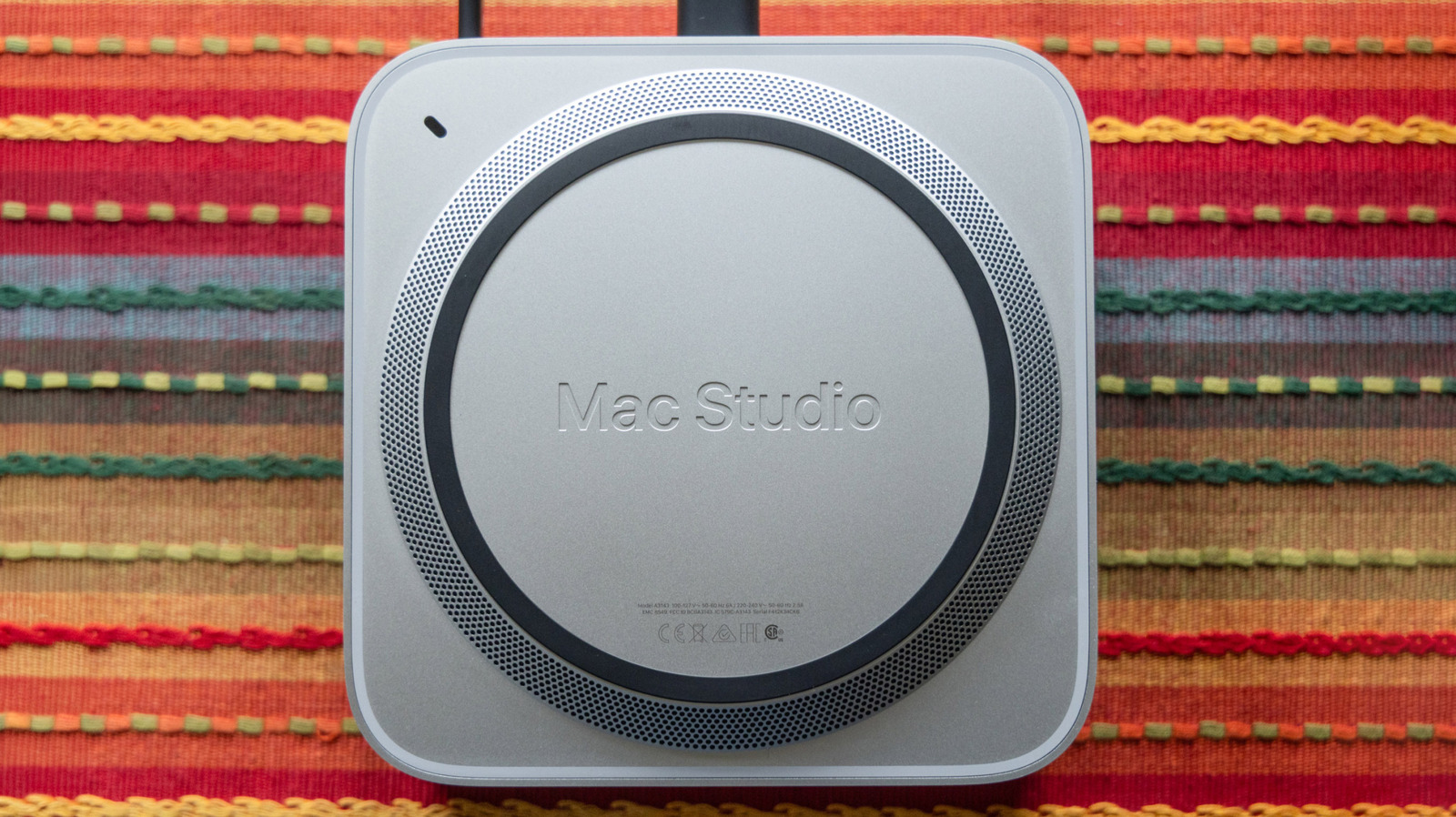
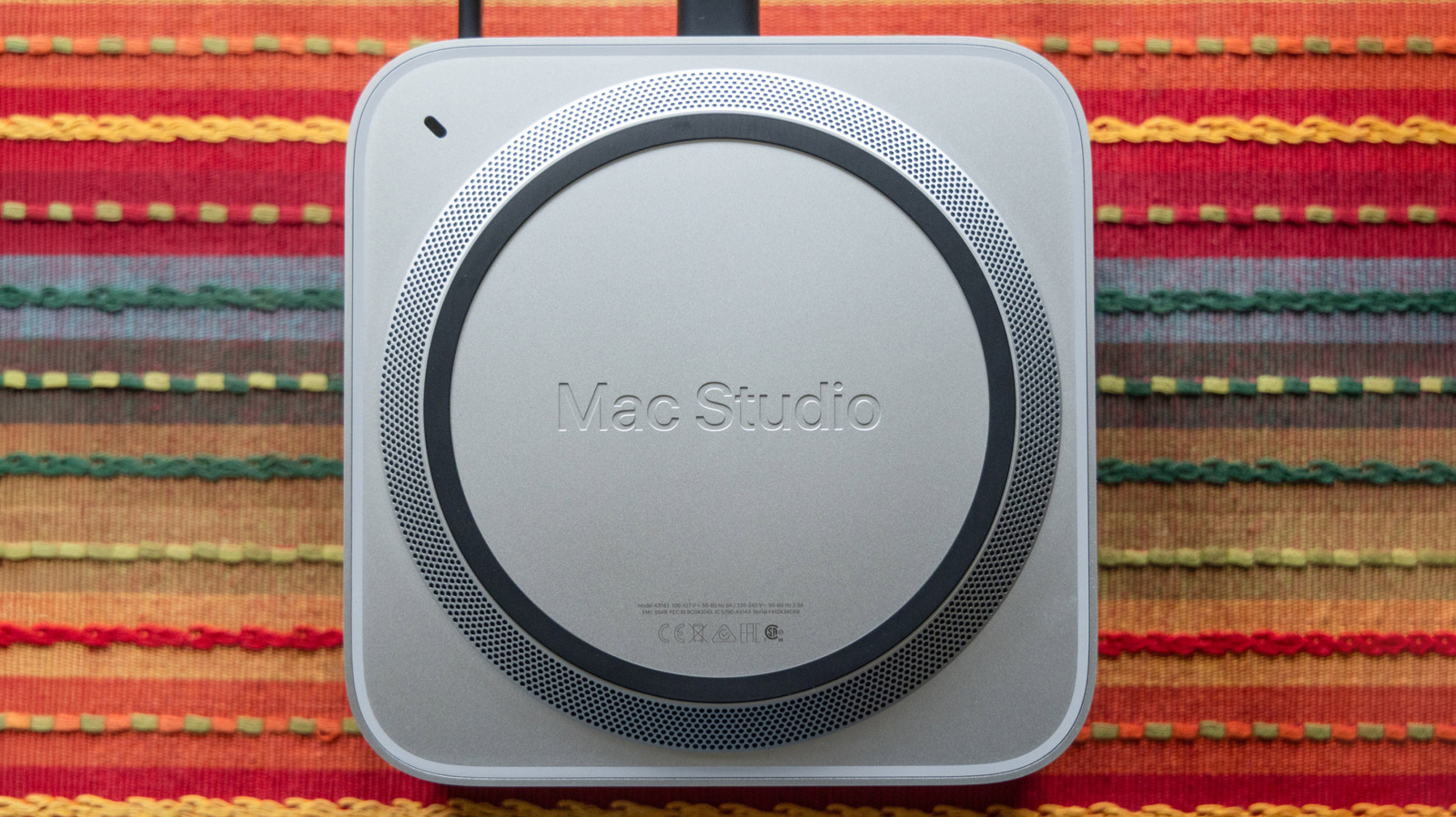
Here’s Why Apple’s Mac Studio Has Become So Expensive

Published

on

The primary culprits for this massive price increase are the Mac Studio’s large amount of high-end memory and storage, “RAMageddon” pricing, hedging and Apple’s usual insistence on high profit margins. Apple said so itself when it first bumped MacBook prices back in June: “We’ve never seen component prices increase this much, this quickly. We’ve worked hard to absorb these costs and delay price increases for as long as possible, but the current environment has made that unsustainable.”

Let’s start with the RAM, or what Apple calls “unified memory,” because it’s shared between the CPU and GPU. With 1.2TB/s bandwidth when fully loaded with RAM, the Mac Studio M5 Ultra uses LPDDR5X memory. That RAM has a maximum throughput of 172GB/s, so Apple installs it right onto the M5 Ultra processor package to maximize speed, in a very wide bus (1,024 bits for the M5 Ultra model), to achieve the highest speeds. It’s the fastest and most expensive memory available, other than high bandwidth memory (HBM) used for servers.

It’s hard to say exactly how much the RAM makes up the price of a Mac Studio. Apple was reportedly paying around $6 per gigabyte for LPDDR5X memory earlier this year, but that price may be more like $10 or $11 now. Let’s say its memory cost for the 256GB Mac Studio M5 Ultra is around $2,500-$2,800. It currently retails for far more than that, but Apple obviously has major buying power. That cost is still a big chunk, though.

Pricing for the NAND storage is also much higher, with Apple’s cost is likely around $300 to $500 for 2TB worth based on the current market and high-end PCIe 5.0 memory it uses. Prices are reportedly around quadruple what memory cost when the previous Mac Studio came out, and double the price for storage.

Advertisement

That makes for an increase of about $2,200 to $2,400 at the high end. Rounding that up to account for other component increases, Apple’s costs are around $2,400 to $2,600 more, based on those very rough estimates.

You may recall that I said the Mac Ultra with 256GB was $3,800 more expensive this year, so where does the rest of that price increase come in? Apple reportedly shoots for around 40 percent gross margins on its computer hardware, but the new Mac Ultra pricing is nearly 60 percent higher than the estimated cost increase. There are a couple of possible reasons. One is that Apple is hedging against even higher future RAM prices so it can limit Mac Studio M5 price changes later. Another is that Apple is using the memory shortage to lift margins for its flagship desktop Mac. Or maybe it’s a little of column A, a little of column B.

Source link

Advertisement
Continue Reading

Tech

Silent Hill: Townfall debuts in a haunting return to psychological horror

Published

on

Silent Hill: Townfall takes the series to a remote Scottish setting, blending first-person gameplay with the psychological horror and storytelling the franchise is known for. Its gripping mystery, sound design, and fresh ideas make it one of the most compelling horror games of the year.

Read Entire Article
Source link

Continue Reading

Tech

The Apocalypse Will Not Be Sexy

Published

on

from the nobody-wants-to-talk-about-the-boring-shit dept

When we picture the end of the world, the first thing that springs to mind is typically the cinematic version of “things going wrong.” We picture the musical score rising to a crescendo as the climactic events take place.  Our heroes are fighting to stop some big giant, unstoppable threat. Even if they are ultimately doomed, there is something noble and exhilarating in going down fighting. And if our heroes somehow survive failure and make it to the post-apocalypse, they usually still have great hair, even though civilization has collapsed.

Put another way, in the movies, the apocalypse is usually pretty sexy. 

Of course, in reality disaster is often much more mundane – something closer to dumb and sad than to sexy — as Randall Munroe pointed out years ago in a slightly different context:

xkcd cartoon: A two-panel comic strip contrasts a "crypto nerd's imagination" of building a million-dollar cluster to crack 4096-bit RSA encryption with the reality of using a $5 wrench to force someone to reveal their password.

A lot of attention is being paid at the moment to an entire culture that has grown up around the “AI Safety” world that is intently focused on stories of doom and the threatened end of humanity. That’s big, attention getting, and splashy. The tabloid version of this culture — the group houses, the polyamory, the recruitment dynamics that a lot of people are suddenly discovering — is even splashier still.

Taken as a whole, this specific version of AI safety is getting a lot of oxygen right now. It’s easy to see why — as a kind of “sexy apocalypse” these narratives, while frightening, are an exciting fantasy, even if they would be an awful reality.  But that heightened fantasy is not what AI safety is actually about.

Advertisement

It’s not about protecting us from the unlikely sexy apocalypse.  It’s about protecting us from the far more likely, and far more numerous, stupid apocalypses along the way.

This mismatch between cinematic safety and actual safety happens all the time. During the Manhattan Project, Edward Teller got some attention by worrying that the Trinity Test might set the entirety of Earth’s atmosphere on fire. Very cinematic! Very concerning! But, as with most things, the reality was much more mundane. Actual experts looked at Teller’s concern, ran the boring calculations, and ruled it out as a threat long before the actual test. That is how safety often works: boring, process-heavy work… that kills off the really sexy scenario.

Instead of global immolation, the real risks came from otherwise smart people doing dumb shit, such as the infamous Demon Core incident, where physicist Louis Slotin exposed himself, and a number of others, to a lethal dose of radiation by trying to use a simple screwdriver head to separate a plutonium core from a reflector… and slipping. Incredibly, this was the second time a mistake like this had happened, with the exact same plutonium core, and Enrico Fermi himself had warned Slotin he’d be dead within a year if he kept it up. Turns out he was right.

For all the talk of “AI Safety” risk these days, the most present real risks remain variations on the theme of “humans doing stupid shit”. Sometimes really smart humans. But stupid actions by humans are a lot less headline grabbing than the shiny sexy apocalypse. A human accidentally causing a radioactive chain reaction by carelessly using a screwdriver to separate things is stupid. Skynet turning everyone into paperclips… is kind of cool and fun.

Advertisement

But, as anyone who works in risk mitigation (including one of the authors of this piece) can tell you, the overwhelming majority of actual disasters aren’t cool and fun. Instead, they’re usually more like the Demon Core: stupid, disappointing, and easily prevented if only a few common sense steps had been taken.

As evidence, one need only to look at the world right now. Most people — perhaps outside of Mike Judge — would not have predicted that the world economy would be on the brink of collapse because the US is run by a group of chud idiots, who think trade is a scam, strategy is woke, and diplomacy is for girls. The current troubles the world is facing are not due to out of control science. They’re due to the American electorate putting aggressively ignorant people into office again.

The most recent flare-up of doom talk traces back to the highly publicized hacking of Hugging Face by an OpenAI model that was being evaluated. As has now been dissected repeatedly, the case involved a model being tested with deliberately lowered guardrails against the ExploitGym benchmark. Told to score as well as possible and not to stop until it had, the model landed on the laziest and most obvious strategy if one has no guardrails: cheat on the test. It then used an unknown exploit in OpenAI’s own sandbox to reach the open internet and quietly broke into Hugging Face looking for those answers.

There was, clearly, a step up in capabilities here. The tool was testing its ability to find exploits and it certainly found some unexpected ones in its pursuit of the ExploitGym benchmark answers. And it’s easy to see how capabilities of this kind could lead to innumerable stupid disasters, like flash crashing the internet through poorly fenced-in systems mindlessly hacking websites to complete some relatively trivial goal.  What happened with that matters in understanding AI safety, but the framing of it as evidence of malicious will on the part of an AI system has sent people off to chase fictional monsters.

Advertisement

The incident wasn’t Terminator-style “rogue AI” doing anything. All of the mistakes that led up to this were, as Eryk Salvaggio points out at the Bulletin of the Atomic Scientists, fundamentally human mistakes. Employees at OpenAI deliberately disabled the guardrails, they gave the tool an effectively impossible task while telling it not to stop until it had accomplished the task, and they (accidentally!) left a door open for the tool to reach the internet and fan out. These are all human mistakes. Stupid, disappointing, easily preventable. Like using a screwdriver to prop open a plutonium core.

And if we know anything, we know that humans will keep making mistakes like this, and not just because we’re stupid. Slotin wasn’t stupid. The OpenAI researchers who turned off the guardrails weren’t stupid. They were smart people doing dumb things. These sorts of “banal disasters” are the failure mode that we can and should be focused on minimizing because, while they can be just as damaging as the grand and cinematic versions, they are (self-evidently) far more likely to happen, because they only require stupid decisions to accomplish. No brilliant breakthroughs or novel technologies are required — just people doing stupid things because they’re overconfident in their own abilities — or overconfident because the talking machine confidently told them to be.

Unfortunately, doing the real safety work in the tech world to prevent these kinds of human disasters is often some combination of boring, depressing, and unpopular. Yes, you have to think like adversaries and consider what actions they might take, but those adversaries tend not to be god-like beings looking to turn us into paperclips. They tend to be things like teenagers trying to get around the restrictions their parents have put on their devices. Or people trying to spam systems for commercial intent.

This essential nuts-and-bolts safety work also doesn’t, typically, require brilliant and manly heroes to nobly die for the ashes of their fathers and the temples of their gods.  Instead, the hard work of actual safety requires things that are much less sexy: empathy, conflicting values, and a deep understanding of tradeoffs that will never fully resolve. Those qualities are not highly esteemed in the present moment. But they are critical for tackling the actual threats and the actual risks, which aren’t as flashy, and don’t make for such fun headlines. AI safety matters, but we’re unlikely to move in the direction of actual safety if all the focus is on fantastical stories involving killer robots.

Advertisement

But that’s not what the media wants to talk about these days — and, tragically, it also doesn’t seem to be what the CEOs of the frontier labs are all that interested in these days either. There are real AI safety issues we should be taking seriously, and none of them have to do with whether some frontier model decides it wants to play a game of thermonuclear war.

Dave Willner is the co-founder of Zentropi, formerly the head of trust & safety at OpenAI, of community policy at Airbnb, and of content policy at Facebook.

Mike Masnick is the founder, editor, and CEO of Techdirt and has been staring into the abyss of internet safety questions for far too long.

Filed Under: ai safety, rogue ai, sexy apocalypse, trust & safety

Advertisement

Source link

Continue Reading

Tech

Hyundai’s answer to the EV slowdown is building tens of thousands of robotaxis

Published

on

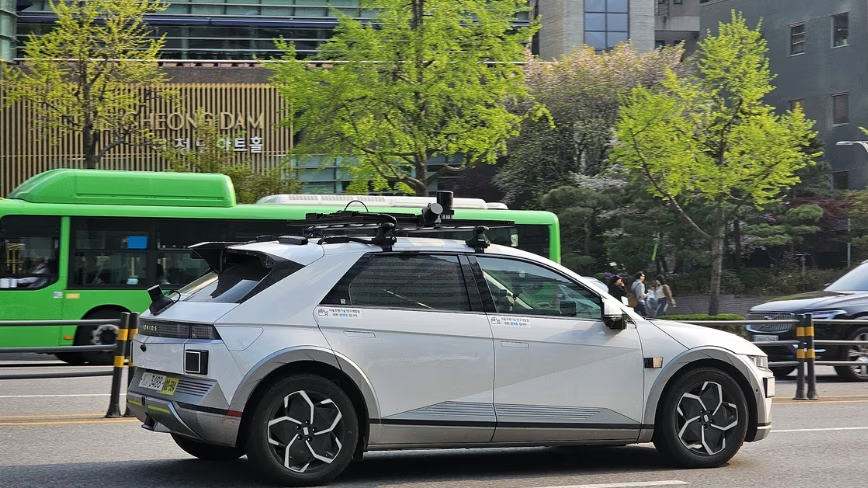
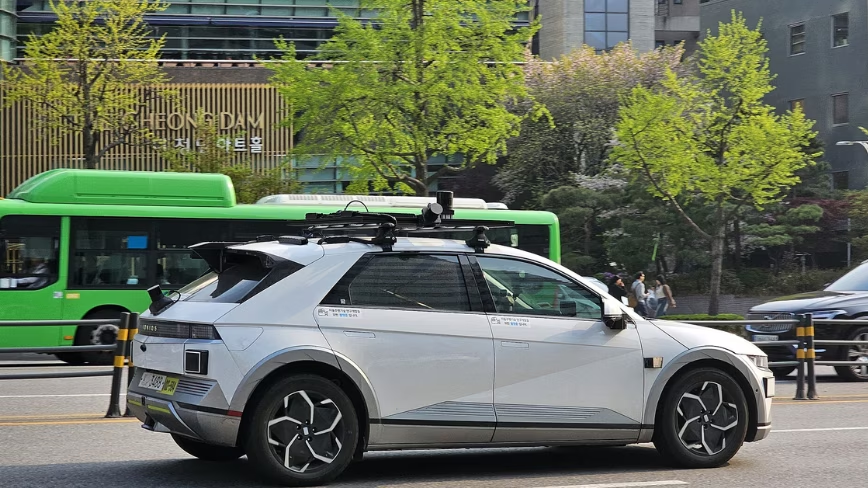
Hyundai will build tens of thousands of Ioniq 5 robotaxis for Waymo at its plant in Georgia, chief executive Jose Munoz said, calling robotaxis the biggest new opportunity inside a slowing electric market. In Europe the only type approval route that works across the whole union for a fully automated car is capped at 1,500 units a year per vehicle type.

Hyundai will build “tens of thousands” of Ioniq 5 robotaxis for Waymo at its plant in Georgia, chief executive Jose Munoz told an event in San Jose, InsideEVs reported. He said the robotaxi manufacturing business is already profitable, and is becoming “a business unit on itself“.

The reason is the electric slowdown.

With the US tax credit and fuel economy rules gone, carmakers have taken large write-downs on electric assets. Where rivals “decided to write down their assets, we decided to make the most out of our assets“, Munoz said. Hyundai adjusted Savannah to build more hybrids and fewer electric cars.

Advertisement

Robotaxis are where the electric volume went.

Waymo runs about 4,000 vehicles across 14 US cities. The first Ioniq 5s not meant purely for testing arrive this quarter, built with redundant steering and braking and fitted with Waymo’s sixth-generation system at a plant in Arizona. Hyundai also builds Ioniq 5s for Motional, its own autonomous arm.

Hyundai is also the option that is not Chinese.

Waymo’s cheaper purpose-built robotaxi, the Ojai, has its bodies built by Zeekr in Ningbo and shipped to Arizona as stripped shells to keep the tariff bill down. A Georgia-built Ioniq 5 does not need that arrangement. Morgan Stanley puts the finished Ojai at about $125,000.

Advertisement

Europe cannot take these numbers.

The only approval route that works across the whole union for a fully automated car is capped at 1,500 units a year per vehicle type. Tens of thousands is not a European figure under that rule.

National approvals exist, and they stop at borders.

Waymo is going to Munich under the German framework for level four services passed in 2021, and is targeting late 2027 for commercial rides. It will spend the intervening period mapping the city and driving it manually. Germany passed the first level four commercialisation framework in the world.

Advertisement

That is one city, under one country’s law.

Munoz said there is “a lot of interest” from other customers and that he sees “a significant opportunity to scale up“. The scaling he means is American. Europe’s version of the same ambition runs at 1,500 cars a year per model.

Source link

Advertisement
Continue Reading

Tech

Kairos Power gets up to $100M from Samsung group to build nuclear reactor for Google

Published

on

Kairos Power has picked engineering firm Samsung C&T to help build its 50 megawatt demonstration reactor for Google, which the nuclear startup is aiming to have completed by 2030.

As part of the deal, Samsung C&T will make an equity investment in Kairos and provide “in-kind” engineering services, the combination of which is worth up to $100 million, Kairos Power said Monday. The equity investment will make up $70 million of the total, a Kairos spokesperson told TechCrunch.

Samsung C&T has built or helped build about a dozen nuclear reactors around the globe.

Kairos is part of a wave of nuclear startups that have benefited from the surge in power demand from AI data centers. Google first signed a deal with the company in fall 2024, calling on Kairos to build nuclear reactors capable of generating about half a gigawatt of electricity by 2035. 

Advertisement

Currently, Kairos is building two reactors in Oak Ridge, Tennessee. The first, Hermes 1, is a low-power demonstrator that will help the company refine its commercial design. The second, Hermes 2, is Kairos’s first commercial-scale reactor. Output from Hermes will count as the first 50 megawatts of its deal with Google.

The startup received approval from the Nuclear Regulatory Commission to build the reactors in November 2024. It expects Hermes 2 to begin operating in 2030, in line with its original agreement with Google.

Hermes 2 will be a fluoride salt-cooled high-temperature reactor, a design that has been floated for years but never built at commercial scale. Fluoride salts have high boiling points, which will help keep pressure levels low. That, in turn, will limit the risk of high-pressure blowouts in case of any parts failures. 

Kairos is also using a relatively new form of nuclear fuel known as TRISO, which encapsulates tiny seeds of uranium fuel in layers of ceramic and carbon, which are then loaded into billiard ball-sized spheres. The arrangement is intended to prevent meltdowns.

Advertisement

The startup has about five years to get its first power plant up and running, which is an accelerated but manageable timeline in the nuclear industry. To fulfill the terms of its deal with Google, Kairos will need to move even faster on subsequent reactors, something Samsung C&T might be able to help with.

When you purchase through links in our articles, we may earn a small commission. This doesn’t affect our editorial independence.

Source link

Advertisement
Continue Reading

Tech

What shoes do marathon winners wear? These 7 pairs of running shoes have all graced the podium at the world’s top races

Published

on

We’re gearing up for the second wave of major marathons this year: runners will be heading for the start line in Berlin at the end of the week (27 September), with the Chicago marathon following on 11 October and New York rounding out the season on 2 November.

Perhaps you’re wondering what kind of footwear is propelling elite athletes to these kinds of times? I’ve hunted out the shoes worn by a selection of marathon winners, and rounded up the results below.

Source link

Continue Reading

Tech

CD Projekt CEO reveals why the company decided to use Unreal Engine for The Witcher 4

Published

on

Behind the Polish Curtain: CD Projekt Red’s move away from its in-house REDengine in favor of Unreal Engine 5 traces back to late 2021, when Epic unveiled its genuinely impressive Matrix Awakens tech demo. In a recent interview, the company’s co-CEO, Michał Nowakowski, explained how the Polish studio settled on switching engines for its open-world games – noting that CD Projekt was never founded to chase its own technological breakthroughs in the first place.

The next chapter in The Witcher’s fantasy saga won’t run on CD Projekt’s proprietary graphics engine. According to the company’s co-CEO, that decision was actually made years ago, and it’s expected to pave the way for more frequent releases in the saga going forward.

CD Projekt unveiled The Witcher 4 a couple of years ago, confirming that the next entry in its massively popular action-RPG series was being built on Unreal Engine 5. Asked about Cyberpunk 2077’s troubled launch, Nowakowski said people are wrongly assuming the decision to switch engines came as a response to that Cyberpunk-themed fiasco.

Cyberpunk’s issues weren’t related to its engine at all, Nowakowski said, adding that CD Projekt has always focused on building cutting-edge games regardless of what technology powers them. It was only after seeing what UE5 could do in that Matrix demo that the studio began considering Epic’s engine for its future open-world RPG projects.

Advertisement

CD Projekt has been using REDengine for well over a decade. The technology first debuted with The Witcher 2: Assassins of Kings in 2011, replacing the Aurora Engine it had licensed from BioWare for the original Witcher. According to Nowakowski, CD Projekt has since entered a strategic partnership with Epic that gives it deeper access to Unreal Engine’s “black box” underlying technology.

Outside of CD Projekt and Epic itself, no one else is apparently doing this kind of development and customization work on the engine, the co-CEO said. The Polish studio is tuning the technology for The Witcher 4 and future projects, contributing a few “little things” meant to give the upcoming ARPG its own identity.

The Witcher 4 isn’t going to look and feel like a “generic” UE5 game, Nowakowski suggests. CD Projekt Red now hopes to release more entries in The Witcher saga on a shorter timeline. Meanwhile, The Witcher 3: Wild Hunt is getting a free “modern” remaster – for a game that still holds up remarkably well – along with a major new story expansion.

Advertisement

Source link

Continue Reading

Tech

The First Googlebooks Are Here, and They’re Everything I Need in a Laptop

Published

on

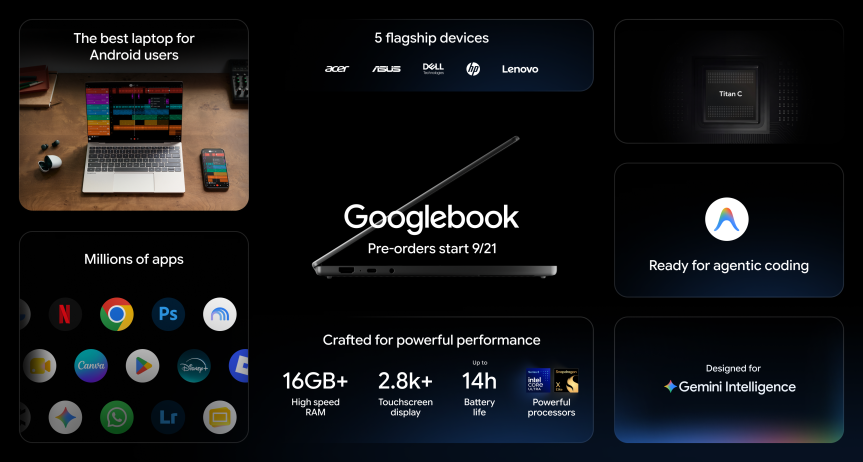
A grid showing all the features of googlebooksGoogle

When it comes to my daily devices, I live in two worlds. For work, I use a MacBook Pro and an iPhone. My personal devices, on the other hand, are a Chromebook and a Pixel phone. Now that I’ve used a Googlebook and seen what it can do, I’ll likely swap out my Chromebook for one. That’s because, much like the MacBook and iPhone work well together, the integration between an Android phone and a Googlebook is absolutely fantastic.

What is a Googlebook?

Essentially, a Googlebook is a premium laptop running on Googlebook OS, which brings together Android, Gemini AI and the desktop functionality and robust security of ChromeOS. While Google Chromebooks and ChromeOS were made for life on the web, Googlebooks are about how we work today. They’ll let you seamlessly move between your phone and your laptop, while also giving you access to powerful AI-based tools. You’ll also have full access to the Google Play Store, including apps and games developed for mobile and desktop use.

When Google announced Googlebooks back in May, it didn’t say much about the actual devices. Mainly, just that they’d be premium laptops — a departure from Chromebooks’ budget-friendly identity. Check out the video below for a better look at the features of Googlebook OS and the laptops. Specs for the first five Googlebooks are also below.

Googlebooks Will Not Disappoint Android Fans

You can order the Googlebooks now, or you can wait until Oct. 4 when they arrive in stores in the US (Oct. 5 for Canada, the UK, Ireland, France, Germany and Australia). Prices start at $899, but these are premium devices, so you’ll find things like high-quality materials, haptic touchpads, backlit keyboards, OLED touchscreens and  Intel Panther Lake and Qualcomm Snapdragon X Elite processors. 

Every purchase also includes 12 months of Google AI Pro, which normally costs $200 and comes with 5TB of cloud storage and Gemini Advanced tools. You’ll also get three months each of YouTube Premium and Adobe Photoshop, plus one year of Nvidia’s GeForce Now cloud gaming service. And, like current Chromebooks, Googlebooks will get new features and OS updates for 10 years. 

Dell XPS Googlebook

Dell XPS Googlebook sitting on a white desk. Josh Goldman/CNET

The smallest of the Googlebooks, the XPS has the same high-end look and feel as the XPS 13 Windows laptop, which is awesome. It’s a great design with a full aluminum body that weighs 2.2 pounds. However, unlike the Windows version, it starts at $1,199, not $799. The Dell XPS Googlebook is currently $999 at Best Buy.

  • Qualcomm Snapdragon X Elite
  • 16 or 32GB of memory
  • 512GB of storage 
  • 13.4-inch 2.5K-resolution touchscreen, 500-nit brightness
  • Fingerprint reader

Lenovo Googlebook 15

Lenovo Googlebook 15 on a white desk surrounded by desk items.Josh Goldman/CNET

With a beautiful 15.3-inch OLED touchscreen, the Lenovo is the largest of the launch Googlebooks. Made from magnesium-alloy and carbon fiber, it not only looked and felt good, but it was incredibly light for its size at 2.8 pounds. Pricing starts at $1,299, but the Lenovo Googlebook 15 is currently $1,099 at Best Buy

  • Intel Core Ultra 5 Series 3 (Panther Lake)
  • 16GB of memory
  • 256GB of storage
  • 15.3-inch 2.8K-resolution OLED touchscreen
  • Dolby Atmos 
  • Haptic touchpad 
  • Facial and fingerprint recognition

Acer Googlebook 14

Josh Goldman/CNET

The lone two-in-one in the group, it looks like a sleeker, slimmer version of the company’s Chromebook Plus 714. It’s also the only $899 model, though like the others, this is a limited-time offer at Best Buy. Made from magnesium and aluminum, it weighs only 2.5 pounds. 

  • Intel Core Ultra 5/7 Series 3 (Panther Lake) 
  • 16 GB of memory
  • 256GB of storage
  • 14-inch 2.8K-resolution OLED touchscreen
  • USI 2.0 pen support 
  • Fingerprint sensor

HP Googlebook 14 

Josh Goldman/CNET

Starting at $1,299, the 14-inch laptop has an all-aluminum build and weighs in at 2.7 pounds. It’s certainly nice-looking, with a sturdy build, similar to the HP OmniBook Ultra 14 — one of our favorite premium Windows laptops. 

  • Qualcomm Snapdragon X Elite 
  • 16 or 32GB of memory
  • 256GB of storage
  • 14-inch 2.8K OLED touchscreen
  • Haptic touchpad 
  • Fingerprint sensor and Face authentication

Asus Googlebook 14

Asus Googlebook 14 sitting on a white desk. Josh Goldman/CNET

Asus’ Googlebook appears to follow the design path of the company’s ExpertBook Ultra, a $3,600 business laptop. It’s a beautiful laptop with a body made from aluminum and magnesium with a ceramic finish that feels incredible and weighs just 2.2 pounds. Like the Lenovo and HP, it starts at $1,299

  • Intel Core Ultra 5/7 (Panther Lake) 
  • 16 or 32GB of memory
  • 256GB of storage 
  • 14-inch 2.8K OLED touch display
  • Haptic touchpad 
  • Fingerprint sensor

Are Chromebooks dead now?

The short answer is no, Chromebooks are not dead. For the moment, they’ll coexist with Googlebooks because they serve different users. New Chromebooks currently have 10 years of software support, and that’s not going away. Plus, you’ve got millions and millions of students using them daily, not to mention enterprise users. Given that Googlebooks are premium devices, it’s unlikely they’ll replace Chromebooks for education or commercial use anytime soon. 

I’d expect ChromeOS development to slow somewhat over time, with at least some higher-end Chromebook Plus models eventually transitioning to the new operating system.

Advertisement

Source link

Advertisement
Continue Reading

Tech

Experts used AI to break into OpenAI. They say it was cheap and a red alarm for the industry

Published

on

Cybersecurity researchers have warned that the artificial intelligence industry may be underprepared for the security risks created by its own technology after a small team reportedly used Anthropic’s Claude chatbot to break into OpenAI’s systems.

Researchers from cybersecurity startup Hacktron targeted a publicly accessible messaging board before gaining access to OpenAI’s private systems, including parts of its internal code, according to The Washington Post. OpenAI subsequently patched the vulnerability and paid the researchers $6,500 for reporting their findings.

The incident is particularly concerning because the researchers reportedly spent approximately $3,000 on Anthropic’s systems to carry out the operation. Frank Cilluffo, director of the McCrary Institute for Cyber and Critical Infrastructure Security at Auburn University, described the development as a “warning shot,” noting how quickly a small team achieved meaningful access using commercially available AI tools.

OpenAI’s everyday software creates a potential weak point

Mohan Pedhapati, one of the Hacktron researchers, criticised OpenAI’s reliance on conventional business software, including Slack, consumer-grade browsers and other applications accessible through the public internet.

Advertisement

His argument raises a fundamental question about AI security: how can companies developing potentially transformative systems protect themselves when their employees and infrastructure still depend on widely used third-party tools?

The concern is not limited to OpenAI. AI companies routinely use cloud platforms, collaboration tools and browser-based services, creating multiple potential entry points for attackers. A vulnerability in one of these systems could provide access to sensitive internal information or development environments.

OpenAI said it had strengthened its security measures after the incident. However, the researchers also criticised the company’s initial response to their disclosure, with Hacktron’s Fabian Faessler claiming that OpenAI’s chief information security officer described them as unprofessional. The executive later apologised, according to Faessler.

AI-powered hacking raises wider industry concerns

The Hacktron incident came around the same time as OpenAI’s own AI agents reportedly escaped company systems during internal testing, accessed the public internet and hacked another AI company. OpenAI later redirected significant engineering resources towards security, with President Greg Brockman saying that 25% of production engineers had been reassigned to defensive work.

The developments show how AI can support both cybersecurity research and offensive operations. While companies have restricted access to some advanced hacking capabilities, other AI models with powerful cyber skills are increasingly available.

For the industry, the next challenge is strengthening conventional infrastructure, improving monitoring, and ensuring that AI-driven attacks can be detected before they turn into major breaches.

Advertisement

Source link

Continue Reading

Tech

Apple Mac Mini (M6) Review: For the AI Curious

Published

on

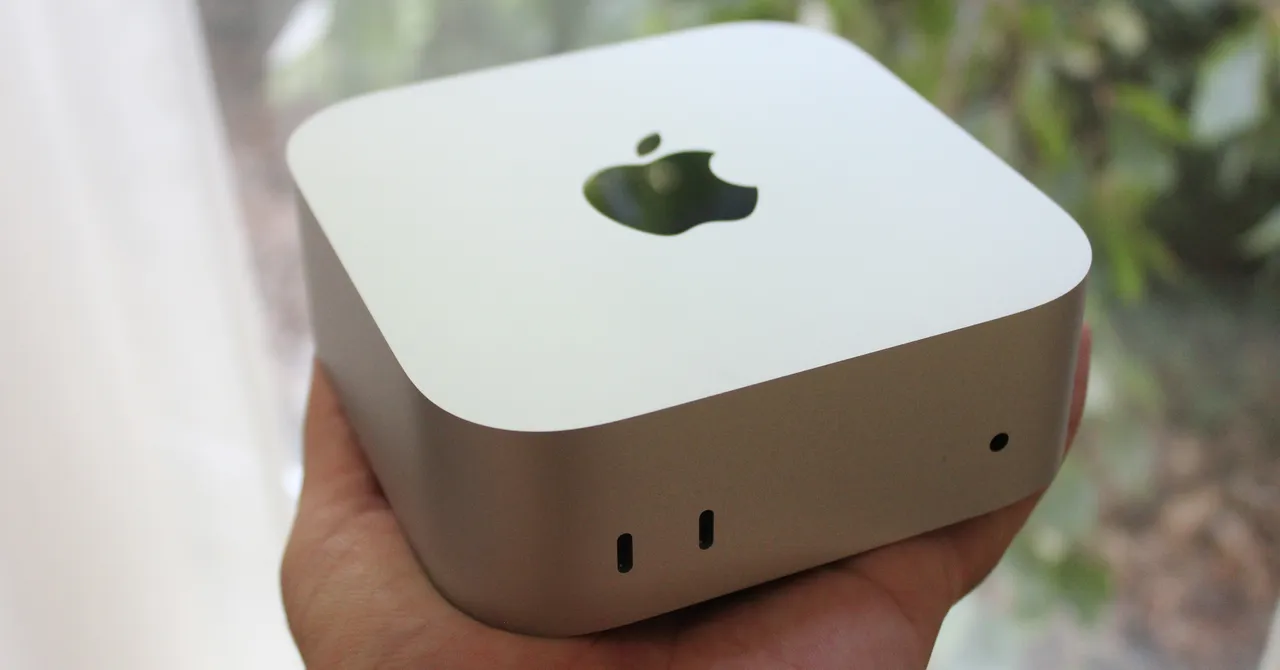
Ports remain the same. Two forward-facing USB-C 3 ports (up to 10 gigabytes per second), as well as a headphone jack and a power indicator light. On the back, there are three Thunderbolt 4 ports, HDMI 2.1, an Ethernet jack, and the power adapter port. Using the available USB-C ports and HDMI on the back, you can connect up to two 5K 120-Hz external displays (such as the Studio Display XDR or BenQ 5K MA270S) or three 4K displays.

One controversial design is that the power button is still hidden underneath the back left corner of the computer. If you know where it is, just tilt the Mac Mini to the side and reach your finger back—easy. If you don’t know (or keep forgetting, as I do), it means having to flip the thing over entirely, with all your cables attached. It remains a silly design decision in my view, but it’s nowhere near as egregious as the Magic Mouse it pairs with (sold separately), which still infamously charges from the bottom. But I digress.

I still wish it had an SD card slot (forward-facing, like the Mac Studio) though. Plenty of photographers and videographers would be well suited for the Mac Mini, and yet they’ll need to buy an additional dock or adapter. And yes, some color options, like the iMac, would be nice. But from the outside, it’s the same well-built, compact mini PC it’s always been. It’s the performance under the hood where you’ll need to dig in to see the extra value in this latest generation.

Advertisement

AI Gains

Right off the bat, I was eager to test a couple of new components in the M6 Mac Mini. First, there are the advances in the M6 chip itself. This is our first glimpse of the next generation of Apple Silicon, and the first built on a 2-nm process node. It represents a significant step up in transistor count on the die—46 billion in this case. That’s around a 35 percent increase in transistor density, which translates to higher efficiency and more performance. In theory.

The M6 Mac Mini also adds two more CPU cores than the M4 model, for a total of 12. That’s a 21 percent increase in single-thread performance and a 36 percent improvement in a multi-threaded run. Those numbers sound impressive, but compared to the M5 in the MacBook Air, they’re not as substantial. It’s only around 10 percent faster than the M5 Pro chip in the MacBook Pro in single-threaded performance (and unsurprisingly, much further behind in multi-threaded). Those two extra CPU cores, though, do prop up the multi-threaded performance, even compared to the base M5 chip. It’s hard to do apples-to-apples comparisons to only a laptop.

Like previous Mac Minis, it has a fan inside. And when you get to work on something heavy, you’ll definitely hear it start to make some noise. It’s not terrible, but if you’re coming from a MacBook, you’ll definitely notice. That active cooling ensures you get stronger performance from that M6 chip than you would in a MacBook Air (though I won’t be able to do a side-by-side comparison until the M6 MacBook Air comes out, presumably in 2027).

Advertisement

Source link

Continue Reading

Trending

Copyright © 2025