TL;DR
Akamai disclosed a 1.8 billion dollar, seven-year cloud deal with Anthropic, its largest contract ever. The stock rose 27 per cent in a day as the CDN company’s AI cloud pivot received its most significant validation.





Akamai disclosed a 1.8 billion dollar, seven-year cloud deal with Anthropic, its largest contract ever. The stock rose 27 per cent in a day as the CDN company’s AI cloud pivot received its most significant validation.
TL;DR
Akamai Technologies disclosed a 1.8 billion dollar, seven-year cloud infrastructure deal with a customer it described only as “a leading frontier model provider.” Bloomberg identified the customer as Anthropic. The stock rose 27 per cent in a single day, the largest rally in the company’s 28-year history. A company that built its business delivering web pages faster than anyone else just became an AI infrastructure provider on the strength of one contract.
The deal is the centrepiece of a quarter in which Akamai’s cloud infrastructure services revenue grew 40 per cent year over year to 95 million dollars, while its legacy content delivery business declined 7 per cent. The company is being repriced by investors not for what it has been for two decades but for what one contract suggests it could become. The question is whether a single customer commitment, however large, constitutes a transformation or a concentration risk.
The 1.8 billion dollar contract is the largest in Akamai’s history. Revenue from the commitment is expected to begin in the fourth quarter of 2026, contributing approximately 20 to 25 million dollars in that period. The seven-year term provides visibility that Akamai’s legacy CDN business, which operates on shorter cycles and faces persistent price compression, has never offered.
The deal follows a 200 million dollar, four-year cloud services agreement that Akamai signed in February with another unnamed US technology company, under which the customer will use a multi-thousand NVIDIA Blackwell GPU cluster. Together, the two contracts represent two billion dollars in committed cloud revenue from customers that Akamai did not have two years ago.
Anthropic signed to take all of SpaceX’s Colossus 1 data centre capacity, adding more than 300 megawatts and over 220,000 NVIDIA GPUs to its compute footprint. The Akamai deal extends the same logic: Anthropic is buying compute capacity from every available provider as demand for Claude outpaces supply. Dario Amodei, Anthropic’s chief executive, said the company experienced “80x growth” in annualised revenue and usage in the first quarter of 2026 and is “working as quickly as possible” to secure more computing resources.
Akamai was founded in 1998 at MIT to solve the problem of delivering web content without congestion. For two decades, it operated the world’s largest content delivery network, caching and distributing web pages, video streams, and software downloads across more than 4,000 locations in 130 countries. The CDN business made Akamai indispensable to the internet. It also became a commodity.
Under chief executive Tom Leighton, who moved from chief scientist to the top role in 2013, the company spent a decade diversifying. The first pivot was into cybersecurity, which now accounts for 55 per cent of revenue at 590 million dollars per quarter, growing 11 per cent year over year. The second pivot, into cloud computing, began with the 900 million dollar acquisition of Linode in 2022 and is now producing the growth that investors had been waiting to see.
Leighton told CNBC that the deal represents validation of the company’s “different approach” and that Akamai has “a very strong pipeline of major enterprise customers, including some that have very large cloud needs.” The company announced at NVIDIA’s GTC event in March that it would deploy thousands of NVIDIA RTX PRO 6000 GPUs and build what it described as the “industry’s first global-scale implementation of NVIDIA’s AI Grid,” pushing AI inference closer to end users to reduce latency and cost.
Anthropic’s decision to sign a 1.8 billion dollar contract with Akamai reflects the constraint that defines the current AI infrastructure market: demand for compute exceeds the capacity of any single provider. Anthropic already runs Claude across Google tensor processing units, Amazon’s custom chips, and NVIDIA hardware. It has signed with SpaceX for data centre capacity. It is exploring building its own chips.
Anthropic is exploring building its own AI chips as its run-rate revenue surpasses 30 billion dollars, but custom silicon takes years to design and validate. In the interim, Anthropic is buying capacity wherever it can find it. Akamai’s distributed network of edge locations, originally built for CDN traffic, offers something that centralised hyperscale data centres do not: the ability to run inference workloads close to end users, which reduces latency for the real-time applications that enterprises are beginning to deploy.
Nebius acquired Eigen AI for 643 million dollars to optimise inference performance, a bet that the most valuable layer in AI infrastructure is not raw compute but the efficiency with which that compute is used. Akamai’s pitch to Anthropic rests on a similar premise: that distributed inference at the edge is more efficient for certain workloads than centralised processing in a hyperscale facility.
Akamai reported first-quarter revenue of 1.074 billion dollars, up 6 per cent year over year. Adjusted earnings per share were 1.61 dollars. Cloud infrastructure services revenue was 95 million dollars, up 40 per cent. Security revenue was 590 million dollars, up 11 per cent. Delivery and other revenue was 389 million dollars, down 7 per cent.
The cloud segment represents less than 9 per cent of total revenue. The 1.8 billion dollar deal, at approximately 257 million dollars per year, would more than double the segment’s current annual run rate. The contract transforms cloud from a promising but small division into the company’s primary growth engine, at least on a committed-revenue basis.
For the full year, Akamai is forecasting revenue of 4.45 to 4.55 billion dollars and adjusted earnings of 6.40 to 7.15 dollars per share. The guidance does not yet reflect the full impact of the Anthropic contract, which begins contributing in the fourth quarter. Analysts will spend the next two quarters trying to determine whether the deal is a one-off or the first in a series.
Anthropic launched a marketplace for Claude-powered enterprise software, and committed 100 million dollars to the Claude Partner Network, signalling that the company’s commercial ambitions extend well beyond model development into the infrastructure and services layers that support enterprise AI deployment. The scale of Anthropic’s expansion explains the compute hunger that produced the Akamai deal.
But a 1.8 billion dollar contract with one customer concentrates risk as much as it concentrates revenue. Anthropic’s annualised revenue has grown from approximately 900 million dollars in late 2025 to a reported 30 billion dollar run rate. Growth at that pace creates demand for infrastructure. It also creates the conditions for a correction if the demand curve flattens. Akamai’s stock gained 27 per cent on the announcement. The company’s ability to sustain that valuation depends on whether Anthropic’s growth trajectory holds for seven years.
Leighton said there is more coming. The company’s history suggests patience. Akamai survived the dot-com crash, navigated the commoditisation of its original business, and spent a decade building a cybersecurity franchise before the market rewarded it. The AI cloud deal is the latest reinvention of a company that has been reinventing itself since 1998. The difference is that this time, the reinvention depends on one customer’s continued appetite for compute, and on the assumption that the demand for AI inference at the edge will grow as fast as the demand for AI itself.


Offbeat
Imagine taking a dip 177m above the streets of London’s West End
Visitors to London’s iconic Telecom Tower might soon be able
to go for a rooftop swim, according to plans revealed by the developer turning the building into a hotel.
The iconic 177 meter (581 ft) high structure in Fitzrovia in
London’s West End was sold off by BT Group in 2024 to US-based hotel
owner-operator MCR Hotels for £275 million ($346 million).
At
the time, the firm said it wanted to preserve the Grade II listed building,
while converting it into a hostelry.
Now, MCR has announced a small number of public consultation events it
is holding on May 11, 12, and 16 where those interested can view the emerging
proposals for the site, meet the project team, and share any feedback on the
plans.
Those proposals include public access to
the top of the tower and its podium buildings for the first time in almost half
a century. The 34th floor was famously home to a revolving restaurant that gave
diners a panoramic view of Britain’s capital as it slowly turned once every 22
mins, but this was closed in 1980.
Also part of the proposals are a new publicly accessible
square plus retail shops and restaurants at ground level, and a rooftop
swimming pool.
London is home to a number of high-rise swimming venues already.
There is the vertigo-inducing Sky Pool which
spans two apartment buildings ten stories up at the Embassy Gardens development
in the Nine Elms region of Wandsworth. You will find an infinity pool at the Shangri-La hotel
on the 52nd-floor of the Shard building near London Bridge, and there is also a
pool on the roof of the Berkeley Hotel, overlooking Knightsbridge.
The BT Tower was originally known as the Post Office Tower
when it was first built in 1964, and its main purpose was to support microwave
antennas used to beam telecom signals between London and the rest of the
country.
The tower will not be turned into a vertical hotel immediately.
BT said payment for the site is spread over six years to 2030, during
which time the company will gradually remove all of its telecoms equipment from
the building.
As we reported previously, the BT Tower also famously fell
victim to a giant kitten in an episode of the British 1970s TV comedy
series The Goodies. ®

Apple is updating its education program with new verification and Apple Watch elligibility
Education customers in the US will need to verify eligibility to make a discounted purchase, as Apple expands its verification process to the US and other countries.
Starting on Friday, May 8, Apple has started to more strictly enforce its education pricing. Previously, while Apple Stores would verify eligibility in person, anyone was able make discounted purchases by visiting the virtual education store.
Apple has partnered with Unidays on a new verification system. Students will be able to verify their enrollment and faculty will be able provide the appropriate documentation with the new automated process.
Most will receive verification instantly. In rare cases it may take up to 24 hours to be verified before you’re able to make a purchase.
This new program will apply to buyers both in-store and online. Users shopping online can go through the portal and can complete the same forms in-store. Users are able to complete the verification first before going into the store to help expedite the process.
Some countries already had a verification process. The countries gaining verification for the first time include:
This program is also is able to verify homeschool teachers. By providing the requested information, including identification numbers and other materials, they can be approved more easily.
The new verification program will help curb people from abusing the education pricing. This is especially important on new, lower-margin items like the MacBook Neo that offers a substantial 16% discount on the base model.
Apple has a similar program for military member purchase. That has a different verification process, that has been in place for some time.
On Thursday, Apple also updated its education program to include Apple Watch for the first time. Discounts are about 10%.
There are often steeper discounts on Apple products at third-party resellers that are available to the general public, so you don’t have to go through the EDU verification process.
At press time, B&H has the standard 1TB 14-inch MacBook Pro with Apple’s M5 Pro chip marked down to $1,949 via an instant rebate and in-cart coupon. This beats the EDU price by $100.
The 2026 M5 MacBook Air is on sale from $949 at Amazon, which is $50 cheaper than Apple EDU pricing.
And for Apple Watch shoppers, Amazon is taking $100 off multiple Series 11 styles.
It’s worth checking out our Apple Price Guides for the latest specials across iPads, Macs, Apple Watches, and more.

September 2025? January 2026? Delivery dates keep slipping for the Trump Organization’s “Trump Phone” — a gold-coloured Android smartphone priced at $499 (£370). But in March the Verge spotted signs the phone was moving forward:
FCC listings for a smartphone with the trade name “T1” show that it was tested late last year, and granted certification by the FCC in January… [T]he phone was submitted for testing by another company entirely: Smart Gadgets Global, LLC… Smart Gadgets Global’s website promises “Top Quality Electronics created for ‘YOUR’ customer!”
But in April the Trump phone revised its “Terms and Conditions” for preorders. The new language?
A preorder deposit provides only a conditional opportunity if Trump Mobile later elects, in its sole discretion, to offer the Device for sale. A deposit is not a purchase, does not constitute acceptance of an order, does not create a contract for sale, does not transfer ownership or title interest, does not allocate or reserve specific inventory, and does not guarantee that a Device will be produced or made available for purchase….
Estimated ship dates, launch timelines, or anticipated production schedule are non-binding estimates only. Trump Mobile does not guarantee that: the Device will be commercially released… Trump Mobile will not be responsible for delay, modification, or failure to release a Device due to causes beyond its reasonable control, including but not limited to regulatory review, carrier certification delays, component shortages, labor disruptions, governmental orders, acts of God, transportation interruptions, or third-party supplier failures…
If Trump Mobile cancels or discontinues the Device offering prior to sale, Trump Mobile will issue a full refund of the deposit amount paid… If Trump Mobile cancels, delays, or does not release the Device, your sole and exclusive remedy is a full refund of the deposit amount actually paid, and you waive any claim for equitable, injunctive, or specific performance relief relating to preorder priority or Device allocation.
There was an unconfirmed report on social media that the updated Terms were also emailed to customers (cited by the International Business Times). And the new language also hedges that for the gold T1 phone, “Images, prototypes, beta demonstrations, and marketing renderings are illustrative only and may not reflect final production units….”
But then eight days ago The Verge reported that phone “has just passed another milestone on its slow road to release,” described as “a requirement for any phone launching in the US…”
“The phone has received the little-known PTCRB certification, a first step toward being certified to work on major networks and be issued with IMEI numbers.”
[A]t least, I think it’s been certified. What’s actually been certified by the PTCRB is the SGG-06, a smartphone from Smart Gadgets Global, LLC, with support for 5G, 4G, 3G, and 2G networks.

The Fabio Wardley vs Daniel Dubois live stream is for Wardley’s WBO world heavyweight title and has the potential to be an all-British barnstorming classic from the Co-Op Live in Manchester. Two knockout artists who throw and land big – what’s not to like? Don’t miss it.
DDD returns to the squared circle for the first time since his devastating second defeat by Usyk, for the undisputed world heavyweight crown last July. Dubois has taken some time out of the ring but he needs to win a fight in which his back catalog of opponents – Usyk, Anthony Joshua and Filip Hrgović among them – means he’s been in the ring with a better quality of fighter. Dynamite is aptly nicknamed, with his stoppage of AJ a breakthrough moment, but questions surrounding his ring IQ and chin remain.
Here’s how to watch a Wardley vs Duboi live stream wherever you are. We’ve also got details of the full card, start times and tale of the tape further down the page.
Unfortunately not, as this is a PPV fight shown by DAZN in over 200 countries worldwide, but there is value to be had for boxing fans.
While DAZN is streaming the action across the globe, you may find yourself in a different country during the fight and wanting to access the correct PPV price for your location. That’s where a VPN comes in handy — it can help you bypass geoblocks to access the correct DAZN stream. Our favourite is NordVPN:

Fight fans in the United States can watch Wardley vs Dubois live streams via DAZN PPV. The price is set at $49.99.
You can also bundle Wardley vs Dubois with one of the upcoming Oleksandr Usyk vs Rico Verhoeven, or Tommy Fury vs Eddie Hall, or Xander Zayas v Jaron ‘Boots’ Ennis for $107.99 ($120.99 for Zayas option).
The new DAZN Ultimate Tier subscription is available Stateside, with 12 PPVs annually available along with all the boxing, football, golf and tennis action. It costs $49.99 a month over the course of 12 months, and you could save more than $530 a year. Ultimate Tier will also include fights such as Oleksandr Usyk vs Rico Verhoeven.

The Wardley vs Dubois live stream is available on PPV in the UK, setting you back £24.99 on the DAZN PPV platform.
Viewers do not need a subscription to the streaming platform to purchase the pay-per-view.
You can also bundle Wardley vs Dubois with the upcoming Oleksandr Usyk vs Rico Verhoeven, or Tommy Fury vs Eddie Hall fights for £44.99.
As we’ve mentioned above, you can also take out a new DAZN Ultimate Tier subscription, which gives you access to 12 PPVs a year in addition to the regular 185 fight nights. It costs £24.99 a month, meaning you could save more than £350 a year.
Like in the US, Ultimate Tier will also include fights such as Oleksandr Usyk vs Rico Verhoeven.

In Australia, fight fans can watch the Fabio Wardley vs Daniel Dubois on DAZN PPV.
It will cost AU$49.95 to watch the entire fight card. You won’t need a DAZN subscription to order this PPV event.
The new DAZN Ultimate Tier subscription is also available Down Under for AU$39.99 a month for 12 months’ access, with 12 PPVs included.
The main event is scheduled to get underway at 8am AEST on Sunday, May 10.
Yes, but you still need to buy a PPV to watch. DAZN access is included in 200 countries worldwide. If yours isn’t mentioned directly in this article, it will cost the equivalent of $24.99 where you are.
In Australia, as well as the DAZN option, you can also get the fight on Kayo Sports Main Event for AU$49.95 – no existing subscription to Kayo Sports required.
The card begins on Saturday, May 9 at 1pm ET / 10am PT / 6pm BST / 3am AEST.
The Fabio Wardley vs Daniel Dubois ringwalks are expected at approximately 6pm ET / 3pm PT / 11pm BST / 8am AEST (Sunday). Is Wardley vs Dubois available anywhere else?
What time is the Wardley vs Dubois fight?
| Header Cell – Column 0 |
Fabio Wardley |
Daniel Dubois |
|---|---|---|
|
Nationality |
British |
British |
|
Age |
31 |
28 |
|
Height |
6′ 5″ |
6′ 5″ |
|
Reach |
78″ |
78″ |
|
Total fights |
21 |
25 |
|
Record |
20-0-1 (19 KOs) |
22-3 (21 KOs) |
Jack Rafferty takes on Ekkow Essuman in a domestic super-lightweight scrap that serves as the co-main event. The unbeaten Rafferty got a majority draw decision with Mark Chamberlain last time out and wants to get back to winning ways.
The popular Liam Cameron is also in action, as he fights Bradley Rea, who lost a narrow decision to Lyndon Arthur in November.
We test and review VPN services in the context of legal recreational uses. For example: 1. Accessing a service from another country (subject to the terms and conditions of that service). 2. Protecting your online security and strengthening your online privacy when abroad. We do not support or condone the illegal or malicious use of VPN services. Consuming pirated content that is paid-for is neither endorsed nor approved by Future Publishing.

UFC 328 live streams feature two titles up for grabs in the Octagon, with middleweights Khamzat Chimaev vs Sean Strickland headlining proceedings after a flyweight title tussle between Joshua Van vs Tatsuro Taira in the co-main event at the Prudential Center in Newark, New Jersey on Saturday night.
‘The Fearless’ Van is another star making his first title defense. There was an element of good fortune that saw him injure Alexandre Pantoja’s arm at UFC 323 in just 26 seconds and take the Brazilian’s flyweight strap. That won’t bother Van, who became the second-youngest champion in UFC history in the process. Many fancy that Taira has a good shot to take the title following his devastating TKO of Brandon Moreno at the same event. In doing so he would create his own slice of history – Japan’s first ever UFC champ.
Here’s where to watch UFC 328 live streams online and from anywhere with a VPN – including a clever way to watch UFC 328 for just $1.

Exclusive US coverage of the full UFC 328 event is on Paramount Plus. It’s being headlined by Khamzat Chimaev vs Sean Strickland, which is expected to start at around 11pm ET / 8pm PT.
Plans start from only $8.99 a month with the Paramount Plus Essential Plan, or upgrade to Premium for $13.99 a month (see below for more details). You can also get a Paramount Plus trial with Walmart+ for $1 as with this sneaky trick we found.
While Paramount Plus will show UFC 328 in its entirety, you can also watch the Early Prelims with the UFC Fight Pass.
Traveling outside of the US? Use a VPN to watch Paramount Plus from abroad while you’re away from home.
A VPN is a handy piece of software that can make your device appear as if it’s back in your home country, thereby letting you unlock your usual streaming services. The best VPN right now? We recommend NordVPN – it does everything and comes with a 76% discount.
Using a VPN is incredibly simple:
1. Install the VPN of your choice. As we’ve said, NordVPN is our favorite.
2. Choose the location you wish to connect to in the VPN app. For instance, if you’re visiting the UK and want to view your usual US service, you’d select a United States server from the list.
3. Sit back and enjoy the action. Head to your usual local streaming service and watch the UFC.

The UFC 328 live stream is on TNT Sports 1 in the UK.
You can get it by adding TNT Sports to your Sky, Virgin Media or EE TV package, or pay from £25.99 per month for a HBO Max plan that includes TNT Sports.
The main card action is set to begin at 2am BST on Sunday morning. UFC Fight Pass subscribers can also watch the Prelims and Early Prelims there.
If you’re abroad whilst the MMA live stream is on, a VPN like NordVPN can help you to access your home streaming services from anywhere.

There are a host of pay-per-view providers offering a UFC 328 live stream in Canada.
You can head to the likes of Sportsnet, Bell or the UFC Fight Pass to watch the whole event, where the PPV price is set at $69.99. Prelims will also be shown on Sportsnet and TVA Sports, with Early Prelims also on UFC Fight Pass.
North of the border from the US? You can use NordVPN to watch your Paramount Plus subscription like you were back at home.

Sunday’s Main Card at UFC 328 will be available on PPV in Australia, setting you back AU$59.95 from Foxtel Main Event or Kayo Sports Main Event.
That means you can live stream UFC 328 via your web browser and devices like Android, iOS, Samsung TV, Apple TV, Android TV, Telstra TV and Chromecast.
You can also catch all the Prelims (but not the Chimaev vs Strickland main event) via Paramount+ and free-to-air Network 10.
Downloading a VPN will help you access your subscriptions from anywhere if you’re abroad when the fight is on.
Not quite. Other than the sneaky little Walmart+ for $1 trick described above in the US, there doesn’t seem to be any way to watch UFC 328 for free. It’s on Paramount Plus in the US, which no longer carries a free trial. And it’s on PPV in many other countries around the world. TVNZ+ will also broadcast the early prelims for free in New Zealand if you are looking to catch the full card.
The UFC 328 Main Card is scheduled to begin at 9pm ET / 6pm ET on Saturday, May 9. That’s 2am BST or 11am AEST in the UK and Australia on Sunday, May 10.
Before that, the Early Prelims start at 5pm ET / 2pm PT / 10pm BST / 7am AEST (Sun) and the Prelims at 7pm PT / 4pm PT / 12am BST (Sun) / 9am AEST (Sun).
Yes. Most broadcasters have streaming services that you can access through mobile apps or via your phone’s browser – Paramount Plus, HBO Max and Kayo Sports all have mobile apps, for example. You can also stay up-to-date with the latest UFC news and plays on the official social media channels on X (@ufc), Instagram (@ufc), Facebook (UFC) TikTok (@ufc) and YouTube (@ufc).
Can I watch UFC 328 for free?
When does UFC 328 start?
Can I watch UFC 328 on my mobile?
Main card
Khamzat Chimaev vs Sean Strickland (for UFC Middleweight title)
Joshua Van vs Tatsuro Taira (for UFC Flyweight title)
Alexander Volkov vs Waldo Cortes Acosta (Heavyweight)
Sean Brady vs Joaquin Buckley (Welterweight)
King Green vs Jeremy Stephens (Lightweight)
Prelims
Ateba Gautier vs Ozzy Diaz (Middleweight)
Joel Álvarez vs Yaroslav Amosov (Welterweight)
Grant Dawson vs Mateusz Rębecki (Lightweight)
Jim Miller vs Jared Gordon (Lightweight)
Early prelims
Roman Kopylov vs Marco Tulio (Middleweight)
Pat Sabatini vs William Gomis (Featherweight)
Baisangur Susurkaev vs Djorden Santos (Middleweight)
Clayton Carpenter vs Jose Ochoa (Flyweight)
We test and review VPN services in the context of legal recreational uses. For example: 1. Accessing a service from another country (subject to the terms and conditions of that service). 2. Protecting your online security and strengthening your online privacy when abroad. We do not support or condone the illegal or malicious use of VPN services. Consuming pirated content that is paid-for is neither endorsed nor approved by Future Publishing.

My nerd cred, painstakingly built up over the last 30 years, is about to take a big hit. Until 2021, I’d never seen The Lord of the Rings trilogy. Until 2026, very recently, I’d never played Middle-earth: Shadow of Mordor. I’d made attempts, you understand, way back in the wilderness years of the 2010s, but it never really grabbed me. Then, just recently, I gave it another go, and, it really did.
From the Backlog
Every gamer has a backlog — and that’s no different for us at TechRadar Gaming. From the Backlog is a series about overdue first-plays, revisiting classics, returning to online experiences, or rediscovering and appreciating established favorites in new ways. Read the full series here.
You step into the half-dead shoes of Talion, a Ranger of Gondor who is just a little bit dead after Sauron’s servants attacked. However, death is not the end, as the wraith of an Elven smith called Celebrimbor takes possession of your body and revives you. This leads to a bit of a Tyler Durden situation, two minds living in just one body, to put a spin on the words of Phil Collins.
Keen-eyed readers will likely recognise Celebrimbor. He’s the smith who forged the Rings of Power in LOTR, and was then fully killed by Sauron. That’s just the biggest of many differences between Shadow of Mordor and the work of Tolkien, with another notable difference being that the Black Gate had been abandoned, uh, 1000 years before the game begins.
Never mind! See what I mean about the LOTR lore not really mattering?
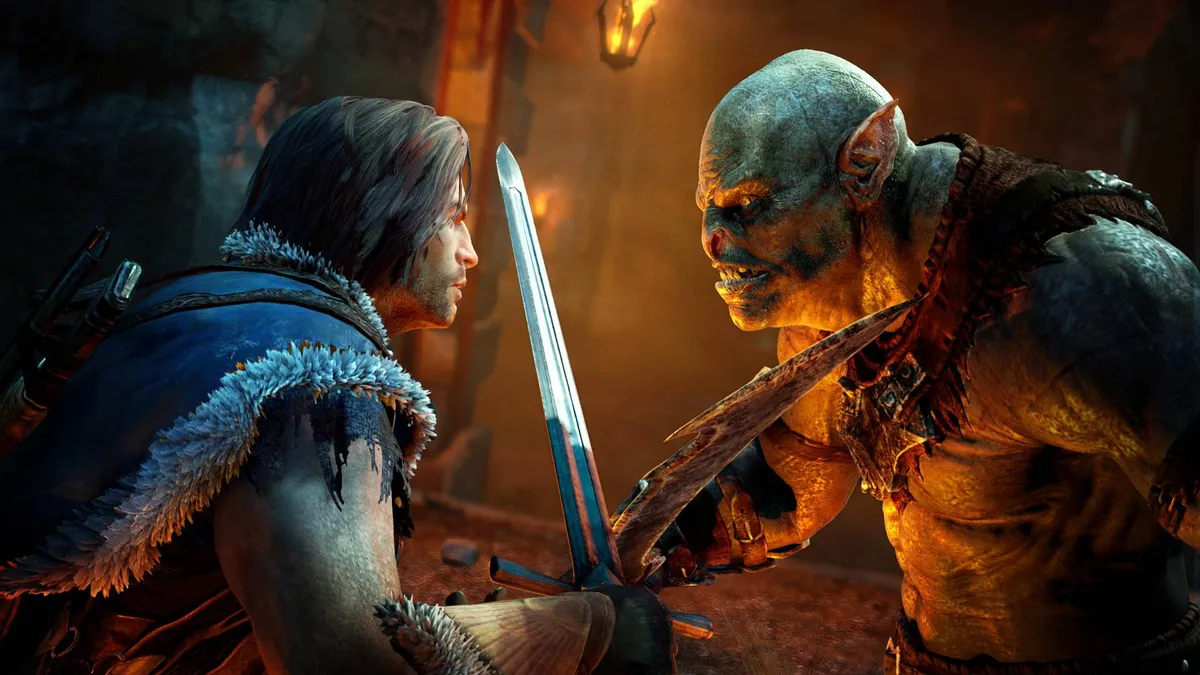
After being revived, you meet Smeagol (400 years before he was born), and attempt a dual-pronged mission: getting your revenge and also helping Celebrimbor remember his past. Being a wraith is bad for the memory, it seems. Getting revenge is the order of the day, though, and you’ll be getting a lot of it. The big bad may be the Black Hand of Sauron, but you’re going to get revenge in instalments along the way by taking on innumerable numbers of Uruks, which is where the game’s real masterstroke comes into play.
The Nemesis System was a particularly fantastic innovation for the time and one that has yet to be equalled, even 12 years on. Essentially, it’s a way to keep track of the Uruk Captains who command the rank-and-file footsoldiers of Sauron’s hordes. Each one has a personality, fears, and a wide range of character traits.
The best part of all of this is that your interactions with them will affect their personality and physicality. Attack them with fire, and if they survive, they may well develop a fear of fire, for example. Beat them badly, they’ll come back with scars and additional dialogue about how angry they are with you, MANFILTH!
It’s a hell of a tightrope to walk, and one that Shadow of Mordor pulls off near-effortlessly
It’s not just one-sided, however. If a footsoldier has the skill to take you down in battle (looking at you, archers and javelin throwers), they can be promoted into an open captain slot. By killing the captain, you’ve just allowed another enemy to go up the echelons of Uruk society. To quote Civilization 5, itself quoting Aesop, “we often give our enemies the means of our own destruction.”
This means that the game doesn’t really have meaningless fights. As soon as you start mulching your way through the ranks of Sauron’s army, you’ll start creating more captains yourself. They don’t sit still, either: the captains have their own motives, and their own power struggles. They will frequently attempt to level themselves up and become stronger, or kill one another over squabbles. You can sit back, if you like, and watch an Uruk climb the ranks, only to be felled by a young upstart.
The Nemesis System makes the enemies matter. Mooks become potential rivals, and captains become sworn enemies that you have fought several times before and that have become powerful enough that running in with a sword simply won’t do. Now, you need to carefully plan your attack, exploiting their fears and weaknesses to make up for their increased power. It’s a hell of a tightrope to walk, and one that Shadow of Mordor pulls off near-effortlessly.
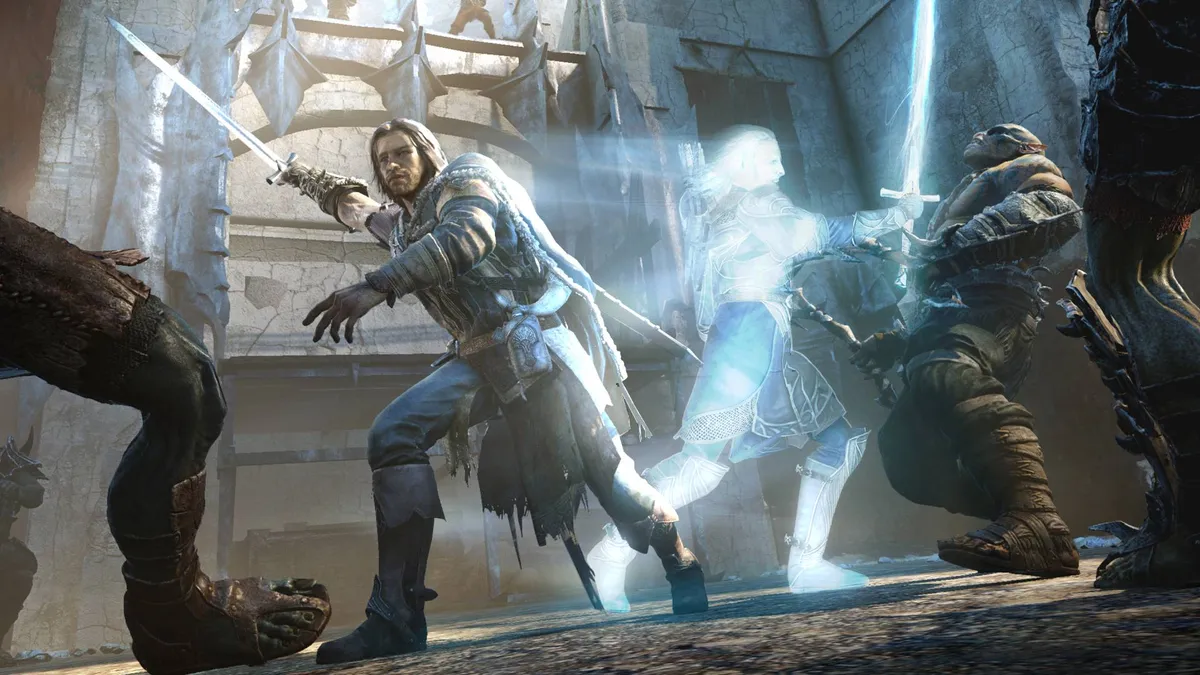
The real problem, such as it is, with the Nemesis System is extrinsic. Patent and copyright law have made it so that only Warner Bros. Interactive Entertainment can use it until 2036, by which time it will likely have been forgotten. It’s tragic. Genuinely, heartachingly tragic, that this fantastic system, so suited to action games of all calibres, is now locked away in an IP vault.
Even Warner Bros. haven’t touched it since the 2017 sequel, Middle-earth: Shadow of War. There was talk of it being used in Monolith’s Wonder Woman game, but that’s now been canned, so it’s unlikely that we’ll see it used again, at least until after the patent expires.
By then, I suspect that, like Ridge Racer‘s usage of playable games in loading screens, technology will have moved past the need for the Nemesis System, with new approaches to gaming making it redundant. That’s a real shame, a backsliding of gaming’s development, and something that makes Shadow of Mordor well worth your time.
Playing this game gives you a glimpse of an alternate LOTR, sure, and it’s interesting for that. But it also gives you a glimpse of a lost future of games, and that bittersweet beauty is worth more than an entire Silmarillion of backstory could ever be.

The best gaming consoles

Follow TechRadar on Google News and add us as a preferred source to get our expert news, reviews, and opinion in your feeds.

Cisco has released an open-source tool “to trace the origins of AI models,” reports SC World, “and compare model similarities for great visibility into the AI supply chain.”
[Cisco’s Model Provenance Kit] is a Python toolkit and command-line interface (CLI) that looks at signals such as metadata and weights to create a “fingerprint” for AI models that can then be compared to other model fingerprints to determine potential shared origins. “Think of Model Provenance Kit as a DNA test for AI models,” Cisco researchers wrote. “[…] Much like a DNA test reveals biological origins, the Model Provenance Kit examines both metadata and the actual learned parameters of a model (like a unique genome that comprises a model), to assess whether models share a common origin and identify signs of modification.”
The tool aims to address gaps in visibility into the AI model supply chain. For example, many organizations utilize open-source models from repositories like HuggingFace, where models could potentially be uploaded with incomplete or deceptive documentation. The Model Provenance Kit provides a way for organizations to verify claims about a model’s origins, such as claims that a model is trained from scratch, when in reality it may be copied from another model, Cisco said. This may put organizations at risk of using models with unknown biases, vulnerabilities or manipulations and make it more difficult to resolve any incidents that arise from these risks.
Thanks to Slashdot reader spatwei for sharing the news.


Both the Nissan Frontier and Toyota Tacoma start around $33,000 (including destination fee) for the 2026 model year, but they won’t be worth that much for long. In fact, as soon as drivers leave the dealership, their trucks will lose some of their original value; they’ll continue to do so as the months and years tick by. Yet based on the latest data, one of these two trucks is likely to lose its value notably faster than the other.
The estimated difference in depreciation between the two trucks varies between data sources, but the overall picture remains consistent. The Tacoma is predicted to lose less of its value over a 5 year period than the Frontier, although both models hold their value well compared to best-selling full-size pickups like the Ford F-150 and Chevrolet Silverado 1500.
According to the latest iSeeCars study, the Frontier will lose an average of 35.5% of its value after 5 years on the road, while the Tacoma will lose just 19.9% of its value across the same period of time. That makes the Tacoma the least-depreciating pickup truck on the market according to the study, just ahead of the larger Toyota Tundra. Meanwhile, CarEdge predicts that a new Frontier will lose 37% of its value after five years, while a new Tacoma will only drop 22% in value. KBB isn’t so optimistic about either truck’s depreciation rates, predicting that the Frontier and Tacoma will lose 52.2% and 44.3% of their value respectively over the same period.
The difference in predicted values between sources can be attributed to a variety of factors, from differences in calculation methodology to assumptions about the average new price each buyer will be paying. The latter factor is particularly important when comparing the Frontier and Tacoma, since the Tacoma has a far bigger price difference between its base and top trims.
Although both trucks start around the same MSRP for a bare-bones, base-spec model, many buyers will be looking further up the trim range to add as much extra capability and comfort as their budget allows. The costliest trim of the 2026 Frontier is the Long Bed Pro-4X, which starts from $44,115 (including a $1,745 destination fee). That price dwarfs the top end of the Tacoma’s trim range, where the TRD Pro starts from $66,195 (also including a $1,745 destination fee).
The currently available study data doesn’t confirm whether buyers who pick a top-spec Tacoma, which retails for roughly double the price of a base variant, can expect to hold onto as much of their original investment as those who buy a base-spec truck. Nonetheless, average value retention across the model as a whole remains very high, and given that the Tacoma was crowned the most dependable midsize truck on the market by JD Power in 2026, that class-leading value retention is unlikely to change anytime soon.
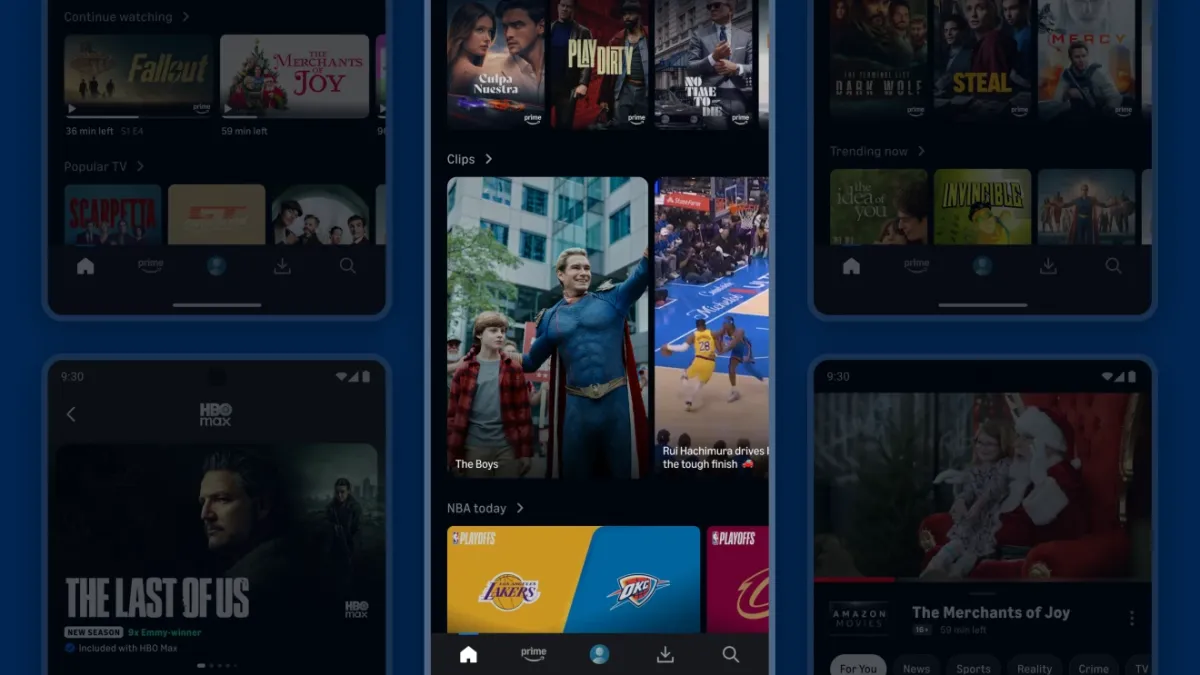
Amazon is adding a short-form video feed to the Prime Video app called “Clips,” the company announced on Friday.
Rolling out first in the U.S., Clips will include… well, clips of shows on Prime Video that are designed to hook a viewer and get them to give the full show a try. From that clip, users can add a title to their watchlist, share it with a friend, or navigate to rent, buy, or access the title through their subscription.
“Clips gives customers a whole new way to browse with short, personalized snippets tailored to their interests,” said Prime Video’s director of Global Application Experiences, Brian Griffin, in a press release. “Whether they have a few minutes to scroll or are looking for something to watch when they have more time, entertainment is just a tap away.”
Amazon first tested this short-form feed during the NBA season, showing highlights that users can scroll through as though they’re watching TikToks.
It’s not a surprise to see Prime Video make this change — Netflix, Peacock, Tubi, Disney, and others have recently rolled out similar experiences, which are designed to promote discovery. Netflix’s short-form feed even shares the Clips name.
Clips is first rolling out to select U.S. customers on iOS, Android, and Fire tablets, but it will be available more broadly this summer. Users can navigate to Clips by scrolling down on the Clips carousel on the Prime Video mobile home page, which will surface a full-screen vertical feed.
When you purchase through links in our articles, we may earn a small commission. This doesn’t affect our editorial independence.

“Plant seeds can sense the vibrations generated by falling raindrops,” reports ScienceAlert, “and respond by waking from their state of dormancy to welcome the water, new research shows…. to germinate in ‘anticipation’ of the coming deluge.”
The finding, discovered by MIT mechanical engineers Nicholas Makris and Cadine Navarro, offers the first direct evidence that seeds and seedlings can sense and respond to sounds in nature… “The energy of the rain sound is enough to accelerate a seed’s growth,” [explains Markis].
Plants don’t have the same aural equipment we do to actually hear sounds, of course. But the study suggests that seeds respond to the same vibrations that can produce a sound experience in our human ears. Across a series of experiments, the researchers submerged nearly 8,000 rice seeds in shallow tubs of water, at a depth of around 3 centimeters (1 inch), and exposed some of them to falling water drops over periods of six days… A hydrophone recorded the acoustic vibrations produced by the drops, confirming that the experiment mimicked the vibrations produced by actual raindrops falling in nature — such as the driving downpours that can sometimes pelt Massachusetts’ puddles, ponds, and wetlands… In their study, the researchers observed that seeds exposed to the falling drops germinated up to around 37% faster, compared with seeds that did not receive the simulated rainstorm treatment but were housed in otherwise identical conditions.
More information in Scientific American and Scientific Reports.







HarrisX Poll Found 52% of Registered Voters Support the CLARITY Act


Channel 5 – All Creatures Great and Small series 7 new post


Upbit adds B3 Korean won pair as Base token gains Korea access


Image AI models now drive app growth, beating chatbot upgrades


AP Dhillon – Old Money (Official Audio)


Weekend Open Thread: Marianne Dress

NCP car park operator enters administration putting 340 UK sites at risk of closure
New Netflix Movies in May 2026 — My Top 3 Picks to Stream
Anna Nicole Smith’s Daughter Attends 2026 Kentucky Derby


Five killed in Texas plane crash identified as Amarillo pickleball players


Melissa Joan Hart and More Stars Attend 2026 Kentucky Derby
Venus Williams’ Best Met Gala Looks Over the Years


Bitcoin mining equities rise in 2026 as BTC lags behind

Ignore market noise, India’s long-term story intact, say D-Street bulls Ramesh Damani and Sunil Singhania


Luka Doncic Injury Update: Doncic’s Hamstring Recovery Slows Lakers’ Hopes Against Thunder: Can He Run Yet?


Is Man United v Liverpool on TV? Channel, streaming and how to watch Premier League fixture


Winning Numbers Drawn as Jackpot Resets to $20 Million
“Storage Wars” star Darrell Sheets' ex-wife breaks silence on his death

Netflix’s 10-Part Miniseries Based on a True Story Is a Perfect Weekend Binge

Q1 2026 Tech Layoffs AI Wave Hits 81,747 as Firms Shift to AI Infrastructure




You must be logged in to post a comment Login