



Connect with us
DAPA Banner

Tech

Amazon cuts S’pore roles, phases out Amazon Fresh & local fulfilment operations

Published

on

The firm will help affected staff find new roles within the company

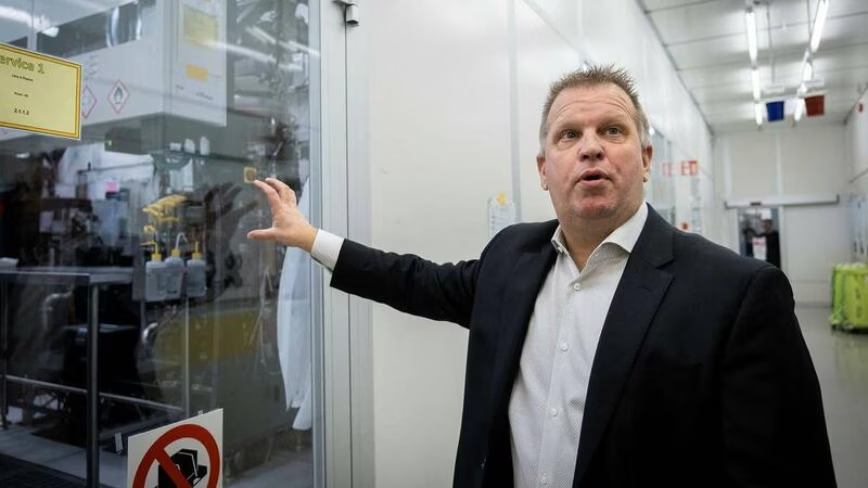
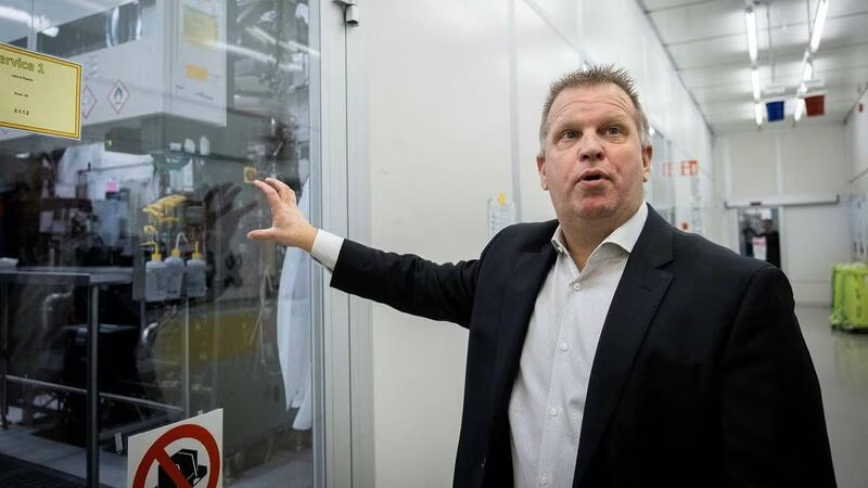
Amazon is cutting roles in Singapore as it shifts resources toward expanding its international store selection in the market.

In a post on its website, the firm said that a “small number” of roles will be impacted, and Amazon will help affected staff find new roles within the company. Those unable to secure an internal transfer will receive transition support, including severance payments and career services.

“Amazon remains deeply committed to Singapore and our investments across our retail, Global Selling, entertainment, devices, and AWS business lines, employing 2,500 people in the country,” said the company in the post.

At the same time, Amazon is also phasing out its local fulfilment operations in Singapore, including Amazon Fresh and its grocery partner network. The e-commerce giant said it is working with vendors and sellers on alternative ways to continue serving customers in the country.

Advertisement

These changes form part of Amazon’s broader effort to adapt to growing customer demand in Singapore for products from its international stores in the US, Japan and Germany.

“We’re seeing strong demand for products from international stores, and we’re responding by increasing our investment in what customers tell us they want most: great value selection from around the world with fast, reliable delivery,” said Peter Li, Amazon Singapore Country Manager.

Vulcan Post has reached out to Amazon for comment.

  • Read other articles we’ve written on tech giants here.

Featured Image Credit: Jaap Arriens via NurPhoto

Advertisement

Source link

Continue Reading
Click to comment

You must be logged in to post a comment Login

Leave a Reply

Tech

Voter Suppression In South Dakota Is Well Underway, Even Without SCOTUS’s Help

Published

on

from the subtracting-votes-by-adding-confusion dept

It may be almost impossible to devolve this country into a nation of slaveholders, but the Trump administration and all of its MAGA buddies are working hard to make sure a white person’s vote counts more than a vote cast by anyone else.

These bigots recently got an assist from the Supreme Court, which decided minorities can have their votes rendered meaningless so long as the people doing the gerrymandering don’t actually say the quiet part loud. Redistricting for the sole purpose of excluding as many non-whites as possible is perfectly legal if politicians never affirmatively state that the only reason they’re doing this is to make sure minorities can’t vote against their racist asses.

This is all part of what the state of South Dakota is doing now. Governor Larry Rhoden was never elected to his post. He was elevated after Kristi Noem was selected to head the DHS by Donald Trump. (Since she’s about as unemployed as any Trump appointee ever gets, I’m sure she wishes she was back running the state of South Dakota… into the ground.) His most recent brush with the electoral process saw him losing handily to Mike Rounds in the 2014 Senate race.

Rhoden actually needs to win an election if he wishes to remain South Dakota’s governor. And all the MAGA fellatio in the world doesn’t mean much when plenty of other MAGA acolytes are running against him.

Advertisement

So, there’s a mixture of things going on here. There’s Rhoden’s (and the state GOP’s) desire to engage with Trump’s election conspiracies — ones that claim (with zero facts in evidence) that a whole lot of undocumented immigrants are voting in state and local elections.

There’s also a nationwide attempt to deter voting by mail, because these votes more often side with the other team.

In response to completely made-up problems, the GOP passed a bill that Rhoden signed that says state residents must prove their citizenship to engage in local elections. If they can’t, they’re only allowed to participate in federal elections.

According to Rhoden and other GOP alarmists, that’s because too many people who aren’t citizens were granted permission to vote, thanks to what was likely nothing more than a clerical error. South Dakota may be small state in terms of population (~950,000 residents as of 2025), but the “problem” this vaguely written law supposedly addressed was even smaller.

Advertisement

Soulek said only one of the 273 noncitizens had ever cast a ballot. That was during the 2016 general election.

Those are the words of the Director of Elections Rachel Soulek, who works out of the Secretary of State’s office. The Secretary of State blamed this on clerical errors by the Department of Public Safety. The DPS provided the data that Governor Rhoden claims to evidence of widespread election fraud by non-citizens.

One illegal ballot. And that was likely an honest misunderstanding, rather than the criminal intent Rhoden and GOP buddies want to pretend it is.

But the law is on the books. Citizenship must be demonstrated to participate in state and local elections. The problem is that no one running these elections seems to agree what is or isn’t acceptable proof of citizenship.

Hughes County Finance Officer Thomas Oliva, who acts as that county’s auditor, said his office is requiring new voters to show the physical driver’s license.

“The main reasoning behind that is because it’s the back of the license. There’s no other identifying information on the back we can tie back to that person, so we felt it’s in the best interest to see the physical card,” Oliva told News Watch.

Advertisement

Haakon County Auditor Stacy Pinney said she has not run into any issues yet with voter registration but also will require new applicants to physically show the driver’s license.

“I’m going to make it a policy in my office that I want to see the actual card. If I have to verify it, I want to see the real deal,” Pinney told News Watch.

Meanwhile, Harding County Auditor Kathy Glines said her office will accept a photocopy of the driver’s license.

“They would have to send a front and back,” Glines told News Watch.

Advertisement

“I hope they would call before sending it by mail,” she added, referring to the limited hours the office is open.

Everyone appears to be making up their own rules because the law — and the Secretary of State’s office — are being deliberately vague about these requirements, especially in relation to absentee voting. And many people in the state may not know that the law only applies to people who have registered to vote after July of last year, so lots of people are going to be presenting IDs to precinct staffers even if they’re not legally required to do so.

This all adds up to exactly what Governor Rhoden and the GOP want: confusion over who is or isn’t allowed to vote, blended with another law passed by Rhoden that allows pretty much anyone to challenge someone else’s eligibility to vote.

The state could offer much-needed clarification. But it won’t.

Advertisement

As early and absentee voting for the primary election gets underway, Scott-Stoltz hopes officials in Pierre can provide more certainty on the registration process for new voters.

“We’re hoping for more clarification from the secretary’s office before the primary and are looking forward to working with the election board,” she said.

The secretary of state’s office didn’t respond to a request for comment by News Watch.

That’s a feature, not a bug. Those in power definitely prefer incumbent voters over new ones, much like incumbent voters prefer incumbents. They want to keep the jobs they have, rather than allow new voters to upset the incumbent apple cart. They all pretend they love the democratic system, but when it’s time latch onto another 2-4 years in power, they work together to reduce the electorate to the votes they can count on.

Filed Under: bigotry, larry rhoden, south dakota, trump administration, voter fraud, voter id law

Advertisement

Source link

Continue Reading

Tech

GeekWire test ride: Lime’s new bike packs a zippy punch into a compact, easier-to-use device

Published

on

GeekWire’s Kurt Schlosser cruises the Burke-Gilman Trail in Seattle on a new LimeBike electric bicycle from Lime this week. (GeekWire Photo / Todd Bishop)

Lime’s newest electric bike is being billed mostly as an accessibility upgrade, but don’t let that undersell it — this thing is nimble, punchy and genuinely fun to ride.

The new LimeBike, which plays on the company’s original name, is hitting Seattle streets this week, combining some of the comfort and ease of its compact, sit-down LimeGlider scooter with a quick-off-the-line bicycle powered by its throttle and pedal-assist.

The San Francisco-based micromobility company is betting that an easy-on, easy-off bike will bring new riders into the fold, particularly those who’ve found its existing hardware too intimidating or physically demanding.

While GeekWire appreciated the accessibility tweaks, a zippy test ride around Fremont left us equally impressed. The LimeBike accelerates fast, handles hill climbs and feels like a legitimate candidate to replace a car trip or two.

What’s new: The LimeBike features 20-inch wheels — smaller than those on the Gen4 e-bike — giving it a more compact, approachable feel. A step-through frame makes mounting and dismounting easier. There’s even a new seat clamp designed to let riders adjust height more easily. In the U.S., the bike comes equipped with a handlebar throttle, so riders can pedal with electric assist, use the throttle alone, or combine both.

Advertisement

Other upgrades include wider front baskets positioned lower on the frame for easier turning when loaded, ergonomic hand grips designed to reduce fatigue, and a sliding clamp-style phone holder. Lime also repositioned the battery and updated the wheels to lower the center of gravity — a tweak aimed at improving stability, particularly for smaller-statured riders.

“It wasn’t just learnings from the glider,” Parker Dawson, Lime’s senior regional lead for government relations in the Pacific Northwest, told GeekWire. “It was really talking with frequent riders, infrequent riders, and even non-riders in cities around the world, wanting to understand how to make a more accessible and even intuitive experience for more people.”

The LimeBike features smaller wheels, a lower step-through frame, and an easy-to-adjust seat clamp. (Lime Photo)

Who it’s designed for: Lime says the LimeBike is aimed at riders who may struggle with extended pedaling, with a particular focus on making the experience more approachable for women and older riders — two groups the company says have been underserved by existing e-bike designs.

But the target is broader than that. Dawson said the goal is for the LimeBike to be additive to Lime’s fleet rather than a one-to-one swap for a particular trip type or rider — helping more people find more reasons to leave their cars behind.

How it rides: For a rider who has tried everything Lime has to offer, the LimeBike checks a number of the boxes the company was going for when it comes to ease of use. But compared to older model bikes, it’s also just more fun.

Advertisement

Sure, the seat adjusted easily and the step-through frame made getting on and off a breeze. The bike feels more compact thanks to the lower center of gravity, much like the LimeGlider, which GeekWire tested back in 2024.

But the LimeBike also feels lighter and is quick off the line, reaching 15 mph in short order via throttle, pedal assist, or a combination of both. The ability to alternate between the two — coasting on the pedals, then leaning on the throttle — gave the ride a natural feel while still leaving room to actually break a sweat.

The bike handled moderate hills in the Fremont neighborhood without much drama, losing a little speed on the climb but staying comfortable throughout.

And if you’re thinking the last thing Seattle or its bike trails need is another way-too-fast e-machine, the LimeBike is still much slower than the 25 mph speeds (or more) that many modified commercial e-bikes are reaching.

Advertisement
Classic versions of Lime’s electric bikes, in Seattle in 2018. (GeekWire File Photo / Kurt Schlosser)

By the numbers: Lime will roll out 500 LimeBikes to start, slotting them into a Seattle fleet that currently totals around 15,000 devices — including 4,000 Gen4 e-bikes, 7,000 scooters, and 4,000 gliders. Seattle is Lime’s largest shared micromobility market in North America by fleet volume.

The company is also now Seattle’s sole micromobility operator, a status it assumed April 1 following the exit of competitors including Bird, which previously filed for bankruptcy. Dawson said riders had been choosing Lime over rivals well before the field thinned out.

The consolidation hasn’t hurt demand. Lime provided 2.3 million rides in Seattle in the first quarter of this year, up roughly 50% from 1.4 million in Q1 of last year — itself coming off a record 10.1 million rides in 2024.

What’s ahead: With Seattle set to host FIFA World Cup matches this summer, Lime is expecting a surge in demand — but Dawson said the company isn’t planning to dramatically expand its fleet for the tournament. Instead, Lime made a conscious decision earlier this year to request 1,000 additional gliders, prioritizing seated options for Seattle’s regular riders over a one-time influx of hardware.

“We are very confident in our operations team that we can be delivering a great user experience and be a really strong asset to the transportation network on game days,” Dawson said.

Advertisement

Dawson also said progress is being made on Lime Vision, the company’s previously announced AI-powered compliance technology, saying 50% of the standing fleet will be outfitted by June 1. Lime is also continuing to work with SDOT on expanding its network of parking corrals across the city — a key piece of making the overall system more convenient for riders.

Lime’s current contract with SDOT runs through the end of the year, and Dawson said the company, which has been in Seattle since 2017, is eager to compete for a longer-term deal.

“Seattle is one of our oldest, most well-developed markets that we have across the world,” Dawson said. “That’s something of an innovation center. A lot of our tech folks live here. A lot of our new technologies are born and bred here to be exported around the world to other cities.”

Source link

Advertisement
Continue Reading

Tech

Major Homebuilder To Test Placing Mini Data Centers in Suburban Backyards

Published

on

NewtonsLaw writes: According to Realtor.com, a California startup called Span plans to partner with Nvidia, PulteGroup, and other homebuilders to equip new homes with mini-data centers, so as to relieve the need to build and power much larger traditional centers. The article states the company “can install 8,000 XFRA units about six times faster and at five times lower cost than the construction of a typical centralized 100 megawatt data center of the same size.” Could this be the solution to at least some of the problems hindering the rollout of greater data-center capacity for AI systems? “One big reason the XFRA model works is that the average American home only uses about 40 percent of its electrical capacity,” Span said. “As big data center developers struggle to find power sources and distribution capacity, XFRA uses capacity that’s already available.”

The startup says they will launch a 100-home proof of concept within the year to see if the idea is viable.

Source link

Continue Reading

Tech

In 2026, what does a career in data engineering look like?

Published

on

IAS’ Declan Gowran explores his role in the data engineering space and how leaders create cohesive environments.

Senior staff data ops engineer at IAS Declan Gowran’s journey into the data engineering world evolved organically from a broader IT infrastructure and cloud background.

He told SiliconRepublic.com, “Early in my career, I worked extensively on enterprise infrastructure, virtualisation and cloud deployments across multiple platforms, which exposed me to large scale systems and the complexities of managing data at scale. Over time, I became increasingly fascinated with the ways structured and unstructured data can drive decision making and AI applications. 

“That led me to roles at Optum and IAS where I could focus on building secure, scalable data platforms, integrating DevOps, MLOps and data governance frameworks, and supporting enterprise AI workloads. Essentially, my path was shaped by a mix of curiosity, technical challenges and opportunities to work at the intersection of cloud, data, and analytics.”

Advertisement
What is the current data engineering landscape like in Ireland?

Ireland’s data engineering landscape is vibrant and rapidly maturing. With the strong presence of multinational tech companies and data driven organisations, there is a growing demand for engineers who can not only manage cloud infrastructure but also design modern, scalable data platforms. Organisations are increasingly adopting cloud native architectures, Kubernetes based platforms and MLOps frameworks. There’s also an emphasis on governance, compliance and data mesh strategies, particularly for companies handling sensitive or regulated data.

What are the biggest challenges currently impacting the data engineering sector and how might they be addressed?

Data governance and trust at scale. As data powers AI and decision-making, ensuring quality, lineage and secure access, while meeting regulations like GDPR, is critical. This requires strong governance frameworks and centralised metadata to maintain consistency and control. Complexity across distributed environments. Most organisations operate across multi-cloud and hybrid systems, which makes integration, standardisation and orchestration difficult. The focus here is simplifying architectures and using scalable, interoperable platforms to reduce fragmentation. Scaling for real-time and AI-driven workloads. There’s increasing demand for low-latency data and reproducible AI pipelines. This means investing in streaming, automation and reliable infrastructure that can handle both batch and real-time use cases. Overall, the solution isn’t just tooling, it’s aligning these capabilities to clear business outcomes, so data engineering drives measurable value rather than just technical capability.

What are you currently working on and what is its potential?

I’m currently leading the development of a secure, cost-optimised enterprise data platform at IAS, built on Databricks and Kubernetes. It’s designed to centralise governance while enabling scalable, self-serve access to data across the business. In parallel, we’re building AI gateways and services to support secure deployment of LLM and AI workloads, ensuring we can scale these capabilities responsibly. The potential is twofold. Internally, it significantly improves efficiency, teams can access trusted data faster and experiment more easily. Externally, it enables better products and outcomes, from more effective ad campaigns to improved transparency and performance.

What goes into creating a sturdy, cohesive team in data and engineering?

Creating a high performing data and engineering team requires balancing technical expertise with collaboration, culture and shared values. I am a strong believer in investing in people and fostering a positive team environment. It’s not enough for team members to just understand the technology, they also need to get along, communicate effectively and support one another. I focus on mentorship and development, clear communication, aligning the team, cross functional collaboration, breaking down silos, analytics, empowerment and autonomy. As well as providing engineers with the right tools and frameworks to innovate while maintaining accountability. By prioritising people and culture, we create an environment where trust, communication and collaboration are strong, allowing innovation and high performance to become natural outcomes.

Advertisement
How can leaders in dynamic spaces create productive and cohesive working environments?

Leaders need to provide clarity, trust and structured autonomy. This involves setting clear goals, fostering a culture of feedback and encouraging innovation without micromanaging. Leveraging agile practices, automated workflows and transparent dashboards also helps teams measure progress and stay aligned. Equally important is supporting professional development, celebrating achievements and ensuring psychological safety so that team members can collaborate openly and take calculated risks.

Have you any predictions for how the data engineering space might evolve over the course of the next nine months?

Over the next nine months, I anticipate several key trends shaping the data engineering landscape. Firstly, the wider adoption of data mesh and governance frameworks, particularly for enterprises managing AI and agentic workloads, with a strong focus on data lineage, provenance and integrity knowing where data comes from, how it changes and why. The Increased emphasis on data quality and protection against data poisoning, as organisations recognise that “garbage in, garbage out” can compromise AI and agentic model outcomes. The Greater adoption of cloud native and serverless architectures, enabling scalable, flexible and cost efficient platforms capable of supporting large AI workloads, agentic processes and seamless connectivity across systems. 

The Expansion of retrieval augmented generation vector databases and connected pipelines, supporting advanced AI and agentic use cases while ensuring embeddings, knowledge sources, and real time data remain accurate, auditable, and interoperable. A stronger focus on observability, performance, and compliance, with distributed monitoring, automated validation and lineage tracking becoming standard to maintain trust in both traditional data and AI outputs. Lastly the standardisation of AI model deployment and MLOps practices, enabling enterprises to scale foundation models, agentic workloads and intelligent workflows while maintaining governance, reproducibility and operational reliability.

Don’t miss out on the knowledge you need to succeed. Sign up for the Daily Brief, Silicon Republic’s digest of need-to-know sci-tech news.

Advertisement

Source link

Continue Reading

Tech

How To Better Enjoy VR On Linux

Published

on

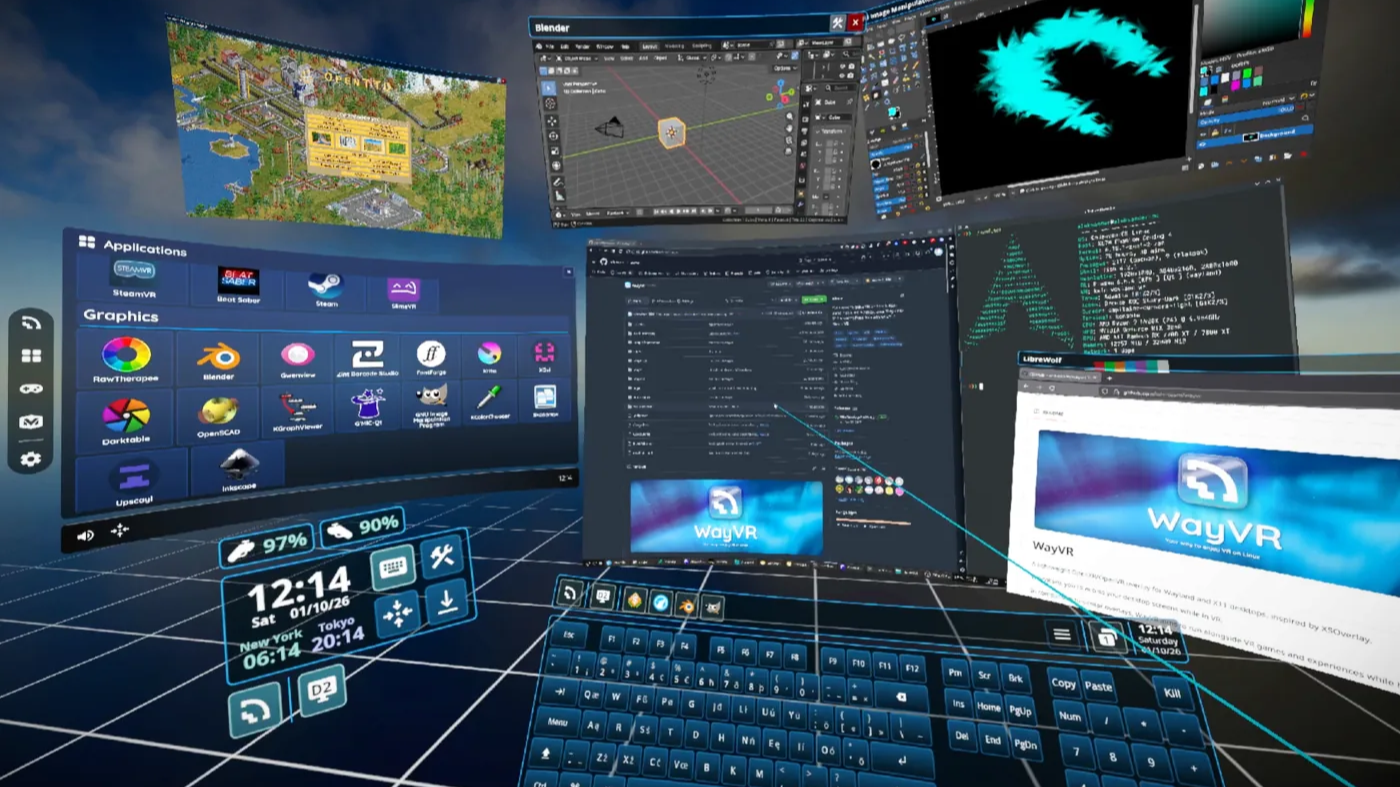
Linux folks are used to having to roll many of their own solutions, and better Linux desktop usability is a goal of the WayVR project, which aims to provide desktop control and app launching from within a VR session.

VR applications can already stream from Linux to standalone headsets with projects like WiVRn, but what WayVR does is let one launch programs and access desktop screens within VR. Put another way, instead of the headset being limited to acting as a pseudo-monitor that only receives the output of an already-running VR application, the headset and controllers can now be used to interact with one’s computer as if one were physically sitting at it. Controls and user interface are highly flexible and help users to do anything they need — including clicking, typing, and launching applications. It’s a considerable step forward for convenience and general usability.

Naturally, when it comes to using a computer from within VR there is plenty of unexplored territory regarding user interfaces. It’s fertile ground for experimentation in everything from DIY headsets to ways to input text without a keyboard, so if you enjoy working on the frontiers of such things, it’s a good scene to dive into.

Advertisement

Source link

Advertisement
Continue Reading

Tech

How I Fixed My Webcam Lighting for Zoom Calls (2026)

Published

on

Here’s the problem. We have two young kids at home, and we live in the city in a townhouse that isn’t exactly large. With that comes a lot of “shared space”—also known as partially controlled chaos. The room that we have colloquially named the “office” is hardly a dedicated work space. I couldn’t survive without the blur background function in Zoom and Teams. The closet is a storage space, and in addition to our standing desk, which is typically filled with laptops, monitors, laptop stands, and various peripherals I’m testing, we also have some nonwork items throughout the room. Some of those include a play kitchen, bins of toy food, an entire crate of Duplos, a modular play couch, and an ssortment of other pokey things that hurt to step on.

Moving isn’t an option—at least, not an easy one. I could certainly close the blinds, but that’s also where my 5-year-old displays his Lego creations. And doing so also leaves me exclusively with terrible track lighting on the ceiling—which, again, is behind me. It’s a mixed-use room, and I’m sure some of you can relate to the limitations that creates.

I’m back to buying a webcam. After all, an external webcam doesn’t have to stuff all its parts into a tiny camera module that’s squeezed into the top bezel of a screen. Maybe it’s wrong to expect much from these tiny laptop cameras in the first place. I gathered every possible webcam I could find. There are tons of options out there, ranging from cheap 1080p cameras up to spending hundreds of dollars on 4K options with AI features. But I was less concerned with specs like resolution, megapixels, aperture, and field of view, and simply found myself wanting to improve the dismal situation I faced in my office.

Lights, Camera, Action

Two small rectangular webcams clipped to the top of a laptop screen one in white and the other black

Insta360 Link 2C (left); Insta360 Link 2C Pro (right)

Advertisement

Photograph: Luke Larsen

Nearly all of the dozen webcams I tried out looked great while under ideal lighting. I spent some time working in a different room next to a window, and the upgrade to an external camera felt significant. With all that light to work with, the higher-end cameras with a larger 1/1.3-inch image sensor handled the situations beautifully. It didn’t need to blow out the direct natural light to get details in my face, showing a wider dynamic range of shadows and highlights. Having more natural light in the room improved just about every webcam I tried, but they also better showcased just how powerful some of these higher-end cameras really are, such as the Insta360 Link 2C Pro or Obsbot Tiny 3. These are the scenarios most webcams are tested in, leaving them all looking more or less adequate.

Source link

Continue Reading

Tech

AirAsia to start a new airline despite fuel crisis

Published

on

The announcement comes after a recent US$19 billion purchase of 150 Airbus A220 planes

AirAsia X co-founder Tony Fernandes is preparing to launch a new airline, betting that expanding amid the aviation industry’s turmoil from high oil prices will pay off in the future, Bloomberg reported.

The new airline will be announced in the next month or two, Fernandes said in a video interview from Montreal late Wed (May 6). The low-cost Southeast Asian carrier group is already moving planes for the venture, though he declined to share further details.

The expansion follows AirAsia’s US$19 billion order for Canadian-made commercial aircraft—what Prime Minister Mark Carney called the largest such purchase ever. The order covers 150 Airbus A220 planes. These are smaller, nimbler jets Fernandes plans to deploy across all corners of Asia.

“Why waste a crisis? There are opportunities in a crisis,” Fernandes said.

Advertisement

We can’t control what happens in the Middle East, but we have to take a view that it’s not going to last for two years.

Tony Fernandes

It’s a bold bet, even by AirAsia’s unconventional standards. The carrier’s refusal to hedge fuel costs has helped send shares tumbling roughly 35% since the Iran war began, making it the worst performer on the Bloomberg World Airlines index during the period.

Fernandes remained defiant on hedging fuel costs, predicting oil prices will eventually come back down.

“Obviously people who hedge now are in the money, but over a longer period, hedging never really works,” Fernandes said. “So we continue to not hedge like many American airlines, and we feel oil is bearish.”

Advertisement

To fund expansion, AirAsia is preparing to sell up to US$600 million in bonds and is negotiating with Malaysian banks for a “quite a large” refinancing loan to cut interest costs, Fernandes said. 

He’s also planning to meet with Canadian pension funds to attract investors, he said. 

Currently, the airline is expecting short-term pain. Fernandes said the company will soon announce it will miss its initial profit target, though revenue should land “more or less” where predicted.

AirAsia has also explored expanding in Vietnam, people familiar with the matter have said.

Advertisement

The group currently operates across Malaysia, Thailand, and Indonesia with a fleet of roughly 250 mostly single-aisle Airbus aircraft. The latest order will grow its backlog to around 550 single-aisle jets.

On another note, AirAsia has announced it’s going to launch flights from Bahrain, with the goal of launching a local unit based in the Gulf island nation.

  • Read other articles we’ve written on Singaporean businesses here.

Featured Image Credit: Getty Images

Advertisement

Source link

Continue Reading

Tech

The ITSM complexity crisis and how to control it

Published

on

The IT Service Management (ITSM) platform market has evolved beyond an operational, IT-centric back-office niche into one of the most strategic tiers of enterprise technology.

Platforms such as ServiceNow, Atlassian JSM, and BMC Helix ITSM power everything from incident response to digital workflows that connect IT operations, security, HR, facilities, and customer service.

Source link

Advertisement
Continue Reading

Tech

How Do The Two Tires Compare?

Published

on


Getting the right set of tires for your vehicle is crucial for a safe, quiet, and smooth ride. For tackling all kinds of weather and road conditions, digging through the best all-season tires on the market is in your best interest before settling on your next set. Two notable all-season tires from tenured, reliable brands are the Michelin CrossClimate 2 and the Goodyear WeatherReady 2. While they do overlap in some areas, like the fact that they’re both all-season tires with V-shaped treads and 60,000 mile warranties that start at well over $100 each, make no mistake; these tires aren’t exactly the same.

These specific Michelin and Goodyear tires deviate in a few key areas. The CrossClimate 2s claim to be the longer-lasting of the two tires, providing around 23,000 more miles of drive time than the WeatherReady 2s. Thermal Adaptive Tread is included as well to prevent the tire from becoming brittle when faced with cold roads and low temperatures. Meanwhile, Goodyear’s tires are advertised as including a built-in Wear Gauge to track tread depth, AquaTred technology for improved traction in wet and slushy road conditions, and Evolving Traction Grooves to maintain tire grip on the road throughout the tire’s lifespan.

Advertisement

While this is all well and good, the big question is how do these tires actually compare when in use? Here’s what testing has shown about the CrossClimate 2 and the WeatherReady 2 when put through the same conditions.

Advertisement

How the CrossClimate 2 and the WeatherReady 2 perform

The only true way to know how the Michelin CrossClimate 2 and the Goodyear WeatherReady 2 tires stack up is to put them through their paces. That’s exactly what Jack Talks Tires on YouTube got the opportunity to do, using both sets of tires on a closed course. They were taken through wet and dry patches alike, around tight turns, and in quick braking scenarios. Overall, they did well and were pretty evenly-matched in their handling and braking. Still, there were a few areas where the WeatherReady 2 turned out to have a slight edge over the CrossClimate 2.

The area where the WeatherReady 2 proved its worth was the rough road simulation. On uneven, bumpy road, the WeatherReady 2 was noticeably quieter, likely thanks to Goodyear’s Comfort Flex technology: Sidewalls that flex to absorb road impact and create a smoother, quieter driving experience on bump and pothole-filled roads. The Evolving Traction Grooves also turned out to be a difference-maker for grip and handling, and Jack Talks Tires noted that the tire’s integrated Wear Gauge is a nice touch that the average driver will surely appreciate.

Of the major tire brands currently on the scene, few are at the level of Michelin and Goodyear. Thus, it’s not too surprising that the CrossClimate 2 and WeatherReady 2 are both durable, capable all-season tires that have a lot to offer drivers in need of a tire refresh. While the WeatherReady 2 scored a narrow victory over the CrossClimate 2 in some regards, odds are you’ll experience a similarly smooth and safe ride with either type.

Advertisement


Source link

Advertisement
Continue Reading

Tech

Pure-play MEMS foundry Silex prices Stockholm IPO

Published

on

The Bure Equity- and Creades-backed pure-play MEMS foundry priced at SEK 81 per share, with the offering oversubscribed several times. Cornerstone investors, including Capital Research, Fidelity, AFA, AP2, AP3, AP4, Swedbank Robur, and Carnegie, took roughly three-quarters of the deal.


Silex Microsystems opened sharply higher on its Nasdaq Stockholm debut on Wednesday, with the chipmaker’s shares climbing in early trade after the IPO priced at SEK 81 a share. The offering had been oversubscribed several times in the bookbuild and was placed almost entirely with institutional cornerstones, leaving little float for retail demand on opening day.

The deal raised approximately SEK 1.99bn ($217m) on a 24.6-million-share offering, with the equity valuation at IPO around SEK 8.9bn. The trading symbol is SILEX. Settlement is scheduled for 11 May.

Silex describes itself as the world’s leading pure-play MEMS foundry. The company manufactures micro-electromechanical systems for customers in automotive, industrial, life sciences, and consumer electronics, operating from a single fab in Järfälla, just outside Stockholm, on 200mm wafer production.

Advertisement

The pure-play model means Silex builds chips designed by other companies rather than designing its own product, the equivalent of TSMC’s relationship with fabless semiconductor designers but in the much smaller MEMS niche.

The financials behind the listing are unusually clean for a recent European chip IPO. Net sales for the year ended 31 December 2025 reached SEK 1,385m, with EBIT of SEK 368m, an operating margin around 27 per cent. First-quarter 2026 numbers were stronger still, with SEK 375m of revenue and SEK 128m of EBIT, an operating margin above 34 per cent. Those are the kind of figures that make a pure-play foundry attractive to the institutional cornerstone investors that took most of the deal.

The cornerstone slate is the part of the announcement that sets the stock’s likely trading dynamic. Cornerstones together purchased ordinary shares for approximately SEK 1.501bn, representing about 75 per cent of the offering. The list spans Creades, AFA Insurance, Tredje AP-fonden, Capital Research Global Investors, Swedbank Robur Fonder, Fjärde AP-fonden, Andra AP-fonden, Fidelity International, and Carnegie Fonder.

The combination of three Swedish national pension funds, two of the country’s largest fund managers, two major US institutional investors, and the largest insurance company in Sweden is an unusually deep cornerstone book for a Stockholm chip listing.

Post-IPO ownership stays concentrated. Bure Equity retains roughly 34.2 per cent of the outstanding ordinary shares, and Creades holds about 10.1 per cent. The two firms led the original investor consortium that acquired Silex from its previous Chinese-state-aligned owner in 2023, a transaction that returned the company to Swedish ownership after roughly seven years under Sai MicroElectronics.

Advertisement

That ownership transition is the relevant backstory: Silex spent the latter half of the 2010s as a Swedish-domiciled fab inside a Chinese-controlled corporate structure, until the geopolitical realignment of 2022 and 2023 made that arrangement commercially and politically untenable.

The MEMS market itself has been growing on AI-adjacent demand. Recent contracted volume includes a high-volume manufacturing partnership with Norwegian audio specialist sensiBel for studio-quality MEMS microphones, a category where the underlying processor demand is being driven by the same on-device AI workloads scaling through the broader semiconductor industry.

Silex’s customer base is broader than any single end-market, but the same demand pattern that has supported foundry capacity additions globally is part of why a pure-play MEMS operator is now able to clear a Stockholm IPO at this multiple.

Two questions are unresolved on the public record. The first is the magnitude of Wednesday’s debut-day move; Bloomberg’s framing was that shares soared, but the precise percentage is not yet in the secondary coverage. The second is what Silex does with the IPO proceeds.

Advertisement

The prospectus indicates capacity expansion at the Järfälla facility and balance-sheet flexibility for selective acquisitions in the broader MEMS supply chain. Whether the company can deploy the capital faster than the wider AI-driven demand cycle holds up will be the first thing investors look for in the company’s quarterly disclosures.

For now, the listing has done what it set out to do. Silex has cleared a public-market valuation around SEK 8.9bn enterprise value, attracted a deep cornerstone book, and given Bure Equity and Creades a partial path to monetisation while keeping a controlling combined stake. The next checkpoint is the Q2 print, which will be the first reporting cycle in which Silex operates as a public company.

Source link

Advertisement
Continue Reading

Trending

Copyright © 2025