Getting the right set of tires for your vehicle is crucial for a safe, quiet, and smooth ride. For tackling all kinds of weather and road conditions, digging through the best all-season tires on the market is in your best interest before settling on your next set. Two notable all-season tires from tenured, reliable brands are the Michelin CrossClimate 2 and the Goodyear WeatherReady 2. While they do overlap in some areas, like the fact that they’re both all-season tires with V-shaped treads and 60,000 mile warranties that start at well over $100 each, make no mistake; these tires aren’t exactly the same.
These specific Michelin and Goodyear tires deviate in a few key areas. The CrossClimate 2s claim to be the longer-lasting of the two tires, providing around 23,000 more miles of drive time than the WeatherReady 2s. Thermal Adaptive Tread is included as well to prevent the tire from becoming brittle when faced with cold roads and low temperatures. Meanwhile, Goodyear’s tires are advertised as including a built-in Wear Gauge to track tread depth, AquaTred technology for improved traction in wet and slushy road conditions, and Evolving Traction Grooves to maintain tire grip on the road throughout the tire’s lifespan.
Advertisement
While this is all well and good, the big question is how do these tires actually compare when in use? Here’s what testing has shown about the CrossClimate 2 and the WeatherReady 2 when put through the same conditions.
Advertisement
How the CrossClimate 2 and the WeatherReady 2 perform
The only true way to know how the Michelin CrossClimate 2 and the Goodyear WeatherReady 2 tires stack up is to put them through their paces. That’s exactly what Jack Talks Tires on YouTube got the opportunity to do, using both sets of tires on a closed course. They were taken through wet and dry patches alike, around tight turns, and in quick braking scenarios. Overall, they did well and were pretty evenly-matched in their handling and braking. Still, there were a few areas where the WeatherReady 2 turned out to have a slight edge over the CrossClimate 2.
The area where the WeatherReady 2 proved its worth was the rough road simulation. On uneven, bumpy road, the WeatherReady 2 was noticeably quieter, likely thanks to Goodyear’s Comfort Flex technology: Sidewalls that flex to absorb road impact and create a smoother, quieter driving experience on bump and pothole-filled roads. The Evolving Traction Grooves also turned out to be a difference-maker for grip and handling, and Jack Talks Tires noted that the tire’s integrated Wear Gauge is a nice touch that the average driver will surely appreciate.
Of the major tire brands currently on the scene, few are at the level of Michelin and Goodyear. Thus, it’s not too surprising that the CrossClimate 2 and WeatherReady 2 are both durable, capable all-season tires that have a lot to offer drivers in need of a tire refresh. While the WeatherReady 2 scored a narrow victory over the CrossClimate 2 in some regards, odds are you’ll experience a similarly smooth and safe ride with either type.
The firm will help affected staff find new roles within the company
Amazon is cutting roles in Singapore as it shifts resources toward expanding its international store selection in the market.
In a post on its website, the firm said that a “small number” of roles will be impacted, and Amazon will help affected staff find new roles within the company. Those unable to secure an internal transfer will receive transition support, including severance payments and career services.
“Amazon remains deeply committed to Singapore and our investments across our retail, Global Selling, entertainment, devices, and AWS business lines, employing 2,500 people in the country,” said the company in the post.
At the same time, Amazon is also phasing out its local fulfilment operations in Singapore, including Amazon Fresh and its grocery partner network. The e-commerce giant said it is working with vendors and sellers on alternative ways to continue serving customers in the country.
Advertisement
These changes form part of Amazon’s broader effort to adapt to growing customer demand in Singapore for products from its international stores in the US, Japan and Germany.
“We’re seeing strong demand for products from international stores, and we’re responding by increasing our investment in what customers tell us they want most: great value selection from around the world with fast, reliable delivery,” said Peter Li, Amazon Singapore Country Manager.
Vulcan Post has reached out to Amazon for comment.
Read other articles we’ve written on tech giants here.
Linux folks are used to having to roll many of their own solutions, and better Linux desktop usability is a goal of the WayVR project, which aims to provide desktop control and app launching from within a VR session.
VR applications can already stream from Linux to standalone headsets with projects like WiVRn, but what WayVR does is let one launch programs and access desktop screens within VR. Put another way, instead of the headset being limited to acting as a pseudo-monitor that only receives the output of an already-running VR application, the headset and controllers can now be used to interact with one’s computer as if one were physically sitting at it. Controls and user interface are highly flexible and help users to do anything they need — including clicking, typing, and launching applications. It’s a considerable step forward for convenience and general usability.
Naturally, when it comes to using a computer from within VR there is plenty of unexplored territory regarding user interfaces. It’s fertile ground for experimentation in everything from DIY headsets to ways to input text without a keyboard, so if you enjoy working on the frontiers of such things, it’s a good scene to dive into.
Here’s the problem. We have two young kids at home, and we live in the city in a townhouse that isn’t exactly large. With that comes a lot of “shared space”—also known as partially controlled chaos. The room that we have colloquially named the “office” is hardly a dedicated work space. I couldn’t survive without the blur background function in Zoom and Teams. The closet is a storage space, and in addition to our standing desk, which is typically filled with laptops, monitors, laptop stands, and various peripherals I’m testing, we also have some nonwork items throughout the room. Some of those include a play kitchen, bins of toy food, an entire crate of Duplos, a modular play couch, and an ssortment of other pokey things that hurt to step on.
Moving isn’t an option—at least, not an easy one. I could certainly close the blinds, but that’s also where my 5-year-old displays his Lego creations. And doing so also leaves me exclusively with terrible track lighting on the ceiling—which, again, is behind me. It’s a mixed-use room, and I’m sure some of you can relate to the limitations that creates.
I’m back to buying a webcam. After all, an external webcam doesn’t have to stuff all its parts into a tiny camera module that’s squeezed into the top bezel of a screen. Maybe it’s wrong to expect much from these tiny laptop cameras in the first place. I gathered every possible webcam I could find. There are tons of options out there, ranging from cheap 1080p cameras up to spending hundreds of dollars on 4K options with AI features. But I was less concerned with specs like resolution, megapixels, aperture, and field of view, and simply found myself wanting to improve the dismal situation I faced in my office.
Lights, Camera, Action
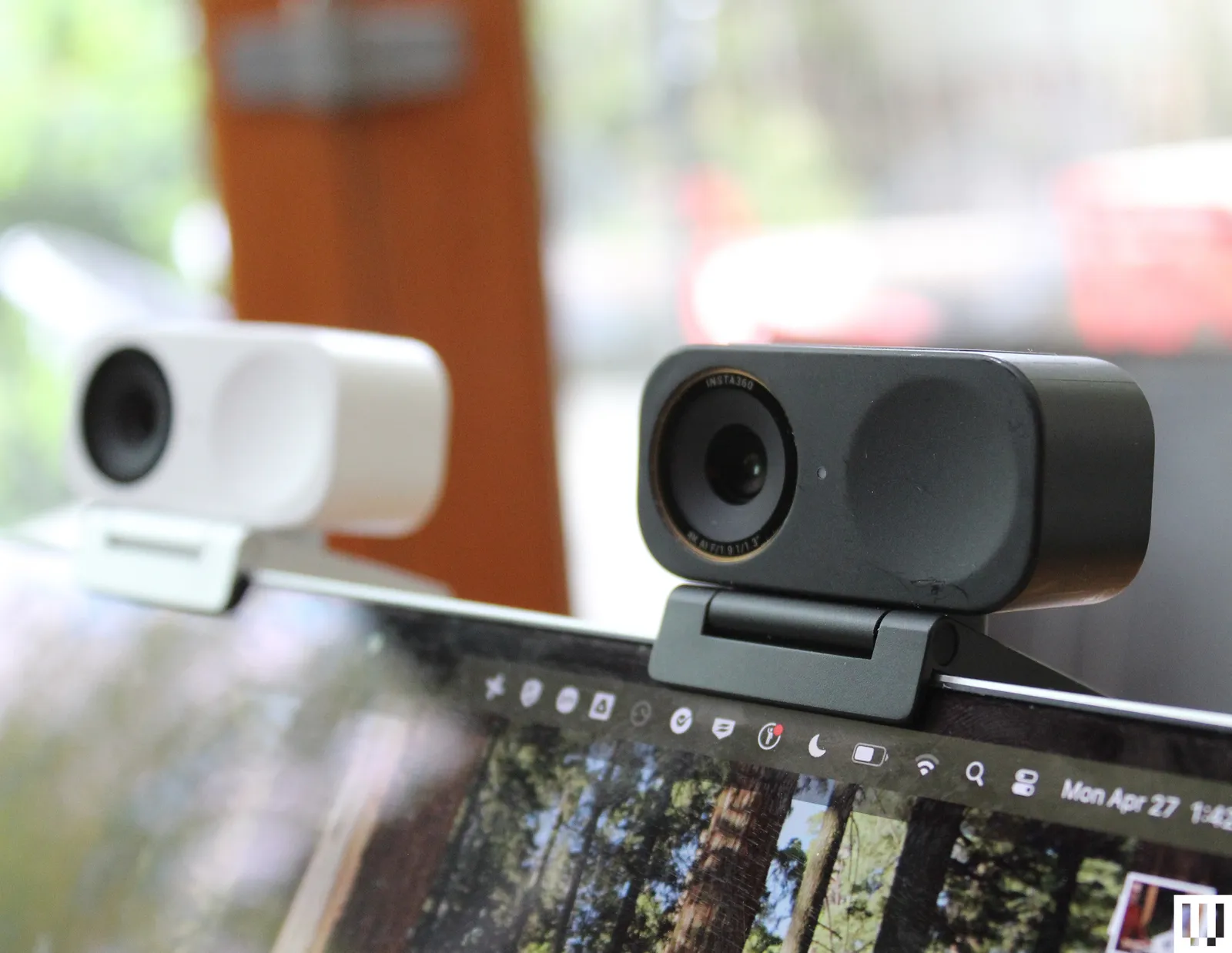
Insta360 Link 2C (left); Insta360 Link 2C Pro (right)
Advertisement
Photograph: Luke Larsen
Nearly all of the dozen webcams I tried out looked great while under ideal lighting. I spent some time working in a different room next to a window, and the upgrade to an external camera felt significant. With all that light to work with, the higher-end cameras with a larger 1/1.3-inch image sensor handled the situations beautifully. It didn’t need to blow out the direct natural light to get details in my face, showing a wider dynamic range of shadows and highlights. Having more natural light in the room improved just about every webcam I tried, but they also better showcased just how powerful some of these higher-end cameras really are, such as the Insta360 Link 2C Pro or Obsbot Tiny 3. These are the scenarios most webcams are tested in, leaving them all looking more or less adequate.
The announcement comes after a recent US$19 billion purchase of 150 Airbus A220 planes
AirAsia X co-founder Tony Fernandes is preparing to launch a new airline, betting that expanding amid the aviation industry’s turmoil from high oil prices will pay off in the future, Bloomberg reported.
The new airline will be announced in the next month or two, Fernandes said in a video interview from Montreal late Wed (May 6). The low-cost Southeast Asian carrier group is already moving planes for the venture, though he declined to share further details.
The expansion follows AirAsia’s US$19 billion order for Canadian-made commercial aircraft—what Prime Minister Mark Carney called the largest such purchase ever. The order covers 150 Airbus A220 planes. These are smaller, nimbler jets Fernandes plans to deploy across all corners of Asia.
“Why waste a crisis? There are opportunities in a crisis,” Fernandes said.
Advertisement
We can’t control what happens in the Middle East, but we have to take a view that it’s not going to last for two years.
Tony Fernandes
It’s a bold bet, even by AirAsia’s unconventional standards. The carrier’s refusal to hedge fuel costs has helped send shares tumbling roughly 35% since the Iran war began, making it the worst performer on the Bloomberg World Airlines index during the period.
Fernandes remained defiant on hedging fuel costs, predicting oil prices will eventually come back down.
“Obviously people who hedge now are in the money, but over a longer period, hedging never really works,” Fernandes said. “So we continue to not hedge like many American airlines, and we feel oil is bearish.”
Advertisement
To fund expansion, AirAsia is preparing to sell up to US$600 million in bonds and is negotiating with Malaysian banks for a “quite a large” refinancing loan to cut interest costs, Fernandes said.
He’s also planning to meet with Canadian pension funds to attract investors, he said.
Currently, the airline is expecting short-term pain. Fernandes said the company will soon announce it will miss its initial profit target, though revenue should land “more or less” where predicted.
AirAsia has also explored expanding in Vietnam, people familiar with the matter have said.
Advertisement
The group currently operates across Malaysia, Thailand, and Indonesia with a fleet of roughly 250 mostly single-aisle Airbus aircraft. The latest order will grow its backlog to around 550 single-aisle jets.
On another note, AirAsia has announced it’s going to launch flights from Bahrain, with the goal of launching a local unit based in the Gulf island nation.
Read other articles we’ve written on Singaporean businesses here.
The IT Service Management (ITSM) platform market has evolved beyond an operational, IT-centric back-office niche into one of the most strategic tiers of enterprise technology.
Platforms such as ServiceNow, Atlassian JSM, and BMC Helix ITSM power everything from incident response to digital workflows that connect IT operations, security, HR, facilities, and customer service.
As a result, they have become a foundational part of enterprise-scale service delivery infrastructure.
Advertisement
Latest Videos From
Ron Browning
CEO and Co-Founder of Dyna Software.
Annual spending on ITSM solutions is in the tens of billions of dollars, with continued growth expected as more organizations advance digital transformation efforts and position themselves for an AI-driven future.
Advertisement
Since their introduction, ITSM solutions have evolved from simple help desk ticketing tools into comprehensive digital workflow platforms. They now sit at the heart of how work gets done and how experiences are delivered.
Increasingly, they serve as the connective tissue between applications, IT infrastructure, employees, and customers. However, with widespread adoption comes growing pains, and one issue that has become particularly problematic is technical debt.
Technical debt
Technical debt occurs when organizations take shortcuts or fail to adequately invest in the long-term health of their platform. Poorly considered design decisions, unnecessary customization, weakly governed development practices, and improperly migrated processes from legacy systems can gradually create a platform that is fragile, complex, and costly to manage.
Advertisement
Sign up to the TechRadar Pro newsletter to get all the top news, opinion, features and guidance your business needs to succeed!
Much like financial debt, technical debt builds over time as small decisions accrue interest across the platform lifecycle. It can begin before implementation, when legacy designs and workflows are carried into a new environment, and it often grows as teams introduce shortcuts or workarounds to meet pressure for faster feature delivery.
The result is a snowball effect: upgrades take longer, new functionality becomes harder to deliver, and work that should fit within a single sprint can begin taking two or three. Left unchecked, platform owners are forced to manage an increasingly complex and fragile environment that can eventually become too unstable to maintain.
Preventing this requires proactive management, thoughtful architecture, strong governance, and sound operational practices. Through overseeing hundreds of enterprise ServiceNow environments, we have identified several practices that help organizations maintain long-term platform health.
Advertisement
Being strategic
First, avoid custom development when possible. It is not about eliminating custom development entirely, but rather being strategic about when to use it. Every major ITSM platform includes robust out-of-the-box functionality designed to support common practices and activities.
These platforms are built with specific design and feature capabilities intended to be leveraged across applications. However, many organizations still create custom scripts, UI actions, and even full applications to replicate functionality that already exists within the platform.
Advertisement
Each line of custom code increases the maintenance footprint that must be supported through every upgrade or enhancement. Whenever possible, organizations should rely on native platform configuration to meet business needs. Custom development should be reserved for cases where requirements cannot be met using built-in functionality.
After reducing unnecessary customization, governance becomes the next critical factor in maintaining long-term platform health. Early in a platform’s lifecycle, development practices are often not well defined, and without formal governance, teams may make inconsistent architectural and development decisions.
Effective governance includes architectural reviews, coding and design standards, and clear guidelines on when customization is appropriate.
While governance should still enable teams to move quickly, it also provides the guardrails needed to protect long-term platform health. In this sense, governance acts as an accelerator: better visibility, oversight, and adherence to standards allow organizations to identify and address risk earlier, reduce complexity, and ultimately deliver faster.
Advertisement
Understanding their environment
Organizations must also take time to understand their overall environment. Modern ITSM platforms are sophisticated, interconnected ecosystems. The purpose of a platform is to unify a network of processes and journeys supported by shared elements such as profiles, permissions, and workflows.
This interconnectedness creates the end-user, customer, or citizen service experience. Across shared service areas like HR, IT, security, and facilities, there are shared data models, scripts, and integrations.
Changes to one application can have ripple effects across the platform. As a result, developers must understand how their code impacts other components. A holistic view helps prevent conflicts between custom applications and future platform capabilities.
Advertisement
It is equally important to avoid cutting corners in development practices. While no-code platforms have made development more accessible and accelerated delivery, ITSM platforms remain enterprise-grade systems that require disciplined engineering.
Coding standards, architectural guidelines, peer code reviews, automated testing, change management, and segregated development environments are essential controls that prevent defects, instability, and inconsistency from reaching production.
Under business pressure, teams may bypass these practices in the interest of speed. While this may create the appearance of faster delivery in the short term, it often shifts cost and risk downstream. The result is increased rework, more complex troubleshooting, longer testing cycles, and a growing support burden.
In practice, strong development discipline does not slow delivery; it makes delivery more reliable, scalable, and sustainable. Organizations that uphold these standards are better equipped to move quickly without compromising platform health.
Advertisement
Measure platform health
Organizations should also implement tools and processes that allow IT leaders to measure platform health and identify risks early. Whether through periodic platform health assessments, code analysis tools, or monitoring for environmental drift, visibility enables organizations to address technical debt before it requires significant remediation.
A key advantage is having a unified, end-to-end view of platform activity rather than relying on fragmented, piecemeal insights.
AI-powered tools should also be considered, with the appropriate level of governance and validation. As AI-driven development becomes more prevalent, organizations will face new challenges related to technical debt.
Advertisement
While AI can accelerate configuration and development, it can also introduce poorly governed practices if not properly managed. Maintaining architectural guardrails and rigorous validation processes will become increasingly important as AI-assisted development becomes more widespread.
The challenge of technical debt is not purely technical; it is also organizational. Business stakeholders are often not focused on long-term maintenance implications when requesting new capabilities. Platform teams must balance meeting immediate business needs with maintaining platform health.
Clear communications
Successful platform teams will find ways to clearly communicate the risks of technical debt to business stakeholders.
Advertisement
When technical debt accumulates, upgrades slow down, innovation becomes more difficult, and operational costs rise. Platform health directly impacts an organization’s ability to move quickly and control costs. Building this awareness empowers IT leaders to manage technical debt proactively.
As the ITSM market continues to expand and platforms like ServiceNow evolve into enterprise workflow hubs, effective platform management will become increasingly critical. Governance and architectural integrity will be strategic differentiators that enable organizations to scale their digital operations.
Maintaining a healthy ITSM platform is not about slowing teams down; it is about preventing uncontrolled technical debt so organizations can remain agile and move quickly.
This article was produced as part of TechRadar Pro Perspectives, our channel to feature the best and brightest minds in the technology industry today.
The views expressed here are those of the author and are not necessarily those of TechRadarPro or Future plc. If you are interested in contributing find out more here: https://www.techradar.com/pro/perspectives-how-to-submit
The Bure Equity- and Creades-backed pure-play MEMS foundry priced at SEK 81 per share, with the offering oversubscribed several times. Cornerstone investors, including Capital Research, Fidelity, AFA, AP2, AP3, AP4, Swedbank Robur, and Carnegie, took roughly three-quarters of the deal.
Silex Microsystems opened sharply higher on its Nasdaq Stockholm debut on Wednesday, with the chipmaker’s shares climbing in early trade after the IPO priced at SEK 81 a share. The offering had been oversubscribed several times in the bookbuild and was placed almost entirely with institutional cornerstones, leaving little float for retail demand on opening day.
The deal raised approximately SEK 1.99bn ($217m) on a 24.6-million-share offering, with the equity valuation at IPO around SEK 8.9bn. The trading symbol is SILEX. Settlement is scheduled for 11 May.
Silex describes itself as the world’s leading pure-play MEMS foundry. The company manufactures micro-electromechanical systems for customers in automotive, industrial, life sciences, and consumer electronics, operating from a single fab in Järfälla, just outside Stockholm, on 200mm wafer production.
Advertisement
The pure-play model means Silex builds chips designed by other companies rather than designing its own product, the equivalent of TSMC’s relationship with fabless semiconductor designers but in the much smaller MEMS niche.
The financials behind the listing are unusually clean for a recent European chip IPO. Net sales for the year ended 31 December 2025 reached SEK 1,385m, with EBIT of SEK 368m, an operating margin around 27 per cent. First-quarter 2026 numbers were stronger still, with SEK 375m of revenue and SEK 128m of EBIT, an operating margin above 34 per cent. Those are the kind of figures that make a pure-play foundry attractive to the institutional cornerstone investors that took most of the deal.
The cornerstone slate is the part of the announcement that sets the stock’s likely trading dynamic. Cornerstones together purchased ordinary shares for approximately SEK 1.501bn, representing about 75 per cent of the offering. The list spans Creades, AFA Insurance, Tredje AP-fonden, Capital Research Global Investors, Swedbank Robur Fonder, Fjärde AP-fonden, Andra AP-fonden, Fidelity International, and Carnegie Fonder.
The combination of three Swedish national pension funds, two of the country’s largest fund managers, two major US institutional investors, and the largest insurance company in Sweden is an unusually deep cornerstone book for a Stockholm chip listing.
Post-IPO ownership stays concentrated. Bure Equity retains roughly 34.2 per cent of the outstanding ordinary shares, and Creades holds about 10.1 per cent. The two firms led the original investor consortium that acquired Silex from its previous Chinese-state-aligned owner in 2023, a transaction that returned the company to Swedish ownership after roughly seven years under Sai MicroElectronics.
Advertisement
That ownership transition is the relevant backstory: Silex spent the latter half of the 2010s as a Swedish-domiciled fab inside a Chinese-controlled corporate structure, until the geopolitical realignment of 2022 and 2023 made that arrangement commercially and politically untenable.
The MEMS market itself has been growing on AI-adjacent demand. Recent contracted volume includes a high-volume manufacturing partnership with Norwegian audio specialist sensiBel for studio-quality MEMS microphones, a category where the underlying processor demand is being driven by the same on-device AI workloads scaling through the broader semiconductor industry.
Silex’s customer base is broader than any single end-market, but the same demand pattern that has supported foundry capacity additions globally is part of why a pure-play MEMS operator is now able to clear a Stockholm IPO at this multiple.
Two questions are unresolved on the public record. The first is the magnitude of Wednesday’s debut-day move; Bloomberg’s framing was that shares soared, but the precise percentage is not yet in the secondary coverage. The second is what Silex does with the IPO proceeds.
Advertisement
The prospectus indicates capacity expansion at the Järfälla facility and balance-sheet flexibility for selective acquisitions in the broader MEMS supply chain. Whether the company can deploy the capital faster than the wider AI-driven demand cycle holds up will be the first thing investors look for in the company’s quarterly disclosures.
For now, the listing has done what it set out to do. Silex has cleared a public-market valuation around SEK 8.9bn enterprise value, attracted a deep cornerstone book, and given Bure Equity and Creades a partial path to monetisation while keeping a controlling combined stake. The next checkpoint is the Q2 print, which will be the first reporting cycle in which Silex operates as a public company.
from the does-the-vampire-squid-have-a-lawyer? dept
Perhaps Matt Taibbi’s most famous bit of writing ever was his takedown of Goldman Sachs in Rolling Stone (and then in a book that followed) that opened with the highly evocative metaphor:
The world’s most powerful investment bank is a great vampire squid wrapped around the face of humanity, relentlessly jamming its blood funnel into anything that smells like money.
Even now, if you ask anyone about Taibbi’s writing, the phrase “great vampire squid”* is probably the most likely response.
* For what it’s worth, contrary to the what you might think given the name, vampire squids are (1) not actually squids, (2) not bloodsucking as they’re actually described as gentle scavengers, and (3) pretty small.
So, a question: how do you think that Matt Taibbi (who claims to be a giant free speech supporter) would react if Goldman Sachs had sued him back then claiming that they were not, literally, a cephalopod?
Advertisement
I think he would have been rightly outraged at the abuse of the courts to attack his free speech for his use of a metaphor.
The Book’s title and subtitle “Owned: How Tech Billionaires on the Right Bought the Loudest Voices on the Left” falsely state that Plaintiff was “owned” and “bought” by billionaires.
Even more ridiculously, Taibbi took to the pages of Bari Weiss and David Ellison’s The Free Press to claim that he was suing a journalist for his reporting “to protect free speech.”
Yeah, sure man, whatever you have to tell yourself to sleep at night.
But, no, vexatious SLAPP suits don’t protect free speech; they do the exact opposite. Higgins wrote a thorough and sharp critique of how a bunch of people, like Taibbi, who had been formerly associated with left-leaning views, seemed in recent years to have drifted sharply rightward — frequently with the financial and institutional backing of right-wing tech billionaires.
Advertisement
Taibbi’s lawsuit was weak from the start, repeatedly insisting that obviously metaphorical statements were defamatory because he wasn’t literally “owned” or that he didn’t make that much money by cozying up to Elon Musk with his ridiculously misleading Twitter Files. Even Taibbi’s amended complaint was laughably bad, whining that because he took no direct payments or “financial inducement” from Elon Musk, that it was unfair to associate him with Elon Musk. This despite Taibbi getting the first exclusive batch of internal Twitter documents, which he did discuss on Twitter (this is pre-X) but absolutely used to burnish his own reputation and that of his Substack newsletter.
Thankfully, Higgins and his publisher, Bold Type Books (a Hachette imprint) had strong representation: Elizabeth McNamara and Leena Charlton from Davis Wright Tremaine — McNamara in particular is well known in media and First Amendment circles as one of the best in the business — and the court has issued a pretty quick and pretty thorough dismissal of the case.
Over and over again, the judge, George B. Daniels, patiently explains to Taibbi that metaphors and opinion are not defamatory. Which, you know, is the kind of thing you’d hope a famous writer like Taibbi would have understood already. Alas.
The Book’s Cover and Jacket
None of the statements Plaintiff identifies on the Book’s cover and jacket, standing alone, are actionable. Statements 1 and 2, the words “Owned” and “Bought” on the Book’s front cover, are susceptible to both literal and metaphorical meanings depending on the surrounding context. Plaintiff acknowledges, however, that the contents of the Book cannot support a literal reading, stating that the “[t]he Book contains no evidence of any financial transaction, payment, contract, or quid pro quo involving Plaintiff.” (Opp. at 4.) In this context, “Owned” and “Bought” naturally read as attention-grabbing rhetoric used to signify Higgin’s opinions and the Book’s conclusions. Aside from the scattered words and phrases discussed below, Plaintiff does not dispute the accuracy of the vast majority of the Book’s factual content that informs these views or point to language suggesting the opinions are based on facts other than those disclosed in the book. See Levin v. McPhee, 119 F.3d 189, 197 (2d Cir. 1997) (noting that “hypothesis or conjecture… may yet be actionable if they imply that the speaker’s opinion is based on the speaker’s knowledge of facts that are not disclosed to the reader”). Plaintiff may not like Higgins’s subjective conclusions, or agree with their accuracy, but that does not make them actionable defamation.
Advertisement
And for all of Taibbi’s “but Elon didn’t give me any money!” whining, that doesn’t matter. That’s not how defamation law works. Because if it did work that way lots of journalists wouldn’t be able to report on anything, for fear of vexatious SLAPP suits like the one Taibbi filed. As the judge explains:
Statement 3, that Plaintiff was in “the snug patronage of billionaires,” is also a nonactionable opinion. Just like “Owned” and “Bought,” the language “snug patronage” does not have a readily understood precise meaning, so there is no way for a reader to determine whether the statement is true or false. The statement also appears as a reviewer comment on the back cover under the heading “Praise for Owned.” From this context, a reader would likely intuit this statement as an opinion of the reviewer, supported by the facts disclosed in the Book, and not a statement of fact about Plaintiff. See Hammer v. Amazon.com, 392 F. Supp. 2d 423, 431 (E.D.N.Y. 2005) (“[T]he average person understands that [book reviews] are the reviewer’s interpretation and not ‘objectively verifiable’ false statements of facts.” (quoting Hammer v. Trendl, No. CV 02- 2462 (ADS), 2003 WL 21466686, at *3 (E.D.N.Y. Jan. 18, 2003)).
Rhetorical statements and opinions cannot be defamatory. Just like calling Goldman Sachs a vampire squid couldn’t be. Just like saying you’re someone’s “crony.” Incredibly, there was even an earlier ruling in the very same district specifically on whether or not calling someone a crony was defamatory. A good lawyer would have known that before suing over the word “crony.”
Statement 4 is a passage from the Book’s left flap that states that Plaintiff was one of the right-wing technology billionaires “cronies.” (Am. Compl. 20.) Courts in this district have previously held that calling someone a “crony,” without more, is nonactionable rhetorical hyperbole. See Cassava Scis., Inc. v. Heilbut, 2024 WL 553806, at *5 (S.D.N.Y. Jan. 5, 2024), report and recommendation adopted sub nom. Cassava Scis., Inc. v. Bredt, 2024 WL 1347362 (S.D.N.Y. Mar. 28, 2024) (holding that a presentation which labeled individuals as “cronies” was nonactionable opinion); cf. Biro, 883 F. Supp. 2d at 463 (“[T]he use of the terms ‘shyster,’ ‘con man,’ and finding an ‘easy mark’ is the type of ‘rhetorical hyperbole’ and ‘imaginative expression’ that is typically understood as a statement of opinion.”) (internal citation omitted). The same is true here. The assertion that Plaintiff is a billionaire’s crony is the sort of excessive, unverifiable language that signals to a reasonable reader that they are reading the speaker’s opinion, and not a statement of fact.
Also a fail: claiming that more general statements not directly about Taibbi could be defamatory about Taibbi. In this case, Taibbi claimed that Higgins book flap saying that the book “follows the money, names names” is somehow defamatory to Taibbi, despite not being directly about him. Again, making claims about general statements like that is a hallmark of vexatious, speech-suppressing SLAPP suits. As the judge notes:
Statement 5 also appears on the left flap and states that the Book “follows the money, names names,” and is a “biting expose of journalistic greed.” (Am. Compl. 24-25.) Plaintiff alleges that “follows the money” and “names names” “represents to readers that the author has traced actual financial relationships and identified specific recipients of improper payments or patronage.” (Id.24.) “In New York, a plaintiff cannot sustain a libel claim if the allegedly defamatory statement is not ‘of and concerning plaintiff but rather only speaks about a group of which the plaintiff is a member.” Chau, 771 F.3d at 129 (internal citation omitted). Statement 5 does not indicate that it is “of and concerning” Plaintiff it describes Higgins’s investigative process for all the Book’s subjects, not only Plaintiff. A reasonable reader would, therefore, not interpret “follows the money” and “names names” as a false statement of fact about Plaintiff.
It’s also not defamatory (and obviously opinion) to call someone “greedy.” You would think that the author of a supposed exposé on Goldman Freaking Sachs would know that. Alas. The judge has to explain it to Taibbi.
Advertisement
Statement 6 states that the Book is an “exposé of journalistic greed,” which Plaintiff alleges “asserts professional dishonesty and unethical conduct.” (Id. 25.) But whether someone is motivated out of greed or ambition is a subjective determination that is not capable of being proven true or false. See Rosa v. Eaton, No. 23 CIV. 6087 (DEH), 2024 WL 3161853 (S.D.N.Y. June 25, 2024) (“[C]ourts have recognized that words like… ‘greedy crooks’ are vague, imprecise statements of hyperbole considered nonactionable opinion.”) Further, the context surrounding the statement, including its placement on the left flap of the Book’s cover, clearly implies that the facts on which this opinion is based can be found within the Book. Cf. Graham v. UMG Recordings, Inc., 806 F. Supp. 3d 454 (S.D.N.Y. 2025) (holding that an album’s cover art shares the same overall context as the recording itself because the cover is “designed to reinforce the message of the [recording.” (internal citation and quotation marks omitted)).
As a kind of SLAPP Hail Mary, Taibbi’s lawyer had admitted that even if all of these statements were protected opinion, you could still claim defamation on the theory of “yeah, but if you lump them all together, people might jump to false and defamatory conclusions” and the judge has to explain that that, for that to be the case, you have to actually show that the statements are really intended to show such a defamatory meaning. And Taibbi’s lawyer couldn’t do that. Because it does not appear to be true.
Plaintiff acknowledges that these statements “might be protected opinion standing alone.” (Opp. at 11.) But he claims that when viewed together, the statements on the Book’s cover and jacket “become implied factual assertions that the accused was actually paid.” (Id.at 12.) Plaintiff is correct that otherwise nonactionable statements may create “false suggestions, impressions, and implications,” and that these false implications can serve as the basis of a defamation claim. See Armstrong v. Simon & Schuster, 85 N.Y.2d 373, 380-81 (1995). But plaintiffs alleging defamation by implication must “make a rigorous showing that the language of the communication as a whole can be reasonably read both to impart a defamatory inference and to affirmatively suggest that the author intended or endorsed that inference.” Stepanov v. Dow Jones & Co., 987 N.Y.S.2d 37, 44 (N.Y. App. Div. 2014) (emphasis added).
Even assuming that Plaintiff has affirmatively alleged a defamation by implication claim-despite not labeling his sole cause of action as such-Plaintiff has failed to allege facts showing that Defendants intended or endorsed the defamatory inference. As stated above, Plaintiff admits that “the Book contains no evidence whatsoever that Plaintiff received payments, sponsorship, or financial inducement from Elon Musk or any other billionaire.” (Am. Compl. 29.) Instead of endorsing the alleged defamatory implication, the Book argues that Plaintiff’s central reason for agreeing to participate in the Twitter Files was to “gain access.” Higgins, supra at 182. Plaintiff also claims that Higgins “admitted contemporaneously that readers expecting proof of who was ‘bought’ would be disappointed.” (Am. Compl. 62.) In short, the Book’s contents and Higgins contemporaneous statements distance the Book from the defamatory implication Plaintiff alleges. See Henry v. Fox News Network LLC, 629 F.Supp.3d 136, 150 (S.D.N.Y. 2022) (finding that a corporate statement did not endorse a defamatory implication because the statement intentionally included “nebulous” phrasing). Without any additional facts pointing to Defendants’ intent, Plaintiff’s defamation by implication claim fails.
There’s more. Taibbi sued Higgins over the phrase “cash in” but the judge points out that doesn’t need to literally mean getting cash:
This context makes clear that the Book’s reference to “cash in” is not referring to literal money, but rather the idea that Plaintiff traded his reputation for access to the Twitter Files. This sort of loose, figurative language would naturally lead a reasonable reader to interpret this as a statement of opinion.
Hilariously, Taibbi had tried to argue that Higgins claiming that Taibbi got a bunch of new Substack followers because of the Twitter Files was defamatory, but Taibbi’s lawyer had to admit during oral arguments that “getting a bunch of new Substack subscribers” is not the kind of statement that injures your reputation. Oh, and also, it turned out to be true.
Advertisement
Similarly, statement 8 is a nonactionable subjective determination. Statement 8 claims that Plaintiff’s Substack “gained thousands of subscriptions” following his work on the Twitter Files, which translated to a “financial windfall.” But as Plaintiff’s counsel acknowledged during oral argument, this statement, “in the abstract,” is not defamatory because it does not tend to injure Plaintiff’s reputation. Oral Arg. Tr. at 44:13-17; see also Chau, 771 F.3d at 127 (“To be actionable … the statement must do more than cause discomfort or affront; the statement is measured not by the sensitivities of the maligned, but the critique of reasonable minds that would think the speech attributes odious or despicable characterizations to its subject.”) And even if one could read a defamatory meaning into these words, Plaintiff admits that he did in fact gain thousands of Substack subscribers following the Twitter Files reporting. (See Am. Compl. 11 38-39 (“The ‘thousands of new subscribers Owned claims Plaintiff gained after publication represented only a small percentage of Plaintiff’s overall readership.”) Whether this “small percentage” of increased subscribers represented a “financial windfall” is a subjective determination.
In other words, the entire case was a garbage, vexatious attack on Higgins’ own speech — and should put to rest forever the idea that Taibbi was ever a true supporter of free speech. He spent years falsely implying that protected speech activities of private companies were an attack on free speech, and now he’s moved on to actually attacking the free speech of others — abusing the power of the courts to cost them time, money, and attention to fight off a vexatious lawsuit.
Honestly, it seems that, if anything, the small, cuddly, vampire squid would likely have a stronger case against Taibbi than Taibbi had against Higgins.
As AI model providers increasingly move downstream, launching products and agents for specific enterprise applications and sectors like finance, one big question still remains: how will said AI agents be equipped with the proper context surrounding a task — who assigned it, which other stakeholders are involved, what data or discussions have taken place about it and how it should be done?
This practice of “context engineering” remains one of the great unsolved problems of the AI era. But SageOx, a Seattle-based startup founded by the veterans who built the original AWS EC2 and EBS infrastructure, believes it has the answer: a new systems layer it calls “agentic context infrastructure.”
Using a combination of small hardware recording devices and the existing applications enterprises already rely on — Slack, email, documents, files — and applying new, open-source frameworks and instructions atop it all, SageOX has developed a system by which enterprises can keep agents as “in-the-loop” and updated on the enterprise’s tasks as their human employees are, and prevent them from “drifting” off their assigned tasks and the firm’s larger goals.
“We are capturing all of this context where it happens,” said Ajit Banerjee, founder and CEO of SageOX and a former Hugging Face, Meta, Amazon and Apple engineer said in a recent video call interview with VentureBeat. “Product development is a team sport, and the context doesn’t just come from people typing on a keyboard. It happens in conversations.”
Advertisement
SageOX founding team. Credit: SageOX
By capturing the “why” behind the “what”—the intent that lives in Slack threads, whiteboarding sessions, and water-cooler conversations—SageOx aims to provide a “hivemind” that ensures agents don’t drift and humans stay in flow.
“The way people have to work is not old-school coordination, where I write down an issue and then it goes through a sequence. It has to be almost like playing jazz,” Banerjee added.
Today, the company emerged from stealth to announce its $15 million seed round led by Canaan and participation
from A.Capital, Pioneer Square Labs, and Founders’ Co-op.
Today’s AI agents operate in isolated sessions, lacking a shared memory of prior decisions or architectural intent.
Every task effectively starts from scratch, forcing developers to manually recap context—a process that undermines the very speed agents are meant to provide. SageOx addresses this through a multi-surface product suite designed to capture context wherever it naturally occurs.
At the center of this ecosystem is the Ox Dot. A customized hardware device designed for the shared office, the Dot captures meetings, standups, and design reviews with a single touch.
Advertisement
Its most distinctive feature is “Auto Rewind”—a fail-safe for the spontaneous brilliance of a team. If a breakthrough happens during an unrecorded conversation, Auto Rewind allows the team to “go back” and capture the discussion after the fact. This audio is transcribed, speaker-identified, and distilled into team memory, where it becomes accessible to both humans and agents.
For the developer, the open-source, MIT-licensedOx CLI provides the bridge. Commands like ox agent prime allow coding assistants—including Claude Code and Codex—to consult the team’s shared history before writing code. This ensures that if a team decided in a meeting to use a specific authentication pattern, the agent knows it without being explicitly told in a prompt.
As Dr. Rupak Majumdar, Scientific Director, Max Planck Institute for Software Systems, noted after seeing the team’s development speed, they are effectively “treating code like assembler.”
Agentic engineering: moving Beyond “clean” code
The shift to an agent-first workflow has forced the SageOx team to reconsider nearly every principle of modern software management.
In the agentic era, 10,000-line PRs spread across the codebase make it impossible for an agent to reason about intent.
Instead, SageOx advocates for smaller, high-volume, and highly focused commits. This “agent-readable” history allows the machine to look back and understand exactly why a specific change was made. The team is even re-evaluating repo structures; while they currently utilize a monorepo for their 750,000 lines of code, they are exploring a future where agents manage a constellation of micro-repos, as agents can “get lost” when a codebase grows too large for their context window.
This philosophy of “speed-over-stasis” allowed the team to build their own firmware for the Ox Dot in less than two weeks, despite having no recent hardware experience.
Advertisement
By feeding technical PDFs and documentation into AI models, they bypassed months of traditional research. CEO Ajit Banerjee calls this the “unlearning” of old habits—realizing that the “undifferentiated heavy lifting” of knowledge work can now be offloaded to a system that remembers everything the team knows.
Radical transparency: beyond open source to an “open work” model
Perhaps as significant as the technology is SageOx’s commitment to “Open Work.” Moving beyond traditional open-source software, the company is practicing a form of radical transparency in an effort to foster the acceleration of development across the entire open source community and any enterprises who wish to learn from the way they work.
SageOx’s team openly shares their internal prompts, their planning sessions, and even their unfiltered internal debates with the public. Users can sign in to the SageOx console and watch the team build SageOx in real-time.
This “open kimono” approach was an intentional decision to lead by example. Banerjee argues that since they are asking teams to change how they work, they must be willing to show the “WTF” moments and the course corrections as they happen.
Advertisement
“The revolution is not going to be televised,” Banerjee says. “It’s going to be SageOxed.”
This transparency is intended to prove that a small, lean team—”yoking up lean”—can outpace massive organizations by leveraging a shared context layer.
As for how SageOx plans to monetize and become profitable, Banerjee said the revenue path is modeled on the AWS EC2 playbook: start with early adopters, especially small AI-native startups, then expand toward enterprises as the need becomes obvious.
The pedigree of infrastructure
The technical foundation of SageOx is rooted in the early days of cloud infrastructure.
Advertisement
Banerjee was an original member of the AWS EC2 team, and Snodgrass was one of Amazon’s first engineers, leading the transition from monolithic architectures to microservices.
This background is reflected in the company’s name: the “Ox” represents the “Yeoman work” they aim to do—a dependable animal that handles the heavy lifting of data and context so the team can move forward.
The SageOx vision is one where humans are no longer the manual assemblers of context.
Instead, they act as the directors of a “parallel processing” engine.
Advertisement
In a recent demonstration, a feature request moved from a verbal discussion to a completed implementation in under seven minutes. By priming coding agents with the recorded context of the original discussion, the team bypassed the need for formal specs or Jira tickets.
The new way of work
SageOx is currently focusing its efforts on “AI-native” startups—teams that operate primarily through prompts and rely heavily on agentic coworkers.
Their suite of tools, from the open-source Ox CLI to the hardware-enabled Ox Dot, is designed to solve the immediate problem of alignment drift.
As AI moves from being a tool to a teammate, the most valuable asset a company possesses is no longer its raw source code, but its shared context.
Advertisement
SageOx suggests that the way forward is not to hoard information behind “private fences,” but to create a communal ground where intent is visible to every teammate—human or machine. In this new epoch, the teams that win will be the ones that can remember as fast as they can execute.
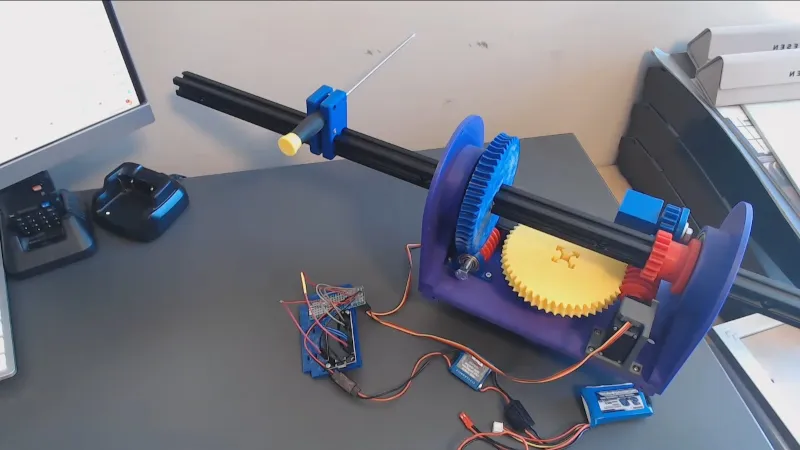
Communication with satellites often involves the use of high-gain directional antennas coupled with careful positioning to find and track the target. With a geostationary satellite the mount is either fixed or a single-axis polar mount, but when the craft is moving in a different orbit it becomes more of a challenge to stay locked on. An azimuth-elevation mount is needed to cover the whole sky, and [Ham Radio Passion] has one as a work in progress. It’s 3D printed and looks straightforward, making it a project to watch.
An az-el mount has two parts, the first being a turntable to set the azimuth, and the second being a horizontal rotating axis to set the elevation. He’s mounting the antenna to a piece of aluminium extrusion and driving it through a set of 3D printed gears driven from a 360 degree servo with a worm drive. He explains why the servo makes more sense to him here.
The result is not yet a finished project, but it shows enough promise to make it worth keeping an eye on. It’s by no means big enough for a huge antenna array, but we can imagine antennas for higher frequencies would be well within its capabilities. Meanwhile it’s certainly not the first az-el mount we’ve seen.
We all should know by now that Nintendo is incredibly protective of its IP. When it comes to anything having to do with Pokémon specifically, all the more so. While they would tell you that they’re just protecting their IP, the end result is that some of the biggest Pokémon fans out there that just want to do some fun things that represent no harm to Nintendo get shut down by threats, lawyers, or copyright strikes.
Take the YouTube series called PokeNational Geographic, for instance. While this YouTube series has been pushing out faux nature documentary videos about Pokémon for several years, the channel behind it just got hit with a bunch of copyright strikes from Nintendo.
In a video posted to an alternate channel, Elious says that Nintendo of America suddenly issued numerous strikes on large batches of his videos, all in the space of 12 hours. At the time he posted the video, a total of 20 videos had been caught up in four separate copyright strikes which encompass the entirety of the videos. With YouTube’s three-strikes policy, this means his channel is now pending deletion by YouTube and will disappear in seven days.
Elious says the strikes claim his channel is inappropriately using “content used in Pokémon video games including audiovisual works, characters, and imagery.” Elious’ videos consist of original 3D animation of various Pokémon in the “wild,” with a David Attenborough–style narration sharing various facts about Pokémon like Magikarp, Squirtle, Magnemite, Snom, Mew, Charizard, and more. He has been producing these videos on this channel since as far back as 2023 without issue, and claims in his video that the only actual content he took directly from the games was “tiny sprite roars” that last less than three seconds, adding that numerous other Pokémon creators on YouTube, as well as AI-produced channels mimicking his own, use images or footage directly from the games with no issue.
So, why now? There’s no way to know for sure, but Elious did recently launch a Patreon account so that fans could compensate them for the series. The general speculation is that once Elious attempted to make any kind of money from his video series, that spurred Nintendo to send the copyright strikes. And for many people, that will make complete sense.
Advertisement
I don’t understand that point of view. Regardless of any money changing hands, this still doesn’t represent any threat or harm to Nintendo or the Pokémon franchise. If anything, fun little fan videos like this only propel interest in the product. They represent free engagement lures for fans of Pokémon. Why in the world is copyright striking this channel to hell a better option than working out a free or cheap licensing arrangement with Elious so that they can keep producing the series and Nintendo can reap some of the benefit?
Or, hell, Nintendo could have tried to have a conversation with Elious, at least.
Elious continues by saying that he isn’t opposed to just deleting all the Pokémon videos if Nintendo of America asks, but he wishes he could keep his nearly 100,000 subscribers so he can keep making videos of other things, as he has on the channel in the past.
“I can’t really fight this,” Elious says. “It all seems legitimate, it does seem to come from the actual, real Nintendo of America. I can’t fight this. I don’t…I don’t know what to do about it because it’ll remove everything. I’m downloading stuff, of course, I have like, all the videos myself. But I’ll never be able to post them again, and I’ll never be able to use this channel again. Almost 100,000 subscribers over three years of making these animations and it’s all going to be gone in seven days.”
It’s simply too bad that Nintendo would rather worship at the altar of intellectual property than get creative with how it can support its fans. Thanks to IP maximalist thought, here is just a little more fun that Nintendo has flushed down the toilet.





















































You must be logged in to post a comment Login