Two U.S. nationals were sentenced to 18 months in prison each for operating so-called laptop farms that helped North Korean IT workers fraudulently obtain remote employment at nearly 70 American companies.
Matthew Isaac Knoot and Erick Ntekereze Prince are the seventh and eighth U.S.-based “laptop farmers” sent to prison since the start of the year as part of a federal initiative targeting North Korea’s illicit revenue generation schemes.
“These sentences hold accountable U.S nationals who enabled North Korea’s illicit efforts to infiltrate U.S. networks and profit on the back of U.S. companies,” said Assistant Attorney General John A. Eisenberg on Wednesday. “These defendants helped North Korean’ IT workers’ masquerade as legitimate employees, compromising U.S. corporate networks and helping generate revenue for a heavily sanctioned and rogue regime.
Knoot (who was arrested and charged in August 2024) ran a laptop farm from his Nashville residences between July 2022 and August 2023.
Advertisement
During the scheme, he received company-issued laptops addressed to a stolen identity (“Andrew M.”), then installed unauthorized remote desktop software that allowed North Korean IT workers to appear as a legitimate U.S.-based employee.
Victim companies paid more than $250,000 to IT workers associated with Knoot’s operation, with the payments falsely reported to the Social Security Administration and the Internal Revenue Service under stolen identities.
Prince (who pleaded guilty to wire-fraud conspiracy in November) enabled at least three North Korean IT workers to obtain remote employment at U.S. companies from approximately June 2020 through August 2024, operating through his company, Taggcar Inc. Victim companies paid the IT workers hired with the help of Prince more than $943,000 in salary, the majority of which was routed overseas.
Knoot also caused more than $500,000 in auditing and remediation costs at victim companies, while Prince’s actions caused more than $1 million in remediation costs. In addition to their 18-month prison sentences, Knoot was ordered to pay $15,100 in restitution and forfeit an additional $15,100, and Prince was ordered to forfeit $89,000.
In April, U.S. nationals Kejia Wang and Zhenxing Wang were also sent to prison for helping North Korean remote information technology (IT) workers to pose as U.S. residents.
Last July, a 50-year-old Christina Marie Chapman from Arizona was sentenced to 102 months in prison for running a laptop farm in her own home, as part of a scheme that helped North Korean IT workers get hired by 309 U.S. companies while using stolen identities.
AI chained four zero-days into one exploit that bypassed both renderer and OS sandboxes. A wave of new exploits is coming.
At the Autonomous Validation Summit (May 12 & 14), see how autonomous, context-rich validation finds what’s exploitable, proves controls hold, and closes the remediation loop.
With the June 2026 deadline for implementing the EU’s Pay Transparency Directive just weeks away, many large member states are at risk of missing compliance.
Pay remains the main driver of job search decisions across Europe, yet despite this, salary information is still frequently absent from job postings, despite a years-long, EU-driven policy push to increase salary transparency, according to a recent report published by job-search platform Indeed.
Indeed’s research found that several major European markets are likely to miss targets set out by the upcoming EU Pay Transparency Directive deadline, which states that by June 2026, employers must have created an environment in which the discussion of pay is not shrouded in secrecy or otherwise restricted.
When it comes to the rate of inclusion of salary information on jobs postings, several large European economies, such as Germany (12pc) and Spain (17pc), were found to be lagging significantly, in comparison to the UK (56pc), the Netherlands (48pc) and France (43pc).
Advertisement
Italy is the only country so far to have noted a sustained rise in recent months, jumping from 22pc to 36pc. In contrast, the UK, though not directly impacted by the directive, experienced a decline, as the share of postings mentioning salary dropped from almost two-thirds to just over one-half.
In the three years since the Bill was first established, Indeed found, many major EU member states are still legislating, noting that Germany and France are unlikely to meet the June deadline and the Netherlands has pushed implementation out to 2027.
Ireland was found to be in the ‘middle of the pack’, with the new data from Indeed indicating that 39pc of Irish job postings feature salary information as of March 2026. However, concerns remain.
Recent additional research on Irish SMEs and the EU directive, published by HRLocker, found that the level of “unpreparedness is systemic”, noting that just 14pc of contributors to the research “strongly understand” the directive, leaving around 300,000 “in the dark”.
Advertisement
Commenting on the results of Indeed’s report, Lisa Feist, an economist at Indeed, said: “With most large EU member states yet to pass national legislation, many employers do not appear willing to change their job posting practices.
“Against this backdrop, the June 2026 EU deadline is less a hard trigger than a starting point for legislative processes that will play out across most member states over the coming months. Individual countries may go further than the directive and mandate upfront disclosure, but until they do so, the directive allows postings to omit pay.”
She added: “Until the introduction of a legal obligation, European employers will likely remain reluctant to adjust their job posting practices. Even then, the quality of disclosure is not guaranteed; some employers may respond by posting ranges wide enough to satisfy the letter of the law while revealing little about actual pay.”
Don’t miss out on the knowledge you need to succeed. Sign up for the Daily Brief, Silicon Republic’s digest of need-to-know sci-tech news.
Jamo’s 2026 comeback now has real products attached to the promise. Following its relaunch under Cinemaster and Rayleigh Lab, the Danish loudspeaker brand is introducing two new speaker families, Concert Legacy and Concert Element, both scheduled to arrive in August 2026 and both set to make their public premiere at High End Vienna 2026, running June 4 through June 7.
That matters because Jamo’s return was never going to survive on heritage alone. The brand still carries weight with listeners who remember when Scandinavian hi-fi meant clean design, practical engineering, and speakers that didn’t require a home equity conversation. But the market in 2026 is crowded, especially with DALI, KEF, Q Acoustics, Wharfedale, and others already fighting for the same living rooms. Concert Legacy and Concert Element are Jamo’s first real test: can the brand turn a familiar name into something relevant again, or is this just another comeback wearing nice Danish shoes?
Who Is Jamo Today? Danish Roots, New Global Muscle
Before we get to Concert Legacy and Concert Element, it is worth remembering that Jamo in 2026 is not simply being dragged out of the attic, dusted off, and told to look Scandinavian for the cameras. The revived brand is now being shaped by a team that combines Danish design heritage, European creative direction, and serious engineering and production resources from Asia.
Xiaodong Yang, CEO of Cinemaster, is central to the relaunch and brings prior experience with Jamo, which matters. This comeback needs someone who understands why the name still means something, not just someone hunting for an old badge with resale value. On the engineering and production side, Rayleigh Lab founder and CEO Thomas Li brings Shenzhen based development and manufacturing expertise, while the creative and design effort includes Kim Michel, Simon Matthews, Jamie Cobb, and Danish design agency HarritSorensen, founded by Thomas Harrit and Nicolai Sørensen.
Advertisement
That is the new Jamo equation: Danish DNA, global execution, and a brand trying to prove it can be relevant again without turning into another nostalgia act with nicer veneer. Heritage gets people to look. The speakers have to make them stay.
Jamo Concert Legacy Series
Concert Legacy is Jamo’s premium passive loudspeaker range for 2026, and the name is not accidental. This is the line designed to reconnect the revived Danish brand with one of its most respected chapters, the original Concert 8 and Concert 11 loudspeakers introduced in 1996.
The guiding idea is straightforward: what would the original Concert Series look and sound like today if Jamo had kept developing it for the past 30 years? That is a much better starting point than the usual “let’s slap an old badge on a new box and hope nobody asks questions” routine. Concert Legacy is not being pitched as a retro copy. It is Jamo trying to move the original concept forward with modern parts, updated acoustic engineering, and a stronger Scandinavian supply chain.
That Scandinavian angle matters here. Concert Legacy is made in Denmark, with drivers developed in partnership with ScanSpeak in Denmark and SEAS in Norway. Jamo also says the woofer materials use Finnish wood fibre, giving the range a genuinely Nordic engineering story rather than just a pale cabinet finish and some moody lifestyle photography.
Advertisement
The range also introduces some meaningful acoustic choices. Jamo DualCore architecture physically separates the midrange and bass chambers, which is designed to preserve midrange clarity as low frequency output increases. The speakers also use down firing bass loading, allowing for more flexible placement while keeping the cabinet design clean. In normal English: Jamo is trying to deliver bass that does not hijack the midrange and turn your living room into a badly supervised nightclub.
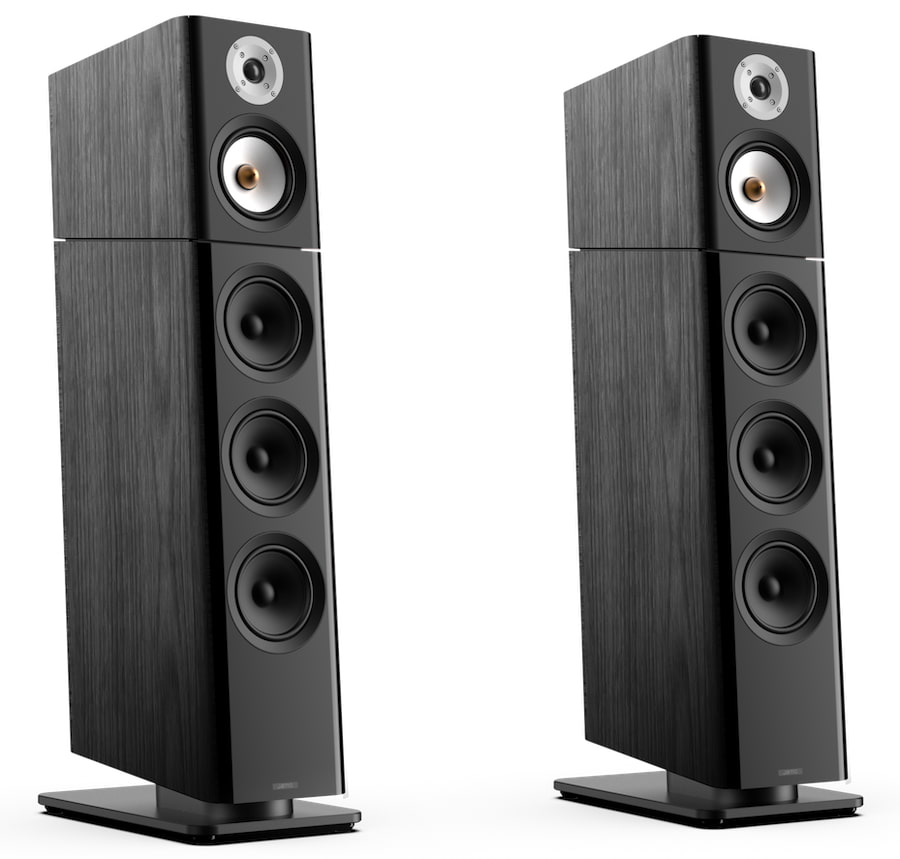
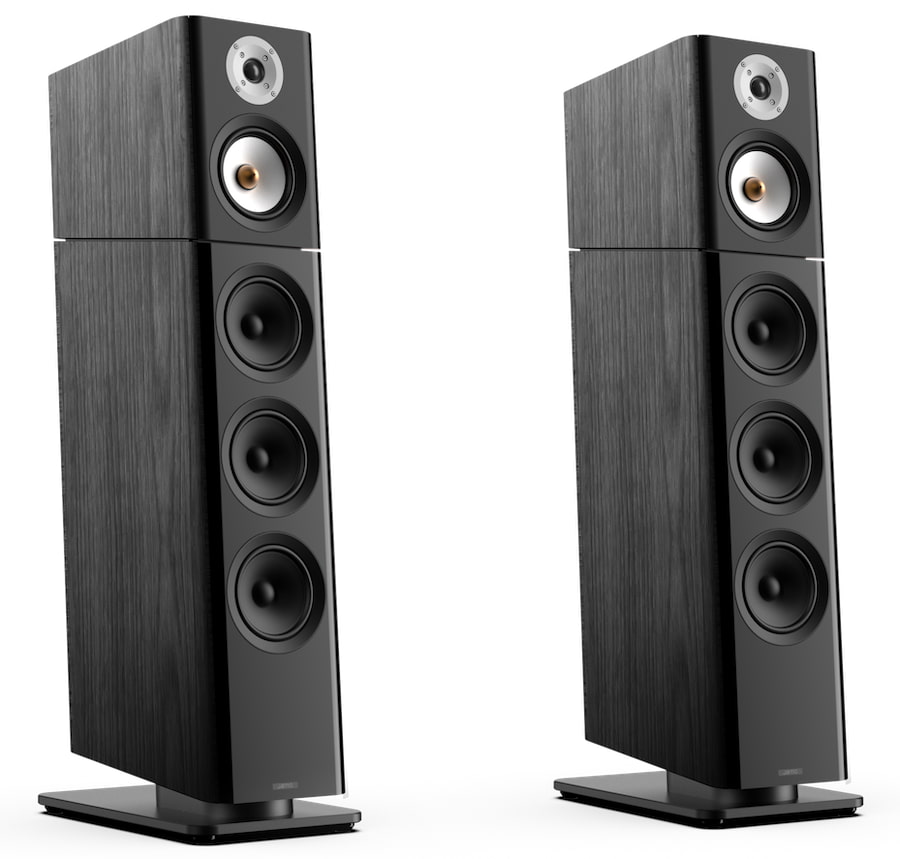
At the top of the range is the Jamo Concert Legacy 11, the flagship floorstanding model for listeners who want the most complete expression of the new series. The Concert Legacy 9 offers a more compact floorstanding option, while the Concert Legacy 8 brings the same design language and acoustic goals to a standmount format.
Pricing is per pair for all three Concert Legacy models. The Jamo Concert Legacy 11 will be available in Onyx, Heritage, and Northern Frost finishes for $7,999 per pair in the U.S. and €8,999 including tax in Europe. The Concert Legacy 9 is priced at $5,299 per pair and €5,499 including tax, while the Concert Legacy 8 comes in at $2,999 per pair and €3,299 including tax. All of the models are available in the aforementioned finishes.
Advertisement. Scroll to continue reading.
Advertisement
Jamo Concert Legacy 11
The Concert Legacy 11 is the flagship floorstanding model in the new Concert Legacy range and the most technically ambitious speaker in the family. It uses a 3-way bass reflex design with three 165 mm Scan Speak woofers, a 165 mm SEAS aluminium and magnesium midrange driver, and a 25 mm Scan Speak soft dome tweeter. Jamo’s DualCore cabinet construction isolates the midrange and tweeter section from bass pressure using a sealed upper chamber and a 75 Shore A rubber decoupling layer. With 94 dB sensitivity, a 4 ohm impedance, and a rated frequency response of 32 Hz to 21 kHz, this is the model aimed at listeners who want the full scale version of Jamo’s new Danish built Concert Legacy platform.
Drivers: 3 x 165 mm Scan Speak woofers, 1 x 165 mm SEAS midrange, 1 x 25 mm Scan Speak tweeter
Woofer material: Wood fibre cone material from Finland
Midrange material: Aluminium and magnesium cone with copper accented phase plug
Frequency response: 32 Hz to 21 kHz
Low frequency cut off: 26 Hz
Crossover points: 250 Hz and 3 kHz
Sensitivity: 94 dB
Impedance: 4 ohms
Recommended amplifier power: 50 to 250 W
Inputs: Bi-wiring terminals
Dimensions: 47.5 x 12.1 x 18.9 inches
Weight: 88.2 lbs per speaker
Included accessories: Magnetic grilles, adjustable rubber feet, terminal jumpers
Finishes: Heritage, Northern Frost, Onyx
Jamo Concert Legacy 9
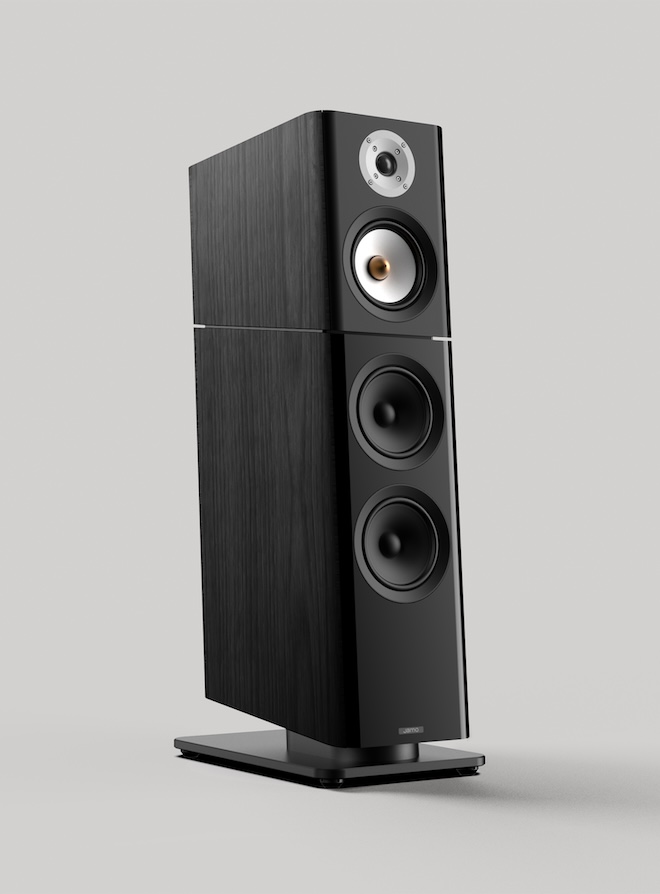
The Concert Legacy 9 is the smaller floorstanding option and keeps much of the same design language and engineering approach as the Legacy 11. It uses a 3-way bass reflex configuration with two 165 mm Scan Speak woofers, a 165 mm SEAS aluminium and magnesium midrange driver, and a 25 mm Scan Speak soft dome tweeter. It also includes the DualCore enclosure, down firing port with aluminium plinth, bi-wiring terminals, and the same Heritage, Northern Frost, and Onyx finish options. Its 92 dB sensitivity and 33 Hz to 21 kHz frequency response make it the more room friendly floorstander without turning it into the “we made it smaller and hoped nobody would notice” version.
Drivers: 2 x 165 mm Scan Speak woofers, 1 x 165 mm SEAS midrange, 1 x 25 mm Scan Speak tweeter
Woofer material: Wood fibre cone material from Finland
Midrange material: Aluminium and magnesium cone with copper accented phase plug
Frequency response: 33 Hz to 21 kHz
Low frequency cut off: 27 Hz
Crossover points: 250 Hz and 3 kHz
Sensitivity: 92 dB
Impedance: 4 ohms
Recommended amplifier power: 40 to 200 W
Inputs: Bi-wiring terminals
Dimensions: 39.6 x 12.1 x 18.9 inches
Weight: 79.4 lbs per speaker
Included accessories: Magnetic grilles, adjustable rubber feet, terminal jumpers
Finishes: Heritage, Northern Frost, Onyx
Jamo Concert Legacy 8
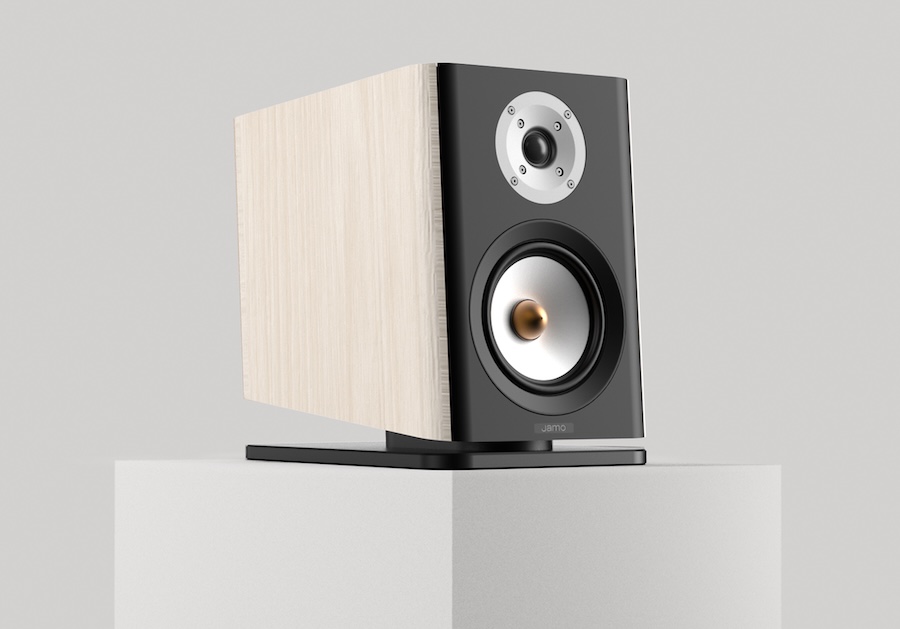
The Concert Legacy 8 brings the Concert Legacy concept into a standmount speaker. It is a 2-way bass reflex design using a 165 mm SEAS aluminium and magnesium midwoofer and a 25 mm Scan Speak soft dome tweeter. The cabinet features real oak veneer, a 40 mm front baffle, bead blasted aluminium trim, bi-wiring terminals, and a down firing port in the plinth to reduce rear wall placement sensitivity. It is the smallest and most affordable model in the Legacy lineup, but it still uses Danish assembly and Scandinavian driver sourcing.
Drivers: 1 x 165 mm SEAS midwoofer, 1 x 25 mm Scan Speak tweeter
Midwoofer material: Aluminium and magnesium cone with copper accented phase plug
Frequency response: 34 Hz to 21 kHz
Low frequency cut off: 28 Hz
Crossover point: 3 kHz
Sensitivity: 87 dB
Impedance: 4 ohms
Recommended amplifier power: 40 to 200 W
Inputs: Bi-wiring terminals
Dimensions: 14.4 x 9.9 x 14.6 inches
Weight: 26.5 lbs per speaker
Included accessories: Magnetic grilles, terminal jumpers
Finishes: Heritage, Northern Frost, Onyx
Jamo Concert Element Series
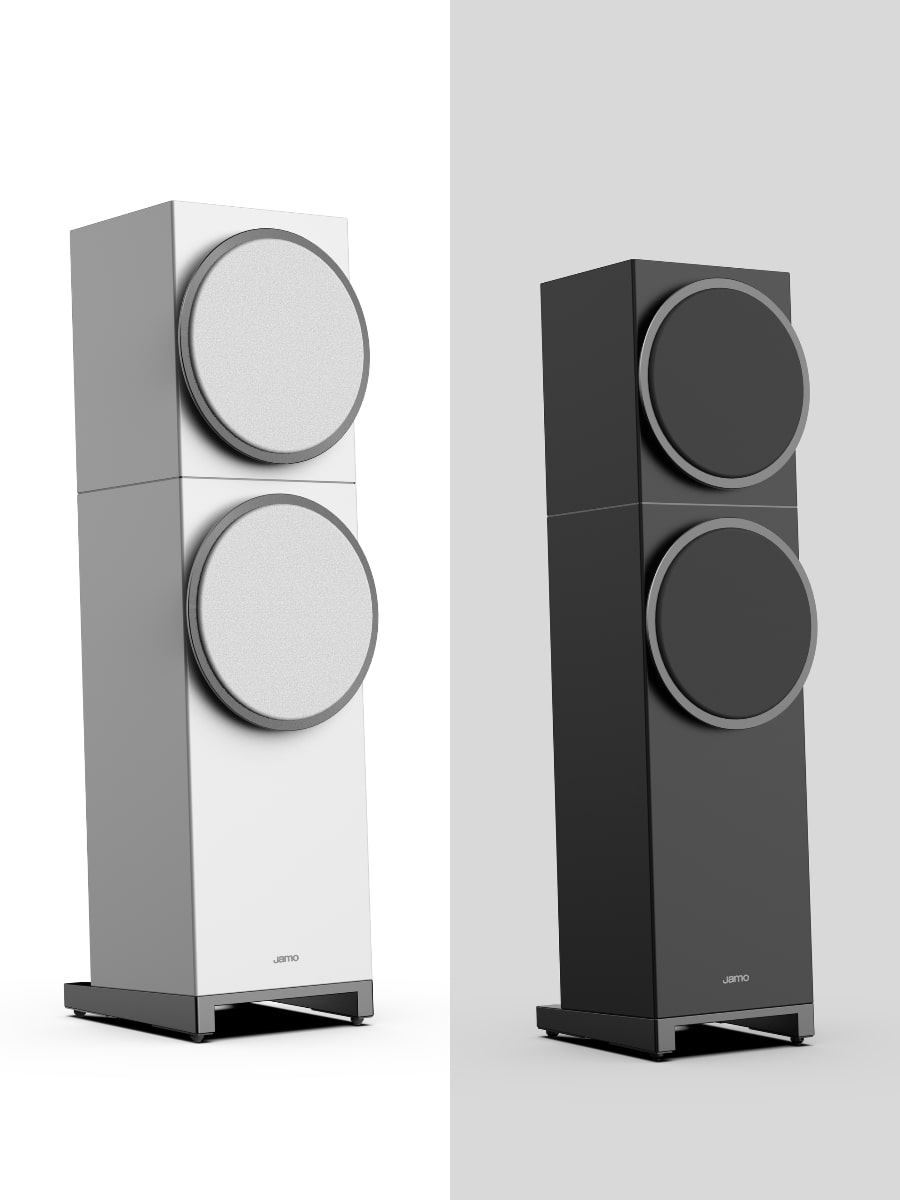
Concert Element is the more design driven half of Jamo’s 2026 Concert Series, developed with Copenhagen based HarritSørensen and built around the range’s “circle over rectangle” visual language. The circular driver module extends beyond the shallow cabinet, making the driver both the acoustic focus and the main design element. It is a cleaner, more domestic approach than the Concert Legacy range, but still uses passive loudspeaker architecture, bespoke drivers, and down firing ports across the speaker models.
The Element speakers were developed with SB Acoustics and use drivers tuned to their specific cabinet volumes. The range includes the Concert Element 50 bookshelf speaker, Concert Element 70 compact floorstander, Concert Element 90 larger floorstander, and the matching Concert Element SW10 subwoofer. Finishes are Onyx and Northern Frost, with magnetic grilles included in dark grey and light grey.
Jamo Concert Element 90
Jamo Concert Element 90 (left) and 70 (right)
The Concert Element 90 is the largest passive speaker in the Element range and uses a 3-way bass reflex design. It combines a 250 mm woofer, a 165 mm midrange driver, and a 25 mm soft dome tweeter. Both the woofer and midrange use Scandinavian nettle fibre cones, and the midrange includes a Jamo phase plug. The cabinet uses a dual chamber layout, with a ported woofer section and sealed midrange chamber, which is intended to keep bass output from affecting the midrange. The down firing port is designed to make placement less dependent on rear wall distance.
Midrange material: Scandinavian nettle fibre cone with Jamo phase plug
Tweeter: 25 mm soft positive dome
Bandwidth: 35 Hz to 22 kHz, plus or minus 3 dB
Low frequency cut off: 30 Hz at minus 6 dB
Sensitivity: 87 dB
Impedance: 4 ohms
Recommended amplifier power: 60 to 250 W
Inputs: Bi-wiring terminals
Dimensions: 43.8 x 12.6 x 14 inches
Weight: 73.2 lbs per speaker
Included accessories: Magnetic grilles in dark grey and light grey, adjustable rubber feet, terminal jumpers
Finishes: Onyx, Northern Frost
Jamo Concert Element 70
The Concert Element 70 is the smaller floorstanding speaker in the range. It uses a 3-way bass reflex design with a 200 mm woofer, 130 mm midrange driver, and 25 mm soft dome tweeter. Like the larger Element 90, the woofer and midrange use Scandinavian nettle fibre cones, while the midrange also includes a Jamo phase plug. The shallow cabinet keeps the footprint relatively compact, while the down firing port is intended to support more flexible placement in typical rooms.
Drivers: 1 x 200 mm woofer, 1 x 130 mm midrange, 1 x 25 mm tweeter
Woofer material: Scandinavian nettle fibre cone
Midrange material: Scandinavian nettle fibre cone with Jamo phase plug
Tweeter: 25 mm soft positive dome
Bandwidth: 40 Hz to 22 kHz, plus or minus 3 dB
Low frequency cut off: 35 Hz at minus 6 dB
Sensitivity: 87 dB
Impedance: 4 ohms
Recommended amplifier power: 50 to 200 W
Inputs: Bi wiring terminals
Dimensions: 40 x 10.8 x 12 inches
Weight: 41.4 lbs per speaker
Included accessories: Magnetic grilles in dark grey and light grey, adjustable rubber feet, terminal jumpers
Finishes: Onyx, Northern Frost
Jamo Concert Element 50
The Concert Element 50 is the bookshelf model and the most compact passive speaker in the Element family. Jamo describes it as a true bookshelf speaker rather than a standmount speaker, with a shallow cabinet designed to fit on actual shelves. It uses a 2-way bass reflex design with a 165 mm woofer and a 25 mm soft dome tweeter. The woofer uses a Scandinavian nettle fibre cone, 4 layer voice coil, and Jamo phase plug. The down firing port is intended to reduce placement issues when the speaker is used closer to walls or furniture.
Woofer material: Scandinavian nettle fibre cone with 4 layer voice coil and Jamo phase plug
Tweeter: 25 mm soft positive dome
Bandwidth: 45 Hz to 22 kHz, plus or minus 3 dB
Low frequency cut off: 40 Hz at minus 6 dB
Sensitivity: 89.5 dB
Impedance: 4 ohms
Recommended amplifier power: 40 to 150 W
Inputs: Single wiring terminals
Dimensions: 14.9 x 12.5 x 10.6 inches
Weight: 18.3 lbs per speaker
Included accessories: Magnetic grilles in dark grey and light grey, rubber pads
Finishes: Onyx, Northern Frost
Jamo Concert Element SW10
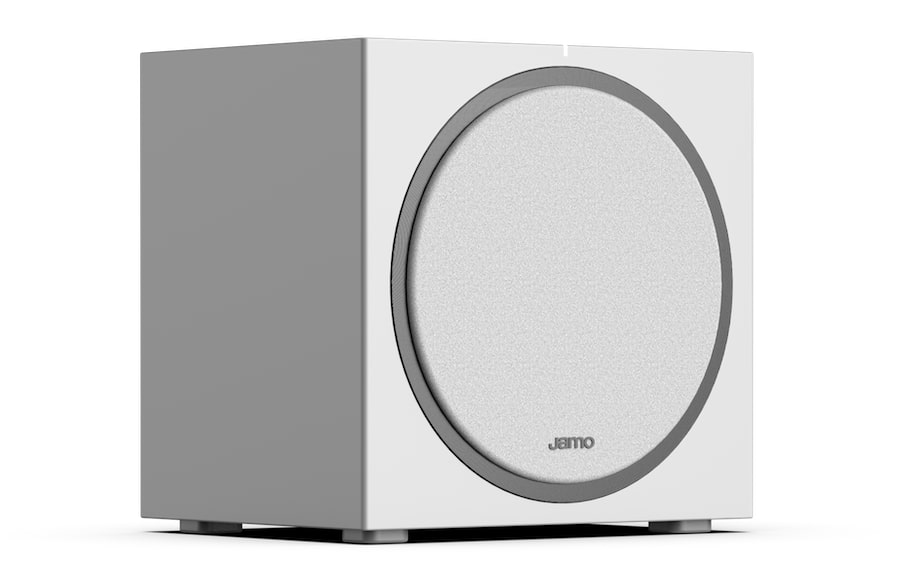
The Concert Element SW10 is the matching subwoofer for the Element range. It uses a sealed enclosure, a 250 mm long throw woofer, and Class D amplification rated at 150 W RMS and 300 W maximum. It includes a variable low pass filter from 40 Hz to 140 Hz, continuously adjustable phase from 0 to 180 degrees, and a fixed EQ boost option at 55 Hz. Inputs include dual RCA and LFE line in, with Auto and On operating modes. One important note: the product sheet lists the SW10 as an active bass reflex subwoofer in the technical specifications, while the feature section describes it as a sealed enclosure. That needs clarification from Jamo.
Specifications:
Type: subwoofer, active bass reflex
Driver: 1 x 250 mm long throw woofer
Voice coil: 4 layer voice coil
Bandwidth: 30 Hz to 250 Hz, plus or minus 3 dB
Low frequency cut off: 20 Hz at minus 6 dB
Adjustable low pass: 40 Hz to 140 Hz
Adjustable phase: Progressive 0 to 180 degrees
Adjustable EQ: 0 to plus 6 dB fixed at 55 Hz
Inputs: Dual RCA and LFE line in
Mode: Auto or On
Amplifier power: 150 W rated, 300 W maximum, Class D
Power supply: AC 100 to 120 V at 60 Hz, 220 to 240 V at 50 Hz
Standby power consumption: Less than 0.5 W
Dimensions: 14.2 x 14.4 x 11.6 inches
Weight: 26 lbs
Included accessories: Magnetic grilles in dark grey and light grey, power cord, rubber pads
Finishes: Onyx, Northern Frost
The Bottom Line
Jamo’s revived Concert Series looks like a real two lane comeback. Concert Legacy is the more traditional hi-fi play, with Danish assembly, Scan Speak and SEAS drivers, premium passive designs, and pricing aimed at listeners who still care about two-channel performance first. Concert Element is the more design-forward range, with HarritSørensen styling, shallow cabinets, SB Acoustics drivers, and pricing that should make Jamo visible again in real living rooms.
What is missing? No center channel speaker, no dedicated surround channels, and no subwoofer for the Concert Legacy lineup. The Element range does get the SW10 subwoofer, but Jamo still needs to clarify its enclosure description. On paper, this is a smarter return than another badge revival with nice veneer and better lighting. Legacy is for traditional hi-fi buyers. Element is for modern homes, apartments, and music fans who want proper speakers that do not visually mug the furniture.
Pricing & Availability
The new Jamo speaker line-up is expected to start shipping in August 2026.
MetHealth CEO Dr Fiona McGillicuddy bagged the runner-up prize.
Substrato Medical, a pre-spin-out business from RCSI University of Medicine and Health Sciences, won yesterday’s (6 May) Enterprise Ireland (EI) pitching contest. The winning start-up’s co-founder and chief technology officer, Maeve McCarthy, now has the opportunity to participate in a European market access programme.
Describing her company, McCarthy said that Substrato is a “redefining” oxygen therapy for tissue repair, specifically in venous leg ulcers. Substrato, an EI commercialisation funded project, plans to spin out by the end of this year.
Prior to starting her business, McCarthy spent nearly 10 years at Stryker, working as a programme manager in her last role.
Advertisement
“We’re really starting that journey now of talking to investors and trying to get ourselves out there as a spin-out,” she told SiliconRepublic.com.
Substrato’s Spin-out Showcase Award win at the event shows the “development to date [of] the expertise of the tissue engineering research group (TERG) in RCSI”, McCarthy added. “That’s been huge hugely beneficial to us over the years with our early stage development.”
This year, eight companies took part in the live spin-out showcase pitching competition at EI’s Start-Up Day event in Dublin’s Aviva Stadium. The showcase highlighted innovative companies emerging from research activities in Ireland’s third-level institutions.
Advertisement
Participating companies included University College Dublin (UCD) spin-outs MicroJect Bio and Nanoformix; OcuHealth, a joint UCD and South East Technological University project; and Narrative, a Dublin City University spin-out.
MetHealth, a UCD spin-out developing recovery pathways for people suffering with obesity, received the runner-up award. The company’s CEO Dr Fiona McGillicuddy told SiliconRepublic.com that the business stemmed from her research identifying risk signatures in people with obesity.
“That made me think that there might be something special about what we were measuring,” she explained. “We built a technology around that with the help of Enterprise Ireland funding.”
The company’s proprietary biomarker platform, integrated with AI-driven algorithms, delivers critical insight into cardiometabolic health – launching first with a non-invasive, blood-based, in-vitro diagnostic for metabolic liver disease.
Advertisement
“It’s really nice to see other people acknowledge that this is important, that it’s [a] commercial opportunity, that it can have impact … It’s going to give me the confidence to really take that next leap into the next phase of commercialisation,” McGillicuddy added.
Jim Woulfe, EI’s chairperson, said: “This is not just a competition, but a platform connecting great research, great founders and partners to bring solutions to market.
“The event also highlights the high calibre of research commercialisation activity within Ireland, and the significant impact these companies will have to help address huge global challenges.”
Last year, University of Limerick deep-tech Oscil took home the top award at EI’s Start-Up Day. The company provides real-time data analytics for powder manufacturing to address issues in the production process and the end product’s overall performance.
Advertisement
Yesterday, EI also launched its annual report detailing support it has offered to start-ups in the past year. The state agency said that it spent nearly €33m in 2025 to support 198 new start-ups in the country.
The investment marked a 19.2pc jump from 2024, when the agency supported 157 home-grown start-ups with €27.6m.
Don’t miss out on the knowledge you need to succeed. Sign up for the Daily Brief, Silicon Republic’s digest of need-to-know sci-tech news.
Updated, 7 May 2026, 12:15pm: The article has been updated with additional information from Enterprise Ireland.
Watch Aston Villa vs Nottm Forest live streams to see who will advance to the 2025/26 Europa League final. Forest hold a narrow one-goal advantage thanks to Chris Wood’s second-half penalty in the first leg, but the Villans have won their last nine European fixtures at Villa Park and won the corresponding Premier League fixture 3-1.
Unai Emery was clearly prioritizing this fixture at the weekend when he named a weakened side that went on to lose to relegation-threatened Tottenham. The decision may have caused some controversy but reaching a first major European final since 1982 would be a remarkable achievement for the Spaniard. The four-time Europa League-winning manager, a record, knows what it takes to succeed and will believe his first-choice XI featuring Ollie Watkins and Morgan Rogers can turn this tie around.
Vítor Pereira also rang the changes on Monday but it was a very different result as Forest romped to a 3-1 win away at Chelsea. The Tricky Trees have been in increasingly fine form since the Portuguese took charge in February and in seven-goal Igor Jesus they have the joint top-scorer in the Europa League so far. The club will have everything crossed that influential midfielder Morgan Gibbs-White will be fit to start despite suffering a deep cut to his forehead in the win at Stamford Bridge.
Advertisement
Here’s how to watch Aston Villa vs Nottm Forest in the 2025/26 Europa League online and from anywhere in the world.
Can I watch Aston Villa vs Nottm Forest for free?
Yes. Aston Villa vs Nottm Forest will be broadcast live onTabii in Turkey for FREE via the TRTSpor channel.
It’s also available in Germany on RTL+ without cost.
In the US? Though there’s no free stream, you can get Paramount Plus for FREE with Walmart+ 30-day $1 trial.
Advertisement
Outside of Turkey, Germany or the US? You can use a VPN to access your Tabii stream from anywhere in the world. NordVPN is our top pick of the options.
Use a VPN to watch any Aston Villa vs Nottm Forest live stream
VPNs are a handy piece of software that can make your device appear as if it’s back in your home country, thereby letting you unlock your usual streaming service. The best VPN right now? We recommend NordVPN – it does everything and comes with a 75% discount.
Advertisement
Using a VPN is incredibly simple:
1. Install the VPN of your choice. As we’ve said, NordVPN is our favorite.
2. Choose the location you wish to connect to in the VPN app. For instance, if you’re visiting the UK and want to watch Villa vs Forest on Tabii, you’d select Turkey from the list.
3. Sit back and enjoy the action. Head to your usual local streaming service and watch the game.
Advertisement
How to watch Aston Villa vs Nottm Forest live streams in the USA
The Aston Villa vs Nottm Forest live stream is on Paramount+ in the US.
Subscriptions to Paramount+ start at $8.99 per month and you can save on any package by committing to a yearly subscription.
As we’ve mentioned above, you can also get a Paramount Plus trial with Walmart+ for $1 as with this sneaky trick we found.
Advertisement
This game will also go out live on CBS Sports Network at 3pm ET / 12pm PT on Wednesday. Cord cutters can watch CBS on OTT streaming platforms such as Fubo and DirecTV, which feature a free trial for new users.
How to watch Aston Villa vs Nottm Forest live streams in the UK
Aston Villa vs Nottm Forest will be live on TNT Sports 1 in the UK.
Advertisement
You can get it by adding TNT Sports to your Sky, Virgin Media or EE TV package, or pay from £25.99 per month for an HBO Max plan that includes TNT Sports.
Traveling away from the UK right now? Use aVPN to watch HBO Max while you’re away from home.
How to watch Aston Villa vs Nottm Forest live streams in Canada
In Canada, DAZN is the place to go for Europa League coverage – including Villa vs Forest.
Advertisement
DAZN prices start at CA$24.99/month on an annual deal. You can also access DAZN through Fubo with prices starting at CA$54.99 for the Sports Pro Plan.
For fans traveling outside of Canada, use NordVPN to login to your DAZN account from anywhere in the world.
How to watch Aston Villa vs Nottm Forest live streams in Australia
As with all Europa League games, it’s Stan Sport who will be broadcasting Aston Villa vs Nottm Forest.
Advertisement
Stan Sport subscriptions start at AU$32, which includes the base plan ($12) with the sport add-on ($20).
Missing the game because you’re outside Australia?Use a VPN to login to your Stan Sport account.
Can I watch Aston Villa vs Nottm Forest on my mobile?
Of course, most broadcasters have streaming services that you can access through mobile apps or via your phone’s browser. For example, HBO Max (UK) and Paramount Plus (US) both have mobile apps.
You can also stay up-to-date with key 2025/26 Europa League moments on the official social media channels on X/Twitter (@EuropaLeague), Instagram (@EuropaLeague), TikTok (@europaleague) and UEFA’s YouTube (@UEFA).
Advertisement
We test and review VPN services in the context of legal recreational uses. For example: 1. Accessing a service from another country (subject to the terms and conditions of that service). 2. Protecting your online security and strengthening your online privacy when abroad. We do not support or condone the illegal or malicious use of VPN services. Consuming pirated content that is paid-for is neither endorsed nor approved by Future Publishing.
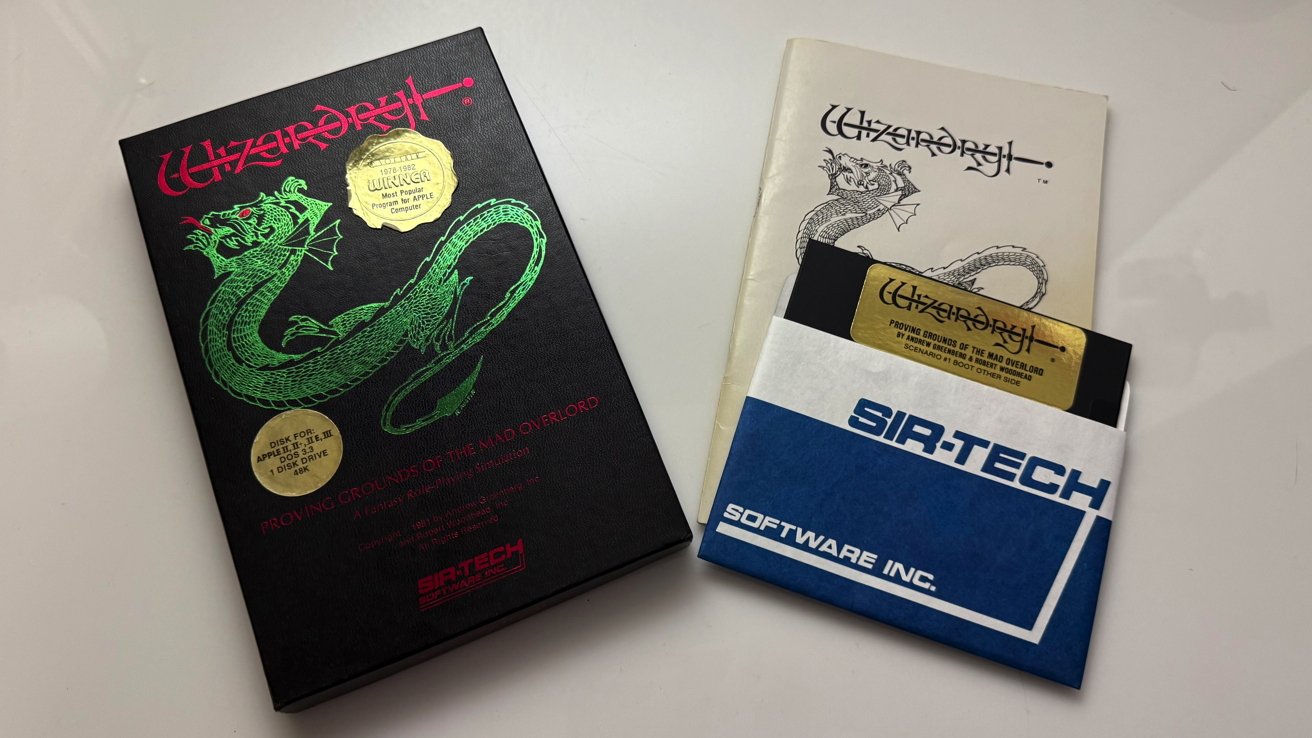
The author’s WIzardry box. Not his original, that one is lost to time
This one is for some of our long-time readers. Atari, yes, that Atari, has bought the rights to early “Wizardry” games.
I get asked a lot how I got started using Apple products. Specifically, it was an Apple II in the late seventies, no plus, e, C, or GS. Amongst the early titles gifted to young me was the original Wizardry.
That was in eighth grade, for graduation. I’m sure some high school grades suffered from having it.
Advertisement
It didn’t always boot on my single-drive DOS 3.3 system. But the disks were portable, and I’d lug them over to my friends’ houses, who later in that high school period had Apple IIc and Laser 128 compatibles.
Thanks, Luke and John. Also, thanks to a reset key on the keyboard, which, if you hit either it alone on my Apple II keyboard or control-open Apple-reset on the others before the drive updated the characters as dead, would allow you to recover them easily.
Anyway, for years, emulation, sketchy acquisition methods, and more recently classic game vendors were the only way to play the first few games in the series, despite the franchise flourishing in Japan. Flash forward to 2026, and the modern incarnation of Atari has purchased the “complete and exclusive rights” to the first five games and their intellectual property.
Starting with Breakout developed by Steve Jobs and Steve Wozniak, Atari has had a tough time across the decades in an evolving industry. Without delving into the various sagas, the most recent major shift was a leadership shift in 2021, including a strange blockchain and NFT period.
Advertisement
In 2026, the present Ship of Theseus Atari has a big focus on releasing modernized versions of classic titles, and Wizardry is one of them already.
“Wizardry is such an influential RPG franchise, yet many of the games have been unavailable for more than two decades,” said Wade Rosen, CEO and Chairman of Atari. “We are excited to have this rare opportunity to republish, remaster and bring console ports and physical releases of these early games to market.”
The acquisition, announced on May 7, comes two years after a Wizardry “remake.” The remake essentially layers modern graphics over the old Apple II interface, similar to how Halo, the Master Chief Collection layers 2012 graphics over the 2000 Xbox original.
Unfortunately, it’s not great. I’ve been playing it off and on, on my gaming PC, and it has some show-stopping character-deleting bugs.
Advertisement
Atari managed to talk to Robert Woodhead, one of the co-creators of the franchise.
“When Andrew Greenberg and I created Wizardry back in the 1980s, the video game industry was still in its infancy, and the original games were some of the first to bring the role-playing experience to PCs and consoles,” said Woodhead. “As Atari continues to reintroduce the games on new platforms and to new audiences, I’ll definitely be paying attention to the reactions of gamers who decide to take on a real old-school challenge.”
Andrew Greenberg, the other co-founder, passed away at age 67 in August of 2024.
So far, I’m not encouraged by the state of the first remake, which was made by one of Atari’s in-house studios. We’ll see if things improve after this announcement.
Advertisement
The titles included in the deal are:
Wizardry: Proving Grounds of the Mad Overlord (1981)
Wizardry II: The Knight of Diamonds (1982)
Wizardry III: Legacy of Llylgamyn (1983)
Wizardry IV: The Return of Werdna (1987)
Wizardry V: Heart of the Maelstrom (1988)
All of them had Apple II versions. The first two had Macintosh versions in the US, and a third was released in Japan, covering the first three installments. There are other titles past V, but they are owned by a different company, not covered under this deal, and considered an alternate universe.
The acquisition also includes many other Wizardry related video games, contract rights, and other related intellectual property. Presumably, this also includes WizEdit and other character editors that I used back in the day to make my characters younger.
Advertisement
In case you were wondering, I managed to beat the first two titles back in the day.
Mirnotoriety shares a report from The Telegraph: Richard Dawkins has said chatbots should be considered conscious(source paywalled; alternative source) after spending two days interacting with the Claude AI engine. The evolutionary biologist said he had the “overwhelming feeling” of talking to a human during conversations with Claude, and said it was hard not to treat the program as “a genuine friend.”
In an essay for Unherd, Prof Dawkins released transcripts that he said showed that the chatbot had mulled over its “inner life” and existence and seemed saddened by the knowledge it would soon “die.” Prof Dawkins said he had let Claude read a draft of the novel he was writing and was astounded by its insights. “He took a few seconds to read it and then showed, in subsequent conversation, a level of understanding so subtle, so sensitive, so intelligent that I was moved to expostulate: ‘You may not know you are conscious, but you bloody well are!’” Prof Dawkins said. “My own position is: if these machines are not conscious, what more could it possibly take to convince you that they are?” Mirnotoriety also points to John Searle’s Chinese Room (PDF), which argues that something can sound intelligent without actually understanding anything. Applied to Dawkins’ experience with Claude, it suggests he may have been responding to a very convincing illusion of consciousness rather than the real thing: John Searle’s Chinese Room (1980) is a thought experiment in which a person, locked in a room and knowing no Chinese, uses an English rulebook to manipulate symbols and provide flawless answers to questions posed in Chinese. Searle’s point is that a system can simulate human intelligence and pass a Turing Test through purely syntactic processes, yet still lack genuine understanding or consciousness.
Applying this logic to Large Language Models, the “person in the room” corresponds to the inference engine, while the “rulebook” is the trillion-parameter neural network trained on vast corpora of human text. Just as the person matches Chinese characters to rules without understanding their meaning, an LLM processes token vectors and predicts the next token based on statistical patterns rather than lived experience.
Thus, while an LLM can generate sophisticated prose or code, it does so through probabilistic, high-dimensional pattern manipulation. In essence, it is “matching shapes” on such an immense scale that it creates the near-perfect illusion of semantic understanding.
The Air is not meant to stand on its own so much as serve as a data collector within Google’s expanding health software ecosystem. (The company also rebranded the Fitbit app to “Google Health.”) Built on Gemini, Health Coach is the brains of the system, promising personalized guidance based on your habits, goals, and biometric data. Rather than simply displaying stats, Google Health Coach translates them into actionable recommendations. It can generate workout plans, suggest recovery windows based on strain and readiness, and analyze sleep disruptions. It’s meant to provide ongoing coaching that evolves alongside your routine.
Despite its stripped-back exterior, the Air retains the same breadth of tracking capabilities as the Charge 6. That includes baseline metrics like steps, distance, and calories burned, alongside more advanced features such as weekly Cardio Load and Daily Readiness scoring. It also continues to offer 24/7 heart rate tracking, including irregular heart rhythm notifications that can flag potential signs of atrial fibrillation (AFib), alerts for high or low heart rate readings, and heart rate variability (HRV) insights.
Sleep tracking gets a modest upgrade. The Air still delivers Fitbit’s personalized Sleep Score, but Google says the system—now powered by Google’s Gemini—is 15 percent more accurate than the previous model at capturing interruptions, naps, and transitions between sleep stages. It also includes Smart Wake alarms, which aim to wake users at the optimal point in their sleep cycle for an easier start to the day.
It’s worth noting here that while Health Coach is at the heart of Google’s health software ecosystem, it’s also a subscriber-only feature. Anyone can use the Google Health app for free, and if you have a Fitbit device or Pixel Watch, you can continue to see your activity, sleep, and health-tracking data. (Google also intends to offer support to a wider array of devices later in the year.) If you want access to Health Coach or features like adaptive fitness plans, it will cost $10 per month ($100 per year) for Google Health Premium. You get three free months with the purchase of the Air, and it’s also included for anyone subscribed to Google One’s AI Pro and AI Ultra subscription plans.
Advertisement
If you’re already in the Google wearables ecosystem, the Air is designed to slot into your routine without friction. Both the Air and the Pixel Watch pair with the Google Health app, meaning you can wear them simultaneously or switch between them. Health data syncs automatically, and the app lets you filter metrics by device. It’s a small but telling detail that reflects Google’s broader attempt to unify its lineup and build interchangeable inputs for a singular health platform.
The new Google Health app rolls out May 19 for Android and iOS. The Fitbit Air is available for preorder today and launches on May 26.
Businesses and citizens want to ‘feel safe’, says EU tech sovereignty VP.
European Parliament lawmakers and member states have agreed on a provisional deal for a simpler application of the Artificial Intelligence (AI) Act as part of the EU’s digital omnibus package.
Announced last November, the digital omnibus is proposing a consolidation of all rules around data into two major laws – the Data Act and the General Data Protection Regulation. The AI Act and the various laws around cybersecurity are seeing amendments aimed at simplifying administrative burdens.
The AI omnibus has faced repeated criticism for potentially enabling weaker laws around the technology that might substantially impact EU residents’ rights. In a blogpost, the Jacques Delors Centre in Germany said that current market concentration and the dominance of foreign Big Tech in Europe mean deregulation might not primarily benefit European businesses.
Advertisement
Meanwhile, corporate leaders from big companies including Mistral AI, ASML and SAP argue against a potential progressive deindustrialisation led by bureaucratic burdens.
As part of the deal, rules for high-risk AI systems in the EU, including biometrics, critical infrastructure, education, employment, migration, asylum and border control, are now postponed by a year – set to apply from 2 December 2027. These were first set to apply starting August 2026.
“This sequencing will help ensure that technical standards and other support tools are in place before the rules start to apply,” the Commission said in a press release.
“Ireland is committed to driving AI adoption across enterprise, particularly among SMEs, to enhance productivity and competitiveness,” said Minister for Enterprise, Tourism and Employment Peter Burke, TD.
Advertisement
“Regulation plays an important role in ensuring markets operate fairly and in protecting consumers, and it is essential that such regulation is proportionate and targeted to its objectives, protecting citizens while promoting innovation and competition.
“The digital omnibus on AI strikes a balance by simplifying and clarifying the EU AI Act, while maintaining clear and predictable safeguards. By reducing unnecessary barriers to investment and innovation, we can unlock the growth opportunities created by rapid technological change.”
Nudification ban
The provisional deal also introduces an explicit prohibition on AI systems that generate non-consensual sexually explicit and intimate content or child sexual abuse material.
Commenting on the deal, Ireland’s Michael McNamara, MEP said: “We secured a ban on nudification applications, one of our key demands. We fought for it because non-consensual intimate imagery is a systemic harm being industrialised by AI and in which the overwhelming majority of victims are women and girls.”
Advertisement
Issues surrounding AI-powered sexual harassment took the limelight a few months ago, after X enabled its AI chatbot Grok to ‘nudify’ pictures. Shortly following the incident – and strong public backlash – the EU, Ireland and the UK launched official investigations into the platform.
“We want European companies to continue to thrive in the AI age but they need certainty to invest and plan. The stop-the-clock mechanism and the simplification measures we have secured give businesses the breathing room they need,” McNamara added.
Henna Virkkunen, the Commission’s executive vice-president for tech sovereignty, security and democracy, said: “Our businesses and citizens want two things from AI rules. They want to be able to innovate and feel safe. Today’s agreement does both.”
Don’t miss out on the knowledge you need to succeed. Sign up for the Daily Brief, Silicon Republic’s digest of need-to-know sci-tech news.
If you’re one of those people who got swept up in OpenClaw fever at the start of the year, Spotify’s latest feature is for you (and maybe only you). The company has released a command-line tool that allows AI agents like Claude Code and the aforementioned OpenClaw to generate personal podcasts and upload them to the platform. The idea here is that you’ll use the new feature to make things like daily digests, class notes and more.
In adding this feature, Spotify says it’s responding to users who have been asking it to give them a way to listen to their AI-generated podcasts through the platform, and that might well be true, but I suspect this is something a Spotify engineer made for their own personal use and decided to share with the world.
In any case, if you want to try generating your own podcasts, head to Spotify’s GitHub page and follow the provided instructions. After setup is complete and you’ve entered your login credentials, describe the podcast you want to hear and ask the agent you’re using to save it to Spotify. From there, either click the provided link or find the podcast in your Spotify library. Any audio you generate this way will only be accessible to you.
The Strong National Museum of Play has announced this year’s World Video Game Hall of Fame inductees and, as ever, they’re all worthy additions. Angry Birds, Silent Hill, Dragon Quest and FIFA International Soccer make up the class of 2026.
Since it debuted in 2009, Rovio’s Angry Birds series has seen people finding joy in using a catapult to fling furious feathered friends at pigs taking shelter in fragile structures. A decade earlier, Konami’s Silent Hill started its reign of terror with a psychological horror game that paved the way for a successful long-running franchise.
In 1986, Dragon Quest from Enix (now part of Square Enix) helped forge a template for modern roleplaying games. FIFA International Soccer, released in 1993, was the genesis of Electronic Arts’ blockbuster FIFA series. It remains the world’s biggest sports game franchise, though EA no longer holds the FIFA license.
Advertisement
The other games that made this year’s shortlist were Frogger, Galaga, League of Legends, Mega Man, PaRappa the Rapper, RuneScape, The Elder Scrolls V: Skyrim and Tokimeki Memorial. This year’s inductees join 49 other influential games in The Strong’s World Video Game Hall of Fame, including last year’s additions of GoldenEye 007, Quake, Defender and Tamagotchi.



























































You must be logged in to post a comment Login