Following last year’s triple-header of new Apple Watches (Series 11, Ultra 3 and SE 3), 2026 is looking a lot less crowded. Early rumors point to the Apple Watch Series 12 carrying the lineup on its own this fall, but that doesn’t necessarily mean it’s going to be a boring one.
We’re not expecting a dramatic new look (based on rumors and Apple Watch history), but that doesn’t mean there’s nothing to get excited about. Rumors point to at least one major shakeup under the surface, including hints of a long-removed iPhone feature finally making its way to the wrist.
As always, nothing is confirmed until Apple says so, but here’s everything we know, think we know and are crossing our fingers for.
Advertisement
Watch this: I Ran 30 Miles and THIS Is the Most Accurate Smartwatch
Apple Watch Series 12 launch date
If there’s one thing Apple tends to keep consistent, it’s the timing of its fall hardware event, where it typically unveils its newest flagship iPhones and Apple Watch models.
Apple typically holds this event on the second Tuesday of September (usually the week after Labor Day). By that logic, Sept. 15 seems like the most likely candidate for Apple’s 2026 fall event. Because it lands a bit later in the month than in previous years, there’s also a slim chance Apple moves it up to Sept. 9 (Labor Day week), as it has before.
As in previous years, preorders would likely open on the Friday after the event, with availability following a week or so later (assuming no production delays).
Advertisement
Pricing and availability
Expect pricing for the new watches to stay roughly in line with the current Series 11 lineup, which starts at about $400 (42mm Wi-Fi model). Though price hikes aren’t completely off the table, with lingering tariff increases and the potential for supply chain issues.
The Apple Watch Ultra 3, SE 3 and Series 11 on launch day.
Celso Bulgatti/CNET
How many Apple Watch models will we get?
A Series 12 is all but guaranteed — we’ve had a new Apple Watch model arrive every year since its launch. What’s less certain is whether Apple will refresh the entire lineup again this year. The Apple Watch SE and Ultra models don’t follow the same annual update cycle, and because both the SE 3 and Ultra 3 were refreshed in 2025, it’s less likely that Apple will update both again this year.
Advertisement
If Apple does add another model alongside the Series 12, the Ultra would be the more plausible candidate. Apple isn’t one to hold out on new features for its high-end models when warranted. Or if it follows the pattern set with the Ultra 2, the company might just roll out a new color model for the Ultra 3.
Familiar design on the Apple Watch Series 12
Don’t hold your breath for a circular Apple Watch, or a major makeover (at least not for this year). Bloomberg’s Mark Gurman said during a live Q&A on March 26 that no major design changes are expected for this year’s Apple Watch lineup, according to MacRumors. That aligns with how sparse the redesign chatter has been overall, so expect the same silhouette with similar colors and materials.
What could change: screen technology. A more energy-efficient display — potentially an improved LTPO panel with better brightness, as seen on the Series 10 — could help claw back some battery life without adding bulk.
Advertisement
Better battery life tops the Apple Watch wish list year after year.
Vanessa Hand Orellana/CNET
Battery life and processor
The Series 11 and Ultra 3 got a significant battery bump over their predecessors: at least 6 hours more by Apple’s numbers and roughly an extra half day (or more) in my real-world testing. And the Ultra 3 also got charging speed worthy of its name, like its newer siblings. But there’s still a lot of room for improvement on both battery life and charging speed.
With no major clues hinting at bigger batteries yet, I’d bet we see more incremental gains (if any) on the Series 12. Improvements could come from better screen technology, software optimizations, and more efficient processors.
In theory, the processor name usually matches the watch number, suggesting an S12 chip this year. But since the Series 11 and Ultra 3 are still running on the previous year’s S10 chip, the next upgrade could technically be an S11, making this year’s naming a bit awkward.
Advertisement
Watch this: The Biggest Battles Ahead for Apple’s Next CEO, John Ternus
New health features on the horizon
Apple has already dipped its toes into blood pressure monitoring with hypertension notifications on the Apple Watch (Series 10, Series 11 and Ultra 3). The feature alerts owners when it detects signs of abnormally high blood pressure, but it stops short of providing an on-the-spot read. This could be on the table for the fall of 2026.
Other wearable health companies like Omron and Med-Watch have proven that wrist-based blood pressure measurement is possible, though it’s not as reliable as a traditional cuff and may require new (bulkier) hardware to bring to the Apple Watch.
According to Bloomberg’s Mark Gurman, Apple has been testing the feature internally but has encountered accuracy issues. And even if Apple pulls it off for this year, it might measure only baseline trends similar to Samsung’s blood pressure feature on the Galaxy Watch 7 and Ultra (not supported in the US).
Advertisement
Glucose monitoring is another long-running rumor that’s on the table, but according to Gurman, it’s even further from a finished product than blood pressure and realistically wouldn’t appear before 2027.
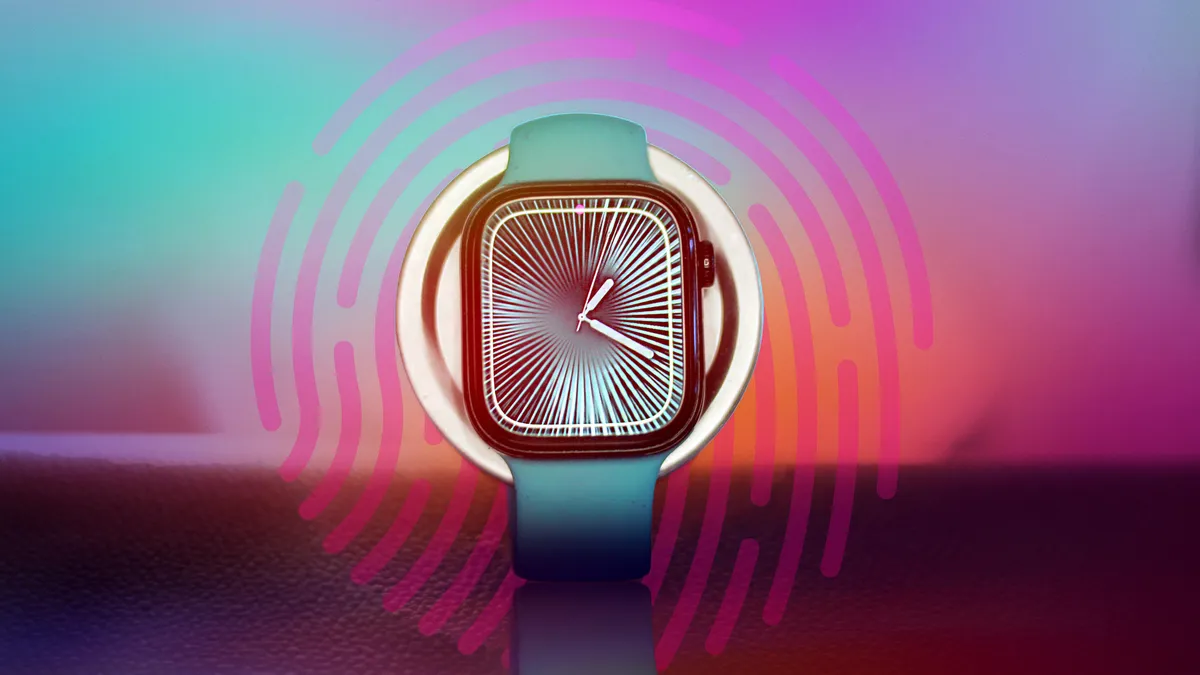
The next Apple Watch Series 12 may bring back TouchID.
Jeffrey Hazelwood/CNET
Biometric authentication: Touch ID or Face ID?
Rumors of a camera on the Apple Watch have been around for a few years — not for selfies, but potentially for Face ID or AI-based image recognition.
Advertisement
Apple Intelligence on the iPhone introduced a visual search tool that uses the camera to identify objects and places in real time, and it might be a matter of time before this feature eventually makes its way to the wrist. Meanwhile, wearable-focused processors like Qualcomm’s Snapdragon chips already support cameras and even livestreaming. Apple is known to use its proprietary chips, so it’s unlikely this would impact Apple’s timeline, but it shows the technology is there, and we may see it down the line on the Apple Watch. Just not this year, according to Bloomberg.
A more feasible near-term option could be Touch ID. Macworld recently spotted lines of internal code suggesting Apple has been experimenting with biometric authentication for the 2026 Apple Watch lineup. According to the report, the code references “AppleMesa,” which is Apple’s internal code name for a watch-based Touch ID. It’s still unclear whether the sensor would be integrated under the display, like we see on Android phones, or built into the side button or the Digital Crown.
Watch OS 27 wishlist
Now that Apple has standardized its operating system names to match the year ahead, you don’t need to be a rocket scientist to figure out that the next big update for the Apple Watch will be WatchOS 27.
With a major redesign already in the books (5 New Apple Watch Features Coming With WatchOS 26), we’re not expecting a dramatic visual change this time around, but there’s plenty on the wishlist, including better battery management tools and more customizable gesture controls. Apple could also expand Workout Buddy from metric-driven encouragement into more concrete training territory. This could bring it closer to what Samsung is trying with its AI-powered Running Coach.
Advertisement
Lastly, I’d welcome a more robust symptom tracker tied into the Vitals app similar to Oura Ring’s Symptom Radar that can flag early signs of illness.
A future Apple Watch could bring advanced health sensors for on-the-spot blood pressure reads.
Tharon Green / CNET
Other Health app updates
The next version of WatchOS 27 could also bring changes to the Health app. According to a report from Mark Gurman at Bloomberg, Apple has been working on a top-secret initiative code-named Project Mulberry, aimed at revamping the Health app with an AI-powered health concierge that could unify your health, fitness, and medical data in one place.
Advertisement
However, the project has recently run into some obstacles. Bloomberg’s latest report suggests Apple has put the effort on hold (at least for this year). That still leaves room for improvement on the Health app front with a potential redesign to the main dashboard that would make spotting trends easier.
Watch this: Apple Watch Series 11 Review: Is It Worth the Upgrade?
Businesses and citizens want to ‘feel safe’, says EU tech sovereignty VP.
European Parliament lawmakers and member states have agreed on a provisional deal for a simpler application of the Artificial Intelligence (AI) Act as part of the EU’s digital omnibus package.
Announced last November, the digital omnibus is proposing a consolidation of all rules around data into two major laws – the Data Act and the General Data Protection Regulation. The AI Act and the various laws around cybersecurity are seeing amendments aimed at simplifying administrative burdens.
The AI omnibus has faced repeated criticism for potentially enabling weaker laws around the technology that might substantially impact EU residents’ rights. In a blogpost, the Jacques Delors Centre in Germany said that current market concentration and the dominance of foreign Big Tech in Europe mean deregulation might not primarily benefit European businesses.
Advertisement
Meanwhile, corporate leaders from big companies including Mistral AI, ASML and SAP argue against a potential progressive deindustrialisation led by bureaucratic burdens.
As part of the deal, rules for high-risk AI systems in the EU, including biometrics, critical infrastructure, education, employment, migration, asylum and border control, are now postponed by a year – set to apply from 2 December 2027. These were first set to apply starting August 2026.
“This sequencing will help ensure that technical standards and other support tools are in place before the rules start to apply,” the Commission said in a press release.
“Ireland is committed to driving AI adoption across enterprise, particularly among SMEs, to enhance productivity and competitiveness,” said Minister for Enterprise, Tourism and Employment Peter Burke, TD.
Advertisement
“Regulation plays an important role in ensuring markets operate fairly and in protecting consumers, and it is essential that such regulation is proportionate and targeted to its objectives, protecting citizens while promoting innovation and competition.
“The digital omnibus on AI strikes a balance by simplifying and clarifying the EU AI Act, while maintaining clear and predictable safeguards. By reducing unnecessary barriers to investment and innovation, we can unlock the growth opportunities created by rapid technological change.”
Nudification ban
The provisional deal also introduces an explicit prohibition on AI systems that generate non-consensual sexually explicit and intimate content or child sexual abuse material.
Commenting on the deal, Ireland’s Michael McNamara, MEP said: “We secured a ban on nudification applications, one of our key demands. We fought for it because non-consensual intimate imagery is a systemic harm being industrialised by AI and in which the overwhelming majority of victims are women and girls.”
Advertisement
Issues surrounding AI-powered sexual harassment took the limelight a few months ago, after X enabled its AI chatbot Grok to ‘nudify’ pictures. Shortly following the incident – and strong public backlash – the EU, Ireland and the UK launched official investigations into the platform.
“We want European companies to continue to thrive in the AI age but they need certainty to invest and plan. The stop-the-clock mechanism and the simplification measures we have secured give businesses the breathing room they need,” McNamara added.
Henna Virkkunen, the Commission’s executive vice-president for tech sovereignty, security and democracy, said: “Our businesses and citizens want two things from AI rules. They want to be able to innovate and feel safe. Today’s agreement does both.”
Don’t miss out on the knowledge you need to succeed. Sign up for the Daily Brief, Silicon Republic’s digest of need-to-know sci-tech news.
If you’re one of those people who got swept up in OpenClaw fever at the start of the year, Spotify’s latest feature is for you (and maybe only you). The company has released a command-line tool that allows AI agents like Claude Code and the aforementioned OpenClaw to generate personal podcasts and upload them to the platform. The idea here is that you’ll use the new feature to make things like daily digests, class notes and more.
In adding this feature, Spotify says it’s responding to users who have been asking it to give them a way to listen to their AI-generated podcasts through the platform, and that might well be true, but I suspect this is something a Spotify engineer made for their own personal use and decided to share with the world.
In any case, if you want to try generating your own podcasts, head to Spotify’s GitHub page and follow the provided instructions. After setup is complete and you’ve entered your login credentials, describe the podcast you want to hear and ask the agent you’re using to save it to Spotify. From there, either click the provided link or find the podcast in your Spotify library. Any audio you generate this way will only be accessible to you.
The Strong National Museum of Play has announced this year’s World Video Game Hall of Fame inductees and, as ever, they’re all worthy additions. Angry Birds, Silent Hill, Dragon Quest and FIFA International Soccer make up the class of 2026.
Since it debuted in 2009, Rovio’s Angry Birds series has seen people finding joy in using a catapult to fling furious feathered friends at pigs taking shelter in fragile structures. A decade earlier, Konami’s Silent Hill started its reign of terror with a psychological horror game that paved the way for a successful long-running franchise.
In 1986, Dragon Quest from Enix (now part of Square Enix) helped forge a template for modern roleplaying games. FIFA International Soccer, released in 1993, was the genesis of Electronic Arts’ blockbuster FIFA series. It remains the world’s biggest sports game franchise, though EA no longer holds the FIFA license.
Advertisement
The other games that made this year’s shortlist were Frogger, Galaga, League of Legends, Mega Man, PaRappa the Rapper, RuneScape, The Elder Scrolls V: Skyrim and Tokimeki Memorial. This year’s inductees join 49 other influential games in The Strong’s World Video Game Hall of Fame, including last year’s additions of GoldenEye 007, Quake, Defender and Tamagotchi.
Bans on kids and teens using social media have swept the country and the world in the past few years, with lawmakers from Australia to Massachusetts enacting or considering legislation to keep young people off platforms like TikTok.
Manitoba Premier Wab Kinew announced the proposed ban at an April fundraiser, arguing that tech platforms are “doing these very awful things to kids all in the name of a few likes, all in the name of more engagement, and all in the name of money.”
Advertisement
Kinew didn’t say which social media and AI platforms the ban might include, or when the legislation might be introduced, although Manitoba’s education minister has said enforcement might begin in schools.
So far, social media bans don’t have a ton of evidence behind them. Australian teens seem to be getting around their country’s ban, possibly by wearing masks to foil age-verification systems. Some experts have also questioned the wisdom of locking kids out of social media, which can have benefits as well as risks.
But AI regulation is a new frontier. While social media platforms have been with us in some form for decades, AI tools have only been available to ordinary kids and teens for a couple of years — and they’re evolving and becoming more ubiquitous all the time. Some parents say AI chatbots have encouraged children to harm themselves or others, and experts fear that early use of AI in the classroom could keep young people from learning vital critical-thinking skills.
From my reporting on social media, I’m suspicious of age-related bans. But I’ve also been watching with anxiety as AI creeps into my kid’s life, not to mention my own. So I asked experts, educators, and young people themselves what kind of guardrails could help keep kids and their education safe from the most pernicious effects of artificial intelligence.
Advertisement
I did not (spoiler) come away with a clear legislative proposal that would solve all of our problems around this technology. What I did find, however, were a few guidelines that radically changed how I think about AI in my life, and that I think can help us guide kids through theirs.
As any high school teacher can tell you, AI use is extremely common among young people. In a Pew survey conducted at the end of last year, 64 percent of teens said they used chatbots, with about three in 10 reporting daily use. The most common use is searching for information, followed by help with schoolwork.
Quinn Bloomfield, 18, likes to use Google’s NotebookLM to help with chemistry, the first-year university student told me. The tool is “extremely helpful for quizzing me on things, and helping explain things when my professors aren’t great at it,” said Bloomfield, who’s also a member of Manitoba’s Youth Ambassador Advisory Squad.
AI tools are also increasingly making their way into classrooms, where they’re used by younger and younger students. Kindergartners in some districts use an AI-powered reading bot called Amira, Jessica Winter reports at the New Yorker. Winter’s sixth-grade daughter recently received a Google Chromebook at her Massachusetts middle school, pre-installed with Google’s AI tool Gemini, which quickly offered to “help” her with her writing and presentations.
Advertisement
As useful as some young people find the tools, experts fear they’re having unintended consequences. When AI tools are used to make learning “more straightforward and efficient” — by helping kids write a paragraph or outline an essay, for example — they are “quite likely undermining kids’ opportunities to grapple with the very difficulties that are the source of real, developmentally oriented learning,” said Mary Helen Immordino-Yang, a professor of education, psychology, and neuroscience at the University of Southern California.
Bloomfield, for his part, wants young people to be involved in formulating any legislation that might restrict their access to technology.
Tools like Gemini that volunteer to do some of the hard work for kids can keep them from learning crucial skills like argument-building and coming up with ideas, Immordino-Yang said. The most optimistic (or cynical, depending on your view) AI boosters argue that human skills like these will matter less in a world where AI can do most tasks for us. But “we’re always going to need to be able to formulate complex thoughts and arguments about the things that we hold dear,” Immordino-Yang said. “It’s never going to be the case that we don’t have to know how to think.”
Beyond academics, some also worry about the social implications of AI chatbots. “We are finding that for every minute that a kid is talking with a chatbot, that’s one minute less they’re spending with their friends,” said Mitch Prinstein, a professor of psychology and neuroscience at UNC Chapel Hill who studies kids’ interactions with technology. That’s concerning because young people need interactions with their peers to develop social skills, and chatbots aren’t a good substitute.
Advertisement
“It’s not giving you the appropriate kind of coaching and feedback,” Prinstein said. “It’s just agreeing with you, even if you offer really poor ideas.”
Also concerning is that in Prinstein’s research, “a remarkable number of kids are saying that they prefer talking to a chatbot than a human peer.” Many kids also worry that they’re using chatbots too much, Prinstein said. “They’re scared that they might be becoming a little bit too reliant on them.”
Guiding kids through an AI world
In the context of findings like these, it’s no surprise that jurisdictions like Manitoba are considering an AI ban for youth. But legislation that tries to ban social media users below a certain age has faced criticism, both because kids will find a way to get around any ban, and because such laws fail to target the basic structures of tech platforms that can make them harmful to people.
Advertisement
Some experts have similar concerns about an AI ban. “If the focus is only on a ban, what happens when they reach the age where they’re allowed to go on, especially after you’ve made it forbidden fruit,” Prinstein asked.
Young people themselves are also worried about Manitoba’s proposal. Banning AI risks taking away “the opportunity for kids to have way more personalized learning experiences,” Bloomfield told me.
However, a growing body of research suggests that the current free-for-all may not be the best idea either. It’s especially odd to see schools around the United States embrace AI so enthusiastically, even as they ban phones and treat social media like poison.
Advertisement
To make sense of some of these complexities, I talked to Beck Tench, a principal investigator at Harvard’s Center for Digital Thriving who thinks about AI use in terms of digital agency, which she defines as people “having meaningful choice and intention and control over how technology fits into your life.”
The idea of approaching AI use as a question of agency immediately resonated with me. As an adult, I often encounter AI in ways that deprive me of agency — pop-ups that offer to write my emails for me, or statements from tech CEOs that their models are about to take my job. When I am given a choice in how I use the tools (for example, in a recent Vox seminar about ethical ways to use AI for research), they become a lot more appealing.
For kids, supporting AI agency in the classroom might look like an ongoing series of conversations between teachers and students about what’s appropriate at any given time, Tench told me. “Maybe at the beginning of the year, you can’t use it for spelling and grammar, but once you’ve got that down, you can, and you need to make sure you’re not using it for outlining.”
“One of the things that we’re hearing from young people is that they want adults to help them with this, and they want advice and guidance,” Tench said. “That advice and guidance needs to come in conversation with them.”
Advertisement
Agency around AI is going to look different for young children than it does for adults. But figuring out how all of us can have more control over the presence of AI in our lives feels like a better goal to me than simply banning kids from a technology that causes a lot of problems for grown-ups, too.
As Tench put it, “we’re focusing on young people because they’re, frankly, easier to set rules for than the actual tech companies, who have far more power in the world.”
Bloomfield, for his part, wants young people to be involved in formulating any legislation that might restrict their access to technology. Kids “deserve a say in what happens in their own lives,” he said. “They deserve not to be left out of the world that’s evolving around them.”
A new study of school cellphone bans found that the bans did work to reduce cellphone use. However, they did not improve test scores, and at least initially, suspensions actually went up at schools with bans.
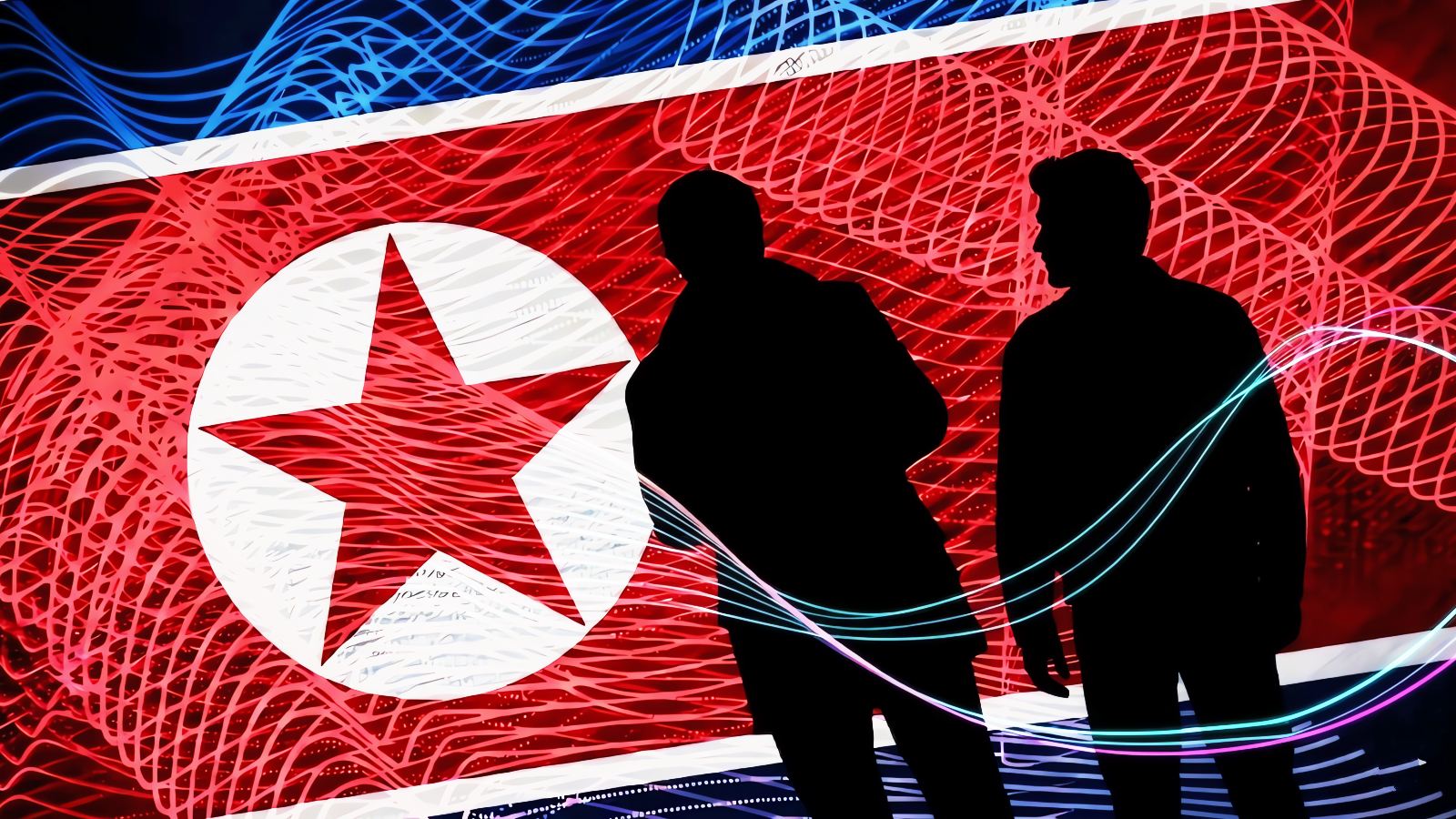
Two U.S. nationals were sentenced to 18 months in prison each for operating so-called laptop farms that helped North Korean IT workers fraudulently obtain remote employment at nearly 70 American companies.
Matthew Isaac Knoot and Erick Ntekereze Prince are the seventh and eighth U.S.-based “laptop farmers” sent to prison since the start of the year as part of a federal initiative targeting North Korea’s illicit revenue generation schemes.
“These sentences hold accountable U.S nationals who enabled North Korea’s illicit efforts to infiltrate U.S. networks and profit on the back of U.S. companies,” said Assistant Attorney General John A. Eisenberg on Wednesday. “These defendants helped North Korean’ IT workers’ masquerade as legitimate employees, compromising U.S. corporate networks and helping generate revenue for a heavily sanctioned and rogue regime.
Knoot (who was arrested and charged in August 2024) ran a laptop farm from his Nashville residences between July 2022 and August 2023.
Advertisement
During the scheme, he received company-issued laptops addressed to a stolen identity (“Andrew M.”), then installed unauthorized remote desktop software that allowed North Korean IT workers to appear as a legitimate U.S.-based employee.
Victim companies paid more than $250,000 to IT workers associated with Knoot’s operation, with the payments falsely reported to the Social Security Administration and the Internal Revenue Service under stolen identities.
Prince (who pleaded guilty to wire-fraud conspiracy in November) enabled at least three North Korean IT workers to obtain remote employment at U.S. companies from approximately June 2020 through August 2024, operating through his company, Taggcar Inc. Victim companies paid the IT workers hired with the help of Prince more than $943,000 in salary, the majority of which was routed overseas.
Knoot also caused more than $500,000 in auditing and remediation costs at victim companies, while Prince’s actions caused more than $1 million in remediation costs. In addition to their 18-month prison sentences, Knoot was ordered to pay $15,100 in restitution and forfeit an additional $15,100, and Prince was ordered to forfeit $89,000.
In April, U.S. nationals Kejia Wang and Zhenxing Wang were also sent to prison for helping North Korean remote information technology (IT) workers to pose as U.S. residents.
Last July, a 50-year-old Christina Marie Chapman from Arizona was sentenced to 102 months in prison for running a laptop farm in her own home, as part of a scheme that helped North Korean IT workers get hired by 309 U.S. companies while using stolen identities.
AI chained four zero-days into one exploit that bypassed both renderer and OS sandboxes. A wave of new exploits is coming.
At the Autonomous Validation Summit (May 12 & 14), see how autonomous, context-rich validation finds what’s exploitable, proves controls hold, and closes the remediation loop.
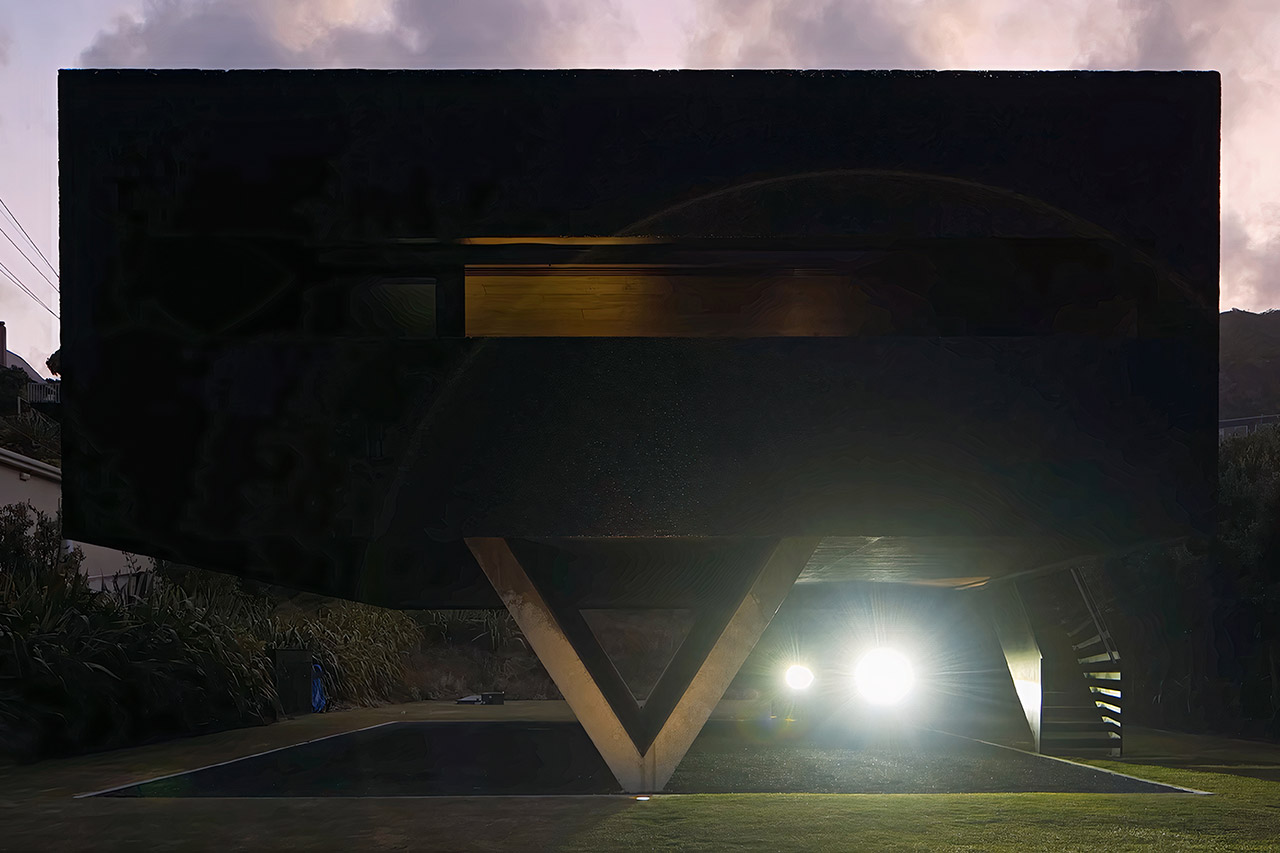
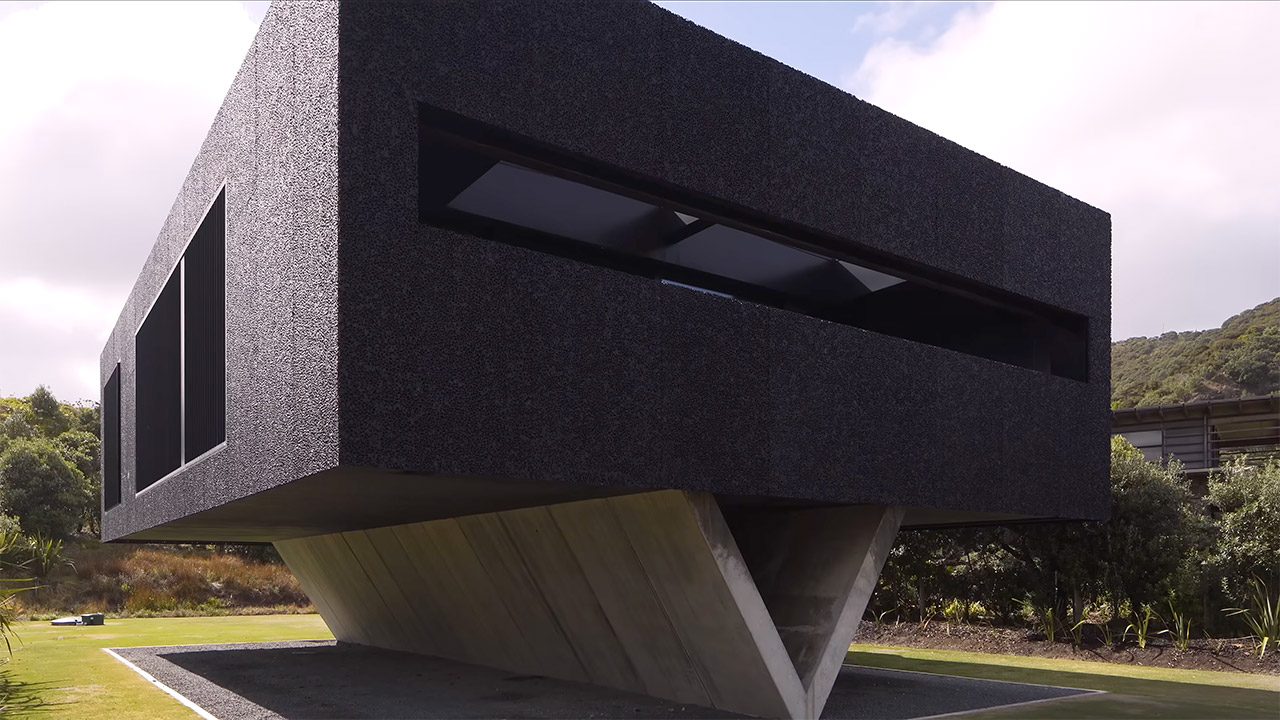
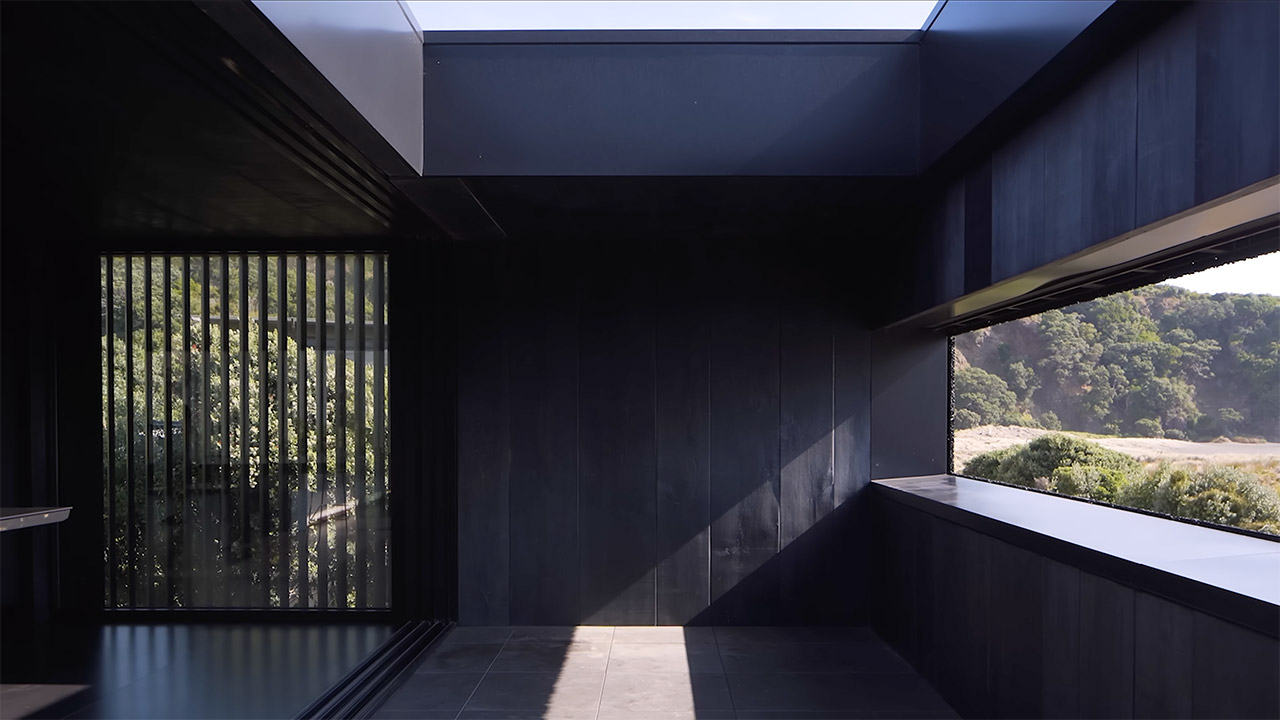
Photo credit: Home of Architecture | Chris Tate Piha Beach stretches along New Zealand’s wild west coast where black sand meets pounding surf and sheer cliffs rise without warning. Chris Tate placed Bunker House, a compact two-bedroom home right there next to a public car park and surf lifesaving club. The structure rises as a solid black form that feels carved from the landscape itself.
Chris Tate spent a remarkable 7 years perfecting the design before construction began, and the entire build took 14 years. The foundation is effectively a gigantic X built of concrete, with half of it sinking 3 metres into the sand and the other half supporting the house. The piles of concrete that hold it all together are a true insurance policy against earthquakes that turn the ground into a watery mess, as well as keeping the entire structure stable. You’d never guess it’s only 300mm off the sand, but against all odds, the entire structure holds the full weight of the house without even a hairline fracture showing. The cantilevered sections protrude out slightly, giving the box a ‘hovers-over-the-sand’ appearance while being perfectly balanced.
MODEL KIT FOR ADULTS – Adults ages 18 and up can embrace their love of architecture with this LEGO building set (21064), which makes striking home…
DETAILED PARIS DECOR – This detailed model features 4 iconic Paris landmarks—the Eiffel Tower, Notre-Dame de Paris, the Arc de Triomphe, and the…
HANG OR STAND TO DISPLAY – Your completed cityscape includes a buildable frame and a decorated ‘City of Love’ brick and can be hung on a wall or…
The cladding has been coated in sheets manufactured from recyclable cans shipped over from Canada and painted on-site, of course. The finish catches the light in an amazing ballet of patterns, perfectly reflecting the volcanic rock and black sand all around. With a little distance between you and the home, the surface appears to be one large textured skin. When you get close, it becomes easy to see where the material came from, but it all blends in so well that you can’t help but think that this house grew straight out of the sand rather than being thrown down on it.
When people arrive, they are instantly met with darkness. It takes a while for their eyes to pick out the layered blackness that appears to be draped over every inch of the place, but even in the absence of color, there are hints of depth and texture, as evidenced by the subtle changes in tone that suggest the presence of glass, steel, and stone, all fitted together with meticulous care to conceal all the messy bits, such as pipes and wires. It’s a highly efficient space that meets all of the passive house standards, so the temperature stays just right throughout the year.
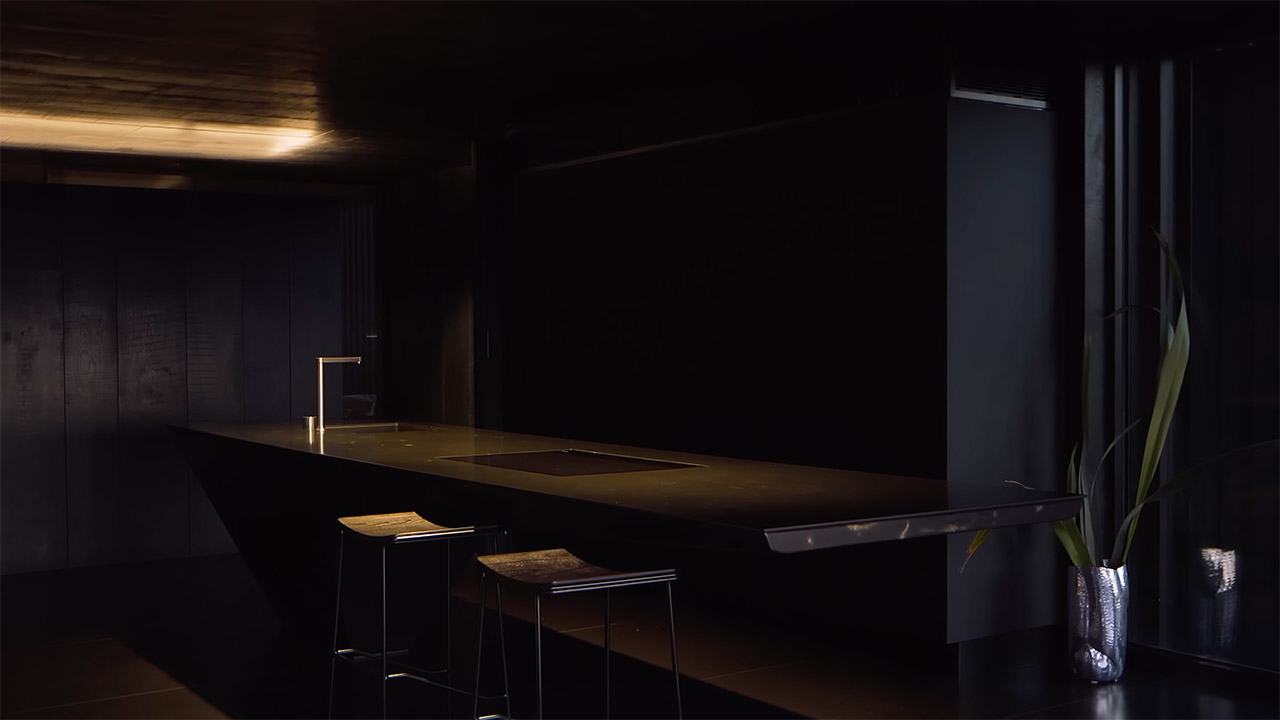
The kitchen island is a real showpiece, stretching out for four meters and providing a perfect view of the shore. Its raw steel frame is attached directly to the floor, reflecting the house’s foundations. What a view: a long narrow strip of glass frames a beautiful slice of crashing waves, Lion Rock, and a distant cove, and the crowded car lot fades away as you take a few steps back.
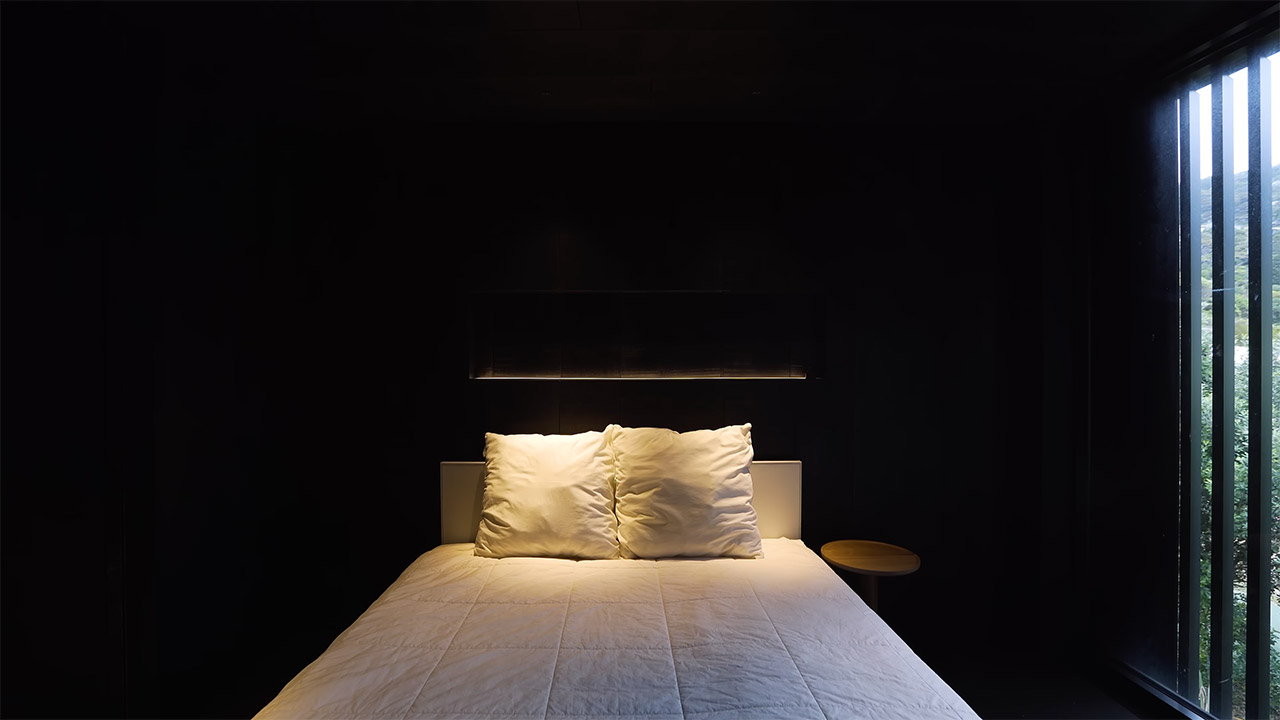
Two identical small bedrooms are nestled away at the back of the house, each enclosed by a wall of gold mesh panels that give off a nice gentle glow and provide a bit of metallic sheen to the entire space. The light streaming through makes each area feel quite secluded and calm. It’s a truly fantastic space, as it’s similar to a cave yet can still open up to the ocean anytime the owners desire. When the lights go off at night, all you hear is the waves smashing outside. [Source]
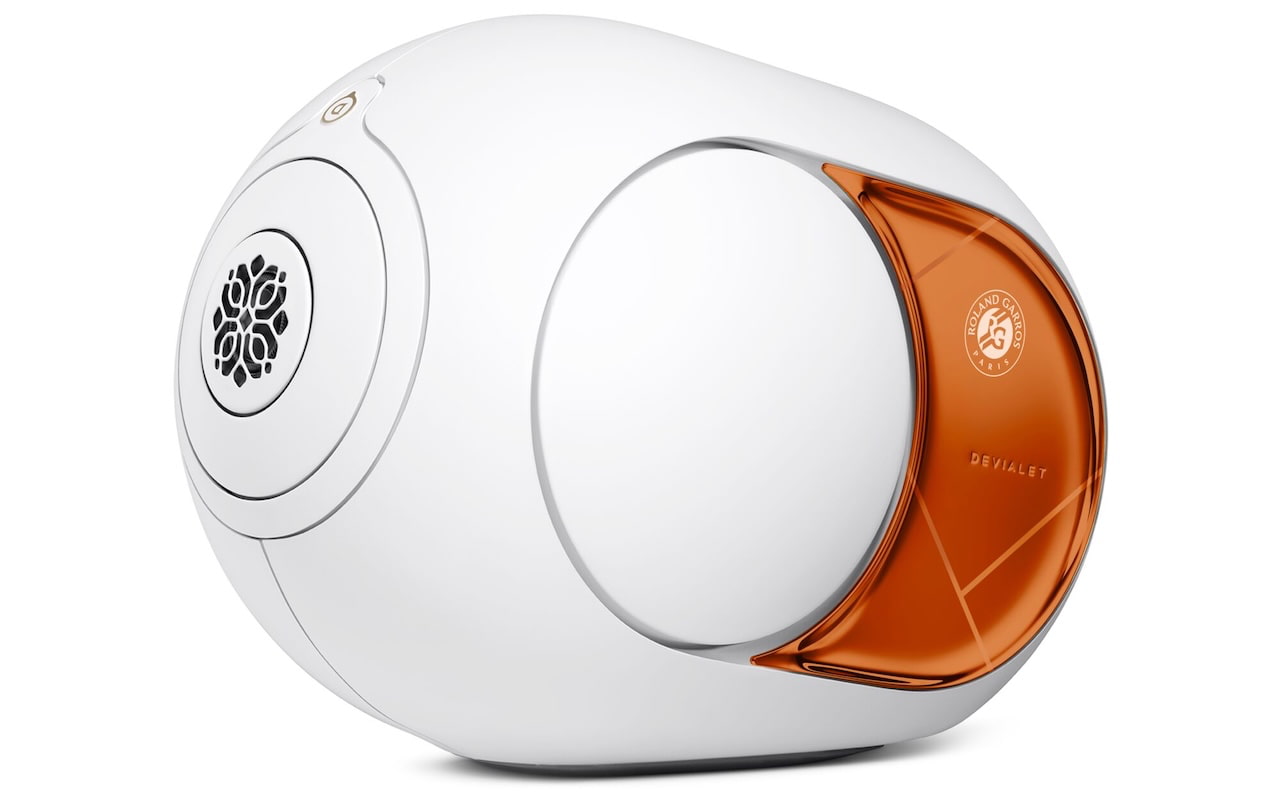
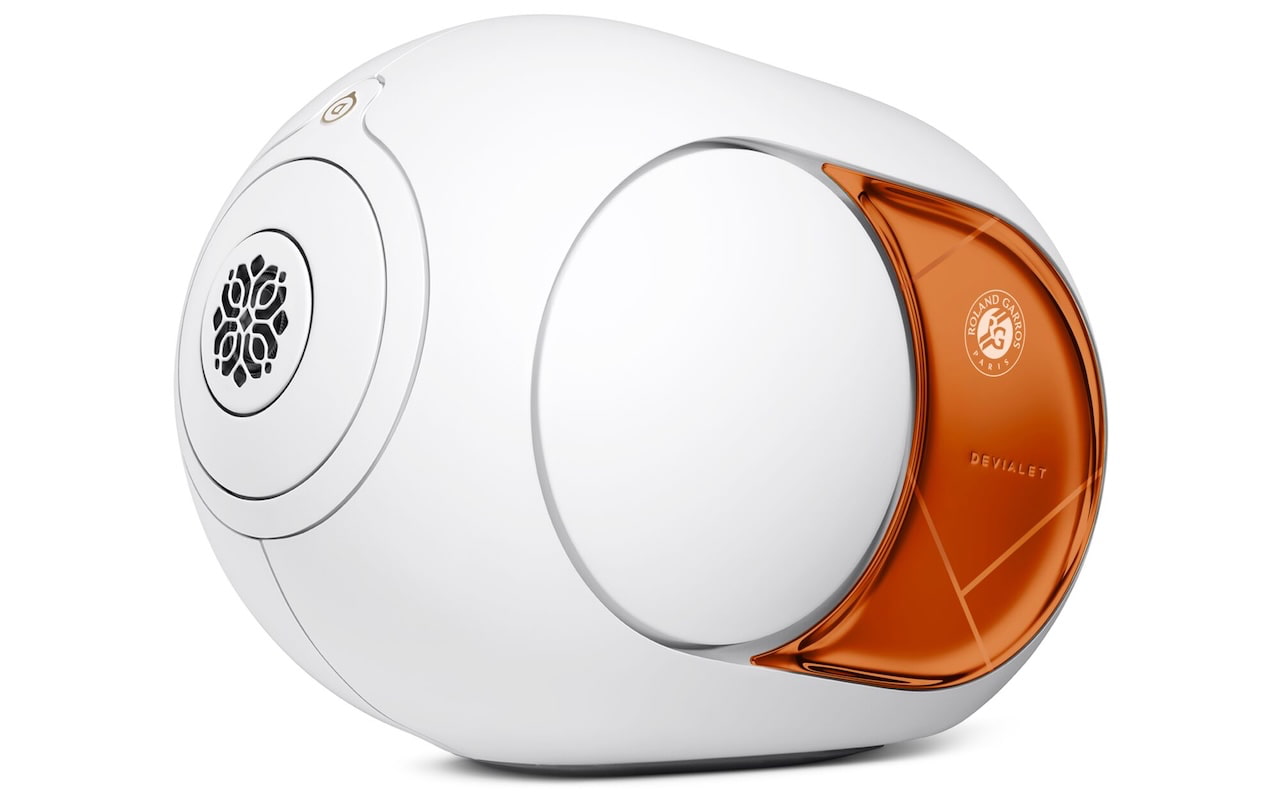
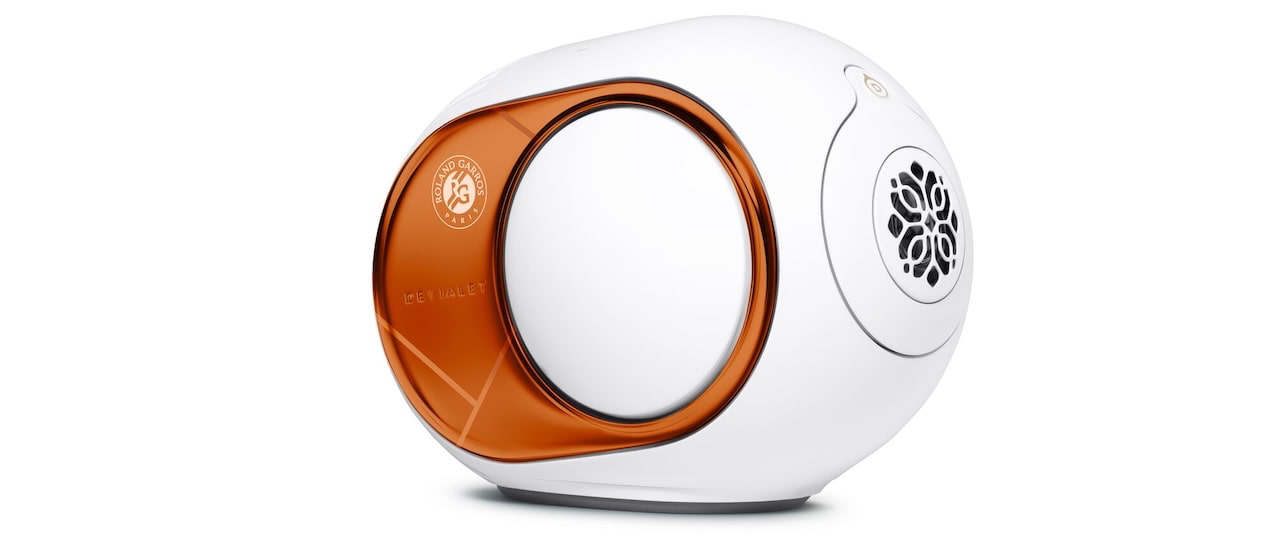
Leave it to the French to come up with something this stylish, expensive, and completely unwilling to explain itself to anyone drinking domestic sparkling wine. Devialet’s Phantom Ultimate Roland Garros Exclusive Edition is what happens when a French acoustic engineering company partners with the world’s most famous clay court tennis tournament: a limited edition Phantom Ultimate speaker dressed like it just won match point in Paris and refuses to apologize for the outfit.
Finished in clay red with warm ochre tones, white court line detailing, and the official Roland Garros logo, it is limited to a few hundred pieces, making it less “buy one for the kitchen” and more “collector piece for someone who already knows where the good Champagne is stored, keeps foie gras within striking distance, and treats your Bluetooth speaker like a peasant with a tambourine.”
The design is more than a color swap. Devialet says the side panels were created to evoke the reflection of Court Philippe Chatrier on the silver of the Coupe des Mousquetaires, the trophy awarded to the men’s singles champion. The white lines are laser engraved and finished with multiple coats of high gloss lacquer, while the Roland Garros logo is applied using a multi layer pad printing process. Très subtle? Not exactly. But subtlety was never really the Phantom’s department.
Devialet Phantom Ultimate 108 dB Roland Garros Wireless Speaker
Same Phantom Ultimate Performance, Now With More Clay Court Drama
Under the Roland Garros finish, this remains the Devialet Phantom Ultimate platform, which we recently reviewed and found to be one of the more serious attempts to make a compact wireless speaker behave like something far larger. The Phantom formula has always been about controlled violence in a small enclosure: deep bass, high output, active processing, and a design that looks like it escaped from a French aerospace lab after a long lunch.
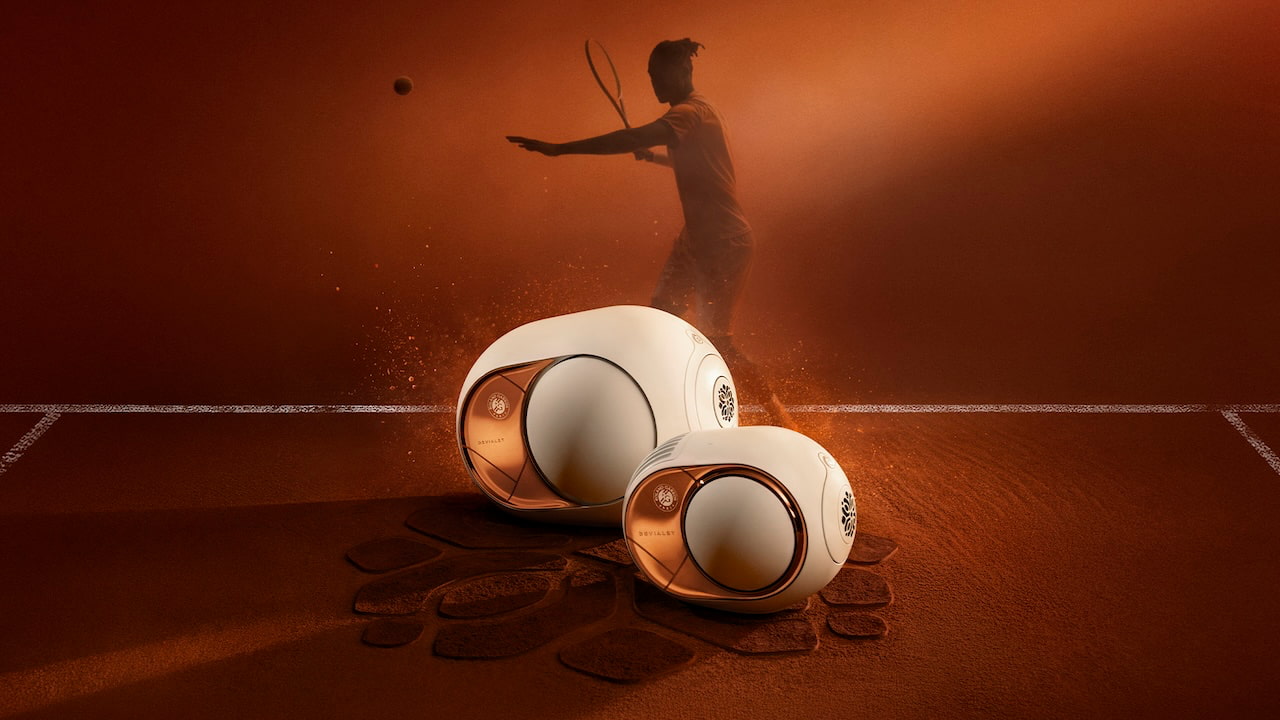
The Roland Garros edition will be offered in two versions. The larger Phantom Ultimate 108 dB version delivers 1,100 watts of amplification and a stated frequency range of 14 Hz to 35 kHz, with 32 bit 96 kHz audio processing. The smaller Phantom Ultimate 98 dB version delivers 400 watts and a stated frequency range of 18 Hz to 25 kHz.
Advertisement
Those numbers are not decoration. In our experience with the Phantom Ultimate 108 dB, the speaker’s appeal is not just that it plays loud or reaches low. Plenty of wireless speakers claim big bass and then proceed to smear everything like overcooked brie. The Devialet approach is more controlled, more physical, and more precise than most lifestyle wireless speakers at this level. It still sounds like a Phantom, which means it wants to impress you immediately.
The difference with the Ultimate generation is that the software, streaming support, processing, and user controls make it feel more complete. It is a category leading wireless speaker in every possible way.
Devialet Phantom Ultimate 98 dB Roland Garros Wireless Speaker
The Tech Stack Still Matters
Devialet’s core technologies carry over here, including ADH, SAM, HBI, and AVL. In plain English, ADH combines analog Class A behavior with Class D power and efficiency. SAM is Devialet’s driver matching system, designed to control phase and amplitude in real time. HBI is responsible for the Phantom’s low frequency reach and physical bass impact. AVL adjusts volume behavior in real time to keep playback more balanced across different types of content.
The Phantom Ultimate also uses an NXP i.MX 8M Nano processor and runs on Devialet DOS3, the company’s newer software platform first introduced with the Devialet Astra amplifier. That matters because modern wireless speakers live or die by the app, the operating system, and streaming stability.
Streaming support includes AirPlay, Google Cast, Roon Ready, Spotify Connect, TIDAL Connect, Qobuz Connect, and UPnP. The Devialet app also includes Music, Podcast, and Cinema modes, along with a six band EQ, Bass Reducer, and Loudness controls. That gives users more flexibility than older Phantom models, especially if the speaker is doing double duty for music, TV, podcasts, and those “why is the dialogue buried under explosions?” movie nights.
Advertisement
Bose clearly got the memo with its new Lifestyle Ultra Soundbar as well. Some of us are getting older, some of us have spouses who do not appreciate the Stanley Cup Playoffs at 11 p.m. at full tilt, and some of the best moments in French cinema still involve uncomfortable silence, cigarettes, footsteps in the Marais, and the creeping suspicion that an international terrorist is about to ruin someone’s galette.
Advertisement. Scroll to continue reading.
The Bottom Line
The Roland Garros edition is not for someone looking for the best wireless speaker bargain. That ship sailed, hit the clay, and got booed by the French crowd.
This is for the Devialet buyer who already likes the Phantom Ultimate but wants something more visually distinctive. It is also aimed at collectors, tennis fans with serious audio taste, and design conscious listeners who want a wireless speaker that does not look like another fabric wrapped cylinder apologizing from the corner.
The bigger 108 dB version makes the most sense for larger rooms or listeners who want the full Phantom experience with the most bass extension and output. The smaller 98 dB model is the better fit for bedrooms, offices, smaller living spaces, or anyone who wants the design and Devialet signature without detonating the room every time the playlist gets ambitious.
Advertisement
Pricing and Availability
The Devialet Phantom Ultimate Roland Garros Exclusive Edition launches on May 6, 2026 with a $200 or $400 premium of regular finishes. It will be available through select Devialet stores, Devialet’s website, the Roland Garros Megastore, and the official Roland Garros online boutique.
Garmin is moving JL Audio deeper into the high end home audio conversation with Primacy, a premium active loudspeaker system built around network streaming, amplification, signal processing, and room optimization. That approach is becoming more common across the category, as brands try to simplify hi-fi without asking listeners to build a rack full of separate components.
But Primacy is not chasing the same customer as WiiM, Eversolo, or other value driven streaming platforms. Garmin and JL Audio are making a much bigger ask. They want audiophiles to buy into a complete ecosystem where the streamer, preamp, DSP, room correction, amplifiers, and loudspeakers are designed to work together from the start. At $50,000 to $105,000, that is not convenience audio. That is a controlled, luxury hi-fi system for buyers who want fewer boxes, fewer cables, and far less guesswork.
JL Audio Primacy
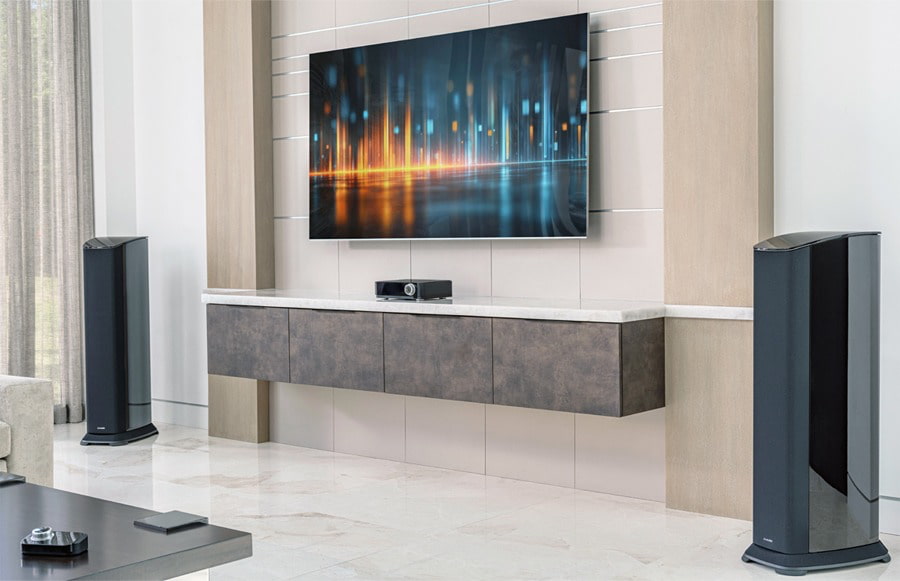
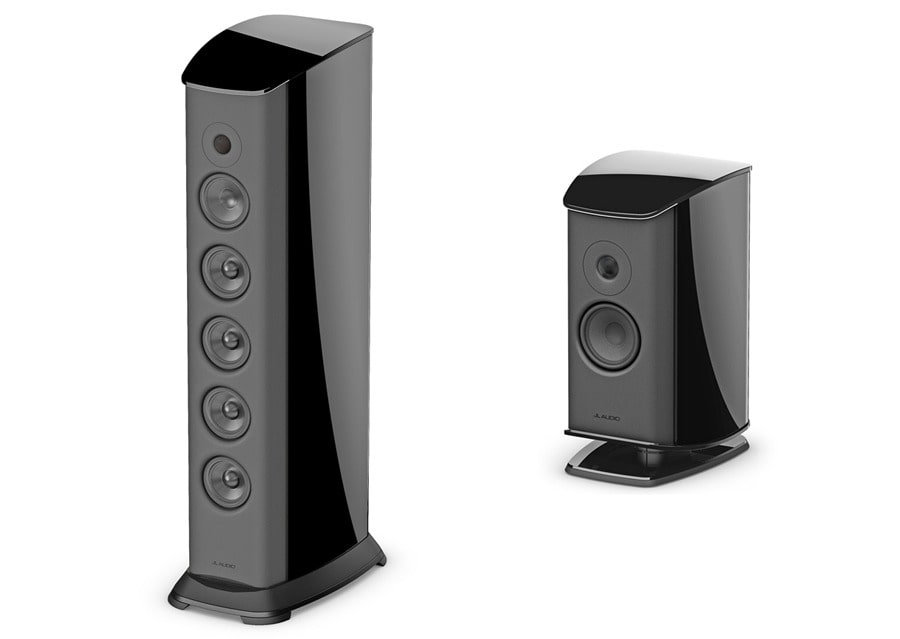
Primacy T6
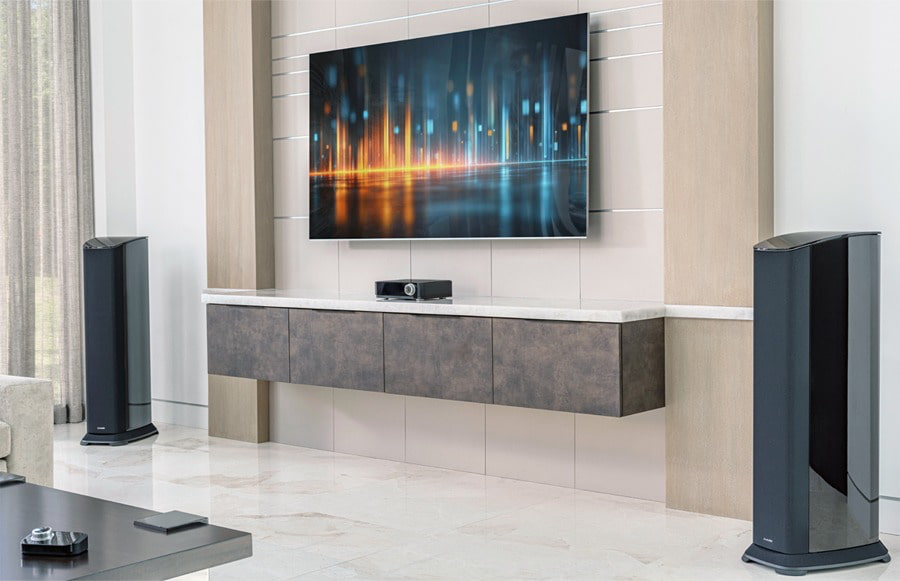
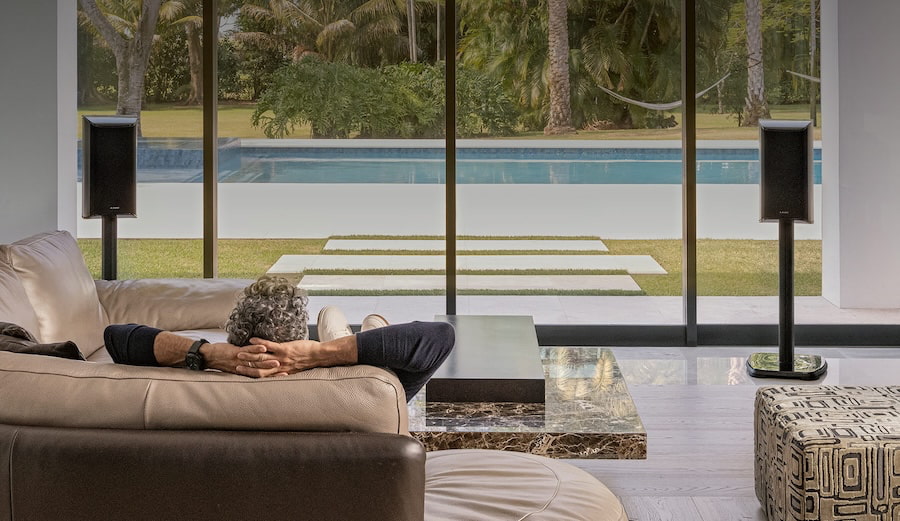
Primacy will be offered in two loudspeaker configurations: the T6 three-way tower loudspeakers or the S3 two-way bookshelf/stand-mount loudspeakers. Both systems are designed around the same basic idea: keep the amplification, signal processing, loudspeakers, and system control working as one package instead of forcing the customer to assemble the whole thing one expensive box at a time.
That matters because this is not a passive speaker system waiting for someone to add an amplifier, streamer, DAC, and room correction later. Garmin and JL Audio are selling Primacy as a complete active loudspeaker ecosystem, with the electronics and speakers intended to operate together from the beginning.
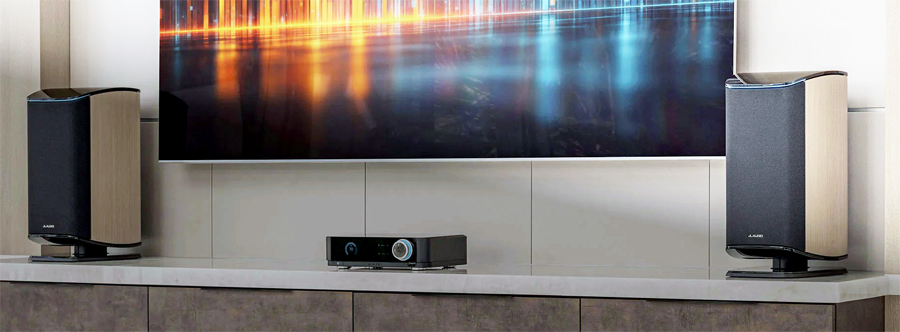
Primacy S3
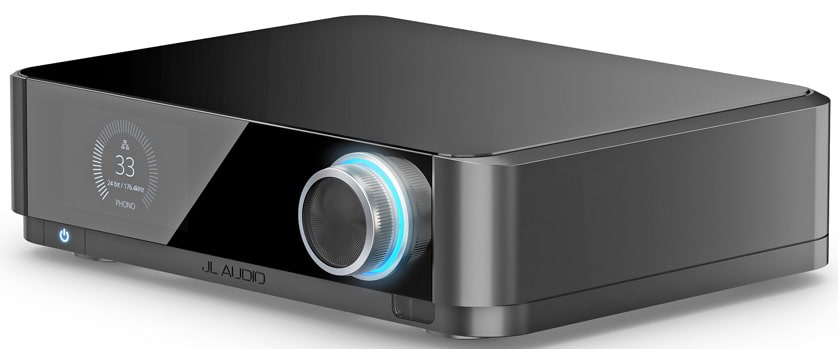
The hub of the Primacy system is the CS Centerpiece, which handles network streaming, preamp duties, system control, and room optimization processing. In other words, this is where the Primacy system stops being just a pair of active loudspeakers and becomes a complete JL Audio ecosystem.
Advertisement
“Primacy reflects our unwavering commitment to integrate modern lifestyles and technologies into luxury audio that is high performing, beautifully built, and uniquely optimized for the space it is in,” said Susan Lyman, Garmin Vice President of Consumer Sales and Marketing. “The ultimate audio experience, Primacy lets you listen to music, movies, and games like you are there live, inside the scene, with amazing clarity of every sound.”
Inside the JL Audio Primacy System: Streaming, Room Optimization, and Active Loudspeakers
Active Design: The Primacy T6 and S3 are active loudspeakers with DSP based audio filtering and built in amplification for each driver section. JL Audio uses switching amplifier technology, with DSP filtering applied at the input of each active amplifier channel. The goal is tighter control over each driver and better integration across the loudspeaker, rather than relying on an external amplifier and passive crossover network to sort it all out after the fact.
The Primacy T6 is the floorstanding tower option, while the Primacy S3 is the bookshelf or standmount model for smaller rooms, secondary spaces, or installations where a full tower makes less sense. Not everyone wants a loudspeaker that looks like it requires its own zoning permit.
Advertisement
Precision Machined Alloy Enclosure: Each Primacy loudspeaker uses a single cast, precision machined aluminum alloy enclosure with integrated internal bracing and woofer ports. That construction is designed to improve structural rigidity, reduce unwanted resonance, and support more predictable acoustic performance. It also makes the system feel more like a finished luxury product than another wooden box pretending the room is not part of the problem.
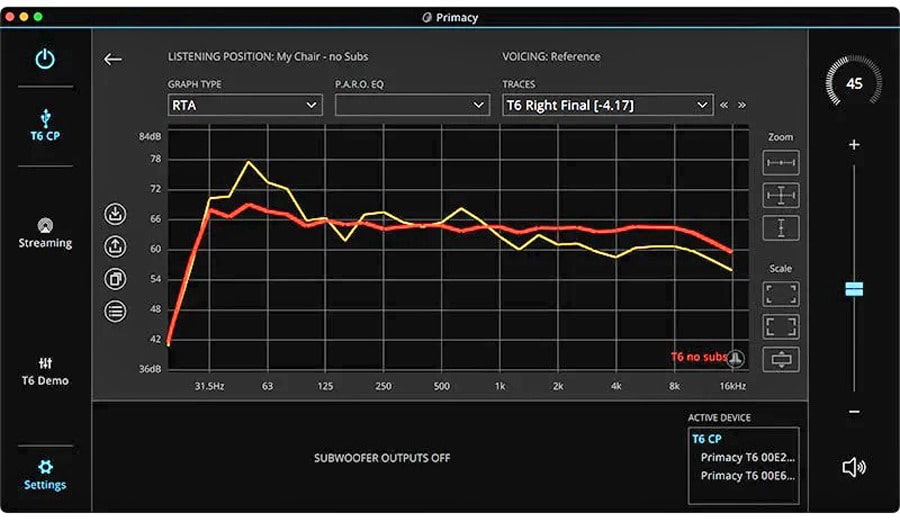
Primacy Automatic Room Optimization: Primacy Automatic Room Optimization, or P.A.R.O., measures and optimizes the system during setup, including any additional powered subwoofers used with the system. According to JL Audio, P.A.R.O. automatically adjusts crossovers, levels, equalization, and delay for each driver section. That matters because this is a fully integrated active system, not a mix and match pile of components hoping the room behaves itself.
High-Performance Triple-Core DSP: A digital signal processor, operating at 32-bit/192 kHz audio resolution, provides precise control over crossover filters, equalization, dynamics, and delay and phase.
Advertisement. Scroll to continue reading.
Advertisement
Dante Digital Network: Dante is an audio/video networking technology that is built into each Primacy loudspeaker. Dante supports efficient routing, control, and connectivity for streaming pristine digital audio directly to the Primacy loudspeakers’ internal amplifiers.
The Primacy Centerpiece
CS Centerpiece System Hub: The Primacy CS Centerpiece is the control hub for the system, combining network streaming, preamplifier functions, source connectivity, and control for the T6 and S3 active loudspeakers. It is designed to keep the main system functions in one component rather than requiring separate boxes for streaming, preamplification, source selection, and system control.
Streaming and Source Connectivity: The CS Centerpiece supports Bluetooth, AirPlay, Google Cast, Spotify Connect, Qobuz Connect, and TIDAL Connect. It also provides wired digital and analog inputs, including MM/MC phono input for turntable users. That gives Primacy support for both modern streaming services and traditional sources.
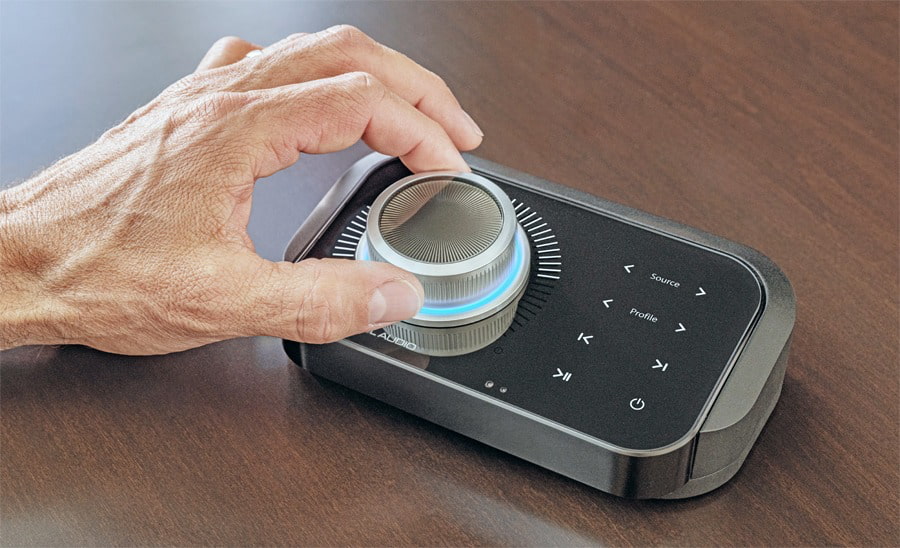
External Tabletop Remote: The system includes an external wireless tabletop remote, giving users physical control without relying only on a phone or tablet.
Minimalist Industrial Design: The CS Centerpiece has a clean, minimalist design intended to integrate into a room without drawing too much attention. That fits the broader Primacy approach: fewer visible components, fewer cables, and a more controlled system layout.
Advertisement
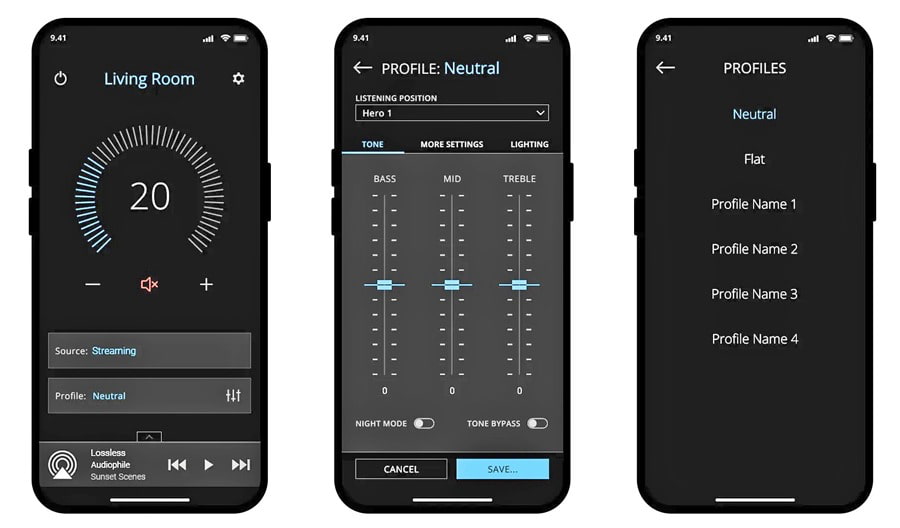
The centerpiece connects to the Primacy T6 and S3 active loudspeakers via Dante networking. This supports a high-resolution digital signal flow and includes a wireless, Wi-Fi connected tabletop remote controller that features a weighted volume knob and touch buttons to select source, profile, and more.
Primacy App
As a complement to the Centerpiece, JL Audio’s Primacy App also provides audio and room optimization control. The app can also be used to create, store, and name listening profiles optimized for different listening positions, equalization preferences, and activities.
JL Audio Primacy Comparison
JL Audio Model
T6
S3
Product Type
Floorstanding Active Speaker
Bookshelf Active Speaker
Price (Pair)
$90,000
$35,000
Driver Configuration
3-Way
2-Way
Drivers
1 x Tweeter: 1″ 1 x Midrange: 5.5″ 4 x Woofer: 5.5″
1 x Tweeter: 1″
1 x Woofer: 5.5″
Enclosure type
Tweeter: Sealed
Midrange: sealed, secondary cast alloy enclosure
Advertisement
Woofer: bass-reflex design vented at the base of the primary cast alloy enclosure
Tweeter: Sealed
Woofer: bass-reflex design vented at the base of the primary cast alloy enclosure
Amplifier Power (RMS)
1000 W (Total) Tweeter: 200 W Midrange: 200 W Woofer: 600 W
400 W (Total) Tweeter: 200 W
Advertisement
Woofer: 200 W
Frequency response (Anechoic)
45 Hz to 20 kHz, ±2 dB, -3 dB @ 35 Hz, -6 dB @ 32 Hz.
55 Hz to 20 kHz, ±2 dB, -3 dB @ 44 Hz, -6 dB @ 36 Hz.
Digital to Analog Converters
ESS SABRE Reference DACs x 3 (operating in mono mode)
ESS SABRE Reference DACs x 3 (operating in mono mode)
AKM triple-core with Velvet Sound technology, processing at 32 bit/192 kHz for local system volume, crossovers, delays, equalization, and dynamics for each amplifier and driver section
AKM triple-core with Velvet Sound technology, processing at 32 bit/192 kHz for local system volume, crossovers, delays, equalization, and dynamics for each amplifier and driver section
Signal Processing
Unbalanced input(s) Mono (one RCA jack – input impedance of 50k ohms)
Balanced input(s) Mono (one female XLR jack – input impedance of 50k ohms)
Unbalanced input(s) Mono (one RCA jack – input impedance of 50k ohms)
Advertisement
Balanced input(s) Mono (one female XLR jack – input impedance of 50k ohms)
Calibration mode
Primacy Automatic Room Optimization (P.A.R.O.) via PC and Primacy Centerpiece (sold separately)
Primacy Automatic Room Optimization (P.A.R.O.) via PC and Primacy Centerpiece (sold separately)
Input modes
Analog or Dante Network
Analog or Dante Network
12 V trigger output capacity
50 mA max (1/8″ (3.5 mm) mini jack)
50 mA max (1/8″ (3.5 mm) mini jack)
Maximum peak short-term sine wave acoustic output, averaged from 100 Hz to 3 kHz @ 1 m, half space
>112 dB SPL
>114 dB SPL
Dante Network Connections
Two RJ45 ports
Two RJ45 ports
Analog input sensitivity
0.32 V (-10 dBV) to 8.0 V (+18 dBV)
0.32 V (-10 dBV) to 8.0 V (+18 dBV)
Input modes
Analog or Dante® Network
Analog or Dante® Network
Input Grounding
Isolated or grounded (analog inputs)
Isolated or grounded (analog inputs)
Level control
Level Trim (dB): 0 to -5 dB and muted (-∞)
Level Trim (dB): 0 to -5 dB and muted (-∞)
Filter frequency rangeHigh-pass
80 Hz
80 Hz
Crossover frequencies/slope
240 Hz/3 kHz, 24 dB/octave Linkwitz-Riley
240 Hz/3 kHz, 24 dB/octave Linkwitz-Riley
Processing bit depth/resolution
32 bit/192 kHz
32 bit/192 kHz
Power modes
Off, on or automatic (signal-sensing or 12V trigger)
Off, on or automatic (signal-sensing or 12V trigger)
T6 speaker with black gloss decorative side panels Power cord Documentation White gloves Grille(s) included
S3 speaker with black gloss decorative side panels Power cord White gloves Documentation
Primacy CS Centerpiece Specifications
Jl Audio Model
Primacy CS Centerpiece
Product Type
Streamer, Preamp, Controiller
Price
$15,000
Construction
Primary cast aluminum alloy enclosure with secondary machining, glass top, and fascia
Volume control
Machined aluminum rotary dial with active lighting ring and push-button center cap
Display
RGB AMOLED dead front, 640 x 320 pixels, 198 ppi, 70 x 43 mm active area
Circuitry Shielding
Modular architecture with isolated power supply and dedicated, fully shielded secondary enclosures for analog and phono subsections
Thermal Management
Active, quiet-flow fan cooling system with user-serviceable air intake filtration
Streaming Functionality
Apple® AirPlay® 2, Google Cast™, Qobuz Connect, Roon Ready, SPOTIFY® Connect, TIDALSMConnect, and more…
Network Standard
UPnP/DLNA
Digital to Analog converters
ESS SABRE Reference DACs x 2 (operating in mono mode)
Analog to Digital Converters
ESS SABRE PRO x 2 (operating in mono mode)
Digital signal processor
AKM triple-core with Velvet Sound technology, with local input switching/routing and line output processing
Processing bit depth/resolution
32 bit/192 kHz
Sample Rate Conversion
Dedicated, hardware asynchronous sample rate converters for rate matching non-analog inputs to core 32-bit/192 kHz processing
Primacy® Automatic Room Optimization (P.A.R.O.)
Yes – Includes speaker and subwoofer optimization
Computer Requirements
A computer running the Primacy Desktop application
Windows 10 (OS Build 1809 or later), 11
Mac OS 14, 15, 26
Audio Settings
Balance: left/right channel slider Tone controls: Off/on Bass: -6.0 dB to +6.0 dB in 0.5 dB steps Midrange: -6.0 dB to +6.0 dB in 0.5 dB steps Treble: -6.0 dB to +6.0 dB in 0.5 dB steps Extreme Low Frequency (E.L.F.) Trim –12 dB to 0 dB in 0.5 dB steps
Network Digital Audio Transport
Protocol Dante® audio over IP Standard 802.3ab compliant (1000BASE-T)
Advertisement
Four RJ45 (Four-port switch, redundant or daisy chain Dante + control) 2 Channels @ 32 bit/192 kHz
Unbalanced Analog Inputs (RCA)
Two sets of left and right RCA input jacks Input impedance: 47 kΩ Frequency response 20 Hz to 20 kHz (+/- 0.02 dB)
Phono Inputs (RCA)
Left and right RCA input jacks, plus grounding terminal – MM and MC compatible
RIAA equalization method: Two separate passive networks per channel, one each for low and high frequencies.
RIAA frequency response 20 Hz to 20 kHz (+/- 0.2 dB)
Advertisement
Optical Input (Toslink)
3 x Toslink (SPDIF) Input receiver transfer rate 25 Mbps (max) Input receiver sensitivity (min) –27 dBm Input receiver wavelength 650 nm Digital input data type: 44.1 kHz to 192 kHz, 24-bit LPCM
HDMI Input
Standard HDMI 2.1/HDMI-CEC Audio format 2 CH LPCM (ARC/eARC) Sample rate support 16/20/24/32 bit @ 44.1/48/88.2/96/176.4/192 kHz
USB Input (USB-C®)
USB 2.0 (high speed)
ASIO 2.3.1 compliant driver (supports audio class 1.0/2.0 and USB 2.0 full-speed/high-speed devices
PCM: 16/20/24 bit @ 44.1/48/88.2/96/176.4/192/352.4/384 kHz
DSD: 1x/2x/4x
Advertisement
Subwoofer Outputs
Two sets of analog subwoofer output jacks (RCA and XLR)
Network/Wireless Specifications
LAN 802.3ab compliant (1000BASE-T) (for the best streaming experience, a wired LAN connection is recommended)
WLAN 802.11a/b/g/n/ac/ax 2×2 MIMO (Wi‑Fi® 6)
Bluetooth® 5.1 SBC with AAC codec
RST
Advertisement
DFU
USB-2
USB-3 Service controls
Power
Mains voltage 100 to 240 V AC, 50/60 Hz
Advertisement
Power consumption Standby in Eco mode: < 7.0 W
Idle power consumption (active with no signal) 120 V: ~34 W, 240 V: ~40 W
12 Volt Trigger
12 VDC input: 1/8″ (3.5 mm) mini jack, tip positive
12 VDC output 1/8″ (3.5 mm) mini jack, tip positive, 50 mA max. load
Advertisement
CS Centerpiece Physical Specifications
Overall height (including feet) 3.61″ (92 mm)
Chassis height 3.31″ (84 mm)
Width 13.10″ (333 mm)
Overall depth (including volume control and connections) 11.30″ (287 mm)
Advertisement
Net weight 18 lbs (8 kg)
CS Remote Controller Physical Specifications
Height 1.20″ (31 mm) Width 6.61″ (168 mm) Depth 3.98″ (101 mm) Net weight 1.72 lbs (0.78 kg
What’s In The Box
Primacy centerpiece Tabletop remote controller USB-C cables (4 m and 2 m) P.A.R.O. microphone Power cord Microphone fixturing accessories Microfiber cloth Documentation
Primacy S3
The Bottom Line
Garmin’s JL Audio Primacy is a luxury active audio system built around the $15,000 CS Centerpiece and either the $90,000 T6 towers or $35,000 S3 bookshelf/standmount speakers. The hook is integration: streaming, MM/MC phono, room correction, Dante networking, DSP, amplification, and loudspeakers designed to work as one system.
What makes it different is also the gamble. Primacy is not as design-forward as the best Bang & Olufsen systems or as exotic as some Goldmund wireless offerings, but it appears to offer deeper system control, more serious connectivity, and customizable speaker finishes through removable exterior plating.
What’s missing? Flexibility. At this price, many audiophiles may still want to choose their own electronics and speakers. Primacy is for luxury buyers who want high-end audio without the usual stack of boxes, cables, and setup anxiety.
Austin Bowden-Kerby, a pioneer in coral reef conservation, spends many of his days gardening corals for reefs around Fiji and the Pacific. He grows corals in ocean nurseries. Once they’re healthy enough, he moves them to outer ocean areas with the hope they will replicate and grow.
“We’re looking at what Mother Nature would do on her own if she had 1,000 years to adapt,” said Bowden-Kerby, who founded the UNESCO-endorsed Reefs of Hope strategy. “We would have these kinds of things happening.”
Advertisement
Bowden-Kerby is one of several scientists trying to conserve, replicate and reproduce heat-resistant corals before climate change wipes them out.
The United States National Oceanic and Atmospheric Administration has said the world is experiencing a fourth global coral bleaching event. They’ve found that bleaching-level heat stress affected almost 85pc of the world’s coral reef area between 2023 and 2025.
But naturally occurring, heat-resistant corals can survive in waters up to 36C and potentially higher. They are usually found in warmer waters, like parts of the Pacific Ocean and the Persian Gulf. These corals are increasingly important as sea temperatures rise. So scientists are turning to them to help save declining reefs.
However, heatwaves have led to widespread coral bleaching and loss. When waters become too warm, corals expel the algae in their tissues that give them their colour. That causes corals to turn completely white.
Coral reefs and their ecosystems are also threatened by pollution, ocean acidification, coastal development and overfishing.
Christopher Cornwall, a lecturer in marine biology at Te Herenga Waka-Victoria University of Wellington in New Zealand, co-authored a recent review that found some reefs can survive if corals become more heat-tolerant.
Advertisement
He told me there are multiple things to consider when conserving and replicating corals: restoring heat-resistant corals where it’s feasible, doing so at a large enough scale and maintaining coral diversity. Restored corals also must be able to survive, he added.
“We can’t just do coral restoration without thermally tolerant corals, because they’re just going to die the next time it gets too hot,” Cornwall said.
Assisted evolution
“A lot of the research now is about, can you scale up restoration and how do you do it more effectively?” said Peter Mumby, a professor of coral reef ecology at the University of Queensland in Australia. “One of the key concerns is to make sure those corals are as tolerant of high temperature as possible.”
Breeding heat-tolerant corals is a form of assisted evolution. Humans intervene to speed up natural processes to help corals more quickly respond to and recover from their stressors, like heatwaves from climate change.
Advertisement
One recent study examining the possible success of assisted evolution interventions like breeding and selecting traits found these interventions can help corals become more tolerant to heatwaves, but they need “extremely strong selection”.
Liam Lachs co-authored that study. Lachs is a former postdoctoral research associate in the CoralAssist lab, a team of scientists led by James Guest at Newcastle University in the United Kingdom. Lachs specialises in coral reef ecosystems and researches coral in Palau, a Pacific island country where corals are surviving in warmer waters.
He told me variability within and among reefs and coral species must be considered when creating more heat-resistant coral, which makes replication complex. “Even within a single reef, there’s a range of tolerance levels,” he said.
Algae and bacteria
Researchers at the Australian Institute of Marine Science (AIMS) have found that some algae (Durusdinium), which symbiotically live in corals and provide them with food in exchange for housing and protection, can boost corals’ heat tolerance.
Advertisement
Madeleine van Oppen is a senior principal research scientist at AIMS. She co-authored a recent review about potentially introducing beneficial bacteria into corals to improve their heat tolerance.
Scientists are also exploring whether heat-tolerant corals should be planted across oceans – from the Indo-Pacific region to the Caribbean – and not just in nearby waters.
Van Oppen said new ventures ultimately need more research, and the real test of success is if something done in a lab works in the wild. “Field testing, I’d say, is the next big thing,” she said. “Finding out whether these interventions can enhance tolerance at ecologically relevant scales. Is it stable over time?”
AIMS researchers also found that heat tolerance could be passed down by interbreeding wild colonies of the same coral species. Heat-resistant coral species include some pocillopora and acropora.
For all the efforts by scientists to save coral reefs and ensure heat resilience, nothing will keep corals healthy more than lowering the global temperature. “The lower we can get our greenhouse gas emissions, the more chance there will be that reefs will exist in the future,” said Cornwall.
Whitney Isenhower is a freelance journalist and communications consultant specializing in health, climate and science. Her work has appeared in Devex, Live Science and North Carolina Health News. Previously, she supported U.S. Agency for International Development projects until 2025.She also completed the fellowship in journalism and health impact through the University of Toronto Dalla Lana School of Public Health.
Advertisement
Don’t miss out on the knowledge you need to succeed. Sign up for the Daily Brief, Silicon Republic’s digest of need-to-know sci-tech news.
The two conglomerates are funding separate R&D centres focused on next-generation battery chemistries and advanced EV systems. The investment is a hedge: both groups currently buy critical battery components from Chinese suppliers and want options when Beijing tightens export rules again.
India’s two largest steel-and-everything-else conglomerates are putting close to $1bn behind a question that has become urgent for the country’s electric-vehicle industry: what happens when the Chinese suppliers stop picking up the phone?
Tata Group and JSW Group are separately funding research-and-development centres aimed at building in-house expertise in next-generation battery technologies and advanced EV systems, Bloomberg reported on Wednesday, citing people familiar with the plans. The combined commitment is just under $1bn.
Both companies are reasoning from the same exposure. India’s EV industry, including their own businesses, runs heavily on Chinese cells, materials and equipment.
Advertisement
The 💜 of EU tech
The latest rumblings from the EU tech scene, a story from our wise ol’ founder Boris, and some questionable AI art. It’s free, every week, in your inbox. Sign up now!
China’s tightening of export controls on graphite, lithium-processing equipment and battery-making machinery has, over the past year, made that exposure a board-level problem rather than a procurement one.
What each group is funding
Tata’s R&D effort sits inside Agratas, the group’s battery arm, which is already building a 20 GWh gigafactory in Sanand, Gujarat to supply Tata Motors. The new spend goes upstream of that: chemistry, cell design, and process know-how the group has historically licensed or sourced.
Advertisement
Agratas has previously partnered Tata Technologies to fast-track battery solutions for mobility and renewable energy storage; the new funding extends that work into materials and proprietary cell formats.
JSW Group’s track is different but rhymes. JSW Motors, the JV vehicle through which the conglomerate sells MG cars in India alongside SAIC, opened JNEXT, the JSW NextGen Technology Center, in Pune in February through a partnership with Tata Elxsi.
Neither company has confirmed the figures publicly. The Bloomberg sources put the combined investment at “nearly $1 billion”, with the funds spread across multi-year R&D programmes rather than capex on production lines.
The trigger is policy on the other side of the Himalayas. Late last year, executives and engineers from Reliance Industries fanned out across Wuxi looking to lock in roughly $1.1bn of equipment for a planned battery plant; Beijing’s tightening of export controls on key battery-making technology arrived shortly after. Hundreds of equipment shipments to India have been delayed or rerouted since.
Advertisement
Tata Motors itself has had to lean further on Chinese suppliers in the meantime. The Curvv.ev launched with cells from Octillion Power Systems, and the company struck a sourcing arrangement with Envision AESC for higher-density packs.
Each of those deals tightened the supply chain rather than diversifying it. Building a domestic chemistry programme is the obvious medium-term hedge.
JSW’s exposure is structural in a different way. The MG joint venture, of which Sajjan Jindal’s group owns 35%, sources around 60% of its components from China.
JSW has publicly aimed at a million new-energy vehicles by 2030 and a 10 GWh battery plant in partnership with LG Energy Solution.
Advertisement
The new R&D push is what would make those numbers achievable without renegotiating the SAIC stack every time Beijing changes its rules. The dependency picture is the same dependency Europe is grappling with, and it is now driving capital allocation in Mumbai and New Delhi as much as Berlin and Paris.
The competitive backdrop
Tata is no longer India’s runaway EV leader. Mahindra overtook it in EV revenue in the most recent fiscal year, even though Tata still leads on sales volume. JSW MG has doubled its market share in the past twelve months.
The two competing R&D commitments arrive against that shifting hierarchy: each group needs proprietary technology to defend its margins, not just match its rivals on offer.
The pattern is recognisable. Europe’s homegrown battery cell push, spurred by Northvolt’s collapse and the energy-security argument, is the closest analogue. Indian groups have studied it carefully: the same logic of chemistry sovereignty, recycling capacity (UK recycler Altilium’s £18.5m round sits at one end of the same arc), and policy support for domestic cell production now drives the conversation at home.
Advertisement
The difference is that India’s industrial policy, including the PLI scheme for advanced chemistry cells, has been in place for several years; what was missing was private R&D capital. The Tata and JSW announcements move that piece into place.
What is at stake?
Even with $1bn flowing into research, neither group will displace Chinese chemistry leadership in this decade. The realistic ambition is narrower: enough internal capability to specify, validate and customise cells, to qualify alternative suppliers, and to negotiate with Chinese partners from a less precarious position.
That ambition shapes the spending profile. Most of the money will go to talent, lab equipment and pilot lines rather than to gigawatt-scale fabs. Both groups already have, or are building, those at scale; the gap they are closing is the one between buying technology and owning it.
Whether that is enough depends on how aggressively China continues to limit access. The export controls of the past year suggest the line is moving the wrong way, and that India is not the only economy facing it. EU battery industrial policy on much the same arithmetic, and the equity question is whether national champions can build technical depth fast enough to keep up.



















































You must be logged in to post a comment Login