Google is working on a more streamlined way for app developers to authenticate users. The company has introduced a new verified email credential issued directly through Android’s Credential Manager API, with the goal of modernizing the authentication process. Users will no longer need to check their inbox for temporary authentication… Read Entire Article Source link
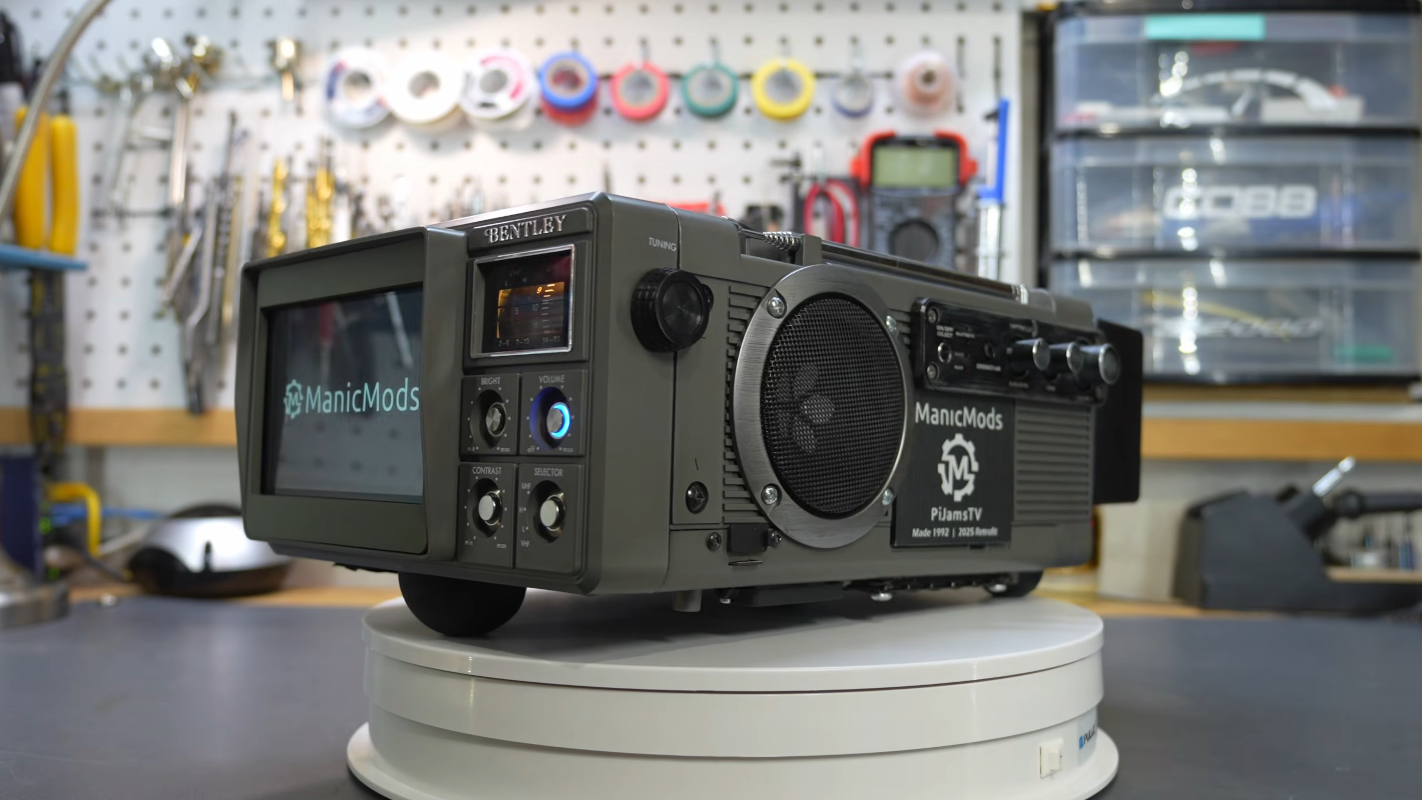
The humble cathode ray tube (CRT) was once the technology behind almost all of our televisions and computer displays. Its replacements, from LCD screens to OLED and others, are generally cheaper to make and better to look at. Old televisions were comparatively large as well, but their size can be an advantage for people like [ManicMods] aka [Jeff]. His latest build ditches the CRT from an old Bently portable TV and uses the huge space available in the case for a hi-fi audio system and some other parts that turn it into an impressive portable home theater system.
After removing most of the internals of the TV, the first part to go in is the stereo and subwoofer combo as it takes up the most amount of space. The subwoofer section points downward and the two stereo speakers are mounted to the sides. To free up the most space inside, the new display is mounted forward of the original bezel, with a new 3D printed one helping to hold it in place. Behind it goes a Raspberry Pi, loaded with the moOde audio player, a high quality DAC for audio output, and a 1 TB SSD with [Jeff]’s uncompressed audio library. Most of the ports are extended out to the case including the SD card slot so other operating systems can be loaded on the Pi, and there are a ton of options for hooking up external speakers and displays as well, making it an extremely modular and expandable portable media center.
Also added to the finished product are a few small game controllers, since the Pi is perfectly capable of playing retro games, as well as a small wireless keyboard and trackpad combo. Although the CRT’s demise will be felt harder by some than by others, the original look of the case is preserved somewhat by keeping the original tuning display and locations of the original control buttons and knobs. If preserving the CRTs are of upmost importance, though, this build used a pair of them in a VR headset.
If you own one of the Sony Bravia lines of televisions (like I do) and were hoping that the expensive television would suddenly become slightly less functional for no good reason, I have some good news for you.
Sony just announced that the company is making adjustments that will reduce the usefulness and efficiency of watching over-the-air (OTA) broadcasts with an antenna (something many still do in order to “cut the cord,” but still watch local sports broadcasts). According to the Sony announcement, the TV’s internal guide for watching live OTA simply won’t work as well anymore:
“The changes primarily target the program guide functionality for over-the-air antenna TV channels received via the ATSC tuner. After the cutoff date, program information may fail to display on certain channels, limiting the guide’s usefulness for planning viewing schedules. Users will often see listings only for channels they have recently watched, rather than a comprehensive overview of available broadcasts. Additionally, channel logos that previously appeared in the guide will disappear, and any thumbnail images accompanying program descriptions will no longer load or show.”
Many of the TVs being impacted are several thousand-dollar televisions, including the 2025 BRAVIA 8 II (XR80M2) and BRAVIA 5 (XR50), and the 2024 BRAVIA 9 (XR90), BRAVIA 8 (XR80), and BRAVIA 7 (XR70).
Sony didn’t specify why it’s making several-thousand-dollar televisions slightly less useful, but as always it’s about money. Many companies are keen to direct consumers to their (or their own) ad-based streaming alternatives to live OTA broadcasts, which are easier to monitor and monetize through surveillance. As Ars Technica posits Sony is also just likely cutting costs:
Advertisement
“Sony’s plan to remove some TV guide and menu features may be aimed at reducing costs and burden associated with features that typically depend on backend data services. Things like channel logos and enhanced metadata often require licensing agreements and the use of third-party electronic program guide data providers and metadata aggregators.”
Again, some of these sets (especially of the larger screen sizes) can run upwards of $3000 to $4000. You don’t typically expect products that expensive to suddenly become less useful. Or perhaps you do, if you’ve watched repeatedly how you no longer actually own the products you buy, which can be routinely downgraded (or bricked entirely) with a firmware update out of the blue.
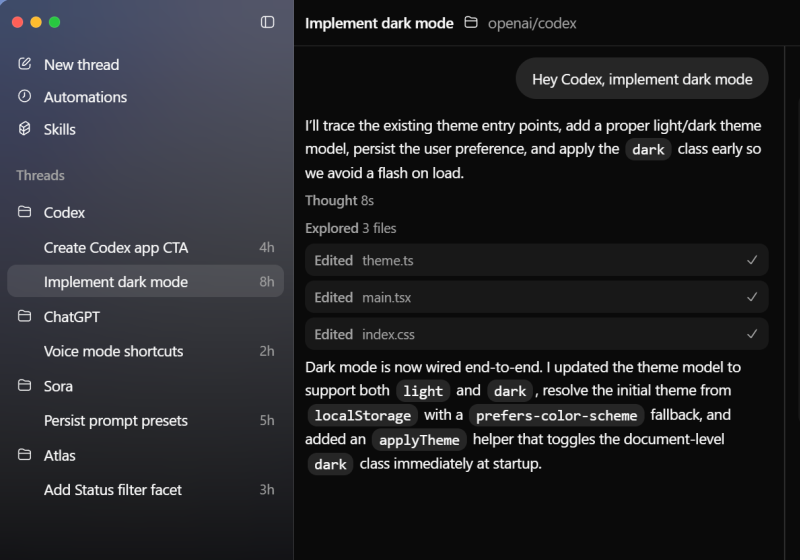
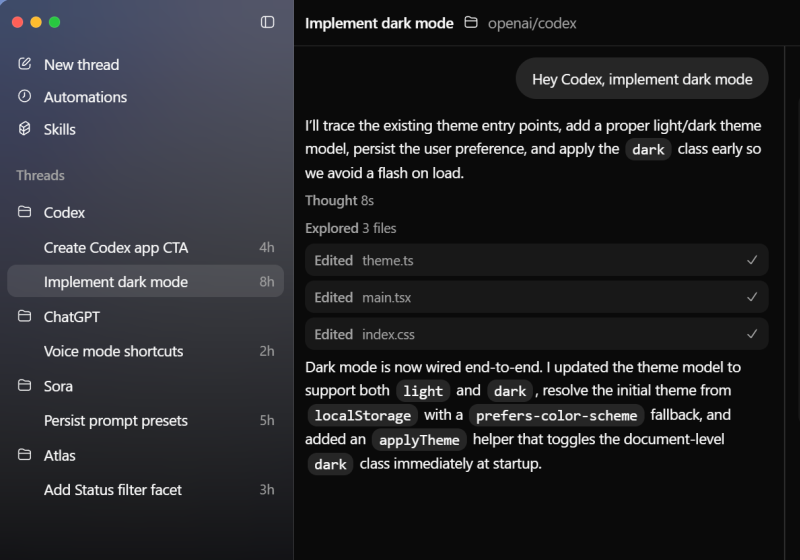
OpenAI Codex is a coding agent powered by ChatGPT that helps developers build, test, and ship software. It can run tasks in parallel, generate and review code changes, and automate repeatable workflows, while working with existing tools and secure sandboxed environments.
When Yong Wang recently received one of the highest honors for early-career data visualization researchers, it marked a milestone in an extraordinary journey that began far from the world’s technology hubs.
Harbin Institute of Technology in China; Huazhong University of Science and Technology in Wuhan, China; Hong Kong University of Science and Technology
“Visualization helps people understand complex ideas,” Wang says. “If we design these tools well, they can make advanced technologies accessible to everyone.”
Wang was born in southwestern Hunan Province. China’s economy was still developing, and life in his village was modest. Most families in Hunan grew rice, vegetables, and fruit to support themselves.
Wang’s parents worked in agriculture too, and his father often traveled to cities to earn money working in a factory or on construction jobs. The extra income helped support the family and made it possible for Wang to attend college.
“I’m very grateful to my parents,” Wang says. “They never attended university, but they strongly supported my education.”
Advertisement
“If we build tools that help people understand information, then more people can participate in science and innovation. That’s the real power of visualization.”
Technology was scarce in the village, he says. Computers were almost nonexistent, and televisions were considered precious, expensive household possessions.
One childhood memory still makes him laugh: During a summer vacation, he and his brother spent so many hours playing video games on a simple console connected to the family’s television that the TV screen eventually burned out.
“My mother was very angry,” he recalls. “At that time, a TV was a very valuable thing.”
Advertisement
He says that despite never having used a laptop or experimenting with electronic equipment, he was fascinated by the technologies he saw on TV shows.
One of the defining experiences of his undergraduate years, he says, was a university robotics competition. Wang and his teammates designed a robot capable of autonomously navigating around obstacles.
The design was simple compared with professional systems, he acknowledges. But, he says, the experience was exhilarating. His team placed second, and Wang began to see engineering as both creative and collaborative.
That experience helped him clarify his future, he says: “I realized I didn’t enjoy doing repetitive work or simply following instructions. I wanted to explore ideas that interested me, and I wanted to conduct research.” The realization pushed him toward graduate school, he says.
His research focuses on a challenge facing nearly every business: how to make sense of the enormous amounts of data being generated.
Advertisement
“We live in an era of information explosions,” Wang says. “Huge amounts of data are generated, and it’s difficult for people to interpret all of it to make better business decisions.”
Data visualization offers a solution by turning complex information into images, patterns, and diagrams that people can more readily understand.
But many visualizations still must be designed manually by experts, Wang notes. It’s a time-consuming process that creates a bottleneck, he says.
His solution is to use large language models and multimodal systems that can generate text, images, video, and sensor data simultaneously and automate parts of the process.
Advertisement
One system developed by his research group lets users design complex infographics through natural-language instructions combined with simple interactions such as drawing on a touchscreen with a finger. It allows nontechnical people to generate visualizations instead of hiring professional designers.
Another focus of Wang’s research is human-AI collaboration. AI systems can analyze data at enormous scale, but people still need to be the final decision-makers, he says.
Visualization helps bridge the gap between human intention and AI’s complex calculations by making the process an AI system uses to reach a result more transparent and understandable.
“If people understand how the AI system works,” Wang says, “they can collaborate with it more effectively.”
Advertisement
He recently explored how visualization techniques could help researchers understand quantum computing, a field where core concepts—such as superposition, where a bit can be in more than one state at a time—are abstract. In classical computing, the bit state is binary: It’s either 1 or 0. A quantum bit, or qubit, can be 1, 0, or both. The differences get more dizzying from there.
Visualization tools could help scientists monitor quantum systems and interpret quantum machine-learning models, he says.
The importance of IEEE communities
Teaching and mentoring students remain among the most meaningful parts of Wang’s career, he says.
Professional communities such as the IEEE Computer Society, he says, play a major role in helping him transform early-stage graduate students unsure of which lines of inquiry they will pursue into independent researchers with a solid technical focus. Through conferences, publications, and technical committees, IEEE connects Wang with other researchers working in visualization, AI, and human-computer interactions, he says.
Advertisement
Those connections have helped him share ideas, collaborate, and stay up to date on innovations in the research community.
Receiving the Significant New Researcher award motivates him to continue pushing the field forward, he says.
Looking back, he says, the distance between his rural village in Hunan and an international research career still feels remarkable. But, he says, the journey reflects something larger about his chosen field: “If we build tools that help people understand information, then more people can participate in science and innovation.
Looking for the most recent regular Connections answers? Click here for today’s Connections hints, as well as our daily answers and hints for The New York Times Mini Crossword, Wordle and Strands puzzles.
Today’s Connections: Sports Edition could trip you up, unless you know your video games. If you’re struggling with today’s puzzle but still want to solve it, read on for hints and the answers.
Connections: Sports Edition is published by The Athletic, the subscription-based sports journalism site owned by The Times. It doesn’t appear in the NYT Games app, but it does in The Athletic’s own app. Or you can play it for free online.
Hints for today’s Connections: Sports Edition groups
Here are four hints for the groupings in today’s Connections: Sports Edition puzzle, ranked from the easiest yellow group to the tough (and sometimes bizarre) purple group.
Yellow group hint: Not on top.
Advertisement
Green group hint: Hoops teams.
Blue group hint: Great netminders.
Purple group hint: Good group for gamers.
Answers for today’s Connections: Sports Edition groups
With that, they have now hijacked that university’s subdomain. Given the reputations universities have, search queries then flow to the top of Google’s results.
The root cause is simple: organizations create DNS records and never clean them up. There is no expiry date on a CNAME record. Nobody gets an alert when the target stops responding. And most university IT departments don’t maintain a comprehensive inventory of their subdomains and where they point.
This is compounded by how universities operate—they are highly decentralized. Individual departments, labs, research groups, and student organizations can often request subdomains independently. When people leave, there is no decommissioning process for the DNS records they created.
Finding hijacked subdomains is straightforward. People need only enter site:[university].edu “xxx” or site:[university].edu “porn” for an affected institution, and scores of results will appear. In some cases, the subdomains returned no longer lead to porn sites, but as of Friday morning, many still did.
Advertisement
The lesson here is clear: Any organization with a website should compile a running inventory of all subdomains along with the purpose of each one and its corresponding CNAME record. Then staff should regularly audit the list in search of “dangling” records, meaning those that remain even after the official subdomain has gone dark. Any subdomain found to be inactive should have its CNAME removed.
Clearly, many universities and other organizations are flouting this common-sense practice. Shakhov said only a handful of the affected universities have expunged dangling CNAME records since he went public with his findings earlier this month. Even then, several of them have failed to get the URLs delisted by Google. That results in the indexed remaining visible in search results. Inquiries sent to UC Berkeley, Columbia, and Washington University didn’t receive responses before publication.
We spend hours testing every product or service we review, so you can be sure you’re buying the best. Find out more about how we test.
ADP is one of the largest providers of payroll, HR, and tax services in the business world, but its products are more often associated with larger enterprises – so RUN powered by ADP is a refreshing change of pace.
It’s a payroll and HR platform specifically designed for smaller businesses with fewer than 50 employees. We’ve reviewed all the best HR software, with this particular service built to make potentially complex functions faster, easier, and more reliable, so the people in charge of small businesses can concentrate on the work they really want to be doing.
Advertisement
Over 900,000 small businesses already rely on ADP, so there’s plenty to suggest that this solution will work for your small enterprise – and with a healthy array of features and a solid selection of product tiers available, your organization will have plenty of choice when it comes to picking its next payroll and HR solution.
RUN Powered by ADP: Plans and pricing
As with many HR and payroll tools, pricing for RUN Powered by ADP is available on a case-by-case basis, and you’ve got to talk to the company to get concrete figures.
RUN powered by ADP is available in four different packages. All are designed around smaller businesses, but there’s a broad array of features available.
Advertisement
The Essential Payroll option is ideal for small organizations that just need a product to handle payroll, taxes, and compliance in all fifty US states, and the Enhanced Payroll adds background checks, State Unemployment Insurance and ZipRecruiter compatibility. The Complete Payroll & HR Plus product provides basic HR support, while HR Pro offers in-depth HR support and employee perks.
(Image credit: Future)
RUN Powered by ADP: Features
Even the entry-level Essential Payroll package is packed with capabilities, including online, phone, and mobile payroll functionality, direct deposits, reporting, tax filing, multi-company and multi-jurisdiction payroll support, and more.
Sign up to the TechRadar Pro newsletter to get all the top news, opinion, features and guidance your business needs to succeed!
Advertisement
That entry-level product also includes employee self-service payroll and document portals, new-hire onboarding, background checks and employee discounts.
Upgrade to Enhanced Payroll and you get State Unemployment Insurance management, Job Costing and more. Opt for the basic HR support of the Complete Payroll & HR Plus tier and you get phone and email support, an employee handbook wizard, salary benchmarking, HR tracking, training, and documentation. And by upgrading to the top product, HR Pro, you add ATS capability, learning management and legal assistance to the product.
This impressive list of features is bolstered by solid functionality.
Many of those key payroll tasks can be automated, and mobile access and an effective system of reminders ensure that your HR staff can keep things running smoothly. The system now also includes AI-powered error flagging so you can spot issues before they have an impact.
Advertisement
The payroll system keeps things moving with logical, sensible workflows and comprehensive reporting capabilities, and there’s a document vault for cataloguing employee information.
That’s great, but this product does have some limitations, especially when compared to solutions that are designed for larger organizations. You won’t find the depth of reporting and analytics here that you’ll see elsewhere, for instance, and customized workflow functionality is limited.
Several add-ons can enable extra functionality, albeit at extra cost. The Time and Attendance module helps you manage schedules and tackle time away from work, and the Retirement utility allows you to build and choose competitive retirement plan options through ADP Retirement Services.
The Workers’ Compensation module adds pay-as-you-go solutions for your employees, and a Health Insurance add-on lets staff choose from a wide variety of group coverage options.
Advertisement
(Image credit: Future)
RUN Powered by ADP: Ease of use
Access RUN Powered by ADP and it’s immediately clear that the system has been designed for smaller businesses that may not have large HR departments – or much HR experience within the organization at all.
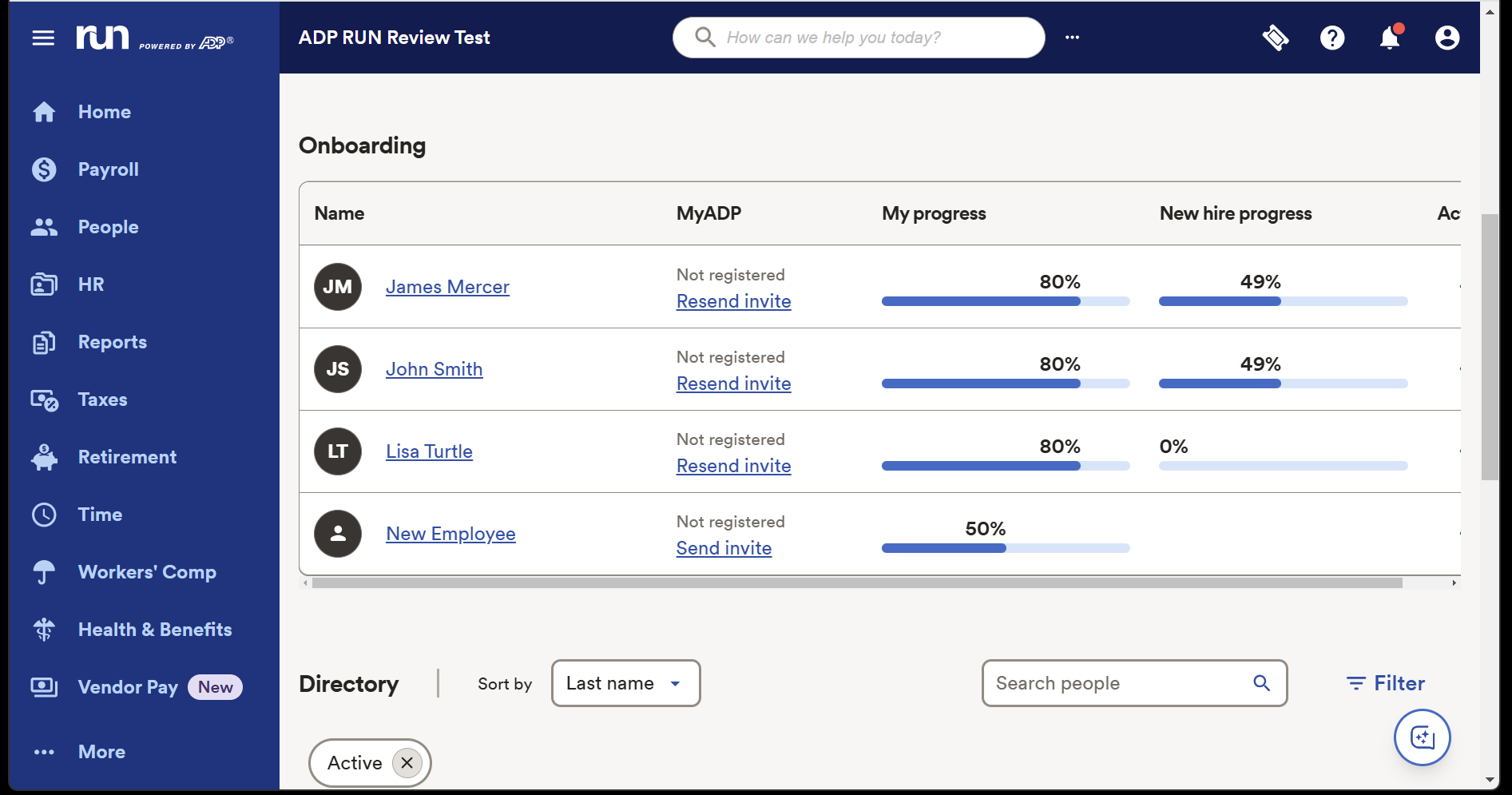
The layout is clear and intuitive. Different modules are accessible in a menu bar on the left-hand side of the product, and the Home Screen provides a slick, straightforward view of your upcoming payroll, key next steps, your latest reports and a calendar.
A button in the bottom-right corner opens up ADP Assist, a new AI helper, and you can edit quick-access links next to the search bar at the top of the home screen.
Advertisement
Individual sections are just as straightforward. The Payroll section puts key notifications, including W-2 and 1099 paperwork, right at the forefront. Similarly, the People section prioritizes your next steps, the Employee Directory makes it easy to find key details about your staff, and many sections around the app have Quick Action menus that make common functionality easy to tackle.
The system is easy to navigate even for people without lots of HR experience, which is key for a product like RUN Powered by ADP – and it gives this solution an instant advantage when compared to many rivals.
The downside of that? Limited customization. You can’t tweak every option on the home screen like you can in other products, you can’t integrate using API, and you can’t add any of the thousands of utilities available in ADP Marketplace – RUN supports integrations with several leading accounting, business, and POS system providers, but that’s it.
For smaller organizations none of those issues will be a deal-breaker, because RUN will provide everything they need, but it’s worth bearing this in mind – and noting that you may need to upgrade to a more flexible product if your organization grows and develops more complex HR requirements.
Advertisement
(Image credit: Future)
RUN Powered by ADP: Support
As well as the aforementioned ADP Assist module, RUN provides several different support routes for small businesses.
Every tier of the product provides 24/7 payroll phone support from ADP agents, and live chat agents are available from 7.30am to 10pm on weekdays. Users can file service tickets and leave messages for those chat agents. If you opt for the Complete or HR Pro packages you also get phone and email HR support, too, alongside training modules.
ADP’s website has a knowledge base with answers to common questions and a client community called The Bridge, where administrators can ask questions.
Advertisement
That’s a good slate of options, but online user reviews suggest that payroll support is sometimes not particularly fast, which may be an issue in your organization.
(Image credit: Future)
RUN Powered by ADP: Competition
We’re going to start this section in a slightly unusual way: by talking about another ADP product. ADP Workforce Now is built for midsized and enterprise-level businesses with more than fifty employees – in contrast to RUN Powered by ADP, which is designed for organizations with less than fifty members of staff.
ADP Workforce Now provides much of the functionality as RUN Powered by ADP, and adds more robust capabilities around benefits administration, talent acquisition, reporting, and professional services.
Advertisement
This broader product concentrates on streamlining, automation, and cost management, and it also supports integrations through the ADP Marketplace and via standard APIs – something you don’t get with RUN Powered by ADP.
Beyond ADP’s own products, RUN faces some tough competitors. If you’d like to explore straightforward payroll tools that work well with smaller organizations, Gusto and QuickBooks are perennially popular options.
If you’re on the hunt for a solution that offers HR capabilities alongside payroll, then Rippling is a more complex choice, and Paylocity is another contender that can grow with your business and provide a broader slate of features.
Advertisement
RUN Powered by ADP: Final verdict
RUN Powered by ADP makes payroll, taxes, and core HR admin tasks feel manageable for small businesses that don’t have an HR team or managers who want to deal with the extra burden – and if you find yourself in that position, this is an excellent and effective choice.
It’s got an intuitive interface, easy learning curve, and excellent payroll features that make compliance, tax, and financial reporting a breeze.
There are negatives, though, with a lack of flexibility, customization, and integration options compared to many other products. A lack of pricing transparency can hinder decision-making, and costs can escalate if you invest in a pricier tier with add-ons to deploy extra functionality.
RUN Powered by ADP does a good job with the essentials of payroll and HR, so it’s a solid choice for smaller businesses that don’t have in-house expertise, but we’d consider shopping around if you’d like to grow your business and may require a more ambitious selection of features.
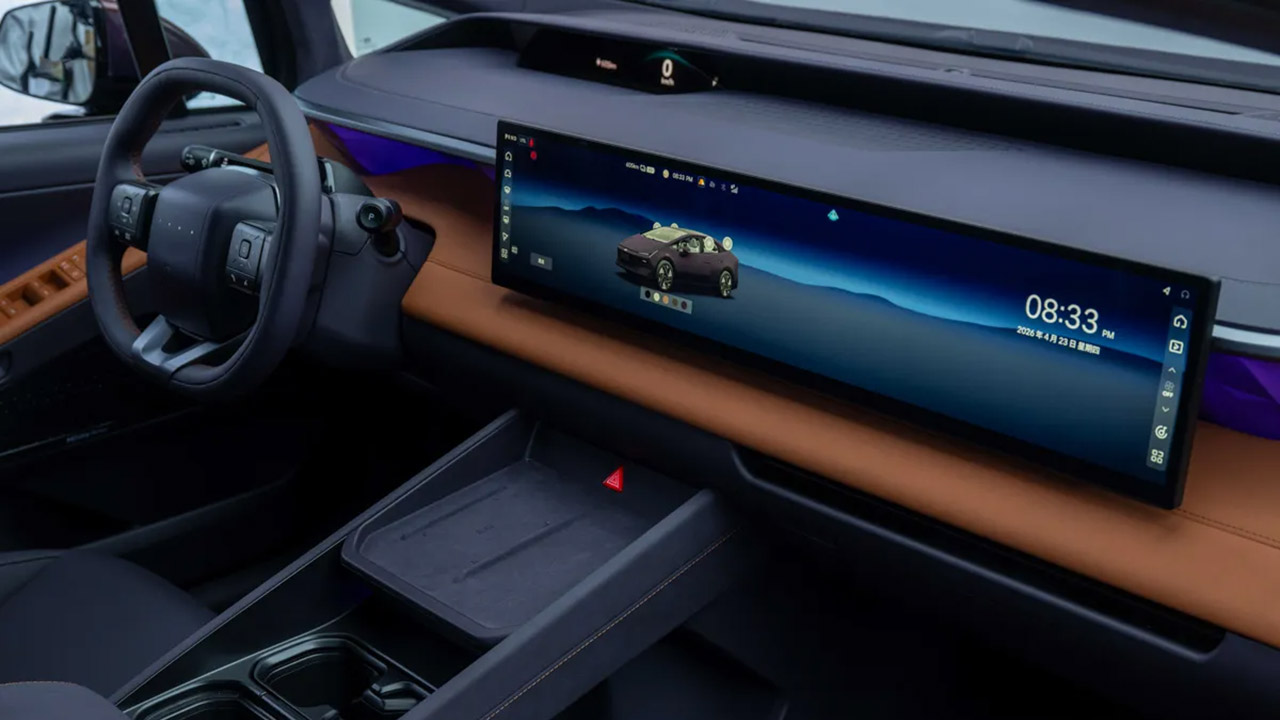
Hyundai just revealed its IONIQ V sedan at the Beijing Auto Show, and the new vehicle shares the elegant design of the Venus concept that inspired it. The engineers and designers stayed fairly near to the wild lines that made the concept so appealing, releasing an electric machine designed from the bottom up with Chinese buyers in mind.
The IONIQ V’s design features a single flowing curve that extends from nose to tail, with no bumps in between. The frameless doors blend seamlessly into the body, and the side mirrors appear to hover above the fenders. The headlights protrude from the front like the two parts of the Hyundai logo, and a corresponding light bar spans the entire width of the rear, just above the sleek tiny tail. The overall style is low and wedge-like, paying homage to vintage 80s designs while remaining undeniably modern.
2.4 GHz Remote Control Car – 1:18 scale cool design, waterproof RC truck toys made of premium material and sturdy, with LED lights, waterproof remote…
High Quality & DIY Removable Toys RC Cars – This remote control monster truck structure design quality, flexibility and strength in one. The rc truck…
All Terrain Amphibious Monster Truck – 4-wheel drive off-road design rc trucks for kids, with high-quality tires (shock absorption, strong grip…
The IONIQ V measures just under 193 inches long, 74.4 inches wide, and has a wheelbase of 114.2 inches. That all adds up to plenty of space inside for everyone, with front passengers having 42.4 inches of legroom and rear passengers having 40.1 inches, which is among the finest in its class for a car of this size. The IONIQ V is nearly as long as a Sonata, but thanks to its all-electric construction, it rides lower and glides more smoothly.
Advertisement
Things under the hood are powered by an 800-volt electrical system, which allows you to take advantage of speedy charging. CATL is providing the batteries, which together provide more than 600 kilometers of range on China’s CLTC test cycle, or approximately 373 miles under local conditions. Of course, real-world driving would likely be slightly lower, but the layout appears to have been designed with long-distance comfort in mind for China’s congested highways.
Inside the driver’s cockpit, there’s a very clean dashboard with a single large 27-inch screen operating at 4K resolution. The steering wheel contains the only physical controls, while the typical gauges are located on the horizon-style head-up display. The software is powered by Qualcomm’s Snapdragon 8295 chip, and Hyundai’s onboard AI voice assistant is ready to listen for natural voice requests to modify music, navigation, climate, or seat settings. Orange and blue interior tones add a touch of modest color without overwhelming the serene and peaceful cabin.
Hyundai executives characterize their strategy as producing cars in China for Chinese drivers before exporting the best parts to other markets. The IONIQ V is already hinting at several new stylistic elements that could make their way into future Hyundais all over the world, whether in next-generation crossovers or sedans. You can get in on the fun later this year, and all of the cars will come with specialized staff to assist with servicing, as well as a one-price policy aimed to make purchasing much easier. [Source]
The jump from a good smartphone camera to a genuinely great one comes down to how the hardware and software work together, and no manufacturer has pushed that integration further than Google has with the Pixel 10 Pro XL.
The headline camera number is 100x Pro Res Zoom, powered by a combination of the upgraded telephoto lens and Google’s AI imaging pipeline, which means the kind of reach that used to require a dedicated camera is now sitting in your pocket at a fraction of the cost.
Advertisement
The Pixel 10 Pro XL‘s camera system is built on top of the Google Tensor G5 chip, which Google describes as the biggest chip upgrade in the Pixel lineup yet, with an improved TPU and CPU designed specifically to handle the kind of on-device AI processing that makes features like Pro Res Zoom and real-time video stabilisation possible.
Gemini Live also adds another layer to the camera experience — point the camera at something you’re curious about and have a natural spoken conversation about what you’re seeing, whether that’s an exhibit at a museum or a dish on a menu you can’t read.
Advertisement
The 6.8-inch Super Actua OLED display reaches 3,300 nits of peak brightness, which puts it ahead of the standard Pixel 10‘s Actua panel and makes outdoor visibility a genuine strength rather than a tolerated limitation, even in direct sunlight.
Build quality comes from durable aluminium and Corning Gorilla Glass Victus 2, and the phone is water resistant, so the hardware matches the ambition of everything running on top of it.
Seven years of software and security updates, 256GB of storage, and a 5,200mAh battery rated for 24-plus hours cement the Google Pixel 10 Pro XL as the best premium Pixel phone you can buy right now, and at $849 with $250 off, that case has never been easier to make.
As cyberthreats advance, so too must workforce cyber defences to avoid making what are often preventable and costly mistakes.
Cybersecurity measures in the workplace never grind to a halt, in that employees and employers must always strive to ensure that their skills and systems are as advanced, if not more so, than those wielded by people with malicious intent.
A lot of cybersecurity is arguably common sense – don’t click suspicious links, don’t share sensitive information and so on – but it doesn’t hurt to have a refresher course now and then to keep it all fresh in the mind. To that point, here are some of the most helpful tips to follow if you want to improve or maintain your company’s cybersecurity efforts.
Silo your systems
This one is specifically for anyone who works from home. It goes without saying that we feel comfortable in our own properties and have tried and tested ways of doing things. But there is such a thing as being too comfortable and employees may forget that their systems should never overlap with the organisations.
Advertisement
If you are using company software, keep all activity tied to the workplace. That is to say, don’t download anything not approved by the organisation, or anything you are using in a personal capacity.
Furthermore, if you move around and work between locations – for example at home, a cafe, a work hub – do your due diligence first and ensure that the network you are using is secure. This can be easier said than done, as using public Wi-Fi in general can be risky. With that in mind, shared office spaces and hubs tend to be a more secure option. If you are using what could be a potentially non-secure network in a public place, always use a VPN as an added layer of protection.
Get AI ready
Advancements in technology unfortunately bring risk. AI has unlimited potential and it is certainly the way forward for a lot of organisations looking to advance, scale and grow, but as we have seen recently, it also presents significant risk, as threat actors can use it to launch highly sophisticated scams. The companies and employees that are serious about avoiding and navigating threats are the ones that will adopt AI upskilling as a core aspect of the organisation – not just as a once a year box-ticking exercise.
Useful skills to consider include an understanding of AI and ML models, data science for cyber defence, AI-specific threats and broad digital literacy. You can’t defend against a threat that you don’t understand and if your organisation has knowledge gaps, then you are automatically in a weak position. So make sure everyone on a system understands the ins and outs of how it works and how to keep it secure.
Advertisement
Simple simply isn’t good enough
We have all picked a password because it was simple and easy to remember, making our own lives simpler and easier, in theory. But when you choose an obvious password, or take shortcuts online, it can expose you to malicious people who can easily bypass the protections you put in place.
That doesn’t mean that every password has to be 80 characters long, or so obscure that you yourself can’t recall it without physically writing it down. But it should be something with a diverse set of characters, that someone else couldn’t guess. For example, avoid using easily obtained information like the names of pets, loved ones, birthdays or other significant dates. Implementing multifactor authentication adds another critical layer and biometric verification tools, such as fingerprint or facial recognition software, can also be useful.
Stay current
It is important to note that all of the above is effectively useless if you are operating off of a system that is old or is not updated frequently. In the same way that innovators are constantly coming up with new ways to enhance a system, bad actors are also constantly coming up with ways to break and exploit weaknesses in systems. If you don’t regularly update your devices then you are basically holding a door open for threat actors and welcoming them in.
If your approved system or device is due an update or if there is a trustworthy patch to be applied, don’t put it on the long finger. The longer you leave an update the more vulnerable you leave yourself, your co-workers and the organisation. So, don’t leave it on the to-do list for too long.
Advertisement
When it comes down to it, cybersecurity measures are arguably the most important policies in place at a company. When they are breached or weakened, either accidentally, or on purpose, there is no one in an organisation that won’t feel the impact. Externally, it also places the consumers and partners of a business at risk. Especially financially, or if that business deals with complex or sensitive information.
So we all have to do our bit to ensure practical, robust and consistent cybersecurity engagement.
Don’t miss out on the knowledge you need to succeed. Sign up for the Daily Brief, Silicon Republic’s digest of need-to-know sci-tech news.






























































You must be logged in to post a comment Login