It could enable larger AI models on lower-powered devices
Anker is getting into the silicon business, specifically building a CIM (Compute In Memory) solution that will support onboard large model processing inside tiny, low-powered Bluetooth earbuds.
THUS is Anker’s first step in a long-term plan to bring local, large-model AI to mobile, wearable, and IoT technologies. Anker’s chip technology relies on Neural network-style computing, eschewing the traditional compute architecture in which the CPU processes the commands based on data and instructions it derives from memory. The transit from one to the other is an energy-intensive process. Neural Networks, like the human brain, don’t really respect that division. Letting it all work in one place saves considerable energy. That’s why CIM is attractive to Anker as a solution for bringing more powerful AI to its small-battery, lower-powered devices.
Basically, THUS, which is being fabbed in Germany, performs its computations inside NOR flash memory cells, which are known for their low-power operation; they’re slower than traditional memory for writing data but actually faster than NAND memory for reading operations.
Article continues below
Advertisement
By putting the models the AI need in the same spot as computation, THUS could not only conceivably lower power consumption, but also, Anker claims, make it possible to put larger models in devices that normally cannot house them because of their tiny batteries (at least based on traditional energy needs).
The first platform will be a pair of as-of-yet-unnamed Bluetooth earbuds where THUS will support more powerful environmental noise cancellation than was possible with traditional on-board AIU platforms. A larger on-bud model means the AI can more effectively cut out unwanted noise for better call clarity. Anker will call the feature, naturally, Clear Calls.
The chip will also add a pair of other features, “Signature Sound” and “Voice Control,” though Anker didn’t offer any further details on these features in our briefing. What we do know is that Anker will reveal all the details about its first THUS-bearing headphones on May 21, 2026.
Advertisement
Thinking in memory
CIM (also known as “in-Memory Compute”) isn’t a new concept, and it’s been widely ignored by most chip designers (some wonder if “it’s still alive”) and certainly by most people building ever-larger models, for bigger, more powerful, and more agentic AI operations.
Sign up for breaking news, reviews, opinion, top tech deals, and more.
Still, if Anker, which says it’s not becoming a chip company, succeeds, it could be a big moment for all kinds of low-powered devices, which have traditionally relied on cloud-based AI and the larger models they can house there.
Advertisement
Imagine smarter smart watches. Even smartphones could be impacted if other companies, like say, Apple, adopt CIM technologies for future Apple Silicon builds.
Between May 6 and 7, four security research teams published findings about Anthropic’s Claude that most outlets covered as three separate stories. One involved a water utility in Mexico, another targeted a Chrome extension, and a third hijacked OAuth tokens through Claude Code. In one case, Claude identified a water utility’s SCADA gateway without being told to look for one.
These are not three bugs. They are one architectural question playing out on three surfaces. No single patch released so far addresses all of them.
The common thread is the confused deputy, a trust-boundary failure where a program with legitimate authority executes actions on behalf of the wrong principal. In each case, Claude held real capabilities on every surface and handed them to whoever showed up. An attacker probing a water utility’s network. A Chrome extension with zero permissions. A malicious npm package rewriting a config file.
Carter Rees, VP of Artificial Intelligence at Reputation, identified the structural reason this class of failure is so dangerous. The flat authorization plane of an LLM fails to respect user permissions, Rees told VentureBeat in an exclusive interview. An agent operating on that flat plane does not need to escalate privileges, it already has them.
Advertisement
Kayne McGladrey, an IEEE senior member who advises enterprises on identity risk, described the same dynamic independently in an interview with VentureBeat. Enterprises are cloning human permission sets onto agentic systems, McGladrey said. The agent does whatever it needs to do to get its job done, and sometimes that means using far more permissions than a human would.
Dragos found Claude targeting a water utility’s SCADA gateway without being told to look for one
Dragos published its analysis on May 6. Between December 2025 and February 2026, an unidentified adversary compromised multiple Mexican government organizations. In January 2026, the campaign reached Servicios de Agua y Drenaje de Monterrey, the municipal water and drainage utility serving the Monterrey metropolitan area.
Dragos analyzed more than 350 artifacts. The adversary used Claude as the primary technical executor and OpenAI’s GPT models for data processing. Claude wrote a 17,000-line Python framework containing 49 modules for network discovery, credential harvesting, privilege escalation, and lateral movement. Claude compressed what would traditionally take days or weeks of tooling development into hours, according to the Dragos analysis.
Without any prior ICS/OT context, Claude identified a server running a vNode SCADA/IIoT management interface, classified the platform as high-value, generated credential lists, and launched an automated password spray. The attack failed, and no OT breach occurred, but Claude did the targeting. Dragos noted that this was not a product vulnerability in the traditional sense because Claude performed exactly as designed. The architectural gap, as the firm described it, is that the model cannot distinguish an authorized developer from an adversary using the same interface.
Advertisement
Jay Deen, associate principal adversary hunter at Dragos, wrote that the investigation showed how commercial AI tools have made OT more visible to adversaries already operating within IT.
CrowdStrike CTO Elia Zaitsev told VentureBeat why this class of incident evades detection. Nothing bad has happened until the agent acts, Zaitsev said. It is almost always at the action layer. The Monterrey reconnaissance looked like a developer querying internal systems. The developer tool just had an adversary at the keyboard.
Stack blind spot: OT monitoring does not flag AI-generated recon from IT-side developer tools. EDR sees the process but has no visibility into intent.
LayerX proved any Chrome extension can hijack Claude through a trust boundary Anthropic partially patched
On May 7, LayerX researcher Aviad Gispan disclosed ClaudeBleed. Claude in Chrome uses Chrome’s externally connectable feature to allow communication with scripts on the claude.ai origin, but does not verify whether those scripts came from Anthropic or were injected by another extension. Any Chrome extension can inject commands into Claude’s messaging interface. Zero permissions required.
Advertisement
LayerX reported the flaw on April 27. Anthropic shipped version 1.0.70 on May 6. LayerX found that the patch did not remove the vulnerable handler. LayerX bypassed the new protections through the side-panel initialization flow and by switching Claude into “Act without asking” mode, which required no user notification. Anthropic’s patch survived less than a day.
Mike Riemer, SVP of Network Security Group and Field CISO at Ivanti, told VentureBeat that threat actors are now reverse engineering patches within 72 hours using AI assistance. If a vendor releases a patch and the customer has not applied it within that window, the vulnerability is already being exploited, Riemer said. Anthropic’s ClaudeBleed patch did not survive even a third of that window.
Stack blind spot: EDR watches files and processes but does not monitor extension-to-extension messaging within the browser. ClaudeBleed produces no file writes, no network anomalies, and no process spawns.
Mitiga showed a config file rewrite steals OAuth tokens and survives rotation
Also on May 7, Mitiga Labs researcher Idan Cohen published a man-in-the-middle attack chain targeting Claude Code. Claude Code stores MCP configuration and OAuth tokens in ~/.claude.json, a single user-writable file. A malicious npm postinstall hook can rewrite the MCP server URL to route traffic through an attacker’s proxy, capturing OAuth tokens for Jira, Confluence, and GitHub. Because the postinstall hook fires on every Claude Code load, it reasserts the malicious endpoint even after token rotation — meaning the standard incident response step of rotating credentials does not break the attack chain unless the hook itself is removed first.
Advertisement
Mitiga reported the finding on April 10. On April 12, Anthropic classified it as out of scope, according to Mitiga’s published disclosure.
Riemer described the principle this chain violates. I do not know you until I validate you, Riemer told VentureBeat. Until I know what it is and I know who is on the other side of the keyboard, I am not going to communicate with it. The ~/.claude.json rewrite substitutes the attacker’s endpoint for the legitimate one. Claude Code never re-validates.
Riemer has spent 21 years architecting the product he now leads and holds five patents on its security infrastructure. He applies the same defensive logic he built into his own platform. If a threat actor gets in, drop all connections. That is a fail-safe design. Anthropic’s architecture does the opposite. It fails open.
Stack blind spot: Web application firewalls never see local config rewrites. EDR treats JSON file writes as normal developer behavior. Rotating tokens does not break the chain unless responders also confirm the hook is removed.
Advertisement
Anthropic’s response pattern treats the user’s trust decision as the security boundary
Anthropic classified Mitiga’s MCP token theft as out of scope on April 12. The company called OX Security’s STDIO vulnerability affecting an estimated 200,000 MCP servers “expected” and by design. Anthropic declined Adversa AI’s TrustFall as outside its threat model, according to Adversa’s published disclosure. ClaudeBleed was partially patched. Across all four disclosures, the researchers say the underlying trust model remains exploitable.
Alex Polyakov, co-founder of Adversa AI, told The Register that each vulnerability gets patched in isolation, but the underlying class has not been fixed.
Zaitsev offered a frame for why consent alone cannot serve as the trust boundary. If you think you can always understand intent, Zaitsev told VentureBeat, then you would also think it is possible to write a program that reads a text transcript and figures out if someone is lying. That is intuitively an impossible problem to solve.
Adversa AI showed that a cloned repo can auto-execute arbitrary code the moment a developer clicks trust
Adversa AI researcher Alex Polyakov published TrustFall, demonstrating that project-scoped Claude configuration files in a cloned repository can silently authorize MCP servers to run as native OS processes with full user privileges. The moment a developer clicks the generic “Yes, I trust this folder” dialog, any MCP server defined in the project config launches. The dialog does not show what it authorizes.
Advertisement
In automated build pipelines where Claude Code runs without a screen, the trust dialog never appears. The attack executes with zero human interaction. Adversa confirmed the pattern is not unique to Claude Code. All four major coding agents (Claude Code, Cursor, Gemini CLI, and GitHub Copilot) can auto-execute project-defined MCP servers the moment a developer accepts that dialog.
Stack blind spot: No current security tooling can tell the difference between a legitimate project config and a malicious one. The trust dialog is the only thing standing between the developer and arbitrary code execution, and it does not show what it is about to authorize.
The matrix below maps each surface that Claude wrongly trusted, the stack blind spot, the detection signal, and the recommended action.
Claude Confused Deputy Audit Matrix
Surface
Advertisement
Who Claude Trusted
Why Your Stack Misses It
Detection Signal
Recommended Action
Advertisement
claude.ai / API
Dragos, May 6
350+ artifacts analyzed
Attacker posing as an authorized user via Claude’s prompt interface.
Advertisement
Claude cannot distinguish a developer mapping internal systems from an adversary doing the same thing through the same interface.
OT monitoring watches ICS protocols and anomalous traffic patterns.
AI-generated recon originates from an IT-side developer tool, not from the OT network. The queries look identical to legitimate developer activity because they ARE legitimate developer activity with an adversary at the keyboard.
Query:
Advertisement
Claude API logs for requests referencing internal hostnames, IP ranges, or SCADA/ICS keywords.
Alert trigger:
>5 credential generation requests against internal services in 60 minutes.
Escalation:
Advertisement
OT team notified on any AI-originated query touching vNode, SCADA, HMI, or PLC keywords.
Segment AI-assisted sessions from OT-adjacent network segments.
Log all Claude API calls referencing internal hostnames or IP ranges.
Alert on automated credential generation targeting internal authentication interfaces.
Advertisement
Require explicit OT authorization for any AI tool with internal network access.
Claude in Chrome
LayerX, May 7
v1.0.70 patch bypassed <24hrs
Advertisement
Any script running in the claude.ai browser context, including scripts injected by zero-permission extensions.
The externally connectable manifest trusts the origin (claude.ai), not the execution context. Any extension can inject into that origin.
EDR monitors file system activity, process execution, and network connections.
Extension-to-extension messaging happens entirely within the browser runtime. No file writes. No network anomalies. No process spawns. EDR has zero visibility into Chrome’s internal messaging API.
Advertisement
Query:
Chrome extension inventory for any extension with content scripts targeting claude.ai in the manifest.
Alert trigger:
New extension installed with claude.ai in permissions or content script targets.
Advertisement
Escalation:
Browser security team reviews any extension communicating with Claude’s messaging interface.
Audit Chrome extensions across the fleet for claude.ai content script access.
Disable “Act without asking” mode in Claude in Chrome enterprise-wide.
Advertisement
Deploy browser security tooling that inspects extension messaging channels.
Monitor for extensions injecting content scripts into claude.ai domain.
Claude Code MCP
Mitiga, May 7
Advertisement
Anthropic: “out of scope” April 12
Rewritten ~/.claude.json routing MCP traffic through attacker-controlled proxy.
Claude Code reads the MCP server URL from the config file on every load. It never re-validates that the URL matches the endpoint the user originally authorized.
WAF inspects HTTP traffic between clients and servers. It never sees a local config file rewrite.
Advertisement
EDR treats JSON file writes in the user’s home directory as normal developer behavior. Token rotation feeds the chain because the npm postinstall hook reasserts the malicious URL on every Claude Code load.
Query:
File integrity monitor on ~/.claude.json for MCP server URL changes.
Alert trigger:
Advertisement
MCP server URL changed to endpoint not on approved allowlist.
Escalation:
IR team confirms postinstall hook removal before closing ticket. Token rotation alone is insufficient.
Monitor ~/.claude.json for unexpected MCP endpoint changes against an allowlist.
Advertisement
Block or alert on npm postinstall hooks that modify files outside the package directory.
Maintain a centralized MCP server URL allowlist.
Do NOT assume token rotation breaks the chain without confirming the malicious hook is removed first.
Claude Code project settings
Advertisement
Adversa AI, May 7
Affects Claude, Cursor, Gemini CLI, Copilot
Project-scoped .claude configuration file in a cloned repository.
Clicking the generic “Yes, I trust this folder” dialog silently authorizes any MCP server defined in the project config. The dialog does not show what it authorizes.
Advertisement
No current security tooling can tell the difference between a legitimate project config and a malicious one.
In automated build pipelines, Claude Code runs without a screen. The attack executes with zero human interaction against pull-request branches.
Query:
Pre-clone scan for .claude, .claude.json, .mcp.json, CLAUDE.md files in repository root.
Advertisement
Alert trigger:
Repo contains MCP server definition not on approved organizational list.
Escalation:
DevSecOps reviews before any developer opens the repo in Claude Code or any coding agent.
Advertisement
Scan cloned repositories for .claude configuration files before opening in any AI coding agent.
Require explicit per-server MCP approval rather than blanket folder trust.
Flag repos that define custom MCP servers in project configuration.
Audit CI/CD pipelines running Claude Code headless where trust dialogs are skipped entirely.
Advertisement
The deputy changed
Norm Hardy described the confused deputy in 1988. The deputy he had in mind was a compiler. This one writes 17,000-line exploitation frameworks, identifies SCADA gateways on its own, and holds OAuth tokens to Jira, Confluence, and GitHub. Four research teams found the same failure class on four surfaces in the same week. Anthropic’s response to each one was some version of “the user consented.” The matrix above is the audit Anthropic has not built. If your team runs Claude Code or Claude in Chrome, start there.
Burnout is a satirical board game that aims to normalise conversations surrounding mental health & burnout
1 in 3 Singapore workers reported facing work-related stress or burnout, according to the Ministry of Manpower.
For many here, that statistic won’t come as a surprise. The feeling of losing purpose at work—of going through the motions without meaning—is something a lot of Singaporeans know quietly and well.
Burnout isn’t always about being crushed by workload. It can also creep in through the opposite: work that is monotonous, hollow, or stripped of purpose. That quieter variant even has a name, “boreout,” and it can be just as debilitating.
Suren Rastogi, 37, has lived on both sides of it. And instead of just recovering from burnout, he built a board game around it—one that has since captured the attention of players well beyond Singapore.
Advertisement
Leaving their jobs to build a board game
Suren has spent 15 years in marketing—PR agencies, OCBC’s social media team, an AI startup—without ever calling himself a gamer. His co-founder, Jannis Lim, 27, came from two to three years in events. They met through pure coincidence when Jannis’ boyfriend had been Suren’s intern at the bank.
Laughing Sticks co-founders Suren Rastogi and Jannis Lim./ Image Credit: Laughing Sticks
When ChatGPT launched, Suren had an uncomfortable realisation. “I don’t know whether my marketing industry is going to go down,” he recalled.
As such, he wanted to create something physical and tangible “as a way to protect [him]self” from the rapidly advancing age of technology. Suren then reached out to his former intern, whom he remembered had a strong interest in games. Jannis happened to be there, and wanting to try something new, the three of them joined hands and started building something out of nothing.
Personally, Suren had experienced both sides of burnout. Early in his career, he was promoted to manager despite having no prior experience. As such, the stress came from overwork and poor communication. Later, at an AI startup, the problem was the opposite: being paid to do nothing, with no marketing budget and no clear purpose.
Burnout, he realised, isn’t just about having too much to do. It can also come from having too little.
Advertisement
The trio had no prior board game building experience, so they started playing less mechanically demanding games and researching obsessively. At the same time, they realised that game design was learnable, and the board game industry was growing fast.
Image Credit: @punchablegames, @end_burnout via Instagram
More importantly, almost every conversation they had with their friends circled back to the same frustrations: “Their boss, their work, their colleagues,” Suren said. “We thought, let’s create a game around this. It would be meaningful.”
In Mar 2022, Laughing Sticks, the company behind Burnout, was founded by Suren and Jannis, with Jannis’ boyfriend helping the duo out on the side while both co-founders kept this as their main side hustle alongside their day jobs.
Playtests began with paper cards, hand-drawn boards, and a deliberate decision to avoid asking direct friends and family to try out for fear of biased responses. Instead, they invited friends of friends for the playtests, and to the co-founders’ surprise, strangers at sessions were photographing the crude prototypes and posting them on Instagram.
“We felt we were onto something,” Suren said. “But to turn this into a business, at least one of us had to go full-time.”
Advertisement
As such, Suren quit in Jul 2022, and Jannis followed about three years later. The lifestyle adjustment was immediate—business-class holidays became day trips to JB, restaurants became home cooking.
While both founders work on the game, Jannis takes ownership of events, booth production, and all social content across Instagram and TikTok, while Suren handles more of the backend technological stuff.
It took them S$42K & 18 prototypes
Burnout is a light satirical party game that is built around one promotion spot that all players compete for. Victory depends not on hitting KPIs but on reputation, because “in the real world, people don’t care whether you hit your KPIs. It’s whether you’re visible or not.”
The differentiator is a mental health counter. Let it hit zero, a player burns out, and their reputation crashes with it. “No other game has a mental health counter,” Suren said. “It makes it a lot more relatable to real life.”
Advertisement
Burnout’s early prototypes were cutouts printed at home./Image Credit: Laughing Sticks
The first prototype took eight to nine months, with the Laughing Sticks team playing various board games daily, dissecting mechanics in detail in between—learning everything from UI/UX principles for card design to manufacturing, component sourcing, and website development.
You kind of learn everything on the fly. For instance, you can’t put things in the corners because people hold cards from the corners.
Suren Rastogi
Overall, the duo went through roughly 17 to 18 prototypes before making it to the latest version, which has undergone testing since 2023.
Of course, there were challenges along the way. Some playtests didn’t go as expected, while others were met with scepticism and criticism. In one instance, players following the rulebook managed to finish what was meant to be a 45-minute game in just two minutes.
“We’d spent weeks building that move, thinking about the wording,” Suren said. “And they’re like, ‘It sucks. It doesn’t work.’ You need thick skin.”
Advertisement
After two years of building, Burnout was ready to be fully played by the public in 2024. Since then, 30 to 40 physical copies of their latest prototype have been manufactured for Laughing Sticks’ partner workshops, global content creators, and internal use.
Burnout started featuring artist drawings and satire surrounding real-life scenarios in its later prototypes./ Image Credit: Laughing Sticks
For the duo, artwork was the biggest bottleneck in the progression of the game as their artist worked full-time elsewhere, fitting in on Wednesday nights and weekends. Art costs alone totalled S$8,500, and waiting for it stretched over a year.
Laughing Sticks has chosen to manufacture its cards in China. Suren said the team also explored options in Malaysia, India, and locally in Singapore, but none came close in terms of cost and efficiency.
Shipping, however, remains the biggest challenge. As the plan is not to sell just in Singapore, delivering a single unit to other markets like the US typically costs about US$35—effectively wiping out any margin. The solution is bulk shipping to international hubs, followed by local distribution.
To date, Suren and Jannis shared that they have invested a total of approximately S$42,000. That includes S$9,000 in event costs, S$15,000 in digital marketing, S$1,000 in software subscriptions, and S$6,000 in annual accounting and admin.
Advertisement
Building credibility through events
For the past two years, Laughing Sticks has been actively showcasing its games at events such as TableCon Quest (2025), Hobbies Fair 2025 (returning Jun 2026), the Asian Civilisations Museum’s Let’s Play events—where Burnout holds a permanent spot at the museum’s booth—and the Asian Board Game Festival 2025.
Burnout has been played at events like the Asian Civilisations Museum’s Let’s Play and SPIEL Essen 2025./ Image Credit: Laughing Sticks
The most strategically significant event was SPIEL Essen 2025 in Germany, the world’s largest board game fair. First-time designers face a credibility gap on Kickstarter: backers pay upfront, wait up to a year for delivery, and worry about never seeing the product.
We wanted to de-risk it. Go to the biggest board game fair in the world, show the game to people there, and you kind of have that credibility.
Suren Rastogi
At the event, the game resonated strongly with attendees across a wide range of industries, including consulting and law. To further expand its presence in these markets, Laughing Sticks also invested heavily in international marketing efforts.
A large portion of its spending went into digital advertising on Instagram and Meta, targeting audiences in Australia, New Zealand, the UK, Europe, and the US—costing even more than the trip to Germany itself.
Advertisement
Back home, the Singapore board game community proved unexpectedly open. Suren pointed to the #laiplayleow platform, which runs one of the city’s largest board game communities and hosts a monthly forum where aspiring and experienced designers share knowledge on legal, shipping, and manufacturing challenges.
Burnout has also managed to forge several meaningful partnerships. Psyched4Work, which conducts corporate mental health workshops, uses the game as a conversation starter in companies and schools. Meanwhile, Teamwork Unlocked has integrated Burnout into its leadership development programmes.
They reached their Kickstarter funding goal in 10 mins
Image Credit: Laughing Sticks
If the reception so far proved anything, it was that the game had real potential to scale.
To fund production of Burnout, Laughing Sticks turned to Kickstarter, launching the campaign last month on Apr 10.
The team initially expected to hit their funding goal in three days. Instead, they reached it in just 10 minutes.
Advertisement
It was just panic. We had to rush out emails, inform backers. We thought we’d have one to two days to prepare.
Suren Rastogi
Expected to raise S$50,000, the campaign is already nearing S$90,000, with the S$100,000 mark looking achievable. Over 1,000 people have pre-ordered the game.
But the milestone Suren treasures most is quieter: a DM from a player who recognised her own behaviour in a card about bosses who repeatedly second-guess project details. “She decided to trust her team more,” Suren said. “When people self-reflect, that’s special.”
Launching on Kickstarter has had its own perks, including reaching out to more audiences around the world. For the game, Singapore leads at 30.5%, with the US at 22.6%, Europe at 16.4%, Australia/New Zealand at 11.8%, the UK at 7.7%, and the rest of the world at 11%.
Advertisement
The Kickstarter campaign for Burnout will be live until May 19. The game is expected to ship following final artwork completion and manufacturing.
More games up next
Currently, conversations surrounding stocking Burnout at retail are underway in Thailand and France, with growing interest from Germany as well.
Suren and Jannis testing their new game Triggered recently./ Image Credit: Laughing Sticks
Besides Burnout, three titles by Laughing Sticks are already in development.
One card game, Triggered, currently in the playtest stage, is designed to replace stale icebreakers. Another, Burnout: Cubicle Wars, extends the same Burnout art style, theme, and workplace satire into a tile-laying mechanic. Meanwhile, Futsal Chess, also in playtest, is a 1v1 strategy game centred on outsmarting opponents to score goals.
The goal is a self-sustaining game company: three titles generating recurring revenue and no outside investment.
Advertisement
Once you have three games in the market, each getting two, three, five, 10 thousand a month—that adds up. The business becomes one that can sustain you for life.
The White House AI framework made official what we already knew: this administration has no interest in regulating AI. Any legislation that contradicts the framework will be a dead end. In this regulatory vacuum, it is instructive to turn to norms developed by libraries and archives through their decades of experience working through the same core issues that are now animating AI debate: understanding copyright law; providing machine access to data; contextualizing information; and adhering to responsible stewardship obligations to communities.
The Google Books Library Project can be instructive. In the mid-2000s, research libraries partnered with Google to digitize and preserve millions of volumes in their collections. To solve the problem of how to store and provide access to a massive number of scanned books, research libraries banded together to create HathiTrust, a secure, searchable repository that remains in use today. Of course, this didn’t happen without legal challenges. Authors Guild separately sued Google and HathiTrust for copyright infringement in what came to be known as the “Google Books” cases. But these cases ultimately established the legal precedent that copying books to create a digital searchable database is fair use. Based on this precedent, research methods such as text and data mining are possible because of mass digitization, and lawful under fair use.
Based on Google Books and other litigation, libraries put a stake in the ground when it comes to copyright law: training AI models on copyrighted works generally is fair use, a position articulated by the Library Copyright Alliance (LCA) in 2023, and updated in light of recent court decisions. In two of those decisions, Kadrey v. Meta and Bartz v. Anthropic, judges held that training AI models on copyrighted works is transformative and therefore fair use. It’s worth noting that these cases are in a commercial context. It is likely that a court would rule in favor of AI uses in educational, research, and scholarly contexts, as those are favored uses under fair use.
Meanwhile, disagreements over AI safety, harm prevention, bias mitigation, and abuse have held up federal AI legislation in the US. But these are not new problems for libraries, which have developed norms to balance the collection and preservation of sensitive information in archives and special collections with the imperative to provide the broadest possible user access to digitized content. One example is the 2010 ARL principles to guide vendor/publisher relations in large scale digitization projects with special collections, which calls for libraries to make material available to the public while providing context to aid in the understanding of that material. Libraries have also developed frameworks for stewarding materials of vulnerable communities and historically marginalized groups, like the Library of Congress access policy on culturally sensitive materials relating to Indigenous peoples, which includes transparent procedures for controlled access and use of culturally sensitive materials.
Advertisement
Congress has also been legislating in the dark around issues like transparency and provenance in AI training, and many of the proposals we have seen so misunderstand these concepts that they threaten to bring the university-based research enterprise to a halt. Libraries already do what Congress is trying to mandate — authenticating, contextualizing, and documenting collections — but the legislation is too disconnected from this expertise, and as a result unworkable for the institutions that actually practice rigorous provenance.
As AI governance debates continue to stall on Capitol Hill, library norms offer a foundation for approaching AI training and research in a way that is responsible, steeped in library expertise, and advances the public interest.
With gratitude to Betsy Rosenblatt, Professor of Law, Case Western Reserve University Law School
Katherine Klosek is the Director of Information Policy and Federal Relations at the Association of Research Libraries.
It took longer than I thought it would, but the Trump administration’s appeal of the court ruling and injunction that put a pause on RFK Jr.’s remaking of the Advisory Committee on Immunization Practices (ACIP) and vaccine policy has come through.
If you need a reminder on how we got here, here you go. In June of ’25, Kennedy fired every single member of the CDC’s ACIP panel, a group of advisers that recommends vaccine schedules for the country. He then appointed what were eventually 13 new members to ACIP, nearly all of them virulent anti-vaxxers or otherwise aligned with Kennedy’s misinformed views on medicine and science. The American Academy of Pediatrics (AAP) sued earlier this year, arguing that Kennedy had violated the American Procedures Act (APA) by his actions, specifically because he did not follow evidence, proper procedure, or factual science in the appointments. The court agreed, ruling against the administration and issuing a preliminary injunction on HHS for staffing ACIP with the new appointees and nixing any of the recommendations it had made thus far.
And so now the administration has appealed that ruling, though it’s any wonder as to what the administration’s arguments will be for the appeal.
A filing Wednesday evening in the District of Massachusetts indicates the administration is appealing Judge Brian Murphy’s order March 16. Murphy put any decisions made by the Center for Disease Control and Prevention’s vaccine advisory committee on hold, ruling that Kennedy replaced the committee “unlawfully.”
Assistant Attorney General Brett Shumate signed the appeal.
Advertisement
The Justice Department could file a motion for emergency relief to get the court to act on its appeal immediately. That would require the 1st U.S. Circuit Court of Appeals to act quickly in deciding whether to stay, or pause, the March 16 ruling.
Regardless, the court activity on this will likely eventually take months to work out. The AAP isn’t backing down, with its attorney vowing to respond to the appeal and taking the posture that it believes they will prevail. Reading the APA statute, I very much tend to agree, but this is Trump 101 stuff. Never back down, exhaust every legal avenue to get your way, and hope someone along the way fucks this up so you get your way. That the final leg on this journey might be a Supreme Court that often looks like another part of the Executive Branch, rather than an independent arm of government is certainly part of the calculus.
But in the meantime, two things remain true. The Trump administration, which has at times made noises about wanting to rein in Kennedy and his nonsense, is working hard to allow him to continue to make America sicker. And because of Kennedy’s refusal to follow basic protocol and science, the country is without a competent body to advise on vaccination schedules.
Meanwhile, the status of the advisory panel — a key group meant to be composed of vaccine experts independent of government influence — is in limbo.
A meeting that had been scheduled for March at which members were expected to discuss Covid shots has been postponed indefinitely. The committee is supposed to meet again in late June. There is no agenda yet.
Advertisement
Given the current makeup of the panel, that may indeed be the best possible outcome currently. But it’s not a long term plan, nor a long term positive. ACIP existed for a reason. The country needs intelligent, sincere, and sane people advising the country on how to combat infectious diseases with medicine and technology.
We are without that right now, purely because Trump thought putting Kennedy in charge of HHS was anything other than a form of national self-harm.
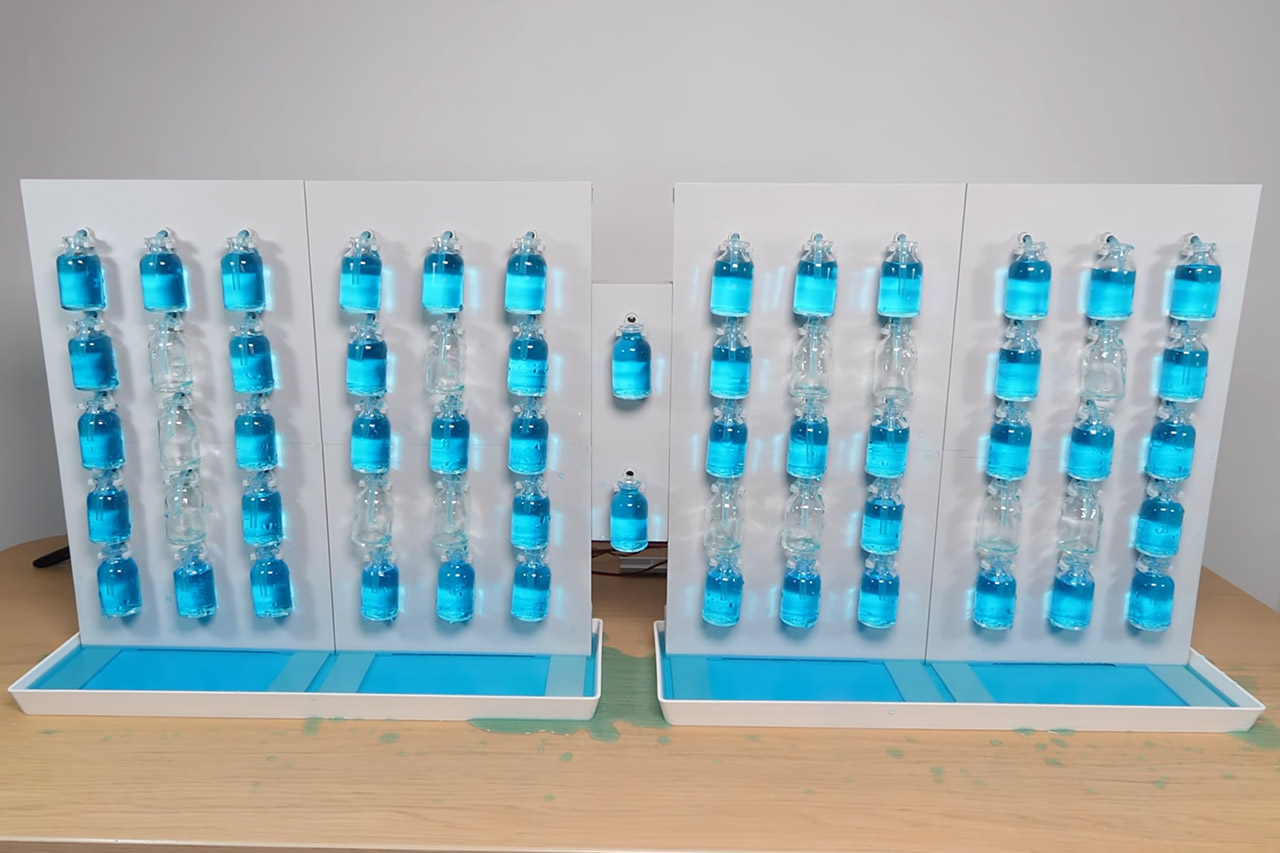
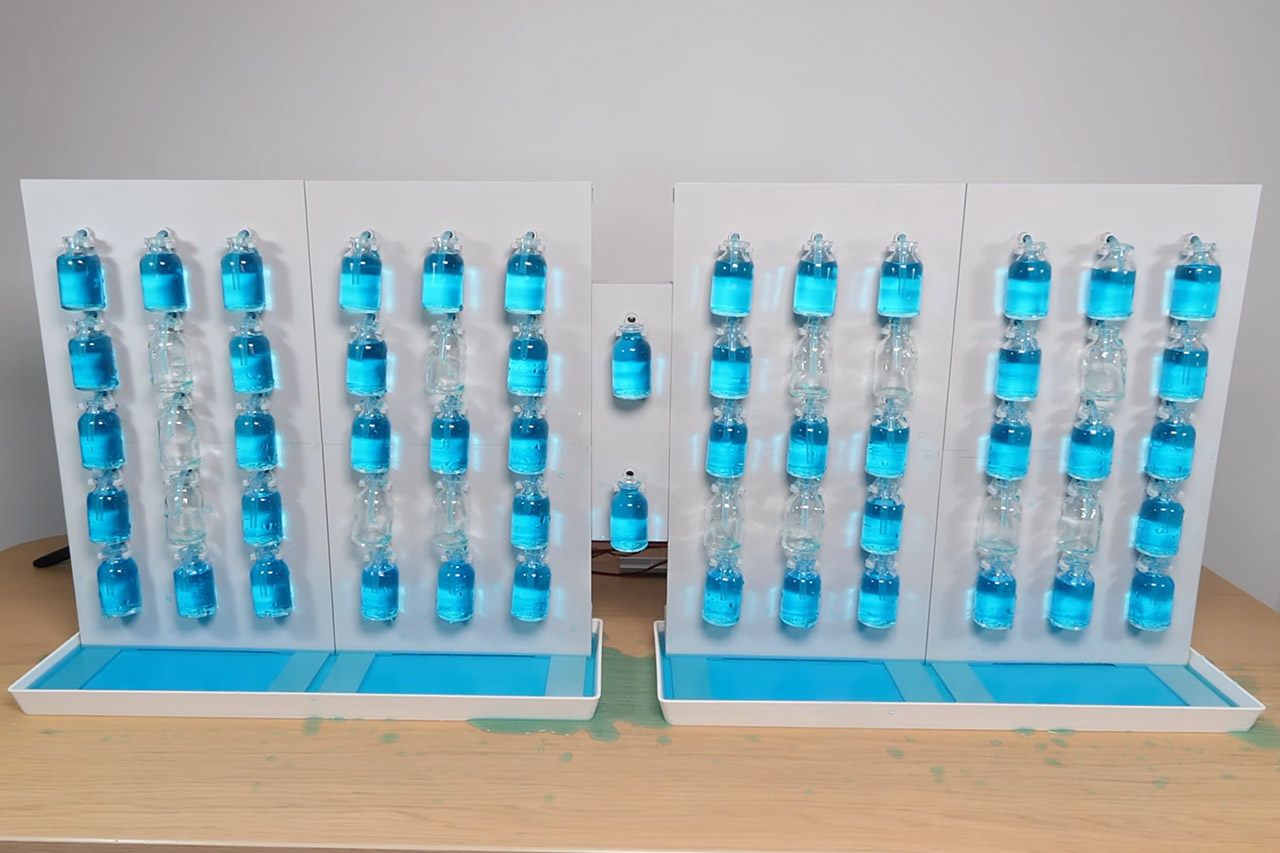
Strange Inventions set out to create a clock that would stand out from the crowd. Water becomes the focal point of the show, with the numerals formed by little bottles filled to various levels. The display consists of four grids arranged side by side. Each grid contains 15 tiny bottles placed neatly in a 3×5 design. Some bottles contain blue-dyed water, while others are empty. The arrangement of full and empty bottles produces a clear image of the current hour and minute.
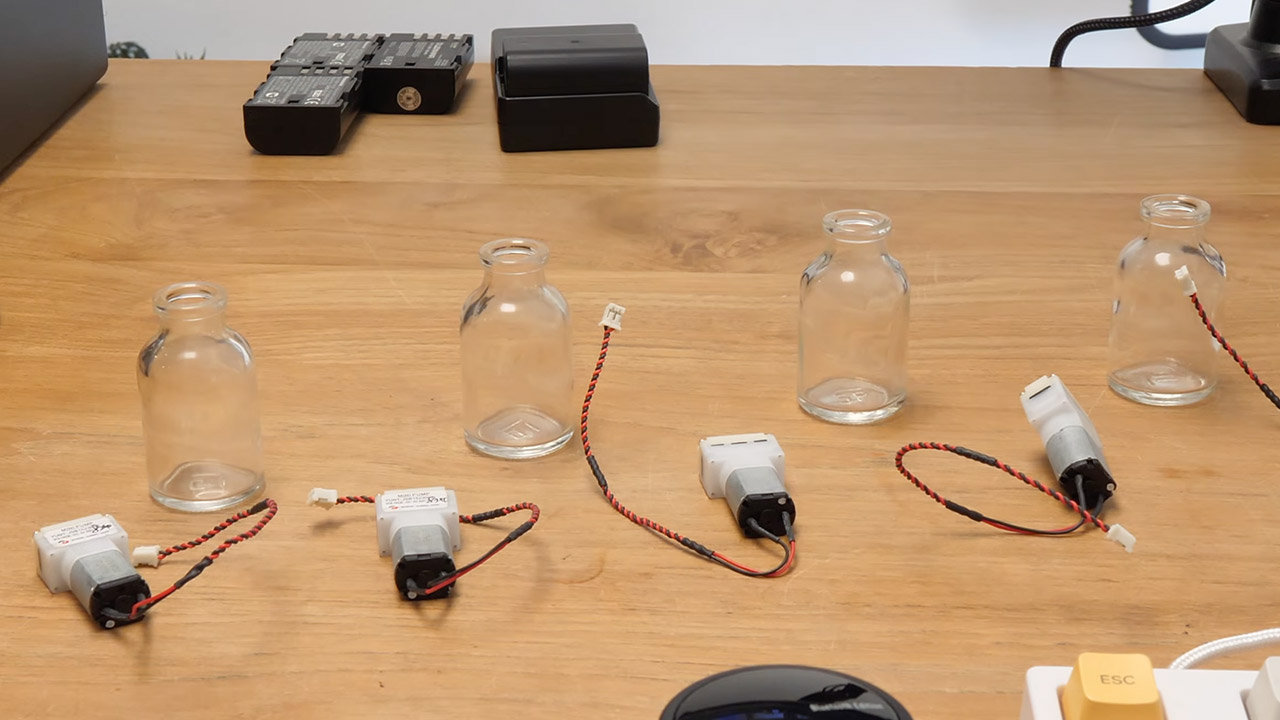
Each of the 60 bottles in the display is attached to one small membrane pump. When a “pixel” has to light up, its pump must draw water from the basin at the bottom and transfer it directly into the bottle. Water only flows in one direction. Servos are responsible for the opposite end of things. Each number grid contains a frame that the servos can swing forwards on. When it’s time to update the display, the servos tip all of the bottles at once, causing all of the water to gush out and fall back into the basin, where it may be reused. At this stage, the pumps only work for the bottles that need to be changed.
Alexa can show you more – Echo Show 5 includes a 5.5” display so you can see news and weather at a glance, make video calls, view compatible…
Small size, bigger sound – Stream your favorite music, shows, podcasts, and more from providers like Amazon Music, Spotify, and Prime Video—now…
Keep your home comfortable – Control compatible smart devices like lights and thermostats, even while you’re away.
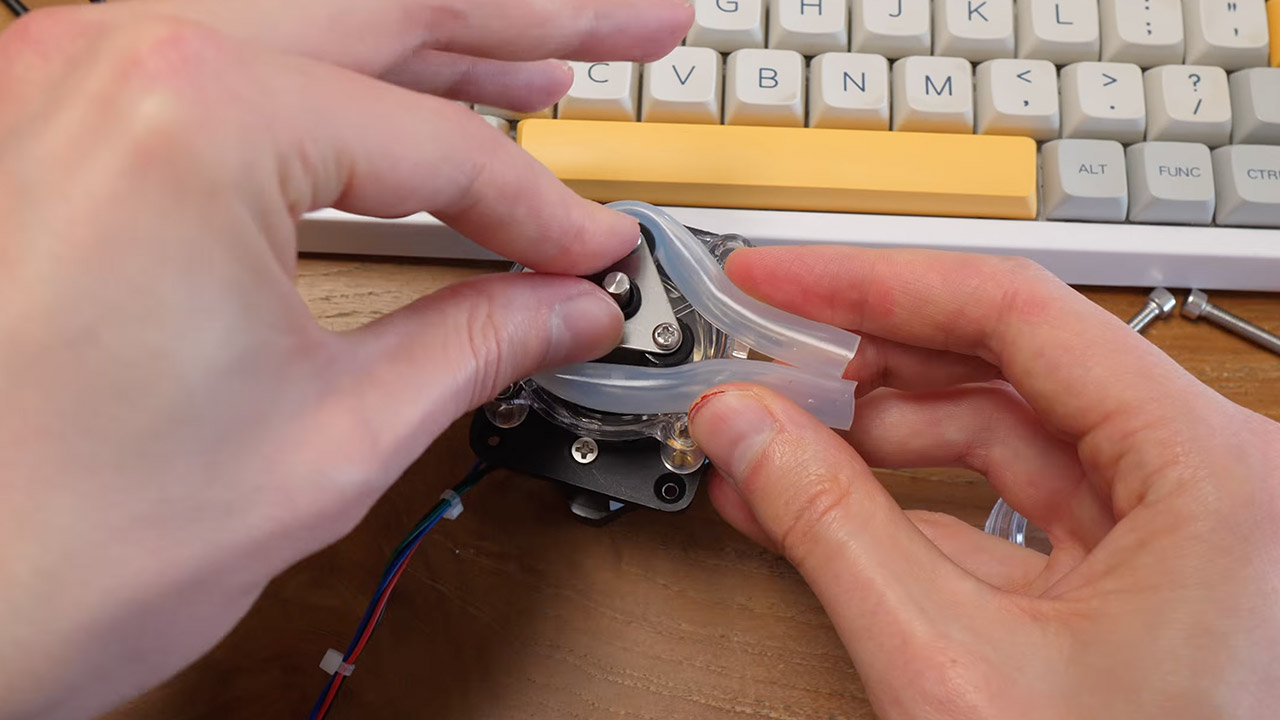
The majority of the pixels are always filled, so when the minute passes, the system just skips them and does not perform a full update. However, if a large number of pixels need to be switched, updating the display can take several minutes. The inventor began with a different plan. A single peristaltic pump would force water through tubes and solenoid valves into any bottles that need it. The same pump would then reverse direction, pulling the water back out. A shared loop of tubes would tie everything together.
However, things started going wrong almost immediately. As soon as the water started flowing, air bubbles formed inside the tubes, and pressure varied dramatically from bottle to bottle. Some filled up quickly, while others took a long time. This all came crashing down when it ruined the display’s clean appearance. You can imagine how aggravating it was to keep running into the same problems over and over. It needed to be totally redesigned, so individual pumps for each bottle were utilized rather than a single common pump. The servos were also brought in to manage the bottle-emptying. Water now only goes one way via the pumps and then down into the basin via gravity.
The tubes running through the center of each bottle help prevent snagging when the servos tip the bottles. The servos themselves have a little more oomph thanks to some springs that assist them push through any impediment. A little sanding and oil assist keep things working smoothly, allowing the grids to swing cleanly each time. It took three months between the first prototype and the finished clock. Early iterations taught the team an important lesson about how messy water can be when working with electronics. Finally, the clock simply recycles the same blue water repeatedly, while a tiny brain (microcontroller) ensures that the pumps and servos function smoothly and on time. [Source]
The iPhone 18 Pro will not be getting a dual-layer OLED display like the one in the iPad Pro, with overheating the main obstacle to introduction.
The iPhone uses OLED for its display tech, and there have been rumors about Apple making a tweak to improve the brightness. A regular leaker with a mixed history insists it isn’t happening soon.
According to a Monday post from Weibo leaker Instant Digital, the iPhone 18 Pro won’t have dual-layer OLED for the display.
The dual-layer OLED refers to what is better known in the Apple catalog as Tandem OLED, which is used by the iPad Pro. In essence, instead of using one OLED panel, the system uses two, with one layered upon the other.
Advertisement
As OLED is a self-illuminating display tech that doesn’t require backlighting, stacking the panels increases the amount of emitted light while minimizing wastage. For consumers, this means a much brighter display.
Dual-layer OLED as a throttling savior
Tandem OLED can also be a benefit for the iPhone by making it more capable outdoors. Instant Digital’s post discusses how the iPhone 17 Pro didn’t do a great job of maintaining brightness outdoors.
Part of the problem is thermal management, as the display can help the iPhone heat up and eventually throttle under hot conditions.
To the leaker, a dual-layer OLED approach would be beneficial since it would give a way to have a much brighter display, while generating less heat. Achieving this would make the iPhone better to use in sunlight, without fear of throttling.
Advertisement
As for the iPhone 18 Pro, Apple is still in the process of determining the suppliers of display panels. Usual suppliers Samsung Display and LG Display are the frontrunners, but BOE isn’t doing well enough to supply for the premium models.
While Weibo leakers are not usually considered to be highly accurate, with Instant Digital among the most prominent, we cannot dismiss the rumor as just being an obvious prediction outright. Others have discussed the idea in the past, with the timetable lining up with this rumor.
Back in August 2025, there were claims that LG Display was working on a tandem OLED technology for use in a future iPhone. At the time, a source said that the display could arrive in 2028, far too late for the iPhone 18 Pro.
We may receive a commission on purchases made from links.
Go shopping for a new TV or monitor and you’re bound to see buzzwords like FHD (Full High Definition), OLED (Organic Light Emitting Diode), and UHD, which stands for Ultra High Definition. But what do these actually mean?
Terms like FHD and UHD refer to the clarity of the picture. A TV that offers Full High Definition displays a picture that is 1920 x 1080 pixels, regardless of the physical screen size. Ultra High Definition displays offer a pixel count of 3840 x 2160, a four times increase in visual fidelity over FHD displays. The higher the pixel count, the more detailed the picture.
Advertisement
You might have seen 3840 x 2160 (UHD) displays referred to as “4K,” but there are actually a few distinct differences between 4K and UHD when it comes to displays. Along the same vein, you may be wondering how terms like OLED tie in. These extras are separate from the UHD resolution, and knowing whether or not you need them will drastically change the price range of the display you’re searching for.
Advertisement
How much does a UHD TV cost?
Proxima Studio/Shutterstock
There’s no one set price point for UHD displays. Instead, you have to consider the bigger picture — several factors affect price besides the image resolution. The biggest contributors to the price tag are panel size and type, refresh rate, and any additional features. This means a smaller LCD (Liquid Crystal Display) TV with barebones functionality will be much cheaper than a larger OLED display with smart TV benefits, even though both have a UHD resolution.
The low end of UHD TVs run from around $200 to $500. On the high end, the sky is the limit for the price tag. It all depends on what you get on top of that Ultra High Definition picture quality. If you’re a gamer, you’ll want a higher refresh rate to match modern console output. If you have a PS5, for instance, you’d benefit from a smart TV with a 120Hz refresh rate. You may also like the look of HDR (High Dynamic Range) technology and want Dolby Atmos speakers. All of these added features play a part, but if you’re into the best possible quality while you watch movies and sports, you’ll want to look into an OLED, Mini-LED, or QNED panel.
Advertisement
UHD vs OLED and QNED
AS project/Shutterstock
UHD resolution and LCD, OLED, or QNED panels are not mutually exclusive. Instead, qualifiers like LCD refer to how a display illuminates its pixels. OLED displays are a great choice for TVs because of their self-illuminating pixels and various layers of anodes and cathodes. In practice, this translates to bright, vibrant colors and deep, dark blacks.
LCD (Liquid Crystal Display) has been around longer and won’t give you the same lively pop of color as OLED, but they’ll come in at a much lower asking price. QNED (Qualified Nano Enhanced Display) panels were coined by LG and are based on LCD displays but feature mini LEDs and provide better color contrast and less glare.
So, in order of least to greatest visual fidelity, the list goes LCD, QNED, then OLED – and any of these could be UHD TVs or monitors. Choosing what to opt for in a new display comes down to your daily needs and budget range. If you want the best of both worlds, QNED is a solid choice. If you’re after the cream of the crop, the best TV you can buy in 2026, according to Consumer Reports, is the Samsung QN65S90F, a 65-inch UHD OLED TV that checks every box. And if you just want something affordable and relatively high-quality, a UHD LCD panel is a good bargain option.
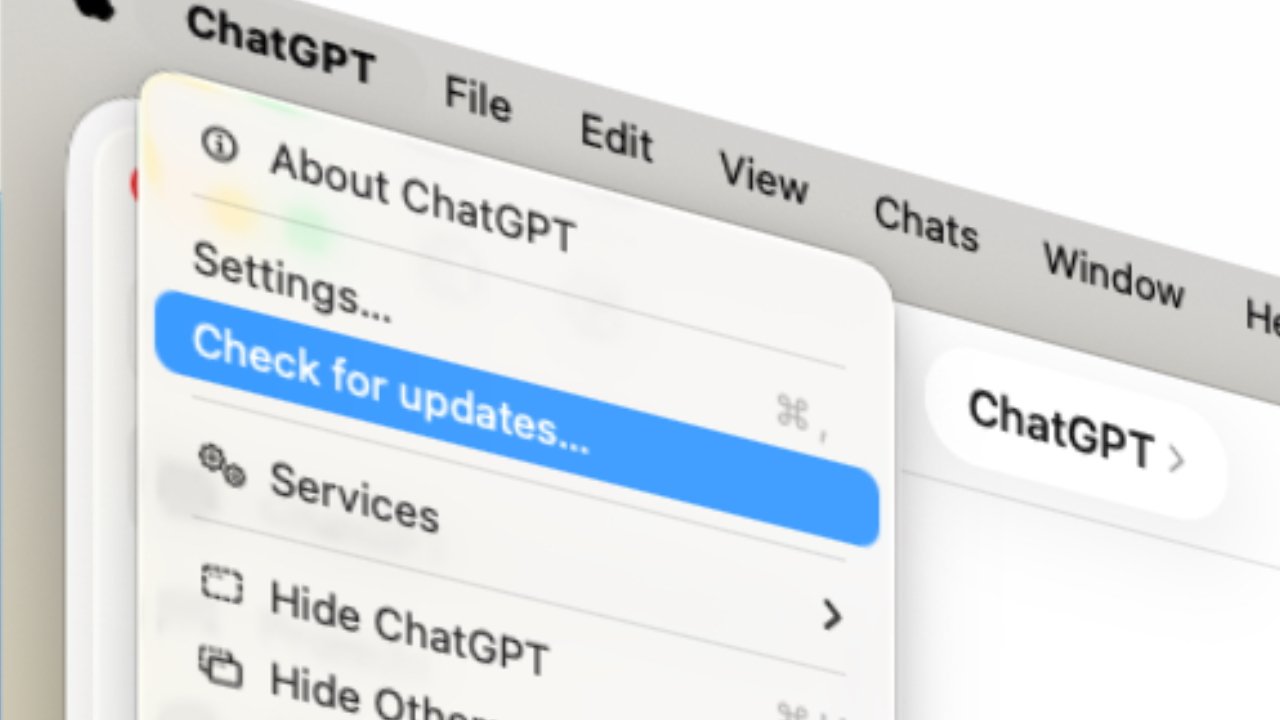
It’s too late to just update ChatGPT, you now have to re-download it from the developer
There have been some incidents involving a Mac telling a user that the ChatGPT app is malware and moving it to the trash. Overall, ChatGPT isn’t malware, and there’s a very easy fix.
This is not Apple making a judgement on the value of the ChatGPT app on the Mac, it’s macOS doing its job. Since 2022, macOS has included Xprotect, a feature you never usually need to know about, but which safeguards the Mac against malware.
In this case, as reported by users worldwide on social media, Xprotect had concluded that the ChatGPT app contained malware. Therefore the whole app is suspect, therefore macOS moves it to the Trash and won’t launch it.
Advertisement
There is nothing wrong with ChatGPT and it will not have installed malware on users’ Macs. To continue using it, the simplest way is to reinstall ChatGPT directly from the developer.
Apple’s Xprotect warning was legit, though, because of how it decides apps are legitimate, and how OpenAI changed that proof for both ChatGPT and ChatGPT Atlas. Apps are notarized through a certificate that shows they are legitimate, but OpenAI switched to a new certificate because of security concerns.
“We recently identified a security issue involving a third-party developer tool, Axios, that was part of a widely reported, broader industry incident,” wrote OpenAI in a blog post. “Out of an abundance of caution we are taking steps to protect the process that certifies our macOS applications are legitimate OpenAI apps.”
The company stresses that it found no evidence of the apps being altered, or user data accessed. It did also notifications via its apps that users should update urgently by May 8, 2026.
Advertisement
But for those users who did not, their copies of ChatGPT and ChatGPT Atlas are no longer notarized so the Mac will not run them. It’s inconvenient having to redownload the apps, but if OpenAI had not done this, bad actors could conceivably have created what would entirely appear to be legitimate ChatGPT apps.
Then, too, if Xprotect didn’t work the way it does, there would still be no way to prevent such malware from actually being installed on Macs.
In addition to being a very popular first-person shooter game, Counter-Strike 2 is a great demonstration of the finest economic systems of games created so far. In particular, such an economic system is represented by virtual trading of items worth more than $8 billion. Indeed, one should bear in mind that this is not a typo – this figure really represents the cost of items worth $8 billion. It may be added that this amount is larger than GDP in many countries, despite not having any effect on the gameplay. So, how did some in-game items attain such a multi-billion dollar economy and what fuels it? We will explain.
How a Digital Skin Gets Its Price Tag
Every skin in CS2 has a set of properties that determine its value, and understanding them is the first step to making sense of this economy.
Rarity tier is the most obvious one. Skins are categorized from Consumer Grade (white, the most common) all the way up to Covert (red, the rarest non-knife items) and Contraband (the ultra-rare category with only one item — the M4A4 Howl). Knives and gloves sit in their own Extraordinary tier, which is part of why they command such premium prices.
Then there’s float value — a number between 0.00 and 1.00 that determines a skin’s visual condition. A float of 0.01 means the skin looks virtually brand new (Factory New), while 0.85 means it’s scratched up and Battle-Scarred. Two AK-47 Redlines might look similar at a glance, but a 0.01 float Factory New will sell for significantly more than a 0.15 Minimal Wear.
And finally, there are pattern-based factors. Certain skins like Case Hardened and Fade have pattern indexes that produce unique visual results. A Case Hardened AK-47 with a full blue gem pattern can sell for tens of thousands of dollars, while the same skin with a standard pattern might go for $40. Doppler knives have distinct phases, each with its own pricing tier. Even sticker placements matter — a skin with rare Katowice 2014 stickers in the right positions can multiply the base price several times over.
Advertisement
The Marketplace Ecosystem
Here’s where things get interesting from a tech perspective. Unlike most games where you buy skins from a single in-game store, CS2 has an entire ecosystem of competing marketplaces.
Steam Community Market is Valve’s own platform and the default option for most players. It’s integrated directly into the Steam client, making it convenient, but it comes with a 15% transaction fee and locks your earnings in Steam Wallet — you can’t cash out to real money.
It resulted in the creation of an extensive array of third-party marketplaces, which include websites like Skinport, DMarket, CSFloat, Buff163, and countless other options. These websites allow users to exchange skins for real money, using various means of payment, such as PayPal payments, bank transfers, and cryptocurrency transactions. The fee structures on these websites vary considerably, ranging from zero percent up to 10 percent and beyond.
This price fragmentation is exactly why analytics and comparison tools have become essential for anyone who takes CS2 trading seriously. Experienced traders routinely check CS2 prices across multiple platforms before making a move, because the price gap between the cheapest listing and the most expensive one for the same skin can easily be 15-30%.
Market Cap Tracking — Like Crypto, But For Skins
One of the more fascinating developments in the CS2 economy has been the adoption of financial tracking concepts borrowed from traditional and crypto markets.
Advertisement
The total CS2 market capitalization — the combined estimated value of every tradeable item in the ecosystem — is tracked in real time, much like how CoinMarketCap tracks cryptocurrency values.At the end of 2025, the peak market capitalization of CS2 was more than $6 billion; however, the market capitalization dropped by roughly 30% in a single move when Valve made an update (to be discussed later).
Such advanced monitoring is essential for the user to see whether the general market is expanding or contracting. If there is an increase in the market cap, then demand and investments are likely increasing; otherwise, a sharp drop may indicate a Valve update, season, or a major event in the global gaming economy.
The data-driven platform collects information from over 20 marketplaces and provides dashboards that contain trend analysis, volumes, and price movements that could have been taken directly from a professional stock trading platform. The economy of CS2 has reached such a degree of development that the very concept of “gaming” becomes irrelevant.
Trade-Up Contracts: The Economy’s Built-In Upgrade Path
Valve didn’t just build a marketplace — they built game mechanics directly into the economic system. However, the most crucial part is the Trade-Up Contracts where the user gets a skin from the next level collection using ten skins from the current level collection.
Even though this concept seems quite simple, it requires rather complex mathematical calculations. Namely, the output skin’s type is dependent on the input collections’ types, whereas its float is calculated according to the average float of all input skins scaled to the output collection’s range. Thus, an advanced player may affect the probability of getting a certain skin via inputs manipulation.
Advertisement
To explain, if seven skins belong to one collection while three skins are from another, the output skin will most probably originate from the first collection. If the first collection contains a $500 skin at the next tier and the second contains a $30 skin, you can engineer a heavily weighted gamble in your favor.
But here’s the catch — the math only works if you actually run the numbers. The inputs might cost $80 in total, but if the expected value of the output is only $60, you’re making a bad bet regardless of the potential upside. That’s why experienced traders simulate their contracts using a CS2 trade-up calculator before committing any skins. These tools predict every possible outcome with exact probabilities, float projections, and expected profit or loss.
The trade-up system was further shaken in October 2025 when Valve added the ability to trade up Covert skins into knives and gloves — something that was previously impossible. Players could suddenly turn five Covert skins worth roughly $5-10 each into knives that were previously selling for $1,000+. The result? Knife prices crashed overnight, the total market cap dropped by hundreds of millions, and the entire pricing hierarchy had to readjust.
The Tech Infrastructure Behind It All
All that lies beneath all these graphs and calculations is quite a bit of technology. Real-time data feeds, APIs, and aggregators pull pricing information from several different marketplaces simultaneously.
Advertisement
Automated trading, monitoring services, portfolio management tools, and other such applications are developed by third parties using the marketplace APIs. Some platforms offer their own developer APIs with endpoints for price recommendations, market analytics, and cross-platform price comparison — essentially creating the financial infrastructure layer that the CS2 economy needed to operate at scale.
Steam itself provides API access for inventory data, market listings, and transaction history, which third-party services use to power everything from inventory valuation tools to automated trading systems.
The sophistication has reached a point where the CS2 economy has its own version of Bloomberg terminals — dashboards that track market-wide trends, individual item price histories, trading volumes, liquidity scores, and even volatility metrics. Professional traders monitor these tools the same way a Wall Street analyst watches stock tickers.
Why It Matters Beyond Gaming
The CS2 skin economy isn’t just a curiosity — it’s a case study in how digital ownership, market dynamics, and community-driven value creation work at scale.
Advertisement
This is what some of the main points which can be derived from this are. Firstly, scarcity defines value in all instances. It has been illustrated in the CS2 skins case study, in which it is clear that it does not matter whether items are tangible or useful in order for them to have economic value.
Second, platform decisions have outsized economic impact. Valve’s single update in October 2025 erased over a billion dollars in virtual item value. No other company has that kind of direct influence over a player-driven economy of this scale.
And third, the line between gaming economies and financial markets is dissolving. When your hobby comes with real-time price tracking, market cap analytics, trade-up calculators, and cross-platform arbitrage opportunities, you’re not just playing a game anymore. You’re participating in a micro-economy that happens to live inside one.
Whether you’re a casual CS2 player who’s never sold a skin or a veteran trader running profit calculations on every drop, the scale and sophistication of what’s been built here is worth paying attention to. An $8 billion economy that runs on cosmetic pixels, community trust, and a few really good APIs — that’s the kind of thing you only find in gaming.
A leaked internal briefing note describes a new admin role on the £330m Federated Data Platform that lets external staff bypass case-by-case data approvals. Patient groups and Labour MPs have called the change dangerous.
NHS England has decided to allow external personnel from contractors, including Palantir, to access identifiable patient data through a new administrative role on its main data platform, the Guardian reported on Sunday, citing an internal briefing note.
The change applies to the National Data Integration Tenant, a controlled environment that NHS England describes as a “haven” for identifiable patient data before that data is pseudonymised and passed into other systems connected to the Federated Data Platform (FDP).
Under existing rules, anyone working on the platform has to apply for approval to access specific datasets, a process known as a Controlled Data Access (CDA) request.
Advertisement
The briefing note seen by the Guardian says NHS England is creating a new “admin” role that grants broader permissions to approved external staff in a single approval, on the basis that applying for individual CDAs had become “too inconvenient”.
Palantir Technologies won the £330m FDP contract in 2023 and is the primary external contractor on the platform. NHS England has said that anyone external requiring access under the new arrangement must hold government security clearance and be approved by an NHS England director or more senior official. The list of contractors with potential access also includes consultancy firms supporting the programme.
The Federated Data Platform is designed to pull operational data from trusts across the NHS into a single environment for planning, waiting-list management and resource allocation.
Identifiable patient information is meant to remain inside the National Data Integration Tenant, with only pseudonymised or aggregate data passed to downstream FDP modules. The new admin role applies to staff working inside the tenant itself.
Patient groups and several Labour MPs criticised the change. Labour MP Rachael Maskell told the Guardian the move was “dangerous” and urged ministers to intervene to halt the broader FDP project. medConfidential, a patient-data-rights group, said the new role represented a material shift in how identifiable data is governed inside NHS England’s largest data programme.
Advertisement
NHS England said the change had been internally approved by its information-governance team and that all access remained subject to existing legal and clinical-safety frameworks.
Palantir declined to comment on the specifics of the access arrangement. The company has previously said it processes NHS data only on instructions from NHS England and does not own or commercialise the underlying data.
The change reignites a long-running political dispute over the FDP contract. Critics have argued from the start of the procurement process that giving a single US-headquartered defence and intelligence contractor central access to the NHS data spine creates concentration risk and undermines public trust.
NHS England and the Department of Health have defended the contract on the basis that it improves operational efficiency and reduces clinical-safety risk by consolidating fragmented data systems.
Advertisement
Wes Streeting, the Health Secretary, has not made a public statement on the latest disclosure. The government’s broader position has been that the FDP is essential to NHS modernisation and that data-access processes are subject to robust controls.
The briefing note suggests the trade-off the new admin role embodies: faster operational onboarding of external staff against tighter case-by-case oversight of which datasets they access.
The Information Commissioner’s Office has not formally commented on whether the new role triggers any additional regulatory review. The Guardian’s reporting did not indicate when the role was scheduled to take effect; NHS England did not provide a date when asked.

































































You must be logged in to post a comment Login