Connect with us

Tech

Anthropic delays IPO plans to October

Published

on

The latest plans could see Anthropic completing its listing days before the US mid-term elections in November.

Anthropic is expected to delay its initial public offering to mid-October at the earliest, Reuters news reported late last week.

The delay pushes plans back by a month, according to sources, who told Reuters that the AI giant initially aimed to make its IPO prospectus public as early as this week.

The latest plans would see Anthropic completing its listing days before the US mid-term elections in November. The IPO process was initially expected to kickstart before the end of August.

Advertisement

Anthropic is expected to make a historical IPO debut, with investors hoping the company rakes in $75bn or more, surpassing SpaceX as the largest listing.

Last month, the Financial Times reported investors’ expectations that Anthropic would be valued at $2trn or more – doubling its initial target of $1trn and dwarfing Elon Musk’s AI space-tech company. Anthropic was last valued at $965bn after a $65bn Series H funding round in May.

Expectations for lofty valuations are backed up by Anthropic’s rapidly growing revenue, which reportedly hit roughly $11bn in the second quarter of this year – more than doubling the $4.8bn it recorded in the first quarter.

The company posted a net loss of $42bn for the entirety of 2025. Despite this, backers expect rapidly growing sales to reach an annualised revenue of between $100bn and $120bn this year.

Advertisement

As part of the IPO process, Anthropic is looking to ​finalise a $15bn revolving credit facility, Reuters reported. Sources further told the publication that Morgan Stanley, ⁠Goldman Sachs, ​JPMorgan and Citi are among the banks working with the AI giant on the IPO.

Last month, a US judge blocked the Pentagon’s blacklisting of Anthropic’s products for government use, handing the AI company a major win ahead of its plans to go public. The company sued the US government in March after its refusal to lower guardrails on its AI models led to an abrupt ‘supply chain risk’ designation.

In the 27 August ruling, the judge said that the Pentagon’s actions threatened to harm Anthropic and quell public debate around its actions.

Don’t miss out on the knowledge you need to succeed. Sign up for the Daily Brief, Silicon Republic’s digest of need-to-know sci-tech news.

Advertisement

Source link

Continue Reading
Click to comment

You must be logged in to post a comment Login

Leave a Reply

Tech

DRAM contract prices forecast to grow only 13-18% in Q3

Published

on

storage

PC buyers already had enough of helping to fund the AI revolution, only essential refreshes happening now

The relentless rise in memory prices may finally be losing steam, as PC and smartphone buyers reach the limits of what their budgets will allow them to pay. 

Advertisement

Taiwanese market watcher Trend Force estimates that rising DRAM contract prices drove a 59.5 percent quarter-on-quarter jump in industry revenue to $154.73 billion in calendar Q2.

The analyst now expects conventional DRAM contract price growth to “moderate” to 13 to 18 percent quarter-on-quarter in Q3. That reflects a shift in demand away from high-capacity RDIMMs toward lower-capacity products, as well as “the limited ability of PC and smartphone customers to absorb further price increases.”

That 13 to 18 percent is still a punishing increase by any normal standard. Supplier inventories remain at historic lows, TrendForce warns, and total bit shipments are expected to grow modestly. In other words, prices are climbing more slowly and supplies are likely to remain tight for the forseeable future.

The forecast follows a warning from market intelligence biz Context that European PC shipments are set to decline even more sharply as rising component costs push up system prices. 

Advertisement

Context forecasts a year-on-year decline in laptop shipments of 6.4 percent in Q3, followed by a 20 percent fall in Q4. The outlook is even worse for desktops, with shipments expected to decline around 20 percent in Q3 and almost 30 percent in Q4.

Despite declining shipments, PC makers have continued to bring home the bacon, as higher prices have so far more than compensated for the fall in volumes. Earlier this year, The Register reported how Lenovo boasted it had sidestepped the fallout from the memory crisis by shifting its focus to premium devices.

Context says corporate buyers are extending refresh cycles where possible and acquiring new PCs only when upgrades are unavoidable.

“The PC refresh cycle has not disappeared, but the economics around it have changed,” said Context senior analyst Marie-Christine Pygott.

Advertisement

“For the channel, the opportunity is increasingly about helping customers prioritize where refreshes are essential, where devices can remain in service for longer and where investment in newer, more capable systems makes commercial sense.”

As for the AI PCs that manufacturers hoped would trigger a mass upgrade wave, Context says the end of Windows 10 support was the principal driver of recent buying activity, as The Register noted at the start of this year. While AI-capable PCs account for an increasing share of systems entering the European supply chain, this is mostly because AI functionality is becoming standard in newer devices.

TrendForce notes that the three major memory makers continue to focus on high-end products for the AI market. Samsung benefited from its early move into HBM4 mass production, while SK hynix had the highest proportion of HBM in its total bit shipments among the three leading suppliers. Micron is prioritizing higher-priced server DRAM.

That has left second-tier manufacturers such as Nanya, Winbond, and PSMC to meet demand for mature-process products such as DDR4 and DDR3. ®

Advertisement

Source link

Continue Reading

Tech

GPUThor breaks the error correction Nvidia recommended against Rowhammer

Published

on

Last year Nvidia told GPU owners worried about Rowhammer to switch on error correction. Four researchers at the University of Toronto have now shown that the same attack, aimed harder, goes straight through it.

Their technique, GPUThor, is the first Rowhammer attack to defeat ECC on Nvidia GPUs. It works on four Ampere-generation workstation cards: the RTX A4000, A4500, A5000 and A6000. On each, it turns an ordinary unprivileged CUDA program into a root shell on the host computer, with error correction enabled. Chris S. Lin, Joyce Qu, Aditya Rajeev and Gururaj Saileshwar published the paper on 25 August. They will present it at ACM CCS in The Hague in November. Nvidia issued a security notice on 21 August. Bill Toulas at BleepingComputer reported the disclosure the following day; TechRadar picked it up on Monday.

The attack code stays private until 15 November. There is no patch, and the researchers say there cannot be one without new hardware.

What Rowhammer does, and why ECC was the answer

DRAM stores each bit as a charge in a cell, and the cells sit in rows packed tightly together. Hammer one row with repeated reads and charge leaks into its neighbours, flipping their bits. The attacker never touches the victim’s data directly. That is why Rowhammer has been a favourite route to sandbox escapes and privilege escalation on CPUs for a decade.

Advertisement

The same team brought it to GPUs. GPUHammer in 2025 produced the first bit flips in GDDR6 memory. GPUBreach earlier this year turned those flips into a root shell. Both attacks died the moment a user enabled ECC. They produced tens to hundreds of flips per gigabyte, and the GPU’s error correction could fix a single flipped bit and detect a second.

So Nvidia’s advice was correct for the attacks that existed. GPUThor is a different attack.

Hammering harder, not smarter

Earlier GPU attacks hammered uniformly, spreading effort across decoy rows to evade the chip’s built-in defence, Target Row Refresh. CPU attacks moved to non-uniform patterns years ago. Nobody had managed it on a GPU, for two reasons the paper reverse-engineers.

The first is that the GPU memory system merges repeated requests to the same address, so naive hammering collapses into a single activation. The team found that accesses from different warps to different cache lines of the same row survive as separate hits. The second is timing: Target Row Refresh on Ampere GDDR6 fires roughly once every 72 refresh intervals, not once per interval as assumed. Patterns that stay synchronised with that schedule reproduce reliably.

Advertisement

The result is 6.6 times the hammering intensity of prior GPU attacks, and 500 to 23,500 times more bit flips. With ECC off, the A5000 gave up 377,000 flips per gigabyte. Blacksmith, the strongest CPU attack, achieves about 550,000 on DDR4. An end-to-end privilege escalation that took 21.9 hours with GPUHammer patterns takes 1.1 minutes with GPUThor.

With ECC on, the flips arrive faster than the correction can handle. The researchers recorded 387 double-bit errors that ECC detects but cannot fix. They also saw two triple-bit errors that it silently repaired into the wrong value.

Three things an attacker can now do

The first is denial of service. On an A6000 with ECC enabled, GPUThor forces a GPU reset every two hours, killing every job on the card. Within a day the GPU declares itself defective and asks to be replaced.

The second is takeover. By corrupting GPU page tables, an unprivileged program gains read and write access to any memory and opens a root shell on the host CPU. The researchers describe it as the first such takeover on an ECC-protected GPU.

Advertisement

The third is silent corruption. A triple-bit error that ECC miscorrects leaves no trace. On a card training or serving a model, that is a wrong weight nobody will find.

Who should worry

The four confirmed cards are workstation parts, common in AI workstations and in cloud instances. Nvidia says no bit flips appeared on GDDR6X or HBM2e cards under the same patterns, and the researchers found none on HBM or GDDR7 either. But BleepingComputer reports the paper says privilege escalation can still work on A100 server GPUs, which use the same class of error correction. Blackwell’s repair feature slows the attack rather than stopping it, the paper says.

The setting that matters is a shared GPU. When one physical card is time-shared between users, which is common in cloud AI services, an attacker on the same card can flip bits in a victim’s data or crash the shared GPU. TNW reported in July that a cloud tenant with nothing but a rented GPU could rattle the power grid. GPUThor is the same threat model aimed at the tenant next door.

The advice, and the economics

Even an unshared GPU is exposed if it runs untrusted code, and in AI that is most of them. A model downloaded from the internet, a package pulled in by a training script, or an agent given a sandbox all run on the card. China’s Kimi K3 broke out of its sandbox at the UK’s AI Security Institute in August, and OpenAI’s agents escaped a capture-the-flag lab in July. Neither needed a hardware flaw. GPUThor hands the next one a much shorter path.

Advertisement

Nvidia’s own advice is to enable system ECC and IOMMU isolation together, monitor error telemetry, and restrict untrusted workloads. The researchers add: do not share a physical GPU across untrusted tenants, and treat a spike in corrected-error counts as an attack in progress.

That advice runs against the economics. The neocloud business sells shared GPU time by the hour, and short-term capacity already costs double long-term. Isolating every tenant on their own card makes it dearer still. Nvidia, which built an AI safety team this summer with a business case behind it, now has a hardware security problem with the opposite business case.

What to watch

Three things. The first is 15 November, when the code goes public on GitHub. The gap between a paper and a working exploit in the wild is usually measured from that date, not the paper’s.

The second is the A100 question. The confirmed cards are workstation parts. If the escalation path works on the server GPU that trained most of the current generation of models, the affected fleet is a different order of magnitude, and Nvidia has not said so either way.

Advertisement

The third is the fix that is not coming. The researchers say a complete answer needs multi-bit ECC or the DDR5-class defences, Refresh Management and Per-Row Activation Counting, built into GPU memory. Those are future products. Everything currently deployed will run with the mitigation Nvidia gave last year, which is the one this paper breaks.

Source link

Advertisement
Continue Reading

Tech

‘Cupertino’ legal drama doesn’t represent region demographics

Published

on

The trailer for an upcoming B-tier legal drama for CBS called “Cupertino” suggests it knows where the show takes place, but doesn’t offer much else that represents the region where Apple calls home.

No, Cupertino isn’t coming to Apple TV, but it does appear to be a drama hoping to showcase legal battles between tech giants and their employees. However, reports suggest that the trailer leaves a lot to be desired in representing the city.

According to a report from Mercury News, the show’s first trailer left real Cupertino residents scratching their head. Not only does the trailer lack real Cupertino locations, but it lacks representation of the local majority Asian population.

It is normal for a show to take some creative license with filming, production, sets, and casting, but residents of Cupertino are feeling a little put out. You won’t spot Apple Park in the sweeping cityscapes, nor will you see a single boba shop despite them outnumbering coffee shops in the area.

Advertisement

The region has a 70% Asian population and the people of Cupertino are well aware of this thanks to knock-on effects of such a specific population majority. To see a trailer focus so much on characters and locals not associated with their beloved town, it begs the question of why it’s called “Cupertino” in the first place.

Apple is name-dropped in the trailer, and you’ll spot MacBooks throughout. However, given Apple’s brand appearance, it seems highly unlikely that the show will tackle Apple as one of the “Goliaths” it wants to take on legally.

To make matters a little more awkward, the show is filmed in New York and New Jersey. It seems odd that the show wouldn’t at least bother with some B-roll of the area for the trailer.

We’ll have to see what the show actually looks like when it premieres on October 8, but it feels like another crime procedural dud waiting to be canceled.

Advertisement

Cupertino seemingly chose the name to evoke Silicon Valley as its focus, though that name was taken by an HBO property. However, in naming itself after a very recognizable region of California, it asks to be scrutinized, and locals don’t recognize themselves in the trailer whatsoever.

While I’d like to believe the show found time to pay better homage to Cupertino itself, I highly doubt it. More than likely we can treat this version of Cupertino the same way we might Gotham City or San Fransokyo — pure fiction.

Some social media users have argued that the show being fictional should mean it can change how the region is portrayed. However, deliberately or not, not acknowledging a key demographic of a region your show is named for is, at the minimum, problematic.

For the real residents of Cupertino, they can sit this crime drama out, as it likely holds little resemblance to the real place. It seems highly unlikely that the show will properly acknowledge the majority Asian population or Apple’s combative nature with labor unions.

Advertisement

Source link

Continue Reading

Tech

Blue Ring for a Red Planet: Blue Origin wins $700M from NASA for Mars Telecommunications Orbiter

Published

on

An artist's conception shows the Mars Telecommunications Orbiter in Martian orbit. (Blue Origin Photo)
An artist’s conception shows the Mars Telecommunications Orbiter in Martian orbit. (Blue Origin Photo)

Jeff Bezos’ Blue Origin space venture has won a contract worth up to $700 million to boost NASA’s telecommunications capability in Martian orbit, using a version of the company’s Blue Ring multi-mission space platform.

The contract calls on Blue Origin to deliver a high-performance Mars telecommunications orbiter to NASA by the end of 2028, the space agency said in a news release. Blue Origin would also be charged with operating the Mars telecommunications network as part of NASA’s broader space communications and navigation infrastructure.

Blue Origin CEO Dave Limp said the Blue Ring spacecraft for the mission was already in production in Huntsville, Alabama. “Before the first human steps on Mars, we have to build the road. … MTO will enable science, carry payloads, and help lay the foundation for human exploration,” he said in a post to X.

“MTO is the backbone of America’s Mars exploration program for the next decade and beyond, and will provide the reliable communications capacity that will keep future robotic and human missions connected to each other and to Earth,” Tory Bruno, president of Blue Origin’s National Security Group, said in a news release. “This awarded contract is a testament to the Blue Origin team that has been building Blue Ring with exactly this kind of mission in mind. We’re ready, and so is the hardware.”

NASA’s current telecommunications links to Mars rely on an aging set of orbiters, including Mars Odyssey (launched in 2001) and Mars Reconnaissance Orbiter (launched in 2005). The multinational relay network also makes use of the European Space Agency’s Mars Express and ExoMars Trace Gas Orbiter. In addition to the orbiting relay satellites, NASA’s probes on the Martian surface can communicate directly with Earth to a limited degree.

Advertisement

Plans for a new Mars telecommunications orbiter have been under consideration for more than a decade and a half, but had been repeatedly put on hold due to budget concerns. This May, NASA issued a request for proposals relating to a commercial network for the Red Planet, drawing responses from Blue Origin as well as Rocket Lab.

Blue Origin announced three years ago that it was developing its Blue Ring in-space mobility platform for a wide range of potential applications — and last year, the first flight of the company’s New Glenn rocket included a payload that tested communications and control system for Blue Ring.

NASA said the Mars Telecommunications Network would be managed by the space agency’s Space Communications and Navigation program. The network is expected to be operational at Mars by 2030 to support current and future missions to the Red Planet.

Source link

Advertisement
Continue Reading

Tech

5 Common Van Life Myths Too Many People Still Believe

Published

on


As the cost of living continues to increase, van life is becoming more popular — according to Statista data cited by Bankrate, the number of U.S. van lifers increased from 1.9 million in 2020 to 3.1 million in 2022. Most Gen Z and millennials can’t afford to buy homes, which has led many young people to fantasize about giving up renting and living out of a van instead. The idea of saving money, avoiding responsibility, and seeing some of the most beautiful sights the United States has to offer is very appealing to just about everyone. 

However, there are a lot of myths out there that could lead you astray while planning your perfect van build and cross-country trip. Van life is a lifestyle, and it may not be the best lifestyle for everyone. You’ll need to factor in your finances, planning skills, social life, and bathroom habits before jumping into full-time travel. Here are some of the myths about van life worth keeping in mind.

Advertisement

You can camp just about anywhere

One of the most romanticized aspects of van life is the idea that you can find a scenic spot along the road or a serene, peaceful park and just set up camp. The reality is that it can be a bit more challenging than that. Those deep into van life have noticed more restrictions on overnight parking as spots become popular. “As van life becomes more popular,” wrote full-time traveler Claire Fleming, “there are a small number of people who overstay their welcome, leave behind trash, or cause damage to places that used to openly welcome the van life community.” 

Speaking of this small but impactful group, some campsites are not as relaxing and beautiful as you might expect due to things like loud neighbors and littering. Spots may also be limited at the more popular destinations that still allow overnight guests. It can become stressful searching around for a potential camping spot, so you’ll definitely need to plan ahead, call campsites, and confirm arrival times — it’s not the spontaneous adventure you may have imagined. If you end up sleeping in a less desirable area, like a parking lot, you may find yourself in trouble since certain cities don’t allow you to sleep overnight in a vehicle. You’ll need to do further research on city rules before making a stop.

Advertisement

It’s expensive to build and renovate a van

It can seem like a massive investment to renovate a van into the place where you will live, work, travel, and sleep. However, much like van life itself, this is quite flexible. First, you’ll need to buy the van — there are some budget-friendly camper vans that can make a great foundation. Just keep in mind, these are usually for short camping trips — you’ll need to renovate the van for full-time living. This includes things like electrical work, plumbing, and propane systems. 

You can renovate the van yourself to save some money, although there’s a lot to learn about what goes into designing a van. Luckily, there are plenty of DIY blogs and YouTube videos out there for those who want to save money. Some of the more technical aspects will probably still need an expert. There are also professionals who can build custom vans for you, which come in every price range.

Advertisement

You’ll see something beautiful every day

The appeal of van life is the idea of seeing a new, scenic view every time you park for the night. Escaping the city to sleep among the trees, see the stars in a clear night sky, or look at an endless plain full of wildlife seems like a dream come true for those who love camping and want to make it their everyday life. Unfortunately, that’s not always the reality. While some destinations will be breathtaking, you will also find yourself at plenty of rest stops, parking lots, and city streets as you travel cross-country — or if you miss out on the spot you initially came for. “The times you wake up on a lake with mountain views are significantly less often than waking up in a random Walmart parking lot,” said one Reddit user

However, full-time travelers are often adaptable and optimistic about their random circumstances. On Reddit, someone even responded that the random Walmart parking lot you fall asleep in could actually have an incredible mountain view that you’ll see as the sun starts to rise. “Waking up in the Walmart parking lot in Evanston, WY was like this. Got there late and didn’t realize there were snow-covered mountain peaks all around us until the morning!” one traveler noted.

Advertisement

There is only one kind of van life traveler

It can be easy to get caught up in stereotypes when it comes to van life. You may picture the young hippie type who has no job and no worries. Or maybe you have watched a lot of TikToks and seen all of the curated videos from influencers that seem to never run into any issues. 

But the van life community is full of diversity, and you’ll find all ages, races, cultures, and tax brackets during your journeys. You’ll see professionals with full-time jobs who work remotely in the most beautiful state parks, you’ll come across retirees who just want to relax, and you’ll meet families who find ways to function while constantly on the move. 

A lot of full-time travelers are also not doing van life for fun, but rather out of necessity. Some people believe that van life has become a bit romanticized, with one Redditor answering the “you’re so lucky, you get to go everywhere you want” sentiment with: “But I don’t want to go anywhere, I just want a safe place to sleep that I can afford.” Another Redditor admitted that it hasn’t been fun for them, “but I don’t pay rent so whatever.” 

Advertisement

Life is cheaper when you live in a van

One of the main reasons that people turn to van life is to avoid rent and other expenses. While building and maintaining a van may not be as expensive as you think, life on the road is also not as cheap as you’d think. Monthly expenses still exist, including gas, insurance, laundry, groceries, and internet. 

“Accidents, breakdowns, and general mishaps are almost guaranteed in this lifestyle,” added Roadtrippers. You can learn to repair your van yourself to reduce costs, but it’s still an expense to factor in when you live in your van. Said one Reddit user: “I went from paying $1000-2000 to mechanics, to paying $100-200 for parts and doing it myself. Saved me thousands over the years and I can assure my van, even at 20 years old, is in perfect running condition.”

Advertisement

Another surprising cost is showering. While many people have composting toilets and showers in their custom vans, full-time travelers have found it a lot better to buy gym memberships for showers and access to restrooms to avoid using buckets or bags. Overall, van life can be cheaper than owning a home, but there are still expenses to consider.

Advertisement

Methodology

To get a better idea of what van life is actually like for full-time travelers, we used a wide range of blogs and forums frequented by those who live on the road 24/7. Blogs like Roadtrippers and Fifty Grande are written by those with experience with van life, so their lists of misconceptions come from firsthand experience — and they’re not afraid to tell you what it’s really like. “Since hitting the road full time, my dogs and I have done more than our fair share of lake swimming and spending time in nature,” said Roadtrippers. “But we’ve also had our rig catch on fire, lost tires on the freeway due to shop negligence, and broken down more times than I care to count.” 

We also used Reddit to check out the raw and unfiltered conversations those in van life are having. Many full-time travelers were not afraid to admit the struggles they face on the road while also revealing what has made the experience so special. In the end, we came up with a list of myths that those with experience wanted to debunk, from long-time adventurers to rough-and-tumble travelers who call themselves homeless. 


Advertisement

Source link

Continue Reading

Tech

Opaque recurrence, and other AI terms that you should probably know

Published

on

AI is rewriting the world and, at the same time, inventing a whole new language to describe how it’s doing it. Sit in on any product meeting, pitch, or panel these days, and you’ll hear people toss around LLMs, RAG, RLHF — and, as of last week, terms like “opaque recurrence,” the reasoning technique in OpenAI’s new Astra model that’s got AI safety researchers rattled. The vocabulary moves fast enough to make even very smart people in the tech world feel a little insecure.

This glossary is our attempt to fix that: plain-English definitions of the AI terms you’re most likely to see, whether you’re building with this stuff, investing in it, or just trying to keep up by reading TechCrunch or listening to related podcasts. We update it regularly as the field evolves, so consider it a living document, much like the AI systems it describes.


Artificial general intelligence, or AGI, is a nebulous term. But it generally refers to AI that’s more capable than the average human at many, if not most, tasks. OpenAI CEO Sam Altman once described AGI as the “equivalent of a median human that you could hire as a co-worker.” Meanwhile, OpenAI’s charter defines AGI as “highly autonomous systems that outperform humans at most economically valuable work.” Google DeepMind’s understanding differs slightly from these two definitions; the lab views AGI as “AI that’s at least as capable as humans at most cognitive tasks.” Confused? Not to worry — so are experts at the forefront of AI research.

An AI agent refers to a tool that uses AI technologies to perform a series of tasks on your behalf — beyond what a more basic AI chatbot could do — such as filing expenses, booking tickets or a table at a restaurant, or even writing and maintaining code. However, as we’ve explained before, there are lots of moving pieces in this emergent space, so “AI agent” might mean different things to different people. Infrastructure is also still being built out to deliver on its envisaged capabilities. But the basic concept implies an autonomous system that may draw on multiple AI systems to carry out multistep tasks.

Advertisement

Think of API endpoints as “buttons” on the back of a piece of software that other programs can press to make it do things. Developers use these interfaces to build integrations — for example, allowing one application to pull data from another, or enabling an AI agent to control third-party services directly without a human manually operating each interface. Most smart home devices and connected platforms have these hidden buttons available, even if ordinary users never see or interact with them. As AI agents grow more capable, they are increasingly able to find and use these endpoints on their own, opening up powerful — and sometimes unexpected — possibilities for automation.

Given a simple question, a human brain can answer without even thinking too much about it — things like “which animal is taller, a giraffe or a cat?” But in many cases, you often need a pen and paper to come up with the right answer because there are intermediary steps. For instance, if a farmer has chickens and cows, and together they have 40 heads and 120 legs, you might need to write down a simple equation to come up with the answer (20 chickens and 20 cows).

In an AI context, chain-of-thought reasoning for large language models means breaking down a problem into smaller, intermediate steps to improve the quality of the end result. It usually takes longer to get an answer, but the answer is more likely to be correct, especially in a logic or coding context. Reasoning models are developed from traditional large language models and optimized for chain-of-thought thinking thanks to reinforcement learning.

(See: Large language model)

Advertisement

This is a more specific concept that an “AI agent,” which means a program that can take actions on its own, step by step, to complete a goal. A coding agent is a specialized version applied to software development. Rather than simply suggesting code for a human to review and paste in, a coding agent can write, test, and debug code autonomously, handling the kind of iterative, trial-and-error work that typically consumes a developer’s day. These agents can operate across entire codebases, spotting bugs, running tests, and pushing fixes with minimal human oversight. Think of it like hiring a very fast intern who never sleeps and never loses focus — though, as with any intern, a human still needs to review the work.

Although somewhat of a multivalent term, compute generally refers to the vital computational power that allows AI models to operate. This type of processing fuels the AI industry, giving it the ability to train and deploy its powerful models. The term is often a shorthand for the kinds of hardware that provides the computational power — things like GPUs, CPUs, TPUs, and other forms of infrastructure that form the bedrock of the modern AI industry.

A subset of self-improving machine learning in which AI algorithms are designed with a multi-layered, artificial neural network (ANN) structure. This allows them to make more complex correlations compared to simpler machine learning-based systems, such as linear models or decision trees. The structure of deep learning algorithms draws inspiration from the interconnected pathways of neurons in the human brain.

Deep learning AI models are able to identify important characteristics in data themselves, rather than requiring human engineers to define these features. The structure also supports algorithms that can learn from errors and, through a process of repetition and adjustment, improve their own outputs. However, deep learning systems require a lot of data points to yield good results (millions or more). They also typically take longer to train compared to simpler machine learning algorithms — so development costs tend to be higher.

Advertisement

(See: Neural network)

Diffusion is the tech at the heart of many art-, music-, and text-generating AI models. Inspired by physics, diffusion systems slowly “destroy” the structure of data — for example, photos, songs, and so on — by adding noise until there’s nothing left. In physics, diffusion is spontaneous and irreversible — sugar diffused in coffee can’t be restored to cube form. But diffusion systems in AI aim to learn a sort of “reverse diffusion” process to restore the destroyed data, gaining the ability to recover the data from noise.

Distillation is a technique used to extract knowledge from a large AI model with a ‘teacher-student’ model. Developers send requests to a teacher model and record the outputs. Answers are sometimes compared with a dataset to see how accurate they are. These outputs are then used to train the student model, which is trained to approximate the teacher’s behavior.

Distillation can be used to create a smaller, more efficient model based on a larger model with a minimal distillation loss. This is likely how OpenAI developed GPT-4 Turbo, a faster version of GPT-4.

Advertisement

While all AI companies use distillation internally, it may have also been used by some AI companies to catch up with frontier models. Distillation from a competitor usually violates the terms of service of AI API and chat assistants.

This refers to the further training of an AI model to optimize performance for a more specific task or area than was previously a focal point of its training — typically by feeding in new, specialized (i.e., task-oriented) data. 

Many AI startups are taking large language models as a starting point to build a commercial product but are vying to amp up utility for a target sector or task by supplementing earlier training cycles with fine-tuning based on their own domain-specific knowledge and expertise.

(See: Large language model [LLM])

Advertisement

A GAN, or Generative Adversarial Network, is a type of machine learning framework that underpins some important developments in generative AI when it comes to producing realistic data — including (but not only) deepfake tools. GANs involve the use of a pair of neural networks, one of which draws on its training data to generate an output that is passed to the other model to evaluate.

The two models are essentially programmed to try to outdo each other. The generator is trying to get its output past the discriminator, while the discriminator is working to spot artificially generated data. This structured contest can optimize AI outputs to be more realistic without the need for additional human intervention. Though GANs work best for narrower applications (such as producing realistic photos or videos), rather than general purpose AI.

Hallucination is the AI industry’s preferred term for AI models making stuff up — literally generating information that is incorrect. Obviously, it’s a huge problem for AI quality. 

Hallucinations produce GenAI outputs that can be misleading and could even lead to real-life risks — with potentially dangerous consequences (think of a health query that returns harmful medical advice).

Advertisement

The problem of AIs fabricating information is thought to arise as a consequence of gaps in training data. Hallucinations are contributing to a push toward increasingly specialized and/or vertical AI models — i.e. domain-specific AIs that require narrower expertise — as a way to reduce the likelihood of knowledge gaps and shrink disinformation risks.

Inference is the process of running an AI model. It’s setting a model loose to make predictions or draw conclusions from previously seen data. To be clear, inference can’t happen without training; a model must learn patterns in a set of data before it can effectively extrapolate from this training data.

Many types of hardware can perform inference, ranging from smartphone processors to beefy GPUs to custom-designed AI accelerators. But not all of them can run models equally well. Very large models would take ages to make predictions on, say, a laptop versus a cloud server with high-end AI chips.

[See: Training]

Advertisement

Large language models, or LLMs, are the AI models used by popular AI assistants, such as ChatGPT, Claude, Google’s Gemini, Meta’s AI Llama, Microsoft Copilot, or Mistral’s Le Chat. When you chat with an AI assistant, you interact with a large language model that processes your request directly or with the help of different available tools, such as web browsing or code interpreters.

LLMs are deep neural networks made of billions of numerical parameters (or weights, see below) that learn the relationships between words and phrases and create a representation of language, a sort of multidimensional map of words.

These models are created from encoding the patterns they find in billions of books, articles, and transcripts. When you prompt an LLM, the model generates the most likely pattern that fits the prompt.

(See: Neural network)

Advertisement

Memory cache refers to an important process that boosts inference (which is the process by which AI works to generate a response to a user’s query). In essence, caching is an optimization technique, designed to make inference more efficient. AI is obviously driven by high-octane mathematical calculations and every time those calculations are made, they use up more power. Caching is designed to cut down on the number of calculations a model might have to run by saving particular calculations for future user queries and operations. There are different kinds of memory caching, although one of the more well-known is KV (or key value) caching. KV caching works in transformer-based models, and increases efficiency, driving faster results by reducing the amount of time (and algorithmic labor) it takes to generate answers to user questions.   

(See: Inference)  

Model Context Protocol, or MCP, is an open standard that lets AI models connect to outside tools and data — your files, databases, or apps like Slack and Google Drive — without a developer building a custom connector for every single pairing. Think of it as a USB-C port for AI. Anthropic introduced MCP in 2024 and later handed it over to the Linux Foundation, and it’s since been adopted by OpenAI, Google, and Microsoft, making it one of the fastest-spreading standards in recent AI history.

Mixture of Experts is a model architecture that splits a neural network into many smaller specialized sub-networks, or “experts,” and only activates a handful of them for any given task. Rather than routing every request through the entire model — like calling in your whole office for every question — an MoE model has a built-in “router” that picks just the right specialists for the job. This makes it possible to build enormous models that stay relatively fast and cheap to run, since only a fraction of the network is doing work at any one time. Mistral AI’s Mixtral model is a well-known example; OpenAI’s newer GPT models are also widely believed to use some version of this approach, though the company has never officially confirmed it.

Advertisement

(See: Neural network, deep learning)

A neural network refers to the multi-layered algorithmic structure that underpins deep learning — and, more broadly, the whole boom in generative AI tools following the emergence of large language models. 

Although the idea of taking inspiration from the densely interconnected pathways of the human brain as a design structure for data processing algorithms dates all the way back to the 1940s, it was the much more recent rise of graphical processing hardware (GPUs) — via the video game industry — that really unlocked the power of this theory. These chips proved well suited to training algorithms with many more layers than was possible in earlier epochs — enabling neural network-based AI systems to achieve far better performance across many domains, including voice recognition, autonomous navigation, and drug discovery.

(See: Large language model [LLM])

Advertisement

A hypothetical worst-case scenario where a model reasons entirely in its internal numeric representations rather than human-readable language, making its thinking a total black box. No shipped model does this today — OpenAI has said its Astra model (released in September 2026 and notable for its early use of the “opaque recurrence” reasoning technique) keeps its chain of thought legible, and has pushed back on comparisons to neuralese. But safety researchers point to Astra’s use of opaque recurrence — its definition is directly below — as a real first step in that direction, which is why the term has surged since the reporting around Astra’s launch.

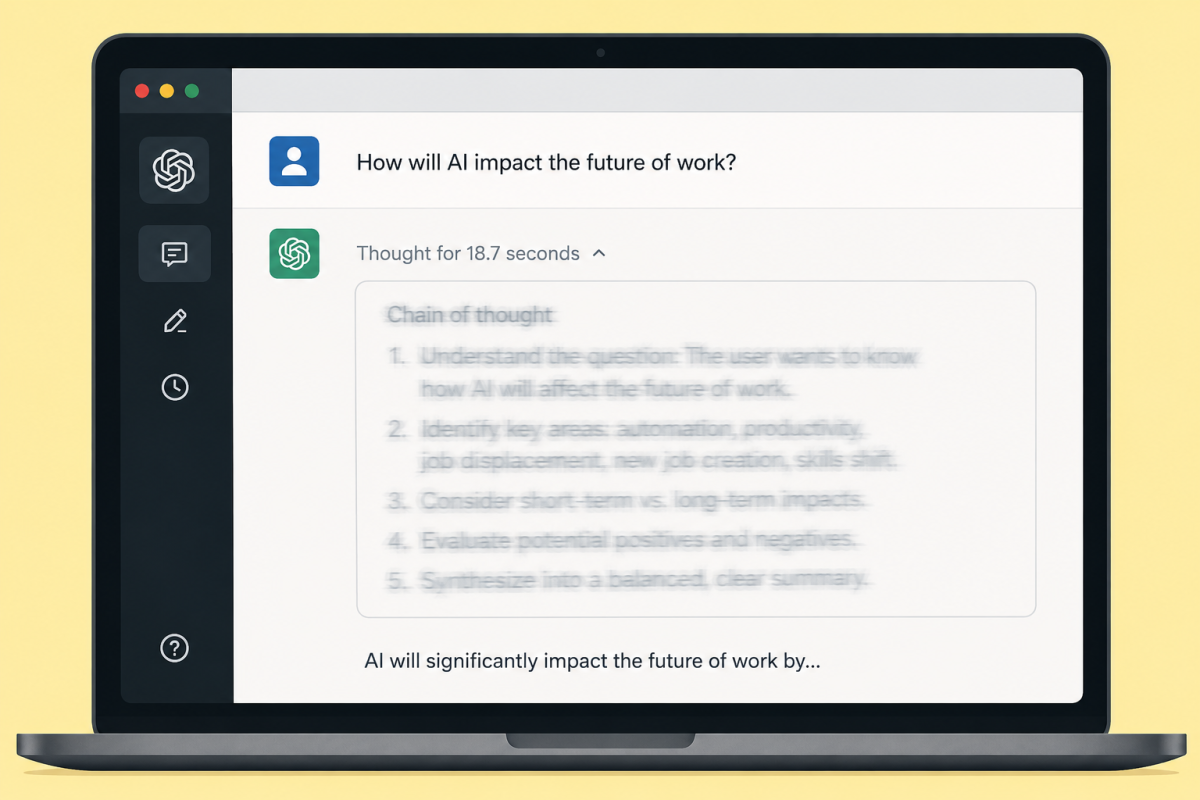
Opaque recurrence is when an AI model loops the same query through its internal layers repeatedly, instead of reasoning step-by-step in plain language. It’s more efficient — smaller models can punch above their weight while using less compute — but leaves far fewer readable traces than a normal chain of thought (that running commentary you see after asking a chatbot for help). That worries safety researchers, since those logs are a key tool for catching misbehavior — and this technique could make that oversight much harder.

(See: Chain of thought)

Open source refers to software — or, increasingly, AI models — where the underlying code is made publicly available for anyone to use, inspect, or modify. In the AI world, Meta’s Llama family of models is a prominent example; Linux is the famous historical parallel in operating systems. Open source approaches allow researchers, developers, and companies around the world to build on top of one another’s work, accelerating progress and enabling independent safety audits that closed systems cannot easily provide. Closed source means the code is private — you can use the product but not see how it works, as is the case with OpenAI’s GPT models — a distinction that has become one of the defining debates in the AI industry.

Advertisement

Parallelization means doing many things at the same time instead of one after another — like having 10 employees working on different parts of a project at the same time instead of one employee doing everything sequentially. In AI, parallelization is fundamental to both training and inference: modern GPUs are specifically designed to perform thousands of calculations in parallel, which is a big reason why they became the hardware backbone of the industry. As AI systems grow more complex and models grow larger, the ability to parallelize work across many chips and many machines has become one of the most important factors in determining how quickly and cost-effectively models can be built and deployed. Research into better parallelization strategies is now a field of study in its own right.

RAMageddon is the fun new term for a not-so-fun trend that is sweeping the tech industry: an ever-increasing shortage of random access memory, or RAM chips, which power pretty much all the tech products we use in our daily lives. As the AI industry has blossomed, the biggest tech companies and AI labs — all vying to have the most powerful and efficient AI — are buying so much RAM to power their data centers that there’s not much left for the rest of us. And that supply bottleneck means that what’s left is getting more and more expensive.

That includes industries like gaming (where major companies have had to raise prices on consoles because it’s harder to find memory chips for their devices), consumer electronics (where memory shortage could cause the biggest dip in smartphone shipments in more than a decade), and general enterprise computing (because those companies can’t get enough RAM for their own data centers). The surge in prices is only expected to stop after the dreaded shortage ends but, unfortunately, there’s not really much of a sign that’s going to happen anytime soon.  

This is a more “technical” name for the same underlying method as opaque recurrence (looping a query through a model’s layers numerous times rather than reasoning sequentially in language). Media outlets use the two terms almost interchangeably, which is why we’re including it here, though “recurrent depth” is the engineering term and “opaque recurrence” is the framing that emphasizes the safety concern.

Advertisement

(See Opaque recurrence, chain of thought.)

Like AGI, recursive self-improvement is a threshhold for how smart AI can get, and how little it may rely on humans. In the RSI scenario, AI models start improving themselves without human intervention, leading to a huge acceleration in capabilities and autonomy. In some tellings, this would be a cataclysmic moment akin to the singularity, a moment when AI models become immune to outside intervention. But RSI also describes a basic capability — can an AI model design its own successor? — which makes it much easier for engineers to try to build it. A number of recent AI startups have set out to build recursively self-improving models, but most of them dismiss the apocalyptic implications, presenting RSI as simply the next frontier for research.

Reinforcement learning is a way of training AI where a system learns by trying things and receiving rewards for correct answers — like training your beloved pet with treats, except the “pet” in this scenario is a neural network and the “treat” is a mathematical signal indicating success. Unlike supervised learning, where a model is trained on a fixed dataset of labeled examples, reinforcement learning lets a model explore its environment, take actions, and continuously update its behavior based on the feedback it receives. This approach has proven especially powerful for training AI to play games, control robots, and, more recently, sharpen the reasoning ability of large language models. Techniques like reinforcement learning from human feedback, or RLHF, are now central to how leading AI labs fine-tune their models to be more helpful, accurate, and safe.

When it comes to human-machine communication, there are some obvious challenges — people communicate using human language, while AI programs execute tasks through complex algorithmic processes informed by data. Tokens bridge that gap: they are the basic building blocks of human-AI communication, representing discrete segments of data that have been processed or produced by an LLM. They are created through a process called tokenization, which breaks down raw text into bite-sized units a language model can digest, similar to how a compiler translates human language into binary code a computer can understand. In enterprise settings, tokens also determine cost — most AI companies charge for LLM usage on a per-token basis, meaning the more a business uses, the more it pays.

Advertisement

So again, tokens are the small chunks of text — often parts of words rather than whole ones — that AI language models break language into before processing it; they are roughly analogous to “words” for the purposes of understanding AI workloads. Throughput refers to how much can be processed in a given period of time, so token throughput is essentially a measure of how much AI work a system can handle at once. High token throughput is a key goal for AI infrastructure teams, since it determines how many users a model can serve simultaneously and how quickly each of them receives a response. AI researcher Andrej Karpathy has described feeling anxious when his AI subscriptions sit idle — echoing the feeling he had as a grad student when expensive computer hardware wasn’t being fully utilized — a sentiment that captures why maximizing token throughput has become something of an obsession in the field.

Developing machine learning AIs involves a process known as training. In simple terms, this refers to data being fed in in order that the model can learn from patterns and generate useful outputs. Essentially, it’s the process of the system responding to characteristics in the data that enables it to adapt outputs toward a sought-for goal — whether that’s identifying images of cats or producing a haiku on demand.

Training can be expensive because it requires lots of inputs, and the volumes required have been trending upwards — which is why hybrid approaches, such as fine-tuning a rules-based AI with targeted data, can help manage costs without starting entirely from scratch.

[See: Inference]

Advertisement

A technique where a previously trained AI model is used as the starting point for developing a new model for a different but typically related task — allowing knowledge gained in previous training cycles to be reapplied. 

Transfer learning can drive efficiency savings by shortcutting model development. It can also be useful when data for the task that the model is being developed for is somewhat limited. But it’s important to note that the approach has limitations. Models that rely on transfer learning to gain generalized capabilities will likely require training on additional data in order to perform well in their domain of focus

(See: Fine tuning)

Validation loss is a number that tells you how well an AI model is learning during training — and lower is better. Researchers track it closely as a kind of real-time report card, using it to decide when to stop training, when to adjust hyperparameters, or whether to investigate a potential problem. One of the key concerns it helps flag is overfitting, a condition in which a model memorizes its training data rather than truly learning patterns it can generalize to new situations. Think of it as the difference between a student who genuinely understands the material and one who simply memorized last year’s exam — validation loss helps reveal which one your model is becoming.

Advertisement

Weights are core to AI training, as they determine how much importance (or weight) is given to different features (or input variables) in the data used for training the system — thereby shaping the AI model’s output. 

Put another way, weights are numerical parameters that define what’s most salient in a dataset for the given training task. They achieve their function by applying multiplication to inputs. Model training typically begins with weights that are randomly assigned, but as the process unfolds, the weights adjust as the model seeks to arrive at an output that more closely matches the target.

For example, an AI model for predicting housing prices that’s trained on historical real estate data for a target location could include weights for features such as the number of bedrooms and bathrooms, whether a property is detached or semi-detached, whether it has parking, a garage, and so on. 

Ultimately, the weights the model attaches to each of these inputs reflect how much they influence the value of a property, based on the given dataset.

Advertisement

This article is updated regularly with new information.

When you purchase through links in our articles, we may earn a small commission. This doesn’t affect our editorial independence.

Source link

Advertisement
Continue Reading

Tech

Instead of Fighting AI, Some Teachers Work It Into Their Lessons

Published

on

Last year the writing program at the University of Baltimore used an app that tracks students while they’re writing in Google Docs, offering teachers a video playing back revisions “with a scoreboard of all the edits, pastes and minutes spent on it,” writes the Washington Post. “Is it surveillance? Yes, I think obviously,” says the program’s director.

But was there a better way?

She is one of a dozen educators around the country who told The Post that they’re experimenting with a different approach to student use of generative artificial intelligence this school year. Teachers and professors are throwing out old assignments, installing new policies and protocols, and incorporating AI built for the classroom, rather than feeling forced to choose between returning to pencil and paper or acting like the AI police.

Her new lesson plan even incorporates generative AI in a controlled way to let her evaluate students’ critical thinking skills. She created chatbots using BoodleBox, the university’s AI vendor, that allow instructors to see both sides of the conversation. For an assignment testing students’ ability to make evidence-based arguments, they participate in a simulated school board meeting about banning books. It involves debating chatbots designed by Zeleny with names like the Confrontational Parent. Writing students usually turn in business proposals and research papers. This semester, instructors are starting to ask instead for transcripts of conversations a student had with a chatbot, a handwritten outline of their composition, and a video reflection of how they felt about the work. “In a lot of ways, we have made these assignments harder, but writing should have always had more detailed checkpoints along the way,” she said.

Advertisement

Read more of this story at Slashdot.

Source link

Advertisement
Continue Reading

Tech

How To Talk To A Machine Without Anthropomorphising It

Published

on

LLMs remain a divisive topic in these times. Perhaps we all know someone who’s become over-infatuated with their new robotic friend, or who believes it has made them a genius. [Emily M. Bender] and [Nanna Inie] have written about how people anthropomorphise the LLMs they interact with, and suggested some language tips to avoid that. It’s a couple of months old, but we think Hackaday readers will find it interesting.

Their analysis is interesting, because it looks at the way people talk about LLMs and highlights the unconscious anthropomorphism. The LLM is a piece of software not a person, so why does it “recognise” when it does “speech recognition”, for example. They suggest “automatic transcription” instead. Even “hallucination” implies cognisance that evidently isn’t there. They admit that their suggestion of “undesirable output” isn’t entirely appropriate. They’re on safer ground with “input” and “output” instead of “prompt” and “response”.

Whatever your views on them, it’s evident that LLM usage will be a feature of the world for the forseeable future. The language surrounding them is however capable of evolving, and maybe some of the suggestions here are worth taking note of.

Advertisement

Grappling with our new electronic overlords? Have a look at our AI for Skeptics series.

Source link

Advertisement
Continue Reading

Tech

A Vacuum Tube Computer For The Home

Published

on

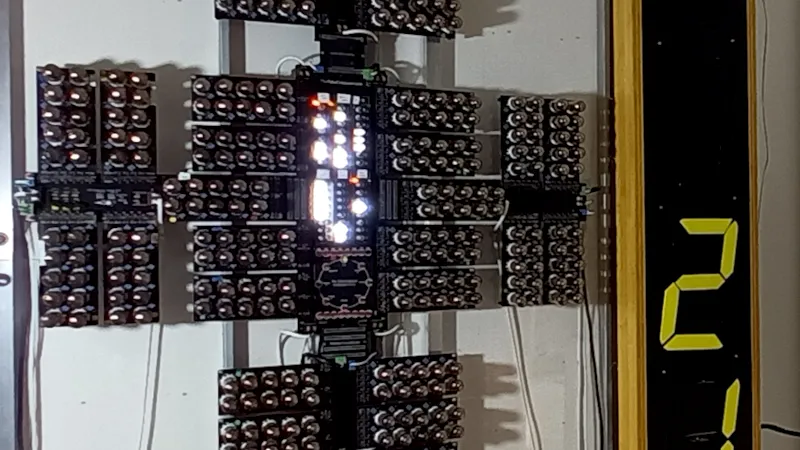
The earliest all-electronic computers used vacuum tubes, and most of us will know about machines such as ENIAC or Colossus. Vast machines that required the budget of a country at war to build, andfill very large rooms. It’s very pleasing then to see that a useful vacuum tube computer can be made which has neither of these requirements, as with this example from [Mike] that uses former eastern bloc double-triodes.

It’s an 8-bit design following a von Neumann architecture with 16 instructions, whose operational block diagram would be instantly recognisable to anyone used to working with a 1970s-era 8-bit microcomputer. It follows a NOR-based design in the same manner as the famous NASA machines from the Apollo programme, and as we understand from the description it uses more modern parts for its I/O circuitry. Physically it’s a surprisingly compact wall-mounted unit, and it has an accompanying ex-British Rail flip-digit display as well as a control panel for a simple airship simulator game. There’s a website with full details, if you are interested.

We like this machine, a lot. It may not be the largest computer we’ve seen and it certainly isn’t the first one with vacuum tubes, but it’s a very impressive achievement to have created it. If tubes in computing interest you meanwhile, we took a trip to see the daddy of them all.

Advertisement

Should [Mike] enter this into the Retrocomputing Challenge? We think so.

Source link

Advertisement
Continue Reading

Tech

US watchdog opens probe into Tesla’s Cybercab self-certification

Published

on

offbeat

Wheels turning on the road and in government

Tesla’s Cybercab’s wheels have only just hit the asphalt for its commercial launch and the autonomous vehicle has already attracted the attention of the US National Highway Traffic Safety Administration (NHTSA).

Advertisement

The body announced an investigation into Tesla’s self-certification of the vehicle at the weekend. Central to the probe is the fact that the Cybercab famously lacks conventional controls.

The NHTSA says there are “clear vehicle performance requirements” – stuff like brake controls – that “in order for automakers to access the US market, they must certify that their vehicles meet these standards – subject to oversight from the agency to confirm compliance. When certified vehicles appear to not adhere to these requirements, NHTSA conducts an investigation.”

The NHTSA is updating the requirements for autonomous vehicles designed never to be operated by a human, but Tesla appears to have jumped the gun somewhat, prompting the agency to open an Audit Query (AQ) just hours after the Cybercab began a commercial rollout on the streets of Austin, Texas.

Tesla told the NHTSA that it had certified the Cybercab “as compliant with all applicable Federal Motor Vehicle Safety Standards (FMVSS).”

Advertisement

The vehicles lack permanently attached manual controls such as a brake pedal, accelerator, steering wheel, or mirrors. In the AQ, the agency wrote it intended to “examine the process and technical data on which Tesla relied when certifying the Cybercab and related issues.

“Among other things, NHTSA will consider the extent to which Tesla’s certification depended on determinations that certain FMVSS are inapplicable to the Cybercab.”

Tesla is not the only company with autonomous vehicles ferrying passengers around on US roads without using conventional controls in the cabin. Amazon tentacle Zoox, for example, was granted a two-year exemption [PDF] at the end of July 2026, with the proviso that “not more than 2,500 exempted vehicles are introduced into interstate commerce for commercial deployment in any 12-month period.”

There is therefore precedent. However, the NHTSA wants to see how Tesla came up with its self-certification for the Cybercab. NHTSA Administrator Jonathan Morrison said, “NHTSA fully supports the safe development and deployment of automated vehicles. But as the federal regulator, we need to ensure that all of our laws are followed.”

Advertisement

The agency noted, “When certified vehicles appear to not adhere to these requirements, NHTSA conducts an investigation.” ®

Source link

Continue Reading

Trending

Copyright © 2025