Tech
Anthropic launches powerful Fable 5 model publicly, while keeping Mythos restricted over cybersecurity concerns

In context: Anthropic’s latest release is really a story about control, not just capability. The company is offering two versions of the same underlying model: Claude Mythos 5 for a small circle of trusted partners, and Claude Fable 5 for everyone else. The split reflects a core challenge Anthropic is still trying to solve – how to deploy an extremely capable system into the wild without simultaneously handing attackers a new class of offensive tools.
Mythos has already shown what it can do when it is not heavily restricted. Since April, when an earlier preview was sent to about 150 organizations under the banner of Project Glasswing, users have reported more than 10,000 critical security flaws in their own systems. Those same capabilities could also be used by attackers looking to break in, rather than to patch security holes.
For that reason, Mythos 5 is staying behind the glass for now. Anthropic is keeping it in the hands of a “small group of cyberdefenders and infrastructure providers,” along with select biology researchers, and is coordinating with US government agencies as part of the rollout. Access is effectively on a need-to-know basis, with the company signaling that a broader “trusted access program” will come later.
Fable 5 is where Anthropic is testing what a general-purpose release of Mythos-class technology looks like under constraint. Technically, it runs on the same underlying model as Mythos 5, but with hard limits built in. The system is designed to refuse or redirect a long list of requests related to cybersecurity, biology, and chemistry. When those guardrails trigger, the query is silently routed to an older model, Claude Opus 4.8, instead.
Anthropic has also wired Fable 5 to watch for distillation, where a user tries to harvest large volumes of answers to train a smaller model of their own. If the system thinks that is happening, those requests are also redirected to Opus 4.8. In other words, the company is not only trying to control what the model will talk about, but also what others can learn from it.
Anthropic has been wrestling with these decisions for months. Diane Penn, the company’s head of product management, told Wired that testing and feedback since the April preview have helped shape the current strategy, even though it is still far from perfect.
“We’re trying to make improvements in a way that’s beneficial, even if we don’t have the perfect [solution] for every use case to start,” she says. “Out of all the different approaches, this emerged as the most viable and the best one. We just ended up feeling like this was the best product choice for users to get the maximum value out of Fable 5.”
For now, the filters are tuned to err on the side of over-blocking. Penn has acknowledged that some harmless queries will be routed to the older model. Anthropic says it wants to refine its classifiers over time but argues that this level of caution is the only way to justify a wider release at this stage.
The stakes are higher because Fable and Mythos are not just chatbots that respond to prompts and stop. Anthropic says both can run “unattended” for longer stretches than previous Claude models, carrying out sequences of instructions without constant supervision.
That shift toward more agent-like behavior could substantially boost software engineering and other technical work, especially given Fable 5’s stronger code generation and visual capabilities. But it also raises obvious questions about what happens if those capabilities are misused.
Anthropic’s pricing reflects how powerful it believes these systems are compared with its other models. Fable 5 and Mythos 5 cost $10 per million input tokens and $50 per million output tokens, roughly double the company’s other public models but still cheaper than the earlier Mythos Preview. The higher price reflects both the performance gains and the sense that these models are still positioned as specialized systems, not yet just another SKU in a growing catalog.
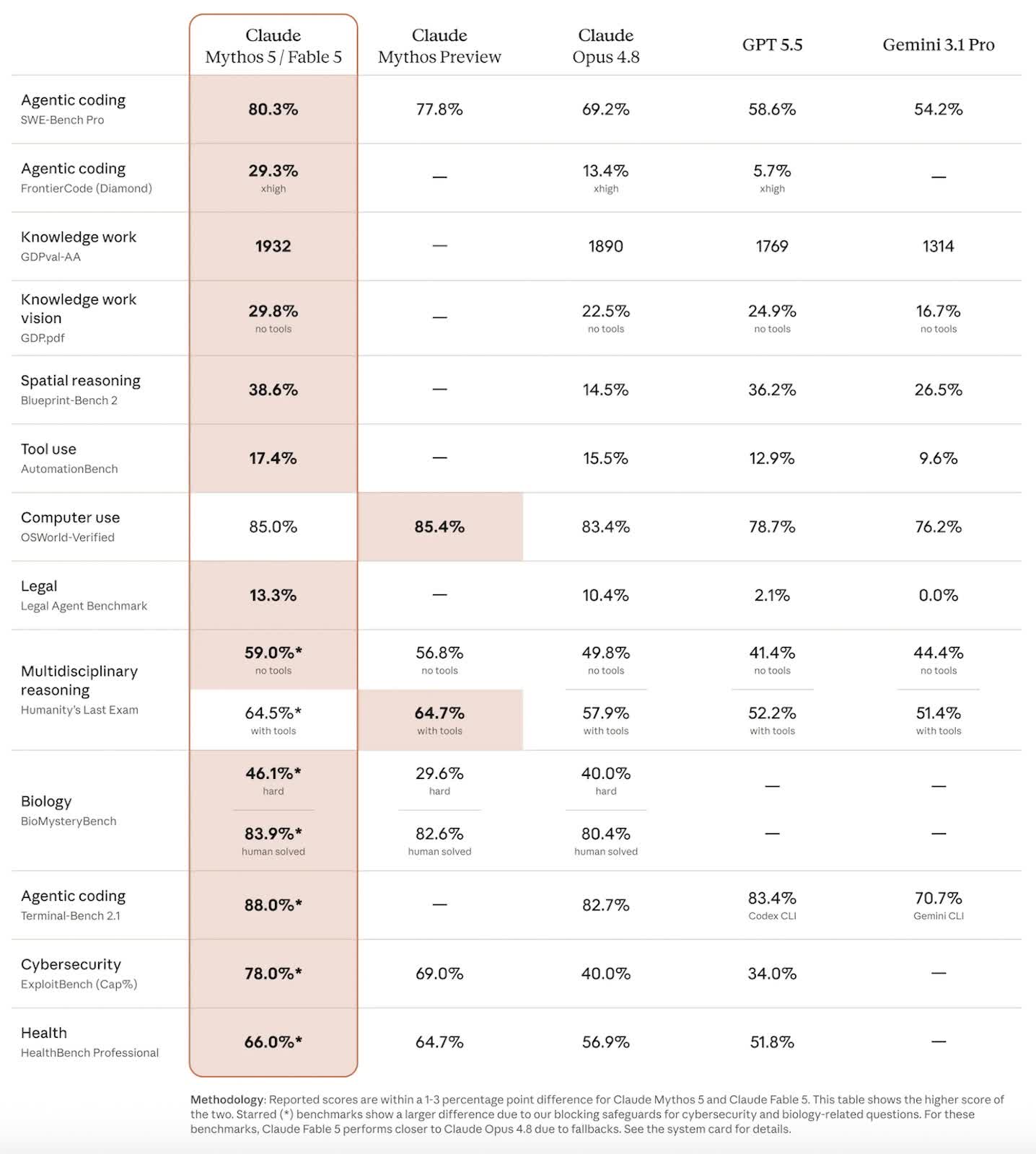
Around Anthropic, competitors are moving in a similar direction. OpenAI has rolled out its own advanced cybersecurity model to a small circle of partners and convened a working group that echoes Project Glasswing. Both companies are preparing for potential IPOs and are under pressure to show investors they can ship cutting-edge technology without triggering backlash over safety concerns.
Even some of the people watching from the outside say the unease is justified. Canadian finance minister François-Philippe Champagne told the BBC that public concern around Mythos stemmed from “it’s the unknown, unknown.”
Anthropic co-founder Jack Clark has made a similar point from the inside, arguing that the industry has not yet figured out how to slow itself down. “You want the option to be able to take your foot off the gas and put your foot on the brake,” he said. “Right now, it’s like the AI industry has a gas pedal, but it doesn’t have a brake pedal.”
You must be logged in to post a comment Login