

In 1954, years after he led the project that created the atomic bomb, physicist J. Robert Oppenheimer was called to testify before the Atomic Energy Commission (AEC). The ostensible subject of the hearings was Oppenheimer’s position on the hydrogen bomb, a far more destructive version of the atomic bomb that the US had developed and first tested two years earlier.
Tech
Anthropic says AI needs regulation. But who chose to build it?


Oppenheimer, who in the years after the war had become increasingly conflicted about atomic weapons, initially opposed work on the hydrogen or thermonuclear bomb, partially for moral reasons and partially because he was skeptical it would work. But he later changed his mind and supported work on it. The lawyers at the AEC wanted to know why.
It wasn’t because Oppenheimer had changed his mind about the morality of city-vaporizing thermonuclear bombs. Rather, it was because American physicists had struck upon a new design for hydrogen bombs that wasn’t just workable, but positively elegant, or “technically sweet” as he called it. For Oppenheimer, that was enough. As he told the AEC hearing: “When you see something that is technically sweet, you go ahead and do it, and you argue about what to do about it only after you have had your technical success.”
What Oppenheimer described was a kind of moral helplessness dressed up as resolve: the pull of a scientifically beautiful answer to an ugly problem, and the accompanying habit of holding the moral accounting until after the technical success. It is one of the most honest things anyone who built the bomb — or any other world-altering thing — has ever said. And it has never stopped being relevant, because the people now building the world-altering technology of our own moment keep saying versions of it too.
Jack Clark, the co-founder and head of policy at Anthropic, the company behind the Claude models, is one such person. So it was worth paying attention last week when Clark sat down for a long public dialogue with Samuel Kimbriel, the founding director of the Aspen Institute’s Philosophy and Society, just six days after the federal government had abruptly cut off access to Anthropic’s two most powerful models, ostensibly over fears of what they could do.
Much of the conversation circled around a single idea that will be familiar to those who read Clark’s work: Powerful AI is coming, and it presents us with a choice — a choice we are actively refusing to make by failing to regulate AI. (Disclosure: Future Perfect is funded in part by the BEMC Foundation, whose major funder was also an early investor in Anthropic; they don’t have any editorial input into our content.)
We regulate toothbrushes, Clark pointed out, and cars, and nuclear weapons. “But we seem to have this attitude towards technology that it’s impossible to regulate,” he said. “It is not impossible to regulate … we sort of act as though, oh well, the technology industry is just inevitably going to do stuff, which I think is a choice.” His sharpest example was the online platform shift that utterly reshaped the last two decades. “Social media ran an uncontrolled experiment on the world,” he said. “We all now think and talk a bit differently because of social media. That was a choice. We can choose things to be different.”
This is the kind of talk that has long differentiated Anthropic from other major AI companies: Its principals are willing to linger on the serious risks of advanced AI, risks that demand clear and even strong regulation. (About a week before the Aspen dialogue — and just a day before the Trump administration came down hard on Anthropic’s latest models — CEO Dario Amodei published a blog post calling for government authority to legally block or even reverse the deployment of frontier AI models failing safety tests on threats like cyberhacking and bioweapons.)
Anthropic acknowledges that advanced AI is an existential gamble, but argues it’s a gamble we must take. At the Aspen dialogue, Clark spoke of a coming century that will be marked by brutal challenges — aging populations, straining institutions, a warming planet — that apparently can only be addressed with AI. To not go forward with artificial intelligence would be to rob ourselves of medical miracles we can only imagine, and implicitly condemn those who might otherwise be saved.
Clark is right that there is a choice buried in all of this. But the question his framing elides is exactly whose choice it actually is.
Sure, as Clark said, we regulate cars and toothbrushes and nuclear weapons, but in each case someone built the thing first, and the rest of us were left to decide what to do about a world that already contained it. Nobody voted on whether the atomic bomb should exist. We were handed the consequences and had to write the rules later.
Much the same is true of AI. The choice Clark wants the public to make around governing it only became necessary once his industry created the thing that needs governing. He is offering us a vote on what to do about AI, not a vote on whether it gets made — because that vote was already cast, in private, by him, a few hundred colleagues, and trillions of dollars. But why didn’t we get a say? Why are we stuck in the world where, as in Oppenheimer’s formulation, “you argue about what to do about it only after you have had your technical success”?
I wasn’t the only person in the audience who was wondering this. Near the end of the dialogue, a young woman put a sharper version of this question to Clark directly. Every frontier lab now admits the technology carries enormous risk, even existential risk, she noted. “So my question is, what gives you, Anthropic, and the rest of the frontier labs the right to continue building something that could destroy everybody, when none of us can actually opt out of it?”
Clark, to his credit, did not brush the question away. But neither did he answer it fully. He reframed it — away from the choice to build, toward the need for someone to take responsibility after it is built.
That someone can’t be the companies themselves, he said, describing an ideal future where “outside compliance, regulatory, testing and verification systems” would decide when each lab was allowed to go further. Governments were already moving faster than anyone expected — the US and UK, he said, had built testing agencies whose tools were sometimes better than the companies’ own.
It was a gracious answer — albeit one that sat awkwardly with the reality that President Trump now appears to be regulating AI by whim — but notice what it concedes. Asked what gives his company the right to build something that could destroy everybody, the head of policy at a leading AI lab did not say we have that right. He said the decision shouldn’t rest with companies like his, only to describe a system to take it out of their hands that does not yet fully exist. He and his colleagues are still building, at the frontier, as fast as the science and the compute allows, while telling the room that someone else really ought to be in charge. AI is already loose in the world. The regulation of AI is still mostly the stuff of blog posts.
So why are they really doing this? To bring it back to Oppenheimer: because AI is “technically sweet.” It’s not the race with China, not the trillion-dollar valuations, not even the creditable desire to cure disease — though all of those are real. Underneath them is something simpler and much harder to govern: we are compelled to build what is beautiful. Clark all but said so, marveling that AI is “easier and simpler to build than many other aspects of science,” that his chief scientist jokes they’d have AGI already if they just fixed the bugs in their code.
We humans are a tool-using species, Clark argued, and AI is the ultimate tool. It’s not that AI is inevitable, exactly, but that it is so weirdly simple to build once the foundations are set that “almost any path you go down, [AI] appears.”
What Clark described is the pull Oppenheimer named in 1954 — the pull of an elegant solution that makes the question of whether you should build it feel beside the point.
I can feel it myself, and I’m just a user. Put a capable model at your fingertips, ask it to do something you couldn’t do alone — write the program, find the flaw, untangle the thing you’d been stuck on — then watch it simply do what you requested, and you’ll experience a small electric thrill that has nothing to do with aging populations or the future of democracy. That thrill runs in an unbroken line from the user at the keyboard up through the engineer who trained the model to the executive who shipped it.
That’s why I suspect Clark’s regulation talk, however sincere, is downstream of a decision that was never really in doubt. Like Oppenheimer with the hydrogen bomb, the people building this technology feel they have no choice but to go ahead — and then to hope the rest of us make the right choices to govern what they could not stop themselves from making.
We have been lucky, so far, with the last technically sweet device that could still end the world. The hydrogen bomb has existed for 70 years without being used in anger, not because we solved the politics Oppenheimer warned about, but because the wiser choice won. And because we were lucky.
Clark may be right that the choice is still ours: The bomb did not decide the Cold War, people did, and people can decide this too. But it would help if the people handing us that choice slowed down long enough to let us make it — instead of building as fast as they can and trusting our luck, and theirs, to hold.
A version of this story originally appeared in the Future Perfect newsletter. Sign up here!

Continue Reading

Slate, maker of the stripped-down EV pickup truck, found another way to simplify its product: the battery.
When the startup revealed its starting price on Wednesday — $24,950 before destination, taxes, and other fees — it also said it had changed its battery strategy, eliminating the optional 240-mile pack but bumping the standard pack from 150 miles to 205.
How Slate pulled that off illustrates just how significantly the battery market in the U.S. has changed in the past four years.
Initially, the startup planned to use nickel-manganese-cobalt (NMC) cells. The chemistry is widely used in the automotive industry and favored for its energy density, which translates into longer range. But NMC is also expensive, mostly due to high nickel and cobalt prices.
More recently, automakers have begun to use another chemistry, lithium-iron-phosphate (LFP). Battery packs that use LFP are less energy dense but cheaper by about 40%, thanks in part to lower-cost ingredients like iron, one of the main cathode materials, which replaces nickel and cobalt.
There were good reasons why Slate, and other automakers, started with NMC. The LFP supply chain today is today concentrated in China. That wasn’t always the case — early U.S. battery startup A123 Systems was founded to commercialize the technology. But after a few missteps, it fell into bankruptcy and was bought in 2013 by a Chinese auto parts company. Since then, Chinese battery companies have embraced the chemistry and dominated production of LFP cells.
LFP’s foreign origin meant that, before last summer, EVs that used it wouldn’t qualify for a $7,500 tax credit under the Inflation Reduction Act. Only batteries made of materials sourced domestically or from companies with which the U.S. had a free trade agreement would qualify. But when the One Big Beautiful Bill Act axed the tax credits, those concerns evaporated, as well. Chinese manufacturers were back in consideration. Slate said it is working with Hefei-based battery company Gotion to source the cells, which will be built at a factory in Illinois, according to InsideEVs.
The other reason automakers passed over LFP batteries was their limited range. Automakers selling into the U.S. market have prioritized range, though vehicles that can travel more than 300 miles on a charge tend to be pricey — pretty much the opposite of what Slate is going for.
In reality, most people don’t need that much range, and as charging networks have grown in size, reach, and speed, range anxiety is gradually waning. While LFP cells will never match NMC in energy density, modern variations of the chemistry have helped close the gap. Ford, GM, Rivian, and Tesla all offer models that use LFP cells.
The industry’s embrace of LFP cells has also coincided with its transition to cell-to-pack technology, which Slate is using to build its battery packs.
Previously, when automakers assembled a battery pack, they first loaded cells into modules, which were then loaded into the pack. That setup allowed them to use pouch cells, which are cheaper and lighter. But over time, they realized the module approach canceled out the cost and weight savings the pouch cells offered. Though some EVs still use modules, the industry is moving toward cell-to-pack construction, in which rigid batteries, either prismatic or cylindrical, are loaded directly into the pack itself.
Cell-to-pack trims manufacturing steps and boosts volumetric energy density, a helpful trait for a small EV like the Slate truck. Plus, LFP cells can be charged to 100% with fewer concerns about degradation than NMC, meaning drivers can use the full pack on a daily basis.
While there was probably a moment when Slate’s leadership had to green-light the switch from NMC to LFP, the momentum toward that decision had been building for years. LFP won’t take over the entire market — automakers like GM are betting on an entirely different chemistry — but its combination of low cost and decent range make LFP an obvious choice for what will be the cheapest EV in the U.S.
When you purchase through links in our articles, we may earn a small commission. This doesn’t affect our editorial independence.
Tech
AWS beats AMD and Intel to rentable PCIe 6.0 servers while customers wait for hardware capable of benefiting

- AWS becomes the first cloud provider offering rentable PCIe 6.0 processors
- Graviton5 combines 192 Arm cores with 96 PCIe lanes
- Memory bandwidth exceeds 800GB/s across AWS’s latest server platform
AWS has quietly achieved a milestone that neither AMD nor Intel reached first in commercially available cloud infrastructure by deploying a PCIe 6.0-capable processor.
The company’s Graviton5 CPU is now generally available through Amazon EC2 M9g and M9gd instances, allowing customers to rent PCIe 6.0 hardware by the hour.
While that development sounds significant on paper, practical benefits remain difficult to identify for most users at the current stage of deployment.
Latest Videos From

PCIe 6.0 arrives in the cloud before it reaches most hardware
Graviton5 was developed by Annapurna Labs and adopts a chiplet design built on TSMC’s 3nm manufacturing process technology.
The processor combines four compute dies containing 48 Arm v3 cores each, bringing the total core count to 192.
AWS says each core carries 1MB of dedicated cache, while the platform integrates 12 DDR5 memory channels operating at speeds up to DDR5-8800.
According to company figures, the memory subsystem can deliver more than 800GB/s of aggregate bandwidth across demanding workloads.
The processor also includes 96 PCIe 6.0 lanes, making it the first cloud CPU customers can actively access with PCIe 6.0 connectivity.
Communication between chiplets relies on a coherent interconnect capable of transferring data at 420GB/s while maintaining unified operation.
AWS claims Graviton5 can deliver performance improvements reaching 25% compared with earlier generations deployed across its infrastructure.
Additional figures suggest application workloads may run 35% faster, while database operations improve by 30% under suitable conditions.
Network bandwidth reportedly increases by as much as 15%, while storage bandwidth rises by approximately 20% across instance categories.
For larger deployments, AWS says network throughput can double compared with previous offerings available through its cloud platform.
Why PCIe 6.0 may not matter much yet
The challenge is that PCIe 6.0 alone does not automatically transform application performance unless the surrounding hardware can exploit the added bandwidth.
This limitation becomes clearer when examining storage devices capable of taking advantage of the newer interface standard today.
Micron’s 9650 NVMe SSD is among the first PCIe 6.0 drives reaching commercial availability, though its audience remains hyperscale operators.
The SSD can reportedly achieve sequential read speeds of 28GB/s, almost twice the throughput commonly associated with PCIe 5.0 storage.
Even so, these drives are largely intended for AI inference environments rather than conventional enterprise or cloud computing workloads.
The same pattern appears in Teamgroup’s recently announced PCIe 6.0 SSD, which reaches 28GB/s yet remains far from mainstream deployment.
For many AWS customers, processor architecture, memory bandwidth, cache capacity, and software optimization will likely matter far more.
The M9gd instances also include local SSD storage reaching 11.4TB capacity and delivering 30% higher IOPS than predecessors.
Although PCIe 6.0 gives AWS an early technological distinction, meaningful gains will depend heavily on broader ecosystem adoption.
At present, the achievement appears more important as an infrastructure milestone than as a feature that immediately changes everyday cloud workloads.
Via The Guru of 3D / Wccftech

Follow TechRadar on Google News and add us as a preferred source to get our expert news, reviews, and opinion in your feeds.


Light from a galaxy that lived just 1.4 billion years after the Big Bang traveled more than 12 billion years to reach us. Astronomers examining long Hubble exposures of a deep sky field spotted something they had not expected to see at such an early time. The galaxy, cataloged MXDFz4.4, sent out ultraviolet radiation strong enough to change the gas in its immediate surroundings from opaque to clear.
This object existed at the tail end of a long period when neutral hydrogen gas filled space and blocked energetic light. MXDFz4.4 sits in the MUSE eXtremely Deep Field, a region already studied by several telescopes. Hubble’s visible-light images captured the galaxy’s output after cosmic expansion stretched its original ultraviolet light into wavelengths the telescope could record.

LEGO Icons NASA Artemis Space Launch System – DIY Rocket Model Building Set for Adults, Ages 18+ – Gifts…
- NASA rocket model kit – Launch into a creative project with the LEGO Icons NASA Artemis Space Launch System model building project for adult space…
- What’s in the box? – This creative building set includes everything you need to craft a multistage rocket with 2 solid-fuel boosters, an Orion…
- Features and Functions – This NASA-themed rocket model features retractable launch tower umbilicals, rocket support and crew bridge, detachable…
The galaxy itself measures roughly 100 times smaller in area than the Milky Way yet forms stars about 10 times faster. Most of that activity happened in tight clusters of young, massive stars only a few million years old. Those stars produced intense radiation that broke apart hydrogen atoms in the surrounding gas. As the gas ionized and thinned, between 50 and 100 percent of the ionizing light escaped the galaxy and its immediate neighborhood.

Combined Hubble and Webb photos show the galaxy as part of a dense field that includes thousands of other distant objects. Colors in the composite indicate areas where light broke free and gas cleared. Instead of a continuous production, the power came from bursts of star formation. Short-lived big stars most likely exploded, causing further holes in the remaining gas.
The discovery, according to lead author Ilias Goovaerts of the Space Telescope Science Institute, was previously thought to be impossible. Hubble not only captured the departing light, but also identified the concentrated young stars driving the alteration. Co-author Marc Rafelski pointed out that astronomers were already aware of the existence of many galaxies at the time. Prior to MXDFz4.4, no one has demonstrated unambiguous evidence of ionizing photons escaping.

Data from the James Webb Space Telescope provided information about the galaxy’s total mass and the evolution of its oldest stars. The European Southern Observatory’s Very Large Telescope helped determine its exact distance and timing. Together, the three facilities demonstrated how a single tiny system may influence conditions directly around it during a pivotal shift in cosmic history. The discovery provides the first direct evidence of an individual galaxy changing its surrounding gas in this manner. Previous detections of similar fleeing light occurred later in time, around 1.6 billion years after the Big Bang or more. MXDFz4.4 brings the record closer to the time when the cosmos as a whole went from murky to clear.

The air will run thick with nostalgia as Scotland face Brazil at the FIFA World Cup 2026, with both teams aiming to book their place in the knockout stage – and you can live stream the game around the world for free.
Mention this fixture to members of the Tartan Army and they will immediately go dewy-eyed, as they recall Scotland’s battles with Brazil at World Cups of yore. This is the Scots’ fifth meeting with A Selecao at the tournament – they have not played any other country more than twice – but their finals record against the five-time winners is not the best, with a 0-0 draw in 1974 followed by defeats in 1982, 1990 and 1998. It falls on Steve Clarke’s Class of 2026 to change the narrative in Miami, where they may need a point to qualify for the knockout stage following their 1-0 defeat by Morocco last weekend. Finish third, and it’s calculators out as one of the eight best records. If they do that, they will become the first Scotland side in history to progress beyond the group stage of a major tournament.
This fixture may not mean the same to Brazil as it does to the Scots, but it is important nonetheless. Carlo Ancelotti’s side beat Haiti 3-0 last time out to take control of Group C and they know that a win here should put them top the standings, thanks to their superior goal difference over Morocco. The Atlas Lions can leapfrog Brazil if they beat already-eliminated Haiti and A Selecao fail to win, or if both teams triumph but the North Africans overturn their goal difference deficit of two. As a result, Ancelotti will want his side to not just win but win well as they look to secure top spot. It means Brazil’s supporting cast will have to follow the lead of Matheus Cunha, who scored twice against Haiti, and take the pressure off superstar forward Vinicius Jnr.
So, read on as we show you exactly how to watch Scotland vs Brazil for free from anywhere in the FIFA World Cup 2026.
How to watch Scotland vs Brazil for free
Scotland vs Brazil is available to watch for free in multiple countries, including the UK, Australia, Brazil, Belgium, Ireland, Netherlands, Switzerland and Turkey.
Abroad? Can’t access your free stream? Unblock your free World Cup stream with Norton VPN — more on that below.
Use a VPN to watch Scotland vs Brazil live streams
It’s the World Cup, and if you’re traveling, you might discover your usual Scotland vs Brazil stream is suddenly unavailable due to geo-restrictions.
Don’t worry, that’s exactly where a VPN can help. A virtual private network lets you connect to servers around the world so you can securely access your usual World Cup coverage as if you were back home.
We recommend Norton VPN. Here’s why:
How to watch Scotland vs Brazil in the US

US viewers can watch Scotland vs Brazil on Fox and Telemundo (Spanish comms).
You can watch every World Cup game on Fox, FS1 and Telemundo, which are available on cord-cutters like YouTube TV (free trial), Hulu+Live TV, Sling (select markets), Fubo or DirecTV.
Those looking for a streaming service instead can watch Scotland vs Brazil on Fox One (3-day free trial). Telemundo is available via Peacock as well.
Visiting the US from the UK? You can still watch your World Cup stream for free thanks to Norton VPN (try for 60 days).
How to watch Scotland vs Brazil in the UK

UK customers are in luck as they can stream Scotland vs Brazil for free on the BBC. Live coverage is available on BBC One and BBC iPlayer.
You require a TV license and a valid UK postcode for an account (e.g. SE1 7PB).
Norton VPN can unlock your stream if you’re abroad today.
How to watch Scotland vs Brazil in Australia

Scotland vs Brazil will be shown for free in Australia on SBS On Demand.
The streaming platform has every game of the tournament for free, making it the perfect place for your World Cup viewing.
Traveling outside of Oz? A VPN like Norton VPN can help unlock your free stream.
How to watch Scotland vs Brazil in Canada

In Canada, TSN will be broadcasting Scotland vs Brazil.
You can live stream via the TSN+ streaming platform, which costs CA$8 per month or CA$80 per year.
Outside of Canada? Use Norton VPN whilst you’re traveling away from home to unlock your stream.
Scotland vs Brazil: Match Information
What time does Scotland vs Brazil start?
Scotland vs Brazil kicks-off at 11pm BST / 6pm ET on Wednesday, June 24. That’s 8am AEST on Thursday, June 25 in Australia.
What are the squads for Scotland vs Brazil?
Scotland
Goalkeepers: Craig Gordon (Hearts), Angus Gunn (Nottingham Forest), Liam Kelly (Rangers).
Defenders: Grant Hanley (Hibernian), Jack Hendry (Al Ettifaq), Aaron Hickey (Brentford), Dom Hyam (Wrexham), Scott McKenna (Dinamo Zagreb), Nathan Patterson (Everton), Anthony Ralston (Celtic), Andy Robertson (Liverpool), John Souttar (Rangers), Kieran Tierney (Celtic).
Midfielders: Ryan Christie (Bournemouth), Findlay Curtis (Rangers), Lewis Ferguson (Bologna), Tyler Fletcher (Manchester United), Ben Gannon-Doak (Bournemouth), John McGinn (Aston Villa), Kenny McLean (Norwich City), Scott McTominay (Napoli).
Forwards: Che Adams (Torino), Lyndon Dykes (Charlton Athletic), George Hirst (Ipswich Town), Lawrence Shankland (Hearts), Ross Stewart (Southampton).
Brazil
Goalkeepers: Alisson (Liverpool), Ederson (Fenerbahce), Weverton (Gremio).
Defenders: Alex Sandro, Danilo, Leo Pereira (Flamengo), Bremer (Juventus), Ibanez (Al-Ahli), Ederson (Atalanta), Marquinhos (Paris St-Germain), Gabriel (Arsenal), Douglas Santos (Zenit St. Petersburg).
Midfielders: Bruno Guimaraes (Newcastle), Casemiro (Manchester United), Danilo Santos (Botafogo), Fabinho (Al-Ittihad), Lucas Paqueta (Flamengo).
Forwards: Endrick (Lyon), Gabriel Martinelli (Arsenal), Igor Thiago (Brentford), Matheus Cunha (Manchester United), Vinicius Junior (Real Madrid), Luiz Henrique (Zenit St. Petersburg), Neymar (Santos), Rayan (Bournemouth).
Swipe to scroll horizontally
|
Position |
Team |
GD |
Points |
|---|---|---|---|
|
1 |
Brazil |
3 |
4 |
|
2 |
Morocco |
1 |
4 |
|
3 |
Scotland |
0 |
3 |
|
4 |
Haiti |
-4 |
0 |
Can I watch Scotland vs Brazil on my mobile?
Of course, most broadcasters have streaming services that you can access through mobile apps or via your phone’s browser.
You can also stay up-to-date with all of the key World Cup moments on the official social media channels on X/Twitter (@FIFAWorldCup), Instagram (@FIFAWorldCup), TikTok (@FIFAWorldCup) and YouTube (@FIFA).
We test and review VPN services in the context of legal recreational uses. For example: 1. Accessing a service from another country (subject to the terms and conditions of that service). 2. Protecting your online security and strengthening your online privacy when abroad. We do not support or condone the illegal or malicious use of VPN services. Consuming pirated content that is paid-for is neither endorsed nor approved by Future Publishing.

If you’ve been waiting for ASUS’s latest RTX 50-series laptops to arrive in India, we have some great news. ASUS has finally announced the availability of its newest premium gaming and creator laptops in the country, headlined by the flagship ROG Zephyrus Duo. The lineup also includes refreshed versions of the Zephyrus G14 and G16, the TUF Gaming A14, and the creator-focused ProArt PZ14. The new machines are powered by the latest Intel Core Ultra, AMD Ryzen AI, and Snapdragon X processors, paired with NVIDIA’s GeForce RTX 50-series GPUs. ASUS is also leaning heavily into AI this year, with some models offering dedicated NPUs capable of delivering up to 80 TOPS of AI performance.
The Zyphyrus Lineup

The most interesting laptop in the lineup is undoubtedly the ROG Zephyrus Duo. ASUS describes it as its most advanced gaming and creator laptop yet, and it’s easy to see why. The machine features dual 16-inch 3K OLED Nebula touch displays, giving users significantly more screen real estate for multitasking, streaming, video editing, or keeping multiple applications open while gaming.
Under the hood, the laptop can be configured with up to an NVIDIA GeForce RTX 5090 GPU and Intel Core Ultra processors. ASUS has also included its ROG Intelligent Cooling system to help keep temperatures under control during long gaming or rendering sessions.
For users who want flagship performance without carrying around a massive gaming laptop, ASUS is also bringing the latest Zephyrus G14 and G16 to India. Both laptops feature premium lightweight designs, OLED Nebula displays, and NVIDIA RTX 50-series graphics. The G14 gets a 73Wh battery, while the larger G16 bumps that up to 90Wh. ASUS says the machines are designed for users who want a single laptop for gaming, content creation, and everyday work without sacrificing portability.
TUF Gaming A14 & ProArt PZ14

The TUF Gaming A14 targets gamers and students who need something more portable than a traditional gaming laptop. Weighing just 1.46kg, the laptop combines AMD Ryzen AI processors with NVIDIA GeForce RTX 5060 graphics. ASUS has also retained the military-grade durability the TUF series is known for, making it a more rugged alternative to the Zephyrus lineup.
Meanwhile, the ProArt PZ14 caters to creators looking for a highly portable AI PC. The device features a detachable Bluetooth keyboard and a 2-in-1 design, allowing it to function as both a laptop and a tablet. It runs on Qualcomm’s Snapdragon X2 Elite processor and includes a 14-inch 3K ASUS Lumina Pro OLED display. At just 0.79kg, it’s easily the lightest device in the lineup. ASUS is also positioning it as an AI-focused machine, thanks to support for up to 80 TOPS of AI performance.
Price and Availability
The new ASUS laptops are now available across ASUS Exclusive Stores, ROG Stores, the ASUS eShop, Amazon, Flipkart, Reliance Digital, Croma, Vijay Sales, and other authorized retail partners. Pricing starts at ₹1,99,990 for the TUF Gaming A14 and goes all the way up to ₹6,99,990 for the top-end Zephyrus Duo with RTX 5090 graphics. ASUS is also offering No Cost EMI options through ASUS Easy Pay for up to 18 months, with monthly payments starting at ₹11,111.


The European Parliament said the digital euro can be used to make both online and offline payments to merchants across Europe. Online payments would be processed through an account-based system, while offline payments would function more like cash, with transactions conducted directly via local storage devices such as smartphones.
Read Entire Article
Source link


OS PLATFORMS
Maybe sometimes users know best
OPINION On June 24, 2021, Microsoft announced Windows 11, unveiling a new and controversial operating system. Five years on, how has that worked out for you, Redmond?
Windows 11 has always been a problem child for Microsoft. It was announced in June 2021 and became generally available on October 5 that year, while much of its customer base was still reeling from the COVID-19 pandemic. At the time, The Register called it pointless rather than a point release of Microsoft’s flagship operating system.
Why? Because Windows 10 was more than adequate. Microsoft’s apology for the Windows 8.x era was… fine. It mostly worked without difficulty. It lacked the user-experience missteps of its predecessors and was an architectural step up from Windows 7. And, most importantly, the operating system didn’t trip up a user’s workflow.
There is an old adage: “If it ain’t broke, don’t fix it,” but Microsoft set to work fixing Windows 10 regardless, and the result was Windows 11.
The user experience has irked users ever since. Did you like being able to move the taskbar around in Windows 10? Tough – in Windows 11, you’ll have to learn to love where Microsoft stuck it. How about the Start Menu? Again, Microsoft knew best and redesigned it.
In the last year, Microsoft appears to have realized that its actions have alienated users and promised to restore eliminated user interface elements, such as the movable taskbar. It hasn’t, however, gone back on another Windows 11 feature – the infamous hardware requirements.
While Windows 11 contained plenty of software elements to annoy users, it was the company’s decision, on security grounds, to render hardware perfectly capable of running the operating system obsolete at a stroke that really angered users. Even hardware (including some of the company’s own) that was still on sale at the time wouldn’t work. The company demanded TPM 2.0 and warned that anything older than an eighth generation Intel CPU (or equivalent) would not make the cut.
Then and now, the decision carries an arbitrary air, particularly as several workarounds emerged, revealing the requirements to be the technically unnecessary decisions they were.
More than anything, Microsoft’s hardware requirements slowed the operating system’s adoption, as hardware that ran Windows 10 perfectly well was rendered obsolete overnight.
In the end, it took until 2025 for Windows 11 to overtake its predecessor in market share, and until 2026 for the gap to widen. Much of the change in market share is likely due to hardware replacement cycles and the end of mainstream support for Windows 10 on October 14, 2025.
Microsoft’s operating systems have followed a set pattern over the years. Windows XP was good, Windows Vista was not. Windows 7 was good, Windows 8.x was not. Windows 10 – good. Windows 11 – oh dear, it seems it was always destined to be a bit of a duffer, even without Microsoft loading it with ads and AI.
While hindsight has made Windows 10 seem rather good, retrospectives are unlikely to be so kind to Windows 11, which marked an era in which Microsoft took its eye off the desktop to focus on shinier, AI-related things. Microsoft has already dropped Copilot branding from products like Notepad, an acknowledgment that the assistant is not the welcome pal in every place it is forced into. The same could be said for Windows 11, which has become a byword for iffy quality and bad management decisions.
Based on the last five years of Windows 11, Windows 12 should be a beacon of light. Right? ®
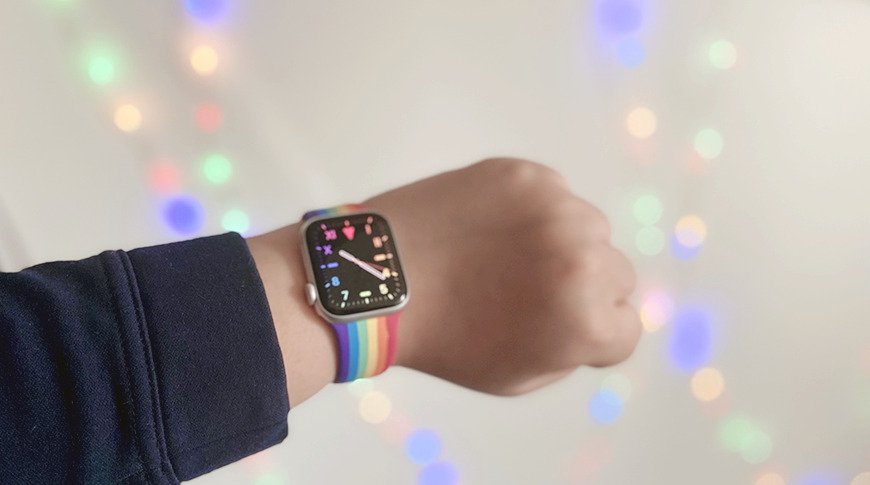
The Apple Watch is reigning king among fitness trackers, but there’s a big enough gap in the market for Apple to release a ring-style tracker, even though it probably won’t.
I hate the Apple Watch. I know, I know, heresy, but I do.
And I don’t even hate it for a singular reason. I hate it for a multitude of reasons, which is impressive, because I’ve bought three in my lifetime.
I hate the way the Apple Watch looks. It’s too chunky on my delicate little bird-wrists and, regardless of the band I choose, it managed to ruin every non-gym outfit I ever wore it with.
It’s also physically uncomfortable as all get out. I’m not entirely sure how everyone else here manages to wear theirs at the desk.

I’m sorry, but this just doesn’t look cool.
I’m a bit more flexible than I should be, so as a result, I needed to wear my watch “upside down” to avoid summoning Siri every time I ride my bike, do a push-up, or push open a door. It also pinches the ever-loving crap out of my inner wrist, eventually leading to a bruise that horrifies everyone who’s ever seen it.
I’m willing to bet that some of this may be my faulty genetics. Sure, it’s not Apple’s fault, but it’s still something I have to live with.
But the worst part about the Apple Watch? It is, effectively, another screen vying for my attention.
I didn’t know this until I bought my first Apple Watch and wore it for a month, but attaching a screen directly to my body is not ideal. I am not built for a screen I can’t opt out of.
I don’t think I’m alone in this, either. Even with going in and manually disabling all but the barebones notifications, it doesn’t seem to be enough.
It always goes something like this:
There’s a buzz when my phone rings or I get a text. I look at the screen, despite the fact that I’ve already reached for my phone or looked at my desktop screen. Now I’m interfacing with my Apple Watch. I’m touching the screen for some reason, now I’m scrolling through the information there.
I’m holding my iPhone, sitting in front of my iMac, and looking at my Apple Watch. I’m suddenly a caricature of a tech-addicted millennial in a political comic.
If this sounds extreme, don’t worry, it is. But this is also just how I react to the constant reminder that I’m available to everyone and every app in my life at all times. I am not built for this sort of thing.
So, into the box, and onto the electronic bay, my Apple Watch went. Goodbye, psychological torture device.
I already hear you guys typing your comments, saying, “Well, then don’t wear an Apple Watch. And, for the love of all things holy, stop buying them!”
And yes, I agree! Except there’s one problem:
I actually like the Apple Watch.
In theory.
Hello, midlife crisis.
Before we get started here, I’d like to point out that I am not an athlete. For years, I’d argue that I was actually the opposite of an athlete in pretty much every way you could be.
However, in 2023, I got my first bike after not having one since 2005. Suddenly, I was doing things like “going outside,” “going to the gym,” and “willingly participating in physical activity instead of aimlessly walking around my city in an effort to stave off the inevitable decay of my corporeal form.”
All that to say, I wasn’t completely sedentary before 2023, but I definitely wasn’t prioritizing physical activity.
Three years later, I now hit the gym four or five times a week, weather permitting. Also, weather permitting, I’ll log about a hundred miles on my bike in the same timeframe.
This year I’ve started hiking. I’ve managed to hike about 20 miles, which is impressive solely because of the hostile weather the Great Lakes region has had to endure this year.

I enjoy going hiking on one of the rare days that the weather allows it.
I’m pretty proud of how much I’ve changed in the last three years. I don’t actually think this is a midlife crisis, for the record, I think I just got a bike and could do more things.
That being said, I’ve done a lot in the last three years, and I like seeing how I can improve. Currently, my method for tracking that improvement is a bunch of different apps and relying on the basic features of my iPhone.
If only there were a way to track this data in a single device. And could you imagine if it were integrated with Apple’s ecosystem nicely?
Oh, wait. There is.
And I sold it on eBay. Twice, actually.
Damn it.
Understanding the follies of fitness trackers
Fitness tracking is, as many health professionals will tell you, not an exact science. Fitness trackers themselves aren’t infallible, and they’re far less accurate than the manufacturers would lead you to believe.
There are scenarios in which fitness trackers are not actually useful. Caloric burn, or more accurately, energy expenditure, is probably the most well-known place where fitness trackers come up short.
If you got an Apple Watch to hit a target amount of calories burned in a day, I’ve got some bad news for you: it doesn’t actually have any idea how many calories you’ve burned.
Most studies say the Apple Watch is accurate within an 18% to 40% range. You know what else is probably accurate within a 40% range?
Me. I can probably guess how many calories I’ve burned going on a one-hour-long hike at a moderate pace, and I’d probably be within 40% of the actual number.
A lot of this is purely human biology. A fitness tracker can make an educated guess, but it is effectively a form of digital divination, reading tea leaves and spitting out something fact-adjacent.
Step tracking is another thing that is difficult for a tracker to measure. A “step” is not a standardized unit of measurement or a standardized movement across all bodies.
It’s wild that we assume a fitness tracker could accurately guess the steps of both shuffling elderly and elite college athletes. Steps taken in crowded areas will be measured differently from those done on uneven ground while jogging on a wilderness scale.
The Apple Watch is markedly better at tracking steps than energy expenditure. According to an Ole Miss meta study, the Apple Watch is within a 10% of the actual number of steps taken, at least in a lab setting.
So if they’re not useful for tracking activity, why would we want to use them? Or, more specifically, why do I want one?
Getting trendy with it
While fitness trackers might not track things perfectly, they are actually quite good at tracking things over time. For the average person, and even for most lower-level athletes, you don’t actually need hard numbers to track your progress.
What you need is trends over time.
For example, let’s say your Apple Watch move goal is 350 calories. If you’re hitting that consistently, it doesn’t actually matter what the number of calories burned was.
Eventually, that goal may increase, either because you increased it or the Apple Watch decided it needed to be higher. If you continue to meet or exceed that goal, you’ve got documentation that you’re trending in a positive direction.
Same with exercise minutes. Maybe you started with a modest goal of 10 minutes a day, but over time you began stretching that to 12, then 15, then 20.
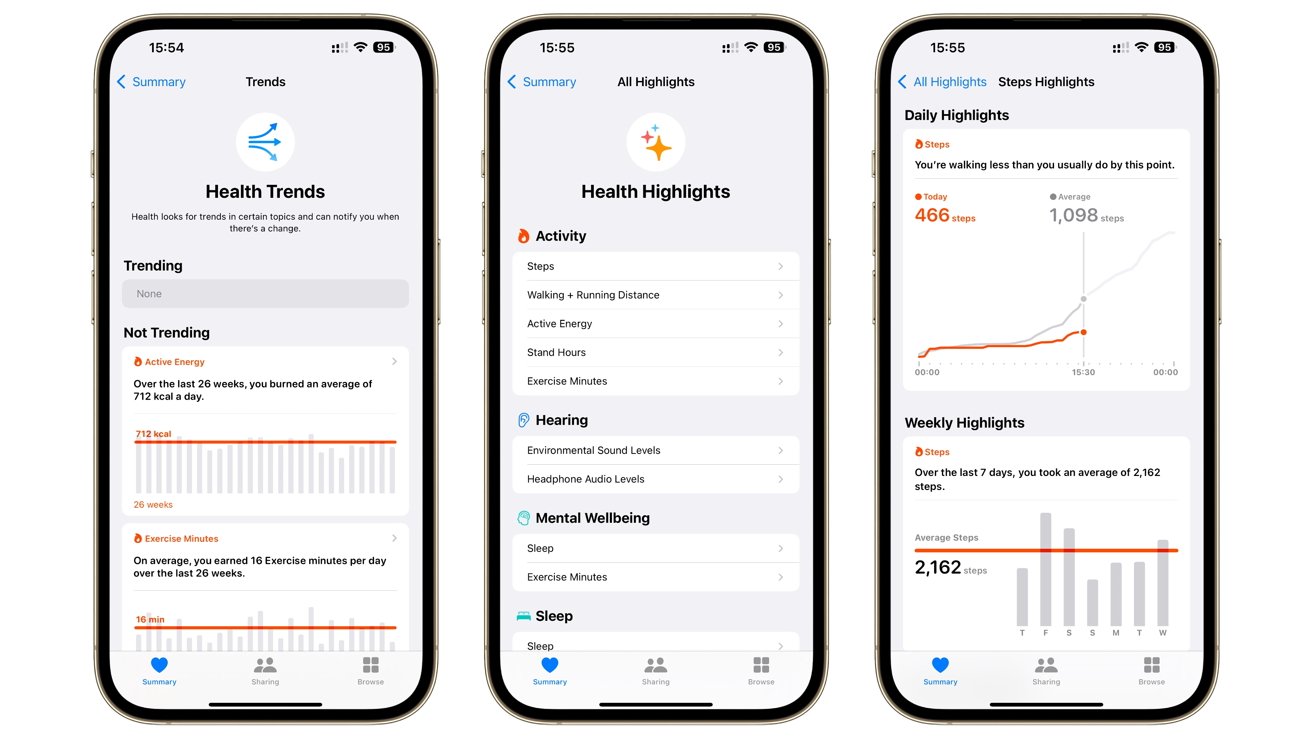
Views of Trends and Highlights in Health for iOS
Similarly, you can also use downward trends to keep an eye on your health. Maybe you notice you start taking fewer steps, suggesting you’re not getting enough movement in.
Maybe your VO2 starts dropping steadily below your baseline in the days before you become ill. This is genuinely beneficial information to have.
And the only way you can track those trends is by consistently wearing a fitness tracker.
Bringing it full circle
I know a lot of people love the Apple Watch, and they’re great at wearing it consistently. And I’m super happy for them.
I’m not one of those people. And judging by the fact that Oura’s done well enough for itself to release the fifth iteration of its tracking ring, there’s a solid market for non-wrist-based trackers.
And once upon a time, Apple was rumored to be working on such a device. Though if you’ve been around the block a couple of times, you know that patents effectively mean nothing in terms of what will or won’t make it to market.
I would love an Apple Ring were one to ever actually materialize, provided Apple didn’t decide that it needed to be another “everything” device like the Apple Watch.
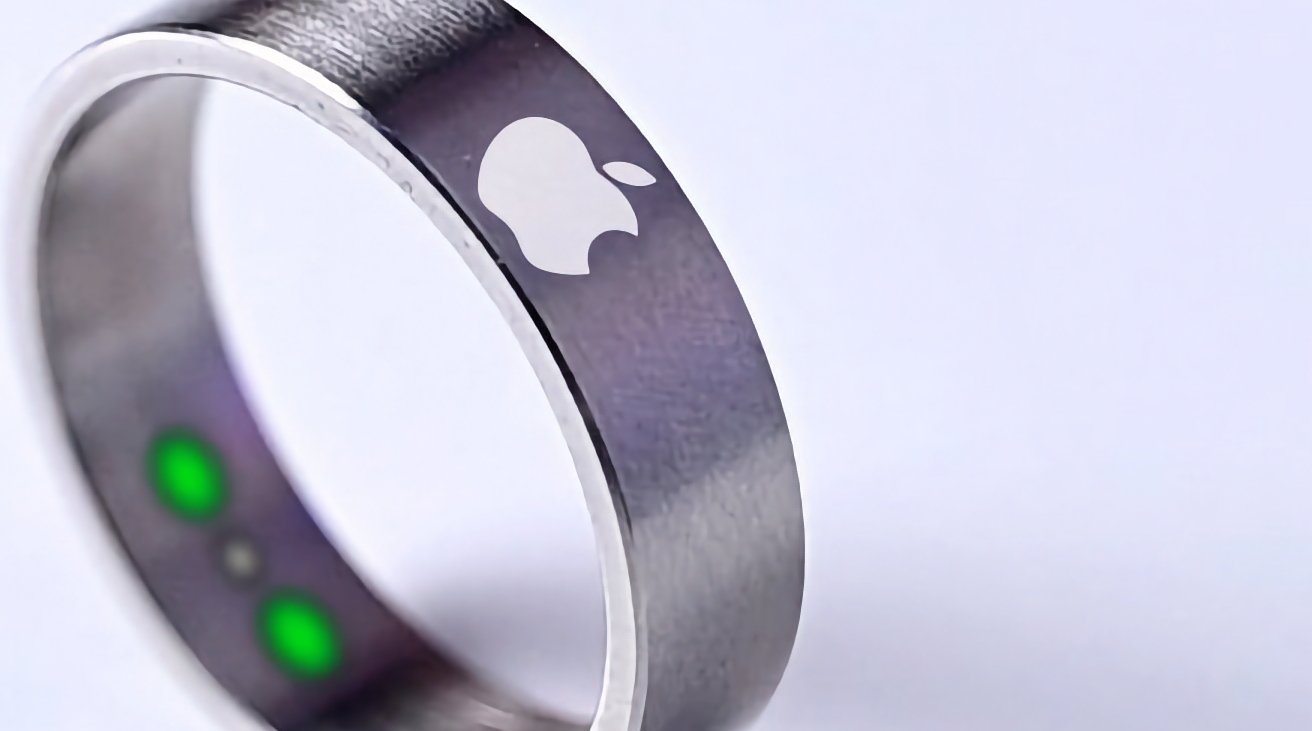
Render of a possible Apple Ring
I would wear the ring every day. I want my sleep metrics, I want to know my heart rate during an intense biking session. I’d like to know what it thinks my average step counts are, so I can work on getting that number higher.
Wearing a ring is pretty set-and-forget as far as activities go. I used to wear my second-generation Oura ring all the time before the battery life finally started degrading to the point of needing to be charged daily.
For the record, I appreciate what Oura is doing, but I still crave the deep Apple ecosystem integration. I want to close my rings, I just want to do it sans Apple Watch.
I really want this stupid ring to exist. Which, frankly, sucks, because I don’t think it’s going to happen anytime soon.
I think Apple’s figured out exactly where it wants to be vis-a-vis the whole device roadmap for the next five years.
We just got the MacBook Neo, and the iPhone Fold is coming out at some point. I suspect that Apple’s HomePod-with-a-Screen will make an appearance at some point in the next year or two.
Apple’s going to buckle down and come to market with some sort of AR glasses situation, much to my chagrin.
I think if Apple made a fitness ring, it would entirely upset the wearable market again. I think it would sell, and I think it would sell incredibly well.
I could see it doing better than AirPods, frankly.
And maybe that’s another reason Apple won’t do it. Apple wants you to buy an Apple Watch.
The Apple Watch comes with accessories you can swap out, and third-party developers make and, crucially, sell, apps for it. You only have to produce an Apple Watch in a few different sizes, whereas an Apple Ring would probably need to come in at least eight sizes.
And the Apple Ring would most assuredly cut into the Apple Watch market. Considering how hard Apple pushes the Apple Watch, I can’t see it wanting to split people off for what it may view internally as a less worthwhile product.
So, I don’t see it happening anytime soon.
For now, I suppose I’ll continue to use my four separate apps to track the various workouts I do. Maybe someone else will come to market with a ring that is just as good as the Apple Ring could be.
Maybe I’ll eventually cave and buy an Oura Ring 5.
Either way, I’m still going to hope Apple has a change of heart and finds a way to make the fitness tracker of my dreams a reality. I think it’d be way better than the stupid Pixar lamp it’s allegedly got in the works, at any rate.
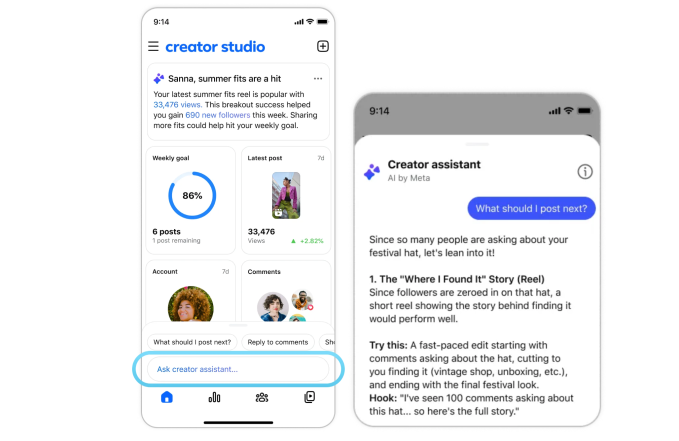
Facebook announced on Wednesday that it’s reimagining its Creator Studio tool as a stand-alone AI companion app designed to help creators grow their audiences on the social network.
By giving creators access to this AI companion app, Meta is looking to keep creators active on Facebook as it competes for their attention against rivals like TikTok and YouTube. The company also likely hopes that the app will eliminate the need for creators to turn to third-party tools like ChatGPT when brainstorming content ideas and analyzing performance.
The new app, which is currently being tested with select creators, will have Facebook’s recently launched AI creator assistant built into it. The assistant provides creators with personalized recommendations based on their content style, performance, audience engagement, and goals.

Creators often have to sift through charts and dashboards to understand their performance, but with the AI assistant, they can get quick answers to questions like “When should I post?” and “What are people saying in my comments?” Since the AI assistant is conversational, they can also ask follow-up questions, like how their audience has shifted over time.
Beyond the built-in AI assistant, the Creator Studio app will include a set of several new features, such as an AI-powered comment tool that will help surface the most important comments and draft replies in the creator’s own tone. Creators can edit and approve the drafted replies before posting them, Facebook says.
When creators open the app each day, they will see a feed of daily priorities: reviewing their newest post’s performance, tracking progress toward goals, and flagging comments in need of a reply.

Wednesday’s announcement adds to Meta’s recent wave of app launches. Last month, the company rolled out a stand-alone app for Facebook Groups called Forum that functions similarly to Reddit. In April, Meta launched a new app called Instants that lets users share disappearing photos with Instagram friends.
The pipeline keeps growing. The New York Times reported on Tuesday that Meta is building its own Polymarket-like app, internally called “Arena,” though it has yet to launch.
The cadence is deliberate. The Wall Street Journal reported in April that CEO Mark Zuckerberg told employees that AI-driven efficiencies would enable the company to build more apps than it has historically.
When you purchase through links in our articles, we may earn a small commission. This doesn’t affect our editorial independence.


The U.S. Cybersecurity and Infrastructure Security Agency (CISA) is warning of hackers actively exploiting flaws in Ubiquity UniFi OS and Lantronix serial-to-ethernet servers.
According to the BOD 26-04 directive, federal agencies have three days to apply available security updates or vendor-recommended mitigations.

The Ubiquiti flaws that CISA added to its catalog of Known Exploited Vulnerabilities are:
- CVE-2026-34908: an access control bypass flaw that allows an unauthenticated attacker to make unauthorized changes to a UniFi OS system, potentially leading to full system compromise.
- CVE-2026-34909: a directory/path traversal vulnerability that allows an attacker to access sensitive files on the underlying operating system, potentially exposing configuration files, credentials, and other sensitive data that could facilitate account takeover.
- CVE-2026-34910: an improper input validation flaw that enables an attacker to inject and execute arbitrary operating system commands, potentially leading to remote code execution and complete system takeover.
Ubiquiti released security updates for the three vulnerabilities in May, warning that they could be exploited remotely without privileges.
Researchers at Bishop Fox later demonstrated that the three flaws could be chained to achieve full remote code execution with elevated privileges on vulnerable UniFi OS devices.
Bishop Fox has also released a free detection script on GitHub to help defenders discover vulnerable instances in their environment.
The security issue exploited in Lantronix servers is tracked as CVE-2025-67038, and is a critical-severity root-level command injection affecting model EDS5000 running firmware 2.1.0.0R3.
The vulnerability exists in the HTTP RPC module, which executes a shell command to log failed authentication attempts.
The supplied username is concatenated directly into the shell command without proper sanitization, allowing an attacker to inject arbitrary operating system commands.
Lantronix released a released a patch for CVE-2025-67038 and recommends users to upgrade to EDS5000 version 2.2.0.0R1.
CISA has not shared any details about the observed exploitation of any of the four flaws, while the “use in ransomware campaigns” flag was set to “Unknown” for all of them.
System administrators managing the above products are recommended to apply the available updates and/or suggested mitigations as soon as possible.

Security teams log 54% of successful attacks and alert on just 14%. The rest move through your environment unseen.
The Picus whitepaper shows how breach and attack simulation tests your SIEM and EDR rules so threats stop slipping by detection.

NewsBeat43 seconds ago
Scots girl, 6, dies after rare cancer battle as plea issued for Scotland-Brazil tribute

Business2 minutes ago
Lionel Messi at 39 Defies Age with Strict Diet and Dedication as He Dominates on Pitch

Crypto World3 minutes ago
Microsoft Copilot AI Predicts Incredible Solana Price by The End of 2026


-

 Fashion5 days ago
Weekend Open Thread: Miami – Corporette.com
-

 Entertainment4 days ago
Renter of Home in Anne Heche Crash Denies Settlement With Son
-

 Tech2 days ago
Microsoft accidentally kills epic Outlook email threads
-
 Sports1 day ago
Two goals and an assist by sheer aura: Cristiano Ronaldo just entered the World Cup chat
-

 Business4 days ago
Soccer-U.S. defends Iran World Cup travel restrictions, says discussions ongoing
-
Crypto World16 hours ago
Bitcoin (BTC) Dips Below $62K, Ethereum (ETH) Plunges 6% Daily: Market Watch
-

 Politics6 days ago
BBC Reporter Discusses Cross Party Criticism Of Trumps Iran Deal
-

 Crypto World13 hours ago
Securitize Wraps Roubini's SEC-Registered ETF as Dubai VARA Digital Security
-
Business19 hours ago
Entergy settles forward sale agreements, raises $672 million in cash proceeds
-
 Business5 days ago
Wall Street Week Ahead: Investors see Micron earnings as pulse check of AI rally momentum
-

 Politics4 days ago
Andy Burnham and the meaning of Makerfield
-

 Tech6 days ago
AWS enters the context layer race with a graph that learns from agents, not manual curation
-

 NewsBeat5 days ago
Keir Starmer Allies Question His Chances For No 10
-
 Crypto World4 days ago
Can Charles Hoskinson Really Rescue Cardano?
-

 Crypto World5 days ago
HIVE shares jump as $220M AI deal speeds Bitcoin mining pivot
-

 Crypto World4 days ago
Jake Chervinsky accuses CME of protecting derivatives monopoly
-
 Tech3 days ago
Signal’s Meredith Whittaker says AI chatbots ‘are not your friends’ and calls Copilot agents a backdoor
-

 Entertainment5 days ago
Jose Alvarado Wants Taylor Swift at More Knicks Games
-

 Tech2 days ago
Nearly 7,000 fake Amazon domains registered ahead of Prime Day 2026, researchers warn
-

 Business6 days ago
Brexit cost 6% of UK economy, Bank of England company data suggests
You must be logged in to post a comment Login