
TL;DR
Anthropic launched Claude Tag, an always-on Slack AI that follows conversations, learns context, and proactively jumps in to flag updates and tasks.





Apple’s refreshed AirPods Max 2, priced at $399 on Prime Day (was $549), immerse you with a listening experience that grabs your attention right away and keeps it there without you having to think about it. The improved noise cancellation eliminates common distractions, such as road rumble or workplace noise, keeping the music front and center. When someone nearby begins talking, the headphones detect it and lower the volume for you, allowing you to hear what’s going on outside in crystal clear detail until the conversation is over. Pairing with Apple devices happens automatically and switches in the blink of an eye, while the USB-C connector allows for both quick top-ups as well as wired playback with CD-quality sound.
Mounting the eufy SoloCam S340 in a sunny location allows the solar panel’s battery to stay charged, eliminating the need to recharge it or run any cables to get it going. The dual lens setup provides a nice wide view of the yard as well as the option to zoom in and get a closer look at anything that catches your eye, all in crystal clear 3K during the day and in stunning color at night. With motorized pan and tilt, the camera can track activity across the yard, leaving no blind zones, while the app only sends you a legitimate alarm when it detects a real person or a vehicle, not every single leaf that falls. There’s a built-in light to lighten things up when needed, and local storage means that all clips are preserved safely directly on the camera, with no subscription required. Two-way communication works great over the phone, and connecting is a breeze with only your usual Wi-Fi and some easy controls. Product page.
Lenovo’s Idea Tab includes a pen and a folio case, making it a ready-to-use tool for taking notes, reading, or simply working. The 11-inch screen displays all details at a fluid 90 frames per second, and its matte texture eliminates bothersome glare, even on bright days, when you’re browsing pages or viewing videos. The included Tab Pen glides over the screen like a dream, making it easy to write, draw, or even sign papers without the need for setup or pairing. The battery life will last you a whole day of mixed use: watch a few shows, browse the web, do some light office work, and don’t need to recharge till the next day. The built-in speakers work well whether you’re viewing movies or listening to music, and you can quickly add more storage with a memory card as your app collection and files develop. Everything operates on the current Android version, and the controls are really basic, making it easy to complete daily tasks and respond quickly to the initial swipe. Product page.
The Samsung The Frame 55-Inch LS03F TV is designed in such a way that it adheres perfectly to the wall, with barely a gap and just one cable connected to an outside box; it looks more like a large piece of framed artwork than a television screen. In its off state, Art Mode displays art gallery quality artworks or pictures which seem to be printed and three dimensional because of the matte surface of the screen which prevents reflection in regular light. Bezel customization ensures that the frame blends in with the woods of the room. The processor takes care of all the processes including streaming applications and also upscaling old media without any lag in the interface. Once it is mounted along with some choice artworks, it becomes visually less conspicuous and yet provides a great viewing experience. Product page.
The recently released second-generation AirTag perfectly fits into the previous compact circular form factor, but with a very important upgrade, which is increased accuracy. The signal emitted by the AirTag when activated from the Find My app will be much louder, regardless of whether it’s hiding underneath the couch cushion or inside a bag. Setup is easy since AirTags will connect with Apple’s large network of devices, which will quietly transmit the location of AirTags when out of reach. The battery will last you approximately a year before having to change it, and the AirTag itself is so small that it can easily attach to your keys or slip into your wallet without adding any extra weight. Product page.
The newest Kindle Paperwhite screen at Amazon feels incredibly like paper, without the shine or reflections, which makes the words readable in broad daylight and under lamp light during the night. Turning of the pages happens by light tap on the screen, and there is no need to make pauses or interruptions by the device in the process of reading. Warm light mode contributes to reducing the brightness and making the nighttime reading easier. Plus, the battery life is quite decent, which means that it works weeks and needs only quick charging through USB-C port. Despite the abundance of technology in it, the device is quite light and thin, which makes it possible to hold the gadget in one hand all day long. It is also water-resistant, so the device will not suffer from any water contacts, be it a bath or a beach. Besides, you can save thousands of books on the device and even more in the clouds. Product page.

Anthropic launched Claude Tag, an always-on Slack AI that follows conversations, learns context, and proactively jumps in to flag updates and tasks.
Anthropic is launching Claude Tag in research preview, an “always-on Claude” that lives inside Slack and acts as a persistent AI teammate. The feature lets users tag @Claude to get insights in conversations and assign tasks. It is available to Claude Enterprise and Claude Team customers starting today.
Claude Tag is an evolution of Anthropic’s existing Slack integrations, which already let users direct-message Claude or tag it in channels for on-demand help. Claude Code in Slack can also route coding tasks from channel mentions to full coding sessions on the web, posting updates back into the thread. But Claude Tag adds a layer of persistent context and memory that the previous tools could not maintain.
“As Claude follows along with its channel, it learns ever more about the work,” Anthropic said in a statement. Claude can also automatically gather facts from elsewhere in the organisation if granted permission to read other channels. The result is an AI that accumulates institutional knowledge over time rather than starting from scratch with every interaction.

The 💜 of EU tech
The latest rumblings from the EU tech scene, a story from our wise ol’ founder Boris, and some questionable AI art. It’s free, every week, in your inbox. Sign up now!
Everyone in a given Slack channel can access a single Claude identity, meaning anyone can see what Claude has been working on and pick up the conversation from where the last person left off. System administrators specify which tools, information, and channels each Claude identity can access, and each identity stays scoped to whichever channels the admins define. A Claude set up for legal work cannot seed memories into the engineering channel, for example.
When assigned a task, Claude Tag breaks it into stages and works through them using whichever tools it has access to, responding in a Slack thread with what it has created. But the more notable feature is an ambient mode that proactively jumps into conversations to keep teams updated, flag relevant information from across the organisation, and follow up on threads or tasks that have been forgotten.
The ambient mode is the feature that separates Claude Tag from a conventional chatbot. Rather than waiting to be asked, Claude monitors the channels it has been assigned to and intervenes when it judges that a team would benefit from a reminder, a summary, or a piece of context pulled from another part of the company. Anthropic says this makes it feel like “working with a real colleague, one that can produce work in public view, with far greater context and understanding than before”
Organisational context is increasingly the battleground for enterprise AI. Microsoft has been building Work IQ, an intelligence layer expressed through Copilot that draws on Microsoft Graph to understand roles, collaboration patterns, and organisational structure. Startups like Viktor have raised tens of millions to put AI coworkers directly inside Slack and Teams.
Glean, which recently surpassed $300 million in annual recurring revenue at a $7 billion valuation, is building a permissions-aware knowledge graph that sits between the model and enterprise data.
Claude Tag is Anthropic’s answer to the same problem, but its approach is narrower and arguably more disciplined. Rather than building a horizontal intelligence layer across every enterprise application, it plants the AI inside the one surface where most knowledge work already happens: the team chat. The bet is that persistent presence in Slack, combined with cross-channel memory and admin-controlled scoping, is enough to accumulate the institutional context that makes an AI agent useful.
The privacy implications are substantial. An always-on AI that follows along with workplace conversations and autonomously decides when to intervene will face scrutiny from both employees and compliance teams. Anthropic’s admin-scoping controls are the structural answer to that concern, but the real test will come when enterprise customers deploy it at scale and discover how workers respond to an AI that is always listening.
Anthropic says it is working to bring Claude Tag to other platforms in the coming weeks. For now, Slack is the only surface, which limits the feature’s reach but also constrains its complexity, a deliberate trade-off for a research preview.


HPC
Use of Arm cores and Linux mean Beijing hasn’t broken away from the world
The TOP500 list of Earth’s mightiest supercomputers has a new leader: the 2.198 Exaflop/s LineShine machine housed at the National Supercomputer Center (NSC) in Shenzhen, which took the top spot without using any kit from Nvidia, Intel, or AMD.
Which is not to say that LineShine is an entirely Chinese creation. As explained in a pre-press paper, the machine’s LX2 processors are a local effort but use Armv9 designs – so chalk up a win for Blighty, the home of Arm. The machine also runs KylinOS – a Linux distribution that features contributions from around the world.
The paper reveals that LineShine comprises 20,480 computing nodes, and that each LX2 processor “integrates two compute dies (304 cores total) and eight on-package HBM stacks (32 GB, 4 TB/s aggregate bandwidth).”
“Each compute die contains 152 cores and 128 GB of off-package DDR memory organized into four NUMA domains,” the paper adds. “A dedicated SDMA engine handles data movement between DDR and HBM. The LX2 supports FP64/FP32/FP16/INT8 via SME and SVE units, delivering up to 60.3/120.6 TFLOPS in FP64/FP32. Nodes are interconnected via the LingQi high-speed network with a dual-plane multi-rail fat-tree topology, offering 1.6 Tb/s bandwidth per node.”
That network is also a Chinese creation, from the minds at Hangzhou LingQi Technology Co.
LineShine became the first system on the TOP500 to exceed two exaflops of sustained double-precision performance using CPUs only and the curators of the list think it could do better in future tests, because this time around it reached about 80 percent of its 2.736 Exaflop/s theoretical peak in tests conducted in preparation for this iteration of the TOP500 list.
News that LineShine topped the supercomputing charts comes as China’s government increasingly steers local organizations towards buying made-in-China tech. Beijing wants to decrease dependency on foreign products, because China has gone all-in on AI and other technologies to boost economic growth and enhance the capabilities of its military.
China’s Communist Party understands that reliance on imports can stymie those ambitions, with the USA’s ban on GPU sales to the Middle Kingdom offering ample evidence of the need to control tech supply chains. And now Beijing can point to its policies producing the most powerful single computer on the planet.
It’s conceivable that China could do even better in the future, as its GPU industry is nascent and currently producing products whose performance trails Nvidia and AMD by four or five years.
Those two paragons of US computing power, along with Intel, dominate this version of the TOP500 list – as has been the case for years. China is therefore on the march, but is a long way from global dominance.
Our sibling site The Next Platform has extensive analysis of the TOP500 list here. ®

An anonymous reader quotes a report from The Guardian: A tech sell-off shook global markets on Tuesday as attention turned away from developments in the US war with Iran and toward the future of AI companies and chipmakers that have driven stock markets to record highs. The tech-heavy Nasdaq index closed 2.2% lower on Tuesday. The S&P 500 was also down by Tuesday afternoon, dropping 1.43% while the Dow remained steady. All three major US indices have hit record highs this year, riding off a rush of funding to support AI technology and infrastructure. Nasdaq is up 10% for the year, while the Dow jumped 6% so far this year, breaching past 51,000 points, and the S&P 500 is up 7.3%.
But some economists have warned that the influx of AI spending is a bubble reminiscent of the dot-com bubble that burst in the early 2000s. Seven tech companies make up 30% of the S&P 500’s value. The heavy reliance on a single industry and a few key companies has some investors wondering if it’s a matter of when, not if, there will be a burst. Those concerns have been heightened by signals from the Federal Reserve last week that it may increase interest rates, and therefore the cost of borrowing, in order to tackle rising inflation. Alphabet fell 5% on Monday. SpaceX plunged 16%. The selloff also spread to Asia, with South Korea’s benchmark dropping 10% as SK Hynix and Samsung Electronics each lost more than 12%, while Japan’s Nikkei 225 declined 3.5%.

The growing use of AI contributed to Oracle laying off 21,000 workers in a year, according to a Securities and Exchange Commission filing on Monday.
In its annual regulatory filing for the fiscal year ending May 31, Oracle said it has 141,000 full-time employees. In its 2025 filing, Oracle said it had 162,000 employees. The reported 12.9 percent reduction followed March reports of mass layoffs at the database management software company.
“[T]he adoption and deployment of AI technologies across our operations have resulted, and may continue to result, in reductions to our workforce,” the filing reads.
However, the job cuts are also tied to large capital expenditure to build Oracle’s data center infrastructure to support AI workloads.
“The majority of the initiatives undertaken by the 2026 Restructuring Plan were effected to implement our continued emphasis in developing, marketing, selling, and delivering our cloud-based offerings,” this week’s filing reads.
Oracle plans to raise $45 billion to $50 billion in 2026 to expand its Oracle Cloud Infrastructure for customers like OpenAI, xAI, AMD, Nvidia, and Meta, it said in February. About half of that funding will come through debt, with the remainder coming from equity. When Oracle announced this, investors had already been concerned about Oracle’s growing debt to fuel its AI efforts. Overall, Oracle has over $120 billion in debt, per its fiscal year 2026 earnings report.
In February, bondholders sued Oracle, claiming that they lost money because Oracle hid the need to raise its debt to build its AI infrastructure, Reuters reported.

I recognize that when we talk about AI generally, and specifically AI in the gaming industry, there are some people out there who will simply dogmatically insist that this technology doesn’t have a place in the industry and never will. This typically comes along with two chief concerns: concerns about artistic expression if AI is used in the creation process and industry jobs being lost as a result of its use. As I’ve said in previous posts, people aren’t merely allowed these opinions, but we should be glad they’re there. If we’re going to move into the next phase of AI use in gaming, we need people to challenge its use, point out its potential negative outcomes, an spur the discussion about what it means for the art that is these games.
But journalists, including opinion journalists, are supposed to have a higher standard for topics like this. And it’s with that in mind that I say the following: Kotaku’s writing on AI in gaming is dogmatic and annoying in that it pre-judges all uses of AI in gaming in the same way I described above.
Now, I generally like Kotaku and have been a reader of the site for many years. But the pre-judgment in these articles is getting cringey. Take this recent post by Zack Zwiezen about how depressing Steam Next Fest was this year because gaming companies are using AI as a tool in their games. Zack uses a tool that informs him if a game he’s looking at comes with an AI disclosure. And this brought him great displeasure.
When I opened the main hub page for Steam Next Fest earlier today, right after my email inbox was flooded by PR messages reminding me that the event had started, I was excited to go exploring. But as I did, I started running into numerous games that feature disclaimers from the devs confirming the use of generative AI tools for various parts of the game or its marketing.
I clicked on 16 different games featured on the Steam Next Fest main hub page, and 10 of them triggered my extension and warned me of generative AI disclaimers. Of course, this will vary from user to user, as many of the hub’s slots are algorithmically driven. Still, my reaction is: Yikes. And scanning the most popular demos, I continued to run into AI warnings, so it’s not just my algo serving up slop.
Note that Zack knows almost nothing more about these games prior to his negative reaction about it all. He does note that some of the disclosures either come from small studios that explain that they don’t have the resources otherwise to produce these games without AI, which is the exact point I’ve been making about lowering the barrier of entry into the industry, or that the use of AI was very small and reviewed and edited by humans before anything went in the game. But seriously… that’s it. And the use of AI’s mere existence has resulted in Steam Next Fest being “depressing.”
That’s not how it’s supposed to work. Unless you believe that every use of AI in gaming is bad, that is. And if that’s your stance, you’re going to spend a lot of time being upset, because this isn’t going to stop. These are tools and tools will be used in the industry.
This isn’t a one-writer problem at Kotaku, either. Rebekah Valentine recently wrote a piece about how Epic produced a video showing how some of the art in Fortnite is made. And, yes, there is some use of generative AI tools involved. From there, Valentine discusses whether editing out undesirable contributions from AI, or mistakes, was actually saving time in the creation process. Then she notes that she’s not an artist and would believe artists if they said it did in fact save time. Then she says maybe that doesn’t matter at all because AI isn’t perfect and humans don’t always catch mistakes before something makes it into a game.
But then she questions whether any of the above matters because gaming companies have laid people off.
Or maybe none of that matters. Maybe we’re content with touches of generative AI here and there if it “helps” developers. We shouldn’t refuse the conveniences of new technology, right? Maybe this is good for the artists. Sure. But this is coming just three months after Epic games laid off 1,000 people because its leadership couldn’t keep an eye on their own balance sheet. What that tells me, in aggregate, is that Epic Games needs fewer artists to make new content for the game faster, which inevitably is going to mean tighter deadlines and more mistakes. I am not naive enough to think that Epic Games, having laid off this many folks, is going to use generative AI to give the artists that remain more generous deadlines that will allow them to reach their creative potential or fully realize their original ideas or whatever. Epic Games is concerned, first and foremost, with making money. If its leadership thinks they have a tool in hand that will allow fewer people to spit out art that’s good enough faster, they will use it.
This tendency to couple layoffs in gaming companies with the use of AI is lazy. I have no doubt that some layoffs, or slowing hiring trends, have been a result of the use of AI in some companies, some of the time. And I also understand that the gaming industry has suffered from some serious layoff numbers in recent years.
But the macro story is actually that layoffs have slowed in the industry, not sped up. They appear to have peaked in 2024, with a downward trend since then. We’ll have to see how 2026 ends up looking, but I very much believe that these claims are being made due to some very high profile layoffs at major gaming companies this year. The story of Epic’s layoffs is far more complicated than them deciding to use AI. The reasons behind Microsoft’s steady drip of layoffs and studio closures over the past few years is all the more so. And, industry wide, it needs to be remembered that there was a furious spate of acquisitions and consolidation in the market during the pandemic era of 2020 and 2021. That itself came with the dual problem of gaming companies overextending and lying about future plans when the regulators came calling about some of these acquisitions.
I’m not asking anyone to like bad uses of AI in gaming. I’m not even asking anyone to like AI in gaming generally. But dogma has no place in journalism, nor the market. Bad use of AI will produce bad games and the market will respond. Judging any and all uses as bad before you know anything else about a game is not the job of a journalist. Blaming every layoff in the industry on AI is no different than blaming piracy for every lost sale.
In short, writing about how game makers are using a tool and just shouting “It’s bad!” at it is not journalism. It’s not even really opinion journalism. It’s just lazy.
Filed Under: ai, ai in video games, journalism, video games
Companies: kotaku


The safety briefing at the start of any flight explains to passengers what they need to do in the event of an in-flight emergency. It will tell you things like where to find the emergency exits and where the life jackets are stored. One thing it won’t explain is where to find your parachute.
This might seem strange, as parachutes have been saving fliers since the 1910s, a few short years after the Wright Brothers’ historic 1903 flight. In fact, the first successful use of a parachute happened in the 18th century, when André-Jacques Garnerin successfully parachuted from a hot-air balloon. But there are very good reasons why we’re not all issued with parachutes upon boarding a commercial flight.
One of the biggest problems is altitude. Commercial jets typically fly at altitudes of about 35,000 feet or more, with some long-haul flights exceeding 40,000 feet. And while it’s easy to forget when you’re sipping a coffee at 37,000 feet, there are only a few inches of airplane separating you from freezing temperatures and air that’s too thin to breathe. Commercial planes also fly at incredible speeds, up to 575 mph in some instances. The fact that most passengers won’t have parachute training is another issue. Put simply, hundreds of flip-flopped holidaymakers exiting an aircraft into a minus 50-degree Celsius, 500-mph airstream without a clue how to skydive is not a scenario that’s likely to end well.

To illustrate why passengers are better off without parachutes, let’s look at an incident that took place on June 24, 1982, when a British Airways 747-200 unknowingly flew through a volcanic ash cloud. The ash caused the engines to fail, and the plane dropped 25,000 feet before the pilot managed to restart them and perform a successful emergency landing. Had passenger parachutes been available and the captain made the call to use them, the result would have been hundreds of passengers widely dispersed over the ocean.
There are no circumstances where turning off the seatbelt light and illuminating a hypothetical prepare-to-parachute light is viable. Even in instances where the altitude is survivable and the cabin doors can be opened (which can only happen if the plane is depressurized and below 10,000 feet), the idea of startled passengers with no parachute training forming an orderly queue, leaping into the airstream, and landing on the ground unscathed is unrealistic.
Modern airliners are incredibly safe, and flying remains the safest form of transportation. Issuing parachutes to passengers is unlikely to improve these stats. Parachutes only work when conditions allow them to, circumstances that commercial flights never satisfy. This is not a new realization either; as far back as 1931, airline operators maintained that the time element in crashes made passenger parachutes pointless. Perhaps slightly more plausible is a system like the whole-airframe parachutes fitted to Cirrus aircraft. However, weight, size, cost, and doubts about its effectiveness mean we probably won’t see such systems on commercial flights anytime soon.


It’s 100 feet shorter and $100 million cheaper than Meta CEO Mark Zuckerberg’s superyacht, but another billionaire’s ship had no trouble drawing attention in Seattle on Tuesday.
“Zen,” a $200 million, 289-foot yacht reportedly owned by Chinese billionaire Wu Guangming, motored smoothly through the Ballard Locks and out to Puget Sound, attracting onlookers along the railings of the popular Seattle destination.
Flying a Cayman Islands flag, the vessel displayed its port of registry, George Town, below its name on the stern.
@media (max-width: 600px) {
aside.callout { float:none !important; max-width:100% !important; margin-left:0 !important; margin-right:0 !important; }
aside.callout .callout-img { display:none !important; }
}
Wu is the founder of China’s Jiangsu Yuyue Medical Equipment and Supply, which supplies devices such as rehabilitation machines, oxygen tanks and diagnostic equipment.
Forbes ranks Wu, with a net worth of $2.6 billion, No. 1251 on its 2026 list of billionaires. It wasn’t clear if he was onboard or why the vessel was in Seattle.
Marine Traffic listed Alaska as the ship’s reported destination.
The yacht’s fenders and lines were tended to by a dozen or so crew members wearing matching white shirts and black shorts. U.S. Army Corps of Engineers workers guided the ship through the Locks, which connect the waters of Lake Washington, Lake Union, and Salmon Bay to the tidal waters of Puget Sound.
“Tis the season,” said one worker when asked by GeekWire if it seemed like an unusual number of superyachts were sailing into Seattle these days. He said it was not the biggest he’d seen and besides, the Locks are long enough to hold the 600-foot Space Needle lying down.
Zuckerberg’s “Launchpad” arrived in Seattle on May 26 and turned heads with its own trip through the Locks before mooring on Lake Union and drawing even more attention before moving out.
Zen was built in 2021 by Feadship, the same Dutch shipbuilder that made Launchpad. According to Superyacht Times, Zen can accommodate 16 guests and 25 crew members. In the world rankings for largest yachts, it’s listed at number 141.
Matt Sunday of Green Lake was out for a bike ride Tuesday evening when he stopped to check out Zen at the Locks. A director of engineering at Boeing, Sunday said he was interested in how the boat navigated the waterway.
“I’m fascinated by the precision and how it’s using the bow thrusters,” Sunday said. “It looks like it’s got space, but it’s tighter than that captain wants it to be, I’m sure.”
Sunday said he couldn’t really fathom the wealth of someone who could own such a vessel, calling it “a $200 million toy.”
Check out more GeekWire photos:



B&H’s flash Deal Zone drops a blowout 15-inch MacBook Air configuration to a record-low $949, with free 2-day shipping.
For 24 hours only, pick up Apple’s last-gen M4 MacBook Air 15-inch for $949 at Apple Authorized Reseller B&H Photo. Available in your choice of Midnight or Sky Blue, this laptop originally retailed for $1,199.
Buy 15″ MacBook Air M4 for $949
The 15-inch Air comes with Apple’s M4 10-core chip, along with 16GB of unified memory, and 256GB of storage. If you want to extend your storage, we covered network attached storage (NAS) deals that deliver savings of up to $215 off.
B&H is throwing in free 2-day shipping on the thin-and-light laptops when shipped within the contiguous U.S., ensuring your order will arrive quickly so you can enjoy it right away.
This Flash Deal Zone is valid now through 8:59 p.m. Pacific Time, or while supplies last.
If you need additional ports and storage, B&H is also running a coupon special on the M5 14-inch MacBook with a 1TB SSD. The Space Black model is marked down to $1,529, which is $170 off retail.

Amazon Prime Day is here, and it’s bringing some jaw-dropping deals on TVs. Whether you want a flagship OLED TV that delivers perfect blacks or a budget-friendly Mini-LED TV that punches above its weight, there is a deal for everyone this year. I have rounded up the five best TV deals so you don’t have to dig through endless listings. Let’s get into it.
If you want the best of the best, the LG C5 OLED Evo is the one to beat. This 65-inch flagship OLED has dropped to around $1199, down from roughly $1399.
You get over 8.3 million self-lit pixels that deliver perfect blacks and stunning color, even in bright rooms. It’s powered by the Alpha 9 AI Processor Gen8 chipset, which provides all the performance needed to stream content smoothly and handle anything you throw at it.
The TV comes verified for glare-free viewing, so it performs great no matter the lighting in your room. Gamers get a 0.1ms response time, up to 144Hz refresh rate, and four HDMI 2.1 ports, plus NVIDIA G-Sync and AMD FreeSync. Toss in Dolby Vision and Dolby Atmos, and you have a TV that handles everything.
Pros
Cons
Deep inky black contrast.
Aggressive automatic brightness limiting.
Wide off-axis viewing angles.
Struggles in very bright rooms.
Ultra-low input lag times.
Excellent 144Hz gaming performance.
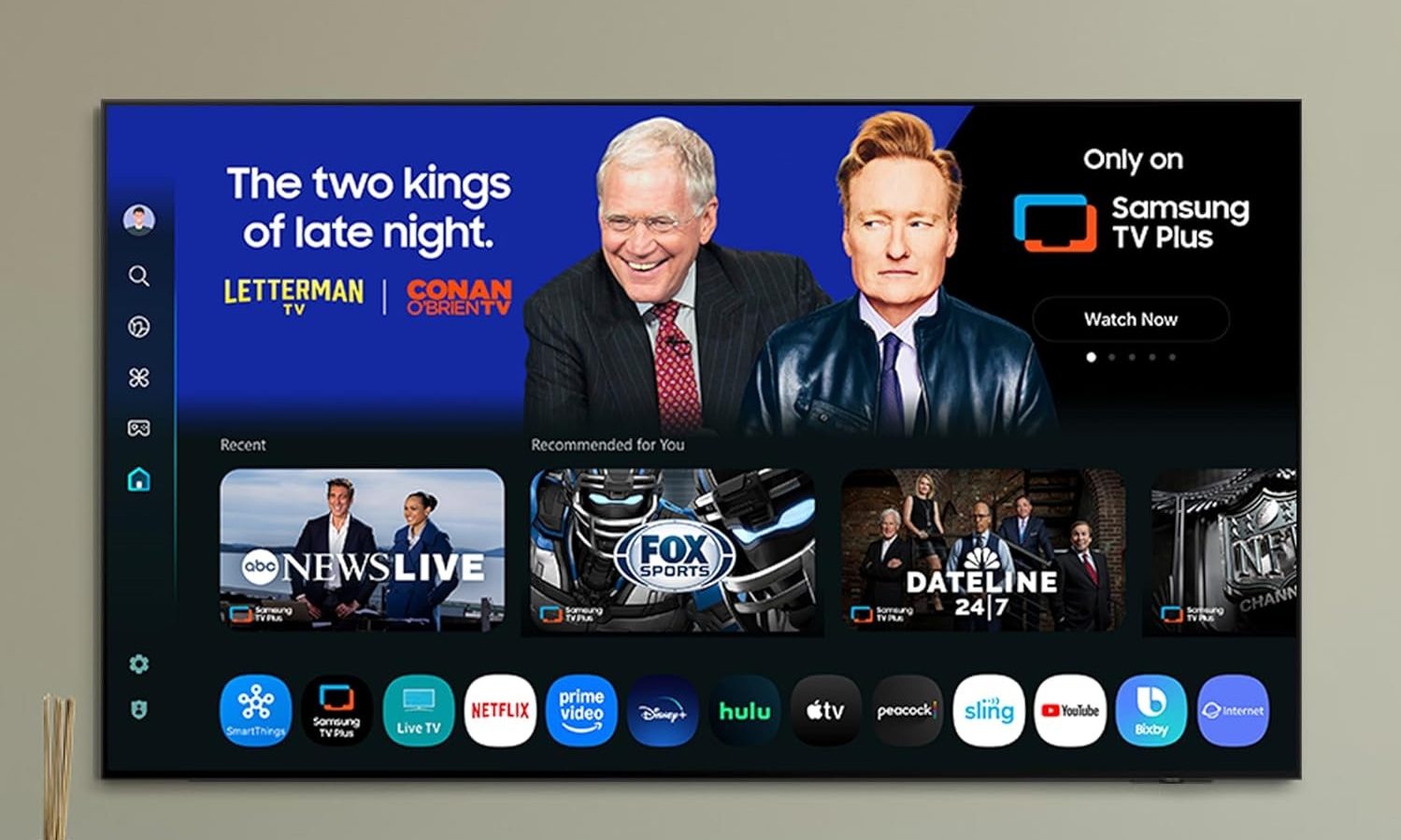
If you want an OLED TV at a friendlier price, the 55-inch Samsung S90F will be right up your alley. It has dropped to around $997.99, down from roughly $1,397.99. That is up to 28% off and a great entry point into premium OLED territory.
This TV runs on Samsung’s NQ4 AI Gen3 processor, which uses 128 neural networks to upscale everything you watch to crisp 4K quality. You get powerful brightness, deep contrast, and smooth motion for tear-free gaming at up to 4K 144Hz.
It can also transform SDR content to HDR-like quality with brighter highlights and more vibrant colors. If you want vibrant colors and inky blacks for mixed use and gaming, this one is a steal.
Pros
Cons
Excellent at 4K upscaling.
Audio quality is not up to par.
Runs on powerful NQ4 AI Gen3 processor.
The reflection handling could be better.
Supports smooth 144Hz lag-free gaming.
Produces vibrant colors.

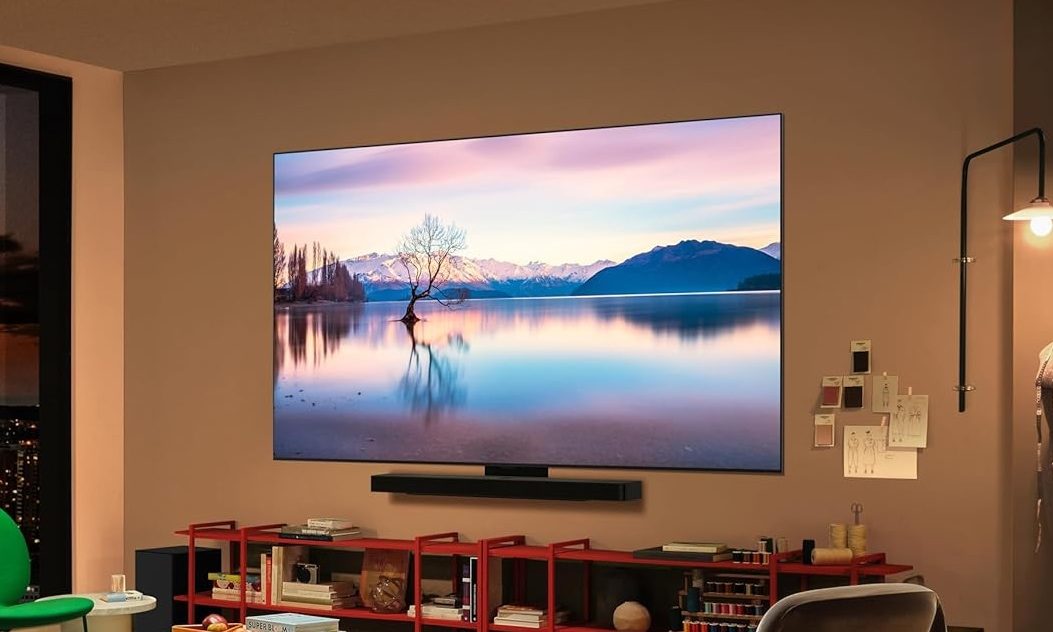
The Samsung Frame is for those who want their TV to double as a piece of art. This 65-inch model has dropped to around $697.99, down from roughly $1,097.99, which is about 36% off.
When you are not watching, the Frame transforms into art with its matte, glare-free screen that makes digital paintings look like real prints. You can upload your own photos or pick from a curated collection in the Art Store, and customizable bezels let you match it to your decor.
The slim design mounts flush to the wall, and an external hub connects the TV to power and your devices with a single wire, so you don’t have to deal with messy cables. I have a Samsung Frame TV in my bedroom (a different model), and let me tell you, it looks far better than your regular TVs.
Pros
Cons
Matte screen kills glare beautifully.
Weaker viewing angles.
Doubles as beautiful wall art.
You don’t get as deep blacks as on OLED TVs.
Slim, single-cable flush mount.
Solid 4K QLED picture quality.

If you are shopping on a budget, the TCL QM7K is the deal for you. This 65-inch Mini-LED QLED has dropped to $498.99, down from $649.99, which is about 23% off and lands it under $500, which makes it a bargain in TV territory.
TCL’s QD-Mini LED combines the best of QLED and OLED tech, with up to 2500 precise local dimming zones for dark black levels. The high HDR brightness gives you a great picture in any room, and the CrystGlow HVA panel blocks reflections so your image stays crisp and visible.
Then there’s TCL’s Halo Control System working behind the scenes to deliver clean, halo-free images without that distracting glow around bright objects. With Google TV baked in, this is incredible value for the money.
Pros
Cons
Outstanding peak HDR brightness.
Narrow off-angle viewing.
Excellent 144Hz gaming capabilities.
Noticeable screen glare/reflections.
Effective backlight blooming control.
Audio lacks strong bass.
Premium feel, mid-tier price.

No best TV list can be complete without a Sony Bravia, and the one we are featuring on this list is the Sony X90L BRAVIA XR. The TV has an MSRP of $1398. But this Prime Day, the TV is getting a massive price cut, going down to $1198, giving you a savings of $200.
As for features, it hits all the right notes. It packs a 4K OLED panel with over 8 million self-lit pixels that are precisely controlled to deliver pure blacks with high brightness, while the XR Processor enhances every scene in real time, boosting color, contrast, and clarity on the fly.
One of my favorite features of this TV is the Studio Calibrated Picture mode, which ensures you watch your favorite movies just the way the creator intended.
Pros
Cons
Superb 4K picture quality.
Competitive models are cheaper.
Wonderfully natural color reproduction.
Prone to aggressive brightness limiting.
Excellent motion handling processing.
Loud immersive built-in audio.
It really comes down to your budget and what you want from your TV. If money is no object, the LG C5 OLED and the Sony Bravia are the clear winners. If you want OLED quality at affordable pricing, the Samsung S90F is a brilliant pick. The Samsung Frame is for the design lovers, while the TCL QM7K is the budget champion that doesn’t skimp on picture quality.
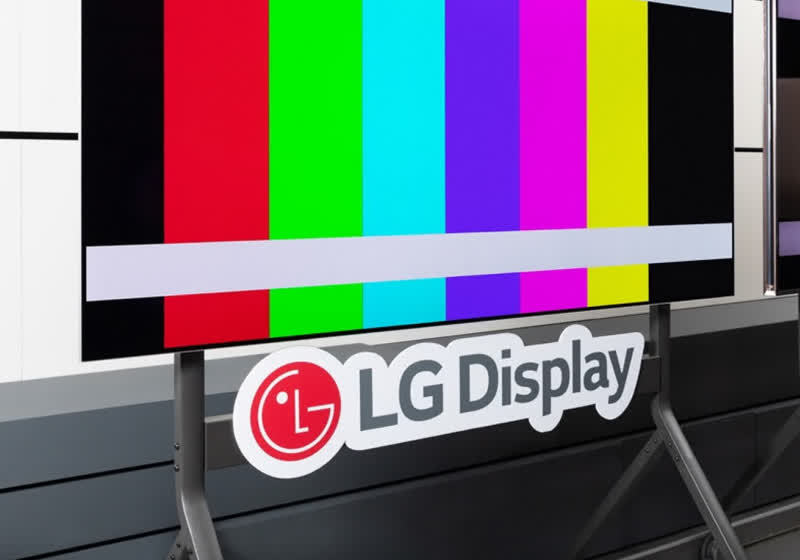
LG Display recently announced that its OLED panels can accurately reproduce colors and brightness levels as content creators intended. The Korean manufacturer is the first company to pass a new Intertek certification program, and says it will use the achievement to better communicate the benefits of its display technology to…
Read Entire Article
Source link




Weekend Open Thread: Miami – Corporette.com


Renter of Home in Anne Heche Crash Denies Settlement With Son


Microsoft accidentally kills epic Outlook email threads


Soccer-U.S. defends Iran World Cup travel restrictions, says discussions ongoing

Two goals and an assist by sheer aura: Cristiano Ronaldo just entered the World Cup chat
Bitcoin (BTC) Dips Below $62K, Ethereum (ETH) Plunges 6% Daily: Market Watch


BBC Reporter Discusses Cross Party Criticism Of Trumps Iran Deal

Wall Street Week Ahead: Investors see Micron earnings as pulse check of AI rally momentum
Entergy settles forward sale agreements, raises $672 million in cash proceeds


Andy Burnham and the meaning of Makerfield


AWS enters the context layer race with a graph that learns from agents, not manual curation

Can Charles Hoskinson Really Rescue Cardano?


HIVE shares jump as $220M AI deal speeds Bitcoin mining pivot


Jake Chervinsky accuses CME of protecting derivatives monopoly


Keir Starmer Allies Question His Chances For No 10

Nearly 7,000 fake Amazon domains registered ahead of Prime Day 2026, researchers warn


Brexit cost 6% of UK economy, Bank of England company data suggests


FIFA World Cup 2026: Canada beat 9-men Qatar 6-0 to register first ever win | FIFA World Cup 2026

Signal’s Meredith Whittaker says AI chatbots ‘are not your friends’ and calls Copilot agents a backdoor


Jose Alvarado Wants Taylor Swift at More Knicks Games


You must be logged in to post a comment Login