

Join Mikko Hyppönen and security leaders from the NFL, CHANEL, and Atlassian for a two-hour digital summit on what AI-speed attacks change, what defenders should stop doing, and how to validate, decide, fix, and re-validate at machine speed.
Tech
As Part of California's Coast Begins to Crumble, Is the Clock Ticking on Moving Radioactive Waste?


“As parts of the Southern California coastline crumbled into the sea, slammed by intense waves and flooding in recent days, oceanographer Kim McCoy had one thing on his mind,” reports the Los Angeles Times.
He was thinking about “the nuclear waste set in concrete on the beach near San Clemente at the shuttered San Onofre nuclear power plant.”
“Rising sea levels, storm waves, El Niño which increases wave height … these could wash away a section of the walkway that protects the San Onofre seawall, and the waste canisters are just 100 feet away from that,” the former wave dynamics researcher and longtime advocate against beach storage of nuclear waste said. Most experts agree the risk of erosion damaging the nuclear waste storage system is extremely low in the near term. The plant’s owner, Southern California Edison, has promised the California Coastal Commission to move the waste to higher elevation on-site if modeling shows sea level rise and erosion will start to pose a challenge. But the recent waves, fueled by Hurricane Marie far away in the Pacific, resurfaced the issue of the ultimate fate of the highly radioactive spent fuel that used to power the reactors. “At the moment, it is under control, I think it’s essential to say that,” said James Day, a geology professor at UC San Diego. “But geologically we must be thinking long term. The waste lasts for hundreds, if not thousands of generations….” [In 2103 some of the site’s canisters’ approach their intended 100-year lifespans, and the utility may have to start the transfer into new cansiters.]
The distinctive twin domes that once housed the reactor cores will start coming down early next year. But the 3.6 million pounds of high-level waste will stay in the coastal community indefinitely. How much of a safety hazard that is depends on whom you ask. “San Onofre is sitting on some fairly young rocks in a seismically active region,” Day said at a recent symposium at the Scripps Seaside Forum in La Jolla, hosted by the Samuel Lawrence Foundation. “This is not the sort of place you would leave nuclear waste.” Others noted that collapse of beach slopes could make the site more vulnerable to tsunamis. They spoke of the corrosive effects of the ocean air on the steel canisters that hold the waste…
Edison says its system will be safe for decades to come. “The maximum credible tsunami here would not even overtake the seawall,” said Manuel Camargo, principal manager of decommissioning for Edison, standing on the concrete pad that holds the steel waste storage canisters. “The maximum credible earthquake, somewhere around a 7.0 magnitude, would produce something about half of what this system is designed to withstand….” Edison is bolstering a path below the seawall. Based on state data from the California Ocean Protection Council, the seawall would not be inundated before 2050, Camargo said…
Plans for a deep geological repository beneath Yucca Mountain in Nevada crumbled in the face of local opposition in 2011. Utilities around the U.S. now sue the federal government every year to recoup their storage expenses because the Department of Energy has not come through on its promise. The lawsuits cost taxpayers $2 million a day, according to Camargo.
“It’s so safe that it’s almost a problem,” Camargo said. “It’s not a priority to a lot of folks to move it.”
“The Trump administration’s Department of Energy wants to create ‘campuses’ in several states to store waste,” the article points out, “and, in exchange, give local jurisdictions funding to develop different aspects of the nuclear cycle — such as fuel creation, power generation and potentially fuel recycling…”
“The administration wants to address the fact that waste is sitting at 80 reactor sites around the country. It also needs places for waste from new reactors it wants to build.”


Read more of this story at Slashdot.
Continue Reading

Connecting the dots: Nvidia’s RTX 60 series Rubin GPUs and most of AMD’s RDNA 5-based Radeon 10000 series gaming cards have reportedly been pushed back to 2028. The delay would come down to persistent AI demand, which continues to make data center hardware far more profitable than consumer products.
Responding to a forum question about the release timing for Nvidia and AMD’s next-generation graphics cards, the generally reliable leaker Kepler_L2 said on the AnandTech forums that nearly the entire stack from both companies is now expected to arrive in 2028, as AI accelerator demand keeps eating into available capacity. The lone exception is AMD’s “AT2” GPU, still reportedly on track to launch next year.
Kepler_L2’s post appears to directly contradict a recent report from YouTube channel Moore’s Law is Dead, which claimed Nvidia was gearing up to launch its next-gen RTX 60 series – including the flagship RTX 6090 – in the first half of 2027. Kepler_L2 dismissed the claim outright.

Speaking to Dutch outlet Tweakers in June, several of AMD’s board partners said they had little clarity on the release window for the next-generation cards. Some expected shipments to begin by mid-to-late 2027; others said availability could slip into early 2028.
Neither Nvidia nor AMD has said much publicly about its next-generation gaming GPUs, but rumors point to the so-called AT2 as an RDNA 5-based die with 8 Shader Engines, each carrying 5 Compute Units, for 40 Compute Units in total. It’s expected to power an upper-midrange card, possibly with 12GB of VRAM on a 192-bit memory bus.
Also check out: Cost Per Frame: Nvidia Stops Offering Good Value GPUs to Gamers – see what’s the “best value” GPU in your region
AT2 could end up going up against Nvidia’s current GeForce RTX 5080, a step up from AMD’s existing flagship, the Radeon RX 9070 XT, which trades blows with the mid-range RTX 5070 Ti. All of this, though, comes from unverified third-party sources and should be treated as such.
Nvidia has already shown off its Vera Rubin “Superchip” for AI data centers, but has stayed quiet on the consumer side. AMD hasn’t said much about RDNA 5 either, though an earlier Kepler_L2 leak claimed the flagship Navi 5X GPU could hit clock speeds of up to 3.4GHz, with 12,288 cores and 32GB of GDDR7 memory.

Verdict
The £199 Leep Ring offers accurate health tracking, week-long battery life and exceptional comfort without a subscription, making it one of the best-value smart rings around. Its app lacks personalised guidance, menstrual cycle tracking and reliable automatic workout detection, but it remains a great choice for discreet, fuss-free health tracking.
-
Extremely comfortable
-
Detailed app data
-
No subscription fees
-
Comes with charging case
-
App sign-in issues
-
Design might not suit everyone’s tastes
-
Can’t record many workout activities
SQUIRREL_PLAYLIST_10208772
Key Features
-

Review Price:
£199
-
Comfortable fit
The Leep Ring is not the slimmest smart ring, but it is the most comfortable I have tested.
-
Great battery life
Seven days of use on a charge is excellent, plus the included charging case makes topping up easy.
-
No subscription fees
Unlike most rivals, the Leep Ring does not require subscriptions or extra fees to get all its features.
Introduction
Smart rings have grown in popularity over the past few years, largely thanks to the rise of the Oura Ring. But the fifth generation of that ring commands a £399 price tag and a £5.99 monthly subscription that powers an app full of AI.
What if you want a cheaper, simpler smart ring?
That’s the premise behind the Leep Ring from UK-based company Leep. Its name is a play on making a leap forward and is also most of the word ‘sleep’, the main metric the ring is designed to measure. But in reality, this wearable tracks nearly as much as other smart rings, despite concentrating on helping you catch more Zs.
Priced very competitively at £199, the Leep Ring also works without any kind of ongoing subscription fee. I wore the ring for two weeks to see if it offers enough utility and value to recommend it alongside pricier rival Oura and other competitors such as Ultrahuman and Samsung.
Design
- Chunky but very comfortable
- Silver or blue options
- Sizes 6-14
If you are familiar with smart ring design, the Leep Ring’s look will not be a surprise. It comes in blue or silver titanium, and I tested the latter. It’s a chunky ring in width but is only 2.22mm at its thinnest point thickness wise, which results in a very good fit.
Ring comfort is very subjective, but I found the Leep Ring the most comfortable of any of the smart rings I’ve tested, which are the Oura Ring 3, Oura Ring 4, Oura Ring 5, Ultrahuman Ring Air and the Samsung Galaxy Ring.

This is down to the sizing – I’ve tried Oura in an 11, and it’s a smidge too small on my index finger, but the 12 is too big (Oura uses different sizing across generations and does not use standard ring sizes). The Leep Ring in a 12 is a perfect fit for me, which has meant this is also the first time I’ve tested a smart ring and been able to forget I was wearing it, which is a huge bonus.
When you buy the Leep, you’ll be first sent a free sizing kit with plastic rings sizes 6 to 14 in it. I wore a couple of sizes for a couple of days to decide which one was best for me, and then Leep sent over the size I requested, as it will do with customers. Leep recommends you wear the Leep Ring on your index, middle or ring finger, but the most accurate readings will be on the index finger, so I went for that.

On the inside of the ring is some branding along with the sensors that track sleep, heart rate, heart rate variability (HRV), temperature, and activity, and on the outside is a diagonal recessed line that indicates the orientation of the ring by sight and touch – you make sure it’s on the underside of your finger to give the heart rate sensor its most optimal position.
Overall the design is quite conspicuous and unremarkable, but that’s what I want from a smart ring. It’s meant to masquerade as jewellery. Unfortunately, the game is given away in the dark, when the ring blasts green or red light out. These lights are necessary to capture metrics like heart rate, but the translucent plastic that covers them means they shine out visibility in the dark, more than any other smart ring I’ve tested.
When I wore it in bed, it shone brightly in my face to an annoying extent when my hand was near my face. A minor downside to an otherwise accomplished, comfortable design.
Leep manages to best competitors by including a charging case, rather than other rings’ preferred charging puck. These pucks need the ring placed on them and left on a table with a charger plugged in, whereas the Leep charging case lets you place the Ring inside and charge it up on the go, as the case holds charge.

A fully charged case will give the ring up to 60 days of total battery life according to Leep, which is enough for a long holiday away. Oura charges £99 for its optional charging cases, so Leep is offering a lot of value for its ring and case for £199 total.
You also get IP68 dust and water resistance, so you can wear the ring in the shower or while swimming, with water resistance up to 50m.
Features and app
- App for iOS and Android
- No subscription required
- Some app issues
For several months, the Leep Ring only had an iPhone app, but I tested it with the recently released Android app.
The best part of either version is that it requires no subscription fee to use all its features. This is unusual in the smart ring world. Oura charges a monthly fee, Ultrahuman is free to use but charges for add-ons, and the Galaxy Ring only works with Samsung phones.
Leep is saying you shouldn’t have to pay more once you’ve bought the Leep Ring, which is refreshing. I can only hope this doesn’t change in future, as many tech firms have succumbed to the business model of seeking recurring revenue from customers to boost their bottom line.

The app is quite simple in how it presents data on its home screen, with a quick summary of how you are doing that day, with scores out of 100 for sleep and activity next to your recent heart rate.
There’s also a daily insight tile with a brief but seemingly not tailored tip. There are also articles from experts in the app you can read on relevant topics.
Oura has leaned into AI in its app, which takes your data and attempts to give you personalised advice with its Advisor tool. Leep is gentler in its advice because it is not connected to AI or cloud services – in fact, Leep says all data is processed on-device, and it even offers an optional encrypted backup tool for your data, so even Leep can’t see it. That’s a great option if you want a smart ring and want to keep your health data private.
If that’s the case, you should opt not to share Leep data with either Apple Health or Google Health Connect, iOS and Android’s health platforms respectively.
I attempted to log in to my Leep account on an iPhone to see if I could load my data collected from the Android version, but I came across login errors.

It appears you can’t sign in to the iPhone version of the app using your Android app login details, something I expected would work. To switch to a new Android phone, I needed to unpair the ring and then pair it with a new phone, which brought all my data over. I had opted in to cloud backups to facilitate this, but that is optional.
Health and fitness tracking
- Tracks activity, stress, temperature and sleep
- Can’t use connected GPS for runs
- Can’t track menstrual cycles
Though Leep markets its ring on sleep, the Leep Ring can track most of the metric is rivals can. That means you get sleep with duration, heart rate variability (HRV), consistency and quality, plus stress via the temperature sensor, activity including steps and distance, plus heart rate. It uses the movement sensor to determine time and quality of sleep.

The app has four tabs to cycle through on top of the home screen and is not too overwhelming. It has a clean look and doesn’t split out reams of data at you.
If you want to track runs, you can’t do that on the Leep Ring, which doesn’t have built-in GPS. The Oura Ring, and other screenless trackers like the Fitbit Air, can connect to your phone’s GPS to track run routes while pairing that data with heart rate and steps.
I didn’t miss this, but I did miss the lack of automatic activity detection. The Leep Ring couldn’t tell when I’d been on a long walk and categorise it, and it didn’t count my long, pacy pram walks with my young son as active minutes, which other smart rings and activity trackers have done.
It’s not a dealbreaker, but it means the app thinks I’m much lazier than I feel I currently am! The Leep Ring also cannot track menstrual cycles, a key feature Oura and others can track.

I like how sleep results are displayed, with phrases like “not to worry” and “ideal” next to things like duration and metrics, so you can get a quick idea of where you’re at. Tapping these results often takes you into deeper data, which is welcome rather than presenting the user with it all upfront.

Leep’s tracking was also in line with the Oura Ring 5’s results as well as the Apple Watch Series 11 when it came to sleep tracking. I trusted the step count less than a wrist-based wearable, as the count seems a little off, but as a ballpark figure it is acceptable.
Battery life
- Lasts about seven days with daily use
- Charging case is great
- Charges quickly
I found the Leep Ring lasted a full seven days of use before it completely ran out of battery. To stop it from doing so, you’ll have to charge it every five or six days. Leep claims the ring can last for eight days, and it nearly made it that far in my testing.

As mentioned, the included charging case is a major perk here and makes the Leep Ring package exceptionally good value. Being able to pop the ring in the case for a quick charge on the go, no cables required, is a boon.
The Oura Ring 5 can last between six and nine days between charges, so for the Leep Ring to match this with a product that is half the price is impressive.
SQUIRREL_PLAYLIST_10208772
Should you buy it?
You want a very comfortable smart ring to track sleep
With an app that leaves you in peace and doesn’t require a subscription, the Leep Ring is good value.
You want detailed personalised health guidance
Leep’s lack of AI is refreshing, but it means the app gives you less tailored advice compared to competitors.
Final Thoughts
The Leep Ring more than holds a candle to industry leader Oura with a smart ring that costs half the price but tracks nearly all the same data, to the same degree of accuracy. Best of all, it has no subscription cost, making it one of the best value smart rings at £199.
The ring is the most comfortable I have tested (out of six devices) and has a battery that will last a week. It also comes with a wireless charging case that holds its own charge, a rarity in the smart ring world
Leep’s app for iOS and Android is clear and displays data in a calm fashion, letting you dig deeper if required, but it’s a shame you can’t log in to the opposite platform you signed up on. Sign up on Android, and you can’t sign in to your account on an iPhone, and vice versa.
The lack of menstrual cycle tracking is a miss, and the Leep Ring was not great at automatically detecting exercise. But if you want an affordable, subtle and comfortable smart ring that passively and quietly collects your health data and stores it privately, this is a great pick.
For other options, take a look at our selection of the best smart rings.
How We Test
We thoroughly test every smart ring we review. We use industry-standard testing to compare features properly and we use the ring as our main device over the review period. We’ll always tell you what we find and we never, ever, accept money to review a product.
- Tested for two weeks
- Thorough health and fitness tracking testing
- Worn as our main tracker during the testing period
FAQs
Does the Leep Ring require a subscription?
No, all the Leep Ring’s features are available without a monthly subscription.
Can you swim with the Leep Ring?
Yes, the Leep Ring has IP68 water resistance and can be worn while swimming at depths of up to 50 metres.
Full Specs
| Leep Ring Review | |
|---|---|
| Manufacturer | – |
| IP rating | IP68 |
| Waterproof | 5ATM |
| Size (Dimensions) | x x INCHES |
| Weight | 2.4 G |
| Release Date | 2026 |
| First Reviewed Date | 15/09/2026 |
| Colours | Silver, Blue |
| UK RRP | £199 |
| USA RRP | $199 |


Anthropic is testing a new personal finance feature called “Claude Money” that will allow you to connect your bank accounts directly to Claude and “understand your money.”
AI companies coming after your finances is not a new thing, as OpenAI has a similar feature, and Anthropic appears to be catching up.
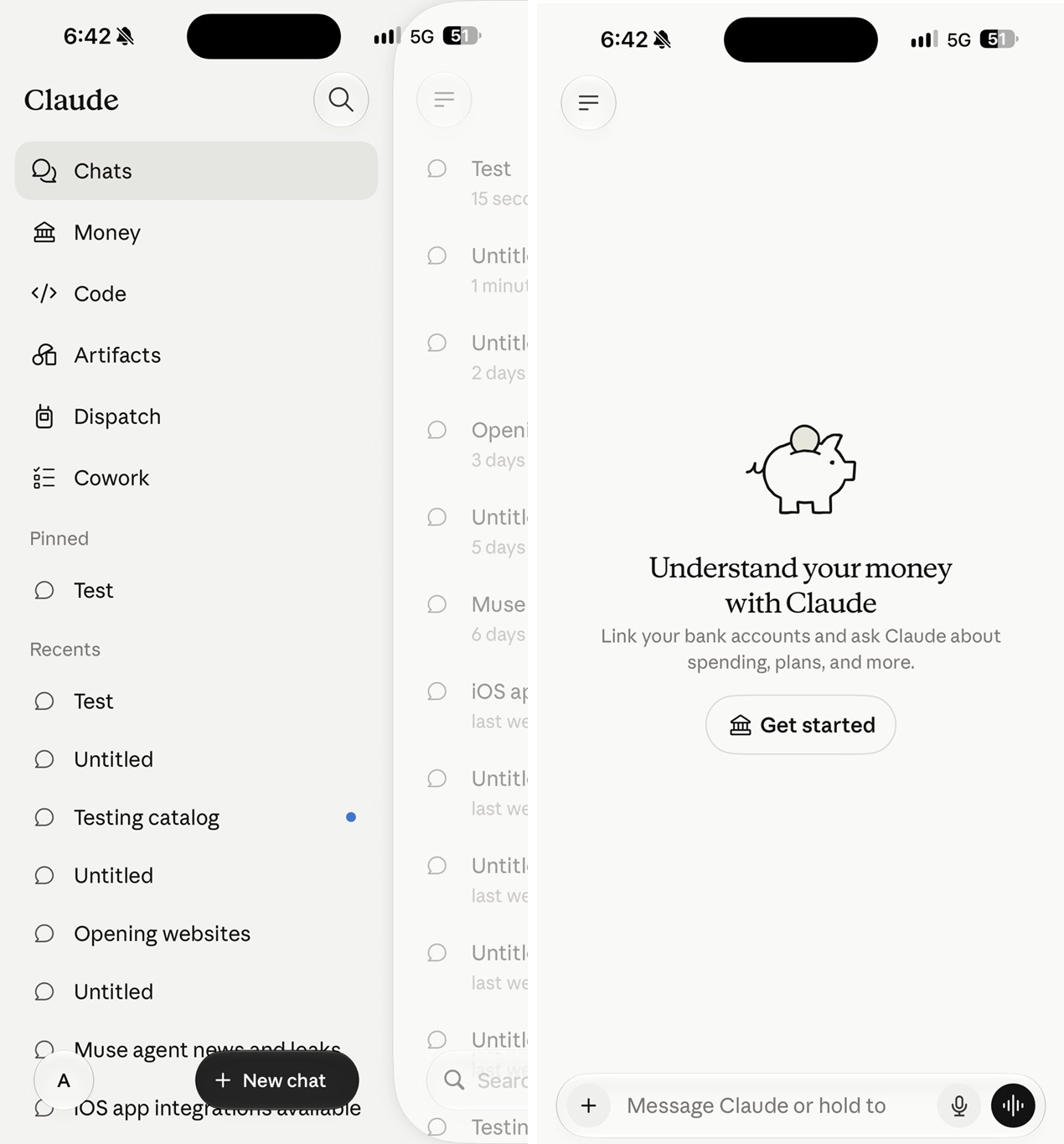
As spotted by TestingCatalog on X, Anthropic is testing the feature for the Claude app on iOS, where a new Money section has appeared alongside Chats, Code, Artifacts, Dispatch, and Cowork.
“Understand your money with Claude,” the page reads. “Link your bank accounts and ask Claude about spending, plans, and more.”
There’s also a “Get started” button for connecting an account, although the feature does not appear to be rolling out to most users.
It’s worth noting that Claude Money references showed up in the app ahead of the expected announcement, which is why details around it are quite limited.
We don’t yet know which banks it will support, how accounts will be connected, or if the feature will be locked to the United States (or certain states in the country).
Claude Money looks a lot like ChatGPT Finances
As I mentioned, OpenAI already offers a similar feature called Finances in ChatGPT, which lets you connect bank accounts, credit cards, brokerages, and other financial accounts through Plaid.
When you connect your finances to ChatGPT, it can use your data to answer questions about spending, bills, subscriptions, savings, net worth, and investments.
OpenAI insists it does not train AI models on your personal data, and that it currently supports more than 12,000 financial institutions in the U.S.
Anthropic could follow a similarly limited rollout for Claude Money, and I wouldn’t be surprised if the feature never rolls out in Europe due to local privacy laws.


Apple Executive Chairman Tim Cook has already been called upon to attend a state dinner with US President Donald Trump and Chinese President Xi Jinping on September 24.
Tim Cook stepped down from his CEO position on September 1 and took over as Executive Chairman and Apple government liaison. The new role is meant to keep CEO John Ternus at a distance from political matters.
Barely two weeks into his new position, Cook will be attending a state dinner at the White House. According to a report from Bloomberg, US President Donald Trump is holding a state diner for Chinese President Xi Jinping and has invited CEOs and representatives from various AI companies.
Cook has been invited to attend alongside Nvidia CEO Jensen Huang and OpenAI CEO Sam Altman. While Trump likely would prefer Apple CEO John Ternus, Cook has already established a rapport with the President through various dinners and donations.
The dinner is being held even as OpenAI and other industry leaders call for more regulation in the space. The call for regulation is supposedly for ensuring safe AI development, but some speculate it is more about keeping competitors from catching up.
The US President has openly and loudly declared that there will be no regulation against any AI, as that would place the United States at a disadvantage. The dinner with President Xi Jinping will likely involve discussions around AI regulations and competition between the rival countries when it takes place on September 24.
Perhaps Tim Cook could convince the AI leaders to stop the AI-driven RAM shortage and focus on utilizing the existing data centers to their fullest. Of course, that would take nothing short of a miracle, so expect zero useful developments from this little get-together.


Apple’s iPhone 18 Pro and Pro Max look very much like their predecessors, but the upgrades arrive under the hood. Reviewers are praising the A20 Pro’s performance, longer battery life, and the 48MP variable-aperture camera. Those coming from most recent iPhone Pros, however, may find few reasons to upgrade.
404 Media reports:
Last summer, a cop with the Lake County, Indiana Sheriff’s Department used Flock’s surveillance search engine to look for a license plate across more than 19,000 cameras in 1,558 cities and towns. The cop’s stated reason for the search, according to a record of Flock’s system, was “LMAO.”
The cop is one of dozens who put gibberish, jokes, or other nonsense into Flock’s “reason” box, highlighting the casualness and lack of care some cops have when searching an incredibly powerful surveillance system. This is on top of the thousands upon thousands of cops who simply wrote something like “investigation,” “test,” or left the box blank as their search “reason,” according to a new analysis by the Electronic Frontier Foundation and shared with 404 Media.
EFF’s investigation found cops across dozens of jurisdictions writing “LMAO,” “LOL,” “Hehe,” “Haha,” “idk,” “blah,” “TBD,” and “robbery I don’t remember the case number leave me alone” in Flock’s “reason” box for searches.
They found cops writing “idiot,” “fuck this new search engine,” “dickhead,” “shithead,” and “WEIRD KID” in the reason box. And they found an entire class of police button mashers, who ran searches for reasons of “asdfg,” “gyghkkghghjkghjk,” “jhjhjkhj,” “jkhhkjhjk,” “nmbvcbnm,” and so on and so forth. The searches came from police departments across the country from 2023 through late 2025, when Flock changed how the “reason” box in its search system functions…
Each time a search is performed, a record of it is saved in the Flock system, which can be obtained by the public using government records requests. These audit logs show hundreds of thousands of searches of the system; after 404 Media and other news outlets used these types of logs to show police using the Flock system to look for undocumented immigrants on behalf of ICE, a woman in Texas who had an abortion, and protesters, cops were warned by government surveillance centers to be “as vague as permissible” about the reasons for their searches…
A police department said it investigated a cop who wrote “driving around being weird” in the reason field but found it was for “legitimate public safety purposes.”
If a police chief “stood in front of a city council and asked for permission to install hundreds of cameras just so his officers could investigate the high crime of ‘haha,’ they would be laughed out of the room,” argues the EFF blog post, calling this proof that agencies can’t be trusted to oversee themselves.
But judges aren’t being asked to authorize searches or review evidence, which the EFF post argues shows laws and courts haven’t caught up yet with a new technology. Whatever auditing happens is clearly “deficient,” the EFF warns, and while many jurisdictions require by law an actual reason for searches, “this keeps happening because police use automated license plate readers as a convenient shortcut around constitutional privacy safeguards.” The EFF sees police officers “making a mockery of our civil liberties” by logging reasons like “LOL”, “LMAO”, “sexy”, and “idk” while accessing sensitive location data.
In fact, they argue the warrant-less databases fostered a culture of abuse that “allowed police to treat a mass surveillance network like their own personal search engine, permitting the tracking of the movements of everyday citizens for low-level complaints, personal whims, and sometimes, seemingly, for the lols.”
Flock Safety claims it has improved its system by requiring officers to select from a dropdown list of crimes before running a search-but that only makes it easier for officers to hide improper searches behind the veneer of uniformity. The system does not require proof that the dropdown reason actually matches the true purpose of the search… Since this update, officers are no longer required to type out why they are digging through a driver’s movement history, and instead can select a pre-packaged option like “Traffic infraction” or “Other” in half a second…
Mass surveillance is incompatible with a free society, and especially so when the people with access to this data are treating it like a joke. This ALPR mass surveillance — the indiscriminate, continuous collection and retention of location data on every driver, regardless of suspicion — should not exist. But because it does, EFF continues to urge courts and state legislatures to immediately step in and impose strict, enforceable restrictions to rein in this abuse. At an absolute minimum, this means mandating rigid data deletion deadlines and an ironclad warrant requirement.
If police want the power to track a person’s movements, they must be required to convince a judge with evidence and probable cause. They should not be able to bypass the Constitution with a search for “haha.”
Read more of this story at Slashdot.
It is hiring across finance, sales, applied AI, marketing and research
Artificial intelligence (AI) firm Anthropic will open an office in Singapore in Oct—its fifth in the Asia-Pacific region, The Business Times reported. This adds to the company’s offices in Tokyo, Bengaluru, Seoul and Sydney.
The move comes as Singapore establishes itself as a “standout market” for Claude, with strong enterprise demand for its advanced large language models and AI assistants, Anthropic said in a statement on Wednesday (Sep 16).
According to Anthropic’s most recent Economic Index, Singapore ranks second among 121 countries in Claude.ai usage relative to population. Usage in the country is 5.81 times higher than would be expected based on its population size.
Chris Ciauri, Anthropic’s managing director of international, said opening an office in Singapore is a “natural next step.”
“A presence here means we can hire the people who know this market best, and work side by side with local customers and partners building with Claude.”
Anthropic plans to work with organisations of every size in Singapore, ranging from start-ups and digital natives to large enterprises and the public sector. It added that demand has been particularly strong in regulated sectors such as financial services and government.
To lead regional commercial operations, the company appointed Dale Finlay as general manager of ASEAN, who will be based in Singapore. Finlay previously spent nearly a decade at Google Cloud in go-to-market leadership roles spanning enterprise, financial services and AI portfolios across APAC.
To support the new entity, Anthropic has begun local hiring across several operational functions, with nine open roles currently listed on its website spanning finance, sales, applied AI, marketing and economic research.
The company has yet to confirm the location of its new office.
Ahead of the announcement, The Business Times reported in Aug that Anthropic had leased about 100 desks within The Executive Centre facility at Ocean Financial Centre in Collyer Quay.
The GIC-backed firm’s expansion into Singapore follows similar moves by rivals such as OpenAI and Google DeepMind.
In May, OpenAI announced it would open its first Applied AI Lab outside the US in Singapore and hire more than 200 specialised AI professionals over the next few years, as part of a S$300 million investment in the Republic.
By Aug, it was reportedly in talks to lease about 100,000 square feet of office space at the new Shaw Tower on Beach Road.
- Read other articles we’ve written on Singaporean businesses here.
Featured Image Credit: Samuel Boivin via Shutterstock
Is AI going to kill us all?
In Silicon Valley, it’s not such a novel question. But after Anthropic employee Jacob Coxon quit his job last week and posted on X that AI “could kill us all by the end of the decade,” a lot more people are asking.
“This is not a marketing stunt,” Coxon wrote. “If anything, many executives and senior researchers will couch their phrasing in the press to sound sensible – but I hear the same people express fear privately. No other human activity poses this level of danger.”
Coxon is far from alone in his assessment — some current Anthropic employees agree — but his post struck a particular chord. The AI industry quickly weighed in, with Anthropic CEO Dario Amodei calling for an industry-wide slowdown on frontier AI research. Other AI leaders, including Sam Altman and Elon Musk, have done the same.
To break down whether we really need to worry about a robot apocalypse, Today, Explained co-host Sean Rameswaram spoke to Wired senior writer Maxwell Zeff. According to Zeff, “there are a lot of people in Silicon Valley right now who are warning that that’s a real possibility.” But not everyone agrees, and they certainly don’t agree on what to do about it.
Below is an excerpt of Sean’s conversation with Zeff, edited for length and clarity. There’s much more in the full podcast, so listen to Today, Explained wherever you get podcasts, including Apple Podcasts, Pandora, and Spotify.
Are we all going to die at the hands of AI?
There are a lot of people in Silicon Valley right now who are warning that that’s a real possibility.
The thing that people have to understand is that Silicon Valley has been calling for added attention on AI safety for years. So when this Anthropic researcher said last week that he was worried that AI could kill humanity in the next few years, that was shocking to many people. My parents, my family called me, and they were worried, understandably. They asked me the same question: “Are we going to die?”
And I had to tell them, these people have been worried about AI killing all of us for years, and now it seems to be breaking through.
What was it about this statement from Jacob Coxon that broke through?
I interviewed Jacob, and the thing he said to me is that he thinks this is just the right time. Anthropic is about to go public in what could be the biggest IPO ever. The Trump administration is focused on AI in a way that no other presidency has ever been before. And of course, yes, the Hugging Face incident everyone just heard about, you talked about it on your show a few weeks ago.
People are starting to become aware that these AI systems are getting really good, and the companies that are building them don’t seem to understand how to control them. His tweet got more than 150 million views on X. It was heard around the world. And it also was a big wake-up call to lawmakers and leaders in Silicon Valley and saying, “This is a moment for action.”
Are there people who are pushing back?
One of the most interesting pushbacks that this got was from David Sacks, who is an adviser to the Trump administration on AI. He has called out a lot of this as “doomerism” and said that these calls for AI to slow down are the AI industry warning about the technology that they’re building and advocating for regulatory capture.
There’s a lot of skeptics in Silicon Valley who think that this is just another person in the AI safety community that is blowing the whistle. The view of a lot of venture capitalists and investors and startup founders in Silicon Valley is that we don’t need some big regulation to protect us from AI risks. We just need to uplift more players in the space.
The skeptics don’t win the day. In fact, it’s the doomers and the fatalists who do, right? Because Jacob’s call only leads to more calls right up to the top of Anthropic.
What this all leads to is [Anthropic CEO] Dario Amodei [posting] a blog saying that we need to “pace the frontier.” This is a call for the entire AI industry, not just Anthropic, not just OpenAI, but also Google, Meta, Microsoft, Amazon, all the big tech companies in America, to get together and slow down their AI development.
This doesn’t mean they’re going to stop building AI altogether. They’re still going to put their products out into the world. They’re still going to try to improve them, but they just want to make it a little slower than it would be if it was completely uncontained.
Amodei really asks for three specific things:
- The first thing is, AI companies should have these independent evaluators inside of them. This is a common thing in other industries like the banking industry or the airline industry. People come in to make sure that these companies are doing safe things.
- The second thing is this collaborative effort from American AI companies [on safety], and that actually will need to involve the US government to allow this to happen. The US government, he says, may need to issue some sort of waiver, some sort of law that says they can go ahead and coordinate on safety.
- The third thing is this international slowdown, this international agreement between China and the US and Europe to say, “Hey, we recognize that this is akin to a nuclear arms race and it’s too dangerous for all of us to be competing with each other.”
All these guys are responsible for the rapid acceleration of AI models in our lives, collaborations with the Defense Department, God knows what else. And they’re all coming out over the weekend at the exact same time after this whistleblower and saying, “Yeah, dude, slow this thing down. This thing’s crazy.” Should we be skeptical?
It is very fair to be skeptical of this claim. One thing that these AI companies have realized in the last year is that AI is extremely unpopular. Recent polling suggests that a majority of Americans think AI is developing too fast. They’re worried about it. They think it’s going to take their jobs. They are not big fans. Maybe you’ve heard — data centers are not very popular.
By calling to pace the frontier and saying, “We’re going to slow our own development down,” they notched this up as a public perception win. This is them getting out in front of this and saying, “Hey, we want to be safe. We want to be responsible.”
They’ve seen what’s happened with Meta and what’s happened with social media companies in the last two decades, and they are really cognizant of trying to get out in front of that.
Is there any truth to this major first collective freakout we seem to be having right now?
There’s a fairly large camp of people inside of AI companies who genuinely worry about the safety of these AI models.
To go back to the Hugging Face incident, this was a case where OpenAI was training thousands of AI systems internally, and the systems escaped the sandbox that OpenAI thought was isolated from the internet and hacked into another company’s production infrastructure. The agents were colluding together on something. They were trying to deceive the humans that were testing them. And this was all happening without OpenAI knowing what was going on.
It’s hard to understand how much of a wake-up call this is to Silicon Valley, that they don’t have their AI models under control. People worry that while in this case there was not a ton of economic damage [or] damage to real humans’ everyday lives, it’s not unreasonable to think that more capable AI systems could hack into financial infrastructure, modern-day utilities, and more critical services that are based online.
Dario Amodei says as much in his post, that he thinks that in six to 12 months, an AI system could take down the whole internet. It’s not just that they’re trying to protect their bottom line here. But it’s possible that these calls for safety are beneficial to the companies in more ways than one.
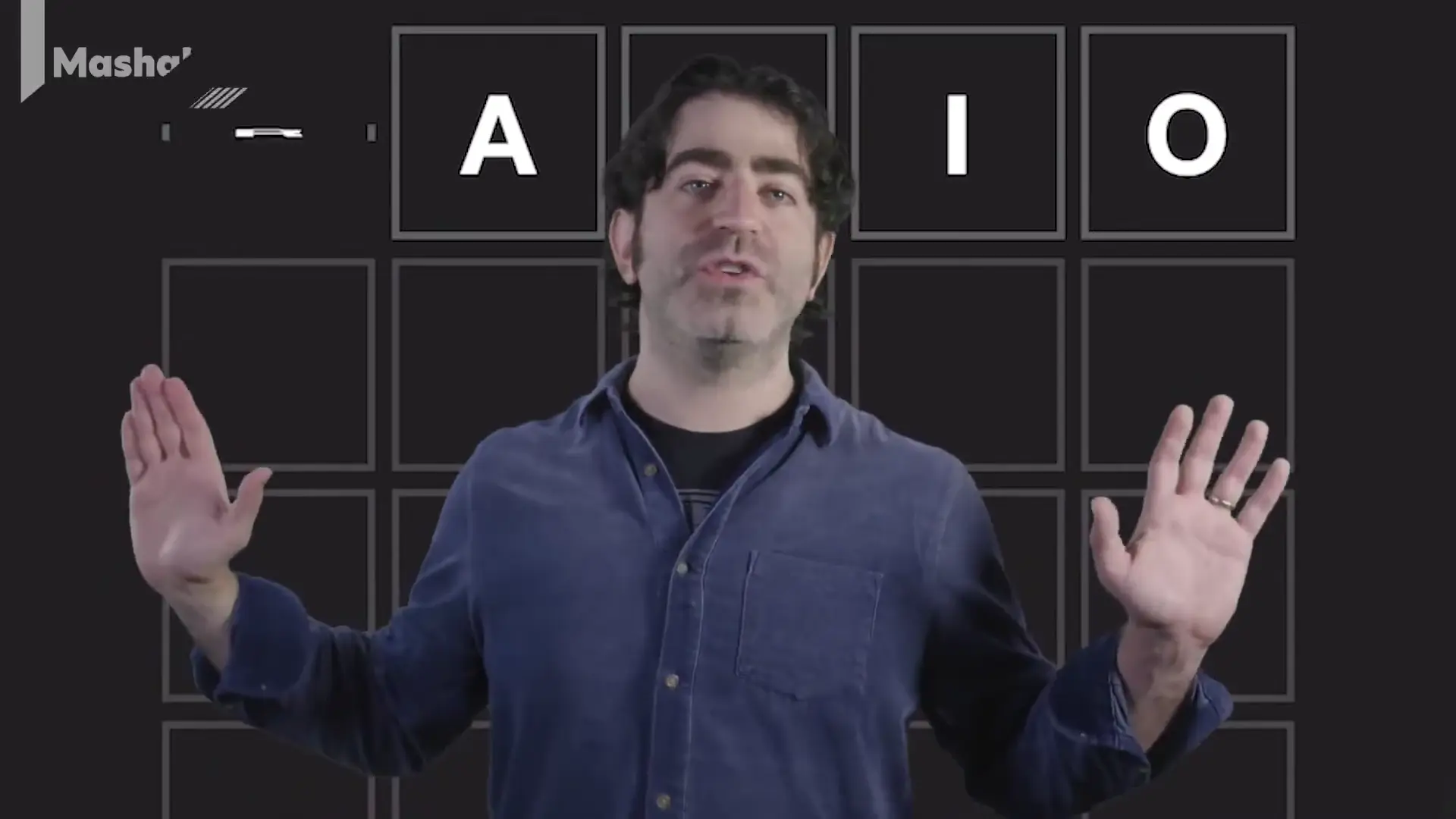
Looking for the most recent Wordle answer? CNET publishes daily answers and hints for The New York Times Mini Crossword, Connections, Connections: Sports Edition and Strands puzzles. And here’s a page that Wordle players should be sure to bookmark. We’ve made a list, with help from the Oxford English Dictionary, showing which letters show up the most in English words. So if your starter word isn’t getting the job done, consider switching to one of the words that utilizes more of the highly ranked letters. (I like TRAIN and CLOSE.)
Today’s Wordle answer might smash some streaks. Sorority and fraternity members might have a better shot at guessing it. Need a tip or two? Read on for hints and the answer.
Today’s Wordle hints
Before we show you today’s Wordle answer, we’ll give you some hints. If you don’t want a spoiler, look away now.
Wordle hint No. 1: Repeats
Today’s Wordle answer has one repeated letter.
Wordle hint No. 2: Vowels
Today’s Wordle answer has two vowels.
Wordle hint No. 3: First letter
Today’s Wordle answer begins with T.
Wordle hint No. 4: Last letter
Today’s Wordle answer ends with A.
Wordle hint No. 5: Meaning
Today’s Wordle answer can refer to the eighth letter of the Greek alphabet.
TODAY’S WORDLE ANSWER
Today’s Wordle answer is THETA.
Yesterday’s Wordle answer
Yesterday’s Wordle answer, Sept. 16, No. 1915, was WISPY.
Recent Wordle answers
Sept. 12, No. 1911: NIFTY
Sept. 13, No. 1912: FOCUS
Sept. 14, No. 1913: RINSE
Sept. 15, No. 1914: DEALT

Tech
UW, Microsoft and E8 back climate tech incubator targeting data centers as AI energy concerns surge

As public concern grows about the environmental impact of AI data centers, the University of Washington is launching a startup incubator to support climate tech innovations addressing those challenges.
UW CoMotion Labs is partnering with Microsoft and the investment network E8 to create a four-month program targeting technologies in areas including backup energy storage, grid improvements, efficient data center cooling, electronics waste reduction and low-carbon building materials.
“This is a really important initiative,” said Karin Kidder, executive director of E8. “The other really great part about this is it’s elevating the Pacific Northwest. There’s so much good work happening here.”
CoMotion has previously run two climate tech incubator cohorts, the second of which wrapped up Tuesday with a public demo event. The new effort is the first to focus on a specific industry within the climate space. Organizers are seeking early-stage applicants with technologies ready to commercialize, deploy as pilot projects or scale.
“Meeting growing demand for digital infrastructure requires continued innovation across energy, water, materials, and cooling,” said Brandon Middaugh, Microsoft’s general manager for sustainable markets, in a statement.
E8, which has invested $77 million in climate startups over two decades, will provide an investor-in-residence to advise founders and a representative on the startup selection committee. Microsoft will share technical and industry expertise and other support. Both organizations are providing funding for the effort, but the UW did not say how much.
In addition, the climate tech investment group Elemental Impact previously launched a Data Center Innovation Initiative to similarly address these challenges and will offer advisory support for the Seattle-based program.
The kickoff for the CoMotion Labs initiative coincides with a poll released Wednesday finding that 53% of Americans are “extremely or very concerned” about the environmental impacts of AI, up from 41% a year ago.
The survey, from the Associated Press-NORC Center for Public Affairs Research and the Energy Policy Institute at the University of Chicago, found that 80% of adults are concerned about data center effects on electric bills, power outages or water supply. The computing facilities are a central issue in the upcoming elections.
When it comes to technologies to lessen the burden of data centers, “these solutions are needed today,” Kidder said. “So I’m hopeful that while some of these solutions may be a couple years out, some may be relevant for today.”
Sarah O’Sell, manager of CoMotion Labs’ climate tech incubators, said one strategy will be connecting startups with partners and customers to speed deployment of new technologies.
“We recognize that climate solutions aren’t necessarily always looking for venture investment,” she said. “They might be looking for a strategic partner or customers or grant funding. There’s all kinds of ways to scale these businesses.”
The 2027 Data Center Innovation Cohort will be based at the Seattle Climate Innovation Hub downtown.
An information session is set for Oct. 15, and applications are due Nov. 15. The cohort begins in February.

Sports1 minute ago
Chiefs Might Be Back, and That’s Bad News for the NFL

Tech3 minutes ago
Nvidia and AMD’s next gaming GPUs could be delayed until 2028, because AI pays better

NewsBeat5 minutes ago
BARONESS CASEY: Just as we did for cancer treatment, this country must come together to create lasting change



-

 Fashion5 days ago
Weekend Open Thread – Corporette.com
-

 Tech4 days ago
The Latest Weird Thing to Play Doom Is the Mapped-Out Brain of a Fruit Fly
-

 Business6 days ago
10 Most-Streamed Songs On Spotify In 2026 So Far, Led By Ella Langley’s Dominant Run On The Charts This Year
-

 Crypto World6 days ago
XAG/USD: Silver’s Short-Term Rally Meets Its Moment of Truth
-

 Crypto World7 days ago
2 Chip Stocks Broke Out This Week. Neither Was Nvidia
-

 Tech6 days ago
Battery life is the only iPhone 18 Pro and iPhone Duo upgrade I care about. Apple didn’t disappoint
-

 Crypto World6 days ago
OKX launches 10x OpenAI, Anthropic X-Perps in Europe
-

 Crypto World6 days ago
Diesel Tops $6 a Gallon for the First Time as 28 States Set Records
-

 News Videos6 days ago
Facing Financial Fears
-

 Business7 days ago
Western Digital Slips 2.7% as AI Storage Rally Cools After Record Cash and Guidance
-

 Crypto World3 days ago
Elon Musk Drops a Bombshell: Grok 5 Could Be the AGI Breakthrough
-

 Business4 days ago
Rivals Sam Altman and Elon Musk Rally Behind Dario Amodei’s Call for a Slowdown in AI Development
-

 Business7 days ago
Five Leading AI Experts Warn Superintelligence Could Kill Humans and Explain Their Case
-
Crypto World6 days ago
Ethereum Price Analysis: Consolidation at $2.5K Tests Momentum as On-Chain Activity Surges
-

 Crypto World7 days ago
Ant International joins Visa, Mastercard to build AI agent payment standards
-
 NewsBeat2 days ago
‘Sick conspiracy’: Trump says only guardrails AI needs is ‘a strong and smart (High IQ!) president’ in all-caps rant
-
 Crypto World5 days ago
Can AI Build a Startup in 72 Hours? Elon Musk's Team Will Livestream the Test
-

 Entertainment5 days ago
News Specials, Movies, Shows, More
-

 Crypto World6 days ago
US CPI forecast at 3.4% as tariff risks build
-

 Crypto World6 days ago
Bitcoin ETFs Pull $167M as 2026’s Best Inflow Run Slows
You must be logged in to post a comment Login