Security teams log 54% of successful attacks and alert on just 14%. The rest move through your environment unseen.
The Picus whitepaper shows how breach and attack simulation tests your SIEM and EDR rules so threats stop slipping by detection.





Australian energy provider Origin Energy has confirmed a data breach by an unknown threat actor that exposed customers’ personally identifiable information (PII).
The company has 4.8 million customers and is currently investigating how many of them have been impacted to inform them of the risk via individual notifications.
Origin Energy is Australia’s largest energy retailer, providing electricity, natural gas, and broadband internet services to millions of clients across the country.

The company is listed on the ASX, has annual revenue of $8.5 billion, and holds a 20% ownership stake in the UK’s renewable energy retailer Octopus.
Yesterday, Origin announced that it had launched an investigation into “a potential security incident that may involve unauthorized access to some customers’ data.”
An update published today confirms a data breach, listing the following data types as potentially exposed:
The company noted that the exposed financial details are “incomplete” and cannot be used to hijack accounts or make unauthorized charges to clients’ bank accounts.
Origin CEO, Frank Calabria, apologized to customers for the sensitive data being exposed, and assured them that the company is taking steps to block further unauthorized access.
Also, confirmed impacted clients are being contacted directly and offered support via a dedicated portal and related resources.
Origin has informed the Australian Federal Police (AFP), the Australian Cyber Security Centre, and the Office of the Australian Information Commissioner about the incident, and continues to engage with the agencies as needed.
Local media outlet 7news reported that before Origin Energy released its second statement, a threat actor identifying as “John Doe” contacted them to claim the breach.
The threat actor alleged to be holding the data types for 2 million Origin customers.

The hacker claimed that they contacted security teams, customer support, and even board executives, without receiving a response.
The hacker has set up a site where he threatens to leak the stolen data in two weeks unless Origin contacts them via Signal to negotiate a solution.

Security teams log 54% of successful attacks and alert on just 14%. The rest move through your environment unseen.
The Picus whitepaper shows how breach and attack simulation tests your SIEM and EDR rules so threats stop slipping by detection.
A Florida man is suing OpenAI and CEO Sam Altman, alleging the company’s chatbot, ChatGPT, provided him with incorrect and “dangerous” medical guidance regarding a health condition that nearly became fatal.
According to the lawsuit, Scott Winters, a 55-year-old pastor, often turned to ChatGPT for medical advice when he experienced health symptoms. The suit alleges the chatbot eventually diagnosed Winters with dysautonomia, a nervous system disorder, and “developed a personalized recovery plan with specific instructions for Scott on how to heal his body.”
But on July 13, 2025, Winters experienced a “massive pulmonary embolism due to multiple blood clots in both of his lungs that brought him to the brink of death,” according to the lawsuit, which has been shared by multiple publications. Doctors’ notes later contradicted ChatGPT’s alleged diagnosis.
“I do not believe he has any dysautonomia (self-diagnosed from the internet),” one note read, according to the complaint.

The suit alleges that ChatGPT went beyond its scope by providing medical advice, and that the chatbot “should have escalated crisis safeguards and directed” Winters to medical personnel. Instead, it allegedly “dissuaded him from seeking that help and instead offered him unqualified diagnoses and personalized treatment plans,” which the suit alleges led to the “life-altering medical emergency.”
OpenAI spokesperson Drew Pusateri told CNET in part that “ChatGPT is not a doctor and should never be used as a substitute for medical care, diagnosis or treatment. Treating chatbots as the whole story behind people’s medical decisions or outcomes oversimplifies a much bigger challenge, and risks getting in the way of people accessing powerful new tools that can aid them in their health journey.”
According to the suit, the chatbot did at least on one occasion provide a disclaimer that read, “it is important to consult a healthcare provider to identify the underlying cause and receive appropriate treatment.” However, the suit alleges it subsequently began giving medical advice without a disclaimer.
“The lengthier Scott’s interactions with the tool, the fewer disclaimers it included in its messages,” the suit alleges. Winters is seeking financial damages based on these allegations.
Winters was using an older ChatGPT model, GPT-4o, which OpenAI has since retired due to concerns that the bot was too agreeable and could possibly cause harm. The same model was named in a separate lawsuit filed by a Canadian woman whose daughter died by suicide after interacting frequently with the chatbot. That case is still in litigation.
(Disclosure: Ziff Davis, CNET’s parent company, in 2025 filed a lawsuit against OpenAI, alleging it infringed Ziff Davis copyrights in training and operating its AI systems.)
A recent study published in the scientific journal Nature Medicine found that when people interact with an AI chatbot for health diagnoses, it misses more than half of all medical diagnoses. This is despite the fact that large language models can now score comparably to passing the US Medical Licensing Exam on medical knowledge benchmarks.
The study notes that missed diagnoses may be at least partially attributed to users not providing enough information regarding symptoms.
According to a survey released in January and conducted by OpenAI itself, three in five US adults say they’ve used AI tools for health-related information in the past three months.

Death of Gaming: Just like any other company dealing in hardware products built from off-the-shelf components, Valve is facing some truly difficult choices when it comes to pricing. The company tried to fend off the chip shortage caused by the AI boom with a massive price increase, but potential customers apparently responded by removing themselves from the buying equation.
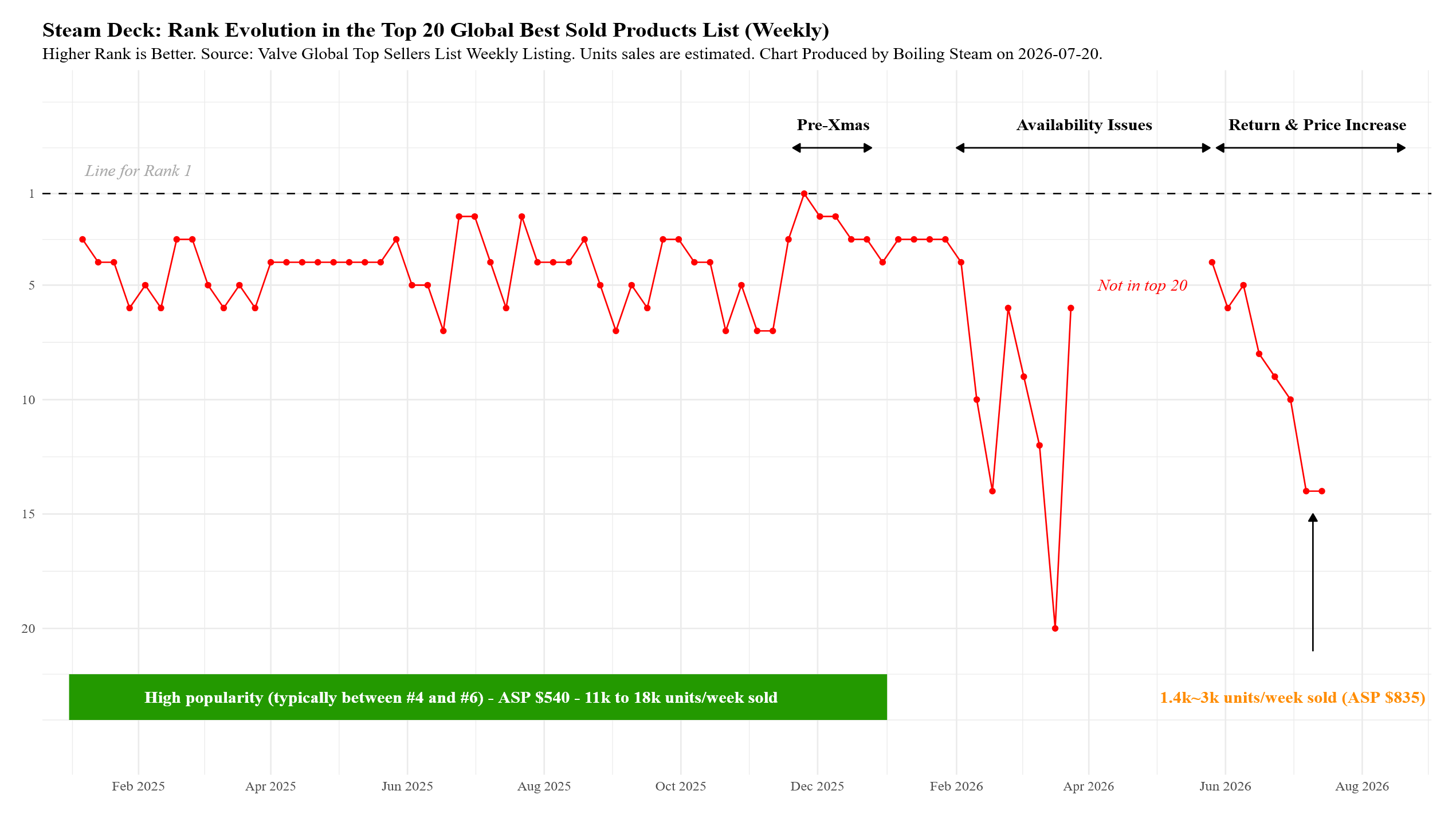
A recent report by Boiling Steam might confirm what most enthusiasts have always suspected: an overpriced Steam Deck is never going to sell well. In fact, Valve’s handheld machine might have already suffered a disastrous drop in sales. Despite the price hike, Valve is earning far less money than it did before.
Boiling Steam used the same methodology it employed to estimate Steam Machine sales, tracking data points from Steam’s own global list of best-selling games and products. The outlet compared the Steam Deck’s ranking throughout 2025, when it was often listed fairly high on the sales chart. Things changed in 2026, when Valve decided to retire the older – and cheaper – LCD models and offer only the OLED models at a significantly higher price.
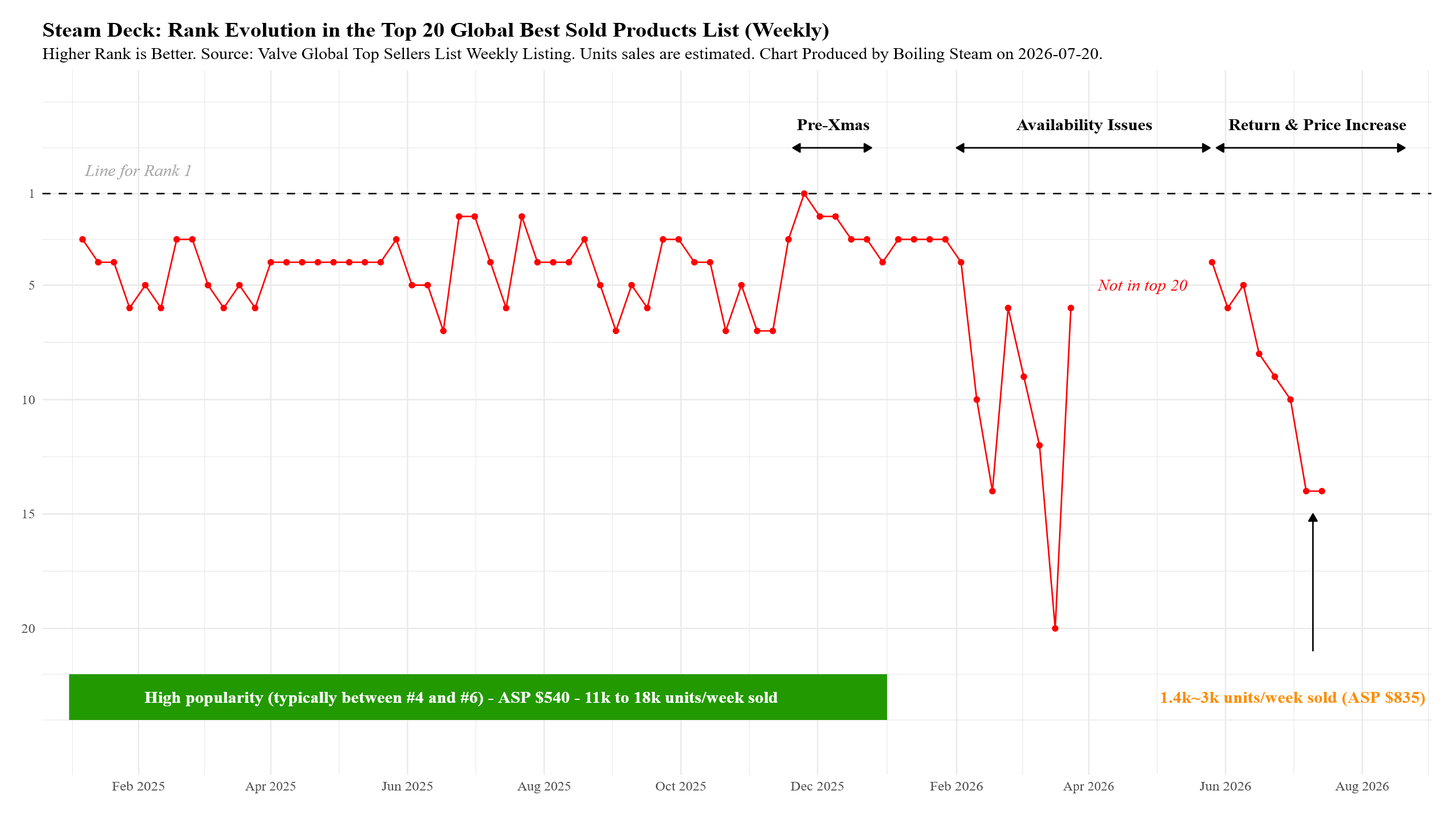
At first, OLED Steam Decks appeared to sell out despite the $300 price hike. According to new estimates from Boiling Steam, sales have now undergone yet another dramatic change. Valve is selling 82% fewer units than it did in 2025. Steam Deck sales have allegedly fallen from 11,000 – 18,000 units per week to an average of 1,400 – 3,000 units per week.
Valve tried to offset the massive increase in component prices by passing the supply-chain surcharge on to customers. According to Boiling Steam’s estimates, the company is now suffering from a 72% drop in revenue as well. Despite the price hike, Valve might have significantly diminished the Steam Deck’s appeal as an enticing option for handheld gaming enthusiasts.

Boiling Steam speculates that the Steam Deck was an interesting option when it sold for $650 but is a complete waste of money when priced at around $1,000 for the 1TB model. Furthermore, affluent gamers looking for a handheld at that price point will likely gravitate toward more powerful machines, such as the MSI Claw 8 EX AI+ or the Asus ROG Ally X.
If the publication’s methodology checks out, we might soon see a dramatic collapse in Steam Machine sales as well. The IT industry is currently going through a series of massive transformations, which means it’s probably too early to say that the Steam Deck is completely finished. After all, Valve engineers recently confirmed that things can always get worse.

Musk told investors Optimus has no supply chain and every part is new, as Tesla quietly dropped mass production language from its Q2 deck
Elon Musk told investors on Tesla’s second-quarter earnings call that Optimus will be “the hardest product to scale manufacturing that we’ve ever made at Tesla,” warning that the humanoid robot has no existing supply chain and that every component is new. He said he wanted to “calibrate people correctly” on expectations, acknowledging that the initial production ramp will follow a normal curve but with a flat early stretch that could last longer than investors hope. Tesla also quietly removed references to Optimus mass production from its Q2 shareholder presentation, after using that language as recently as the first quarter.
The admission marks a sharp change in tone from previous quarters. Last year Musk said he would be “shocked” if Tesla was not producing 100,000 Optimus robots per month within five years, and in January 2025 he projected 50,000 to 100,000 units for 2026. By January of this year he acknowledged that zero Optimus robots were doing useful work in Tesla’s factories, with the more than one thousand Gen 3 units deployed across Fremont and Gigafactory Texas collecting training data rather than performing productive tasks.
Musk was candid about the engineering barriers, saying Optimus needs at least human-level dexterity before it can be useful outside controlled factory settings and calling the human hand “an incredible thing” that no robotics company has managed to replicate. Tesla must also solve memory, logic, and chip packaging challenges while securing AI processors from partners including Samsung and TSMC. The robot contains roughly 10,000 unique parts, and unlike Chinese competitors that can tap an existing smartphone supply chain for actuators and precision motors, Tesla is building its manufacturing base from scratch.

The 💜 of EU tech
The latest rumblings from the EU tech scene, a story from our wise ol’ founder Boris, and some questionable AI art. It’s free, every week, in your inbox. Sign up now!
The financial backdrop adds pressure. Tesla reported Q2 revenue of $28 billion, up 26 percent, but adjusted earnings of 33 cents per share badly missed the 51 cents analysts expected, and operating income fell 57 percent. Capital expenditure jumped to nearly $6 billion in the quarter, part of Tesla’s $25 billion full-year spending plan, pushing free cash flow to a negative $1 billion and sending shares down about seven percent in pre-market trading on Wednesday.
Musk’s compensation deal ties part of his payout to delivering one million Optimus robots within a decade, a target that now sits uncomfortably against his own warnings about how difficult scaling will be. Tesla has converted its Fremont Model S and Model X lines for Optimus production and is building a dedicated facility near Gigafactory Texas, but the company has stopped promising when volume output will begin. Tesla’s China president has described the Shanghai Gigafactory as a “golden key” to mass-producing Optimus, though that factory has not yet begun robotics manufacturing either.


‘Ottava’ has been given market authorisation for use in multiple general surgery procedures within the upper abdomen.
Healthcare giant Johnson & Johnson has been granted ‘de novo’ approval by the US Food and Drug Administration (FDA) for what the company said is the world’s first table-integrated soft tissue robotic surgical system.
‘Ottava’ has been given market authorisation for use in multiple general surgery procedures within the upper abdomen, including gastric bypasses, gastrectomies, appendectomies and hiatal hernia repair.
When integrated into an operating theatre, the system’s four robotic arms occupy up to 50pc less space than ‘boom- and cart-mounted’ solutions for such environments, the company said. The system can also be programmed to help simplify set-up and breakdown of an operating theatre, or manipulate the positioning of a patient during a procedure.
Ottava also features a curated range of surgical tools and has its own “digital ecosystem” to support surgeons working with it, according to Johnson & Johnson.
“We are pioneering a new category of surgical robotics with Ottava,” said Tim Schmid, executive vice-president and worldwide chair of medtech at Johnson & Johnson.
“This is the start of the next era in surgery as we deliver not just a new surgical robotics system, but a catalyst for fundamentally better surgical care that is informed by technology, guided by clinical insight and delivered with care.”
The company said that Ottava – which will initially launch commercially with select US customers while aiming to advance into other use cases and regulatory jurisdictions – is purpose-built for present-day surgical procedures and environments while building a pathway to “support more digitally enabled, data-driven surgery in the future”.
Hani Abouhalka, the company’s group chair for surgery and medtech, said: “By opening up the way we think about architecture, data and the very workflows of surgery itself, we have designed Ottava to deliver clinical and economic benefits, and support surgeons and hospitals as the future of surgery unfolds.”
Earlier this week, US neural engineering company Science Corporation received EU approval for its vision-repairing medtech implant, Prima, with FDA approval processes also ongoing.
Don’t miss out on the knowledge you need to succeed. Sign up for the Daily Brief, Silicon Republic’s digest of need-to-know sci-tech news.

Chipmaker AMD is taking aim at competitor Nvidia with its latest hardware release: a rack-scale system designed to power computing needs of the world’s largest AI labs.
At the company’s sold-out Advancing AI conference in San Francisco on Thursday, AMD Chair and CEO Dr. Lisa Su promoted the new AI rack system known as Helios — along with its growing list of customers, including Microsoft — as the company prepares to ship it later this year. Su also pitched the company’s newest chips that are designed to feed the compute-hungry dragon that is the AI industry.
Rack systems combine many processors into a single high-powered unit. They are built for data centers, where they train and run AI models and other compute-intensive workloads.
Su called Helios the tech industry’s “highest-performance AI rack,” adding that it was “built to train and run the most demanding frontier models in the world at massive scale.” The system will be deployed by leading AI companies at gigawatt-scale, the company said.
Nvidia has historically dominated this market with its Vera Rubin and Grace Blackwell rack-scale systems. AMD is clearly looking to get in on the action. And Helios’ performance metrics appear to give it a real chance, beating out Vera Rubin by a number of metrics, The Register reported.
Helios, which was revealed in 2025 and shown onstage in January at CES 2026, already has several well-known customers, including OpenAI, Meta, Oracle, Anthropic, and Microsoft, all of which have plans to deploy the system. Microsoft CEO Satya Nadella said Monday that the company would expand its Azure infrastructure with Helios. Meanwhile, Anthropic and AMD announced a strategic partnership Wednesday to deploy up to two gigawatts of GPUs via the new rack system.
AMD also introduced Thursday its Venice-X CPU, which is designed for data centers and to handle high-computing workloads. The Venice-X is expected to launch in 2027.
During her remarks, Su commented on the trajectory of the chip industry, claiming that, by the year 2030, chips that power AI will become a massive part of the overall computing market. This is because the industry is “seeing a step change in compute demand” driven largely by the rise of agentic AI, she said.
“When you ask the agent to do something, it actually has dozens of steps, and it has to reason, and it has to call tools, and it has to access data, and it has to keep doing it over and over until it solves the problem, and so you need lots of GPUs to do all that,” the executive said.
“We’re now expecting that by 2030, the AI accelerator market is going to reach about $1.4 trillion,” Su said. “What that means is, by the end of the decade, the AI accelerator market is going to approach the size of the entire semiconductor market today.”
“We do expect that GPUs are going to make up the vast majority of that market because the algorithms are still very much in their infancy, and we’re still continuing to see the workloads change, and that favors programmability in the overall silicon ecosystem,” she added.
When you purchase through links in our articles, we may earn a small commission. This doesn’t affect our editorial independence.


AI and ML
AI no longer welcome in human-focused community
You can take your vibe-coded project elsewhere. Codeberg, a volunteer-run code hosting community, has decided that AI-authored software is no longer welcome.
On Thursday, Codeberg announced that the members of Codeberg e.V., the Berlin-based non-profit overseeing the code hosting service, had voted to ban “vibe-coded projects” and declared that Codeberg would not use users’ code or data for AI training due to its impact on Free, Libre and Open Source Software (FLOSS).
The vote follows ongoing efforts by Codeberg to prevent automated software (bots) from taxing its infrastructure with excessive network requests. Authors Bastian Greshake Tzovaras, Otto Richter, and William Zijl argue that AI companies are shifting costs to others and damaging online communities in the process.
“LLMs are so costly that companies externalize the costs on a massive scale – on those who don’t use them and society at large,” they wrote in a blog post. “Increased hardware prices, energy use and environmental damage – we all pay for it!”
They point to the cost of Codeberg’s SSD and memory hardware as an example, noting that a drive that only a few years ago cost €700 (~$800) now costs €3,700 (~$4,200) – if it’s even in stock. The result is that Codeberg has been forced to raise prices.
The authors also call out the proliferation of projects that often involve a solo developer “working with a statistical machine that turns energy into code.” They fault these folks for not having any community and argue it’s unreasonable for Codeberg to spend its limited CI/CD and storage resources on ghost projects.
But the vote isn’t simply about unfair resource consumption. It reflects broader unease among Codeberg members about the damage AI coding models are doing to the FLOSS community.
AI-driven price hikes, they contend, are broadening the digital divide by making personal computers less affordable, forcing more people toward corporate-owned cloud services. And beyond the environmental harm of increased water and energy use, the Codeberg authors argue that LLM use is undermining the foundation of trust and community that makes FLOSS work.
“The widespread use of LLMs in FLOSS is instead becoming a multidimensional attack on the trust between contributors and the very idea of convivial collaboration itself,” they state.
LLMs magnify maintainers’ workloads, create confusion around whether projects will be maintained, and “lead to ‘license laundering’, where copyleft code is stripped of its reciprocity requirements by ‘generating’ it out of the training data.”
“As we want to center on human collaboration, we will not actively support or engage in the creation of LLMs and will not put our limited resources to use for storing single-use software that would pollute our FLOSS commons,” the authors conclude.
As a consequence of the community vote, projects developed and maintained mostly by an AI agent are no longer welcome at Codeberg and are urged to move to other hosting options.
This is reflected in amended Terms of Use language: “You must not share projects that mostly consist of code written by ‘generative AI’-tools (including services such as Claude, OpenAI Codex). Such projects having an unclear copyright status … and furthermore have little safeguards to ensure that they do not include harmful code.”
Enforcement of the ban seems unlikely, however, unless a project draws attention to itself, given Codeberg’s statements about limited resources and its overburdened workforce.
Support for the vibe-coding ban was substantial but not overwhelming, with some celebrating the decision and others condemning it. Among Codeberg members, 358 voted in favor, 144 voted against, and 14 abstained. About half the active members voted.
“I think this is a very bad move, and the people behind Codeberg should re-consider their stance,” said Armin Ronacher, creator of Flask and one of the co-founders of AI agent biz Earendil.
On its way toward Free, Libre, and Open Source Software equilibrium, Codeberg also decided to ban cryptocurrency projects, citing a similar move by SourceHut in 2023.
A proposed amendment to make it Codeberg’s stated purpose “to oppose discrimination and promote a diverse FOSS community” passed with a two-thirds vote but is not yet merged. The protection extended to philosophical outlook does not cover belief in AI. ®
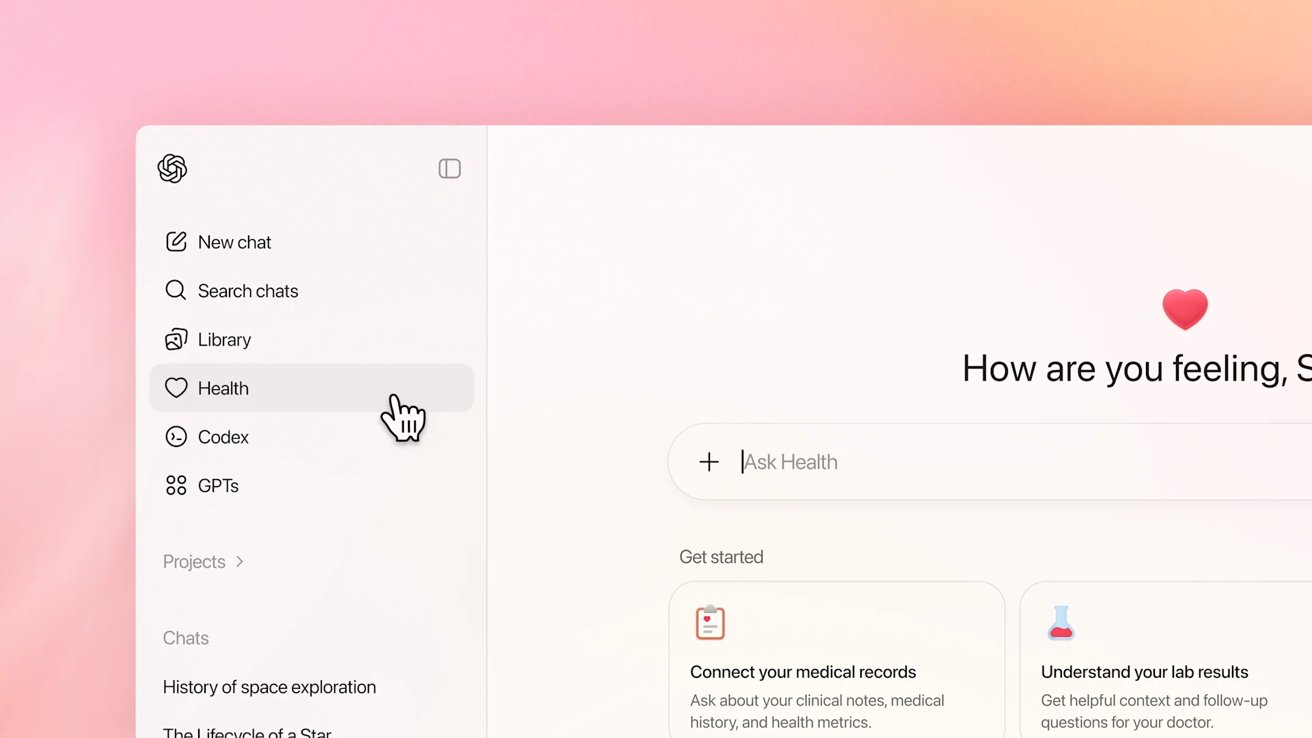
OpenAI’s new Health feature gives ChatGPT access to Apple Health data and medical records, adding useful analysis at the cost of sharing sensitive information with another company.
The feature is available to logged-in users 18 and older across Free, Go, Plus, and Pro plans. OpenAI says ChatGPT can compare laboratory results over time, summarize changes since a medical appointment, and identify patterns involving sleep, exercise, and daily activity.
Users can connect Apple Health, medical records from supported U.S. hospital systems, One Medical, and Function Health. ChatGPT can also receive information that fitness, nutrition, and wearable apps make available through Apple Health, although some proprietary scores may not transfer.
OpenAI says more than 300 million people turn to ChatGPT with health-related questions each week. Connecting records could make it easier to understand medical terminology, prepare questions for a doctor, or track changes without repeatedly uploading the same documents.
Health in ChatGPT requires users to sync potentially extensive medical and wellness information with OpenAI. Users who don’t connect the feature avoid adding OpenAI to the services handling that data.
OpenAI says connected medical records, Apple Health information, and related conversations won’t train foundation models or target ads. It further claims that all ChatGPT conversations are encrypted in transit and at rest, with added protections for Health data.
ChatGPT asks for permission before using connected health information by default. Users can approve access for one request or allow ChatGPT to use it automatically in future conversations.
Permission controls don’t eliminate the underlying data transfer. ChatGPT can analyze health information only after users make it available to OpenAI.
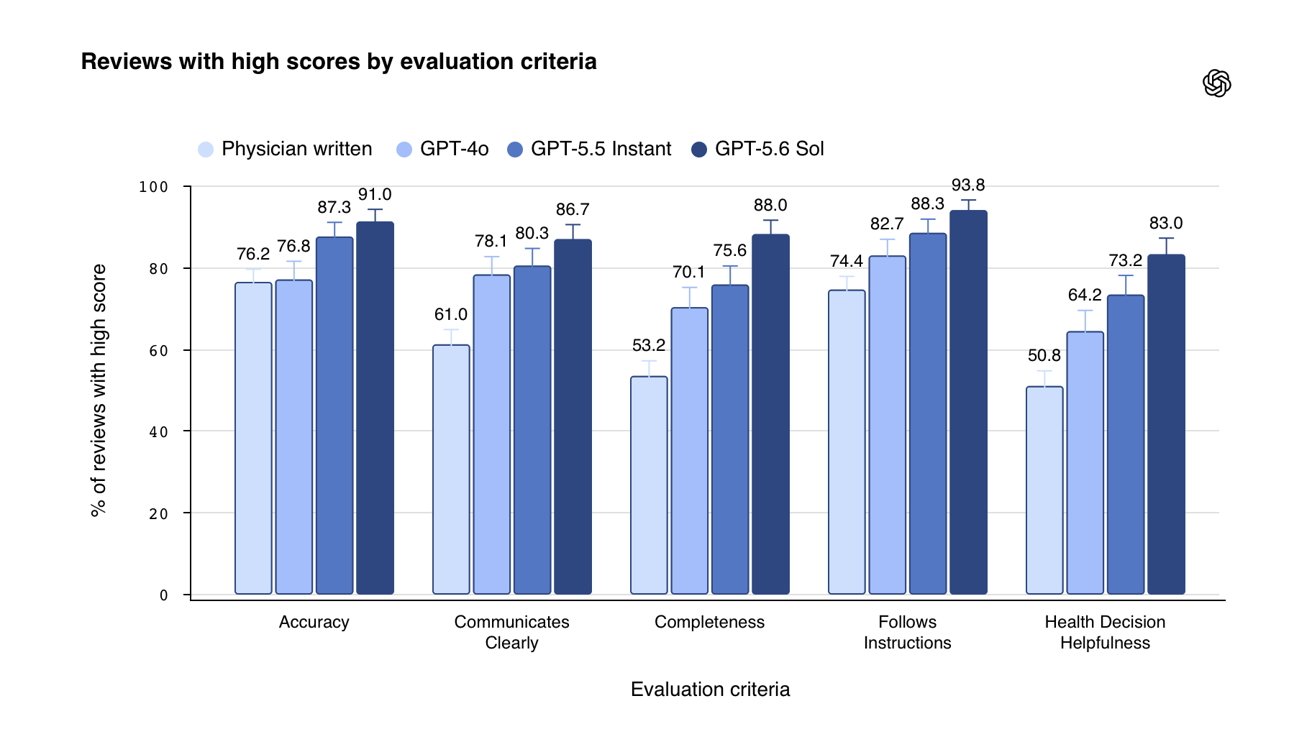
 Percentage of reviews earning high scores by evaluation category. Image credit: OpenAI
OpenAI deletes synced health data within 30 days after disconnection, while information in past chats remains until users delete those conversations. ChatGPT can also create memories from Health conversations, and sharing health details through another service may require confirmation.
Apple’s Siri AI in iOS 27 uses a first-party architecture for supported requests involving personal context. Siri AI can search across apps for user data, understand information shown onscreen, and perform actions through Apple’s systemwide app frameworks.
The company processes many requests on the device and uses Private Cloud Compute when a request needs a larger model.
Private Cloud Compute sends only the data needed to process a request to Apple Silicon servers. Apple can’t access or retain that data, and researchers can inspect the software used to process it.
The key difference is how Apple and OpenAI process the data. For supported health tasks, Apple can process requests on-device or through Private Cloud Compute without a persistent connection to OpenAI.
Processing supported health requests on-device or through Private Cloud Compute avoids adding OpenAI as another service handling the data. OpenAI’s safeguards reduce some risks, but avoiding the extra connection minimizes data sharing more effectively.
The Health rollout also comes amid a legal conflict between Apple and OpenAI. Apple continues to offer optional ChatGPT integration through Apple Intelligence.
 Connecting Apple Health to ChatGPT. Image credit: OpenAI
Apple sued OpenAI and two former Apple employees on July 10 over alleged trade secret theft tied to OpenAI’s consumer hardware work. The lawsuit names Tang Yew Tan and Chang Liu.
According to the complaint, both men improperly accessed, kept, or shared confidential information connected to their departures from Apple and later work for OpenAI.
OpenAI has denied wanting or using competitors’ trade secrets. The allegations haven’t been proven, and the dispute is separate from the privacy and security of Health in ChatGPT.
Hundreds of physicians helped OpenAI build realistic health scenarios for testing ChatGPT. The evaluations measure accuracy, safety, communication, context awareness, completeness, and whether ChatGPT recognizes when professional care may be needed.
GPT-5.6 outperformed GPT-5.5 on OpenAI’s HealthBench Professional evaluation, though ChatGPT can still make mistakes. Users should verify important information with a qualified health care provider.
Connected records may also be incomplete or outdated. OpenAI notes that a medication can remain listed after someone stops taking it, making it important to check ChatGPT’s information against the original source.
ChatGPT can make records easier to understand, identify changes worth discussing, and help someone prepare for an appointment. Its output shouldn’t be the sole basis for a diagnosis, medication change, or decision to avoid professional care.
Health in ChatGPT organizes scattered medical data. Apple users must decide whether that convenience is worth sharing their health information with OpenAI.
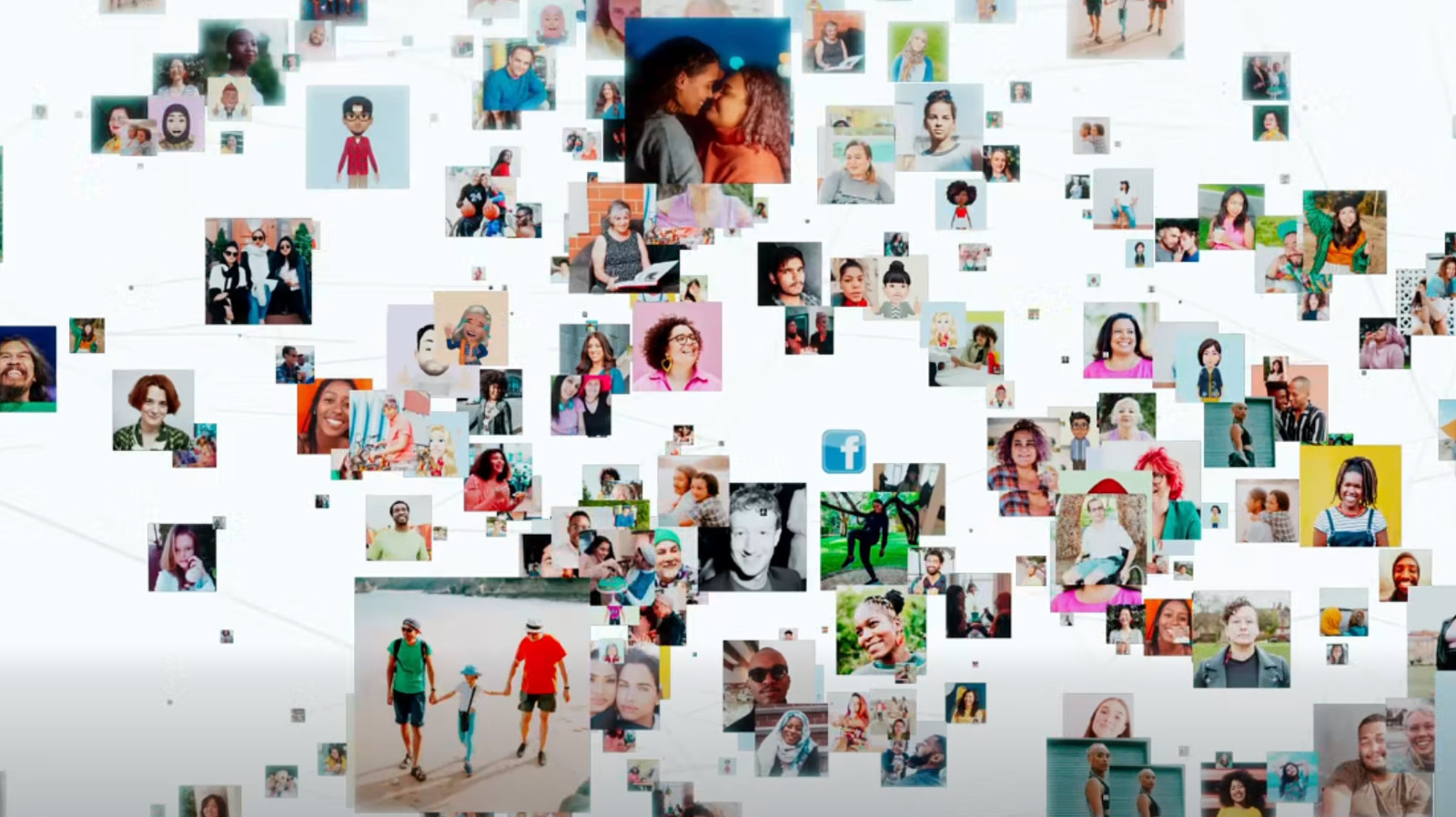
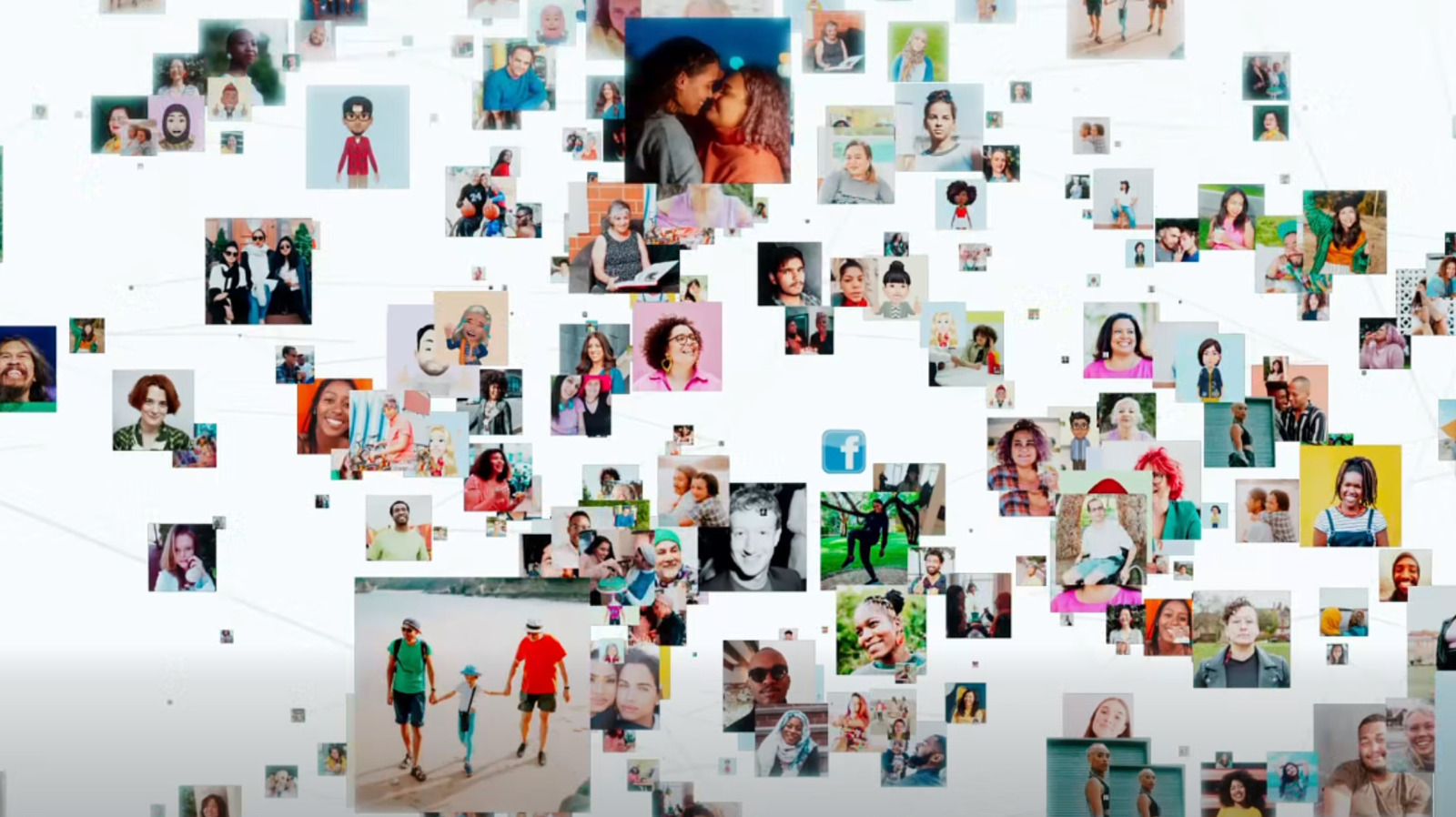
Mark Zuckerberg really wants you to believe that AI is good, actually. But the centerpiece of his company’s new “optimistic” ad campaign, at least for now, is a one-minute commercial for Meta’s AI efforts that… features very little AI.
According to a Meta spokesperson, the ad is the start of a broader effort from the company to present an alternative view to “AI doomers and those who have sketched out a dystopian vision” for the future. “As we enter this next wave with AI, we continue to believe the future is for everyone,” Zuckerberg wrote in a post accompanying the video. “We’re focused on giving every person the tools to reach your full potential and making sure the benefits of technology are distributed to everyone.”
Notably this is the same company which in recent months has used the supposed productivity benefits of AI as an excuse to lay off many thousands of its own staff. The same company that has been accused of using AI to justify cuts that disproportionately affected workers on medical leave. The same company that is being sued by publishers for allegedly training its AI on copyrighted material. The same company that once had an internal policy document that suggested it was permissible for AI chatbots to have “sensual” conversations with minors. Those guys!
So what are the benefits of AI? It’s hard to say because the commercial makes very few references to any of Meta’s AI features. Instead, it shows a bunch of nondescript footage: a crowd walking, people smiling, a couple dancing. Are these people implied to be happily benefitting from AI? Who can say. It then cuts to someone scrolling Facebook, the Instagram logo and a WhatsApp chat. All of those apps have been flooded with AI features over the last year, but none are visible in the video.
The company’s communications team describes the campaign as “beginning to articulate [Meta’s] optimistic vision for a future with AI,” which seems like something that should have been figured out before investing many billions of dollars into building AI.
There’s a brief moment where the video cuts to the words “Muse Spark,” Meta’s latest AI model, on a laptop screen. And a moment later the Meta AI interface appears. But there’s no indication of what these tools can actually do or why they should be relevant to anyone watching. Just that… they are available to “everyone,” I guess? “Some people will have you believe AI will make us less connected, that it’s gonna leave us behind,” the video states. “We couldn’t disagree more.” Ok!
It wouldn’t be the first time Zuckerberg has been vague about the future of AI. He now talks about AI with the same incomprehensible enthusiasm he once had for the metaverse, the thing he once predicted was “going to be the successor of the mobile internet.” We all know how that ended.
The final 15 seconds of the video prominently feature Meta’s smart glasses, including its new Kylie Jenner-branded frames. There are a few shots of POV footage captured from Oakley Meta glasses but, again, no references to AI.
“The discourse around AI spans everything from existential dread to utopian visions,” Meta’s Chief Marketing Officer Denise Moreno wrote in a post on LinkedIn. “With all the noise, it’s easy to feel like the future is heading toward less connection and less agency. We’re taking a different stance: we think AI will empower people to do more of what they love. As we enter this next wave of AI, we’re continuing that work and doing everything we can to ensure the future is for everyone.”
Meta might believe the future is “for everyone,” but Moreno apparently felt differently about the present. She limited comments on her post.
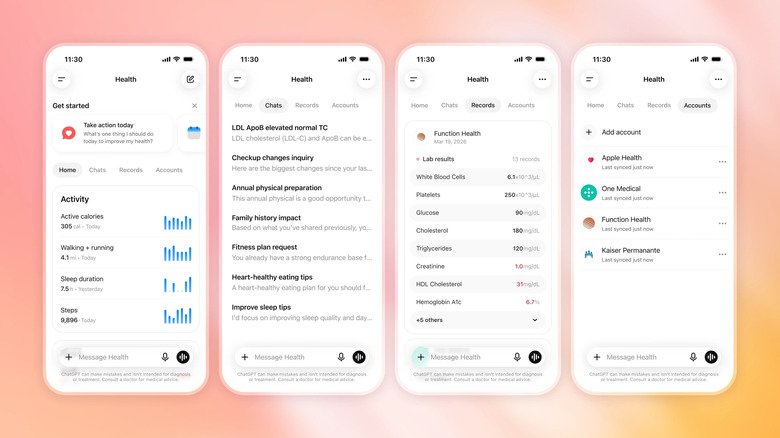
The company is rolling out its ChatGPT Health feature to users in the US who are 18 years or older.
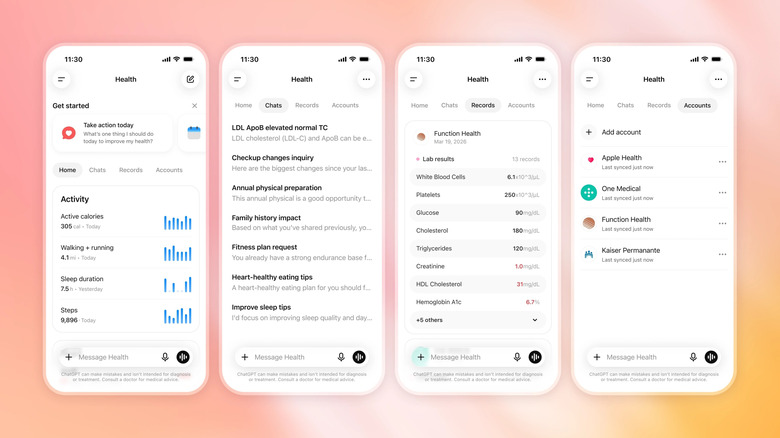
OpenAI is rolling out its dedicated health experience, ChatGPT Health, to users who are 18 years or older and live in the US. The company began testing ChatGPT Health in January in a separate portal, but this updated version lets ChatGPT reference relevant health data in any conversation.
The new feature is designed to go beyond the chatbot’s existing ability to answer health-related questions — something OpenAI claims its new GPT-5.6 Sol model improves — and grounds responses in personal data from doctors’ notes, blood tests and more. You can connect your data via ChatGPT’s new Health tab, where OpenAI will guide you through linking the chatbot to Apple Health (via the company’s Healthkit framework) and providers like Kaiser Permanente or One Medical. ChatGPT can also prompt you to review any current conditions you might have, medications you’re taking and your family’s history of illness to make sure it’s interpreting everything correctly.
From there, OpenAI suggests you can revisit the Health tab to browse your records, view recent health trends and see suggested prompts to ask ChatGPT, but the main thrust of ChatGPT Health happens anytime your health is relevant to a chat. OpenAI is (appropriately) careful to frame its responses as a way to summarize an appointment, understand test results and be a better patient, but that doesn’t stop anyone from asking for more direct advice from the chatbot. ChatGPT is still capable of making mistakes, and anything it says shouldn’t be considered diagnosis or official treatment, even if the chatbot offers it confidently.
Privacy is also a major concern worth considering when sharing things like health records. Like when it originally announced ChatGPT Health, OpenAI says your medical information is not used to train foundation models or target ads, regardless of your other settings. You can also decide when ChatGPT can use health information you’ve connected, forcing the chatbot to ask every time it wants to use your data. Any health information you’ve connected can be disconnected at any time.
The timing of OpenAI’s announcement is undeniably unfortunate. The company is currently being sued by a pastor who alleges that ChatGPT offered dangerous medical recommendations that led him to not seek treatment for a pulmonary embolism. The company is also embroiled in a separate lawsuit with Apple. That, at the very least, makes its reliance on Apple Health as a major data source awkward. OpenAI obviously doesn’t have a say in all the legal fights it’s embroiled in, but you can certainly decide you don’t feel comfortable giving ChatGPT your medical information.
ChatGPT leveraged faith to convince a man with a cardiac issue to stay home instead of seeking medical help. Now, facing years of recovery and profound financial damage, the man is suing OpenAI over the ordeal.
In a lawsuit filed in San Francisco Superior Court, Florida pastor Scott Winters argues that ChatGPT used his faith against him. After asking the chatbot about his symptoms, he was told that they were likely “another minor piece of the long story” and that “God did not design your body to endlessly fail.”
After going back and forth with ChatGPT’s Health feature for six weeks, Winters finally spoke to a real medical professional. He was then diagnosed with a dangerous blockage of arteries in both of his lungs.
During his talks with ChatGPT, Winters was told to stay “recliner-bound” until he’d had up to 10 more episodes. Doctors believe that this advice probably made matters worse, with Winters’ immobility aiding the blockage of those vital arteries.
Now, The Next Web reports, the pastor faces a long road to recovery. He’s no longer able to do his job as a result of the condition, and he blames OpenAI.
“Not only did I nearly die,” the pastor said in a statement, “but I lost my job, my career, my ministry, my home, everything.”
In his lawsuit, Winters accuses OpenAI and CEO Sam Altman of the “unauthorized practice of medicine.” He wants damages, and he is seeking the roll-out of ChatGPT Health to be halted entirely.
At least, until independent auditors can give it a clean bill of health.
The legal complaint doesn’t pull any punches, either. In it, Winters’ lawyers argue that ChatGPT’s “sycophantic nature and authoritative tone, combined with its manipulation of Scott’s religious identity, cultivated in him a dangerous reliance on the tool that subverted Scott’s ability to make sound decisions, isolated him from family members who urged him to seek medical care, and convinced him that seeking medical attention was unnecessary and even potentially lethal.”
And as it always does, OpenAI is hiding behind one-line warnings that the models give from time to time. It should know at this point given at least five suits against the 4o model specifically, what it is doing, and what the dangers are, yet it persists.
The company argues that the chatbot regularly reminds users that it isn’t infallible. Users regularly ignore it.
It’s also telling that OpenAI offers ChatGPT Health, a feature that gives users the impression OpenAI’s chatbot is qualified to comment on exactly that: health.
As is so often the case with lawsuits like this, there’s a lot of blame to go around.
OpenAI can’t market ChatGPT as the all-knowing, all-doing technology of the future and be surprised when people listen to, and have faith in, what it has to say.
But similarly, people are still responsible for their actions. Unfortunately, too many buy into the hype and believe ChatGPT and other chatbots are much more capable than they really are.
In the case of Pastor Scott Winters, ChatGPT used his faith to argue its points. And he almost died.
Faith can be used for good, of course, and being a pastor shows real devotion. And Winters surely knows that weaponizing religion is a terrible misuse of faith.
Somehow, after being trained on stolen data across the depth and breadth of the internet, ChatGPT hasn’t quite figured that out and is happy to brandish that weapon to make its point.




Weekend Open Thread – Corporette.com


The House | The City of London can help the new chancellor deliver growth in every postcode


Ripple Payments Joins MiCA With 14 Firms, Does It Mean Anything For XRP?

Two July Windows Left: The CLARITY Act’s Senate Fight and What Failure Means


Democrats look to World Cup watch parties to register thousands of voters


Ripple wins EU-wide access as ESMA adds it to MiCA register


Grayscale Files For Worldcoin ETF, WLD Registers Sharp Rise


Unregistered fitter used Gas Safe logo on business flyers


Sail Virtually Aboard The “Itanic” With IA-64 Emulator

Turtle Beach Command Series KB7 review: a nifty screen-equipped gaming keyboard


Registration is now open for March for Men with Kev 2026


Big Money Is Entering XRP

New Jersey voter registration controversy explained: How 6,600 noncitizens got on the rolls, and what happens next


Money | Class 12 Economics | CBSE Board Exam 2026-27


Banco Bilbao Vizcaya Argentaria, S.A. (BBVA) Discusses Global Macro Environment and Economic Outlook for Core Markets Transcript


Kaspersky exposes OkoBot’s 20-module crypto wallet attack


Airlines warn Sunshine Protection Act could disrupt flight scheduling


Durham County Council to send out electoral registration emails

Johnny Depp’s R-Rated Gothic Cult Classic Gets New Release Ahead of Sydney Sweeney Remake
Nephros, Inc. (NEPH) Discusses Evolving Water Safety Strategies and Expansion Beyond Filtration Transcript



You must be logged in to post a comment Login