Tech
Best in Show: The Top Hi-Fi Systems at T.H.E. Show SoCal 2026

Coming just three weeks after HIGH END Vienna and on the same weekend as the North West Audio Show in the U.K., T.H.E. Show SoCal 2026 had a lot of competition for industry attention. The Costa Mesa event was clearly smaller than last year, but the rooms stayed busy and there was no shortage of genuinely impressive sound.
Affordable hi-fi was not really the theme. Active systems, ambitious analog front ends, low-powered tube amplification, and six-figure reference rigs dominated the better rooms. These are the systems that stood out most, not because they cost the most, but because they made music convincing enough to keep people planted in the chair.
Legacy Valor ($100K/pair)


Legacy Audio is another multiple Best in Show winner, with the Aeris XD earning the honor at T.H.E. Show SoCal 2025 and the Talos doing the same at AXPONA 2026. At this year’s event, however, Legacy brought its flagship: the Valor system, a nearly six-foot, 288-pound loudspeaker that represents the company’s biggest and most ambitious statement.
Priced at $100,000 per pair, the Valor combines 2,750 watts of onboard amplification per speaker with the Wavelet 2 DSP processor, room correction, and Legacy’s Stereo Unfold processing. It is not quite a “just add streamer” solution, as each speaker still requires an external amplifier channel for the high-frequency section, but it remains considerably less complicated than assembling a conventional reference system around separate passive loudspeakers, multiple power amplifiers, and outboard room correction.
Legacy rates the four-way Valor from 12 Hz to 30 kHz, ±2 dB, and its combination of large bass drivers, passive radiators, and serious internal power gives it the kind of output capability that makes polite background listening feel almost insulting. The dual 4-inch AMT tweeters are arranged in a post-convergent array designed to keep the top end consistent beyond the center seat, helping the Valor deliver a stable and expansive presentation across a wider listening area. It is also available in a deep roster of wood veneers and premium finishes, which matters when your speakers are roughly the size and visual commitment of small monoliths.
ATC EL50 ($100K/pair)

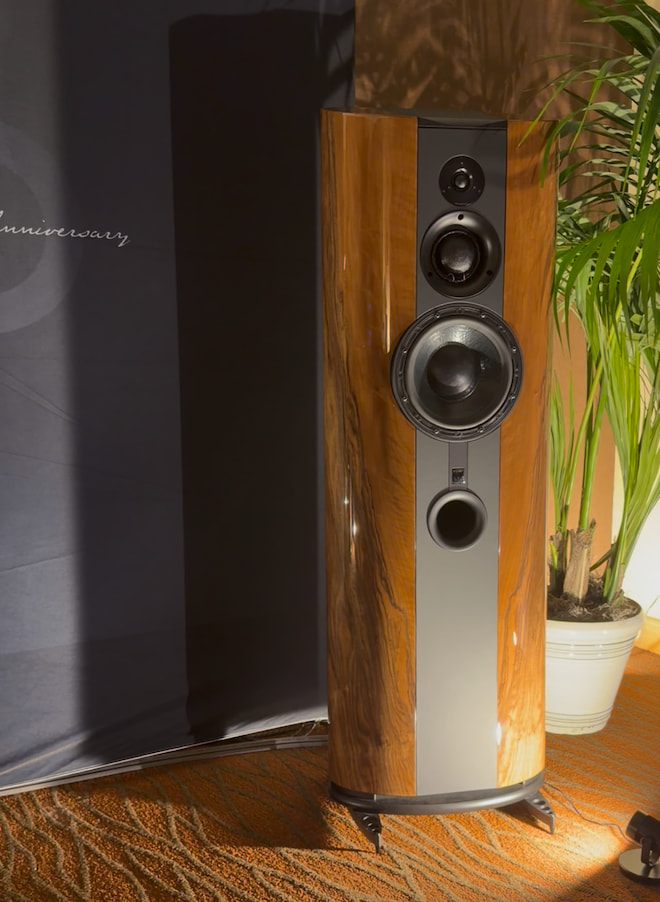
Staying with the active theme, ATC earns another Best in Show award for its EL50 Anniversary Edition active loudspeaker system, which was an easy unanimous selection at AXPONA just two months ago. Standing almost 56 inches tall and weighing 139 pounds each, these are not modest floorstanders, but they again proved remarkably comfortable in a smaller hotel room.
Lone Mountain Audio kept the core AXPONA system intact: ATC’s SCA2 preamplifier, the Innuos ZENith NG server, Playback Designs MPD-8 DAC, and WireWorld cabling. This time, the distributor also rotated in the Sonorus ATR10 Mk II reel-to-reel deck, which made a strong case for itself as an analog source in a room already blessed with excellent digital playback.
The EL50’s fully active three-way architecture remains the attraction. Each speaker contains dedicated 200-watt bass, 100-watt midrange, and 50-watt high-frequency Class A/B MOSFET amplification, with ATC’s active crossover and in-house drivers doing the heavy lifting. That integration helped the EL50 deliver the same qualities that stood out in Chicago: authoritative but controlled bass, natural scale, exceptionally clean midrange performance.
For those interested in learning more, read Ian White’s extensive report from AXPONA here. A full eCoustics review is planned for late summer.
Odyssey Audio & Stella Acoustics

This was my first experience with Odyssey Audio, and it was not one I am likely to forget. The packed room, littered with flickering faux candles, should have been the first clue that Klaus Bunge was not interested in another polite hotel-room demonstration.
The setup was not remotely conventional. The loudspeakers were positioned very close to the side walls and roughly a third of the way into the room from the rear wall, with each driven by Odyssey’s new Meilenstein monoblocks. On paper, it looked like the sort of placement audiophiles are taught to avoid. In practice, it worked spectacularly well. The speakers disappeared, leaving an image that extended well beyond the front wall with exceptional depth, focus, and clarity.
More importantly, this was not a demo built around the usual collection of pristine audiophile recordings. The Doors’ “Riders on the Storm” was genuinely immersive, placing the listener inside the recording’s rain-soaked atmosphere rather than merely showing off a wide soundstage. Tracks from Justin Bieber and Stone Temple Pilots followed and proved that the system could do more than flatter one particular type of music. Stella Acoustics’ room treatment clearly played a role as well, helping create a presentation that felt unusually open, three-dimensional, and convincing in a crowded hotel suite.
REL / Acora / VAC

Acora Acoustics loudspeakers have consistently impressed in rooms built around VAC amplification, but this system showed how much more the company’s MRC-3 floorstanders can deliver when supported by a properly ambitious REL six-pack.
The MRC-3s were partnered with six REL Carbon Special Black Label subwoofers, arranged as triple stacks behind each speaker. At $4,999 apiece, that is essentially $30,000 worth of low-frequency reinforcement, which sounds absurd until you hear what the array does. The subs never called attention to themselves or turned the room into a bass demo. Instead, they added scale, weight, and low-end authority while preserving the speed, clarity, and dimensionality of the Acoras.
REL’s triple-stack approach also helps maintain the height and scale of the soundstage rather than simply adding more rumble below it. That was particularly apparent with the Acora MRC-3s, whose marble cabinets and ceramic drivers already deliver considerable control and resolution on their own. The result was a system that sounded full-range without relying on oversized tower speakers loaded with enough bass drivers to qualify for a municipal permit.
The rest of the chain was equally serious: Berkeley’s Alpha DAC Series 3P with Alpha Reference USB, Synergistic Research’s Voodoo Server, Soulution’s 541 CD player, and the Sonorus ATR10 MK2 tape machine fed VAC’s Master Preamplifier and 202iQ stereo/mono amplifiers. The system was supported by an Artesania Audio Exoteryc rack, Synergistic Research’s Galileo LUX, SRX XL, and Foundation XL cabling, along with ASC Tube Traps and Synergistic room-treatment products.
This room made a strong case for spending intelligently on bass management rather than assuming the only path to full-range performance is an enormous pair of loudspeakers with a small forest of woofers on the front baffle. The REL array gave the Acoras more authority, more scale, and more convincing low-frequency realism, while letting the speakers do what they do best.
Prodigio WR2 with AGD and Bacch 3D
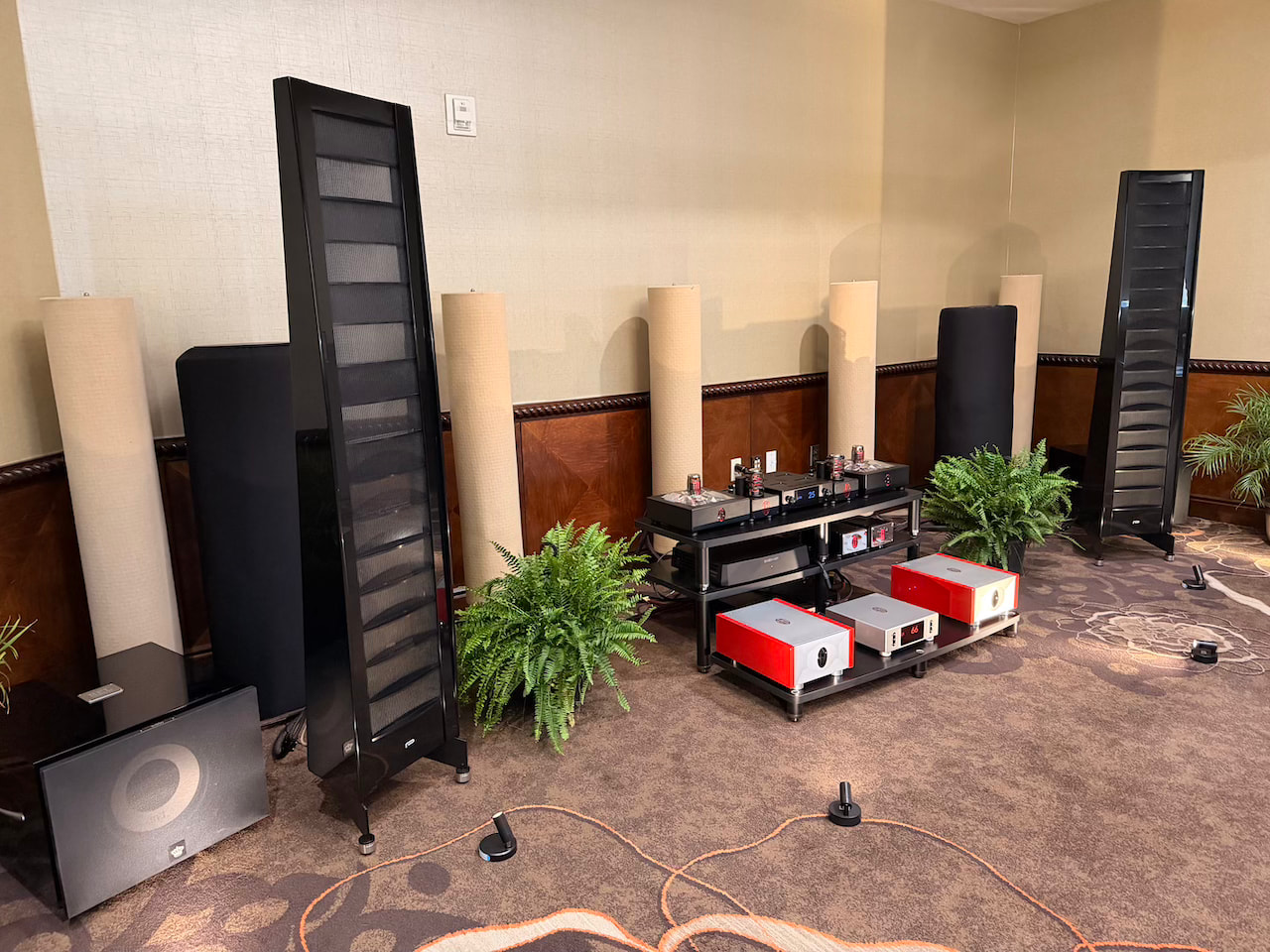
Prodigio Audio, formerly Popori Acoustics, is another repeat Best in Show winner. The Hungarian-made WR2 electrostatic loudspeakers were again paired with AGD electronics and Theoretica Applied Physics’ BACCH-SP adio processor, a combination capable of extracting spatial information from conventional stereo recordings that most two-channel systems simply leave on the table.
The tall WR2 panels are impressive even without processing. They are fast, revealing, and exceptionally transparent, with the kind of midrange clarity and transient speed that electrostatics can deliver when properly set up. Engage BACCH 3D, however, and the presentation becomes something else entirely. Instruments and effects extended well beyond the speakers, with spatial cues that could reach around the listener rather than remaining trapped between the two panels.
There is a caveat, because there always is. BACCH is a highly personalized, single-listener experience that works best from the precisely calibrated center seat. Move too far off-axis and the effect diminishes. Park yourself in the sweet spot, though, and the result can be startlingly immersive without requiring a room full of surround speakers.
This year’s larger room also benefited from a pair of REL S/850 subwoofers. The WR2s already offer more low-frequency presence than many listeners expect from a panel speaker, but the RELs added weight and extension without turning into the main event. They blended seamlessly, giving the system more foundation and scale while preserving the WR2’s speed, openness, and almost unnerving ability to disappear.
With the BACCH processor, REL subs, WR2 electrostatics, and AGD amplification, the system starts north of $85,000 before cables, accessories, and setup.
Zesto Tube Amps / DAC with YG Acoustics
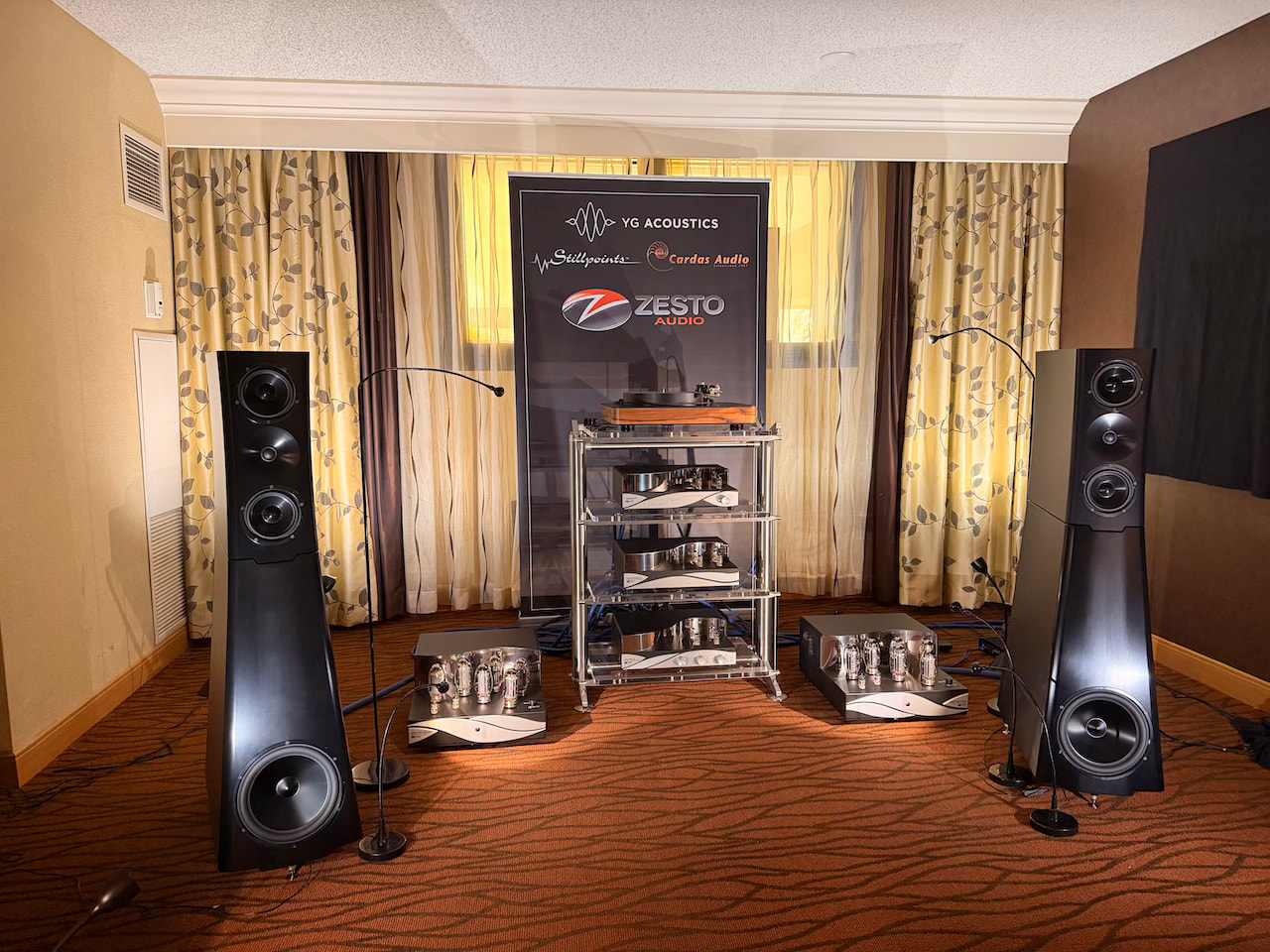
Zesto Audio returned with a full tube-based system built around its new Athena DAC, Leto Ultra II preamplifier, and Eros 500 Select Class A monoblocks. At $15,000, $11,900, and $35,000 per pair respectively, the electronics were partnered with YG Acoustics’ Sonja 3.2 loudspeakers, a $106,800-per-pair reference design that requires serious amplification and rewards it accordingly.
This was not a system chasing syrupy tube warmth or trying to sand down the edges of every recording. The Zesto and YG combination was all about resolution, control, and tonal precision, with Cardas cabling tying the system together. The Sonja 3.2’s aluminum cabinet, proprietary drivers, and exceptionally low-distortion crossover design gave the Eros 500s plenty to work with, resulting in a presentation that was detailed, dynamic, and remarkably composed.
The Athena DAC also provided a useful real-world demonstration of DSD playback. Switching among 1x, 2x, and 4x DSD files revealed audible differences, although the gains were not equal at every step. From outside the center seat, the move from 1x to 2x DSD seemed to offer the most noticeable improvement in refinement and separation, while the jump to 4x was far more subtle. That does not make 4x DSD pointless, but it does reinforce the reality that implementation matters far more than simply chasing the largest number on the display.
Zesto and YG Acoustics proved to be a highly potent pairing: tube electronics with enough speed, grip, and transparency to let the Sonja 3.2s show why they belong in the reference category.
Rockport / CH Precision
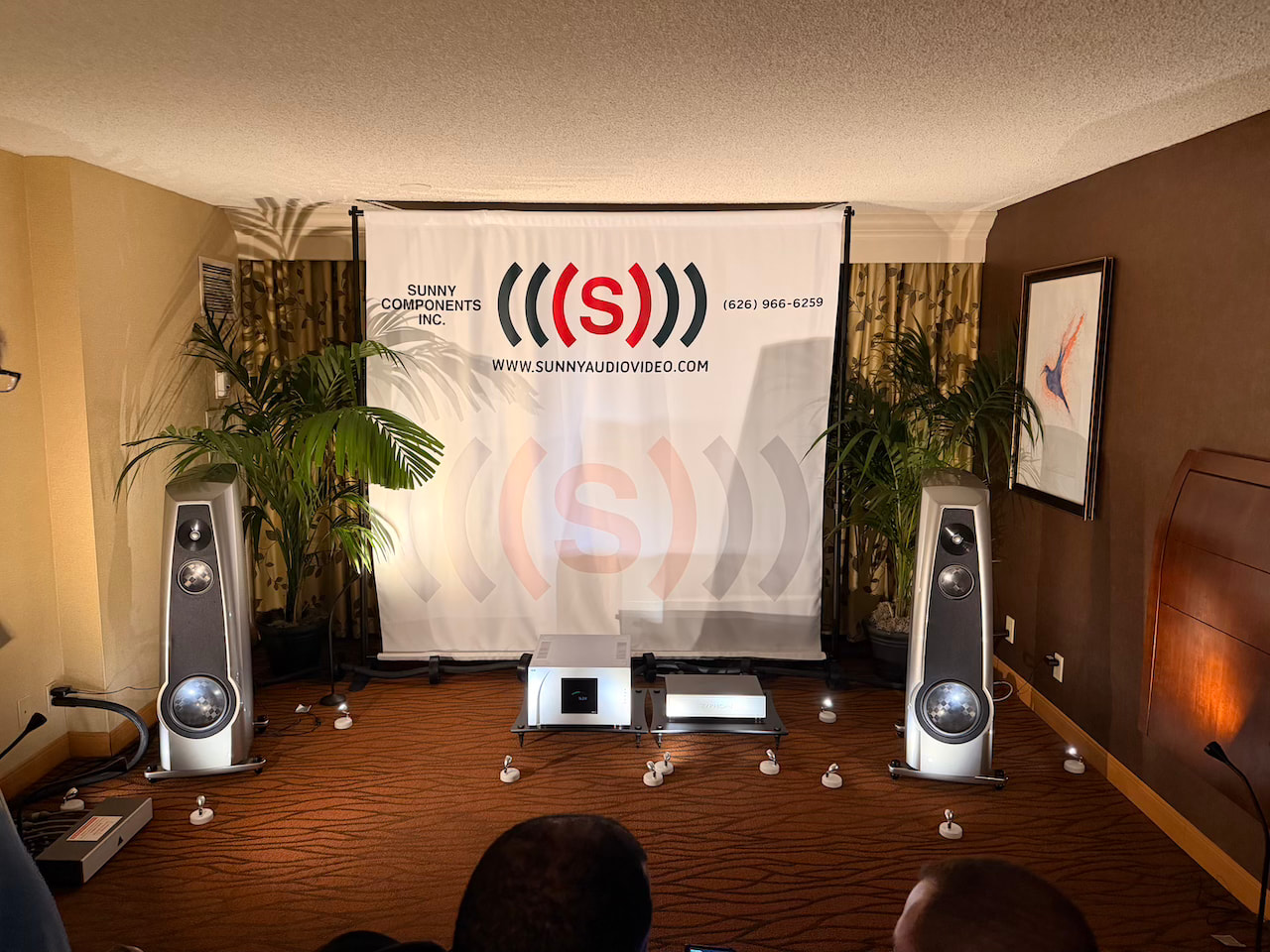
Rockport Technologies and CH Precision delivered one of the most expensive and meticulously assembled systems at T.H.E. Show SoCal 2026, built around the custom Lexus Silver Rockport Lynx loudspeakers and a full complement of Swiss electronics. With the speakers, Aurender N50 music server and NH10 network switch, plus CH Precision’s D10 SACD/CD transport, C10 Reference DAC, T10 Time Reference clock, L10 preamplifier, and M1.1 power amplification, this was a system hovering around the $500,000 mark before anyone started counting racks, power products, and cables.
The Rockport Lynx is a three-way floorstander with a 10-inch carbon-fiber sandwich woofer, 6-inch midrange driver, and waveguide-loaded beryllium tweeter housed in the company’s extraordinarily inert DAMSTIF3 aluminum enclosure. It is a speaker engineered to reveal everything upstream, which made it an ideal match for CH Precision’s ultra-low-noise, no-nonsense approach to solid-state electronics.
This was not a system designed to flatter weak recordings or wallpaper over the rough edges. It was all about control, silence, image specificity, and the kind of precision that makes small shifts in level, decay, and placement feel more obvious.
Tonian Labs Oriaco D6
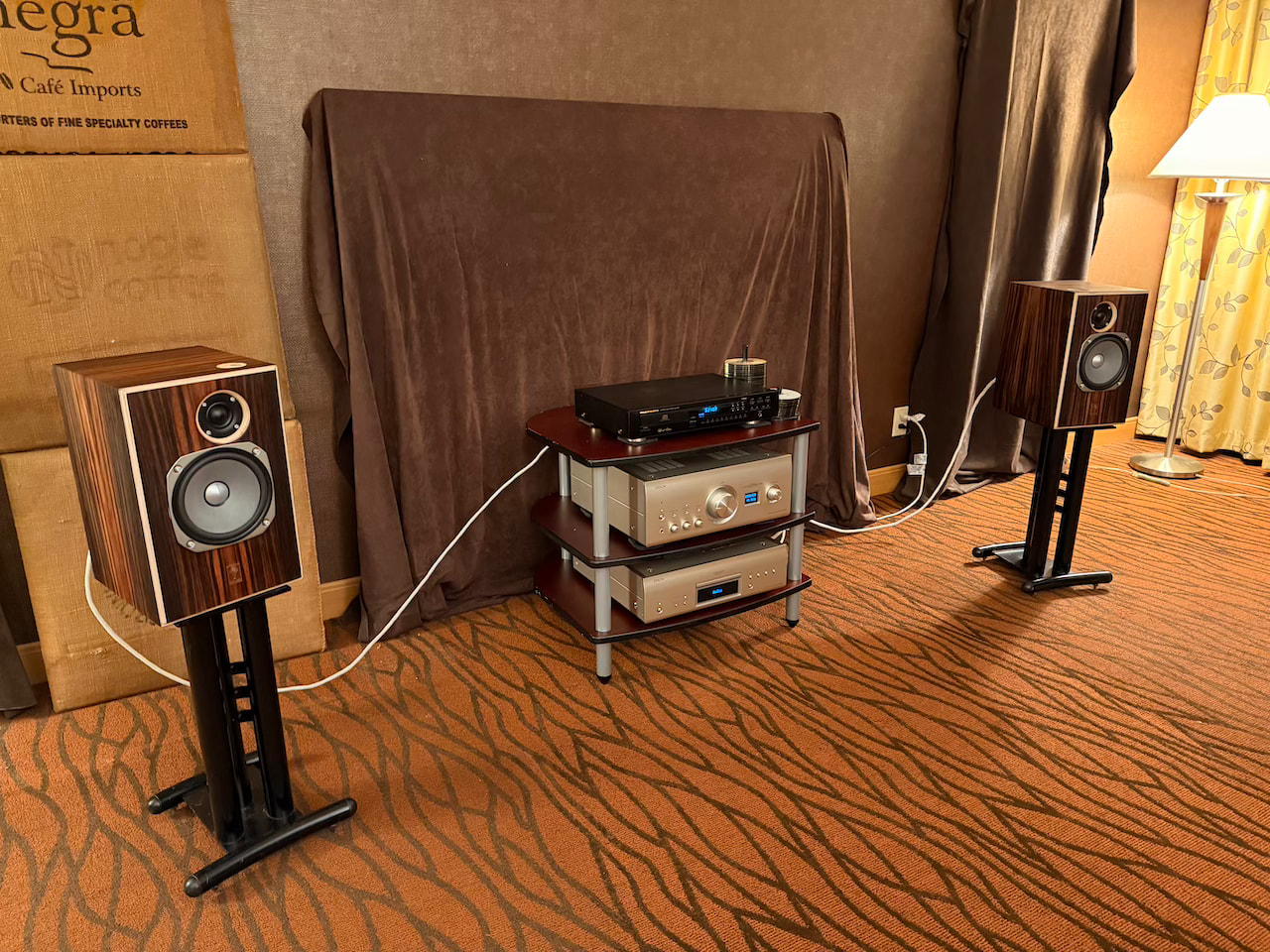
Scaling way back from the six-figure excess, Tony Minasian’s Oriaco room delivered one of the most affordable systems in this year’s Best in Show lineup. The previous winner returned with the Oriaco D6 stand-mount loudspeakers, now $6,300 per pair, driven by Denon’s PMA-3000NE integrated amplifier at $3,799. Add a CD player, stands, and cables, and the system still lands in five-figure territory, but compared with the financial carnage elsewhere at the show, this was refreshingly sane.
Minasian used a vintage Marantz CD player as the source, although the Denon’s capable onboard DAC means almost any suitable CD transport with a digital output could do the job. The PMA-3000NE delivers 80 watts per channel into 8 ohms, includes optical, coaxial, and USB-B digital inputs, and has enough current delivery to make the compact Oriacos sound far larger and more authoritative than their size suggests.
What separates Tony’s speakers is not flash or exaggerated hi-fi fireworks. They reproduce transients, decay, and vocal placement with an uncommon sense of natural ease. Percussion has real air around it, piano notes fade with convincing shape and weight, and vocals lock firmly into the center of the soundstage. The D6 uses a carefully voiced 6-inch full-range driver, front-mounted soft-dome tweeter, and a top-mounted ambient tweeter, all selected and tuned with far more care than the relatively understated cabinet suggests.
The most impressive demonstrations came from Minasian’s own recordings with working musicians, which makes sense because he knows exactly what those sessions should sound like. But the system was equally convincing with orchestral material, Snoop Dogg, and everything in between. It was another reminder that intelligent engineering, careful voicing, and good recordings can still embarrass systems costing many times more.
Atlantis Labs AT38 / AT23 Pro / Neoson
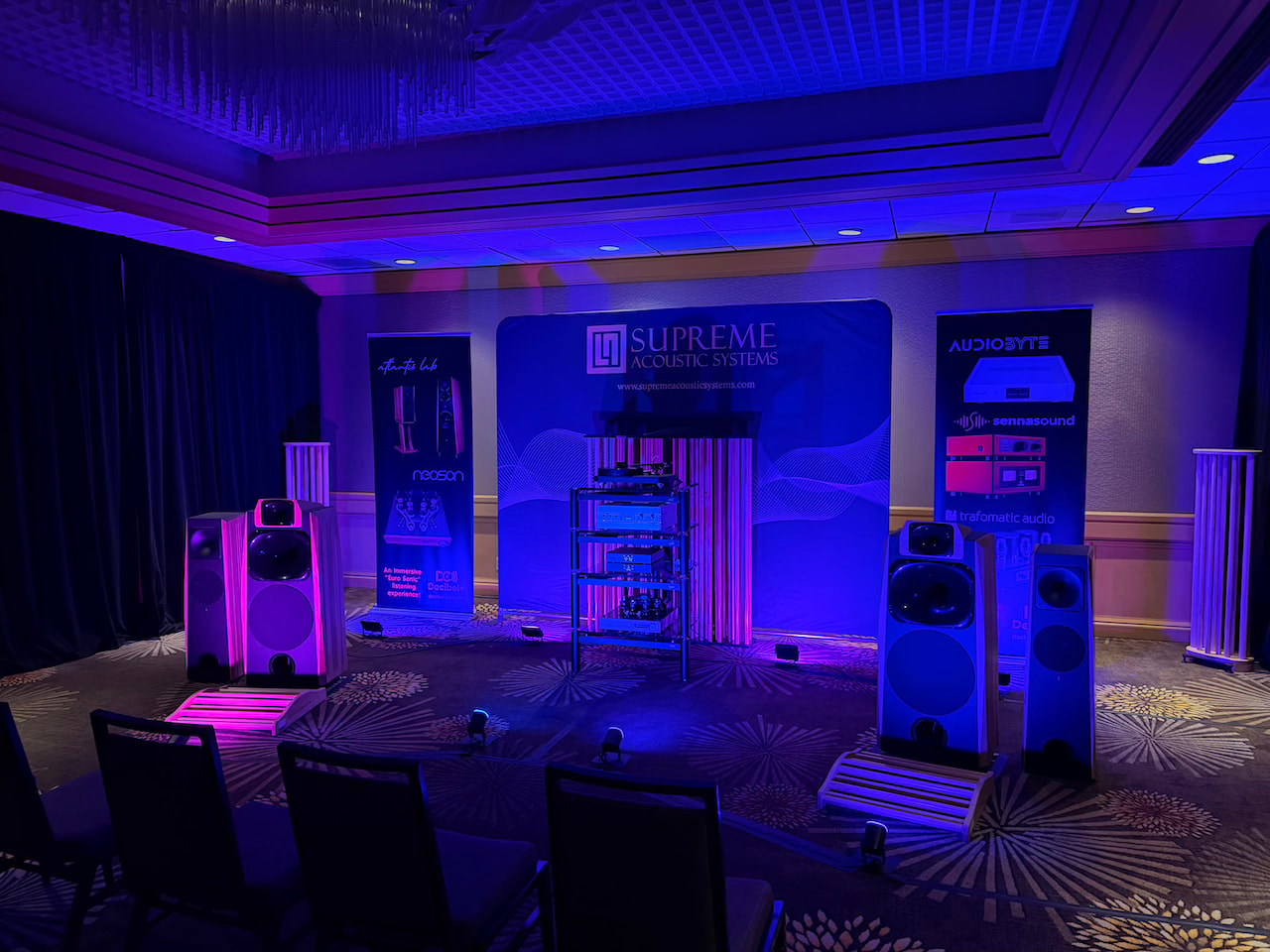
Atlantis Lab and Neoson earn a second Best in Show nod following their impressive T.H.E. Show Vegas debut earlier this year. The basic formula remained intact: high-sensitivity French loudspeakers, low-powered Class A tube amplification, and a digital front end designed to get out of the way. This time, however, the room also featured a BennyAudio turntable making its world premiere at the show.
The Atlantis Lab AT 23 PRO is the accessible entry point here at $6,466 per pair, although “accessible” becomes relative once it is partnered with the $11,828 Neoson Evolution tube amplifier and Audiobyte’s SuperHub streamer and SuperVOX DAC. That puts the digital system around $27,000 before cables, racks, and accessories. Add a serious analog front end and phono stage, and the total moves past $40,000 quickly. Welcome to high-end audio, where the inexpensive option can still require a modest conversation with your financial adviser.
The good news is that the system continues to justify the attention. The AT 23 PRO throws a genuinely wide soundstage, locks vocals firmly into place, and delivers bass with speed and control rather than overhang. The Neoson Evolution’s 20 watts per channel of Class A tube power proved more than sufficient, which is exactly the point of pairing it with loudspeakers this sensitive.
The flagship AT 38 PRO, at $23,939 per pair, brought additional bass weight, greater scale, and a richer, more expansive presentation. Its horn-loaded compression drivers and 38 cm woofer give it a more effortless sense of dynamic freedom, but it did not lose the smaller model’s quickness or ability to make voices feel present in the room.
We will have more to say about the Atlantis Lab AT 23 PRO and Neoson Evolution, both of which are currently under review.
Wolf von Langa / Cinnamon
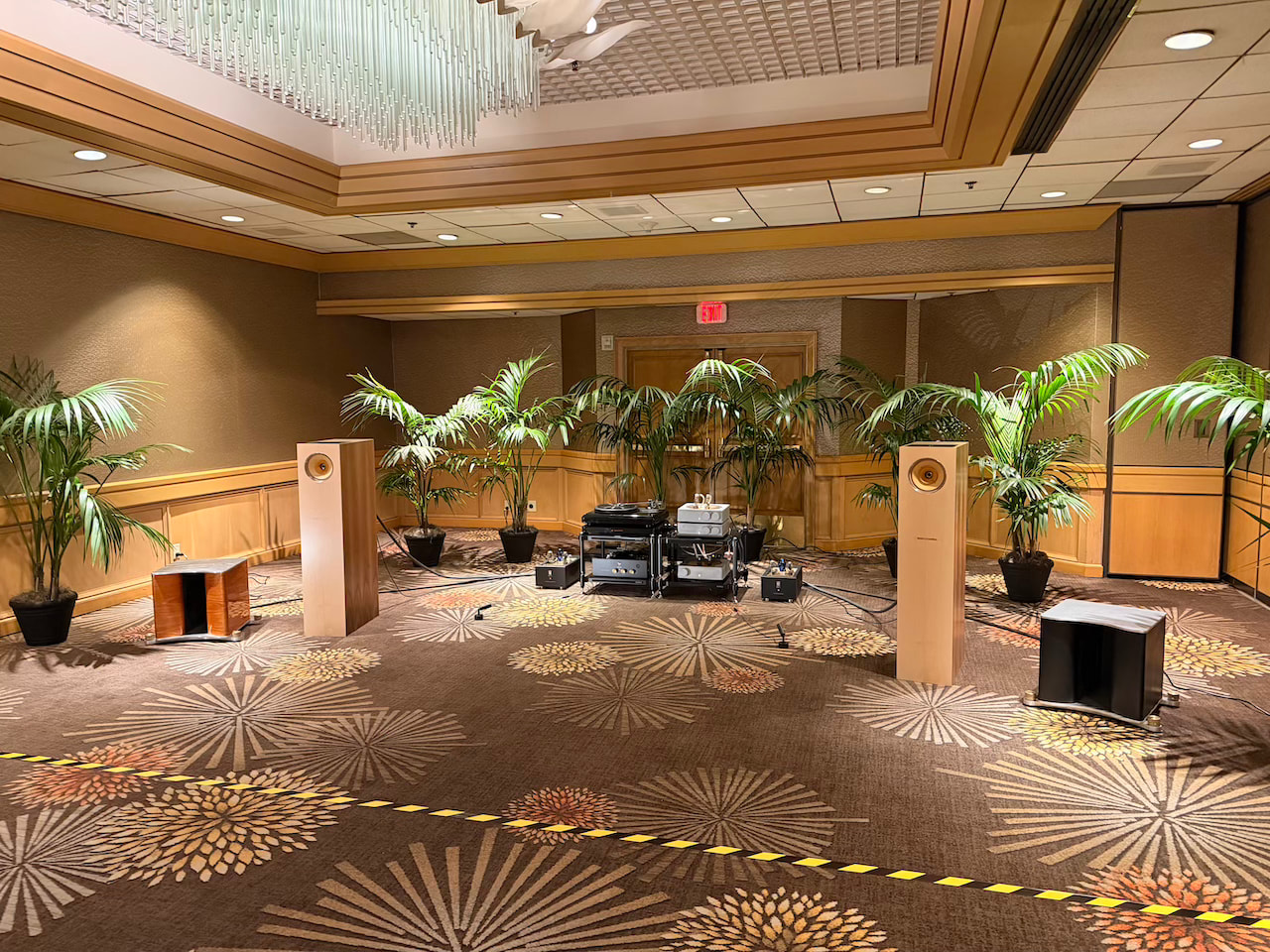
My first experience with the Wolf von Langa WVL 11620 ORGANIC loudspeakers was an instant delight. In a show full of systems flexing enormous power ratings, this room took a far more elegant approach.
The $39,995 German-made ORGANIC field-coil loudspeakers were paired with Cinnamon’s $17,995 Malabar VLF bass system, an SW1X PRE III Classic linestage ($28,041), and SW1X MPA V Special monoblocks ($37,836). The analog front end was equally formidable: a PrimaryControl Kinea II turntable ($27,995) with FCL tonearm ($38,995) and Fuuga MC cartridge ($10,995), feeding Cinnamon’s Galle phono stage ($32,995) and Galle step-up transformer ($8,250).
With nearly $250,000 invested in the core system before cables and accessories, this was not a modest setup. But the sound was not about brute force or audiophile fireworks. It was about finesse: natural vocal presence, excellent low-level detail, tonal color, and a sense of musical flow that made it easy to forget about the hardware.
The ORGANIC speakers delivered the speed, clarity, and realism that make a properly assembled low-power tube system so rewarding. Highly engaging at sensible listening levels, this room proved that a system does not need to turn the volume into an international incident to make a lasting impression.
PranaFidelity / E.A.R. / Furutech
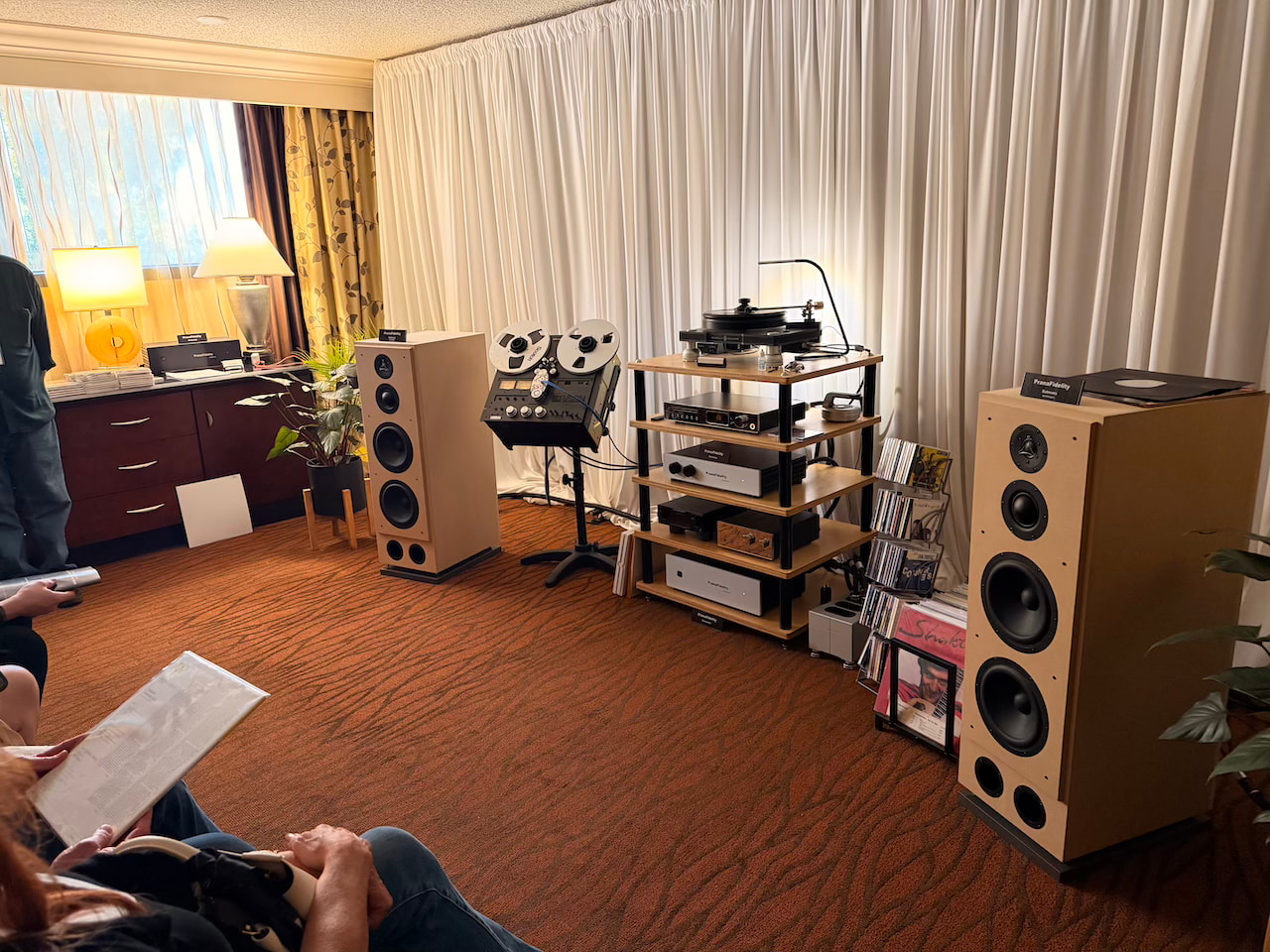
Steven Norber of PranaFidelity arrived at T.H.E. Show SoCal with something genuinely new: the Satmata, a three-way prototype floorstander completed just in time for the event. It is not a finished product yet, but based on what I heard, Norber would be wise not to overthink the final formula.
The analog front end was as serious as the speakers. A Merrill-Williams R.E.A.L. 101.3 turntable fitted with a Breuer Dynamics tonearm and OTTA Theorbo moving-coil cartridge fed an E.A.R. 88PB phono stage, while PranaFidelity’s purna/ma amplifier handled power duties. Furutech power distribution and cabling completed a system that looked deceptively straightforward by high-end show standards, at least until the music started.
The room was packed every time I stopped by. Late on the first day, I finally landed the coveted center seat and understood why. The Satmata created a presentation with real depth, nuance, spaciousness, and remarkably lifelike vocal presence. Rather than simply placing performers across a large soundstage, it pulled the listener closer to the recording without sacrificing scale or composure.
Nima Ben David’s Résonance showed off the system’s ability to reproduce the dynamic bowing, harmonic texture, and natural decay of solo viola da gamba. A mono selection from Porgy and Bess provided the encore, proving that even a straightforward recording can sound deeply immersive when the system gets tone, timing, and scale right. This was one of the most captivating analog rooms at the show.
You must be logged in to post a comment Login