Connect with us
DAPA Banner

Tech

Best Mobile Apps for Soccer Fans in 2026 (By Use Case)

Published

on

There are hundreds of soccer apps in the App Store and Google Play. Most are forgettable. A small number have become genuinely useful tools that serious fans check before, during, and after every match. This guide covers the best of them in 2026 — organized by what you actually want to do, not just ranked in a list.

Best App for Each Use Case — At a Glance

  • Free live streaming: FIFA+ (powered by DAZN)
  • Live scores, fastest updates: Flashscore
  • Deep in-match stats and xG: SofaScore
  • Clean matchday UI and notifications: FotMob
  • News and match previews: OneFootball
  • Fantasy Premier League: Official Premier League App
  • All-in-one (scores + AI predictions): Tiki Taka

No single app does everything equally well. The honest answer for most fans is two apps: one for live scores and stats during the match, and one for news and previews between gameweeks. Everything below is rated on what it actually does best — including what it does poorly.

FIFA+ — Best Free Streaming App

FIFA+ (Powered by DAZN)

Free | iOS + Android + Smart TV | Global availability

The biggest development in soccer fan apps for 2026 is the FIFA and DAZN partnership that relaunched FIFA+ as a free global platform ahead of the World Cup. The new FIFA+ combines what was previously a limited free-tier app with DAZN’s streaming infrastructure, creating a single destination for live matches, on-demand replays, highlights, and original documentaries — all at no cost.

The platform carries live content from more than 100 men’s and women’s leagues, with behind-the-scenes access from national teams and major clubs. For World Cup 2026, FIFA+ is the global home for tournament content, including match archive, player profiles, and exclusive video — making it the most important new soccer app of 2026 for fans who want professional-quality content without a subscription.

Advertisement

Best for: Fans who want free live matches, replays, and World Cup content on any device. Limitation: Does not carry top domestic league matches in most major markets (Premier League, Champions League, etc.) — those rights remain with national broadcasters.

Live Score Apps: Flashscore, FotMob, and SofaScore

These three apps dominate the live score category — but they’re not interchangeable. Each has a distinct strength, and the right choice depends on whether you prioritize speed, depth, or range.

Flashscore — Best for Speed Across Many Sports

Free (ads) / Premium tier available | iOS + Android | Global

Flashscore is the fastest live score app available, and it covers the widest range of competitions and sports of any tool in this category. If you follow multiple leagues simultaneously or want to track matches across different sports during the same evening, no other app matches its breadth. The interface is dense but efficient: fixtures, results, league tables, and H2H records are all one tap away.

Advertisement

Best for: Multi-league fans, fast score checking, fans who also follow non-soccer sports. Limitation: UI is data-heavy and can feel overwhelming for casual fans. In-match stats are shallower than SofaScore.

FotMob — Best Matchday Experience

Free / FotMob Pro (paid) | iOS + Android | Global

FotMob covers live scores, fixtures, tables, match stats, and personalized news from over 500 football leagues. Its edge over the competition is design: it’s the cleanest, most navigable soccer app on mobile. Match pages are well laid out, push notifications are reliable and configurable (goal, lineup, kickoff, final), and the player performance ratings system — where FotMob assigns a match rating to every player — is a feature fans check consistently after full-time.

Best for: Fans who want one polished app for their primary team or league. The “My Teams” personalization layer makes it the best daily companion for following specific clubs. Limitation: Less deep on expected goals (xG) and advanced stats compared to SofaScore.

Advertisement

SofaScore — Best for Deep In-Match Statistics

Free / SofaScore Premium (paid) | iOS + Android | Global

SofaScore is the most data-rich live soccer app available to general consumers. During a live match, it surfaces possession, xG (expected goals), shot maps, player heatmaps, pass accuracy, duel success rate, and a live match timeline that logs every event in sequence. SofaScore ranks best for broad match coverage and live event data among independent evaluations of 2026 football stat tools. The player ratings system covers over 5,000 leagues — a scope that few competitors match.

Best for: Tactically engaged fans, analysts, journalists, and FPL players who use xG and heatmaps as part of their research. Limitation: The free tier is ad-supported; some advanced filters are behind the paid tier. Less polished visually than FotMob.

OneFootball

Free | iOS + Android | Global

Advertisement

OneFootball is the best app for fans who want editorial content — match previews, post-match analysis, transfer news, and club-specific coverage — rather than raw scores. It covers over 100 international soccer leagues and competitions with live commentary and breaking news. For the 2025/26 season, OneFootball added individual player match stats, heatmaps, and shot charts — significantly closing the gap on SofaScore for stat-focused users who prefer a news-first interface.

Best for: Fans who want context alongside scores — club news feeds, manager quotes, pre-match analysis, and transfer rumors curated by competition. Limitation: Live scores are slightly slower to update than Flashscore or FotMob. Stats depth still trails SofaScore for advanced metrics.

Fantasy Premier League — Best Fantasy App

Official Premier League App (FPL)

Free | iOS + Android | Global

If you play Fantasy Premier League — and with tens of millions of managers globally it’s hard to avoid — the official Premier League app is the authoritative tool for managing your FPL squad, tracking points, and researching player history across 30+ years of match data. For 2025/26, the Premier League introduced meaningful rule changes: points now reward defensive contributions (not just clean sheets), and managers receive two full sets of chips across the season, including the new “Wildcard reset” mechanic that gave veteran players new strategic options mid-season.

Advertisement

Beyond FPL, the app includes official match highlights, the full Premier League fixture list, club news, and historical stats — making it a useful general companion for EPL fans even if you don’t play fantasy.

Best for: Fantasy Premier League players — no third-party app fully replicates the official FPL interface. Also strong for EPL-only fans who want an official, ad-light source. Limitation: Coverage is limited to the Premier League; no use for following other competitions.

How to Build Your App Stack (Practical Workflow)

Most fans don’t need seven apps — they need two or three that serve different moments in the matchday cycle. Here’s a practical structure by fan type:

Fan Type Primary App Secondary App Optional Add
Casual EPL fan FotMob (scores + news) Official PL App (FPL + highlights) FIFA+ (free streaming)
Multi-league follower Flashscore (breadth + speed) OneFootball (news by competition) SofaScore (deep stats)
Tactical / stats-focused fan SofaScore (xG, heatmaps, ratings) FotMob (notifications + match UI) OneFootball (previews + context)
Fantasy Premier League player Official PL App (team management) SofaScore (player form research) FotMob (live GW scoring)
World Cup 2026 casual fan FIFA+ (free streams + content) FotMob (scores + fixtures)

For more on where to find full live streams beyond what FIFA+ carries free, see our guide on the best official soccer streaming services by region — which covers Peacock, Paramount+, Stan Sport, beIN, and the other major paid platforms in detail.

Advertisement

What to Avoid

A note worth adding: the App Store and Google Play are full of apps with “Soccer 2026” or “Football Live” in their titles that are either clones, data scrapers, or ad-farms built to rank on search. The apps in this guide are independently developed, widely used, and actively maintained. Before installing any soccer app not mentioned here, check: when was it last updated? Does it have a verified developer? Is the review score based on genuine engagement or padding? These are small checks that save frustration. If you want to go deeper on how technology shapes the fan experience more broadly, our overview of how technology has transformed the soccer fan experience covers smart stadiums, AI officiating, AR tools, and streaming infrastructure in one place.


Key Takeaways

  • FIFA+ is the most significant new app development for 2026 — relaunched with DAZN as a free global platform covering 100+ leagues, live and on-demand.
  • Flashscore is the fastest live score app for fans who follow multiple competitions or sports simultaneously.
  • FotMob offers the most polished matchday experience, best push notifications, and the cleanest UI in the category.
  • SofaScore is the go-to for tactical fans who want xG, heatmaps, player ratings, and deep in-match data.
  • OneFootball added heatmaps and shot charts for 2025/26, making it a stronger all-round app for fans who want news alongside stats.
  • Official Premier League App is the only tool to use for FPL management; the 2025/26 season introduced defensive contributions scoring and two chip sets.
  • You don’t need six apps. Two or three, chosen by use case, covers everything most fans need.

Frequently Asked Questions

What is the best free soccer app in 2026?

For live streaming, FIFA+ (powered by DAZN) is the best free option — it carries content from 100+ leagues globally at no cost. For live scores, FotMob and Flashscore are both free at their base tier and cover the vast majority of what most fans need without paying. All three are available on iOS and Android.

What is the difference between FotMob and SofaScore?

FotMob is cleaner and better designed for casual matchday use — great notifications, smooth navigation, and strong player ratings. SofaScore goes deeper on data: expected goals (xG), player heatmaps, pass accuracy, and duel statistics are all available live during a match. For general fans, FotMob is the better daily driver. For tactical or analytically-minded fans, SofaScore provides more useful information.

Is FIFA+ actually free? What’s the catch?

Yes — the relaunched FIFA+ platform on DAZN is free globally. The trade-off is that it does not carry the major domestic league competitions (Premier League, La Liga, Serie A, Champions League) that are licensed exclusively to national broadcasters. What it does carry — international football, women’s football, lower-tier leagues, World Cup content, and documentaries — is genuinely high quality and available without any subscription or registration requirement.

Which soccer app is best for Fantasy Premier League players?

The official Premier League app is the primary tool for managing your FPL squad, transferring players, and tracking points. For research and player form analysis, SofaScore is the best complement — its player ratings, heatmaps, and match-by-match stats are directly useful for FPL transfer decisions. FotMob is useful during live gameweeks for tracking provisional points in real time.

Advertisement
Does OneFootball show live scores?

Yes. OneFootball shows live scores, live match commentary, and basic stats for over 100 competitions. For the 2025/26 season it added heatmaps, shot charts, and individual player match statistics. It is slightly slower to update than Flashscore or FotMob during live matches, but for fans who primarily want news, previews, and post-match analysis, it covers all the basics well.

What soccer apps work best outside Europe and North America?

SofaScore, FotMob, and Flashscore all have global league coverage that extends well beyond European competitions — including South American, Asian, and African leagues. FIFA+ is also fully global and covers women’s and lower-tier competitions often ignored by other platforms. For live streaming in MENA specifically, the TOD app (beIN Sports) is the primary option for top-tier European club football.

Are there soccer apps specifically designed for the 2026 World Cup?

FIFA+ is the official platform for World Cup 2026 content — free globally, covering live tournament matches, highlights, player profiles, and archive material. The BestFootball 2026 Cup app on iOS is a dedicated competition-tracking tool specifically built for the tournament, useful for bracket tracking and scheduling. All major score apps (FotMob, Flashscore, SofaScore) will also carry full World Cup live coverage.

Do I need to pay for any app to follow soccer in 2026?

For scores, stats, news, and some live content — no. FotMob, Flashscore, SofaScore, OneFootball, and FIFA+ all have robust free tiers that cover most of what casual to passionate fans need. Paid tiers on SofaScore and FotMob remove ads and unlock advanced filters, but are not necessary for core functionality. For full live streaming of the Premier League, Champions League, and other top competitions, a paid streaming subscription (Peacock, Paramount+, Stan Sport, etc.) is required — see our regional streaming services guide for details.


Advertisement

Source link

Continue Reading
Click to comment

You must be logged in to post a comment Login

Leave a Reply

Tech

NYT Strands hints and answers for Sunday, May 3 (game #791)

Published

on

Looking for a different day?

A new NYT Strands puzzle appears at midnight each day for your time zone – which means that some people are always playing ‘today’s game’ while others are playing ‘yesterday’s’. If you’re looking for Saturday’s puzzle instead then click here: NYT Strands hints and answers for Saturday, May 2 (game #790).

Strands is the NYT’s latest word game after the likes of Wordle, Spelling Bee and Connections – and it’s great fun. It can be difficult, though, so read on for my Strands hints.

Advertisement

Source link

Advertisement
Continue Reading

Tech

AI-generated actors and scripts are now ineligible for Oscars

Published

on

The organization behind the Academy Awards released new Oscar rules on Friday, including several that address the use of generative artificial intelligence.

The Academy of Motion Picture Arts and Sciences said that only performances “credited in the film’s legal billing and demonstrably performed by humans with their consent” will be eligible for Academy Awards. Similarly, the academy said that screenplays must be “human-authored” to be eligible.

The academy also said it has the right to request more information about a film’s AI usage and “human authorship.”

These rule changes come as an independent film is in the works with an AI-generated version of Val Kilmer, as AI “actress” Tilly Norwood keeps making headlines, and as new video models are causing at least a few filmmakers to make sweeping declarations of despair. AI was also one of the main sticking points in the actors’ and writers’ strikes back in 2023.

Advertisement

Outside Hollywood, at least one novel has been pulled by its publisher due to the apparent use of AI, and other writers’ groups are declaring that AI usage makes work ineligible for awards.

Source link

Continue Reading

Tech

Tesla Starts Selling Chinese-Made Model 3s In Canada At The EV’s Lowest Price Ever

Published

on


Tesla has lowered the bar for electric vehicle affordability in Canada with the latest Model 3 Premium Rear-Wheel Drive option. Reintroducing its entry-level sedan in Canada, Tesla’s RWD variant for the Model 3 will start at $39,490 CAD, or approximately $29,000. That’s nearly half the price of the previous entry-level price point for a Model 3 in Canada, which started at $79,990 CAD, or around $59,000.

At the higher end, Tesla also reduced the price of its Model 3 Performance for Canadian customers from $89,000 CAD to $74,990 CAD, or around $55,000. To explain the sudden shift, we have to thank Tesla’s global supply chain and the ever-evolving tariff situation across the world. Canadian residents were previously able to buy a Model 3 made in Tesla’s Shanghai factory before 2024, but Canada eventually slapped an additional 100 percent tariff on EVs made in China. In response, Tesla switched to offering EVs built in its Fremont, Calif. factory to Canadian customers. However, following the Trump administration’s tariff campaign, Canada instituted a 25 percent retaliatory tariff on US-made vehicles that led to the $79,990 CAD price tag on the most affordable Model 3 for Canada at the time.

Advertisement

In the latest shift, Canada reduced the tariffs on Chinese-made EVs to just 6.1 percent, allowing for Tesla to once again ship its EVs made in the Giga Shanghai factory into the country for more reasonable prices. It’s important to note that the Model 3 Premium RWD option isn’t currently covered in Canada’s new Electric Vehicle Affordability Program that allows for up to a $5,000 CAD incentive. Although the latest incentive program recently went into effect, the newest Model 3 doesn’t apply since it’s not made in Canada.


Advertisement

Source link

Continue Reading

Tech

Boston Scientific’s Sean Gayer on a meaningful mission

Published

on

The final episode of The Leaders’ Room podcast season four features Sean Gayer, VP of operations for EMEA manufacturing at Boston Scientific. This series is created in partnership with IDA Ireland.

Once again in season four of The Leaders’ Room podcast, we get to know the leaders of some of the most influential multinationals in tech, life sciences and innovation, as well as getting insights into their leadership styles and the high-tech trends that are transforming their industries.

In this final episode of season four, we speak to Sean Gayer, VP of operations for EMEA manufacturing at Boston Scientific, about his role at one of the world’s major medtech organisations, the future of human health as we all live longer, and the kind of leadership that keeps people – and patients – at the centre.

Advertisement

Boston Scientific was founded in 1979 and is today a global medical device company with revenues of $20bn, a presence in 127 countries, 59,000 employees and 48m patients treated annually. Its stated mission – to transform lives through innovative medical solutions – is one that comes through clearly in how Gayer talks about the company and the work being done at its three Irish facilities.

In Ireland, Boston Scientific has three manufacturing sites and around 8,000 employees in total. Galway, the largest site with more than 4,000 staff, focuses on cardiovascular products including the Watchman device – a stroke prevention product placed in the heart that reduces the risk of clotting and the need for lifelong blood thinners.

Clonmel makes active implantables: defibrillators, pacemakers and a deep brain stimulation device used in the treatment of Parkinson’s. Cork produces cancer treatment products, catheters and a device called Rotablator, which rotates at 160,000 revolutions per minute to drill out calcified plaque in the arteries, explains Gayer.

A €75m investment in R&D capabilities in Galway was announced shortly before we spoke, which Gayer says reflects the confidence the company has in the Irish sites, and the direction of travel for Boston Scientific in this country.

Advertisement

Scorekeeper or team player?

Gayer’s route to his current role is an unconventional one, and he tells it with good humour. A BCom from UCC, training at PwC, and then his first industry role at Millipore (now Merck), where an early manager gave him advice that has stayed with him to this day: you can be a scorekeeper or a team player, and you’ll have more fun being a team player. “Go down to the production floor, understand what is driving the numbers, and then you can actually do something about them,” explains Gayer.

It is a principle he refers to as Gemba – going to where the problem actually is, talking to the people doing the work – and he has carried it through every role since: a hearing healthcare company, a spell in telecoms and ICT, and then Boston Scientific Cork in 2013 as finance director. Two years later he became site lead, and two years ago he stepped into the EMEA regional role. An accountant, as he puts it, “who had too much interest in operations”.

On leadership, Gayer draws on the Shingo Prize model, which Boston Scientific Cork challenged for successfully during his time as site lead. At the top of the triangle is the North Star – for Boston Scientific, positively impacting patients’ lives. At the base are the cultural enablers – lead with humility, and respect every individual, says Gayer. The middle piece, he says, takes care of itself if you give the right people a well-defined problem rooted in purpose.

Looking to the future

The conversation about the future of human health is a fascinating one. We are living longer – average life expectancy in Ireland has risen by more than 20 years in the past century, and that is likely to continue. That puts real pressure on health systems, and Gayer sees AI, robotics and remote monitoring as part of the response – AI for early detection and clinical decision-making, robotic-assisted surgeries and virtual wards that allow patients to recover at home while being monitored remotely. That kind of thinking, he says, is what the health system needs more of.

Advertisement

In manufacturing, the focus is on supply chain resilience post-Covid and on smarter, more connected factories where pooled data supports better decision-making. Boston Scientific’s Irish workforce of 8,000 represents, as Gayer put it to the company’s board, more than 70,000 years of accumulated knowledge. That, he said without hesitation, is their greatest asset.

We’re grateful to all our interviewees again this season, for taking the time out of busy schedules to come into the studio and share their insights and their intelligence with us. And a big thanks as ever to our partners IDA Ireland who make this series possible.

The Leaders’ Room podcast is released fortnightly and can be found by searching for ‘The Leaders’ Room’ wherever you get your podcasts. For those who prefer their audio with visuals, filmed versions of the podcast interviews are all available here on SiliconRepublic.com.

Check out The Leaders’ Room podcast for in-depth insights from some of Ireland’s top leaders. Listen now on Spotify, on Apple or wherever you get your podcasts.

Advertisement

Source link

Continue Reading

Tech

Amazon earnings preview: Big AI deals meet a $200B spending binge

Published

on

Amazon reports first-quarter earnings Wednesday amid accelerating cloud growth and a record capital spending plan. (GeekWire File Photo)

Follow-up: AWS growth climbs to 28% as Amazon’s big AI bets start to pay off

Amazon reports first-quarter earnings Wednesday with more signs than ever that its cloud business is in demand, including a $244 billion revenue backlog, blockbuster deals with Meta,  OpenAI and Anthropic, and a custom chip business that doubled in a matter of months.

The problem: a $200 billion capital spending plan, largely dedicated to new AI infrastructure, that drained Amazon’s free cash flow and sank its stock 10% last quarter. 

Here’s a preview of the key numbers and storylines to watch.

Core expectations: Wall Street expects Amazon to report about $177 billion in first-quarter revenue, up roughly 14% from a year ago, with earnings of $1.65 per share. That’s up just 4%, reflecting the growing depreciation costs from the company’s infrastructure buildout.

Advertisement

Amazon’s guidance for first-quarter operating income ranges from $16.5 billion to $21.5 billion — a $5 billion spread that reflects uncertainty around tariff impacts on its retail business and about $1 billion in new costs from its satellite internet project, Amazon Leo.

AWS growth: But the main event is Amazon Web Services, where analysts expect about $36.8 billion in revenue, up nearly 26% from a year ago. AWS growth has been accelerating for three straight quarters (from 17% to 20% to 24%) and investors are looking for that to continue.

On the fourth-quarter earnings call, CEO Andy Jassy described the AI market as a “barbell” — with AI research labs spending heavily on one end, and enterprises automating routine tasks on the other. The massive opportunity, he said, is in the middle: core enterprise production workloads that haven’t moved to AI yet, for the most part.

“The lion’s share of that demand is still yet to come,” Jassy said.

The question is whether that middle is starting to fill in, or whether AWS growth is still being driven primarily by a handful of giant AI lab deals.

Advertisement

Beyond the cloud: It’s easy to forget in the AI frenzy, but Amazon is also the country’s largest online retailer, and the first quarter brings its own set of pressures. Jassy warned earlier this year that import costs from tariffs were starting to show up in product prices, and the company faces growing competition from Walmart, Temu, and Shein for cost-conscious shoppers. 

Online store sales grew 10% to $83 billion in the holiday quarter, and third-party seller services brought in $52.8 billion. But costs are rising too: Amazon spent $31.5 billion on shipping in Q4, up 10% from a year earlier.

At the same time, the company has been cutting costs aggressively, eliminating about 16,000 corporate jobs in January in what Jassy has described as a campaign against bureaucracy, followed by additional cuts in its robotics unit in March.

Advertising remains a standout, growing 23% to $21.3 billion in the fourth quarter and emerging alongside AWS as one of Amazon’s primary profit engines. 

Amazon won’t be the only tech giant reporting Wednesday. Microsoft, Alphabet, and Meta are all scheduled to release quarterly results the same day, giving investors a chance to compare notes on AI spending and cloud growth across the industry. 

Advertisement

Google Cloud has been growing faster than AWS in percentage terms, adding another dimension to the debate over which company is best positioned to capitalize on the AI boom.

Check back Wednesday afternoon for coverage.

Source link

Advertisement
Continue Reading

Tech

NYT Connections hints and answers for Sunday, May 3 (game #1057)

Published

on

Looking for a different day?

A new NYT Connections puzzle appears at midnight each day for your time zone – which means that some people are always playing ‘today’s game’ while others are playing ‘yesterday’s’. If you’re looking for Saturday’s puzzle instead then click here: NYT Connections hints and answers for Saturday, May 2 (game #1056).

Good morning! Let’s play Connections, the NYT’s clever word game that challenges you to group answers in various categories. It can be tough, so read on if you need Connections hints.

Advertisement

Source link

Advertisement
Continue Reading

Tech

The Supreme Court’s Voting Rights Ruling Is Results-Driven Cynicism, Not Law

Published

on

from the just-garden-variety-racism dept

I will continue to make the case for a 100 Justice Supreme Court because we need to get to the point that no single Supreme Court Justice matters. As it stands, each individual Justice has way too much power, and when they go mad with it, they can undermine the very structure of democracy. And while I’m sure some people will insist this is sour grapes about cases not going the way I want, it’s not that. I can accept rulings I disagree with, where I can see and understand the Constitutional logic behind them. For example, while I agree that the post-Citizens United change in campaign finance has been disastrous and needs to be fixed, I think the actual ruling in that case is not just defensible, but correct on the law (i.e. I think the fixes to campaign finance should come from elsewhere, not from getting rid of that ruling).

Similarly, while the underlying hatred and bigotry animating the decisions in 303 Creative and Chiles v. Salazar are deeply problematic, the actual rulings make some level of Constitutional sense on First Amendment grounds.

But the Roberts Court keeps handing down rulings that have no basis in any actual Constitutional principles, and are instead very clearly ideological and results-driven approaches to deciding cases. The Dobbs decision on abortion, most famously, but also (obviously) Trump v. US in which the Supreme Court effectively ruled that Trump could violate any law he wanted while President. And now we can add to that Louisiana v. Callais, which effectively brings back Jim Crow segregation and turns the Fifteenth Amendment into a dead letter.

If you want deeper analysis on just how fucked up this ruling is, I’ll point you to voting law expert Rick Hasen’s writeup in Slate, where he calls it “the worst ruling in a century.” But even more useful is his follow-up piece on just how cowardly Alito’s reasoning is:

Advertisement

In Callais, Alito purported to overturn no precedent, claiming he was merely “updating” a framework that the Supreme Court constructed in the 1986 Thornburg v. Gingles case to determine when a redistricting plan violates Section 2 of the Voting Rights Act by diluting minority representation. This follows his 2021 majority opinion in Brnovich v. Democratic National Committee, where he purported to provide mere “guidelines” for determining when a state violates Section 2 in passing a law related to voting or voter registration.

In both cases, however, Justice Alito made it impossible for plaintiffs to win their cases, leaving Section 2 on the books, but essentially toothless. Since Brnovich, as I showed in a recent law review article, no plaintiffs have brought successful suits under Section 2 challenging a law alleged to suppress votes. Justice Elena Kagan’s exasperated dissent in Callais cited this research and rightly predicted the same fate for redistricting claims under Section 2: “The consequences are likely to be far-reaching and grave. Today’s decision renders Section 2 all but a dead letter.”

But I want to focus on something a bit different, which is just how hypocritical many of the recent decisions are. The supposedly “conservative” Justices contradict themselves over and over again to reach the motivated result they are seeking. We’ve already seen some of this in other rulings, such as when the court decided that nationwide injunctions by district courts were bad… but only when they were used against Trump (after blessing many against Biden).

In Callais we see more of the same. Remember, just two years ago in the Loper Bright case, this same Supreme Court pretended to stand on principle against the administrative state by arguing that the executive branch had way less power than it had previously suggested in its old Chevron case, arguing that the power of Congress to define things rather than delegate decisions is key. Well, the Fifteenth Amendment explicitly says that “Congress shall have the power to enforce this article by appropriate legislation” in order to make sure that “the right of citizens of the United States to vote shall not be denied or abridged by the United States or by any State on account of race….”

So in one case it’s left for Congress to legislate to clarify governmental power, and in the other Justice Alito and the other conservatives on the Court have decided they can take that Constitutionally granted power away from Congress — not based on any actual Constitutional reason, but because they’ve concluded that racism is over. That’s literally the crux of Alito’s argument, in which he notes that:

Advertisement

By 2004, the racial gap in voter registration and turnout had largely disappeared, with minorities registering and voting at levels that sometimes surpassed the majority. Black voters now participate in elections at similar rates as the rest of the electorate, even turning out at higher rates than white voters in two of the five most recent Presidential elections nationwide and in Louisiana.

Of course, this is both highly misleading and beside the point of what the Constitution actually says in the Fifteenth Amendment, which gives that power to Congress to decide. It’s misleading because he cherry-picked “two of the five most recent” elections to obscure the fact that it wasn’t true in the last three — elections that occurred only after the Court had already hollowed out the rest of the Voting Rights Act.

As we discussed last year in the Texas redistricting case, the Supreme Court has made it clear in previous rulings that it’s totally legal to gerrymander for partisan reasons, just so-long as it’s not explicitly for racial reasons. The problem in Texas was that its legislature had initially rejected the (already flimsy and obviously pretextual) partisan reasons for redistricting until the Trump DOJ threatened them over the racial makeup of districts, leading to the last minute decision to redistrict, solely in response to the warning about the racial makeup of districts from the Trump admin. The lower court (in a ruling issued by a Trump appointed judge) found that to be a violation of the Fourteenth and Fifteenth Amendments.

But, bizarrely, this Supreme Court also tossed out that ruling on the shadow docket (naturally) in December, claiming it had to do this because it was too close to the election in Texas to toss out the redistricted maps… even though the election was many months away and the “redistricted” maps had only been created a few months earlier. Literally none of it made sense. That ruling was just a stay to allow the redistricted maps for the 2026 midterm elections, but the case technically continued over whether or not there could be an injunction against the maps.

In an absolutely bizarre ruling on Monday (right before this Callais ruling) the Supreme Court effectively further rejected the challenge to Texas’ redistricting by simply citing its original shadow docket ruling, even though (1) the issue before the court now is different and (2) that original shadow docket ruling was based on no significant briefing or oral arguments. Court watcher (and shadow docket coiner/criticizer) Steve Vladeck notes that this is a dangerous power grab by the court:

Advertisement

I can’t remember a prior case with this kind of (true) summary reversal—where the Court just reversed a three-judge district court on the merits without any detailed explanation.

The original (already questionable) order was procedural, and apparently deemed necessary due to the “emergency” nature of an election that wasn’t happening for months and for which there was plenty of time to adjust. But to then claim to rule on the merits of the case by simply pointing back to that other emergency ruling, without more detailed briefing and without explanation, is bizarre.

But remember: the stated basis for the December ruling was the supposedly imminent 2026 midterm primaries. And then look at what happened in Louisiana after the Callais decision, where Governor Jeff Landry literally declared a “state of emergency” to suspend the already ongoing primary election in order to initiate redistricting, based on the Callais ruling.

So if you’re playing along at home, in Texas they redrew the Congressional maps in August of 2025 for blatantly racial reasons (as called out by a Trump-appointed judge in November, who provided a ton of evidence). In December of 2025, the Supreme Court said that those racially-biased new districts had to stay because it was too close to the 2026 midterms (which were still months away) to try to redistrict (despite the ability to easily go back to the pre-August districts which were the existing districts). But now, in late April, based on this new Supreme Court ruling, Louisiana can magically stop elections in which voting has already occurred in order to redistrict to create more racist gerrymandering.

And all this because Alito and Roberts are happy to literally ignore the Fifteenth Amendment when they don’t like the results.

Advertisement

That is what results-driven judicial decision-making looks like. And it’s why the court is viewed as increasingly illegitimate across the board.

I can live with the Court issuing principled rulings I disagree with. But here there are no principles on display beyond “we’re racist and we want to deprive non-white people of their vote.” The Supreme Court makes it clear that it is illegitimate with such a move, and not worthy of any respect at all.

And that won’t change until we get real reform, such as by shifting the Court so that no single Justice (or small clique of Justices) has so much power.

Advertisement

Filed Under: 14th amendment, 15th amendment, callais, constitution, discrimination, john roberts, louisiana, motivated reasoning, racism, samuel alito, supreme court, voting rights, voting rights act

Source link

Advertisement
Continue Reading

Tech

One of AMD’s best gaming CPUs is now much cheaper than usual

Published

on

Cache is the most underrated word in PC gaming, and this chip is built around having more of it than almost anything else on the market.

That’s the promise the AMD Ryzen 7 7800X3D has always made, and at $324.99 down from $449, saving you $124.01, it’s now a far easier one to act on.

Deal AMD Ryzen 7 7800X3DDeal AMD Ryzen 7 7800X3D

The AMD Ryzen 7 7800X3D has dropped by nearly a third, offering a speed boost for your PC without the high cost

A near‑third price drop on the AMD Ryzen 7 7800X3D means one of the most capable consumer CPUs is now firmly in “why not upgrade” territory.

Advertisement

View Deal

The story of Ryzen 7 7800X3D begins with AMD’s 3D V-Cache technology, which stacks an additional layer of cache directly onto the processor die, taking total cache up to a remarkable 104MB across L2 and L3 combined.

Advertisement

What that means in practice is that the processor can hold far more game data close at hand, reducing the number of times it needs to fetch information from slower system memory during a demanding gaming session.

The result is smoother frame rates in CPU-limited titles, the kind of real-world gaming uplift that raw clock speed alone has never been able to deliver quite as reliably or as consistently.

Advertisement

Underpinning all of this is AMD’s Zen 4 architecture, built on a 5nm process, which brings eight cores and sixteen threads to bear at a base speed of 4.2GHz across the Socket AM5 platform.

Advertisement

The Whatsapp LogoThe Whatsapp Logo

Get Updates Straight to Your WhatsApp

Join Now

Advertisement

The 7800X3D draws 120W under load, which is relatively disciplined for a high-performance desktop processor, though it is worth noting that no cooler is included in the box, so factor that into your overall build budget.

This deal makes the most sense for anyone already on AM5 or planning a new build around it, and who wants a processor that will hold its own in demanding games for years rather than months, at a price that no longer requires a painful compromise elsewhere in the build.

SQUIRREL_PLAYLIST_10148964

Advertisement

Advertisement

Source link

Continue Reading

Tech

Ask Slashdot: Are YouTube’s Subtitles ‘Appallingly Bad’?

Published

on

Long-time Slashdot reader Anne Thwacks frequently uses YouTube’s subtitles “not to disturb others in the room, or because my hearing is not very good.” But they say there’s a new problem.

“The subtitling is terrible!”

Almost every sentence has a huge error. Proper names are more often wrong than right. Non-English place names are almost always mangled to barely recognizable. And no effort whatsoever is made to use context to figure out whether a place name is Russian or Arabic, and often complete garbage is used in place of a common French, Spanish or Italian name!

If AI actually works (I have my doubts about this), surely it would be possible to figure out language contexts. If it is about an event in Italy, then expect a lot of Italian names! If it is about the Russia-Ukraine war, then expect places in Russia or Ukraine to be more plausible than mindless gobbledygook! Does YouTube not know that there are places in the world that are not in America? (However, plenty of names of people and places famous in America are also regularly screwed up.)

They argue the subtitles are “appallingly bad” — and that “the situation seems to be getting worse,” wondering why the problem isn’t addressed with some basic spell-checking. (“I’m sure that the vast majority of foul-ups could be fixed by the use of a dictionary.”) Have any Slashdot readers seen similar problems? A friend of mine noticed that YouTube’s subtitles even bungled this innocuous song from the 1966.

Advertisement

ANNETTE FUNICELLO: “If your love is true love, you can tell by his touch.”
YOUTUBE SUBTITLE: “If your love is too lava, you can tell by his touch…”

Share your own experiences and thoughts in the comments. And do you think YouTube’s subtitles are “appallingly bad”?

Source link

Advertisement
Continue Reading

Tech

Criminal IP and Securonix ThreatQ Collaborate to Enhance Threat Intelligence Operations

Published

on

Criminal IP + ThreatQ

Criminal IP partners with Securonix to integrate Criminal IP’s Threat Intelligence into ThreatQ, allowing organizations to incorporate external IP intelligence into their existing workflows, helping security teams accelerate analysis and response with more actionable context.

Unlike traditional intelligence feeds, Criminal IP provides visibility into how assets and infrastructure are exposed across the internet. By embedding this data into ThreatQ, organizations can incorporate real-world context into investigations without disrupting existing processes.

ThreatQ centralizes and prioritizes threat data from multiple sources. With Criminal IP integrated, organizations can enrich this data with continuously updated, exposure-based intelligence, strengthening investigation and response workflows without added complexity.

Automated Intelligence Enrichment at Scale

Within the integrated environment, Criminal IP’s threat intelligence APIs automatically enrich incoming IP indicators in ThreatQ with contextual data such as maliciousness scoring, VPN and proxy detection, remote access exposure, open ports, and known vulnerabilities.

Advertisement

Powered by ThreatQ’s data-driven orchestration engine, organizations can configure automated workflows that continuously evaluate incoming indicators against Criminal IP’s threat database.

This ensures that threat context remains current without requiring manual analyst effort, supporting faster triage and more consistent prioritization.

Integrate Criminal IP’s exposure-based threat intelligence into ThreatQ to enrich IP indicators with real-time context.

Automate analysis with maliciousness scoring, VPN/proxy detection, and infrastructure insights to accelerate investigation and response within a unified workflow.

Advertisement

Explore Criminal IP Integration

Real-Time Investigation Within a Unified Workspace

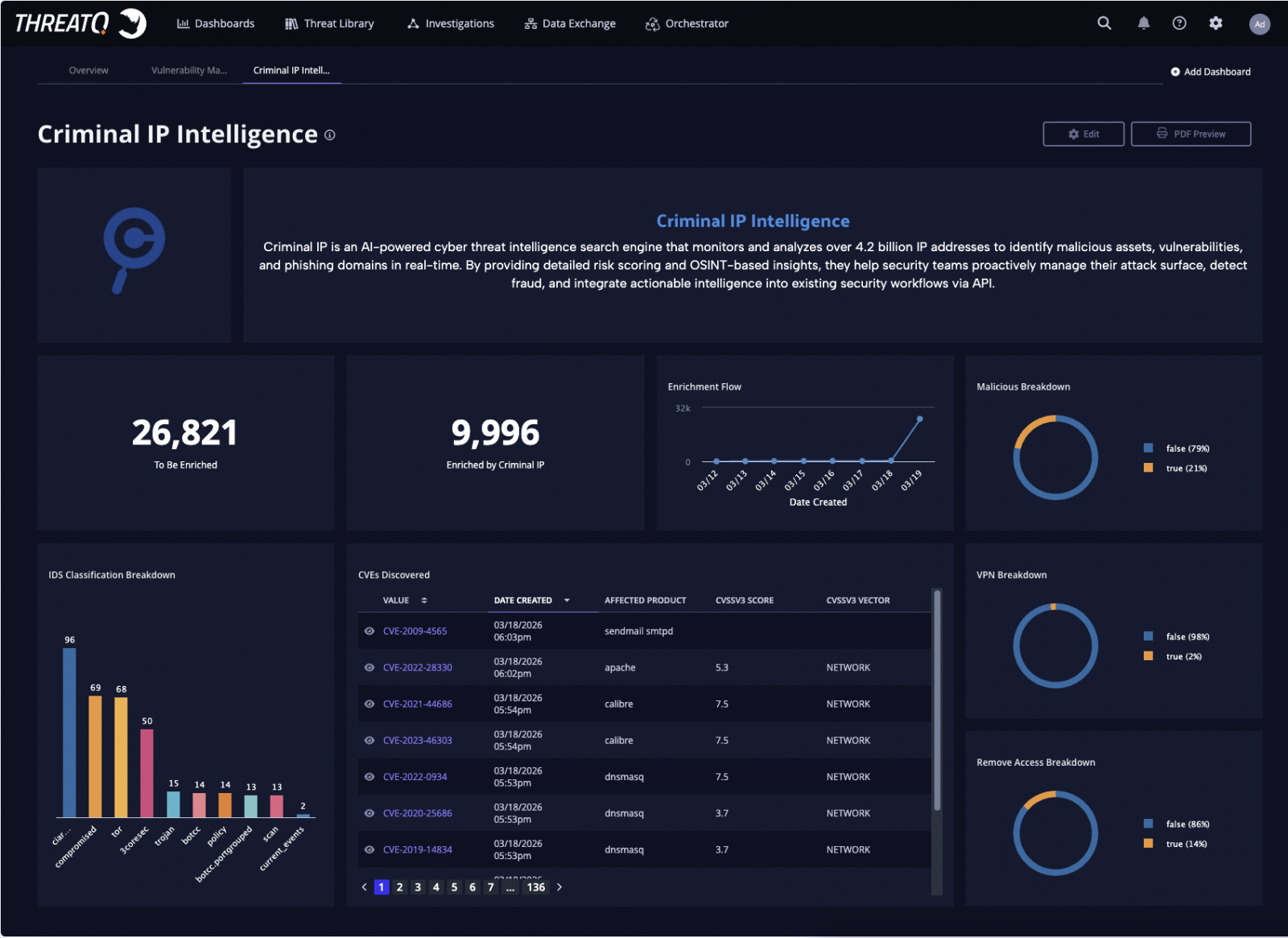
Criminal IP intelligence integrated into the ThreatQ dashboard, enabling unified visibility into enriched indicators and risk context
Criminal IP intelligence integrated into the ThreatQ dashboard,

enabling unified visibility into enriched indicators and risk context

The integration allows analysts to access Criminal IP intelligence directly within the ThreatQ interface, enabling real-time validation of suspicious IP activity without switching tools. By combining exposure data with infrastructure-level insights, teams can assess risk more effectively within their existing workflows.

Analysts can also perform on-demand Criminal IP lookups directly from indicator detail views or investigation boards, providing immediate access to additional context during active investigations.

Criminal IP further enhances ThreatQ’s investigation graph by revealing relationships between IP addresses, associated infrastructure, and attack activity, helping analysts better understand connections and patterns across threats.

Intelligence-Driven Prioritization and Response

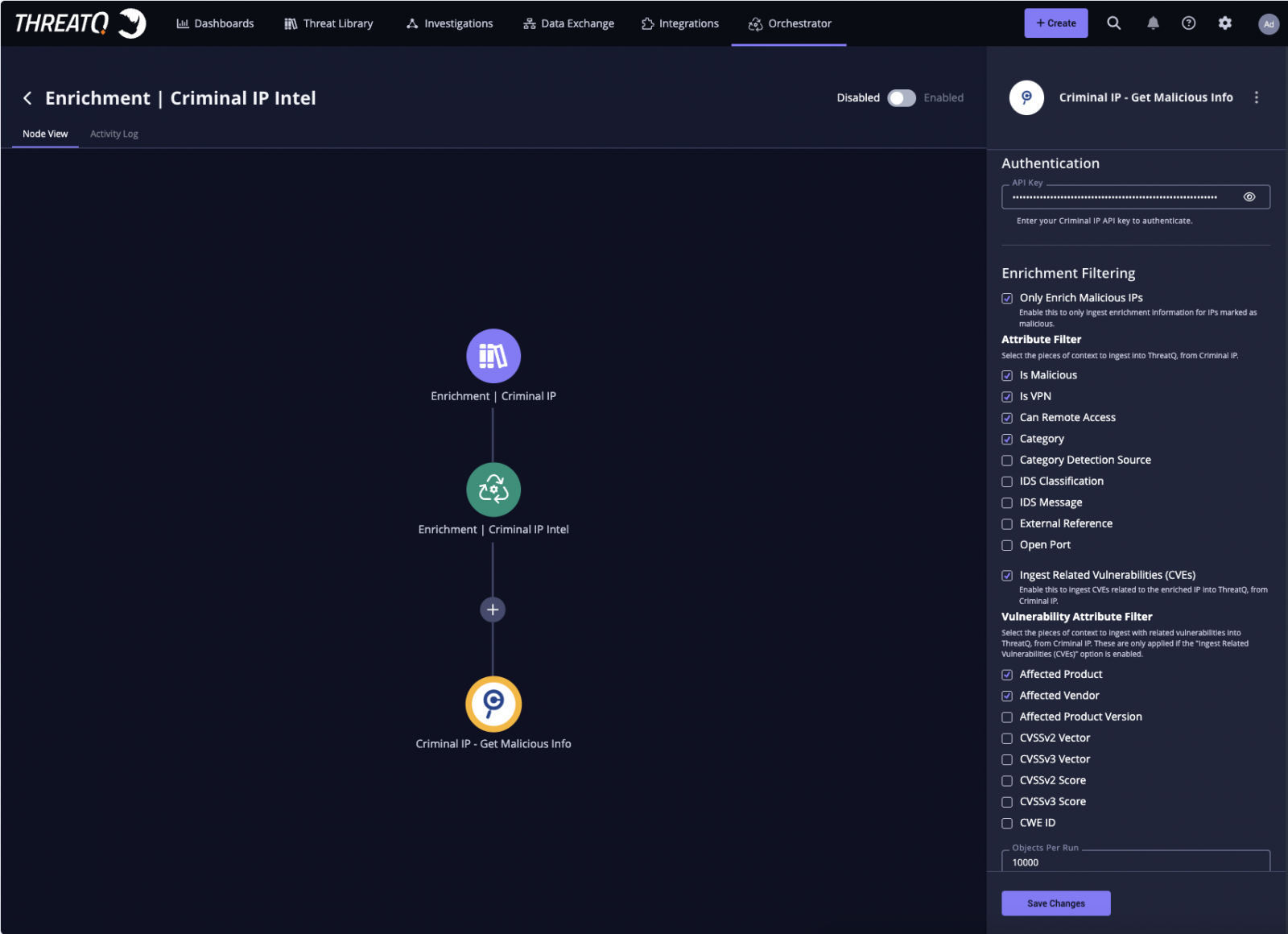
Criminal IP enrichment integrated within the ThreatQ Orchestrator, enabling automated ingestion and filtering of exposure-based IP intelligence directly into analysis workflows
Criminal IP enrichment integrated within the ThreatQ Orchestrator,

enabling automated ingestion and filtering of exposure-based IP intelligence directly into analysis workflows

By integrating Criminal IP’s intelligence into ThreatQ’s scoring framework, organizations can align risk evaluation with their specific operational environment. This enables more precise prioritization and supports more effective decision-making during investigations.

Enriched data can also be visualized through dashboards, providing clearer visibility into maliciousness trends, VPN usage, and risk distribution across indicators.

Expanding Visibility with Exposure Intelligence

The integration highlights the growing importance of exposure-based intelligence in modern threat analysis. By continuously monitoring and analyzing internet-facing assets and IP infrastructure, Criminal IP provides differentiated visibility that extends beyond traditional indicator-based approaches.

Advertisement

“This integration enables organizations to bring IP reputation and exposure intelligence directly into the ThreatQ platform, supporting faster analysis and more effective response throughout the investigation lifecycle,” said Byungtak Kang, CEO of Criminal IP. “By integrating our intelligence into existing workflows, security teams can improve visibility and make more informed decisions without adding operational complexity.”

“This collaboration strengthens the role of IP intelligence at critical points of investigation and decision-making,” said Scott Sampson, Chief Revenue Officer, Securonix. “By combining ThreatQ’s orchestration and prioritization capabilities with Criminal IP’s real-time threat data, organizations can accelerate enrichment processes, reduce manual workloads, and focus on the most relevant threats within their environment.”

Through this partnership, Criminal IP and Securonix enable security teams to operationalize threat intelligence more effectively by integrating automated enrichment, workflow orchestration, and precise prioritization within the ThreatQ platform.

About Criminal IP

Criminal IP is a cyber threat intelligence solution operated by AI SPERA that provides decision-ready IP address and domain reputation data to security teams worldwide.

Advertisement

By continuously scanning the global internet, Criminal IP aggregates and contextualizes threat signals across IPs, domains, URLs, and attack infrastructure, covering malicious indicators, known vulnerabilities, exposed assets, and attacker behavior.

Criminal IP’s mission is to give organizations real visibility into their cyber landscape and accelerate threat detection and response by delivering the intelligence needed to outsmart attackers. For more information, visit www.criminalip.io.

About Securonix

Securonix is transforming security operations with the industry’s first Unified Defense SIEM with Agentic AI, built to decide and act across the threat lifecycle with a human-in-the-loop philosophy. Its cloud-native platform unifies detection, investigation, and response, while enabling Sam, the AI SOC Analyst, and a productivity-based AI operating model for the SOC, so organizations can measure and govern AI by the analyst work it delivers. Helping enterprises become Breach Ready and Board Ready, Securonix delivers accountable, outcome-driven security operations at scale. Recognized as a Leader in the Gartner® Magic Quadrant™ for SIEM and a Customers’ Choice by Gartner Peer Insights™, Securonix delivers trusted security operations for global enterprises. Learn more at www.securonix.com.

Sponsored and written by Criminal IP.

Advertisement

Source link

Continue Reading

Trending

Copyright © 2025