Amodei, Altman, and Elon Musk agreen on how government can tame the monster they created
ANALYSIS The leaders of major AI labs spent the weekend agreeing on a plan to capture regulators, make more money, and avoid responsibility for their dangerous behaviour. They call it “pacing the frontier.”
Advertisement
Anthropic CEO Dario Amodei set the ball rolling with a post in which he professed alarm at how quickly AI is improving and suggested the attack on Hugging Face caused by rogue agents run by his rival OpenAI as a warning (which he referred to as ‘OAI-HF’) represented a moment that proved something needs to change at so-called “frontier” AI companies – essentially the big US model-makers.
“It’s also easy to dismiss OAI-HF as the failure of one company, but I believe that would be a mistake,” he wrote. “I believe it’s incumbent on every frontier AI company to act as if OAI-HF had happened to them,” he added, because he worries that OAI-HF shows that a swarm of agents “could be capable of taking over the entire internet with a persistent botnet.”
Amodei therefore suggested “We must slow the pace at which we improve the capabilities of AI models. Progress will still seem fast, and we must make wise use of the time we gain.”
The CEO proposed a three-point plan to regulate AI:
Advertisement
Requiring AI labs to host “embedded evaluators” whose job is to “verify adherence to safety practices and commitments, report incidents, and help assess the alignment of not just completed AI models but training pipelines and processes.”
Frontier AI companies that operate in democratic countries collaborating “to establish common safety standards as well as limits on the rate of unchecked AI progress,” with undefined “forms of coordination” that would be “legally challenging” and “require government support.”
A vague call for democratic governments “to coordinate with authoritarian governments, to the extent this is possible, while taking seriously the challenges of verifying compliance.”
And just like that, three billionaires all signed up to the same set of rules they think the world’s governments should adopt to regulate their activities. Microsoft’s Satya Nadella signed up, too.
Amodei even gave democracies a threat/villain to unite against – authoritarians willing to use AI unethically.
Big AI has also argued it will deliver a productivity revolution. Daryl Plummer, chief of research at analyst firm Gartner, used his keynote speech at the company’s annual Symposium in Australia today to cite research that found software vendors are pitching 50 percent productivity gains from AI, but customers report a 16 percent lift.
Plummer also doubted that Amodei’s promise to slow development is real.
“I will believe that when I see it,” he said in the keynote.
Write your own rules
Amodei’s ideas therefore read like an attempt at “regulatory capture” – the situation in which vested interests find a way to define the rules their regulators impose. Those supine regulators then make decisions that benefit the entities they oversee more than they benefit the rest of us.
Advertisement
In this case, Anthropic, SpaceX, and OpenAI get regulations that amount to a cease fire during which they don’t need to compete so fiercely.
OpenAI boss Sam Altman also all-but-admitted that regulation will be good for investors when he used a weekend interview with the billionaires’ bible Fortune to reveal his company won’t seek a public listing this year because it is inopportune to do so while AI safety concerns are unresolved.
“We got a lot of stuff to do, like meeting this moment of what is going to be required for safety and alignment, and how the industry and governments can work together,” he said.
Or in other words: Our investors will get a better return if we pause our IPO until confidence is higher, and regulatory capture is the way to get that.
Advertisement
Amodei, meanwhile, outlined some very specific things he wants from Washington: stop selling Nvidia chips to China so its AI companies can’t build better models, and a crackdown on model distillation.
“If we execute these measures well, I believe they would slow China’s progress enough to widen America’s lead significantly over the next 3–5 years — the window when AI becomes geopolitically most important,” he wrote.
This plan would, of course, also mean that Chinese companies’ AI services would be inferior to Anthropic’s for a longer period – at a time when Chinese clouds are pushing into the rapidly growing middle eastern and southeast Asian markets.
Pacing the frontier landed badly in Washington. Speaker Mike Johnson warned Amodei’s plan could “smother innovation” and see China dominate global AI. President Trump dismissed warnings that AI can have deleterious effects and said the USA must lead the world in AI.
Advertisement
Such responses may reflect the fact that vast spending on AI infrastructure is delivering GDP growth in otherwise stagnant economies. Or perhaps they prove, yet again, that lawmakers are nearly always late to understand technology companies’ ambitions and the means they use to achieve them. ®
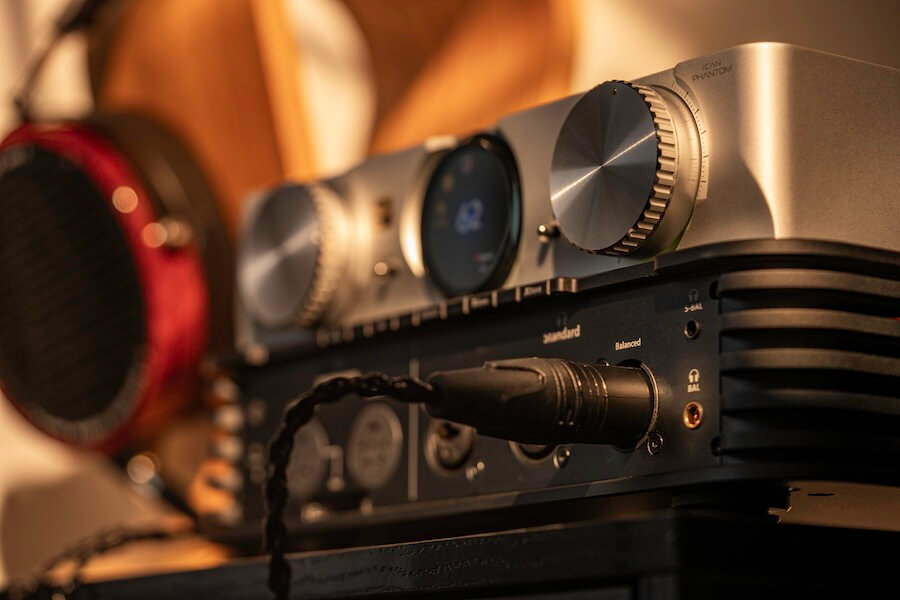
Three years ago, iFi Audio introduced a rather unusual flagship headphone amplifier. The original iCAN PHANTOM could handle sensitive IEMs, dynamic headphones, demanding planar magnetics, and electrostatic headphones from the same chassis, eliminating the separate energizer normally required for the latter.
That remains an extremely uncommon combination, but it is not new for 2026.
With the iCAN PHANTOM 1.5, iFi is not reinventing its $3,749 flagship or dramatically increasing its already formidable output power. Instead, it has concentrated on making an amplifier that was already designed to accommodate almost any headphone easier to match, easier to control, and somewhat easier to live with.
The biggest changes include a wider 0dB, 12dB, and 24dB gain range, stronger IEMatch attenuation for sensitive earphones, a new VU meter display, revised controls and interface, and expanded Nexis app functionality. The underlying proposition remains the same: one rather expensive box instead of several rather expensive boxes.
Advertisement
Headphone collectors will understand the distinction immediately. Everyone else is probably wondering when owning multiple $3,000 headphones became a problem requiring its own consolidation strategy.
Related Reading:
One Amplifier for Almost Everything
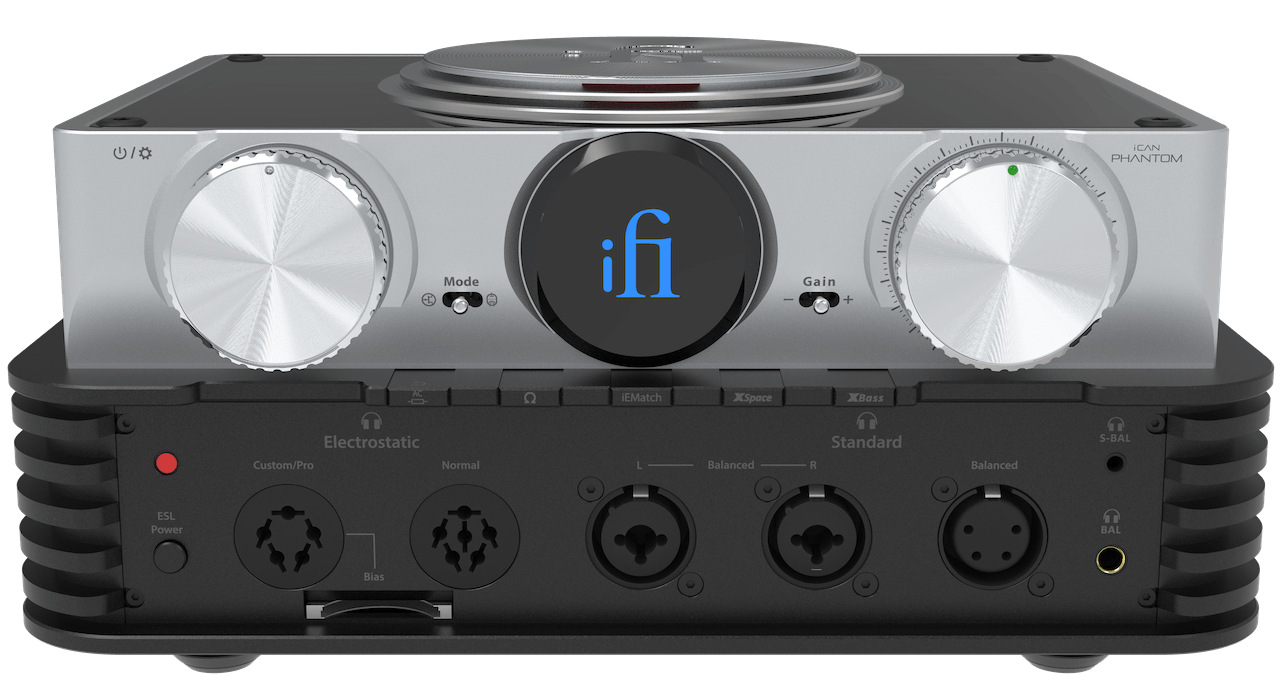
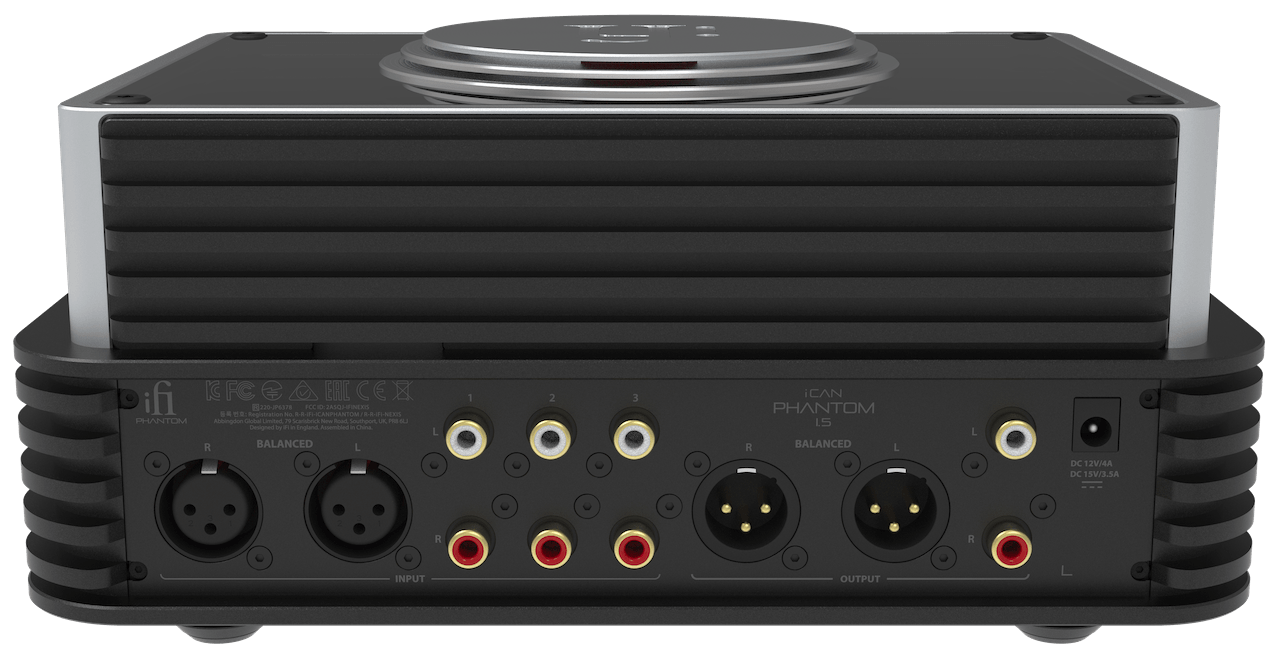
The $3,749 iCAN PHANTOM 1.5 is an analog headphone amplifier, preamplifier, and electrostatic energizer designed to handle IEMs, conventional dynamic headphones, difficult planar magnetics, and electrostatic models from one chassis.
Power is certainly not the problem. The PHANTOM can deliver more than 15,000mW maximum balanced into 16 ohms, more than 9,030mW RMS balanced into 32 ohms, and more than 27V into a 600-ohm load. Single-ended output reaches more than 5,760mW maximum into 16 ohms and more than 3,120mW RMS into 32 ohms.
For electrostatic headphones, the PHANTOM provides a 230V Normal Bias output and a Pro/Custom output with selectable bias settings from 500V to 640V. The electrostatic drive stage itself is rated at up to 640V RMS in Custom/Pro mode and 320V RMS in Normal mode.
iFi iCAN PHANTOM 1.5 Specifications
Type: Analog headphone amplifier, preamplifier, electrostatic energizer
The PHANTOM 1.5 uses two separate switchable Class A input stages rather than inserting tubes into a common signal path. The solid-state section uses discrete JFET circuitry, while the tube stage employs matched GE 5670 tubes.
There is also Tube+, which reduces loop gain and negative feedback to emphasize more of the tubes’ harmonic character. In practical terms, owners can move between solid-state, Tube, and Tube+ without owning three amplifiers — which is useful considering headphone enthusiasts have demonstrated a remarkable ability to fill every available shelf.
Advertisement
XBass offers three levels of analog low-frequency adjustment, while XSpace provides separate spatial processing matrices for headphones and loudspeakers. The 1.5 revision also increases gain from the original PHANTOM’s 0/9/18dB settings to 0/12/24dB, while stronger IEMatch attenuation provides more usable volume range with highly sensitive IEMs.
Advertisement. Scroll to continue reading.
A new VU meter display, revised user interface, improved volume control feel, anti-fingerprint glass coating, and expanded Nexis app support round out the changes. Nexis can handle remote control, diagnostics, firmware updates, product renaming, resets, and real-time monitoring of tube condition.
The Bottom Line
There are alternatives, but this remains a very short list.
Advertisement
The Apos x ES Lab HYDRA, which won one of our Best in Show awards at CanJam SoCal 2026, can drive conventional dynamic and planar magnetic headphones along with 580V Pro Bias electrostatic models. Plus its 20-watt-per-channel speaker output adds another layer of flexibility.
The two amplifiers approach the problem rather differently. The HYDRA uses a fixed 580V electrostatic bias and puts greater emphasis on versatility between headphones and loudspeakers. The iCAN PHANTOM 1.5 goes further at the extremes, however, with IEMatch for sensitive earphones and selectable electrostatic bias settings that accommodate a broader range of electrostatic headphones. It also adds Solid-State, Tube, and Tube+ operating modes, three gain settings, XBass, XSpace, and app-based control.
The Linear Tube Audio Z10e is more expensive alternative. At $6,950, it can drive electrostatic, dynamic, and planar magnetic headphones while also functioning as a 12-watt-per-channel integrated amplifier for loudspeakers. It is considerably more expensive and follows a very different all-tube design philosophy.
What keeps the PHANTOM 1.5 unusual is not simply that it can drive electrostatic headphones; the original PHANTOM already did that. It is the combination of electrostatic support, substantial power for difficult planar magnetics, low-noise operation and attenuation for sensitive IEMs, selectable tube and solid-state stages, adjustable analog processing, and extensive load matching in one chassis.
Advertisement
At $3,749, calling it inexpensive would require a concussion. But for someone already using separate amplifiers for IEMs, planar headphones, and electrostatics, the consolidation argument is not nearly as absurd as the price initially makes it sound.
MagSafe is safer and simpler, but USB-C has a few advantages of its own.
Ivan_Shenets/Shutterstock
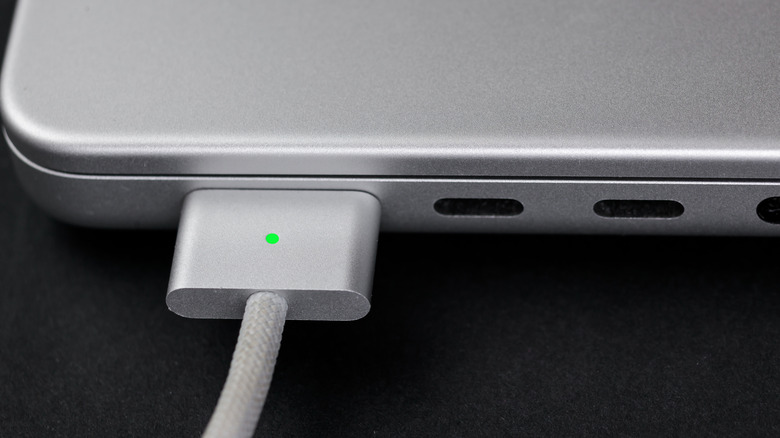
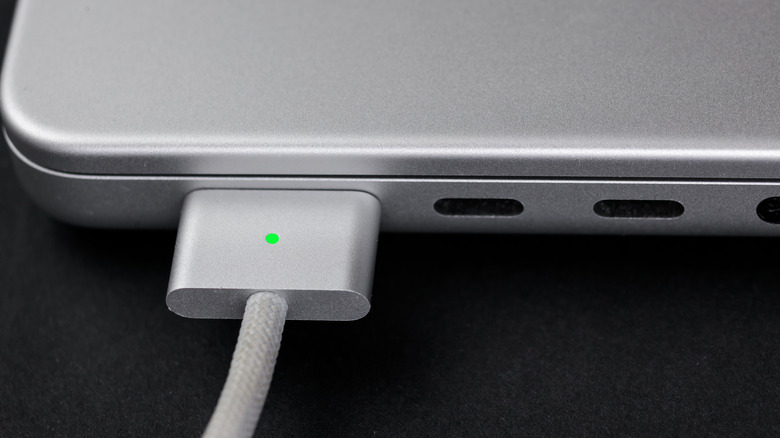
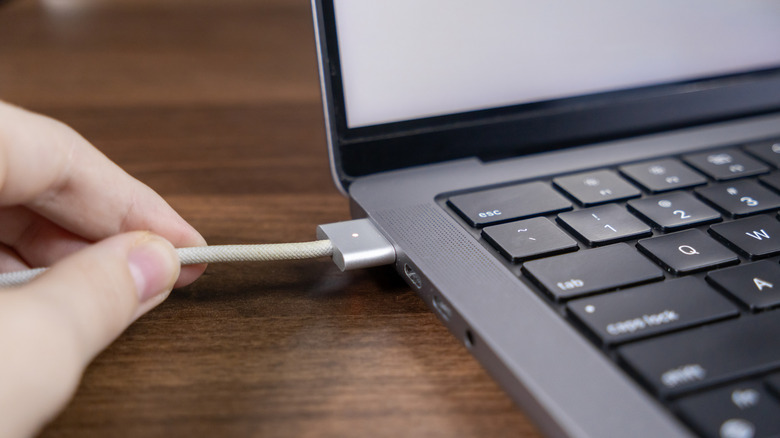
The latest MacBooks are known for featuring Apple’s clever charging solution: MagSafe. It’s one of those features that’s a make-or-break factor for some people. And it’s no wonder — these chargers attach magnetically and disconnect if the cable is pulled sharply, like when tripping over it. But Apple laptops can also be charged via USB-C, which has become an industry standard. While you can’t use both at the same time, they can both be great charging options depending on what you need at a given moment.
While it has the same name, don’t confuse the MacBook’s charging tech with the iPhone’s MagSafe, which is a different technology. While the iPhone’s MagSafe is based on the Qi standard, the MacBook’s MagSafe uses a proprietary — and much smaller — connector. Still, the idea is the same: magnetically attaching a charger versus plugging in a standard USB connector.
MagSafe on MacBooks has also gone through a few iterations, with MagSafe 3 being the current one. Each generation has the same fundamental purpose, though different physical sizes and power capacities means they aren’t cross-compatible.
Advertisement
The differences between MagSafe and USB-C
Alina Vytiuk/Getty Images
There are pros and cons to using either MagSafe or USB-C to charge your MacBook. For MagSafe, the biggest pro is obvious: your laptop is kept safe if the cable becomes an obstacle. If someone trips over the cable or you accidentally pull on it too hard, chances are that it will simply come unplugged. It won’t pull your MacBook down with it.
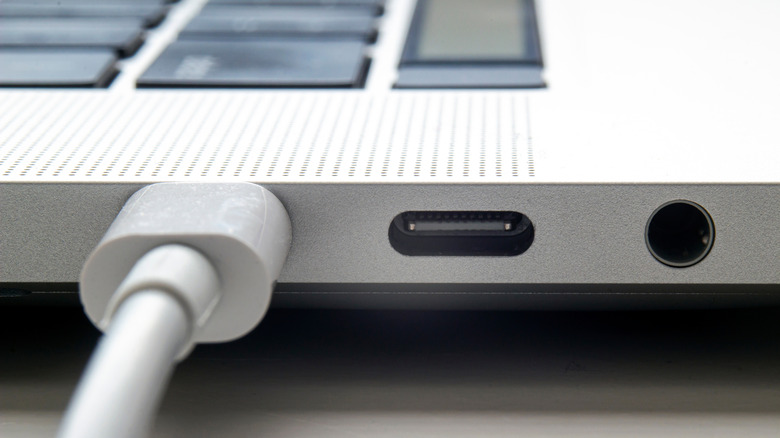
USB-C, on the other hand, is a standard connector. You have to insert it into the right port on your laptop. And if an accident happens, there’s a good chance your Mac will be pulled along with the cable and hit the floor.
But there are also important differences in charging power. The MagSafe cable is designed for faster charging. If you have a 2021 MacBook Pro, a 2022 MacBook Air or later, MagSafe can charge your Mac at up to 140W. That is, of course, if you have the right power adapter. Apple sells a $99 adapter that pairs with the MagSafe cable to enable fast charging. We’re talking about a 50 percent charge in just 30 minutes, which is quite fast.
Advertisement
USB-C is a different story. While there are cables that can deliver even higher wattages in theory, that’s not the case for most of them. The standard for USB-C is 60W of power, which is half of what MagSafe can deliver. There are special cables that deliver up to 100W or 240W of power — Apple even sells a 240W USB-C cable. This is something you need to keep in mind before buying a new cable if you’re looking for fast charging.
When USB-C works best
Habanero Pixel/Shutterstock
As we’ve seen, MagSafe is the best choice in most cases. It’s physically safer, supports fast charging and keeps your USB-C ports free for other accessories. It’s also much easier — you don’t have to worry about complicated charging standards and specs. Just use the Apple combo, and you’re good to go.
But USB-C can offer some conveniences, too. The most notable is a single cable handling everything. This makes traveling much easier, since you don’t need a mess of cables in your backpack. A fast USB-C charger can power your Mac, iPhone, iPad and anything else with USB-C. MagSafe is for Macs only.
Advertisement
Plus, if you have a MacBook Pro released after November 2023, there’s an extra treat: these can charge at up to 240W via USB-C. You’ll need the right cable and power adapter, but it’s still another benefit of USB-C, if ultra-fast charging is something you care about. It really comes down to choosing what works best for your needs; keeping one of each cable around lets you swap them as needed.
At Apple’s recent hardware event, the software powering its foldable iPhone Duo stood out, with translucent Liquid Glass effects and vertically stacked icons. But you don’t need to snatch a folding smartphone to reap the benefits of Apple’s iOS 27 updates.
When iOS 27 leaves beta on Monday, Siri AI’s standalone app and smartphone search integration will likely be the most immediately obvious change for many iPhone users. But it’s worth digging even deeper to uncover helpful additions to key apps, like Apple’s Safari browser, as well as revamps to underutilized apps, like Shortcuts.
The version of Safari available in iOS 27 looks fairly similar to the last iteration, with a few key updates tucked away in the settings. These Safari features are powered by Apple Intelligence, which requires an iPhone 15 Pro or newer (they’re also available on iPadOS 27 and macOS 27).
Notify Me
Photograph: Courtesy of Apple
If you’re shopping online and want a quick price-drop notification, you can use the “Notify Me” feature to scan a webpage on a certain cadence and look for changes. First, head to the page you want to track and tap the three-lined hamburger menu icon in the top right corner of Safari. About halfway down, you’ll see this option listed.
Advertisement
“Safari can let you know when a website updates the content you’re interested in,” reads the feature’s description. Here you’ll find an open text box where you can describe what change in content you want Safari to scan for, as well as how often you want it to check.
For example, my couch is broken, so I’ve been eyeing a few different replacement options. I have two final contenders from CB2, but both are out of my price range. So, I set up a “Notify Me” for Safari to scan the pages each day for a significant discount. Whichever one goes on sale first will likely be what I decide to get, and now I don’t have to refresh the pages manually every day.
While many other browsers have similar shopping features, like the price-tracking bell in Google Chrome, I appreciate how this feature stretches beyond just buying stuff. You can also use Safari to scan for ticket drops, privacy policy changes, and other content updates.
Describe an Extension
Photograph: Courtesy of Apple
If you’ve experimented already with the “Describe a Shortcut” feature for iPhone automation, then “Describe an Extension” for Safari will seem familiar. It’s located under the same settings menu as the “Notify Me” tool, just a little further down.
Oleksii Oleksiyovych Lytvynenko, 44, pleaded guilty in June to conspiracy to commit wire fraud over his role in Conti, the Russia-linked ransomware operation associated with more than 1,000 victims and at least $150 million in ransom payments.
Lytvynenko took an unusual route into the ransomware business. The Ukrainian national, who later lived in Cork, Ireland, trained as a lawyer before joining Conti as an intruder and developer.
According to his plea agreement [PDF], Lytvynenko operated under the handle “henry” and joined a team run by another Conti conspirator known as “silver” or “buza.” He was recruited to help with coding and directed to work on a malware loader – software designed to get other malicious code running on a victim’s machine.
Prosecutors said his Google account showed he had also been doing some homework. Investigators found books and videos about malware and hacking alongside Conti malware, ransom notes, and stolen victim data. Prosecutors said he also used Google and ZoomInfo to research potential targets.
Advertisement
Lytvynenko wasn’t confined to writing code, according to the filing. Evidence from his online accounts showed that he possessed data stolen from eight US victims and four overseas, with the eight American victims reporting more than $1.5 million in losses.
Court documents identify several Bitcoin transfers tied to his Conti work, including 0.4 BTC worth $25,042 that prosecutors traced back to one of his victims. He has been ordered to forfeit the same amount.
Conti disbanded in 2022 after its internal chats and source code were leaked following the gang’s public support for Russia’s invasion of Ukraine. Lytvynenko apparently didn’t take that as his cue to find another line of work.
When Gardaí turned up at his County Cork home in July 2023, they said they found his laptop open, Cobalt Strike running and a Rocket.Chat session connected over Tor. Prosecutors said evidence recovered from the machine showed that his involvement in ransomware activity had continued after Conti disbanded.
Advertisement
Lytvynenko was extradited from Ireland to the US in October 2025.
The Justice Department says Conti attacked organizations across 47 US states, the District of Columbia, Puerto Rico, and 31 foreign countries between 2020 and 2022. By January 2022, the FBI estimated that victim payouts associated with Conti exceeded $150 million.
Lytvynenko will now have four years to contemplate a career change. ®
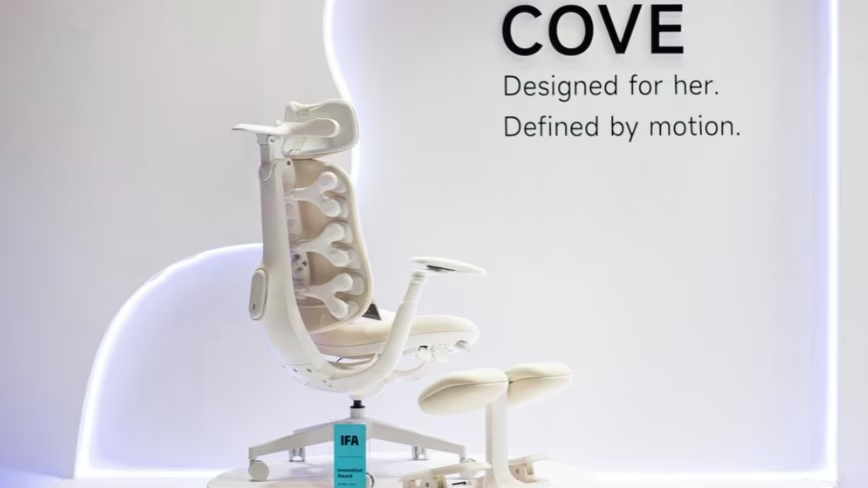
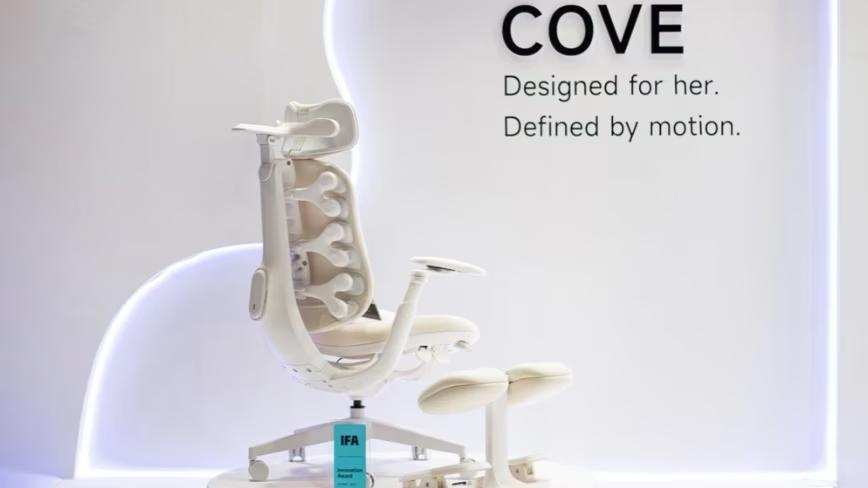
At IFA Berlin 2026, ARBREST put a chair through movements that office furniture often treats as exceptions. COVE is the new brand’s first product, made its world debut with an IFA Best of Design award. At Hall 2.2, Stand 141, visitors leaned toward a desk, shifted their shoulders, turned and reclined. The demonstration made a larger point: working is not a single posture, and support should not disappear when the body changes direction.
COVE is ARBREST’s first product and first expression of that idea in the ergonomic chair category. The new smart lifestyletechnology brand focuses on real needs that remain poorly addressed in work and everyday life. Its aim is to let technology recede into the background. COVE is the brand’s first step, not a claim that ARBREST will only make ergonomic chairs.
The reason for developing the chair is closely connected to the limits of standard office furniture. Many chairs are built around a standardized reference body, with differences addressed later through adjustments. That approach can leave smaller users compensating for a seat that is too deep, a lumbar support out of reach, armrests too far apart or feet that do not land securely. Women’s bodies are not identical, but the category has often treated their proportions as an afterthought. ARBREST decided to make them an initial design reference.
COVE starts with a 7-Point Fit Calibration. Seat height, width and depth, lumbar support, armrests, headrest and footrest are considered together. The recommended user height is 150 to 175 centimetres; seat height ranges from 46 to 54 centimetres and seat depth from 43 to 49 centimetres. The idea is to establish a better fit from the start, rather than relying on adjustment to compensate for the wrong proportions.
Advertisement
The seat has its own logic. A firmer sit-bone zone provides a stable base. A contoured pelvic area follows the body’s shape, and a flexible front edge is intended to reduce pressure under the thighs. The dual-tier active footrest helps bridge the gap between leg length and seat height. Together, these details address a familiar problem: when the legs, pelvis and lower back do not share a stable base, the user keeps moving in search of one.
COVE’s other details are similarly grounded in ordinary habits. The 3D Winged Headrest creates clearance for ponytails and styled hair during recline. Wide-surface touch controls are intended to be easier with longer nails. The 5D armrests follow the elbows as the user types, reads, browses or turns to communicate. None of these features changes the category alone. Together, they suggest that the chair was designed around a person’s routine rather than an abstract diagram of correct sitting.
Movement becomes more visible in the mechanism. COVE’s multi-axis forward-tilt chassis reaches 16 degrees, allowing the user to move closer to the desk without perching on the seat edge. The footrest continues to support the legs. The point is not to demonstrate how much a chair can move, but to keep support present as the body leans forward, sits upright, turns or reclines.
The 12-Zone Micro-Motion Backrest distributes support across twelve independent units arranged along a flexible spine plate. A small turn of the shoulders, a change in weight or a shift in the lower back can be met by different areas of the backrest. This is a different answer to the familiar ergonomic instruction to “sit correctly.” Instead of holding the body still, the chair is designed to stay connected as the body moves.
Advertisement
Designed around women’s proportions: the ARBREST COVE dynamic ergonomic chair and active footrest system. — Credit: ARBREST
COVE links that backrest to a 5-Point Synchronized Support system. The headrest, armrests, backrest, seat and footrest move as coordinated contact points. When fatigue appears, one touch activates the motorized lumbar support. As the backrest reclines, the support extends forward and the footrest continues to cradle the legs, creating a brief seated stretch.
The market value of this approach is not that COVE promises to solve every problem associated with desk work. It is that the chair gives a growing conversation about inclusive design a physical, testable form. Designing for women here means more than reducing dimensions. It means looking at where the pelvis settles, how the feet are supported, how hair and fingernails affect daily use, and how a person moves between concentration and rest.
After its IFA debut, ARBREST expects to move COVE into an initial launch or crowdfunding phase later in 2026. Launch details will be announced later. Its broader significance lies in its starting assumption: the user is not a fixed shape, and a chair should not require her to behave like one. COVE is the brand’s first product, and its first step toward further smart lifestyle products built around real user needs.
The report found that the gap in skills is leading to increased financial risk for organisations.
A new report from Ireland’s professional body for compliance professionals, the Compliance Institute, has found evidence of a growing skills gap within financial services.
51pc of the 125 senior compliance experts who contributed to the research survey said that companies lack the skilled workforce needed to stay on top of financial crimes and meet growing regulatory obligations.
82pc were of the opinion that financial services firms lacking the necessary skilled workforce are increasing their financial or operational risk, and more than half (56pc) believe Ireland is not developing enough talent in compliance and financial crime to meet future demand in the financial services sector.
Advertisement
Michael Kavanagh, the CEO of the Compliance Institute, said, “At a time when financial crime is becoming more complex, sophisticated and global, it’s concerning that the overwhelming majority of compliance experts believe that talent shortages in the areas of financial crime and compliance are increasing regulatory and operational risks for the Irish financial services sector.”
“So, it’s crucial that financial services institutions have the right firepower to combat financial crime, and a key part of this is suitably qualified staff and well-resourced compliance teams.”
Kavanagh explained that it is critical that the financial services sector has consistent access to adequately skilled compliance staff, especially as the overwhelming volume and pace of regulatory changes puts pressure on compliance teams in the sector.
Advertisement
“The sheer breadth of regulations demands a significant allocation of time, expertise and operational focus, often stretching teams to their limits. It has never been more important for the industry to have access to the right talent,” he said.
He explained that companies should take the necessary steps to ensure that their staff are well-trained and possess the skills needed to meet regulatory and operational challenges.
He added: “But there also needs to be a concerted effort by the Government and industry to invest more in talent so that the Irish financial services sector can truly prosper and navigate all the challenges that come its way.”
Don’t miss out on the knowledge you need to succeed. Sign up for the Daily Brief, Silicon Republic’s digest of need-to-know sci-tech news.
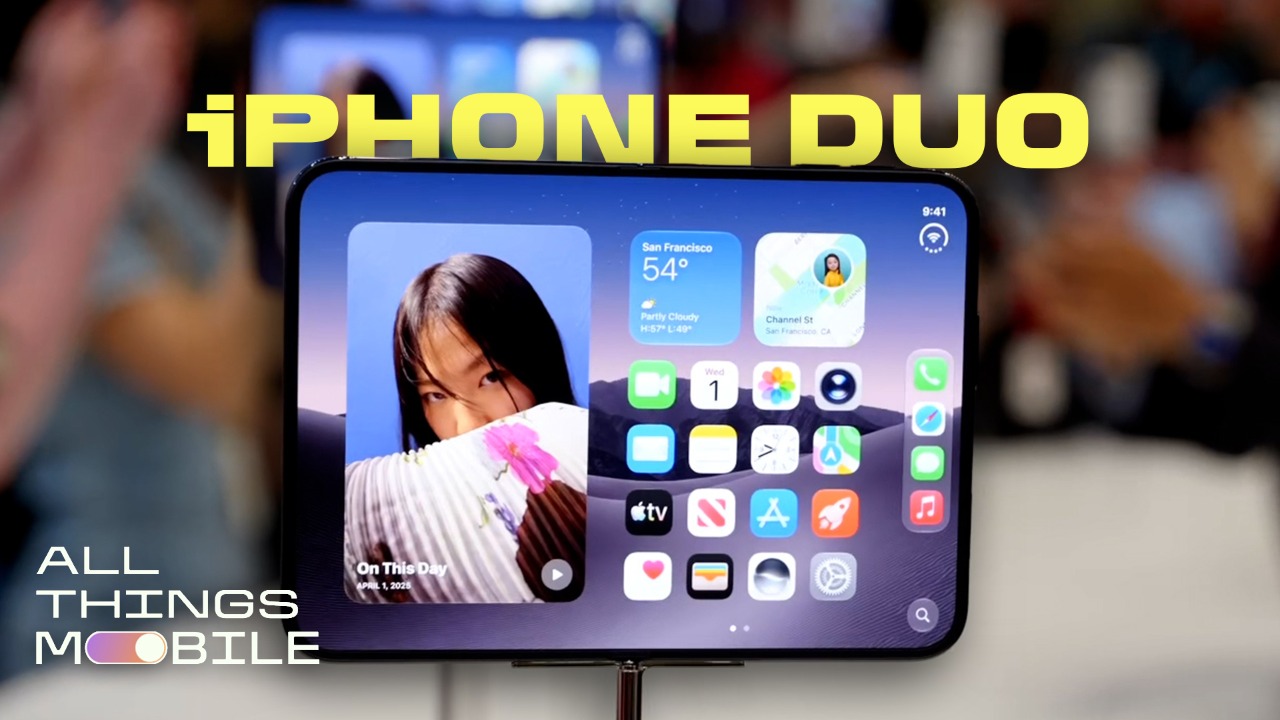
For months, rumors suggested Apple would name its first foldable the iPhone Ultra. But on Wednesday, the company unveiled its highly anticipated device with a different name: the iPhone Duo.
Skipping the Ultra name feels fitting for a foldable that doesn’t quite offer Apple’s highest-end features. The Duo is still a premium device, but it lacks a telephoto camera and has a slightly more modest battery than the iPhone 18 Pro Max.
In that respect, the iPhone Duo is more comparable to Samsung’s similarly palm-size Galaxy Z Fold 8. The Galaxy Z Fold 8 Ultra, meanwhile, takes things a step further with Samsung’s top-tier camera and battery specs.
The Duo is designed to be compact and versatile, allowing you to easily watch horizontal videos in landscape mode and vertical content in portrait. On the other hand, the Z Fold 8 Ultra feels similar to a slab phone when closed, thanks to its slim design and more standard dimensions. (Meanwhile, the smaller Galaxy Z Fold 8 shares design elements with the iPhone Duo. You can read more about how those phones compare here.)
Samsung’s Galaxy Z Fold 8 (left) has a more compact design, while the Z Fold 8 Ultra has a taller build that’s more similar to a slab phone.Andrew Lanxon/CNET
The Duo and Z Fold 8 Ultra share the commonality of a high price tag. The iPhone Duo starts at $1,999 for 256GB, while the Galaxy Z Fold 8 Ultra starts at $2,100 for the same storage level.
iPhone Duo vs. Galaxy Z Fold 8 Ultra design and displays
The iPhone Duo has a 5.4-inch cover display.Abrar Al-Heeti/CNET
The key difference between the iPhone Duo and the Galaxy Z Fold 8 Ultra is in their designs.
The iPhone Duo is palm-size with a squat, 5.4-inch cover screen and a 7.6-inch inner display. The Z Fold 8 Ultra has a more conventional book-style foldable design, with a taller, 6.5-inch cover screen and a larger 8-inch inner display.
A unique feature of the iPhone Duo is its matte, nano-texture inner display that helps to reduce reflections and minimize the crease. The Galaxy Z Fold 8 Ultra has an anti-reflective coating that also helps to reduce those distractions, but the Duo’s matte finish does a better job at that.
The iPhone Duo has a 7.6-inch matte inner display that helps to reduce reflections and the crease — though you can still see both under certain lighting conditions.Abrar Al-Heeti/CNET
The Z Fold 8 Ultra stands out for its exceptionally thin build, measuring 4.1mm when open and 8.9mm when closed. The iPhone Duo is also fairly thin, measuring 5.2mm when open and 11.3mm when closed.
The Z Fold 8 Ultra is a little lighter, weighing 215 grams, while the Duo weighs 254 grams. It’s a small difference that’s barely perceptible.
Advertisement
When multitasking, the Duo can only run up to two apps simultaneously, while the Z Fold 8 Ultra supports multitasking with up to three apps. This is aided by the Ultra’s larger main display that prevents apps from feeling cramped.
The Galaxy Z Fold 8 Ultra is the most advanced foldable Samsung currently sells.Andrew Lanxon/CNET
Perhaps one of the most impressive features of the Duo is its IP68 rating: it can withstand submersion in up to 6 meters of water for 30 minutes and is dust-resistant. The Z Fold 8 Ultra has a more limiting IP48 rating, meaning it can be submerged in up to 1.5 meters of water for 30 minutes and is protected against solid objects larger than 1mm, but not dust or sand. The Duo’s dust resistance is a rarity in the world of foldables and is shared with Google’s Pixel 11 Pro Fold.
If you value durability and compactness, the iPhone Duo can be a good fit. If you want a foldable phone that feels more similar to a slab phone when closed and a tablet when open, the Galaxy Z Fold 8 Ultra is a good pick.
iPhone Duo vs. Galaxy Z Fold 8 Ultra cameras
The iPhone Duo has two 48-megapixel rear cameras.Abrar Al-Heeti/CNET
Because the iPhone Duo is compact, it makes some compromises with the cameras. There’s a 48-megapixel main camera and a 48-megapixel ultrawide camera, but no telephoto lens. The cover display has a 12-megapixel selfie camera, while an “under-display FaceTime camera” sits on the inside screen.
The Galaxy Z Fold 8 Ultra has a triple rear-camera system, which includes a 200-megapixel wide-angle, 50-megapixel ultrawide and 10-megapixel telephoto camera. There’s a 10-megapixel selfie camera on each display.
The Z Fold 8 Ultra has a triple rear-camera system.Andrew Lanxon/CNET
We’ll have to see how the iPhone Duo performs in our camera tests, but the Galaxy Z Fold 8 Ultra shares rear camera optics with the top-of-the-line Galaxy S26 Ultra (hence the shared moniker), and has performed well in our camera tests.
iPhone Duo vs. Galaxy Z Fold 8 Ultra processor and battery life
The iPhone Duo is powered by the same in-house A20 Pro chip as the iPhone 18 Pro models. The Galaxy Z Fold 8 Ultra has Qualcomm’s Snapdragon 8 Elite Gen 5 chip for Galaxy.
Advertisement
Apple doesn’t share specific battery specs, but says the iPhone Duo will give you up to 31 hours of video playback on the inner display, and 44 hours when using the outer screen. When using both screens equally, the company says you’ll be able to go 24 hours before needing to charge.
Samsung boosted battery capacity on its book-style foldable this year, going from 4,400 mAh on the Z Fold 7 to 5,000 mAh on the Z Fold 8 Ultra. That should easily get you through a day without worrying about where the nearest charger is.
The iPhone Duo has specialized visual layouts that it switches to automatically when the device is unfolded, folded closed or rotated.Abrar Al-Heeti/CNET
Apple says the iPhone Duo can charge up to 50% in around 20 minutes with a 60-watt adapter or higher. The Z Fold 8 Ultra supports up to 45-watt wired charging, going from empty to 63% in around 30 minutes in CNET’s testing.
The Duo has a key advantage when it comes to wireless charging: it supports MagSafe, with Qi2 wireless charging up to 25 watts. Meanwhile, the Z Fold 8 Ultra doesn’t have built-in magnets, but if you use a Qi2-compatible case, you can tap into 20-watt wireless charging.
If you prefer being able to easily attach magnetic accessories without a case, the iPhone Duo has the advantage here. The Galaxy Z Fold 8 Ultra has a long-lasting battery that pulled its weight in our testing.
Advertisement
Which phone should you pick?
The Galaxy Z Fold 8 Ultra has a wider inner display, which offers a little more space for watching videos and multitasking.Andrew Lanxon/CNET
Whether you go with the iPhone Duo or the Galaxy Z Fold 8 Ultra ultimately depends on how you plan to use your foldable phone.
The iPhone Duo is designed to better accommodate both horizontal and vertical content on the inner display, while the compact cover is good for quickly sending texts or checking notifications. If you find yourself viewing swaths of content and want a phone that feels a little different — or are deep in Apple’s ecosystem — the Duo could be the right fit for you.
Meanwhile, the Z Fold 8 Ultra operates as more of a standard-feeling phone when closed, opening to a wide, traditional tablet-like display. If you don’t want to stray too far from the design of slab phones but also want a more expansive screen sometimes, the Z Fold 8 Ultra might be a better pick.
Stay tuned for CNET’s review of the iPhone Duo for more details on the experience. For now, you can read our hands-on with Apple’s new foldable, and check out the spec chart below for more on how the phones compare.
Apple N1 wireless networking chip (Wi-Fi 7 (802.11be) with 2×2 MIMO), Bluetooth 6, Thread. Camera Control button. Dynamic Island. Apple Intelligence. Visual Intelligence. Siri AI. Dual eSIM. 1 to 3,000 nits brightness display range. IP68 resistance. Colors: black, white. Fast charge up to 50% in 20 minutes using 60W adapter or higher via charging cable. Fast charge up to 50% in 30 minutes using 35W adapter or higher via MagSafe Charger.
Abrar’s interests include phones, streaming, autonomous vehicles, internet trends, entertainment, pop culture and digital accessibility. In addition to her current role, she’s worked for CNET’s video, culture and news teams. She graduated with bachelor’s and master’s degrees in journalism from the University of Illinois at Urbana-Champaign. Though Illinois is home, she now loves San Francisco — steep inclines and all.
See full bio
Oracle co-founder and executive chairman Larry Ellison has canceled a planned sale of his Oracle stock, the company announced on Saturday.
Oracle had previously disclosed in a regulatory filing that Ellison planned to sell 50 million shares worth around $7.5 billion, according to Reuters. The company did not offer a reason for the change in plans.
“No Oracle stock was sold under that plan, and he has no other plans to sell any of his Oracle stock,” the company said.
Why it matters: Although not foolproof, password managers are one of the most secure ways to generate, store, and use passwords. However, switching between them can be tedious and, in some cases, open users to security risks. A new feature for Android devices simplifies the process while removing a crucial vulnerability.
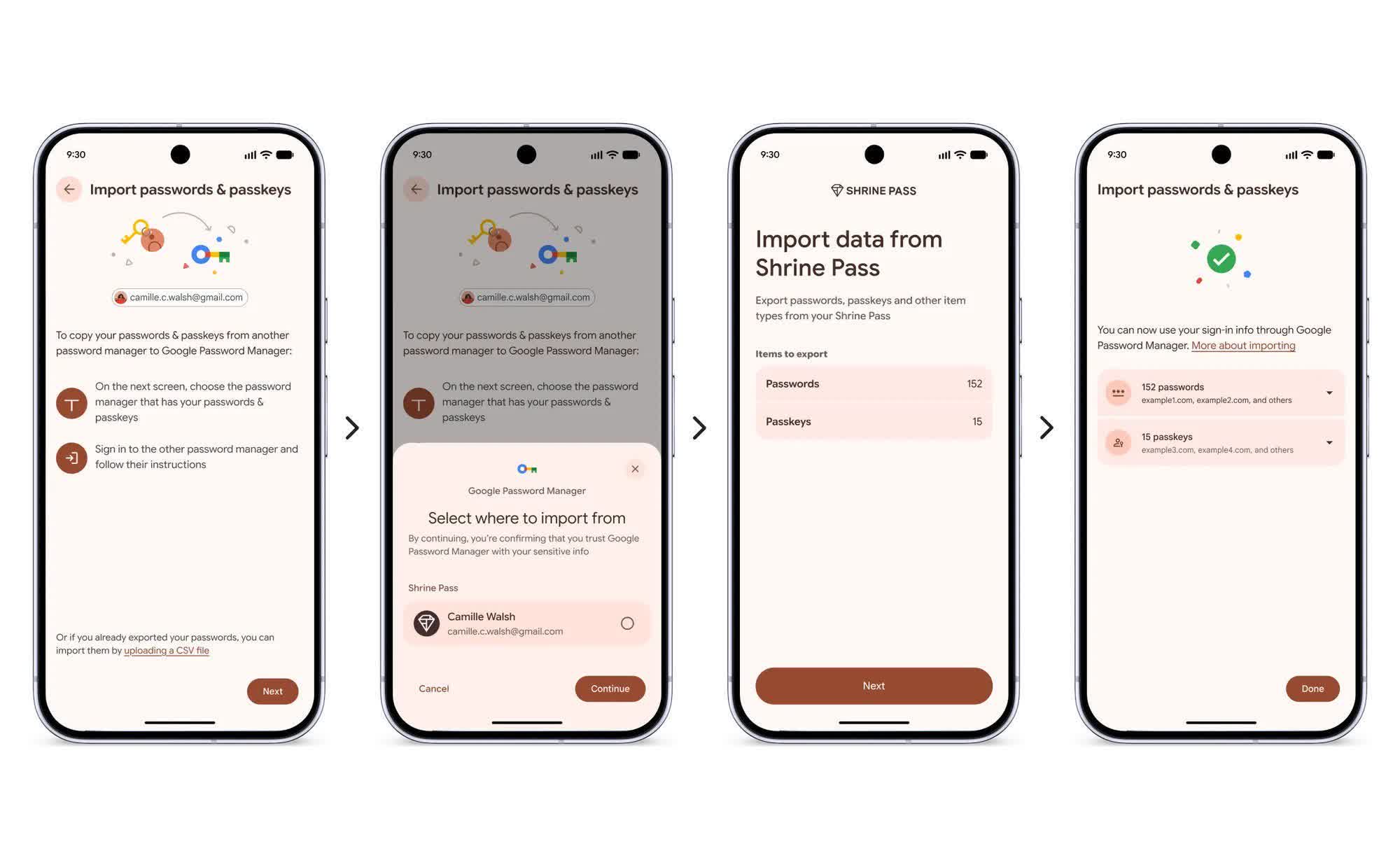
Android users can now transfer passwords and passkeys between password managers via a new procedure managed by the operating system. The feature already supports most major password managers on Android 8 or later, with more to follow.
To start, download the password manager you intend to transfer your information to. Then, choose the option to import or copy data from another manager. Android will automatically detect other installed password managers and display which ones support the transfer. After tapping “Continue,” you can review the information being moved before authorizing the transfer.
Outside of speed, the feature’s main new benefit is that it requires no file downloads. Moving passwords between managers sometimes involves downloading an unencrypted text file that could be intercepted. Furthermore, transferring passkeys usually requires reassigning them one by one, which the new process handles automatically.
Google confirmed that Android password transfers currently support Google Password Manager, 1Password, Bitwarden, and Dashlane. More managers are expected to add support soon.
Security experts generally recommend password managers as the best way to generate strong, unique passwords, something many users still struggle with. As recently as last year, “123456” and “password” still ranked among the most popular passwords.
However, password managers do have vulnerabilities and have suffered breaches, which might prompt users to switch between them. Earlier this year, researchers found vulnerabilities in Bitwarden, LastPass, and Dashlane. Password managers tied to web browsers can be even riskier, as Microsoft Edge was found to be storing saved passwords unencrypted in memory. Furthermore, Dashlane fell to brute-force attacks in June, and hackers stole LastPass subscriber information (but not passwords) later that month.
Advertisement
Passkeys, which tie authentication to specific devices via PINs and biometrics without revealing sensitive information to servers, are considered more secure than passwords, but not perfect. In August, researchers published a method for stealing passkeys from Google Chrome’s memory, and they can also be stolen along with browser sessions.
Lanterns episode 5 ending explained: who dies, why does John Stewart [spoiler], and more big questions answered about the DC comic book show’s latest entry
Lanterns episode 5 has landed on HBO Max — and it’s not only the DC Universe (DCU) TV show’s most devastating chapter so far for myriad reasons, but it also wraps up its 2016 storyline. From here on out, then, we’ll be back in 2026, aka the DCU‘s current timeline.
Its present-day plot will have to wait another week, though, because we need to dissect all the hugely significant events that happened in Lanterns‘ fifth episode. Consider this your one and only warning: full spoilers immediately follow for Lanterns chapter 5, titled ‘Lights Out’. If you haven’t seen it yet, bookmark this page for later and return once you’re caught up.
Who dies in Lanterns episode 5?
Will Macon is one of three major casualties in the DCU TV show’s fifth chapter (Image credit: John Johnson/HBO Max)
Frankly, lots and lots of people die. Innocent Rushville civilians caught in the crossfire and foot soldiers in Will Macon’s militia and Antaan’s extraterrestrial forces all bite the dust in the HBO Max show’s latest installment.
Advertisement
Latest Videos FromTechRadar
Three notable individuals also lose their lives — the first two being the aforementioned Macon and Antaan. Macon is actually killed by Antaan, the latter believing the former is the Manhunter that Antaan’s forces have been pursuing for some time.
However, after Antaan murders Macon and cuts out his heart to confirm Macon is the Manhunter — remember, a Manhunter’s heart crystallizes once they die — he realizes Macon isn’t the Manhunter. Cue Antaan going after Hal Jordan because the latter lied about the Manhunter’s identity when the pair crossed paths earlier in episode 5.
Advertisement
Unfortunately for Antaan, he doesn’t last much longer. In an attempt to kill Hal, he activates the explosive device woven into his skeleton. But before he goes out with a bang, trying to take Earth’s first Green Lantern with him, Hal uses his ring to make a whirlwind construct that flings Antaan into the air before he detonates.
Zoe is the third and final important character who meets their demise (Image credit: HBO Max)
Of this episode’s three big deaths, though, Zoe’s is arguably the most significant.
Sign up for breaking news, reviews, opinion, top tech deals, and more.
Advertisement
Lanterns episode 4 finally revealed Zoe was the Manhunter, but she also appeared to meet her end in that chapter after her truck was destroyed by a lethal laser satellite attack. As it turns out, she survived that ordeal — one she instigated herself to try to trick Hal (with a little help from John Stewart) into thinking she was no longer a threat to him, the Green Lantern Corps, or the Guardians, which would finally make Hal leave Rushville.
It’s ironic, then, that Stewart is the one who puts her down. The pair slept together twice in the DCU Chapter One show’s first four episodes. Meanwhile, Zoe saved Stewart’s life after he was critically injured when his rental car — you know, the one that Hal purposefully crashed in last week’s entry — exploded. So, it stands to reason that Stewart wouldn’t be the one who takes Zoe out.
Not so. Stewart shoots Zoe in the head and cuts out her heart, which crystallizes in his hands, so he can not only prove to the Guardians that the Manhunter has been destroyed, but also that he’s worthy of being Hal’s replacement. Speaking of which…
Why does John Stewart give up the Green Lantern ring?
John’s been training for this moment for his entire life, so why does he walk away from it? (Image credit: HBO)
Plainly, Stewart doesn’t actually believe he’s worthy of the Green Lantern mantle. That much is clear in his decision to give Hal’s ring and lantern, which he wrestled off his mentor in a climactic duel, back to the Guardians of the Universe.
There are other reasons why Stewart makes this choice, though. Ultimately, he doesn’t believe in working for a manipulative group of individuals like the Guardians, nor does he feel that, despite training to become a Green Lantern for as long as he can remember, it’s his dream to join the space cop agency. Remember, he was pushed into this by his parents and, after plenty of measured introspection, it’s evident Stewart doesn’t want his parents to live vicariously through him anymore. As such, he takes ownership of his life and walks away from the lofty goal they’ve projected onto him since day one.
Advertisement
What will happen in Lanterns episode 6?
We’ll finally start to investigate Hal Jordan’s demise in Lanterns’ next entry (Image credit: DC Studios/HBO Max)
With ‘Lights Out’ officially bringing Lanterns‘ 2016 storyline to a close, all eyes will now turn to the sci-fi crime series’ present-day plot.
First and foremost, the DC comic book show’s sixth episode will need to pick things up around Hal Jordan’s death. It feels like an age since Lanterns shockingly revealed Jordan’s demise at the end of its first chapter, so it’ll be interesting to see if next week’s episode begins where the show’s premiere left off, or if it’ll go back prior to this pivotal event.
Who murdered Hal Jordan? (Image credit: John Johnson/HBO Max)
If the 2026 storyline starts before Jordan is murdered, we’ll likely find out what he and Stewart have gotten up to in the decade since we last saw them. I wouldn’t be amazed if we also learn what happened to the likes of Bill Macon, why Sheriff Kerry Kane stuck around Rushville after the town’s near-decimation in 2016, and the wider impact that those explosive events had on those who had to pick up the pieces.
Last but by no means least, I wager we’ll discover when and why Guy Gardner became Earth’s new Green Lantern. It’s clear he was chosen by the Guardians after Stewart refused to answer the call. However, we don’t know how long he’s been operating as a Green Lantern or, based on a clip shown on a recent episode of The Jimmy Kimmel Show, how Gardner and Stewart know each other. Over to you, Lanterns.

























































You must be logged in to post a comment Login