TL;DR
A former Wisk Aero software manager is suing the Boeing subsidiary, alleging she was fired for flagging cuts to FAA-required testing.




A former Wisk Aero software manager is suing the Boeing subsidiary, alleging she was fired for flagging cuts to FAA-required testing.
A former software manager at Wisk Aero, Boeing’s autonomous air taxi subsidiary, has filed a lawsuit alleging she was fired after raising internal safety concerns about reduced software testing, the Seattle Times first reported. Briahna O’Neill filed the suit in Santa Clara Superior Court, claiming wrongful termination and discrimination. According to the complaint, O’Neill submitted two internal safety reports alleging that company executives pushed engineers to cut FAA-required software testing in order to meet a 2025 test flight deadline.
O’Neill says she was terminated in March 2025, weeks after filing her second internal complaint. Wisk said it cannot comment on ongoing litigation, and Boeing declined to comment on the matter. The allegations have not been proven in court, and the case is in its early stages.
Wisk was founded in 2019 as a joint venture between Boeing and Kitty Hawk, the air taxi company backed by Google co-founder Larry Page, and is now a wholly owned Boeing subsidiary. The company is developing a fully autonomous electric air taxi designed to fly without any pilot on board, supervised remotely by a single operator overseeing up to three aircraft at once. That approach sets it apart from competitors like Joby Aviation, which uses a piloted model and is the furthest along in the FAA certification process.

The 💜 of EU tech
The latest rumblings from the EU tech scene, a story from our wise ol’ founder Boris, and some questionable AI art. It’s free, every week, in your inbox. Sign up now!
Wisk’s Generation 6 aircraft completed its first flight in December 2025, and a second prototype flew in May 2026, doubling its test fleet. The company is one of eight selected for the FAA’s eVTOL Integration Pilot Program, which launched in March 2026 and allows supervised commercial testing across 26 states over a three-year period. Wisk is preparing for operations in Texas as part of that programme.
The lawsuit lands at a difficult moment for Boeing’s broader safety reputation. The company has faced 32 whistleblower complaints filed with OSHA since 2020, according to federal records, and a Senate subcommittee has held hearings on what it described as Boeing’s “broken safety culture.” Corporate retaliation against employees who raise concerns has become a recurring theme across the tech and aerospace industries, with legal actions multiplying in recent years.
Whether O’Neill’s allegations hold up in court remains to be seen, but for Wisk the timing is particularly sensitive. The company is asking the FAA to certify the first fully autonomous passenger aircraft in the United States, a process that depends entirely on regulators’ confidence that its software systems meet the highest safety standards. A lawsuit alleging that those same software testing requirements were deliberately weakened to hit an internal deadline raises exactly the kind of question the FAA will need to answer before any certification is granted.

Amazon says its Leo satellite network now has enough spacecraft in orbit to begin limited commercial internet service, with 396 satellites providing “continuous service across initial latitudes.” Early performance will likely be uneven, however, and well behind Starlink. “It’ll be years before Amazon can boast similar performance numbers as it continues to launch a planned 3,232 Leo satellites,” reports The Verge. From the report: SpaceX went live with its “Better than nothing beta” back in 2020 when it had almost 900 satellites operating in low-Earth orbit. It initially served a narrow band of users in the upper US and Canada, who complained about frequent service interruptions and high sensitivity to obstructions, with speeds between 50Mbps and 150Mbps, and latency from 20ms to 40ms. By 2022, the service and coverage areas had already dramatically improved. […]
SpaceX currently has over 10,000 Starlink satellites in operation, providing robust internet connectivity on land, sea, and air in over 160 countries. Performance varies by the dish, service level paid for, time of day, and location of the user, but we’re now talking 200Mbps median download speeds, 10Mbps to 40Mbps uploads, and latency hovering around 25ms.


IQM Quantum Computers has become the first European quantum computing company to list on a major US stock exchange.
Finland’s IQM Quantum Computers began trading on the Nasdaq Global Select Market on Wednesday (July 2) under the ticker symbol IQMX, becoming the first European quantum computing company to list on a major US stock exchange.
The listing follows the completion of IQM’s business combination with Real Asset Acquisition Corp (RAAQ), a special purpose acquisition company. The deal leaves IQM with a pro forma cash position of €337m to fund its next phase of growth.
Founded in Espoo in 2018 by a group of scientists with the aim of building the best quantum processing units, IQM has since grown into a global provider of full-stack superconducting quantum computers, deploying systems to enterprises, research institutions, supercomputing centres and national laboratories. The company now employs more than 400 people across Europe, Asia and North America.
IQM claims to have sold 23 quantum computers worldwide, more than any other quantum manufacturer. Its customers include CINECA in Italy, the Leibniz Supercomputing Center in Germany, and the US Department of Energy’s Oak Ridge National Laboratory. The company also recently secured the first enterprise quantum computer purchase in Japan, with Toyo Corporation acquiring an IQM system.
“Quantum computing is reaching an inflection point,” said Jan Goetz, CEO and co-founder of IQM. “Around the world, organisations are moving from exploration to implementation, investing in quantum infrastructure and building the capabilities that will define the next generation of computing. IQM enters the public markets from a position of strength, with leading technology, a growing global customer base, and a clear strategy for scaling the commercial adoption of quantum computing.”
Central to IQM’s commercial model is what it calls the Production Quantum approach – full-stack, open-architecture systems that customers own, operate and build on, rather than access remotely via cloud alone.
The company is also expanding its US footprint with the opening of its first Quantum Technology Centre in Maryland and has recently announced a novel quantum error correction approach that it says significantly reduces hardware requirements for fault-tolerant quantum computing.
IQM’s Nasdaq debut comes as the broader quantum sector attracts growing attention from investors and governments alike, with organisations increasingly moving beyond research to real-world deployment.
Don’t miss out on the knowledge you need to succeed. Sign up for the Daily Brief, Silicon Republic’s digest of need-to-know sci-tech news.

Looking for the most recent Mini Crossword answer? Click here for today’s Mini Crossword hints, as well as our daily answers and hints for The New York Times Wordle, Strands, Connections and Connections: Sports Edition puzzles.
Need some help with today’s Mini Crossword? Read on for all the answers. And if you could use some hints and guidance for daily solving, check out our Mini Crossword tips.
If you’re looking for today’s Wordle, Connections, Connections: Sports Edition and Strands answers, you can visit CNET’s NYT puzzle hints page.
Read more: Tips and Tricks for Solving The New York Times Mini Crossword
Let’s get to those Mini Crossword clues and answers.
The completed NYT Mini Crossword puzzle for July 3, 2026.
1A clue: Top of an org. chart
Answer: CEO
4A clue: Terse way of saying “I’d like to speak with you”
Answer: AWORD
6A clue: Grouping of musical notes
Answer: CHORD
7A clue: Roll on a pool chair
Answer: TOWEL
8A clue: Like one’s feet after a beach day
Answer: SANDY
1D clue: Jointly manage
Answer: COOWN
2D clue: Made a mistake
Answer: ERRED
3D clue: In a strange way
Answer: ODDLY
4D clue: ___ of the Apostles (Bible book)
Answer: ACTS
5D clue: “Mind blown!”
Answer: WHOA

On Wednesday, SwitchBot released its latest outdoor security camera. The smart home company bumped the resolution to 3K and now offers AI video descriptions, a feature that most security companies have added in the past year.
SwitchBot’s new outdoor pan/tilt camera, starting at $80, includes motion tracking and object recognition and offers you the choice between wired and wireless connections. It can also hold up to 512GB of local video clips or offer cloud storage as an option in its subscription plans.
The real standout is the AI recognition technology, which allows the camera to describe the events it captures. “A man in a UPS uniform walks on a porch with a package,” for example. The camera can also provide daily summaries of everything it’s seen, saving you even more time.
I’ve seen these features move into cameras from major brands including Ring, Nest, Blink and Arlo over the past year. They usually come with a hefty subscription fee around $20, but SwitchBot’s is lower than usual, starting at $5 per month.
Video descriptions are now common in home security, but SwitchBot is adding an animal species focus, too.
The only AI identification features you can get for even less come from Eufy, which is planning to offer onboard AI descriptions for free sometime later this year.
A representative from SwitchBot didn’t immediately respond to a request for comment.
SwitchBot has one trick, though, that really sets its camera apart from the pack: Its recognition features are specifically trained to identify wildlife, down to the species level. While most AI cams can tell the difference between dogs, cats and deer, this SwitchBot camera’s abilities go a little deeper. That’s useful if you want to get notifications like, “A coyote enters your yard,” alerting you that it may not be safe for your outdoor cats or other pets. And its spotting the difference between a possum and a raccoon could help you plan your pest management.
The camera also supports Alexa and Google Home, so you can use Echo Shows and Nest Hubs to view the live feed.
While SwitchBot’s camera and plans don’t currently include facial recognition, AI technology like this can sometimes be repurposed for other tasks, such as recognizing individual people, which raises surveillance and privacy concerns. I’ve asked SwitchBot whether it plans to address these concerns and will update this story when I receive a response. In the meantime, I’ll have to find a coyote and convince it to run around my yard for testing purposes.

It’s been a while since we checked in on the Nintendo patent suit in Japan against Pocketpair, the company behind the hit game Palworld. If you need a quick refresher, here you go.
Pocketpair made a game that was clearly inspired by the Pokémon series of games, but which also did no direct copying of any of those games. We argued it was a fantastic example of the idea/expression dichotomy in most copyright laws, though we also expected Nintendo to try to do something about it anyway because, well, it’s Nintendo. Nintendo did in fact sue Pocketpair in Japan, but for patent infringement instead of copyright. The patents in question were for generic gaming mechanics that enjoy plenty of examples of prior art. While Pocketpair fought back in the suit, the company also began quickly patching out the content in its game that Nintendo was complaining about in the lawsuit, while also seeking to invalidate Nintendo’s nonsense patents. Nintendo also attempted to file additional patents to use in the suit after filing it, one of which was rejected.
That year and a half journey got us to the present, where there are hearings in Japan set to be held and a court opinion to be issued in November. And nobody seems to think that Nintendo is going to get much out of the suit, if it gets anything at all.
If you need an illustration of what the sunk cost fallacy is, you could do worse than look in the direction of Nintendo’s Japanese copyright infringement lawsuit against Palworld developer Pocketpair, which appears to be heading to its final stages and, in the opinion of legal analysis by Games Fray’s Florian Mueller, a meager result for the Big N.
Mueller reports that in November 2025, Nintendo amended the scope of what it seeks in court to only focus on the older versions of the survival sandbox, as Pocketpair made updates through Palworld’s early access that changed mechanics that were specifically argued as patent infringing, like summoning captured critters from balls and using them for transportation.
The problem for Nintendo here is that the limited scope of the patent infringement suit also limits any potential damages it could be awarded. There are two things working against Nintendo here. First, some of the patents that it is relying on in the suit didn’t exist at the time Palworld was released, so those initial sales of the game won’t figure into the damages according to Mueller’s analysis of Japanese law. Second, so to would damages not apply to later versions of the game when the supposedly infringing material was patched out of the game. That narrows the window of time for which Nintendo could seek damages to a very limited scope. The same applies to the injunction that Nintendo has been seeking, which wouldn’t even apply to the present version of the game.
In Mueller’s estimation, this basically hamstrings any real monetary relief that Nintendo could possibly get. Assuming that it clears all of the legal hurdles needed to win its case, it may result in a settlement of ¥5M, or $30K US at most, which amounts to “chump change” for both parties or “a rounding error” compared to Nintendo’s litigation expenses.
“This litigation is no longer about anything serious in commercial terms,” Mueller concludes. “It’s about a hypothetical injunction that doesn’t apply to current product versions and (if anything) a small damages award for a period during which Pocketpair generated limited new sales in Japan.”
I can’t imagine anything more Nintendo than this. A lawsuit that harasses a competitor that isn’t actually infringing on copyright, over patents that never should have been granted and should in fact be invalidated, for an amount of money that is dwarfed by the cost of time, money, and energy that was spent on the lawsuit in the first place.
And that’s assuming Nintendo wins any part of this and doesn’t instead end up with a handful of nixed patents on its hands for all of its trouble. This suit should have been settled months and months ago, but I suppose Nintendo is going to Nintendo.
Filed Under: japan, palworld, patents, pokemon
Companies: nintendo, pocketpair


Software
A final humiliation for Australia’s Securities Exchange and its attempts to run a bourse on distributed ledgers
The attempt by Australia’s Securities Exchange (ASX) to replace its core trading platform with a blockchain-based system has ended with an A$20.5 million fine ($14.2 million/£10.6 million), further humiliation after the project flopped.
The ASX runs a platform called the Clearing House Electronic Subregister System (CHESS) to process and track trades on its exchange. In 2017, the ASX decided to replace CHESS, citing difficulties maintaining the application, which the bourse coded in COBOL and ran in OpenVMS on Itanium processors.
The ASX is a listed company so its own shares trade on CHESS.
The organization decided to replace CHESS with blockchain-based architecture. As explained in its 2019 annual report [PDF], the ASX believed its decision would help it “develop new services that improve the efficiency and standardisation of processes, reduce operational risk, and create new opportunities for growth and innovation.”
That optimism was utterly misplaced because the project foundered and missed deadline after deadline.
But in February 2022, the ASX issued a statement [PDF] in which it described the project as “progressing well, with the fully integrated industry test environment open and operating successfully.”
In the months that followed, the organization issued a string of statements about difficulties with the project and expected deployment delays. The ASX ended up abandoning the project.
In 2024, financial regulator the Australian Securities and Investments Commission (ASIC) sued, alleging that claim all was well with the CHESS replacement was a misleading statement. The regulator argued that as both the market operator, and a listed company itself, any misleading statements from ASX had the potential to undermine confidence in the entire Australian securities market.
ASX and ASIC settled the matter in June, and the bourse admitted [PDF] to having misled investors.
Australia’s Federal Court today handed down its judgement in the matter, noted that the ASX admitted its errors, but still ordered the bourse pay the A$20.5 million fine, plus ASIC’s A$3 million ($2.1 million/£1.55 million) costs.
A parliamentary report [PDF] on the project found three reasons why it failed. One was that the ASX didn’t properly define its objectives. Another was that the company kept adding new requirements but started building the CHESS replacement anyway, meaning the planning and deployment phases of the project overlapped.
The report also found “scalability risks were not properly identified and managed; with the result that it was never clear whether the proposed blockchain technology could in fact adequately replace the existing CHESS system.”
Those problems weren’t apparent to the outside world, where the Blockchain community regarded the ASX’s decision as a sign distributed ledger technology was suitable for even the mission-critical role of running a stock exchange.
The Register offers that assessment based on this account of AWS investigating whether it should get into the blockchain business. The author, a former AWS exec, explains how he was sent to Wall Street to research Blockchain, and often heard the opinion that the ASX’s project meant the technology must have merit.
AWS did not become a major blockchain player. And the ASX clearly regrets making the attempt. ®

Security researchers have confirmed that a European politician had his phone hacked with the Pegasus spyware while serving on an investigatory committee probing abuses of the notorious surveillance tool. This has reigniting fresh controversy over governments abusing spyware to collect information about their critics.
The researchers at the University of Toronto’s digital rights unit The Citizen Lab say the confirmed phone hacking of Greek journalist and former politician Stelios Kouloglou during 2022 and 2023 marks the first time that a member of the European Parliament’s PEGA committee, tasked with investigating phone spyware attacks by European governments, has been publicly identified as a victim of spyware.
Kouloglou told TechCrunch in a phone call that the deliberate compromise of his phone was “reckless.” One serving European lawmaker described the hacking of Kouloglou’s phone as a “direct attack on the rule of law,” and called on the European Commission to take concrete action by imposing strict limits on the use of spyware across the 27 member-state bloc.
While spyware attacks on lawmakers are rare, the timing and targeting of a committee investigator by way of the very spyware under his investigation suggests an intense focus on the committee’s inner workings ahead of a widely anticipated report detailing its findings. The hacks open fresh questions about how governments use spyware ostensibly needed for identifying serious crime, but then caught spying on the communications of journalists, lawmakers, and critics.
Citizen Lab’s researchers did not attribute the phone hacking to a specific country, but said that the government customer used the same Pegasus-loaded email address that was used in a previous campaign that hacked into the phones of journalists across Europe. The customer’s identity is not known, but the reuse of the same attacking email address implies that the customer had NSO Group’s authorization to use its Pegasus spyware to snoop on phones across multiple countries in Europe.
A spokesperson for the European Commission did not respond to TechCrunch’s request for comment. NSO Group also did not respond to a request for comment about the Citizen Lab report prior to publication.
In its report out Friday, Citizen Lab said Kouloglou was hacked in October 2022 and at least twice during March 2023 using an exploit that compromised a security vulnerability in Apple’s iPhone software. This vulnerability had been patched but the fix was not yet installed on Kouloglou’s phone. The exploit was a “zero-click” bug, meaning the spyware broke in and stole his data without needing any interaction on his part.
The bug abused a previously discovered flaw in Apple’s smart home software used in iPhones. It allowed the spyware to grab private data from Kouloglou’s phone without his knowledge, such as his text messages and other correspondence, location data, and photos.
The timing of the October 2022 hack coincides with intense discussions over email and text message throughout October and November 2022, ahead of the delivery of a first draft describing spyware abuses focusing in Cyprus, Greece, Hungary, Poland, and Spain.
The hack also lines up at the exact time that Kouloglou was in the hospital at the time for a pre-scheduled surgery, which may have allowed the spyware operators to listen in to ambient audio discussing his healthcare or other conversations he had with visitors at the time.
Months later on March 6 and 7, Citizen Lab said Kouloglou’s phone was hacked again by the same Pegasus operator while Kouloglou traveled from Athens to Brussels, during a period of committee hearings and months prior to the committee finalizing and adopting their written draft report.
In a call, Kouloglou told TechCrunch that he didn’t know why he was specifically targeted but that he believes it was due to his work on the European Parliament’s committee investigating Pegasus abuses.
He described anger when he learned that his phone had been hacked.
“You realize that all of your personal data [was taken] — not all the professional exchanges or messages with ministers — but also the very private things, like the happy moments and the sad moments,” he told TechCrunch.
Kouloglou said he plans to sue NSO Group, the Israeli-headquartered spyware maker. NSO remains largely banned from use in the United States following a Biden-era executive order that outlawed the government’s use of spyware that could violate people’s human rights.
Last year, the spyware maker confirmed an unnamed American investment group funneled tens of millions of dollars into the company, likely as part of an effort to rehabilitate NSO’s beleaguered brand associated with enabling human rights abuses.
Kouloglou said he was going public with his story “for democracy, human rights, and the fight against corruption.”
“Corruption concerns everybody,” he said.
When you purchase through links in our articles, we may earn a small commission. This doesn’t affect our editorial independence.


Come 15 September, multipurpose crawlers used by the likes of Google, Microsoft and Apple will be blocked by default according to Cloudflare’s new rules.
IT and network services provider Cloudflare has announced new rules designed to give website owners more control over the types of web crawlers that will be allowed on or blocked from their sites – along with plans to block multipurpose crawlers by default on ad-supported pages.
Traditionally, search engines and websites maintained a sort of “symbiotic relationship”, as Cloudflare puts it, whereby web owners allowed search engines to crawl their sites and in return, search engines sent users back to their pages.
The company explained that this crawl-to-referral process, when balanced, would help sites generate the pageviews needed to sustain advertising, affiliate revenue and subscriptions.
However, the rise of AI crawlers and agents changed things, as AI chatbots scrape sites to synthesise answers and bypass original sources – often leading to imbalanced crawl-to-referral ratios. Cloudflare’s own research from last year noted ratios ranging from 118:1 up to nearly 50,000:1 – meaning an AI crawler could have scraped a site tens of thousands of times and only sent back a single user.
Nowadays, many of these crawlers are used for multiple purposes – including AI training and search indexing – which puts website owners in a difficult position, as turning off all automation and crawler access to their sites could diminish their chances of showing up on search results.
Cloudflare hopes to tackle this issue with its new rules, which include options for managing crawler access by establishing three categories of crawler purposes: Search, Agent and Training.
‘Search’ refers to crawlers that are used for search indexing, ‘Agent’ refers to automated behaviours used by the likes of chatbots and browser-use agents, and ‘Training refers to crawlers that scrape content for fine-tuning AI models.
With these three classifications, website owners will be able to selectively allow or block crawlers that are used for each of the three classifications – meaning that if a web owner wanted to allow Search crawlers but block Agent and Training crawlers, they will now be able to do so
As part of these new rules, Cloudflare will also block Training and Agent crawlers by default on pages that display ads.
The default block settings, which will apply to any new domain onboarded to Cloudflare from 15 September, won’t apply to crawlers used for search indexing, while multipurpose crawlers – specifically those used for both search and training purposes – will be allowed or blocked “according to all of their behaviours”.
As a result, multipurpose crawlers used by the likes of Google, Microsoft and Apple will be blocked by default come 15 September.
“We believe it should be simple for all website owners to manage access for these three AI-centred use cases,” read a blogpost by Cloudflare. “We believe that bot operators should separate their crawlers because that creates more transparency for website owners, allowing them to better understand why a given crawler is visiting them as well as to better manage the access they extend to that crawler.
“If a company runs automation that builds Search indexes, acts as an Agent, and collects data to Train their models, then we strongly encourage that company to separate the automation into three separate crawlers.”
In the lead-up to the September default deadline, Cloudflare customers can opt out of the default settings if they want to.
Cloudflare’s new rules are the latest in the company’s attempts to curb crawler misuse.
This time last year, the company introduced new crawler controls for website owners, including a ‘pay per crawl’ system designed to integrate with existing web infrastructure and leverage HTTP status codes and established authentication mechanisms to create a framework for paid content access.
The year before that, Cloudflare introduced a tool that allowed website owners to block all bots at once.
Don’t miss out on the knowledge you need to succeed. Sign up for the Daily Brief, Silicon Republic’s digest of need-to-know sci-tech news.

TikTok Singapore has laid off employees on Jul 1 as part of a global reorganisation.
According to a report from Mothership, a TikTok spokesperson said the changes are meant to strengthen the company’s global operating model for its Trust & Safety team, which oversees content moderation.
An affected employee told the publication that around 20 people from their team were impacted. Employees reportedly received an email on the morning of Jul 1, and the office atmosphere was described as “hectic.”
TikTok did not disclose the total number of employees affected.
The company said it is providing support consistent with local laws and regulations. It added that it is committed to ensuring affected employees receive the information, resources and benefits available to them during the transition.
The layoffs weren’t limited to Singapore. On the same day, TikTok confirmed job cuts in Indonesia as it realigns its R&D organisation for long-term growth.
Bloomberg also reported that the tech firm is considering cutting about 300 jobs at its European hub in Dublin.
Meanwhile, several former employees in Malaysia also shared on social media that they had been retrenched.
The TikTok spokesperson who spoke to Mothership said that the company is centralising parts of its workforce into key operating hubs and evolving the way it operates to keep teams scalable and agile, while advancing platform safety through the latest technological innovations.
The spokesperson added that TikTok’s priority is to treat affected employees with respect, care and transparency throughout the process.
Vulcan Post has reached out to TikTok for more information.
Featured Image Credit: Getty Images/TNS

Samsung has used the same 12MP front camera on its flagships for what feels like forever, and I was starting to think it would never change, but a recent leak gives us some hope. According to Ice Universe, a reliable source, GalaxyClub, known for its accurate Samsung leaks, has said that we might finally see a selfie-camera upgrade with Samsung’s next-generation flagships, the Galaxy S27 Pro and Ultra, and it’s not just a spec bump either.
Both phones are rumored to get a new 16MP selfie camera, and the resolution bump hints at something more interesting than just a spec upgrade. According to Ice Universe, GalaxyClub suggests Samsung could move to a square sensor, similar to what Apple introduced with its iPhone 17 series.

For the unaware, the iPhone 17 series’ square sensor allows users to capture landscape selfies even when the iPhone is held in portrait mode. This has become one of the features that has received much love from users, including me. It’s no wonder Samsung wants its next flagship not to be left behind.
If the rumors pan out, you would be able to shoot portrait and landscape selfies without rotating your phone, since the sensor can crop either way from a single capture.
The front camera isn’t the only upgrade on the table. Leaker Ice Universe has separately pointed to a 50MP telephoto camera and a 50MP ultra-wide camera coming to both the Galaxy S27 Pro and Galaxy S27 Ultra.
The current generation S26 Ultra already packs a 50MP ultra-wide and a 50MP 5x telephoto camera. We are not sure if the leaks are for the new Pro series or whether the 10MP 3x camera on the S26 Ultra will get the 50MP upgrade on the S27 Pro.

Of course, this is all still leak territory, and Samsung hasn’t confirmed a thing yet. But if these reports hold up, the Galaxy S27 Pro and Ultra could end up being the biggest camera upgrade Samsung has offered in years. I will believe it when I see it, but I am cautiously excited.





Weekend Open Thread: Staud – Corporette.com


Strategy authorizes up to $1.25B in Bitcoin sales under new capital plan


MAJOR BITCOIN & MARKET UPDATE!!!! (MUST WATCH ASAP!!!)


Anonymous researcher drops 0-day ‘exploitarium’ repo


Coinbase, Circle Deepen Crypto Stock Losses Despite Resilient S&P 500


Australia treasurer says alleged access of prime minister’s bank data ’incredibly concerning’


Kraken's xStocks Opens Bending Spoons IPO Registration to EEA Retail


FIH Pro League: India defeat Pakistan 7-1, register biggest win of campaign | Other Sports News


Bluekit phishing kit adopts browser-in-the-middle for login theft


Russian hackers now target Signal backup recovery keys

Hyperliquid Named on Singapore MAS Investor Alert Register


RTX holders must register wallets before token distribution begins


Broncos roster: OL Ben Powers (No. 74) entering final year of contract

The AI boom won’t burst all at once. It will pop in ‘rolling bubbles’: Macquarie


Claude Code turned every engineer into three. Now companies need more product thinkers
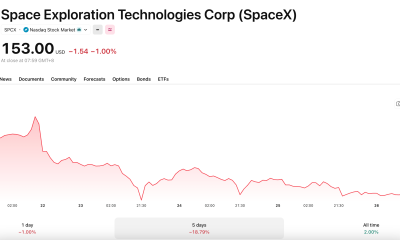

SpaceX Called a Market Top Signal Just 2 Weeks After Its $86 Billion IPO

Silicon Valley paid to kill AI regulation, now it wants the rules back


Presenter Caroline Flack’s brother Paul Flack dies aged 55


Binance stock trading tops $1B in first month after launch

New exhibition reflects five decades of movement between island of Ireland and GB

You must be logged in to post a comment Login