Tech
Builder Turns LEGO Bricks and Printed Discs Into a Generator Powered by Compressed Air Alone

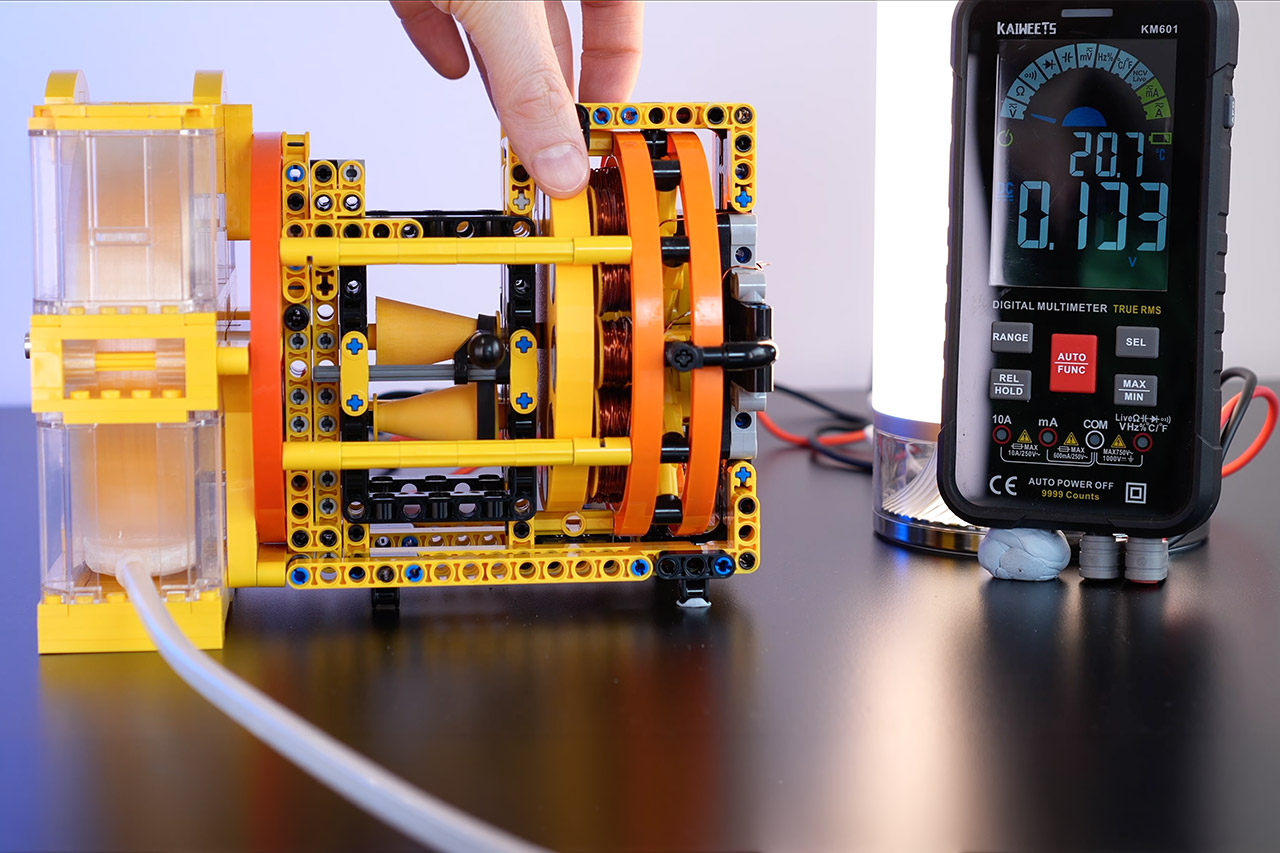
Jamie’s Brick Jams decided to take an old Nikola Tesla idea and turn it into something completely new, utilizing LEGO parts to construct a working generator. Jamie decided to utilize stacked discs rather than the standard spinning blades. Air enters at an angle through small holes and spirals in towards the closely spaced surfaces, and the friction from the moving air is what causes the discs to spin, without the need for any direct pushing force.


His first attempts employed basic LEGO Technic wheels and beams to construct a basic rotor stack, but compressed air at sixty pounds per square inch was insufficient, as the assembly was only spinning at eighteen thousand revs per minute and lacked thrust. It was speedy, yet it struggled to move a little walking robot, let alone huge objects. Then Jamie had the bright idea to use printed discs. The thin little circles that came out of the 3D printer at one millimeter thick were a huge game changer. Eleven of them stacked on a central shaft increased the surface area and provided the entire contraption a massive speed boost, by more than 70%. The airflow improved dramatically, and the rotor became quite steady.


Bambu Lab A1 Combo, A1 3D Printer and AMS lite, Support Multi-Color 3D Printing, High Speed & Precision…
- High-Speed Precision: Experience unparalleled speed and precision with the Bambu Lab A1 3D Printer. With an impressive acceleration of 10,000 mm/s…
- Multi-Color Printing with AMS lite: Unlock your creativity with vibrant and multi-colored 3D prints. The Bambu Lab A1 3D printers make multi-color…
- Full-Auto Calibration: Say goodbye to manual calibration hassles. The A1 3D printer takes care of all the calibration processes automatically…
Next came the enclosure, which Jamie designed to control the entering air so that it flowed perfectly over each disc. Printed housings had eight small holes spaced equally around the outside edge, and LEGO bricks sealed the edges to maintain air flowing smoothly in and prevent leaks. The outcome was a 50% increase in speed and a significant reduction in vibrations.
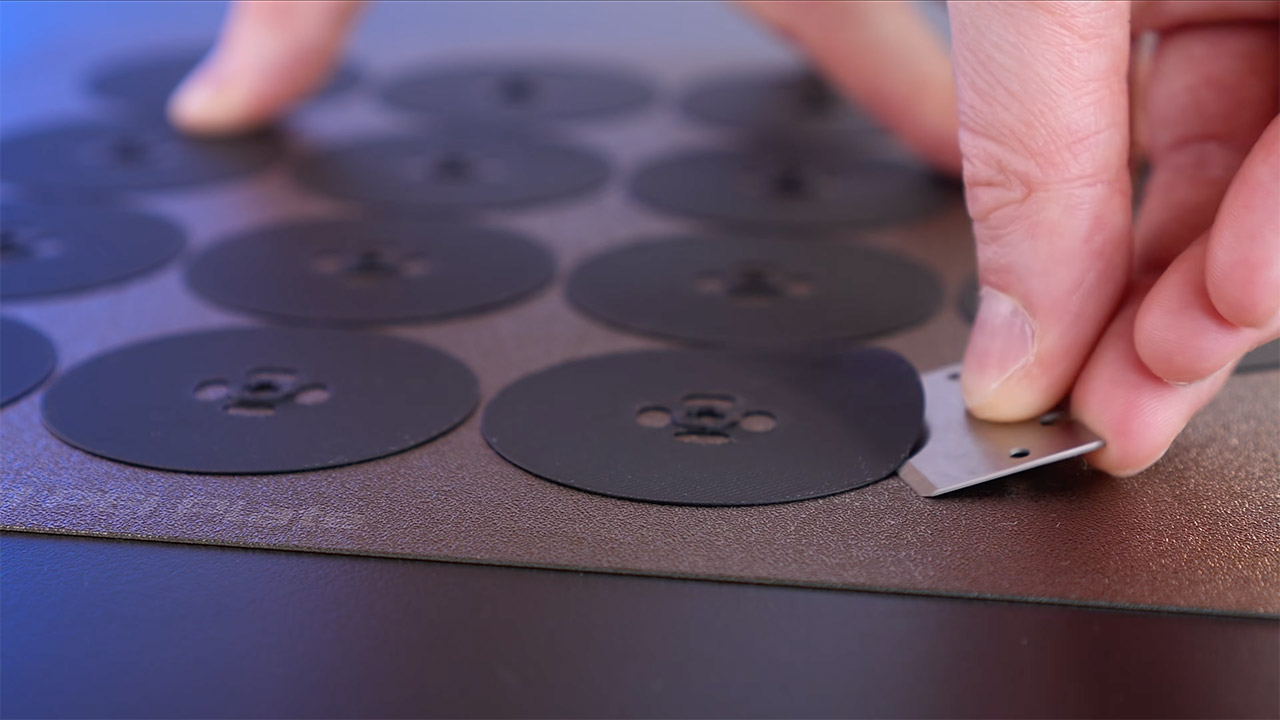
Jamie also conducted tests to determine which materials were the best, including normal PLA, a more durable variety, PETG, polycarbonate, and even flexible TPU. It turns out that a tougher version of PLA is the way to go, as it reached 27,000 revolutions per minute at the same air pressure. If you print the discs at a narrower three tenths of a millimeter, you can put more of them into the stack without it being too heavy.

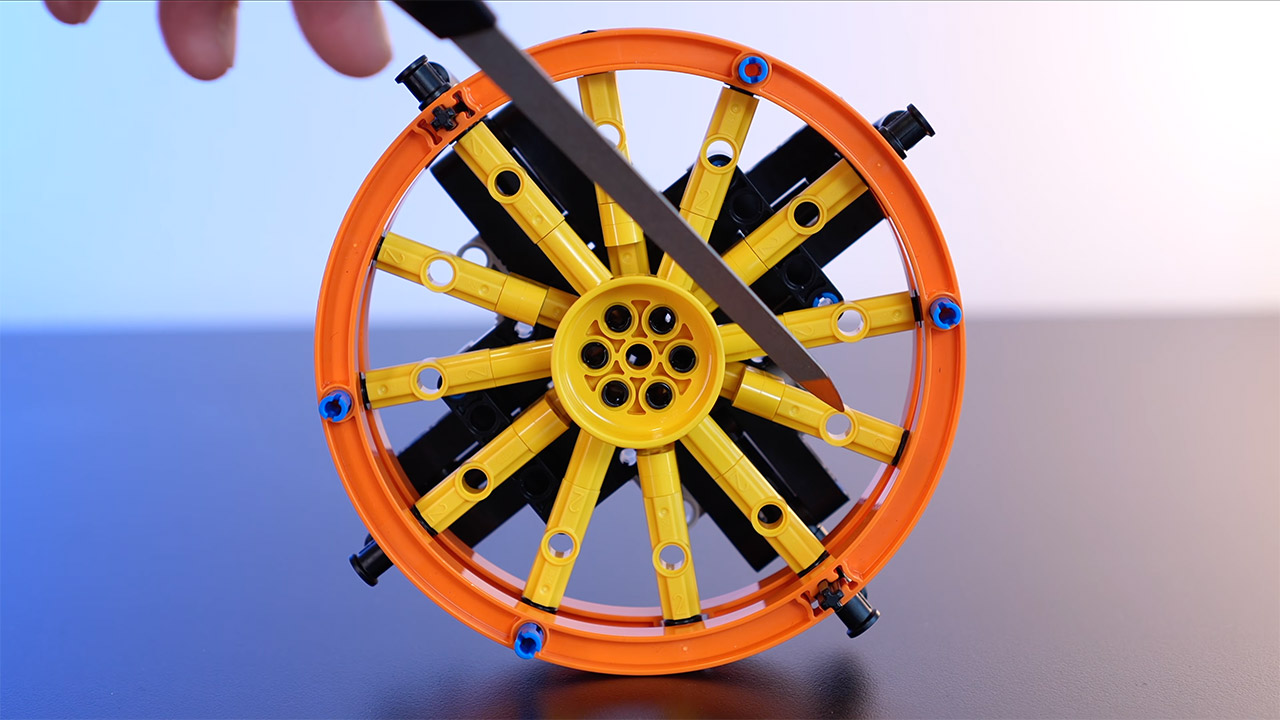
The finished design consisted of thirty discs stacked inside a reinforced LEGO Technic frame with metal axles and bearings for maximum durability. The centrifugal force of spinning keeps the flexible discs flat, and there are exhaust holes near the center shaft to evacuate the clean air once it’s finished. Getting the high speeds to generate useful electricity was the actual challenge. Jamie initially tried a cone pulley system with a rubber belt, but it did not last very long. So they moved to metal gears with a set reduction ratio, which made all the difference since it allowed them to achieve smooth power transmission without constantly fiddling with modifications.
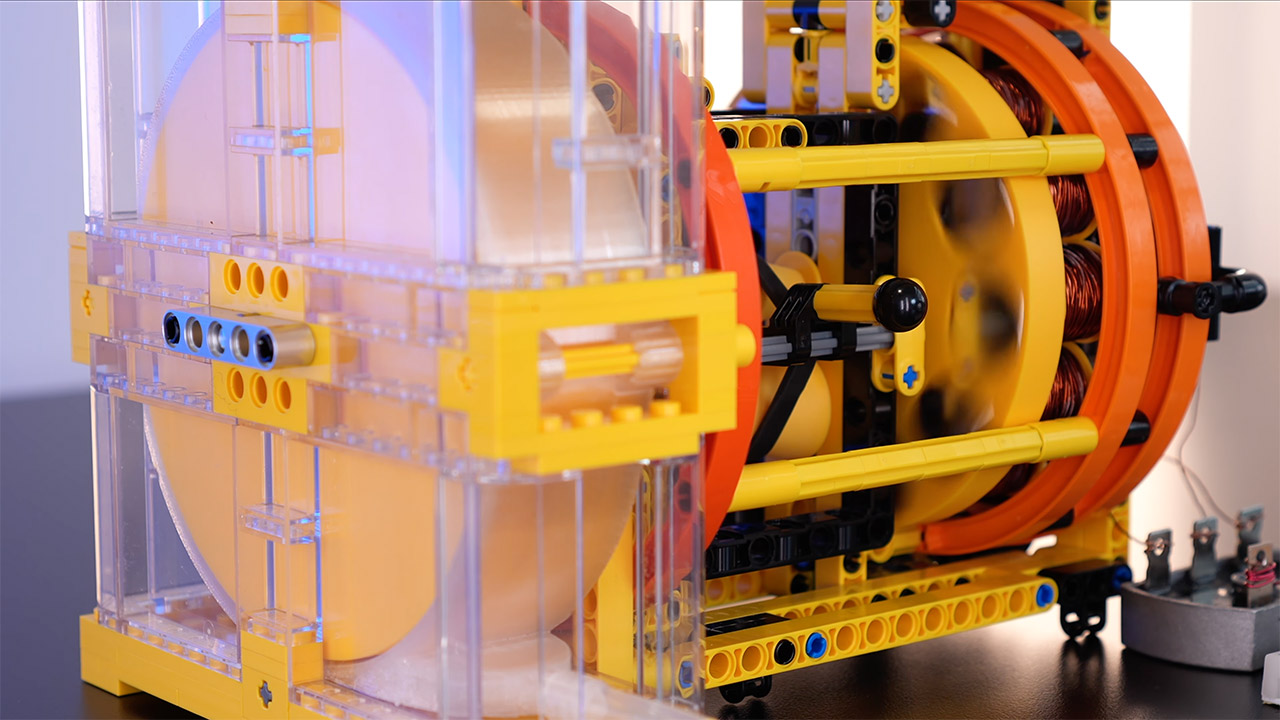
Coils and magnets served as the generator’s electrical core. It was a really clever setup, with a twelve-pole stator made from real LEGO bricks that contained coils of 20 gauge wire wrapped in three phases. Ten powerful neodymium magnets were used to generate the magnetic field on the spinning rotor. As the rotor spun, it generated a fluctuating magnetic field that the stator picked up. Next thing you know, rectification kicks in and converts that AC to steady DC, ready for the real world.
On the final runs, pushing the turbine hard with air at a whopping 85 pounds per square inch yielded impressively consistent results. Even under a strong load it held a steady 13,500 revolutions per minute, and as the pressure climbed the output followed, peaking at thirty volts with occasional bursts of up to one amp of current. The end result was fourteen watts of usable power, which is enough to charge a smartphone or keep a 100 watt LED panel running at full brightness for hours
[Source]