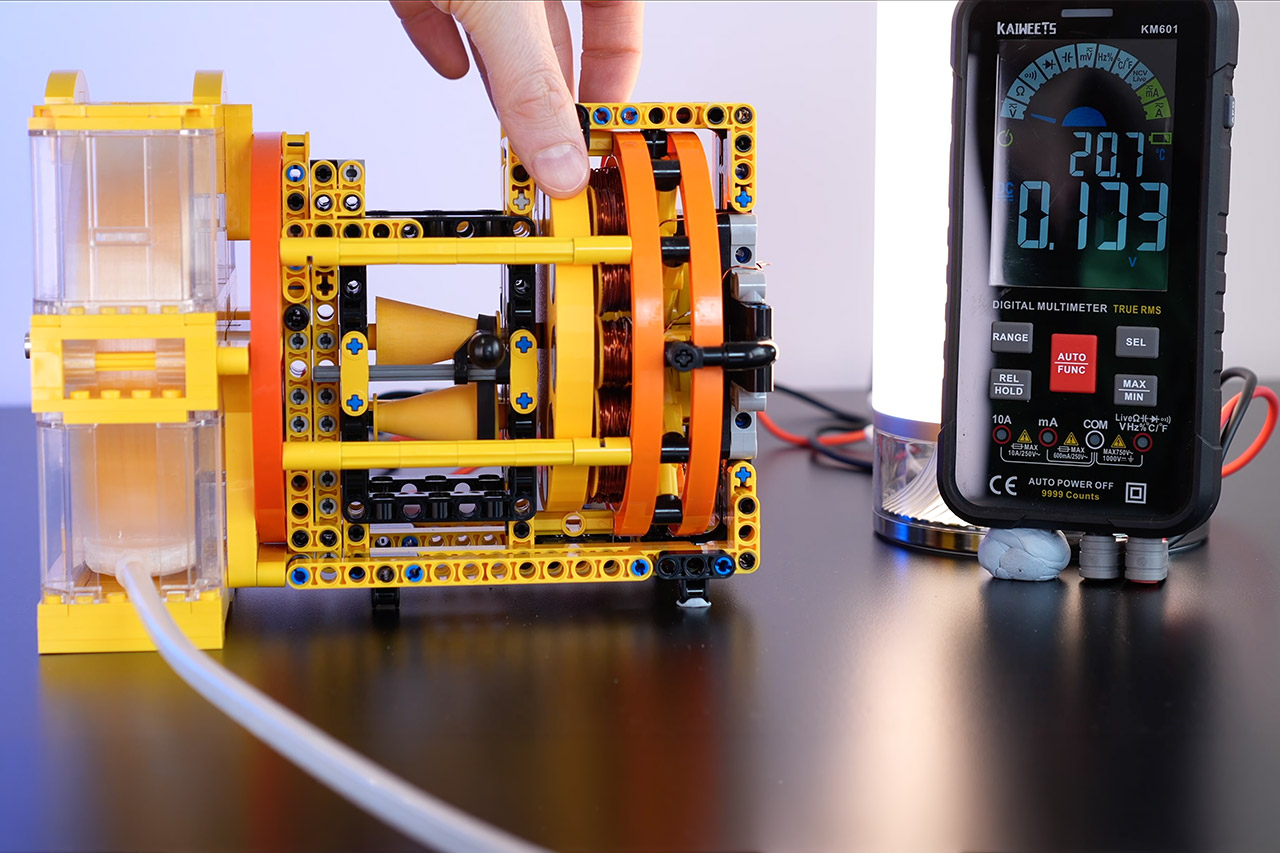
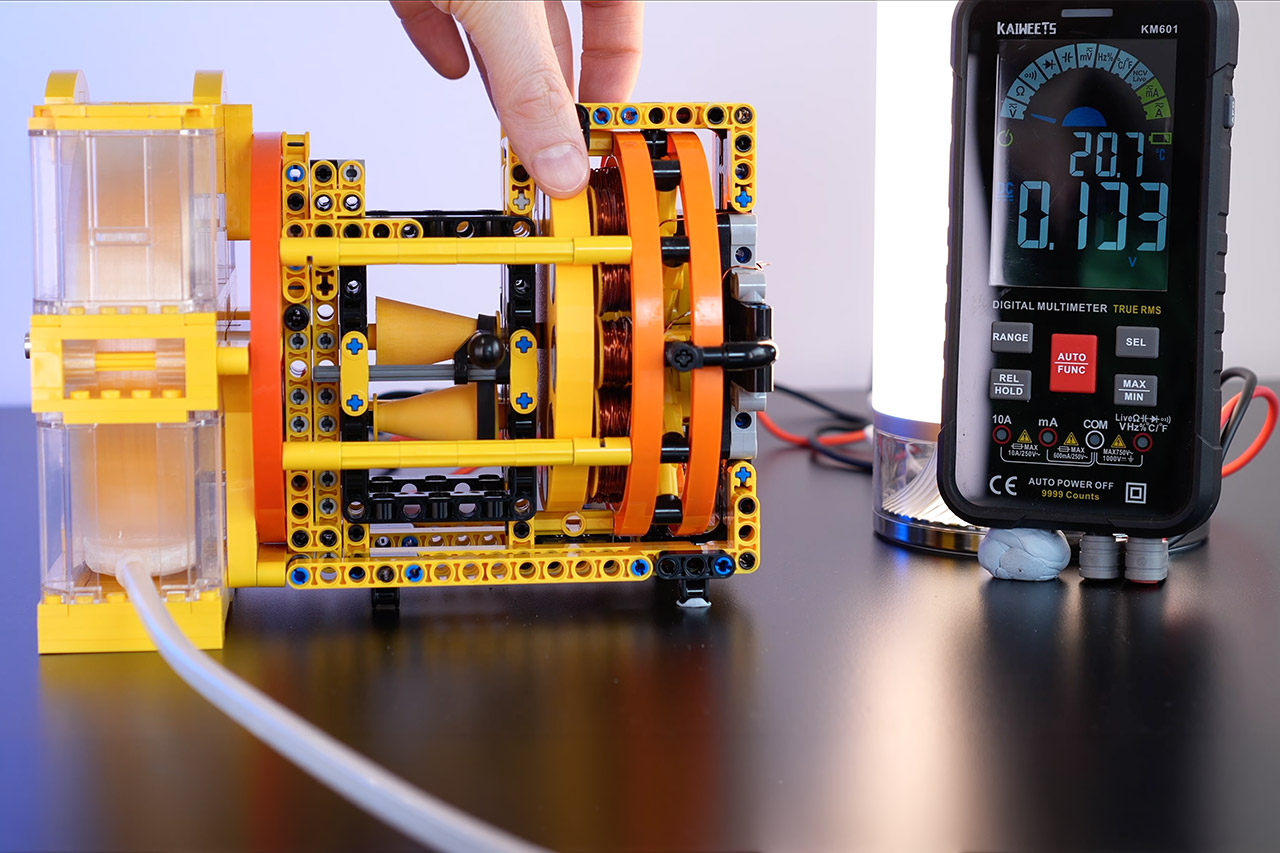
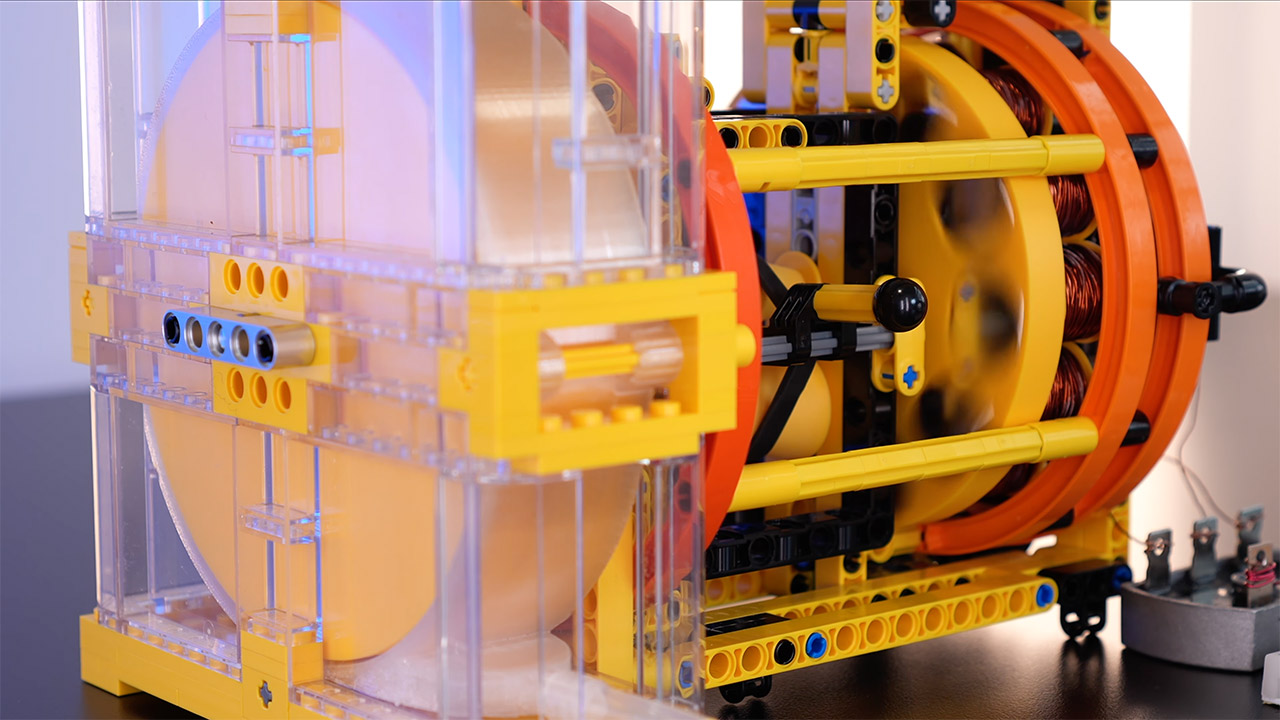
Jamie’s Brick Jams decided to take an old Nikola Tesla idea and turn it into something completely new, utilizing LEGO parts to construct a working generator. Jamie decided to utilize stacked discs rather than the standard spinning blades. Air enters at an angle through small holes and spirals in towards the closely spaced surfaces, and the friction from the moving air is what causes the discs to spin, without the need for any direct pushing force.
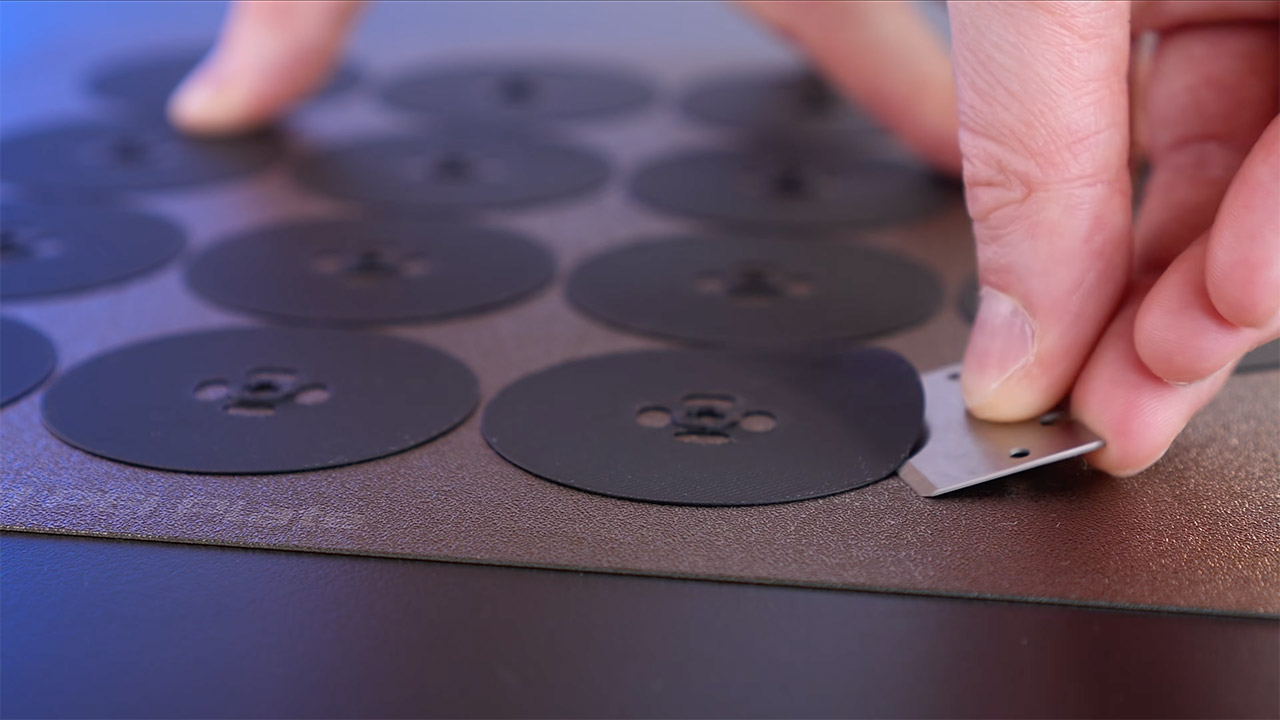
His first attempts employed basic LEGO Technic wheels and beams to construct a basic rotor stack, but compressed air at sixty pounds per square inch was insufficient, as the assembly was only spinning at eighteen thousand revs per minute and lacked thrust. It was speedy, yet it struggled to move a little walking robot, let alone huge objects. Then Jamie had the bright idea to use printed discs. The thin little circles that came out of the 3D printer at one millimeter thick were a huge game changer. Eleven of them stacked on a central shaft increased the surface area and provided the entire contraption a massive speed boost, by more than 70%. The airflow improved dramatically, and the rotor became quite steady.
High-Speed Precision: Experience unparalleled speed and precision with the Bambu Lab A1 3D Printer. With an impressive acceleration of 10,000 mm/s…
Multi-Color Printing with AMS lite: Unlock your creativity with vibrant and multi-colored 3D prints. The Bambu Lab A1 3D printers make multi-color…
Full-Auto Calibration: Say goodbye to manual calibration hassles. The A1 3D printer takes care of all the calibration processes automatically…
Next came the enclosure, which Jamie designed to control the entering air so that it flowed perfectly over each disc. Printed housings had eight small holes spaced equally around the outside edge, and LEGO bricks sealed the edges to maintain air flowing smoothly in and prevent leaks. The outcome was a 50% increase in speed and a significant reduction in vibrations.
Jamie also conducted tests to determine which materials were the best, including normal PLA, a more durable variety, PETG, polycarbonate, and even flexible TPU. It turns out that a tougher version of PLA is the way to go, as it reached 27,000 revolutions per minute at the same air pressure. If you print the discs at a narrower three tenths of a millimeter, you can put more of them into the stack without it being too heavy.
The finished design consisted of thirty discs stacked inside a reinforced LEGO Technic frame with metal axles and bearings for maximum durability. The centrifugal force of spinning keeps the flexible discs flat, and there are exhaust holes near the center shaft to evacuate the clean air once it’s finished. Getting the high speeds to generate useful electricity was the actual challenge. Jamie initially tried a cone pulley system with a rubber belt, but it did not last very long. So they moved to metal gears with a set reduction ratio, which made all the difference since it allowed them to achieve smooth power transmission without constantly fiddling with modifications.
Coils and magnets served as the generator’s electrical core. It was a really clever setup, with a twelve-pole stator made from real LEGO bricks that contained coils of 20 gauge wire wrapped in three phases. Ten powerful neodymium magnets were used to generate the magnetic field on the spinning rotor. As the rotor spun, it generated a fluctuating magnetic field that the stator picked up. Next thing you know, rectification kicks in and converts that AC to steady DC, ready for the real world.
On the final runs, pushing the turbine hard with air at a whopping 85 pounds per square inch yielded impressively consistent results. Even under a strong load it held a steady 13,500 revolutions per minute, and as the pressure climbed the output followed, peaking at thirty volts with occasional bursts of up to one amp of current. The end result was fourteen watts of usable power, which is enough to charge a smartphone or keep a 100 watt LED panel running at full brightness for hours [Source]
Meta could be preparing for one of the largest layoffs in its history, according to a Reuters report. The tech giant is planning to cut about 20 percent of its workforce, according to the outlet’s sources. According to the report, neither a date nor the exact number of layoffs has been finalized yet.
However, Reuters reported that Meta’s top executives have told “other senior leaders” to start “planning how to pare back.” In its latest financial report, the company’s employee headcount was 78,865 as of December 31, 2025, while revenue reached nearly $60 billion for the fourth quarter and more than $200 billion for the entire year. A Meta spokesperson told Reuters that this was “speculative reporting about theoretical approaches.”
Meta is no stranger to major layoffs. Earlier this year, Meta targeted about 1,000 employees in its layoffs with the Reality Labs division that’s responsible for the company’s virtual reality and metaverse efforts. Early last year, Meta laid off about five percent of its workforce, following a smaller round of firings that same month. Meanwhile, the company has been spending heavily to acquire AI startups, like Moltbook, a social network designed for AI agents, and Manus, a startup focused on AI agents for task automation.
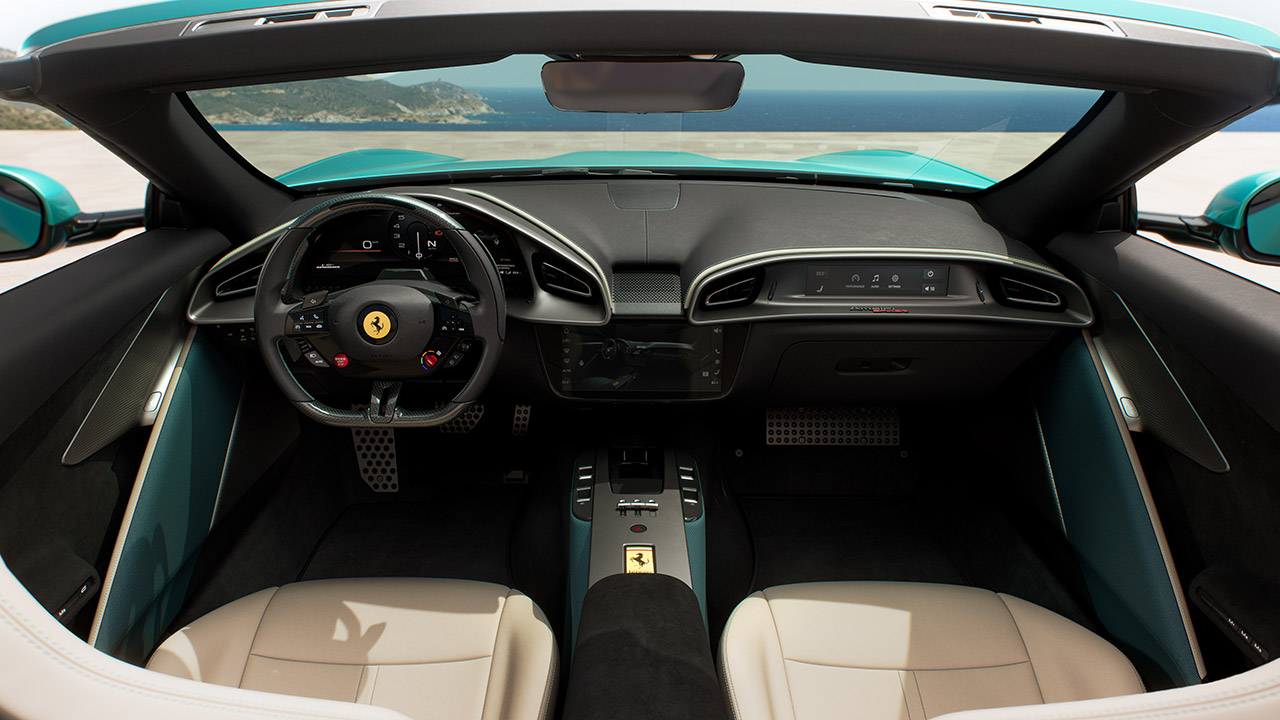
Ferrari has just unveiled its new convertible, the Amalfi Spider, and it begs to be driven with the top down. This open-top version is built on the Amalfi coupe, with engineers keeping the overall form consistent from the beltline down, thus the long hood and smooth contours remained mostly unchanged. Rosso Tramonto, a new paint color in the portfolio, has a gorgeous orange hue to it, like the sun setting over the Italian shore.
The design was all about airflow, as engineers molded the body with extreme care to ensure that air flowed over and around the car perfectly. That rear wing has three settings and can provide up to 243 pounds of extra traction when driving at highway speeds. Front air intakes and rear diffusers work together to keep the vehicle stable without sticking your nose out in the wind. You can choose from six different fabric colors for the roof, including this beautiful dark blue one called Tecnico Ottanio, and you can even add some contrast stitching to make it more personal. The roof folds up into a compact little package behind the seats, measuring eight point seven inches tall, and it does so at speeds of up to 37 mph.
MODEL CAR KIT FOR ADULTS – Celebrate a legend of the race track with the LEGO Icons Ferrari F2004 & Michael Schumacher (11375) building set for…
WHAT’S IN THE BOX – Includes all you need to craft a detailed replica of the Ferrari F2004 F1 race car, plus a Michael Schumacher minifigure…
REALISTIC FEATURES & FUNCTIONS – The LEGO Ferrari F1 model comes with working steering, a detailed cockpit and V10 engine, and grooved slick tires…
Dropping the top takes exactly 13.5 seconds, and the five-layer fabric is substantial, so there isn’t much wind noise or heat flowing in when the roof is down. In reality, it performs similarly to a solid roof. You can even deploy a little wind deflector on the back seat with the press of a button, which remains effective up to 106 mph. Trunk capacity is also surprisingly good, nine cubic feet with the roof up and six when it’s stowed, which is still enough to fit some weekend bags or a couple of helmets.
The power comes from a 3.9-liter twin-turbocharged V8 that delivers 631 horsepower and 561 lb-ft of torque to the rear wheels via an eight-speed dual-clutch transmission. That means you can accelerate from 0 to 62 in 3.3 seconds and reach 124 mph in 9.4 seconds. Maximum speed is 199 miles per hour. The entire vehicle weighs 3,430 pounds dry, which is 190 pounds more than the coupe, but it handles fairly well, with 48% of the weight up front and the rest in the back.
Drivers get the same revised cabin as the coupe, with all of the physical controls and dials on the steering wheel, replacing the touch sensitive pads with something more substantial. You get a 15.6-inch digital cluster straight front, but there’s also a 10.25-inch central screen for navigation and media, as well as an 8.8-inch display in front of the passenger that shows real-time engine data and g-forces. When she’s ready to go, the metal start button glows red, and you can connect Apple CarPlay or Android Auto wirelessly as well. Those tiny rear seats are useful for storing gear or taking the kids on a short journey, but the entire cockpit wraps around the front two occupants, giving them a focused sense, as if the car is all about them.
The electronics are cutting-edge, as the brake-by-wire system provides a very precise pedal feel, and the latest iteration of Side Slip Control modifies grip in real time. You have five distinct driving modes to pick from on the steering wheel, ranging from Wet to Race, and each one adjusts the throttle responsiveness and suspension firmness via those fancy magnetorheological dampers. Then there are the key safety features, such adaptive cruise control and lane-keeping assistance, which are all included, but you can also add some extras, like as a 360-degree video system.
Ferrari is manufacturing the Amalfi Spider at its Maranello plant, and it will hit the road later this year as a 2027 model. The coupe started at a quarter of a million dollars, so you can probably expect to pay a little more for the Spider, especially if you start clicking the options box, possibly in the low $300,000s. [Source]
E Ink has come a long way. There are now a lot of cool applications of it, from pocketable e-readers like the Boox Palma 2 to fully fledged Android tablets with color layers like the Boox Note Air 4C. There’s plenty of appeal in a display that doesn’t require a glowing backlight. There’s less eye strain, no blue light concerns and easy viewing, even in direct sunlight.
The Bigme B251 monitor plays into that appeal with a 25.3-inch color E Ink display. It sounds and looks promising, but at $1,499, it needs to deliver on that promise. Unfortunately, I can’t say it does.
Not the display you’re hoping for
Advertisement
Mark Knapp/CNET
Testing the Bigme B251 may be my first time using an E Ink monitor, but it is far from my first time testing an E Ink device. I’ve seen the black-and-white contrast improve considerably over the years, but E Ink displays with a color layer lag behind. The B251 is one of these, putting a color LCD layer over an E Ink layer. This negatively impacts the brightness as a result.
One of the key promises of E Ink is that you can rely on ambient light to illuminate the display, so you don’t need a built-in backlight like a traditional monitor. The problem is that the color layer dims the display so much that you need lighting unless you’ve got your back to a wall of sunlit windows.
For me, even in a comfortably lit room near a sunny window, the Bigme B251 was too dim without its lighting. That lighting is gentle on the eyes and has an adjustable color temperature.
While 3,200×1,800 resolution on a 25.3-inch display should be decent, clarity still ends up an issue because of the color layer and ghosting. Even the text clarity of black-and-white content isn’t up to snuff, with text showing noticeable pixelation.
Black text on a white background is the best-case scenario, but white text on a black background is barely legible. Bigme claims a 300ppi E Ink resolution and a 150ppi color resolution, but I’m skeptical. This should be as sharp as a 15.3-inch display at 1200p, but I’m using one side-by-side with the Bigme, and the latter doesn’t look as sharp.
Advertisement
Mark Knapp/CNET
The B251 offers a few different image modes to help nudge it in the right direction when viewing different types of content. For web browsing, there’s the aptly named “web” mode. There are also modes for text, images, and video. Each has some customization available for contrast and saturation, but they have locked refresh rates.
The “image” mode offers the best clarity, but it has a very slow refresh rate, maybe about 1Hz. Mousing around is virtually impossible. Though “video” mode is smoother, it’s incredibly blotchy. The videos themselves appear somewhat fluid, but the rest of the display becomes largely unusable, especially as ghosting artifacts persist permanently if a pixel isn’t refreshed with new content.
The “text” and “web” modes offer a nice middle ground, but still aren’t completely satisfying. Outside of the “image” mode, the others have a heavy reliance on dithering, making for a messy, grainy-looking screen for a lot of content. That’s not a great look for such a pricey gadget.
An otherwise mixed bag
Advertisement
At least the Bigme B251 has a lot of connection options.
Mark Knapp/CNET
Beyond the screen itself, the Bigme B251 monitor is middling. It has a reasonable variety of ports: HDMI, Mini HDMI, DisplayPort and USB-C, plus some USB hub capabilities. Wireless streaming to the monitor is also possible, though I didn’t find it quite as compelling as Bigme’s promotional content suggested. For instance, I couldn’t get my phone to fill the entire height of the monitor when it was in vertical orientation.
The B251 comes with a small remote for quickly adjusting settings. Even though it’s a basic remote, it’s quite useful since the monitor’s built-in controls feel cheap and have hard-to-read labels.
The monitor hardware looks pretty enough, with a simple white-and-silver color scheme that harks back to some old all-in-one Mac systems. At over an inch thick, the white bezels are undeniably large for 2026, but they’re pleasantly curved and uniform. Unfortunately, those bezels and the whole back case of the monitor feel like they’re built from far too cheap a plastic for a $1,500 monitor.
Advertisement
The bezel is thin by 2026 standards.
Mark Knapp/CNET
The stand has some actual metal, one of the only parts that is, but this is offset by the neck portion having a plastic plate painted silver to look like metal. On the bright side, the stand offers plenty of position flexibility with tilt, pivot, height and rotation adjustments.
The B251 includes speakers, but they don’t sound great. There’s some obnoxious resonance in the case, even at medium volumes, which is hard to accept for a monitor at this price.
Advertisement
Mark Knapp/CNET
Just one more nail in the coffin: the B251 uses an external power brick. The monitor isn’t small overall, nor thin by any means, and it only needs 60 watts. Relying on a desk-cluttering external power brick feels entirely unnecessary.
Final thoughts
The dream of a great-looking E Ink monitor that can be lit simply by room lighting, showing sharp, easy-on-the-eyes content, isn’t dead, but the Bigme B251 doesn’t accomplish it. While this monitor gives you a lot more screen space than you might get from E Ink tablets, it’s an all-too-compromised experience for a device with a considerable price premium.
I did find it gentle to look at, but that was offset by the extra strain on my eyes to parse the rough-edged text. I had to figure out where my mouse cursor was, thanks to the low refresh rate, and try to make out whatever was going on in areas where any color is involved.
If you want easy-on-the-eyes E Ink, I’ve spent days writing and browsing the web on a black-and-white Boox Note Air and color Boox Tab Ultra C. While much smaller than the B251, the experience was altogether better. Plus, their portability means you can just bring them right out into the sunshine and avoid backlighting altogether.
On the podcast, [Tom] and I were talking about the new generation of smartphones which are, at least in terms of RAM and CPU speed, on par with a decent laptop computer. If so, why not just add on a screen, keyboard, and mouse and use it as your daily driver? That was the question posed by [ETA Prime] in a video essay and attempt to do so.
Our consensus was that it’s the Android operating system holding it back. Some of the applications you might want to run just aren’t there, and on the open side of the world, even more are missing. Is the platform usable if you can’t get the software you need to get your work done?
Looking back, these have been the same stumbling blocks for the last decade. In 2018, I was wondering aloud why we as a community don’t hack on cell phones, and the answer then was the same as it is now – the software is not friendly to our kind. You can write phone apps, and I have tried to do so, but it’s just not fun.
Advertisement
The polar opposites of the smartphone-as-computer are no strangers in our community. I’m thinking of the Linux single-board computers, or even something like a Steam Deck, all of which are significantly less powerful spec-wise than a flagship cell phone, but which are in many ways much more suitable for hacking. Why? Because they make it easy to do the things that we like to do. They’re designed to be fun computers, and so we use them.
So for me, a smartphone isn’t a computer, but oddly enough it’s not because of the hardware. It’s because what I want out of a computer is more than Turing completeness. What I want is the fun and the freedom of computering.
A new NYT Connections puzzle appears at midnight each day for your time zone – which means that some people are always playing ‘today’s game’ while others are playing ‘yesterday’s’. If you’re looking for Saturday’s puzzle instead then click here: NYT Connections hints and answers for Saturday, March 14 (game #1007).
Good morning! Let’s play Connections, the NYT’s clever word game that challenges you to group answers in various categories. It can be tough, so read on if you need Connections hints.
What should you do once you’ve finished? Why, play some more word games of course. I’ve also got daily Strands hints and answers and Quordle hints and answers articles if you need help for those too, while Marc’s Wordle today page covers the original viral word game.
Advertisement
SPOILER WARNING: Information about NYT Connections today is below, so don’t read on if you don’t want to know the answers.
Article continues below
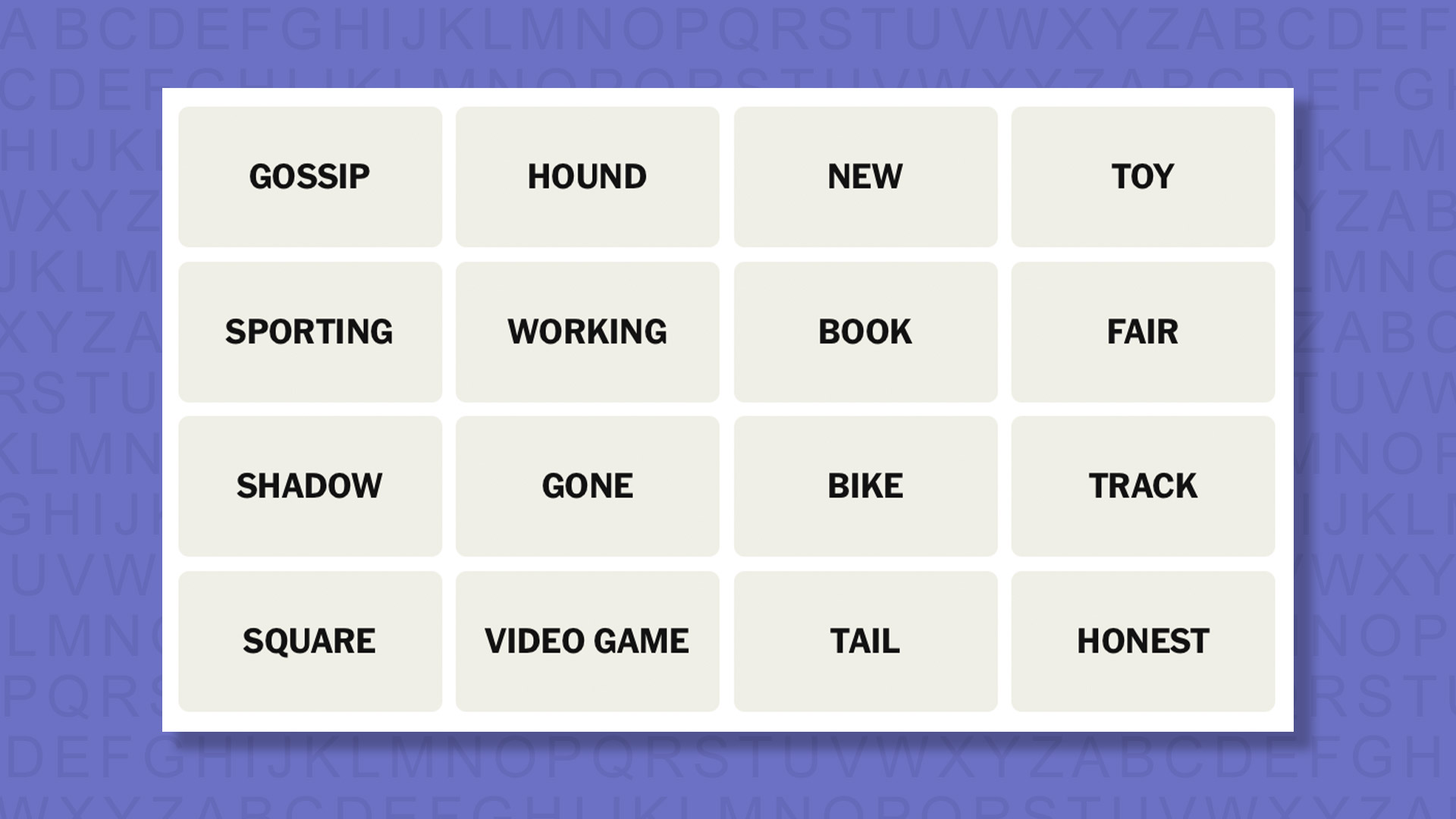
NYT Connections today (game #1008) – today’s words
(Image credit: New York Times)
Today’s NYT Connections words are…
GOSSIP
HOUND
NEW
TOY
SPORTING
WORKING
BOOK
FAIR
SHADOW
GONE
BIKE
TRACK
SQUARE
VIDEO GAME
TAIL
HONEST
NYT Connections today (game #1008) – hint #1 – group hints
What are some clues for today’s NYT Connections groups?
YELLOW: Following
GREEN: Honorable behavior
BLUE: What to buy a 10-year-old
PURPLE: Screen arts featuring “a young woman”
Need more clues?
We’re firmly in spoiler territory now, but read on if you want to know what the four theme answers are for today’s NYT Connections puzzles…
Advertisement
Sign up for breaking news, reviews, opinion, top tech deals, and more.
NYT Connections today (game #1008) – hint #2 – group answers
What are the answers for today’s NYT Connections groups?
YELLOW: PURSUE
GREEN: SPORTSMANLIKE
BLUE: CLASSIC KID GIFTS
PURPLE: “____ GIRL” TITLES
Right, the answers are below, so DO NOT SCROLL ANY FURTHER IF YOU DON’T WANT TO SEE THEM.
Advertisement
NYT Connections today (game #1008) – the answers
(Image credit: New York Times)
The answers to today’s Connections, game #1008, are…
BLUE: CLASSIC KID GIFTS BIKE, BOOK, TOY, VIDEO GAME
PURPLE: “____ GIRL” TITLES GONE, GOSSIP, NEW, WORKING
My rating: Easy
My score: Perfect
Seeing TOY and BOOK alongside FAIR temporarily sidelined me into attempting a fair group (are VIDEO GAME fairs a thing?) and GOSSIP and HOUND seemed to hint at another collection, but fortunately I quickly moved on from these ideas.
In most groups there is always one tile that you feel less certain about than the others and in PURSUE it was HOUND, which sounded closer to up-close harassment than the covert activities suggested by SHADOW, TAIL, and TRACK.
Advertisement
For SPORTSMANLIKE the tricky fourth tile was SQUARE (isn’t this what you’d call an uncool sportsman?), while for CLASSIC KID GIFTS it was most definitely BOOK.
Yesterday’s NYT Connections answers (Saturday, March 14, game #1007)
YELLOW: HYPNOTIC STATE DREAM, HAZE, SPELL, TRANCE
GREEN: STARTING WITH PREFIXES MEANING “TWO” BINARY, DIOXIDE, DUOLINGO, TWILIGHT
PURPLE: ENDING IN FEMALE ANIMALS HOOTENANNY, LICHEN, MOSCOW, NIGHTMARE
What is NYT Connections?
NYT Connections is one of several increasingly popular word games made by the New York Times. It challenges you to find groups of four items that share something in common, and each group has a different difficulty level: green is easy, yellow a little harder, blue often quite tough and purple usually very difficult.
On the plus side, you don’t technically need to solve the final one, as you’ll be able to answer that one by a process of elimination. What’s more, you can make up to four mistakes, which gives you a little bit of breathing room.
Advertisement
It’s a little more involved than something like Wordle, however, and there are plenty of opportunities for the game to trip you up with tricks. For instance, watch out for homophones and other word games that could disguise the answers.
It’s playable for free via the NYT Games site on desktop or mobile.
We have all heard about model context protocol (MCP) in the context of artificial intelligence. In this article, we will dive into what MCP is and why it is becoming more important by the day. When APIs are already available then why do we need MCP? Although we have seen a large rise in popularity of MCP, is there staying power in this new protocol? In the first section, we will look at the parallels between APIs and MCP and then start to explore what sets it apart.
From APIs to model context protocol
A single isolated computer is limited in the amount of data that it can access and that has a direct impact on its usability. APIs were created to enable data transfer between systems. Just like APIs, Model Context Protocol (MCP) is the protocol for communication between AI agents that are using large language models (LLMs). APIs are primarily written for developers while MCP servers are created for AI agents (Johnson, 2025).
What is MCP?
MCP was introduced by Anthropic on November 25, 2024 as an open source standard to enable communication between AI assistants and external data sources. AI agents are constrained by the fragmentation of data in isolated systems (Anthropic, 2024). The protocol defines how agents can interact with external systems, elicit user input and enable automated agents.
At its core MCP utilizes the client server model and there are three main features for clients and servers.
To keep this article concise, focus will be kept on the most important feature of both client and server. For MCP servers, tools are the primary way to perform complex tasks and clients utilize elicitation to enable a two way communication between the agent and the user.
Instead of explicitly calling APIs, agents select and use the appropriate tools (functions) based on the input they receive from the user. If a tool requires certain parameters the agent will use elicitation to get the data from the user. This allows for a more responsive workflow where two way communication between LLM and the user is possible.
Advertisement
Why do we need MCP now?
A very valid question to ask is if APIs are already present then why is there a need for MCP? APIs are designed to connect fragmented data systems and SaaS applications already enable a two way communication with a user. So, why do we need MCP now?
The main need for MCP is that the user of external data has changed from developers to AI agents. A developer will usually program an application using APIs that behaves in a deterministic fashion. Whereas, AI agents will use the user prompt and make autonomous decisions to execute on the user request. By nature, the execution of a workflow by an AI agent is not deterministic.
APIs are a machine-executable contract which acts in a deterministic fashion. APIs work if the users of APIs know what action needs to be taken next (Posta, 2025). AI agents run on top of probabilistic LLMs which do not consistently deliver repeatable results across all tasks (Atil, 2024). Variance in a LLM’s response is expected and this poses a problem for autonomous execution.
MCP to the rescue
MCP solves the problem of variance in agent execution by providing high level abstraction that wraps functionality rather than API endpoints. Tools enable LLM models to perform actions like searching for a flight, booking a calendar and more (Understanding MCP Servers, 2026).
Advertisement
One common misconception for tools is that they are just an abstraction over existing API calls. Tools are not designed to be an abstraction over API calls but rather abstraction over functionality. If a lot of APIs are just exposed as tools it will increase the cost and context size for the agent which is not ideal (Johnson, 2025).
A tool may include multiple API calls in its implementation to achieve the desired outcome. An agent will review the list of available tools to automatically select the most appropriate tools and determine the appropriate order of execution.
MCP adoption boom
Since its release in 2024 MCP has seen a steady rise in popularity. The following chart from Google Trends showcases the relative interest in MCP since its launch.
A lot of companies have launched their own MCP servers to facilitate building autonomous agents. As of February 2026, the official MCP registry has over 6400 MCP servers already registered. This number of MCP servers is only expected to grow in the near future. The official registry for MCP servers is still in preview and the ecosystem has grown massively in less than a year.
Advertisement
Other major players in the market have adopted MCP and added support to their clients. OpenAI added MCP support to ChatGPT in March and Google added support a few weeks later in April 2025. This showcases the staying power of the protocol and the fast pace of adoption.
What lies ahead?
MCP is still in the early stages of widespread adoption where a lot of applications need to mature and start hitting production. Leonardo Pineryo from Pento AI summarized it the best “MCP’s first year transformed how AI systems connect to the world. Its second year will transform what they can accomplish” (2025).
Guardrails around tools is an area that will see further development as trust is one of the biggest concerns with AI agents. With better guardrails in the tools, an AI agent can be allowed to perform with more autonomy. Over the next year, MCP is certain to see continued growth, both in the sophistication of its capabilities and the volume of its application.
A new NYT Strands puzzle appears at midnight each day for your time zone – which means that some people are always playing ‘today’s game’ while others are playing ‘yesterday’s’. If you’re looking for Saturday’s puzzle instead then click here: NYT Strands hints and answers for Saturday, March 14 (game #741).
Strands is the NYT’s latest word game after the likes of Wordle, Spelling Bee and Connections – and it’s great fun. It can be difficult, though, so read on for my Strands hints.
Want more word-based fun? Then check out my NYT Connections today and Quordle today pages for hints and answers for those games, and Marc’s Wordle today page for the original viral word game.
Advertisement
SPOILER WARNING: Information about NYT Strands today is below, so don’t read on if you don’t want to know the answers.
Article continues below
NYT Strands today (game #742) – hint #1 – today’s theme
What is the theme of today’s NYT Strands?
• Today’s NYT Strands theme is… Best of all
NYT Strands today (game #742) – hint #2 – clue words
Play any of these words to unlock the in-game hints system.
Advertisement
GEAR
STAGE
SNOW
SNAG
CARER
TURN
NYT Strands today (game #742) – hint #3 – spangram letters
How many letters are in today’s spangram?
• Spangram has 12 letters
NYT Strands today (game #742) – hint #4 – spangram position
What are two sides of the board that today’s spangram touches?
First side: left, 5th row
Last side: right, 5th row
Advertisement
Right, the answers are below, so DO NOT SCROLL ANY FURTHER IF YOU DON’T WANT TO SEE THEM.
Advertisement
NYT Strands today (game #742) – the answers
(Image credit: New York Times)
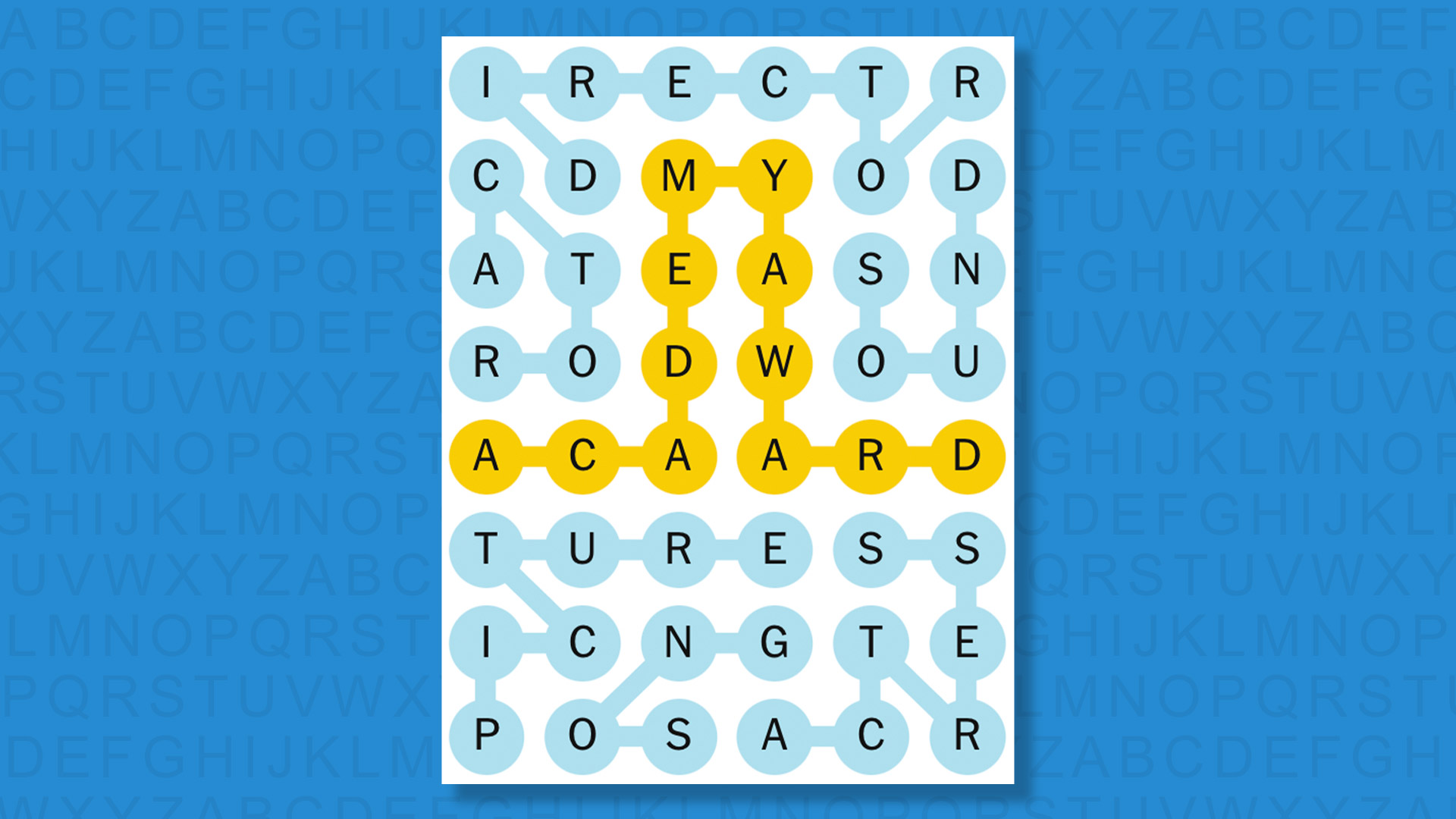
The answers to today’s Strands, game #742, are…
DIRECTOR
SOUND
ACTOR
ACTRESS
PICTURE
SONG
SPANGRAM: ACADEMYAWARD
My rating: Easy
My score: Perfect
This Sunday the world will be tuned into the 98th ACADEMY AWARD ceremony in Los Angeles, as the 3,141st to the 3,165th statuettes are handed out to the “best of all”.
Sign up for breaking news, reviews, opinion, top tech deals, and more.
Despite the many things I don’t like about it (the industry thank you list speeches, mainly), I always really enjoy watching the Oscars — although in the UK it does require staying awake until 3.30am — and this year I’ll be hoping The Secret Agent gets some recognition.
I digress, with little in the way of mystery this edition of Strands was fairly straightforward. My only error was adding an S to the end of the Spangram and having to connect it all over again after it didn’t turn yellow.
Advertisement
Yesterday’s NYT Strands answers (Saturday, March 14, game #741)
VENT
CRUST
FILLING
LATTICE
GLAZE
FRUIT
EDGES
SPANGRAM: HAPPYPIDAY
What is NYT Strands?
Strands is the NYT’s not-so-new-any-more word game, following Wordle and Connections. It’s now a fully fledged member of the NYT’s games stable that has been running for a year and which can be played on the NYT Games site on desktop or mobile.
I’ve got a full guide to how to play NYT Strands, complete with tips for solving it, so check that out if you’re struggling to beat it each day.
AI services may not stay cheap for long, as companies like OpenAI and Anthropic are currently subsidizing usage to rapidly grow market share. As these companies move toward profitability and potential IPOs, Axios reports that investors will likely push them to increase prices and improve margins. An anonymous reader shares an excerpt from the report: Flashback: Silicon Valley has seen this movie before. The so-called “millennial lifestyle subsidy” meant VC money helped underwrite cheap Uber rides and DoorDash deliveries. Before that, Amazon built its base with low prices, free shipping and, for years, no sales tax in most states. Eventually, all of these companies had to charge enough to cover costs — and make a profit.
Follow the money: The current iteration of AI subsidies won’t last forever. Both OpenAI and Anthropic are widely expected to go public. Public investors will demand earnings growth and expanding margins. Even as chips get more efficient, total spending keeps rising. Labs need more capacity, more upgrades and more supply to meet demand.
The bottom line: The costs of AI will keep going down. But total spend from customers will need to keep going up if AI companies are going to become profitable and investors are ever going to get returns on their massive investments.
The feature, announced at SXSW by co-CEO Gustav Söderström, lets Premium listeners see and shape the data model powering their recommendations, starting with a beta rollout in New Zealand
For a decade, Spotify’s recommendation engine has worked largely in silence. It watched what you played, noted what you skipped, inferred meaning from the time of day and the tempo of your commute, and it never told you what it had concluded. On Friday, at SXSW in Austin, the company decided to change that.
Gustav Söderström, Spotify’s co-CEO, announced Taste Profile: a new feature that surfaces the algorithmic model the platform has been building about each listener, and crucially lets users modify it directly. The beta will begin rolling out to Premium subscribers in New Zealand in the coming weeks.
The premise is straightforward enough. Taste Profile aggregates a listener’s behaviour across music, podcasts, and audiobooks into a single view: the genres explored recently, the artists listened to most, the patterns that define a listening day.
Advertisement
The 💜 of EU tech
The latest rumblings from the EU tech scene, a story from our wise ol’ founder Boris, and some questionable AI art. It’s free, every week, in your inbox. Sign up now!
Where a user notices the profile is wrong, too heavy on music they played years ago, or missing a phase they have been quietly working through, they can flag it. They can ask for more of a particular vibe, or less. They can describe a current context, training for an event, commuting on weekdays, and the system will factor that in when deciding what to surface on the Spotify homepage.
“This is the next step in our vision to make personalization more transparent, responsive, and truly yours,” Söderström told the SXSW audience.
Advertisement
Spotify cited an internal figure that more than 80% of its listeners name personalisation as what they value most about the service. The claim, which the company has referenced in various forms since at least 2023, positions algorithmic curation not just as a feature but as the primary reason people stay.
The competitive logic behind Taste Profile follows directly from that: if personalisation is the product, giving users more control over it is a way to deepen their investment in it.
The announcement comes roughly two months after Spotify expanded Prompted Playlist, a separate but related feature that lets users generate playlists by describing what they want in natural language, from its initial New Zealand testing to Premium users in the US and Canada in late January 2026, and subsequently to subscribers in Australia, Ireland, Sweden, and the UK in February. The sequencing is deliberate.
Both features push the same underlying argument: that the future of streaming personalisation is collaborative, not passive.
Advertisement
Where Prompted Playlist is generative, it creates something new from a description, Taste Profile is corrective. It works with the model that already exists, giving users a chance to audit and adjust what years of listening have written about them.
Whether someone has been an accidental customer of the algorithm (playing whatever appeared on the homepage, not particularly caring) or has strong views about the direction their recommendations have taken, the feature is designed to accommodate both. “You can shape your Taste Profile as much as you’d like,” the company said in its announcement, “or leave it and enjoy Spotify as usual.”
The beta will start in New Zealand, a market Spotify has used repeatedly for early-stage testing of AI-adjacent features, including the initial Prompted Playlist launch. No timeline was given for a broader global rollout. Taste Profile will be available to Premium subscribers only; there was no indication of when, or whether, it might reach free-tier accounts.
Spotify is marking 2026 as its 20th anniversary year, and its SXSW presence this week has been calibrated accordingly, concerts, a headline session with Söderström, country artist Lainey Wilson, and podcast host David Friedberg.
Advertisement
The Taste Profile announcement landed on the last day of the company’s main SXSW programming, providing a product note to accompany the celebration.
What the feature represents, beyond its functionality, is a shift in how Spotify frames its relationship with listeners. The algorithm has always existed; the company is now making the case that knowing it is there, and having some say in what it does, is a feature in itself.
Last June Texas Agriculture Commissioner Sid Miller said in a statement that Texans “have a God-given right to know what’s on their plate, and for millions of Texans, it better come from a pasture, not a lab. It’s plain cowboy logic that we must safeguard our real, authentic meat industry from synthetic alternatives.”
But California company Wildtype sells lab-grown salmon — and is suing Texas over its ban on cell-cultivated meat, the Austin Chronicle reported this week. The company’s founder says lab-grown salmon eliminates the mercury, microplastic, and antibiotic contamination commonly found in seafood. And one chef in Austin, Texas says lab-grown salmon is “awesome” and “something new”– at the only Texas restaurant that was serving it last summer:
Just two months after the salmon hit the menu, Texas banned the sale of cell-cultivated meat…
A lawsuit from Wildtype and one other FDA-approved cultivated meat company [argues] it’s anti-capitalism and unconstitutional… This law “was not enacted to protect the health and safety of Texas consumers — indeed, it allows the continued distribution of cultivated meat to consumers so long as it is not sold. Instead, SB 261 was enacted to stifle the growth of the cultivated meat industry to protect Texas’ conventional agricultural industry from innovative competition that is exclusively based outside of Texas….” [according to the lawsuit]. It was filed in September, immediately after the ban took effect, and cell-cultivated companies are awaiting judgment. That Texas ban would last two years, notes U.S. News and World Reports, adding that
Alabama, Florida, Indiana, Mississippi, Montana, and Nebraska have also passed bans, some temporary “on the manufacturing, sale or distribution of cell-cultured meat.” Meanwhile, a new five-year moratorium on lab-grown meat was signed this week by the governor of South Dakota “after rejecting a permanent ban last month,” reports South Dakota Searchlight:
The new law bars the sale, manufacture or distribution of “cell-cultured protein” products from July 1 this year through June 30, 2031. Violations are punishable by up to 30 days in jail, a fine of up to $500, or both. “But supporters of lab-grown meat are not going down without a fight,” adds U.S. News and World Reports, with another lawsuit also filed challenging a ban in Florida:
Advertisement
When Florida Gov. Ron DeSantis signed the ban in Florida, he described it as “fighting back against the global elite’s plan to force the world to eat meat grown in a petri dish or bugs to achieve their authoritarian goals.” He added that his administration “will save our beef.”