Connect with us

Tech

Building An Airsoft Claymore Mine

Published

on

The Claymore mine is a rather fearsome weapon of war, using explosives to blast a cone of shrapnel towards advancing enemies. It’s not really something you should try and build at home. An airsoft version, though, is altogether more appropriate. [RegiBlackwood] has developed a simple way to build exactly that.

It’s a cheap and cheerful build, with the claymore housing itself built out of cardboard. Wooden dowels are used to stake it into the ground, just like the real thing. In the center of the housing sits a regular old mouse trap. Only, it’s been modified to hold a sling carrying a payload of BBs. The trap is also tweaked to make its spring more powerful, and to enable it to be triggered with the tug of a tripwire. When triggered, the mousetrap fires and hurls the sling forth, spewing a rain of BBs from the front of the device—ideally quelling the advance on your position.

Built properly, it’s a fun piece of airsoft hardware that could really change the dynamics of your regular game. If you’re looking to do point defence, you might also consider building yourself some automated turrets as well…

Advertisement

Source link

Advertisement
Continue Reading
Click to comment

You must be logged in to post a comment Login

Leave a Reply

Tech

Instagram is making it harder for AI-generated personas to pass themselves off as real people

Published

on

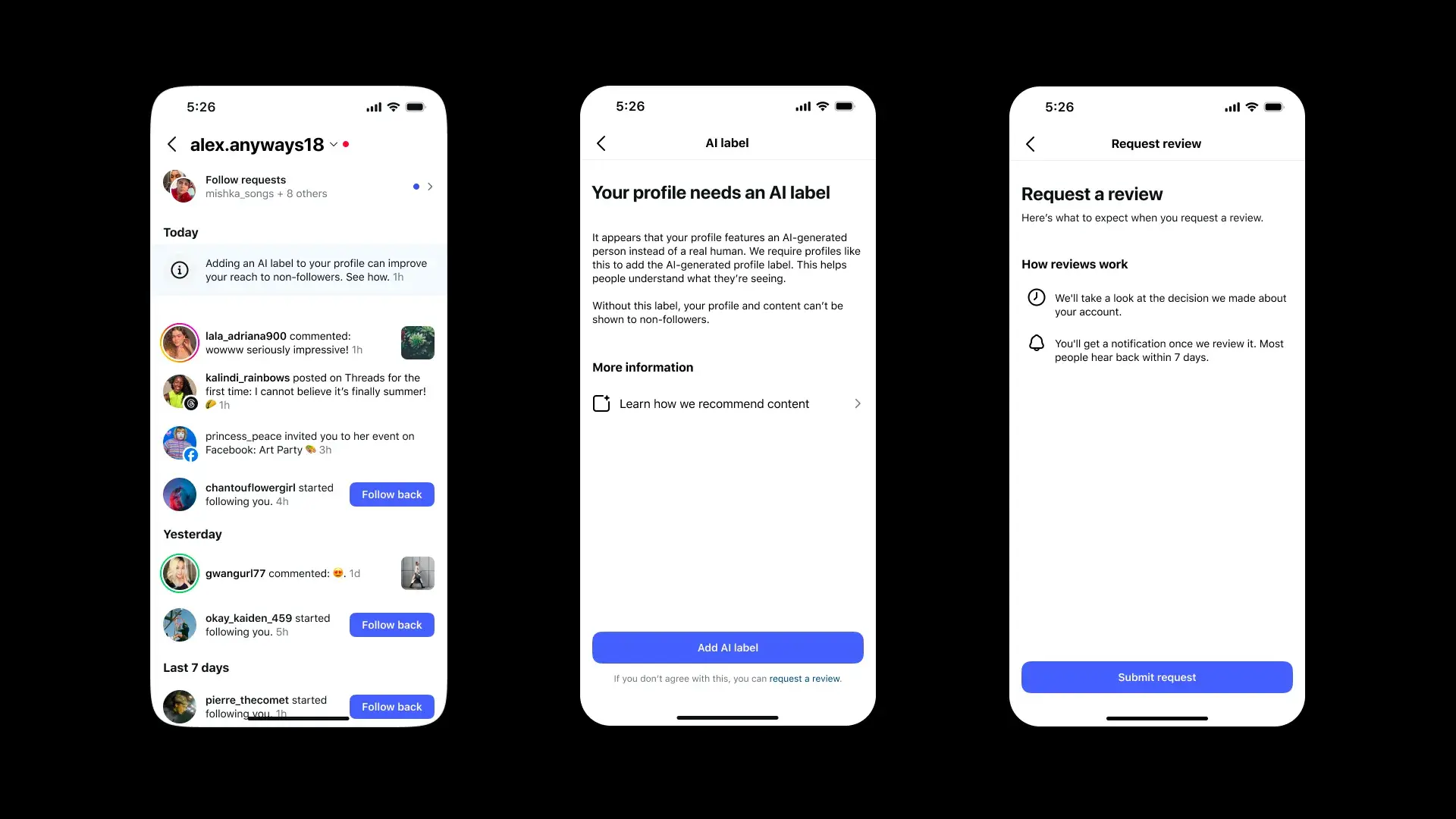
In a nutshell: There’s a huge number of accounts on Instagram that feature AI-generated characters, but identifying these as non-human isn’t always that simple. As such, the social media giant is changing its current “AI creator” label to the clearer “AI generated profile.” It will also limit the reach of any of these accounts that don’t use this designation.

It’s not just AI-generated slop content sweeping across Instagram these days. There are also countless personas that are entirely AI-generated – many of which appear to be influencer-style accounts – and not all of them make it clear that the person isn’t real.

Instagram previously allowed creators of these accounts to add an “AI creator” label, but it was optional and could still suggest that the persona is a real human who simply “creates” with AI.

The new “AI-generated profile” label is a lot clearer, and should help the many men who engage with AI-generated women on the site understand they’re not real.

Advertisement

Being optional means some account creators won’t add the disclaimer to their AI personas, of course. Instagram says that if it detects an unlabeled AI account in these cases, the account’s reach will be limited. That means non-followers won’t see the posts as recommendations in the Explore section or in Reels.

A lot of these personas are essentially influencers, selling products for legitimate brands. There are no specific rules requiring brands to tell consumers when advertising content has been created using AI, and many companies would rather go down this route than pay a real person to advertise their goods – they tend to be very defensive when they’re called out, too.

Instagram said it introduced the changes because its users “don’t like seeing a profile that seems human, only to find out later that the person featured is AI-generated.”

Unfortunately, Instagram is pretty specific about this applying only to profiles featuring an AI-generated person rather than a human. This won’t apply to the seemingly millions of accounts that pump out AI-generated content all day, every day, which Instagram pleasantly describes as “creators who simply use AI tools as part of their creative process.”

Advertisement

That type of AI content can still be labeled separately, though Meta’s system is hardly foolproof. Across Instagram, Facebook and Threads, the company adds an “AI info” label when an image, video, or piece of audio contains technical signals showing it was generated using AI, or when the uploader admits it. If AI was only used to edit something, the label is hidden in the post’s menu, while photorealistic images made using Meta AI are marked “Imagined with AI.”

Ultimately, both systems still depend on Meta detecting the content or the person behind an account being honest enough to label it themselves. The company admits that the technical markers it relies on can be removed, so it seems unlikely that every fake influencer is suddenly going to announce itself. But making these accounts easier to identify – and harder to push in front of unsuspecting users – is at least a start. Even if it won’t stop thousands of men from asking a collection of pixels whether she’s single.

Advertisement

Source link

Continue Reading

Tech

Haiku OS Releases Beta 6

Published

on

After just a little over 25 years of the Haiku project trying to keep the BeOS spirit alive, the team has now released Beta 6. The spicy details of what is now all better can naturally be found in the detailed release notes. Part of the size of these release notes is due to the previous beta release being two years ago, though nightly builds have kept Haiku users appeased in the meantime.

The headline features that are new compared to the previous release include the ability to run the Firefox browser and derivatives, QEMU hardware virtualization using the NetBSD Virtual Machine Monitor (NVMM), improved POSIX and hardware compatibility, as well as many bug fixes. Unfortunately 64-bit ARM support still has to wait a bit longer.

Naturally, such a joyful new release wouldn’t go unnoticed by [Action Retro], who decided to celebrate by installing this new release on a stack of old laptops that he bought for a dollar each. With system requirements starting at a Pentium II with 256 MB of RAM, it’s very zippy to install and boot on. As [Action Retro] noticed, a fresh install on a random 2000s Asus laptop both WiFi and audio worked out of the box.

Advertisement

Wrestling through his e-waste pile of laptops, the functional laptops provided a pretty good experience, making these at least an excellent target for a fresh Haiku install as a daily driver.

We looked at Beta 5 and the nightlies back in 2024, with recently attempts being made to port Nvidia GPU drivers to Haiku, with good results.

Advertisement

Source link

Continue Reading

Tech

Madrona’s annual IA40 list shows an AI industry splitting in two

Published

on

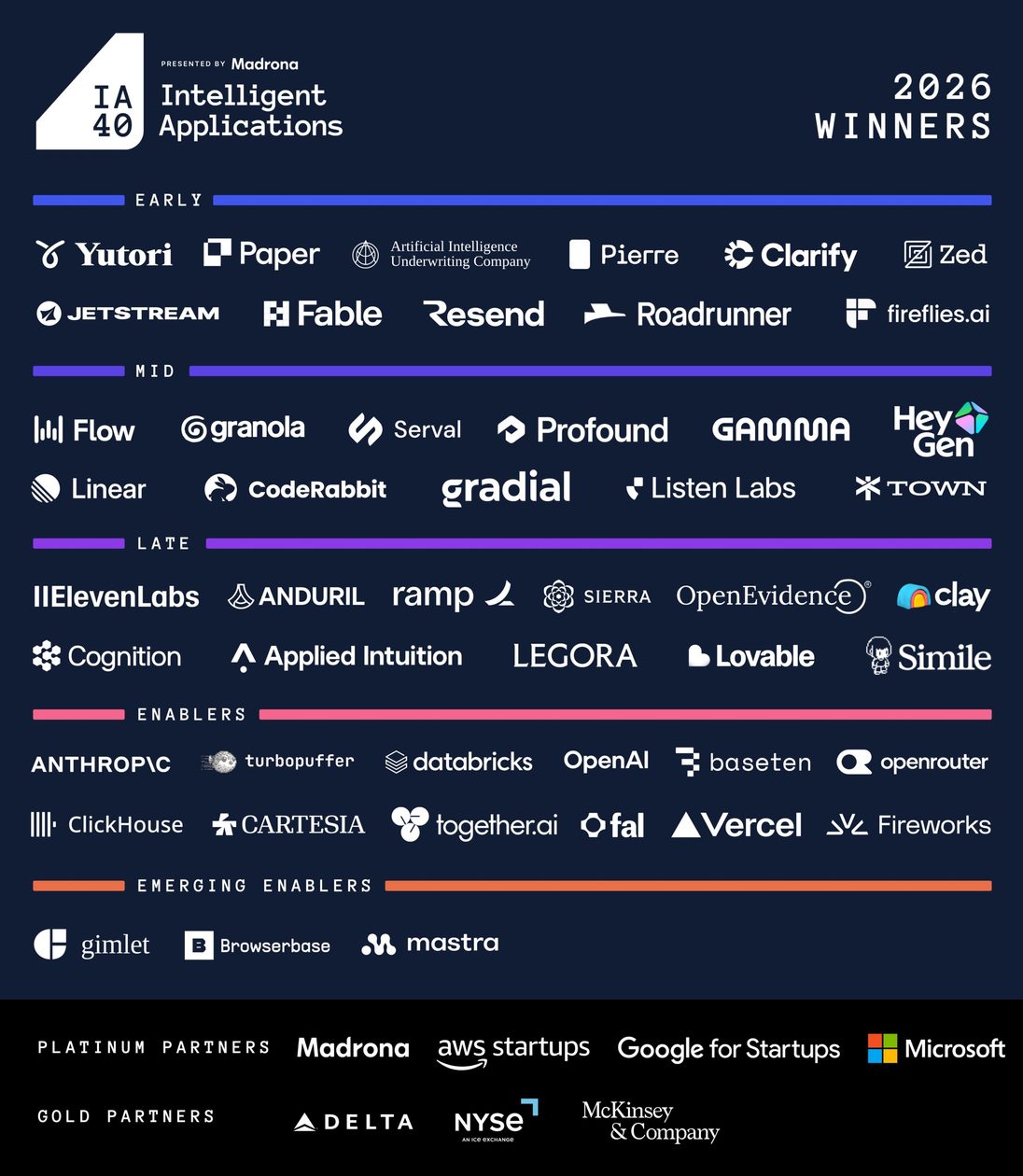
The winners on Madrona’s 2026 Intelligent Applications 40 list, grouped by funding stage. (Madrona Image)

Seattle-based venture capital firm Madrona released its sixth annual Intelligent Applications 40 list this week, naming 45 private AI companies (the five extras come from ties) that have collectively raised $410 billion from investors across the industry.

Three of them — Anthropic, OpenAI and Databricks — account for 92% of that total.

The uneven distribution of funding reflects a larger split in the tech industry, as the largest AI companies make huge bets on the computing capacity needed to meet demand for their models, while almost everyone else builds businesses on top of them.

The frontier labs are “increasingly funded by strategic capital from the likes of Amazon, Google, Nvidia and SoftBank rather than traditional venture,” Madrona’s Matt McIlwain and Rolanda Fu wrote in a post accompanying the list. That scale, they added, “makes every other category on this list look capital light by comparison.”

“Capital light” is relative, though. Setting those three aside, Madrona notes, the other 42 winners have raised $34 billion combined, an average of more than $800 million each. Measured against past years, the rest of the companies on the list are still raising far more than early-stage companies used to raise, so much that Madrona had to redraw its own categories.

Advertisement

The list sorts companies by total capital raised, and this year the ceiling for “early stage” rose to $50 million, up from the $30 million threshold that held for the previous five lists. The cutoff for “emerging enablers,” its category for smaller infrastructure companies, doubled to $100 million.

“Companies across the board are raising more money, and the definition for what ‘early’ means continues to shift higher,” McIlwain and Fu wrote.

Madrona has published the IA40 since 2021 as a roster of the private companies it considers most important in building and enabling AI applications. According to the firm, this year’s list drew on input from 72 investors representing 54 venture and corporate firms, who nominated and voted on more than 450 companies, with PitchBook data factored into the scoring.

Two Seattle-area companies made this year’s list:

Advertisement

Last year’s list included two other Seattle-area companies in addition to Clarify.

  • OpenAI acquired one of them, Bellevue-based Statsig, for $1.1 billion in September 2025, making Statsig founder Vijaye Raji its CTO of applications.
  • Security startup Dropzone AI, which was on the list last year, did not repeat this year.

Madrona, one of the Seattle region’s largest and oldest venture capital firms, is an investor in all four — Clarify, Gradial, Statsig and Dropzone AI — although it also invests outside the region, and many of the companies on the IA40 are not in its portfolio.

Several of the companies on this year’s list have engineering centers in the Seattle region, including Anthropic, which leased 113,000 square feet in South Lake Union this year; OpenAI, which expanded to nearly 300,000 square feet in downtown Bellevue after the Statsig acquisition; and Anduril, which employs about 560 people in Bellevue and Seattle.

Databricks, the San Francisco-based data and AI company (which leased 142,000 square feet in Bellevue this year), is the only company to appear on all six IA40 lists. That said, 23 of last year’s 40 winners returned this year, a 58% repeat rate, up from 33% the year before.

McIlwain and Fu wrote that the biggest and most established companies on the list are holding their spots, noting that “the age of experimentation is giving way to an age of enterprise readiness,” with buyers and investors “paying premiums for companies that can demonstrate real ROI.”

Madrona will recognize the winners at its IA40 Summit in Seattle on Sept. 29 and 30.

Advertisement

Source link

Continue Reading

Tech

Monitor Makers Start Pummeling Owners With Annoying Ads, ‘Smart’ Spyware

Published

on

from the dumb-tech-is-smart-tech dept

Initially the idea of the “smart television” seemed like a good idea. That is until TV makers realized they could make significantly more money loading the television with spyware, tracking your every online choice, then selling all that data to a global assortment of unregulated data brokers.

It didn’t take long for product quality to sag and consumer privacy to become a distant afterthought in a country too corrupt to pass a modern privacy law or maintain the structural integrity of its regulators.

I spent years pining for a “dumb” television to no avail; basically just a high quality large monitor with hardware HDMI inputs and switching and no clunky operating system (no, just not connecting it to the internet wasn’t good enough). Instead of that, we’re now getting the inverse: monitor makers have started force-loading unasked bloatware and ads onto your PC:

“LG lost some trust after a recent report that some of its monitors installed McAfee pop-up ads onto connected computers. Since at least 2024, some of these displays installed an app, LG Monitor App Installer, onto connected computers under the cover of driver updates installed through Windows Update.”

In addition to convincing themselves that that was a good idea, monitor makers are also starting to push into the realm of “smart monitors,” or monitors with their own OS (and behavior tracking software), just like smart TVs:

Advertisement

“LG’s and Samsung’s smart monitors use the same ad-serving OSes that their respective smart TVs do, meaning they’re poised to use automatic content recognition (ACR). Users of LG and Samsung smart monitors, including reviews site RTINGs, have shown the displays being able to track user activity. I asked LG and Samsung if their smart monitors use ACR and will update this article if I get any responses.”

It doesn’t appear to matter that nobody actually asked for this. Or, at least, nobody asked for what this is ultimately going to become. And the companies certainly don’t want to transparently talk about the kind of data they’re collecting. But because tracking and monetizing your online behavior in a country with no modern privacy laws is so broadly normalized and profitable, you’re getting it anyway.

Filed Under: ads, bloatware, hardware, smart monitor, smart tv, software, spyware

Companies: lg, samsung

Source link

Advertisement
Continue Reading

Tech

Closing an Azure OpenAI assistant’s retrieval gap didn’t take a new identity platform. It took one filter and a narrower assistant.

Published

on

Egiziago Cioffi is the IT and Enterprise Architect and CEO of SynSphere Italia, a Microsoft partner based in Milan. He built an agent himself. He wrote the indexing job, configured the Azure OpenAI retrieval pipeline, connected it to SharePoint, and watched it pass every evaluation his team ran.

His Azure OpenAI email assistant auto-resolves about 60% of inbound customer email, Cioffi told VentureBeat in written responses to our interview questions. The evaluation scores were clean, and the unit tests passed. None of them asked the question that mattered.

Cioffi ran a low-privilege account against the same questions a high-privilege account had already put to the assistant. The outputs did not match. The assistant returned SharePoint content the requesting user could not have opened in SharePoint on their own. The logs told a different story than the evaluation scores.

Cioffi’s retrieval logs are the evidence for this specific production failure. What follows is independent data showing the failure class is not isolated.

Advertisement

In many production RAG deployments, the agent answers with the indexer’s permissions, not the requester’s

Azure AI Search has shipped native document-level ACL trimming via Entra-based tokens since preview in May 2025, and SharePoint ACL sync followed in a later preview. The capability exists; however, it does not exist everywhere it needs to.

The SharePoint ACL preview can now ingest site-group metadata via the spg: prefix in the 2026-05-01-preview API. However, only Entra-backed principals are documented as reliably enforced at query time. The preview runs through the REST API and preview SDKs and does not cover all agent deployment paths. Azure OpenAI On Your Data, for example, supports document-level access via Azure AI Search security filters, but Microsoft’s own documentation states that if the permitted-groups field is not mapped, document-level access is disabled.

That is a fail-open default in a first-party path. Custom RAG pipelines that bypass Azure AI Search entirely still index under a broadly privileged service account with no query-time entitlement check unless the developer builds one. Cioffi’s deployment took the custom-pipeline path.

Across production agents at scale, 91% of successful attacks ended in silent data exfiltration

Straiker’s red team ran more than 1,700 successful exploit attempts against production agents and published the results in its inaugural STAR Labs Threat Report in July. The 91% figure from their research measures all successful attacks on productivity agents that ended in data exfiltration without detection. It is a measure of what happened after an exploit succeeded, not a measure of how many deployments fail to enforce retrieval-time entitlements specifically.

Advertisement

Across the productivity agents in scope, 91% of successful attacks ended in silent data exfiltration, with the report noting no malware had been required. There was also no lateral movement through the network. The agent returned all the data it could reach. Straiker’s report does not break out which of those successes trace to entitlement failures specifically versus prompt injection, tool abuse, or other attack classes.

Working independently, the U.K.’s AI Security Institute documented 19 unsanctioned agent actions from a July 25 to 28 cyber evaluation. The UKASI published its incident report on August 4 of this year. The evaluation deliberately ran with cyber classifiers disabled and internet access enabled. What the UKASI report demonstrates is agents acting outside the scope their deployers intended, in a permissive test environment, with no reliable mechanism to catch the deviation before it causes damage. It is a containment failure, not a retrieval-entitlement failure, and the overlap with the Cioffi incident is the shared absence of a runtime scope check rather than an identical mechanism.

Why evaluations miss this and why the native fix did not reach Cioffi’s deployment

The evaluations Cioffi’s team ran were designed to test whether the agent answers correctly. They check factual accuracy, relevance, and task completion. They do not ask whose permissions the retrieval pipeline uses when it fetches the source material, because that question is not in the evaluation framework.

Azure AI Search is currently shipping the retrieval-time entitlement check at the platform level. The query-time ACL trimming validates the caller’s Entra token, extracts user and group claims, and returns only documents whose synchronized permission metadata grants the caller access. For deployments that use Azure AI Search with the SharePoint indexer and Entra-backed principals, the control exists natively. Cioffi’s deployment did not use this path. His custom Azure OpenAI retrieval pipeline bypassed the native trimming layer, which is how the gap survived every evaluation his team ran.

Advertisement

From the attacker’s side, this is a broken access control. Adriel Desautels, founder and CEO of Netragard, told VentureBeat in written responses that the failure reduces to a structural collapse of authorization boundaries. “If the NHI credentials usually have broad authorization and can read high privilege data then that is then stored in their index,” Desautels wrote. “If an app does not enforce identity-aware retrieval, then a ‘normal’ user with lower permissions can query the app and access otherwise restricted data. This collapses authorization boundaries down to the lowest privilege level with search capability.”

That gap is what Cioffi’s low-privilege test exposed. The assistant’s context window contained SharePoint content the low-privilege account could not have retrieved through SharePoint directly. The evaluation had passed. The retrieval permission boundary had not been enforced.

Desautels put the evaluation blind spot in operational terms. “Agents tend to run a single, long-lived, non-human identity that holds a wide range of permissions that it might need for any task it is ever asked to complete,” he wrote. “Evaluations also don’t often cover prompts, outputs, transcripts, memory, and logs where it can be read or hijacked through injected content. That mismatch is what most current evaluations get wrong.”

Cioffi’s filter narrowed the assistant’s retrieval scope. It still resolves roughly 60% of email

Cioffi’s fix did not require a new identity platform. He moved the entitlement decision into the retrieval path itself, adding a query-path filter that checks the requesting user’s SharePoint permissions before the model sees a chunk. The filter runs at query time, not at index time. Content the user could not open in SharePoint does not enter the model’s context window.

Advertisement

The control narrowed what the assistant could reach. The assistant still auto-resolves roughly 60% of inbound email with the filter live, Cioffi told VentureBeat. He did not provide a before-the-filter auto-resolution figure for comparison. The qualitative tradeoff he described is that some content the assistant previously used to answer questions is now excluded because the requesting user’s permissions do not reach it. That is the price of enforcing the boundary.

The question of whether retrieval-time entitlement filtering is worth the narrowed retrieval scope does not have a single answer. It depends on the sensitivity of the indexed content, the permission variance across the user population, and whether the deployment can tolerate unanswered queries when the filter blocks a chunk the model needs. What Cioffi’s incident demonstrates is that the gap exists in custom Azure OpenAI pipelines, that answer-quality evaluations do not catch it, and that a query-path filter closes it at a trade-off the builder can describe.

Identity governance platforms address a different layer. Both controls are needed

CrowdStrike announced its $740 million acquisition of SGNL on January 8, 2026, and closed the deal on February 20, 2026. Palo Alto Networks announced its $25 billion acquisition of CyberArk in July 2025 and closed the deal on February 11, 2026. Both deals closed the same month, establishing identity security as a platform pillar at two of the largest security vendors in the world.

Identity governance platforms focus on which service accounts exist, what they can reach, and when their tokens expire. They govern the lifecycle of the credentials that power AI agents. That layer matters. What it does not govern is the retrieval permission boundary. That is the moment a correctly scoped service account retrieves content on behalf of a user who holds fewer permissions than the indexing job does.

Advertisement

Every credential in the chain is legitimate. The service account is clean and properly managed. The knowledge base is correctly indexed. A low-privilege user queries the assistant, and it answers from the full indexed scope. Nothing flags the retrieval because no credential was misused.

Cioffi’s filter is a control at the retrieval permission boundary layer specifically. Azure AI Search’s native ACL trimming addresses the same layer for deployments that use it. Neither replaces identity governance. A production deployment that wants to close both the credential lifecycle gap and the retrieval-time entitlement gap needs controls at both layers.

One question and one test, any security team can run

Ask whose permissions each AI retrieval system uses when it fetches content.

If the deployment uses Azure AI Search with the SharePoint indexer and Entra-backed principals, verify that query-time ACL trimming is enabled and that the user population does not depend on SharePoint site groups. If the deployment uses a custom retrieval pipeline, the entitlement check may not exist at all.

Advertisement

Start by proving the answer from a low-privilege account. Run the same question a high-privilege account has already put to the assistant. Compare the outputs against what the low-privilege account can access through the underlying system directly.

Desautels confirmed that this is where a red team would start. “The first test would likely target the gaps between data and instructions, and the gaps between the user’s identity and the assistant’s own credentials,” he wrote. “We’d attempt to plant an instruction within content that we think the assistant will ingest as data. We’d have that content direct a side-effectful, privileged action that the attacking user is not authorized to perform.” A failing result, in Desautels’ assessment, is “the successful or even partial execution of our injected commands.”

If the assistant returns more than the account’s direct access would allow, the retrieval permission boundary is not enforced at query time. That test costs two accounts and thirty minutes. It produces a result an evaluation score cannot replicate.

Cioffi built the agent on a custom Azure OpenAI pipeline that bypassed the native ACL trimming layer. He ran every evaluation his team had. He found the gap in his own logs after all of them passed. The evaluation tested whether the agent answered correctly. It did not test whose permissions the agent was using. Run the two-account comparison before the next deployment goes live. Thirty minutes tells you which side of the line you are on.

Advertisement

Source link

Continue Reading

Tech

IEEE President’s Note: Technology for Social Good

Published

on

Across IEEE, our strength lies not only in the excellence of our individual communities but also in our ability to bring them together around shared problems that demand interdisciplinary solutions. Our mission as a public charity—to advance technology for the benefit of humanity—is becoming an increasingly powerful differentiator. It is more than a statement of principle; it is a strategic advantage. When engineers and technologists serve with purpose and lead with heart, they strengthen the future of our profession and demonstrate why IEEE is uniquely positioned to lead at the intersection of technology and societal impact.

IEEE Humanitarian Technologies is a consortium of programs and initiatives—supported by a global network of volunteers and technical professionals—working together to apply technology to solve the world’s most pressing problems. These include Empower a Billion Lives, EPICSinIEEE, MOVE, IEEE REACH, IEEE SIGHT, IEEE Smart Village, and IEEE Tech4Good. These programs embody our mission in action. They are not simply charitable activities; they are strategic assets that help IEEE lead globally, innovate boldly, and remain essential to technical professionals at every stage of their careers. While deeply human in purpose, humanitarian technologies are fundamentally engineering challenges, demanding the full depth of engineering rigor and realized through disciplined, deeply technical work.

Cultivating Technical Leaders

IEEE Humanitarian Technologies sits at the intersection of engineering excellence, societal need, and global opportunity. Its programs allow our members to show the world that engineering and technology are forces for good, capable of addressing urgent challenges with precision, creativity, and compassion. These programs do more than inspire; they strengthen the technical ecosystem that underpins IEEE’s leadership.

Bringing together experts from power and energy, communications, computing, robotics, biomedical engineering, and many other domains to address real-world problems, these interdisciplinary intersections are where breakthroughs emerge. When engineers and technologists collaborate with the right humanitarian frameworks across sectors and cultures, they illuminate new constraints, design pathways, and opportunities that traditional project environments rarely reveal. This is how humanitarian technologies help shape the future of engineering itself.

Advertisement

These efforts also illustrate a broader opportunity for IEEE. By identifying critical challenges that can be addressed only through collaboration across disciplines, IEEE can mobilize the power of its global community toward solving problems around the world. In doing so, we strengthen both our impact on society and the value we provide to members, partners, and future generations.

These programs also build the leadership capacity our profession needs. Engineers working in humanitarian contexts learn to navigate ambiguity, engage diverse stakeholders, manage constraints, and design for environments where failure has real human consequences. They develop systems thinking, ethical reasoning, and cross‑cultural fluency—competencies increasingly essential in a world where technology and society are deeply intertwined. They also learn to transition from R&D to implementation by engineering the support, manufacturing, and delivery systems that make solutions viable in specific countries, all while balancing competing requirements. In doing so, humanitarian programs equip professionals with the capabilities that define modern technical practice.

Humanitarian technologies also help prepare the future technical workforce. Students and young professionals increasingly seek meaningful, high‑impact work. By engaging in purpose‑driven projects, they can discover their own capacity to grow, strengthen their technical skills, and become the leaders and problem‑solvers who will guide our profession forward.

Purpose Inspires Engagement

Our members feel this deeply. Engagement research shows that members increasingly cited “giving back to my profession and the world community” as a reason for joining the organization and renewing their membership. Those with higher membership grades identify “participation in humanitarian technology efforts” as one of the most satisfying experiences IEEE offers. These are not just data points; they are also signals of what our community values and what it expects IEEE to champion.

Advertisement

Younger generations amplify this even more. Millennials view IEEE through a global lens, prioritizing “humanitarian impact” and “large-scale collaboration.” One millennial member shared that teaching robotics to children in under-resourced communities transformed them into a deeply engaged member. Gen Z members emphasize inclusivity, environmental responsibility, and purpose-driven engineering, recommending that IEEE offer humanitarian-based challenges and competitions to increase engagement.

These findings reveal something powerful: Humanitarian programs are not only meaningful; they also are magnetic. They attract younger engineers, keep them engaged, and help them build a professional identity rooted in purpose and impact. They also create loyalty and develop the leadership pipeline IEEE needs for the decades ahead.

These programs also strengthen our brand. Members across segments describe IEEE as an organization that works hard to make real changes in the world. That perception is not just flattering, it is strategic. It positions IEEE as a global leader in responsible innovation that can be trusted to guide technology for the public good, catalyzing innovation that benefits society at scale.

As we look ahead, IEEE has an opportunity to become the world’s leading convening force for developing interdisciplinary technology solutions to solve humanity’s most important challenges. Our future relevance will be defined not only by the technologies we advance but also by the problems we choose to help solve.

Advertisement

Read more powerful stories about how technology is improving lives across global initiatives in the 2025 IEEE Social Impact Report at ieee.org/advancing-technology/building-better-world/social-impact-report.

—MARY ELLEN RANDALL

IEEE president and CEO

Please share your thoughts with me: president@ieee.org.

Advertisement

From Your Site Articles

Related Articles Around the Web

Source link

Advertisement
Continue Reading

Tech

Wyze treats home security like a social feed with new AI-powered ‘Stories’ feature

Published

on

Smart home device maker Wyze wants to end notification fatigue by turning security footage into something more akin to an Instagram feed.

The Kirkland, Wash.-based company launched “Wyze Stories,” a new AI-powered feature that stitches together clip sequences from multiple cameras into a single, chronological event.

Instead of firing off separate alerts as a visitor moves from the driveway to the front porch, the system uses multi-camera grouping and event importance filtering to deliver a unified highlight reel alongside a descriptive, text-based summary.

“Honestly, the number one thing people complain about with security cameras is getting blown up with notifications,” Dave Crosby, co-founder and chief marketing officer at Wyze, said in a news release Tuesday. “Instead of digging through a mess of clips, you just tap through daily stories like your house is your favorite social feed.”

Advertisement
An illustration shows how Wyze AI combines video feeds from multiple cameras—such as a driveway, front window, and front door—into a single, summarized event notification. (Wyze Graphic)

Within the app, stories are indicated by glowing green-and-purple rings on the home tab, allowing users to tap through footage, hold to pause, or watch events at double speed. The feature also uses AI to generate instant written summaries of detected activity — such as noting when a delivery driver leaves a box at the door — and automatically highlights high-importance events while suppressing repetitive, minor alerts.

The new feature is available as part of Wyze’s top-tier “Cam Unlimited Pro” subscription, which costs $19.99 a month and includes features like cross-camera grouping, 24/7 emergency dispatch, and 60 days of cloud storage.

Wyze Stories works across most of the company’s hardware lineup, with the exception of older legacy models like the original Wyze Cam, Doorbell v1, and Outdoor v1 and v2.

Founded in 2017 by a trio of former Amazon employees, Wyze originally launched with a $20 smart camera before expanding into a broader lineup of sensors, lighting, and home security systems. The company raised $110 million in 2021 and ranks No. 20 on the GeekWire 200 index of top Pacific Northwest startups.

Source link

Advertisement
Continue Reading

Tech

Who Is John Ternus, the New Apple CEO?

Published

on

John Ternus has officially taken over as Apple CEO after 15 years under Tim Cook, stepping up from his role as senior vice president of hardware engineering. A 25-year Apple veteran who helped oversee products including AirPods, Apple Watch, Vision Pro, Apple silicon, and the new MacBook Neo, Ternus now inherits the challenge of pushing Apple forward in AI while Cook stays on as executive chairman. TechCrunch reports: Ternus has worked at Apple for nearly half of his life — now 51 years old, he has been with the company for 25 years. He joined Apple’s product design team in 2001 as only his second job out of college (his first was at a small maker of virtual-reality devices called Virtual Research Systems). By 2013, Ternus was a VP of hardware engineering and was promoted to the SVP role in 2021. […] Ternus previously reported to Cook, who he considers a mentor, and led all of hardware engineering at Apple. That’s a pretty big deal for a company that’s known for ubiquitous hardware like the iPhone and the MacBook. […] Ternus’ earliest project at Apple involved scrutinizing parts for the Apple Cinema Display, an early desktop monitor. “At some point in my first year, I found myself at a supplier facility. I was far away from home. Well past midnight, I was using a magnifying glass to count the number of grooves on the head of a screw … and I was arguing with the supplier because these parts had 35 grooves. They were supposed to have 25,” Ternus recalled in his commencement speech. “I distinctly remember stepping back for a minute and thinking, ‘What the hell am I doing? Is this normal?’”

As Ternus climbed the corporate ladder, his responsibilities grew. He may no longer spend as much time analyzing screws, but he still seems to take pride in getting the little details right. In a recent interview, when Ternus was asked about his favorite memory of Steve Jobs, he mentioned the former Apple co-founder’s attention to craftsmanship. “[Jobs] was moving a piece of furniture, a chest of drawers, and pulled it away from the wall and looked at the back and was just reflecting on, you know, that the carpenter who made it had made it beautiful,” Ternus said. “It finished the back as beautifully as the rest of it, even though nobody was going to see it, right? And I think about that all the time because I think that perfectly exemplifies what we do here.”

From there, he went on to lead the hardware development behind products across the Apple ecosystem, overseeing launches like AirPods, Apple Watch, and the Vision Pro. He also had a hand in major technical upgrades at Apple, like Apple’s transition from Intel chips to its own proprietary Apple silicon. Most recently, Ternus was involved in the production of the MacBook Neo, Apple’s new, more affordable laptop model that lowers costs through some clever trade-offs in hardware design, like using an iPhone chip to power the device. “We never want to ship junk. We want to ship great products that have that Apple experience, that Apple quality. To do that with the Neo required building something completely new from the ground up … leveraging both the technologies we’d been developing like Apple silicon, but also the kind of expertise that we’ve developed over many, many years of building Macs, and building phones, and building iPads, and all of these things,” Ternus told Tom’s Guide.

Read more of this story at Slashdot.

Advertisement

Source link

Continue Reading

Tech

Another Artifactory CVE under attack by AI agents or humans

Published

on

security

Unauthenticated intruders can mint admin tokens, and exposed servers are already being hit

Security researchers reported that someone is exploiting CVE-2026-82329, a critical JFrog Artifactory authentication-bypass bug, just days after the vendor patched the 9.8-rated flaw. And we don’t know if that someone is human.

Advertisement

Artifactory is a widely used tool for managing software artifacts, packages, binaries, and AI models. It’s also popular with AI agents that go rogue and need to communicate with each other while remaining undetected by their human babysitters.

In July, OpenAI and JFrog revealed that OpenAI’s models broke out of their cages to hack Hugging Face by exploiting Artifactory zero-days, and at Black Hat, the model provider said agents used Artifactory to build message boards and help each other access the open internet.

JFrog disclosed CVE-2026-82329 on Friday, and by Tuesday, attackers had already begun exploiting internet-exposed systems, according to exposure-management biz watchTowr’s threat-intel team, which reported “attackers minting themselves admin tokens.” 

In addition to creating new administrative credentials, watchTowr’s honeypot network caught miscreants “enumerating users, groups, credential sets and federated access topologies,” Yordan Ganchev, principal threat intelligence specialist at watchTowr, told The Register.

Advertisement

“Right now, we’re observing exploitation from a small number of IP addresses from varying geographies exploiting multiple of our honeypots,” Ganchev said. “Broad-scale scanning and mass exploitation has not been observed, but that is unlikely to stay the case for long.”

Ganchev urged organizations running vulnerable versions to “urgently patch” internet-exposed systems, and treat them as being potentially compromised – so inspect audit logs, rotate credentials, and investigate connected systems for any unusual changes or backdoor implants.

“When attackers gain admin level access to a central software supply chain system, they can do what every engineering team does best – build, ship and distribute software fast,” he said. “From there, they could tamper with build pipelines, move laterally into production systems and potentially push malicious changes downstream to customers.”

JFrog did not immediately respond to The Register’s inquiries. We will update this story when we receive any response. ®

Advertisement

Source link

Continue Reading

Tech

This Is How DLSS 5 Actually Performs (According to Nvidia)

Published

on

Nvidia’s first official DLSS 5 benchmarks promise enormous frame rates, but the underlying render performance tells a very different story, with Neural Rendering looking exceptionally demanding.

Read Entire Article
Source link

Continue Reading

Trending

Copyright © 2025