Tech
Can You Use J-B Weld On A Cracked Engine Block?


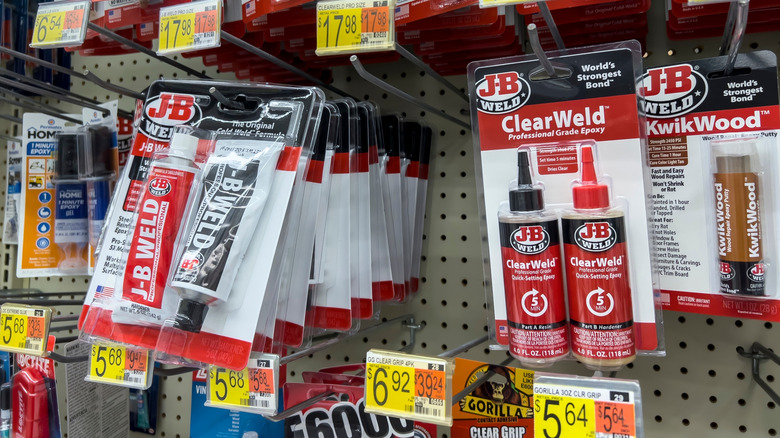
Few things sound the death knell of an engine as clearly as a cracked engine block. The signs are usually obvious – daily puddles of coolant spreading across a garage floor, the tell-tale rainbow sheen of oil appearing where it shouldn’t, or a worrying trail of sounds and smells — the sweet tang of burning coolant, or the staccato beat of rough idling and misfires. All represent symptoms pointing toward impending breakdown, a very expensive repair, or complete replacement. It is no surprise, then, that when facing that impending expense, a five-dollar tube of J-B Weld starts looking surprisingly attractive.
J-B Weld has an extensive product range, covering everything from simple metal repairs to high-temperature compounds and automotive sealants. The standard J-B Weld formula is a two-part epoxy designed for metal, including cast iron and aluminum, and is rated to 550 degrees Fahrenheit (288 degrees Celsius) once fully cured. A promising claim, especially when a cursory Google search will tell you that apart from the combustion chamber and exhaust manifold, the majority of a block doesn’t get hotter than around 427 degrees Fahrenheit.
The appeal is obvious. Avoid the hassle of a full engine replacement, or an expensive TIG welding bill, while still getting a vehicle mobile again. However, an engine block is an exceptionally volatile environment. That crack formed in that spot for a reason; repeated heating and cooling, vibration, fluid pressure, and potentially enormous combustion forces. So, much like a space-saver spare, epoxying an engine block should be considered a stopgap. Will it hold? Probably, for a while, but stay out of the fast lane and get a real fix on ASAP.
Where J-B Weld can work, and where it won’t
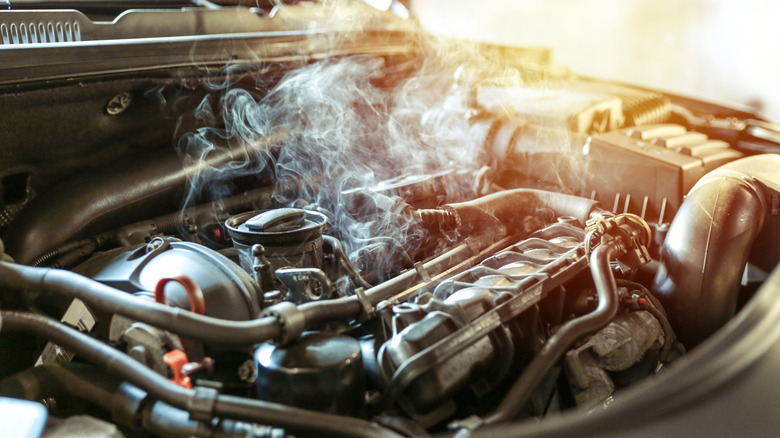
Why put epoxy on an engine block at all? The same reason you would carry a spare tire or a set of jumper cables. Disaster tends to strike at the most inopportune moments. A carefully applied epoxy repair can temporarily patch a crippling fracture or fault, buying you valuable time or miles to get to somewhere you can effect a permanent fix.
Ultimately, the location of the damage is going to be the critical factor. A small crack in a non-structural area or away from a gasket is a great candidate for an epoxy repair. Conversely, an epoxy-patch over a crack that exposes an oil gallery, cylinder wall, head sealing surface, or combustion chamber is unlikely to withstand the heat and pressure of a running engine for the long term.
Other issues that may arise include thermal expansion. As they heat and cool, metal and cured epoxy expand and contract at different rates. Because the epoxy will deform much faster than the base metal, the joint can suffer from delamination, cracking, or even complete debonding. A second issue is epoxy contamination. Trace chemicals within the epoxy itself can taint metal, while having to grind away cured epoxy can complicate welding and expose internal chambers to contamination, leading to future damage.
How to make an epoxy repair work
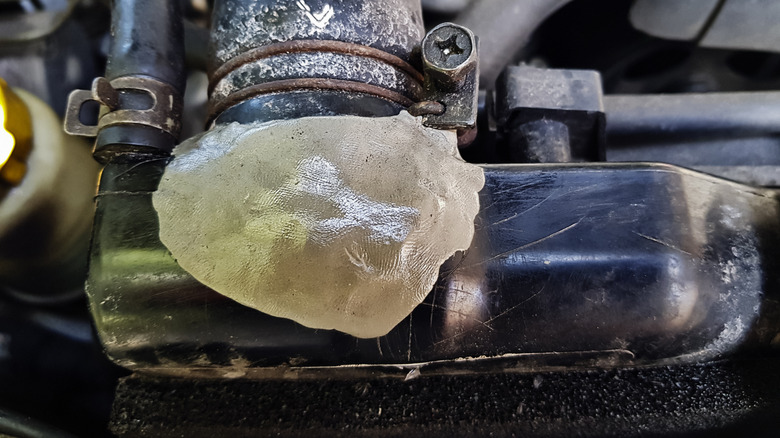
If you do decide that epoxy is the way to go, correct preparation is critical, and is going to be what separates a trustworthy patch from a botched mess. Epoxy cannot compensate for a contaminated surface, so start with a completely cold engine and remove every trace of oil, coolant, grease, rust, and loose material. A repair can be also be strengthened by drilling small holes to stop the crack’s progression at both ends, a technique known as stop drilling.
Routing, the use of a grinder or rotary tool to open the crack into a shallow V-shaped groove, can provide a larger surface area of substrate for the epoxy to bind to. Remember, epoxy is more effective when applied as a broad patch extending beyond the damaged area. Unlike cyanoacrylate and anaerobic adhesives, like superglue and thread-lockers, epoxy doesn’t adhere to the “less is more” rule.
Finally, exercise patience. Epoxy requires about 15–24 hours to fully cure. Rushing the curing process and driving a car that is held together with uncured, pre-polymer epoxy is just going to end with a Jackson Pollock-esque splatter of B-stage resin across the inside of the engine bay.
So if the crack involves combustion pressure, a major structural area, an important oil passage, or a rapidly growing fracture, epoxy should only represent a short-term substitute for professional repair or replacement. It might get you somewhere. It might even work surprisingly well. But you probably shouldn’t plan your next road trip around it.
You must be logged in to post a comment Login