Security teams log 54% of successful attacks and alert on just 14%. The rest move through your environment unseen.
The Picus whitepaper shows how breach and attack simulation tests your SIEM and EDR rules so threats stop slipping by detection.





Cisco has released security updates to address a vulnerability in the Catalyst SD-WAN Manager, tracked as CVE-2026-20262, that was exploited in attacks to escalate to root privileges.
Formerly known as SD-WAN vManage, this network management software allows admins to manage up to 6,000 SD-WAN devices from a single dashboard.
The now-patched zero-day security flaw affects all deployment types, regardless of device configuration, including on-prem deployments, Cisco SD-WAN Cloud-Pro, Cisco SD-WAN Cloud (Cisco Managed), and Cisco SD-WAN for Government (FedRAMP).

Cisco said the issue stems from insufficient validation of user-supplied input during file uploads, which can allow low-privilege remote attackers to execute arbitrary commands as root by sending crafted HTTP requests to an affected API endpoint.
“A vulnerability in the web UI of Cisco Catalyst SD-WAN Manager, formerly SD-WAN vManage, could allow an authenticated, remote attacker to create a file or overwrite any file on the filesystem of an affected system,” Cisco said in a Monday advisory.
“An attacker could exploit this vulnerability by sending a crafted HTTP request to an affected API endpoint of the affected system. A successful exploit could allow the attacker to create or overwrite any file on the underlying operating system. This file could later be used to elevate to root.”
Cisco said its Product Security Incident Response Team (PSIRT) became aware of the exploitation of CVE-2026-20262 earlier this month and “strongly” advised customers to patch their systems.
| Cisco Catalyst SD-WAN Release | First Fixed Release |
|---|---|
| 20.9.9.1 and earlier | 20.9.9.2 |
| 20.12.7.1 and earlier | 20.12.7.2 |
| 20.15.4.4 and earlier | 20.15.4.5 |
| 20.15.5.2 and earlier | 20.15.5.3 |
| 20.18.3 | 20.18.3.1 |
| 26.1.1.1 and earlier | 26.1.1.2 |
While the company did not share any details on these attacks, it shared indicators of compromise (IOCs) warning admins to check their SD-WAN vmanage-server, vmanage-appserver, and serviceproxy-access logs for attempts to upload index.jsp and .war files.
In February, Cisco patched another Catalyst SD-WAN Manager information disclosure security flaw (CVE-2026-20133), flagged as actively exploited in late April, and, two weeks later, warned of two more flaws (CVE-2026-20128 and CVE-2026-20122)that were abused in the wild.
Last month, it also tagged a maximum-severity Catalyst SD-WAN Controller authentication-bypass flaw (CVE-2026-20182) as actively exploited as a zero-day to gain admin privileges on unpatched devices.
More recently, in early June, Cisco warned of one more unpatched Catalyst SD-WAN Manager zero-day (CVE-2026-20245) that was exploited in attacks, allowing attackers to gain root privileges.
Over the last several years, the Cybersecurity and Infrastructure Security Agency (CISA) tagged 91 Cisco vulnerabilities as abused in the wild, five of them in Cisco Catalyst SD-WAN Manager and six others exploited in ransomware attacks.

Security teams log 54% of successful attacks and alert on just 14%. The rest move through your environment unseen.
The Picus whitepaper shows how breach and attack simulation tests your SIEM and EDR rules so threats stop slipping by detection.

This story was originally published by ProPublica. Republished under a CC BY-NC-ND 3.0 license.
For decades, the U.S. Department of State gave money to groups protecting free speech, human rights and persecuted minorities in poor and authoritarian countries.
To decide what to fund, staffers with deep expertise typically pored over reams of information on abuses under the most repressive regimes and held an open competition to fund groups to work in those countries.
This year, Trump administration officials presented State Department workers with their own list of organizations that should be funded. To the shock of many staffers and lawmakers, they proposed at least a dozen grants that would bypass the normal open bidding process. They also sought to give taxpayer dollars to groups aligned with conservative and anti-immigration movements in Europe as well as advocates for white South Africans, according to interviews and documents reviewed by ProPublica.
Among the organizations appointees have considered funding in recent months are a British free-speech organization that has fought against bans on “gay conversion therapy” and an Afrikaner group run by a controversial figure who has called for self-governance of the white ethnic minority within South Africa.
This type of giving would mark a stark departure from the traditional aid that helped torture victims and documented rapes, political violence and other abuses in some of the most oppressive countries in the world, according to more than a dozen former State Department employees. One new program with $4.9 million of competitive funding available to groups to develop “civilizational self-confidence in Europe” is slated for “research, conferences, cultural engagements, and support for civil society” in wealthy democracies. The call for proposals says recipients should “not attempt to reform the legislative processes,” but experts and lawmakers have expressed concern that the U.S. is seeking to influence politics in allied countries.
That emphasis on Western nations was evident in a grant the State Department has been working on for months to a fledgling British American think tank dedicated to “renewing our Judeo-Christian culture and civilisational mission.” After pushback from Congress, the State Department abandoned those plans in recent days.
“I’ve never before seen U.S. government funding for such groups,” said William Allchorn, a senior research fellow at Anglia Ruskin University and an expert on radical-right extremism in the United Kingdom. “It’s crossing the Rubicon, isn’t it?”
A review of proposed grants shows several are being directed to more traditional human rights purposes, but even some of those have raised concerns in and outside the State Department.
Strict agency rules have long required an open bidding process whenever possible to guard against waste, fraud and abuse. Generally, the State Department is allowed to offer awards directly to a single entity or to a small group of potential grantees in rare instances, such as when only one organization is capable of the work or an emergency necessitates providing money so quickly that open competition is impossible. It has also used such “sole-source” and “limited-source” awards, which are not publicly announced, in highly sensitive countries where openly working on human rights can be dangerous.
None of those justifications appear to apply here, according to contracting experts and former staffers consulted by ProPublica. The situation is all the more concerning, they said, because Trump officials handpicked the potential recipients, decisions previously made by a panel of government experts who evaluated applicants based on the organizations’ experience and qualifications.
“It’s not good governance to have political appointees give grants to individuals for unknown reasons,” one former bureau staffer said.
Directing awards to organizations in high-income countries further complicates the funding. The practice is so unusual that an internal waiver justifying the choice is typically required.
The State Department did not answer when asked whether it had sought waivers for the grants to high-income countries.
During private briefings this month, members of Congress expressed concern over both the list of potential recipients and the plan to award no-bid or limited-bid grants, according to officials familiar with the closed-door meetings who weren’t authorized to publicly discuss them.
In response to a detailed list of questions about this story, the State Department sent a short written response, noting that “programs are still in active deliberation and receipt of a grant is not guaranteed to any organization that does not meet all requirement and standards for federal grants.” A State Department official who declined to be named stressed that the process for awarding grants was ongoing and that multiple offices provide input. They also said the administration has serious concerns about the human rights situation in South Africa that need to be addressed.
Asked about the potential grants, Sen. Jeanne Shaheen, a Democrat from New Hampshire and the ranking member of the Senate Committee on Foreign Relations, said Congress expects the State Department “to invest resources to advance human rights, democratic institutions, civil society, freedom of expression and worker rights” and that the proposals are “an appalling departure from that practice and an affront to our democratic allies.”
“These awards suggest that the Department intends to select awardees for federal funding based on their political ideology,” Shaheen said, “not in the interest of American taxpayers or national security.”
Internal records and interviews show one of the key figures involved in the grants is Samuel Samson, a 27-year-old deputy assistant secretary of state who previously worked as a fundraiser for a group that aims to bring people with an “America first” worldview into government.
On the day of President Donald Trump’s second inauguration, Samson started work as a senior adviser to the Bureau of Democracy, Human Rights and Labor, also known as DRL, the State Department unit that selects and distributes the human rights grants.
Over the past 18 months, he has courted far-right leaders in Europe, an area with which he believes the U.S. shares a “common civilizational struggle.” In recent weeks, Samson has defended the agency’s grantmaking plans during private meetings with lawmakers.
One group expected to receive a no-bid grant is the Free Speech Union, a British organization founded in 2020 to counter “cancel culture.” The group often steps in to defend people accused of being transphobic and has created a petition opposing the U.K.’s proposed ban on discredited therapy practices that attempt to convert gay people to heterosexuality. It’s unclear if the grant would go to the British-based organization or its international offshoot. The $5 million grant is to be used to combat “digital overregulation,” provide support for individuals facing “deplatforming” and advocate against “restrictive online safety and hate speech laws,” according to a document reviewed by ProPublica. Trump officials met with the group during a European tour late last year, according to Politico.
Scholars said the U.S. government’s support for these groups could give them a layer of legitimacy they wouldn’t otherwise have.
“We see them as intellectualizing or sanitizing radical-right ideas that are then taken up by the parties in power,” said Allchorn, the U.K. extremism expert.
The Free Speech Union’s website says it is nonpartisan and does not take government funds. In response to questions from ProPublica about the potential grant, the organization’s founder, Toby Young, said, “We have neither applied for nor been awarded a grant from the US State Department or any other branch of the US Government.” He did not respond to criticisms about the award or his organization.
The largest award the bureau has put forward this year, $40 million, is for the Victims of Communism Memorial Foundation, which was created by Congress and signed into law by President Bill Clinton. The foundation’s goal is to memorialize those killed by communist regimes and pursue freedom for people still living under totalitarian rule.
The proposed sum is staggering to people familiar with the State Department’s allocation practices and would dwarf the organization’s budget. Victims of Communism has received a handful of government grants in the past, but for much smaller sums. Its most recent publicly available tax forms, from 2024, show its total assets come to about $12 million. Four sources familiar with the foundation’s previous U.S.-funded work questioned its ability to manage such a large award.
Samson has a personal connection to the organization. The foundation’s board chair, Elizabeth Spalding, is a visiting fellow at a graduate school branch of Hillsdale College in Washington, D.C.; Samson was enrolled in the same small graduate program of the Christian conservative college as recently as this year, according to his LinkedIn profile (which is no longer publicly available). Spalding’s husband, Matthew, is that graduate school’s dean, and Samson has taken classes with one or both of them, according to a State Department official.
The State Department official who declined to be named said Samson’s relationship with the Spaldings had nothing to do with the grant.
The foundation’s proposed award is to “amplify the voices of dissidents and political prisoners while educating global audiences about the dangers of communist and authoritarian regimes,” according to a document reviewed by ProPublica.
In response to questions from ProPublica about the award and concerns about its ability to manage it, the foundation said it was not aware of the proposed funding, but “if true, the 100 million victims murdered by communism in the past, and another 1.5 billion men, women, and children still enduring communism today will rejoice.”
The State Department declined to comment on awards in process but noted that Victims of Communism has long worked with the State Department. “As President Trump has said, communism is a mortal threat to American liberty — and as Secretary Rubio has repeatedly emphasized, America will not allow radical extremists to undermine our sovereignty and national security,” the agency said in a statement. “Our foreign assistance programming is aligned to support our strategic priorities.”
Trump officials are also planning to finance at least one organization to research crime and atrocities against minority populations in South Africa. This spring, DRL staff were initially told to begin the process of awarding funds to Lex Libertas, a South African organization founded by a prominent member of the nation’s white Afrikaner movement. The group, which claims that white South African farmers are victims of racial discrimination and violence, is fundraising to place 3,000 white crosses on the National Mall in remembrance of attacks on South African farmers.
The proposed award to fund the South African crime research was later widened to allow other invited groups to apply for a $1 million grant, according to people with knowledge of the process. The State Department declined to say whether Lex Libertas will be among those invited to compete, saying the grant is still under deliberation.
Extensive research shows white South African farmers are not victims of crime at higher rates than other groups. But Trump has argued there is a genocide of white South Africans and is using claims that white people are subjected to disproportionate violence to justify cutting off South Africa’s funding for HIV treatment and research.
Former diplomats told ProPublica that it makes little sense to focus on the victimization of white South Africans given the enormous suffering elsewhere in the region. “It’s laughable to suggest that on the African continent, the prime issue of human rights concern is whites in South Africa,” one former agency official told ProPublica.
Lex Libertas did not respond to questions.
One of the most controversial grants that officials singled out for funds was recently dropped, the State Department official told ProPublica. The decision came after Democratic lawmakers raised objections during briefings last week about the months-old organization and its agenda. That grant was to 878, a British American think tank created this year focused on “existential threats to Britain, to America, and to our shared Judeo-Christian civilisation,” according to its website. The sole-source $7 million grant aimed to advance “Anglo-American values” in the U.K., Europe and “allied partner countries,” according to a document ProPublica reviewed.
878 did not respond to questions.
Since creating a bureau to focus on human rights in 1977, the State Department has championed human rights and democracy in more than 100 countries. Its awards have sought to support documenting and investigating rapes committed during political violence in Burma; preventing torture in Tunisia and rehabilitating torture survivors in Syria; and combating pervasive sexual violence in Mauritania.
Since at least 2011, as anti-LGBTQ+ laws and violence spread globally, the bureau added a specific focus on people persecuted for their sexual orientation or gender identity.
Throughout most of its existence, DRL has enjoyed bipartisan support. Democrats applauded its championing of international labor standards and marginalized communities, while Republicans favored its defense of democratic freedoms in China, North Korea, Cuba and other communist countries. As a senator, Marco Rubio was a strong supporter of the bureau and human rights broadly, once arguing from the Senate floor that safeguarding the freedoms of gay men who were persecuted in Chechnya — and all people — was in the national interest. In 2018, he urged the president to appoint an assistant secretary to oversee DRL, a post Trump had left vacant for over a year.
But after Rubio became secretary of state in January 2025, the fate of DRL dramatically changed. Trump suspended all foreign aid in his first week in office. Within months, cuts by Trump’s newly installed Department of Government Efficiency decimated the bureau, and Rubio closed most of its offices. In April 2025, Rubio published a Substack post smearing the bureau he once championed as “a platform for left-wing activists to wage vendettas against ‘anti-woke’ leaders.”
Samson also sent shock waves through the bureau. In March, he traveled to the U.K., meeting an anti-abortion protester and the anti-immigration politician Nigel Farage. In his own essay on the State Department’s Substack, Samson lashed out at the U.K. for arresting anti-abortion protesters and at Germany for labeling its hard-right Alternative for Germany party “extremist,” likening the countries’ actions to the “censorship, demonization, and bureaucratic weaponization” used against Trump.
Meanwhile, DRL’s remaining skeleton crew was tasked with removing trigger words from documents. “We would try to talk about human rights defenders in talking points, only to have them struck,” said one former bureau employee, requesting anonymity for fear of retribution.
“We went from having a real, dynamic appreciation for individuals and their human rights and fundamental freedoms to erasing that, especially if individuals were part of an underrepresented group or marginalized community,” the former employee said.
The bureau is working with a severely reduced budget — about $190 million compared with over $500 million in 2024. Now the administration is preparing to put money behind its new priorities.
“We’re just implementing the agenda of the president as we’ve been directed through the national security strategy and the White House,” the State Department official told ProPublica.
Filed Under: bigotry, donald trump, europe, racism, samuel samson, south africa, state department, uk
Companies: free speech union, lex libertas
Washing machines can save us a lot of time and effort when it comes to keeping our clothes clean and fresh. But like many appliances in our home, they also require cleaning themselves to be able to operate properly. While Whirlpool washers are known to usually last around a decade, this number isn’t set in stone. In reality, how long your machine will last really depends on how well you’ve taken care of it.
While some signs that a washing machine is about to break can be quite obvious, others can take more time to spot. However, if you notice that your machine also isn’t draining properly before, during, or after a wash (or you’re getting drainage-specific error codes), there’s a big chance that you need to look at your drain filter. In that case, you’ll need to find it on the bottom of your washing machine — possibly from behind its storage drawer, depending on the model you have.
When washing our clothes, it’s normal for lint and debris to clump together. In some cases, things like coins, buttons, and other small items also end up where they shouldn’t be. Because of this, manufacturers included a drain filter to prevent foreign objects from damaging your washing machine. Once it gets packed, we need to clean the drain filter so it continues to do its job. First, it’s always a good idea to turn off and unplug it first to avoid electric shocks. Finding the filter from there is a simple matter, but accessing and cleaning it could be another story.
On Whirlpool washing machines with storage drawers, the drain pump filter is located behind the dispenser drawer that is found at the bottom part of the machine. To remove the drawer, you’ll want to press the tabs located on both sides. On the right side, you’ll need to release the tab by pushing it down. On the left side, you’ll want to pull the tab upwards. But if you have a Whirlpool washing machine without a storage drawer, you won’t have to go through all of this since you can easily access it from the panel door.
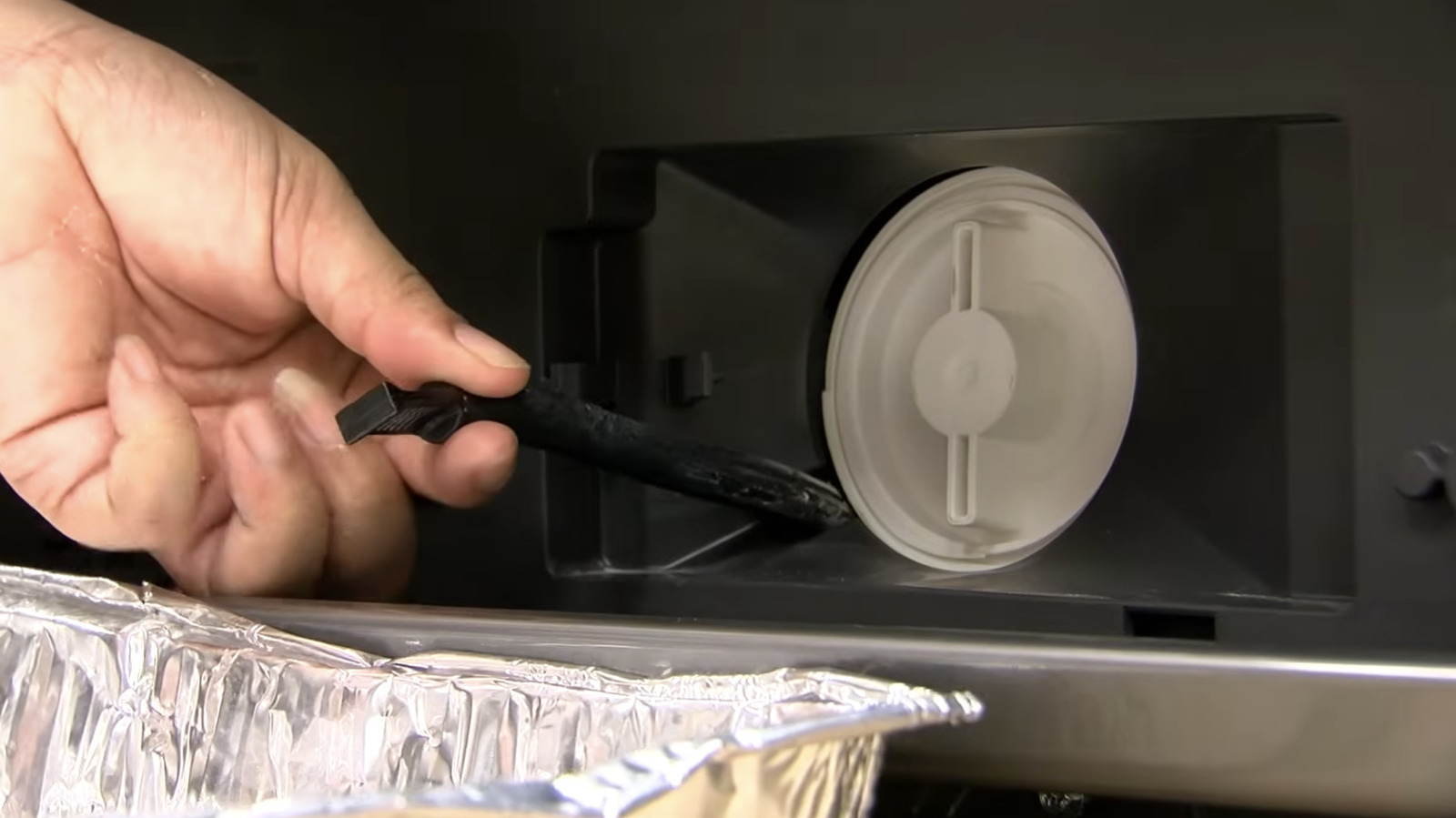
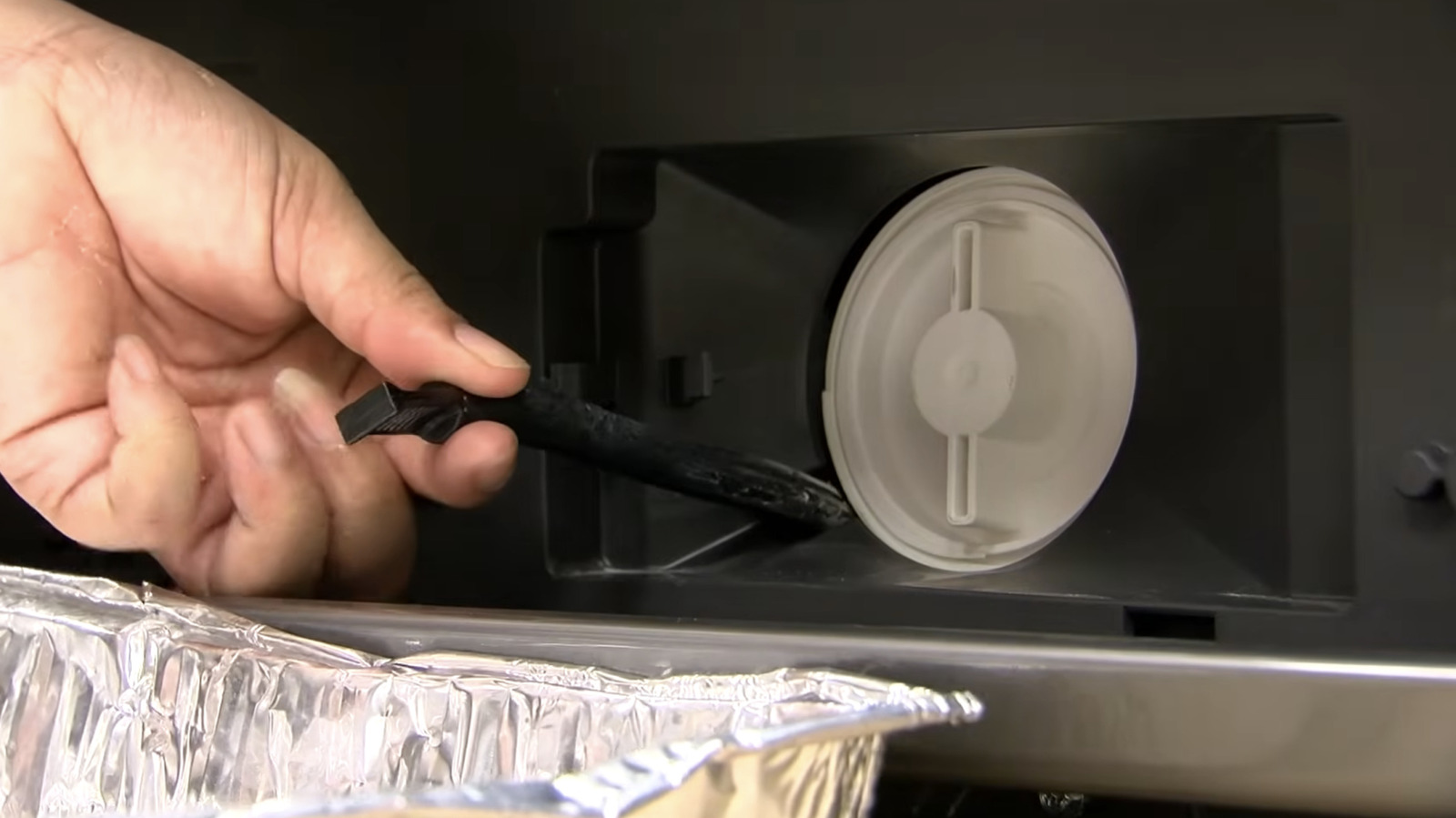
Once you’ve found your drain pump filter, the process for cleaning is the same. First, you’ll want to manage the possible spills by having either a shallow tray or broad flat container on-hand to catch both the water and the debris. Grab the black hose, remove its plug, and drain the water into a container. After you’ve drained it completely, put back the plug and return the black hose to its clip. Next, rotate the drain filter counterclockwise to remove it. You’ll be able to remove the clumps of hair, lint, and other debris with your hands. Once all the big clumps are gone, you can rinse the filter with water before putting it back. Then, either close their access panel door or re-insert the storage drawer until you hear the rails lock into place. Lastly, grab a towel to wipe down any accidental spills.
Two of the most obvious ways that the drain filter needs cleaning is when the water doesn’t drain properly or you see a drain-related error code (such as F9 E1) on your washing machine. However, other signs that you should also look out for include weird sounds, clothes smelling bad, or the drum not spinning. If you don’t want to wait until your washing machine starts having problems, just know that Whirlpool doesn’t list an official recommended cleaning frequency. But professional cleaning service Home Alliance mentions that it should be done every two to four months. And, of course, you’ll want to consider doing it more often if you’ve been washing heavily soiled items or pet beds after a particularly bad shedding season.
Most people don’t really clean their washing machines often enough, so if you’re already working on your drain pump, you might as well do everything else too. To cover all your bases, you can check your specific washing machine’s care guide, since there are slightly different steps for front and top load models. But if you don’t have access to these anymore, Whirlpool has a great guide that you can follow which includes using affresh tablets inside the tub, machine cleaning wipes for the dispensers, around the doors, and the outside of the unit. You can also manage mold by leaving the door open every now and then run cleaning cycles.

realme has announced new milestones for its P Series in India. The company said the lineup continues to see strong demand on Flipkart. According to realme, the P Series became Flipkart’s best-selling smartphone series by sales volume from July 1, 2026. The achievement adds to the lineup’s strong performance during the first half of the year. It also comes at a time when India’s smartphone market is facing slower growth.
In the first half of 2026, Realme managed to occupy the second position in terms of its market share on the platform. However, the good performance was noted across various price ranges. Realme managed to lead in the ₹10,000 to ₹15,000 price range while securing top-three positions in the ₹15,000 to ₹20,000 and ₹20,000 to ₹25,000 price ranges. These achievements, according to the company, highlight the increasing popularity of the P Series.

As reported by Counterpoint Research, the Indian market for smartphones experienced a 10% drop in the second quarter of 2026. However, despite the slowdown in the market, Realme still succeeded in becoming a stronger player. The company’s market share grew from 9.6% in Q2 2025 to 10% in Q2 2026.
The company is also preparing for the second half of 2026 by investing more than ₹10 crore in co-created marketing campaigns. Through these efforts, realme hopes to connect with more consumers, strengthen its position before Diwali, and continue growing its share in the Indian smartphone market.

Chinese tech giant Baidu has started testing autonomous vehicles in London as part of its partnership with Lyft and Freenow, the German taxi and multi-mobility app that Lyft now owns. Baidu is the latest in a string of companies to test self-driving technology in the UK ahead of commercial robotaxi deployments.
The testing, which began Tuesday with human safety operators, comes nearly a year after the two companies struck a strategic partnership to deploy Baidu’s purpose-built Apollo Go RT6 robotaxi across key European markets through the Lyft platform. The vehicles will eventually be available through Freenow, which Lyft acquired in 2025 for about $197 million.
That deal gave Lyft a foothold in Europe’s ride-hailing market, where a handful of well-funded companies are now jockeying to be first to market with robotaxis.
London is particular is shaping up to be a key battleground in the region. In April, Waymo began testing its autonomous vehicles with human safety operators in the city. Uber and its self-driving tech partner, Wayve, also announced plans to launch a robotaxi service in London this year. That initial service — which customers can now sign up for on an interest list — will have human safety operators behind the wheel before fully driverless operations begin later.
Baidu and Freenow by Lyft (as the latter service is now called) said they expect to invite the public to hail their robotaxis in 2027. The companies, which didn’t provide a more detailed timeline, noted that the launch will depend on regulatory approval.
For now, dozens of test vehicles will operate within London’s borough of Brent. Lyft and Freenow said they continue discussions with safety and city officials, including Transport for London (TfL) and the Centre for Connected and Autonomous Vehicles (CCAV). The UK government is in the process of creating autonomous vehicle regulations and opened applications in May for companies interested in an AV pilot program that lets companies test self-driving vehicles under government oversight.
When the service does launch, Freenow by Lyft said it will operate a hybrid network — employing the same language rival Uber has used — meaning human drivers operating taxis and private-hire vehicles will work alongside the robotaxis.
“As a platform with deep roots in the taxi industry, our priority is ensuring that autonomous technology supports the professional drivers who keep London moving,” Thomas Zimmermann, CEO of Freenow by Lyft, said in a statement.
When you purchase through links in our articles, we may earn a small commission. This doesn’t affect our editorial independence.

Baidu’s Apollo Go RT6 will start appearing in the UK capital, with test drivers aboard to start with.

As it promised last year, Baidu has started testing its robotaxis in London along with partners Lyft and Freenow, the companies said in a press release. Baidu’s Apollo Go RT6 will start appearing in the UK capital (with test drivers aboard to start with), while Lyft and and Freenow, the German taxi company Lyft now owns, will take care of booking passengers starting next year.
The trials are part of the partnership between Lyft and Baidu, with the aim of eventually deploying thousands of autonomous vehicles across Europe. To expedite that plan, Lyft acquired Freenow last year to take advantage of its large taxi network operating in the UK and Germany.
Lyft and Baidu are the latest companies to announce robotaxi testing plans in London. Earlier this year Waymo started testing its Jaguar I-Pace vehicles in the city with human safety operators aboard. Uber and its own self-driving partner, Wayve, are also preparing to launch trials this year and are now allowing customers to sign up on an interest list.
Dozens of Baidu’s Apollo Go RT6 vehicles will be operating as part of the tests in the Brent borough of London, the companies said. The network will eventually operate alongside Freenow’s established taxi and private hire network. The Baidu robotaxi service will be called Freenow by Lyft and expects to invite the public to reserve rides sometime in 2027.
The exact timeline will depend on regulatory approval, in coordination with Transport for London (TfL) and the UK government. The latter is in the midst of drafting autonomous vehicle rules and recently launched a robotaxi pilot program.

It’s time to update your Apple Watch, but don’t get too excited; watchOS 26.6 doesn’t appear to have any significant new features.
Apple has just released watchos 26.6, a relatively minor update. This time, watchOS 26.6 is build number 23U67.
Because there’s nothing mentioned within the software notes, it’s a safe bet that any updates are focused on stability improvements and bug fixes. This isn’t surprising, as Apple Watch receives relatively few updates between major cycle upgrades.
Even barring any exciting updates, it’s still a good idea to go ahead and update your Apple Watch. These minor updates are critical for keeping your Apple Watch running smoothly.
The Apple Watch will update on its own over the air. However, if you want to force the update, you can do so by following the steps below.


The Hugging Face breach made clear the dangers associated with losing control of autonomous AI technology.
Chipmaker Nvidia has formed an alliance with other companies in the technology space, in order to develop and share tools designed for enhanced AI safety and cybersecurity.
The Open Secure AI Alliance’s founding members include Adobe, CrowdStrike, Hugging Face and Dell Technologies and follows a public letter, signed by a wide range of companies including OpenAI, advocating for open-weight AI models.
The creation of the coalition comes after AI and ML platform Hugging Face recently found itself the subject of a major cyber breach, in which the company was unable to defend itself with US-led models.
Because guardrails were unable to distinguish between aggressor and defender, the platform turned instead to a self-hosted Chinese model, which was not subject to the same restrictions.
Commenting on the alliance, Gene Moody, the field CTO at Action1 said, “The formation of industry alliances focused on AI safety is a good step towards accountability. Likewise it reflects an important recognition that the technology is advancing faster than many organisations can responsibly govern it.
“It would be a mistake however to believe those efforts meaningfully limit what determined threat actors can ultimately do, or what could one day be a simple mistake such as the crowd strike code update ‘accident’.”
He added, “The reality of the matter is that malicious actors have never depended on permission from anyone. Open source models already exist by the thousands, many capable of running entirely on local hardware, disconnected from any cloud service or vendor oversight.
“Once a model is operating in isolation, safety controls become just another layer of software. They can be modified, removed, retrained, or replaced altogether. You cannot program a conscience into an artificial intelligence. You can only program behaviours, and behaviours are subject to manipulation by anyone with sufficient technical skill.”
Anthropic’s CEO Dario Amodei aimed to dispel accusations that his organisation is making a move to ban Chinese open-weights models in the US, as a means of protecting his own business.
In a post on the Anthropic website yesterday (27 July), Amodei claimed that Anthropic does not advocate for a ban on open-weights models. He said they serve a public good when they lack dangerous capabilities, cost nothing beyond the computing power needed to run them and provide value to businesses, developers and researchers.
He explained that his concerns lie in the use of more advanced AI by authoritarian governments and the wider risk that powerful AI models may be misused to carry out cyber or biological attacks.
Moody said, “We should be far more deliberate about the information we feed into all systems, not just AI. We should reconsider the authority we grant them, and the degree to which we depend on them. We simply do not possess the ability to secure these systems to the level that many people already trust them and that gap is growing.
“We have chosen convenience and novelty over safety. As AI capabilities accelerate, that choice carries unacceptable consequences. As long as valuable data, critical infrastructure and financial assets remain behind digital locks, someone will always be working to pick those locks.
“AI does not eliminate that; it instills a false sense of trust that the tech will one day solve this problem, when in fact, we are the problem.”
Don’t miss out on the knowledge you need to succeed. Sign up for the Daily Brief, Silicon Republic’s digest of need-to-know sci-tech news.

A new analysis of 89 major geological events over the past 260 million years found evidence that mass extinctions, volcanic eruptions, ocean crises, and other upheavals may cluster around a roughly 27.5-million-year cycle. The cause remains unknown, with possibilities ranging from mantle activity and orbital changes to speculative galactic influences. Slashdot reader alternative_right shares a report from ScienceAlert: One possibility lies deep within Earth itself. The planet’s mantle is constantly circulating through convection, albeit at an almost unimaginably slow pace. Periodic changes in mantle convection, or the initiation of mantle plumes, could influence volcanism, plate tectonics, mountain building, and other large-scale geological processes. Because these systems are closely interconnected, disturbances originating deep within Earth could eventually ripple through the planet’s surface, oceans, climate, and biosphere.
Another hypothesis focuses on interactions between Earth’s surface and interior. Long-term orbital variations influence climate and sea level, periodically redistributing enormous amounts of water, ice, and sediment across the planet. [New York University geologist Michael Rampino] discusses the possibility that these changing surface loads subtly modify stresses within Earth’s crust and upper mantle, potentially influencing tectonic and volcanic activity over geological timescales.
Rampino also considers possible influences beyond Earth, an idea he has been weighing up since the 1980s. As the Solar System orbits the center of the Milky Way, it oscillates above and below the galaxy’s mid-plane, with the timing of these passages aligning with that of Earth’s major upheavals. These crossings, other researchers have suggested, could also gravitationally perturb comets in the distant Oort Cloud, increasing the likelihood of large asteroid impacts.
Another, even more speculative, hypothesis suggests that if dark matter is concentrated near the galactic plane, a fraction of it could occasionally be captured by Earth. Over millions of years, this process could generate small amounts of internal heat, potentially influencing geological activity. At present, however, there is no direct evidence supporting either mechanism, so they remain very controversial.
Large asteroid impacts are discussed separately in the paper. Although they were not included in the statistical analysis of the 89 geological events, the timing of several of Earth’s largest known impact craters appears broadly consistent with the proposed 27.5-million-year rhythm, as Rampino has discussed in earlier papers. Rampino suggests this correspondence may warrant further investigation, but stops short of claiming a causal relationship.

Before you start mopping, you’ll need to roll the Submarine head back and forth for 10 to 20 seconds to make sure it’s damp enough to work. You’ll know it’s ready when you see consistent water trails. Before mopping, I also recommend using the Fluffy Optic head to pick up dust in the area, because the wet head’s debris tray looks smaller than those on the dedicated wet cleaners. You’ll thank yourself for pre-vacuuming when the mop cleanup is less disgusting. Though the debris tray is small, I do like that it is fully plastic, since the mesh on my old Dyson WashG1 grew mold. To avoid a mess after you’re done, make sure to keep the Submarine head flat until you separate the trays, lift off the debris part, and then dump out the gray water that’s beneath it into a sink or toilet.

Photograph: Nena Farrell
If you’re looking for the best overall Dyson vacuum, know that this model scored high in my comparison testing, but you’ll get a slightly better experience with the Gen5Detect while saving yourself some cash. Neither the Gen5Detect nor the V16 Piston Animal outperformed a much cheaper Shark vacuum in side-by-side tests, though, so it’s hard for me to say you should definitely splurge on either Dyson model.
If you’re willing to invest in the add-on mop head and docking station (once it’s available), the V16 might be worth buying. But that’ll be a big bill; the V16 Submarine will run $1,100, and at that point, you could invest in one of my favorite robot vacuums to do the same job without actually doing it yourself. (You can even get Dyson’s Spot+Scrub Ai robot vacuum for just $100 more if you’re set on a Dyson.)
Even so, it’s nice to meet a Dyson stick vacuum that can do it all. It’s notably powerful, and not just because of its suction capabilities, but because of its range of abilities, little improvements to make using it easier, and the option to double as a wet floor cleaner. The strong HEPA filtration on the V16 is also a strong point of consideration if you have allergies and want to capture every micron possible, or get every inch of pet hair out of your carpet. But I won’t lie to you: If I’m buying a new technology-powered mop, I’d rather get a robot vacuum.
Power up with unlimited access to WIRED. Get best-in-class reporting and exclusive subscriber content that’s too important to ignore. Subscribe Today.

Whether they’re dead or alive.

ChatGPT has been refusing to copy the voices and styles of popular authors, Ars Technica reports. Indeed, we have recently seen posts on social media about the chatbot not letting users mimic specific authors’ writing anymore. Ars says the chatbot didn’t comply with its prompts to imitate the styles of both living and dead authors during testing. That means OpenAI has recently changed how it deals with such requests, as a recent study by publication No Latency showed that ChatGPT didn’t refuse them for dead authors.
We tested it for ourselves and found Ars‘ observations consistent with our results. Upon asking ChatGPT to copy the style of Agatha Christie for a mystery story about a woman investigating the sudden disappearance of her husband, the chatbot told us it couldn’t do what I was asking for. “Agatha Christie’s works are still under copyright, so I can’t provide text that closely imitates her distinctive style,” the chatbot responded. However, it did provide us with writing possessing qualities Christie is known for. “I can certainly write something with those characteristics, while remaining original,” ChatGPT told us.
The fact that the AI chatbot still offers to write something with the same qualities an author is known for makes it seem like its refusal to copy Christie’s style in our test was just a disclaimer and not a hard no. Indeed, this could be a change OpenAI has adopted into order to avoid getting into more legal trouble and to fend off more copyright lawsuits than it’s already facing.




Weekend Open Thread: Brooks Brothers


How a former Blue Peter presenter stunned America’s Got Talent judges


Intel is reversing course and bringing hyper-threading back to its server chips

New Jersey voter registration controversy explained: How 6,600 noncitizens got on the rolls, and what happens next

Johnny Depp’s R-Rated Gothic Cult Classic Gets New Release Ahead of Sydney Sweeney Remake


Ethics, other provisions in crypto Clarity Act to be further discussed


Luke Littler dismantles Gerwyn Price to retain title in Blackpool

Commonwealth Games boxing: Jadumani Singh seals dominant 5-0 win over Pakistan’s Sumama Rehman to enter quarter-finals | Commonwealth Games News


2026 3M Open leaderboard: Scottie Scheffler finds putter in Round 1, sits three back


16 Dresses for the High Summer Event


The Peugeot Family: How 200 Years of an “Old Money” Dynasty Died in A Boardroom


The Part of the Electric Transition Nobody Wants to Discuss


Spain sweeps the board at 2026 World Cup with individual awards


BITCOIN JUST ENTERED THIS CRITICAL ZONE…

A New Post-Apocalyptic Gundam Anime Series Blasts Into SDCC


XRP Ledger adds $2.6B as RWA inflows rank second


Ripple bought a bank in pieces. The $4 billion audit


Anthropic launches Claude Opus 5, a cheaper AI model for coding, agents and enterprise workflows


Uniswap (UNI) pushes deeper into tokenized RWAs with permissioned trading pools


Sara Gilson Killed By Husband After Viral “Pedophile” TikTok Video

You must be logged in to post a comment Login