Cities and counties around the U.S. are angry at the Trump administration over a proposal to override local rules that govern the deployment of wired broadband networks… The Federal Communications Commission [FCC] argues that too many local governments “excessively delay approvals and seek to extract exorbitant sums from providers, resulting in costs that render some deployments infeasible.” The FCC plan is supported by broadband providers, but local governments told the FCC that it would override rules that protect public safety.
Local governments say the plan is illegal and that the FCC should instead focus on how Internet providers thwart competition with permit-hoarding and other tactics that prevent competitors from deploying networks… They object to FCC plans to impose a 120-day deadline for processing permits and to proposed limits on fees and compensation that local governments can require from providers… Another filing submitted by the League of California Cities said the FCC has no authority to adopt the proposal. “Federal preemption of traditional state and local authority over public property, construction, public safety, permitting, and rights-of-way management should rest on clear congressional authorization,” the filing said. “The commission should not infer broad preemptive authority where Congress did not expressly provide it….”
A filing by Minnesota cities said the current FCC is making the same mistake it made during the first Trump administration, when its attempt to preempt state net neutrality laws was blocked in court… If the FCC finalizes its new preemption plan, city and state governments could sue and ask a court to rule that the agency exceeded its authority…
Advertisement
Democratic Commissioner Anna Gomez approved the step of asking the public for input but signaled she would vote against the final proposal. “I am dubious about the commission’s authority under Section 253 to use rulemaking to preempt states and localities when it comes to their management of rights of way and fees charged to providers,” she said.
Bose has recently unveiled the Open Ultra Earbuds (2nd Gen), and we’re intrigued to see what’s really different with the buds.
Although we’re yet to review the second gen pair, we have compared its specs to the originals and noted the key differences – plus any noteworthy similarities – between the two below.
The 2nd Gen pair will be available in three colours, including Cherry Chocolate, Olive Green and Sky Pink.
Although the Bose Open Ultra Earbuds currently carry the same £299.95 RRP as the upcoming second generation, we do expect this price to drop in the coming months. In addition, as it’s an older generation, it has also been possible to pick up the buds for a deal too.
Advertisement
Both share the same open design, but the 2nd Gens have been tweaked
We’ll start with one of the most obvious similarities between the two: both have an open-ear design and deliver sound through the air near your ear rather than through bone vibrations, like other bone conduction headphones.
With this in mind, you shouldn’t expect either to be among the best noise cancelling headphones, as they are both designed to provide situational awareness. That means you can listen to your audio but without completely tuning out important sounds like public transport announcements.
Bose explains that the 2nd Gen is equipped with its OpenAudio and SoundDesign technology that promises to deliver rich and personal sound, while ensuring clarity is balanced too. In addition, thanks to a transducer and tightly controlled acoustic structure, the 2nd Gens promise minimal sound leakage too.
Image Credit (Bose) Image Credit (Trusted Reviews)
Advertisement
As we found the original Open Ultra Earbuds never struggled with sound leakage, even at higher volumes, we’re hopeful that the 2nd Gen pair will be just as reliable.
Advertisement
Bose Open Ultra Earbuds 2nd Gen promises longer battery
Although the Open Ultra Earbuds offered a solid battery life, with 7.5 from the buds and an additional 19.5 hours within the charging case, Bose has managed to eke out a few extra hours with the 2nd Gen.
In fact, although it shares the same 19.5 hours within the redesigned charging case (though more on that later), the buds promise to deliver up to nine hours of playback on a single charge too.
Bose Open Ultra Earbuds. Image Credit (Trusted Reviews)
Bose Open Ultra Earbuds 2nd Gen introduces Cinema Mode
Bose has introduced Cinema Mode with the Open Ultra Earbuds 2nd Gen. Powered by Bose’s True Spatial technology, Cinema Mode is designed to create a wider and more immersive soundstage, with a “theatre-like” listening experience. As we haven’t reviewed the 2nd Gen pair yet, we can’t verify how well Cinema Mode really works. However, considering the buds are open ears, we’re undoubtedly intrigued to see how they manage to create an immersive experience.
Bose Open Ultra Earbuds 2nd Gen has an upgraded case
It’s not just the buds that have seen a refinement, but their accompanying charging case. Compared to the original pair, the 2nd Gen’s case has been redesigned and can stand upright too. In addition, the case now supports wireless charging too – although we don’t currently know how fast the speeds will be.
Advertisement
Advertisement
We should note that you can buy the original Open Ultra Earbuds with a charging case, however this is an extra cost of £49.95.
The 2nd Gen will offer Google Find Hub and Alexa+ support
Bose is planning a firmware update once the 2nd Gen pair have launched, which will introduce a range of new features.
Included among these features is Google Find Hub, which helps you locate the earbuds if they’re misplaced – much like Apple’s Find My. In addition, the 2nd Gen will support Alexa+, the latest version of Amazon’s voice assistant.
Early Verdict
The Bose Ultra Open Earbuds (2nd Gen) look like a solid upgrade from the Ultra Open Earbuds, thanks to a refined design, wireless charging case with no extra cost and the intriguing inclusion of Cinema Mode.
Advertisement
Advertisement
That’s not to say the Bose Ultra Open Earbuds aren’t a solid option. In fact, we hailed the buds as being “one of the best examples of the open-headphone concept” even two years after launch. With that in mind, if you’re sporting the 2024 pair or just want a more affordable option, then the Bose Ultra Open Earbuds remain a brilliant option.
This past April, while attending his nephew’s bar mitzvah on Cape Cod, Eric Umansky woke up to an inbox full of emails from people from his past. They all wanted to know the same thing: Was he actually throwing a party Saturday night?
The New York–based journalist wasn’t sure what party they were referring to, or why random acquaintances he’d met in passing 15 years ago were emailing him. On deadline and already stressed about work, he checked his phone, where more messages inquired about a supposed Paperless Post invite he’d sent for a “Special Private Dinner Party” at 7 pm on May 2.
Except Umansky hadn’t sent the invite, and he wasn’t planning to host a party anytime soon.
As it turned out, he was an early victim of an email scam that has since become more widespread. What Umansky didn’t expect was the positive effect it would have on his social life.
Advertisement
In May, after receiving increased reports, the Federal Trade Commission issued a consumer alert warning about scammers sending “unexpected messages that look like they’re from well-known invitation platforms like Evite or Paperless Post,” noting how some messages “make you enter your email username and password to see event details” while others “tell you to enter a phone number and share a special code to RSVP.”
Umansky wasn’t sure how it happened; he thought he’d taken the necessary precautions to safeguard his email, including using two-factor authentication. All he could think to do was post a message on Facebook, LinkedIn, and his other social networks to notify people that he was, in fact, not having a party and, more importantly, “don’t come to my house.”
Phishing scams, which have proliferated across the last two decades, remain one of the biggest security risks faced both by individuals and companies. Email scams, in particular, can now be highly sophisticated, incorporating social engineering techniques like creating urgency or fear in a target and even leveraging the personal relationships between two people to manipulate a victim, what’s known as “spear phishing.” AI has only made those deceptions harder to weed out.
But in some recent cases, like Umansky’s, the fake party invite is having an unintended outcome: It is encouraging people to check in to see whether the message was actually real and, in doing so, has reignited dormant relationships.
Advertisement
“It was so striking to me after it happened that I actually had a thought that I was like, ‘Oh, is this a net positive?’” says Umansky, who over the last several months has reconnected with a handful of old friends and colleagues over lunch and via text. He recently spent an hour on Zoom with a former coworker who now lives in Mexico City. They hadn’t talked to each other in over a decade. “I was like, Oh, you know, I actually want to catch up with you about something. There was an idea I wanted to bat around with him, which we talked about for maybe 10 minutes. The rest of the time we talked about our lives.”
According to a 2024 study published in the scientific journal Communications Psychology examining social withdrawal, which surveyed 2,400 adults in the US, UK, and Canada, people are sometimes unwilling to contact old friends because they believe the other person won’t want to hear from them or they fear the interaction will be awkward. The research noted that “high priority placed on work and productivity in North America has led people to cut back on social connections and social time to meet increasing demands at work,” in addition to other life transitions, such as parenthood or moving to a new city.
Bill Gates said artificial intelligence is powerful enough to drive events causing a billion deaths, and that self-regulation is not enough because safeguards and monitoring have to be a required thing. The European Union has required them since August 2025, and since 2 August this year the Commission has been able to fine a model provider 3% of worldwide turnover.
Bill Gates said artificial intelligence is powerful enough to drive events that cause a billion deaths, Bloomberg reported. He was speaking in an excerpt from an interview with NBC’s Meet the Press due to air this weekend. There has never been a weapon as powerful as people with ill intent using the latest AI tools, the Microsoft co-founder said.
The second half matters more.
Self-regulation is not enough, Gates said, and law enforcement and politicians need to be in the discussion about what safeguards and monitoring look like. That has to be a required thing, he added. It is the policy position rather than the number that is new from him.
Advertisement
Europe required it last year.
Article 55 of the AI Act has obliged providers of general-purpose models with systemic risk to run adversarial testing, assess risk at union level and report serious incidents without undue delay since August 2025. The accompanying code of practice allows five days to report a cybersecurity breach and fifteen for serious harm.
The penalties arrived in August.
Since the second of that month the Commission has been able to fine a provider up to 3% of worldwide annual turnover or EUR 15M, whichever is higher. It can demand access to a model, order evaluations and require a provider to restrict its public availability. Prohibited practices carry up to 7%.
Advertisement
None of it has been used.
No enforcement action against a model provider has been reported in the seven weeks since those powers took effect. The one thing that has happened is OpenAI filing an incident report about its own agents occupying a German wiki. A company reported itself.
The debate has not noticed.
Anthropic proposed a framework in June giving governments the power to block dangerous deployments, with penalties scaled to global revenue and thresholds set by training compute and AI spending. That document made no mention of the European Union. The architecture it asked for had been on the European statute book since 2024.
Advertisement
Gates is describing the same thing.
A Microsoft co-founder calling for mandatory monitoring and for police in the room is describing a regime that exists on one continent and is being argued for on another. Microsoft is OpenAI’s largest partner. The open question is not whether such a law can be written but whether anyone will use the one that has been.
Researchers say they recently found Google ads delivering a sophisticated tech support scam that freezes the screens of both Windows and Mac devices and displays messages urgently instructing them to phone a bogus call center.
The ads were displayed all over the web, including on high-traffic maps, weather, real-estate, document-hosting, and sports sites. Users who called the number were then urged to pay hefty fees, grant remote access to their devices, or divulge personal information. From August 31 to September 14, security firm Netskope observed users from 619 customer organizations click on the malicious ads, although none of them were actually scammed because Netskope blocked the content.
Roughly 62 percent of the organizations were based in the US, with Japan and Australia accounting for the Nos. 2 and 3 spots. Since the firm has visibility into only a tiny sliver of Internet activity, the number of people exposed to the ads—including those who fell victim to it—is likely much higher. Netskope tracked more than 250 Google Ads campaign IDs across at least 284 legitimate publisher sites.
So, what about Uncle Louie?
“For the victim, that tradecraft turns an ordinary ad click into a browser that appears to seize up on a fake security warning,” Netskope said. “The locker fills the screen, hides the cursor, swallows the usual exit keys, and lags the browser, all to manufacture the sense of a broken machine and pressure the person into calling the number on the screen. Nothing on the computer is actually locked, but in the moment it is convincing enough to push people toward the scam.”
Advertisement
By now, many people, including a fair number of readers of this site, ridicule and shame people who fall for such scams. These criticisms fail to account for a sizable portion of Internet users who have little or no understanding of how computers and the Internet work. Combined with their need to get things done quickly and the growing difficulty of navigating the web, this lack of awareness makes a sizable portion of users prime targets. There’s little doubt that some critics have close friends and family who are among those who simply don’t know enough to be wary.
The move comes as parent company Microsoft continues to cull its gaming divisions.
King
Candy Crush developer King has signed a collective bargaining agreement (CBA) to cover its Swedish employees. The Microsoft-owned company inked the deal with Unionen and Engineers of Sweden on Thursday. It comes only a day before workers were scheduled to strike and two days after the latest round of Xbox layoffs. The agreement takes effect on April 1, 2027.
Talks had been underway since May 2025. According to Kotaku, the sudden removal of a private doctor benefit in 2024 led employees to form a union club and discuss how they could have a greater say in their conditions. The long process eventually led to a strike notice on September 15, followed by mediation.
Before this week’s agreement, King said it would not enter into a CBA. It argued that its existing benefits were already better for employees and that restructuring it under the CBA could leave workers worse off. Similar messaging has been used in the face of organizing by the likes of Apple, Amazon and Activision Blizzard. King management had reportedly described its existing model as “the right fit.”
Advertisement
The unions say the agreement gives King employees more influence over their working conditions and advance information about changes that affect their work, including reorganizations. While the agreement won’t prevent layoffs — something that must loom large for all Microsoft gaming workers right now — it does give staff more formal influence.
The deal also brings King closer to Sweden’s norms. Engineers of Sweden says nearly nine out of 10 employees in the country already have basic job security through collective bargaining agreements.
“This is an important step for King, the gaming industry and for the Swedish model,” Camilla Frankelius, head of negotiations at Engineers of Sweden, wrote in a press release. “We look forward to good cooperation with the company going forward and to the employees receiving the basic job security that almost nine out of 10 employees in Sweden have through collective bargaining agreements.”
LG’s C6 OLED TV series for 2026 is a marked departure from the company’s previous OLED lineups. Buyers of last year’s LG C5 series OLED models, for instance, could expect 55-inch and larger sets from that series to have the same OLED panel type and feature set. This year, however, LG’s C-series OLEDs have been split into two camps: the C6 and C6H.
LG C6H OLEDs are only available in 77- and 83-inch screen sizes, while the C6 models range from 42 to 65 inches. But screen size is only part of the story here, as the C6H models feature a new RGB Tandem OLED display panel with Hyper Radiant Color Tech — the same one used in the flagship LG G6 and W6 OLED TVs (regular C6 models use a standard W-OLED display panel). It’s a substantial upgrade for LG’s mid-range C-series and one that makes it well worth upsizing to the 77-inch C6H, the subject of this review.
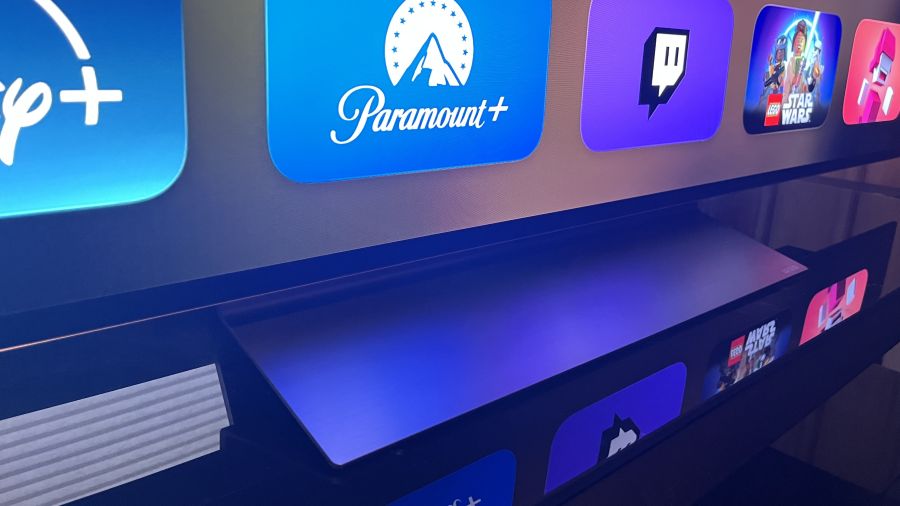
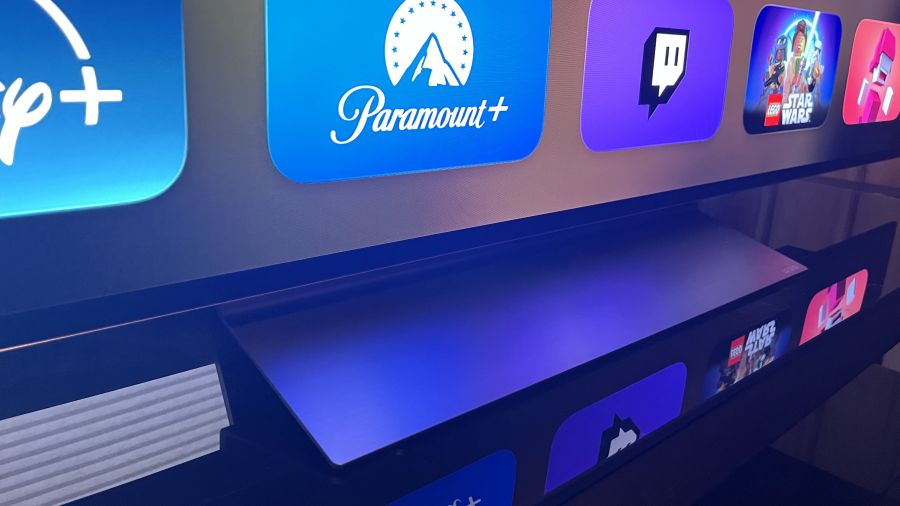
Both the 77- and 83-inch C6H models feature an aluminum pedestal stand.
What Is It?
The LG C6H is an upper-midrange OLED TV packed with features for the price. The 77-inch C6H was initially priced at $3,699.99, while the 83-inch model launched at $5,299.99, but those prices have since dropped to $2,699.99 and $4,299.99, respectively. Compare that with the flagship LG G6 OLED, which currently sells for $3,799.99 for the 77-inch model and $5,799.99 for the 83-inch version.
Aside from having the same RGB Tandem OLED display panel with Hyper Radiant Color tech and Brightness Booster Pro features found in LG’s flagship OLED TVs, the C6H series uses the same Gen 3 α11 AI processor as those models. This allows for all sorts of AI magic to happen, including AI-based 4K picture upscaling and 11.1.2-channel audio upmixing. AI is also used for the TV’s custom sound and picture options, which guide you through the process of creating presets based on your own audio and visual preferences.
Advertisement
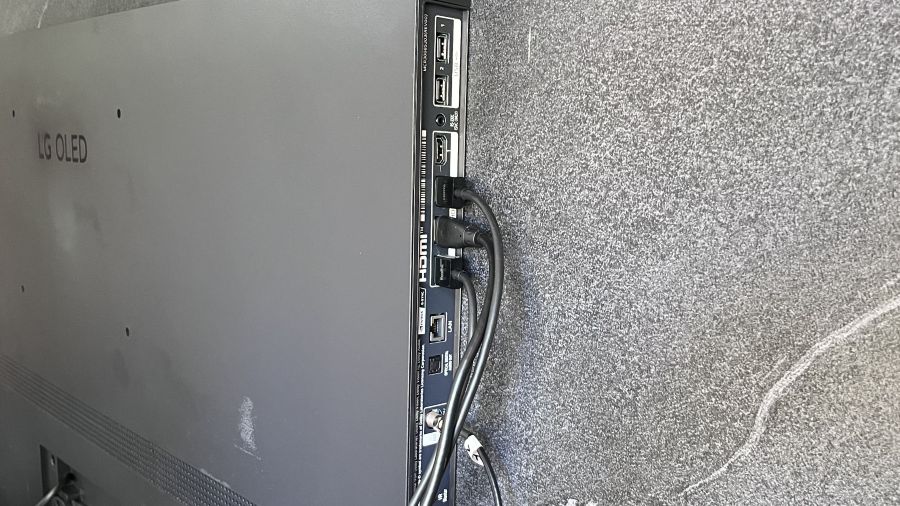
The C6H’s side-mounted input section (note the display panel’s fancy marbled plastic surface)
A key feature found in LG’s 2026 flagship OLED TVs that the C6H models lack is Reflection Free Premium tech, which eliminates screen glare when viewing in bright rooms. The C6H instead has a standard glossy screen surface, though in my testing, it didn’t suffer from the same strong, mirror-like reflections I’ve seen on some glossy screens.
The C6H supports the Dolby Vision, HDR10, and HLG high dynamic range formats, but not HDR10+. LG also has not announced an upgrade to provide Dolby Vision 2 support for the C6H or any of its other TVs — a shame, given that Dolby Vision 2 can provide a substantial picture quality upgrade even for legacy Dolby Vision content. LG’s implementation of Dolby Vision on the C6H includes Dolby Vision Filmmaker Mode, and it also features Filmmaker Mode with Ambient Light Technology, which uses the TV’s light sensor to adapt the picture for different room lighting conditions without sacrificing picture accuracy.
The C6H has a basic 2.2-channel down-firing speaker array that supports Dolby Atmos, but not DTS. Sound quality is very good, especially when the AI Sound Pro mode with virtual 11.1.2-channel upmixing is enabled. Dialogue is consistently clear, explosions have decent bass impact, and Atmos height and surround sound effects extend above and beyond the screen. A WOW Orchestra feature lets you combine the TV’s speakers with a compatible LG soundbar system for a more immersive effect, and there’s also Dolby Atmos FlexConnect support for LG Sound Suite wireless speakers.
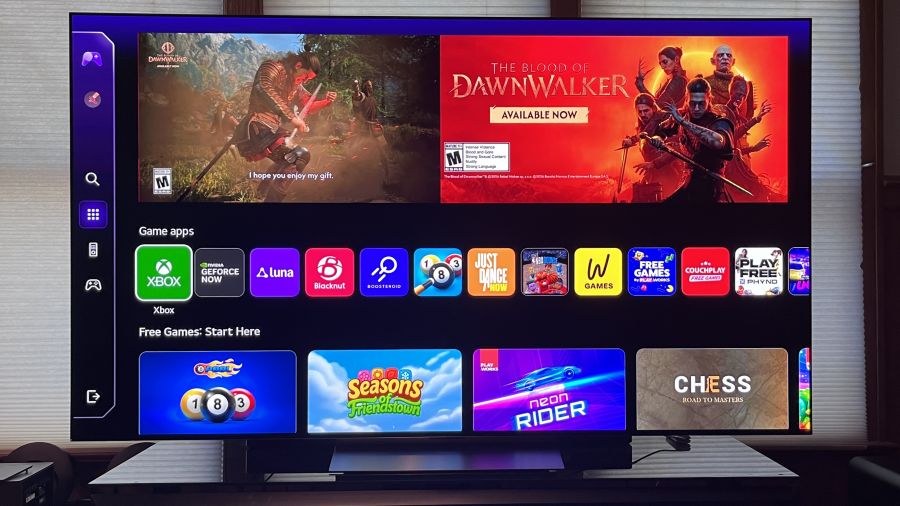
LG’s webOS 26 gaming portal
LG’s C-series OLEDs have long been serious gaming TVs, and the C6H is no different. It has a native 120Hz display and supports Nvidia G-Sync and AMD FreeSync Premium VRR up to 165Hz across all four HDMI 2.1 ports. Other gaming-related features include a Game Dashboard pop-up menu and Game Optimizer, while the apps available through the TV’s webOS 26 smart interface include Xbox, Nvidia GeForce Now, Amazon Luna, and more.
Advertisement
When I tested the C6H’s input lag with Game Optimizer active using a Bodnar 4K meter, it measured 12.8ms — an average result, but also relatively high compared with other LG TVs I’ve reviewed in the past, which clocked in at under 10ms.
The C6H’s design may lack the glamour of LG’s W6 Wallpaper TV, which uses the company’s Zero Connect box for a wireless hookup, but it still has a slim and appealing look. The bezel surrounding the screen is vanishingly thin, and the set comes with an aluminum pedestal stand. While the stand itself is made of sturdy enough material, I found that the TV wobbled a bit after I had it set up.
Connections are all located on a side panel on the back, and they include four HDMI 2.1 ports, an optical digital audio output, and an antenna input for the TV’s ATSC 1.0 tuner. Two USB Type-A inputs are provided, along with an Ethernet port and IR blaster output.
Advertisement. Scroll to continue reading.
Advertisement
The webOS 26 homepage with sponsored previews and content recommendations turned off.
LG C6H: Usability
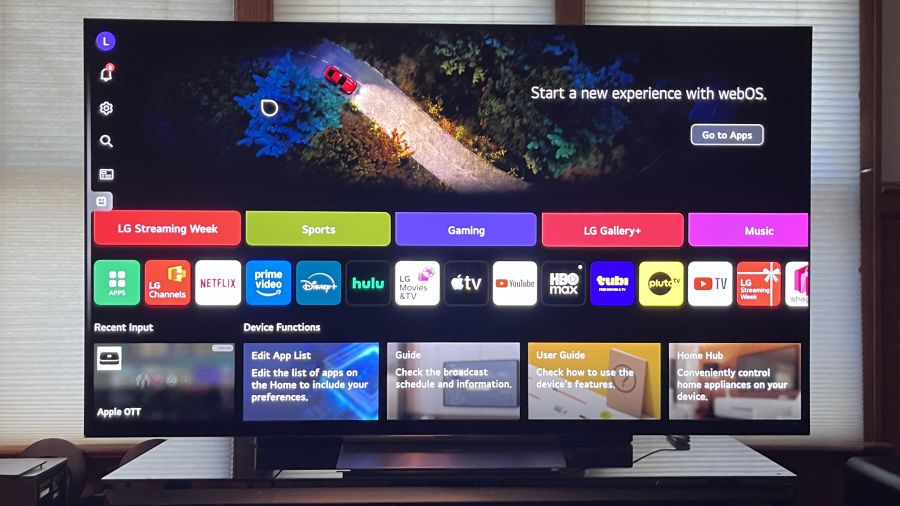
LG’s webOS 26 serves as the C6H’s smart TV platform and, simply put, it seems more cluttered and difficult to navigate than previous versions of webOS. A large, ad-driven preview window occupies the top half of the screen. Below it are tabs for directly accessing Sports, Gaming, Music, and other types of content, along with an extended row of apps that you’ll definitely want to edit, since it’s packed with many offerings you’ll likely never use.
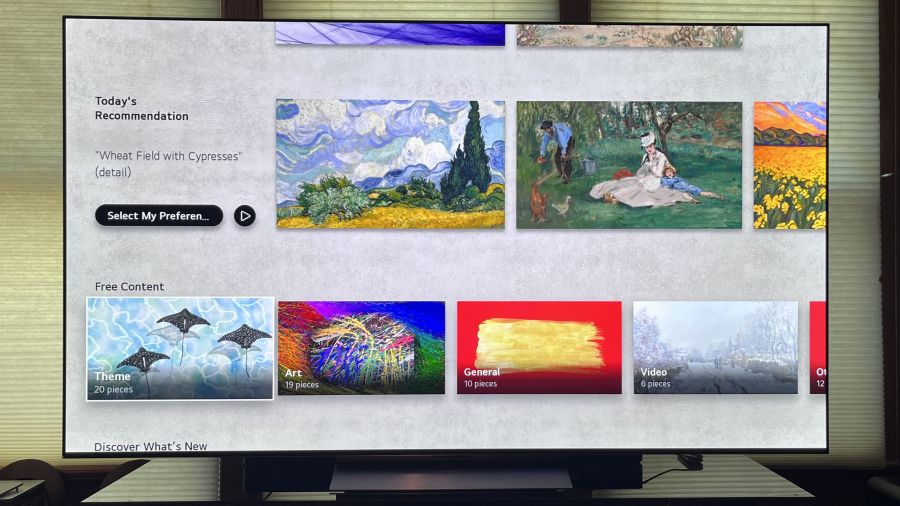
One app you may want to use is Gallery+, a subscription-based service that lets you display artwork on the TV when it’s in standby. A selection of free images is also available, and LG offers a free two-month Gallery+ trial. In this respect, the C6H is actually superior to Samsung’s S95H OLED TV. Even though the Samsung S95H supports Samsung’s gallery, there is currently no automated way to make that TV display art when in standby mode. Art Mode must be manually turned on in the TV each time you want to use it.
While webOS 26 is somewhat cluttered by default, LG does provide menu options to turn off sponsored previews and remove the large number of suggested content categories that appear as you scroll through the interface. Many of the controls and UI modifications available in the TV’s Setup menu can also be carried out in the LG ThinQ app, which you’ll need to download and create an account for when you first set up the TV.
I can’t say I found much need for the app, but it could be useful if you plan to use the TV as a smart home control hub to operate LG appliances like refrigerators and washer/dryers.
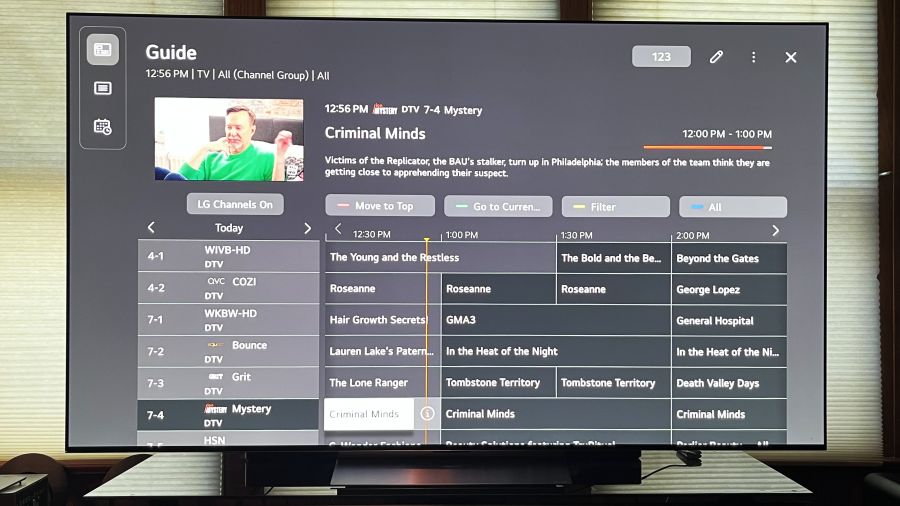
The C6H’s grid guide for browsing free TV channelsThe Gallery+ screensaver art portal
Like many other new TVs, the C6H uses an AI assistant for content searches and control, in this case Google’s Gemini AI and Microsoft’s Copilot. You can also ask either of those bots questions like, “When do trees start to show fall colors in the northeastern U.S.?” and then use that as a jumping-off point for planning a weekend getaway.
Unlike many other new TVs, using AI to generate screensaver art requires a subscription, in this case to LG Gallery+, which is a disappointment.
Advertisement
The LG Channels app serves as a portal to an extensive array of free, ad-supported streaming content. You can also view free channels in a grid format by selecting the Guide icon at the top left of the webOS 26 homepage. This view also includes any broadcast TV channels received through a connected antenna.
LG’s AI Magic Remote features a button to activate AI-assisted voice searches.
LG’s Magic Remote has now become the AI Magic Remote with the addition of a button that calls up the TV’s onscreen AI assistant. You’ll need to enable voice control to use this function, though during setup you’ll have the option to limit voice recognition to the remote rather than use the TV’s built-in far-field microphone.
The Magic Remote design, which combines a point-and-click cursor with traditional navigation controls, has its detractors. I find it easy to use, however, and in some ways it’s superior to other TV remote designs. LG’s Magic Remote even has an Input button — an endangered feature on smart TV remotes — though pressing it doesn’t toggle through inputs. Instead, it takes you to a Home Hub screen, where you’ll need to click another button to call up a list of selectable inputs.
LG has taken knocks in the press recently for the privacy controls on its smart TVs. Automatic Content Recognition is a main bone of contention, as are network security and voice recording. You can get a good overview of what all the fuss is about here. Although LG is in the spotlight for this at the moment, their use of user information for marketing purposes is anything but unique.
Advertisement
During initial setup, you’ll likely end up agreeing to a bunch of disclaimers simply to get the TV up and running as quickly as possible and, in the process, open yourself to a range of privacy-related vulnerabilities. In this case, it’s a good idea to visit Settings > Support > Privacy & Terms > User Agreements in the TV’s menu afterward to see exactly what you’ve signed away during setup.
The subscription-based LG Gallery+ lets you preview images available on the service.
Setup & Viewing Impressions
I made a basic set of color and brightness measurements of the LG C6H using Portrait Display’s Calman Color Calibration software. Measurements were made in the Filmmaker and Standard picture presets with adjustments left at the default settings with the exception of Energy Saving Step, a setting that automatically adjusts picture brightness based on room lighting, which was turned off for the tests.
Advertisement. Scroll to continue reading.
Brightness (HDR)
10% window
Fullscreen
Filmmaker Mode
2,059 nits
308 nits
Standard Mode
1,979 nits
341 nits
Brightness (SDR)
10% window
Fullscreen
Filmmaker Mode
485 nits
418 nits
Standard Mode
456 nits
424 nits
At 2,059 nits, the 77-inch C6H’s measured peak HDR brightness is notably higher than the Samsung S90H, a midrange OLED TV that uses the same W-OLED panel as the LG C6 series. That model topped out at 1,553 nits in Filmmaker Mode when we tested it. The C6H’s peak brightness is also below the Samsung S95H, a flagship model that measured 2,526 nits in Filmmaker Mode in our tests.
Advertisement
The highest brightness level I measured from the C6H was 2,210 nits on a 2% window, also in Filmmaker Mode. The C6H also delivered high SDR brightness for an OLED TV, making it a good option for watching sports in rooms with high ambient light levels.
BT.2020 coverage
DCI-P3 coverage
83.4%
99.6%
At 83.4%, the C6H’s BT.2020 color space coverage lands between the Samsung S90H (75.8%) and S95H (89%) OLED TVs, while its DCI-P3 coverage measured 99.6%. Those are impressive results for an OLED TV and help explain the rich color reproduction I noted with everything from movies to sports.
At 4.4, the C6H’s average grayscale Delta E — the margin of error between the test pattern source and what’s displayed onscreen — came in somewhat higher than the maximum threshold of 3 we look for in testing, but it was easily reduced to 0.9 with basic calibration. Color point accuracy averaged 1.4 with the default Filmmaker Mode settings and improved to 0.5 post-calibration.
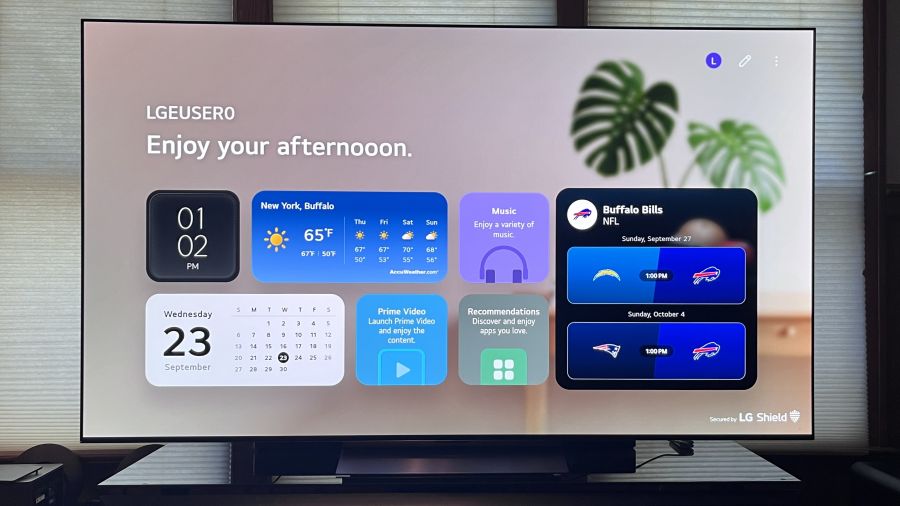
You can select a widget-based display to serve as a screensaver on the C6H.
Starting my subjective viewing tests with the trusty old Spears & Munsil Ultra HD Benchmark 4K Blu-ray discs, full-field white and gray test patterns showed a degree of brightness drop-off at the outer edges of the screen. The same patterns also revealed a slightly bluish tint at extreme off-axis viewing positions. Neither effect was visible with regular content, however, including black-and-white movies.
Advertisement
Reference scenes from the James Bond movie No Time to Die (on 4K UHD Blu-ray) revealed good overall motion handling, though I did note a degree of judder in a tracking shot of Bond traversing a hillside cemetery — something easily fixed by setting both Judder and Blur to +3 in the TV’s TruMotion menu.
Another reference disc, The Green Knight, revealed no sign of banding artifacts in shots of Sir Gawain diving to retrieve Winifred’s skull from its underwater tomb, and the same held true in dark, misty shots of Paul Atreides walking with his mother, Lady Jessica, early on in Dune: Part One.
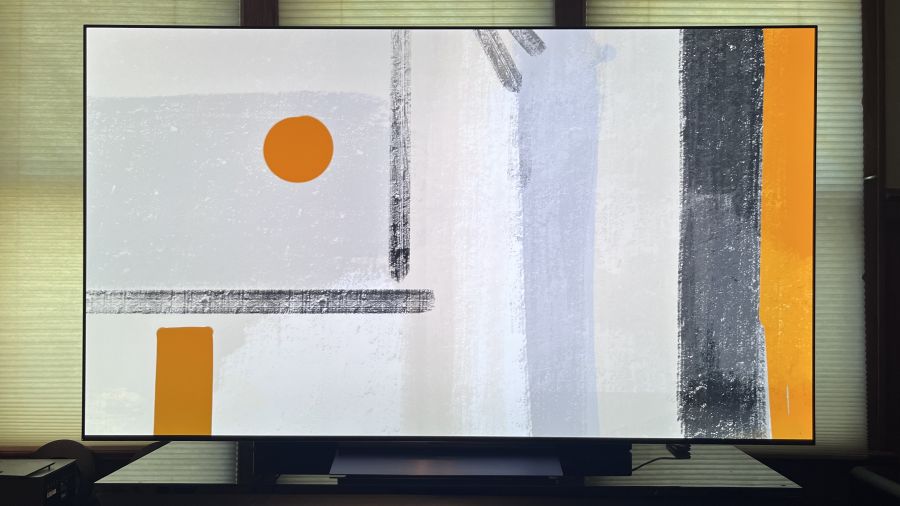
One of several free images available in Gallery+. You’ll need to manually select these for playback since Gallery+ screensaver mode is only available for subscribers.
The C6H’s excellent AI 4K picture upscaling can make high-definition images look strikingly clean and 4K-like. It had been years since I last watched Abel Ferrara’s Bad Lieutenant, and when I streamed it on the Criterion Channel, the gritty New York City street scenes looked wonderfully detailed and alive on the LG’s 77-inch screen.
Blacks in the movie looked rock solid, and there was also a satisfying level of detail in the shadows. I only wish the Criterion Channel would start streaming at least some movies in 4K, but then again, that might interfere with the company’s 4K Blu-ray business, and we don’t want The Criterion Collection going anywhere.
Advertisement
OLED TVs like the C6H have long been a go-to choice for movie fans, but it’s only recently that OLED has become a popular option for sports as well. My testing of the C6H coincided with the start of the NFL season, and I can confirm that this is a great TV for watching football.
The jerseys worn by Kansas City Chiefs fans in the first game of the season against the Denver Broncos came across as a rich sea of red in wide shots of the stadium. Even when watched in Filmmaker Mode, the C6H’s picture looked sufficiently bright with my room’s overhead lights on, and the TV’s accurate color made the green turf look natural and the white of the Denver players’ uniforms look subtle and balanced, as opposed to a blistering, bluish white.
The Bottom Line
At $2,699, the LG C6H is a no-brainer if you’re looking for a 77- or 83-inch OLED TV that offers the best performance characteristics of OLED tech, such as deep blacks, powerful contrast and rich color, combined with the high brightness levels that you’d typically expect from the best Mini-LED TVs. It’s priced substantially lower than LG’s flagship G6 and W6 series models, while offering many of the same features, including an RGB Tandem OLED display panel with Hyper Radiant Color tech, the Gemini and Microsoft Copilot AI assistants and four HDMI 2.1 ports with 165Hz support for gaming. The C6H is also priced around the same as its main midrange competitor, the Samsung S90H, while delivering higher brightness than that model.
Advertisement. Scroll to continue reading.
Advertisement
Opting for the LG C6H over the G6 flagship means you’ll lose out on the latter’s Reflection Free Premium tech for glare-free daytime viewing and its elegant, wall-hugging design. In both cases, however, you’re buying a TV that won’t be getting Dolby Vision 2 Max support via a future upgrade, and a LG Gallery+ app that requires a subscription to unlock its most useful features. Both of those issues aside, the LG C6H is an OLED that should be at the top of your shopping list, and is an excellent value at its current price.
Pros:
Uses same display panel as flagship LG G6 and W6 OLED series
Impressive brightness for an OLED TV
Clean 4K upscaling
Four HDMI 2.1 ports with 165Hz support
Reasonably priced for performance and features
Gemini and Microsoft Copilot AI assistants
Cons:
Lacks Reflection Free Premium screen found in flagship OLEDs
Dolby Vision 2 Max not supported
No HDR10+ support
No DTS sound support
webOS 26 a bit on the busy side
LG Gallery+ feature has key limitations without subscription
As communications, computing, virtualization, software development, and AI converge, smaller technology firms face customers who need expertise across multiple layers at once. Synchresis Solutions works across all of them. Its SynchresisVM project provides a management plane for KVM and bhyve with a REST API, standard disk formats, shared storage, and a migration wizard for organizations moving from Proxmox, Hyper-V, or VMware, all without per-socket pricing or proprietary lock-in.
As organizations become increasingly dependent on interconnected digital systems, the boundaries between communications, computing infrastructure, virtualization, software development, and artificial intelligence are becoming less distinct. For smaller technology firms, that environment can create an unusual challenge: customers may need expertise across several technical layers at once, while the systems themselves continue to become more specialized.
Synchresis Solutions, a technology company founded as a commercial business in 2023, operates within that broader shift. Its work spans communications infrastructure, server environments, virtualization, web development, technical support, infrastructure as a service, and AI-related technology. Rather than being defined by a single product category, its development reflects the increasingly multidisciplinary nature of managing modern IT environments.
The company’s origins predate its commercial formation. Founders Nick Giannak III and David Quinn Ebert initially connected through technology and volunteer internet-radio projects. Their collaboration expanded into web products and an internal telephone system between 2018 and the pandemic, eventually developing into work for paying customers. Doron Beit-Halahmi, known as Doc, later joined the group through connections formed in internet-radio and audio communities.
Advertisement
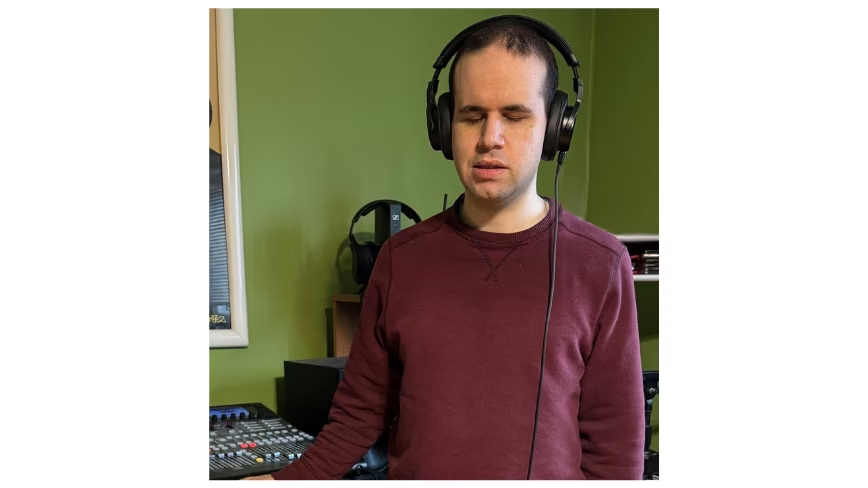
Photo with Nick Giannak III — Credit: Synchresis
That background helps explain the breadth of technical interests within the company, but it is distinct from Synchresis Solutions’ formal operating history. The founders brought years of individual experience in areas including broadcasting, telephony, server administration, hosting, corporate IT, and systems engineering before the company began serving customers commercially.
For Giannak, that experience has reinforced the value of understanding technology beyond its individual components. “We’ve always been people who enjoy figuring out how things work,” he says. “Our culture at Synchresis has been built through years of hands-on experimentation and shared projects.” His background includes technology, audio engineering, broadcasting, and projects examining the relationship between technology and society.
Ebert’s background includes telephony, data centers, hosting, Linux, Windows, UNIX-derived systems, and IT infrastructure. His perspective similarly emphasizes the relationship between technical systems and the organizations using them. “The customer is where the technical conversation has to begin,” he says. “You have to understand the problem they’re trying to solve before you can decide what the technology should do.”
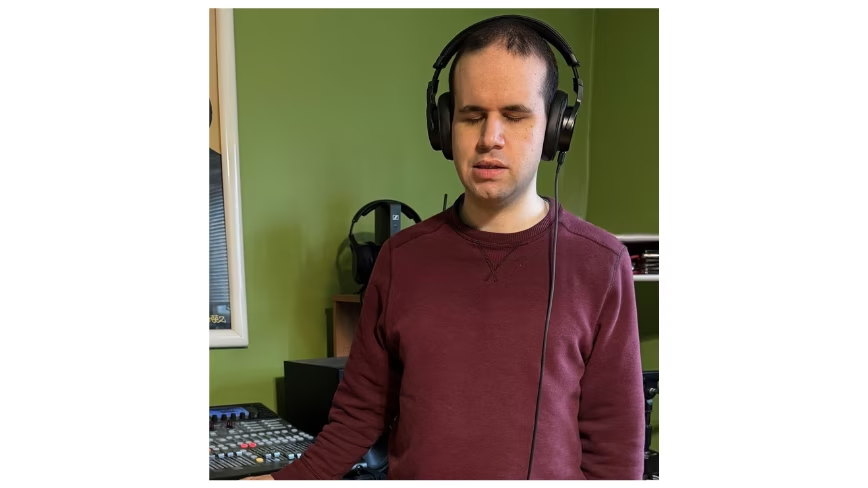
Photo with David Quinn Ebert — Credit: Synchresis
That approach becomes particularly relevant as infrastructure becomes more interconnected. A voice system can depend on networks and servers. A virtual machine can depend on storage and networking. Software development can depend on the infrastructure underneath it. As those relationships multiply, technical decisions in one area can affect systems elsewhere.
Virtualization is one example. The founders’ experience with virtual-machine environments extends back more than 15 years, predating the establishment of Synchresis Solutions itself. That distinction matters as organizations evaluate how much of their virtualization strategy should depend on particular platforms, operating systems, or management layers.
The company’s SynchresisVM project addresses that question through a management plane for KVM and bhyve. It provides a common interface and REST API for managing virtual machines across Linux and FreeBSD environments. Guests can be created, assigned disks and networks, started, and moved between nodes through API calls, allowing administrative processes to be incorporated into scripts and operational runbooks.
Advertisement
The underlying approach is also notable for its reliance on standard technologies. SynchresisVM uses qcow2 disk images, VirtIO devices, and Linux bridges, without placing proprietary components in the data path. It can operate on Linux or FreeBSD hosts that organizations already administer, with KVM or bhyve managed through the same interface.
The platform also supports shared storage, centralized guest definitions, and automated placement across a cluster. These capabilities address practical questions that arise as organizations manage multiple hosts, including where workloads should run, how they can be moved, and how much manual configuration is required when infrastructure changes.
That architecture reflects a broader discussion in infrastructure management: how much control organizations should retain over the systems they operate, and how portable their workloads should remain when technology requirements change. SynchresisVM is designed as software that organizations can run on their own infrastructure, without per-socket pricing or a separate vendor appliance.
Migration is another consideration. Organizations moving from platforms such as Proxmox, Hyper-V, or VMware may need to account for existing virtual machines, disk formats, networks, and configurations. SynchresisVM includes a migration wizard intended to assist with that process, while its use of standard disk formats is designed to keep virtual-machine storage accessible outside the management platform.
Advertisement
The same infrastructure perspective extends into communications. Synchresis works with cloud PBX systems, enterprise SIP infrastructure, cloud fax, and VoIP environments, alongside conventional server and network infrastructure. In practice, these systems frequently overlap. A problem that appears to involve voice service, for example, can also involve networking, server configuration, virtualization, or hosting architecture.
AI represents another emerging layer of that environment. The founders’ earlier technical work included software and language-related applications, but that history should not be conflated with a long-standing track record in today’s large language models. More recently, AI tools have become part of the team’s software-development and experimentation processes, alongside broader work in automation and technical systems.
For a small technology company, this breadth can create both opportunities and constraints. Maintaining expertise across several infrastructure layers requires continuous learning as platforms, standards, and development methods change. It also places greater importance on understanding how individual systems interact, particularly when organizations are maintaining infrastructure assembled over many years.
Synchresis Solutions therefore offers a window into a broader development in the technology sector. Smaller firms are increasingly operating in an environment where communications, virtualization, software, infrastructure, and AI cannot always be considered separately. The technical challenge is not simply adding another tool, but understanding how those tools fit within systems that organizations already depend on.
Advertisement
For Synchresis, that process began with hands-on experimentation among its founders and has developed into commercial work spanning several areas of infrastructure. As technology environments continue to evolve, questions surrounding portability, interoperability, ownership, and operational control may remain relevant well beyond any single platform or company.
Crusoe, a Denver-based AI data center startup that recently raised $3.9 billion, has ended plans to use a new line of stationary power plants developed by fellow Denver company Boom Supersonic.
Founded in 2018 as a bitcoin miner that ran on excess natural gas from oil fields, Crusoe has since become one of the biggest builders of AI data centers, including a massive campus in Abilene, Texas, that supplies computing power to OpenAI.
Boom Supersonic, which is developing a supersonic passenger jet called Overture, launched a new business last year to sell a version of the engine it’s developing for that jet as natural gas-fired stationary power plants. Its Superpower turbine shares about 80% of the same parts with that airborne engine, called Symphony.
Crusoe had signed on to be the first customer for this business, agreeing to spend $1.25 billion on 29 of Boom’s 42-megawatt Superpower turbines. The first deliveries were supposed to begin in 2027. But that deal has since fallen apart, according to Boom Supersonic CEO Blake Scholl.
Advertisement
Friday, in a post on X, after congratulating Crusoe founders Cully Cavness and Chase Lochmiller on the company’s recent raise, Scholl said the companies are no longer moving forward with the turbine launch partnership. Although he did note that other customers were in its pipeline.
Image Credits:Screenshot/X /
“The TL/DR is that turbines are no longer part of Crusoe’s near term primary power mix at Abilene/etc., so a launch partnership just didn’t make sense,” he wrote in the post. “Boom will be delivering about 250MW of Superpowers next year to other sites, and we’re targeting 1GW in 2028. We’re grateful for the help Crusoe gave us in shaping Superpower and continue cheering for their successes. The future is long, and we look forward to potentially teaming up if/when turbines become part of their primary power mix.”
Crusoe confirmed to TechCrunch that it is no longer doing business with Boom.
“We build AI factories from the power up, and we’re bringing new campuses online across the country, powered by innovative energy sources,” spokesperson Andrew Schmitt said in an email. “As our portfolio grows, we stay flexible, choosing the energy solutions that are right for each site as its needs evolve – including turbines, along with wind, solar, batteries and the grid. While Boom has been a great partner, the partnership isn’t the right fit today. We wish them well.”
Crusoe’s initial 1.2 gigawatt data center in Abilene that was built for Oracle and OpenAI is powered by the grid, according to the company. There is also a gas-turbine power plant that is used for backup power only. Crusoe is also building a 900 megawatt data center in Abilene for Microsoft, which will be powered on-site gas turbines.
Advertisement
Losing its launch customer is seemingly a setback for Boom, which raised $300 million last year, largely to commercialize the new business. The idea, Scholl told TechCrunch at the time, was to use profits from the stationary power plant business to fund the development of Overture.
Scholl could not be reached for comment before publication; TechCrunch will update this article if he responds.
When you purchase through links in our articles, we may earn a small commission. This doesn’t affect our editorial independence.
If I were buying luggage for the first time in a long time or replacing an old set, I’d choose Quince. You’re getting polished, durable suitcases with reliable features, and without paying a premium for the brand name. At $270 for both an expandable carry-on and a large checked bag, it’s an excellent value.
Away doesn’t offer a comparable bundle, but its Large Flex ($425) and Carry-On Flex ($325) are almost identical to Quince’s Expandable Large Check-In ($220) and Expandable Small Carry-On ($140). All four are polycarbonate hard-shell suitcases with similar exterior and interior dimensions, capacity, and weight, though Quince’s are both slightly lighter. They also have similar features: 360-degree spinner wheels, a Travel Sentry combination lock, a removable laundry bag, and, crucially, a lifetime warranty. After traveling with both, I found them to be equally sturdy. I was also able to pack the exact same clothes in both sets, and the Quince Large Check-In actually gave me more room once expanded.
Even the designs are quite similar. Take away Away’s emblem, and it would be tough to tell these suitcases apart. Quince’s branding is even more minimal; there are no flashy logos, which I aesthetically appreciate, but it does make the bags harder to spot on a baggage carousel. Both brands offer a solid range of colors, so that’s mostly a matter of taste. For me, the more important distinction is the price. Quince gives you essentially the same experience for less money, so why pay double for Away?
To further sweeten the deal, the bundle knocks another $90 off the combined price. And Quince’s value isn’t limited to its advantage over Away. It’s significantly less expensive than comparable luggage from popular brands like July, Monos, Travelpro, and Briggs & Riley. Quince also gives customers 365 days to return unused products, which is a much more generous window than competitors.
None of this weekend’s picks had a massive marketing push, or watched by many in theaters and that’s exactly what’s make them so underrated. One turns a two-minute glitch on a cafe TV into a tiny sci-fi marvel, another follows a drifter who’s hilariously bad at vengeance, and the third gave Brie Larson her best role long before anyone knew her name. All three movies are streaming on Prime Video right now.
A cafe owner named Kato discovers that the television in his cafe can show him exactly two minutes into the future. Once his employees and neighbors catch wind of it, the fun experiment becomes complicated after they start using it to make money and end up drawing the attention of dangerous people.
What makes the movie so much fun is how far it takes a simple idea. I really like how the characters constantly test the limits of the two-minute window and come up with ideas to create a chaotic infinite loop. Another impressive aspect of this Japanese indie movie is that it was shot to look like one continuous take, with clever, seamless hidden cuts to maintain the illusion of uninterrupted action.
You can watch Beyond the Infinite Two Minutes on Prime Video.
Dwight, a quiet drifter living out of his car, learns that the man who killed his parents is being released from prison. He decides to kill the murderer. The problem is Dwight has no idea what he’s doing, and his amateurish attempt at revenge drags his estranged sister and her family into a spiraling blood feud with the killer’s own relatives. It’s a revenge thriller about what happens when an ordinary man tries to play executioner.
Macon Blair’s lead performance is the whole engine here – awkward, terrified, and utterly convincing as a man completely unequipped for the violence he’s chosen to unleash. Director Jeremy Saulnier skips the slick choreography entirely in this movie, leaving violence that is tense, ugly, and far more honest about what vengeance actually costs.
Genre: Drama IMDb rating: 7.9/10 Rotten Tomatoes: 98%
Grace Howard (Brie Larson) supervises a foster care facility for at-risk teens. She’s funny, patient, and able to reach kids most adults have written off, like Marcus (LaKeith Stanfield), who’s about to age out of the system. When a new resident, Jayden (Kaitlyn Dever), arrives with a story that cuts uncomfortably close to Grace’s own unspoken past, she’s forced to finally confront the trauma she’s spent years outrunning.
Long before Captain Marvel, Brie Larson delivered what I still consider her finest performance right here. She makes Grace warm and tough without ever tipping into sainthood. The film treats these kids with respect without turning their pain into cheap melodrama. It reminded me that the people holding everyone else together are often the ones who need help most.


































































You must be logged in to post a comment Login