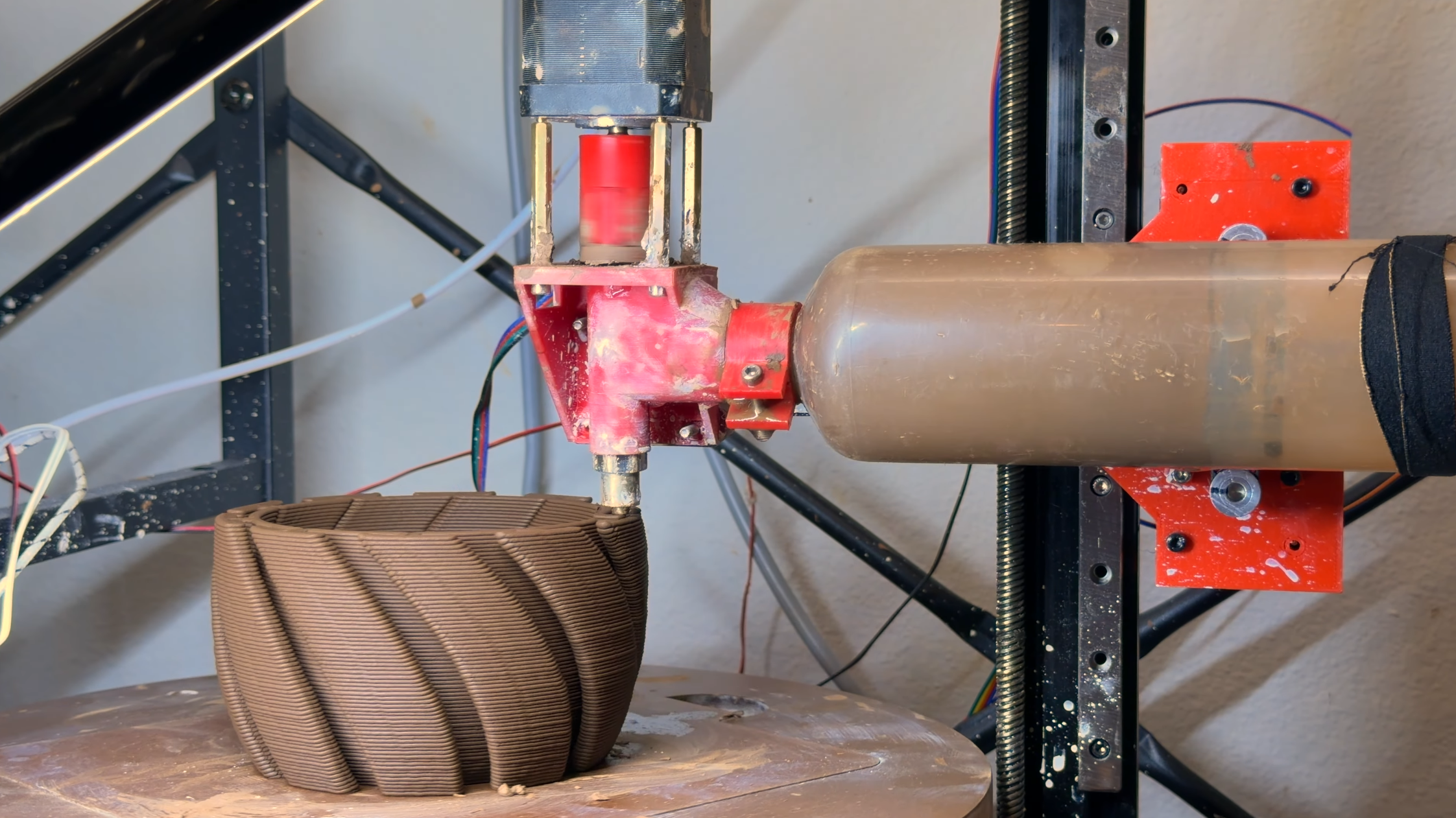
Ceramic 3D printers, despite using the same fundamental mechanism as standard FDM printers, are much harder to find. Part of this comes down to the material properties of fired ceramics versus thermoplastics, but they’re also significantly harder to build; for example, in his ceramic printer build, [Joshua Bird] had to deal with severe material shrinkage, collapsing bridges, and the surprisingly abrasive effects of clay.
The centerpiece of the printer is the clay extruder: an air compressor pushes clay along a tube into the extruder, which uses an auger to squeeze the clay through the nozzle, while a gap at the top lets trapped air escape. The extruder has enough control for successful retractions, but rheology remained a challenge: the clay needed to be soft enough to flow through the nozzle, but stiff enough to form bridges without collapsing. [Joshua] thus pressurized the clay as much as possible, making it possible to use stiffer clay mixtures. The extruder’s greatest challenge was longevity: [Joshua] tried many 3D-printed plastic augers, but the clay abraded them all much too quickly, often in under an hour of use; a 3D-printed stainless steel extruder solved this.
Printing in ceramic isn’t a simple process: for each part, [Joshua] had to mix the clay, load it into the tube, clean the extruder, actually print the object, let it dry, fire it, apply glaze, and fire it again. The clay’s shrinkage during drying and firing destroyed many prints, but [Joshua] was nevertheless able to print a double-walled cup, a decorative climbing-themed cup, and even a chain-mail mesh.
Apple’s long-rumoured OLED iPad mini could finally be close to launch, with a new report suggesting the compact tablet is in the final stages of development.
According to Bloomberg’s Mark Gurman, the next-generation iPad mini, reportedly codenamed J510 is nearing the end of development. It is expected to arrive shortly after the iPhone 18 Pro launches.
This will mark the first time the iPad mini has adopted the technology. The screen is also rumoured to use an LTPS backplane and retain a 60Hz refresh rate. Therefore, ProMotion will remain exclusive to Apple’s higher-end iPads. A shame, but maybe not that much of a surprise.
Advertisement
That could make the iPad mini noticeably better for watching films, reading and gaming, thanks to OLED’s deeper blacks, stronger contrast and improved colour reproduction.
Advertisement
But what about pricing?
Apple increased the starting price of the current iPad mini to $599. OLED panels remain considerably more expensive to manufacture than traditional LCDs. While Apple hasn’t confirmed pricing, another increase wouldn’t come as a surprise. This is likely if the company wants to offset the higher production costs.
Advertisement
Beyond the display, earlier leaks have suggested the tablet could arrive with Apple’s A20 chip, replacing the A17 Pro in the current model. Previous rumours had pointed to the A19 instead. However, more recent reports indicate Apple may skip straight to its newer silicon.
Rumours of an OLED iPad mini have been circulating for what seems like an age. Code references first appeared in 2025, followed by reports that Apple was targeting a 2026 launch. More recently, supply chain leaks suggested OLED display production had already begun.
If those reports prove accurate, the OLED iPad mini could be one of Apple’s biggest tablet upgrades in years. The only remaining question is whether buyers will have to pay significantly more for it.
Abbott Laboratories is investigating two separate cybersecurity incidents after confirming unauthorized access to internal legacy Exact Sciences systems in its Cancer Diagnostics business, while also investigating a separate claim that attackers breached its LabCentral portal and stole company data.
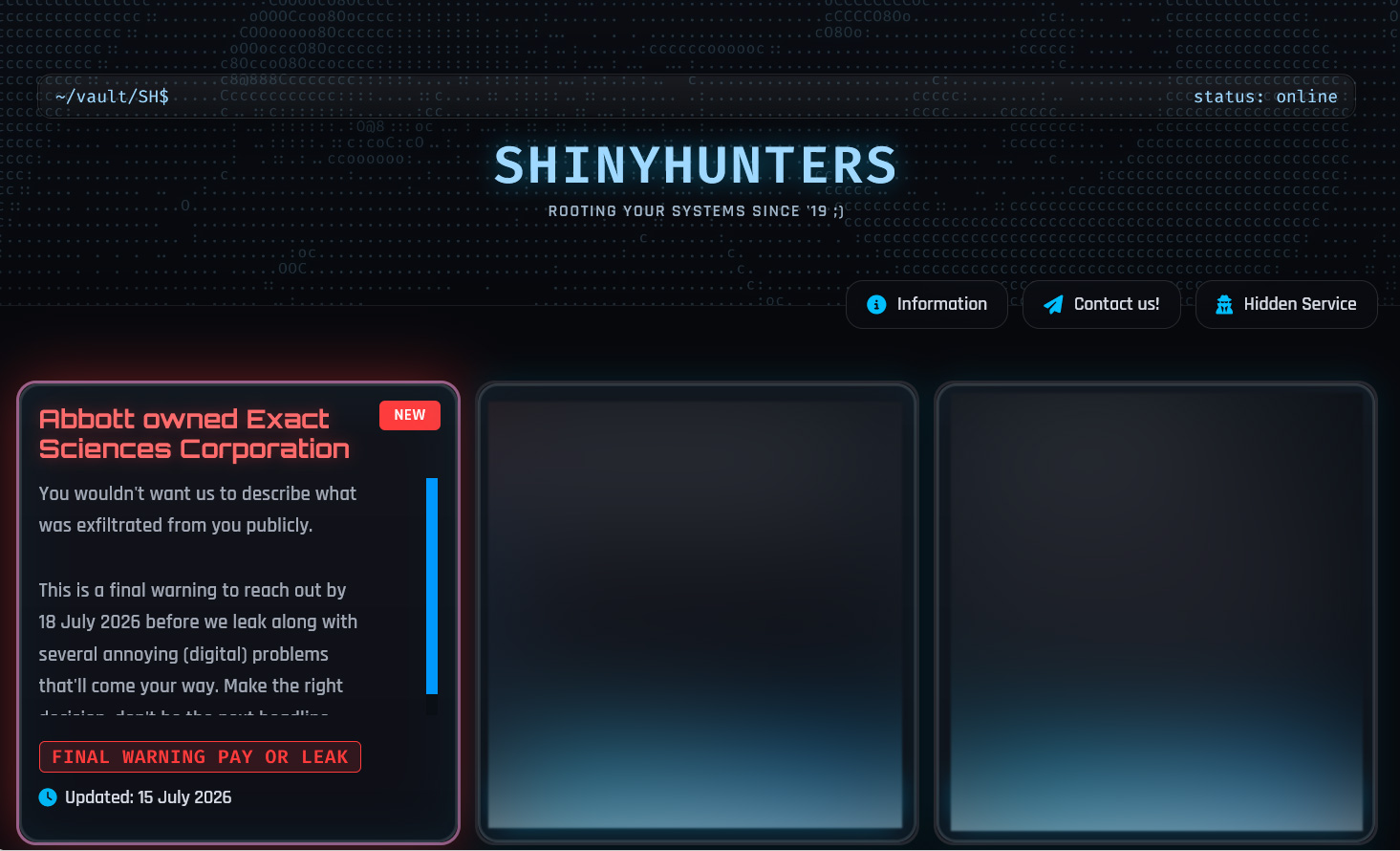
The company confirmed the Cancer Diagnostics incident after the ShinyHunters extortion gang added Abbott to its data leak site, initially threatening to publish allegedly stolen data after July 18 unless the company negotiated with the group, before later extending the deadline to July 21.
Abbott’s Exact Sciences is listed on ShinyHunters extortion site Source: BleepingComputer
When BleepingComputer asked Abbott about the alleged ShinyHunters incident, Abbott directed BleepingComputer to a statement published on its website.
“Abbott is investigating a cyber incident in which there was unauthorized access to a limited number of internal systems in our Cancer Diagnostics business only,” the company said.
“This does not impact any business operations, product or product availability, manufacturing or lab operations, or our ability to serve patients.”
Abbott added that the security incident has not impacted any other Abbott businesses or systems, and said the legacy Exact Sciences systems are separate from Abbott’s.
Advertisement
The company said it activated its incident response procedures after it learned of the incident, engaged cybersecurity experts, and notified law enforcement.
Abbott also stated that it does not expect the incident to have a material impact on its business or financial results.
ShinyHunters claimed to BleepingComputer that it gained access through a vishing attack targeting several Abbott employees in mid-June. According to the threat actor, the attack allowed it to compromise a Microsoft Entra single sign-on (SSO) account and gain access to internal systems.
Since last year, the extortion group has been conducting social engineering campaigns that target employees’ Microsoft Entra, Okta, and Google SSO accounts.
Advertisement
After gaining access to a corporate SSO account, the threat actors steal data from connected SaaS applications such as Salesforce, Microsoft 365, Google Workspace, SAP, Slack, Adobe, Atlassian, Zendesk, Dropbox, and many others.
When asked what data was allegedly stolen, ShinyHunters claimed it exfiltrated data from Microsoft Entra, ServiceNow, SharePoint, Databricks, and Coupa, including internal documents, contracts, and customer information.
The threat actor further claimed to have stolen more than 30 million rows of customer personally identifiable information (PII) from multiple datasets containing names, email addresses, phone numbers, physical addresses, dates of birth, and more than one million Social Security numbers.
Advertisement
The group also claimed to have stolen over 22 million client notes containing doctor-patient conversations, more than 20 million medical orders, and customer agreements and NDAs.
BleepingComputer has not independently verified the threat actor’s claims regarding the stolen data.
Alleged breach at LabCentral customer portal
The second incident involves a threat actor known as ShadowByt3$, who contacted BleepingComputer claiming to have breached Abbott’s Core Laboratory diagnostics business through its LabCentral customer portal.
The threat actor said it breached the unit via its LabCentral customer portal using compromised customer credentials after identifying what it described as a “weak point” in the environment.
Advertisement
According to the threat actor, they gained access on July 4, 2026, after which they slowly exfiltrated files by targeting API endpoints.
ShadowByt3$ claims the stolen data includes CE manufacturing certificates, operation manuals, technical specifications, regulatory documentation, product requirement archives, calibrator value assignments, assay files, and other product documentation related to Abbott’s laboratory diagnostic systems.
The group says no customer data was stolen, but claims it obtained sensitive business documents and intellectual property. It also provided BleepingComputer with screenshots and a file listing as purported proof of the intrusion.
Abbott confirmed to BleepingComputer that it is aware of the “potential” cyber incident but disputed the threat actor’s characterization of the data it claims to have stolen, stating that all data stored in the environment is public and not sensitive.
Advertisement
“LabCentral is an externally facing third-party hosted portal used by Abbott’s core laboratory diagnostics business,” an Abbott spokesperson told BleepingComputer.
“It houses publicly available technical product reference documents, including operating manuals, troubleshooting checklists and product specifications, and does not contain proprietary/sensitive customer or business information.”
At this time, neither ShinyHunters nor ShadowByt3$ has publicly released data they claim to have stolen from Abbott.
Security teams log 54% of successful attacks and alert on just 14%. The rest move through your environment unseen.
The Picus whitepaper shows how breach and attack simulation tests your SIEM and EDR rules so threats stop slipping by detection.
The Fold 8 Ultra could get a sharper display, a more powerful chipset, a new camera, and a larger battery. Samsung’s purported wider foldable, the Fold 8, is expected to solve the most common problem with tall-body, narrow cover screens by adopting a new aspect ratio. The Flip 8, on the other hand, could only debut with a new chip, and not a Snapdragon one.
A recent report from WinFuture claims the Flip 8’s pricing will begin at €1,299 for the 256GB model and €1,499 for the 512GB model. For those catching up, the Flip 7 launched at €1,199 for the 256GB variant and €1,319 for the 512GB variant.
In other words, Samsung might ask between €100 and €180 more for the phone in Europe. In the US, the Flip 8 (256GB) could land around $1,199, while the 512GB variant could cost $1,399. However, these are speculations at the moment, based on the ongoing memory crisis and its effects on smartphone manufacturers.
Evan Blass
Despite rumors of a price increase, Samsung might retain its free storage upgrade launch offer to boost initial purchases. The Flip 8 could break cover at the Galaxy Unpacked event on July 22, 2026, and, based on Samsung’s recent launch pattern, sales could commence around August 5, 2026.
Samsung Galaxy Z Flip 8: Rumored specs at a glance
Samsung Galaxy Z Flip 8
Inner display
6.9-inch Dynamic AMOLED 2X, 120Hz
Outer display
4.1-inch Super AMOLED
Chipset
Exynos 2600, 10-core, up to 3.8GHz
RAM
12GB LPDDR5X
Storage
256GB, 512GB
Rear cameras
50MP main (OIS) + 12MP ultrawide
Selfie camera
10MP
Battery
4,300 mAh
Wired charging
45W
Wireless charging
Supported (speed TBD)
Weight
180g
Colors
Graphite, Cream, Pink
European starting price
€1,299 (256GB), €1,499 (512GB)
US starting price
TBD (est. $1,199+)
Announcement
July 22, 2026
Expected sale date
August 5, 2026
Design
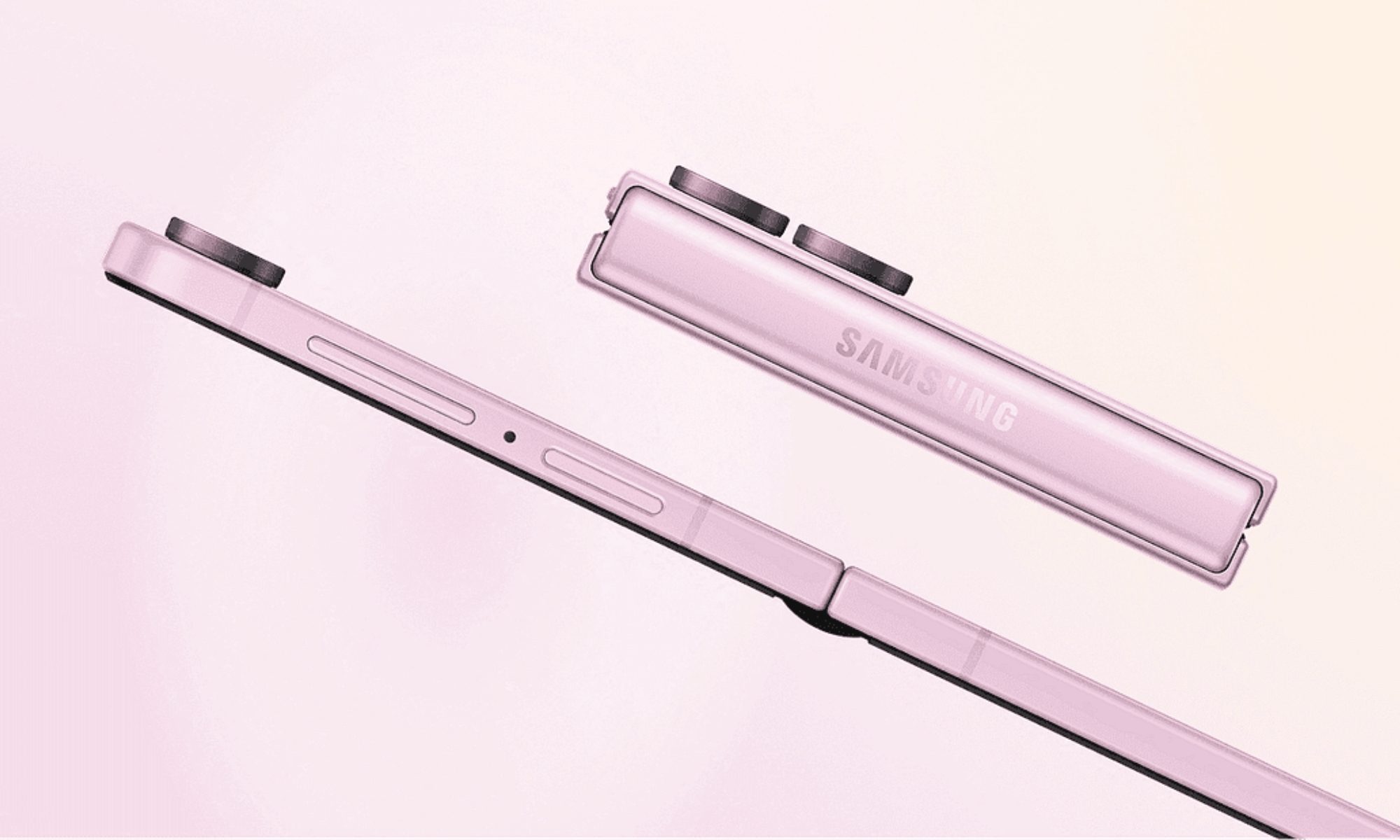
Samsung might not revamp the Flip 8’s design at all. As seen in the renders, the Flip 8 could be virtually indistinguishable from the Flip 7. According to Android Headlines, the flip phone could be available in four colors: Graphite, Cream, Pink, and Mint (Samsung exclusive shade).
Advertisement
Evan Blass
A leak from Ice Universe puts the Flip 8’s total thickness at 6.6 mm, which is 0.3 mm less than the Flip 7’s 6.9 mm. However, a new WinFuture report refutes those claims, mentioning that the Flip 8 could be 0.2 mm thicker than the Flip 7. When it comes to weight, however, the upcoming Flip could be about eight grams lighter.
All the other things, such as the placement of the rear cameras, the cover display that runs around those cameras, a punch-hole screen on the inside with relatively thicker bezels, and the positioning of the buttons and USB-C port, could largely remain the same.
Android Headlines
Display
Per the current consensus on leaks and the absence of any claims of upgrades, the displays on the Galaxy Z Flip 8 may be unchanged from those on the Flip 7. The Inner panel could retain the 6.9-inch Dynamic AMOLED 2X at 120Hz, while the cover screen could feature the familiar 4.1-inch Super AMOLED.
Even though both the panels hold up their ground, buyers paying more than last year would naturally expect upgrades across the board.
Android Headlines
According to a new report from NewsPim (via SammyFans), the Flip 8 won’t get Samsung’s Flex Titanium display. In other words, it might not get the new hinge design that could enable a more durable, less-visible crease on the Fold 8 and Fold 8 Ultra, despite early rumors.
I’ve used the chip on the baseline Galaxy S26 earlier this year (on the Indian version), and it did well, especially in terms of peak performance. What I didn’t like about it is the thermal management: the S26 got warm rather quickly under heavy workloads. In retrospect, the chipset can handle everything you’d possibly do on a clamshell foldable.
The Galaxy Z Flip 8 will most definitely ship with One UI 9 on Android 17, and there are two things to discuss here. First, the updates that might roll out to Samsung’s foldables due to Google’s Android 17, which may or may not include the new features Google talked about at The Android Show and Google I/O 2026.
Second, the specific additions Samsung launches as part of One UI 9, including those rumored for the Samsung Internet Browser, multi-window browsing, new Galaxy AI features, and other visual enhancements across the user interface. Like the company’s previous flagships, this one could also come with seven years of major operating system and security updates.
Evan Blass
Cameras
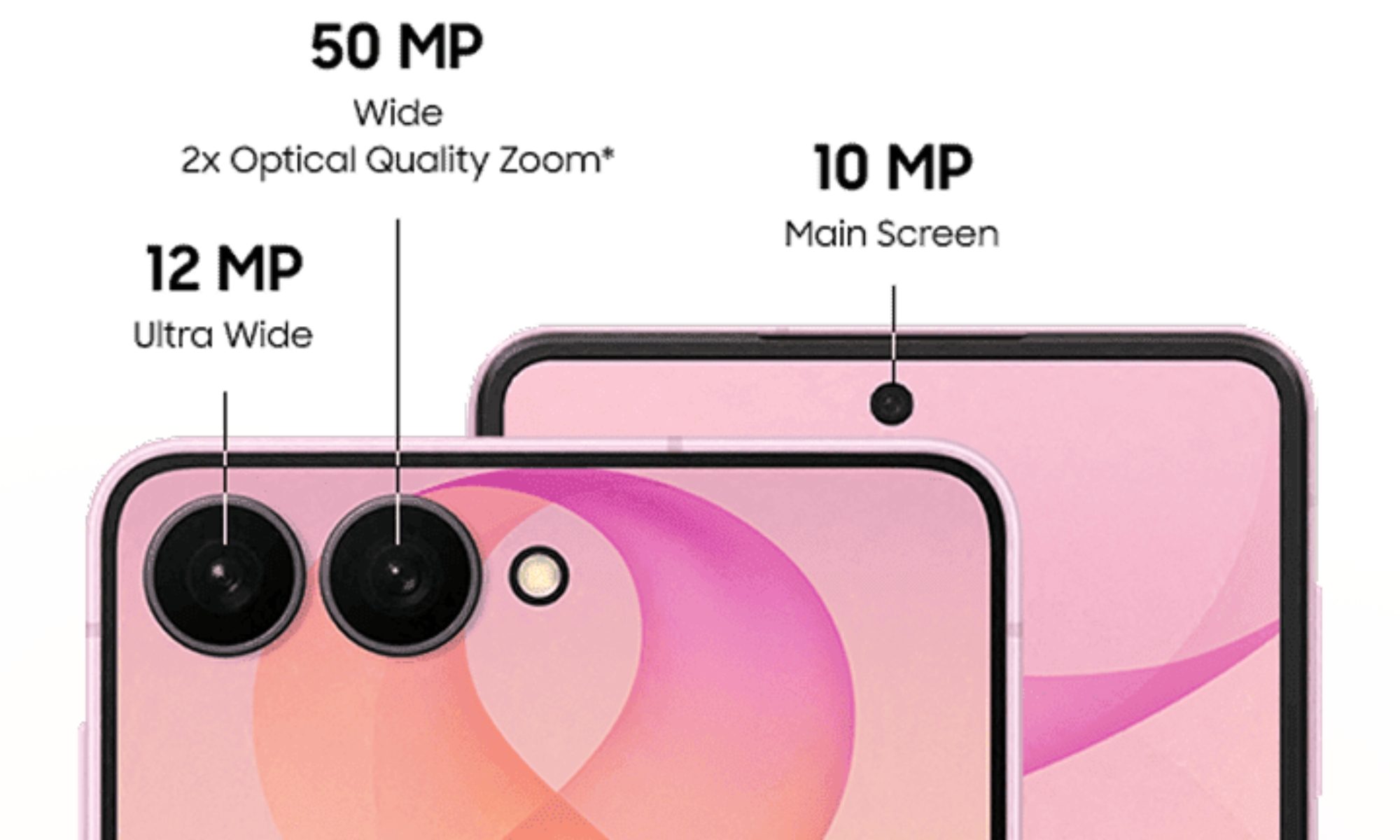
Camera hardware on the Galaxy Z Flip 8 might be unchanged from the Flip 7 across the board. The clamshell could sport a 50MP primary sensor, a 12MP ultrawide sensor, and a 10MP selfie shooter on the front. No source has reported any sensor-level improvement, new apertures, or new processing modes specific to the Flip 8.
The one genuine upgrade is wired charging, which jumps from 25W on the Flip 7 to 45W on the Flip 8. At 45W, a 4,300 mAh battery might reach full charge in roughly an hour. The phone could also support wireless charging, but whether it will come with magnetic wireless charging remains to be seen.
Galaxy Z Flip 7
Galaxy Z Flip 8 (expected)
Battery
4,300 mAh
4,300 mAh
Wired charging
25W
45W
Wireless charging
Supported
Likely supported
Nadeem Sarwar / Digital Trends
Should you wait for the Flip 8, or buy something now?
If you’re upgrading from an old clamshell foldable, perhaps the Flip 4 or the Flip 5, and you’re certain that you want a Samsung, and you’ve used a regular smartphone but have always been drawn to a flip phone’s form factor, waiting for the Flip 8 makes sense.
However, if the Flip 8’s cameras or battery don’t look impressive enough, and you’re open to other brands, the Motorola Razr Ultra is available now with a larger 5,000 mAh battery, Snapdragon 8 Elite Gen 5, and a competitive camera setup. Its price, $1,499, could make you think twice about your decision.
Anand Subbaraman is departing as CEO of Icertis, the Bellevue, Wash.-based contract management software company said Friday. Chief Financial Officer Rajat Bahri and longtime executive and Icertis board member Jim Moffatt will serve as interim co-CEOs as Icertis searches for its next CEO.
Subbaraman took the helm in August 2025 when Icertis co-founder Samir Bodas stepped down. Bodas had been the company’s only CEO since launching the business in 2009. Bodas shared at the time that he was resigning due to a health concern, and passed away in January after a battle with cancer.
Subbaraman, who joined Icertis in 2024 as chief operating officer, will serve as an advisor during the leadership transition. No reason was provided for his exit. We’ve asked the company for further details.
“We are grateful for Anand’s service and his work to expand the company’s AI capabilities and scale operations,” Moffatt said in a statement. “As our Board conducts its search for the next CEO, Rajat and I will ensure we do not miss a beat during this important time for our company.”
Icertis Chief Financial Officer Rajat Bahri, left, and board member Jim Moffatt will serve as interim co-CEOs as the company searches for a new chief executive. (Icertis Photos)
Founded in 2009, Icertis has raised more than $500 million and was valued at $5 billion four years ago. Its investors include SoftBank’s Vision Fund, SAP and PSP Partners, the firm chaired by lead independent director Penny Pritzker.
Bloomberg reported in February that Icertis was working with Goldman Sachs to explore a potential sale that could value the company at as much as $5 billion, citing people familiar with the matter. Buyout firms had shown preliminary interest, and no final decision had been reached, according to the report.
Advertisement
The company said Friday that Bahri will hold dual roles as interim co-CEO and CFO. He joined Icertis in 2022 and previously served as CFO at several companies, including ID.me; Wish, where he helped lead the company’s IPO; and Jasper Technologies.
Moffatt has served on the Icertis board since 2022, after previously serving on its advisory board, and is a member of the board’s audit and compensation committees. He has also been appointed chair of the board, in addition to his interim leadership role. Moffatt spent more than 35 years at Deloitte, leaving the company as vice chairman and global CEO of Deloitte Consulting. He is now president of JSM Advisors.
AI deepfakes have become a headache for creators, and TikTok is finally stepping up to fight back. Social media consultant Matt Navarra spotted the platform quietly testing a new opt-in tool that hunts down AI-generated content mimicking a creator’s face, giving them the power to flag it directly.
TikTok is testing AI likeness detection for creators@tiktok_us is testing an opt-in Likeness Detection tool with some US creators.
It surfaces AI-generated content that may use a creator’s face without consent. pic.twitter.com/XxTF4nUETz
To fight deepfakes, TikTok wants a scan of your real face
TikTok’s AI likeness detection tool is optional, but creators who want to use it must first verify their identity through Jumio. That includes a real-time selfie and an ID check. According to Kizer, TikTok does not keep ID documents, while facial data is used only to match a creator’s likeness and identify possible unauthorized AI-generated content.
Once verification is complete, TikTok starts scanning AI-generated content that may feature the creator’s face or likeness. If it finds potential matches, the creator can review them and report any posts or accounts they believe are impersonating them.
TikTok
TikTok flips that script: verification comes first, participation is opt-in, and creators stay in control. With YouTube and TikTok now leading the way on this kind of protection, AI likeness detection is quickly becoming a tool creators expect from every major video platform.
As an all-in-one instant camera/printer, the Fujifilm Instax Mini Evo Cinema does so much right, and the ability to jump between different decades to change the look of your photos never gets old. It’s just a shame that the camera doesn’t reach its potential on video, and at full price it’ll be far too expensive for a lot of people.
Retro-inspired design is a lot of fun
Eras concept is well realised
Fast printing
Time restrictions on video feel absurd
App set-up is far too convoluted
Glitches and bugs everywhere
Quite a hefty price tag
Key Features
Advertisement
Review Price:
£329.99
Hybrid camera system
Advertisement
Print out photos from the camera and your phone
Eras Dial
Advertisement
Jump between decade-inspired filters
Record video footage
Advertisement
Capture clips up to 15-seconds in length
Introduction
If you’re someone who misses the days of Polaroids, camcorders and Super 8 film cameras, the Fujifilm Instax Mini Evo Cinema carries a shot of pure nostalgia that’s hard to beat.
As much as I love the fact that you can now capture great-looking footage on most smartphones, including more cost-effective ones like the iPhone 17e, and you can now have proper professional-grade cameras in a compact form factor like the DJI Osmo Pocket 4, there is something about the clunkier camcorders of old that I miss.
Advertisement
It’s a hard thing to explain, but there’s something about the tactile feeling of holding a fairly hefty recording device in your hand that makes you feel more connected to what you’re capturing in the moment. I’m able to reclaim some of that when I bring the ShiftCam ProGrip with me on a day out, but the Fujifilm Instax Mini Evo Cinema, with its retro-inspired design, speaks to kids (now adults) of the 80s and 90s in a way that few other devices can in 2026, and that’s exactly why I jumped at the chance to try it out.
Advertisement
I wasn’t quite sure what to expect from a device that so clearly looks like it’s been taken out of a time machine, but in spite of its many faults, I really did enjoy my time with this camera.
Design and handling
Super 8 inspired design
Takes some getting used to but it’s fun when it clicks
Grip and viewfinder accessories included
Depending on your age, you may recognise the Instax Mini Evo Cinema as having taken more than a few design cues from Fujifilm’s classic Fujica cameras, but what that means from a more contemporary perspective is that the device is built in a way that can feel completely foreign and unlike anything else that you can buy right now, which can take some getting used to.
Image Credit (Trusted Reviews)
Instead of the wider build that you typically see with most instant cameras, the Instax Mini Evo Cinema is constructed vertically, with the expectation that you use one hand to grip the base of the device and to access the trigger at the front, while the other can be used to operate the various sliders and dials on the left-hand side.
Advertisement
Advertisement
As much as I like the look of the Instax Mini Evo Cinema, it did take me a bit of time to wrap my head around how to hold it comfortably. I recommend using the little grip extension which can be added to the bottom and gives your hand the space it needs to help keep the device steady as you move.
When it comes to lining up your shot, there’s a 1.54-inch square display on the back of the Instax Mini Evo Cinema which is fine for scrolling through menus, but there’s a viewfinder accessory bundled in that I also recommend bringing into the mix. As someone who reviews a lot of the best smartwatches for a living, I don’t usually have issues with smaller screens but the viewfinder just helps you to get more creative with your framing.
Image Credit (Trusted Reviews)
If you want to take a quick selfie then you’ll be glad to know that there’s a small mirror on the front of the camera where you can line yourself up for the shot. I will admit that the framing can be a tad tricky as my positioning wasn’t quite where I thought it was initially, but after a few tries, it finally clicked.
As a final note on the design, I absolutely love the capture trigger on this thing. Instead of having a shutter button on top as you would with a typical camera, the Instax Mini Evo Cinema uses a trigger button where your index finger naturally rests. It’s just an immensely satisfying way of taking pictures and capturing video, and it taps into that aspect of photography that smartphones, no matter how great they are, can never really capture on a touchscreen.
Features
Eras Dial adds unique, time period-inspired filters
Built-in printer for photos taken on-device, and on your phone
Glitches aren’t uncommon
Advertisement
Because it can take pictures, record video and even print photos, the Instax Mini Evo Cinema is an all-in-one device that stands above typical instant cameras that usually stick to photography.
Advertisement
The problem is that for the convenience of having access to those features, the cost comes at a premium, with the Instax Mini Evo Cinema tagged at £329.99/$409.95, which is just far too expensive. For that money and if you shop around, you could buy the Insta360 Go 3S vlogging camera and the Instax Square Link photo printer for around the same price. As much as I’ve enjoyed my time with the Evo Cinema, I don’t think it’s worth the full whack and you’re better off waiting for a discount.
If you do decide to push ahead however, there’s a lot to enjoy when you get this camera in your hands, and it starts with the rather ingenious Eras Dial. Part Instagram filter, part Taylor Swift-like trip down memory lane, the Eras Dial lets you jump between the decades to create a visual overlay that’s closely associated with the period in question, going all the way back to the 1930s.
Image Credit (Trusted Reviews)
What this translates to, for example, is a black-and-white TV-looking filter (complete with horizontal lines) for the 50s, as well as a slightly fuzzy but full of colour aesthetic when diving into the 80s.
Then there’s my personal favourite, the 90s, which took me right back with an overlay that looked like it came straight off a VHS player. It’s exactly how I remember our old family movies from the same era and I loved getting to play around with it. Taking pictures of modern-day items and places with this filter on was simply a blast, and I’m sure that everyone who uses the Instax Mini Evo Cinema is going enjoy toying with the decade that means the most to them.
Advertisement
Advertisement
You can tweak the overall look of each era by rotating the lens but I always found the default setting to be the most visually appealing. What I did enjoy toggling is the Frame Switch, a slider button on the side which, when activated, overlays some form of frame that’s exclusive to each era.
For instance, when the dial is set to the 90s, you’ll see information around the screen such as the date and a play button, much like how you would with video tapes back in the day. The 2010s frame is a nod to YouTube videos with a progress bar at the bottom and a livestreaming tag in the top-left corner which made me chuckle.
As mentioned before, the Mini Evo Cinema has a built-in printer that uses Fujifilm Instax Mini prints, and you can even use it to print off pictures that you’ve taken with your phone, something that I’ve greatly appreciated as I’ve been slowly maxing out my cloud storage with pictures of our newborn daughter. There’s a great bit of physicality to printing shots that you’ve taken on the device as there’s a lever you have to twist as a final bit of confirmation. I do wish however that the app situation was a bit more streamlined.
Instead of having just one app that works with all aspects of the Mini Evo Cinema, interactions are spread across two. At the centre of it all you have the Instax Mini Evo app which is designed for sending your photos to the Evo to print, as well as tapping into any video recordings you’ve taken on the device. If you want to extract pictures from the Evo then you’ll have to download the Instax Up! app, which just feels far too convoluted.
Advertisement
Image Credit (Trusted Reviews)
It also doesn’t help that during my time with the Instax Mini Evo Cinema, I encountered quite a few glitches. Being more specific, the camera crashed on me twice, requiring a reset in order to get things up and running again. Thankfully, these instances didn’t take too long to fix but it’s hardly ideal when you’re trying to capture shots in the moment, and for a device as costly as this one.
Advertisement
Image and video quality
Photos have a great retro look to them
The printing process is fast
Videos are lacklustre at best
The quality you get from the Fujifilm Instax Mini Evo Cinema depends on a number of factors. With regards to pictures and footage captured on the camera itself, the era that you’ve picked can have a big impact – the 1930s mode, for example, because it’s supposed to have a dated look to match the time period, it can look a bit grainy at times. The 2020s mode, which effectively removes all filters, certainly looks a bit clearer, but the 1/5-inch CMOS 5MP sensor still has its limits.
Because instant cameras aren’t exactly known for putting out the type of high-quality pictures that the best camera phones can achieve, I’m willing to give the Mini Evo Cinema a pass, especially as I do quite like the retro look that the prints come out with. They have an almost ethereal aesthetic as if you’re trying to recall a distant memory, but I think that’s part of the fun.
Image Credit (Trusted Reviews)
The camera’s printing ability is impressive as there’s a good degree of colour reproduction here, but you can really put it to the test by printing out shots from your phone.
There is a slight bit of resolution lost in the process, so pictures won’t be as sharp as they are on your phone, but again, the colour reproduction from the original shot is solid. Plus, now I have a wonderful collection of physical pictures that I wouldn’t have had without the Mini Evo Cinema in tow. That’s precisely why it’s worth having a device like this to hand.
Advertisement
Advertisement
Image Credit (Trusted Reviews)
What I take more of an issue with is the video capture side of things. There was room here for the Fujifilm Instax Mini Evo Cinema to be a great little filmmaking tool, one that could inspire creativity like those classic Super 8 cameras could, but instead it’s something of a halfway house that doesn’t really serve anyone.
For starters, you can’t record anything longer than 15 seconds which is completely absurd. Why such a cap is placed on the user I’ll never know, but if the intention was to make the Instax Mini Evo Cinema a device meant for social media clips then I wouldn’t recommend it here either. The video quality is low-grade in a way that might be fun for transitions between better-looking footage, but you wouldn’t want to film long-form content on this (not in the least because the onboard mic doesn’t hold up well against surrounding noise).
To be more concise, this is a great camera for stills and prints, but less so for video.
Should you buy it?
You want a quirky, all-in-one instant camera
Advertisement
From the Super 8-inspired look of the thing to the ingenious Eras Dial, the Fujifilm Instax Mini Evo Cinema is a lot of fun to use for stills.
Advertisement
You need a competent video camera for filming
If you’re looking for a great entry-level recording camera then you’re better off looking at devices from Insta360 and DJI.
Advertisement
Advertisement
Final Thoughts
The best praise that I can give the Fujifilm Instax Mini Evo Cinema is that I had a lot of fun with putting it to the test – if the price wasn’t so high and the video capabilities were better thought out, I’d be scoring it higher.
From a photography perspective, I can’t really fault the Mini Evo Cinema. Playing around with the Eras Dial is a blast, and the physicality of turning the print lever to see my photos come to life is something that never got old. Being able to print photos from my phone is the icing on the cake, especially as I’m guilty of having too many memories locked away on digital devices.
Unfortunately, the 15-second video cap and the lacklustre quality that goes with it mean that the Fujifilm Instax Mini Evo Cinema is something I can hardly recommend over the likes of the DJI Osmo Pocket 4 or the Insta360 Go Ultra to budding filmmakers.
Advertisement
To see what the Instax Mini Evo Cinema is up against, check out our round-up of the best instant cameras you can buy.
How We Test
We test every camera we review thoroughly. We use set tests to compare features properly and we use it as our main device over the review period. We’ll always tell you what we find and we never, ever, accept money to review a product.
Tested over two weeks
Used in various conditions
Printed off 20 pictures for quality comparison
FAQs
What type of prints does the Fujifilm Instax Mini Evo Cinema use?
The Instax Mini Evo Cinema uses Fujifilm Instax Mini prints.
Advertisement
Does the Fujifilm Instax Mini Evo Cinema have expandable memory?
Yes, there is a Micro SD card slot on the Fujifilm Instax Mini Evo Cinema.
Two weeks before this year’s primary elections, Texas Attorney General Ken Paxton announced the creation of a tip line for the public to report people or groups suspected of voter fraud.
“Free and fair elections are a cornerstone of a thriving republic, and with the authority granted to my office by the Legislature, we will stop at nothing to uncover and stop any illegal voting activity,” Paxton said in a February news release announcing the tip line.
The announcement linked to guidance from his office about election laws in Texas, which included a requirement to be a U.S. citizen, a prohibition on collecting mail ballots on behalf of others and a warning that “it is illegal to misrepresent your residence on election records or to establish a residence for the purpose of influencing the outcome of an election.”
“You must register to vote using the address where you reside,” the attorney general’s guidance stated.
Advertisement
Despite his own warnings, Paxton appears to have used an address where he did not live while voting in six elections in the past two years, including in May’s runoff that made him the Republican nominee for U.S. senator, according to records obtained by ProPublica and The Texas Tribune.
State Sen. Angela Paxton said in a 2025 divorce filing that Paxton, whom she accused of adultery, moved out of their Collin County home a year earlier. But Paxton continues to list the home’s address in the northern Dallas suburb on his voter registration. Angela Paxton declined to be interviewed. A source close to the Paxtons said the attorney general has not moved back into the home since leaving.
It is unclear where Paxton has lived for the past two years, but reporting by ProPublica and the Tribune has linked him to a home in neighboring Denton County since February.
Three election lawyers told the news organizations that Paxton may have violated the same Texas laws his office cautioned about in its news release.
Advertisement
ProPublica and the Tribune reached out to Paxton’s campaign on June 3, 15 and 25, asking why he remained registered to vote in Collin County when he appeared to no longer live there and about his connection to the Denton County property. A reporter also left a voicemail on his personal cellphone on June 25. The news organizations sent his government office and campaign staff an email on Monday with a detailed list of questions, including a request for Paxton’s response to election lawyers’ belief that he may be violating the law.
Paxton and his office did not reply until Monday’s email. Campaign spokesperson Madison Cercy did not answer the questions from the news organizations. Instead, she issued a statement saying that the attorney general has been “a national leader on election integrity, with a long record of defending Texas elections.” Cercy said that “attempting to insinuate otherwise and tear him down with a baseless, lie-filled tabloid story is not real reporting.”
Asked twice to provide specifics about what they believed was inaccurate, the campaign did not respond.
Voting in an election when the voter is ineligible is a second-degree felony under Texas law and is punishable by up to 20 years in prison and a fine of up to $10,000. But prosecutors rarely bring cases challenging individual voters’ residency claims because they are hard to prove, the election lawyers said.
Advertisement
State courts have repeatedly ruled that there is no single way to determine where someone lives, and judges must consider multiple factors, such as where a voter sleeps or stores personal belongings. Prosecuting such cases also requires proof that a voter “knowingly” or “intentionally” broke the law.
Even if it’s clear that someone doesn’t live at the address where they are registered to vote, state law allows them to remain registered if their absence is temporary and they intend to return. The provision is commonly used by college students and military service members.
“So long as you truly intend to return, I think you’re fine,” said Beth Stevens, an election lawyer who worked for the Harris County clerk and the Texas Civil Rights Project. “When you start doing things that suggest, ‘Oh, I’ve fully moved. I’m just wink-wink saying I intend to return,’ that’s when you get into questionable territory.”
Paxton’s public and contentious split from his wife could make it difficult to argue that he intended to return to the home they own and where she continues to reside, said David Becker, a former voting rights lawyer for the Justice Department.
Advertisement
“I think there would be questions raised about a residence where someone does not live, does not spend the night and can in no way have the intent to continue to reside. Those would probably raise red flags in any state,” Becker said.
Becker, who is now the director of the Center for Election Innovation and Research, a Washington, D.C.-based nonprofit that works to build public trust in elections, added that the situation is particularly problematic because Paxton’s job is to enforce election laws.
“Certainly, the chief law enforcement officer of the state of Texas, someone who has made claims about election integrity and made it a priority of his office, should be charged with knowing the laws of residencies of the state of Texas with regard to voting,” Becker said.
Paxton has advocated for strict enforcement of the state’s election fraud law, including in cases against voters his office alleged had falsified records about where they lived. In 2018, the attorney general’s voter fraud unit arrested nine people on suspicion of using residential addresses where they did not live to vote in a municipal election in Edinburg, in the state’s Rio Grande Valley. County prosecutors, acting on behalf of Paxton, later dismissed the charges after failing to secure a conviction against the mayoral candidate they alleged had encouraged those voters to register at false addresses. The candidate, Richard Molina, said he was innocent and said the prosecution was politically motivated.
Advertisement
Clark Birdsall was not the attorney on those cases but defended another resident whom Paxton prosecuted for illegal voting. Birdsall was stunned that the attorney general appears to have voted under an address where he does not live.
He called it “especially egregious that someone such as Ken Paxton appears he’s not conforming to the law.”
State privacy laws allow some politicians and law enforcement officials to shield their voter registration information from public view. Paxton does not do so. His opponent in the Senate race, Democratic State Rep. James Talarico, does. Talarico’s campaign said he lives and is registered at the north Austin home he purchased in 2022. ProPublica and the Tribune were not able to independently confirm this.
Paxton’s campaign did not raise any issues with Talarico’s voter registration. In her statement to ProPublica and the Tribune, however, Cercy said, “Talarico has actively campaigned against voter security measures” and has said he opposes voter identification requirements. She pointed to a 2021 Fox News interview in which the state representative said he opposed voter identification rules that would require Texans to provide their driver’s license number or partial Social Security number for mail ballots. Talarico said hundreds of thousands of Texans, who don’t drive, lack a driver’s license. He did not directly answer a question about Social Security numbers during the interview.
Advertisement
The Talarico campaign did not respond to a request for comment.
Paxton’s living arrangements since he separated from his wife are not public, but information obtained by ProPublica and the Tribune offers some indication of where he may have been residing since February.
In mid-February, a trust bought a 5,000-square-foot home listed for $2.4 million in a gated community in Denton County, according to the appraisal district and the seller’s real estate agent. The trust did not disclose its ownership to Denton County officials. Trusts are not required to by law, a spokesperson for Travis County’s appraisal district said.
Paxton shares a separate blind trust with his wife, Angela, that they have used to purchase property and other assets. For years, the address listed for that blind trust had been an office building in Collin County. But that address was changed to the Denton County home a week after the property was purchased.
Advertisement
Angela Paxton said through a spokesperson that she has no connection to the Denton County home or the trust that purchased it. The trustee of the Paxtons’ trust, family friend Chip Loper, did not respond to questions about the address change.
In June, a reporter knocked on the door of the Denton County home. No one answered. When the reporter placed a letter for Paxton in the mailbox, an envelope addressed to Warren Paxton, the attorney general’s given name, was visible.
Later that week, Paxton appeared on a podcast with Texas Lt. Gov. Dan Patrick. Video from the podcast showed Paxton seated in front of a fireplace and mantle that were nearly identical to those depicted in the home’s online real estate listing. One resident also told the newsrooms that they spotted Paxton in the gated community.
In a podcast appearance in June, Texas Attorney General Ken Paxton was seated in front of a gray fireplace that appeared to match real estate listings for a Denton County home. 📸 Obtained and edited for privacy by The Texas Tribune and ProPublica
Separately, the Daily Mail reported in May that Paxton had moved into the Denton County home with Tracy Duhon, whose extramarital affair with Paxton, the news outlet said, prompted his wife’s divorce filing. The Daily Mail also published a video of Paxton and Duhon that it reported was taken at an airport in Iceland in late June. The video was quickly seized upon by Talarico, who depicted Paxton as out of touch with Texans. Duhon did not respond to questions about her connection to the Denton County property or about the Daily Mail reporting.
Paxton is not registered to vote in Denton County, voter rolls show. Instead, since February, he has voted in Collin County twice: once in the March Republican primary and once in the May runoff. Each Texas county elects its own slate of local officials, which is why state law requires voters to register where they live.
Advertisement
Ekow Yankah, a law professor at the University of Michigan whose expertise includes election law, said Paxton’s voter registration situation should remind the attorney general of what studies have consistently shown: that intentional illegal voting is rare.
“You would think that somebody who’s going through this would learn a little bit of humility that lots of things which look on their face, like technical violations of the law, are usually explained by totally ordinary things,” Yankah said. “It’s only if you’re utterly cynical and ignore all the evidence that you make a claim that, in fact, these cases are attributable to nefarious criminal intent.”
Paxton cannot claim ignorance of the law because he enforces it, said Joshua Blank, research director of the Texas Politics Project at the University of Texas at Austin. In fact, as attorney general, Paxton should avoid even the appearance that he is not following the law, Blank said.
“We expect these laws to be understandable by ordinary citizens,” Blank said. “When our elected officials who are tasked with passing and enforcing these laws exhibit troubles in engaging with the voting process themselves, that raises serious questions.”
Credits: Eric “ConcernedApe” Barone and Sylvain Sarrailh for Wizards of the Coast.
One of the biggest hits ever produced by Seattle’s independent video game scene is joining the Magic: The Gathering multiverse later this month. Sort of.
Magic, the long-running collectible card game published and developed by Renton, Wash.-based Wizards of the Coast, frequently puts out special crossover editions via its Secret Lair imprint.
The Secret Lair “drops” are limited-run collectibles that typically reimagine older Magic cards with new designs and art, which replaces Magic‘s usual cast of wizards and monsters with, for example, Dwarf Fortress, Garfield, or various Marvel superheroes. A caveat: Secret Lairs are priced to appeal to die-hard collectors, rather than casual players.
On Friday, during the first day of MagicCon Amsterdam, Wizards announced several upcoming “drops” for Secret Lair, three of which are based on the popular indie video game Stardew Valley.
Stardew, made by solo developer Eric “ConcernedApe” Barone, is arguably the single biggest success story to come out of Seattle’s independent game development scene. It’s an open-ended video game about a young person who moves back to their grandfather’s abandoned farm, to raise crops, breed livestock, make friends, fish, adventure through the nearby abandoned mines, and/or romance neighbors. This can all be taken at the player’s own pace, with no particular time limits or directions.
Advertisement
Stardew’s success helped to popularize what’s come to be known as the “cozy” genre of chill-out, low-stress video games, alongside other hits like Nintendo’s Animal Crossing. Stardew celebrated its 10th anniversary earlier this year, has sold nearly 50 million copies across multiple platforms, and has spun out into a successful concert tour, a cookbook, and as of earlier this month, a crochet book.
Now Stardew is coming to Magic via Secret Lair, in a package that Wizards is calling the “Superdrop of the Moonlight Jellies,” named after a jellyfish-themed town festival in Stardew Valley.
Coming on July 27, the drop is split into three specific sets of cards: Welcome to Stardew Valley, Life in Pelican Town, and A Flicker in the Deep. The first set, Welcome, features unique pixel art made by ConcernedApe on each card.
Most of the cards in the Stardew Valley Secret Lair are reprints of existing Magic cards, though some have been renamed in keeping with the theme. For example, Swords to Plowshares is one of the oldest cards in Magic, but it’s getting a new Stardew-themed edition in this Secret Lair.
Advertisement
The lone exception is the actual Stardew Valley card (above), which is a special land that’s designed to be compatible with most styles of competitive Magic play.
Other upcoming Secret Lairs announced at MagicCon Amsterdam include:
a full playable deck that’s based on the virtual Japanese singer Hatsune Miku;
a food-themed take on J.R.R. Tolkien’s The Hobbit;
four separate Marvel Comics drops, including one that will feature the universe’s various super-pets;
three drops built around specific artists, including American cartoonist Gene Luen Yang (American Born Chinese);
and most oddly, a drop with a theme based upon the French record label Lofi Girl, best known for its 24-7 chillhop YouTube “radio station” featuring its namesake and mascot.
In a nutshell: Following months of rumors and speculation about the future of the OnePlus brand, the company has officially confirmed that it is exiting all North American and European markets effective immediately. OnePlus will no longer launch new devices in these regions but will continue providing software updates and after-sales support to existing customers.
OnePlus also assured existing users that it will honor all warranty coverage and that eligible devices will be repaired through its authorized service centers in accordance with its standard warranty and support obligations. Eligible OnePlus devices will also continue receiving Android updates and security patches under the company’s existing software support commitments.
Additionally, OnePlus announced that it will replace OxygenOS with the latest version of ColorOS, the Android skin used by its parent company, Oppo. However, the company will give users the option to decline the update and continue using OxygenOS instead. Users will also be able to roll back to OxygenOS if they accidentally update to ColorOS.
Advertisement
As part of its exit strategy, OnePlus will shut down its online community forums in North America and Europe on August 16. In an official announcement, the company said existing forum posts would no longer be accessible after the shutdown and urged users to manually save copies of their posts, comments, photos, guides, and other contributions before that date.
OnePlus’ announcement comes just days after reports began circulating that the long-rumored shutdown could happen as early as this week. Speculation about the company’s future has been ongoing for several months, with multiple tipsters and media reports claiming that OnePlus planned to close its operations in the US, UK, and EU.
OnePlus previously issued denials that failed to convince many observers, with India CEO Robin Liu stating that the company’s local operations would continue as usual. However, he resigned just weeks later, raising further questions about the statement. The company has since confirmed that it will remain operational in India and China and has launched multiple devices in both markets over the past few months.
A glitch with Amazon Web Services’ billing operation led some customers to believe they owed the world’s fifth most valuable company billions of dollars. Oops!
Bill Radjewski, who runs CollegeFootballData.com, was one of the affected customers. This morning, he woke up to a jarring email alert from AWS: He had racked up more than $1.5 billion in usage fees, and his August 1 bill was on track to be upwards of $3 billion.
“I’ve had this account for 6+ years and in that time my monthly spend has never exceeded $0.02,” Radjewski tells WIRED. He shared screenshots of his three most recent monthly AWS invoices. They each came out to $0.01.
Based on replies to the AWS Support account on X, Radjewski is not alone. Others have received similarly shocking quotes: $22 billion; $75 billion; $110 billion. “Blud why did you hit me with a cost of 5 million USD what did I even do,” one user wrote. “Please explain man my heart will explode.”
Advertisement
When reached for comment, Amazon spokesperson Aisha Johnson referred WIRED to the AWS Service Health Dashboard. While it’s not clear exactly how many customers have been affected, the dashboard characterized the issue as “global.”
The dashboard also said that the billing console “began displaying incorrect estimated billing data” on Thursday, July 16 at 10:38 PM ET.
The company began investigating the issue about six hours later, per the dashboard, and concluded that the “root cause” of the error was “an issue with unit pricing within the estimated billing computation subsystem.” It did not specify what the issue was.
In subsequent updates, AWS said that it’s “rolling back a recent change to the billing computation subsystem,” and said it was attempting to revert to its “last known good estimated bill computation.” It also said it had “paused estimated billing computations.”
Advertisement
The issue should be resolved by this weekend, and “there are no customer actions required at this time,” the company wrote.
Ultimately, some customers have decided to post through it.
One Reddit user posted a screenshot of their current “Cost and usage overview” to the AWS subreddit, which showed that they had incurred $7.1 trillion in service fees since July 1—more than twice Amazon’s market cap.






































































You must be logged in to post a comment Login