The Detroit Apple Developer Academy’s fifth year is underway, with the next generation of iPhone developers joining a program whose expense and success have been questioned.
The only developer academy of its kind in North America, the developer academy is a collaboration between Apple, Michigan State University, and the Gilbert Family Foundation. It offers a range of free programs, including the option for a full nine-month learning experience.
The Detroit academy is just one of 19 around the world. All of them help students learn how to design and create their apps, with an eye on turning them into full-fledged businesses.
In a newsroom post announcing the fifth commencement, Apple notes that more than 70% of the people who start the free academy go on to complete the program.
Advertisement
A history of (some) success
Apple talks a big game, but the results speak for themselves. Saamer Mansoor was part of the academy’s original cohort as the world continued to get to grips with the COVID pandemic. After he and his teammates realized they all knew someone with hearing difficulties, they set about creating BeAware Deaf Assistant.
Using Apple’s Neural Engine to handle real-time transcription and translation, the app became a hit. It’s now been translated into 25 spoken languages and is used by institutions including the George Washington University.
Mansoor wasn’t a one-off, either. Courey Jiminez is a 2026 academy graduate and Swift Student Challenge winner who credits the academy with teaching her the skills she needed.
“I had never heard of challenge-based learning prior to coming here. It taught me to dig deeper into the research and to be OK with pivoting if my idea shifts along the way,” the Detroit native noted.
Advertisement
Now, Jiminez is in project management, supporting coders and designers while managing the overall vision of the app being worked on.
If you’re keen to learn more and perhaps get involved with an Apple Developer Academy near you, Apple’s dedicated website is a good place to start.
Question marks
However, its academies aren’t without their detractors. The Detroit academy in particular has come under fire. Huge costs and questions around its ability to set students up for a job in the future left some wondering whether it’s worth the expense.
For Apple’s part, the academies are a key aspect of its continued success. They may be free to students, but Apple knows that teaching them to build apps for its platforms is good business sense for the future of those platforms.
Advertisement
As for the students, Apple is quick to tout its wins, but some have questioned whether it is the outright success it’s claimed to be.
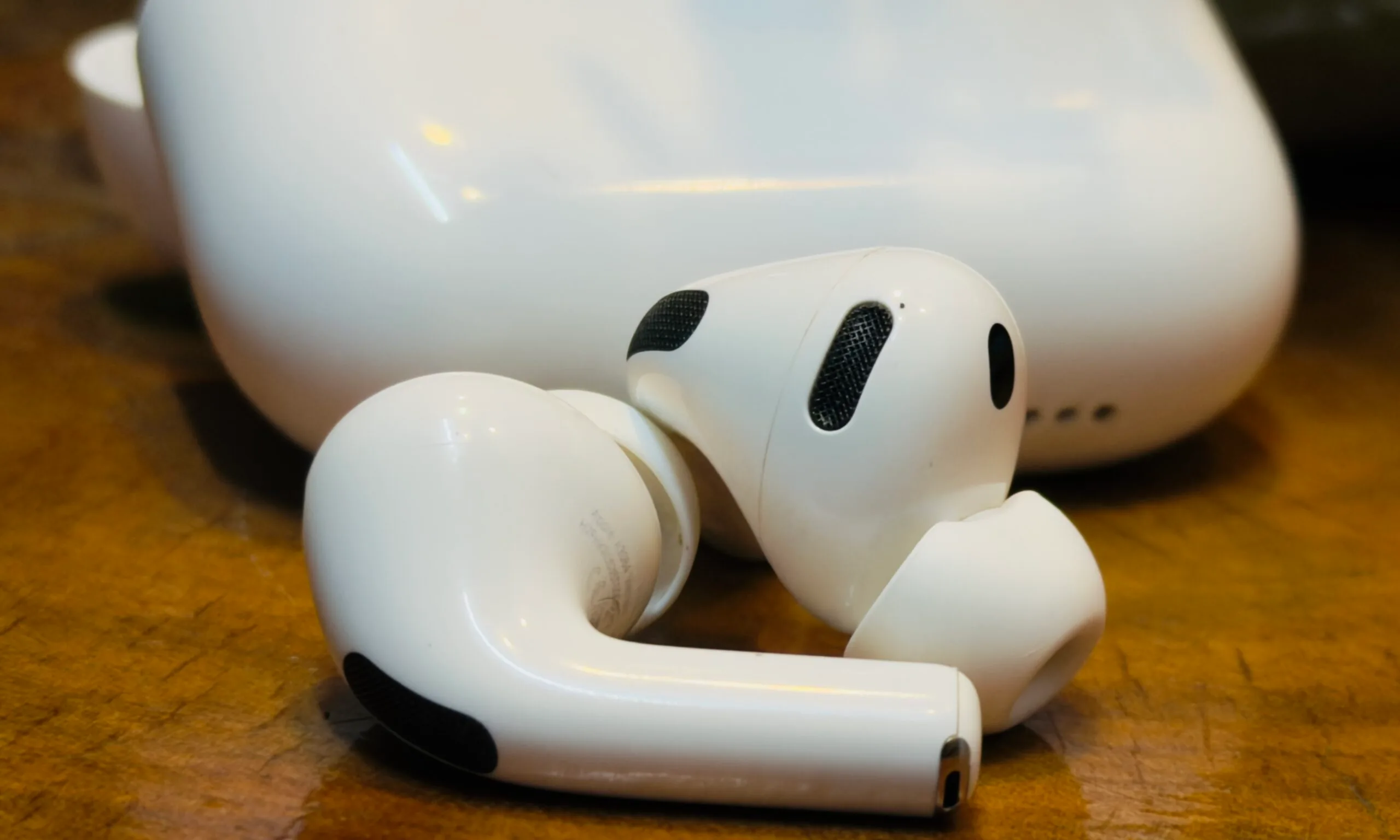
Apple’s wearable future is starting to come into focus, and cameras appear to be at its center. Bloomberg’s Mark Gurman reports that camera-equipped AirPods and Apple’s first smart glasses are currently on the roadmap for 2027. While they may look like ordinary accessories on the surface, both products could play a crucial role in helping Apple Intelligence understand the world around its users in real time.
Your AirPods might start paying attention
When most people think of AirPods, they think of music, podcasts, and phone calls. Cameras aren’t exactly high on the wishlist. But Apple has a different vision. The cameras wouldn’t be there for recording videos. Instead, they’d help gather information about the world around you and feed that data into Siri and Apple’s AI systems.
Nadeem Sarwar / Digital Trends
Imagine asking Siri about a building you’re looking at, identifying an object in front of you, or getting contextual information without ever pulling out your phone. So, your AirPods could become another set of eyes for Apple’s AI; that’s a dramatically different role from what earbuds do today.
Glasses to see, not just display
Then there’s Apple’s smart glasses, arguably one of the company’s most anticipated future products. Unlike the bulky Vision Pro headset, smart glasses could bring AI into a form factor people might actually wear all day. While details remain scarce, cameras are expected to play a crucial role, helping the device understand its surroundings and deliver real-time, useful information.
Amazon
What’s particularly interesting is how these products fit into Apple’s broader AI strategy. Most companies are trying to make AI more useful through apps and chatbots. Apple appears to be exploring something more ambient — AI that observes the world around you and responds when needed. Whether consumers are ready for camera-equipped wearables is another question entirely. But if Gurman’s report is accurate, 2027 could be remembered as the year Apple stopped thinking about AI as software and started turning it into something you wear.
It’s virtually impossible to live in modern society and not be tracked in some way. Websites track you, the apps you need and use every day could be the worst offenders in privacy invasion, and the devices you use it is tracking you, too. And even if you turn off the phone and go outside, you could being watched by the widespread Flock cameras that might be in your neighborhood. We know that tracking devices are all around every single one of us, all the time, every day. But sometimes you don’t even realize a device can track you in the first place.
Now, to walk things back a bit. We’re not out to terrify you into thinking your smart toaster is equivalent to the “1984” telescreen. Oftentimes, tracking is inevitable and even benign. Most electronic devices connected to the internet and receiving updates need basic usage telemetry to help the manufacturer fix bugs and optimize performance. With that in mind, these are five everyday tech devices that might be tracking your activity — for better or for worse.
Advertisement
Wi-Fi routers
Marius Karp/Shutterstock
In recent years, we’ve seen a scary news headline that says that Wi-Fi routers can be used like sonars to “see” inside buildings. Sadly, it’s no exaggeration. A Wi-Fi router can be utilized to map its surroundings. The technology is so sensitive it could theoretically track someone’s gait when walking, and possibly their breathing, even in another room.
What’s worse, a bad actor wouldn’t even have to compromise the network or buy a $10,000 frequency analyzer tool to do it; They’d only need a cheap smartphone kept in the network’s vicinity. Victims wouldn’t know when they were being tracked, either, and the more devices victims have, the more accurate the tracking gets. We already have concerns about mass surveillance with cameras, but now imagine the thousands upon thousands of Wi-Fi networks in every city and state retrofitted into a tracking apparatus that has x-ray vision — and imagine what dark forces out there would love to get their hands on said apparatus.
Now for a dose of reality. We’ve seen that this works, in theory, but so far we haven’t found documented cases where this has been abused. There are certainly concerning trends in that direction, like court cases arguing that that authorities should be able to track you with WiFi-based location, and consumer devices made by shady companies that boast Wi-Fi motion detection. On the flip side, a lot of the research around Wi-Fi sensing has been focused on potentially good use cases. We’d probably all be okay if grandma’s Wi-Fi network was leveraged to alert us in the event she takes a fall. For the possible unsavory uses of the tech, it may be possible to mitigate them by polluting the real data with false data.
Advertisement
Smart TVs
Lord_ghost/Getty Images
Let’s not beat around the bush: your smart TV could be spying on you. It’s something most people never think of, and yet at the same time, it’s completely unsurprising. Tech companies are some of the biggest privacy abusers. Why wouldn’t they take the big screen situated in your living room, the locus of your home’s activity, and track its behavior? Consumer Reports explains how smart TVs use ACR (automatic content recognition) to track you. Basically, ACR is “watching” what you watch, compiling and analyzing that info, and then using it to recommend further content. That Consumer Reports article also has a guide on how to disable ACR in most major TV brands.
In the past, we’ve seen companies do all sorts of spooky things with smart TVs. Samsung was once caught saying that it would collect personal data unrelated to a voice command query over your microphone (the clause has since been removed from Samsung’s privacy policy). There was also that thoroughly dystopian UAB (unique audio beacon) tech that allowed advertisers to figure out who exactly was watching their ads by pinging nearby smartphones with inaudible, ultrasonic noise. Case in point, tech companies have stooped to some disturbing stuff before, and they might try again.
Advertisement
However, we’re not saying you should throw away your fancy OLED panel in favor of an old CRT. Just do some digital hygiene. Go into your smart TV’s settings and disable analytics and ACR; disable features you never use, like the microphone for voice commands; learn how to disable ads on your TV, if possible. If you do all your watching through a streaming box, then you might even disconnect the smart TV from Wi-Fi entirely, since the streaming box is the only thing that needs to be connected.
Advertisement
Smart glasses
David Becker/Getty Images
Smart glasses with cameras seem like a cool way to film things hands-free… except when they enable loathsome individuals to secretly film others in public. We’ve already discussed at length where Meta Ray-Bans and their ilk should and shouldn’t be used, and laws are already in the pipeline to curb their misuse, but it’s not just unsavory people using the glasses for unsavory purposes — It’s the companies, like Meta. They’re not as concerned with filming other people as much as filming you, the user.
The Electronic Frontier Foundation reports how Meta’s smart glasses in particular don’t have any strictly-offline functionality. AI voice chats and media recordings get pumped into the cloud and may in some cases see employees annotating them for AI training. It would appear, according to a Svenska Dagbladet investigation, that users may not always control what’s recorded and uploaded. Imagine going to the bathroom with the glasses on — but not recording — and someone on the other side of the world seeing the whole thing. One of the workers quoted in the aforementioned report said that the stuff they see on a daily basis would unleash “enormous scandals.”
While you might think that the same privacy risk applies to a smartphone, it’s important to remember that a smartphone isn’t sitting on your face, pointed at your surroundings whether or not you’re using the camera. Smart glasses inherently introduce a new class of privacy risk. Considering Meta is up to its neck in a huge class action lawsuit as a result of everything we’ve mentioned, we’d say this is the one device on this list most should avoid entirely.
Advertisement
Doorbell cameras
Ira.foto.2024/Shutterstock
It’s impossible to deny the benefits of a doorbell camera. You can see who’s at your door — even when not at home — as a security measure, a means to avoid unwanted visitors, and a way to keep tabs on anyone who’s entered your property line. As you can probably guess, however, having a camera in your home that’s owned by a tech company requires trusting that only you will be able to see the footage. We’re not just fearmongering baselessly. Ring — one of the most popular doorbell camera makers in the U.S. — was accused by the FTC of spying on users without their consent.
There’s also been growing concern in recent years that the Ring cameras belonging to your neighbors are surveilling and tracking you. We all know that one curmudgeon who makes everyone’s life miserable at the HOA meeting, who spends half their day with a drawn curtain in one hand and a phone dialed to 911 in the other. Now that curmudgeon has a camera that’s on even when they sleep, a camera which footage they can pass along to the police and get them involved even when you’re innocent. And there are probably a lot of these cameras in your neighborhood.
Again, we wouldn’t necessarily advocate for getting rid of your Ring camera. Instead, go into the settings and change a few. Some of the things we’ve mentioned — like Ring Neighbors — can be disabled entirely. Of course, Ring is just one company on the market making these doorbell cameras. It doesn’t matter which brand you’re using. Limit what privacy settings you can, and be wary of any camera-enabled device that’s filming continuously in the background, 24/7.
Advertisement
Smart home devices
Drazen Zigic/Shutterstock
Once you get used to controlling your lights verbally with your smartphone’s AI assistant, it’s painful to go back to the olden days of getting up off the couch and switching lights on manually. Now, you can fill your home with an army of smart devices that make things more secure and convenient — and affordably so. Once again, we extend a gentle reminder that these tech devices are made by companies that may not respect your privacy, or even adhere to their own privacy policy. There’s ample evidence to suggest they’re listening in constantly, gathering information, and potentially sharing it. And if they’re not listening, the devices themselves may be vulnerable to hackers.
First we’d say, use common sense. Don’t put an indoor camera in your bedroom, for example, and be careful what brands you buy from. You only have to Google a device’s manufacturer name paired with keywords like “security vulnerabilities” to quickly find the ones to avoid. Don’t make common Wi-Fi mistakes like using weak, outdated encryption for your home network, since it’s the bedrock of your smart home. Consider keeping some “dumb” devices, like a non-smart front door lock, to limit the attack surface.
In truth, most of this stuff is basic security practice that you should already be doing on your PC and smartphone anyway. Things like setting strong passwords for smart home platforms, like Google Home, and keeping all devices updated to the latest software. Hackers love an easy, low-hanging fruit, so even doing the bare minimum makes you a much less desirable target.
John Ternus has been talking about focusing on Apple’s core strength of design once he takes over as CEO, and a now a questionable report extrapolates that this means he’ll shake up the design team.
John Ternus is now best known for taking over as Apple CEO from Tim Cook, but as recently as January 2026, he took control of the firm’s design team. Now according to Bloomberg, far from leaving that because of other CEO duties, he is planning to continue working on Apple’s whole design philosophy.
Reportedly, Ternus told staff that under him, Apple will “keep focusing on design, because design is core to what we do in Apple.”
He said that Apple has brought “truly incredible design” to customers, and done so more than any other firm. Ternus claims that the best-designed item that most customers have, is an Apple product.
Advertisement
“We’re going to make sure that stays the case,” he said.
There are no further details, although the report echoes claims from January 2026 that Ternus plans a shakeup of the design teams. What is clear, though, is that this is going to mark a clear difference between Ternus and his predecessor, Tim Cook.
Cook was once criticized by Steve Jobs for not being a product person, in the way that Jobs or Jony Ive would obsess over them. It’s repeatedly been reported that Cook did not often visit the design teams, and now it’s said that Ternus has already devoted a lot of his time to the design division.
The first products to come out under Ternus’s aegis will be the iPhone 18 range in September 2026, the month he officially takes over. It’s said that Apple is aiming to mark the 20th anniversary of the original iPhone with a series of new devices, including a new iPhone Fold, and AirPods with cameras, in 2027.
Advertisement
Even those, though, are already at the testing stage. So while Ternus has been involved with them, it could take a couple of years before Apple releases a device that was made entirely on his watch.
This week the Ubuntu desktop’s director of engineering announced they’re bringing speech-to-text dictation to Ubuntu Desktop, aiming for an experience “that feels like a natural part of the desktop while respecting user privacy and running entirely on local hardware.”
“Speech recognition has become a common feature on modern platforms, and we think it should be a first-class experience on Ubuntu Desktop as well.”
For Ubuntu 26.10, the initial version of Myna is expected to be a desktop dictation tool built around GNOME on Wayland with a push-to-talk mechanism gatekeeping when your microphone accepts input. Using it means holding a hotkey, speaking, and letting go. A small activity indicator shows while it is listening, and the transcribed text lands wherever the cursor was sitting when dictation started.
Advertisement
Recognition itself happens inside a sandboxed component called the Canonical Inference Snap, while a Speech Orchestrator manages the session and an Audio Adapter handles whatever the microphone picks up, denoising and chunking it before it ever reaches the model… Speech recognition will happen locally, and an internet connection is not needed once the appropriate model is installed… The audio data won’t be sticking around either, being stored in a small in-memory buffer that gets discarded the moment the session ends. Features like dictation into password fields, wake words, continuous listening, voice assistants, voice commands, translation, speaker identification, and automatic language detection are all off the table…
You should also know that Canonical is looking for feedback before the specs for Myna are finalized, especially from people who already rely on dictation or assistive tools on Linux.
If you bought an iPhone 16 or iPhone 15 when they launched, you may be able to claim some of the money from a class action lawsuit against Apple. It’s all tied to the new Apple Intelligence features the company previewed during launch — features that ultimately didn’t arrive on time, but were finally unveiled more extensively this month at WWDC 2026.
Apple settled a shareholder lawsuit in May, agreeing to pay $250 million to customers who bought the iPhone 16 and some iPhone 15 models during a specified period. The lawsuit alleged that Apple misled customers by promising AI features that didn’t ship when the new devices did. Payouts between $25 and $95 per eligible device are expected.
In a statement to CNET Managing Editor David Lumb, an Apple spokesperson said, “Apple has reached a settlement to resolve claims related to the availability of two additional features. We resolved this matter to stay focused on doing what we do best, delivering the most innovative products and services to our users.”
Advertisement
Why is there a lawsuit over Apple Intelligence?
When Apple advertised its new iPhone 16 lineup, it emphasized how they were optimized for AI features such as an enhanced Siri that could act as an intelligent agent. When the phones did arrive, Apple Intelligence wasn’t yet ready; its first features didn’t arrive until iOS 18.1, five weeks later.
According to the proposed settlement, “Apple allegedly saturated the market with deceptive ads, inducing consumers to purchase iPhones based on the promise of certain enhanced Siri features.”
Customers who purchased one of the following devices between June 10, 2024, and March 29, 2025, are eligible to receive a settlement payment:
Advertisement
iPhone 16
iPhone 16E
iPhone 16 Plus
iPhone 16 Pro
iPhone 16 Pro Max
iPhone 15 Pro
iPhone 15 Pro Max
The iPhone 15 Pro and iPhone 15 Pro Max are included because they had the processor and memory to run Apple Intelligence features.
It’s estimated that there are approximately 36 million customers eligible for this settlement.
Watch this: What iPhone Users Actually Want From the New Google-Powered Siri
How to claim your portion of the settlement
For now, you need to wait.
As set forth in the settlement, Apple will provide a list of eligible customers and their contact information to a settlement administrator.
Advertisement
After the data has been verified, the company Verita will send email and postal notices to those customers directing them to a settlement website. That site has not yet been created. The deadline for filing your claim will be 90 days after your notice arrives.
When can you expect to receive a settlement payment?
According to the settlement, Apple must provide the information about affected customers within five days of the settlement approval, which was scheduled for June 17, 2026.
When the data is provided and verified, a 45-day notice period begins to inform potential consumers that they’re eligible for a payment.
The actual payment of claims will occur within a 60-calendar-day window after the final details, such as exclusions and objections, have been worked out. That puts the first checks or deposits arriving sometime after September 2026, depending on court dates and possible extensions.
A group of companies that specialize in tracking international shipments of sensitive technologies is backing a Capitol Hill bill that would require America’s most powerful AI chips to incorporate stronger security mechanisms aimed at preventing the chips from reaching China and other adversaries. The letter, signed by six companies, says the Chip Security Act (CSA) would increase American chip companies’ competitiveness and close key loopholes in the U.S. export control regime.
The move clashes with claims from semiconductor lobbying groups that the requirements would constrain America’s booming chip industry. Sent to congressional leadership Thursday morning and seen by NBC News, the dispatch instead argues that more robust security verification would assure chip customers and manufacturers that they are abiding by sensitive restrictions on chip sales. The companies argue that the boosted confidence will “lead to increased sales, faster export approvals, larger transactions, greater access to new markets, and more expansive chip deals.”
Despite U.S. export control laws banning sales of advanced AI chips to certain countries, including China, loopholes in current requirements have allowed billions of dollars’ worth of America’s best AI chips to be sold to entities in third-party countries that can then forward them to China. In just one case in March, the Justice Department charged three people with conspiring to forward $2.5 billion of AI chips to China. The CSA aims to address those loopholes, mandating that chip exporters better track where advanced chips are sent, via either bespoke location-verification hardware or software that can run on existing hardware. That, bill proponents claim, would ensure that sensitive chips could be sold to countries like Malaysia or Indonesia without fear of further transfer to China… Experts say that because chips perform the advanced computations required for frontier AI systems, cutting off access to the chips is crucial to prevent geopolitical rivals from using AI systems for military or economic purposes.
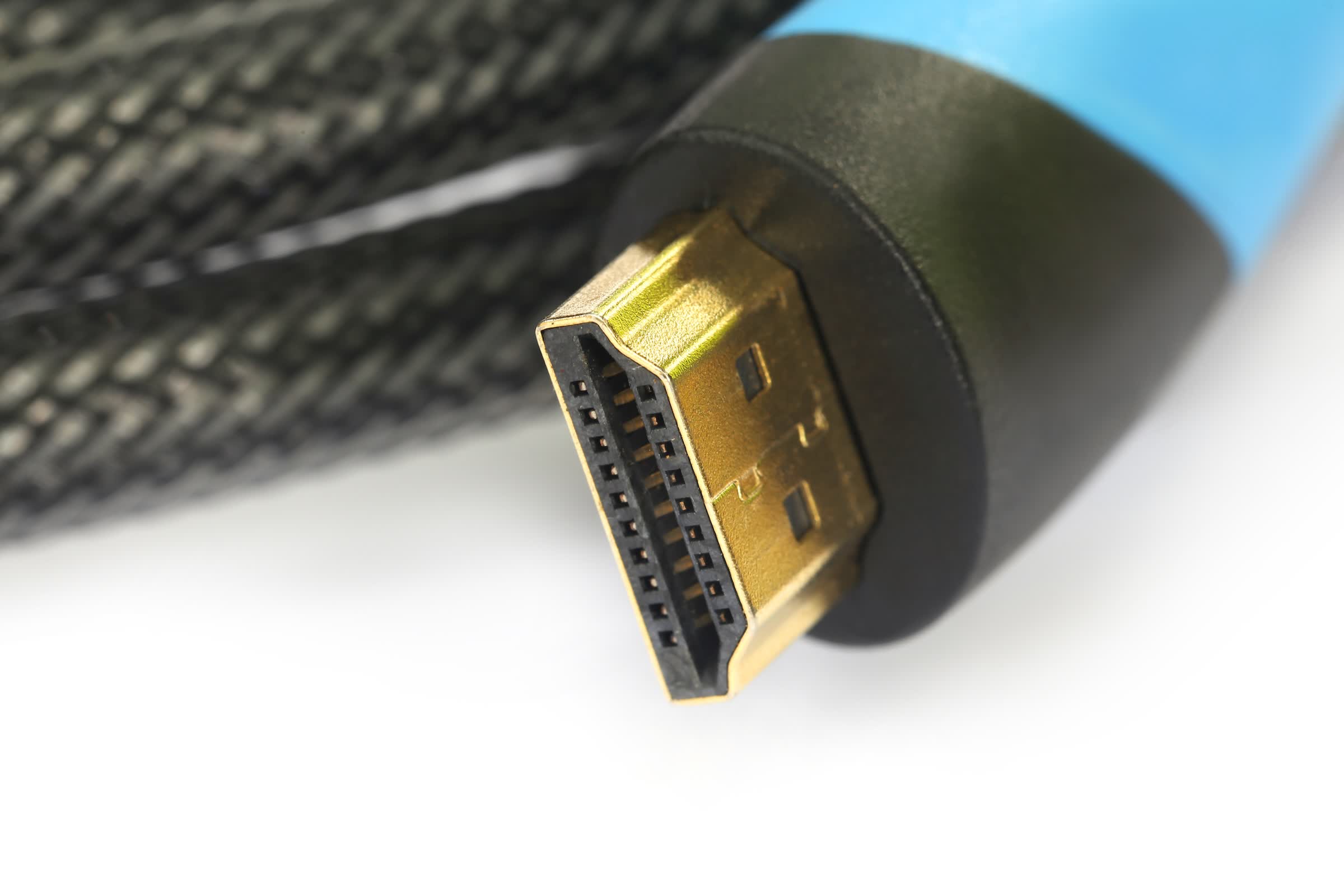
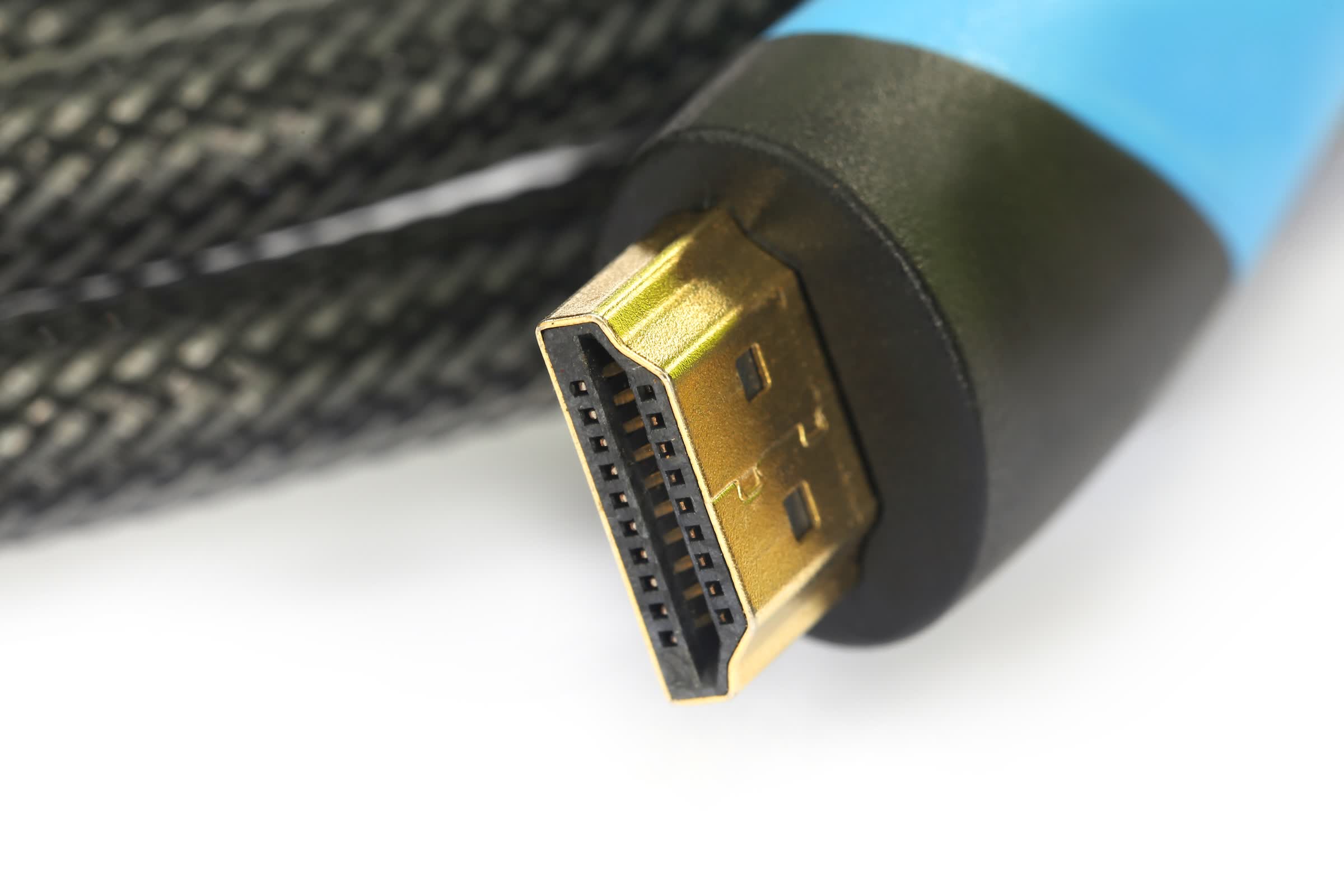
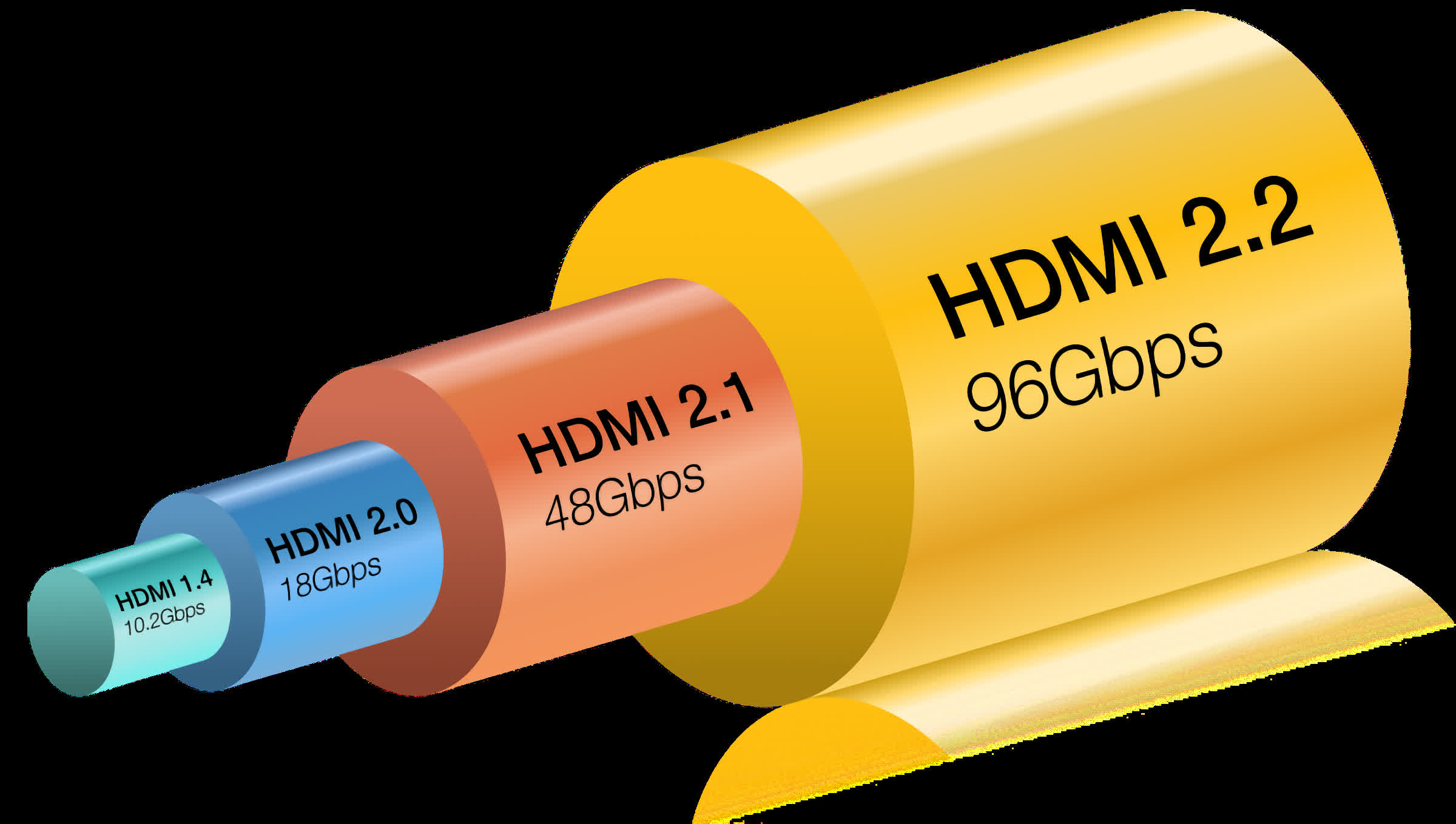
Forward-looking: The next version of HDMI is mainly about pushing bandwidth higher to carry better video and audio, not small, incremental tweaks. HDMI 2.2, teased at CES 2025 and formally released by the HDMI Forum in June of that year, raises maximum bandwidth to 96Gbps, twice that of HDMI 2.1, allowing more uncompressed video data to move between devices.
HDMI 2.2 can carry uncompressed 4K video at up to 240Hz, something that currently requires Display Stream Compression (which as we’ve shown however, is not a big limitation). It can also reach 4K at 480Hz using 4:2:0 chroma subsampling, and handle uncompressed RGB 8K at 60Hz.
The added bandwidth cuts down on the compression and other tricks current hardware has had to rely on to push high frame rates. For gamers, that extra headroom makes it easier to drive high refresh rates at 4K and beyond without leaning as heavily on compression or workarounds.
With compression still in the toolkit when needed, the spec allows for more extreme modes, too, including 1440p at refresh rates above 1,000Hz – numbers that, for now, sit well beyond everyday use.
Advertisement
That leap is tied to FRL2, the updated signaling technology underpinning HDMI 2.2. The transition is already underway at the hardware level. “We’re hearing chip manufacturers will start to sample their FRL2 chips this year,” Rob Tobias, CEO and president of the HDMI Licensing Administrator, told ARMdevices at Computex 2026. “And so we should start to see some 96 or up to 96 gigabit HDMI 2.2 products next year.” Certification efforts are ongoing, and the first wave of compatible devices is expected in 2027.
Still, the headline number – 96Gbps – doesn’t tell the whole story. HDMI 2.2 rolls out in multiple tiers, including 64Gbps and 80Gbps versions, and certification doesn’t require manufacturers to hit the top speed. That means two devices both labeled “HDMI 2.2” could perform very differently depending on how they’re built. For buyers, that puts more weight on spec sheets than branding.
In the PC space, the timing is complicated by the fact that DisplayPort 2.1 already delivers up to 80Gbps and is widely used in high-end monitors. For enthusiasts running multi-display setups, HDMI hasn’t been the primary interface for some time, and that’s unlikely to change overnight. Licensing costs may also factor into how quickly HDMI 2.2 gains traction compared with DisplayPort.
Where HDMI continues to hold ground is in the living room. Features like ARC, CEC, and ALLM are already deeply integrated into TVs and home theater systems, and HDMI 2.2 adds another layer with Latency Indication Protocol, or LIP, aimed at tightening audio-video synchronization – a persistent issue with soundbars and AV receivers. It’s a small but practical upgrade, and one that targets a problem many users encounter even in otherwise high-end setups.
Advertisement
Even so, there’s a gap between what the specification allows and what current content actually demands. Most games and video still operate well below the limits of HDMI 2.1, and 4K at 120Hz – already supported – remains underutilized. It’s easy enough to imagine future consoles taking advantage of higher refresh rates, but widespread use will depend on both hardware and software catching up.
That lag is likely to show up in the rollout. GPU support isn’t expected until late 2027 or later, and early adoption will likely be confined to premium hardware. On the TV side, HDMI capabilities often depend on the underlying processing chips, which have historically led to uneven feature support even among top-tier models. There’s little reason to expect a cleaner transition this time around.
For now, HDMI 2.2 is more about preparing for future hardware than something people need to upgrade to right away. The spec sets a high ceiling, but it may take several product generations before most users see a tangible benefit. In the meantime, its presence will likely be felt more in product positioning than in everyday performance.
Portland, Oregon-based Leatherman is known for its multitools, which feature a plier-based design built around an iconic butterfly mechanism — unlike the iconic Swiss Army Knife. One would imagine the pricing hierarchy for its lineup would be defined by the number of tools, the materials, and the build quality; while that’s generally the case, it’s not for the pliers. Instead, the blade is how you gauge whether your Leatherman multitool is cheap or expensive.
Except for the military and law-enforcement-specific MUT models that retail at $230, all inexpensive (relatively speaking, of course) Leatherman multitools bearing unmarked knife blades are made from 420HC steel. The $100 Skeletool CX and RX variants charge a $10 premium over the base Skeletool to incorporate premium 154CM steel. However, the flagship Leatherman Arc ($250) and Wave Alpha ($200) are equipped with a knife fashioned from an exotic made-in-USA steel branded as CPM MagnaCut. This steel is usually found in high-end pocket knives priced around $300, and it isn’t uncommon for some MagnaCut knives to hit the $500 mark.
Advertisement
Knife steels are designed to strike an optimal balance between three mutually exclusive traits: toughness, edge retention, and corrosion resistance. MagnaCut is a super steel engineered to significantly outperform both 420HC and 154CM in all three aforementioned parameters. The super steel’s improved toughness allows the knife to be ground thinner, with a blade geometry that cuts effortlessly. Meanwhile, its elevated hardness means it stays sharper for longer and resists corrosion better.
Advertisement
What makes CPM MagnaCut steel so special?
Nachiket/SlashGear
CPM stands for Crucible Particle Metallurgy, a fancy trademark for Crucible Industries’ proprietary technique for manufacturing sintered steel. This process atomizes individual alloying elements into tiny, uniformly shaped balls. These powdered elements are then combined in precise ratios under extreme heat and uniform pressure to form an unnaturally dense metal with a perfect grain microstructure and perfect distribution of alloying elements.
This matters because the complex metallurgy underpinning knife steels essentially boils down to finding the sweet spot between hardness, toughness, and corrosion resistance. For example, increasing the carbon content of steel improves hardness and edge retention, but it also reduces toughness. Adding elements such as chromium, vanadium, and niobium to form carbides improves corrosion and wear resistance but makes the blade edge prone to chipping. Steels manufactured using the CPM process allow metallurgists to fine-tune these blends to nail the performance sweet spot.
That’s basically how MagnaCut manages to hit the Goldilocks zone of chromium content, improving corrosion resistance while inhibiting the formation of chromium carbides. Instead, it has harder and smaller vanadium and niobium carbides throughout, which improve wear resistance and significantly reduce chipping compared to other so-called super steels like CPM Rex 121 – even if it retains edges better than MagnaCut. CPM MagnaCut might not be the absolute best at any single metric, but it is an excellent all-rounder, and that’s precisely why Leatherman uses it on its priciest multitools.
Perseverance is officially a marathon finisher. NASA shared this week that the Mars rover has surpassed a total distance of 26.2 miles since it landed on the red planet five years ago. Considering its speed tops out at .1 mph under the best conditions, that’s a pretty remarkable achievement. It crossed the marathon mark on June 14, according to NASA. “Perseverance is only the second explorer to travel the distance of a marathon on another world, following NASA’s Opportunity rover, which accomplished the feat in 2015,” the space agency wrote in an Instagram post.
By comparison, it took Opportunity 11 years and two months to cover that much ground. The Curiosity rover, which has been on Mars since 2012, has driven just over 23 miles. Perseverance “crossed the milestone while exploring intriguing, ancient terrain to the west of Jezero Crater, where the robotic geologist discovered the remnants of an ancient lake, and possible signs of ancient life,” NASA said. The rover recently sent back images from its western excursion, which included a selfie.
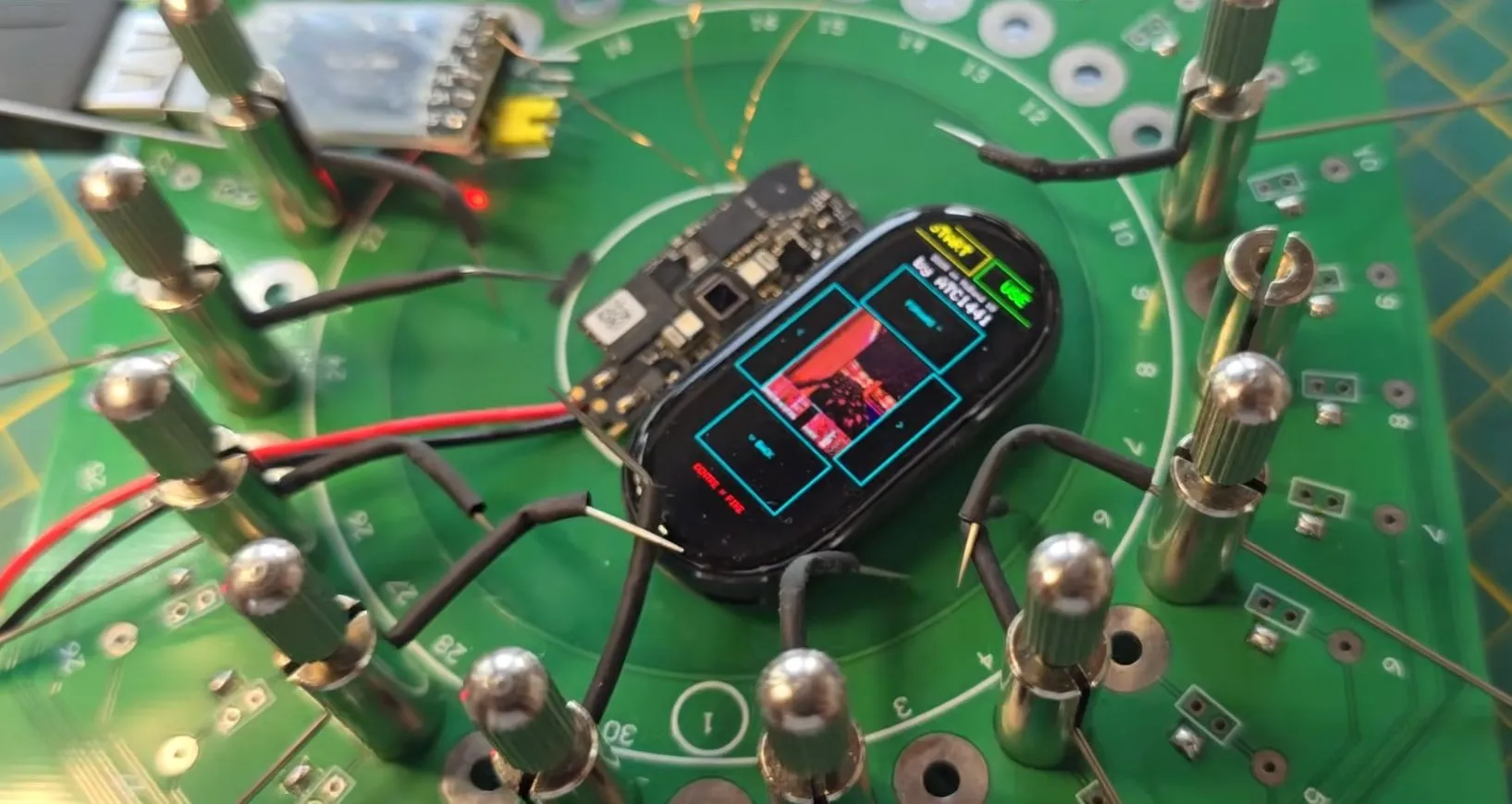
In between playing Doom on the most ergonomically challenged devices, [Aaron Christophel] likes to take a relaxing break with reverse-engineering Xiaomi Mi Band fitness trackers and writing custom firmware for them. Also so that he can play more Doom on those, natch. The latest subject comes in the form of the Mi Band 10, which features a BES2700iMP SoC, known internally at the manufacturer Bestechnic as the BEST1503. This is all documented on the GitHub project.
In the accompanying video we get some more details on this project, with the main challenge being that for this Mi Band 10 there’s no public SDK for its SoC. This was a major bummer until [Aaron] realized that the BEST1306 (BES2700IHC) is effectively the same SoC, but with a leaked SDK available via apparently audio-focused development kits. From there a BEST1503-compatible SDK could be assembled.
Naturally, to check that all of this was working correctly Doom was ported to the device courtesy of the GBADoom project. This mostly works aside from the display running in single-bit SPI mode instead of quad-SPI that it should be capable of, along with limited color depth. Despite burning all the tokens on the Claude, this provided little help, probably because the required information hasn’t leaked out of Bestechnic yet and ended up in the training data set.
Advertisement
Since the Mi Band 9 uses the same SoC, it’s expected that this reverse-engineered SDK will also work for that fitness band, though that hasn’t been tested yet.








































You must be logged in to post a comment Login