Tech
Creative XF1 Desktop Speakers Add Bluetooth 6.0, LDAC and Parametric EQ

Creative built its reputation by making PC audio matter long before laptop manufacturers decided that two downward-firing drivers were sufficient punishment for buying a thin computer.
The new Creative XF1 desktop speakers return to that battlefield with a surprisingly complete feature set for $179.99 USD, which includes Bluetooth 6.0, LDAC, 24-bit/96kHz USB audio, bi-amplification, a 10-band parametric equalizer and a dedicated output for adding a powered subwoofer.
Related Reviews:
Active Two-Way Design With 72 Watts
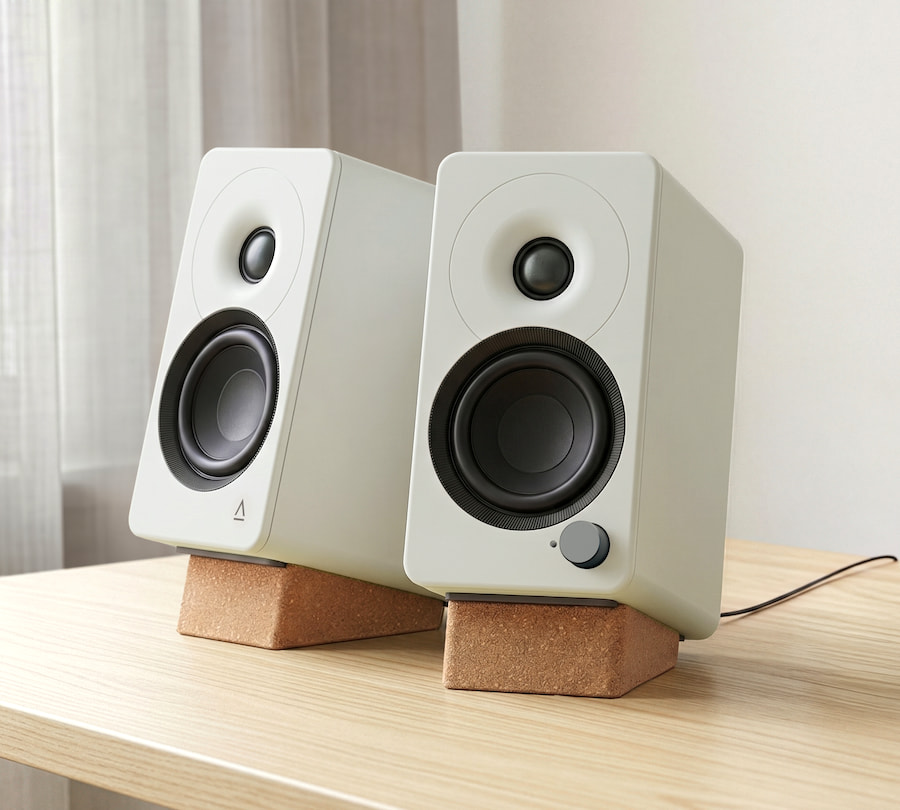
The XF1 is a compact 2.0 active speaker system built around two custom 3-inch woofers and two 3/4-inch tweeters.
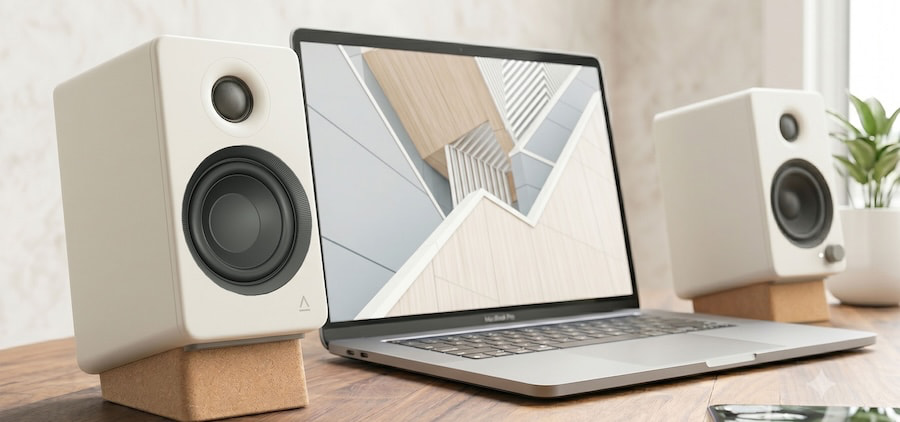

Creative says it used Finite Element Analysis to model the woofers and optimize their behavior for higher output and lower distortion within the XF1’s small enclosure. That kind of computer-assisted driver development is common in serious loudspeaker engineering, although the eventual listening results matter considerably more than the colorful simulation graphics.
The system uses a bi-amplified architecture with a dedicated amplifier channel for each driver. Creative rates each woofer channel at 26 watts RMS and each tweeter channel at 10 watts RMS, producing a claimed total system output of 72 watts RMS.
Specified frequency response is 55Hz to 40kHz, with a signal-to-noise ratio of at least 85dB and THD+N below one percent. The XF1 has received both Hi-Res Audio and Hi-Res Audio Wireless certification.
Bluetooth 6.0 and LDAC
Bluetooth 6.0 remains uncommon among desktop speakers, although the version number should not be mistaken for an automatic guarantee of better sound. Key benefits include channel sounding, advertising improvements, and lower-latency framing options. However, wireless sound quality could vary across its supported codecs: LDAC, AAC, SBC, A2DP and AVRCP profiles, and over its 10 meter (33 feet) of range.
LDAC can carry substantially more data than SBC under suitable conditions and will be most useful to listeners streaming from compatible Android devices, Windows computers or dedicated transmitters.
Apple users will fall back to AAC because iPhones and iPads do not transmit LDAC. That does not make the XF1 useless within the Apple ecosystem, but it does remove one of the product’s more heavily promoted advantages.
USB Type-C, Analog Input and Subwoofer Expansion
The XF1’s USB-C input accepts PCM audio up to 24-bit/96kHz, allowing a laptop, desktop computer, tablet or compatible smartphone to bypass its internal headphone output and send digital audio directly to the speakers.
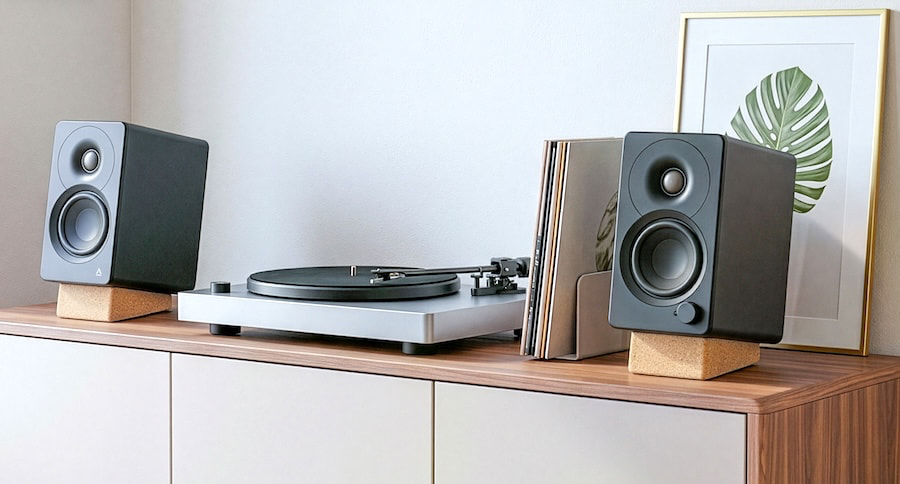
A 3.5mm stereo line input supports analog sources. Creative shows a turntable among its suggested source components, but the XF1 does not include a phono preamplifier. A turntable must therefore have a built-in phono stage or connect through an external one.

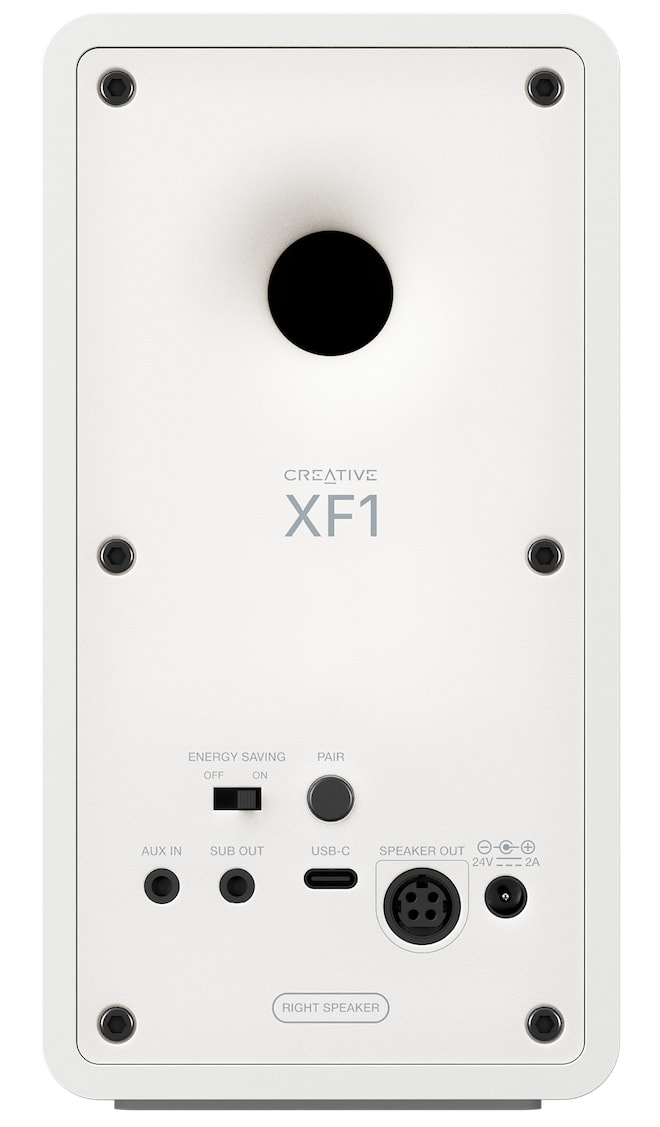
The dedicated subwoofer output is especially useful. Compact 3-inch woofers are not going to reproduce the bottom octave with meaningful authority, regardless of how many times the words “extreme fidelity” appear in the brochure. Adding an active subwoofer should provide better extension for electronic music, hip-hop, games and movie soundtracks while reducing the temptation to force too much bass from the main speakers.
Controls include a front-mounted multifunction knob for power, volume and source selection. A Bluetooth pairing button and defeatable energy-saving switch are positioned on the rear panel.
There is no optical input, HDMI ARC, balanced XLR or TRS connectivity, RCA input, headphone output or integrated phono stage. The XF1 is designed primarily as a desktop system rather than a miniature television sound system or production monitor.
Creative Nexus Parametric EQ
Creative’s Nexus app provides one of the XF1’s most distinctive features: a 10-band parametric equalizer.
A parametric equalizer offers considerably more control than the fixed bass and treble adjustments found on many powered speakers. Users can target particular frequencies, adjust gain and change filter width rather than merely pushing broad sections of the spectrum up or down.
That can be useful on a desktop, where reflections from the work surface, nearby walls and computer monitors frequently alter tonal balance.
Creative also provides more than 120 presets covering over 20 music genres and almost 100 games. That number borders on absurd, but the underlying control is genuinely valuable. Nobody requires a separate EQ preset for every game involving a man with a rifle and unresolved childhood trauma, but the ability to create and save sensible custom curves is welcome.

Compact Enough for a Real Desk
Each speaker measures 155 x 99.7 x 191 mm (6.10 x 3.93 x 7.52 inches). The left speaker weighs 1.29 kg (2.84 pounds), while the right weighs 1.36 kg (3 pounds). The XF1 will be available in black and white.
Creative also includes removable cork feet that angle the speakers upward toward the listener. Proper tweeter alignment matters in a near-field system, particularly when the speakers sit below ear level beside a computer display.
What Makes the Creative XF1 Different?
No single XF1 feature is revolutionary.
USB-C audio is becoming common. LDAC is available from Edifier and FiiO. Kanto and Audioengine offer compact speakers with subwoofer connectivity. App-based EQ is no longer exotic.
The XF1 stands out because it combines nearly all of those capabilities in one compact system:
- Bluetooth 6.0 with LDAC, AAC and SBC
- 24-bit/96kHz USB-C audio
- Active bi-amplification
- A 10-band parametric EQ
- More than 120 presets
- A dedicated subwoofer output
- A small desktop footprint
The parametric EQ and subwoofer output are the strongest differentiators. Together, they give owners a meaningful way to address both desktop placement problems and the inevitable low-frequency limitations of a 3-inch woofer.
Who Is the Creative XF1 For?
The XF1 is best suited to desktop listeners, remote workers, gamers, students and music listeners who want a substantial upgrade over built-in monitor or laptop speakers without adding a separate DAC and amplifier.
Android users with LDAC-compatible devices receive the strongest wireless feature set. PC and Mac users can ignore Bluetooth entirely and use USB C for a reliable 24-bit/96kHz digital connection.
The subwoofer output also makes the XF1 more appealing to buyers who want to begin with a compact 2.0 system and expand later.
The XF1 is less appropriate for recording engineers who require balanced inputs, television viewers who need HDMI ARC or optical connectivity, and vinyl listeners hoping to connect a conventional turntable directly without a phono preamplifier.
Competitors?

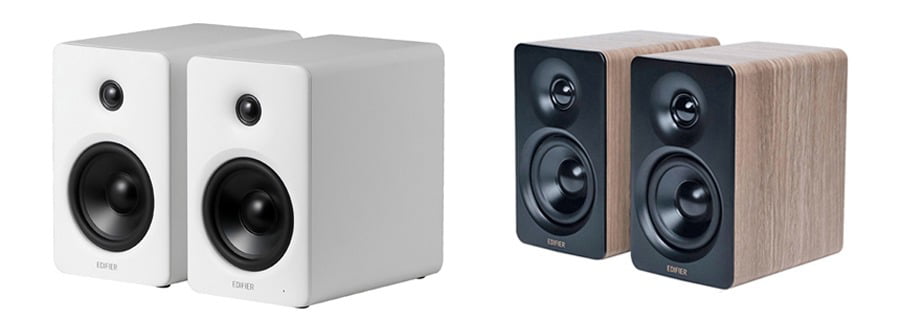
The Edifier M60 is the XF1’s most obvious rival. It sells for $199.99 in the United States and combines 66 watts, 3-inch mid-bass drivers, 1-inch tweeters, Bluetooth 5.3 with LDAC, USB C and app support. The Creative counters with Bluetooth 6.0, a published 10-band parametric EQ and a dedicated subwoofer output.
The Edifier MR4.5 costs $249.99 and offers larger 4.5-inch drivers, 80 watts, Bluetooth 6.0 with LDAC, balanced XLR and TRS inputs and room compensation. It is the more appropriate option for content production and audio interfaces, but it omits USB audio and a subwoofer output.
The Audioengine A2+ Next Gen costs $279 and provides USB-C, Bluetooth 5.3 with aptX HD, RCA and 3.5mm analog connectivity in proven wood cabinets. It lacks LDAC and app-based parametric EQ but has an established performance record and broader analog connectivity.
The Kanto ORA sells for $349 and includes USB-C, RCA, Bluetooth and a subwoofer output. It remains a strong compact desktop option, but the XF1 offers newer Bluetooth support, LDAC and substantially deeper software adjustment.
The FiiO SP3 BT also costs $349 and supports LDAC, aptX Adaptive, USB, optical and coaxial digital inputs. Its broader digital connectivity and 3.5-inch drivers make it a more ambitious system, although at more than twice the XF1’s confirmed European price.

Creative XF1 Key Specifications:
- Model: MF1730
- Speaker Type: 2.0 powered desktop speaker system
- Available Colors: Black or white
- Dimensions: 6.10 x 3.93 x 7.52 inches per speaker
- Weight: 2.84 pounds left speaker; 3.00 pounds right speaker
- Drivers: Two 3-inch woofers and two 3/4-inch tweeters
- Power Output: 72 watts RMS total
- Woofers: 2 x 26 watts
- Tweeters: 2 x 10 watts
- Frequency Response: 55Hz – 40kHz
- Signal-to-Noise Ratio: 85dB or greater
- THD+N: Less than 1%
- Bluetooth: Bluetooth 6.0
- Codecs: SBC, AAC, and LDAC
- Wireless Range: Up to 33 feet
- USB Audio: USB-C, up to 24-bit/96kHz
- Analog Input: 3.5mm stereo
- Subwoofer Output: Yes
- Controls: Multifunction power, volume, and input knob
- Additional Controls: Bluetooth pairing button and energy-saving switch
- Certifications: Hi-Res Audio and Hi-Res Audio Wireless
- Included Cables: 4.9-foot USB-A-to-USB-C cable and 6.6-foot speaker interconnect cable
- Power Adapter: 48 watts, 24V/2A
The Bottom Line
At $179.99 USD, the Creative XF1 looks like an aggressive attempt to move the company beyond inexpensive computer speakers without abandoning the desktop category that helped make Creative relevant in the first place.
The Edifier M60 will be the immediate fight. Both offer compact cabinets, LDAC, USB C and similar power, but the Creative’s parametric EQ and subwoofer output provide a more flexible upgrade path. Ultimately, the XF1 does not look like another pair of plastic PC speakers designed to make notification sounds and gunfire slightly less miserable. There is enough engineering, connectivity and useful adjustment here to make it genuinely interesting.
Price & Availability
The Creative XF1 will be available in black or white beginning August 6, 2026, priced at $179.99 at Amazon in the United States, £139.99 in the United Kingdom, and €159.99 in Germany.
You must be logged in to post a comment Login