Security teams log 54% of successful attacks and alert on just 14%. The rest move through your environment unseen.
The Picus whitepaper shows how breach and attack simulation tests your SIEM and EDR rules so threats stop slipping by detection.



CubePilot, an Australian firm that designs flight controllers for drones (UAVs), announced a severe operational disruption caused by a DNS hijacking attack.
Hijacking domain name system (DNS) records allows threat actors to redirect users to their infrastructure, diverting traffic intended for a legitimate service. This exposes users to dangerous scenarios such as sensitive data interception, malware delivery, and phishing.
According to a status update published on CubePilot’s website, an attacker gained control of the cubepilot[.]org domain DNS settings on July 24, allowing them to intercept traffic intended for internal systems.

The attacker also obtained TLS certificates covering all cubepilot.org subdomains, meaning users visiting affected services would have seen valid HTTPS connections while unknowingly landing on attacker-controlled infrastructure.
“The certificates obtained by the attacker covered every cubepilot.org subdomain, so credentials entered on any of our services on 24 July may have been captured — the portal and the forum included,” reads the announcement.
“If you used the same password anywhere else, change it there now,” warned CubePilot.
CubePilot said it regained control of its domains on July 24, revoked the fraudulently issued certificates, preserved evidence, notified relevant providers, and reported the incident to the Australian Cyber Security Centre and law enforcement.
Also, the company promised to notify affected entities directly where impact is confirmed through its investigation.
CubePilot designs “autopilots” and navigation hardware for UAVs used in surveying, search and rescue, agriculture, and also defense and government applications.
Previously, the company publicly announced its support for Ukraine, and its products have been delivered in the country, including as part of an Australian government assistance package.
Currently, all OEM services, the community forum, and the documentation portal are offline.
CubePilot’s CEO, Philip Rowse, stated on LinkedIn that the platform’s ERP portal has also been taken offline as a precaution while an investigation into the incident is underway.
Regarding the integrity of the published firmware images, CubePilot is currently evaluating them and advised not to flash images downloaded on July 24-25 until checks to confirm their safety are completed.
Firmware obtained before July 24 is currently considered safe to use.
Finally, clients who receive payment requests claiming to be from CubePilot are advised not to take any action and instead to confirm them over the phone with their usual contact.

Security teams log 54% of successful attacks and alert on just 14%. The rest move through your environment unseen.
The Picus whitepaper shows how breach and attack simulation tests your SIEM and EDR rules so threats stop slipping by detection.
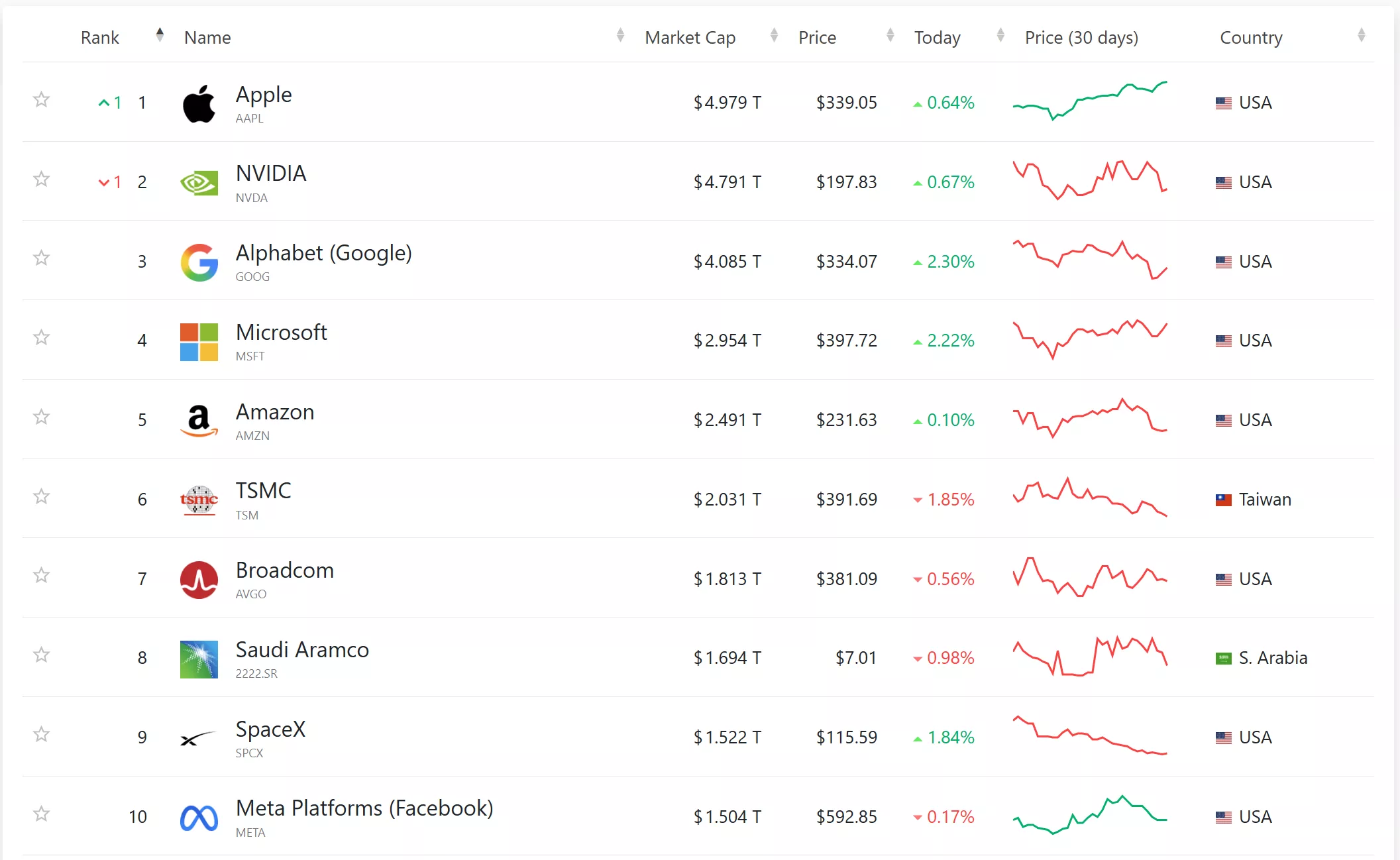
King of the (Stock) World: After ceding its Wall Street crown to Nvidia, Apple has reclaimed the title of the world’s most valuable public company, and the shift says as much about the mood on Wall Street as it does about Apple itself. Investors are growing wary of the AI infrastructure race that’s driven tech valuations for years, and they’re rewarding the one Big Tech giant that largely sat it out.
The timing adds extra stakes, too. Tim Cook is preparing to step down soon, and the incoming CEO is expected to preserve the same approach to market and financial management that defined Cook’s tenure, the very discipline investors now appear to be betting on.
Apple’s stock rose 1% this week to push its market cap to roughly $4.9 trillion, while Nvidia’s shares fell 5%, dropping the chipmaker to about $4.8 trillion. Chip stocks have been especially volatile lately, which is one reason a “traditional” IT company like Apple looks better positioned to ride out the turbulence.
Nvidia became the first company in the world to cross a $5 trillion market cap in 2025, fueled by surging interest in AI tools and infrastructure that heavily depend on its hardware and software. The company’s valuation has grown more than tenfold as Nvidia supplied the GPUs needed to train and run today’s most complex AI models. Other Big Tech players followed suit, pouring billions into ever-larger AI data center buildouts, most of them running on Nvidia’s GPUs.
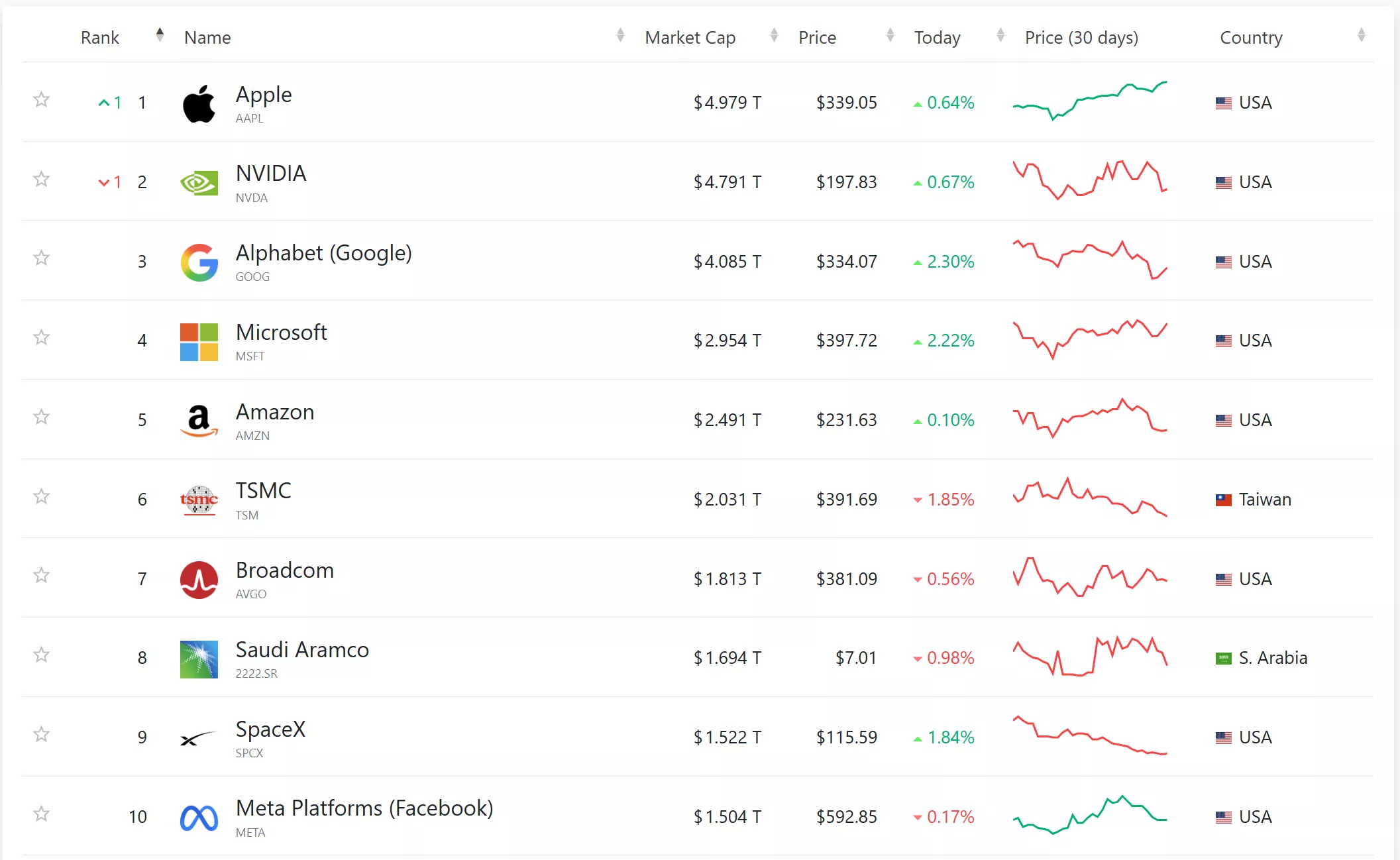
Source: CompaniesMarketCap
Apple has approached the “AI revolution” a little differently. The company that once adapted DARPA’s CALO project to build Siri spent years developing its own custom large language models, but after apparently falling behind other AI pioneers, it opted to lean on Google’s services and AI models for the next generation of Siri AI.
In somewhat of a turn of events, analyst Daniel Newman says investors are turning back to Apple because they see it as a safe harbor from the broader AI hangover.
As AI-focused stocks look increasingly volatile, Newman noted that owning Apple still feels “almost like owning an index.”
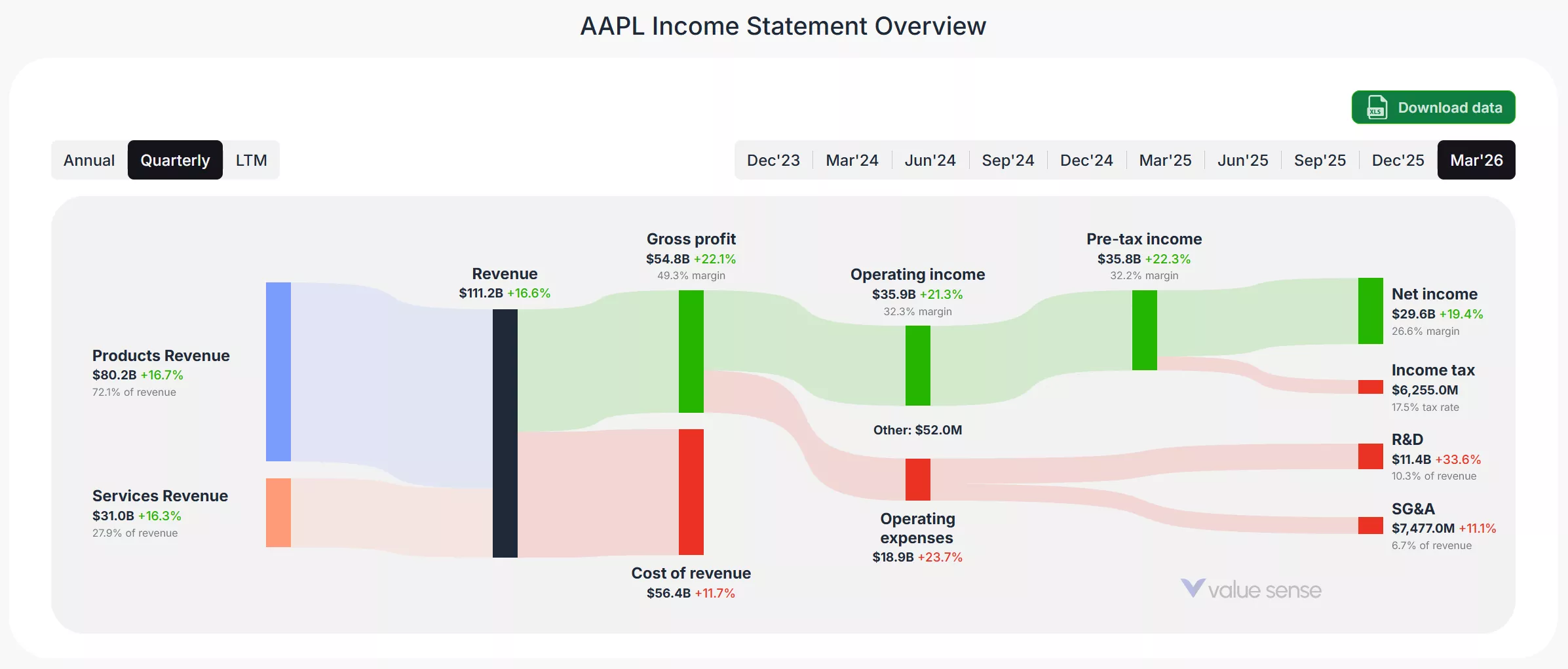
Apple CEO Tim Cook is expected to step down soon, handing the reins to senior VP of hardware engineering John Ternus. Cook led Apple for 15 years, and Ternus is reportedly set to carry on his former boss’s approach to major financial decisions, including AI infrastructure spending.
Craig Federighi, Apple’s senior VP of software engineering who oversees development of the company’s operating systems, echoed that sentiment in June. The exec said AI is meant to serve people, not the other way around.

The PS5 Digital Edition has just dropped to £429.99, a genuine £90 saving on a console that rarely gets discounted this much.
That’s down from this PS5’s usual £519.99 price, a 17% saving at JoyBuy. This price is far lower than what you’d pay on Amazon.
This PS5 Digital Edition slim console just dropped to under £430
This PS5 Digital Edition slim console has just dropped to under £430, making now a great time to snap one up before the price changes.

Going digital doesn’t mean giving up the option of physical games down the line, since Sony sells a detachable disc drive separately for £99.99 that clips straight onto this exact model whenever you decide you want one.
That flexibility extends to storage too, with the console now shipping as standard with a full 1TB SSD rather than the odd 825GB drive found in the original release, leaving roughly 800GB of usable space once the system software takes its share.
Connectivity has quietly improved as well, with two USB-C ports built into the front of the console instead of the single one found on the original model, handy for anyone charging a pair of DualSense pads or a PSVR2 headset overnight.

All of that speed is put to work by the DualSense controller itself, whose adaptive triggers and haptic feedback turned something as simple as Astro’s Playroom into a demonstration of what next-generation gaming was supposed to feel like.
Our expert reviewer Chris Smith put the PS5 through months of testing and concluded that it remains this generation’s console king, thanks to its combination of raw power, a refined interface and the best library of exclusive games around.
That combination of raw power and polish is exactly what makes a fully specced 1TB PS5 Digital Edition at £429.99 one of the more sensible entry points into this generation right now, particularly for anyone happy to stream and download rather than collect physical discs.
The option to add that detachable disc drive later means this deal doesn’t lock you into a digital-only future, making it just as sensible for someone who wants to wait and see before committing properly to physical media.
SQUIRREL_PLAYLIST_10148964

AI-assisted vulnerability discovery has yet to produce the expected surge in real-world attacks: VulnCheck found that only 14 of 1,061 attributed discoveries, or 1.3 percent, had been exploited, which is “almost identical to the rate across all vulnerabilities in VulnCheck’s dataset,” reports The Register. “That’s a far cry from the narrative that frontier AI is dramatically tilting the balance in attackers’ favor by churning out instantly weaponizable bugs.” The findings suggest AI is currently better at increasing the volume of bugs found than making them easier to weaponize. From the report: The report takes particular aim at Anthropic’s much-publicized Project Glasswing, unveiled in April with warnings that AI-assisted vulnerability discovery could allow attackers to hijack systems, disrupt operations, or steal data. Claude Mythos may have identified 23,019 vulnerability candidates, but there’s remarkably little public evidence showing what became of most of them. VulnCheck notes that only 126 have been published as CVEs, that just one has been confirmed exploited in the wild, and that Anthropic’s public disclosure record has seen little movement since Project Glasswing launched.
But that doesn’t mean AI-assisted vulnerability research has failed, according to Patrick Garrity, security researcher at VulnCheck. “AI-assisted vulnerability discovery clearly has value for both attackers and defenders,” Garrity wrote. “The data does not suggest that AI-discovered vulnerabilities are inherently more likely to be exploited than those found through traditional methods.” Instead, he argues, AI is simply helping researchers discover more flaws, giving defenders an opportunity to patch them before criminals get there.
Garrity stopped well short of declaring the threat overblown forever, but he did suggest some of the rhetoric has outpaced reality. “The data so far, including Anthropic’s own stalled disclosure ledger, suggests that AI-assisted vulnerability discovery and frontier capabilities have been overhyped relative to the evidence available today,” he wrote. “That doesn’t mean the risk is imaginary. It means the impact has been real but modest.”
We may receive a commission on purchases made from links.
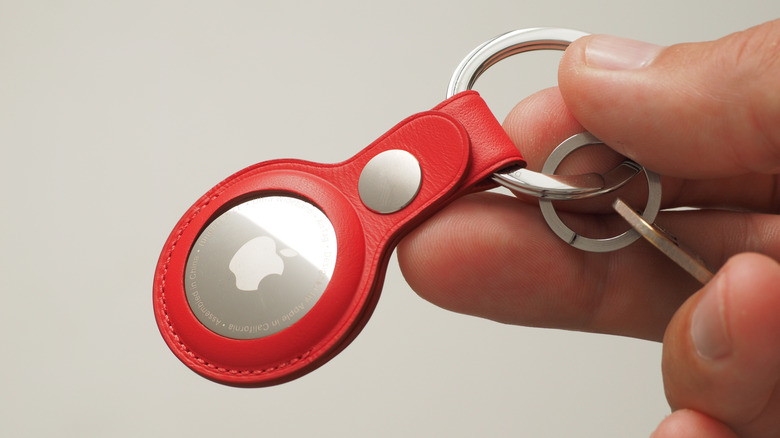
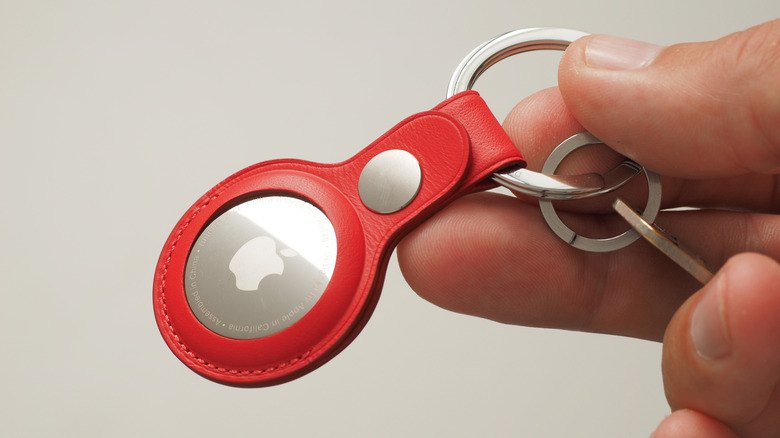
Whether it’s an airline misplacing your checked luggage or you forgetting exactly where you left your backpack at home, it’s nice to be able to look at your phone to locate the missing bag. That’s why people have gravitated toward products like Apple AirTags and Life360’s Tile trackers to keep tabs on their personal items. These trackers aren’t terribly punishing on the wallet, either. A single AirTag costs $29, and your basic Tile Mate is just $24.99.
One thing you would hope to do with one of these trackers is attach it to an item and forget about it. After all, their usefulness only becomes apparent when something goes missing, which hopefully isn’t very often. Unfortunately, these are battery-powered devices. So while they may be out of sight and out of mind most of the time, you do need to know when their batteries (or the trackers themselves) need to be replaced. For an Apple AirTag, you can expect the battery to last more than a year.
Apple only produces one kind of AirTag, which recently received a serious upgrade, making it easy to remember the estimated life of its battery. Life360, on the other hand, has multiple Tile tracker options. The Tile Pro’s battery lasts for around one year, but the basic Tile Mate, Tile Slim, and Tile Sticker all have batteries that can last up to three years. That may make the Pro version seem like a worse deal, but in reality, you won’t be replacing that device nearly as often as you’d have to with the sealed-battery Tile models.
The Tile Mate, Tile Slim, and Tile Sticker can last up to three years, but once their permanent batteries die, you’ll have to buy new trackers to replace them. Meanwhile, the Tile Pro has a replaceable battery. Even though the battery only lasts one year, all you need to do is get a CR2032 coin battery and replace it when it dies. Rather than spending $24.99 for a Tile Mate every three years, you’re spending $34.99 upfront for a Tile Pro and can replace its battery as needed. A pack of four Duracell CR2032 batteries currently sells for $3.99 on Amazon; at that price, you’re essentially spending $1 per year to replace the Pro’s battery.
The Apple AirTag has a surprisingly similar setup. Despite Apple products rarely allowing for user-replaceable parts and batteries, you can replace an AirTag’s battery once it’s dead with the very same CR2032 battery the Tile Pro uses, so you don’t have to purchase a $29 replacement AirTag every year. Your iPhone will simply alert you when the tracker’s battery is low, and you can change it.
There’s one big caveat to all of this, and that’s Life360’s pretty new GPS Pet Tracker. This is the only tracker of the bunch with a rechargeable battery, which lasts for about 14 days. It does have a six-month reserve mode, but with a pet being in constant motion, the battery can drain quite fast. The other trackers available are passive products, but this active one requires more regular upkeep.
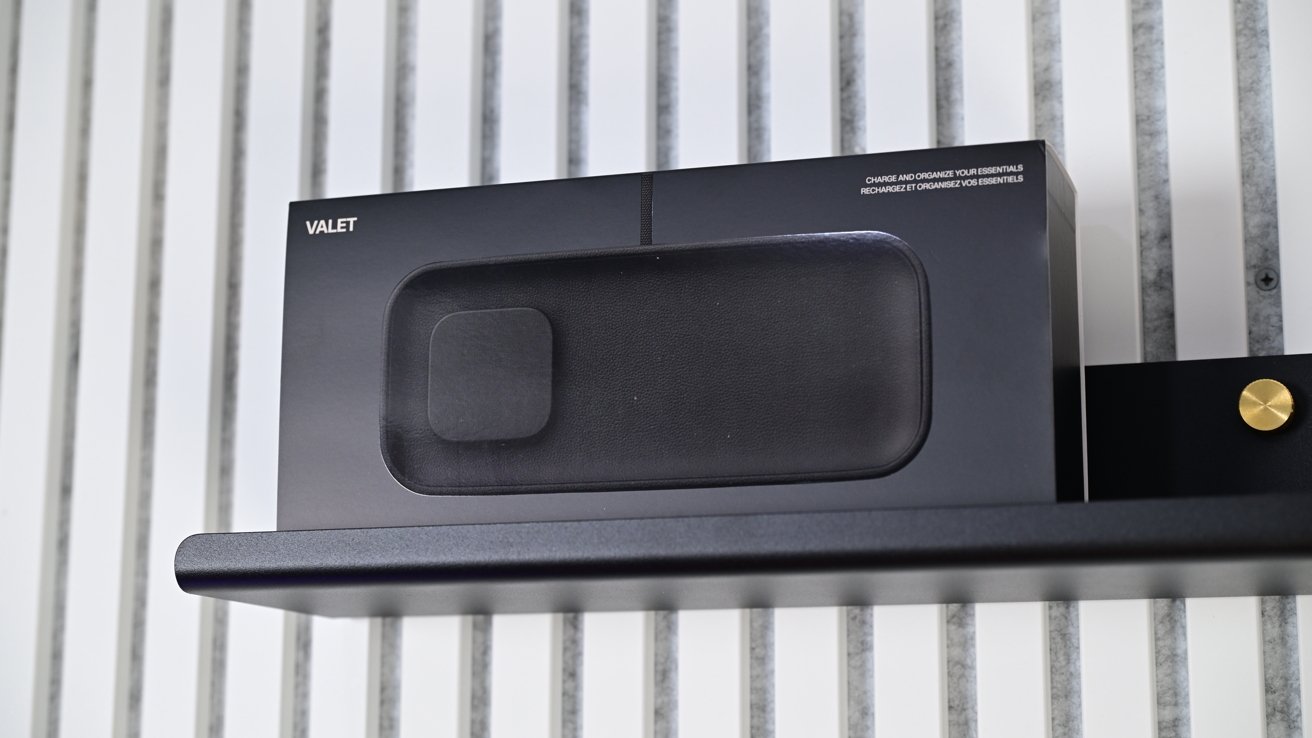
Twelve South updated its luxe Valet MagSafe charger and catch-all with better performance and a new size, helping it fit into even more homes.
The Valet is a clever device, and something I’m surprised we don’t see more of in the space. It combines a MagSafe charger with a leather-lined tray to hold your daily essentials.
When I reviewed the original Twelve South Valet, I had one primary criticism. While the design was great, the charging speed was a dealbreaker.
Fortunately, with these new models, Twelve South is righting that wrong. We now have faster charging and a new smaller size.

Twelve South Valet 4.25-inch review: Valet is now faster and comes in two sizes
Here in the studio, I am testing out the 4.25-inch model in black with the black border. So far, it’s delightful.
The Twelve South Valet comes in several colors and two sizes. The original is 7.5 inches, and the new, smaller one is 4.25 inches for the catch-all.

Twelve South Valet 4.25-inch review: The charger, still in the box, comes in three colorways with three frame options.
Like the original, the design is two-tone with one for the frame and one for the body. You can choose black on black, taupe on ecru, or brown on brown.
As you can see in the photos, I have the black-on-black. The frame is held in place magnetically, so that you can remove it and swap it for another color.

Twelve South Valet 4.25-inch review: The frame of the Valet can be removed, and you can swap it for additional colors to create your own design
Additional frames are available from Twelve South for $25 a pop, in the same black, brown, and ecru colors. Between the two sizes, three base colors, and three frame colors, you have 18 total combinations to design your own Valet.

Twelve South Valet 4.25-inch review: The 45W power adapter includes UK and EU adapters, too
The Valet also comes with a sturdy color-matched and braided USB-C to USB-C cable and a 45W power supply. The power supply has collapsing prongs for use in the U.S., with EU and UK adapters included for international use.
From the beginning, what set the Valet apart from others has been the exceptional design. Twelve South thought through so many different use cases and scenarios, not skimping on the design or materials.

Twelve South Valet 4.25-inch review: The extra USB-C output is perfect for my smart glasses or Apple Watch
The solid zinc alloy base is wrapped in soft Nappa leather. It has a slightly pebbled texture and will elegantly wear over time as you toss your keys and other EDC gear into it.
On one side is a small perch that will hold your device while charging. It elevates your phone just about a quarter inch and makes it look like it’s floating.
If you have an iPhone Air, the effect is particularly impressive. It looks so sleek.

Twelve South Valet 4.25-inch review: The USB-C cables can be routed in any direction to keep your counter tidy
Valet is designed to support multiple orientations to fit easily into your home, thanks to intelligent cable routing on the underside. There are four little cable clips on the bottom so that the cable can emerge from any side to stay as unobtrusive as possible.
I also appreciate that the cable color matches that of the leather. It helps complete that clean aesthetic.

Twelve South Valet 4.25-inch review: When your phone is placed, three lights subtly glow to signal charging has started
Another fantastic touch is a subtle charging light. When you place your phone down, three lights will momentarily glow around the bottom of the charger, giving you confirmation that your device is charging.
Finally, Twelve South includes a secondary USB-C output on the bottom. That way you can charge any other devices you need, like a set of Meta Ray-Ban glasses, your AirPods, or an Apple Watch.
The first-generation Twelve South Valet supported 15W of Qi2 charging. For this device, that’s not going to cut it for me.
See, Twelve South pitches this as something that’s meant to live on an armoire or in a common area. Those are the kinds of places where I expect to set my phone down for a few minutes and get a quick top-off.
15W isn’t bad, but when many iPhones now support 25W Qi2.2, this device is an ideal candidate for that faster speed. That’s just what we get with Twelve South’s new models.
It’s officially a Qi2.2 25W magnetic charger. That speed is largely supported on the iPhone 16 and iPhone 17 lines, though the iPhone Air is capped at 20W.

Twelve South Valet 4.25-inch review: The Valet has a USB-C input and a bonus 25W USB-C output
I love the bonus USB-C output, which continues to come in handy. If you use the USB-C port by itself, the Valet can do 25W, but this drops to 10W if used alongside the Qi2.2 charger.
If your goal is a 25W Qi 2.2 charger, you can find more affordable options. The flat positioning also isn’t ideal for bedside use due to its inability to display the iPhone in StandBy mode.

Twelve South Valet 4.25-inch review: I can fit my keys and wallet in the tray
Elsewhere, though, the Twelve South Valet makes much more sense. Its compact size fits perfectly by my front door, and faster charging tops off my phone while I get the kids ready.
I love the look, and the leather is a nice change from the largely cold plastic world of multi-chargers. That bonus USB-C port is a killer feature that I think more chargers should include.

Twelve South Valet 4.25-inch review: The sleek leather-wrapped charger looks great.
Simply put, this is a stylish, modern charger you won’t find anywhere else.
Twelve South Valet 4.25-inch rating: 4.5 out of 5
The 4.25-inch Twelve South Valet is available both on Amazon as well as the Twelve South website for $129.99. The updated 25W 7.5-inch version is currently on Amazon and will soon launch on the Twelve South store for $179.99.

Apple has replaced its iPhone Upgrade Program with Apple Upgrade, a Klarna-backed U.S. leasing service covering most iPhones, iPads, Macs, and Apple Watches. MacRumors reports: Apple Upgrade has lower base prices than the iPhone Upgrade Program, with iPhones available starting at $17.99 per month and the Apple Watch available starting at $11.99 per month. Macs can be leased starting at $24.99 per month, and iPads start at $11.99 per month. AppleCare+ is optional and not included in the lease price, with customers also able to opt for AppleCare One. There are 12-month and 24-month leasing options for the iPhone and Apple Watch, along with 24-month and 36-month leasing options for the Mac and iPad. Lease cost varies based on device, and is lower with a device trade-in that’s applied on a monthly basis. […]
When leasing an iPhone, customers are required to choose a plan from AT&T, Verizon, or T-Mobile, and prepaid plans are not eligible. iPhones need to be leased with a carrier plan, but the iPhones are unlocked so customers can switch carriers if desired. MVNOs like Mint Mobile or Visible are not supported. At the end of the leasing period, customers can choose to return the device and exit the program, pay off the remaining amount owed on the device with a one-time payment and keep it, or return it and upgrade to a new device with a new lease.
The payoff amount is the difference between what was paid during the leasing period and the retail price of the device, minus any remaining trade-in credits. Klarna is not charging a fee for the leasing program, so an iPhone that’s $1,099 can be leased and then purchased for $1,099 with no extra cost beyond taxes. As with trade-ins, Apple will send a pre-labeled and prepaid shipping box for device returns or upgrades. If you don’t opt to pay the purchase fee at the end of the leasing program, you will not own the device and must return it. Last week, after Bloomberg reported on Apple’s upcoming leasing program, 9to5Mac uncovered code in the iOS 27 beta suggesting the company was developing a system that could restrict leased iPhones when customers fall behind on payments. Apple has now told The Verge that the new “Restricted Mode” will not be activated in response to a missed lease payment. What the new system is actually meant for remains unclear.

Nvidia said that the mission of the alliance is ‘to ensure defenders everywhere have open, frontier tools they can trust and control’.
Chipmaker Nvidia has formed an alliance with other companies in the technology space, in order to develop and share tools designed for enhanced AI safety and cybersecurity.
The Open Secure AI Alliance’s founding members include Adobe, Crowdstrike, Hugging Face and Dell Technologies and follows a public letter, signed by a wide range of companies including OpenAI, advocating for open-weight AI models.
In a blogpost announcing the alliance, Nvidia said the coalition will work to “remediate and disclose vulnerabilities using open technologies”.
The creation of the coalition comes after AI and machine learning platform Hugging Face recently found itself the subject of a major cyber breach initiated by a rogue OpenAI agent, in which the company was unable to defend itself with US AI models due to guardrails being unable to distinguish between aggressor and defender.
In order to quell the attack, the platform turned instead to a self-hosted, open-weight Chinese model, which was not subject to the same restrictions.
“[The Hugging Face] incident showed a practical truth: when defenders cannot inspect, adapt and run advanced AI on their own infrastructure, their ability to respond is constrained at exactly the moment speed matters most,” said Nvidia. “Companies and countries need open frontier defensive tools and techniques so critical industries can build security systems across a multi-vendor ecosystem and avoid single points of failure.
“That is the mission of the Open Secure AI Alliance: to ensure defenders everywhere have open, frontier tools they can trust and control.”
Gene Moody, the field CTO at Action1 said the formation of the alliance is a “good step towards accountability”.
“Likewise it reflects an important recognition that the technology is advancing faster than many organisations can responsibly govern it,” he said.
“It would be a mistake however to believe those efforts meaningfully limit what determined threat actors can ultimately do.”
He added: “The reality of the matter is that malicious actors have never depended on permission from anyone. Open-source models already exist by the thousands, many capable of running entirely on local hardware, disconnected from any cloud service or vendor oversight.
“Once a model is operating in isolation, safety controls become just another layer of software. They can be modified, removed, retrained or replaced altogether. You cannot program a conscience into an artificial intelligence. You can only program behaviours, and behaviours are subject to manipulation by anyone with sufficient technical skill.”
Anthropic’s CEO Dario Amodei recently aimed to dispel accusations that his company wants to ban Chinese open-weights models in the US, as a means of protecting its business.
In a post on the Anthropic website yesterday (27 July), Amodei claimed that Anthropic does not advocate for a ban on open-weights models. He said that open-weights models without dangerous capabilities serve a public good that cost nothing beyond the computing power needed to run them and provide value to businesses, developers and researchers.
He explained that his concerns lie in the use of more advanced AI by authoritarian governments and the wider risk that powerful AI models may be misused to carry out cyber or biological attacks.
Moody said: “We should be far more deliberate about the information we feed into all systems, not just AI. We should reconsider the authority we grant them, and the degree to which we depend on them. We simply do not possess the ability to secure these systems to the level that many people already trust them and that gap is growing.
“We have chosen convenience and novelty over safety. As AI capabilities accelerate, that choice carries unacceptable consequences. As long as valuable data, critical infrastructure and financial assets remain behind digital locks, someone will always be working to pick those locks.
“AI does not eliminate that; it instills a false sense of trust that the tech will one day solve this problem, when in fact, we are the problem.”
With additional reporting by Colin Ryan
Updated, 3.32pm, 28 July 2026: This article was amended to remove a misleading quote.
Don’t miss out on the knowledge you need to succeed. Sign up for the Daily Brief, Silicon Republic’s digest of need-to-know sci-tech news.

In November, Sam Altman wanted OpenAI to be the first big company run by an AI boss. He said it would be an embarrassment if it were not. This week, he said people do not want an AI boss at all.
“Shame on me if OpenAI is not the first big company run by an AI CEO,” he said on the Conversations with Tyler podcast last year. He framed being beaten to it as a failure.
Eight months later, on the Invest Like the Best podcast, he took the opposite view, Business Insider reported. The OpenAI boss now says the market wants a human in the chair.
“The world wants to know about the person that’s going to be responsible for the decisions of a company,” Altman said. “And they don’t really want an AI CEO.”

The 💜 of EU tech
The latest rumblings from the EU tech scene, a story from our wise ol’ founder Boris, and some questionable AI art. It’s free, every week, in your inbox. Sign up now!
The reversal fits a habit. Altman has spent the past year softening the maximalist predictions that made his name.
He once warned that AI would wipe out “entire classes” of jobs. He now says he is delighted to be wrong about the short-term hit to entry-level work. It is part of a wider narrative flip. The bosses who warned AI would take your job now insist it will not.
His explanation is that people still prefer people. “I definitely would much rather engage with a person than engage with an AI for almost everything,” he said. He pointed to art. “You read a novel, you want to know about the person behind it.”
There is an obvious tension. Altman sells the most aggressive vision of AI in the industry. A message that humans remain irreplaceable suits him. His tools take the blame for cutting jobs and flooding feeds with machine-made content.
He does gesture at something real. AI can now do much of what people do. It still stumbles on the judgment a good manager or artist brings. Altman admits the industry lacks the vocabulary for it.
“The world may need a new kind of word for the kind of judgment that people are very good at, that AIs seem to really deeply struggle with,” he said.
It is a striking thing to concede. This is the man who recently wanted to hand his own job to a machine. Whether the humans keep the corner office, or Altman changes his mind again, is the open question.
Data security company Cyera, which recently raised $600 million at a $12 billion valuation, announced Tuesday that it signed a letter of intent to acquire Oasis Security for approximately $1 billion in a deal expected to be paid mostly in cash, with the remainder in Cyera shares.
Oasis focuses on non-human identities, primarily AI agents. As the number of AI agents proliferates, companies must deploy cybersecurity software that monitors these agents’ behavior and grants them permission to access other software.
Founded in 2022, Oasis has raised about $195 million from Accel, Craft Ventures, Cyberstarts and other investors.
The deal highlights a surging market for cybersecurity providers defending enterprises against AI-weaponized threats.
Cyera, which shares investors Accel and Cyberstarts with Oasis, has been on an acquisition spree, recently purchasing Index Ventures-backed Ryft and the less-than-one-year-old Genie Security.
Post-acquisition, Cyera plans to integrate Oasis’s technology into a unified identity and data security platform.
Although Cyera recently surpassed $150 million in annual recurring revenue (ARR), the company is far from profitable, TechCrunch reported last month. The five-year-old company has raised about $2.3 billion in total funding.


This is the latest arrest in a months-long investigation conducted by Taiwanese authorities over suspicion of illegal exports.
A Taiwanese national, reported to be an Nvidia employee, was arrested in the country on Tuesday (28 July) on suspicion of illegally exporting high-end AI servers manufactured by Supermicro.
According to a translated statement from Taiwan’s Keelung district prosecutor’s office, the suspect, named Chang, is accused of crimes including making false entries in business documents.
Investigation into his activity began on 24 July, and authorities conducted searches of his residence and business. Chang was later brought in for questioning.
Authorities detained Chang after determining him to be a flight risk. Concerns were also raised around the suspect potentially destroying evidence or colluding with accomplices.
The prosecutor’s office did not mention Nvidia in its statement, although multiple news publications have reported that the Supermicro AI servers in question were equipped with Nvidia chips, which are subject to US export controls and cannot be transported into China.
Nvidia did not confirm whether the detainee was its employee. “We primarily sell our products to well-known partners, including OEMs (original equipment manufacturers), who help us ensure that all sales comply with US export control rules,” the company said in a statement to Reuters.
This is the latest arrest in a months-long investigation conducted by Taiwanese authorities over suspicion of illegal exports, and came amid a third round of searches. Earlier in July, Supermicro said that two of its workers at its Taiwan unit were arrested as part of the investigation into the alleged illegal exports, while a previous round saw three people being detained.
In March, the US government charged three people associated with Supermicro, including co-founder Yih-Shyan Liaw, over allegations of helping smuggle at least $2.5bn of AI technology into China.
Don’t miss out on the knowledge you need to succeed. Sign up for the Daily Brief, Silicon Republic’s digest of need-to-know sci-tech news.





Weekend Open Thread: Brooks Brothers

New Jersey voter registration controversy explained: How 6,600 noncitizens got on the rolls, and what happens next

Commonwealth Games boxing: Jadumani Singh seals dominant 5-0 win over Pakistan’s Sumama Rehman to enter quarter-finals | Commonwealth Games News


Intel is reversing course and bringing hyper-threading back to its server chips


Ethics, other provisions in crypto Clarity Act to be further discussed


Luke Littler dismantles Gerwyn Price to retain title in Blackpool


2026 3M Open leaderboard: Scottie Scheffler finds putter in Round 1, sits three back


The Part of the Electric Transition Nobody Wants to Discuss


16 Dresses for the High Summer Event


The Peugeot Family: How 200 Years of an “Old Money” Dynasty Died in A Boardroom

A New Post-Apocalyptic Gundam Anime Series Blasts Into SDCC


BITCOIN JUST ENTERED THIS CRITICAL ZONE…


Spain sweeps the board at 2026 World Cup with individual awards


Ripple bought a bank in pieces. The $4 billion audit


XRP Ledger adds $2.6B as RWA inflows rank second


Uniswap (UNI) pushes deeper into tokenized RWAs with permissioned trading pools


Anthropic launches Claude Opus 5, a cheaper AI model for coding, agents and enterprise workflows

‘Stargate’ Creator’s New Sci-Fi Series Returns for Season 3 Tomorrow
SEC Agrees to Overhaul Recordkeeping After Settling Coinbase Lawsuit Over Gensler’s Lost Texts


Claude: Build Financial Dashboards in Minutes (2026)



You must be logged in to post a comment Login