Connect with us

Tech

Daily Deal: The Ultimate Unity Game Development Bundle

Published

on

from the good-deals-on-cool-stuff dept

The Ultimate Unity Game Development Bundle has 44+ hourse of video training designed for aspiring developers. Dive deep into Unity Engine and C# fundamentals, master player physics, and polish your creations with pro-level animations and post-processing. With multi-platform deployment training, it’s everything you need to kickstart a portfolio. It’s on sale for $25.

Note: The Techdirt Deals Store is powered and curated by StackSocial. A portion of all sales from Techdirt Deals helps support Techdirt. The products featured do not reflect endorsements by our editorial team.

Filed Under: daily deal

Source link

Advertisement
Continue Reading
Click to comment

You must be logged in to post a comment Login

Leave a Reply

Tech

X Open Sources Its Ranking and Filtering Algorithms

Published

on

An anonymous reader shared this report from TechCrunch:

X is significantly expanding its open source codebase, which includes the app’s “For You” algorithm and its core ranking engine, and adding a feature that will let users see if their account or posts have been impacted by any of its ranking systems, the social network said on Thursday. The company is making the source code for the “For You” timeline, the default feed you see when you open the app, available on GitHub under the Apache v2 license. It’s also expanding its previous efforts to open source parts of its codebase to add more detail, including the model configuration, filter, and core ranking system details. That means it includes the parameters used to weight different signals — key to understanding which posts are actually displayed. This also makes the codebase roughly 10 to 15 times larger than it was before.

“You’ll get the core ranking code that pulls posts and ranks them for any given user and assembles the feed,” X’s VP of Product Keith Coleman told TechCrunch in an interview ahead of the announcement. “You can see the systems that filter out potentially problematic, rule-violating content…And some of those systems, like the ranker and the score, you can even run yourself outside the company.”
“This is the kind of thing that I think people will be fairly shocked that we are releasing,” he added.

In addition to the repository, X is providing tools that will let users see for themselves if and how X’s ranking systems have impacted their account or posts. A new transparency tool is rolling out to an “Under the Hood” page in the app’s settings, which will let users who have posted 10 or more times over the past month download their aggregate stats as a JSON file. The file will show if any labels have been applied to their account or posts over the past calendar month.

Advertisement

X’s VP of Product told TechCrunch that X engineers will consider pull requests. “That would be amazing to have people submitting code that improves the algorithm…I mean, how cool would it be for the X algorithm to be not just visible to the public, but also, like, by the public?”

Read more of this story at Slashdot.

Source link

Advertisement
Continue Reading

Tech

SpaceX officially closes its Cursor acquisition

Published

on

AI coding startup Cursor is now officially a part of SpaceX, according to an announcement on the Cursor blog.

Elon Musk’s SpaceX — which also acquired Musk’s xAI earlier this year — announced a deal in April for the companies to develop technology together; the deal also gave SpaceX the option to acquire Cursor for $60 billion. Two months later, as SpaceX became a public company, the companies said they were moving forward with the acquisition.

In its announcement that the deal has closed, Cursor repeatedly referenced SpaceX’s computing infrastructure, which the company has been renting out to customers including Anthropic and Google. (SpaceX also faces a lawsuit over the pollution created by its data center gas turbines.)

Cursor said that by becoming part of SpaceX, it will have “access to the largest fleet of GPUs in the world.”

Advertisement

“SpaceX is building the computing capacity needed to scale intelligence far beyond what exists today,” the company added. “Cursor will be one place where that intelligence becomes useful.”

Source link

Continue Reading

Tech

Anthropic shares more details about how Claude’s new watermarks will work

Published

on

Anthropic published a blog post Friday seeking to answer some basic questions about how it will watermark the text generated by its chatbot Claude. Such as: How will the watermarking actually work? Can it be hidden with editing? And how does this affect code?

Claude users have been debating the move since the company revealed earlier this week that it would be doing this watermarking to comply with the EU AI Act’s Transparency Code, which requires AI companies to use systems that make it possible to identify AI-generated content.

On Reddit, for example, one poster characterized this as a conspiracy against innocent Claude users, while another claimed, “The only reason you wouldn’t want this is to lie to people.” And Business Insider reports that “dozens” of users on X have claimed to cancel their Claude subscriptions as a result.

Anthropic’s new post starts with a general overview of the watermarking concept, explaining that when making “low-stakes choices” — like choosing between the words “overcast” and “grey” to describe the weather — Claude can create a pattern in its responses that is “undetectable to the reader, but is detectable to anyone who has a key that encodes it.”

Advertisement

“Watermarking does not impact the quality of Claude’s output,” the company said. “To a reader, a watermarked response is indistinguishable from an unwatermarked one.”

More specifically, Anthropic said it will be using the SynthID-Text approach that the Google DeepMind team outlined in 2024, and that it plans to release a watermark detection API. It also noted that watermarking is distinct from the AI detection approaches offered by companies like Pangram that look for “tells” in the writing (like the construction “his isn’t [X], it’s [Y]”) to reveal AI usage: “Picking up on these patterns is fundamentally different from checking for a watermark.”

Could someone just rewrite the text to hide the watermark? Anthropic said it’s possible, but “light editing probably won’t remove the watermark completely,” while “a complete rewrite where every word is replaced will.”

“In the latter case, of course, it’s arguable whether the text can any longer be described as AI-generated,” the company said.

Advertisement

As for whether the watermark will be detectable in text that was only proofread or edited by Claude, Anthropic said that will depend on “the length of the text and how heavily Claude has edited it.” If it’s only been lightly edited, “nearly all the words” will have been written by the human author and “there’s very little (if anything) for the watermark to attach to.”

Code, meanwhile, should have less of a watermark than other text, because the model will need to create working code and won’t have the freedom to choose between a variety of equally valid options. 

“Having said that, in areas where there is an arbitrary choice between particular words or terms within the code, the watermark can be used, such as comments within code,” Anthropic said. “But by definition, it will have a negligible effect on the actual code produced.”

Anthropic also said that Claude won’t be the only AI chatbot to generate watermarked text, as “other major model developers have signed the same Code of Practice and will be implementing their own watermarks.”

Advertisement

When you purchase through links in our articles, we may earn a small commission. This doesn’t affect our editorial independence.

Source link

Continue Reading

Tech

Porsche’s One-Off Flachbau RS Revives the Slant Nose for the Road

Published

on

Porsche Flachbau RS 911 GT2 RS Reveal
A single customer handed Porsche’s Sonderwunsch team a nearly new 2018 911 GT2 RS with the Weissach package and asked for something that had not existed in decades. The result is the Flachbau RS, a factory one-off that stretches the front of a modern turbocharged 911 into the flat, purposeful silhouette once reserved for the most extreme racing cars of the late 1970s.


The silhouette belongs to the 935/78, a long-tailed Group 5 machine commonly known as Moby Dick due to its white paint and whale-like proportions. In the early 1980s, a few 911 Turbo road vehicles featured the identical front styling. At the time, approximately 948 of the original Flachbau models left the factory. This new automobile marks the first time Porsche has explored the concept of a current generation GT2 RS while still keeping it street legal in Europe.

Sale


LEGO Speed Champions Porsche 911 GT3 RS Super Car Toy – Model Kit & Pretend Play Toy for Boys & Girls…
  • BUILD A RACING LEGEND – Boys and girls ages 9 years old and up can construct the LEGO Speed Champions Porsche 911 GT3 RS Super Car (77239) building…
  • AUTHENTIC PORSCHE DETAILS – Young builders can recreate the real-life vehicle’s signature elements including the famous rear wing, air intake…
  • 1 PORSCHE DRIVER MINIFIGURE – Kids can place the driver minifigure with helmet and red Porsche Track Day Experience outfit behind the wheel to stage…


Work began nearly three years ago, with Style Porsche designers, Weissach engineers, Porsche Motorsport experts, and the Manthey team all contributing. Grant Larson, the designer who had already given us a modern take on the 935 for Porsche’s 70th birthday, was the one who finally got to stamp his name on the finished design – however it’s worth noting that he was already well into retirement by then. The criteria was extremely clear: keep the 3.8-liter twin-turbo flat-six with 700 horsepower and 553 lb-ft of torque exactly as is, and modify everything else around it.

Advertisement

Porsche Flachbau RS 911 GT2 RS Reveal
The most noticeable difference is up front, where the standard GT2 RS’s fenders have been removed. Lower, wider panels with properly positioned louvers replace them, allowing high-pressure air to exit the wheel arches more effectively. There’s a new bumper with two small canards and a deeper splitter, and the gasoline filler flap and mechanism had to be redesigned from the ground up to accommodate the changed shape. Round headlights are no longer available; instead, three thin LED units stacked vertically inside the fender provide high beam, low beam, and daytime running light. When the lights are turned out, the front end appears to have no headlights at all, similar to the vintage race vehicles. The body is primarily coated in Grand Prix White, a color first introduced on the 911 in 1974 and matching several classic cars from Porsche’s own collection. The dark panels and exposed carbon fiber provide contrast. The hood features a U-shaped carbon band that is deliberately reminiscent of the Martini-liveried Moby Dick. Aero disks in the same white are mounted over the rear wheels and brake calipers in a deep black.

Porsche Flachbau RS 911 GT2 RS Reveal
Over at the back of the car, there’s a new rear wing that’s several inches higher than the standard GT2 RS piece. The S-shaped mounts and three-position manual adjustment are all from the 992-generation GT3 R Rennsport. At high speeds, the wing can generate around 1,221 pounds of downforce on the rear axle, which is somewhat higher than a GT2 RS with the Manthey kit installed. A matching front splitter, underbody panels, and rear diffuser round out the kit. Carbon-fiber aero disks reduce drag in the rear wheels. Overall, the changes save the car nearly 70 pounds compared to the already slim Weissach-equipped donor.

Porsche Flachbau RS 911 GT2 RS Interior
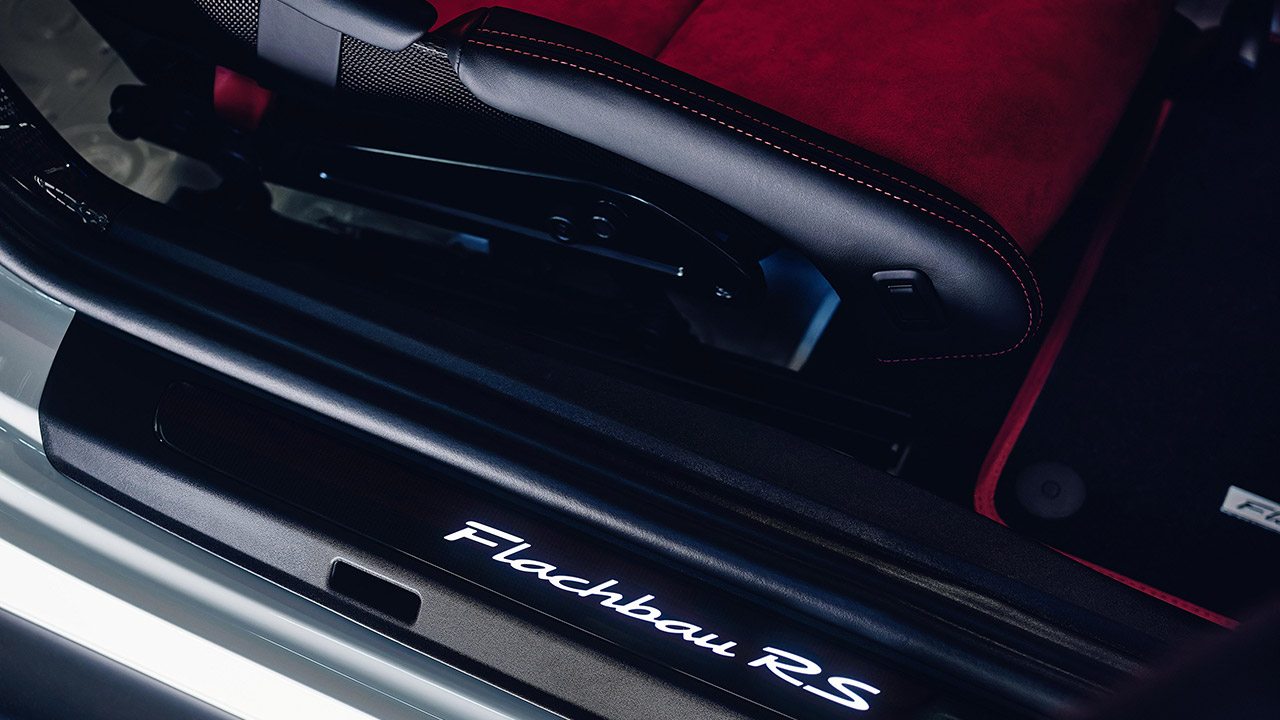
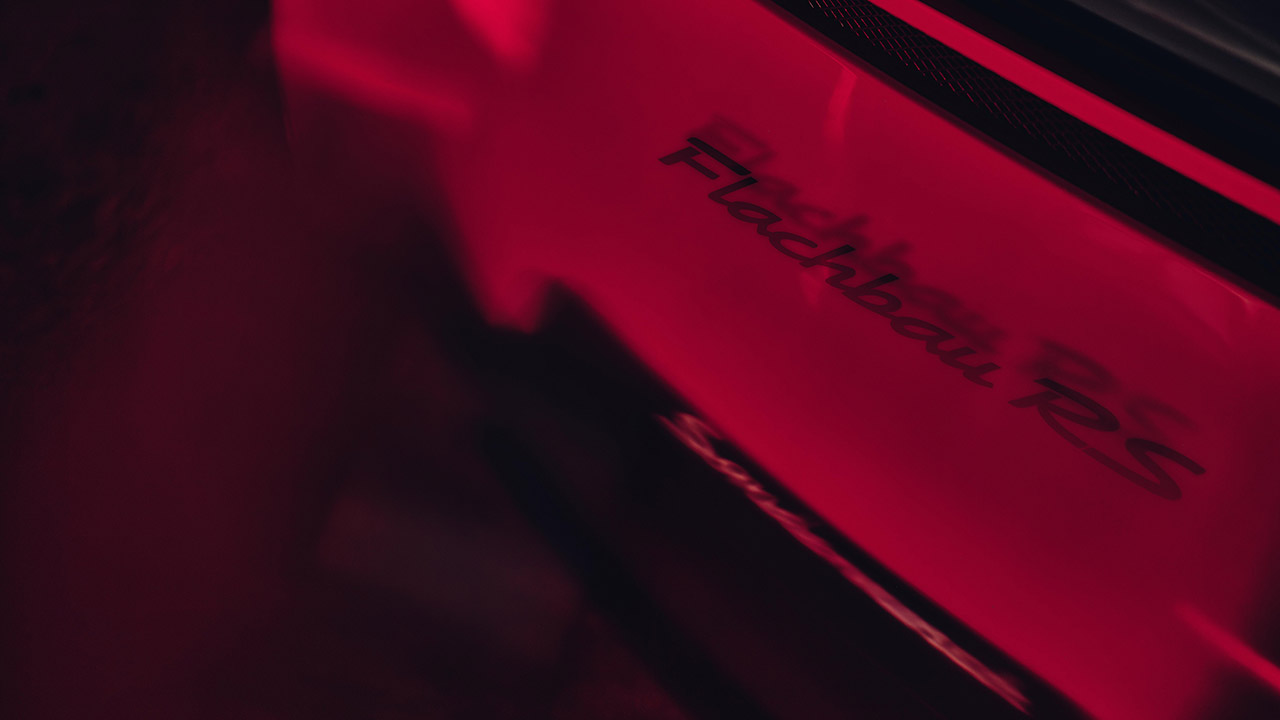
Inside, the front seats remain intact, with red Alcantara and black leather, as well as the carbon fiber shells. Everything else has been ripped out. The middle screen has been replaced by a simple storage box wrapped in leather. To conserve weight, the whole audio system was removed, as well as the majority of the sound deadening material and floor coverings. The exposed metal bits, like the bodywork, have been painted in Grand Prix White. Some parts have also been bolted with carbon cladding, and some of the wiring is still visible, but they made sure to cover the parts they couldn’t go without. The “Flachbau RS” insignia is still stitched on the headrests, along with a stylized shape of the Nürburgring Nordschleife. Even the mandatory warning triangle is tucked away in a removable box so it doesn’t get in the way on track days. A little gold plaque on the passenger side dashboard reads “Sonderwunsch” and comes with an engraved plate stating the car is a “Werksunikat 2026, Flachbau RS.”

Porsche Flachbau RS 911 GT2 RS Interior
Porsche approached the validation process with the same rigor as they would with a production vehicle. First, digital accident simulations, airbag tests, and structural analysis were performed to ensure the vehicle’s safety. Then they built a few prototypes and tested them in the wind tunnel, at high speeds on the Mendig airport, and with test driver Lars Kern doing 50 laps of the Nordschleife. To ensure that all of the faults were worked out, they conducted an endurance test in Weissach that replicated 150,000 kilometers of drive in the showroom. They also built three different test mules to figure out the lighting and aerodynamics. Finally, the finished Flachbau RS contains all of the components required to be legally driven in Europe.

Source link

Continue Reading

Tech

Ferrari’s CZ26 One-Off Debuts at Monterey Car Week, is Silver Capsule with Red Edges

Published

on

Ferrari CZ26 Reveal Monterey Car Week
Ferrari rolled a completely unique coupe onto the Monterey Car Week stage this week and called it CZ26. Built through the Special Projects programme for a single American client, the car started life as an SF90 Stradale and left Maranello two years later looking like something else entirely. Flavio Manzoni’s design team treated the SF90’s hard points as a fixed foundation and then drew a new body around them, one that leans hard into the clean geometry of 1970s Italian industrial objects while still delivering the performance numbers the donor car made famous.


The silhouette is purposefully oriented horizontally. A low, central volume falls in like a capsule between four powerful, muscular wheel arches, and the roof and pillars are finished in black, giving the passenger cell the appearance of a discrete chunk embedded in the body. From the front, the vehicle looks to have a full-width, serious business-like grille that swallows incredibly slim lighting modules, brake ducts, and sensors in a single dismal strip.


LEGO Technic Ferrari 488 Pista Car 42235
  • SPORTS CAR BUILDING TOY – Fuel kids’ passion for high-performance vehicles with the LEGO Technic Ferrari 488 PISTA Car (42235) model building kit…
  • TOY CAR WITH REALISTIC DETAILS – Kids can learn new engineering skills as they put together and explore the V8 engine with moving pistons…
  • FORZA HORIZON 6 UNLOCKABLE – Unlock a special LEGO Technic livery in the Forza Horizon 6 video game – please note that a copy of the game is…


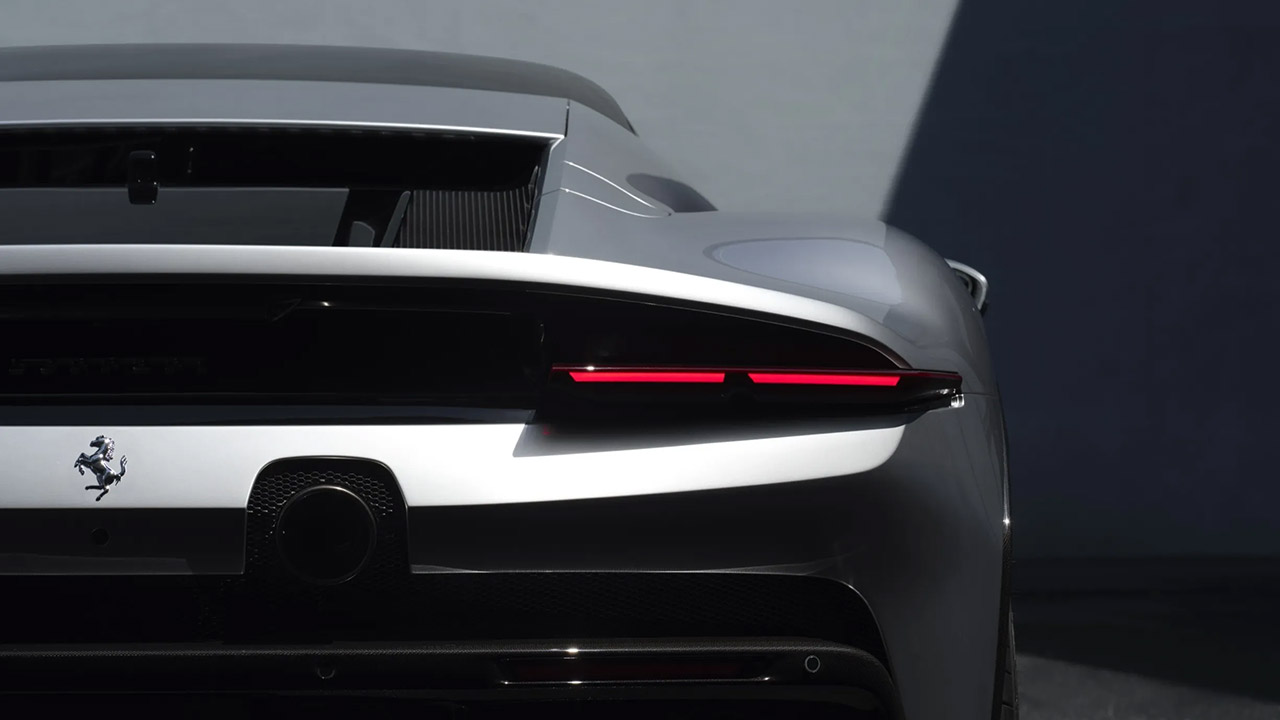
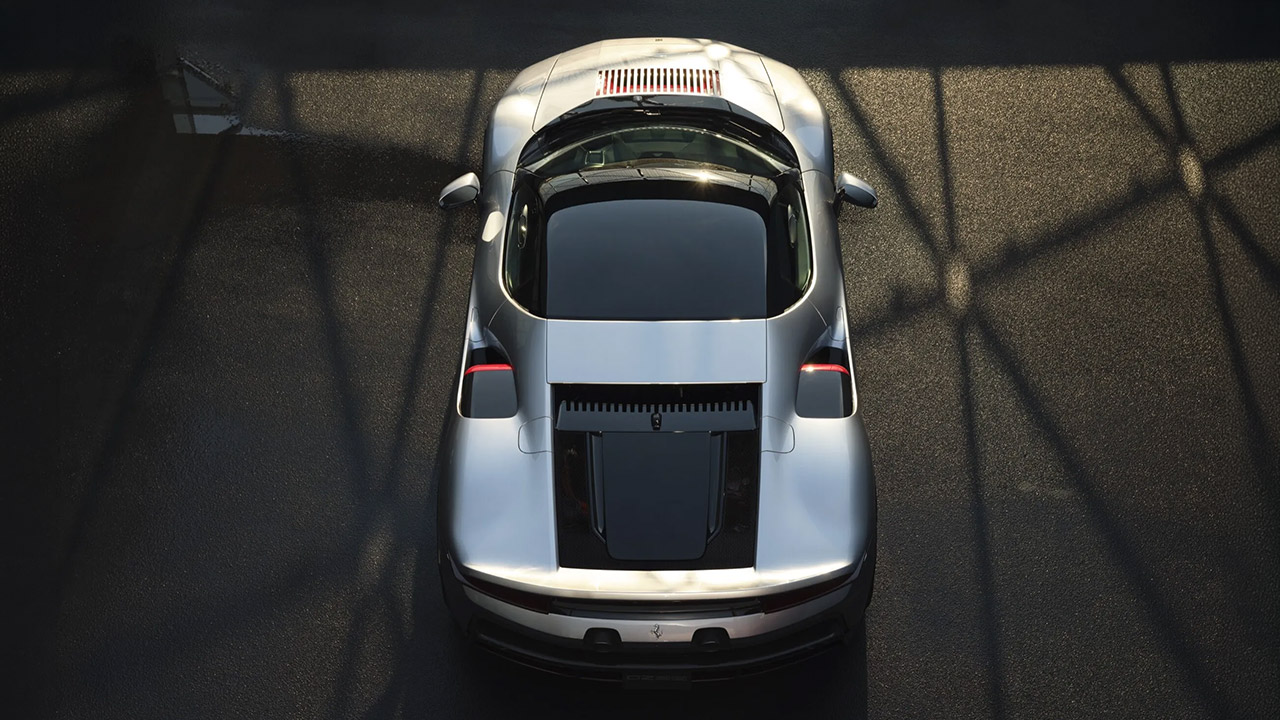
The leading edge is practically straight up and down, giving the nose a sharp visage that appears to have been designed by a brilliant architect rather than just rounded off like the SF90. At the back, the body simply stops dead. The taillights are perched out on the end of the car with a cantilevered design that appears to be about to tip over, and the diffuser is as broad as the car is long, with the glass engine cover completely shaded, making it impossible to see what’s lying underneath. The car’s body is painted a liquid-silver color dubbed Argento Veloce, which looks like liquid metal and shimmers and swirls under the light; the only bright red elements you’ll notice are the functional aero bits.

Ferrari CZ26 Reveal
Ferrari CZ26 Reveal
Every minor change underneath affects how air moves around the car. The radiator pack was rearranged so that air flows more effectively via it while also providing a little extra downforce at the front. The air curtains in the bumper corners ensure adequate airflow around the wheels. The underbody and all of its small vortex generators were modified to maintain the car’s overall balance. The rear spoiler was increased in size and the diffuser was reshaped to increase the car’s speed, while the engine cover received a few new air vents to keep it from becoming too hot when the hybrid system is working as hard as it can. Finally, it all adds up to a car that has a considerably simpler appearance than the SF90 but performs just as well in terms of airflow.

Ferrari CZ26 Reveal
Ferrari CZ26 Reveal
Nothing mechanical has changed; the 3,990cc twin-turbo V8 still produces 797cv at 7900 rpm and 804 Nm at 6250 rpm. Three electric motors add extra 162kW of power. The combined output ranges from 986 to 1000cv, depending on rounding. The power is routed to all four wheels via the reliable 8-speed dual-clutch gearbox, a configuration we’ve seen before. The 7.9kWh battery provides around 25 kilometers of pure-electric range, which is about as far as most people would want to go. The top speed remains at 328km/h, with acceleration from 0 to 100km/h taking 2.5 seconds and 0-200km/h taking 6.7 seconds. It takes only 29.5 meters to brake from 100km/h.

Ferrari CZ26 Reveal
Ferrari CZ26 Reveal
The weight distribution remains the same, with 45% up front and 55% in the back. The car itself is 4,762mm long, 2,005mm wide, and 1,189mm tall, with a 2,650mm wheelbase. The 20-inch wheels are shod with 255/35 rubber in the front and 315/30 in the rear, and the rims are gloss black with a shot-peened surface that catches the light in a way that regular pieces do not.

Ferrari CZ26 Interior
The cabin features the traditional black and red color scheme. The technical fabric upholstery takes up the most of the space, however it is broken up with snatches of Rosso Lampante stitching and inlays. The CZ26 logo will be embroidered on the dash and between the seats. The slick and glossy carbon fibers provide a stunning contrast, with metallic threads running thru them. The door panels and top of the dashboard have the same Argento Veloce finish as the exterior, blending the cabin and body together, while the seats, as expected, are the latest Ferrari design, lighter and more supportive than those on the SF90, but not considerably different.

Advertisement

Source link

Continue Reading

Tech

Fifth Circuit Cites A Ruling Calling Mail-In Ballots “Vital” To Falsely Claim They “Jeopardize Democracy Itself”

Published

on

from the judicial-citation-laundering dept

You may have seen news of the recent Fifth Circuit decision, with an opinion written by Judge Andrew Oldham, overturning a lower court ruling, and reinstating highly questionable ID requirements for mail-in ballots. We can debate how this decision blends two great MAGA obsessions, mail-in ballots and voter ID (both overhyped panics designed to suppress the vote of people who are more likely to vote for Democrats), but I want to focus just on the opening lines of the opinion, and how it should be seen as judicial malpractice. Here’s how Oldham opened his ruling:

It has long been established that mail-in ballots are prone to fraud. See, e.g., Veasey v. Perry, 71 F. Supp. 3d 627, 676 (S.D. Tex. 2014) (“Mail-in ballots are not secure.”), aff’d in relevant part, 830 F.3d 216, 256 (5th Cir. 2016) (en banc). That is why voting by mail jeopardizes election integrity and democracy itself.

As the internet is known to say: citation fucking needed.

I went digging to understand the origins of that claim and what I found is that Judge Oldham (and his colleague, Judge James Ho) are willing to totally misrepresent things for partisan gain. There is a very out of context quote saying that “mail-in ballots are not secure” but in context it’s making a wholly different argument (one against voter-suppressing voter ID laws) and all the supporting documentation directly cuts against Oldham’s completely fabricated claim that “voting by mail jeopardizes election integrity and democracy itself.”

There is nothing that supports that claim. Not the rulings Oldham cites (which actually suggest mail-in ballots are vital!) nor the actual data.

Advertisement

You may recognize the name of Judge Andrew Oldham of the Fifth Circuit from that time he rewrote basically a century’s worth of First Amendment law to claim (incorrectly as the Supreme Court later made clear to him) that internet companies have no right to moderate content on their platforms. If you look, there is basically no MAGA culture war talking point that Oldham — a Federalist Society member, former Justice Alito clerk and Texas Deputy Solicitor General — won’t bend over backwards to justify.

You might also recognize the name of Judge James Ho, and credit where credit is due, Judge Ho beat Judge Oldham to the particular trick we’re talking about in an earlier ruling, in a separate appeal out of the very same consolidated challenge to S.B. 1.

Mail-in ballots are not secure.” Veasey v. Perry, 71 F. Supp. 3d 627, 676 (S.D. Tex. 2014), aff’d in relevant part, 830 F.3d 216, 256 (5th Cir. 2016) (en banc) (crediting district court finding that “mail-in ballot fraud is a significant threat”).

Judge Ho is probably Oldham’s biggest competitor on the Fifth Circuit in attempting to suck up to Donald Trump in hopes of being the next Supreme Court nominee. So perhaps it’s no surprise that he used that same truncated “Mail-in ballots are not secure” line in pursuit of the same culture war MAGA voter suppression.

But they’re playing a nasty bit of judicial telephone, taking an original ruling that struck down an attempt by Republicans to suppress minority votes… and repurposing a quote totally out of context to now justify Republicans suppressing minority votes.

Advertisement

As noted in the citation, the original case goes back to a district court ruling in 2014, in Marc Veasey v. Rick Perry, who was governor of Texas at the time. At issue was a different Texas attempt at voter disenfranchisement, though also one involving voter ID laws. Texas had passed a burdensome voter ID law at the time, which very much appeared to be targeted at disenfranchising minority voters. Texas argued that the law was fine because even if you did not have access to a qualified ID that would allow the resident to vote in person, those individuals (if over the age of 65 or disabled) could still vote by mail.

Now, remember, back in 2014, this was before Donald Trump (and therefore all MAGA cultists) decided that mail-in ballots were evil. Remember, Donald Trump regularly votes by mail-in ballot. Back then, Texas defended restrictions on in-person voting by saying it’s no big deal because people can vote by mail. Now they’re seeking to restrict mail-in voting by claiming that it (the same thing they pushed for to defend the last law) jeopardizes democracy.

So the issue in the earlier case was only the validity of the voter ID law, and Texas’s defense that there was no burden on a class of voters without qualifying IDs, since they could turn to mail-in ballots. The court ruled against the law, finding that it had disparate impact on minority voters, and somewhat in passing said that Texas’s defense of “oh they can just do mail-in ballots” wasn’t sufficient, mainly because many of the affected voters (largely older voters) simply didn’t trust mail-in ballots:

There was substantial testimony that people want to vote in person at the polls, not even in early voting, but on election day, and they were highly distrustful of the mail-in ballot system. For some African-Americans, it is a strong tradition—a celebration— related to overcoming obstacles to the right to vote. Reverend Johnson considers appearing at the polls part of his freedom of expression, freedom of association, and freedom of speech.

As part of that discussion, the judge noted in passing that compared to in person voting the risk of fraud was greater with mail-in ballots, though doesn’t substantiate that claim other than saying that there was “universal agreement” on that point. But the main complaint with mail-in ballots was that they required other burdens on voters: application for a ballot in advance and the requirement that you return the ballot prior to election day.

Advertisement

The evidence also indicates that the choice of using the absentee ballot system is not truly an appropriate choice. At trial, there was universal agreement that a much greater risk of fraud occurs in absentee balloting, where some campaign workers are known to harvest mail-in ballots through several different methods, including raiding mailboxes. Mail-in ballots are not secure and require an application in advance of the election and mailing or returning the ballot before election day.

So, yes, the lower court said “mail-in ballots are not secure” but it was very clearly in the context of saying that minority voters felt less comfortable being shunted into mail-in ballots by a racist voter ID law, and wanted to be able to vote in person. In context, there is zero support for the claim that Oldham makes in his ruling that “mail-in ballots are prone to fraud” or not secure. And there’s certainly no support for going even further and claiming that “voting by mail jeopardizes election integrity and democracy itself.”

Judge Nelva Gonzales Ramos’s original ruling was doing the opposite of what Oldham is now using it for. Her ruling was making the point that these laws were looking to disenfranchise voters by forcing them to use a form of voting they were less comfortable with or less willing and able to use, thus diminishing their access to the polls. Oldham is using it to support voter disenfranchisement by pushing a disproven claim that mail-in ballots are an attack on election integrity.

Even worse, what Oldham is doing is claiming that the earlier en banc ruling in the Fifth Circuit supports his claims about mail-in ballots. But again that’s very much taking the ruling out of context. You can read it here. It includes a footnote on the quote about mail-in ballots that makes it clear it is not claiming there’s a problem with mail-in ballots, and explicitly talks about how “vital” they are:

This statement is not intended as a criticism of allowing mail-in ballots, which are a vital means of enabling voting when it would otherwise be difficult or impossible for some people to exercise their right to vote in person. It is simply an acknowledgement that the evidence supporting the need for reform was minimal on the in-person voting side.

It gets even more ridiculous: Ho’s parenthetical isn’t a misquote. The en banc court really did credit a finding that mail-in ballot fraud is “a significant threat.” What Ho strips out is what that finding was doing there. It appears in a passage explaining why being shunted onto mail ballots was a burden on the plaintiffs — seven of them testified they were reluctant to vote by mail precisely because they’d heard about harvesting. The court credited their fear as a reason the state couldn’t tell them “just vote by mail.” Ho takes a finding about why voters didn’t want mail ballots forced on them and repurposes it as a reason to take mail ballots away.

Advertisement

The district court did not clearly err in finding that mail-in voting is not an acceptable substitute for in-person voting in the circumstances presented by this case. We are by no means criticizing Texas for making mail-in voting available, as it represents an important bridge for many who would otherwise have difficulty appearing in person. Instead, we conclude that it is not the equivalent of in-person voting for those who are able and want to vote in person. Mail-in voting involves a complex procedure that cannot be done at the last minute…. It also deprives voters of the help they would normally receive in filling out ballots at the polls, which Plaintiff Naomi Eagleton cited as a reason why she prefers to vote in person.

Elderly plaintiffs may also face difficulties getting to their mailboxes, like Plaintiff Carrier, who has to be driven to his mailbox because it is at the local post office. Id. at 673. Seven of the Plaintiffs further testified they are reluctant to vote by mail due to the increased risk of fraud because of people who harvest mail-in ballots from the elderly. Id. at 676–77. The district court credited expert testimony showing mail-in ballot fraud is a significant threat— unlike in-person voter fraud. Id. at 639–41, 676. Finally, with mail-in voting, voters lose the ability to account for last-minute developments, like candidates dropping out of a primary race, or targeted mailers and other information disseminated right before the election.

So even the part that the Fifth Circuit previously “affirmed” tries to make it abundantly clear that it’s not challenging the importance of mail-in ballots at all, it’s reinforcing how important they are. It’s just saying that for some voters it’s not a substitute, and that elderly voters are concerned about the potential for harvesting ballots from the elderly. Judge Ho ignores all that context to briefly quote a tiny bit of the ruling totally out of context.

Of course, in the years since, Trump and MAGA Inc. have decided that one of the best ways to attack election integrity is to falsely claim that mail-in ballots are unsafe. This is simply untrue. And we have tons of evidence to debunk the claim that mail-in ballots are inherently at higher risk of fraud.

Indeed, we now have actual empirical data that looks at the rates of fraud in states that switched to mail-in voting, which shows no noticeable increase in fraud (and, again, it bears repeating that documented cases of fraudulent voting are vanishingly rare in all cases, both in-person and mail-in):

Advertisement

… we find no evidence that voting by mail increases the risk of voter fraud overall; if voting by mail creates more opportunities for fraud, those opportunities do not appear to have been realized in the data.

Speaking of actual data, the data that Judge Oldham cites actually cuts against his own claim. Part of his argument for why there’s no evidence that the plaintiffs in this case will “continue to face problems” in voting is that the number of voters who have their ballots rejected has decreased significantly over the years:

But the evidence since S.B. 1’s enactment says otherwise. The number of mail-in application or mail-in ballot rejections caused by missing or mismatched identification numbers dropped from 11 or 12 percent to 2.7 percent in just eight months. And officials testified that the numbers will “continue to decline” because Texas’s identification database will “continue to get more robust,” and voters will “get more used to” the new procedures. ROA.46413. That’s far from the “substantial risk” of injury the district court prophesied.

But 2.7% is potentially still a lot of voters. Even with this law suppressing vote by mail, in the 2024 general election about 350,000 people in Texas voted by mail. 2.7% of that would be about 10,000 people who had their mail-in ballots rejected. And as Oldham notes, originally it was in the 11 or 12% range, which would be a massive number of voters.

That is way, way, way higher than the amount of fraud found in literally any study of any kind of voting, mail-in or in person. Indeed, Texas Attorney General Ken Paxton tasked his team with finding voter fraud, spent 22,000 hours researching it… and found a grand total of 16 prosecutions. And all were for having the wrong address on their registration forms, not any kind of fraud that “threatens democracy.” And, actually, it’s the same thing that Ken Paxton himself is now being accused of doing.

So if we’re talking about threats to election integrity and democracy, it sure seems like this law has way more empirical evidence in support of that claim than the one about mail-in ballots: approximately 10,000 rejected ballots against 16 cases of “ballot fraud” (basically all with the wrong address). Which one is the bigger “threat” to democracy?

Advertisement

Hell, just in the ruling from Judge Oldham alone, we have an actual real human example of someone harmed by the law:

Yvonne Yvette Iglesias… is blind in one eye and has paraplegia and diabetes. She had applied to vote by mail in the 2022 primary and general elections, her applications were rejected because she failed to include an identification number, and her curative attempts were unsuccessful because she still did not include an identification number.

Oldham’s answer to Iglesias is that she testified that she’s since learned more about the requirements under the law and is therefore “better able” to comply. To him, that means no substantial risk of future injury. But even Oldham cites others who had similar issues. And while each of them eventually had those issues resolved, all of these examples should be evidence of real problems with the law:

Teri Saltzman is a legally blind voter. She testified that her mail-in-ballot application was rejected during the March 2022 primary election and that her blindness caused difficulty using the online ballot tracker to cure her application. But her struggles were quickly resolved; she voted in the November 2022 general election without incident. Similarly, Stella Guerrero-Mata has limited vision. Her mail-in ballot was rejected because she forgot to put her identification number on the carrier envelope. But she put the correct identification information on her application for a mail-in ballot, and is now aware that the carrier envelopes contain a space for her identification number in future elections. None of these members has shown a “substantial risk” of disenfranchisement.

So, yes, some people eventually figure it out, but only after significant difficulty and often rejected applications. And Oldham is literally dismissing the fact that a blind woman couldn’t use an online ballot tracker because she’s blind as no big deal.

There is also further evidence that this law pushed people to not even try to vote.

Advertisement

The study found that 30,000 voters in that primary — or 1 out of 7 voters who started the process to vote by mail — had either their application or ballot rejected, and that “roughly 90% of these individuals did not find another way to participate in the 2022 primary.”

So we have real world empirical evidence that this law is suppressing voter access to the polls, which does impact election integrity and democracy. There remains zero empirical evidence that voting by mail harms election integrity.

What this really is, though, is judicial citation laundering. Oldham and Ho, for the sake of partisan gamesmanship, need the claim that mail-in ballots are fraud-prone to be true, and they certainly can’t show it with facts. So they run it through a lower court’s out-of-context sentence and cite it back to themselves as established law. Indeed, if they had to discuss this point in context they would admit that the lower court ruling was an effort to strike down an attempt to suppress voters.

It’s also important to point out that none of this was necessary for this case. Oldham’s actual opinion is based almost entirely on the question of standing (the one bit that is reached on the merits is because district attorneys don’t administer elections). Neither of those holdings requires mail-in ballots to be fraud prone. Nothing in the opinion requires it. Oldham just includes that for window dressing… and to help the next judge who will point to this ruling to re-emphasize the false claim that mail-in ballots are “prone to fraud.”

Advertisement

Filed Under: 5th circuit, andrew oldham, james ho, ken paxton, mail-in ballots, voter id, voter suppression, voting

Source link

Advertisement
Continue Reading

Tech

Apple TV adds some classic movies to subscription

Published

on

Apple TV has quietly expanded its streaming library with around 20 popular films, including The Martian, E.T., The Proposal, The Sixth Sense, Titanic and Zodiac.

The move is a little unusual for Apple, which has largely built the service around original shows and films such as Ted Lasso, Silo and Severance. Previously, these newly added movies have typically been available to rent or buy through the Apple TV Store. Now, they are marked as “Just Added” and can be streamed as part of an Apple TV subscription.

An Apple TV subscription costs £9.99/$12.99 per month or £89/$99 per year. There’s also a seven-day free trial for anyone who wants to try the service before committing.

The newly available films cover a broad range of genres, giving subscribers more of a choice with established content to choose from alongside Apple’s originals. The selection includes science fiction, action, comedy, drama and thrillers. Films such as Arrival, Looper, I, Robot, Gone Girl and Mission: Impossible – Ghost Protocol are joining the service.

Advertisement

Here’s the full list of films currently included: The Martian, Arrival, The Bourne Identity, Looper, E.T., The Proposal, I, Robot, Forgetting Sarah Marshall, 21 Jump Street, The Sixth Sense, Gone Girl, Zoolander, Zodiac, Charlie’s Angels, Titanic, Mission: Impossible – Ghost Protocol, A Beautiful Mind, The Aviator and The Rookie.

Advertisement

It’s not clear how long these films will remain available as part of an Apple TV subscription. Apple also hasn’t explained why it has added this particular collection. However, bringing in recognisable films could give subscribers another reason to keep using the service between new original releases.

That could prove useful for Apple as it looks to make the subscription more appealing. While Apple TV has become known for high-profile originals, established films can provide an easy source of additional viewing. This is helpful for subscribers who have already worked through the service’s headline shows.

Advertisement

For now, the important point is that you no longer need to rent or buy these films individually if they’re showing as included with your Apple TV subscription. The Apple TV app is available across smartphones, tablets and PCs, as well as Apple TV streaming devices.

Source link

Advertisement
Continue Reading

Tech

Turning Energy Drinks Into Rocket Fuel

Published

on

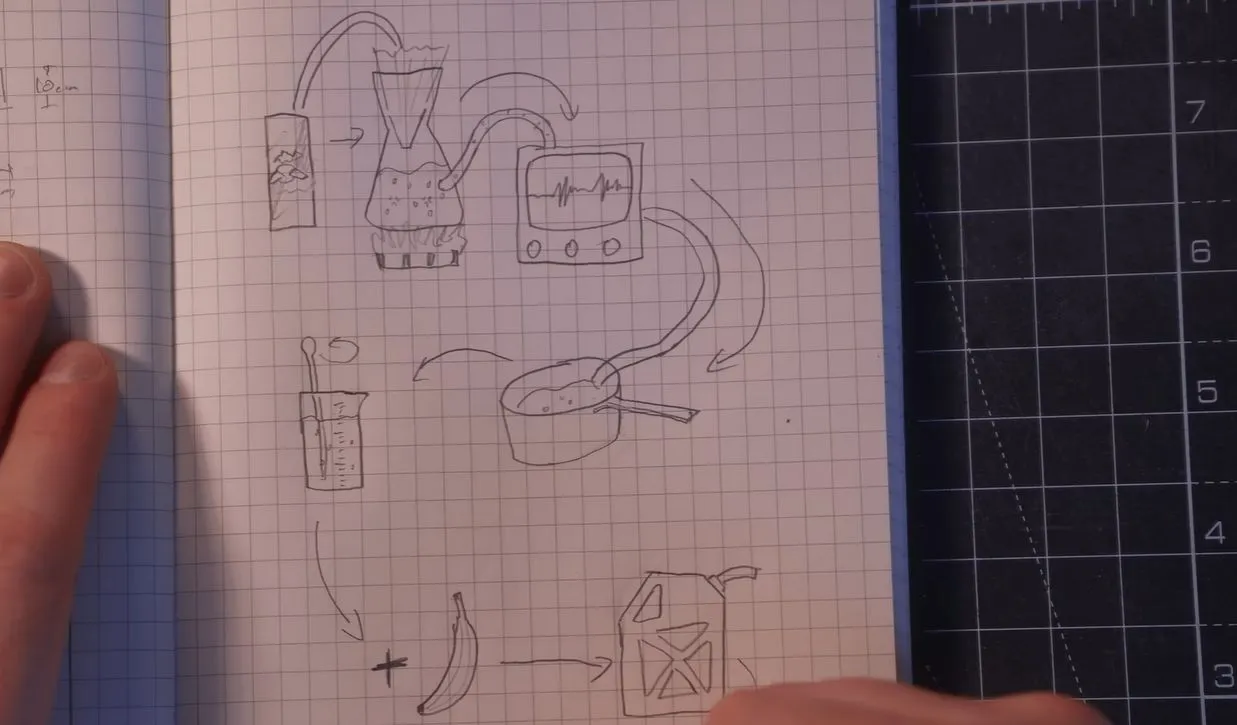
Sometimes claimed to give you wings, energy drinks can, at the very least, be used to make rockets fly. This is what [Nate Scovill] did in a recent video, where cans of the sugary stuff are processed to give a rocket its proverbial wings.

The basic concept is so-called rocket candy, which uses the fact that sugar is a pretty decent fuel type that — when combined with an oxidizer like potassium nitrate — can be turned into solid rocket fuel. Naturally it’d be easiest to start off with a pure source of sucrose or sorbitol for the sugar, but what if you only have access to cans of sugary soda?

Removing the moisture from the energy drink was the obvious first step, as water and rocket fuel aren’t a great mix. Adding and mixing potassium nitrate to the resulting thick syrup created the fuel-oxidizer mixture, also known as rocket fuel. This did take a detour involving removing the carbonation using a vacuum chamber, as CO2 and fire do not really like each other either.

Advertisement

We previously covered making your own rocket candy, though it’s far from the only rocket fuel that can be made at home using products bought at the local supermarket. Obviously, doing so comes with a whole heap of risks, not least of which is the notion that the difference between a rocket and a bomb is a pretty thin and fuzzy line that you do not want to accidentally cross.

Advertisement

Source link

Continue Reading

Tech

Anthropic Is Watermarking Text Generated By Claude To Comply With EU Law

Published

on

Anthropic has revealed how it’s watermarking text generated by Claude AI to comply with the European Union’s new AI transparency rules. The company said its text watermarking will not have easy-to-see visuals, will not be distinguishable to the people who read it and will not be adding hidden characters to the text. Instead, Anthropic’s method involves leaving a pattern in the text that can only be decoded by someone who has the key for it.

The company explained that large language models pick one word at a time when generating text by choosing from a list of potential appropriate words to use. They pick words randomly, as long as they make sense for the context of what they’re generating. With watermarking on, Claude will use a key to decide on what word to choose instead of using an arbitrary random number generator to pick the next word. 

In its example, Anthropic used the digits of pi as a key. Say, the key starts with the digit 2 from the pi sequence 3.1415926535. The next word generated is the sixth in the list of choices, then the fifth, the third and then the fifth again. This method is an adaptation of Google DeepMind’s SynthID-Text approach to watermarking, which the team described in a paper published in Nature. Watermarking doesn’t affect the quality of Claude’s output or slow it down, the company said, and it will not require extra tokens or make generations more expensive.

Of course, AI-generated prose typically has tells. Models are fond of using certain sentence constructions like “this isn’t [X], it’s [Y],” for instance. But those tells are only enough to let you know that an AI was involved in writing that text, not the model used. Anthropic will release an API that has “keys” to decode Claude’s watermarking and will be able to say whether the its AI generated the block of text being checked.

Advertisement

Anthropic admits that its text watermarking method does have limitations. It can’t tell whether Claude actually wrote the text or just edited it, which means if you ask the AI to edit something for you, it will be watermarked too. As the company explains, it can only tell that Claude was likely involved with the text at some point. Even translations will be watermarked. If Claude has only proofread and lightly edited the text, or if the text is too short, the watermark may not be enough to be detectable. Take note that lightly editing Claude-generated text probably won’t remove its watermark. If you want to be sure, you will need to rewrite it completely.

There have been some concerns on how watermarking would affect code, since it may not be copyrightable without significant human input. If one could prove that an entire codebase was AI-generated, they could copy and then iterate on it. Anthropic said, though, that code has “generally less watermarking than some other forms of text” because it typically requires exact output. If there are no choices to be made in the text generation, then watermarking can’t be applied. 

Anthropic will also watermark images by adding a cryptographically signed note in its metadata that says it was generated by Claude. In its announcement, the company said it was applying watermarks to all of Claude’s output at launch because it doesn’t have sure ways to implement the changes by region. The changes will affect output across all Claude products that use models released after August 2. Anthropic will also add watermarking capability to older Claude models over the coming months. 

Advertisement

Source link

Continue Reading

Tech

How Much Does It Cost And Is It Worth It?

Published

on

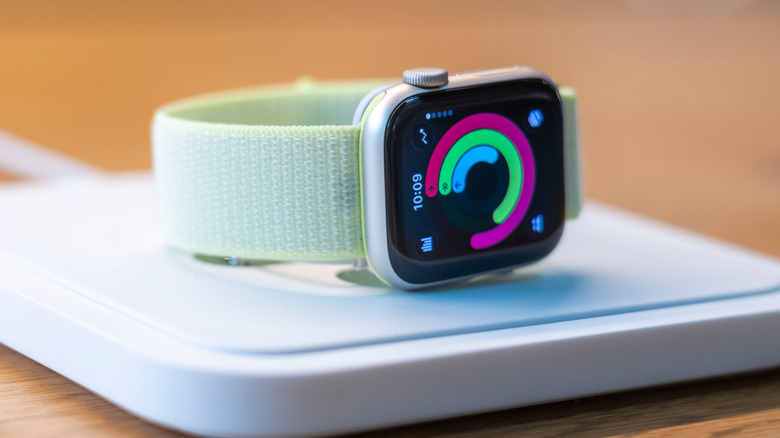
Should you replace your Apple Watch’s battery or upgrade to a new model?

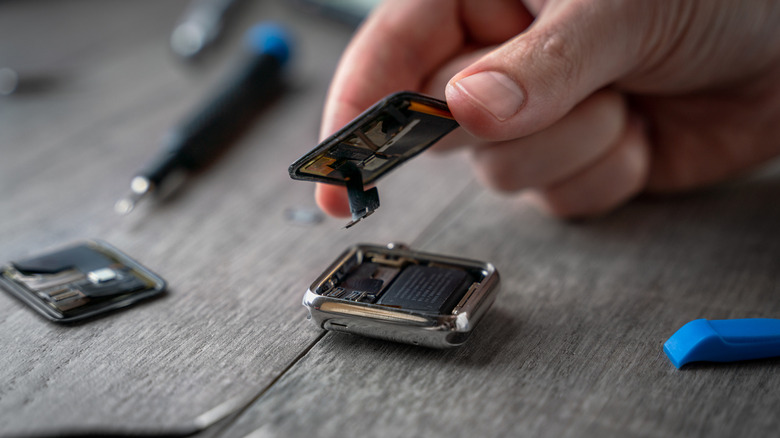
When you spend a lot of money on one of the best Apple Watch models, you want it to last as long as possible. But inevitably, as with any device that uses lithium-ion batteries, the battery will slowly degrade over time. You’ll find it draining faster and faster, and you’ll have to recharge it more often. Thankfully, this doesn’t necessarily mean you’ll have to toss the watch into a recycling bin and buy a new one. Apple Watch batteries can be replaced, which is a consideration worth making to extend the life of the device while also helping the environment.

Spending the $99 it typically costs to fix the watch through Apple can be worth it to get more usage from a wearable that cost you hundreds of dollars — assuming it still has life left it in otherwise. You’ll have to determine if that money is better spent on an upgrade for the refined design and exclusive features of a more recent model, keeping watchOS compatibility in mind.

Advertisement

Pricing an Apple Watch battery replacement

You can arrange Apple Watch repairs directly through Apple, and the price is generally a flat fee of $99. Other retailers like Best Buy serve as Apple authorized Apple Watch service and repair providers, offering the same repair or replacement service for an equal fee. Typically, the process will take about a week, and you can schedule it online or in store.

If you have an active AppleCare plan on your device, that covers battery issues, including if the battery capacity drops below 80%. However, it does not cover normal degradation of the battery over time. Chances are, if this is the case, your Apple Watch is long outside of its warranty and extended warranty period anyway. There is an option to get ongoing AppleCare for Apple Watch for a monthly or yearly fee until you cancel. But this still includes service fees and/or deductibles and doesn’t cover battery depletion from normal use.

Another option, if you’re confident enough to consider it, is a DIY replacement. You’ll find batteries offered by companies like iFixit, though the company only sells batteries for the original and Series 1 models. After acquiring a replacement battery for a newer model elsewhere, you can use iFixit’s detailed instructional guides on how to swap it out manually. But this is not recommended unless you feel comfortable handling the intricate repair process; there are risks that come with attempting it yourself.

Advertisement

When to replace battery versus get a new watch

While eliminating e-waste and extending the life of tech products is great, there comes a time when an Apple Watch isn’t worth bringing back to life with a new battery. First, consider software support. The latest watchOS 27 drops support for many older devices; it’s only available for the Apple Watch Series 9, SE 3, and Ultra 2 and newer. That means if you own an Apple Watch Series 8 or older model, you won’t get the latest software update. Your watch will continue to work just fine, though.

In fact, many people report still using models as old as the Series 4 today. The previous generation watchOS 26 had wider compatibility, working with models dating back to the Apple Watch Series 6 and second-generation SE. This means the Apple Watch Series 5 and first-generation SE (and older) are no longer supported, with their software end of life dating back to September 2024.

Your iPhone model shouldn’t be a concern Apple’s iPhone and Apple Watch compatibility page shows that older watchOS versions work fine with modern iOS releases, though you can’t use the latest Apple Watch with an iPhone running an old iOS release. For example, an Apple Watch Series 11 (our review) will only pair with an iPhone 11 or newer that’s running iOS 26 or later.

Apple Watches don’t hold their value for as long as many other Apple products, so you may not recoup the battery investment if you resell the watch. Check what comparable models are selling for first so you know how much profit you could make. If you’re handing the watch down to a friend or family member, consider giving it a replacement battery so they can enjoy the wearable for years to come.

Advertisement

To help you decide what’s best, consider the age of the watch, software support, cost of the battery, and how much longer the watch will likely be supported. I’d suggest replacing the battery for a Series 6 or 7 and above, which are the oldest models compatible with watchOS 26. But for anything older than five or so years, you’re better off upgrading instead.

Source link

Advertisement
Continue Reading

Trending

Copyright © 2025