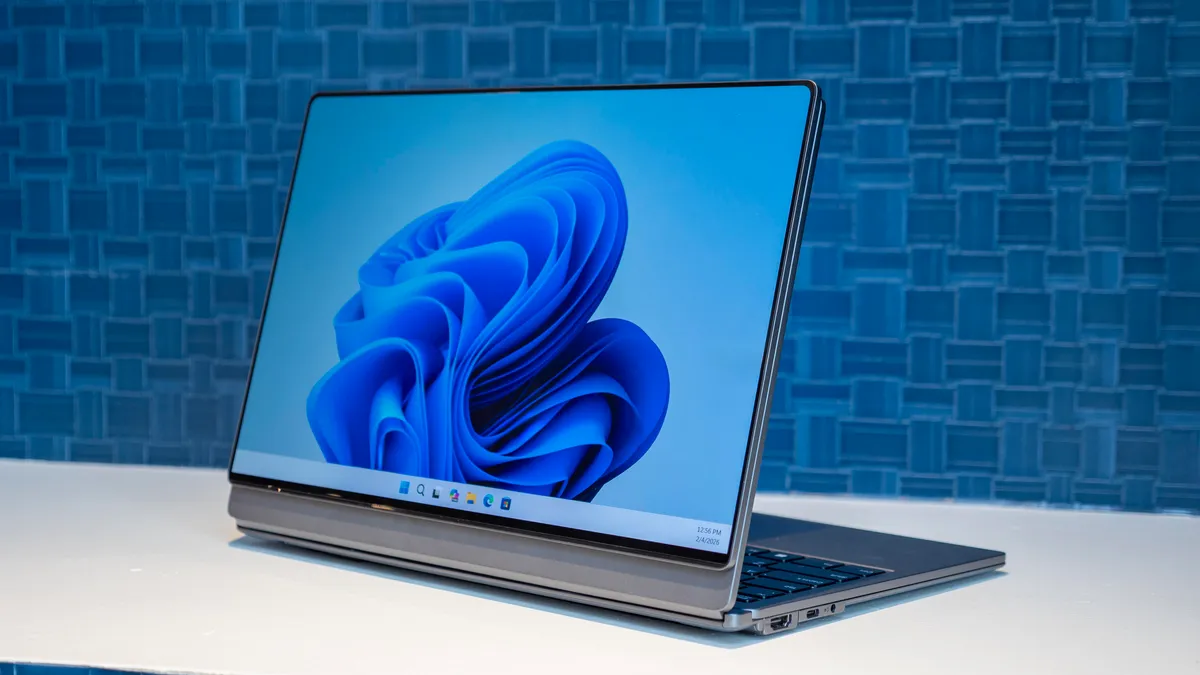




You can always count on Lenovo to show up at a tech conference with a cool laptop concept or two. At CES 2026, we glimpsed the Legion Pro Rollable laptop with a display that expands sideways and the ThinkPad Rollable XD laptop with a display that extends upward. And now, not even two months later, Lenovo has another laptop display concept at Mobile World Congress 2026: the ThinkBook Modular AI PC Concept.
Instead of a rollable or foldable display, this ThinkBook concept has a detachable secondary display that creates a couple of different ways to spread out your work.
In addition to this latest laptop concept, Lenovo announced a number of products at MWC that will ship this year. I’ll get to the other laptop updates from the show, but first, let’s get our heads around Lenovo’s funky, modular ThinkBook concept.
Advertisement
ThinkBook Modular AI PC Concept
This ThinkBook concept looks like a typical laptop, except that it has an extra display on the top cover that faces outward. Each display is a 14-inch panel, but the secondary display can be detached and deployed in a few different ways.
With the secondary display attached to the laptop’s top cover on the back of the primary display, you’ve got the best way to carry the ThinkBook in transit. This back-to-back display arrangement can be used to present to someone sitting across from you — whatever you’re seeing on the screen facing you, they can see on the screen facing them.
More useful are the other two display modes:
1. Remove the keyboard (yes, the keyboard comes off, too), swap the second display in its place, and you’ve got a dual-screen laptop with double the workspace. The detachable keyboard has Bluetooth, so you can use it in this dual-screen mode.
Advertisement
2. Remove the rear secondary display, then set it up next to the laptop as a second screen off to the side, as you would with a portable monitor. The removable kickstand, hidden in plain sight on the bottom of the laptop, magnetically attaches to the display to prop it up in either landscape or portrait mode. You’ll need to use the included cable to connect the display to the laptop, which creates some clutter, but it’s still a useful setup for those busy times of day when you need to keep an eye on more things than will fit on a single 14-inch screen.
With the detachable Bluetooth keyboard, you can use the ThinkBook Modular AI PC with both of its displays arranged vertically side by side.
Josh Goldman/CNET
The keyboard and secondary display connect via pogo pins that Lenovo has favored for its Magic Bay ecosystem of swappable accessories. Each is easy to swap in and out, and they create a satisfying connection when snapped into place.
Advertisement
Additional modularity comes by way of the ThinkBook’s ports. The ports include USB-A, USB-C and HDMI; these can be exchanged for one another. A bay is located on each side of the laptop for these modular ports, and the extras are housed in a small AirPod-like case.
The ThinkBook Modular AI PC has modular ports you can swap in and out.
Josh Goldman/CNET
This is one dual-screen laptop concept that I would really like to see because you aren’t paying a penalty in weight to gain the versatility of this modular design. Many dual-screen laptops are so heavy that I’d rather just have a desktop with two monitors instead.
Advertisement
But with the ThinkBook Modular AI PC Concept, it’s as portable as most 14-inch laptops, weighing just 3 pounds. The detachable display is so thin and light that I thought it was just a mockup when I first picked it up and not an actual operational display.
My only notes would be to encourage Lenovo to strengthen the kickstand on the back of the modular display. It’s too puny to provide a solid base for the display. And I’d like a little rubber nub on the end of it so it doesn’t slide around so easily.
The kickstand is a bit too flimsy.
Advertisement
Josh Goldman/CNET
ThinkPad updates also include a focus on serviceability
Lenovo announced a slew of ThinkPad laptop updates at MWC, and modularity shows up in a couple of them. In both the ThinkPad T series laptop and ThinkTab X11 tablet, Lenovo has introduced a battery that can be removed without tools for greater serviceability. Just press two tabs, and the battery comes right out. The ThinkPad T series laptops also feature bottom panels that are easier to remove, simplified internal layouts and user-replaceable USB-C ports.
The ThinkPad T14 Gen 7 features up to a 14-inch 2.8K OLED display powered by the latest Intel and AMD processors. The ThinkPad T14 weighs close to 3 pounds — 2.8 pounds, according to Lenovo. The slimmer ThinkPad T14s weighs less than 2.5 pounds, which is exceptionally light for a 14-inch laptop.
Stop the presses! Is that a ThinkPad in a color other than black?
Advertisement
Josh Goldman/CNET
In a major shakeup for a ThinkPad, the ThinkPad T14 will be available in a color other than black. You can get it in Cosmic Blue, which is a blue so dark it might as well be black. But, hey, when the light catches it just right, you can see that it is, in fact, navy blue in color.
But if you think that the keyboard will also get the Cosmic Blue treatment, you’ll be disappointed to know that the keys remain a basic, ThinkPad black.
Both ThinkPad T series laptops will start shipping in Q2, with the ThinkPad T14 starting at $1,799 and the ThinkPad T14s starting at $1,899.
Meanwhile, the ThinkTab X11 is a rugged Android tablet featuring an 11-inch 2.5K display and is powered by a Qualcomm Snapdragon X series CPU. It’s expected to be available in Q2, starting at $499.
Advertisement
You’ll need to wait until the second half of the year for the ThinkPad X13 Detachable.
Josh Goldman/CNET
Lenovo also introduced a larger, less rugged tablet in the ThinkPad X13 Detachable. It has a 13-inch display that you can detach from the keyboard for a true tablet experience. Its battery and USB-C ports are also user-replaceable, again showing Lenovo’s focus on repairability and product longevity. The ThinkPad X13 Detachable won’t start shipping until Q3, starting at $1,999.
Inside Amazon’s headquarters in Seattle. (GeekWire Photo / Taylor Soper)
Amazon is doubling down on OpenAI, announcing a strategic partnership Friday that includes a $50 billion investment in the ChatGPT maker.
The companies said Amazon will start with $15 billion, with $35 billion more expected “in the coming months when certain conditions are met.” The investment is part of a broader $110 billion funding round for OpenAI that includes SoftBank and NVIDIA, and brings the company’s pre-money valuation to a whopping $730 billion.
OpenAI and AWS are also deepening their technical ties, expanding an existing $38 billion multi-year agreement by $100 billion over eight years. OpenAI will run more of its AI workloads on AWS, including a commitment to consume 2 gigawatts’ worth of capacity on Trainium — Amazon’s in-house chips built to train and run AI models — to support new OpenAI tools and other computing.
“Combining OpenAI’s models with Amazon’s infrastructure and global reach helps us put powerful AI into the hands of businesses and users at real scale,” OpenAI CEO Sam Altman said in a statement.
The news marks a push to make AWS a go-to place to build and run OpenAI-powered software, as Amazon, Microsoft, and Google battle for AI customers and the computing work that comes with them. It also gives AWS a high-profile customer for Trainium at enormous scale.
Advertisement
“We think they’ll be one of the big winners in AI, we can help them grow, and we believe we’ll earn a strong return for Amazon over the long term,” Amazon CEO Andy Jassy wrote on LinkedIn.
Analysts with William Blair called the deal a clear positive for AWS, estimating the added $100 billion in OpenAI usage over eight years could work out to roughly $17 billion a year in revenue if spending is spread evenly — about 11% of AWS’s expected 2026 revenue, based on consensus forecasts. They also said OpenAI’s plan to use huge amounts of Trainium is a meaningful endorsement as AWS tries to prove it can win the biggest AI workloads.
Microsoft, a longtime partner and key cloud provider to OpenAI, issued a statement Friday emphasizing that the OpenAI-Microsoft relationship remains intact. “Nothing about today’s announcements in any way changes the terms of the Microsoft and OpenAI relationship that have been previously shared in our joint blog in October 2025,” the company wrote.
Advertisement
The Redmond tech giant added that its commercial and revenue-sharing relationship with OpenAI “remains unchanged,” and noted that it has “always included sharing revenue from partnerships between OpenAI and other cloud providers.”
Microsoft also reiterated that Azure remains the exclusive cloud provider of “stateless OpenAI APIs,” and said that any stateless API calls to OpenAI models that result from collaborations with third parties — “including Amazon” — would be hosted on Azure.
In basic terms, the “stateless” calls that Microsoft retains exclusivity over are simple, one-and-done AI requests: ask a question, get an answer. The “stateful” environment that Amazon is building on AWS is where companies run AI systems that remember context, work on complex tasks over time, and coordinate with each other. This is territory where Microsoft also operates through its own Copilot products and Azure OpenAI Service, but where Amazon is now staking a major claim, as well.
Other key details from Amazon and OpenAI’s expanded partnership:
Advertisement
AWS and OpenAI said they will co-create a “Stateful Runtime Environment” powered by OpenAI models, offered through Amazon Bedrock, so customers can build AI applications and agents “at production scale.”
AWS will be the “exclusive third-party cloud distribution provider” for OpenAI Frontier, an enterprise platform for building and managing teams of AI agents with shared context, governance, and security. Microsoft says Frontier will continue to be hosted on Azure.
Amazon and OpenAI will collaborate to develop “customized models” to power Amazon’s own customer-facing applications.
As GeekWire previously reported, Amazon was actually OpenAI’s first cloud partner — providing computing resources at the lab’s founding in 2015, before Microsoft swooped in and built the partnership that defined the generative AI era.
Now, a decade later, the company that OpenAI once left because Amazon was being petty about terms and conditions is writing a $50 billion check to get back in.
Anthropic acquired Seattle startup Vercept on Wednesday, raising familiar questions about the impact of early exits on the broader Seattle startup ecosystem, and the question of whether AI startups can compete long-term against the giants of the field.
We dig into the deal, the public feud between two of the company’s early investors on LinkedIn, and why one co-founder’s prior departure to Meta may have been worth more, ultimately, than the acquisition of the entire company.
Then, the New York Times reported this week that Jeffrey Epstein built deeper connections inside Microsoft than any other major tech company. We break down the key revelations, and talk about what we found when we searched the Epstein files for “GeekWire.”
And stick around for GeekWire Trivia: With Xbox entering a new era under Asha Sharma, we look back at the celebrity who appeared on stage for the original Xbox unveiling 25 years ago.
With GeekWire co-founders Todd Bishop and John Cook. Edited by Curt Milton.
Do you like having a second screen with your computer setup? What if your laptop could carry a second screen for you? That’s the idea behind Lenovo’s latest proof of concept, the ThinkBook Modular AI PC, announced at Mobile World Congress in Barcelona.
At MWC 2026, Lenovo trotted out three concepts. While it’s unclear whether any of them will become real, purchasable products, there’s some unique utility here, and a peek at how computing experiences could change in the future.
A Laptop With a Built-In Portable Screen
The ThinkBook Modular AI PC has a second screen hanging magnetically off the back of the laptop, and it can show content to people sitting in front of you.
Advertisement
Photograph: Julian Chokkattu
This is with the second screen removed from the back and placed in front of the main display. The keyboard is removable and works via Bluetooth.
Photograph: Julian Chokkattu
As someone with a multi-screen setup at home and a fondness for portable monitors, the ThinkBook Modular AI PC appeals to me the most. At first glance, it looks like a normal laptop. Take a look behind, and you’ll notice there’s a second screen magnetically hanging off the back of the laptop, like a koala carrying a baby on its back.
The screen is connected to the laptop using pogo-pin connectors, so you can use it in this state to display content to people in front of you, say, if you were making a presentation during a meeting. Alternatively, you can pop this second screen off, remove a hidden kickstand resting under the laptop, and magnetically attach it to the 14-inch screen so that you have a traditional portable monitor experience. (You’ll need to connect this to the laptop via a USB-C cable in this orientation.)
If you don’t have the desk space for that orientation, you can always remove the keyboard from the base and pop the second screen there—it’ll auto-connect to the laptop via the pogo pins, and you’ll be able to use the Bluetooth keyboard to type on a dual-screen setup that resembles the Asus ZenBook Duo. The whole system is a fantastically portable method of improving productivity on the go, and the laptop isn’t too thick or cumbersome.
Ultrahuman has released the highly anticipated Ring Pro for preorder with a price of AU$739 in Australia
It improves on battery life and heart-rate tracking, but its charging case steals the show
Singapore and New Zealand availability and price TBC
Just a day after Ultrahuman’s CEO broke his silence on the new Oura-beating smart ring, it went up for preorder in most major markets for $479 / £419 / AU$739. That makes the new Ultrahuman Ring Pro a lot pricier than the $349 / £329 / AU$599 Ring Air, but the several improvements its brings — including the promised 15-day battery life — does seem to justify the premium.
Alongside the better battery comes improved sensors for better heart-rate tracking, especially during sleep, and an upgraded dual-core CPU that enables on-chip processing so the Ring Pro doesn’t need to rely on a paired phone. Ultrahuman also says that the CPU offers more accurate metrics thanks to machine learning.
(Image credit: Ultrahuman)
It’s the new charging case that steals that show in my opinion. Not only does it extend the smart ring’s battery life to a staggering 45 days, it features an LED light that gives you a clear visual indication of how much battery it still holds.
Advertisement
It even has enough onboard storage to save a year’s worth of health data from the Ring Pro. It will also provide haptic feedback when delivering alerts. If that wasn’t enough, a built-in speaker will sound a small alarm when you activate the Find My Case feature in the app.
It’s still a little up in the air
One of the main reasons I like Ultrahuman is that you get all your key metrics without a subscription. There are a few that are locked behind a paywall, but most users can get by without paying for any of them. Moreover, it plays well with iOS and Android.
All the improvements I’ve listed above are tempting me to upgrade from my Ultrahuman Ring Air — despite the Ring Pro’s high asking price — and I’m glad I’m not based in the US.
Advertisement
The Ultrahuman Ring Air is my daily driver (Image credit: Sharmishta Sarkar / TechRadar)
As an Australian, I can already pre-order the Ring Pro, but it’s as yet uncertain whether it will be available to buy in the US. It’s availability in other APAC regions is also yet to be confirmed.
Sign up for breaking news, reviews, opinion, top tech deals, and more.
The Ring Pro is the product named in Ultrahuman’s patent-infringement case against Oura, which it lost in the US, meaning the company’s products are banned from being imported into America and the Ring Air was pulled from shelves last year.
Perhaps Ultrahuman has done its due diligence this time and the Ring Pro will soon find its way to US customers, especially since the Ring Air is one of the best smart rings on the market and I’m hoping the Ring Pro will prove just as good.
Apple Stores are preparing for a significant number of physical product launches during its early March event, with the new MacBook getting its own table.
A new MacBook is on the way
From Monday, Apple will be making multiple product announcements before holding a three-city “experience” event. While the actual products that will launch are not officially known, it seems Apple is expecting one to make a big impression on consumers. Retail workers were told to prepare for a sudden influx of customers in early March due to its program of product launches this week, writes Mark Gurman in the Bloomberg “Power On” newsletter. The prelaunch planning for the week is at a similar level to an iPhone launch, meaning Apple has big expectations for its lineup. Rumor Score: 🤯 Likely Continue Reading on AppleInsider | Discuss on our Forums
Lenovo has given the Yoga 9i 2-in-1 Aura Edition a refresh for 2026 and launched the new device at this year’s Mobile World Congress. The convertible laptop comes with a new Canvas Mode when the Yoga Pen Gen 2 case it’s bundled with is attached to the A-cover. When you lay the device down on a flat surface with the case attached, you’ll get a slight elevation on the display, which may make it easier to sketch or draw.
The Copilot+ laptop is powered by Intel Core Ultra Series 3 processors with integrated graphics, has up to 32GB in memory and runs Windows 11. Its 14-inch screen has a resolution of 2,880 x 1,800 pixels, has a variable refresh rate of 120 Hz and supports multi-touch. In addition to the new Canvas Mode, the device also supports Tablet, Tent, Stand and traditional Laptop Modes like its predecessors do. The Yoga 9i 2-in-1 Aura Edition Gen 11 will be available in May, with prices starting at $1,949.
Lenovo has also launched the new Yoga Pro 7a at MWC 2026. This Copilot+ laptop is powered by AMD Ryzen AI Max+ Series processors and comes with up to 128GB of RAM, so it can be used for heavy AI tasks. It has a 15.3-inch 2.5K PureSight Pro OLED display and is equipped with a big Force Pad trackpad that doubles as a drawing tablet. You can get the device starting in August this year for at least $2,099.
For a more affordable option, there’s the new IdeaPad Slim 5i Ultra laptop, which also has Copilot+ features. It’s powered by Intel Core Ultra processors and comes with either a WUXGA OLED or a WQXGA IPS LCD 14-inch display that has a VRR of 120 Hz. The device was designed for portability, with its thinnest part measuring just 11.9 mm in depth, and weighs 2.5 lbs. It will be available starting in October for at least $799.
Advertisement
Another affordable option is the new Idea Tab Pro Gen 2, which is specifically targeted towards students. It’s powered by theSnapdragon 8s Gen 4 Mobile Platform and has a 13-inch 3.5K display. The Tab Pro Gen 2 is Lenovo’s first tablet to ship with its Qira AI assistant and the company’s AI tools. It will be sold with a Lenovo Tab Pen Plus included for $419 starting in July.
How well do you concentrate at work? For me, it very much depends on how I’m feeling that day, what else I have on my mind and a miscellany of other factors. One technique I use fairly successfully to keep me focused is a pomodoro timer, and at Mobile World Congress 2026 I found what I believe could be the perfect AI pomodoro companion.
I first saw Lenovo’s Magic Bay Tiko at last year’s MWC, but at the time it was just a concept. The little circular module perches on the top of your Lenovo laptop display, attached via the magnetic Magic Bay on the rear. The module is home to an adorable animated companion called Tiko, who you can interact with via text or voice.
Accessories with AI agents are becoming increasingly popular, particularly in the wearables space, with many companies starting to offer pins and pendants. They can take on a variety of tasks, such as life logging and transcription. They can also carry out tasks for you, such as adding things to your calendar or checking your calendar to see if you’re busy.
Advertisement
Tiko has a number of standard agentic AI capabilities — it can start and stop your music, open a web page for you or answer a question. You can also interact with it by using emoji. Give it a book emoji, for example, and it will pop on its glasses and sit reading with you while you work. But my favorite Tiko feature effectively turns it into a body-doubling buddy, which I feel would be useful for keeping me on track on distracted days.
Don’t tell me this little guy wouldn’t make you want to stay on track.
Katie Collins/CNET
Body doubling is a technique where you work alongside someone else — either physically or virtually — to keep you on track and accountable. Tiko comes with a timer, allowing you to track a focused work session. When you need a break, you can switch over to “wellness break” for 10 minutes of relaxation before you carry on. You can even choose to add 1 minute of breathing exercises, which Tiko will do with you, to keep you calm.
Advertisement
A traditional pomodoro timer is 25 minutes of work followed by a 5-minute break, but this is flexible. I’m enamored with the idea of a physical manifestation of the timer perched above my screen, with a sweet animated friend to help keep me in check.
The good news for me is that Tiko is no longer a concept from Lenovo. The company wants to sell the Magic Bay accessory later this year — although it doesn’t know exactly when, or how much it will cost. The less good news is that you’ll need to have a Lenovo laptop with a Magic Bay port, which I do not. It might be impractical to consider getting a new laptop just for Tiko, but it could sway me if I was already in the market for one.
Lenovo AI Workmate Concept
Lenovo’s AI Workmate concept is still a work in progress.
Advertisement
Katie Collins/CNET
Another AI companion concept from Lenovo that remains a concept for now is its AI Workmate. This is a kind of stationary tabletop robot, not dissimilar to the Pixar lamp, but with an orb for a head.
With a combination of cameras, microphones and projectors, the AI Workmate can undertake a variety of tasks, including helping you generate and display presentations or turn your written work or art into a digital asset.
I asked the Workmate to make me a presentation about giraffes. Using Lenovo’s proprietary models, it generated a three-slide presentation entitled “The Majestic Giraffe: Nature’s Tall Enigma.” It was factually accurate, as far as I could tell, if disappointingly free of pictures. It’s robotic head swivelled around and projected the slides onto the wall next to me.
I also asked the Workmate to generate me a postcard of Barcelona. It displayed the work on the table in front of me, and I scribbled some text over the top. The Workmate then scanned the entire image, including my writing and sent it straight to the printer for me, leaving me with a tangible souvenir to take away from our encounter.
Advertisement
I can’t say I would necessarily want something as large and bulky on my own desk, and I’m not exactly sure what practical use I work make of the AI Workmate concept at this stage. But it was still fun to play with, and interesting to see how tech companies are imagining ways to bring AI to physical life so they can assist us in at our work.
Apple is expected to push its Gemini-trained Apple Foundation Models and new chatbot-like Siri functions during WWDC, but Core ML could also see an update to Core AI to emphasize the priority shift.
iPhone 17 Pro Max will be an AI powerhouse thanks to its feature set
Core ML is a framework that allows developers to implement machine learning technology into their apps. In recent years, its functionality has spread to generative tools and AI. According to the Power On newsletter, Apple is going to release a Core AI framework during WWDC 2026. It is a replacement for Core ML, though both frameworks could exist in tandem for some time. Rumor Score: 🤔 Possible Continue Reading on AppleInsider | Discuss on our Forums
MWC 2026 officially gets underway on March 2 and will continue through March 5, but the announcements are already pouring in ahead of its start. We can always count on the annual tech event to bring tons of new phones, laptops and tablets, and we’re expecting to see some robots and other gadgets too — plus plenty of AI news, of course. In addition to the announcements, MWC is our chance to get hands-on time with some of the most interesting new devices, like the Xiaomi 17 Ultra and Honor’s Robot Phone.
Engadget’s Mat Smith is on the ground in Barcelona, and we’ll be updating this story as the week goes on to keep you in the loop on everything that caught our attention. Keep checking back here for the latest MWC news.
Lenovo
How silly does this look when its flexible display is fully extended in portrait mode? (Sam Rutherford for Engadget)
Lenovo pulled up to MWC with a bunch of new products and concepts, but if there’s one thing everyone’s going to be talking about, it’s the Legion Go Fold. (Check out Sam Rutherford’s coverage of the Legion Go Fold here). In short, the Legion Go Fold is a concept foldable gaming handheld with a flexible display that can unfurl to a massive 11.6 inches. Or, it can be folded in half to become a 7.7-inch display. It has detachable controllers, and there are multiple mounting points along the tablet so you can switch things up between landscape and portrait mode. The left and right gamepads can also be combined into one controller with an accessory, and the display can be propped up kickstand-style with the folio cover.

You think we’re done here? We’re not. The Legion Go Fold can go laptop mode too, with a strip of pogo pins where a wireless keyboard can be connected. Its right gamepad can serve as a mouse, thanks to the inclusion of a little scroll wheel and a hidden sensor. That gamepad also features a tiny circular OLED display below the buttons, which can both show widgets such as the time and be used as a touchpad.
Advertisement
It is a concept, though, so don’t get your hopes up too much about this one going into production. And if it does ever become a real, buyable product, it’ll no doubt be expensive.
The Lenovo Modular AI PC concept is an ambitious mashup between a traditional clamshell and a dual-screen notebook with hot swappable ports. (Sam Rutherford for Engadget)
Lenovo also announced its Modular AI PC concept — a laptop with two displays and a detachable keyboard. As Sam Rutherford, who got a chance to check it out in person, explained, “This allows you to move its keyboard and secondary display around at will, so the system can better adjust to its environment or workload.” Perhaps even more exciting is that it has hot swappable ports. Lenovo demonstrated it with USB-C, USB-A and HDMI connectors, but said others could be possible too.
Still, while everything looked pretty polished in the demo, Lenovo says this one will remain a concept.
The Lenovo Yoga 9i 2-in-1 Aura Edition Gen 11 (Lenovo)
It hasn’t all been concepts at MWC. Lenovo also refreshed some of its existing tablet and laptop lineups for 2026. The company introduced the Yoga 9i 2-in-1 Aura Edition Gen 11 (with the new Canvas Mode configuration), starting at $1,949, and the new 15.3-inch Yoga Pro 7a, which starts at $2,099. It’s updated its more affordable IdeaPad Slim 5i Ultra laptop ($799) as well. All of those new laptops come with Copilot+ features. For students, Lenovo is launching the 13-inch Idea Tab Pro Gen 2, starting at $419, with its Quira AI assistant and AI tools. You can find all the specs and release dates for those here.
Advertisement
Honor
The Robot Phone. (Image by Mat Smith for Engadget)
Honor teased its Robot Phone this past fall and we just finally got a proper look at it at MWC. And it’s pretty freakin’ cute. The phone is equipped with a camera that’s mounted on a highly mobile 4-degrees-of-freedom gimbal, which tucks away into a compartment on the back when it’s not in use (making for a pretty beefy camera bump). In a demo at MWC, the camera, which behaves like a little robot head, bobbed along to music and showed off some of its gesture skills, like cocking its “head” and nodding in agreement.
Honor didn’t reveal too much spec-wise, but the company says the primary camera uses a 200-megapixel sensor. The gimbal will offer three-axis stabilization, which will be coupled with camera modes such as Super Steady Video and AI Object Tracking. The Robot Phone isn’t quite ready for release at the moment, but the company says it will launch later this year.
Be sure to check out Mat Smith’s writeup on the Robot Phone for a more in-depth look.
Honor’s humanoid robot. (Image by Mat Smith for Engadget) (Image by Mat Smith)
It’s not a humanoid robot reveal without some backflips and a choreographed dance performance. Honor introduced its robot at MWC with all the spectacle we’ve come to expect (though the bot didn’t do any talking). It’s simply called the Honor Robot, and the company has plans for it to be used in both industrial and domestic settings.
Advertisement
Honor Magic V6 (Honor)
The Robot Phone isn’t the only phone Honor showed off at MWC. The company also announced its Magic V6 smartphone, which it says is the thinnest phone in its category, measuring 8.75mm folded and 4.0mm open in the white colorway. The other three colors — black, gold and red — are slightly thicker, at 9mm folded and 4.1mm open.
Not too much has changed from the V5, though, which only came out in August 2025. It does however have the Snapdragon 8 Elite Gen 5, with 16GB RAM and 512 GB storage. As for the cameras, there are two 50-megapixel lenses and a 64-megapixel telephoto, plus a 20-megapixel f/2.2 selfie lens on the cover and internal display.
The international version of the Magic V6 will have a 6660mAh battery with 25 percent silicon content, while the version sold only in China will boast a battery with a rated capacity of more than 7000mAh and 32 percent silicon content. Honor hasn’t yet shared details about pricing and availability.
Honor MagicPad (Honor)
Ahead of MWC, Honor also announced what it claims is the thinnest Android tablet in the world: the 4.8mm thick MagicPad 4. We’re expecting to hear more about this at Honor’s press conference on Sunday, but so far we know it features a 12.3-inch 165Hz OLED display and weighs just 450g. It comes with up to 16GB of RAM and 512GB of storage, and is powered by Qualcomm’s Snapdragon 8 Gen 5 chipset. The thinness doesn’t count the camera bump, Honor notes. The MagicPad 4 has 13MP rear and 9MP front cameras. It also boasts spatial audio, with eight speakers.
Advertisement
Just as the display is slightly smaller than the previous MagicPad, the MagicPad 4 has a smaller battery at 10100 mAh. It comes with a 66W fast charger. The MagicPad 4 will run Honor’s MagicOS 10. We don’t yet know how much it will cost, but we’ll update this after Honor’s press conference (where we’re also expecting to see the company’s robot) with any new details.
Xiaomi x Leica
Mat Smith for Engadget
Xiaomi kicked off MWC this year by announcing the global launch of its 17 Ultra smartphone, which debuted first in China back in December. It’s unclear if the phone will ever come to the US, but it’s now rolling out in Europe. Xiaomi teamed up again with Leica to make a photography-focused smartphone, and the 17 Ultra sports a 1-inch 50-megapixel camera sensor with a f/1.67 lens, a telephoto setup with a 200MP 1/1.4-inch sensor, and a 50MP ultrawide camera. There’s also a manual zoom ring around the camera.
Check out our hands on for our first impressions of what it’s like shooting with the Xiaomi 17 Ultra. And there’s more to it than just the camera. The 17 Ultra has a 6.9-inch OLED 120 Hz display that peaks at 3,500 nits of brightness, and a 6000mAh silicon-carbon battery. The Xiaomi 17 Ultra starts at £1,299 (roughly $1,750).
Leica also announced a new phone made in partnership with Xiaomi at MWC. It looks a whole lot like Xiaomi’s 17 Ultra, but isn’t the 17 Ultra, exactly.
Advertisement
Leica Leitzphone by Xiaomi hands-on at MWC 2026 (Image by Mat Smith for Engadget)
Like the 17 Ultra, Leica’s Leitzphone by Xiaomi has a 1-inch camera sensor and physical controls for zoom and other settings, using a mechanical ring around the camera unit. It features a Leica-designed intuitive camera interface with the option to show just the essentials when you’re shooting, hiding all the modes and labels. There’s a monochrome shooting mode and Leica filters.
The Leica branding is splashed all over it in design and wallpapers, but it’s otherwise pretty similar to the 17 Ultra, with the same specs. Like the 17 Ultra, it has a Snapdragon 8 Elite Gen 5 chip and a 6.9-inch 120Hz display. This one’s priced at €1,999 (roughly $2,362).
The Xiaomi Pad 8 Pro (Xiaomi)
In addition to the 17 Ultra, Xiaomi announced two new tablets at MWC this year: the Xiaomi Pad 8 and Xiaomi Pad 8 Pro. There’s nothing revolutionary here, but they’re lightweight and thin, with both being 5.75mm thick and weighing 485g, and have a 9200mAh battery. The Pro model is powered by a Snapdragon 8 Elite chip, while the regular Pad 8 uses the Snapdragon 8s Gen 4 chipset.
Xiaomi also unveiled a new 5000mAh powerbank, the UltraThin Magnetic Power Bank 5000 15W. The 6mm thick power bank comes in three colors with an aluminum alloy shell: orange, silver and charcoal gray. Along with that, the company introduced the Xiaomi Tag, its own take on the Bluetooth item tracker. The Xiaomi Tag has a built-in hanging loop so it can be attached directly to a keyring, and the company says it will work with both Apple Find My and Google’s Find Hub for Android.
Advertisement
Tecno
Tecno
We can always expect to see some wild phone concepts at MWC, and this year we’re starting with one from Tecno. The company unveiled a modular concept smartphone design that can be as thin as 4.9mm in its base configuration. There’d be 10 modules to choose from based on the announcement, including various camera lenses, a gaming attachment and a power bank, relying on magnets to keep it all together — or Modular Magnetic Interconnection Technology, as Tecno is calling it.
Honor first teased its “Robot phone” with a movable camera arm earlier this year. Ahead of the Mobile World Congress (MWC) in Barcelona, the Chinese company provided more details about the device, including how the robot can respond to different situations without commands. The company said that it is planning to launch this device in the second half of this year.
Honor said that the robot also has a “personality” and can respond to you with “head shakes” and can also dance to the beat of music. The company noted that users can talk to the assistant on the phone through text and voice. Honor showed a video of a person asking for apparel suggestions, and the robot nodding or shaking to suggest an outfit.
The phone has a 200-megapixel camera on a moving robot three-axis gimbal with stabilization tech. The company said that the camera can smoothly rotate around and capture smooth videos and photos. It also has a Super Steady mode for video capture. The company said the phone can get cinematic shots through its Spinshot feature that makes the robot camera rotate by 90 or 180 degrees.
Image Credits: Honor
The robotic camera also allows for more fluid video calls that can track you through AI-powered object tracking. The tech is like Apple’s Center Stage on steroids if it works.
The company said that it developed its own micro motor to control the robotic camera’s movements. It noted that it used some techniques used in foldable phones to make the camera more sturdy and fit the four-degree-of-freedom gimbal system into the body of a phone. Honor said that it is using the same materials for the robotic arm as the Honor Magic V6’s hinge, with 2800 MPa tensile strength.
Advertisement
Image Credits: Honor
Honor also released the Honor Magic V6 foldable with a 6,600 mAh battery, the Honor MagicPad 4 tablet, and the Honor MagicBook 14 laptop at its event.