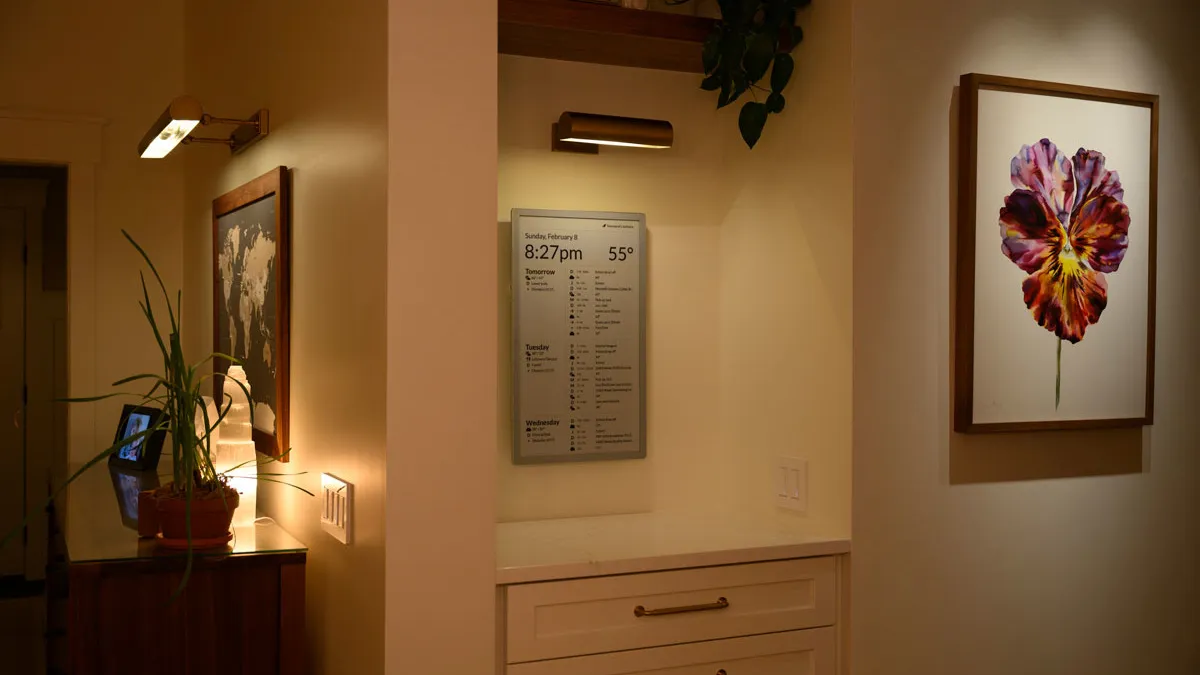
When [Joel] and his partner got married, they had a goal to create a home with a healthy relationship to technology, which largely means avoiding smartphone use. Smartphones aren’t without their benefits, though, like being clocks and calendars, so [Joel] started looking for other options to replace these capabilities. At first he went with a “magic mirror” solution, but quickly pivoted to a wall-mounted e-paper solution he calls Timeframe which has evolved into a respectable overview for his home and life.
E-paper has a number of advantages over LCD and LED displays, one of which being that its resemblance to real paper makes it feel more organic. The first e-paper iterations of Timeframe used multiple displays in wooden frames, and [Joel] had a few different ones stationed around the house. They received their data from a custom-built Rails backend which sent pictures to the devices. This made the refresh rate possible fairly low, but a new 23.5″ display from Boox eventually enabled an acceptably high resolution and refresh rate which could support more traditional display uses. But this display required that [Joel] rewrite the entire back-end, an effort that took quite a bit of time but resulted in an impressive final product.
Like any custom-built project like this, [Joel] still has plans for improvements including those around further integration with his Home Assistant and reducing costs for future platforms. E-paper displays are popular pieces of technology for home dashboards like this, in the past we’ve seen similar, smaller builds which coincidentally have the same name.
More images have surfaced of a black colorway for the Apple Vision Pro, this time showing more of the important parts of the headset sporting the hue. Though, you shouldn’t get excited about a potential release.
In late May, images of what are believed to be components for a black-colored Apple Vision Pro came to light. A week later, that same source has released more images of the fabled headset.
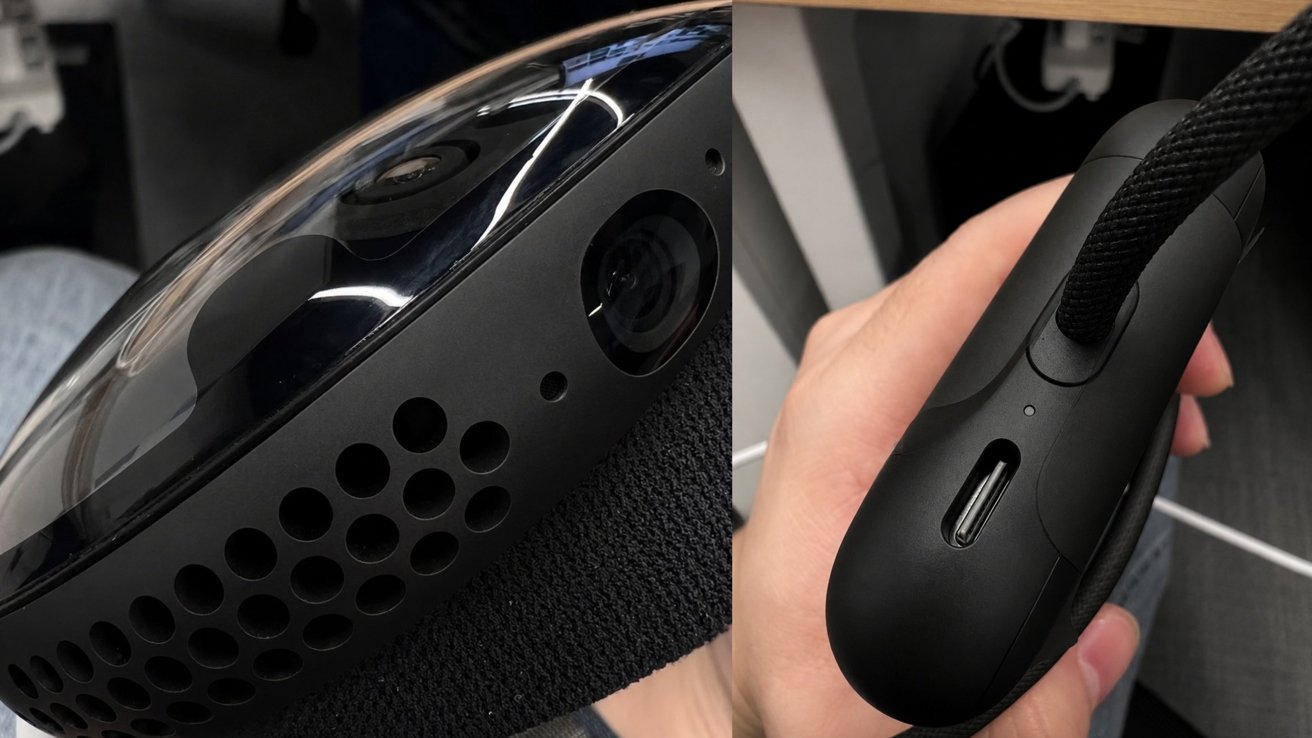
The images, posted to X on Wednesday by a Hong Kong-based developer known as Pipfix or LusiRoy8, are a collection of shots of a headset that looks like the Apple Vision Pro. One is a close-up image of a grille and a camera on the side of the headset, confirming it to be an Apple Vision Pro.
Other shots include the connector for the battery pack, with the mechanism left uncolored. Another shot is of the top of that battery pack, as well as a black braided cable.
Advertisement
One last image shows the knob used to adjust the band attached to the headset. Both the band and the knob are shown in black.
Previously, the account showed off images of the speakers on the side of the Apple Vision Pro, again in the black colorway.
The leaker does have a bit of a track record when it comes to colors, including those of the iPhone 17 Pro. While the previous leak briefly said that the Apple Vision Pro in black is “upcoming,” the new post simply asks readers if they like the color.
While the photographs are quite convincing, there’s no guarantee that Apple will actually release a version in that color. It’s equally plausible that they come from a prototype version that Apple made to test the color, but decided not to go through with the black model in the end.
Advertisement
There are some inconsistencies in some of the images. The fabric surrounding the visor doesn’t quite match the pattern of Apple’s current version, and the battery pack appears wrapped in some kind of film.
Then there’s this odd black wire wrapping between the person’s fingers and yet another white wire further in the background of the battery shot. However, these don’t appear to be AI renders, but genuine photos of black components.
That said, the inconsistent design aspects suggest these are early prototype models.
Possible hardware
While we have had previous rumors going back to April 2025 on the topic, as well as a December shot of a black headset connector, Apple hasn’t slipped up or hinted at new color options for the Apple Vision Pro.
Advertisement
Given the band appears to be the Solo strap, this is likely a prototype of the M2 model that never made it to production. Apple would have no reason to offer different colorways considering how few they sell.
There’s a remote possibility of a black option being introduced in a future model. Don’t expect any mention during WWDC.
Current rumors indicate that Apple Vision Pro won’t see a new hardware iteration for some time. Apple’s Vision Product Team has reportedly directed to focus on smart glasses development while technology for a thinner and lighter Apple Vision Pro can be developed.
Currently, the soonest a new model might be announced is 2028, but Apple hasn’t said as much to supply chains yet.
The catalytic converter in your car’s exhaust system has a complex emissions-related job to perform. Placed between the engine and the muffler, it reduces the amounts of the three primary pollutants found in the exhaust gases of internal combustion engines: nitrogen oxides, carbon monoxide, and hydrocarbons. By passing the engine’s exhaust through the catalytic converter’s honeycomb-like ceramic structure, which is coated with precious metals like palladium, platinum, and rhodium, these three pollutants are converted into less harmful substances. Catalytic converters have been mandated since 1975, with nearly every car required to have one.
Another major part of your car’s catalytic converter system is the oxygen sensor, which interfaces with your engine’s electronic control system to monitor its exhaust gas flow, preventing it from running either too rich or too lean. This keeps your emissions within the legal limits, while also balancing your car’s power and economy.
Catalytic converters can be susceptible to some common problems over their lifespan, which should normally be the vehicle’s entire life. Let’s look at these problems individually, going over why they may happen and what the best ways are to fix them.
Advertisement
Your catalytic converter has been physically damaged
Anastasija Vujic/Shutterstock
Your catalytic converter hangs underneath your car with the rest of the exhaust system, so anything that can cause damage to your muffler or exhaust pipes can also “impact” your catalytic converter. That can mean debris on the road, as well as going over a curb while driving. Doing this type of damage to your catalytic converter can cause its ceramic internal structure to crack or break, affecting its ability to properly convert the toxic substances in your unfiltered exhaust gases.
Physical damage anything like what’s shown above is likely to require replacing your catalytic converter. This type of damage to your catalytic converter will probably also lead to the illumination of your Check Engine Light, since your emission control system will severely impacted by it.
Advertisement
Be aware that certain states require CARB-compliant catalytic converter replacements, which meet the stricter standards set out by the California Air Resources Board. These standards apply to all cars replacing their catalytic converters in California, New York, and Colorado, including out-of-state vehicles. In addition, all CARB-compliant cars replacing their catalytic converters in the state of Maine that were made during or since the 2001 model year must be fitted with a CARB-compliant replacement unit. Be sure to check the local regulations in the state where you reside before replacing your car’s catalytic converter, and don’t even think about whether you should drive without a catalytic converter.
Advertisement
Your catalytic converter has become clogged up
Virrage Images/Shutterstock
There are numerous ways that your car’s catalytic converter can become clogged, and none of them have anything to do with the issue of external physical damage. If you have a leak of coolant or oil that makes its way into the exhaust system or into the cylinders, it can clog up the fine ceramic structure coated with those precious metals inside the convertor, rendering it ineffective. Clogging can also be the result of using substandard fuel, misfiring spark plugs, a fuel-air mix that’s too rich, or just wear and tear over time.
If you are facing the possibility of a clog, there are ways to clean your vehicle’s catalytic converter at home. It’s definitely worth a try if the only other alternative is replacing it out of pocket.
The symptoms of a clogged catalytic converter are pretty tough to ignore. You may experience much worse fuel economy as you drive, hard starting, high heat levels that can start fires under your car, a noticeable lack of performance from your engine, a rotten egg-like smell, and all of this will likely also trigger the Check Engine light on your dashboard to go on. Keep in mind that the clogged catalytic converter is creating an obstruction in your engine’s exhaust system that your engine has to work against, which can lead to leaking oil, seals blowing out in the engine, or even a blown engine if you wait too long to fix the problem.
Advertisement
Your catalytic converter has been stolen
Romanets/Shutterstock
This unfortunate scenario has been happening to car owners across the country. California’s the leader in catalytic converter thefts nationwide, with New York, Illinois, Texas, and Florida rounding out the top five. A thief can cut off your catalytic converter in about a minute, making it unlikely they’ll be apprehended unless they are caught sawing it off. And while thieves get $50 to $500 for stolen converters, you’ll have to pay up to $4,000 to repair your car. While SUVs and pickup trucks, with their increased ground clearance, make the easiest targets, we have compiled a list of the cars most likely to have their catalytic converters stolen.
There are some ways to minimize the risk of having your car’s catalytic converter stolen. These include parking your car in a closed garage, the use of motion sensor lighting where you park your car, never failing to set your car’s alarm and locking your vehicle. If you must park in an area out in the open, be sure that it is at least lit very well.
Additional strategies for protecting your catalytic converter from theft involve making it tougher to remove or making it identifiable. Theft prevention devices include straps, clamps, or cages that make catalytic converter removal much more time-consuming, encouraging thieves to leave your car alone and move on to an easier, unhardened target. Another proactive way to discourage theft is to have your catalytic converter etched or engraved with your VIN or license number, making it easier to identify the owner.
Advertisement
Your catalytic converter’s oxygen sensor goes bad
BLKstudio/Shutterstock
A modern catalytic converter’s oxygen sensor measures how efficiently it is doing its job by monitoring the amount of oxygen present in the exhaust gases. Over time, and possibly due to some engine-related issues like coolant leaking into the cylinders, a bad gasket, or a too-rich fuel mixture, the oxygen sensor can become contaminated or just wear out. In addition to this “downstream” oxygen sensor connected to the catalytic converter, there is usually an “upstream” or “pre-cat” sensor that controls the fuel supply to the engine.
Some indications that your car’s oxygen sensor is failing can include rough engine operation, reduced fuel efficiency, and the Check Engine light on your dash lighting up to alert you there’s a problem. And while you can clean a car’s O2 sensor, it’s not a great long-term idea. To identify the problem with your oxygen sensor, a diagnostic device should produce some trouble codes to guide you along. Make sure that there are no leaks detectible in your fuel injection system or your exhaust manifold, also checking the state of your ignition system parts. Once that you have properly diagnosed the problem and identified which of these sensors is faulty, the bad one can be replaced and correct engine operation restored.
The role of the oxygen sensor in your car’s emission control system, when operating properly, cannot be overemphasized. By consistently monitoring the flow of your car’s exhaust gases, it keeps emissions in check, maximizes performance, and gives you the best possible fuel economy.
AI PCs have quickly become the hottest trend in the tech industry, and Asus doesn’t want to be left behind. As the tradition goes in Computex, the Taiwanese company announced a massive lineup of new AI-powered devices, including creator laptops, consumer notebooks, desktops, all-in-one PCs, and even a brand-new tablet. Here’s everything you need to know about them.
New RTX Spark Laptops
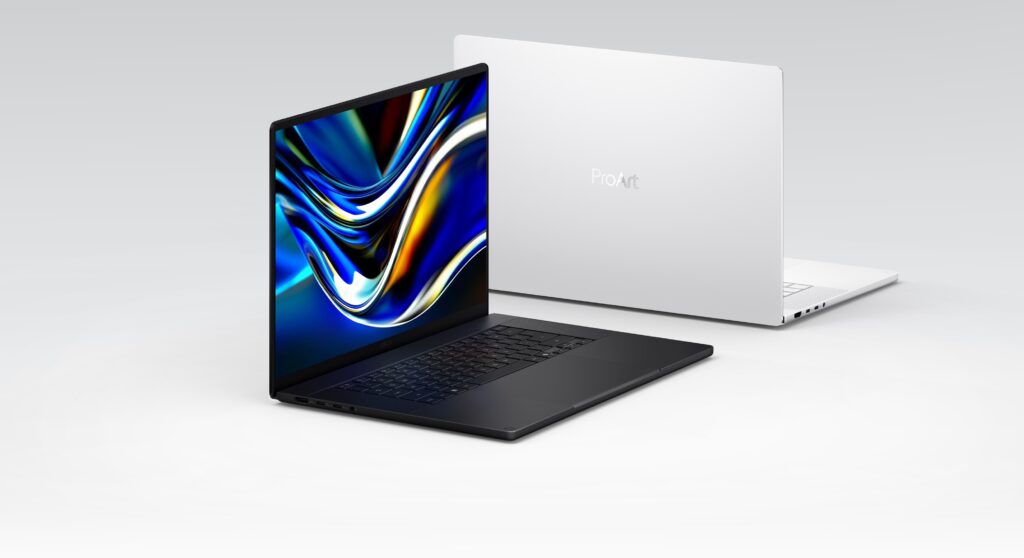
Leading the announcement are the new ProArt P16 and ProArt P14 creator laptops. These are the first ASUS laptops powered by NVIDIA’s new RTX Spark platform, which combines NVIDIA’s Blackwell GPU architecture with the Grace CPU platform for AI-focused workloads.
ASUS says these machines are designed for creators, developers, and anyone working with AI-heavy workflows. The company is also bundling AI tools like MuseTree, StoryCube, and ProArt Creator Hub to help users manage creative projects and optimize system performance.
The laptops also come with ASUS’s latest Lumina Pro OLED displays that can hit up to 1,600 nits of HDR brightness and feature a 120Hz refresh rate. Interestingly, ASUS is introducing two new color options called Nano Black and Neo White, marking the first major design refresh for the ProArt lineup.
Zenbook and Vivobook Get the AI Treatment
For everyday users, ASUS refreshed the Zenbook 14 with a clear focus on portability. The laptop weighs just 1.1kg and uses ASUS’ Ceraluminum construction, which combines aluminum with ceramic-like durability. ASUS claims the laptop can deliver over 21 hours of battery life, making it one of the longest-lasting devices in the company’s lineup. Buyers can choose among Intel, AMD, and Snapdragon variants, with AI performance up to 50 TOPS, depending on the configuration. ASUS has also added new Arctic Blue and Komodo Coral color options to make the laptop feel less corporate than previous Zenbook generations.
Other highlights include a 1.7mm travel keyboard, an ASUS OLED display, Windows Hello support, Microsoft Pluton security, and adaptive privacy features that automatically dim or lock the screen when users step away.
Advertisement
Meanwhile, ASUS is also betting heavily on Snapdragon-powered Windows laptops with the new Vivobook S14 and Vivobook S16. Unlike previous Vivobook generations, these models exclusively use Snapdragon X processors and deliver up to 45 TOPS of AI performance. The laptops are clearly aimed at students and young professionals. ASUS says battery life can exceed 25 hours, while fast charging can take the battery from 0 to 60 percent in under 50 minutes.
The larger S16 model offers a 16-inch OLED display with an 89% screen-to-body ratio, while the S14 opts for a more compact 14-inch design. Both feature 100% DCI-P3 color coverage, TÜV-certified low-blue-light technology, and military-grade durability certification.
ASUS Is Back in the Tablet Business
One of the more surprising announcements from the event was the ASUS Pad, marking the company’s return to the tablet category. The tablet features a 12.2-inch 2.8K OLED display with a 144Hz refresh rate and runs on the MediaTek Dimensity 8300 chipset.
ASUS has equipped the tablet with a 9,000mAh battery, Dolby Atmos-powered quad speakers, Google Circle to Search, and GlideX integration for easier cross-device workflows. At just 6.5mm thick and weighing 523g, the company is positioning it as both an entertainment device and a productivity companion.
New Desktops and AiOs Join the Lineup
Beyond laptops, ASUS also announced the new V700 Mini Tower desktop and V200/V400 all-in-one PCs. The V700 desktop stands out for its unusual home-inspired design, featuring wood-grain finishes and softer aesthetics rather than the aggressive styling usually seen in desktop PCs. It can be configured with up to an Intel Core Ultra 9 processor and NVIDIA RTX 50-series graphics. The V400 AiO, meanwhile, uses Snapdragon-powered hardware and AI capabilities in a larger 27-inch all-in-one form factor aimed at family and home users.
Rounding out the announcements was ASUS Zenni Claw, a new AI assistant designed to simplify access to AI-powered workflows across work, travel, and everyday tasks. ASUS hasn’t revealed extensive details yet, but it appears to be the company’s attempt at creating a more unified AI experience across its devices.
Greenvolt Next also plans to allocate funding for the development of its Waterford headquarters.
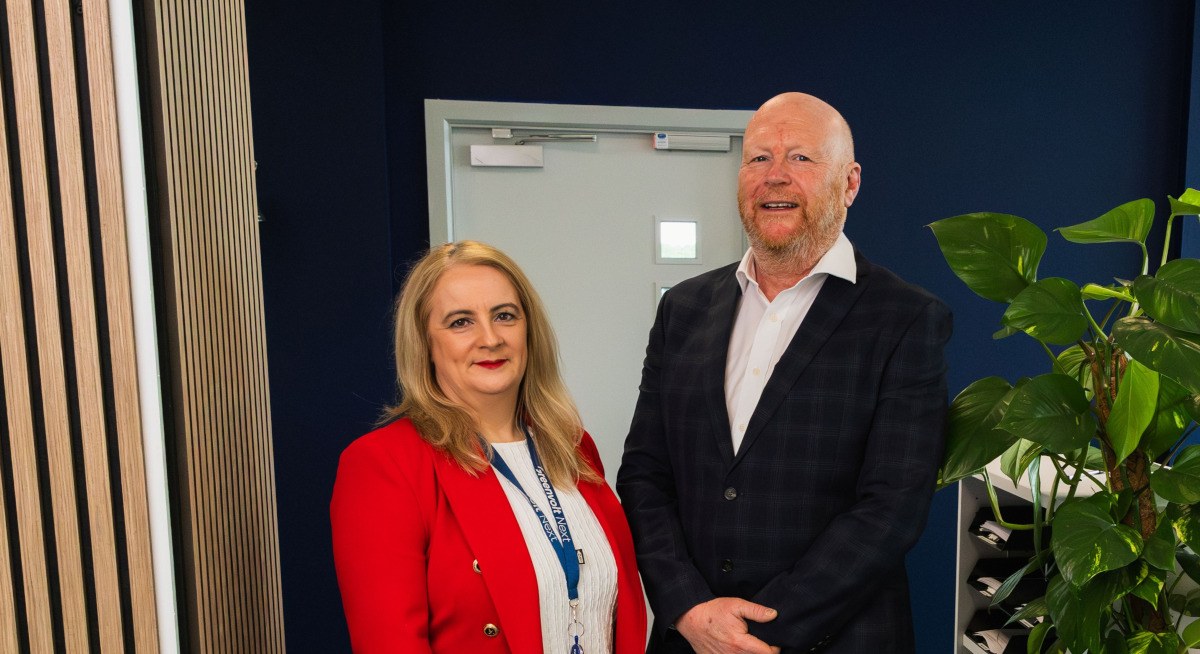
Greenvolt Next Ireland – which is part of Greenvolt Group, a specialist in renewable energy solutions for the commercial and industrial sector – has today (3 June) announced the creation of 90 new jobs. 50 are to be made available at its Waterford headquarters and the remaining 40 will be based in the UK.
Over the next 12 months, the company will be recruiting mid-level to senior managers for roles including project engineers, senior project engineers, project managers and site managers. In expanding the team, the organisation aims to work on additional large-scale projects to support developers and landowners in advancing renewable assets and meet the UK and Irish demand for green energy solutions.
Greenvolt Next is also allocating funding for the further development of its Waterford headquarters, which is being increased by 2,176 sq ft and will be equipped with new technologies.
Advertisement
Commenting on the announcement, Owen Power, the CEO of Greenvolt Next Ireland & UK, said: “Our success to date has been driven by our ability to deliver the most reliable and cost-effective energy solutions to customers, underpinned by unmatched resources and expertise. Looking to the future, which will only see greater demand for such projects, we want to continue making a tangible impact for businesses and the environment.
“That means investing in operations, growing the team and innovating for customers. As well as marking the next stage in our own journey, this will allow us to make renewable energy easy for more organisations across Ireland and the UK. In turn, they will not only be more sustainable but also more successful.”
In 2024, Greenvolt Group announced a partnership with Enerpower, with both organisations agreeing to a joint commitment to install up to 500MW of renewable energy between 2024 and 2029 and create 100 new jobs. The strategy was designed to impact the Irish and wider European markets.
Don’t miss out on the knowledge you need to succeed. Sign up for the Daily Brief, Silicon Republic’s digest of need-to-know sci-tech news.
Springboard+ research found that adults often face financial difficulties when attempting to upskill or change the direction of their careers.
Educational platform Springboard+ has released the results of a survey exploring some of the challenges learners face as they aim to progress personally and professionally. The organisation commissioned an independent national survey collecting data from 1,000 Ireland-based adults across a wide range of ages, genders, regions and social backgrounds.
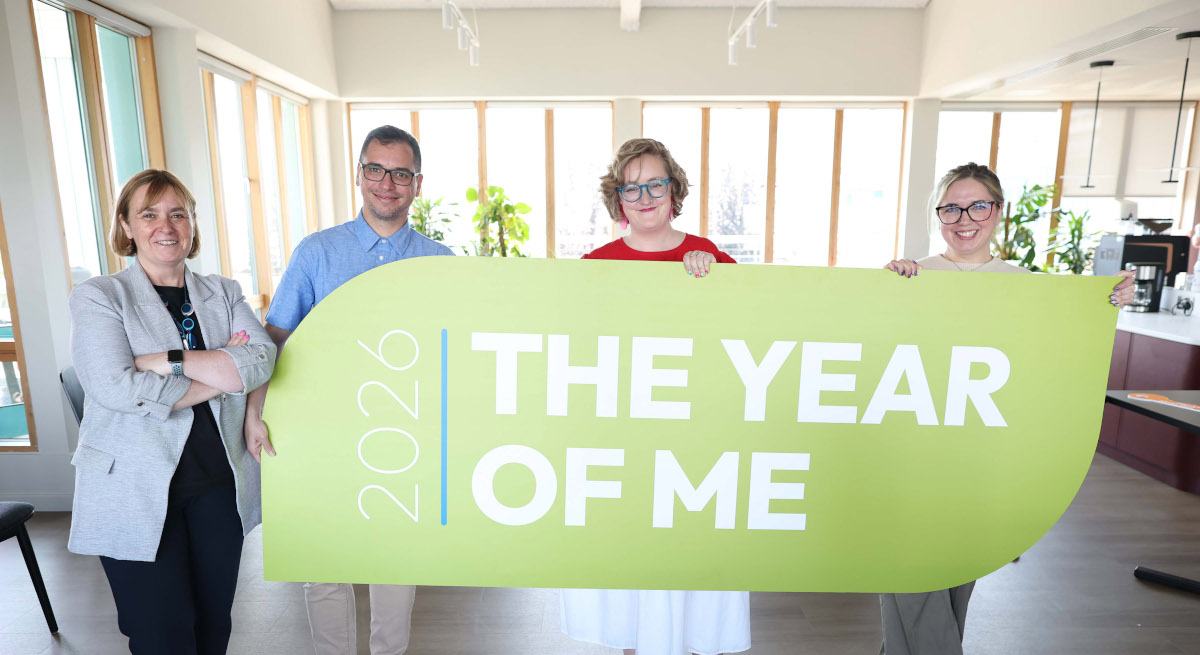
What was discovered is that almost half (46pc) of surveyed adults in Ireland struggle to afford learning and study opportunities to upskill and change the trajectory of their careers. The survey, which was part of Springboard’s ‘2026 Year of Me’ campaign, also identified which groups of people are typically more affected than others.
Perhaps unsurprisingly, women were found to be disproportionately impacted, as 53pc of women surveyed who were under the age of 45 agreed that they have very little time to invest in career growth. Half of parents also responded that time is a limited resource, while 54pc of women said that financially speaking, it is difficult to engage with upskilling opportunities.
Advertisement
Decision time
More than 40pc of people surveyed said that they are afraid of making the wrong decision when choosing a new career direction. This sentiment was particularly prominent among younger cohorts, with 32pc of adults aged between 18 and 24 responding that they would struggle with the stress associated with learning new skills.
The report found, however, that despite the barriers, Ireland’s professionals still value learning and self-development, as 93pc of respondents believe learning new skills as an adult can change the trajectory of one’s life; 93pc also agree that learning new skills opens doors that otherwise would remain closed.
Commenting on the findings of the report, Dr Vivienne Patterson, the head of skills, engagement and statistics at the Higher Education Authority, said, “The findings highlight that many adults across Ireland want to invest in their future and develop new skills, but are often held back by practical pressures such as time, affordability and uncertainty about returning to learning.
“Flexible and affordable learning opportunities can play an important role in helping people overcome some of these barriers. Many Springboard+ courses are delivered on a part-time or online basis, allowing people to balance learning with work, family and other commitments, while the significant financial support available through the programme helps make higher education more accessible.
Advertisement
“The strong demand we are already seeing for Springboard+ 2026 courses reflects the growing demand for flexible learning opportunities that can help people build confidence, develop new skills and explore new career opportunities.”
So far in 2026, a number of organisations and institutions have engaged in offering opportunities to boost skills among the Irish workforce.
In May, South East Technological University announced it is getting a new €11.5m computer system. The IBM z17 mainframe will support students and researchers in developing their skills. In April, the Government launched AIReady.ie, a national AI skilling platformdesigned to provide people across Ireland with the means to learn essential AI skills.
Similarly, in March of this year, Technological University of the Shannon launched its Regional Skills Horizon and Pathways to Employment (ReSHAPE) initiative, an AI-powered digital platform developed to support professionals based in Ireland’s midlands region, supporting economic development in counties such as Laois, Offaly, Longford and Westmeath.
Advertisement
Don’t miss out on the knowledge you need to succeed. Sign up for the Daily Brief, Silicon Republic’s digest of need-to-know sci-tech news.
For those who have never played the hit video games Undertale and Deltarune, the games are partially known for their interesting characters, many of which have eerie, surreal, and expressive designs. One of the more memorable characters from Deltarune is Tenna, a game show host of sorts whose distinguishing feature is an old television as a head, as well as a colorful suit. As a result he’s been the subject of a number of recreations by various cosplayers and makers like [BigRig Creates].
This version of the character was actually inspired by a previous build by [BunnyBii] which used an iPad as the interactive screen/face. Inside the television, though, the actual human found this to be front heavy and limiting in the ways that it could be used interactively, especially since the only way to see the outside world in this version was with a small endoscope and screen. [BigRig Creates]’s version builds on this idea but swaps out the iPad for a Raspberry Pi, allowing for much more customization, and uses a pair of Xreal glasses instead of a screen for the view of the outside world from in the television.
To get the whole costume together, the head is 3D printed with all of the electronics inside, and a game controller integrated into a handheld microphone controls the animations shown on the screen. A vibrant, custom-tailored suit with white gloves rounds out the ensemble, along with a pair of 3D-printed shoe covers since actual yellow shoes were a bit pricy. There were some interesting problems to solve along the way, specifically with regards to power management for all the electronics, but in the end it all seems to have come together quite well. [BigRig Creates] is no stranger to builds with unusual displays, though; one of our favorites was the world’s largest Nintendo 3DS.
If there’s one group that knows how to move fast, it’s runners — and that’s exactly what you’ll need to do to take advantage of this deal. Strava members can earn a free two-week Runna Premium subscription by running a 5K on Wednesday, which marks Global Running Day.
Strava is a popular fitness app that records and logs your runs, rides, hikes and other activities, including strength training. Last April, Strava acquired Runna, an AI-personalized running app, to customize training plans for different race distances and coaching for its subscribers. Strava doesn’t provide training plans, but it can log your runs, let you create your own routes, view your running stats after each run and share them with your app followers.
You can use Strava for free, but to access additional features, you would need to upgrade your membership to an individual ($80 annually), family ($140 annually for a family of four) or student subscription ($40 annually) if you’re willing to pay for the Strava and Runna combination plan, which costs $150 a year. You can also experience Runna for free, but to access it fully, you’ll need a subscription for $120 annually.
Advertisement
However, if you run, walk, trail run or use a wheelchair and log a 5K on Global Running Day on your Strava app, you can experience Runna free for two weeks to decide for yourself if it’s worth the investment. Strava is counting GPS, virtual and manual activities toward the challenge goal.
Apple is also participating in Global Running Day and giving Apple Watch owners the chance to earn a digital badge by logging a 5K run indoors or outdoors. This also applies if you have other third-party fitness apps that log runs and connect to your Apple Health account.
For months the fight in India’s App Store antitrust case was not really about app stores. It was about a spreadsheet. The Competition Commission of India wanted Apple’s financial records; Apple did not want to give them up, least of all the global ones. On 3 June, Apple agreed to submit the financials, removing the obstacle that had stalled the long-pending case.
The reason the data mattered so much is the reason Apple resisted it. Under India’s competition law as updated in 2024, penalties can be calculated against a company’s global turnover rather than its revenue inside the country. For most companies that distinction is academic.
For Apple, whose Indian revenue is a sliver of a business that turns over hundreds of billions of dollars worldwide, it is the difference between a manageable fine and an existential one. Apple has said it fears a penalty of up to $38bn, a figure it has invoked as evidence the regulator is overreaching.
That fear is what drove the months of manoeuvring. Apple had refused to fully comply with the CCI’s demand for detailed financial disclosures, argued that global figures should be out of scope, and escalated the dispute to the Delhi High Court, seeking to pause the proceedings before they reached a final hearing.
Advertisement
The 💜 of EU tech
The latest rumblings from the EU tech scene, a story from our wise ol’ founder Boris, and some questionable AI art. It’s free, every week, in your inbox. Sign up now!
The regulator declined to slow down. The result was a standoff in which the substance of the case, whether Apple abused its market position, was held up by a procedural fight over what the regulator was allowed to see.
The underlying allegation is not new. A 2024 CCI investigation found that Apple had abused its dominant position in the iPhone apps market by requiring developers to use its proprietary in-app purchase system, the same conduct that has drawn regulatory fire in the European Union, the United States and elsewhere. India’s case has moved more slowly, but its penalty framework, anchored to global turnover, gives it unusual teeth.
Advertisement
TNW readers have followed the procedural thread. The Delhi High Court recently brokered a compromise in which it told Apple to cooperate while ordering the CCI not to issue its ruling before 15 July, granting Apple a roughly two-month reprieve while requiring it to produce the data. Wednesday’s agreement is Apple acting on that, handing over the records it had fought to keep back rather than continuing a fight the courts had signalled it would lose.
What the concession does is unblock the case rather than decide it. With the financials in hand, the CCI can move toward the part that actually matters: whether to penalise Apple and, if so, how much.
The global-turnover framework means that calculation is where the real stakes sit, and it is the calculation Apple’s resistance was designed to forestall. Handing over the data does not concede the underlying conduct; it concedes the regulator’s right to the information it needs to act.
The case is now one of several fronts on which Apple’s in-app payment rules are under pressure at once, and India’s is among the more dangerous because of how the fine could be sized. Apple has bought itself a deadline of mid-July and lost the argument over disclosure. The ruling that follows, and the number attached to it, is the part still to come, and the part Apple spent months trying to delay.
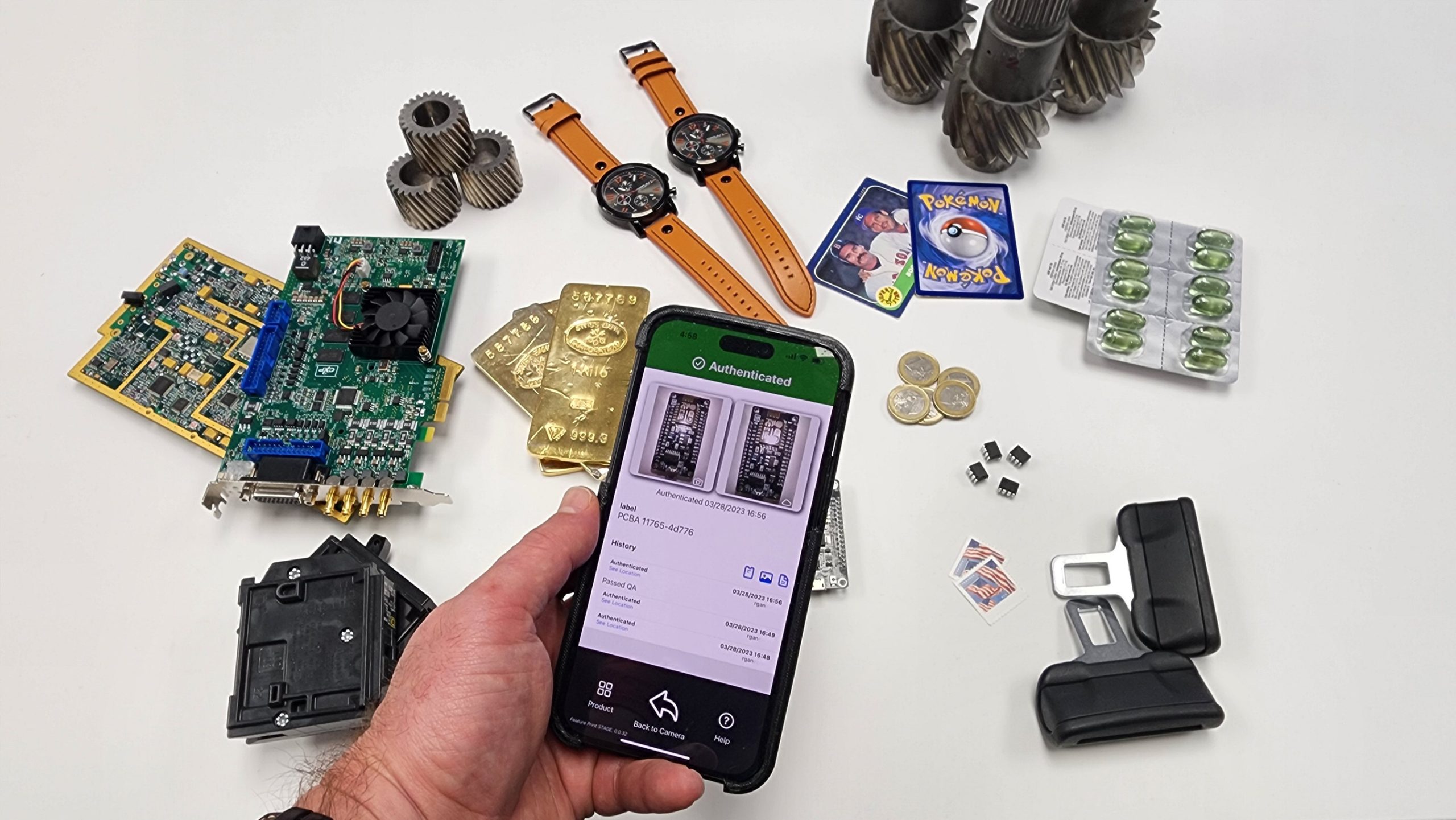
From industrial gears to healthcare products to luxury goods, Alitheon’s FeaturePrint provides a link between physical objects and digital traceability without tags, labels, or stickers. (Alitheon Photo)
Bellevue, Wash.-based Alitheon raised $8 million in new funding to expand its FeaturePrint technology, which uses optical AI to create a unique digital “fingerprint” for physical objects — no barcodes, tags, or labels required.
FeaturePrint works by reading the microscopic surface variations every manufactured object naturally has using nothing more than a standard camera. Alitheon calls it “biometrics for things” and says it works on everything from designer purses to industrial gears to pharmaceutical packaging.
“We aren’t just identifying goods; we are powering the trust layer of the global economy, providing a level of security that additives and standard AI simply cannot match,” Alitheon CEO Roei Ganzarski said in a news release this week.
Founded in 2015, Alitheon has built a portfolio of 55+ patents and attracted customers across industries including aerospace, automotive, luxury goods and defense. Swiss precious metals company Argor-Heraeus is a customer.
Alitheron has landed $1.5 million in federal contracts, including work with the Pentagon’s Nuclear Weapons Center. Time magazine named FeaturePrint one of the 200 best inventions of 2023.
Advertisement
In a 2024 GeekWire feature, Ganzarski illustrated the problem his company is trying to solve.
“Last year, auditors found that Lockheed Martin had lost a million parts in the F-35 program,” he said. “Lost? You don’t ‘lose’ parts. They just become unidentifiable. The barcode fell off, the sticker got erased.”
The Series A1 round was led by Emerald Technology Ventures, with participation from eBay Ventures. Alitheon, which employs 24 people, has raised a little over $40 million to date.
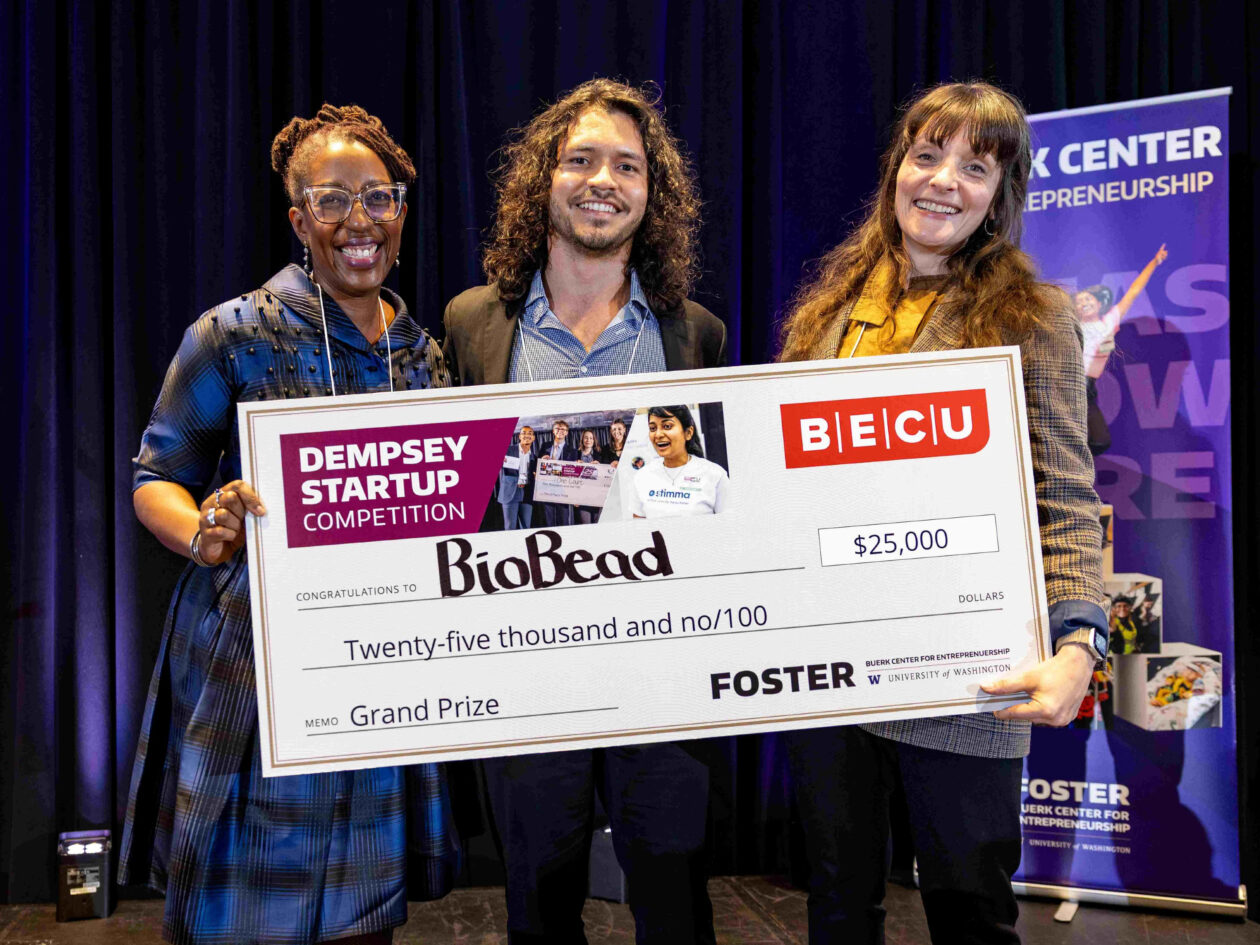
BioBead won the top prize at the Demsey Startup Competition, awarded by Trish Held (left), manager of philanthropy at the BECU Foundation, and received by BioBead’s Jared Espinosa and Renee Davis. (UW Photo)
The big winner at the University of Washington’s 29th annual Dempsey Startup Competition was BioBead, a startup launched by a UW team with an ag tech solution for boosting soil health and crop production.
The company won $25,000 from BECU as well as the $2,500 Voyager Capital Best Business to Business Idea Prize.
A record 186 startups entered the competition, whittled down to 16 contenders who pitched before judges in mock boardroom settings. Winners took home a share of $92,500 in prize money.
The event is open to student entrepreneurs from across Washington, Oregon, Idaho, Alaska and British Columbia. Entrants range from very early-stage startups with a prototype to teams with minimum viable products or technologies ready for commercial production.
The competition runs over seven weeks, during which teams refine their strategies — recruiting business students to strengthen go-to-market plans, for example. Judges this year noted that AI is helping teams design more sophisticated technologies.
Grand prize recipient BioBead is developing small, biodegradable pellets that bring together bacteria and fungi that have coexisted in soil for 400 million years, helping plants absorb essential nutrients including nitrogen and phosphorus.
“People seem to be quite disconnected from everything below our feet because we can’t see it,” said Korena Mafune, a BioBead co-founder and UW research scientist. But those organisms are what allow crops above ground to flourish, she added.
BioBead’s other co-founders are Renee Davis, who is finishing her doctoral degree at the UW, and Mari Winkler, a UW professor in civil and environmental engineering. Jared Espinosa, a recent MBA graduate from the UW’s Foster School of Business, joined the team for the competition.
Advertisement
The startup has been working with farmers growing lettuces, tomatoes, corn and wheat to test the benefits of the soil treatment. Initial results show higher crop yields while reducing the need for increasingly expensive fertilizers.
Mafune last month also won a $275,000 grant from the Washington Research Foundation to support commercialization of the technology.
The second to fourth prize winners were:
$15,000 WRF Capital Second Place Prize – CPRight (UW and Western University of Health Sciences in Oregon) is developing a low-cost patch that provides real-time information on compression depth and pace during cardiac emergencies requiring CPR. CPRight also won the $2,500 Chris and Barbara Petersen Best Health & Wellness Impact Idea Prize.
Advertisement
$10,000 iSpot.tv Third Place Prize – Kinnex Health (University of Idaho) is building a wearable sensor to provide continuous joint-movement data collected from patients after orthopedic surgeries and procedures. The team also won the $2,500 Amazon Best Consumer Product Idea Prize.
$7,500 Friends of the Dempsey Startup Fourth Place Prize – Alarmable (UW) is creating a wearable bracelet charm that also serves as an alarm that can be triggered in emergency situations.
Other winners:
$5,000 Wilson Sonsini Social Impact Big Picture Prize – Osanwe Link (UW)
$5,000 Kathryn Gardow & David Bradlee Climate Solutions Big Picture Prize – LEAF (UW)
$5,000 Glympse Emerging Tech Big Picture Prize – Adam Biotech (UW)
$2,500 Smukowski Family Best Sustainable Business Prize – Clubless Collective (UW)
$2,500 eBay Best Marketplace Idea Prize – Kindred (UW)
$2,500 Perkins Coie Best Innovation/Technology Idea Prize – Emerald Dynamics(UW)
$2,500 Saara Romu Community Impact Prize – UWEMS (UW)
$2,500 DLA Piper Best Idea with Global Reach Prize – GridGuard (UBC)
















































You must be logged in to post a comment Login