Connect with us

Tech

Electromagnetic Compatibility Expert Was a TV Repairman

Published

on

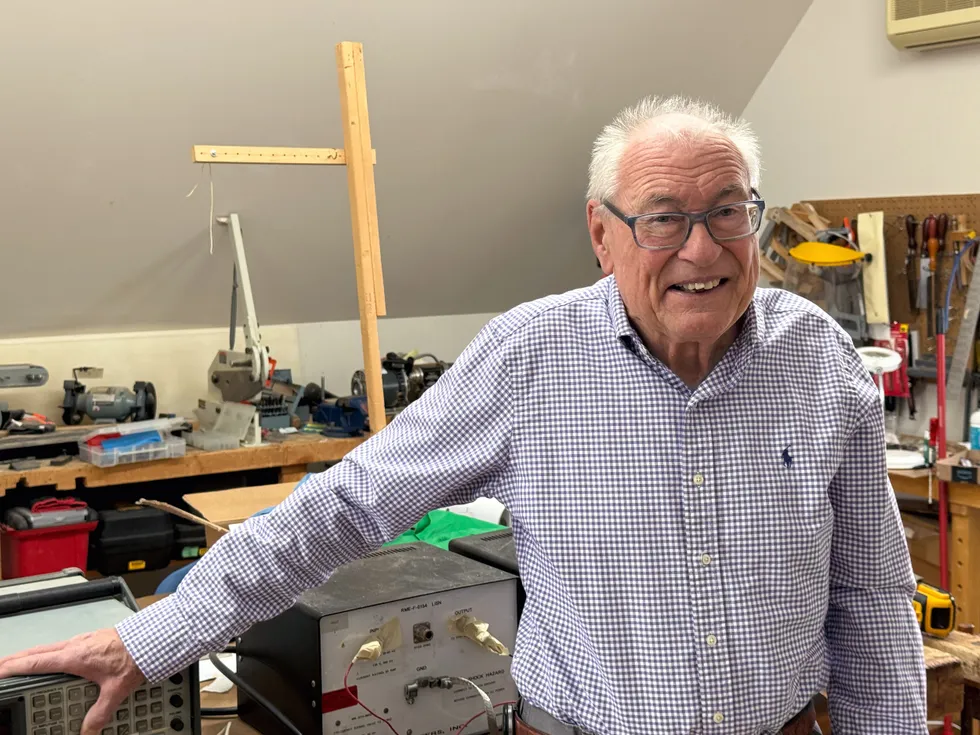
No one had very high career aspirations for teenager David A. Weston—except for Weston himself. Growing up in London, he scored low on the U.K. national assessment test given to students finishing primary school. The result meant that his next path was either to become a laborer or attend a vocational school to learn a trade.

What Weston really wanted to do was to work as a radio and TV repairman. He was fascinated by how the devices worked. He had taught himself to build an AM radio when he was 15. Even after showing it to his parents and teachers, though, they still didn’t think he was smart enough to pursue his chosen career, he says.

David A. Weston

Employer

Advertisement

EMC Consulting, in in Arnprior, Ont., Canada

Job title

Retired consultant

Member grade

Advertisement

Life member

Alma mater

Croydon Technical College, London

So, later that year, the underweight teen got a job on a construction site carrying heavy loads of building materials in a hod, a three-sided wooden trough. The experience convinced him he wasn’t cut out for manual labor.

Advertisement

He eventually earned a certificate in radio and television, the only credential he holds. The lack of academic degrees did not hold him back, though. He went on to become an expert in electromagnetic interference (EMI) and electromagnetic compatibility (EMC).

An EMI field has unwanted energy that causes interference. EMC is the capacity for electronic devices to work correctly in a shared electromagnetic environment without causing interference or suffering from it in nearby devices or signals.

After working for a number of companies, he launched his own business more than 40 years ago: EMC Consulting, in Arnprior, Ont., Canada. The company has helped clients meet EMI and EMC regulatory requirements.

Now 83 years old and retired, the IEEE life member recently self-published his memoir, From a Hod to an Odd EM Wave.

Advertisement

“My memoir is about engineering persistence and human and technical discoveries,” he says. “I wanted to interest a young person, or perhaps a person later in life, in a career in engineering. If I can show that engineering is a personal, human endeavor with exciting opportunities in different fields such as medical, scientific, and the arts, maybe more women would be attracted to it.”

From repairing radios to designing underwater devices

In 1960 Weston enrolled in the radio and electronics program at London’s Croydon Technical College (now Croydon College). The school covered topics from the City and Guilds of London Institute’s radio and television certificate program. He attended classes one day a week for five years while working to put himself through school.

Although his parents and his teachers might not have recognized Weston’s potential, employers did.

He got his first job in 1960, fixing televisions in a small repair shop. Then he helped repair tape recorders. In his spare time, he studied transistors and semiconductors.

Advertisement

Everything he knows, he says, he learned by reading books and research papers, and from on-the-job training.

Later in 1960, he worked as a mechanical examiner for the U.K. Ministry of Aviation, where he calibrated precision meters and potentiometers, which are variable resistors that monitor, control, and measure industrial equipment.

“Engineering is creative. To have a new idea or design accepted is rewarding, satisfying, pleasurable, and even exciting.”

He left the ministry in 1963 because he found the work boring, he says, and he was hired as a technician with the Medical Research Council’s neuropsychiatric research unit in Carshalton. The institution researches the biological causes of mental illness. His manager was interested in learning about advances in medical electronics and eagerly shared his knowledge with Weston.

Advertisement

One of Weston’s tasks was to build an electroencephalography (EEG) calibrator to measure responses from a patient’s brain activity. The methods used at the time to detect a brain tumor—before MRI machines were developed—involved monitoring the patient’s speech and coordination, followed by taking a biopsy, which was not without danger, he says.

He used an ultrasonic transmitter and receiver to measure the time of transmission to the midline in the brain to determine whether the person had a tumor. If the midline had shifted, it would indicate the presence of a tumor, and a biopsy would be performed to confirm it. The measure of the evoked response in the brain was the only reliable indicator.

Weston earned his radio and TV certificate in 1965, leaving the research facility a year later to join Divcon (now part of Oceaneering International), a commercial diving company based in London that developed deep-sea helium diving helmets. Weston helped design a waterproof handheld communication device for divers that could withstand the high pressure in diving bells, the open-bottom pressurized chambers that transported them underwater.

Weston then moved to Hamburg, Germany, in 1969 to work for Plath, an electronics manufacturer. He was tasked, along with other engineers from England, to design a servo control loop.

Advertisement

“Unfortunately it oscillated so badly when first being turned on that it shook itself to bits,” he says.

He left to work as a senior engineer at Dr. Staiger Mohilo and Co. (now part of Kistler), in Schorndorf, Germany. It manufactured torque sensors, force transducers, and specialized test stand systems. Weston designed a process control computer. He says his boss told him that the controller had to work in close proximity to—and from the same power source as—a nearby machine without interfering with it or being interfered by it.

“I was thus introduced to the idea of electromagnetic compatibility,” he says.

After three years, he left to join the Siemens Mobility train group in Braunschweig, Germany, where he helped develop an electronic train-crossing light controller. The original warning lights on crossing gates used a mercury tube as a switch.

Advertisement

“The concern was the danger to personnel if the tube broke,” he says. “The simple and inexpensive solution was to put the tube in a metal container.”

Weston and his wife decided to leave Germany for Canada in 1975, after their young son began forgetting how to speak English.

His first job in the country was as an engineer for Canadian Aviation Electronics in Montreal. CAE helped design the remote manipulator system in robotic hand controllers and simulation systems used to train astronauts for the space shuttle.

The robotic arm, known as Canadarm, was used to deploy, maneuver, and capture payloads for the astronauts. Weston’s engineering team designed the display and control panel as well as the hand controllers located in the shuttle’s flight deck.

Advertisement

“I was attracted to the EMC aspects of the project and avidly studied everything I could on the topic,” he says.

He also helped develop a system that would protect an aircraft’s deployable black box from lightning strikes.

“I used a computer program to analyze the EMI field at close proximity to the black box to predict the lightning current flowing into the aircraft structure,” he says.

While enjoying the warm winter weather during a 1975 visit to a supplier on Long Island, N.Y., he decided he wanted to move his family there and asked whether any companies in the area were hiring. He was told that Brookhaven National Laboratory, in Upton, was, so he applied for a position working on the ring system for the Isabelle proton colliding-beam particle accelerator.

Advertisement

The project, later known as the colliding beam accelerator, was a collaboration between the lab and the U.S. Department of Energy. The 200+200 giga-electron volt proton-proton collider was designed to use advanced superconducting magnets cooled by a massive helium refrigeration system to produce high-energy collisions. The GeV refers to the collision energy in a particle accelerator.

The lab hired him in 1978, and the family moved to Long Island. After a few weeks of meeting with different departments, his boss asked him what kind of work he wanted to do. Weston told him about his idea for designing a device to detect a helium leak, should there ever be one. His machine would cover the entire 3,834-meter circumference area of the ring.

“The danger with increased helium-enriched air is that the oxygen level reduces until the person breathing becomes adversely affected,” he wrote in his memoir. “I found that the speed of the sound of helium increased enough to be detected, but not sufficient enough to cause a person trouble if they were in the tunnel.

“Brookhaven was considering machines that only covered a small area of the ring, but these would be unrealistic because too many machines would be needed, and the cost would have been astronomical.”

Advertisement

Weston’s system included an ultrasonic transmitter, a receiver, a power amplifier, and a preamplifier. It would sound an alarm if the helium content went above a certain level. People in the tunnel would be directed to go to the nearest oxygen-breathing equipment, put on a mask, and immediately evacuate. It was successfully tested.

Weston wrote a report detailing the ultrasonic helium leak detector, but shortly after, he and his wife had to return to Canada in 1978 because they were unable to get additional work permits in the United States.

When he returned to Brookhaven for a visit, his former boss told him the report was well-received. And he shared some news that upset Weston.

“My boss told me he took my report, changed the name on the report to his, did not mention me, and published the report as his,” Weston wrote in his memoir.

Advertisement

But the system was never built. The Isabelle project was canceled in July 1983 due to technical problems with fabricating the superconducting magnets.

Weston got a job working for CAL Corp., an aerospace telecommunications company in Montreal. For the next 14 years, he fixed EMI problems for the company’s products, including its charge-coupled device-based space-qualified cameras, which were designed to be carried aboard a satellite.

In 1992 he realized that nearly all his work involved consulting for the company’s customers, so he decided to start his own agency. CAL generously let him take the clients he worked with, he says.

Weston then conducted EMI analysis and testing and designed EMC systems for companies around the world.

Advertisement

“I always had enough customers and have never had to look for work,” he says. “For me, having my own business was more secure than working for a company.”

He retired in 2022.

IEEE as an educator

To broaden his education, he joined IEEE in 1976 to get access to its research papers and attend its conferences, he says. He is a member of the IEEE Electromagnetic Compatibility Society.

Because he is self-educated, he was “keen to learn as much as possible by reading practical papers published by IEEE,” he says. “I met people at IEEE symposiums and listened to the authors presenting their papers.”

Advertisement

Those included EMC experts such as Life Fellows Lothar O. “Bud” Hoeft, Richard J. Mohr, and Clayton R. Paul, whose papers are published in the IEEE Xplore Digital Library. Several of Weston’s papers are in the library as well.

His book Electromagnetic Compatibility: Methods, Analysis, Circuits, and Measurement references many IEEE papers on data and analysis methods.

“Engineering is creative,” he says. “To have a new idea or design accepted is rewarding, satisfying, pleasurable, and even exciting.”

From Your Site Articles

Advertisement

Related Articles Around the Web

Source link

Continue Reading
Click to comment

Leave a Reply

Your email address will not be published. Required fields are marked *

Tech

California’s Problematic Attempt To Add Age-Verification To Software

Published

on

Last year California’s Digital Age Assurance Act (AB 1043) was signed into law, requiring among other things that operating system providers implement an API for age verification purposes. With the implementation date of January 1, 2027 slowly encroaching this now has people understandably agitated. So what are the requirements, and what will its impact be, as it affects not only OS developers but also application stores and developers?

The required features for OS developers include an interface at account setup during which the person indicates which of the four age brackets they fit into. This age category then has to be used by application developers and application stores to filter access to the software. Penalties for non-compliance go up to $2,500 per affected child if the cause is neglect and up to $7,500 if the violation was intentional.

As noted in the Tom’s Hardware article, CA governor Newsom issued a statement when signing the unanimously passed bill, saying that he hopes the bill gets amended due to how problematic it would be to implement and unintended effects. Of course, the bigger question is whether this change requires more than adding a few input fields and checkboxes to an OS’ account setup and an API call or two.

When we look at the full text of this very short bill, the major questions are whether this bill has any teeth at all. From reading the bill’s text, we can see that the person creating the account is merely asked to provide their birth date, age or both. This makes it at first glance as effective as those ‘pick your age’ selection boxes before entering an age-gated part of a website. What would make this new ‘age-verification feature’ any more reliable than that?

Advertisement

Although the OS developer is required to provide this input option and an API feature of undefined nature that provides the age bracket in some format via some method, the onus is seemingly never put on the user who creates or uses the OS account. Enforcement as defined in section 1798.503 is defined as a vague ‘[a] person that violates this title’, who shall have a civil action lawsuit filed against them. What happens if a 9-year old child indicates that they’re actually 35, for example? Or when a user account is shared on a family computer?

All taken together, this bill looks from all angles to add a lot of nuisance and potential for catching civil lawsuit flak for in particular FOSS developers, all in order to circuitously reimplement the much beloved age dropdown  selection widget that’s been around since at least the 1990s.

They could give this bill real teeth by requiring that photo ID is required for registering an (online-only) OS account, much like with the recent social media restrictions and Discord age-verification kerfuffle, but that’d run right over the ‘privacy-preserving’ elements in this same bill.

Advertisement

Source link

Continue Reading

Tech

DOJ seizes LeakBase, one of the world's biggest hacker forums

Published

on


The Department of Justice describes LeakBase as a clearinghouse for hacked databases. Alongside the “hundreds of millions” of account credentials, it offers credit and debit card numbers, banking details, and other personally identifiable information that can fuel account takeovers and fraud.
Read Entire Article
Source link

Continue Reading

Tech

Scientists develop nanomaterial that targets cancer cells while sparing healthy tissue

Published

on


Iron is essential to biological function, and iron-based nanomaterials may become valuable tools in the long-term effort to develop cancer treatments. Researchers at Oregon State University have engineered a new “nanoagent” using an iron-based metal-organic framework (MOF) structure and demonstrated its ability to destroy cancerous cells in laboratory experiments.
Read Entire Article
Source link

Continue Reading

Tech

Apple M5 chips introduce a new "super core" tier in its CPU design

Published

on


On the surface, the change might look like semantics. But it reflects a broader evolution inside Apple Silicon that moves beyond the traditional mobile-processor model where “big” cores handle demanding work and “little” cores handle background tasks for efficiency’s sake. By renaming its cores (in pure Apple’s marketing style), the…
Read Entire Article
Source link

Continue Reading

Tech

Nvidia says its investments in OpenAI and Anthropic are likely its last

Published

on


Huang’s explanation was brief, but the implications are broad. Nvidia, whose products have become indispensable to generative AI infrastructure, sits in a position few companies have ever occupied: both supplier and shareholder to the firms building the software atop its hardware. That arrangement, once mutually reinforcing, now appears increasingly tangled.
Read Entire Article
Source link

Continue Reading

Tech

What is the release date for Marshals: A Yellowstone Story episode 2 on Paramount+?

Published

on

Marshals: A Yellowstone Story has officially left the Dutton Ranch behind for something a lot more akin to a police procedural.

The episode 1 premiere began with the shock news of Monica Dutton (Kelsey Asbille) dying offscreen since we last saw her in Yellowstone, despite her marriage to Kayce (Luke Grimes) having been dissolved.

Source link

Advertisement
Continue Reading

Tech

Pentagon Formally Designates Anthropic a Supply-Chain Risk

Published

on

The Pentagon has formally designated Anthropic as a “supply chain risk,” ordering federal agencies and defense contractors to stop using its AI tools after the company sought limits on the military’s use of its models. In a written statement, the department said it has “officially informed Anthropic leadership the company and its products are deemed a supply chain risk, effective immediately.” Politico reports: The designation, historically reserved for foreign firms with ties to U.S. adversaries, will likely require companies that do business with the U.S. military — or even the federal government in general — to cut ties with Anthropic.

“From the very beginning, this has been about one fundamental principle: the military being able to use technology for all lawful purposes,” the Pentagon said in the statement. “The military will not allow a vendor to insert itself into the chain of command by restricting the lawful use of a critical capability and put our warfighters at risk.”

A spokesperson for Anthropic did not immediately respond to a request for comment. But the company said last week it would fight a supply-chain risk label in court.

Source link

Advertisement
Continue Reading

Tech

Anthropic to challenge DOD’s supply chain label in court

Published

on

Dario Amodei said Thursday that Anthropic plans to challenge the Defense Department’s decision to label the AI firm a supply chain risk in court, a designation he has called “legally unsound.”

The statement comes a few hours after the Department officially designated Anthropic a supply chain risk following a weeks-long dispute over how much control the military should have over AI systems. A supply chain risk designation can bar a company from working with the Pentagon and its contractors. Amodei drew a firm line that Anthropic’s AI should not be used for mass surveillance of Americans or for fully autonomous weapons, but the Pentagon believed it should have unrestricted access for “all lawful purposes.”

In his statement, Amodei said the vast majority of Anthropic’s customers are unaffected by the supply chain risk designation.

“With respect to our customers, it plainly applies only to the use of Claude by customers as a direct part of contracts with the Department of War, not all use of Claude by customers who have such contracts,” he said.

Advertisement

As a preview of what Anthropic will likely argue in court, Amodei said the Department’s letter labeling the firm a supply chain risk is narrow in scope.

“It exists to protect the government rather than to punish a supplier; in fact, the law requires the Secretary of War to use the least restrictive means necessary to accomplish the goal of protecting the supply chain,” Amodei said. “Even for Department of War contractors, the supply chain risk designation doesn’t (and can’t) limit uses of Claude or business relationships with Anthropic if those are unrelated to their specific Department of War contracts.”

Amodei reiterated that Anthropic had been having productive conversations with the Department over the last several days, conversations that some suspect got derailed when an internal memo he sent to staff was leaked. In it, Amdodei characterized rival OpenAI’s dealings with the Department of Defense as “safety theater.”

Techcrunch event

Advertisement

San Francisco, CA
|
October 13-15, 2026

OpenAI has signed a deal to work with the Defense Department in Anthropic’s place, a move that has sparked backlash among OpenAI staff.

Advertisement

Amodei apologized for the leak in his Thursday statement, claiming that the company did not intentionally share the memo or direct anyone else to do so. “It is not in our interest to escalate the situation,” he said.

Amodei said the memo was written within “a few hours” of a series of announcements, including a presidential Truth Social post saying Anthropic would be removed from federal systems, then Defense Secretary Hegseth’s supply chain risk designation, and finally the Pentagon’s deal announcement with OpenAI. He apologized for the tone, calling it “a difficult day for the company” and said the memo didn’t reflect his “careful or considered views.” Written six days ago, he added, it’s now an “out-of-date assessment.”

He finished by saying Anthropic’s top priority is to ensure American soldiers and national security experts maintain access to important tools in the middle of ongoing major combat operations. Anthropic is currently supporting some of the U.S.’s operations in Iran, and Amodei said the company would continue to provide its models to the Defense Department at “nominal cost” for “as long as necessary to make that transition.”

Anthropic could challenge the desingation in federal court, likely in Washington, but the law behind the decision makes it harder to contest because it limits the usual ways companies can challenge government procurement decisions and gives the Pentagon broad discretion on national security matters.

Advertisement

Or as Dean Ball — a former Trump-era White House advisor on AI who has spoken out against Hegseth’s treatment of Anthropic — put it: “Courts are pretty reluctant to second-guess the government on what is and is not a national security issue…There’s a very high bar that one needs to clear in order to do that. But it’s not impossible.”

Source link

Continue Reading

Tech

Google’s Find Hub gets huge upgrade, especially for frequent fliers

Published

on

Google has added a share item location feature to Find Hub that generates a secure, encrypted link to a lost bag’s real-time position and lets travellers pass it directly to a participating airline, giving carriers the location data they need to recover missing luggage faster than existing baggage tracing methods allow.

The update addresses a persistent gap in the tracker tag experience, where passengers could see exactly where a missing bag sat on a map but had no direct channel to share that information with airline staff.

More than ten major global airlines now accept Find Hub location links as part of their baggage recovery workflow, including Air India, China Airlines, the Lufthansa Group, Saudi Airlines, Scandinavian Airlines, and Turkish Airlines, with Qantas confirmed as joining the programme in the near future.

Google has also connected the feature to SITA and Reunitus, integrating Find Hub into WorldTracer and NetTracer, the two baggage tracing platforms that power recovery operations for hundreds of airlines across thousands of airports worldwide.

Advertisement

Advertisement

Beyond the airline partnerships, Samsonite has embedded Find Hub technology directly into its latest luggage designs, allowing compatible suitcases to pair with the Find Hub network out of the box without requiring a separately purchased tracker tag to be added by the traveller.

Privacy controls sit at the centre of the sharing mechanism, with encrypted links expiring automatically after seven days, sharing disabling the moment the user’s phone detects the item has returned, and a manual stop-sharing option available at any point from within the Find Hub app.

The feature arrives alongside two separate Find Hub updates rolled out at the same time, including location sharing through Google Messages and the expansion of Find Hub support to Pixel Watch devices, broadening the network’s reach across Google’s hardware ecosystem.

Advertisement

The share item location feature is rolling out now across the Find Hub app, available to users with a compatible tracker tag or Find Hub network accessory connected to their account.

Source link

Advertisement
Continue Reading

Tech

Prevent Your Denon Receiver Turning On From Rogue Nvidia Shield CEC Requests

Published

on

In theory HDMI’s CEC feature is great, as it gives HDMI devices the ability to do useful things such as turning on multiple HDMI devices with a single remote control. Of course, such a feature will inevitably feature bugs. A case in point is the Nvidia Shield which has often been reported to turn on other HDMI devices that should stay off. After getting ticked off by such issues one time too many, [Matt] decided to implement a network firewall project to prevent his receiver from getting messed with by the Shield.

The project is a Python-based network service that listens for the responsible rogue HDMI-CEC Zone 2 requests and talks with a Denon/Marantz receiver to prevent it from turning on unnecessarily. Of course, when you want these Zone 2 requests to do their thing you need to disable the script.

That said, HDMI-CEC is such a PITA that people keep running into issues like these over and over again, to the point where people are simply disabling the feature altogether. That said, Nvidia did recently release a Shield update that’s claimed to fix CEC issues, so maybe this is one CEC bug down already.

Advertisement

Source link

Advertisement
Continue Reading

Trending

Copyright © 2025