Tech
Emerging Technology Trends to Watch in 2026 and Beyond

The most important technology trends in 2026 are not simply new inventions. They are technologies crossing practical thresholds in autonomy, computing infrastructure, device intelligence, security, digital trust, robotics, and connectivity.
Quick Take
- AI agents are gaining infrastructure for longer, multi-step work, but reliability still declines as workloads become more complex and interdependent.
- AI is moving in two directions at once: into physical machines and onto personal devices, while large-scale workloads continue to increase data-center demand.
- Quantum computing remains developmental, but migration to standardized post-quantum cryptography can begin now.
- Content provenance and satellite direct-to-device connectivity are adding new trust and coverage layers to the wider digital ecosystem.
These trends are not equally mature. The numbering below identifies their position in this article only; it is not a best-to-worst ranking. Some technologies are already suitable for selective production use, while others are better treated as technologies to pilot, prepare for, or monitor.
What Makes a Technology Trend Worth Watching in 2026?
A useful technology trend is more than a subject receiving attention. Something important should have changed in its capability, deployment model, supporting standards, economics, or infrastructure.
That distinction matters because many technologies once described as emerging are now ordinary parts of computing. Cloud infrastructure, Internet of Things deployments, 5G, virtual reality, augmented reality, blockchain, and low-code tools can still be important, but their existence alone does not make them defining 2026 trends.
The better question is whether a technology has crossed a new threshold. That may mean moving from research into production, gaining an implementable industry standard, becoming practical on consumer hardware, developing a clearer deployment model, or encountering a new constraint that changes how systems must be designed.
A similar maturity-first approach is useful when evaluating web development trends, where production readiness can matter more than novelty.
| Trend | 2026 maturity | What changed | Main opportunity | Main constraint |
|---|---|---|---|---|
| AI agents | Scaling selectively | Long-running agent infrastructure is becoming easier to deploy | Multi-step digital work | Reliability on complex tasks |
| Physical AI and robotics | Scaling in defined environments | AI is increasing robot perception and autonomy | More adaptable automation | Safety and unpredictable environments |
| AI infrastructure | Rapid expansion | Compute growth is becoming an energy and capacity issue | Large-scale AI deployment | Power, cooling, chips, and grid access |
| On-device and edge AI | Expanding | More capable models can run locally | Low-latency and offline intelligence | Memory, power, and model-size limits |
| Quantum computing and PQC | Transitional | Quantum systems are advancing while PQC migration can begin now | New computation models and future-ready cryptography | Quantum maturity and migration complexity |
| Content provenance | Standards developing and deploying | Cryptographically verifiable provenance is becoming standardized | Better origin and edit-history signals | Provenance does not prove truth |
| Satellite direct-to-device | Early deployment | Satellite services are being integrated with ordinary mobile networks | Coverage beyond terrestrial networks | Capacity, spectrum, device, and regulatory limits |
The table is best read as a maturity map rather than a prediction scoreboard. The technologies attracting the most publicity are not automatically the ones closest to dependable, large-scale deployment.
1
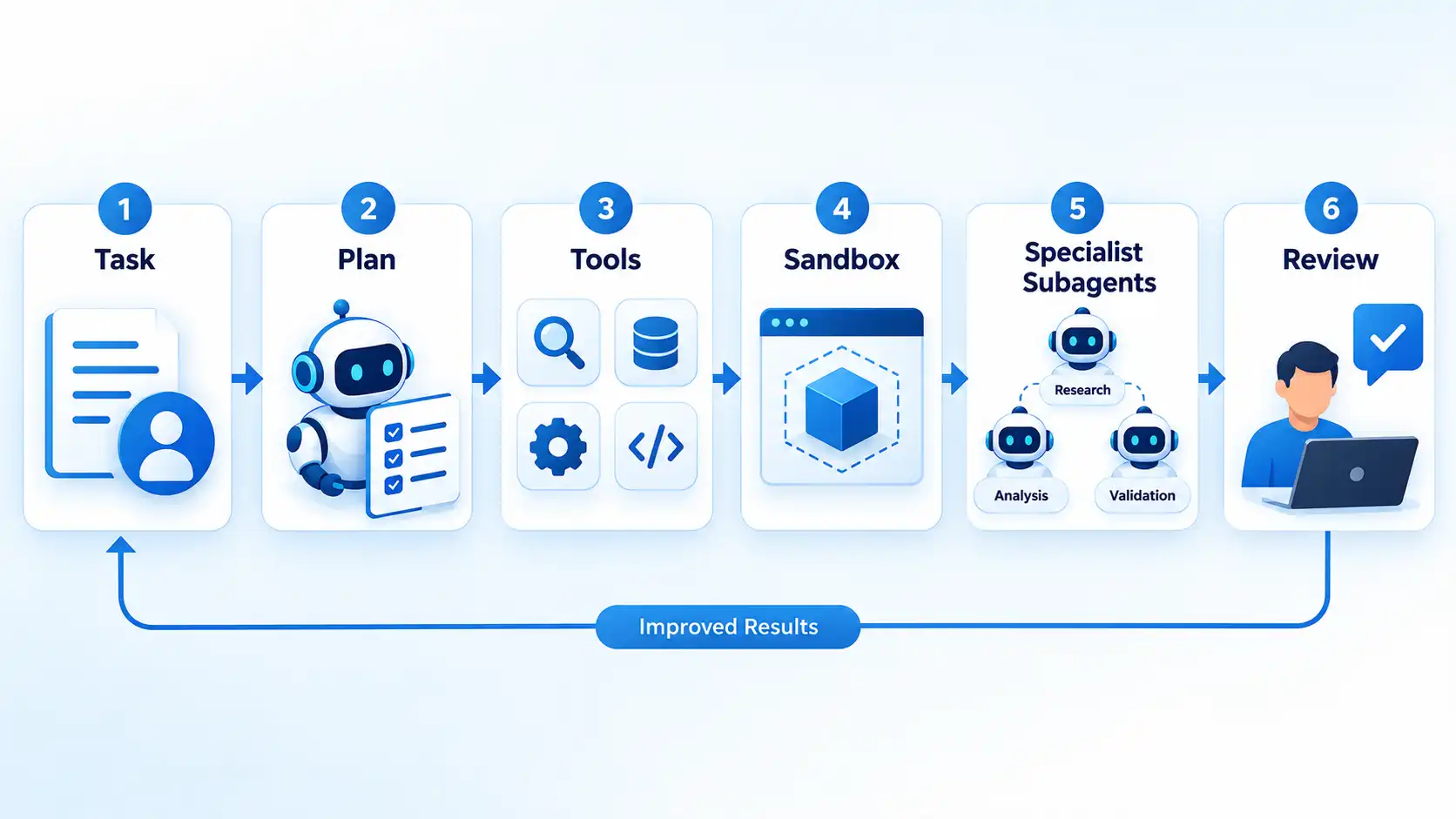
Best for: understanding how generative AI is moving beyond conversational interfaces into multi-step digital work An AI agent is a system that can pursue a task through multiple actions rather than generating one response and stopping. Depending on its design, an agent may maintain working context, call tools, inspect files, run code, delegate subtasks, and continue until it reaches a result or needs human input.
OpenAI’s Agents API entered public beta on September 10, 2026. OpenAI describes infrastructure for long-running sessions, context management, tools, managed or third-party environments, file and code work, and coordinated subagents. The practical difference becomes clearer when you trace how AI agents work across planning, context, tools, execution, and review.
The difficult part is reliability. In Microsoft’s 2026 Multi-Horizon Task Environments research, baseline agent systems were tested with increasingly large groups of interdependent tasks. Completion rates across the tested baseline systems fell from 16.7% to 8.7% as concurrent workloads increased from 12 to 46 tasks. Microsoft’s CORPGEN architecture performed better under the same type of workload, completing 15.2% of tasks at the 46-task level compared with 4.3% for the baselines in that evaluation.
Those figures are benchmark results, not a universal failure rate for AI agents. They do, however, illustrate why production agent design involves more than choosing a capable model. Permissions, memory boundaries, checkpoints, error recovery, task dependencies, evaluation, and human review can determine whether additional autonomy reduces work or creates another system that must be supervised. Important limitation: Agents can compound mistakes across long workflows, especially when later actions depend on incorrect assumptions or incomplete earlier work.
2
Best for: tracking how AI is changing manufacturing, logistics, inspection, and other physical automation
Traditional industrial automation works extremely well when machines repeat predictable actions inside controlled environments. Physical AI pushes that model further by combining machines with perception, learned models, planning, and more adaptive decision-making. The International Federation of Robotics identifies AI and greater autonomy as a leading robotics trend for 2026. IFR says analytical AI can support activities such as failure prediction, path planning, and resource allocation, while generative AI can enable robots to learn new tasks, produce training data through simulation, and accept natural-language or vision-based instructions.
The term physical AI describes AI operating through machines that sense and act in the physical world. That can include industrial robots, autonomous mobile robots, service robots, and other systems where software decisions produce physical movement.
This does not mean general-purpose robots can reliably perform arbitrary human tasks. Factories and warehouses remain easier environments because designers can constrain routes, lighting, equipment, safety zones, object types, and expected behaviors.
The important transition is from machines that execute rigid sequences toward machines that can interpret more of their surroundings and adapt within defined limits. That expands the range of automation while making testing, cybersecurity, safety validation, and human oversight more important. Important limitation: Unstructured environments contain unpredictable people, objects, surfaces, conditions, and edge cases that remain much harder than controlled industrial tasks.
3
Best for: understanding why the next phase of AI depends on data centers, accelerators, cooling, electricity, and grid capacity
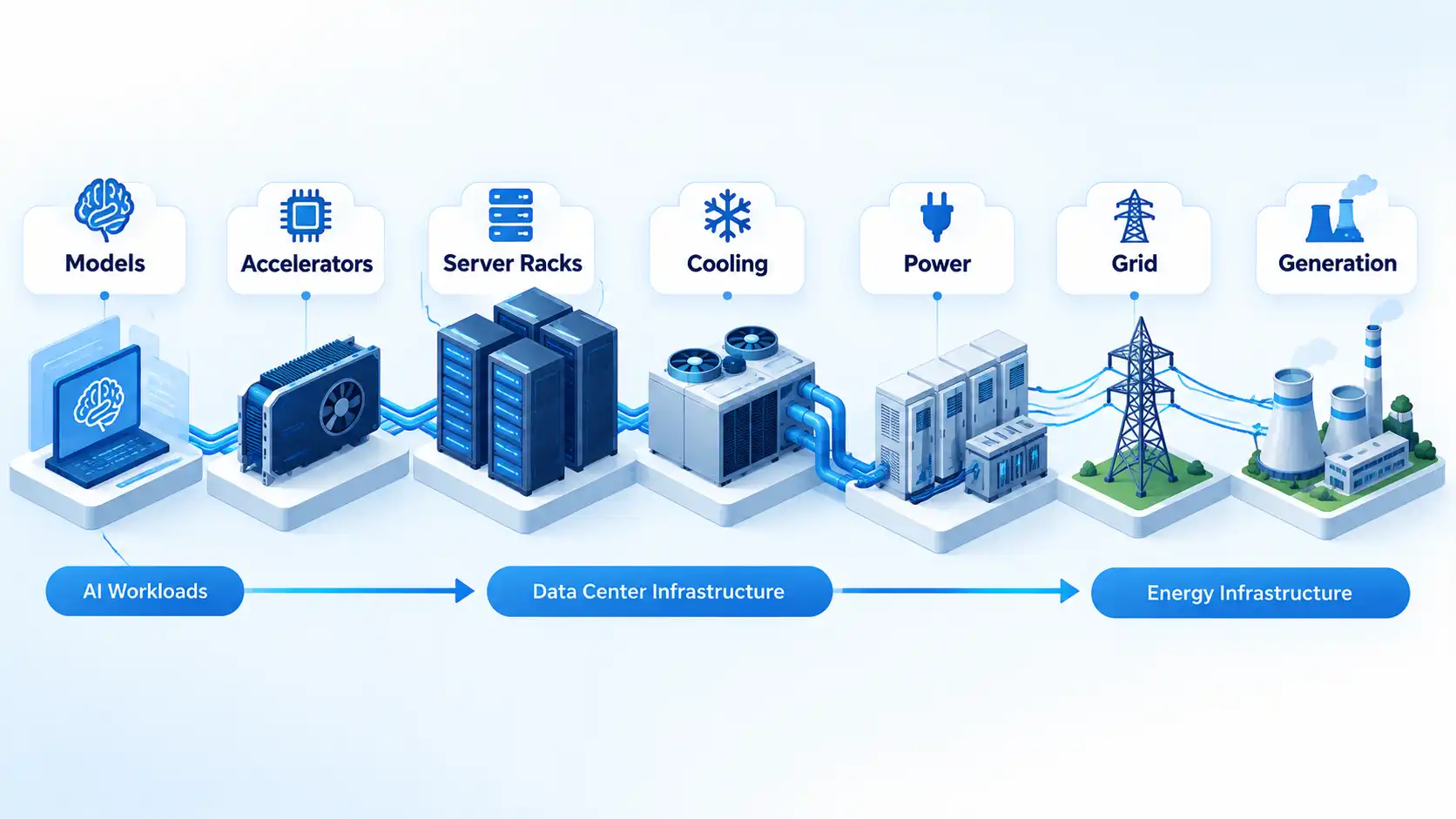
AI progress is usually discussed in terms of models, but production systems depend on physical infrastructure. Training and inference need processors, memory, networking, cooling, buildings, electricity, and connections to an energy system capable of supporting concentrated loads. The International Energy Agency’s April 2026 analysis projects global data-center electricity consumption rising from about 485 TWh in 2025 to roughly 950 TWh in 2030 in its central outlook. The same analysis reports that electricity consumption from AI-focused data centers grew 50% in 2025 and projects that their electricity use will triple between 2025 and 2030.
The IEA also identifies near-term bottlenecks across data-center, chip, energy-equipment, financing, and grid infrastructure. That means a proposed AI deployment may face constraints even when the software itself is technically ready.
This changes architecture decisions. A workload that runs occasionally may suit elastic cloud infrastructure, while predictable high-volume inference may create different economic or operational incentives. Edge deployment can reduce some network traffic and latency, but local hardware introduces its own memory, power, maintenance, and capability limits.
The result is that AI scalability increasingly depends on engineering outside the model itself. Processor availability, utilization, power density, cooling, electricity supply, grid connections, financing, data requirements, and workload placement can all affect whether an AI system is practical. Important limitation: The 2030 electricity figures are projections, not guaranteed demand. Efficiency improvements, workload growth, financing, hardware changes, energy policy, and grid development could change the outcome.
4
Best for: applications that benefit from lower latency, offline operation, or less dependence on remote AI infrastructure
Not every AI task needs to travel to a large remote data center. On-device inference means running an AI model directly on hardware such as a phone, computer, vehicle, appliance, or embedded system. Edge computing places computation closer to where data is created instead of depending entirely on a centralized cloud. Apple’s third-generation foundation-model architecture provides one current example. Apple describes a five-model family spanning on-device and server-based systems. It includes two on-device models, while more demanding models run through server infrastructure.
Local processing can reduce network round trips and allow some capabilities to keep working without an internet connection. Keeping suitable processing on the device can also reduce the amount of data that must be sent to a remote service. Those advantages depend on the complete application design, however; running a model locally does not automatically make every application private.
That makes cloud AI vs on-device AI a deployment decision involving latency, capability, hardware resources, privacy requirements, operating cost, update frequency, and connectivity rather than a simple choice between old and new technology.
Important limitation: Phones and edge devices have tighter memory, power, thermal, and compute budgets than large data-center systems, so local models can differ substantially in capability. 5
Best for: separating long-term quantum-computing progress from security migration work that can begin today
Quantum computing and post-quantum cryptography are related, but they are at different stages. Quantum computers use quantum-mechanical effects to perform certain kinds of computation differently from classical systems. Large-scale fault-tolerant quantum computing remains a development objective rather than an ordinary production computing platform.
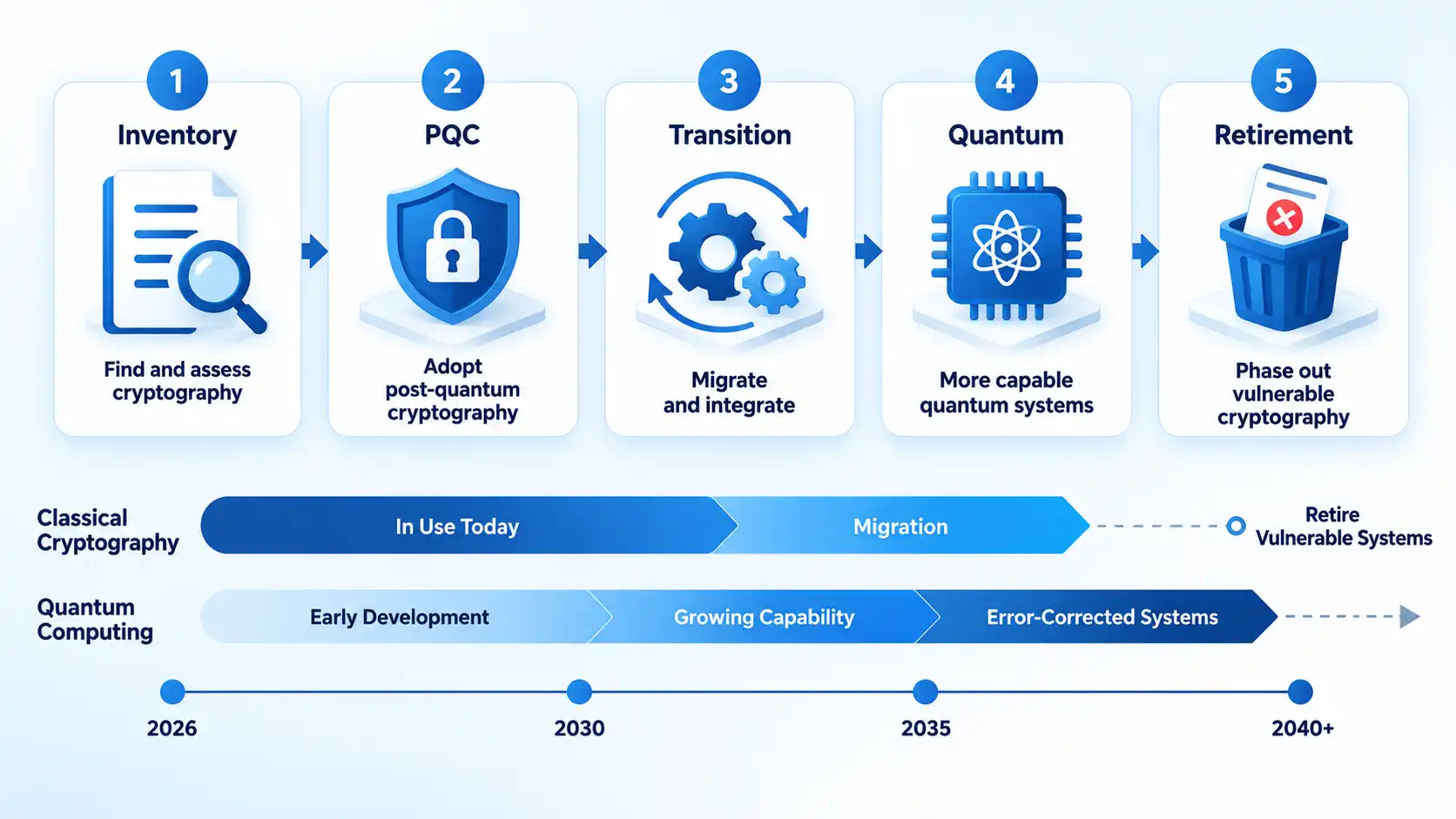
IBM’s March 2026 quantum roadmap, for example, describes 2026 work toward examples of quantum advantage and prototypes for real-time error correction. IBM explicitly labels its roadmap milestones as company goals that are subject to change, so they should not be treated as guaranteed industry timelines. The more immediate security issue is post-quantum cryptography, or PQC. These are classical cryptographic algorithms designed to resist attacks from both conventional computers and sufficiently capable future quantum computers. NIST says its first three finalized PQC standards are ready for implementation now.
NIST’s migration guidance says organizations should identify where quantum-vulnerable algorithms are used and begin planning replacements. Under the transition timeline referenced by NIST, quantum-vulnerable algorithms are expected to be deprecated and ultimately removed from relevant NIST standards by 2035, while higher-risk systems should transition sooner.
Teams responsible for sensitive data, long-lived systems, certificates, embedded devices, or difficult upgrade cycles should therefore treat post-quantum cryptography migration as an inventory and transition problem rather than waiting for a future cryptographically relevant quantum computer to trigger the work.
Important limitation: Quantum-computing timelines remain uncertain, while replacing cryptography across protocols, applications, hardware, certificates, and long-lived systems can take years. 6
Best for: understanding how origin and edit-history signals can complement attempts to assess manipulated or AI-generated media
The growth of generative media makes a simple question increasingly important: where did a digital asset come from, and what happened to it before it reached you?
One approach is provenance, meaning information about an asset’s origin and history. The Coalition for Content Provenance and Authenticity defines Content Credentials as a system for attaching cryptographically verifiable provenance information to digital assets. The current C2PA 2.4 technical specification defines signed manifests, assertions about an asset, content bindings, and digital signatures that can make tampering with recorded provenance detectable. This differs from asking a detector to inspect pixels and estimate whether something was generated by AI. A provenance system can record information about creation, modifications, ingredients, or signing identities when participating tools create, preserve, and expose those records.
The limitation is just as important as the capability. A valid Content Credential does not prove that an event depicted in an image happened as claimed, that accompanying text is accurate, or that the creator is trustworthy. It supplies verifiable provenance information within a defined trust model. Other evidence and human judgment can still be necessary.
Important limitation: Provenance can help establish recorded origin and modification history, but it cannot by itself establish whether the real-world claim represented by the content is true.
7 Best for: following how satellite services can extend mobile coverage beyond conventional terrestrial networks
Satellite communication no longer always requires a dedicated satellite phone. Direct-to-device, or D2D, connectivity describes links between satellites and mobile handsets, allowing satellite services to supplement terrestrial mobile networks.
The GSMA describes satellite D2D as a supplementary coverage and resilience layer that can extend service into sparsely populated or inaccessible areas and provide another communications path during some terrestrial network outages.
The important word is supplementary. According to the GSMA’s current policy guidance, satellite beams cover much larger areas than terrestrial cells and cannot deliver the same capacity in a given area. Indoor reception, interference management, spectrum arrangements, regulations, available satellite capacity, operator agreements, device support, and the type of service can all affect actual performance. The emerging architecture is therefore not simply “satellites replace mobile towers.” It is a more integrated connectivity model in which terrestrial networks continue to provide dense, high-capacity coverage while satellites extend reach and resilience where terrestrial infrastructure is unavailable or insufficient.
Important limitation: D2D capabilities and availability vary by country, operator, device, spectrum arrangement, and service, while satellite capacity remains lower than terrestrial cellular capacity in dense areas.
Technology Trends to Watch
AI Agents Are Moving From Answers to Actions
Physical AI Is Giving Robots More Adaptability
AI Infrastructure Is Becoming a Power and Capacity Problem
AI Is Moving Onto Devices and the Network Edge
Quantum Progress Is Making Post-Quantum Security a Current Task
Digital Provenance Is Becoming Part of the Trust Layer
Satellite Connectivity Is Moving Into Ordinary Mobile Devices

How These Technology Trends Connect
The seven trends are easier to understand as parts of the same changing technology stack rather than as isolated inventions.
AI agents increase the amount of work software can attempt autonomously, but that work still needs computing infrastructure. Some inference will remain in large data centers, while other workloads move toward phones, computers, vehicles, machines, and edge systems. Physical AI then connects software intelligence to machines that sense and act in the physical world.
As automated systems create and transform more digital content, provenance can provide useful origin and modification-history signals. At the same time, post-quantum cryptography addresses a longer-term change in the assumptions beneath digital security. Satellite D2D extends connectivity into locations where terrestrial coverage may be unavailable or disrupted.
The practical pattern is convergence. Computing, networking, AI, physical systems, security, and trust infrastructure are becoming more interdependent. A useful technology strategy therefore needs to consider not only whether a new capability works, but also what infrastructure, standards, safeguards, and operational changes it requires.
What to Watch Beyond 2026
The safest way to evaluate emerging technology is to look for evidence of deployment rather than confident predictions. A technology becomes more consequential when reliability improves, standards stabilize, costs become workable, supporting infrastructure expands, and organizations can operate it without depending on exceptional conditions.
For AI agents, watch whether performance improves on long, interdependent workloads and whether permissions, evaluation, and human-review systems become easier to manage. For robotics, watch deployments beyond tightly controlled settings. For AI infrastructure, follow efficiency alongside electricity demand, processor availability, cooling requirements, grid connections, and financing.
For on-device AI, pay attention to which useful workloads can run locally without unacceptable battery, memory, thermal, or performance costs. For quantum technology, separate experimental computing milestones from the much more immediate work of PQC migration. For content provenance, interoperability and preservation of credentials across tools and platforms matter more than whether an individual product displays a badge. For satellite D2D, the important signals are service capabilities, supported devices, available capacity, regulation, spectrum coordination, and integration with terrestrial operators.
That maturity-based view also prevents an old technology from being relabeled as a new trend simply because it remains popular. The strongest technology trends to watch beyond 2026 are the ones producing observable changes in what systems can do, where they can operate, how they are secured, and what infrastructure is required to support them.
You must be logged in to post a comment Login