State and local regulators would decide whether the public gets a say on minor-source permits
Soon, you may not even be able to find out what that new neighborhood bit barn could do to your air quality. A proposed change by the US Environmental Protection Agency (EPA) would eliminate federal minimum requirements for public participation in minor-source air permits, a move critics warn could affect some datacenter projects.
Advertisement
The Environmental Protection Network, which is made up of former employees of the EPA itself, says the proposed rule change would eliminate mandatory public notice and comment requirements for so-called minor New Source Review (NSR) industrial air pollution permits in state plans under the Clean Air Act (CAA).
Instead, state and local air quality regulatory authorities would be able to determine whether and to what extent public participation in minor NSR programs is necessary, effectively allowing them to decide whether the public is notified about new sources of pollution or modifications to existing sources.
The EPN, which has submitted formal public comments on the proposed changes, warns that it would leave communities in the dark regarding industrial developments. These could include large-scale, fossil-fueled power generators for AI datacenters that may be permitted as minor or synthetic-minor sources, and therefore avoid more stringent major-source review, it claims.
“By eliminating the long-standing federal requirement for public notice, this proposal continues efforts by the current administration to turn its back on the fundamental EPA principle of transparency,” said Mike Koerber, a former deputy director of EPA’s Office of Air Quality Planning and Standards.
Advertisement
We asked the EPA for comment.
The agency’s current administrator, Lee Zeldin, stated earlier this year that the Trump administration was not going to set national-level environmental rules for the growing datacenter industry. He argued that state and local governments were best equipped to make such decisions, as local conditions like water availability, air quality, and electricity needs differ between regions.
But the EPN says that the current proposal directly contradicts Zeldin’s earlier transparency memorandum, which pledged that “the public must be able to trust our work” and called for “the fullest possible public participation in our decision making.”
Without public review, facilities such as datacenters may be able to avoid major-source controls on pollution altogether, it warns.
Advertisement
The build boom in new server farms to profit from the AI gold rush has often run into difficulties when it comes to getting a connection to the grid. Rather than wait years, many developers or operators opt for on-site power generation, typically supplied by gas-burning turbines. But this can have an effect on local communities, thanks to emissions of smog-generating nitrogen oxides (NOx) and other pollutants.
This comes against a background of rising public opposition to bit barns, with a recent Gallup survey finding that more than 70 percent of Americans would be against the construction of a facility in their neighborhood.
The premium car audio arms race has become wonderfully ridiculous.
Genesis just unveiled a 25-speaker Bang & Olufsen system with a discrete 7.1.4 Dolby Atmos layout for its flagship GV90. Cadillac has stuffed 38 AKG speakers into the Escalade IQ. BMW offers 36 Bowers & Wilkins speakers in the 7 Series, while Volvo continues expanding Dolby Atmos and Apple Music Spatial Audio across its latest Bowers & Wilkins-equipped EVs.
Porsche, apparently deciding that another dozen loudspeakers would be too obvious, has gone after the semiconductors instead.
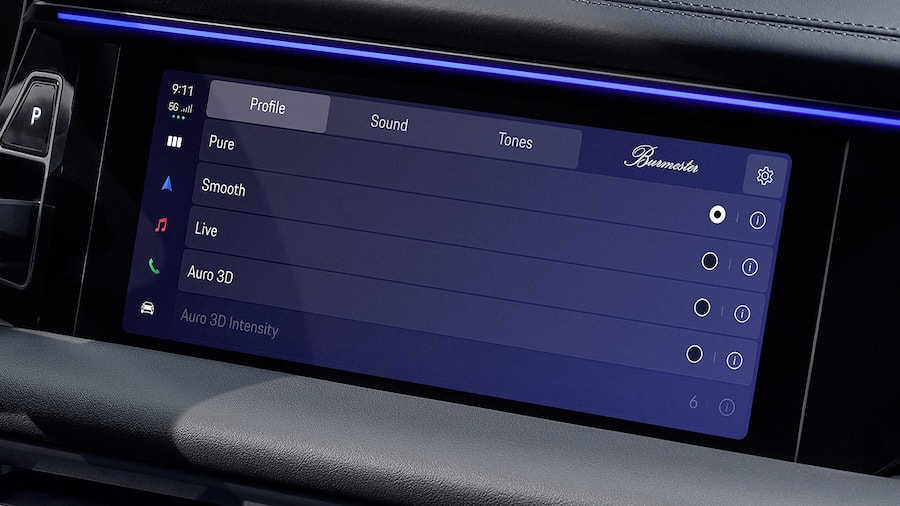
The German automaker has developed what it describes as the world’s first production-ready high-end automotive audio system to incorporate gallium nitride (GaN) semiconductor technology, with the first application scheduled to reach a future Porsche vehicle in 2027. The technology is being integrated into Porsche’s Burmester 3D High-End Surround Sound System and was developed with the University of Stuttgart.
Advertisement
There is an important technical distinction here. Porsche has not announced that every amplifier stage in the Burmester system is becoming a GaN design.
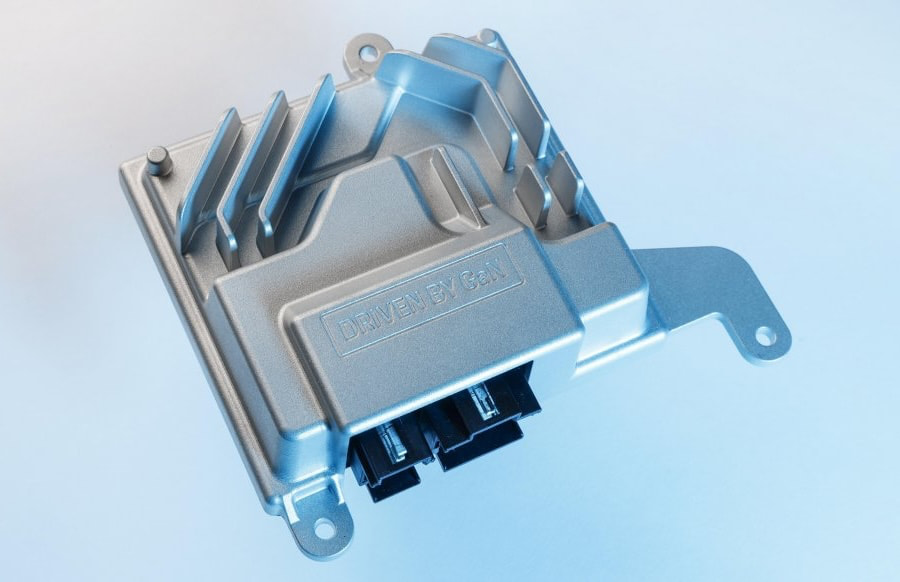
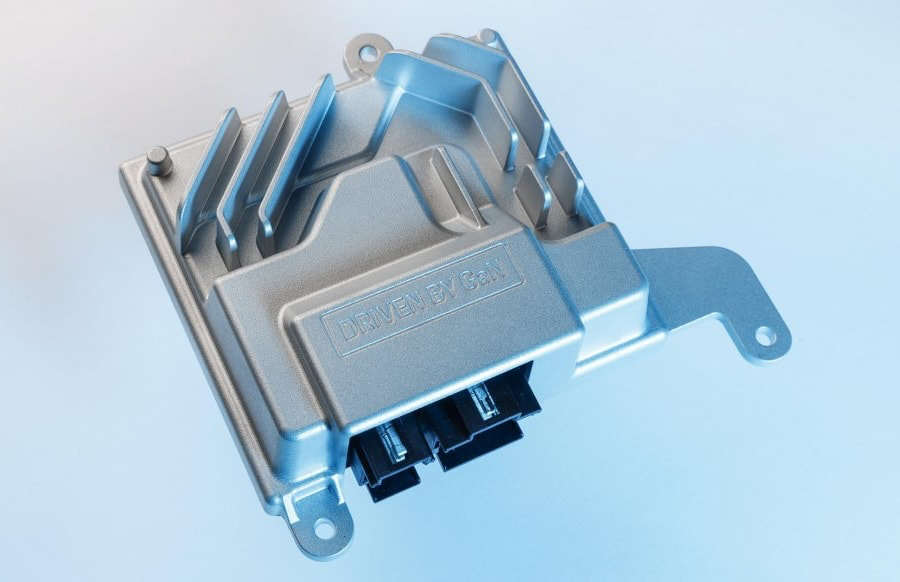
A GaN-based high-performance chip is being used for the voltage conversion required to power the system’s 400-watt subwoofer amplifier. That may sound less dramatic than proclaiming that Porsche has invented a giant GaN-powered stereo on wheels, but it is also considerably more accurate.
Why Is Porsche Using GaN?
Amplifier with GaN technology
Gallium nitride is already familiar to anyone following modern Class D amplification and compact power supplies. Compared with conventional silicon semiconductors, GaN devices can switch at higher frequencies with lower losses, helping engineers reduce heat and shrink some of the supporting circuitry.
Those advantages are particularly useful inside a car, where packaging space and weight matter far more than they do in a listening room.
Porsche says the improved efficiency allows the Burmester amplifier’s heat sink to be approximately 20 percent lighter, while passive components including capacitors and inductors can also be made smaller.
Advertisement
That 20 percent figure applies specifically to the heat sink, not the complete amplifier or audio system.
From Stuttgart University to a Production Porsche
The project began in mid-2023, when Porsche engineers started investigating whether GaN could meet the thermal, durability and packaging demands of an automotive environment.
Advertisement. Scroll to continue reading.
Beginning in spring 2024, Porsche audio, semiconductor and sustainability specialists worked with the Institute for Robust Power Semiconductor Systems at the University of Stuttgart to develop a prototype GaN-based subwoofer amplifier.
Advertisement
Porsche subsequently worked with an unnamed international semiconductor manufacturer and an audio development partner to turn the concept into a production-ready design. The company says several patent applications have resulted from the project.
The first production application is scheduled for 2027, although Porsche has not disclosed which model will receive it first.
We also don’t know the complete speaker configuration, total amplifier output, option price or whether the first GaN-equipped system will otherwise mirror one of Porsche’s existing Burmester installations.
What Does Burmester Already Offer in Porsche Vehicles?
The current electric Porsche Macan provides useful context.
Advertisement
Its $6,010 optional Burmester 3D High-End Surround Sound System uses 21 speakers, 21 amplifier channels and 1,470 watts of total system output, including a 400-watt active subwoofer.
Porsche has also been expanding its immersive audio capabilities. For model year 2026, compatible vehicles equipped with premium Bose or Burmester systems gained support for Dolby Atmos through the latest Porsche Communication Management platform.
The GaN project therefore isn’t replacing Porsche’s broader push toward immersive audio and advanced DSP. It is addressing the electrical hardware underneath those systems.
2024 Porsche Macan Interior
Automotive Audio Is Getting Serious
We have been watching this transformation accelerate throughout 2026.
Advertisement
The Genesis GV90 arrives with a 25-speaker Bang & Olufsen Premier 3D system configured as a 7.1.4 Dolby Atmos layout, including four overhead speakers. Acoustic Lens Technology, cabin isolation and B&O’s Virtual Venue processing make it one of the more ambitious factory systems announced this year.
The Cadillac Escalade IQ’s 38-speaker AKG Dolby Atmos system was also one of the best automotive immersive audio demonstrations we heard at NAMM 2026. Its success wasn’t simply about the speaker count; the system worked because the drivers, processing, bass reproduction and cabin were engineered together.
Premium automotive audio is no longer defined by attaching a famous hi-fi badge to a door grille and hoping somebody notices before signing the lease. Cabin acoustics, streaming platforms, DSP, amplification and immersive formats are increasingly being developed as parts of the same system.
Porsche’s GaN project adds semiconductor efficiency to that equation.
What Makes Porsche’s GaN System Unique?
What separates Porsche’s announcement from most recent high-end car audio launches is its focus.
Genesis, Cadillac, BMW and Volvo are primarily pushing immersive playback, additional channels and more sophisticated cabin processing. Porsche is working deeper inside the electronics, attempting to reduce the size, weight and thermal demands of the hardware supplying that performance.
Advertisement
In a sports car or EV, those gains matter.
Nobody should expect this single audio component to produce a meaningful increase in driving range, and Porsche has made no such claim. The significance is more about what could follow.
The company says it is already examining additional GaN applications elsewhere in the vehicle, including power conversion in high-voltage systems used by electric sports cars, while also evaluating broader uses within automotive audio.
The subwoofer amplifier may therefore be the first production application rather than the final objective.
Advertisement
Price & Availability
Porsche says the first production implementation of its GaN technology will appear in a future Porsche vehicle in 2027.
The company has not announced the vehicle, U.S. availability, pricing, complete Burmester system specifications or whether the technology will initially be standard equipment or part of an optional audio package.
The Bottom Line
The Porsche and Burmester GaN project matters because it approaches premium automotive audio from a different direction. While much of the industry is concentrating on Dolby Atmos, DSP and ever-more-elaborate speaker arrays, Porsche is trying to make the electronics behind those systems smaller, lighter and easier to cool.
For now, the application is relatively focused: GaN-based voltage conversion for a 400-watt Burmester subwoofer amplifier arriving in an unnamed Porsche model in 2027.
Advertisement
Advertisement. Scroll to continue reading.
But if Porsche can expand the technology across more of the audio system and eventually into other areas of the vehicle, this could prove considerably more important than adding another row of speakers to the headliner.
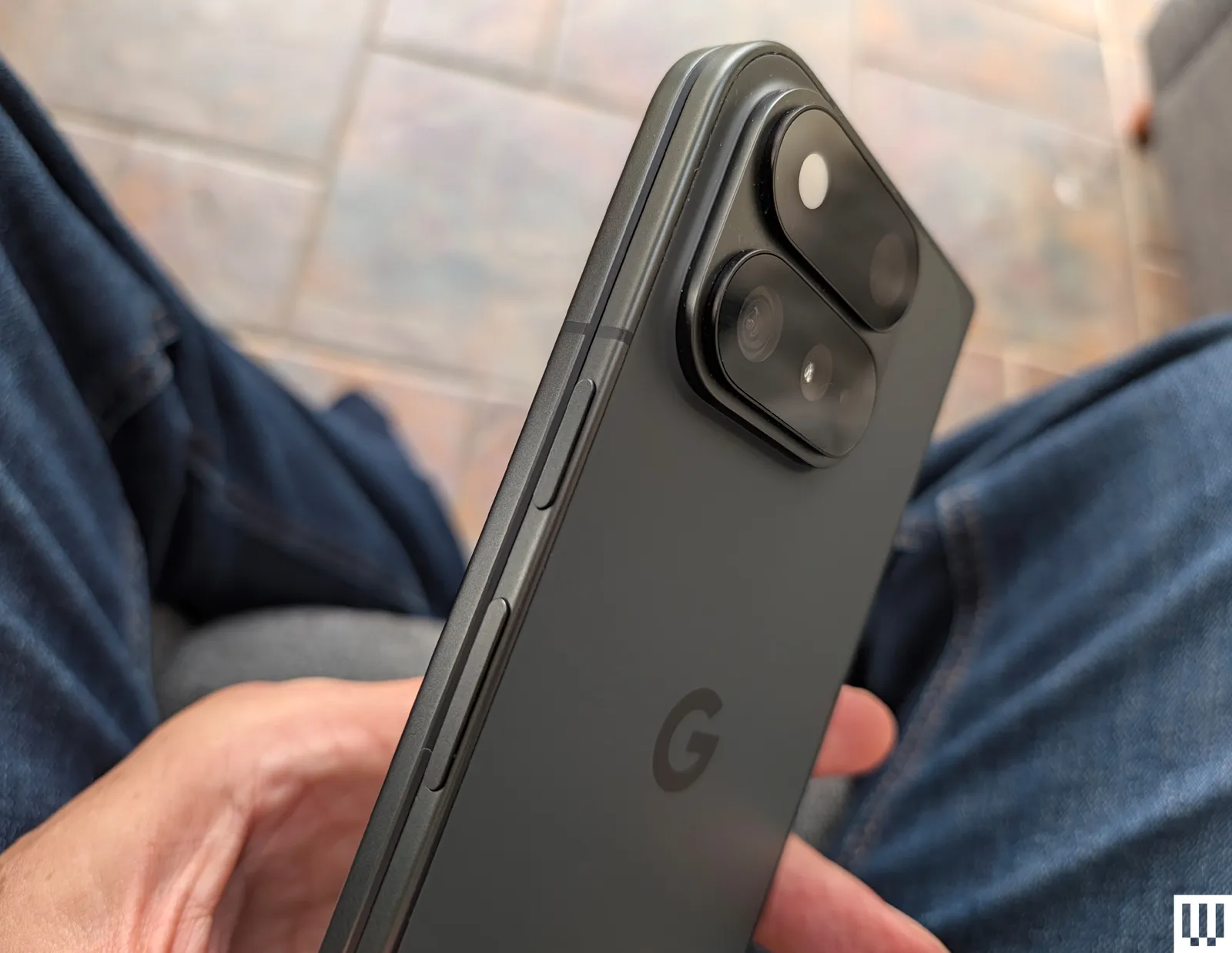
It’s a shame the Fold is only available in two colors: Obsidian, the color of my review unit, looks more like a dark matte gray than black, while Olive Green has a shinier gold frame.
I’m not a fan of Google’s asymmetrical design. With the Pixel 11 Pro Fold closed, there’s a curved corner cutout, and when you open the phone, the two halves have slightly different thicknesses. All folding phones still have a detectable fold line in the middle of the screen when you open them, but Google’s is among the most noticeable. Some folks won’t notice or care, but I’m the kind of guy who goes upstairs to turn the light on so the downstairs switches aren’t misaligned.
The fingerprint sensor in the power button always bugs me when I switch to a folding phone, because I have to pick it up to touch it and unlock the screen, rather than pressing on the screen like most phones. You do have face unlock with the Pixel 11 Pro Fold, and it works well provided there’s ample light, but it still doesn’t work in a dark room, which is still annoying.
Advertisement
You get two lovely, sharp OLED displays in the Pixel 11 Pro Fold: an 8-inch main screen and a 6.5-inch cover screen. Both push peak brightness to 3,600 nits, remaining legible in direct sunlight, and boast a variable refresh rate up to 120 Hz. They’re smooth, with rich colors, and I have nothing to complain about beyond that crease.
Pro Pretender
I’m not convinced the 11 Pro Fold earns the “Pro” in its title. It does have the new HiLight feature, a group of color LEDs in the camera module’s flash that light up different colors based on who is calling, or swirl through the rainbow while you chat to Gemini. It’s neat, if a little underbaked. It’s handy if you put your phone face down when you’re working or trying to relax, but it’s a very minor feature.
All the Pixels get the new Tensor G6 processor, and the Fold has 16 GB of RAM paired with 256 GB, 512 GB, or 1 TB of storage. Switching from the Pixel 10 Pro XL, it was mostly smooth sailing. But it froze a couple of times in split-screen view in Gmail and after launching an app on the outer display, then unfolding the inner display.
The 11 Pro Fold actually has more in common with the regular Pixel 11, because it misses out on the high-end camera in its Pro siblings. Folding phones struggle to match flagships on camera specs because of form-factor limitations, and they must include two front-facing cameras (one for open and one for closed).
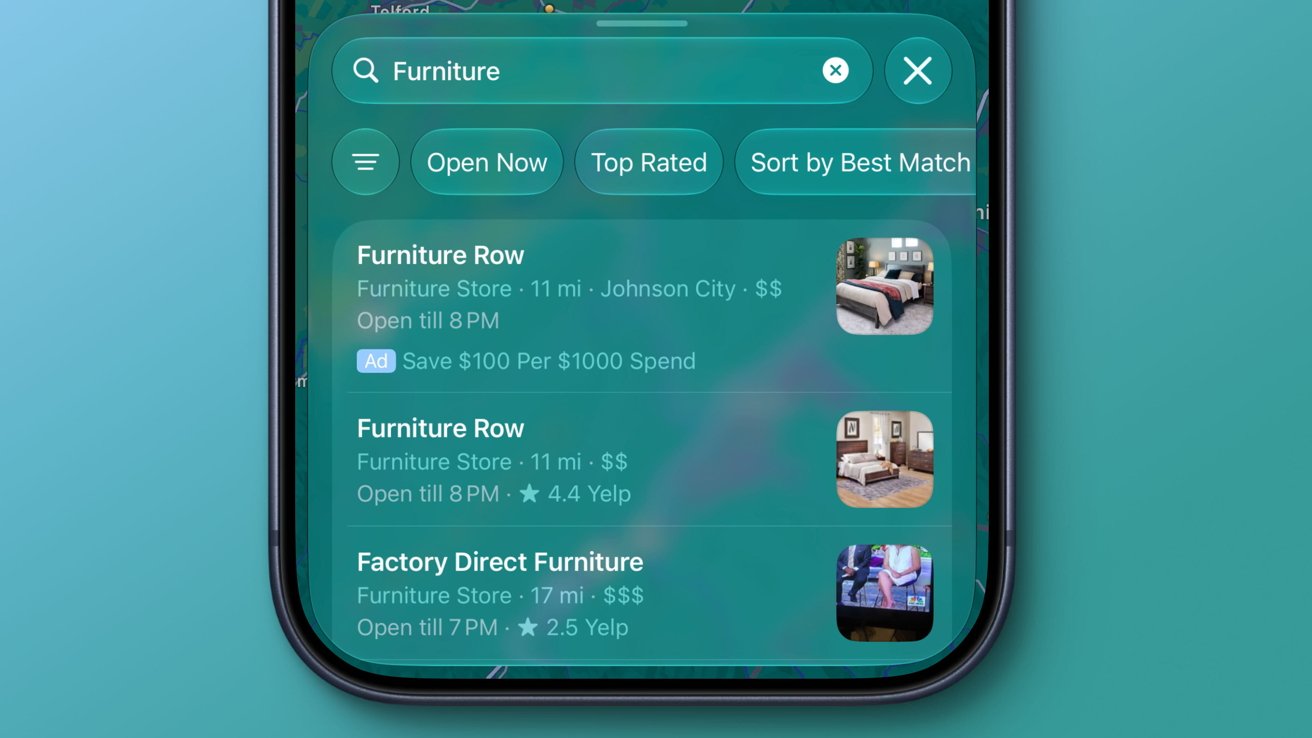
Apple Maps ads have finally arrived after months of buildup, with the first sponsored listings rolling out on iPhones across the US and Canada.
In March, Apple confirmed it would bring ads to Apple Maps. The ads were part of the greater Apple Business rollout.
It wasn’t known exactly when Apple would begin rolling out the ads, but the company had set a tentative release date for Summer 2026. And, true to its word, we’re now seeing ads popping up in Apple Maps.
When you open Apple Maps on iPhone, you’ll see ads in two key places. The first is when you tap the search bar, but before you search for anything specific.
Advertisement
The second is in the actual search results. Apple has said that results will only appear here when relevant.
Apple has confirmed to 9to5Mac that the rollout began in the past few days. Ads are rolling out gradually in parts of the US and Canada.
Apple has promised a privacy-first advertising model. Unsurprisingly, the rules for advertising on Apple Maps are significantly stricter than those of Google Maps.
For instance, Apple Maps has strict prohibitions on certain advertising categories outright. Banned categories include bail bonding services and cryptocurrency ATMs.
Advertisement
Additionally, any home services ads are also banned. Medical services aren’t banned outright, but will need to be evaluated on a case-by-case basis.
Apple could raise the iPhone 18 Pro’s starting price to $1,199 as component costs climb.
Bloomberg’s Mark Gurman floated that figure and said it would follow the roughly $100 price increases Samsung and Google already applied to their own flagship phones this year, both citing rising memory costs across the industry.
Apple has kept its iPhone starting price frozen for several years even as it raised storage tiers and shifted other costs elsewhere, a restraint that has left base models with specifications increasingly behind rival phones at the same price point.
Behind that pressure sit sharp increases in RAM pricing driven by AI data centre demand, alongside the higher per-unit cost of the 2nm process TSMC will use for the A20 Pro chip inside the iPhone 18 Pro compared with the 3nm process behind the A19 Pro.
Advertisement
Apple has already applied similar increases across most of its non-iPhone lineup and raised prices by an average of 23%, with a $200 jump for the MacBook Air and a $500 jump for the Mac Studio.
Advertisement
Gurman estimates that a matching $100 increase would put the iPhone 18 Pro at $1,199, a 9% rise over the iPhone 17 Pro‘s $1,099 starting price, with the larger iPhone 18 Pro Max expected to start closer to $1,299.
iPhone 17 Pro. Image Credit (Trusted Reviews)
Historical jumps of that scale remain rare, since only the iPhone X‘s rise to $999 in 2017 was a steeper 54% increase over the iPhone 8, a leap tied to an entirely new device category much like the first iPhone Fold, expected to cost over $2,000 when Apple announces it on 9 September.
Apple has generally preferred to protect its headline pricing by raising base storage tiers or trimming its own margins instead, an approach it reportedly took with the iPhone 17 rather than adjusting the sticker price outright.
Advertisement
Gurman notes that Apple has already warned investors about margin pressure this quarter, a signal that the company may absorb part of the higher component costs rather than pass the full amount on to buyers.
Advertisement
New payment plans are also said to ease the impact of any price rise for customers upgrading their handsets, though Apple has not confirmed final pricing ahead of the iPhone 18 series launch expected in September.
Healthcare and services provider Nutex is investigating a data breach incident where an unauthorized third party exfiltrated information from company servers.
The organization has disclosed the cyberattack in a filing with the U.S. Securities and Exchange Commission (SEC), noting that the stolen data includes details that may be private or confidential.
“Based on preliminary findings from the Company’s ongoing investigation, the Company believes that certain information maintained on the Company’s servers was accessed and exfiltrated by an unauthorized third party, including some information that may be private and/or confidential,” Nutex says.
Nutex Health is a for-profit healthcare company that operates 28 facilities across 12 states, including the Bayou City ER & Hospital in Texas and Green Bay ER & Hospital in Wisconsin.
The company had an annual revenue of $875 million in 2025, a market capitalization of $1.28 billion, and is publicly traded as NUTX on the Nasdaq Capital Market.
Advertisement
After detecting the intrusion, the company hired external incident-response and forensic specialists, activated its cybersecurity response plan, implemented containment measures, and notified law enforcement.
Nutex has yet to determine the type of data that may have been compromised and if the impact includes patients, employees, or business partners.
“The Company continues to assess whether, and to what extent, patient, employee, credentialed provider, confidential business and financial information, intellectual property, or other information may have been accessed, acquired, or exfiltrated and continues to evaluate the potential impact of the unauthorized activity on the Company, including any potential disclosure of private and/or confidential information by the third party,” reads the SEC filing.
As of August 24, the company says it found no material impact on its operations or financial reporting systems, and it currently does not believe the incident will materially affect its business strategy, operations, financial condition, or results.
Advertisement
BleepingComputer could not find any threat actor claiming the attack on Nutex.
We contacted Nutex for a comment about the incident and we will update this post as soon as we receive a response.
Overall prevention scores can hide what happens after initial access. Once attackers are using valid credentials, prevention drops sharply.
The Blue Report 2026 measures defenses technique by technique across 338 million simulations run in customer production environments.
There are times when turning off Find My is necessary, but you should always have it on otherwise to keep your phone safe.
FellowNeko/Shutterstock
Apple’s Find My service will help you locate your iPhone, iPad or other Apple device that has been lost, stolen or simply misplaced. It relies on Apple’s Find My network, which is a crowdsourced system where other people’s Apple devices use Bluetooth to detect the location of your item — in some cases, even when it’s switched off. It then reports the approximate location of the device to you.
While the feature can be a life-saver, there are instances when you should switch it off. Primarily, Apple recommends disabling Find My before selling, giving away or trading in your device, as well as if you’re sending it in for repair. This ensures technicians won’t be hampered by security features and can properly run diagnostics to figure out what’s wrong with your device. However, disabling Find My at other times will reduce your phone’s security.
Advertisement
Disable Find My by resetting your device
If you’re selling or giving away your device, the process to factory reset your iPhone (Settings > General > Transfer or Reset iPhone > Erase all Content and Settings) is the easiest way to disable Find My. This will ask for your Apple Account password to make sure it’s you wiping the device, and automatically disables Find My as part of the reset process.
Importantly, turning off Find My also disables Activation Lock, which links your Apple Account to the device. When Activation Lock is enabled, your device cannot be used without entering your Apple Account credentials, even if someone factory resets it. This means someone who steals your iPhone can’t wipe it to resell it.
In case your phone was lost or stolen, erasing it remotely via Find My or iCloud on a computer will not switch off Find My and Activation Lock. Those features will continue protecting your device and letting you track it.
Advertisement
Manually disabling Find My
charnsitr/Shutterstock
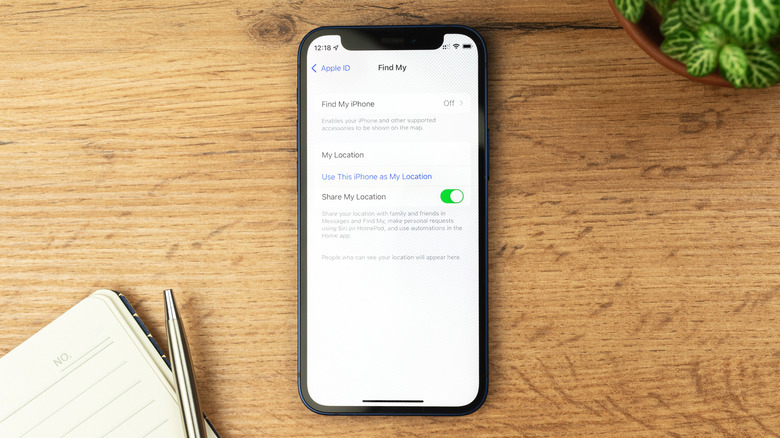
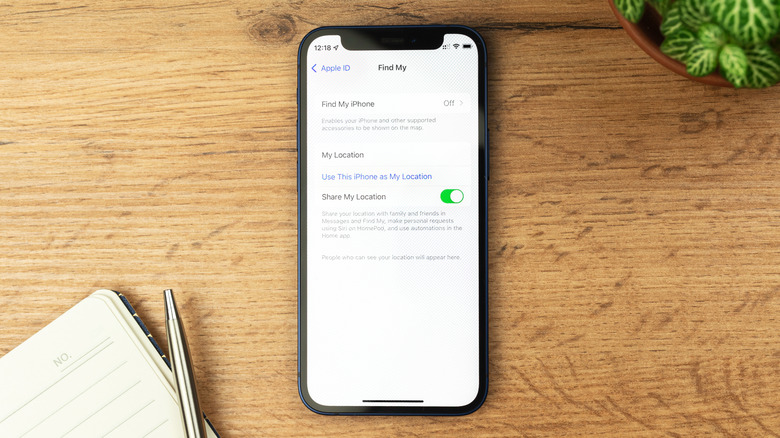
If you’re not planning to factory reset your phone, such as when sending your device in for repairs, you’ll have to disable Find My manually. Thankfully, this is easy: go to Settings > [Your Name] > Find My. Tap Find My iPhone and then toggle it off. This option will be grayed out if Stolen Device Protection is enabled, which is the default as of iOS 26.4.
Stolen Device Protection implements additional security measures when your iPhone is away from familiar locations, such as your home or workplace. It’s designed to protect your data if someone steals your phone and knows your passcode. Your device will require Face ID or Touch ID to access sensitive info like stored passwords, and it adds a delay before changing crucial settings like your Apple Account password.
If you need to switch off Find My, you first have to disable Stolen Device Protection. You should ideally do this while at home to avoid the aforementioned security delays. To do so, go to Settings > Face ID & Passcode > Stolen Device Protection and toggle it off. To re-enable these features after your device is serviced, follow the same steps to toggle them back on.
Advertisement
Find My also lets you share your location with friends and family; if you disable it, this won’t work anymore. If you’re concerned about a particular friend having access to your location, removing their access is better than turning off the entire Find My suite. Open the Find My app, tap the People tab, choose the person, and hit Stop Sharing My Location. Unless they’re on an “older operating system,” they won’t be notified that you stopped sharing with them (though they may notice when they don’t see your name in the Find My app anymore). And others won’t know when you check their location using the app.
What happens when you turn off Find My?
The most obvious answer is also the most important: once you disable Find My, you cannot locate your device through Apple’s network anymore. If you lose your iPhone with Find My switched off, you won’t be able to check its location through the Find My app on another of your Apple devices or the iCloud site in a browser.
Advertisement
Find My’s suite of features also includes Lost Mode, which enables you to display a custom message with your number on the screen for anyone who finds it. This won’t be available once the feature is disabled, and Activation Lock will no longer protect the phone either. Because of all this, you should only disable Find My when you’re sending your phone to a trusted repair center, and re-enable the feature as soon as you get the phone back.
There’s one major scenario in which you should never disable Find My: after you’ve lost your device, especially if you receive intimidating messages about doing so. There are hundreds of stories on Reddit about people who lost their phones and later received messages demanding they disable Find My. They’ll threaten to publish the personal data on your phone, or make up sad stories about wanting to harm themselves because the phone they bought for their child isn’t working.
If this happens to you, do not remove the device from your Apple Account. Because of Activation Lock, your lost phone is useless to someone who’s stolen it and is trying to resell it — as long as you keep Find My enabled. You can erase the phone to know your data is safe, but don’t give these crooks what they want.
Unitree’s shares have fallen roughly 45% from the peak they hit on their first day of trading in Shanghai. The slide has turned a national success story into an argument about how China prices its listings.
The stock steadied on Tuesday after three consecutive days of decline, Reuters reported. The valuation of the Hangzhou humanoid robot maker reached $66bn at one point. It has since dropped by $30bn.
Unitree finished its debut up 460%. Newly listed Chinese stocks have gained an average of 226% on their first day over the past three years. Even in a market used to opening-day surges, that stood out.
The gap between the price and the debut
Unitree listed on 19 August at 150.8 yuan a share, valuing the company near $9bn. The $66bn peak came later, intraday, once the market had its say.
Advertisement
Dong Baozhen chairs the Beijing asset manager Lingtong Shengtai. The distance between the offer price and the debut means “either one of them must be wrong”, he told Reuters. He thinks the debut was the mispriced one.
Debut performance is the barometer of market mood, Dong said, and exuberant mood breeds bubbles. The technology revolution narrative carried investors away. All bubbles are doomed to burst, he added.
What the company earns
Unitree’s adjusted net profit fell 53% in the first three months of 2026, to 40mn yuan, or about $5.95mn. The figure comes from the company’s own prospectus.
Its machines are famous for running, dancing and performing martial arts. One of them beat Usain Bolt’s 100m record at the World Humanoid Robot Games in Beijing this month. Roboticists were quick to qualify that result.
Advertisement
Broader commercial applications have been harder to come by. Analysts had put the company’s likely worth at $7bn or more in the weeks before the float.
The company competes with Tesla and with Boston Dynamics, which Hyundai Motor Group owns. Its backers include Tencent, Alibaba and the AI developer DeepSeek. Founder Wang Xingxing holds about a third of the shares.
The mechanism behind the swing
Chinese stock exchanges vet listing candidates. They also guide IPO pricing, which limits how far bankers can move to meet feverish demand. Analysts told Reuters that this distorts prices.
Two other features compound it. Regulators carry a duty to shield small investors from harm, and rules restrict short-selling. An overpriced listing therefore meets no immediate pushback from anyone betting against it. Bankers described that combination to Reuters.
Advertisement
Unitree’s fast-tracked listing on the STAR Market carried its own signal. The board takes only hard-tech companies in China’s national strategic industries. Analysts read a place on it as government blessing.
Who was left holding it
Abraham Zhang chairs the venture capital firm China Europe Capital. He told Reuters that a desire to pump up the shares and dump them later at lofty prices drove the debut, rather than any rosy prospect.
Loopholes in the IPO system let major shareholders cash in, Zhang said. The risk then moves to small investors buying in the secondary market. Those who won allocations walked away with smiles, he added.
Yuan Yuwei, a hedge fund manager at Trinity Synergy Investments, put it more bluntly. A stock worth 10 yuan can open at 100 yuan and then slide for years. He called it a rip-off.
Advertisement
Restricted short-selling is what makes those schemes possible in the first place, Yuan said.
Retail demand for the offer had been extraordinary. Small investors oversubscribed it more than 8,000 times, a STAR Market record, which left an allocation rate near 0.018%. Almost everyone who wanted the stock had to buy it after trading opened.
One retail investor who lost money wrote in a blog post that he supports Chinese innovation. He also wrote that the rapid concentration of wealth cannot be built on the pains of retail investors.
The case for patience
Not everyone reads the fall as a verdict on robotics. Gao Xingkun manages a fund at China Southern Asset Management, and he told an online roadshow that judging these companies on profit alone is unfair.
Advertisement
Many robot makers spend heavily on research while commercial orders are not yet in sight, Gao said. He compared the moment to the early years of China’s electric vehicle industry, which now dominates its category.
Unitree’s founder Wang Xingxing has made a version of the same argument. Robots are approaching a ‘ChatGPT moment’, he said last week, days after the listing.
Unitree is not the only one
The memory chipmaker CXMT saw its shares climb 466% on its own Shanghai debut last month, a near-identical pattern in a different strategic industry.
Scarcity plays a part. Only 21 companies went public in Shanghai during the first seven months of this year, against 104 in Hong Kong, because of tight regulatory scrutiny.
Advertisement
Yuan said investors chase what few opportunities there are. There are not many good companies in China’s stock market, he told Reuters.
A queue of domestic rivals is preparing to list, and Unitree’s debut was meant to set the tone for them. It still may, though not in the way those companies would have chosen.
What Europe is watching
European robotics has no comparable listing to point to, and its builders are earlier. UMA, founded by an ex-Tesla Optimus scientist, is building Europe’s humanoid from a much smaller base of capital.
Most accounts call that gap a European weakness. The past week offers a reading in which slower capital is not only a handicap. A listing that swings by $30bn in three sessions tells a founder very little about demand for the product.
Advertisement
The question the Shanghai market is now asking is whether the demonstrations that made Unitree famous convert into recurring orders. Zhang expects more of these episodes, saying the capital drama at Unitree is not the first in China and will not be the last.
Despite the New Mac mini and Mac Studio apparently not including an option to add AppleCare where it has historically been during the order process, you just have to click through a few pages to get it done.
It’s not remotely clear why Apple would choose to hide AppleCare for the new Macs since the option is front and center with other Macs. With those, AppleCare is on the order page, right after processor, RAM, and storage options.
With the new Mac mini and Mac Studio, there is no such option on that page, but there is later in the process. Apple uses this extra step to promote the Studio Display and the way it’s done is simply confusing.
Unless you do want a Studio Display, you have to:
Advertisement
Configure your Mac
Click on Continue
Ignore everything about the Studio Display
Instead, click on Add to Bag at the top
Choose your AppleCare plan from the next page
Click “Add to bag” to get past this page, and proceed to the AppleCare page.
To get to the AppleCare page, you hit “Add to bag” next to the name of the computer you’re buying. AppleCare options are on the next page.
Again, if you don’t want anything on the AppleCare page, click the “Review bag” next to the computer name.
If you continue on with your pre-order of a new Mac, you get this AppleCare screen later in the process.
Advertisement
Then you review, and choose payment options.
AppleCare pricing
There are two flavors of AppleCare, with AppleCare+ covering one device and the AppleCare One bundle covering up to three devices for one $19.99 monthly price without additions.
There’s some math to do about how to get the most out of your AppleCare One bundle, and it is generally not in the Mac mini’s favor. We have more details here on that.
The Mac Studio on its own, AppleCare+ is $6.49/month or $64.99/year. For the Mac mini, it’s $3.99/month or $39.99/year.
“This would create a parallel federal eligibility infrastructure on top of existing state voter rolls,” Issue One, a nonprofit seeking to reduce the role of money in politics, wrote shortly after the order was issued.
The second provision targets election officials by demanding that the US attorney general “prioritize the investigation and, as appropriate, the prosecution of State and local officials … who issue Federal ballots to individuals not eligible to vote in a Federal election.”
The final provision in the order directs the USPS to create new rules for absentee and mail-in ballots. Under the rules, states would need to provide the USPS with a list of voters they intend to send ballots to. The order prevents the USPS from sending ballots to anyone not on the list. This rule would require the printing of millions of new ballot envelopes with trackable barcodes.
Last week, before the Supreme Court ruling was issued, the USPS issued a 95-page final rule explaining how it plans to enforce Trump’s proposed changes to mail-in voting in order to “reduce the risk of fraud, and help protect the integrity of federal elections.” The rule compares mail-in ballots to fake bombs or cremated animal remains. The New York Times reported on Monday that Trump is seeking to take control over the USPS board by stacking it with members who have questioned the outcome of the 2020 election.
Advertisement
The provisions of the executive order were mostly blocked by federal courts before the Trump administration appealed the rulings to the Supreme Court in July. Earlier this month, the administration pushed the court to issue a ruling quickly, claiming that failing to do so would cause “irreparable harm to the federal government, the public, and election integrity.”
While the states are likely to file another lawsuit once the USPS rule goes into effect on Wednesday, the Supreme Court decision will still likely cause disruption, given how close the general election is.
“The Court seemed to create complete chaos leading up to the midterm elections, waiting weeks after an administration filing, and just days before mail ballots go out, to completely rewrite the rules of the election,” David Becker, the head of the Center for Election Innovation and Research and a former Justice Department lawyer, wrote in an emailed statement.
That chaos will hit election officials the hardest.
Advertisement
“From a strictly practical perspective, there simply is just not enough time to implement the proposed requirements for the 2026 general election,” Stuart Holmes, director of elections in Washington state, tells WIRED.
Holmes said that county election offices already have ballot packet mailing materials printed and ready to mail, and that destroying and reprinting them is not realistic, financially or otherwise. The USPS rules would also require new envelope designs, which would in turn need to be reviewed and approved by the USPS to ensure compliance with their automation equipment.
“Even if new designs could be developed and approved in time, it is unrealistic to expect the limited number of printing vendors serving Washington’s counties to produce entirely new supplies of ballot envelopes for every county before the general election without significant disruption,” Holmes adds.
Finally, Holmes flagged that the demands of maintaining the USPS lists required under the order would be virtually impossible. “Voter registration data does not remain static. Voters continually update their registrations, ineligible voters are removed from the rolls, and newly eligible voters are added,” he says. “Meeting the proposed reporting requirements would require the Office of the Secretary of State to dedicate staff to provide updated information to USPS while those same staff are already responsible for other essential list maintenance and election preparation activities.”
Waymo said Tuesday it plans to launch a robotaxi service in Munich, months after the Alphabet-owned autonomous vehicle company set up an entity in Germany.
The company still must weave its way through mapping and testing, as well as clear regulatory hurdles before it can launch commercial operations.
Waymo will begin, as it has in other 11 cities where it has commercial robotaxi operations, by first manually driving its vehicles to map the streets of Munich. It will then test its autonomous vehicles with human safety drivers behind the wheel, before removing them. Waymo typically allows its employees, media, and other invited guests to ride in its driverless vehicles at this stage.
The company will eventually open its robotaxis to limited service, and eventually to all riders once it receives the regulatory approval required to operate commercially. Waymo said in a blog post on Tuesday that it is working with Germany’s Federal Motor Transport Authority (KBA), state authorities and local officials, and expects to open commercial ride-hailing to the public towards the end of 2027.
Advertisement
Waymo’s entry into Germany comes more than five years after the country’s lawmakers adopted legislation to allow driverless vehicles on public roads, and in that process making it the first country in the European Union to create a legal framework for Level 4 autonomous driving. Level 4 autonomy is a designation by the Society of Automobile Engineers (SAE) that means the self-driving system handles all the driving, with no expectation of a human taking over, in certain conditions or environments.
This legal framework has made Germany a hotspot for autonomous vehicle testing. Today, several companies, including Mobileye and Volkswagen, hold permits to test their autonomous vehicles in the country, according to the KBA’s latest data. Waymo does not currently have any permits.
However, the vast majority, including U.K. self-driving startup Wayve, and Israel-based Autobrains, hold Level 3 permits. Level 3, or conditional automated driving, is a system that can handle all the driving within specific operating conditions, such as low speeds on highways, but the driver must be able to take over when needed.
Germany isn’t the only overseas hotspot for AV developers. The U.K., especially London, is shaping up as another robotaxi battleground. Waymo has said it plans to launch a commercial service in London in 2026, which will pit it against Wayve and its partner Uber. Chinese tech giant Baidu has also started testing autonomous vehicles in the city as part of its partnership with Lyft and Freenow.
Advertisement
When you purchase through links in our articles, we may earn a small commission. This doesn’t affect our editorial independence.






























































You must be logged in to post a comment Login