Dutch Trade Minister Sjoerd Sjoerdsma visited Washington this week to meet with Commerce Secretary Howard Lutnick and members of Congress to oppose the MATCH Act, a bill that would bar Chinese chipmakers from accessing Western semiconductor equipment, and one that would hit ASML especially hard.
ASML, based in the Netherlands, is Europe’s most valuable company and the only maker in the world of the sophisticated lithography machines that are used to make cutting-edge AI chips.
“It’s exceptional that I’m coming here to broadly outline our concerns to Congress,” Sjoerdsma told Bloomberg after the meetings. “The stakes for the Netherlands may be very high.”
China accounts for 19% of ASML’s net system sales. The MATCH Act would go further than existing controls, extending curbs to ASML’s deep ultraviolet immersion machines on top of the long-standing ban on its most advanced extreme ultraviolet, or EUV, tools reaching China.
Advertisement
As ASML CEO Christophe Fouquet told TechCrunch in May, what China can currently buy are older-generation deep ultraviolet tools — gear first shipped about a decade ago — the same machines the MATCH Act would now relegate off limits.
The bill, introduced in April, hasn’t yet faced a full House or Senate vote; Bloomberg notes it would likely need to be folded into a larger package to pass.
Shares of Cerebras Systems dropped almost 20% on Wednesday, even after the company delivered better-than-expected first-quarter earnings on Tuesday.
That’s because in its first earnings report since going public, the AI chipmaker forecast a narrower gross margin in its core business, guiding for a full-year margin of 38% to 41%, compared with the 47% reported in the first quarter. The stock hit a new low on Wednesday, almost hitting the company’s IPO price.
Cerebras CEO Andrew Feldman told CNBC that investors had misunderstood the company’s margin guidance, noting that Cerebras will need to rent back some equipment from one of its largest customers.
The company said during its earnings call that it decided to make more capacity available sooner by temporarily renting its own systems back from an existing customer while it builds out and deploys its own data center capacity. The company said this would cut into profit margins this year.
Advertisement
According to the company’s earnings report, revenue for the quarter reached $193 million, up 94% year-over-year. Net loss narrowed to $14 million, down from $23.9 million a year earlier.
In a world marred with oppression and strife, one injustice rises above all else: Elon Musk is not currently a trillionaire.
When SpaceX went public earlier this month, Musk became the world’s first trillionaire. He declared in a victory lap-slash-speech that he aspires to take all of us to the moon, Mars, and “maybe beyond the solar system.” He awkwardly threw his fists in the air while his acolytes cheered him on.
But stock prices fluctuate, so right now he’s merely a several-hundred-billionaire, according to Bloomberg’s Billionaires Index.
Frankly, it’s embarrassing. How will Musk support his legion of offspring? Can he even afford to keep expanding his already considerable brood, given his outspoken pronatalism? The math is getting complicated.
Advertisement
We wish him the best as he navigates this trying time. And, Elon, if you need a good rice and beans recipe, or some tips on how to win big at the thrift store, we can point you in the right direction.
An anonymous reader quotes a report from MIT Technology Review: [T]he payment company Stripe, founded by brothers Patrick and John Collison, says it will fund a new $500 million nonprofit whose goal is preventing both the common cold and the flu. Its eventual aim is to get rid of respiratory viruses altogether. The new organization, called Intercept, will use grants and investments to back prevention approaches, including vaccines, as well as large-scale air-cleaning systems for schools, offices, and other public spaces. In addition to Stripe, other funders include Anthropic, Flu Lab, and the OpenAI Foundation, as well as Bill Gates and several traders at the quantitative investing fund Jane Street Capital, according to an Intercept spokesperson.
“I think we treat respiratory infections as a minor nuisance, but have really underweighted the burden that they impose on society,” says Nan Ransohoff, the Stripe executive leading the initiative along with Charlie Petty, a venture capitalist who joined Stripe this year. On average, people spend 5% of their lifetime fighting a cold or the flu, according to Ransohoff. Despite that, drug companies put relatively little effort into preventing colds. Part of the problem is that the sniffles are caused by more than 200 different viruses, according to the American Lung Association, with rhinoviruses being the most common culprits. There are so many that it typically doesn’t pay to try to stop any one of them with a vaccine. “When pharma companies look at it, it’s not as attractive as other things they could work on,” says Ransohoff. “So it hasn’t attracted the resources.”
[…] The project takes inspiration from efforts to fight the covid-19 virus, where Veesler’s group was among those involved in the speedy development of vaccines, antiviral drugs, and antibodies. According to Ransohoff, Intercept’s advisors will include Peter Marks, a former top FDA official, as well as Moncef Slaoui, the pharmaceutical executive who led the US coronavirus vaccine effort, Operation Warp Speed. A key challenge for Intercept will be coming up with ways to counter many viruses at one time. That accounts for the interest in air-cleaning technology, such as using strong ultraviolet light to inactivate viruses. The idea, the group says, is to remove them from the air in the same way municipalities remove impurities from the water supply before it’s piped to people’s homes.
from the free-to-go-but-not-free-of-surveillance dept
Here’s something no one but cops and the tech firms that love cops wanted: an ALPR that can scoop up pretty much any information being broadcasted by cars and the devices carried by the people inside them. As if ALPRs weren’t already controversial enough, here comes a tech company offering that makes most ALPRs (including those sold by Flock!) look absolutely innocuous.
A surveillance company plans to add sensors to automatic license plate readers (ALPRs) that would mean the devices, as well as capture the license plate of passing vehicles, would also sweep up unique identifiers of mobile phones, wearables, and other Bluetooth-enabled devices in those cars, potentially letting law enforcement identify specific drivers or passengers.
The technology, called SignalTrace, would turn ALPR cameras from devices focused on tracking cars to ones that can more readily track the location of particular people.
That’s some wild stuff! And not in a good way!
Advertisement
The legal argument for license plate readers has always been this: A car traveling on a public road has no expectation of privacy. Sure, ALPRs can generate hundreds of millions of plate/location records every year, but the (clumsy) analogy given to courts is that it’s no different than something that could be accomplished by police officers who simply wrote down every license plate that passed by their patrol car.
Of course, to duplicate what ALPRs actually do, you’d have to actually exist in a hypothetical. If a million monkeys with a million typewriters can create Shakespeare, surely a million blue-clad monkeys could generate millions of plate/location data points with the sort of accuracy one would expect from high-speed, high-quality plate reader cameras.
But we don’t exist in the infinite monkey theorem. That’s a strike against ALPRs being nothing more than a “force multiplier.”
And there is currently no legal argument that justifies hoovering data from devices and vehicles, which is something the public certainly can’t do. But that’s what surveillance tech company Leonardo is offering, according to its own pitch document:
Advertisement
It bridges license plate recognition data with sensor-captured device identifiers—such as those from mobile phones, Bluetooth wearables, and vehicle systems—to create a unique, trackable ‘electronic fingerprint’ for investigative use.
When multiple devices consistently move together with a vehicle, SignalTrace’s algorithms link them to that vehicle’s license plate and time-stamped location data. This correlation provides investigators with another layer of actionable intelligence, even if a suspect changes or removes a plate.
First off, let’s address this part of Leonardo’s assertion:
When multiple devices consistently move together with a vehicle…
That seems deliberately misleading. While it’s not illogical to expect surveillance tech to seek correlations between data points, you’d have to be deliberately ignorant to believe that data (i.e., captures that don’t include “multiple devices consistently moving together”) won’t be searchable. While disparate data may be mostly useless in investigations, having the option to search by identifiers other than license plate numbers means cops can track people and devices, rather than limit themselves to the movement of vehicles. And if you don’t think this will be abused, you’re so deep in denial as to be unreachable.
And there’s so much more! The Leonardo document says its tech can capture RFID info from key cards, asset tags, and pet microchips. It also says it can pull info from vehicle infotainment systems. While this may be limited to unique identifiers that link the car to the device, these systems contain plenty of other data that may not be as well-protected as drivers assume — things like GPS data, phone info for every device that has been paired with the system, as well as any communications (and connecting phone numbers) stored during hands-free operation.
Advertisement
Leonardo is angling for federal law enforcement contracts. And it certainly would like to hook up with whatever local agencies it can talk into paying for its services. While it’s not clear that anyone is purchasing Signal trace yet, Leonardo is already filling its pockets with federal dollars, as 404 Media reports:
Its U.S. arm has contracts with U.S. Special Operations Command and the General Services Administration, according to procurement records maintained by the transparency website Widely Reported.
At this point, there is no widely recognized legal argument that supports this sort of intrusiveness. While ALPRs get a pass because anyone can see cars and license plates when they’re traveling public roads and the Third Party Doctrine says nearly anything “willingly” handed over to third parties doesn’t require a warrant to obtain, this is something else completely.
There’s no law on the books or court precedent that says the government can, in effect, force devices carried by people in cars to turn this info over to the government just because the vehicle happened to pass a SignalTrace-powered camera.
This is tech that has no analogue in the public sphere. In other words, the general public doesn’t have access to tech that can obtain this info from other people’s devices. That was the argument used to excuse cops who used an iPhone’s night photography option to “see” through the tinted windows of a parked car. There’s also no “just a cop with a notebook and a pen” equivalent for this tech, which is what has been argued to route ALPRs around the Fourth Amendment.
Advertisement
Leonardo is setting up shop in the unsettled areas of the law. That’s not a great business model. Even if there’s initial interest from the government’s early adopters, securing sustained revenue streams would require the Constitution itself to be upended. I’m not saying it won’t happen. I’m just saying I wouldn’t bet my career on it.
THIEAUDIO has built much of its reputation in the IEM world, where lines such as the Monarch and Hype have earned the brand a loyal following among listeners chasing serious technical performance without immediately selling a kidney.
Full-size headphones have been a less convincing side quest. The Ghost, Wraith, and Phantom all arrived with suitably spectral names, but none made much of an impression in a crowded market already full of established favorites.
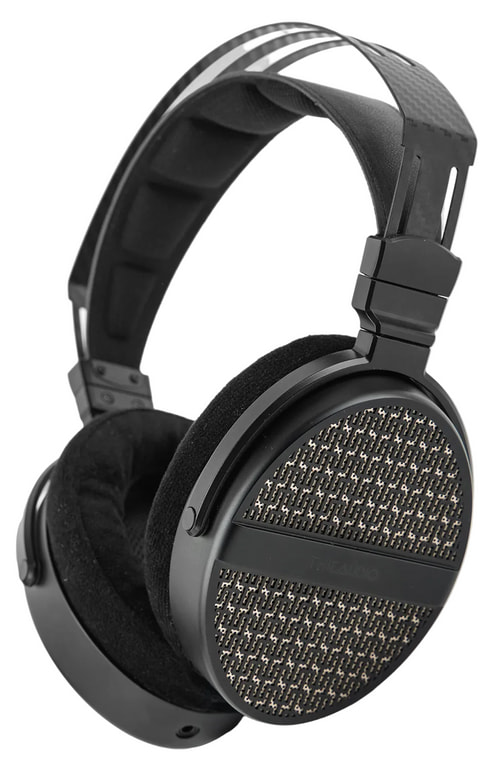
THIEAUDIO Cypher Headphones
The $399 Cypher is THIEAUDIO’s fourth full-size headphone and its most serious attempt yet to change that. Built around a new 50mm dynamic driver, the open-back Cypher enters one of the most competitive corners of the wired headphone market, where stalwarts such as the Sennheiser HD600 and a small army of HiFiMAN planars have set a very high bar.
After launching through Kickstarter in March, the Cypher is now available directly from THIEAUDIO and Linsoul for $399. That removes some of the crowdfunding fog and leaves one rather important question: can THIEAUDIO finally build a full-size open-back headphone worth taking seriously?
Related Reading:
Advertisement
Technology & Specifications
The THIEAUDIO Cypher is built around a 50mm dynamic driver using what the company describes as a semi-crystalline polymer-and-rubber composite diaphragm. THIEAUDIO says the material is intended to balance rigidity, damping, and excursion control in pursuit of low distortion, extended bass, and a natural tonal balance.
That diaphragm is paired with a 20-core N45 magnetic array and a high-tension copper-aluminum composite voice coil. On paper, the design is intended to improve driver control and responsiveness, with the potential for cleaner transients, sharper detail retrieval, and more stable imaging. As always, the proof is in the listening rather than the magnet count.
The Cypher is rated at 32 ohms with a sensitivity of 96dB ±3dB. Those figures suggest it should be easier to drive than some higher-impedance reference headphones, though its real-world amplifier demands deserve a closer look later in the review.
Build Quality & Design
The Cypher makes an excellent first impression with its overall build quality.
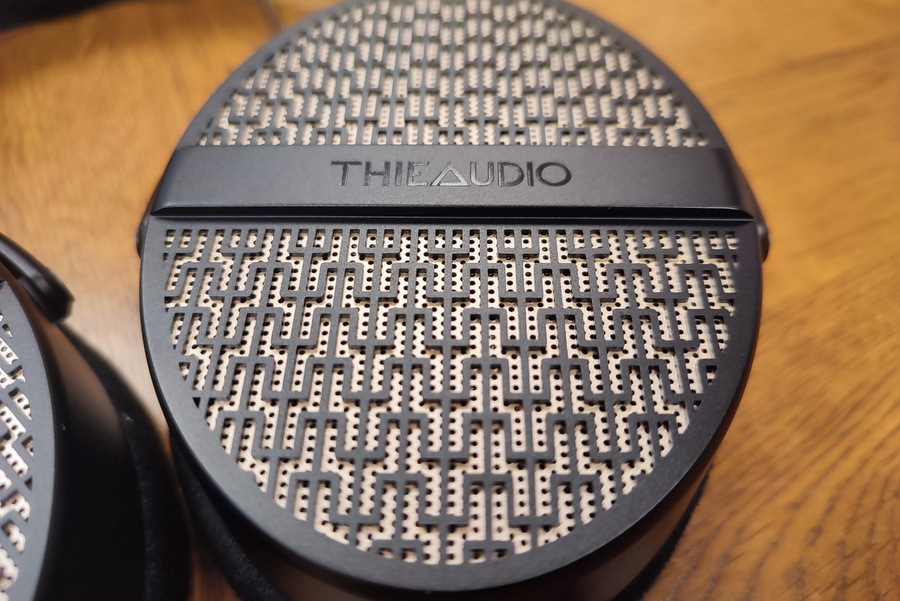
Its earcups are machined from aerospace-grade aluminum, giving the headphone a reassuringly solid feel without pushing the design into industrial-looking territory. THIEAUDIO has paid close attention to the visual details, and the result is a headphone that looks more expensive than its $399 price tag suggests.
Advertisement
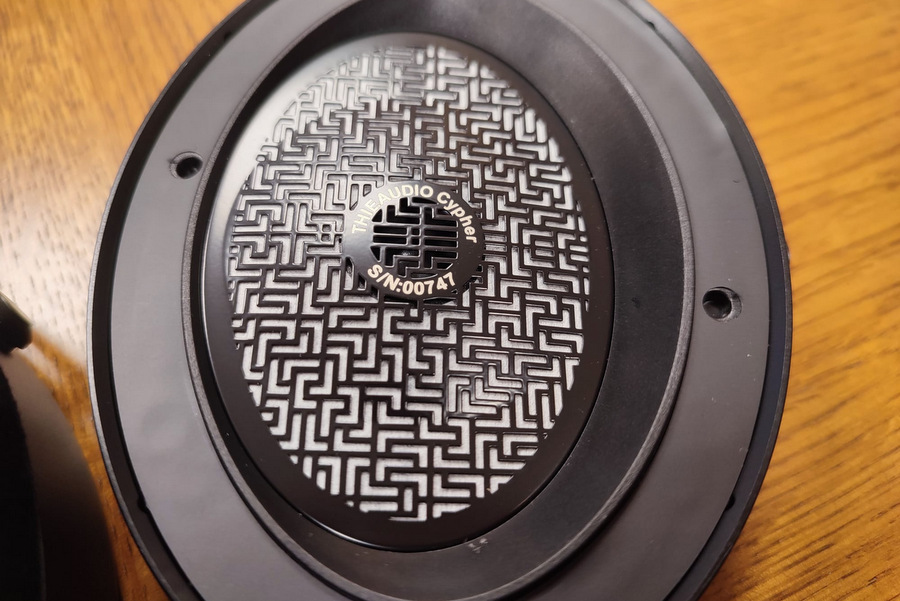
The geometric tessellation pattern on both the outer grille and the driver baffle beneath the earpads is one of the Cypher’s most appealing design choices. It is a subtle flourish, but it gives the headphone a distinct identity in a category full of familiar black-and-gray circles.
Advertisement. Scroll to continue reading.
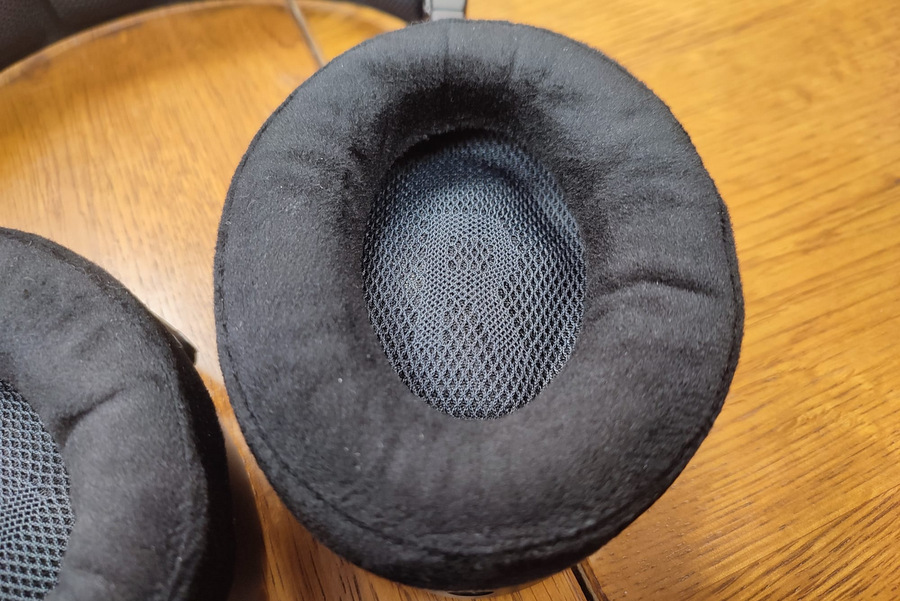
The magnetically attached earpads are another welcome touch. Swapping pads is quick and painless, while the mounting system feels more refined than the usual plastic clips. The trade-off is that the pads are proprietary, which could make replacements harder to source once the originals eventually wear out.
Overall, the Cypher’s build quality is among its strongest attributes. It feels well made, looks properly premium, and avoids the cheap shortcuts that still plague too many headphones at this price.
Advertisement
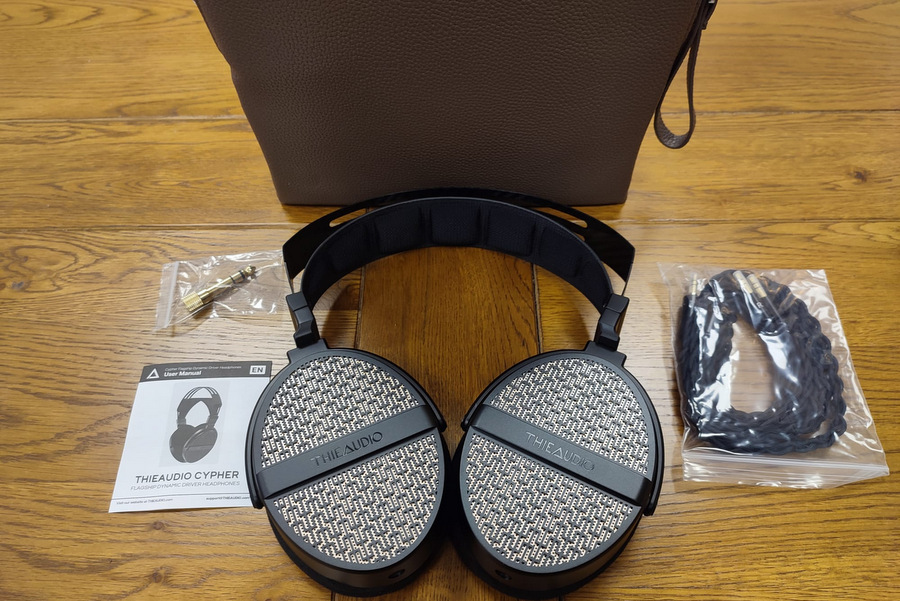
Included with the Cypher is a 1.5m braided cable, a quarter-inch adapter and a very premium-looking leatherette soft carry case.
Comfort, on the other hand, is more of a mixed bag. At first glance, the generously padded headband looks as though it should be well suited to long listening sessions. In practice, I found the opposite. Its concentrated padding creates pressure hotspots that become increasingly noticeable over time, and after roughly two hours of continuous use, they can become genuinely uncomfortable.
Ironically, a simple suspension-strap design might have worked better by distributing the Cypher’s weight more evenly across the head.
The velour earpads are soft and breathable, and clamping force is generally reasonable. Still, despite a manageable 411-gram weight, the Cypher never quite disappears on the head the way the best long-session headphones can.
The yoke swivel mechanism is another issue. While the earcups provide sufficient range of movement, the yokes themselves are surprisingly stiff. Adjusting cup angle requires more force than expected, and they do not naturally conform to the sides of the head as readily as many competing designs.
One final observation: THIEAUDIO describes the Cypher as open-back, but it attenuates outside noise more effectively than expected. It is not a major issue either way, but “semi-open” may better describe its real-world behavior.
Advertisement
Listening
I’ll cut right to the chase: the Cypher’s tuning is exceptional.
It is one of the headphone’s most immediately impressive qualities and, arguably, its greatest strength. The comparison that kept coming to mind was the Sennheiser HD600. Like that long-standing reference, the Cypher favors neutrality, tonal accuracy, and natural timbre over artificial excitement.
Where THIEAUDIO’s headphone separates itself is in its ability to preserve many of those strengths while improving on several of the HD600’s familiar compromises, including bass extension, imaging, perceived soundstage width, and low-level detail retrieval.
As with all of our reviews, the Cypher was tested with a range of amplifiers and DACs to assess how it performed across sources of differing quality and output power. Listening included both Spotify streams and hi-res FLAC files, with the conclusions below drawn from tens of hours of use.
Bass
Bass extension is noticeably stronger than that of the Sennheiser HD600, a headphone long known for rolling off in the lowest audible octave.
Advertisement
Advertisement. Scroll to continue reading.
The Cypher reaches deeper into the sub-bass with greater authority, yet it does so without upsetting its overall tonal balance. There is no obvious mid-bass lift or added warmth masquerading as impact; the extra extension simply gives recordings a more complete and convincing foundation.
Electronic music benefits from that added low-frequency reach, but the improvement is just as apparent with acoustic material, where the body, resonance, and scale of instruments come through more naturally. Hans Zimmer and James Newton Howard’s “Why So Serious?” was a particularly effective test. From roughly the 3:27 mark, its near-subsonic rumble was reproduced with convincing weight and control, without overwhelming the rest of the mix.
Midrange
The midrange is where the Cypher truly shines. Vocals, in particular, sound remarkably natural and believable, with impressive tonal density, presence, and realism.
Advertisement
Male and female voices emerge without obvious coloration, a quality that remains surprisingly difficult to find in headphones at any price. The Cypher may not grab attention on first listen with oversized bass or aggressively bright treble, but spend time with it and the quality of its midrange becomes increasingly difficult to ignore.
That even-handed presentation also pays dividends with instrumental timbre. Pianos carry convincing weight and harmonic complexity, while guitars have the kind of organic texture that makes strings, wood, and resonance feel properly connected rather than merely outlined.
There is an effortless quality to acoustic instruments that makes the Cypher deeply engaging over long listening sessions without becoming fatiguing.
Treble
The THIEAUDIO Cypher strikes a fine balance with its treble presentation. There is enough energy and extension to preserve detail and air without introducing fatigue or harshness. It never sounds artificially bright, but it also avoids the muted or overly relaxed character that can rob a headphone of life.
The result is a highly resolving presentation with excellent long-term listenability. On L’Impératrice’s “La lune,” the Cypher reproduced the faint triangle hits woven through the track with impressive clarity and delicacy, bringing them forward without allowing the treble to turn sharp or piercing.
Advertisement
Soundstaging & Imaging
The Cypher’s tuning may be its headline act, but good tonal balance does not automatically guarantee equally convincing technical performance. The Sennheiser HD600 remains a useful comparison: its midrange is rightly celebrated, yet its relatively intimate soundstage and center-focused imaging can make more complex recordings feel somewhat constrained.
The Cypher addresses both shortcomings. Its soundstage is appreciably wider, and its imaging is more precise, giving densely layered material such as TOOL’s “Chocolate Chip Trip” more room to breathe and making individual effects easier to follow.
I would not call it class-leading in this regard. Headphones such as the HiFiMAN Ananda series still create a more expansive and open-sounding presentation. But at $399, the Cypher delivers a notably more spacious and organized image than the HD600 while retaining much of that headphone’s tonal appeal.
Drivability
As noted earlier, the THIEAUDIO Cypher is rated at 32 ohms with a sensitivity of 96dB/mW.
Advertisement. Scroll to continue reading.
Advertisement
That sensitivity figure is worth noting. It is neither especially demanding nor particularly efficient for an open-back wired headphone, and while the Cypher will play from a laptop or smartphone, I would not recommend relying on either if you want to hear what it can really do.
The good news is that it does not require an extravagant amplifier chain. Moving to pricier DACs and more powerful amplification did not produce a meaningful improvement in overall sound quality, so a capable dongle DAC, such as the Campfire Audio Relay we reviewed last year, should be more than sufficient.
For example, switching from the LAiV Crescendo VERSE DAC/amp to the considerably more powerful Aune S18 EVO and S17 Pro stack resulted in only a barely perceptible tightening of bass notes. It was not enough to justify the substantial price difference, or the additional real estate consumed on the desk.
The Bottom Line
The THIEAUDIO Cypher succeeds because it gets the fundamentals right. Its tuning is unusually accomplished for $399, combining the tonal accuracy and natural timbre that have kept the Sennheiser HD600 relevant for decades with deeper bass, stronger image placement, a wider soundstage, and more apparent low-level detail.
That combination is the Cypher’s real trick. Plenty of headphones in this price range can deliver bigger bass, more treble sparkle, or a wider presentation. Few manage to do so without sacrificing midrange realism in the process. The Cypher does not reinvent the neutral open-back headphone; it makes a strong case for updating the formula.
Advertisement
It is not without compromises. The stiff yokes are unnecessarily frustrating, the magnetically attached pads are proprietary, and the headband creates pressure hotspots during longer sessions. Build quality looks and feels premium, but comfort and long-term serviceability are not at the same level. That matters, especially when the HiFiMAN Sundara is lighter, and the beyerdynamic DT 900 Pro X offers a more practical, repair-friendly studio-oriented alternative.
But once the music starts, the Cypher’s shortcomings become easier to forgive. It does not need a costly amplifier chain, it handles a broad range of music with poise, and its midrange performance is good enough to make many more expensive headphones sound like they are trying a bit too hard.
The HD600 remains the safer choice for buyers who value proven long-term parts support and near-universal comfort. The Sundara remains compelling for listeners who want planar speed and a more expansive presentation. But for someone who wants a neutral, reference-oriented dynamic headphone with more sub-bass reach, better spatial performance, and very little tonal baggage, the Cypher is absolutely worth the money.
THIEAUDIO has made better IEMs than full-size headphones in the past. The Cypher is the first one that feels like a serious correction to that record.
Advertisement
Pros:
Outstanding reference-oriented tuning
Superb timbre and tonal realism
Excellent imaging and detail retrieval
Better bass extension than the HD600
Premium metal construction
Attractive industrial design
Convenient magnetic earpad system
Cons:
Headband creates pressure hotspots
Stiff yoke articulation
Proprietary earpads may be difficult to replace long-term
The Heavys H1H is a $274 over-ear headphone built specifically for rock and metal listeners, with an eight-driver design intended to recreate the feel of a live show. It is an unusual product in a crowded market, and it makes its case on a very specific promise.
Most headphones are designed to be broadly neutral, or to flatter whatever genre the buyer happens to favor. The Heavys H1H takes a different approach entirely.
It is built around the idea that rock and metal have specific sonic characteristics that standard headphone tuning does not serve well. The multi-driver configuration is designed to address that directly, spreading frequency reproduction across eight drivers per side rather than relying on a single unit.
The headphones were engineered by Axel Grell, formerly of Sennheiser, where he led development of the HD 800 and HD 600 series. So, it’s got good bona fides.
Advertisement
I’ve replaced my AirPods Max with them for six weeks.
Heavys H1H review: Specifications
Specifications
Heavys H1H
Driver type
Dynamic
Advertisement
Drivers per side
4 (2 low/mid range, 2 high frequency tweeters)
Frequency range
5 Hz to 46 kHz (wired); 5 Hz to 24 kHz (Bluetooth)
Max SPL
Per IEC 62368-1
Bluetooth version
5.1
Advertisement
Codecs
SBC, AAC, aptX Adaptive
Wired connection
2.5mm to 3.5mm AUX cable (included); USB-C digital
Active noise cancellation
HellBlocker ANC (passive + active combined)
Microphones
5 (2-mic end-fire array for calls)
Advertisement
Modes
Wired passive, Bluetooth passive, Bluetooth ANC, Bluetooth transparent
Transparency mode
Yes
App
Yes (EQ and firmware updates)
Battery life
Up to 50 hours
Advertisement
Charging
USB-C
Weight
14.5 oz (410g)
Ear cup design
Full-size, around-the-ear
Customization
Interchangeable outer shells
Advertisement
Price
$274 (bundle with travel case)
Heavys H1H review: Design and build
The H1H is a full-size over-ear headphone. At 14.5 oz, it is on the heavier side versus most headphones, but not the AirPods Max.
The headband and ear cups have a fairly conventional layout from the outside. The interchangeable outer shells are the most visually distinctive element, letting buyers swap in licensed artist designs from bands including Motorhead, Lamb of God, and Slayer, among others.
The ear cup shells are replaceable without tools and a wide range of official artist designs are available from Heavys separately. It is a smart system for a brand built around fan identity.
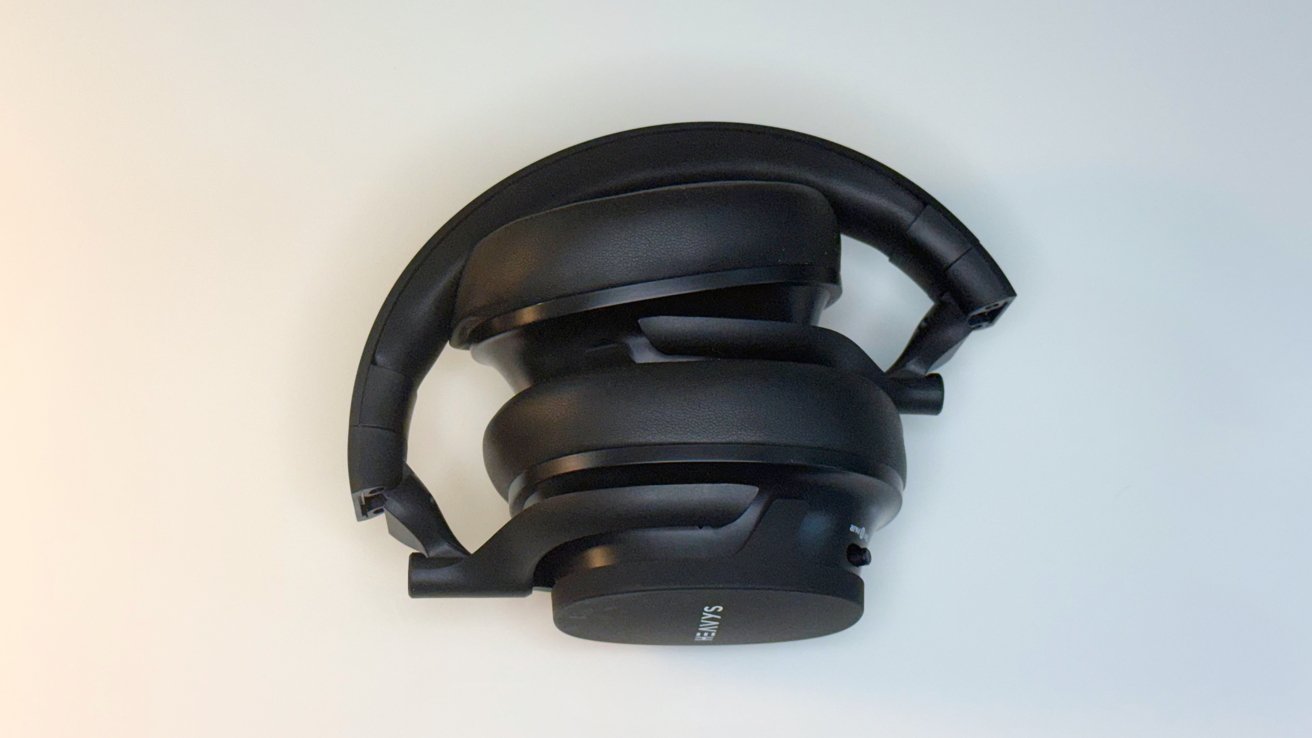
Heavys H1H review: Folded down
Advertisement
The headphones fold for travel and come bundled with a protective hard case in this configuration. USB-C handles both charging and digital audio input, and a 2.5mm to 3.5mm cable is included for wired passive use.
The balance is good on the headset. They are heavier than most as I’ve already said, but not so much that it’s a problem. The headset exaands to fit most heads, and I am fully aware that I have a big dome, so that was nice.
Build quality is excellent. This is not a headset shipped by a brand with too many adjacent consonants next to their name.
Heavys H1H review: The eight-driver system
The core technical claim of the H1H is its eight-driver configuration. Each side contains four drivers: two handling low and mid frequencies, and two high-frequency tweeters.
Advertisement
Most consumer headphones use a single dynamic driver per side. The multi-driver approach is more common in in-ear monitors used by musicians on stage, where separating frequencies across dedicated drivers can improve clarity and reduce distortion at high volumes.
Heavys H1H review: Extra directional speakers in the earcup.
Heavys claims the placement of the drivers is patented and specifically optimized for the way rock and metal are mixed, with an emphasis on guitar presence, drum impact, and the wide dynamic range those genres use.
The frequency range extends from 5 Hz to 46 kHz in wired mode, which is wider than most headphones at either end. Bluetooth operation narrows the upper limit to 24 kHz, which is still beyond the range of human hearing.
Advertisement
Let’s be clear, here. I am in the middle of the target market. I grew up on a steady diet of what is now called yacht rock, spent some time DJing at a rock station before my Navy stint when hair metal was popular, and just continued to listen.
These are the anti-Beats. They know what market they want, and shoot right at it.
And that Heavys claim about guitar and drums? Absolutely true.
Heavys H1H review: Noise cancellation and modes
The H1H uses what Heavys calls HellBlocker ANC, which it describes as a combination of passive noise cancellation and a mild active noise cancellation layer.
Advertisement
Passive noise cancellation (PNC) refers to the physical blocking of sound by the ear cup seal, while active noise cancellation (ANC) uses microphones and processing to cancel out remaining ambient noise electronically.
Heavys H1H review: Multiple physical switches and dials are in play here.
The result is four operating modes: wired passive, Bluetooth passive, Bluetooth with ANC active, and Bluetooth with transparency mode on. Transparency mode uses the microphones to let outside sound in, which is useful for conversations or navigating in public.
The five-microphone setup handles calls via a two-mic end-fire array. End-fire configuration means the mics face outward in the direction of the mouth for better voice pickup and background noise rejection.
Advertisement
AirPods used to be better across the board at noise reduction. It’s not terrible, but it’s not as good as it was.
The Heavys H1H is just about as good as the AirPods Max is at sound reduction. I tested the feature in a moving car, in a noisy crowd before a concert, in a plane, and on a train.
The AirPods Max and Heavys H1H were about the same. The Heavys H1H seemed to be a bit better in the car, and the AirPods Max on the train and plane, but the differences are minute.
Heavys H1H review: Connectivity and app
Bluetooth 5.1 handles wireless connection, with support for SBC, AAC, and aptX Adaptive codecs. AAC is the relevant codec for iPhone users, as it is Apple’s preferred Bluetooth audio format and is used by AirPods and most Apple devices.
Advertisement
AptX Adaptive is a higher-quality codec for Android and compatible devices, offering lower latency and better dynamic bitrate management. iPhone users will be limited to AAC, which is still a good-quality option.
Heavys H1H review: The case for the headphones
The companion app provides EQ customization and firmware updates. EQ access is a meaningful addition here, since the multi-driver tuning may benefit from adjustment depending on personal preference or the genre being played.
Having a built-in EQ in an app is nice. It’s so nice, in fact, that Apple is getting to it in iOS 27.
Advertisement
This is an incredibly personal experience. The app works pretty well, and it’s obvious to tell that there’s tuning going on in real-time as you move the sliders.
Heavys H1H review: Battery
Heavys claims up to 50 hours of battery life. That is a strong figure, comfortably above the 30-hour range that most competitors in this price bracket offer.
In my experience, I saw between 41 and 52 hours of battery life. There does not appear to be any noticeable idle drain.
Heavys H1H review: HomePod mini for scale.
Advertisement
This may be helped by an obvious on and off switch, that the AirPods Max do not have. You know when it’s off, and you have to guess with AirPods Max, for the most part.
I still don’t like that carrying case for the AirPods Max.
Heavys H1H review: A headphone with a very clear point of view
The H1H does not try to be for everyone. It is designed for a specific listener with a specific taste, and it is confident in that positioning.
The eight-driver system, Axel Grell’s involvement, and the genre-specific tuning are all genuine differentiators. There is no comparable product from the major headphone brands aimed this specifically at rock and metal fans.
Advertisement
Heavys H1H review: You can buy covers with your favorite band on them for the earcups.
At $274, it sits in a competitive price range. Sony’s WH-1000XM5 and Apple’s AirPods Max are both options a buyer in this bracket might also consider. Neither of those is tuned for this audience, and neither offers the customization ecosystem that the shell system provides.
For Apple users, the AAC codec support and USB-C connection mean it will work well with iPhone and Mac. It is not an Apple product, but it fits into the Apple ecosystem without friction.
The multi-driver system delivers on the company’s promises, and the ANC is strong enough to hold up against the competition at this price.
Advertisement
What’s not to like?
Heavys H1H Pros
Eight-driver system designed for rock and metal
50-hour claimed battery life
Interchangeable artist shells
Heavys H1H Cons
Heavier than most wireless competitors
iPhone users limited to AAC codec
Genre focus may not suit all listeners, but that’s the case with Beats too
Rating: 4.5 out of 5
Where to buy the Heavys H1H
The Heavys H1H are available from Heavys directly, with a 10% discount at press time bringing the price down to $269.
With evidence that the tools had overlapping infrastructure, company attorneys invoked RICO statutes that target organized crime; the legal action was then able to treat both tools as part of a single conspiracy. As a result, Microsoft said, it disrupted more than 200 command-and-control servers and severed criminal control of more than 18,000 infected computers. Europol, which helped coordinate the law-enforcement part of the operation, said it recovered as many as 27 million stolen login credentials and uncovered $47 million worth of “crypto assets of criminal origin.”
“During this action, 326 servers and 142 domains were actioned by law enforcement and the private sector partners, severely crippling the malware’s distribution network,” Europol said. “By taking down these tools simultaneously, the collaboration between law enforcement and private parties has increased friction for cybercriminals, making it harder for attacks to succeed, spread, or recover.”
Europol said that another tool disrupted in Operation Endgame is SocGholish, a malware loader linked to the Russian cybercrime group Evil Corp. that spreads through compromised websites. Visitors to these sites are tricked into installing trojanized apps posing as browser extensions or other legitimate software. Europol said it has responded by cleaning infected WordPress sites and urging administrators of the sites to change credentials and tighten security. It has also worked to notify parties whose data and credentials were exposed through SocGholish activities. Countries involved in the enforcement action include Canada, Denmark, Germany, the Netherlands, the UK, and the US.
For decades, IT services firms made billions of dollars by allowing companies to outsource tech tasks like customizing, integrating, and maintaining enterprise software. Vishal Sikka, former CEO of Infosys, one of the largest such firms in India, is now betting that AI can do much of that work instead.
His new startup, Hang Ten Systems, has raised a $32 million seed round led by Mayfield, it said Wednesday, with a strategic investment from Aramco Ventures and participation from angel investors. The startup, whose board includes Yahoo co-founder Jerry Yang, said it helps enterprises continuously build, modify, and operate software using AI-driven development and automation.
Hang Ten enters a market where IT services firms, including Infosys, are racing to adapt to AI through partnerships with companies like Anthropic and OpenAI.
The startup’s launch comes amid a growing debate over whether AI will expand the industry’s addressable market or fundamentally alter how enterprise software is built, maintained, and delivered.
Advertisement
Clearly, some enterprises are eager to try the AI-services idea, especially from someone as experienced as Sikka, who spent 12 years building enterprise software at SAP, and later as a board member for Oracle. Mayfield Managing Partner Navin Chaddha told TechCrunch that the company “just got started a month back” and already has customers.
The startup said it is working with customers including Siemens Gamesa Renewable Energy and Fresenius on AI-native project delivery. In a separate blog post announcing the venture, Sikka, 59, said Hang Ten was already helping large enterprises “hang ten on the biggest wave of our lifetimes.”
Headquartered in the Bay Area, Hang Ten told TechCrunch that it is hiring across delivery, engineering, sales, and leadership and plans to expand across multiple locations globally to meet enterprise demand.
The early crew at the startup includes executives who have worked with Sikka for years across SAP, Infosys and his previous enterprise AI startup, VianAI, according to their LinkedIn profiles. Among them are co-founders Navin Budhiraja, the startup’s CTO, Sanjay Rajagopalan, its chief design officer, and Tao Liu, its senior vice president of forward deployed engineering.
Advertisement
After stepping down as Infosys’ chief executive in 2017, Sikka founded VianAI, which emerged from stealth in 2019 with $50 million in seed funding and later raised $140 million in a 2021 round led by SoftBank Vision Fund 2.
Chaddha told TechCrunch Hang Ten is distinct from VianAI, describing Sikka’s earlier venture as focused on a different market. VianAI focused on enterprise AI applications and analytics tools designed to help businesses use artificial intelligence in decision-making. Hang Ten, by contrast, describes itself as an enterprise AI services company built around agentic code generation, reusable AI skills, and domain expertise.
Mayfield backed Hang Ten because of Sikka’s career experience, as well as its belief that the startup’s AI-native model can scale differently from traditional services firms.
“Traditional services scale linearly with headcount,” Mayfield said. “Hang Ten is built so its leverage grows with every project.”
Advertisement
Hang Ten emerges as investors debate how AI will affect the economics of the IT services industry. Analysts at Jefferies argued earlier this year that IT services may be among the first sectors to face meaningful AI disruption. Infosys chairman Nandan Nilekani, however, this week said AI could expand the industry’s addressable market.
Infosys itself has sought to position AI as an opportunity rather than a threat, telling investors this month that “AI-first services” could represent a $300 billion-$400 billion market by 2030. The debate comes as investors reassess the outlook for traditional IT services firms, with Infosys shares down over 35% this year.
When you purchase through links in our articles, we may earn a small commission. This doesn’t affect our editorial independence.
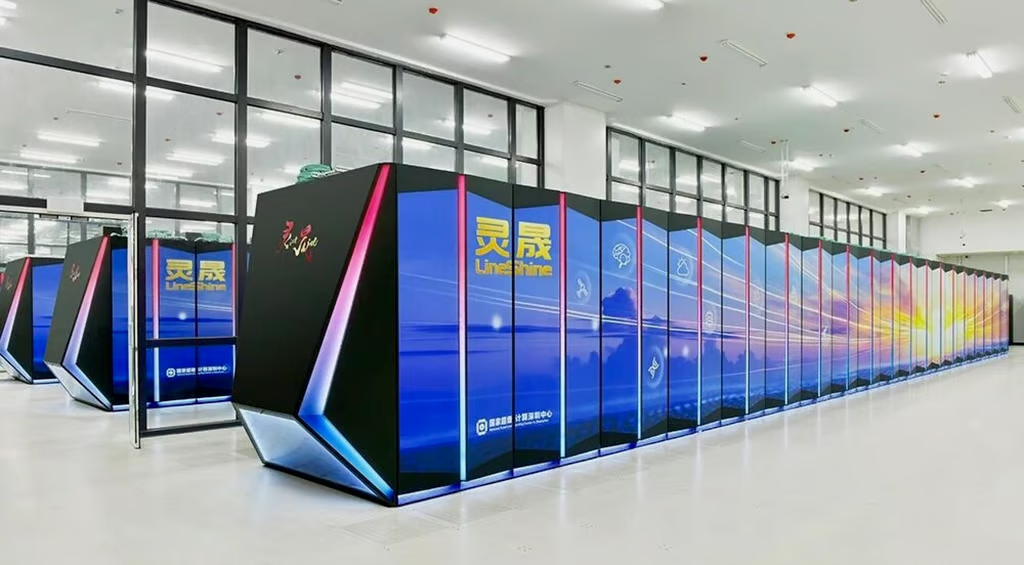
There is a phenomenon where as you get older, your sense of scale becomes somewhat fixed in the earlier era that shaped you– things like expecting the Dollar Store to carry items for 1$, or to get a burger and fries for less than twenty bucks– or, in this case, thinking of supercomputers as being petaflop-scale machines. That’s not wrong, per se– most of the world’s fastest machines benchmarks are best measured in petaflops– but when you’re clocking at 2198 of the things, it becomes easier just to say that the LineShine computer can do 2.188 exaflops. At double precision. With CPUs only. Yes, we are impressed.
Even more impressive is that this machine just debuted in China, which means it was built without the benefit of the latest-and-greatest Western chips, thanks to US sanctions. It’s using a made-in-China LX2 CPU with 304 ARMv9 cores onboard. Well, it’s actually using around 46 thousand of them, but who’s counting?
Each CPU actually consists of two separate compute dies and onboard high bandwith memory (HBM) and DRAM– 4GB of HBM and 32GB of DDR5. The 152 ARMv9 CPU cores on each chip are all built with Scalable Vector Extensions (SVE) and Scalable Matrix Extensions (SME), so despite the lack of GPUs LineShine will have no problem doing the sorts of vector processing that is traditional for high-performance computing, given the 13.79 million cores.
On the other hand, the lack of GPUs shows when you change benchmarks– LineShine is number one in the rankings for High Performance Linpack (HPL), but getting outside the 64-bit box, the supercomputer only hits number four on the HPL-MxP mixed-precision benchmark, behind machines that pair their CPUs with accelerators like GPUs or NPUs. That may mollify the American ego, as while their El Capitain was bumped to second place on the HPL list, they can still claim the pole position on HPL-MxP. Which computer is actually more capable depends entirely on what you want to do with it, and neither Lawrence Livermore National Laboratory nor China’s National Supercomputing Centre in Shenzhen advertise their compute queues, though this paper suggests at least one job will be crunching earth observation data.
Two educators are reckoning with who is really in charge: technology or the teacher. First, a teacher notices her students are quietly forming their professional knowledge on TikTok and decides to lean in rather than fight it. Then a high school engineering teacher builds an AI grading tool so efficient that it sent feedback to students without him ever reading it, and confronts what that actually means for his role in the classroom. Together, they raise urgent questions about judgment, accountability, and what teaching is really for.
What You’ll Learn:
Pre-service teachers are forming their professional knowledge partly through TikTok and social media reels, including content from former teachers who left the profession, raising questions about how teacher prep programs should respond.
Evi Wuskargues that the information gleaned from social media is already shaping how future teachers think, so the more productive move is to help them engage with it critically rather than dismiss or ignore it.
Steven Swansonbuilt a fully automated AI grading tool that sent feedback directly to students without his review, and after a student thanked him for words he never wrote, he rebuilt the tool to put himself back in the loop.
Swanson describes specific assignment types where AI grading adds value versus where it falls short, including the risk of missing opportunities to learn who students actually are as people.
Listen to the episode:
This Week with EdSurge is produced by the EdSurge newsroom. Subscribe to the EdSurge newsletter for the latest in education news delivered straight to your inbox.



















































You must be logged in to post a comment Login