



Connect with us
DAPA Banner
DAPA Coin
DAPA
COIN PAYMENT ASSET
PRIVACY · BLOCKDAG · HOMOMORPHIC ENCRYPTION · RUST
ElGamal Encrypted MINE DAPA
🚫 GENESIS SOLD OUT
DAPAPAY COMING

Tech

Expedia Group sees reward and risk in the rise of AI-powered travel

Published

on

Expedia Group CEO Ariane Gorin. (Expedia Group Photo)

More than 30% of Expedia Group’s self-serve customer support interactions are now handled by AI. Its fastest-growing marketing channel is getting its brands to show up in AI responses. And the company now has travel booking integrations across both ChatGPT and Claude.

Expedia Group CEO Ariane Gorin offered new details about the Seattle-based online travel giant’s AI push on the company’s first-quarter earnings call Thursday, describing a strategy that includes both internal cost-cutting and a bet on chatbots as a new source of customers.

The company reported revenue of $3.43 billion, up 15% year over year, and adjusted earnings of $542 million, up 83%. Its first-quarter profit margin was 15.8%, the highest in 15 years.

Expedia’s stock was down about 6.5% Friday, however, as investors reacted to the company holding its full-year guidance unchanged despite the strong first-quarter results. 

In addition to its flagship Expedia portal, Expedia Group includes Hotels.com, Vrbo, and a B2B business that powers hotel bookings for partners including airlines and corporate travel companies. Last week, it became the exclusive hotel partner for Uber, which will integrate Expedia’s lodging inventory into its app.

Advertisement

AI impact: The AI push is both an opportunity and a defensive necessity for Expedia. The company lists “emerging AI-powered platforms” among its competitive threats, reflecting concerns that chatbots could cut online travel agencies out of the booking process altogether.

OpenAI recently scaled back plans to enable direct checkout inside ChatGPT, a decision that sent OTA stocks higher in March. Gorin said she wasn’t surprised by the pullback, arguing that travel booking and servicing are too complex for AI platforms to handle on their own.

If the market evolves further toward a paid model, she said, “that’s a space we know well.” Expedia was among the first travel brands to launch as an app inside OpenAI’s ChatGPT last October. The company went live with ads on ChatGPT in February.

In addition to travel booking integrations in ChatGPT and Claude, Gorin said Expedia is working to show up on Google’s Gemini as well. 

Advertisement

She noted that traffic and bookings from AI-driven channels are small but the company is encouraged by the mix of new users, conversion rates, and average purchase size. 

New efficiencies: Gorin said Expedia handles roughly 250 million customer service interactions per year, with more than half resolved through self-service and a growing share powered by AI. 

The company has cut new customer service agent onboarding time by about 60%. When customers do need a human agent, AI generates summaries of previous conversations so agents don’t have to start from scratch. The system now works in more than 30 languages. 

At the same time, Expedia has cut hundreds of engineering, product, and technology jobs over the past two years, including 162 roles at its Seattle headquarters earlier this year. 

Advertisement

AI costs: Outgoing CFO Scott Schenkel said the company expects AI compute costs to rise in the second half of the year but is funding the investment through cuts elsewhere. The company didn’t disclose specific AI costs as a line item in its earnings report or conference call. 

Gorin said the company is not holding back on AI adoption but is also being strategic about its usage, scrutinizing where the technology is deployed to make sure it delivers returns.

Source link

Advertisement
Continue Reading
Click to comment

You must be logged in to post a comment Login

Leave a Reply

Tech

Premier League Soccer: Stream Man City vs. Brentford From Anywhere Live

Published

on

When to watch Man City vs. Brentford

  • Saturday, May 9, at 12:30 p.m. ET (9:30 a.m. PT).

Where to watch

  • Man City vs. Brentford will air in the US on NBC Sports Network and Peacock Premium.
73% off with 2yr plan (+4 free months). Now only $3.49/month


See more details

See at Fubo
Advertisement
Fubo

Watch the Premier League in Canada

Fubo Canada

Advertisement

Nothing less than a win looks likely to do for title-chasing Man City on Saturday as it hosts a Brentford side looking to build on its London derby win last weekend. 

Second-placed City has a game in hand over title rival Arsenal. However, the team comes into this weekend’s action five points behind the Gunners, having played out a tremendously entertaining 3-3 draw at Everton on Monday.  

Brentford enters this game in seventh place and with renewed hope of qualifying for Europe for the first time in its history following last weekend’s 3-0 win over London rival West Ham. 

Manchester City takes on Brentford on Saturday, May 9, at the Etihad Stadium, with kickoff set for 5:30 p.m. BST. That makes it a 12:30 p.m. ET or 9:30 a.m. PT start in the US and Canada, and a 2:30 a.m. AEST kickoff in Australia in the early hours of Sunday morning. 

Advertisement
Jeremy Doku of Manchester City running with the ball.

Jeremy Doku scored a last-second equalizer against Everton to rescue a point on Monday night. 

Shaun Brooks/CameraSport/Getty Images

How to watch Man City vs. Brentford in the US without cable

Saturday’s clash at the Etihad Stadium will be broadcast on NBC and streaming service Peacock. To catch the game live on Peacock, you’ll need a Peacock Premium or Premium Plus subscription. NBC Sports Network is available on platforms like YouTube TV.

Advertisement

Peacock offers two Premium plans, and after recent price increases, the ad-supported Premium plan costs $11 a month and the ad-free Premium Plus plan costs $17 a month.

How to watch the Premier League 2025-26 with a VPN

If you’re traveling abroad and want to keep up with Premier League action while away from home, a VPN can help enhance your privacy and security when streaming.

Advertisement

It encrypts your traffic and prevents your internet service provider from throttling your speeds, and can also be helpful when connecting to public Wi-Fi networks while traveling, adding an extra layer of protection for your devices and logins. VPNs are legal in many countries, including the US and Canada, and can be used for legitimate purposes such as improving online privacy and security. 

However, some streaming services may have policies that restrict VPN use to access region-specific content. If you’re considering a VPN for streaming, check the platform’s terms of service to ensure compliance.

If you choose to use a VPN, follow the provider’s installation instructions to ensure you’re connected securely and in compliance with applicable laws and service agreements. Some streaming platforms may block access when a VPN is detected, so verify whether your streaming subscription allows VPN use.

Advertisement

James Martin/CNET

Price $78 for two yearsLatest Tests No DNS leaks detected, 18% speed loss in 2025 testsJurisdiction British Virgin IslandsNetwork 3,000 plus servers in 105 countries

ExpressVPN is our current best VPN pick for people who want a reliable and safe VPN, and it works on a variety of devices. It’s normally $120 a year for its most popular plan (Advanced), but if you sign up for an annual subscription for $90, you’ll get three months free. That’s the equivalent of $6 a month.

Advertisement

Note that ExpressVPN offers a 30-day money-back guarantee.

73% off with 2yr plan (+4 free months). Now only $3.49/month

Livestream Man City vs. Brentford in the UK 

This Saturday afternoon clash is exclusive to Sky Sports and will be shown on its Sky Sports Main Event channel. If you already have Sky Sports as part of your TV package, you can stream the game via its Sky Go app. Cord-cutters will want to set up a Now account and a Now Sports membership to stream the game. 

Advertisement

Now TV

Sky’s standalone streaming service Now offers access to Sky Sports channels with a Now Sports membership. You can get a day of access for £15 or sign up to a monthly plan from £35 a month right now.

Livestream Man City vs. Brentford in Canada 

If you want to livestream EPL games in Canada this season, you’ll need to subscribe to Fubo. The service has secured exclusive rights to the Premier League and is broadcasting all 380 matches live. 

Advertisement

Fubo

Fubo is the go-to destination for Canadians looking to watch the EPL, with exclusive streaming rights to every match. It currently costs CA$27 for the first month, then CA$31.50 per month thereafter.

Livestream Man City vs. Brentford in Australia 

Livestreaming rights for the EPL are now with Stan Sport, which is showing all 380 matches live, including this game.

Advertisement

Stan

Stan Sport will set you back AU$20 a month (on top of a Stan subscription, which starts at AU$12). It’s also worth noting that the streaming service is currently offering a seven-day free trial.

A subscription will also give you access to Premier League, Champions League and Europa League action, as well as international rugby and Formula E.

Advertisement

Source link

Continue Reading

Tech

The Switch 2 still doesn’t have a proper YouTube app, so users made their own solution

Published

on

As the Nintendo Switch 2 still doesn’t have access to the YouTube app, owners have managed to find a workaround on the console.

This workaround is via the free-to-play title Super Animal Royale and takes advantage of the news section embedded within the app. As shared by Reddit user JampyL, the news section surfaces YouTube videos that open inside the console’s browser and enables gamers to search for and watch any YouTube content freely.

Nintendo Switch 2 owners have found a workaround to access YouTube on the console through the free-to-play title Super Animal Royale, filling a gap that Google has yet to address with an official application.

Undoubtedly it’s a clever workaround, however it’s not without its compromises. Firstly, the browser-based playback caps resolution at just 360p which makes longer or detail-heavy content much harder to watch on a TV. In addition, users won’t be able to sign into their YouTube accounts which means there’s no access to personal playlists or recommendations.

Advertisement

The absence of a native YouTube application on the Switch 2 is a notable gap given that the original Nintendo Switch shipped with a dedicated YouTube app that remained available to users throughout the console’s life cycle, with that same legacy app remaining downloadable on Switch 2 hardware for owners who want a stopgap while waiting for a purpose-built successor.

Advertisement

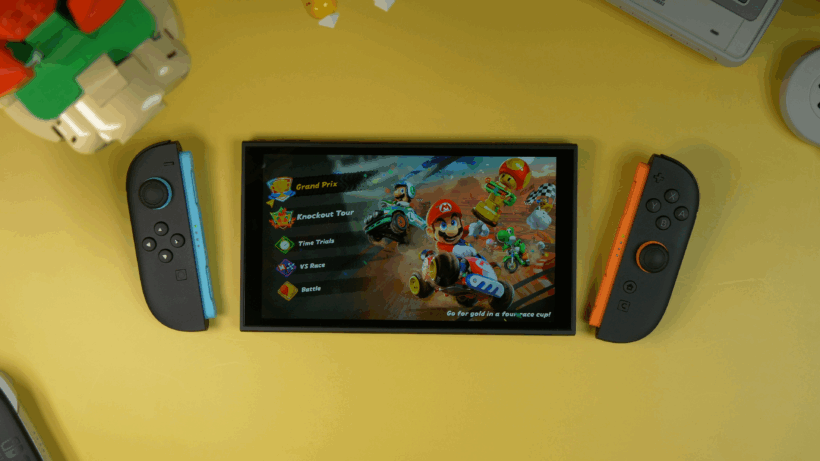
Nintendo Switch 2 - top down - controllers disconnectedNintendo Switch 2 - top down - controllers disconnected
Image Credit (Trusted Reviews)

Google confirmed during an earlier period that a YouTube application for the Switch 2 is in active development, though more than a year has passed since that acknowledgement without any further update on timing or availability, leaving the console without streaming video support that competing platforms have offered as standard for well over a decade.

The Switch 2 launched earlier this year to strong demand, with Nintendo reporting significant early sales figures, making the continued absence of a fully functional YouTube experience on the platform increasingly conspicuous among the broader library of missing media applications at this stage of the hardware cycle.

Google has not confirmed when a dedicated YouTube application will arrive on the Nintendo eShop, leaving Switch 2 owners reliant on workarounds for a feature the platform’s predecessor supported from relatively early in its own life cycle.

Advertisement

Source link

Continue Reading

Tech

Photos: Inside the 2026 GeekWire Awards

Published

on

The scene at the 2026 GeekWire Awards at Showbox SoDo in Seattle on Thursday night. (GeekWire Photo / Kevin Lisota)

Hundreds of Pacific Northwest tech community members turned out to honor each other, network and party at the 2026 GeekWire Awards in Seattle on Thursday.

The shimmering scene inside Showbox SoDo — highlighted by crystal accents to mark the event’s 15th anniversary — included an especially geeky and futuristic acrobatic dance performance by members of Maison de V’s circus and dance community.

Seattle Sounders FC captain Cristian Roldan made a special appearance. There was also a silver-clad juggler tossing lighted batons; a fortune teller’s booth; the usual antics in the photo booth; dinner, drinks and much more as Seattle turned out for the annual event — sponsored by Astound Business Solutions — to celebrate the leading entrepreneurs and innovators across the region’s tech landscape.

Read about all the winners in our main awards story, and keep scrolling for a photographic recap of the event. And thanks again to everyone for attending!

A juggler performs at the GeekWire Awards VIP Reception.
The Yoodli team in the photo booth at the GeekWire Awards.
Peter Tomozawa, CEO of Seattle World Cup 2026 and president of business operations for the Seattle Sounders.
From left: Sonu Aggarwal of TiE Seattle, GeekWire co-founder John Cook, and First Tech’s Keion Mauldin.
GeekWire co-founder Todd Bishop, right, interview’s Augmodo founder and CEO Ross Finman.
The calm before the storm at the GeekWire Awards.
Inside the Baird Fortune Suite at the GeekWire Awards.
From left: Magdalena Balazinska of the UW’s Allen School, Brett Goodwin of Carbon Robotics, Kevan Krysler of Carbon Robotics and Dan Renouard of Baird.
Members of Maison de V’s circus and dance community perform at the GeekWire Awards. (GeekWire Photo / Kevin Lisota)
The Fuel Talent table at the GeekWire Awards.
Karen Dhillon of GeekWire Awards presenting sponsor Astound Business Solutions delivers a toast to open the 2026 GeekWire Awards.
GeekWire co-founders Todd Bishop, left, and John Cook on stage at the GeekWire Awards.
Sounders FC majority owner Adrian Hanauer, center, and Peter Tomozawa, CEO of Seattle World Cup 2026, left, are recognized during the GeekWire Awards.
From left: Wilson Sonsini’s Craig Sherman, Deal of the Year winner Greg Demopulos of Omeros, and Remitly Chairman Matt Oppenheimer.
Seattle Sounders FC captain Cristian Roldan on stage at the GeekWire Awards.
Ambika Singh, left, founder and CEO of Armoire, alongside GeekWire co-founder John Cook while presenting Workplace of the Year.
2025 CEO of the Year David Shim of Read AI, right, congratulates 2026 winner Luis Poggi of HouseWhisper AI.

More photos!

Check out the images from the photo booth here.

Many thanks to Astound Business Solutions, the presenting sponsor of the 2026 GeekWire Awards.

Advertisement

Thanks also to gold sponsors Amazon SustainabilityBairdBECUDeloitte, JLLPwC, F5, First Tech, Microsoft, and Wilson Sonsini, and silver sponsors Prime Team Partners.

Source link

Continue Reading

Tech

Europe can’t afford to sit on the agentic commerce sidelines

Published

on

The basic assumptions behind online commerce are starting to fracture, says Paul Conroy, CTO at Square1, as he looks back at last week’s Stripe Sessions in San Francisco.

Stripe bills Sessions as its “internet economy conference”. Across a few days in San Francisco, thousands of people from around the world gathered last week to talk about the future of online commerce.

But for all the product launches and big-name keynotes, one fundamental shift kept surfacing – the basic assumptions behind online commerce are starting to fracture.

For more than 20 years, payment systems have been built on the assumption that bots are the problem. A good customer browses, hesitates, clicks around and eventually buys something. A suspicious customer lands directly on a payment page, provides almost zero behavioural signal and comes from a server farm rather than a smartphone.

Advertisement

Stripe Sessions 2026 made it very clear: that assumption is dead. In the next phase of commerce, it’s likely that the bot is actually the customer.

Agents need merchants they can understand

One of the clearest examples of this shift is the soon-to-be-everyday idea of asking an AI agent to buy you something. Not just “find me this jacket”, but something more concierge-like: “Get me a full outfit for hiking in France in July, within this budget.”

That request asks vastly more of a merchant than a traditional product search. A human can squint at a product page, read around missing information, infer whether two items might work together and gauge if a return policy feels fair. An agent needs that same information in a structured, reliable format. It needs to understand sizes, materials, compatibility and, crucially, whether a merchant can be trusted.

For merchants, agentic commerce raises a practical question – can your products, prices and policies actually be understood by machines?

Advertisement

This is why new commerce protocols are suddenly so vital. The Universal Commerce Protocol (supported by companies like Stripe, Shopify and Google) is an attempt to standardise how this should work. If agents are going to shop, merchants need a common way to tell those agents what they sell and how it can be bought. Businesses with messy product data will soon find themselves effectively invisible to machine customers.

The new unit economics of AI

This evolution also shows up when we look at agents paying for digital work in tiny increments.

One demo at Sessions involved a code review tool which charges based on tokens consumed. That sounds niche until you consider the economics of AI more broadly. As more companies rely on AI, the cost of inference becomes a massive operational risk. We have all seen the funny screenshots where someone persuades a fast-food chatbot to ignore the menu and write a React app instead. That unintended use is amusing until it is applied to a service with real inference costs behind it. If usage spikes, costs spike.

In the demo, the tool’s price was thousandths of a cent per token used. That is far too small to make sense through traditional credit card processing, so delayed billing in aggregate is common, though risky, for this type of merchant today. However, if an agent can call an API, use an authorised wallet, and make thousands of tiny payments as and when it consumes a service – while keeping processing fees low – viable microtransactions suddenly look very real.

Advertisement

How do you charge for AI-native services when the unit economics are too small, too fast-moving or too risky for traditional payment models? This is where stablecoins graduate from crypto buzzword to practical infrastructure.

The view from Europe

Spending a few days in San Francisco makes the difference in pace hard to ignore. Coming from Dublin, where the bus shelters are more likely to be selling phone plans or supermarket offers, it is striking to arrive somewhere where every billboard seems to be advertising some novel AI startup, or a company with a new way to move money.

Some of that is inevitably hype. But what is entirely real is that the US is actively wiring up the infrastructure to support these shifts. Stablecoin adoption and agent wallets are rapidly moving from theoretical concepts to live commercial deployments.

From a European perspective, that should make us slightly uncomfortable. We have a tendency to approach new financial infrastructure by regulating first. The rollout of the MiCA (Markets in Crypto-Assets) framework is a perfect example. While it gives Europe necessary regulatory clarity, our heavy focus on compliance often means commercial deployment lags behind.

Advertisement

Consumer protection and stability are critical, of course. But there is a difference between moving carefully and moving so slowly that the next generation of infrastructure is built somewhere else, with someone else’s interests at heart. If AI-native commerce, agent wallets and real-time stablecoin microtransactions become the foundation of how online commerce is conducted, Europe cannot afford to watch from the sidelines. The challenge is to regulate well without regulating late.

The fraud arms race gets harder

The fraud angle is where this agentic ecosystem gets significantly more complicated.

Historically, fraud tooling has treated bot-like behaviour as suspicious by default. No normal browsing pattern, a single fast request to transact and a data-centre IP were strong signals that something bad was happening. In an agentic commerce world, a perfectly legitimate transaction will look exactly like that.

This creates a catch-22 for merchants. Block good agents, you lose revenue. Allow bad agents, you lose money. The old signals are failing in both directions.

Advertisement

This came up repeatedly during Sessions. There is a new arms race developing: fraudsters using AI to scale attacks and probe weaknesses, and Stripe using its own AI models in Radar to detect and respond. What I found most interesting was the frankness in many of the talks. There was no triumphalism, just a lot of, “we do not have this fully figured out just yet”. How do we authenticate intent? Who owns the transaction when a user has delegated the decision to an agent?

These are existential questions for businesses operating on low margins. The same automation that makes new buying experiences possible makes abuse much cheaper to attempt.

Clean APIs and the human element

Between talks in the main hall, instead of piped-in background music, a live string quartet played pop covers. It sounds like a tiny thing, and it won’t appear in anyone’s ROI model, but it was a conscious decision somebody somewhere in Stripe made, to make the room a nicer place to be.

That theme of the hidden utility of beauty came up during Patrick Collison’s interview with Sam Altman. Altman noted that Stripe has cared to an almost irrational degree about design and beauty in its APIs for years. That aesthetic consistency was designed to appeal to human developers, but ironically, it may become their biggest advantage in a world of agents. Agents, it turns out, benefit from the exact same things human developers do – clear APIs, coherent abstractions and predictable behaviour. Stripe spent years making itself easier for developers to choose, putting it in a remarkably strong position now that software starts choosing tools too.

Advertisement

During that same interview, there was an interruption as a protester with a guitar walked down the aisle, singing that music and art should be made by humans, not machines. It was a strange and funny moment. The Moscone Center acoustics are so good, many thought he was part of the show initially, before he was hurriedly escorted away. There were numerous callbacks to this during subsequent talks – John Collison noted that an AI demo that was taking too long to run could have used a guy with a guitar to keep people entertained – but it served as another reminder that AI is changing more than commerce. It is colliding directly with culture more broadly, for better and worse.

The future is unevenly distributed

For visitors to San Francisco, Waymo’s autonomous cars navigating the hills still feel like a futuristic tourist attraction. For locals, they are just more traffic.

Agentic commerce feels a lot like those driverless cars. It brings to mind William Gibson’s famous line about the future being already here, just not evenly distributed.

While agentic commerce is unevenly distributed, it is very much here. The businesses that prepare now by cleaning up their data, rethinking their pricing for microtransactions and strengthening their fraud controls will be ready for a fundamentally new kind of customer.

Advertisement

The ones that wait may find the agents have already learned to shop somewhere else.

Paul Conroy is CTO at Square1, an award-winning digital transformation agency specialising in payments and online publishing. He was also among the first cohort of Stripe Partner Advocates – a group of technical leaders with deep payments experience, chosen to collaborate directly with Stripe product teams. Disclosure: Square1 is a longtime collaborator of Silicon Republic.

Don’t miss out on the knowledge you need to succeed. Sign up for the Daily Brief, Silicon Republic’s digest of need-to-know sci-tech news.

Advertisement

Source link

Continue Reading

Tech

Top Megelin Deals for Laser and LED Therapy Devices (2026)

Published

on

The red-light therapy market shows no signs of slowing down. According to Fortune Business Insights, the industry is projected to grow from $1.21 billion in 2026 to $1.76 billion by 2034. Riding that wave is Hong Kong-based Megelin, which is currently running its largest Mother’s Day sale yet, offering major discounts on most of its LED devices and select electrical muscle stimulation (EMS) tools.

I’ve been testing the Duo Lux Laser & LED Light Therapy Mask for the past two weeks as part of a six-week trial. While I’m still forming my final verdict, I already have some early thoughts (more on that below). In the meantime, check out the standout deals because some of these discounts might be too good to pass up while they’re live.

This Laser & LED Light Therapy Mask Is $270 Off

Image may contain: Appliance, Device, Electrical Device, and Mixer

Megelin

Duo Lux Laser & LED Light Therapy Mask

The Megelin Duo Lux Laser & LED Light Therapy Mask combines 660-nanometer (nm) and 1,064-nm lasers with a 660-nm LED light for a more intensive treatment. The brand claims it can help smooth wrinkles, soothe inflammation, reduce pigmentation, and minimize redness. After two weeks of testing, I haven’t noticed any visible changes in my skin just yet, though to its credit, I also haven’t experienced any irritation or adverse reactions.

Advertisement

My biggest issue was the initial unboxing experience: The mask had a strong chemical odor that reminded me of formaldehyde. For a device that sits against your face and doesn’t have a mouth opening, that’s not exactly reassuring. Wiping it down and letting it air out significantly reduced the smell, but it definitely made for a less-than-ideal first impression.

That said, the mask itself is extremely comfortable. The soft, flexible silicone contours well to the face, and the dual-strap design keeps it secure without feeling restrictive. Treatments are quick and easy to customize thanks to four different modes, all controlled through an attached remote. And because it’s cordless, you’re free to move around while using it.

At full price, it’s a steep investment compared to its competitors. But with the current $270 discount, it becomes a much more compelling option, especially given the added laser therapy component, which isn’t as common at this price point. I’ll continue testing through the full six-week period before sharing my final verdict, but if you’re tempted to take advantage of the sale now, Megelin does offer a 60-day money-back guarantee and a one-year warranty.

Source link

Advertisement
Continue Reading

Tech

NYT Connections hints and answers for Saturday, May 9 (game #1063)

Published

on

Looking for a different day?

A new NYT Connections puzzle appears at midnight each day for your time zone – which means that some people are always playing ‘today’s game’ while others are playing ‘yesterday’s’. If you’re looking for Friday’s puzzle instead then click here: NYT Connections hints and answers for Friday, May 8 (game #1062).

Good morning! Let’s play Connections, the NYT’s clever word game that challenges you to group answers in various categories. It can be tough, so read on if you need Connections hints.

Advertisement

Source link

Continue Reading

Tech

Discord Is Back After An Outage That Took Some Users Offline

Published

on


Discord is recovering following a brief outage that saw some users unable to use the popular chat app. At 3:08PM ET, the company said it had begun investigating an issue with its API systems. Shortly thereafter, at 3:24PM ET, Discord said it had identified the problem, but noted at the time it was still affecting users, making it difficult for them to access the service. 

“We are continuing to work to remediate the issues impacting availability for some Discord users,” the company said at3:56PM ET. “This is causing impact across our service, including logging in and sending messages.” Whatever was causing the disruption, Discord appeared to solve it quickly. At 4:16PM ET, the company said it was starting to see “seeing significant recovery” across its systems. As of 4:59PM ET, the service isn’t at “fully healthy state” yet, so if you’re having trouble launching the app, it may take a bit more time before everything is up and running again. By 6:38PM ET, Discord reported that “all critical functionalities have recovered for all users.”

Update 6:4PM ET: The headline and copy of this article have been updated to reflect that Discord is back online for all users.

Advertisement


Source link

Advertisement
Continue Reading

Tech

I tried the lossless audio test and couldn’t believe my ears. Can you really tell the difference between lossless audio and plain old MP3 versions of your favorite tunes?

Published

on


  • A simple test can see how well you can recognize lossy formats using your own music choices
  • Beyond a certain point most people can’t easily tell the difference
  • High-quality lossless is still the most future-proof format

With music, how good is good enough? When you’re listening to digital music, what you hear depends on the original master, the file format and most of all, whether it’s lossy — reducing the sound quality to reduce file sizes — or lossless, which is pristine and perfect. If you’re serious about sound, lossless is going to defeat lossless every time.

Right?

Source link

Continue Reading

Tech

Apple is reportedly working on a holographic iPhone, an AI pendent, and AirPods Pro with AI cameras

Published

on


Information about the rumored new iPhone comes from tipster Schrodinger, who shared screenshots of messages from an unnamed source said to be familiar with the project. The screenshots suggest that Apple is working on a “Spatial iPhone” – codenamed H1 or MH1 – featuring a holographic display that would create…
Read Entire Article
Source link

Continue Reading

Tech

Denon Home series speakers review: Siri & superior sound

Published

on

Denon Home series speakers review: These new smart speakers support Siri & Apple Home with premium audio

Denon’s new line of Siri-enabled Apple Home smart speakers may be what users are looking for in the absence of updated HomePod and HomePod mini. Let’s take a listen.

Japanese audio brand Denon is out with its latest range of speakers: the Denon Home 200, Denon Home 400, and Denon Home 600. While all different sizes and price points, the entire line caters to Apple users with support for conversing with Siri and AirPlay.

The new devices launch in what has been a prolonged pause in Apple’s HomePod product cycle. The second-generation full-sized HomePod launched in 2023, and HomePod mini has gone even longer without an update, hitting shelves in 2020.

Advertisement

This makes Denon’s new lineup even more enticing with few alternatives available. I’ve been testing both the Denon Home 200 and Denon Home 400 for the last couple of months.

Let’s see how they perform and compare to HomePod.

Denon Home speakers review: Design

All three speakers in the range share a clear identity. They’re wrapped in mesh fabric, with obvious buttons and metal accents.

Smart speaker on a wooden dresser beside framed wedding photos and a small jar, against a light-colored wall with a white electrical switch visible

Denon Home series speakers review: The smaller, Denon Home 200 looks sleek and elegant

Advertisement

The Denon Home 200 and Denon Home 400 are most similar, with a curved anodized aluminum base and the mesh-covered top. The tops are flat, with buttons on the top or side and extra IO on the back.

The Denon Home 600 is the biggest departure as the contoured speaker body appears to sit angled on top of the base. This provides better sound direction for spatial support, sending audio up, to the sides, and forward.

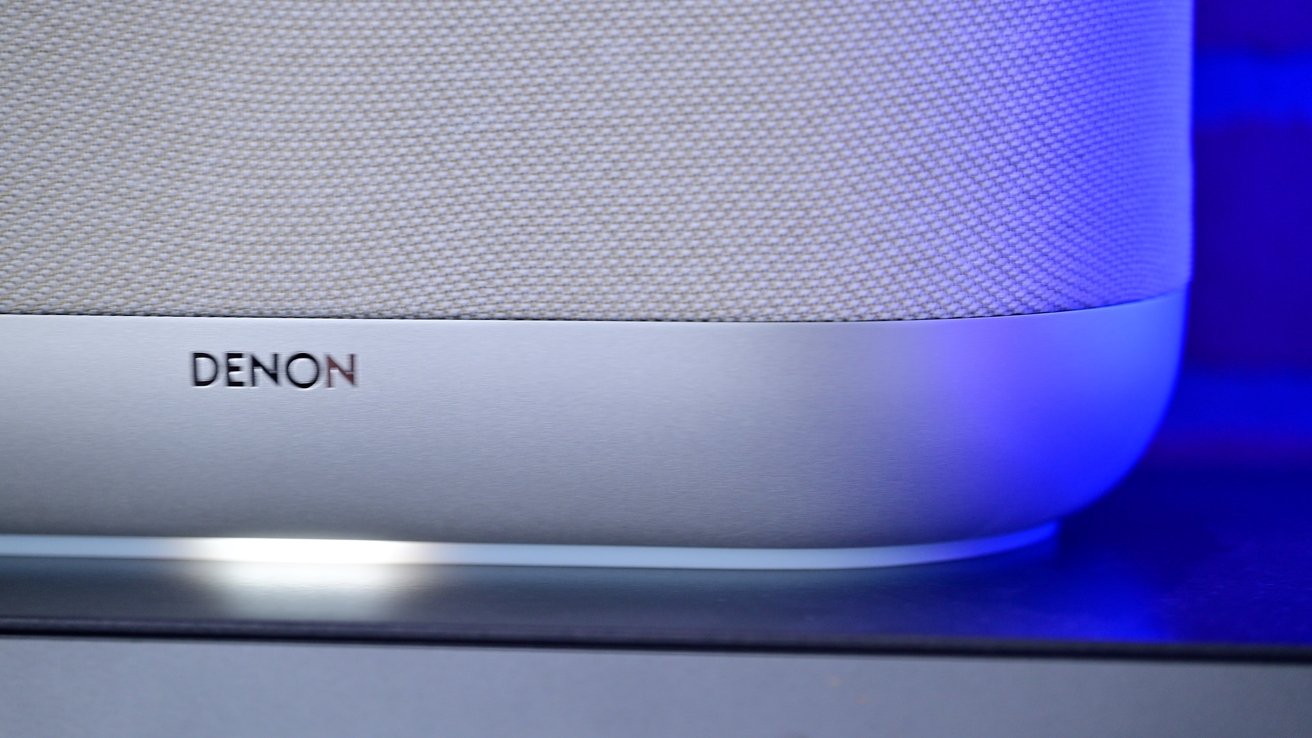
Close-up of a Denon smart speaker with a light gray fabric body, white base, and soft blue accent lighting glowing beneath it on a dark surface

Denon Home series speakers review: Status light on the bottom of the Denon Home 400

I love the metal accents in particular, as they create an elegant upscale look beyond the HomePod. They’re available in both light grey and black, with the former being shown here.

Advertisement
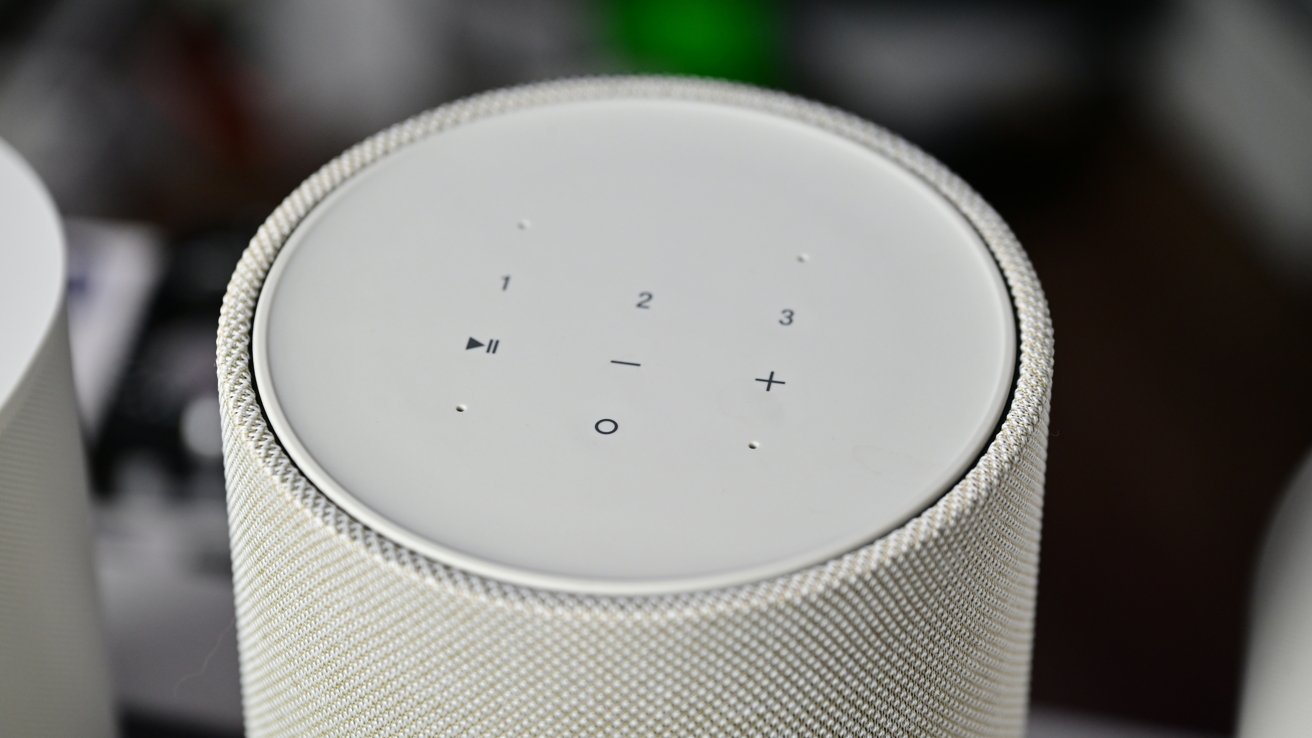
Close-up of a cylindrical smart speaker with fabric sides and a smooth top surface featuring touch controls for play, pause, volume, and numbered buttons against a blurred background.

Denon Home series speakers review: Controls on the top of the Denon Home 200

Unlike with HomePod that has a touch-sensitive surface, the buttons are physical and have a subtle *click* when depressed. There’s a combo play/pause button, volume controls, three user-designated shortcuts, and a multi-function button that can invoke your virtual assistant of choice.

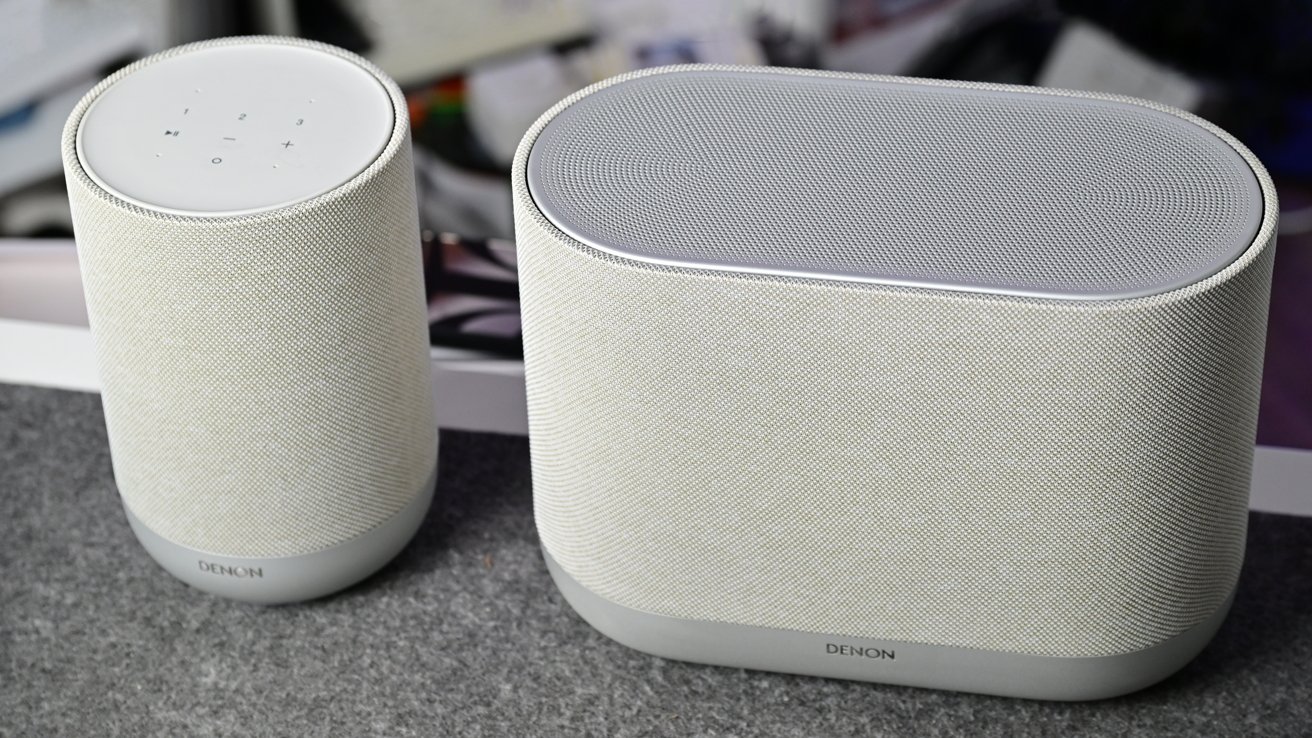
Two modern smart speakers in light gray fabric on a desk, one tall and cylindrical, the other wider and oval-shaped, with subtle controls on top and blurred background electronics

Denon Home series speakers review: Differences in design between the Denon Home 200 and Denon Home 400

The Denon Home 400 is just over twice as wide and instead of the buttons on the top, has a metal grille that helps with Spatial Audio. The buttons are relocated to the ride side for easy access but you don’t see them from the front.

Advertisement
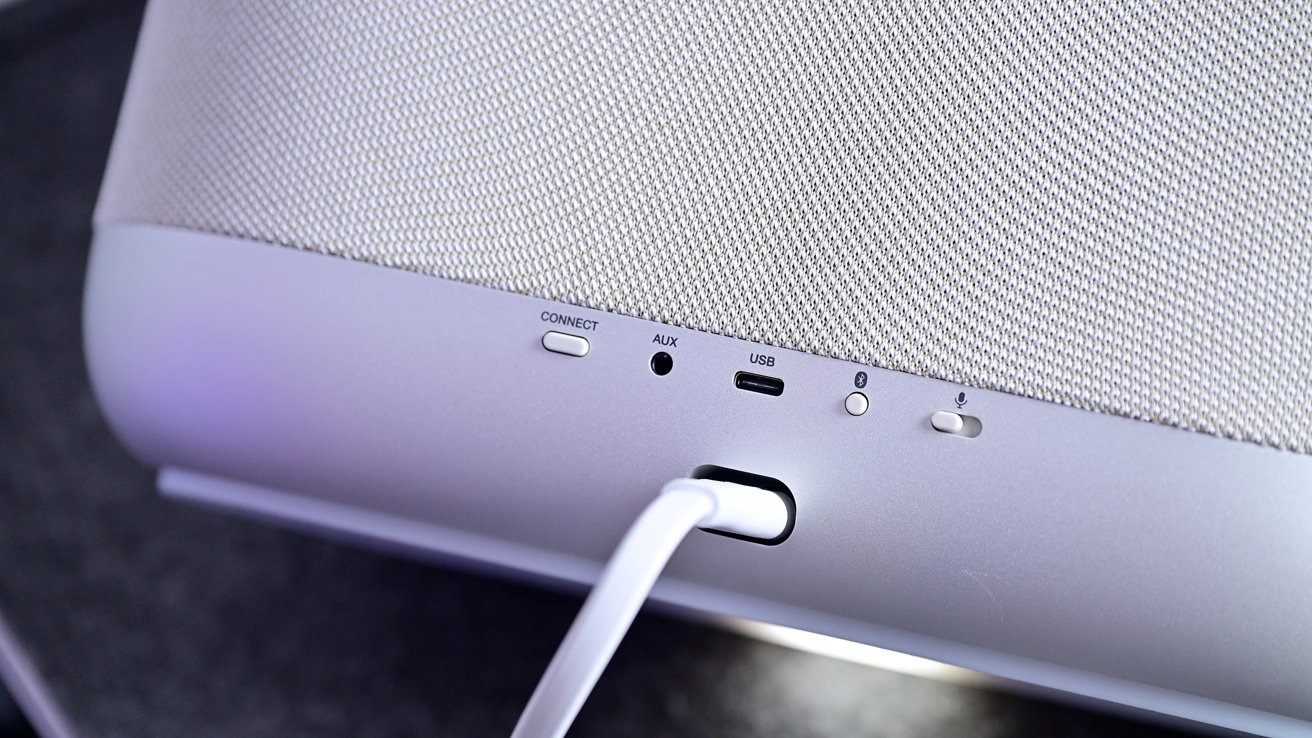
Close-up of a modern speaker's back panel showing connected power cable, USB-C port, AUX jack, control buttons, and mesh fabric grille on a smooth metallic surface

Denon Home series speakers review: Rear ports shared across the Denon home speaker line

For the bonus IO, there are both USB-C and auxiliary audio inputs, a Bluetooth toggle, and a physical toggle that will disable the mic if you don’t want a smart speaker listening in.

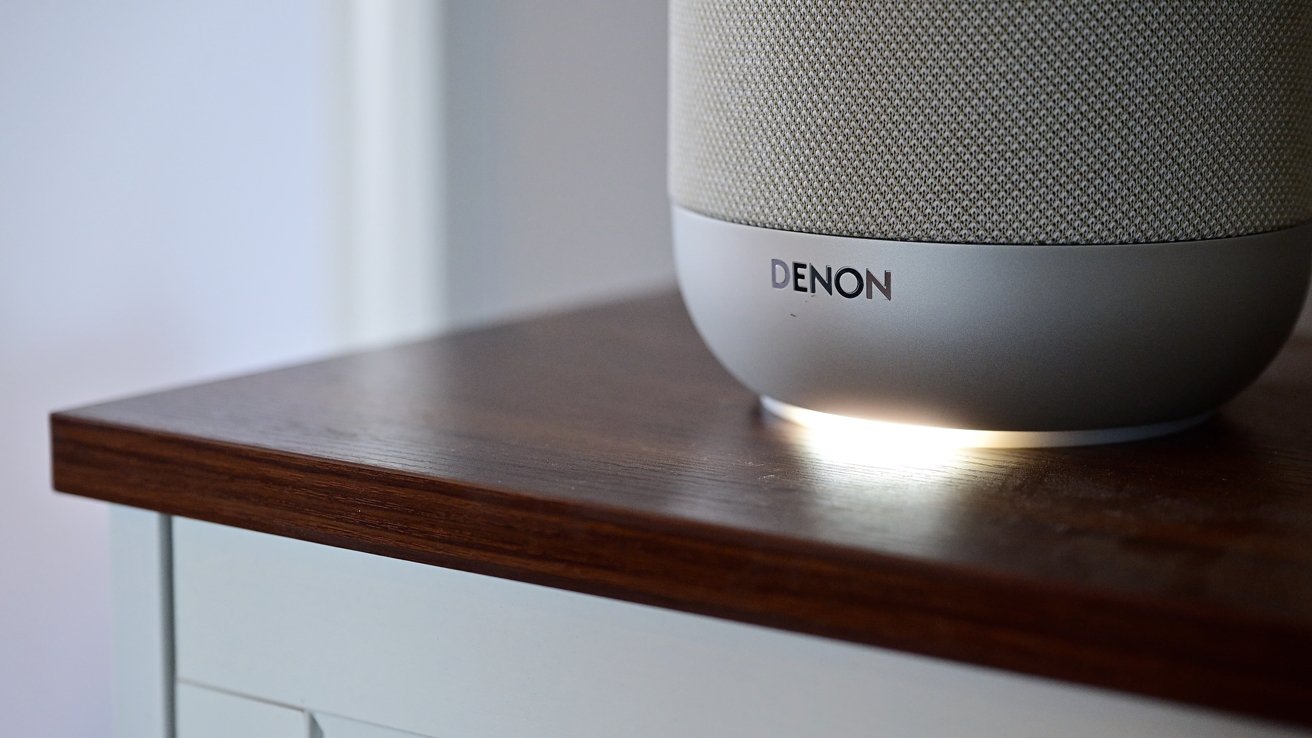
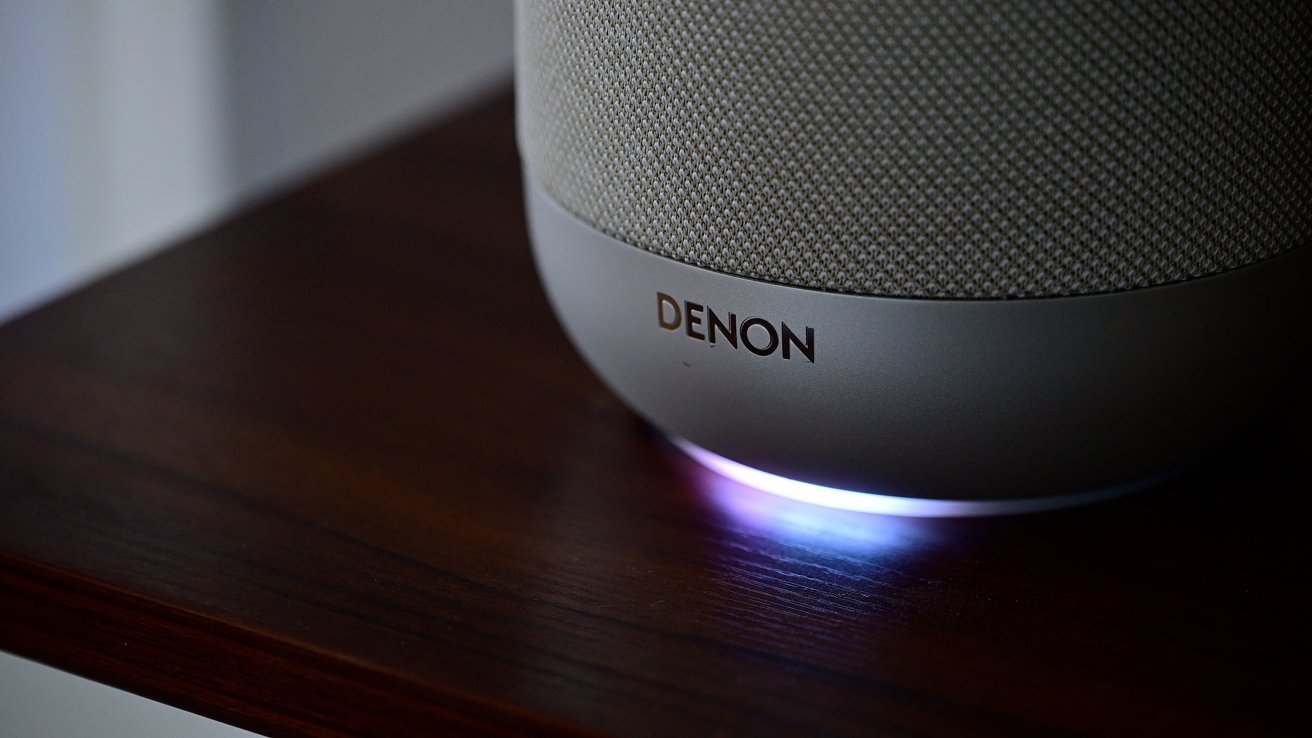
Finally, the speakers have a soft light that glows out of the bottom. It acts as a bit of a status light and can change color.

Denon Home speakers review: Easy setup for Apple users

There are multiple methods of setup for the new Denon speakers. I think for Apple users, though, it’s easiest when using Apple Home.

Advertisement

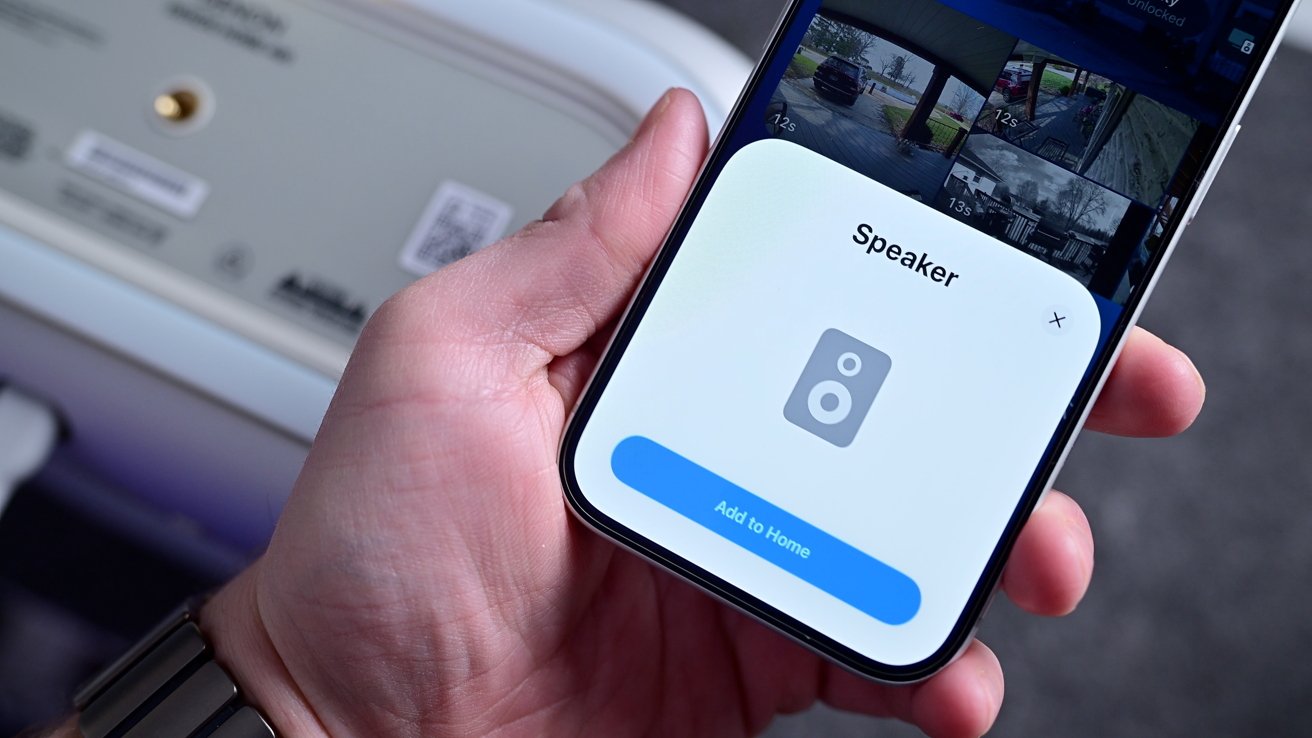
The speakers can be set up just like any other Apple Home accessory. You open the Home app, tap the + button, and scan the pairing code on the speaker.

Hand holding a smartphone showing a smart home app screen, highlighting a Speaker device setup card with an Add to Home button, against a blurred indoor background

Denon Home series speakers review: Scan the pairing code to add to the Home app

This opens a popup modal at the bottom of the screen to walk you through the onboarding process, like giving the speaker a name and assigning it a room in your home. Behind the scenes, it also adds your Wi-Fi credentials.

I’d say this is basically an ideal setup process. You don’t need to do some convoluted pairing process where you connect to a temporary network, download any third-party apps, or even manually enter any credentials.

Advertisement

The only way Denon could have made this any easier would be if they used NFC for commissioning rather than scanning the QR code. That means the whole setup process could be started with a tap versus opening the Home app first.

That’s something still seldom seen, even on dedicated smart home products. Companies probably skip it due to the added cost of the NFC chip that’s used merely once during that initial setup process.

Close-up of a Denon smart speaker with a glowing light at its base, sitting on a wooden tabletop above a light-colored cabinet in a modern, minimal room

Denon Home series speakers review: The status light can change colors

While we’re talking about the setup and wireless, so far in my testing, I’ve not encountered any instances of the speakers going offline. Both speakers have remained online, available, and responsive when I cast audio to them.

Advertisement

The speakers support Wi-Fi 6, including not only 2.4GHz and 5GHz, but 6GHz, too. With strong Wi-Fi in my home, I was able to enable the high-fidelity mode for uncompressed high bitrate audio that used during multi-room playback.

Denon Home speakers review: Smart home powers

What makes these speakers so appealing to me compared to others in their weight class is that they support Apple Home. This doesn’t just make the setup process easier, but allows them to act almost identical to a HomePod.

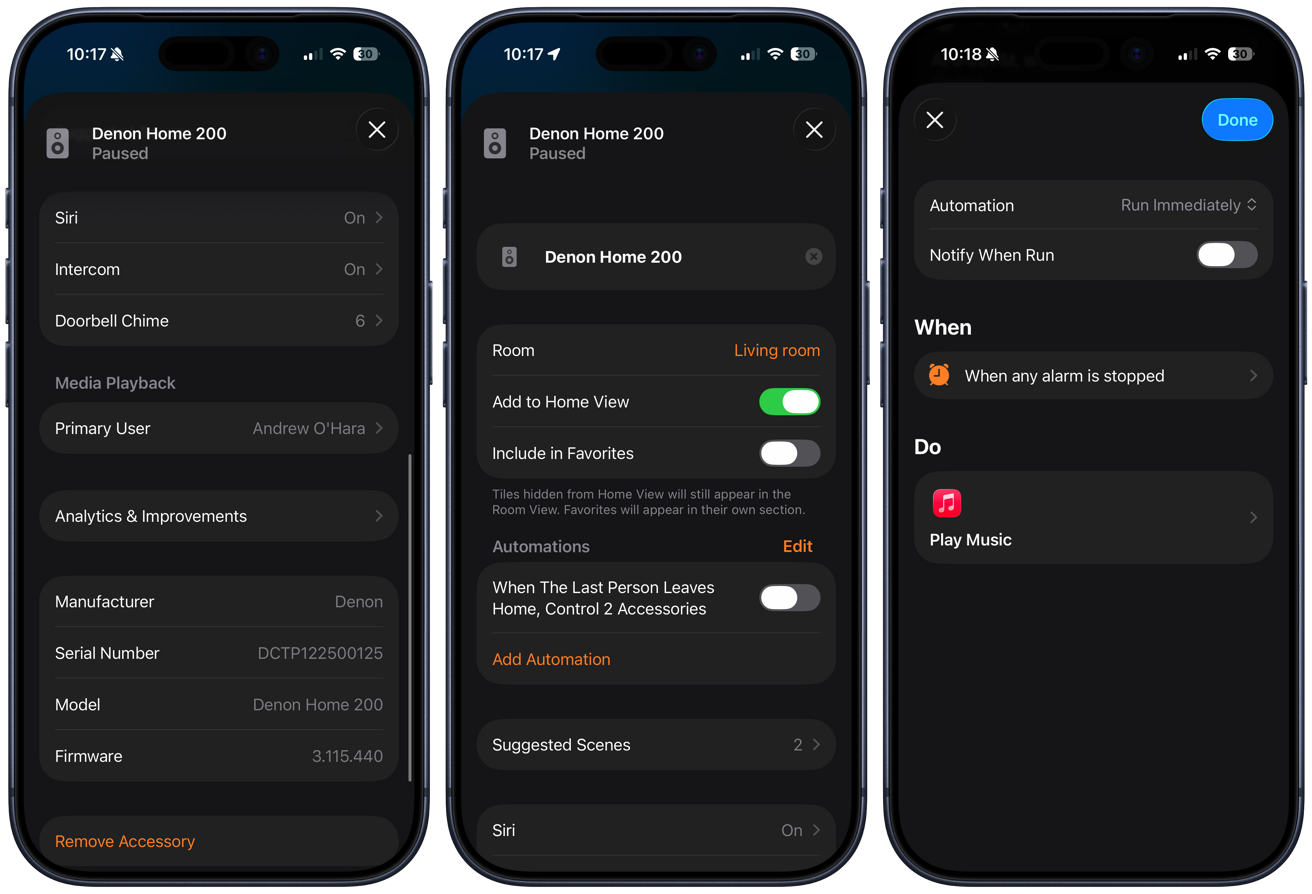
Since it appears in the Home app as a Home accessory, you can include it in your home automations. Simple ones, for example, like automatically pausing audio playback when you or the last person leaves the home, are quite useful.

These speakers can be used in more complex scenes and automations, too. You could have the speakers play your “get ready” playlist in the morning when your alarm goes off, you could have a “pump up” playlist when you set a workout scene, or play white noise with a sleep timer when setting your “Goodnight” scene.

Advertisement
Screenshots of the Denon Home 200 speaker in the Apple Home app

Denon Home series speakers review: The Denon Home 200 showing in the Home app

Another benefit is that it can be used as an intercom with other Apple Home speakers, including HomePods. If I’m in my studio, my partner can call me over the intercom from the kitchen HomePod to my studio Denon Home 400, and I can talk back to them.

If you have an Apple Home doorbell, the Denon Home speakers can act as wireless chimes. That way, if someone presses the doorbell on the front door, the Denon speaker down in the studio can chime to let me know someone is there.

iPhone displaying a smart home control screen with multiple room speakers listed, resting on a colorful background of teal, light blue, and bright pink overlapping shapes

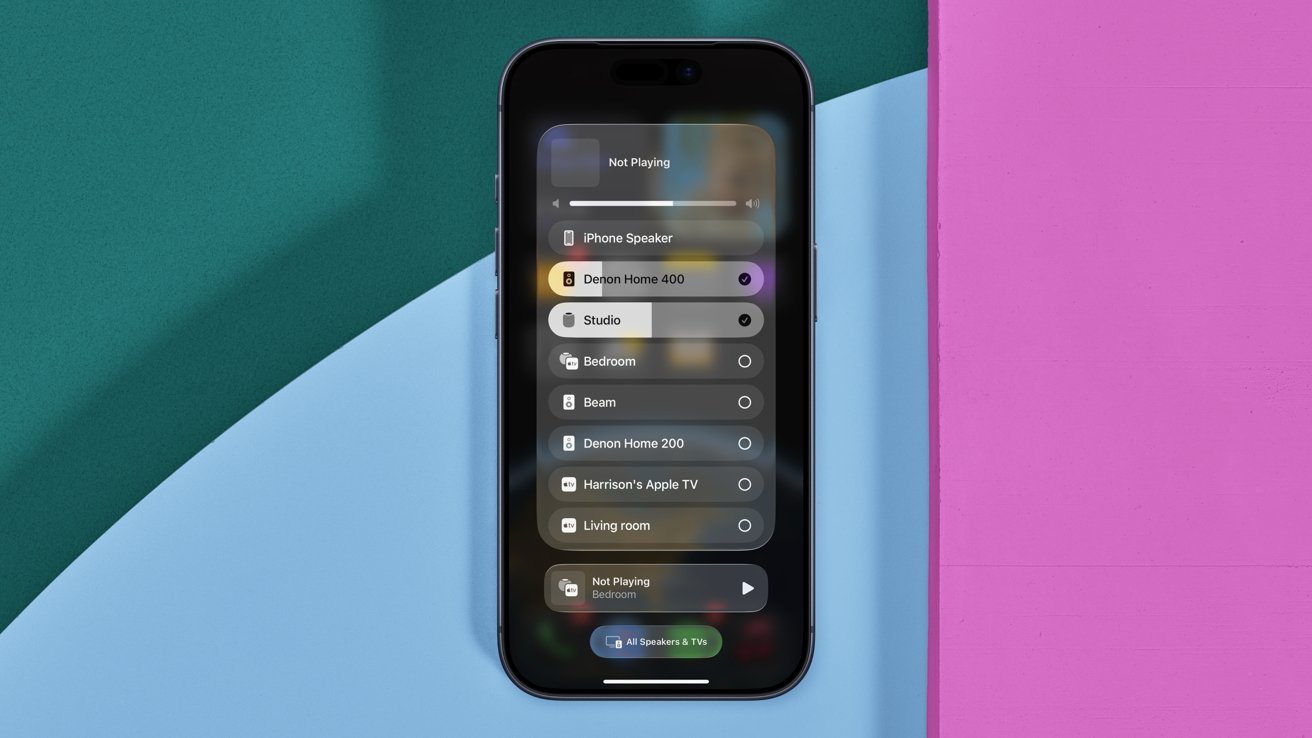
Denon Home series speakers review: Use AirPlay to cast audio to the Denon speakers, including multiple at once

Advertisement

This brings support for AirPlay, too. You can cast audio from nearly any Apple device to the Denon Home speakers.

That’s what allows Apple-native multi-room support. You can play to multiple AirPlay speakers at once, which can be any combination from HomePods and third-party speakers.

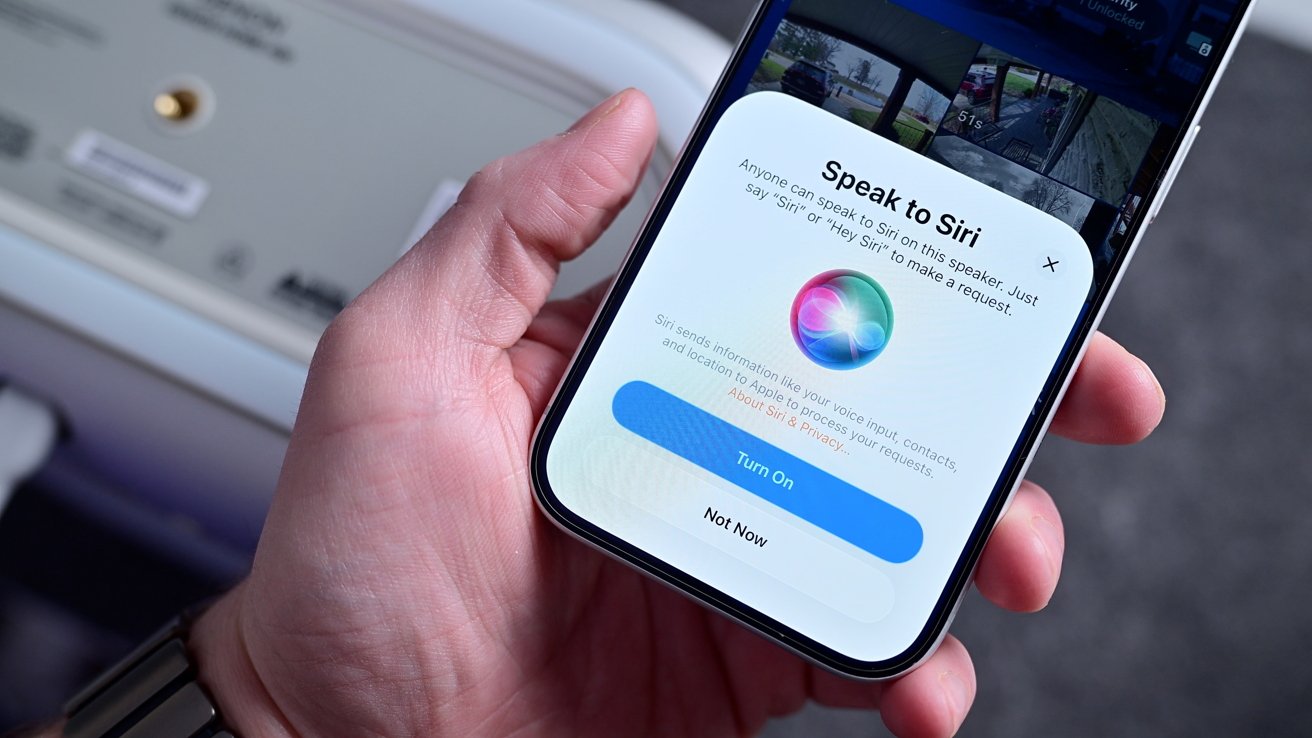
Hand holding an iPhone displaying a Speak to Siri setup screen with a large blue Turn On button, against a blurred indoor background with electronics in soft lighting

Denon Home series speakers review: During setup, you can turn on Siri on the speakers

My favorite is just using Siri for this. I can ask Siri on my iPhone to play my Jams playlist on the Denon Home 400, or if I say to play in a certain room, it will go to all speakers in that location.

Advertisement

Biggest of all is full support for Siri, though the implementation is a little confusing. Apple does allow third-party speakers to build in Siri, but so far, Denon and Ecobee are the only major players to do so.

Denon Home speakers review: Siri, but not on HomePod

The catch with Siri support is that the queries aren’t processed directly on the third-party speaker, but instead require a HomePod or HomePod mini. What happens is that when you ask Siri a question, it listens on that third-party speaker, routes the question to a nearby HomePod, then gives you the answer back on the original speaker.

This major caveat is likely why some of the big players, like Sonos, prefer to cozy up to other virtual assistants like Amazon Alexa, Google Assistant, or its own assistants instead. They don’t want you to have to buy a HomePod, but rather you buy more of their speakers.

Close-up of a Denon smart speaker on a wooden surface, its lower edge glowing with a soft blue and purple light, emphasizing the brand logo and textured fabric exterior

Denon Home series speakers review: The status light can change to Siri colors when you invoke Apple’s assistant

Advertisement

For many Apple users, they likely already have some version of HomePod or two in the Home, so I don’t consider this a huge downside. It is something to be aware of though, before purchasing the speaker with the anticipation of using Siri.

As far as utility, Siri is basically in feature parity with HomePod. Anything you can ask a HomePod, you can ask your Denon speaker.

You can ask it to control your smart home accessories, to text someone, to check the weather, convert units of measurement, and more. That said, there are some ways that they differ.

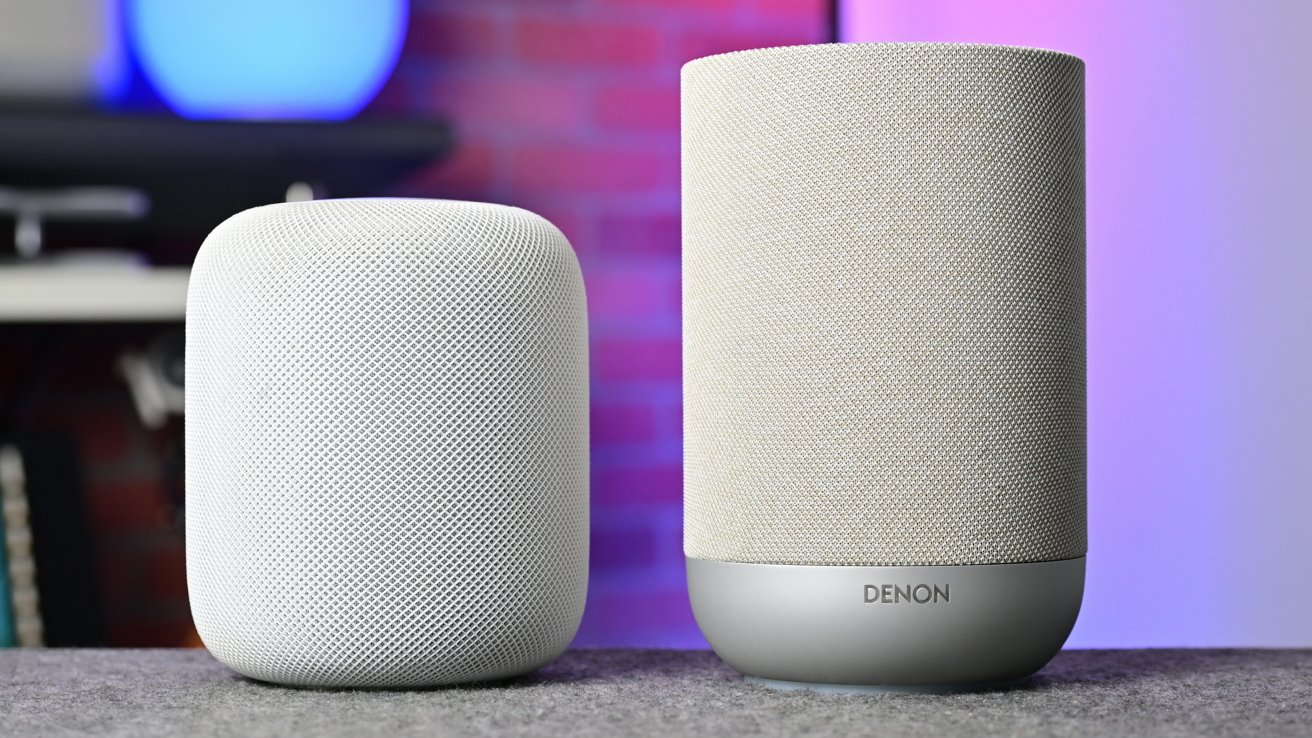
Two modern smart speakers on a gray surface, one rounded white mesh speaker beside a taller cylindrical Denon speaker, with a softly lit, colorful blurred background.

Denon Home series speakers review: Denon Home 200 is still larger than the base HomePod

Advertisement

HomePod, for example, can act as a full Home Hub. A Home Hub helps run scenes and automations when you aren’t at home and is a Thread Border Router.

Apple’s HomePod has handoff using ultra-wideband to automatically transfer audio as your phone approaches. The Denon still gets suggested in the Dynamic Island when you open the Music app nearby, though.

A Home Hub is also what processes the AI video for HomeKit Secure Video, such as people, car, or package detection. Plus, HomePod and HomePod mini have built-in environmental sensors for temperature and humidity.

This is a bit of reading the tea leaves, but because of how Siri works on third-party speakers, I expect Apple Intelligence to arrive sooner rather than later.

Advertisement

Apple has been working on these next-generation HomePod and HomePod mini for seemingly quite some time. If they do launch in the fall of 2026 as expected, Apple Intelligence will certainly be supported.

Again, another leap here, but that would mean if you purchased a new HomePod or HomePod mini with Apple Intelligence, Siri on your Denon speaker would be upgraded. Hopefully, that isn’t wishful thinking, but it’s not a big jump to make.

While I do strongly believe that’s how it will play out, I also strongly caution against buying a product today with the promise of an update in the future. If you buy these speakers now, be comfortable with how they work now, and count future upgrades as a bonus.

Denon Home speakers review: HEOS app

To be crystal clear, users can absolutely set up and use these speakers without any extra apps. But the Denon HEOS app has some added benefits for users that want to use it.

Advertisement
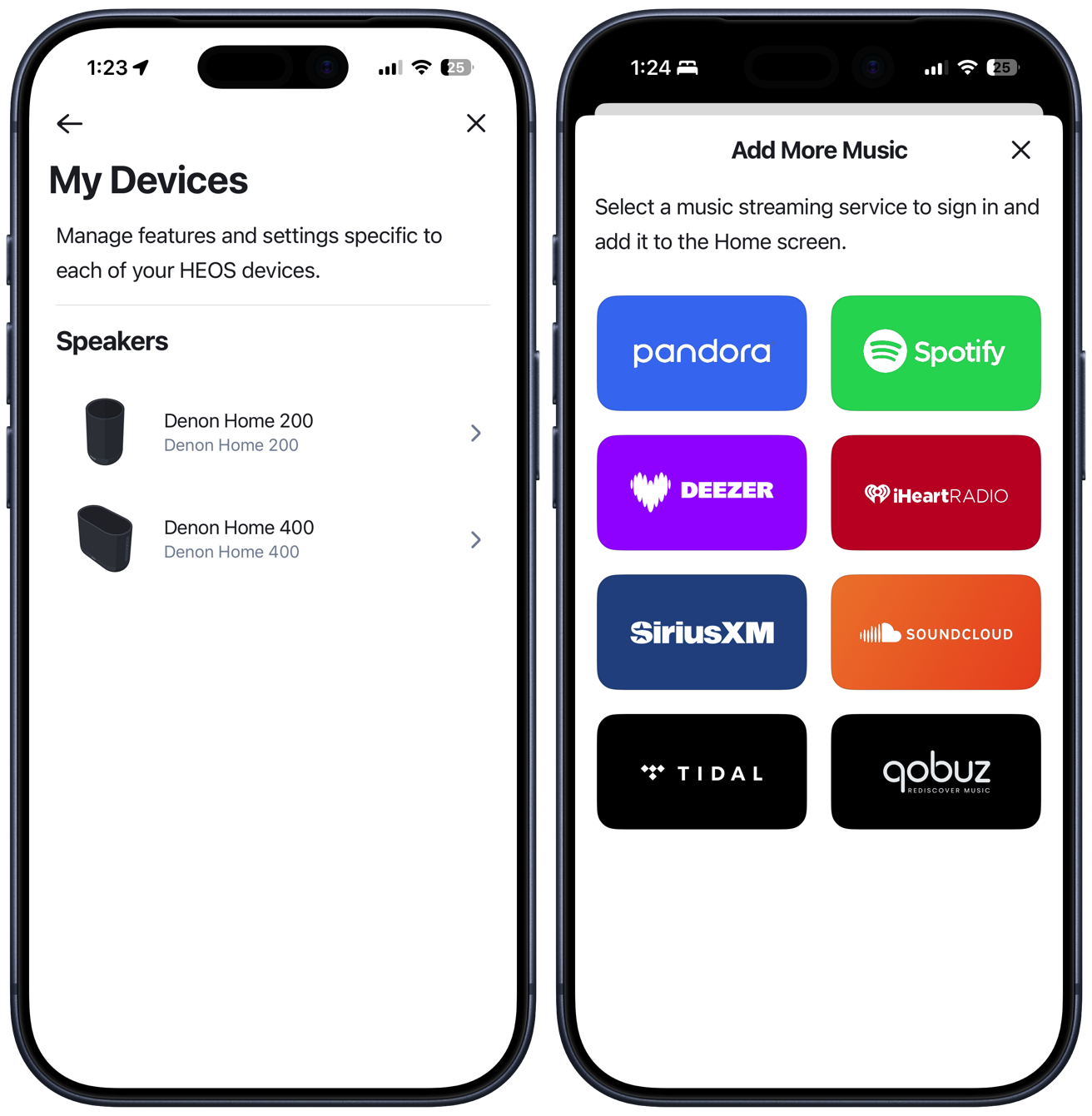
Two smartphone screens showing a HEOS app: one listing Denon Home speakers under My Devices, the other displaying Add More Music with selectable streaming service buttons like Pandora, Spotify, and others

Denon Home series speakers review: The Denon HEOS app has more controls and direct streaming options

This app can guide through a bit more of a convoluted setup process for non-Apple users, plus has direct streaming from various platforms. Users can directly stream from a number of different services, including Tidal, Spotify, Deezer, iHeartRadio, and more.

You can stream from these services, adjust volume, perform updates, and adjust the track queue. It’s similar to the Sonos experience, though maybe a bit more limiting.

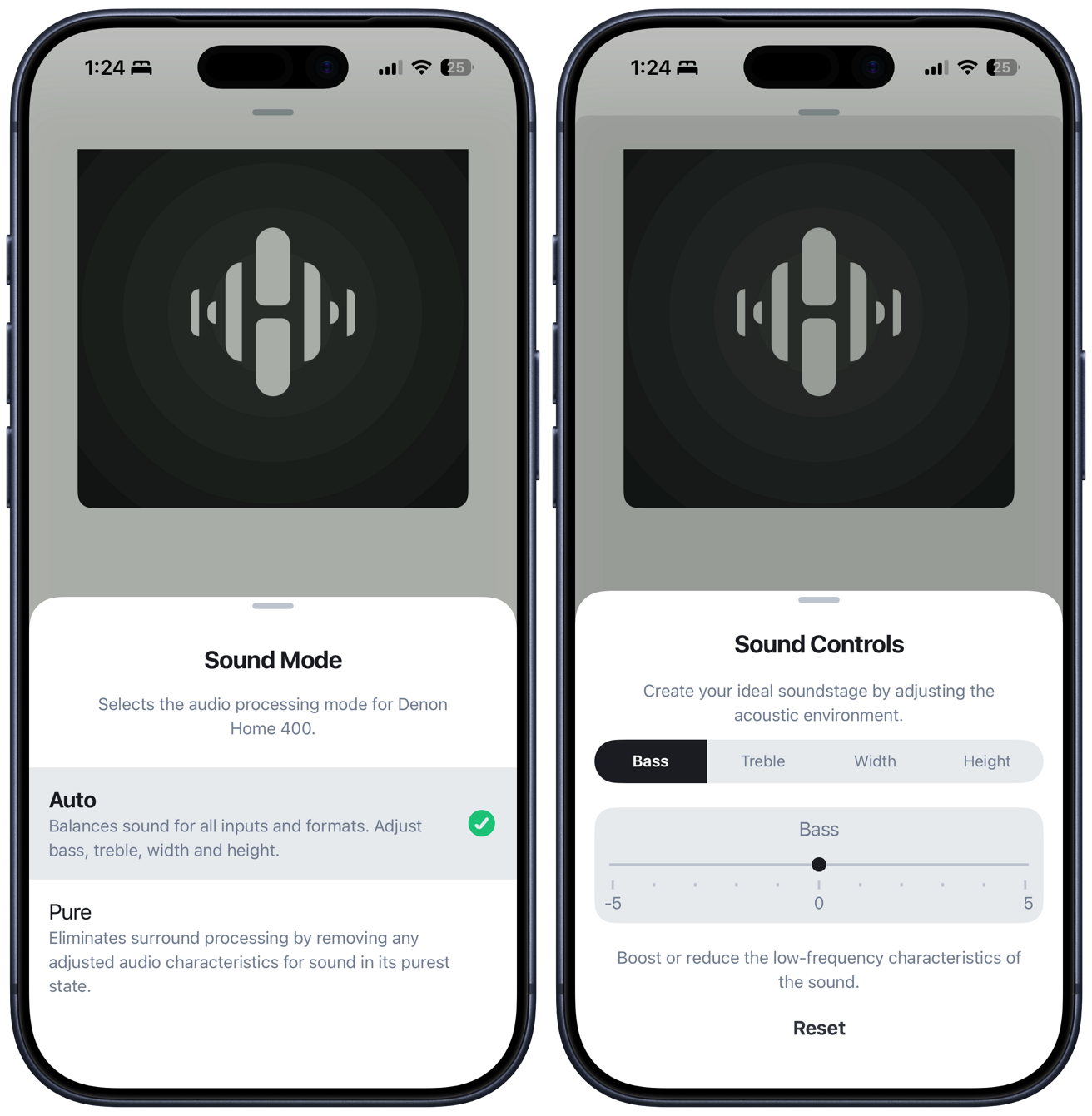
Two smartphone screens display a sound settings app, showing Sound Mode options like Auto and Pure on the left, and adjustable Bass, Treble, Width, and Height sound controls on the right

Denon Home series speakers review: You can adjust audio quality and balance from the HEOS app

Advertisement

Within HEOS, there are sound controls for the speakers. You can turn on “pure” mode to remove any processing or get into the weeds and manually adjust the bass, treble, or width (physical spaciousness of the soundstage).

Denon Home speakers review: Audio quality

As we turn to audio quality, I want to make sure to split it between the two that I have on hand to test. I also want to compare them to the competition, such as Apple and Sonos.

Starting with the smaller of the two, the Denon Home 200 has three drivers. There are two smaller drivers positioned towards the top that angle slightly outwards and a 4-inch front-facing woofer.

Compared directly to HomePod, which is available for $100 less, the Denon Home 200 absolutely sounds better. It’s fuller, with a larger emphasis on the midrange.

Advertisement
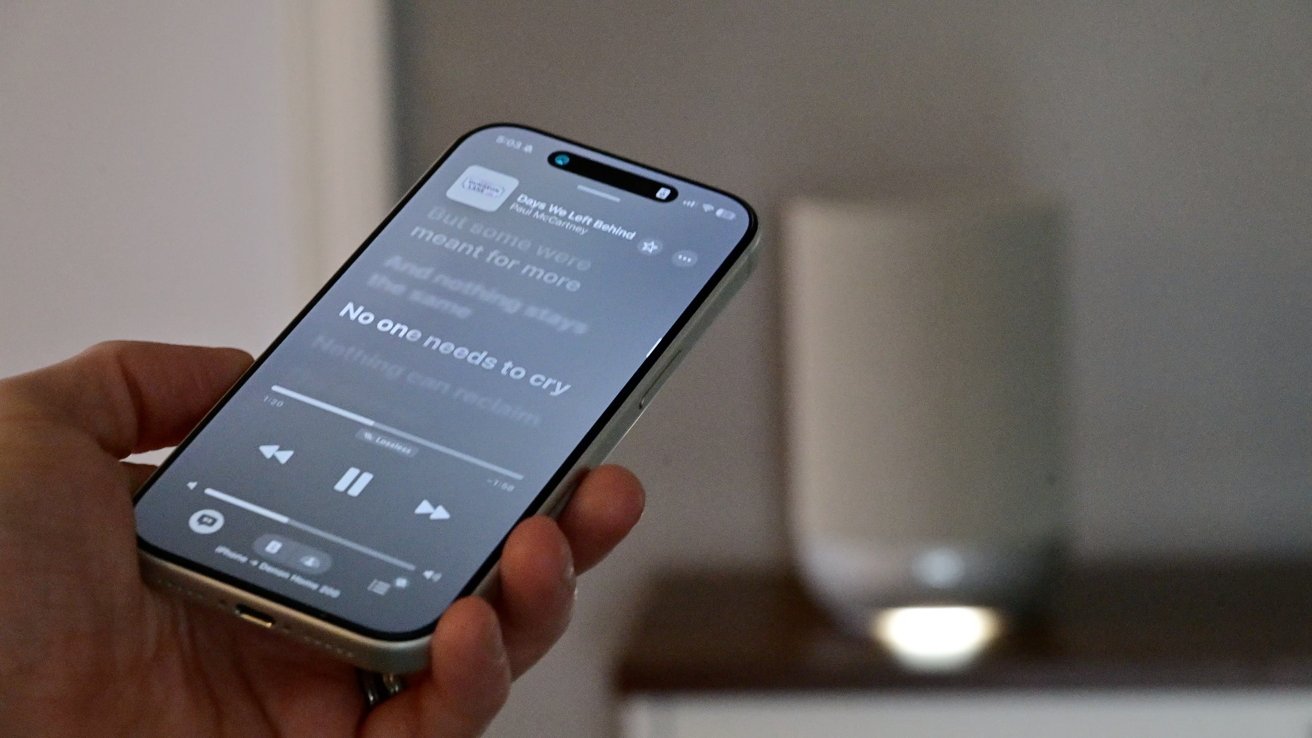
Hand holding a smartphone showing a music player screen with song controls, in front of a blurred smart speaker on a wooden surface in a softly lit room.

Denon Home series speakers review: Controlling audio playback direct from Apple Music

Personally, at times, I find the bass on HomePod to be a bit overpowering or even sloppy, and I think Denon did an excellent job at filling out the midrange.

That isn’t to say the bass is lacking in any way on the 200. Both Denon and Apple speakers have 4-inch woofers, and it definitely puts out some oomph. It’s also much higher volume than the HomePod, with it being arguably too loud in my home to ever go past 75%.

The best way I can describe the sound is very warm, which is something I like. It also maintains this consistency, even at the high volumes.

Advertisement
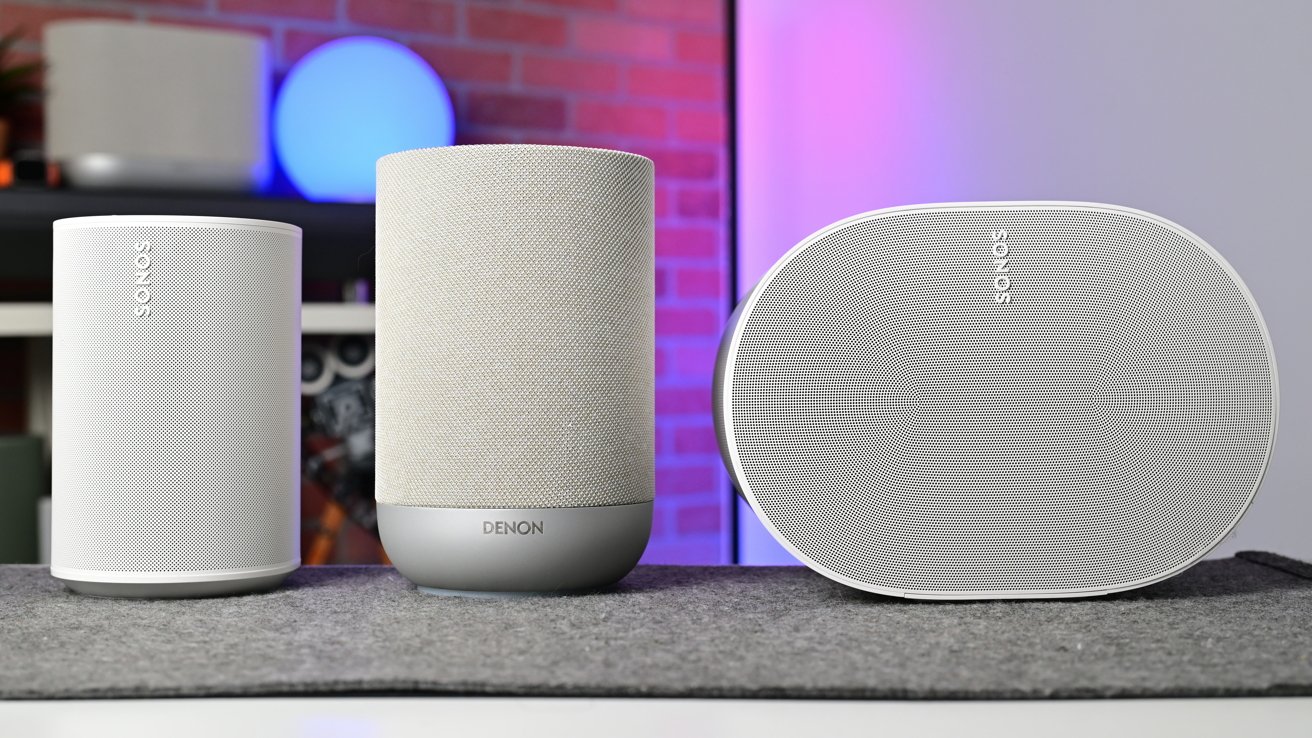
Three modern smart speakers on a gray surface, two Sonos speakers and one Denon, against a softly lit background with blue and pink hues and a blurred brick wall

Denon Home series speakers review: Comparing the Denon Home 200 against the Sonos Era 100 and Sonos Era 300

I’d also say that the Denon Home 200 sounds better than the Sonos Era 100, though there isn’t a perfect comparison to Sonos. This performance should be expected, given the significantly higher price tag of the Denon.

Personally, I even preferred the Denon Home 200 to the Sonos Era 300, to a degree. The Era 300 is larger and more expensive, but I think the Denon Home 200 has a warmer profile that I liked and has a smaller footprint.

Again, the comparison is tough. The Denon Home 200 lacks the upward-firing driver of the Sonos Era 300, but if you move to the Denon Home 400, it’s far more expensive, while being even bigger still.

Advertisement

Listening to “The Mountain Song” by Tophouse, I can very much feel the music build and swell with that full, wide sound. Similarly, “World’s Smallest Violin” by AJR has a ton of detail as the music morphs between musical instruments that make the song very cool to listen to.

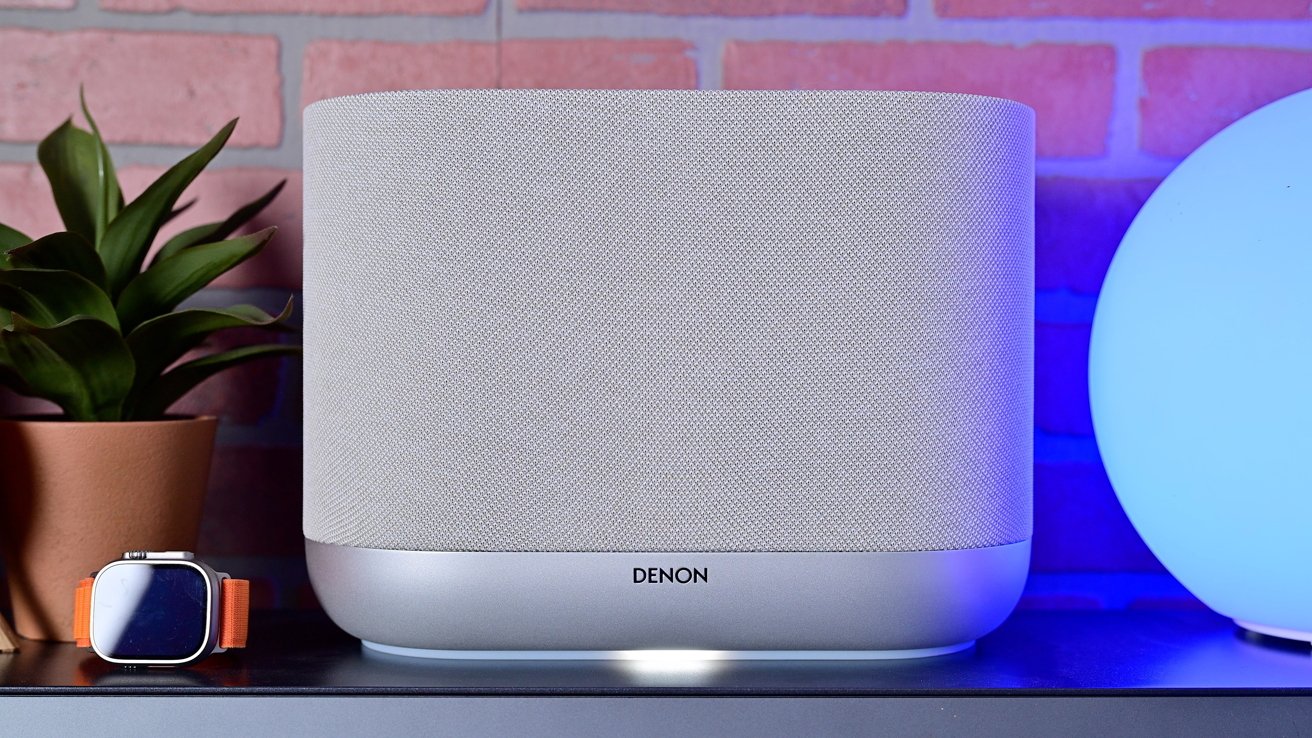
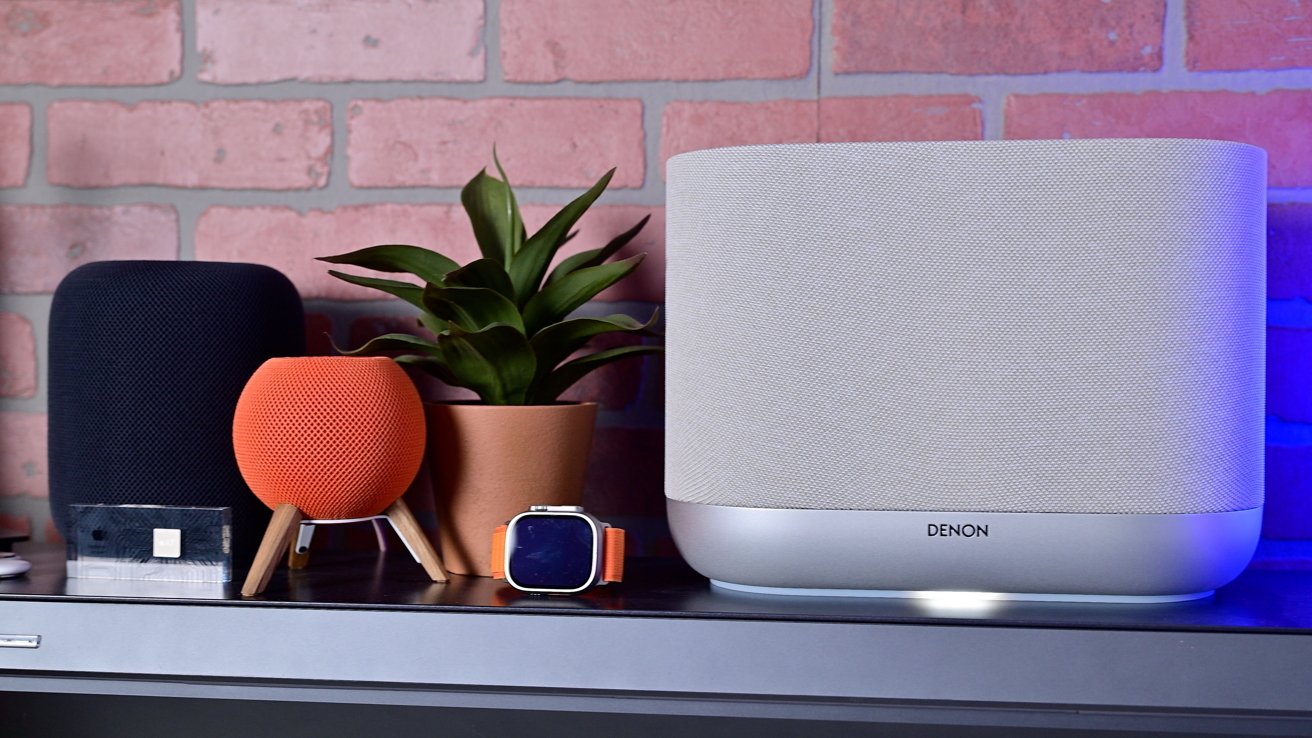
Modern Denon smart speaker on a shelf, flanked by a potted plant and a glowing orb lamp, with a smartwatch resting nearby against a pink brick wall backdrop

Denon Home series speakers review: Denon Home 400 on a shelf in my studio

Moving to the Denon Home 400, it has six total drivers. There are two outward-firing tweeters, dual 4.5-inch woofers, and two more upward-firing drives.

This one gets even louder and is overkill for any small to medium room. It has better stereo separation as well and a broader soundstage.

Advertisement

I can’t emphasize how much this can really fill out a room. Thinking about the Denon Home 600, that must be wild.

When I first started listening to the Denon Home 400, the most noticeable change was the bass. It was far more powerful, but still tightly controlled.

You can feel this bass in your chest before even having to turn up the volume. It was amazing.

Theoretically, the Denon Home 400 will provide more accurate Dolby Atmos Spatial Audio than the 200. I say theoretically because I wasn’t able to test it.

Advertisement
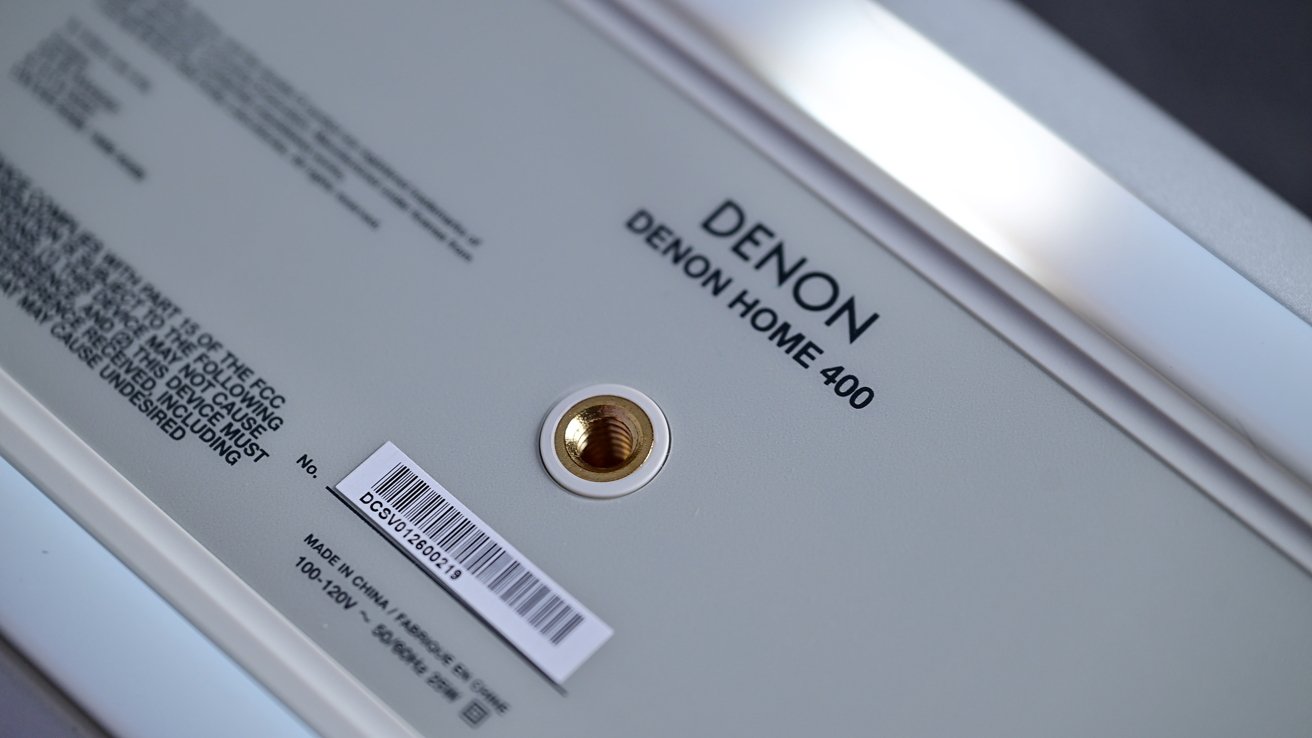
Close-up of the back panel of a Denon Home 400 speaker showing the brand name, model label, a central gold threaded mounting insert, and a small white barcode sticker

Denon Home series speakers review: The bottom of the speaker has a silicone foot and a thread for mounting on a traditional speaker stand or bracket

Currently, Dolby Atmos content is only supported when streaming directly from Tidal or Amazon Music Ultra HD. I don’t subscribe to either of these as an Apple Music listener.

Denon says it is working on Apple Music Dolby Atmos support, but there’s no promise on when that feature will be delivered.

Denon Home speakers review: Siri-ous audio quality for Apple users

In an increasingly competitive space, Denon has excelled here. I’m very pleased with the entire ecosystem.

Advertisement

The base model, while more expensive than a HomePod, has notably better audio quality. It also offers better on-device controls, multiple wired inputs, and still retains Siri support.

Smart speakers, a small orange speaker on wooden legs, a potted plant, and a smartwatch on a shelf against a red brick wall with soft blue accent lighting

Denon Home series speakers review: Denon Home 400 is an amazing-sounding premium speaker with Siri support

Moving up the lineup, users can choose the speaker that suits their environment, upgrading to the larger, more powerful, and louder models. If you ever found that HomePod wasn’t loud enough or the audio wasn’t good enough, there were zero alternatives that let you keep Siri.

While I’m a massive Sonos fan, the Denon Home 200, 400, and 600 offer more than competitive audio quality with native Apple features. As an Apple user, Denon is offering a better experience.

Advertisement

Small points are subtracted for having a HomePod as a requirement for a full experience, but that onus lies on Apple, not Denon. With so few alternatives here, Denon did the absolute best it was able to, all around.

Right now, I think Denon put out the best all around smart speaker, if you’re willing to pony up for superior sound. For Apple users, it’s the premium option to choose, at least while we wait for the possibility of a refreshed HomePod.

Denon Home speakers review: Pros

  • Sleek, premium, modern designs
  • Built-in Siri, and smart home features like doorbell chime, and intercom
  • Fantastic audio quality
  • Dolby Atmos support
  • Easy setup through Apple Home

Denon Home speakers review: Cons

  • Requires HomePod or HomePod mini for Siri
  • Somewhat expensive
  • No Dolby Atmos via Apple Music yet

Denon Home 200 & Denon Home 400 Rating: 4 out of 5 stars

Where to buy Denon Home 200 & Denon Home 400

The Denon Home 200 sells for $399 and can be ordered from Amazon and B&H Photo, while the Denon Home 400 retails for $599.

That model, which comes in your choice of Charcoal or Stone, can also be purchased at Amazon and B&H Photo.

Advertisement

The robust Denon 600, meanwhile, will run you $799 at Amazon and B&H.

Source link

Advertisement
Continue Reading

Trending

Copyright © 2025