

Crypto World
Exchanges Urge Congress to Block Ban on Risky Tokens, Report Finds


In early 2026, as the United States Senate weighs a comprehensive digital asset market structure bill, leading crypto exchanges pressed lawmakers to remove a provision that could hamper token listings. Politico reported that Coinbase, Kraken and Gemini asked lawmakers to excise language requiring trading platforms to offer only assets that are “not readily susceptible to manipulation.” The appeal underscores how industry stakeholders may influence drafting that governs listing standards, exchange compliance, and market integrity.
The reported intervention followed the US Senate Agriculture Committee’s January vote to advance its version of the bill, signaling that industry input is shaping legislative text even as committees refine policy details. Separately, Coinbase Chief Policy Officer Faryar Shirzad said on social channels that the issue was “old news” and had already been included in the committee’s markup, highlighting the persistent tensions around tokenized equities and other complex instruments.
Under the market-structure framework, known as the CLARITY Act after its partisan maneuvering, the Commodity Futures Trading Commission would gain enhanced authority to oversee digital assets. In March, both the CFTC and the Securities and Exchange Commission announced intentions to coordinate oversight of the crypto markets, denoting a pragmatic approach to regulation in the absence of a comprehensive congressional accord. This coordination would influence licensing, enforcement, and cross-agency policy harmonization as firms navigate a bifurcated regulatory landscape.
Industry and policymakers have also been exploring a path forward on related questions, including stablecoins. Reports of a compromise between crypto and banking representatives on stablecoin yield circulated last week, with some lawmakers signaling a push for ethics language addressing conflicts of interest as the bill advances through the banking committee. Meanwhile, observers have widely anticipated a markup in the banking committee in the near term, with projections that the legislation could reach floor consideration before the Senate recess in August. White House crypto adviser Patrick Witt indicated the administration’s objective of shepherding House passage around early July, contingent on a vote in the Senate in June.
For market participants, these developments carry significant regulatory and compliance implications. The proposed standard that assets be “not readily susceptible to manipulation” would tighten the criteria for listing, potentially constraining smaller or newer tokens and altering traditional exchange onboarding practices. The tension between investor protection and market access remains central to the debate, with industry voices warning that overly aggressive constraints could impair liquidity or hinder innovation, particularly in tokenized assets and new digital-asset classes.
Key takeaways
- Major exchanges reportedly urged lawmakers to remove a clause linking listing eligibility to manipulation-resistance, a change that could affect the breadth of tokens that exchanges feel comfortable listing.
- The CLARITY Act, passed by the House in July 2025, would expand CFTC authority over digital assets and push for closer regulatory coordination with the SEC.
- Regulators signaled ongoing coordination between the CFTC and SEC to supervise the crypto markets, a development with material implications for licensing, enforcement, and cross-border compliance.
- The Banking Committee appears poised to markup the bill soon, with some observers predicting passage before the August recess and a White House timeline targeting early July for House approval after a Senate vote.
- Industry–regulator dialogue on stablecoins and yields signals attention to risk frameworks, fiduciary standards, and potential conflicts of interest in governance and custody arrangements.
Policy architecture and oversight shifts under CLARITY Act
The proposed market-structure framework would reallocate regulatory authority toward the CFTC, enlarging its remit over digital assets that operate outside traditional securities or commodities regimes. In parallel, the agreement among regulators to coordinate oversight reflects a move away from siloed supervision toward a layered, cross-agency approach. For market infrastructure providers—exchanges, liquidity venues and token issuers—this coordination could shape requirements for registration, surveillance, AML/KYC controls, and ongoing reporting obligations.
From a compliance standpoint, the shift amplifies the importance of accurate asset classification, as enforcement actions could hinge on whether a given token falls within a commodity, a security, or a digital asset category with bespoke regulatory rules. Firms may need to align programmatic controls—transaction monitoring, risk assessments, and governance frameworks—with expectations that both the CFTC and SEC will monitor market integrity, disclosure, and conflict-of-interest risks. The prospect of tighter, harmonized oversight also raises questions about licensing pathways for new products and the pace at which firms must adapt their compliance tooling to accommodate dual- or cross-registrations.
Industry leverage, listing dynamics, and token risk
The contested provision on manipulation risk reveals a core tension in contemporary market structure debates: balancing investor protection with practical liquidity and innovation. If the requirement to list only manipulation-resistant assets remains in flux or is softened, exchanges could maintain a broader token catalog, including smaller-cap tokens that typically face higher liquidity and surveillance costs. Conversely, stricter standards could narrow the universe of admissible assets, affecting portfolio construction for institutional traders, market-making desks, and fund liquidity programs.
Beyond listing mechanics, the episode underscores how public policy within a highly technical sector depends on input from market participants. Coinbase’s public commentary around the bill’s wording signals that industry players are monitoring both text changes and the process by which committee marks shape final policy. For participants, this means heightened sensitivity to legislative text and the timing of committee actions, with compliance teams tracking changes that affect onboarding, risk categorization, and disclosure obligations tied to asset classes and product design.
Regulatory coordination, enforcement, and licensing implications
With the CFTC and SEC signaling coordinated oversight, firms face an enhanced expectation of consistent implementation across agencies. This alignment bears directly on licensing regimes, registration expectations, and ongoing compliance monitoring. Institutions may need to revisit risk governance frameworks to reflect potential shifts in enforcement priorities, particularly around asset classification, listing standards, and disclosures related to custody and settlement risk. In addition, the broader regulatory stance on stablecoins—an area under intense congressional and executive scrutiny—could influence banking relationships, as regulators assess reserves, liquidity management, and customer protections in stablecoin programs.
Cross-border considerations remain salient. The United States’ regulatory posture often interacts with international frameworks, including MiCA in the European Union and various national regimes. Institutions operating globally must map how U.S. rules interface with overseas jurisdictions, ensuring that policy alignment, risk controls, and reporting obligations satisfy multiple legal regimes while maintaining consistency in risk signaling and governance practices.
Timeline, negotiations, and governance signals
Market participants have tracked a signal-rich window as negotiations proceed. Reports of a compromise on stablecoin yields indicate ongoing sector-into-policy dialogue, with the aim of advancing the bill through the banking committee. While some lawmakers advocate adding ethics language to address conflicts of interest, others anticipate a relatively rapid passage timeline, potentially before the August recess. A White House adviser’s comments regarding a July 4 target for House passage, after a Senate vote in June, illustrate the administration’s eagerness to see a coordinated framework come into effect within a defined cycle. For compliance and risk teams, this translates into windows of opportunity for policy finalization and corresponding readiness testing across internal control systems and audit programs.
Closing perspective
As the United States contemplates a broader framework for digital-asset market structure, the interplay between legislative text, industry engagement, and regulator coordination will shape the pace and scope of enforcement, licensing, and risk management. Institutions should monitor committee marks, enforcement signals, and cross-agency guidance to calibrate listing policies, product design, and compliance programs for the evolving regulatory landscape.

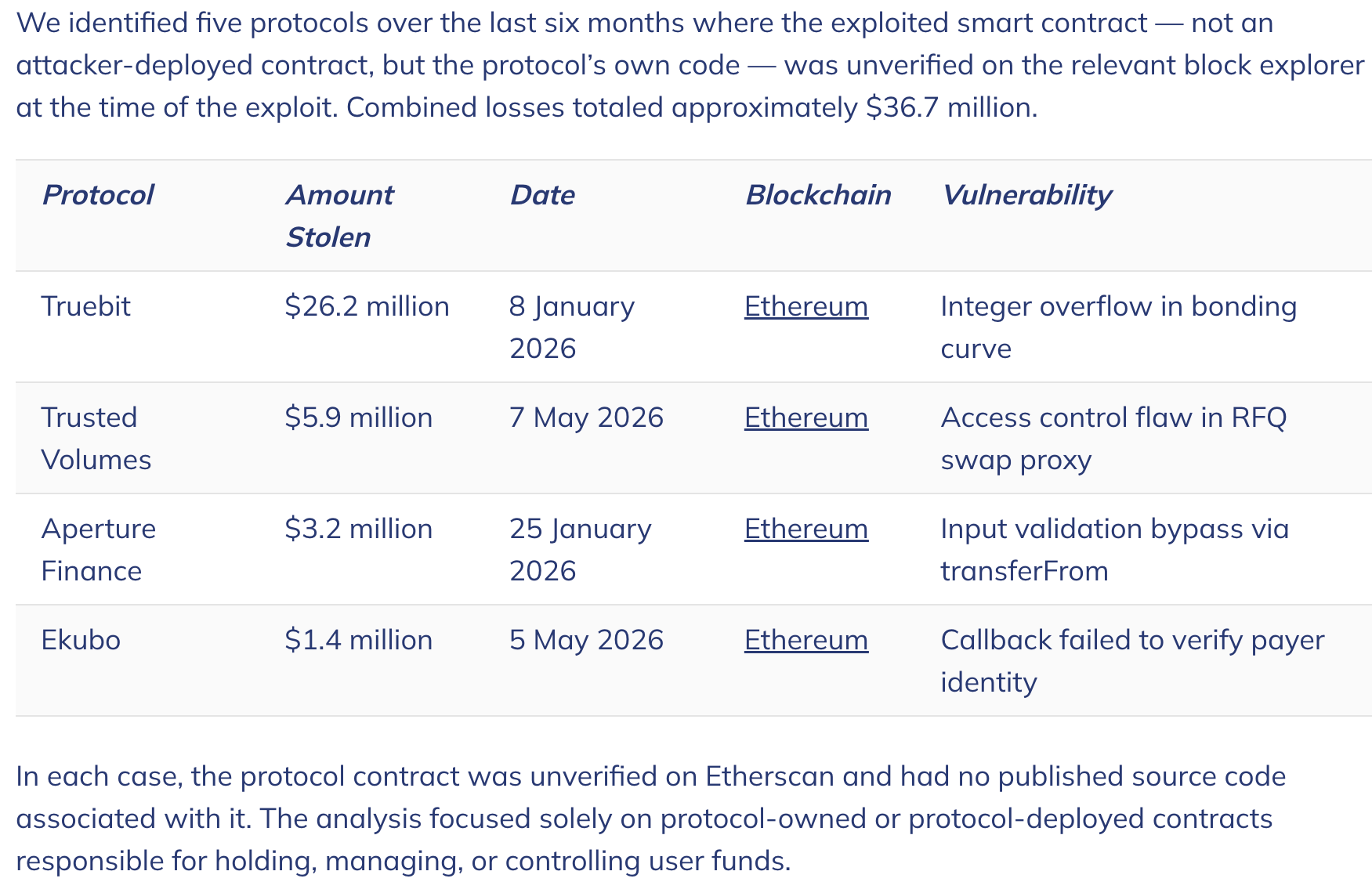
Unverified smart contracts were linked to at least $36.7 million in losses across four DeFi exploits over the past six months, as attackers increasingly target protocols whose source code is not publicly available, according to Chainalysis.
The largest incident involved Truebit, which lost $26.2 million after an attacker exploited an integer overflow vulnerability in a contract that had remained unverified on Ethereum since 2021. The other incidents involved Trusted Volumes, Aperture Finance and Ekubo, according to the report.
In each case, the exploited contract had not been verified on a blockchain explorer, meaning its source code was not publicly available for review. According to Chainalysis, that limited scrutiny from security researchers and excluded the contracts from many bug bounty programs despite controlling user funds.
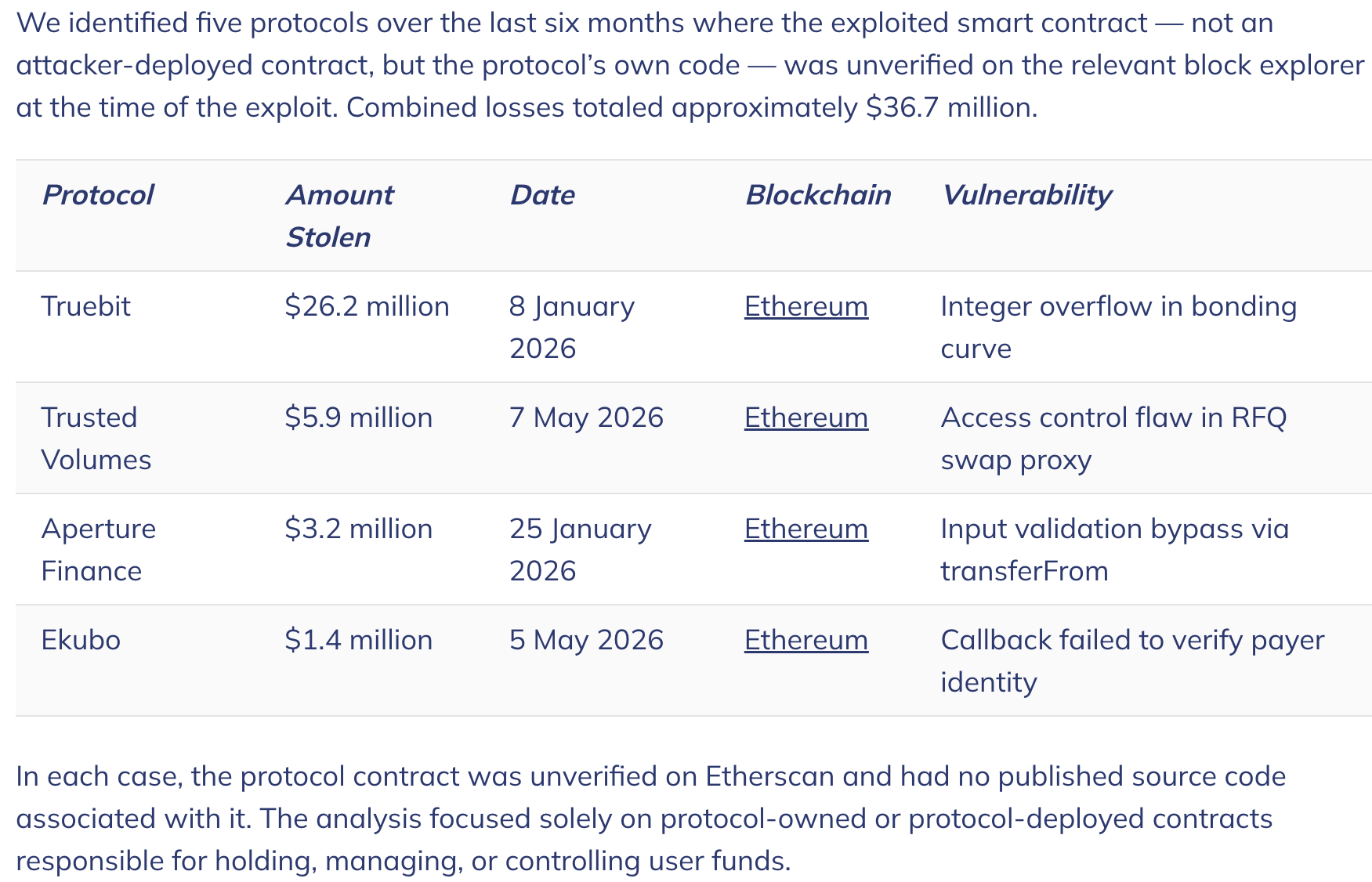
Five protocols saw exploits on unverified smart contracts. Source: Chainalysis
Chainalysis attributed the trend in part to advances in decompilation tools and artificial intelligence, which can help attackers reverse-engineer smart contract bytecode and identify vulnerabilities even when source code is not publicly available. According to the report, what once required “a skilled reverse engineer spending days on a single contract” can now be partially automated across large numbers of unverified contracts.
The report challenges a longstanding assumption in DeFi that keeping smart contract code private provides an additional layer of security. According to Chainalysis, protocols relying on hidden code are increasingly depending on “obscurity as a security measure,” an approach the company said is rapidly losing effectiveness.
Chainalysis recommended source code verification, broader bug bounty coverage and real-time monitoring tools as safeguards against future exploits.
Related: Humanity Protocol token falls 85% amid $30M private key exploit
DeFi security concerns persist after record April losses
The report comes amid a broader rise in crypto exploits. According to DeFiLlama, hackers stole $629.7 million in April alone, the highest monthly total since February 2025.
Two incidents accounted for most of the losses. KelpDAO lost $293 million and Drift Protocol suffered a $280 million exploit, together representing more than 80% of the month’s stolen funds.
Although losses fell sharply in May, with CertiK reporting $68.3 million stolen from cryptocurrency exploits, the fallout from April’s largest attacks continued. In June, blockchain intelligence platform Arkham reported that the attacker behind the KelpDAO exploit had laundered nearly all of the roughly $220 million in unfrozen stolen funds.
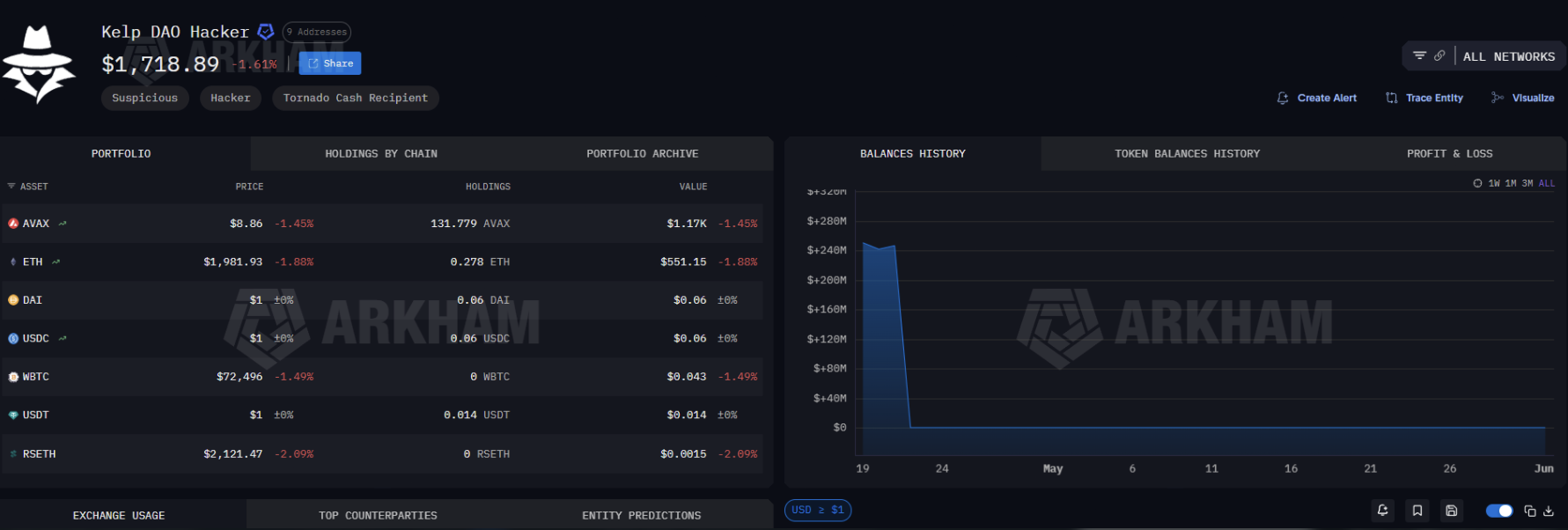
Kelp DAO Hacker-tagged wallet, total balance. Source: Arkham
The KelpDAO exploit also prompted several DeFi protocols to review their security infrastructure, with projects including Solv Protocol announcing plans to migrate to Chainlink’s crosschain infrastructure following internal security reviews.
This month, Anthropic said 560 of the 832 accounts it banned for policy violations over a one-year period had used AI to help prepare cyberattacks, including writing malware and identifying vulnerabilities.
Magazine: The legal battle over who can claim DeFi’s stolen millions
The United Kingdom’s decision to sanction HTX, the exchange operated by Huobi Global’s Panamanian affiliate, has sparked debate across the crypto industry about the collateral damage sanctions can unleash on legitimate users and the broader DeFi compliance ecosystem. While authorities argue the move targets Russia-linked financial networks, researchers and on-chain investigators say the blanket approach may blur lines between illicit and ordinary activity and complicate decentralized tracing efforts.
Key takeaways
- The UK added HTX (Huobi Global S.A.’s entity behind HTX) to sanctions, citing indications of support for Russia’s government through sanctioned entities A7 and Garantex. The step broadens the choke point for HTX’s operations.
- Industry observers argue the designation risks penalizing ordinary users and could undermine long-running efforts to promote on-chain compliance in DeFi, especially around illicit-fund tracing.
- A Global Ledger analysis, cited by industry coverage, tallies HTX as processing about $21.06 billion in high-risk crypto flows from 2021 through May 2026, with roughly $7.64 billion connected to Russian-linked entities and darknet markets.
- Downstream effects have surfaced, including a DeFi project freezing HTX-linked addresses and HTX itself delisting a rival’s USD1 stablecoin and halting several trading pairs.
Regulatory action and its immediate implications
On May 26, the UK government sanctioned Huobi Global S.A., the Panamanian entity behind the HTX exchange, in connection with alleged support for Russia’s government through certain financial services and funds attributed to sanctioned entities such as A7 Limited Liability Company and Garantex. The sanctions connect HTX to a broader framework aimed at curbing Russia-related financial activity and signals the UK’s willingness to pursue cross-jurisdictional enforcement in crypto markets.
HTX has subsequently denied the allegations, emphasizing that the sanctioned entity is a separate corporate vehicle from the online exchange. The dispute highlights a frequent tension in crypto policy: where to draw the line between a platform and the corporate entities behind it, and how to apply sanctions without unduly penalizing users who may have legitimate activity on the platform.
The move also dovetails with a string of UK regulatory actions targeting crypto promotions and exchange operators, raising questions about how different arms of government—policy, enforcement, and sanctions—interact in crypto markets. For context, UK authorities have previously pursued actions against HTX’s parent or affiliates alongside other sanctions measures against Huobi-linked entities.
Data-driven debates over the efficacy and consequences of such sanctions have intensified. In one analysis cited by researchers and journalists, HTX’s on-chain activity is described as having included substantial high-risk flows in the period 2021 through May 2026. While the total volume remains subject to ongoing verification, a sector-wide review has flagged notable Russian-linked flows and activity tied to known darknet markets.
Voices from the research and security community
Several prominent researchers and on-chain investigators weighed in on the implications for enforcement and compliance practices. Galaxy Digital’s head of research, Alex Thorn, argued on X that classifying “all of HTX” under sanctions could be problematic given the platform’s broad user base and the privacy-preserving nature of DeFi tools. Thorn pointed to the divergent practices among stablecoin issuers when it comes to freezing or restricting tokens, suggesting that blanket sanctions may not align with how different protocols assess risk and compliance.
Security researcher Taylor Monahan, also posting on X, contended that sweeping sanctions against HTX risk undermining established efforts to coordinate DeFi safeguards against stolen or illicit funds. Monahan emphasized that a majority of HTX users are legitimate and should not be penalized by association alone.
Crypto investigator ZachXBT added a pointed critique, describing the sanctions as an overreach and noting that on-chain tainting of HTX addresses could undermine tracing work essential to risk management. He warned that when risk categories become too broad, the practical value of tracing decreases, potentially hampering legitimate investigations and compliance workflows.
These perspectives underscore a broader industry concern: sanctions can blur the distinction between malicious actors and ordinary users, complicating the use of on-chain analytics as a risk-management tool and potentially driving legitimate activity underground or toward less-regulated alternatives.
For context, the discourse follows UK sanctions against Huobi Global S.A. in connection with HTX, linked to allegations of Russia-related support via intermediaries such as A7 and Garantex. The industry’s response reflects a tension between national security aims and the practical realities of operating in a decentralized, borderless financial system.
On-chain impact and downstream signaling
Beyond policy debates, the sanctions have produced observable downstream effects. A DeFi project—World Liberty Financial, associated with Trump-linked activity—responded to sanctions considerations by freezing HTX-linked addresses as part of its compliance checks. HTX then delisted this project’s USD1 stablecoin and suspended several trading pairs, signaling how sanction regimes can trigger rapid reconfigurations across the interconnected DeFi landscape.
The sanctioning itself has drawn attention to the broader question of how on-chain enforcement evolves when large, cross-border platforms are implicated. A Global Ledger report highlighted in industry coverage points to HTX processing approximately $21.06 billion in high-risk crypto flows from 2021 through May 2026, with at least $7.64 billion tied to Russian high-risk entities and darknet markets (including Garantex, its successor Grinex, A7A5 and Hydra). While such figures are contentious and subject to methodological caveats, they illustrate the scale of activity that regulators and policymakers are attempting to influence through targeted measures.
Critics argue that while sanctions aim to disrupt illicit networks, the on-chain consequences for legitimate users—ranging from freezing funds to tainting addresses—could complicate normal trading and risk management, potentially driving activity toward less transparent venues. The tension between enforcement objectives and practical usability for compliant users remains a focal point for investors, developers, and exchanges contemplating risk controls and due diligence standards.
What this means for the market and future policy
For investors and builders, the UK HTX action serves as a reminder that regulatory risk remains a material factor in cross-border exchange activity. Sanctions can rapidly alter the operational landscape, including how on-chain analytics are used for compliance and how counterparties assess risk in real time. The responses from researchers also illustrate that enforcement choices may shape how protocols implement sanctions screening, how they coordinate with cross-border regulators, and how they design governance around asset lists and blacklists in a decentralized environment.
Looking ahead, market participants will be watching whether the sanctions regime surrounding HTX prompts additional, more precise guidance on which entities and activities are targeted and how due process is applied. Questions remain about the consistency of enforcement across jurisdictions and the degree to which sanctions risk can be anticipated by exchanges, wallets, and DeFi protocols that rely on open, permissionless on-chain activity. Additionally, observers will be watching to see whether sanctioned entities refocus their strategies, whether more sanctions-linked data becomes publicly accessible, and how institutional risk tooling adapts to evolving regulatory expectations.
In sum, the HTX sanctions illuminate a pivotal moment in crypto policy: authorities aim to curb support to malign networks, but the path forward will require careful calibration to protect legitimate users and maintain the integrity of on-chain ecosystems that rely on transparent, auditable flows of funds.
Readers should monitor ongoing regulatory updates, industry responses from compliance teams, and the evolution of on-chain tracing practices as the sector navigates this complex, high-stakes landscape.


Tata Consultancy Services expects to operate as many AI agents as human employees over the next three years, Chairman N Chandrasekaran said. The company will not cut staff but will slow hiring as AI absorbs more work.
The shift extends beyond technology services. Companies are deploying AI agents to do work once handled by humans, slowing hiring and reshaping how entire industries staff their operations.
AI Agents Reshape India’s IT Workforce
Chandrasekaran made the remarks at the company’s annual general meeting on Tuesday. He said that wider adoption of AI agents will reduce hiring at TCS and across the industry as automated systems take over human tasks.
“I predict that over the next 3 years, TCS will have as many AI agents as human employees. What we build in this next chapter – for our clients, for India, and for you – will be the most consequential work this company has ever done,” he said.
The company does not plan to cut staff but will hire fewer. Even so, Chandrasekaran said new roles and openings will emerge as firms reshape how they work with AI.
“Some of the work being done will go to AI agents. That will be the nature of the transition that we have to go through not only as a company, as an industry, and as a country,” he added.
Notably, India’s $315 billion IT sector built its success on sprawling, people-heavy teams. As one of the country’s biggest private employers, the industry has already pared back hiring, with geopolitical turbulence further weakening client demand.
TCS is India’s largest IT firm by market value and headcount. The company cut more than 12,000 jobs last July. Net headcount fell by over 23,000 in the fiscal year ended March 2026.
Follow us on X to get the latest news as it happens
Hedge Funds Follow the Same Playbook
Meanwhile, finance is moving in parallel. According to Bloomberg, Magnetar, the $18 billion hedge fund, will deploy AI bots to scour markets for ideas, analyze stocks, make recommendations, and forecast trends in its newest vehicle. Humans will retain final say on trades.
The workforce shift is also surfacing in employment figures. AI has been cited as a reason for 87,714 job losses this year, accounting for 22% of all layoffs in 2026. That figure already tops the 54,836 roles the technology displaced throughout 2025.
Layoffs.fyi, which tracks tech job cuts, has logged 117,571 tech employees laid off across 175 companies so far in 2026. Whether AI-staffed funds can beat the market remains an open test. Meanwhile, TCS’s agent buildout will show how far the hybrid model scales across industries.
Subscribe to our YouTube channel to watch leaders and journalists provide expert insights
The post India’s IT Sector Braces for Slower Hiring in AI Era appeared first on BeInCrypto.
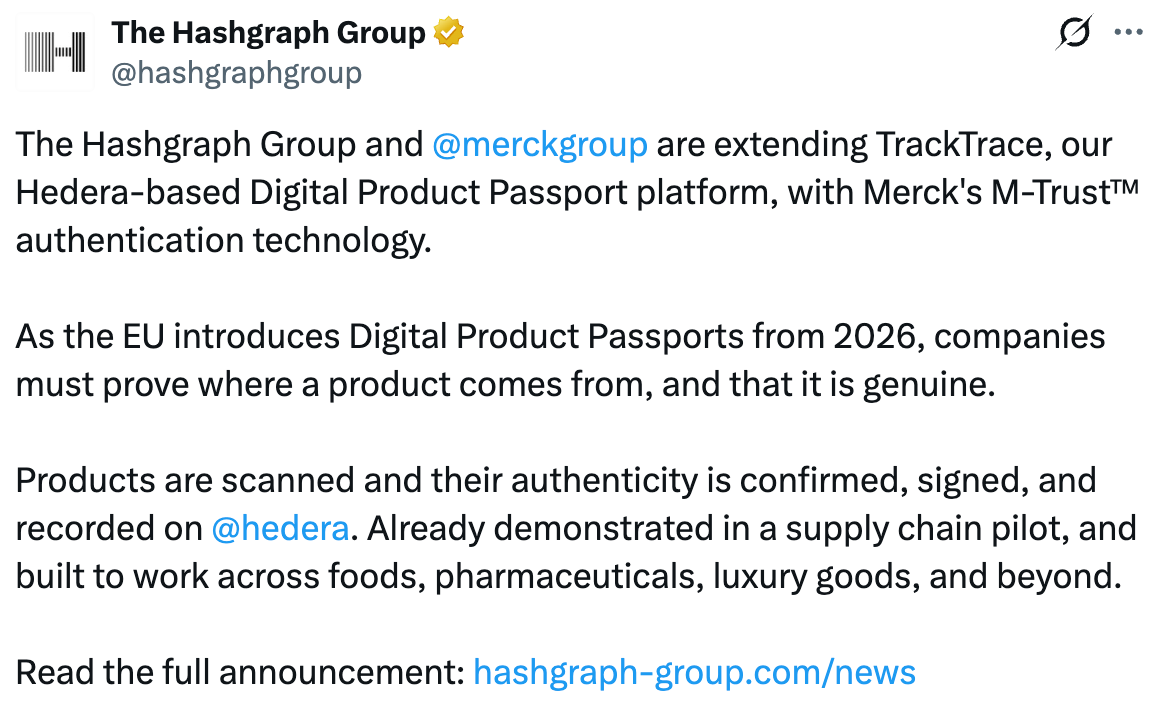
The Hashgraph Group and Merck have integrated the German tech maker’s product authentication technology with TrackTrace, a Hedera-based digital product passport platform introduced in February, as businesses seek to comply with new European Union supply-chain transparency and traceability requirements.
Under the arrangement, Merck’s M-Trust technology embeds security markers into products and packaging that can be verified with a handheld scanner. Authentication data is then recorded on The Hashgraph Group’s TrackTrace platform, creating a digital record linked to a product’s Digital Product Passport.
The companies said the integration combines physical product authentication with blockchain-based traceability, allowing businesses to verify both the authenticity of a product and the records associated with it.
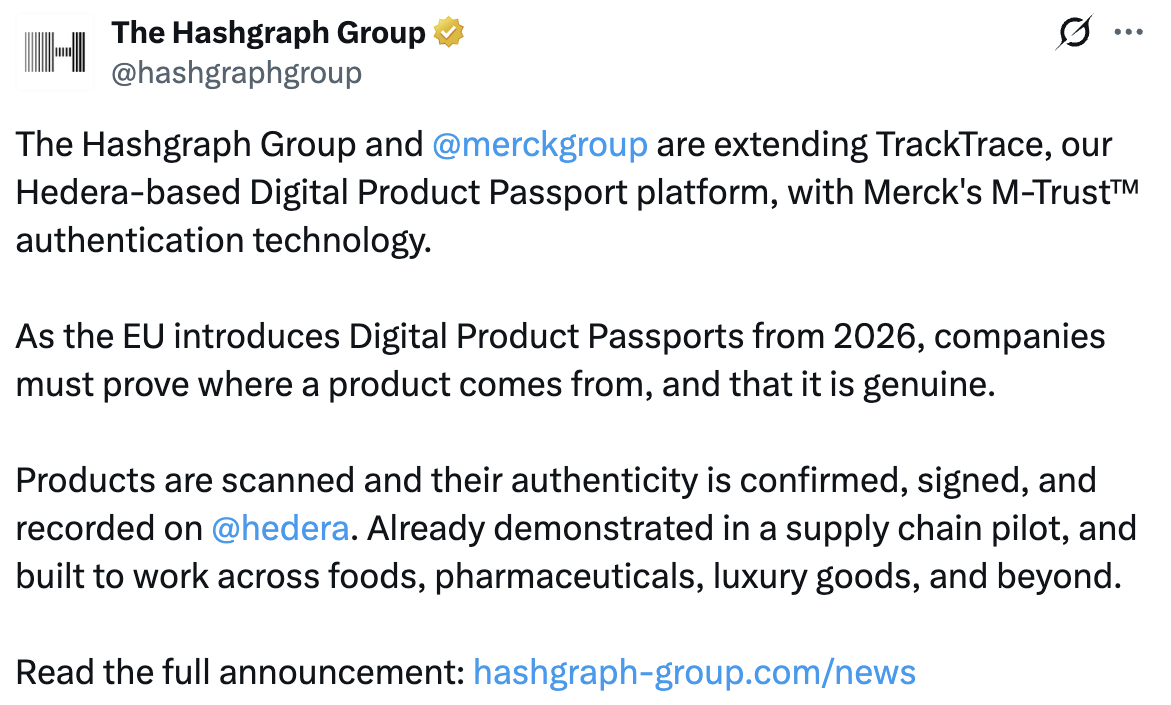
Source: The Hashgraph Group on X.com
The platform targets two emerging EU compliance frameworks: Digital Product Passports under the Ecodesign for Sustainable Products Regulation and traceability requirements under the EU Deforestation Regulation.
Merck is a science and technology company focused on healthcare, life sciences and electronics, while Swiss-based Hashgraph develops enterprise blockchain and AI applications within the Hedera ecosystem.
According to the companies, the technology has already been demonstrated in an undisclosed supply-chain pilot. Potential use cases include food, pharmaceutical, luxury goods and electronics supply chains, where businesses face increasing scrutiny over sourcing and product authenticity.
Related: ECB pushes back on euro stablecoin proposals, citing financial stability risks
EU sustainability rules create market for product traceability
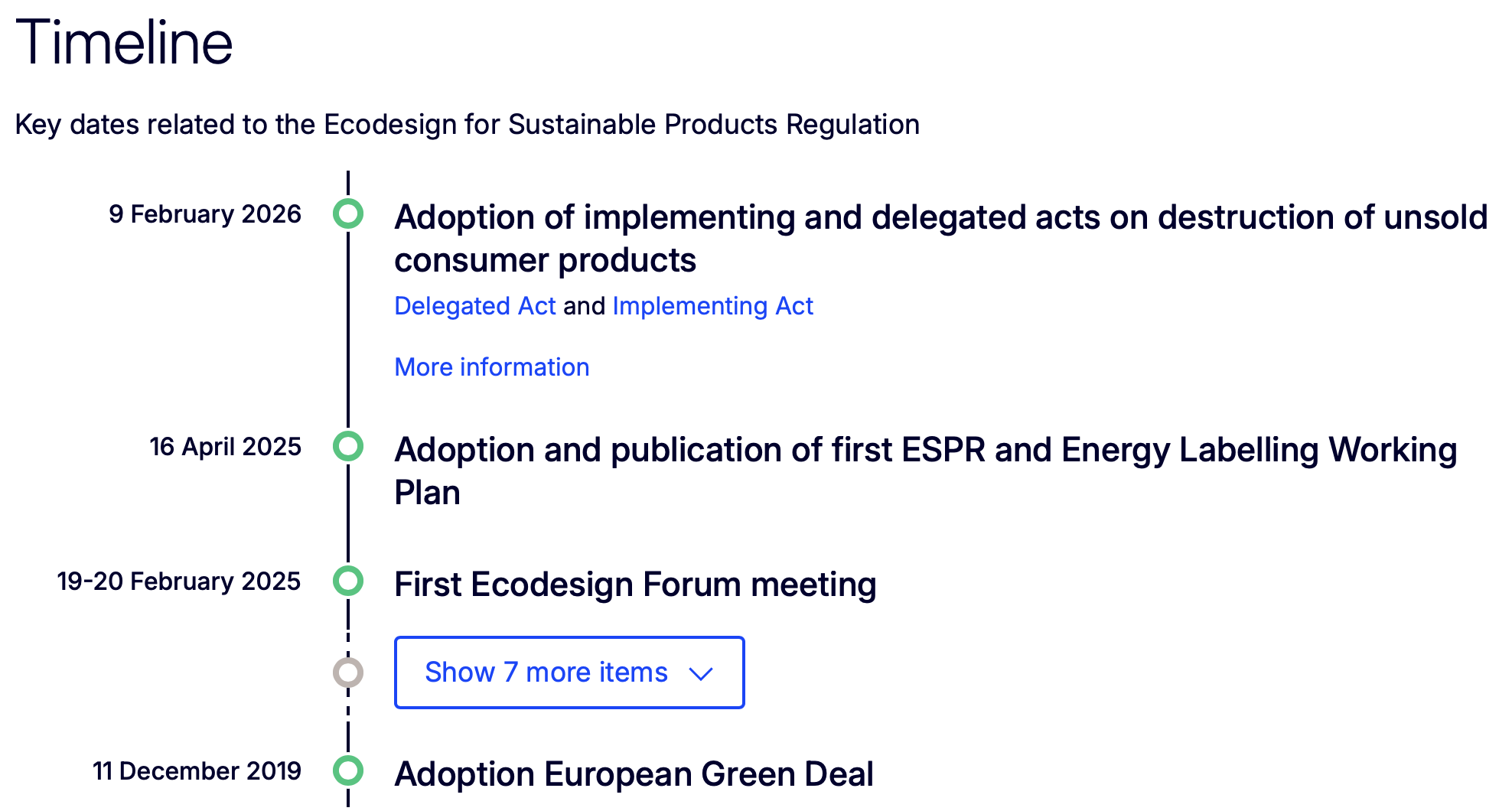
The collaboration comes as companies prepare for forthcoming Digital Product Passport requirements under the European Union’s Ecodesign for Sustainable Products Regulation (ESPR), which entered into force in July 2024.
The regulation applies to most physical goods sold in the EU and forms part of the European Green Deal, a broader effort to improve resource efficiency, expand the circular economy and increase transparency around product environmental impacts.
Source: European Commission
Interest in blockchain-based trade and supply-chain infrastructure extends beyond the EU. In March, authorities in Hong Kong and Shanghai agreed to study a blockchain-based cross-border platform under the Hong Kong Monetary Authority’s Project Ensemble initiative, which explores tokenized market infrastructure and digital financial rails.
The project will examine how trade documentation and commercial data can be integrated into trade finance applications, with the goal of streamlining cross-border commerce and related financial services.
Magazine: Vietnam preps crypto pilot, HK pushes tokenization: Asia Express


StarkWare has launched a new privacy framework for Starknet tokens that allows users to conceal balances and transaction details while preserving tools for compliance reviews and regulatory disclosures.
Summary
- StarkWare launched STRK20, a Starknet privacy standard that hides balances and transaction data while allowing disclosures for compliance reviews.
- Sui opened public testing for confidential transfers that conceal balances and transfer amounts but keep key transaction metadata visible.
- Recent developments at Zama and Zcash have increased attention on privacy systems that combine confidentiality with auditability.
According to StarkWare, the newly released STRK20 standard brings privacy features to ERC-20 tokens on Starknet by enabling users to shield balances and transaction information on-chain.
The framework was announced on Tuesday as developers across the crypto industry continue looking for ways to offer transaction privacy without removing oversight mechanisms relied upon by institutions, exchanges, and regulators.
STRK20s is officially live.
Practical privacy for all assets, accessible in one click, with deep DeFi integration.
We’re fixing onchain privacy for good, and for everyone. https://t.co/5eEG011zBz
— StarkWare 🥷 (@StarkWareLtd) June 9, 2026
Providing details on how the system works, StarkWare co-founder and CEO Eli Ben-Sasson notes that STRK20 should not be viewed as a guarantee of regulatory approval or legal compliance. Instead, he said the framework follows a risk-based approach where privacy remains conditional.
Ben-Sasson explained that screening occurs before assets enter shielded pools and that viewing-key technology can be used to disclose information when lawful requests require access.
Unlike traditional privacy-focused cryptocurrencies that seek to obscure most transaction data, STRK20 introduces disclosure tools designed to balance confidentiality with accountability.
Under the model described by StarkWare, transaction details remain hidden from the public while authorized disclosure remains possible under specific circumstances.
Privacy tools are adding disclosure mechanisms
Elsewhere in the sector, developers are adopting similar approaches to encrypted transactions. According to an announcement published on June 8, Sui opened public testing for confidential transfers on its Devnet. The feature encrypts token balances and transfer amounts while leaving sender and recipient addresses, token types, and transaction timestamps visible on-chain.
As reported by crypto.news, Sui stated that authorized parties can access relevant data when required for auditing or compliance purposes. A Testnet rollout is scheduled for later this year.
Rather than removing transparency entirely, the Sui design keeps selected transaction information visible while concealing financial details. The network described the system as a way to support privacy requirements without limiting access for compliance teams and auditors.
Taken together, the launches from StarkWare and Sui highlight how blockchain developers are increasingly incorporating controlled disclosure features into privacy products instead of relying on complete anonymity.
Recent events have increased focus on oversight
At the same time, several privacy-focused projects have recently faced scrutiny over compliance and operational safeguards.
Earlier this month, blockchain privacy company Zama said it would speed up work on its compliance roadmap after approximately $12.5 million in USDC held within its confidential USDC wrapper was frozen under a court order. According to Zama, the restriction was later removed once the underlying legal request was resolved.
Following the incident, the company highlighted disclosure tools and regulatory coordination procedures available for encrypted transactions.
Meanwhile, developers behind Zcash recently disclosed a vulnerability that raised concerns about the possible creation of counterfeit tokens. According to the project, an emergency network upgrade completed in early June addressed the issue, and no evidence of exploitation has been found.
Zcash developers noted that reconstructing historical activity inside shielded pools can be difficult after vulnerabilities are disclosed, a limitation that has renewed discussion around how privacy systems can provide confidentiality while still supporting verification and oversight when needed.
On-chain analytics firm Glassnode has reported a sharp deterioration in key XRP network metrics, pointing to weakening activity and mounting pressure on holders. Recent data shows both transaction demand and realized profitability have fallen significantly despite the token trading well above its 2024 levels.
The decline in holder profitability is particularly evident in Glassnode’s latest realized profit-and-loss data. According to the firm, the 90-day simple moving average of XRP’s Realized Profit-to-Loss Ratio has dropped to 0.38. This indicates that market participants are realizing only 38 cents in profits for every dollar of losses recorded on-chain.
Profitability Ratio Signals Deep Stress
The profitability metric remains well below the breakeven level of 1.0, a threshold that separates net profit-taking from net loss realization. During strong bull market phases, the ratio often rises far above 20 or even 50 as profitable selling dominates network activity.
The latest reading suggests a very different market environment, with loss-taking outweighing profit-taking by a wide margin. The analytics firm noted that such low levels are commonly associated with capitulation periods. In these phases, a large share of transacted coins belong to holders exiting positions at a loss.
Signs of weakness are also emerging in broader network activity. Glassnode reported that the 90-day simple moving average of total transaction fees on the XRP Ledger has fallen significantly. It dropped from 5,900 XRP in February 2025 to approximately 500 XRP today, a decline of more than 91% over the period.
Ecosystem Under Persistent Pressure
The recent figures reinforce concerns highlighted by Glassnode in late 2025 regarding the condition of XRP holders. In November of that year, the firm reported that only 58.5% of the circulating supply remained in profit.
Those concerns were reflected in earlier market conditions. That figure marked the lowest percentage recorded since November 2024, when XRP traded near $0.53. At the time, roughly 41.5% of the supply, equivalent to about 26.5 billion XRP, was held at a loss despite the token trading around $2.15.
Together, the declining profitability metrics and reduced network activity suggest continued stress across the XRP ecosystem. The data indicates that a significant portion of holders remain under pressure while transaction demand stays well below previous cycle highs.
The post XRP Activity and Investor Capitulation Hit Extremes: What It Means for Ripple appeared first on CryptoPotato.


Morpho Association has raised $175 million in a funding round co-led by Paradigm, a16z Crypto, and Ribbit Capital, the protocol announced on X Tuesday morning. The financing comes at a $2 billion valuation and ranks among the largest fundraises in decentralized finance to date, according to… Read the full story at The Defiant

TLDR
- Paradigm and Hyperliquid Policy Center urged the U.S. Treasury to revise the proposed AML rule for stablecoin issuers.
- The groups argued that secondary market liability would impose obligations issuers cannot control.
- They supported FinCEN’s focus on primary market compliance where issuers know their customers.
- The letter asked regulators to narrow the definition of stablecoin payment-related activity.
- Hyperliquid Foundation funded the advocacy group with about $29 million worth of HYPE tokens.
Paradigm and Hyperliquid Policy Center urged the U.S. Treasury to revise a proposed anti-money laundering rule. The groups said the draft would impose strict liability on stablecoin issuers for transactions they cannot control. They asked regulators to narrow certain provisions before finalizing implementation under the GENIUS Act.
Hyperliquid and Paradigm Outline Concerns Over Secondary Market Liability
Paradigm and Hyperliquid Policy Center submitted a joint letter to the Treasury on Tuesday. The letter addressed a proposal issued in April by FinCEN and OFAC. The agencies seek to implement GENIUS Act provisions under the Bank Secrecy Act.
The proposal would treat stablecoin issuers as financial institutions for compliance purposes. However, the groups said some obligations extend beyond primary market activity. They argued that secondary market rules would create strict liability for actions issuers cannot police.
The letter stated, “We broadly support the proposed rule,” and endorsed FinCEN’s focus on primary market compliance. The groups supported tailoring obligations where issuers know their customers. They urged agencies to clarify or narrow secondary market requirements.
They said issuers only see wallet addresses and transaction amounts in public blockchain environments. Therefore, they argued that agencies should align AML and sanctions requirements with that reality. They warned that smart contract liability would exceed issuer control.
They wrote, “An issuer facing obligations it cannot meet on the secondary market has a strong incentive to deploy only to permissioned environments.”
They added that such an outcome would remove U.S.-regulated stablecoins from DeFi platforms. They stated that offshore alternatives could fill any resulting gap.
Groups Propose Specific Revisions Under GENIUS Act Framework
The joint letter recommended narrowing the definition of “payment stablecoin-related activity.” The groups also asked regulators to reconsider OFAC’s treatment of smart contract interactions. They said the current draft extends liability beyond issuer capacity.
The GENIUS Act passed last year with support from President Donald Trump’s administration. Lawmakers advanced the legislation to provide clearer rules for digital assets. Regulators now work through the rulemaking phase before full implementation.
Hyperliquid Foundation established the Hyperliquid Policy Center in February. The foundation funded the group with roughly $29 million worth of HYPE tokens. Jake Chervinsky serves as the center’s chief executive officer.
Paradigm backed Hyperliquid and supported the center’s advocacy efforts. The venture firm co-signed the letter addressed to Treasury officials. The document forms part of the public comment process.
FinCEN and OFAC will review submitted comments before issuing a final rule. The agencies proposed the draft in April under existing statutory authority. The implementation phase continues as regulators evaluate industry feedback.



Sam Bankman-Fried, the convicted founder of the collapsed crypto exchange FTX, has formally filed a petition for a presidential pardon with the Trump White House, his attorney confirmed to CNBC and Fox Business on Monday. The petition was filed with the Office of the Pardon Attorney, a division of… Read the full story at The Defiant
Crypto World
US Bitcoin Reserve Bill Text Locks Holdings for 20 Years and Mandates Quarterly Proof-of-Reserve Reports


The full legislative text of a bill to codify a US Strategic Bitcoin Reserve is now public on Congress.gov, revealing a mandatory 20-year prohibition on selling any acquired BTC and a requirement for quarterly, publicly audited proof-of-reserve reports. Rep. Nick Begich (R-AK) introduced H.R. 8957,… Read the full story at The Defiant

FCC Wants To Kill Burner Phones By Forcing Telecoms To Get All Customers’ IDs

Trent Alexander-Arnold to Arsenal transfer theory emerges as Liverpool return shot down

MLV Real Estate consolidates brands



-

 Fashion4 days ago
Weekend Open Thread: Evereve – Corporette.com
-
 Crypto World5 days ago
Jensen Huang Approves Samsung, SK Hynix, and Micron for NVIDIA (NVDA) HBM4 Memory Supply
-

 Crypto World2 days ago
Anatomy of the June crypto crash: Fed, Iran, Saylor
-
Crypto World3 days ago
Senator Cynthia Lummis Calls CLARITY Act the Most Consequential Financial Legislation of This Generation
-

 NewsBeat2 days ago
Alexander Zverev wins the French Open to finally earn a 1st Grand Slam title
-

 Tech5 days ago
Microsoft launches MXC, an OS-level sandbox for AI agents, with OpenAI and Nvidia already on board
-
 Entertainment3 days ago
The Best Mystery Series of All Time Is Surging on Streaming 30 Years After It Ended
-
 Business3 days ago
The Pain Points Taking a Fragile Tech Rally Down a Notch
-

 Tech3 days ago
Microsoft unveils seven homegrown AI models in new bid for ‘long term self-sufficiency’
-

 Tech4 days ago
Suspicious Polyfill login prompts pop up on Toshiba, Muji websites
-
Crypto World5 days ago
LBank Surpasses 25 Million Users Worldwide as AFA Partnership Continues to Drive Global Growth
-

 Crypto World3 days ago
Trump’s AI Ownership Plan Could Benefit Anthropic at OpenAI’s Expense
-

 Business5 days ago
(VIDEO) Justin Bieber Delivers Surprise Happy Birthday Serenade to Diners at Los Angeles Mexican Restaurant
-
 Sports12 hours ago
Bangladesh beat Australia after 20 years in ODIs, register only their second win over six-time world champions | Cricket News
-

 Tech5 days ago
RCS Messages Between iPhone and Android Get End-to-End Encryption With iOS 26.5
-

 Tech5 days ago
Meta steals a tactic from Tesla and builds data centers in tents
-
 Crypto World2 days ago
Eli Lilly (LLY) Stock Surges 4% Following Breakthrough Sleep Apnea Trial Results
-

 Tech4 days ago
Hackers now exploit SolarWinds Serv-U flaw to crash servers
-

 Tech4 days ago
Von der Leyen’s AI envoy pick draws conflict-of-interest fire
-

 Business2 days ago
Wall Street ends sharply lower as chips stocks slide
You must be logged in to post a comment Login