Tech
FiiO BTR17 Review: High End DAC Chips, Balanced Output, and Deep EQ in Your Pocket?

FiiO’s product pipeline has been relentless. Over the past two years, the company has introduced a few dozen new models spanning portable DACs, Bluetooth amplifiers, IEMs, headphones, desktop gear, and now increasingly innovative home audio components. Some have been clear hits. Others have felt like experiments in a very crowded field. That is the reality when a brand moves this fast.
The $199 FiiO BTR17, launched in late 2024 as a portable Bluetooth DAC and headphone amplifier, arrived during the early phase of this surge. At the time, it drew rave reviews and strong word of mouth. Now in 2026, it is no longer the newest device in the lineup, but it may be one of the most durable and worthwhile.
Behind the scenes, it is clear that FiiO has no intention of slowing down. What we have seen offline suggests that 2026 and 2027 will bring even more ambitious desktop and home audio components that push the brand further upmarket. Against that backdrop, the BTR17 stands out as one of the earlier releases from this cycle and possibly one of the most complete.
In a market overflowing with portable DAC and amplifier options between $99 and $299, the question is simple. Is the BTR17 still relevant in 2026, and was it quietly one of FiiO’s best moves during this recent run?


Specifications & Technology
Let’s start where it actually matters with the BTR17: the DAC and the amplification stage.
Digital to analogue conversion is handled by a pair of ESS Sabre ES9069Q chips. On paper, they are serious performers, rated at up to 130 dB dynamic range with THD plus noise hovering around -120 dB, all while keeping power consumption in check. These are not entry level DACs thrown in to hit a price point. They are modern, efficient, and more than capable of resolving fine detail without adding grit or glare of their own.
On the amplification side, FiiO opted for the THX AAA 78+ platform. The design uses eight op-amps in a parallel configuration and can deliver up to 650 mW from the balanced 4.4 mm output into 32 ohm headphones. There is an important caveat. That full output is only available in wired Desktop mode. In portable use, maximum output drops to 300 mW, which is still respectable but not the headline number.
Power delivery inside the BTR17 is not an afterthought. The internal supply is divided into three distinct stages to keep things stable and controlled:
- Stage 1: Filtering and overvoltage protection
- Stage 2: DC to DC boost conversion
- Stage 3: High precision LDO voltage stabilization
Critical sections such as the DAC chips and the amplifier each receive power from dedicated rails, a design choice intended to reduce interference and improve overall performance. Whether that translates into audible benefits is something we will dig into in the listening section.

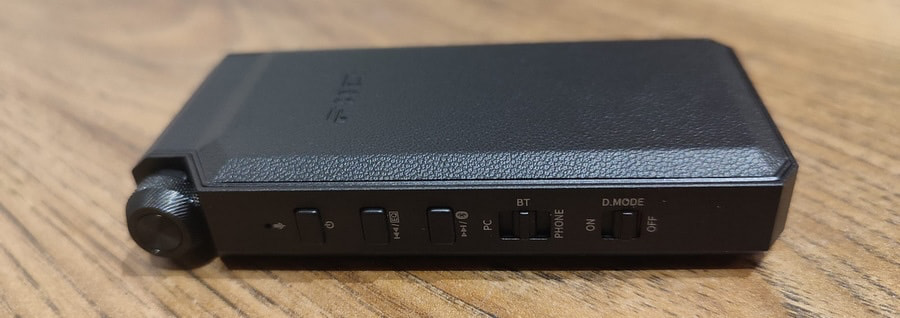
A quick word on Desktop mode, because it is one of the BTR17’s more practical features. Flip the switch and connect power to the dedicated USB C “power in” port, and the unit runs from an external supply instead of its internal battery. That means you can use it at a desk all day without cycling the battery. For anyone planning to use this as a compact home DAC and amp, that is not a small detail.
There are two additional operating modes: BT and PHONE.
- BT mode is exactly what it sounds like. It is engaged when using the BTR17 wirelessly. The unit runs Bluetooth 5.4 via Qualcomm’s QCC5181 platform, with support for transmission rates up to 2100 kbps, along with LDAC and aptX Lossless. In practical terms, that puts it at the front of the pack for high resolution wireless audio support at this price.
- PHONE mode is more about power management. In this setting, the BTR17 shares the load with the connected source device rather than drawing heavily from it. The idea is to reduce battery drain on your phone or tablet during wired use. It is a thoughtful inclusion for anyone who has watched their phone battery nosedive during a long listening session.
Back to the hardware.
FiiO fitted the BTR17 with an XMOS XU316 USB processor, which is not bargain bin silicon. It offers low latency, stable data transmission, and support for 32-bit/768kHz PCM and native DSD512. Even with the built in parametric EQ engaged, it can handle up to 192 kHz. In short, there is more than enough headroom here for any real world use case.
Speaking of EQ, you get a full 10 band parametric setup to fine tune the sound. That means proper control over frequency, gain, and EQ, not just a handful of preset tone tweaks. Profiles can be saved, imported, exported, and shared through the FiiO Control app, so if you have a dialed in curve for a specific IEM or headphone, you can pass it along instead of trying to describe it over text like a lunatic.
The FiiO Control app also handles core settings and firmware updates. Most adjustments can be made directly on the device, but the app makes deeper configuration easier and keeps the unit current with software refinements.
As for battery life, FiiO rates the BTR17 at roughly eight hours using the 4.4 mm balanced output. In practice, that figure held up during continuous use with LDAC over Bluetooth. For a compact all in one DAC and amplifier at $199, that is a solid, realistic result rather than marketing fantasy.

Design & Build Quality
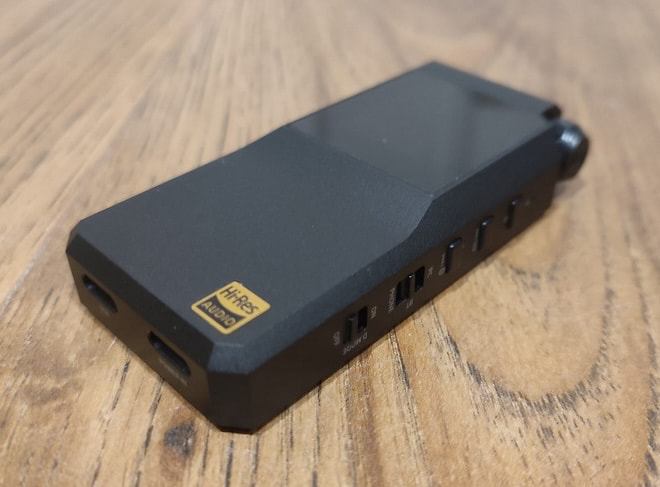
The centerpiece of the BTR17’s design is its display. The 1.3 inch IPS screen, with a 240 x 240 resolution, is bright enough for outdoor use and delivers surprisingly vibrant color for a device this small. Key information is always front and center, including volume level, active Bluetooth codec, and sampling rate. Each codec is color coded, which makes it easy to see at a glance what you are actually streaming.
FiiO makes a point of highlighting the tactile, stepped volume knob. In practice, it is serviceable but not exactly luxurious. The rotation feels a bit light, and the integrated push button comes across slightly hollow and sticky when pressed. It works, but I have handled more refined implementations on competing devices.
The back panel is wrapped in raw leather, which adds some welcome texture and grip. The main chassis is aluminum alloy, something that still is not guaranteed in the sub $200 category. The overall construction feels solid even if the control hardware is not class leading.
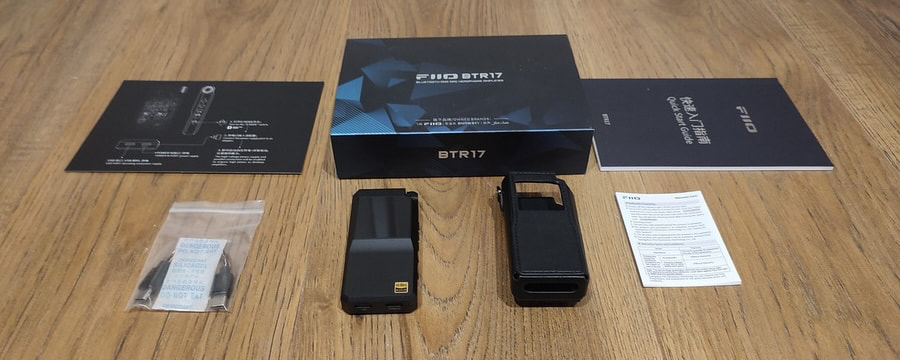
In the box, FiiO includes the usual documentation, a well made leatherette case, and an eight stranded USB C to C cable that looks and feels more premium than expected at this price.
Physically, the BTR17 measures 16.3 mm x 41.2 mm x 86.6 mm, which translates to roughly 0.64 x 1.62 x 3.41 inches. It weighs about 73.4 grams, or approximately 2.6 ounces. In daily use, it is compact and light enough to disappear into a pocket. Our review sample was black, but it is also available in a striking blue finish.
On the right side of the chassis you will find the physical controls. Just below the volume knob sits the power button. Beneath that are the forward and backward track buttons, which also double as EQ preset selectors. Further down are the switches for power mode selection and Desktop mode activation.
Along the bottom edge are two USB-C ports. One handles data transfer and charging, while the second is dedicated to external power input when using Desktop mode. Up top are the headphone outputs: a standard 3.5 mm single ended jack and a 4.4 mm balanced Pentaconn connection.

Listening & Headphone Synergy
With output figures that edge toward a full watt in Desktop mode, the BTR17 has more than enough muscle for the vast majority of full size over ear headphones. Even in portable mode, there is sufficient headroom for anyone who listens at spirited levels.
At that point, the conversation shifts. Raw power is only part of the equation. The real question is how clean, controlled, and refined that power sounds. Quality of amplification matters just as much as quantity, and in many cases more.
It is also worth saying that using a Bluetooth DAC and amplifier in general feels liberating. Being able to move around freely without being anchored to a desk changes the experience in a very real way. That freedom alone makes listening more enjoyable, and it gives the BTR17 an advantage that is not captured on a spec sheet.
The first thing I noticed after plugging the HiFiMAN HE1000 Unveiled into the BTR17 was a subtle but clear sense of added weight down low, even with no EQ engaged. I do not believe the unit is altering frequency response in any dramatic way, but there is a perceptible increase in bass impact and authority compared to some other solid state DAC and amp combinations.
On “Why So Serious?” by Hans Zimmer and James Newton Howard, the subterranean swell that creeps in around the three and a half minute mark had more physical presence and drive than I heard from the FiiO JM21 DAP I reviewed recently. The BTR17 gives that moment extra grunt, which makes the track feel more visceral without tipping into exaggeration.
That translates into a slightly warm overall character, but not one that sounds bloated or soft. The midrange remains articulate and clean, and there is a mild lift in the upper mids that enhances perceived detail. Dynamics are lively across the spectrum, with good separation and fine note clarity. Treble extension is intact with no obvious roll off, though it stops short of the most ethereal or shimmering presentation I have heard. Even so, the delicate triangle hits in L’Impératrice’s “La Lune” came through clearly and without any significant loss of detail.
I have often felt that the HE1000 Unveiled can use a touch more foundation in the bass. The BTR17 does not transform it into a reference caliber headphone in that range, but it does add just enough authority down low to counterbalance the headphone’s inherent treble energy. The pairing felt cohesive and well judged rather than artificially thickened.
I also tested the BTR17 with the Sendy Audio Egret, Beyerdynamic DT880 Edition 600 Ohm, and Audio Technica ATH-R70x. All were driven confidently and without drama. Even the 600 ohm Beyer was handled with composure, which says a lot about the available headroom in Desktop mode.
Listening was split between wired Desktop mode and wireless operation over LDAC from my phone. Despite the lower maximum output and reduced sampling rate in Bluetooth mode, I was genuinely hard pressed to identify meaningful sonic differences between the two in casual and focused listening. That should reassure anyone planning to use this primarily as a wireless solution.
That said, perspective matters. Moving over to a dedicated desktop chain like the SMSL DO400 paired with the Aune S17 Pro immediately delivered greater soundstage width, more defined layering, and a higher level of micro detail. The BTR17 gets impressively close for a compact all in one device, but a serious desktop stack still has the edge in outright scale and refinement.


The Bottom Line
The FiiO BTR17 gets the fundamentals right.
It delivers clean, controlled power with a slightly warm tilt that adds welcome body without sacrificing clarity. The dual ESS DAC implementation, THX AAA amplification, XMOS USB stage, and full 10 band parametric EQ are not filler features. They translate into real flexibility and performance that push this well beyond basic Bluetooth dongle territory. In Desktop mode, it has enough output to handle demanding full size headphones. In wireless mode over LDAC or aptX Lossless, it retains far more composure and resolution than most portable solutions in this price bracket.
What it does not do is replace a serious desktop stack. You will still get greater scale, layering, and ultimate refinement from a dedicated DAC and amplifier chain. The volume control hardware is also merely adequate rather than premium. If you are chasing the last word in micro detail or build finesse, this is not that device.
What makes the BTR17 compelling in 2026 is the combination of genuine audiophile architecture, robust codec support, proper EQ control, and real world usability in a device that fits in your pocket. It is as comfortable on a desk in Desktop mode as it is clipped to a jacket streaming from your phone.
Who should consider it? Anyone who wants near desktop performance without being chained to a desk and headphone enthusiasts with multiple pairs of headphones and IEMs to drive; and that includes commuters and business travellers who have not ventured down the wireless earbud or headphone rabbit hole.
In a cycle where FiiO has released dozens of products, the BTR17 stands out as one of the more complete and mature executions. Not perfect. Not revolutionary. But very, very well executed for $199.
Pros:
- Powerful for the size – Up to 650 mW balanced in Desktop mode with enough headroom for most full size headphones, including higher impedance models.
- Excellent wireless support – Bluetooth 5.4 with LDAC and aptX Lossless delivers near wired performance in real world use.
- High end internal architecture – Dual ESS ES9069Q DACs, THX AAA 78+ amplification, and XMOS XU316 USB stage at $199 is strong value.
- Full 10 band parametric EQ – Deep tuning capability with profile import and export via the FiiO Control app.
- Flexible use cases – Desktop mode, PHONE mode power management, balanced and single ended outputs, compact and genuinely portable.
Cons:
- Not a true desktop replacement – Dedicated DAC and amplifier stacks still outperform it in staging, layering, and ultimate refinement.
- Volume knob feels average – Tactile response and integrated button lack a premium feel.
- Power drops in portable mode – Maximum output is reduced outside Desktop mode.
- Treble is clean but not exceptional – Extended and articulate, though not the most airy presentation.
- Feature density may overwhelm casual users – Extensive settings and modes require some learning curve.
Where to buy:
For more information: fiio.com/btr17