

Tech
FiiO BTR17 Review: High End DAC Chips, Balanced Output, and Deep EQ in Your Pocket?

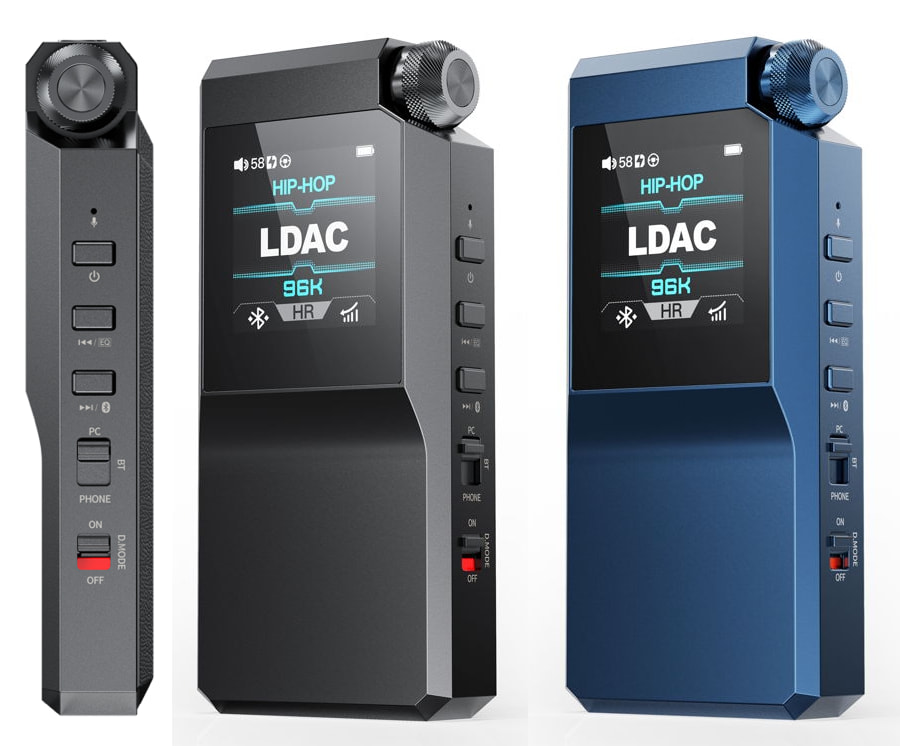
FiiO’s product pipeline has been relentless. Over the past two years, the company has introduced a few dozen new models spanning portable DACs, Bluetooth amplifiers, IEMs, headphones, desktop gear, and now increasingly innovative home audio components. Some have been clear hits. Others have felt like experiments in a very crowded field. That is the reality when a brand moves this fast.
The $199 FiiO BTR17, launched in late 2024 as a portable Bluetooth DAC and headphone amplifier, arrived during the early phase of this surge. At the time, it drew rave reviews and strong word of mouth. Now in 2026, it is no longer the newest device in the lineup, but it may be one of the most durable and worthwhile.
Behind the scenes, it is clear that FiiO has no intention of slowing down. What we have seen offline suggests that 2026 and 2027 will bring even more ambitious desktop and home audio components that push the brand further upmarket. Against that backdrop, the BTR17 stands out as one of the earlier releases from this cycle and possibly one of the most complete.
In a market overflowing with portable DAC and amplifier options between $99 and $299, the question is simple. Is the BTR17 still relevant in 2026, and was it quietly one of FiiO’s best moves during this recent run?

Specifications & Technology
Let’s start where it actually matters with the BTR17: the DAC and the amplification stage.
Digital to analogue conversion is handled by a pair of ESS Sabre ES9069Q chips. On paper, they are serious performers, rated at up to 130 dB dynamic range with THD plus noise hovering around -120 dB, all while keeping power consumption in check. These are not entry level DACs thrown in to hit a price point. They are modern, efficient, and more than capable of resolving fine detail without adding grit or glare of their own.
On the amplification side, FiiO opted for the THX AAA 78+ platform. The design uses eight op-amps in a parallel configuration and can deliver up to 650 mW from the balanced 4.4 mm output into 32 ohm headphones. There is an important caveat. That full output is only available in wired Desktop mode. In portable use, maximum output drops to 300 mW, which is still respectable but not the headline number.
Power delivery inside the BTR17 is not an afterthought. The internal supply is divided into three distinct stages to keep things stable and controlled:
- Stage 1: Filtering and overvoltage protection
- Stage 2: DC to DC boost conversion
- Stage 3: High precision LDO voltage stabilization
Critical sections such as the DAC chips and the amplifier each receive power from dedicated rails, a design choice intended to reduce interference and improve overall performance. Whether that translates into audible benefits is something we will dig into in the listening section.
A quick word on Desktop mode, because it is one of the BTR17’s more practical features. Flip the switch and connect power to the dedicated USB C “power in” port, and the unit runs from an external supply instead of its internal battery. That means you can use it at a desk all day without cycling the battery. For anyone planning to use this as a compact home DAC and amp, that is not a small detail.
There are two additional operating modes: BT and PHONE.
- BT mode is exactly what it sounds like. It is engaged when using the BTR17 wirelessly. The unit runs Bluetooth 5.4 via Qualcomm’s QCC5181 platform, with support for transmission rates up to 2100 kbps, along with LDAC and aptX Lossless. In practical terms, that puts it at the front of the pack for high resolution wireless audio support at this price.
- PHONE mode is more about power management. In this setting, the BTR17 shares the load with the connected source device rather than drawing heavily from it. The idea is to reduce battery drain on your phone or tablet during wired use. It is a thoughtful inclusion for anyone who has watched their phone battery nosedive during a long listening session.
Back to the hardware.
FiiO fitted the BTR17 with an XMOS XU316 USB processor, which is not bargain bin silicon. It offers low latency, stable data transmission, and support for 32-bit/768kHz PCM and native DSD512. Even with the built in parametric EQ engaged, it can handle up to 192 kHz. In short, there is more than enough headroom here for any real world use case.
Speaking of EQ, you get a full 10 band parametric setup to fine tune the sound. That means proper control over frequency, gain, and EQ, not just a handful of preset tone tweaks. Profiles can be saved, imported, exported, and shared through the FiiO Control app, so if you have a dialed in curve for a specific IEM or headphone, you can pass it along instead of trying to describe it over text like a lunatic.
The FiiO Control app also handles core settings and firmware updates. Most adjustments can be made directly on the device, but the app makes deeper configuration easier and keeps the unit current with software refinements.
As for battery life, FiiO rates the BTR17 at roughly eight hours using the 4.4 mm balanced output. In practice, that figure held up during continuous use with LDAC over Bluetooth. For a compact all in one DAC and amplifier at $199, that is a solid, realistic result rather than marketing fantasy.
Design & Build Quality
The centerpiece of the BTR17’s design is its display. The 1.3 inch IPS screen, with a 240 x 240 resolution, is bright enough for outdoor use and delivers surprisingly vibrant color for a device this small. Key information is always front and center, including volume level, active Bluetooth codec, and sampling rate. Each codec is color coded, which makes it easy to see at a glance what you are actually streaming.
FiiO makes a point of highlighting the tactile, stepped volume knob. In practice, it is serviceable but not exactly luxurious. The rotation feels a bit light, and the integrated push button comes across slightly hollow and sticky when pressed. It works, but I have handled more refined implementations on competing devices.
The back panel is wrapped in raw leather, which adds some welcome texture and grip. The main chassis is aluminum alloy, something that still is not guaranteed in the sub $200 category. The overall construction feels solid even if the control hardware is not class leading.
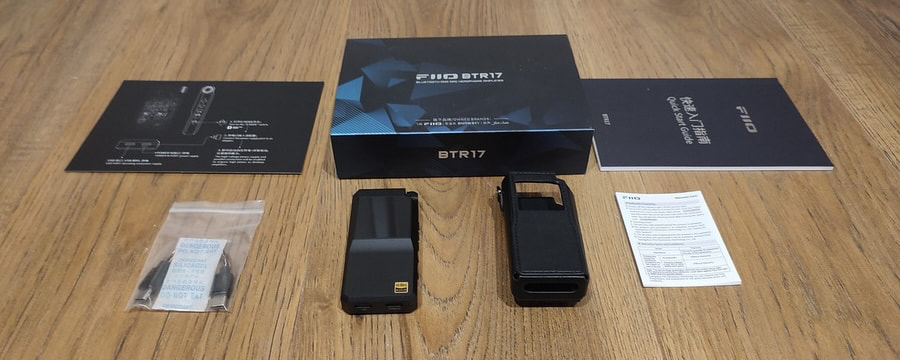
In the box, FiiO includes the usual documentation, a well made leatherette case, and an eight stranded USB C to C cable that looks and feels more premium than expected at this price.
Physically, the BTR17 measures 16.3 mm x 41.2 mm x 86.6 mm, which translates to roughly 0.64 x 1.62 x 3.41 inches. It weighs about 73.4 grams, or approximately 2.6 ounces. In daily use, it is compact and light enough to disappear into a pocket. Our review sample was black, but it is also available in a striking blue finish.
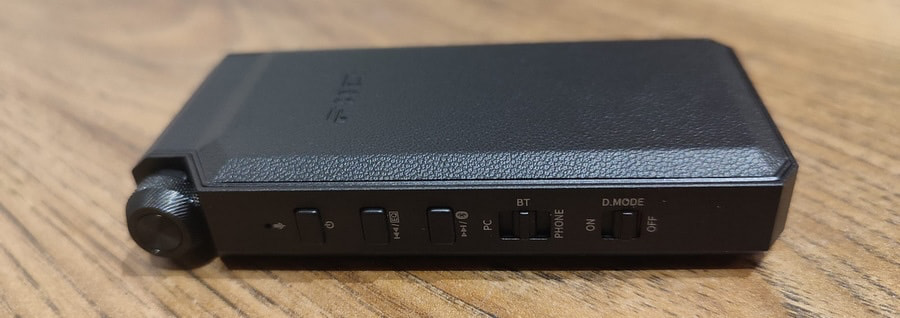
On the right side of the chassis you will find the physical controls. Just below the volume knob sits the power button. Beneath that are the forward and backward track buttons, which also double as EQ preset selectors. Further down are the switches for power mode selection and Desktop mode activation.
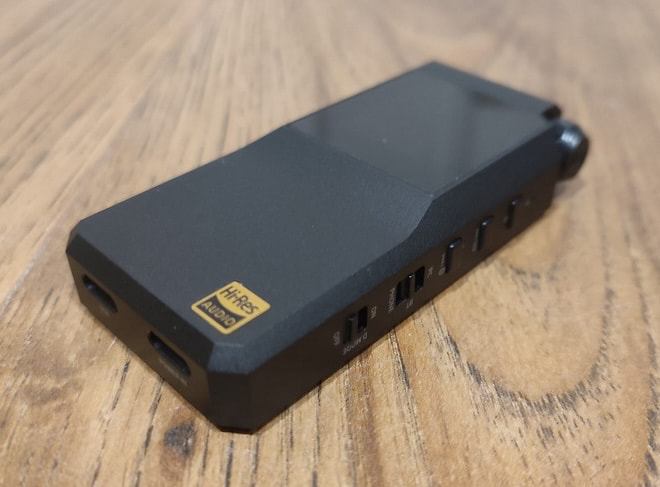
Along the bottom edge are two USB-C ports. One handles data transfer and charging, while the second is dedicated to external power input when using Desktop mode. Up top are the headphone outputs: a standard 3.5 mm single ended jack and a 4.4 mm balanced Pentaconn connection.
Listening & Headphone Synergy
With output figures that edge toward a full watt in Desktop mode, the BTR17 has more than enough muscle for the vast majority of full size over ear headphones. Even in portable mode, there is sufficient headroom for anyone who listens at spirited levels.
At that point, the conversation shifts. Raw power is only part of the equation. The real question is how clean, controlled, and refined that power sounds. Quality of amplification matters just as much as quantity, and in many cases more.
It is also worth saying that using a Bluetooth DAC and amplifier in general feels liberating. Being able to move around freely without being anchored to a desk changes the experience in a very real way. That freedom alone makes listening more enjoyable, and it gives the BTR17 an advantage that is not captured on a spec sheet.
The first thing I noticed after plugging the HiFiMAN HE1000 Unveiled into the BTR17 was a subtle but clear sense of added weight down low, even with no EQ engaged. I do not believe the unit is altering frequency response in any dramatic way, but there is a perceptible increase in bass impact and authority compared to some other solid state DAC and amp combinations.
On “Why So Serious?” by Hans Zimmer and James Newton Howard, the subterranean swell that creeps in around the three and a half minute mark had more physical presence and drive than I heard from the FiiO JM21 DAP I reviewed recently. The BTR17 gives that moment extra grunt, which makes the track feel more visceral without tipping into exaggeration.
That translates into a slightly warm overall character, but not one that sounds bloated or soft. The midrange remains articulate and clean, and there is a mild lift in the upper mids that enhances perceived detail. Dynamics are lively across the spectrum, with good separation and fine note clarity. Treble extension is intact with no obvious roll off, though it stops short of the most ethereal or shimmering presentation I have heard. Even so, the delicate triangle hits in L’Impératrice’s “La Lune” came through clearly and without any significant loss of detail.
I have often felt that the HE1000 Unveiled can use a touch more foundation in the bass. The BTR17 does not transform it into a reference caliber headphone in that range, but it does add just enough authority down low to counterbalance the headphone’s inherent treble energy. The pairing felt cohesive and well judged rather than artificially thickened.
I also tested the BTR17 with the Sendy Audio Egret, Beyerdynamic DT880 Edition 600 Ohm, and Audio Technica ATH-R70x. All were driven confidently and without drama. Even the 600 ohm Beyer was handled with composure, which says a lot about the available headroom in Desktop mode.
Listening was split between wired Desktop mode and wireless operation over LDAC from my phone. Despite the lower maximum output and reduced sampling rate in Bluetooth mode, I was genuinely hard pressed to identify meaningful sonic differences between the two in casual and focused listening. That should reassure anyone planning to use this primarily as a wireless solution.
That said, perspective matters. Moving over to a dedicated desktop chain like the SMSL DO400 paired with the Aune S17 Pro immediately delivered greater soundstage width, more defined layering, and a higher level of micro detail. The BTR17 gets impressively close for a compact all in one device, but a serious desktop stack still has the edge in outright scale and refinement.

The Bottom Line
The FiiO BTR17 gets the fundamentals right.
It delivers clean, controlled power with a slightly warm tilt that adds welcome body without sacrificing clarity. The dual ESS DAC implementation, THX AAA amplification, XMOS USB stage, and full 10 band parametric EQ are not filler features. They translate into real flexibility and performance that push this well beyond basic Bluetooth dongle territory. In Desktop mode, it has enough output to handle demanding full size headphones. In wireless mode over LDAC or aptX Lossless, it retains far more composure and resolution than most portable solutions in this price bracket.
What it does not do is replace a serious desktop stack. You will still get greater scale, layering, and ultimate refinement from a dedicated DAC and amplifier chain. The volume control hardware is also merely adequate rather than premium. If you are chasing the last word in micro detail or build finesse, this is not that device.
What makes the BTR17 compelling in 2026 is the combination of genuine audiophile architecture, robust codec support, proper EQ control, and real world usability in a device that fits in your pocket. It is as comfortable on a desk in Desktop mode as it is clipped to a jacket streaming from your phone.
Who should consider it? Anyone who wants near desktop performance without being chained to a desk and headphone enthusiasts with multiple pairs of headphones and IEMs to drive; and that includes commuters and business travellers who have not ventured down the wireless earbud or headphone rabbit hole.
In a cycle where FiiO has released dozens of products, the BTR17 stands out as one of the more complete and mature executions. Not perfect. Not revolutionary. But very, very well executed for $199.
Pros:
- Powerful for the size – Up to 650 mW balanced in Desktop mode with enough headroom for most full size headphones, including higher impedance models.
- Excellent wireless support – Bluetooth 5.4 with LDAC and aptX Lossless delivers near wired performance in real world use.
- High end internal architecture – Dual ESS ES9069Q DACs, THX AAA 78+ amplification, and XMOS XU316 USB stage at $199 is strong value.
- Full 10 band parametric EQ – Deep tuning capability with profile import and export via the FiiO Control app.
- Flexible use cases – Desktop mode, PHONE mode power management, balanced and single ended outputs, compact and genuinely portable.
Cons:
- Not a true desktop replacement – Dedicated DAC and amplifier stacks still outperform it in staging, layering, and ultimate refinement.
- Volume knob feels average – Tactile response and integrated button lack a premium feel.
- Power drops in portable mode – Maximum output is reduced outside Desktop mode.
- Treble is clean but not exceptional – Extended and articulate, though not the most airy presentation.
- Feature density may overwhelm casual users – Extensive settings and modes require some learning curve.
Where to buy:
For more information: fiio.com/btr17
Related Reading:


Hundreds of employees at Google and OpenAI have urging their companies to in its standoff with the Pentagon over military applications for AI tools like Claude.
The letter, titled “We Will Not Be Divided,” calls on the leadership of both companies to “put aside their differences and stand together to continue to refuse the Department of War’s current demands for permission to use our models for domestic mass surveillance and autonomously killing people without human oversight.” These are two lines that Anthropic CEO Dario Amodei should not be crossed by his or any other AI company.
As of publication, the letter has over 450 signatures, almost 400 of which come from Google employees and the rest from OpenAI. Currently, roughly 50 percent of all participants have chosen to attach their names to the cause, with the rest remaining anonymous. All are verified as current employees of these companies. The original organizers of the letter aren’t Google or OpenAI employees; they say are unaffiliated with any AI company, political party or advocacy group.
The open letter is the latest development in the saga between Anthropic and US Defense Secretary Pete Hegseth, who to label the company a “supply chain risk” if it did not agree to withdraw certain guardrails for classified work. The Pentagon has also been in talks with Google and OpenAI about using their models for classified work, with earlier this week. The letter argues the government is “trying to divide each company with fear that the other will give in.”
OpenAI CEO Sam Altman told his employees on Friday that the ChatGPT maker will draw the same red lines as Anthropic, according to an internal memo seen by . He told on the same day that he doesn’t “personally think the Pentagon should be threatening DPA against these companies.”
Tech
Smartphone Market To Decline 13% in 2026, Marking the Largest Drop Ever Due To the Memory Shortage Crisis

An anonymous reader shares a report: Worldwide smartphone shipments are forecast to decline 12.9% year-on-year (YoY) in 2026 to 1.1 billion units, according to the International Data Corporation (IDC) Worldwide Quarterly Mobile Phone Tracker. This decline will bring the smartphone market to its lowest annual shipment volume in more than a decade. The current forecast represents a sharp decline from our November forecast amid the intensifying memory shortage crisis.


According to a new report from market research firm International Data Corporation, global smartphone shipments are expected to total around 1.1 billion units this year, down from 1.26 billion in 2025. This marks a significant downward revision from the company’s November 2025 forecast, which projected a decline of between 0.9…
Read Entire Article
Source link


Rather than relying on a single model, Perplexity AI’s Computer system functions as an orchestrator across multiple models. Anthropic’s Claude Opus 4.6 serves as the primary reasoning engine, while Gemini handles deep research tasks. Nano Banana generates images, Veo 3.1 produces video, Grok executes lightweight, speed-optimized tasks, and OpenAI’s ChatGPT…
Read Entire Article
Source link

Loewe has announced the Vega, a new range of compact 4K Ultra HD smart TVs available in 32 and 43-inch sizes.
The Vega sits below Loewe’s flagship Stellar OLED line, which spans 42 to 97 inches and starts at £1,699, but uses VA LCD panels with full-array Direct LED backlighting rather than OLED, a technology choice that allows Loewe to hit higher peak brightness figures across a smaller and more affordable chassis.
The 43-inch model carries 390 LED dimming zones and reaches a peak luminance of 880 cd/m², while the 32-inch version uses 260 dimming zones and reaches 550 cd/m², both figures sitting above what most competing LCD televisions at this screen size typically deliver to living rooms in bright daylight conditions.
Both models support the full range of HDR formats, including Dolby Vision IQ, HDR10, and HLG, with the Vega marking the first time Loewe has offered a 4K Ultra HD panel in a 32-inch format, a size that most manufacturers continue to supply only in Full HD resolution.
The integrated soundbar delivers 60 watts of Class-D amplification developed and tuned by Loewe’s in-house audio team, supporting Dolby Atmos and connecting to external sound systems through HDMI eARC, a configuration that competes more directly with premium soundbar bundles than with the basic speakers typically built into televisions at this screen size.
Smart features and connectivity
Loewe’s os9 smart platform, built on the VIDAA operating system, handles streaming access across Netflix, YouTube, Disney+, and Apple TV, with Apple AirPlay, Miracast, DLNA, and Matter connectivity expanding the Vega’s integration with both Apple and broader smart home ecosystems.
The 43-inch model carries two HDMI 2.1 ports supporting 4K at up to 120Hz alongside VRR and ALLM for low-latency gaming, while the 32-inch version supports 4K at up to 60Hz through its HDMI 2.1 ports, with both models also offering cloud gaming access through Blacknut and Boosteroid via the VIDAA platform.
A brushed aluminium frame, rotatable metal table stand with chrome finish, and integrated cable management with magnetic rear covers reflect the same design discipline Loewe applies across its higher-end OLED TV range, placing the Vega closer in aesthetic approach to Bang and Olufsen than to mass-market LCD televisions at comparable screen sizes.
The Loewe Vega 32-inch is priced at £1650 and the 43-inch at £1900, with both models available through selected Loewe retail partners from March 2026.
For a closer look at how the Vega’s LCD panel compares against the best screens on the market, our guide to the best OLED TVs rounds up the top picks from every major brand.


Video Friday is your weekly selection of awesome robotics videos, collected by your friends at IEEE Spectrum robotics. We also post a weekly calendar of upcoming robotics events for the next few months. Please send us your events for inclusion.
ICRA 2026: 1–5 June 2026, VIENNA
Enjoy today’s videos!
Our robots Lynx M20 help transport harvested crops in mountainous farmland—tackling the rural “last mile” logistics challenge.
[ DEEP Robotics ]
Once again, I would point out that now that we are reaching peak humanoid robots doing humanoid things, we are inevitably about to see humanoid robots doing non-humanoid things.
[ Unitree ]
In a study, a team of researchers from the Max Planck Institute for Intelligent Systems, the University of Michigan, and Cornell University show that groups of magnetic microrobots can generate fluidic forces strong enough to rotate objects in different directions without touching them. These microrobot swarms can turn gear systems, rotate objects much larger than the robots themselves, assemble structures on their own, and even pull in or push away many small objects.
[ Science ] via [ Max Planck Institute ]
Bipedal—or two-legged—autonomous robots can be quite agile. This makes them useful for performing tasks on uneven terrain, such as carrying equipment through outdoor environments or performing maintenance on an ocean-going ship. However, unstable or unpredictable conditions also increase the possibility of a robot wipeout. Until now, there’s been a significant lack of research into how a robot recovers when its direction shifts—for example, a robot losing balance when a truck makes a quick turn. The team aims to fix this research gap.
[ Georgia Tech ]
Robotics is about controlling energy, motion, and uncertainty in the real world.
[ Carnegie Mellon University ]
Delicious dinner cooked by our robot Robody. We’ve asked our investors to speak about why they’re along for the ride.
[ Devanthro ]
Tilt-rotor aerial robots enable omnidirectional maneuvering through thrust vectoring, but introduce significant control challenges due to the strong coupling between joint and rotor dynamics. This work investigates reinforcement learning for omnidirectional aerial motion control on over-actuated tiltable quadrotors that prioritizes robustness and agility.
[ DRAGON Lab ]
At the CMU Robotic Innovation Center’s 75,000-gallon water tank, members of the TartanAUV student group worked to further develop their autonomous underwater vehicle (AUV) called Osprey. The team, which takes part in the annual RoboSub competition sponsored by the U.S. Office of Naval Research, is comprised primarily of undergraduate engineering and robotics students.
[ Carnegie Mellon University ]
Sure seems like the only person who would want a robot dog is a person who does not in fact want a dog.
Compact size, industrial capability. Maximum torque of 90N·m, over 4 hours of no-load runtime, IP54 rainproof design. With a 15 kg payload, range exceeds 13 km. Open secondary development, empowering industry applications.
[ Unitree ]
If your robot video includes tasty baked goods it WILL be included in Video Friday.
[ QB Robotics ]
Astorino is a 6-axis educational robot created for practical and affordable teaching of robotics in schools and beyond. It has been created with 3D printing, so it allows for experimentation and the possible addition of parts. With its design and programming, it replicates the actions of industrial robots giving students the necessary skills for future work.
We need more autonomous driving datasets that accurately reflect how sucky driving can be a lot of the time.
[ ASRL ]
This Carnegie Mellon University Robotics Institute Seminar is by CMU’s own Victoria Webster-Wood, on “Robots as Models for Biology and Biology and Materials for Robots.”
In the last century, it was common to envision robots as shining metal structures with rigid and halting motion. This imagery is in contrast to the fluid and organic motion of living organisms that inhabit our natural world. The adaptability, complex control, and advanced learning capabilities observed in animals are not yet fully understood, and therefore have not been fully captured by current robotic systems. Furthermore, many of the mechanical properties and control capabilities seen in animals have yet to be achieved in robotic platforms. In this talk, I will share an interdisciplinary research vision for robots as models for neuroscience and biology as materials for robots.
[ CMU RI ]
From Your Site Articles
Related Articles Around the Web


More Information
This product guide from Master Bond presents a range of medical-grade adhesives designed for device manufacturing. It covers epoxies, silicones, cyanoacrylates, and UV/LED curable systems, each tested against biocompatibility standards including USP Class VI and ISO 10993-5. The guide highlights key selection criteria such as sterilization resistance (autoclaving, EtO, gamma radiation, chemical immersion), thermal performance, chemical resistance, and electrical properties. Case studies demonstrate real-world applications in prosthetics, implantable sensors, and diagnostic devices. The guide emphasizes that adhesive selection should be a systems-level decision made early in the design process to avoid performance and manufacturability trade-offs.
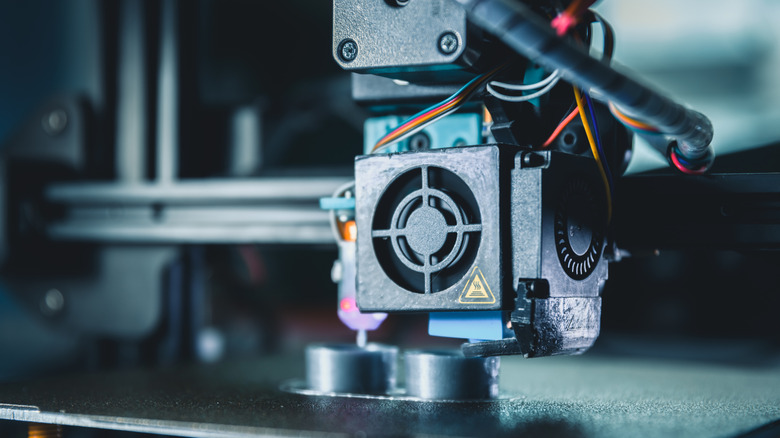
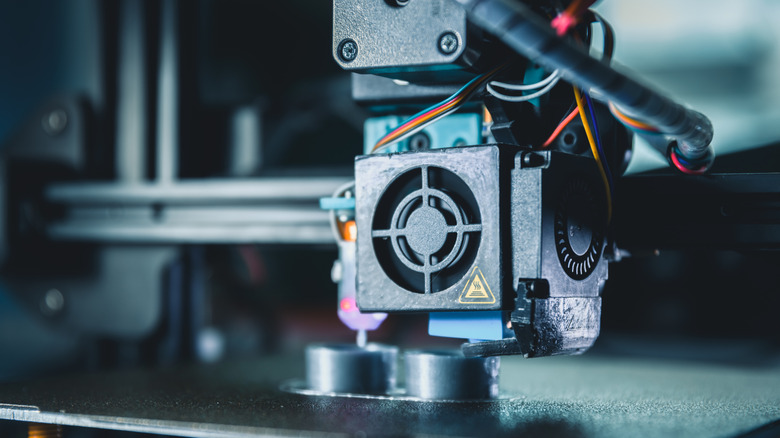
As 3D printers from a number of brands get better and less expensive, there’s always the question of 3D-printed guns. After all, 3D printers are showing up in combat roles. To counter this, at least in California, Assembly member Rebecca Bauer-Kahan introduced a bill that would mandate that every 3D printer sold in California be coded with “firearm blocking features designed to prevent the printing of dangerous gun parts and ghost guns.”
The bill, AB 2047, states: “all 3D printers sold in California will be required to include firearm detection algorithms and software controls that identify files designed to produce guns and illegal gun parts, then block those printing requests.”
The definition of “ghost gun” varies, but it usually refers to firearms without serial numbers or easily traceable markings.
According to the Bureau of Alcohol, Tobacco, and Firearms, it’s federally legal to make your own firearms and does not require a serial number as long as the firearm in question is not being sold for a profit and is “detectable” by metal detectors and X-rays.
You mostly can’t print an entire gun
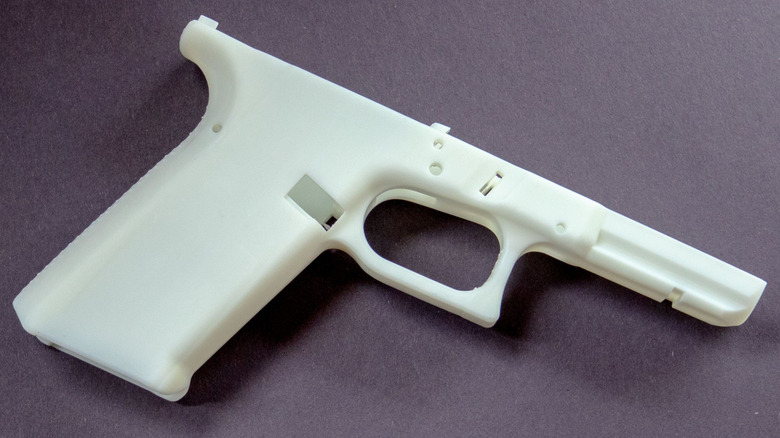
Speaking from personal experience from well over a decade of participating in shooting sports and gun-smithing, you cannot just find a file online and print a functioning gun like something out of a Tom Clancy novel. You can only print accessories and non-stressed parts of a gun, like the receiver of the popular Glock series of handguns or the lower receiver of an AR-15-style rifle.
In order to make a firearm that functions without exploding from the pressure of a fired bullet, you still need a lot of conventional gun parts like barrels, slides, and trigger mechanisms. While each gun is different, receivers are often the only part of a firearm that requires a background check and cannot be purchased online without violating federal law. Still, printing a receiver without a background check is a valid concern.
3D printer bills like the one introduced in California are obviously well-meaning in their intent. No lawmaker wants to see their constituents hurt by potentially dangerous technology. But without knowledge of the problem with 3D-printed firearm components and concrete ways to actually program 3D printers to detect gun parts, the bill might not go very far.
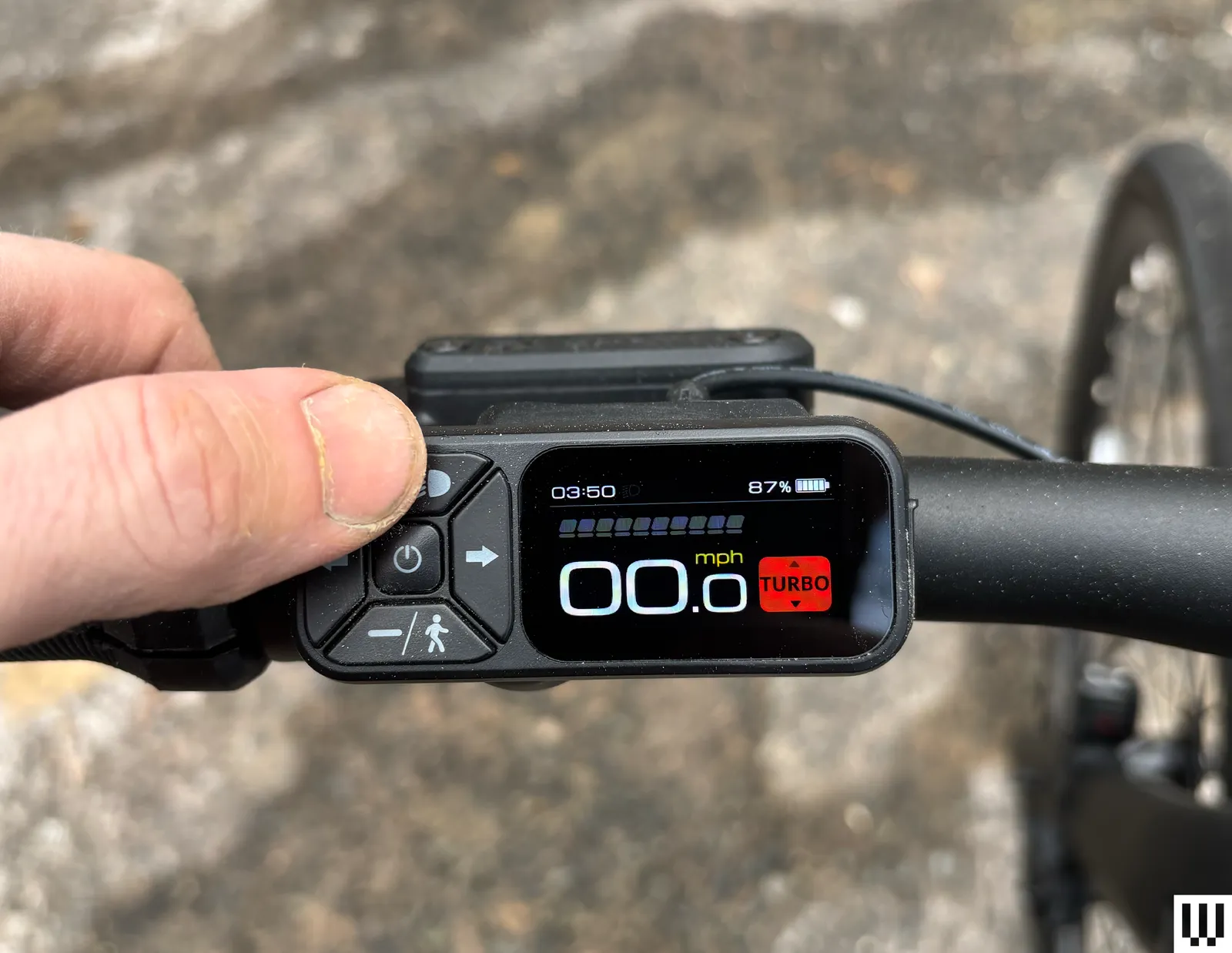
Belt-drive bikes offer some huge upsides. First, they usually require less maintenance, with many belts often lasting twice as long as a typical chain. Second, there’s no grease to speak of, and therefore, no black smudges on your work pants. Third, in the case of the Soltera 3, the belt comes from the Gates brand, whose drivetrain belts are as good as it gets. Belt-drive bikes are silent and often smoother than their chain-driven counterparts.
That said, the inclusion of a low-maintenance element such as a belt drive paired with hydraulic disc brakes, which require bleeding roughly every year, struck me as an odd choice. If Aventon wanted to make the Soltera 3 as hands-off as possible, cable-actuated brakes would have been a more intuitive choice.
The other thing that immediately jumps out about the Soltera 3 is its relatively light weight. At 37 pounds, the Soltera 3 is heavy for an analog bike. But it’s certainly not heavy for an ebike, and it’s nearly as stiff, nimble, and navigable as a conventional bicycle. One issue I’ve always had with ebikes is their heft. Given that they’re often made to replace a car, they’re built with load bearing in mind. Also, ebike batteries are heavy.
Adding to that sense of “this is just like my other bikes,” the Soltera 3 simply looks cool, which is often not the case when it comes to ebikes. The matte black my tester bike arrived in looks cool because matte black almost never doesn’t look cool. (Additionally, the Soltera 3 is available in dark matte blue and a sleek silver.) But beyond the finish, the bike’s geometry; its wide, almost perfectly flat handlebars; and its narrow (by ebike standards) 700 x 36 tires make it feel closer in DNA to a road bike than a traditional ebike.
Button Press

Photograph: Michael Venutolo-Mantovani
I’m 6′4′′, and the extra large Soltera 3 that I tested was at a maximum saddle height. It was suitable for me, but I couldn’t recommend anyone bigger than me riding the Soltera 3. That said, with four sizes ranging from small to extra large, the line covers a wide swath of riders, ranging from my height all the way down to 5′ tall.

With the likes of and out of the way for a bit, Amazon has seized its opportunity to put the spotlight on the next big video game adaptation, its currently-in-production God of War show. Today we got our at Ryan Hurst and Callum Vinson as Kratos and Atreus.
The image released by Amazon shows the eponymous God of War standing next to a tree as he watches his son — who notably looks a bit younger than the video game version of 11-year-old Atreus we first met in 2018’s God of War — take aim with his bow. Exactly what they’re hunting is unclear, but we know that the developing relationship between father and son that was such a big part of the PS4 game is also going to be at the heart of the show.
Whether Sony Pictures Television and Amazon MGM Studios have nailed the looks of its central characters is a matter of opinion. Personally I think Hurst’s Kratos in particular looks a little bit off here, but there’s every chance it all comes together later in production. Or when we first hear him angrily exclaim “boy!”
The Sons of Anarchy star was as Kratos back in January, and earlier this week we learned that Deadpool’s will play Baldur in the Amazon show. The rest of the cast includes Mandy Patinkin as Odin, Max Parker and Heimfall, Ólafur Darri Ólafsson as Thor, as Sif, Alastair Duncan as Mimir, Jeff Gulka as Sindri and Danny Woodburn as Brok.
No release date has been announced yet, but a second season of God of War has been confirmed.

Google and OpenAI employees sign open letter in ‘solidarity’ with Anthropic

Will Jacks the hero again as England fight back to win thriller

Dell Technologies Stock Surges 20% on Blowout Q4 Earnings, AI Server Boom Drives Record Results

Smart energy pays enters the US market, targeting scalable financial infrastructure

Why Israel is blocking foreign journalists from entering

Bitcoin: We’re Entering The Most Dangerous Phase

Bank related Financial Frauds Useful Tips || #bank #money #scam #cybercrime

Do these 5 things to become a millionaire..!! #finance #daveramsey #money

Altseason Starting? Bull Trap or Relief Rally Explained | Crypto Market Update | Bitcoin Update?
-

 Politics6 days ago
Baftas 2026: Awards Nominations, Presenters And Performers
-

 Sports4 days ago
Women’s college basketball rankings: Iowa reenters top 10, Auriemma makes history
-

 Politics4 days ago
Nick Reiner Enters Plea In Deaths Of Parents Rob And Michele
-

 Business3 days ago
True Citrus debuts functional drink mix collection
-

 Politics19 hours ago
ITV enters Gaza with IDF amid ongoing genocide
-

 Crypto World4 days ago
XRP price enters “dead zone” as Binance leverage hits lows
-

 Business5 days ago
Mattel’s American Girl brand turns 40, dolls enter a new era
-

 Business5 days ago
Law enforcement kills armed man seeking to enter Trump’s Mar-a-Lago resort, officials say
-
 NewsBeat2 days ago
Manchester Central Mosque issues statement as it imposes new measures ‘with immediate effect’ after armed men enter
-

 NewsBeat2 days ago
Cuba says its forces have killed four on US-registered speedboat | World News
-

 Tech3 days ago
Unsurprisingly, Apple's board gets what it wants in 2026 shareholder meeting
-
 NewsBeat4 days ago
‘Hourly’ method from gastroenterologist ‘helps reduce air travel bloating’
-

 Tech5 days ago
Anthropic-Backed Group Enters NY-12 AI PAC Fight
-

 NewsBeat5 days ago
Armed man killed after entering secure perimeter of Mar-a-Lago, Secret Service says
-

 Politics5 days ago
Maine has a long track record of electing moderates. Enter Graham Platner.
-

 Business2 days ago
Discord Pushes Implementation of Global Age Checks to Second Half of 2026
-
 NewsBeat3 days ago
Police latest as search for missing woman enters day nine
-
 Sports4 days ago
2026 NFL mock draft: WRs fly off the board in first round entering combine week
-

 Crypto World3 days ago
Entering new markets without increasing payment costs
-

 Business23 hours ago
Only 4% of women globally reside in countries that offer almost complete legal equality