
Security teams log 54% of successful attacks and alert on just 14%. The rest move through your environment unseen.
The Picus whitepaper shows how breach and attack simulation tests your SIEM and EDR rules so threats stop slipping by detection.





AMD’s gaming and graphics VP, Jack Huynh, recently confirmed that Radeon RX 7000 graphics cards will begin supporting FSR 4.1 this summer, with support for RX 6000 arriving in early 2027. The company’s presentation confirms what recent leaks indicated: the older GPUs will rely on INT8 processing, a slower alternative…
Read Entire Article
Source link
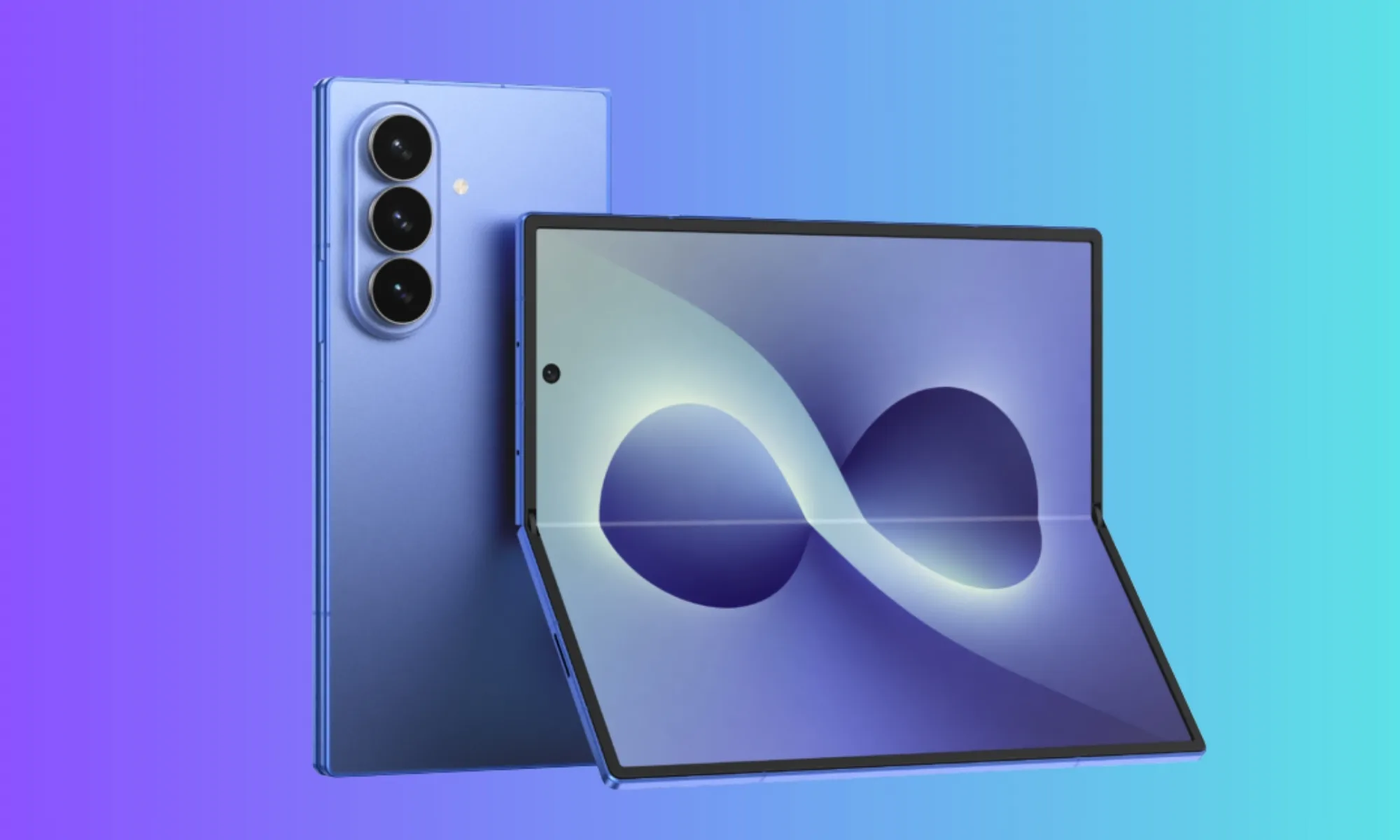
Samsung has confirmed its next Galaxy Unpacked event for July 22, where it’s expected to unveil its next-gen foldables. Recent reports suggest the devices may be priced significantly higher in Europe compared to their predecessors. Now, a new leak claims the same could be true for the US market as well.
According to South Korean outlet SEDaily, the Galaxy Z Fold 8, AKA the Wide Fold, is expected to launch in the US at $1,899 for the 256GB model. The Galaxy Z Fold 8 Ultra, the direct successor to the Fold 7, could cost $2,099 for the same storage capacity, a $100 hike over the Fold 7’s $1,999 launch price.

This lines up with the European pricing leaked earlier this month, which put the base 256GB Ultra model at €2,199, a €100 increase over its predecessor. Although the SEDaily report doesn’t outline pricing for the other storage variants, the hike is expected to be steeper for those models.
The price hike is likely tied to the ongoing memory shortage, though Samsung is reportedly still “conducting a final review of its pricing plan,” meaning the final figures could shift by the July 22 launch.
To offset the price increase, Samsung is reportedly leaning heavily on software upgrades for the upcoming models. The Galaxy Z Fold 8, Fold 8 Ultra, and Flip 8 could be the first from the company to launch with One UI 9.0 and Gemini Intelligence, Google’s new AI system that can carry out tasks across multiple apps.
While the report doesn’t offer pricing details for the Flip 8, it echoes earlier reports suggesting the device could ship with a Qualcomm chip in select regions and Samsung’s own Exynos chip elsewhere. Samsung has not confirmed anything officially, so it’s best to take this information with a grain of salt until the company takes the stage on July 22.
Microsoft says Windows users should expect to see an increase in security updates as the company increasingly relies on artificial intelligence to discover vulnerabilities in its codebase.
In a blog post published today, Microsoft said advances in AI have significantly accelerated vulnerability discovery, allowing engineers to identify more security issues before they can be exploited in zero-day attacks.
“The pace of vulnerability discovery is changing with advances in AI making it possible to find more issues, faster, across more code, with new mechanisms that can accelerate both discovery and analysis,” Microsoft said.

As part of this approach, the company is using Microsoft Security’s multi-model agentic scanning harness (MDASH), an AI-powered vulnerability discovery system previously detailed by Microsoft, which scans critical binaries and validates potential vulnerabilities using multiple AI models.
Microsoft says the system scans critical Windows binaries for vulnerabilities and then validates the findings using multiple AI models. Vulnerability candidates are then passed through a second Windows-specific validation pipeline designed to eliminate false positives before engineers investigate the issues.
The company says it is also using AI to help engineers understand failures more quickly, suggest possible bug fixes, and identify similar bugs elsewhere in the Windows source code. However, Microsoft says human engineers will still oversee and review all proposed code and validate fixes before they are released into production.
Microsoft says the increased use of AI for vulnerability discovery means customers are likely to see more security updates to address newly discovered vulnerabilities in each monthly Patch Tuesday release.
“As AI helps defenders discover more issues, customers will see a higher volume of security updates included in each security release,” says Microsoft.
Artificial intelligence is used not only to find and fix vulnerabilities but also by threat actors to power their attacks and exploit zero-day flaws before they are fixed.
Due to this, Microsoft also announced today that it is updating its Secure Development Lifecycle (SDL) practices to account for AI-enabled attack techniques and to use AI earlier in the software development process to identify security issues before features are released.
This announcement comes two days after Reuters reported that the U.S. Cybersecurity and Infrastructure Security Agency (CISA) has begun using Anthropic’s Fable AI model to scan government software for vulnerabilities that cybercriminals or foreign intelligence services could exploit.
According to the report, the AI-assisted code audits have already uncovered numerous vulnerabilities, though officials did not disclose how many or provide details on their severity.

Security teams log 54% of successful attacks and alert on just 14%. The rest move through your environment unseen.
The Picus whitepaper shows how breach and attack simulation tests your SIEM and EDR rules so threats stop slipping by detection.


A new data-extortion group called Helix is using identity-focused tactics such as voice phishing (vishing), device code phishing, and multi-factor authentication (MFA) abuse to steal data from SharePoint environments.
Initial contact is made through vishing. In some cases, the threat actor called employees while impersonating their manager, using either the manager’s name or caller ID spoofing to appear legitimate.
The purpose is to trick the target into device-code phishing schemes to gain access to their accounts.
Once inside, Helix operators quickly register a new multi-factor authenticator app for persistence, then browse and enumerate SharePoint before exfiltrating files.
According to researchers at cybersecurity firm ReliaQuest, the stolen data is typically used to extort victim organizations by threatening to publish it unless a ransom is paid, or it is sold to other cybercriminals.
The SharePoint exfiltration behavior is Helix’s strongest technical fingerprint.
“Automated enumeration and collection were identical across incidents and represent the most reliable fingerprint. Enumeration ran from 179.43.185[.]230 using the python-requests/2.28.1 user-agent,” the researchers note.
“The operator issued contentclass:STS_Site and wildcard (*) SharePoint searches to inventory all reachable content, then bulk-downloaded from the same IP and user-agent.”
ReliaQuest believes that Helix emerged from the ShinyHunters and BlackFile data extortion groups based on the techniques and infrastructure used, although the researchers did not find a definitive connection.
Over the past month, Medtronic, Nissan, NAIC, Kodak, Infinite Campus, and Nottingham University confirmed data breaches previously claimed by ShinyHunters.
The now defunct BlackFile data extortion group targeted organizations using identity-based attacks and social engineering before ceasing operations in April.
ReliaQuest’s research found that one Helix attack used an exfiltration IP address in the same autonomous system (AS 51852) that hosted a confirmed BlackFile IP address, suggesting shared resources.
Additionally, Helix emerging shortly after BlackFile shut down may indicate a potential continuation of the extinct operation. ReliaQuest also mentions Pink and Redact as potential successors.
Concerning the link to ShinyHunters, Helix demonstrates a very similar social engineering playbook, including vishing, employee impersonation, targeting Microsoft 365, and stealing SharePoint data.
A second clue is the use of the NICENIC registrar, which has also been seen in past ShinyHunters campaigns.
As a highest-impact defensive measure against Helix attacks, the researchers recommend that device code authentication be disabled where possible.
Other recommendations include restricting SharePoint access to only managed devices and blocking exchanges with newly registered domains, which Helix typically uses in its attacks.
Security teams log 54% of successful attacks and alert on just 14%. The rest move through your environment unseen.
The Picus whitepaper shows how breach and attack simulation tests your SIEM and EDR rules so threats stop slipping by detection.

A 21% price drop on the Pixel 9 Pro XL brings one of Google’s most powerful Pixels to its lowest recorded price.
The Google Pixel 9 Pro XL is now $649, down from $823.99, and will save you 21% on a phone whose triple-lens camera system with pro controls and 20x Super Res Zoom Video already made the full asking price easy to justify.
Under $650 and at an all‑time low, the Pixel 9 Pro XL is a worthwhile discount for a dependable phone
Dropping to an all‑time low below $650, the Pixel 9 Pro XL becomes an easy, great‑value pick if you want a phone that simply performs.

The 50MP main sensor works alongside telephoto and ultrawide lenses to give you manual control over shutter speed and focus, which means you can shoot in conditions where most phone cameras would leave you stuck on auto and hoping for the best.
Video is where the Pixel 9 Pro XL separates itself most clearly, with Super Res Zoom capturing smooth and detailed footage at up to 20x magnification, where Video Boost enhancing your recordings to 8K resolution through Google’s cloud processing.
Low light no longer means settling for grainy or washed-out footage either, because Night Sight Video produces sharp and richly detailed clips in darker environments like restaurants, evening street scenes, and nighttime skylines without drowning everything in harsh artificial brightness.
Google’s AI tools extend that camera confidence into editing as well, with Magic Editor letting you reframe and reimagine your shots after the fact while Add Me ensures the photographer never gets left out of group photos by swapping them into the frame.
All of that runs on the Tensor G4 chip with 16GB of RAM behind a 6.8-inch Super Actua display running at 120Hz, and the 5060mAh battery comfortably delivers a full day of heavy use without needing to reach for a charger.
Google backs the phone with seven years of OS and security updates too, which means that at 21% off and sitting at an all-time low price, this is a handset built to comfortably outlast the contract you buy it on.
That kind of longevity puts it near the top of an already strong lineup, and our guide to the best Google Pixel phones ranks the full range by performance, camera, and value if you want to see how the rest compare.
The Pixel 9 Pro XL is one of the most exciting Pixels in a long time; it not only sports a desperately-needed design refresh, but a boost to the auxiliary camera lenses, all-day battery life and a huge focus on GenAI allows it to stand out from the competition.
Redesigned chassis looks way more modern
Holistic, genuinely helpful approach to AI
Amazing photo and video capabilities
All-day battery life
Second price hike in two years
Can get hot when gaming
Tensor G4 isn’t much more powerful than the G3
SQUIRREL_PLAYLIST_10148964


The United States Navy’s main mission is to protect the country at sea, including deterring opponents from attacking the United States, intelligence gathering with units like the Secret Service, and maritime security. As conflict continues around the world and other naval powers deploy additional warships, the U.S. Navy has announced an aggressive shipbuilding plan to expand its fleet in hopes of maintaining its enormous naval forces. In fact, the U.S. has such a large naval presence that there are restrictions on how close another ship can get to a Navy vessel at sea.
Certain areas of the country are designated as Naval Vessel Protection Zones, and they have strict regulations in place to prevent incoming attacks and security threats. In these zones, boats cannot get within 100 yards of a U.S. Navy ship. Additionally, boats must operate at a minimum speed if they pass within even 500 yards from a U.S. Navy ship. This means boats must proceed with their “bare steerageway,” which is the minimum speed at which a boat can still turn properly. In either case, a boat must contact naval authorities in order to proceed.
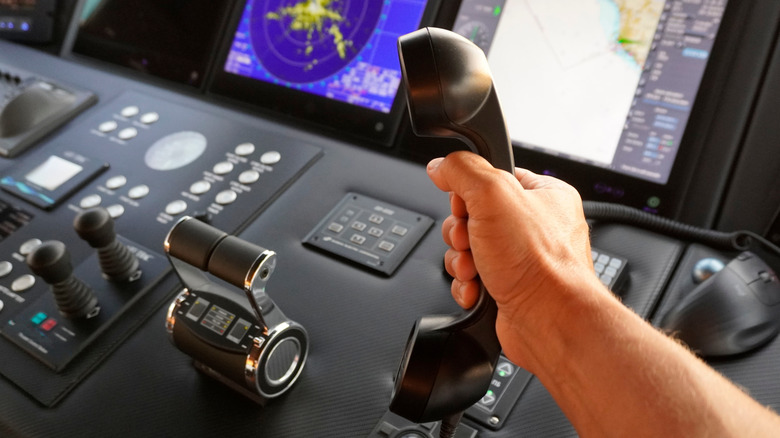
It’s not always possible to keep a safe distance from a U.S. Navy ship within a Naval Vessel Protection Zone. If a boat does pass within 500 yards, it can only proceed once it has contacted the commanding officer or official patrol, and they have given the green light.
If you must go within 100 yards of the ship, you have to contact the ship or the Coast Guard’s escort vessel service, specifically on Channel 16 on a VHF (very high frequency) radio. While this is the designated international hailing and distress channel, military vessels may not be actively monitoring. On your end, hail them a single time, let them know you need to pass through, and await their response.
Violating these regulations in the Naval Vessel Protection Zone is considered a felony offense and is punishable by up to six years in prison and/or up to $250,000 in fines. It’s worth noting, as well, that the U.S. Navy is authorized to protect its vessels in certain situations if a threat is identified.
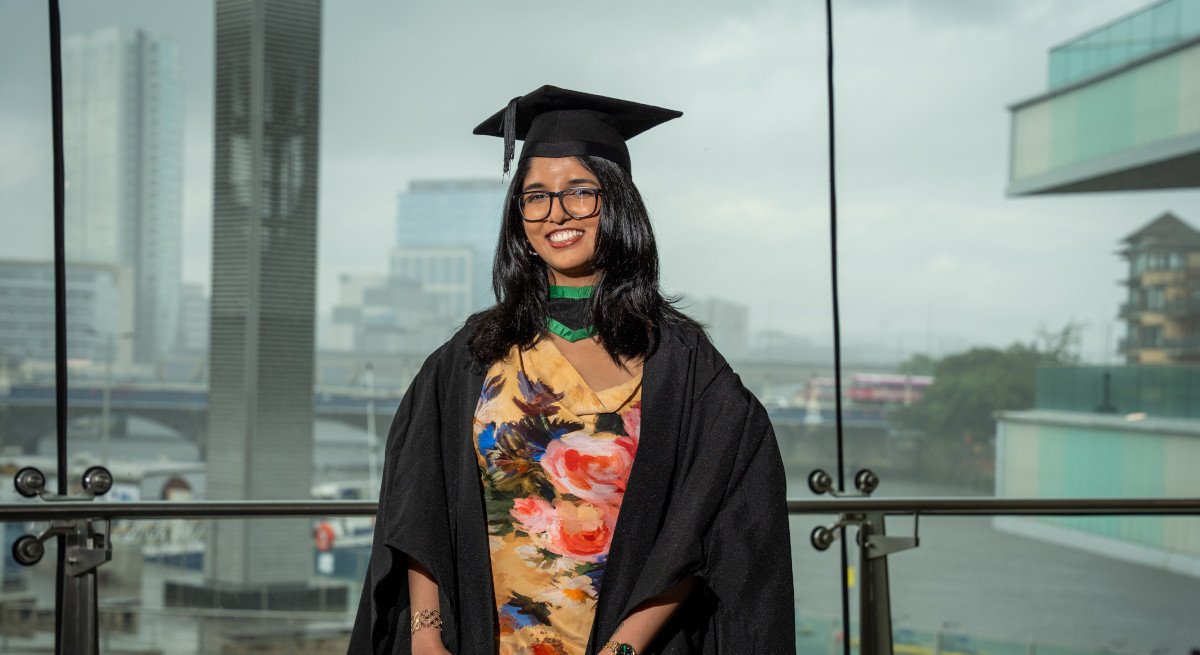

Harsha Koorimannil Valiyamannil discusses the factors that influenced her love of computer science, the leap of faith that brought her from India to Belfast and what the future holds for her.
“I wasn’t one of the kids who grew up coding, but I have always loved a good puzzle”, said Harsha Koorimannil Valiyamannil, a recent computer science graduate who left Ulster University with first class honours and a lengthy list of achievements.
Koorimannil Valiyamannil told SiliconRepublic.com, “I enjoy spotting patterns and figuring out how things work, so when it came to choosing a path, computing science felt like a natural fit for how my brain works. I knew I would enjoy the logical side of it, but what surprised me most was how much room there is for creativity.”
She previously studied animation and graphic design in her native Kerala, India and had always shown an aptitude for maths, so with all of that combined, it made sense to her that she would look to develop a lifestyle and career that merged her skills and interests.
She believes her artistic background has greatly shaped the way she approaches problems, enabling her to experiment, look at things from multiple different perspectives and communicate ideas in ways that resonate with people.
“I loved that computing gave me a highly practical toolkit to merge problem-solving with creative design and build tangible things people can actually experience.
“That is what continues to drive my career path. I want to build accessible technology that goes beyond just being functional. I believe the best solutions are the ones that understand the people using them, consider their needs and make their everyday experiences genuinely better.”
Perhaps surprisingly, Koorimannil Valiyamannil noted, making the career switch – despite the significant personal and professional commitment it took to achieve – did not feel like a drastic move. Having spent some time working with design software, eventually she began to ask herself, ‘If I built this, what would I add?’ or, ‘How could I make this better?’
A background in graphic design and design theory had trained her to consider viewpoints from the user’s perspective, and she found herself constantly analysing what was missing from an experience and how small decisions completely transform the way someone interacts with a product.
“After a while, I realised I wanted to do more than just create the visuals. I wanted to understand the technology behind them and have the technical skills to build the software itself. Computer science gave me the tools to turn my ideas into working products and I knew pretty quickly that this was the exact direction I wanted to take my career.”
To realise her goals, Koorimannil Valiyamannil made the decision to relocate from Kerala to Belfast, in a move that, while bittersweet at points, was exactly the experience she felt was needed. She explained that circumstances at home did not allow for much independence and she wanted the opportunity to build a life entirely on her own terms.
“Here, I have learned how to chase opportunities without having to worry or hold back. Even something as simple as spending late nights studying in the library felt like an entirely new kind of freedom,” she said. “The initial isolation was the hardest part, but it pushed me to step out of my comfort zone and reach out.
“Over time, I became much more confident putting myself forward and started having the courage to try things I would never have considered before. Now, the people I have met have become a massive part of my journey. Building that solid foundation of friendships is what helped me turn a completely unfamiliar place into my own.”
As her confidence grew, so too did her desire to have a genuine impact on the world around her. She had noticed that the Women in STEM Society was no longer active at Ulster University in Belfast – an issue she remedied alongside three like-minded peers.
“We wanted to rebuild a community where students could connect and feel supported throughout their journey in STEM,” she said. “While we started with smaller events to bring people together, we also wanted to create something that would have a wider impact, which led us to making the Hack4Health Hackathon our main goal. “
As the society secretary, she used her design background to create branding and promotional materials for both Women in STEM and the hackathon, supported outreach efforts, and worked with the wider team to contact organisations and secure sponsorship.
“Rebuilding the society and pulling off an event of that scale was a massive amount of work. It was a crash course in the logistics of community building. It also proved that we could actually execute ambitious ideas from the ground up just by stepping up and trying.”
If Koorimannil Valiyamannil’s experiences have taught her anything, it is that often you have to be the architect of your own dreams, but sometimes, you need to be the person helping to lift up others alongside you.
“Throughout my journey, I have benefited from people who encouraged me, and I want to do the same for others,” she said. “I am incredibly excited about this opportunity to learn from the people around me, share what I have learned and use my skills to build up my community.”
With that in mind, she plans to build a career in technology that creates a positive social impact. Her biggest focus right now, she explained, is on ethical technology and digital accessibility. “I want to build solutions that actively break down digital barriers and ensure no one gets left behind.”
She added, “I am excited to explore the different directions my career could take, but my core goal remains exactly the same. I want to keep learning, keep building, and use my skills to create inclusive and human-centred tech.”
Don’t miss out on the knowledge you need to succeed. Sign up for the Daily Brief, Silicon Republic’s digest of need-to-know sci-tech news.
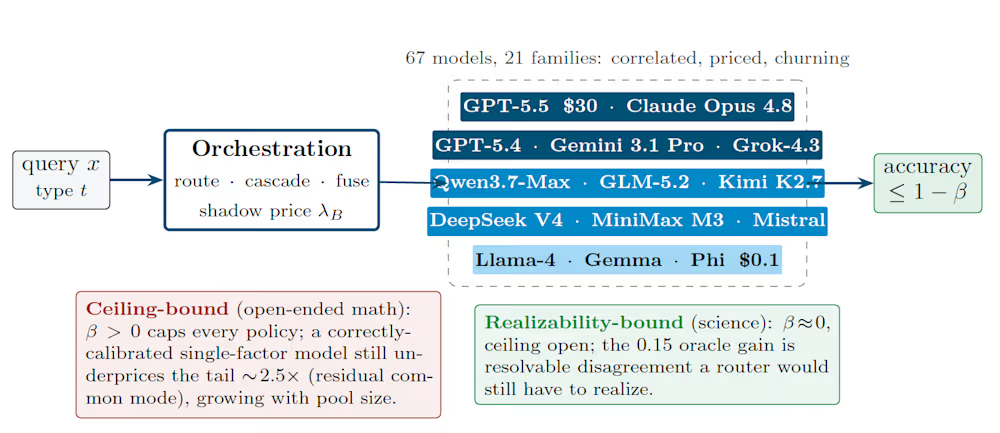
A team routing queries across a coding specialist, a logic specialist, and a generalist model assumes each will cover the others’ blind spots. A new study evaluating 67 frontier models from 21 providers shows that assumption is mathematically flawed — and the flaw has a name: the co-failure ceiling.
The assumption works like this: as long as two models don’t usually fail on the exact same prompts, combining them is supposed to create a safety net against failures.
The real limit on orchestration is not how often models disagree, but the percentage of prompts where every model in the pool gives the wrong answer at once. By ignoring the co-failure ceiling, enterprises are building complex, expensive routing infrastructure to chase performance gains that do not exist. Fortunately, developers can use this same math to build a cost-free test that determines exactly when multi-model orchestration will actually pay off.
To orchestrate multiple language models, developers typically rely on three architectures. Model routers act as traffic cops, sending complex queries to expensive models and simple queries to cheaper ones. Cascades send every prompt to a cheap model first, only escalating to a premium model if the initial system signals low confidence. Finally, approaches like Mixture-of-Agents (MoA) fuse multiple models by asking them the same question and generating a synthesized answer from their combined outputs.
These architectures introduce a “shadow price” to inference costs. Every time a development team implements a router or a cascade, they pay a premium in added system latency, complex infrastructure maintenance, and increased governance risks across multiple API providers.
To justify these operational costs, engineers rely on “pairwise error correlation” to select their model pool. Imagine a developer has Model A, which writes excellent Python but fails at SQL, and Model B, which writes excellent SQL but fails at Python. Because they fail on different types of prompts, their pairwise error correlation is low. The developer assumes that by placing a routing layer in front of them, they have created a composite system that rarely fails at coding.
According to the study, throwing diverse models together based on low correlation can actually hurt performance if the models are not equally capable — when you vote across diverse but unequal models, the weaker ones often gang up and outvote the smartest one.
Josef Chen, author of the paper, told VentureBeat that in their experiments, “Naive majority voting across unequal models had negative mean gain (minus 10 points on our hard mix): diverse-but-weaker members outvote the strong one.” The actionable advice for developers is to “combine only models within a matched quality band.” If you cannot match quality, take the single-model baseline and spend your budget on the best model available.
The paper provides one bright spot for this approach regarding MoA architectures. When building ensembles, teams often use “Self-MoA,” where they query the same premium model multiple times to generate a synthesized answer. The researchers found that at matched quality, building a diverse ensemble of models with low pairwise correlation beats a high-correlation Self-MoA setup.
However, when teams use that same pairwise correlation metric to predict the absolute accuracy of their overall system, the math breaks down.
“So teams pay the orchestration overhead up front (latency, complexity, multi-provider operations) on the assumption that a diversity dividend arrives later,” Chen said. “Usually it doesn’t, because today’s best models agree, and, worse, they fail on the same queries … the prompt simply carries little signal about which model will be the one that’s right when the frontier disagrees.”
The core finding of the study centers on a metric called the “co-failure rate” — the formal name for the all-wrong scenario described above. No router, voting system, or cascade can ever achieve an accuracy higher than the ceiling it imposes.
The coding, logic, and generalist pool shows low pairwise correlation on routine prompts — they rarely fail together. But the co-failure ceiling represents the obscure, highly complex edge case that pushes past the limits of current AI architectures. If a prompt is so difficult that all three models hallucinate or fail, it does not matter how intelligently the router distributes the task. The entire pool wipes out at once.
The researchers tested their 67-model pool, which included GPT-5.5, Claude Opus 4.8, and Gemini 3.1 Pro, on the open-ended MATH-500 math benchmark. Based on standard pairwise correlation, statistical models predicted that the entire pool would wipe out simultaneously on only 2.3% of the questions. In reality, the co-failure rate was 5.2%.

Standard correlation metrics underestimated the failure rate by roughly 2.25 times. The culprit is not just independent difficulty, but a shared failure point.
“The driver is what we call a common-mode atom: a slice of queries on which the entire market fails together, which no pairwise statistic can see,” Chen said. “Adding a 20th model to your pool doesn’t buy tail coverage. The tail is shared.”
The researchers also found that task format directly triggers co-failure. When they took graduate-level science questions from the GPQA benchmark and changed them from multiple-choice to free-response formats, the all-wrong tail expanded to 12.7%.
Developers can engineer around the ceiling, though. “The engineering implication is uncomfortable: multi-model setups buy the least exactly where teams want them most, on open-ended generation,” Chen said. “Anywhere you can convert generation into verification or constrained selection (structured outputs, checkable answers, execution tests), you reopen the ceiling.”
Ultimately, the researchers found this ceiling limits AI applications in two distinct ways, depending on the domain:
Ceiling-bound environments (e.g., open-ended math): The co-failure rate is high. The task is too hard, and all models fail simultaneously. No amount of routing can bypass the lack of underlying capability.
Realizability-bound environments (e.g., graduate-level science): The co-failure rate is near zero, meaning at least one model in the pool usually knows the answer. However, the models disagree so subtly that a routing layer cannot reliably pick the correct answer without an omniscient oracle.
Before dedicating engineering hours to building a router, teams can calculate their absolute performance ceiling for free using a mathematical formula called a Clopper-Pearson bound.
The Clopper-Pearson bound operates as a worst-case scenario calculator. If you flip a coin ten times and get eight heads, you cannot guarantee the coin will land on heads 80% of the time forever. The bound takes a small sample of test questions and outputs a mathematically guaranteed ceiling.
Applied to language models, suppose a team tests a pool of five agents on 50 sample queries and finds they all fail together on just two questions. A developer might assume their multi-agent system will achieve 96% accuracy in production. The Clopper-Pearson formula corrects this optimism. It analyzes the small sample size and provides a mathematical guarantee that the true co-failure rate could actually be as high as 12%.
To use this in practice, enterprises must build a held-out dataset. A fintech company, for example, could take 200 complex customer support tickets from the previous quarter and have human agents write perfect resolutions to serve as a benchmark. While this sounds like a heavy manual project, mature engineering teams can automate the entire ceiling calculation.
“Integration is trivial: it’s a counting job over eval logs teams already produce,” Chen notes, “so it runs in the same CI stage as the eval suite and re-triggers whenever the model pool or the workload changes.”
The engineering team then runs its candidate models against these 200 tickets once and records the results. When they want to evaluate multi-model configurations, they can use the co-failure rate measure to predict the maximum accuracy they can get from the system without running extra queries.
One important conclusion the study draws is that on tasks where answers can be definitively checked, combining models rarely beats using the single best model on the market, unless the team possesses an exceptionally strong query-level routing signal.
In an enterprise environment, a definitively checked task has an objective, zero-tolerance answer. This includes generating a SQL query that must execute without error, extracting a specific invoice total from a 50-page PDF, or formatting a JSON payload that perfectly matches a strict schema. For these tasks, enterprises are usually better off paying a premium for the smartest frontier model rather than weaving together three cheaper models and hoping a router picks the correct output. The study didn’t test subjective, ungraded tasks like drafting marketing copy — the authors note that whether these findings hold outside their verifiable benchmarks remains an open question.
Because this mathematical check is free, enterprise teams can track their own co-failure rates as new models drop.
“The measurement costs nothing, so any team can track its own co-failure rate across model generations and watch whether the tail is closing,” says Chen. Ultimately, “the lever buyers hold is failure-mode heterogeneity and market churn, not model count.”

For the Emperor: After a few turbulent years and multiple ownership changes, Saber Interactive is now in great shape. The Florida-based studio owes its resurgence to one particular Warhammer title, which, according to Chief Creative Officer Tim Willits, made the company almost too successful for its own good.
Since Warhammer 40,000: Space Marine 2 sold millions of copies, Saber Interactive has become one of the most in-demand studios for building new games around established IPs – so in demand, according to Willits, that the company has had to turn down several high-profile productions. It’s a good problem to have, as Willits himself acknowledged.
Space Marine 2 is the well-received sequel to 2011’s Warhammer 40,000: Space Marine, a hack-and-slash shooter developed by Relic Entertainment and published by THQ. The game once again follows the Adeptus Astartes, a brotherhood of superhuman warriors tasked with enforcing the Emperor of Mankind’s rule over a chaos-ridden galaxy full of hostile races. Released in 2024 for PC and current-gen consoles, Space Marine 2 has gone on to become one of the franchise’s biggest hits, reaching more than 12 million players as of early 2026. Saber has continued supporting the game with regular content drops, including the recently released Purgation Update.
The Warhammer 40,000 universe is enjoying a resurgence of sorts, particularly in video games, and Willits said Space Marine 2 changed everything for Saber, forcing the studio to rethink how it makes games. The title also changed how the industry views the company, which now has a reputation for delivering strong results with licensed IPs.
“And because we have a reputation of really doing well with licensed IPs, every major license holder wants to make a video game. It’s just the way it is. Everybody,” Willits said in a recent interview.
Saber’s CCO said the studio had to pass on a particularly enticing business proposal, though he declined to name the franchise involved. Thanks to Space Marine 2 and other successful releases, Saber is now apparently able to deliver AAA-caliber games without needing a “true” triple-A budget. That’s a massive win and advantage at a time when the industry at large is cutting thousands of jobs while trying to improve profitability.
Saber currently manages several studios and employs around 3,500 people, and the company says it’s still looking for growth opportunities. It’s working on numerous IP-based projects, including Clive Barker’s Hellraiser: Revival, a remastered Hitman Classic Trilogy, and Turok: Origins, among others. Space Marine 3 has also been confirmed and is now in development, following the sequel’s outsized success.
Willits thinks the industry will weather today’s chaos, and that creative people will continue finding ways to make great entertainment despite everything.


A group of news publishers has asked a federal judge to impose sanctions on OpenAI. The New York Times, the Daily News, and others allege the ChatGPT maker is concealing evidence central to their copyright case, the Associated Press reports.
A filing on Thursday in Manhattan federal court claims OpenAI “chose obstruction” over handing over datasets and ChatGPT logs. Those records could show how the system used copyrighted news content to train.
The publishers accuse OpenAI of “discovery misconduct”, saying a recent deposition of an OpenAI employee contradicts the company’s earlier claims. Daily News lawyer Steven Lieberman said OpenAI had spent two years “making misrepresentations” about its ability to search its training data.
The motion asks the court to punish OpenAI for hiding and destroying evidence, in Lieberman’s words. OpenAI did not immediately respond to a request for comment.
The stakes reach well beyond one filing. The Times sued OpenAI and Microsoft in late 2023, and has since been joined by a wave of other newspapers, alongside Ziff Davis and the Center for Investigative Reporting.
At the heart of the fight is a simple question with no settled answer. OpenAI argues that training AI on public writing is protected by copyright’s “fair use” doctrine, a defence being tested in dozens of suits from artists, novelists, and music labels.
The Times frames it differently, as unfair competition. It says AI firms free-ride on its costly journalism to build “substitutive” products that answer readers without sending them, or ad money, back to the source.
That threat sharpened when AI-generated search answers began cutting publisher traffic. Courts are only starting to weigh in, with a German court finding Google liable for its AI Overviews.
The litigation is expensive. The Times says it has spent more than $28m fighting AI companies, including a separate suit against Perplexity, and now wants OpenAI to cover fees for chasing withheld evidence.
There is a benchmark for what losing can cost. Anthropic agreed to pay book authors $1.5bn, roughly $3,000 per work, a landmark sum that still amounts to a sliver of its valuation.
Not everyone is suing, though. Many outlets have signed licensing deals with AI firms, and even Getty Images struck a pact with a company it had sued, while regulators pursue their own remedies, such as France’s €250m fine against Google.
That split, sue or license, is the industry’s central bet on its own future. A sanctions ruling against OpenAI would not settle the copyright question, but it could hand publishers leverage they have so far struggled to find.

Fidji Simo, OpenAI’s No. 2 executive, is stepping down from her full-time role, the Wall Street Journal reports.
In a staff note Thursday, Simo said her ongoing medical leave has proven longer and harder than expected, and that she’ll transition to a part-time advisory role instead. Simo joined OpenAI’s board of directors in 2024 and joined OpenAI in May 2025 as CEO of Applications, then a newly created role reporting directly to Sam Altman that consolidated the company’s business and product operations.
Her appointment came with a broader reporting shift: COO Brad Lightcap, CFO Sarah Friar, and CPO Kevin Weil all began reporting to her, while Altman stepped back to focus on research, compute, and safety.
Simo first disclosed her health issues in April, when she announced she was taking medical leave for a relapse of a neuroimmune condition; that same memo publicly announced that Lightcap was moving into a new “special projects” role and that CMO Kate Rouch was leaving the company to focus on cancer recovery. Weil has since left the company, too.
Simo came to OpenAI from Instacart, where she’d been CEO since 2021 and led the company through its 2023 IPO, and before that spent over a decade at Meta, including running the Facebook app.
Simo’s decision to step back permanently leaves Altman searching for a successor right as OpenAI itself eyes a possible IPO. She’d been widely seen as a likely candidate to take on even more responsibility once OpenAI went public, making this a real vacuum for him to address.
Simo was primarily focused on growing OpenAI’s consumer business. But ChatGPT’s growth cooled late last year, missing internal revenue targets, pushing the company to lean harder into coding tools instead, an area where it has been, and for now continues to be, trailing Anthropic.
TechCrunch has reached out to OpenAI for more information.
Soon after the Journal story broke, Simo shared the news directly on X, after which Altman responded, also on X: “i am really sad about this and very grateful for all fidji has done for openai, and even grateful for her friendship and who she is as a person. we all wish her the best for a speedy recovery. this sucks.”
Simo’s announcement lands on a busy news day for OpenAI. Earlier Thursday, the company launched its new GPT-5.6 family of models — Sol, Terra, and Luna — alongside a new agent called ChatGPT Work, designed to handle multistep office tasks like drafting documents, spreadsheets, and presentations. Both releases were framed by OpenAI as directly targeting Anthropic.
OpenAI’s executive ranks appear from the outside to be on the thin side for a company that was most recently assigned an $852 billion valuation. In addition to Altman, Lightcap, Friar, and co-founder Greg Brockman (who is also the company’s president and was overseeing product strategy while Simo was out), its bench includes Denise Dresser, who in December joined as the company’s chief revenue officer, overseeing its “global revenue strategy across enterprise and customer success,” per a release at the time.
It wouldn’t be shocking to see Dresser take on a more expansive role, given she previously spent two years as the CEO of Slack and, before that, spent 14 years with Slack’s parent company, Salesforce.
Simo’s departure comes against another backdrop worth understanding: OpenAI’s shifting approach to employee equity. In April of last year, the same month that Simo joined, the company shortened its vesting cliff — the waiting period before new hires’ stock grants begin vesting — from the industry-standard 12 months to 6 months. Then in December, OpenAI eliminated the cliff altogether for new hires, letting equity start vesting from day one.
The move, described internally by Simo as a way to let employees “take risks” without fear of losing equity if let go early, came amid an escalating AI talent war and reflects just how aggressively OpenAI has been spending to retain staff. The company was projected to spend $6 billion on stock-based compensation in 2025 alone.
None of the aforementioned exits appear tied to compensation. Executive equity packages are typically negotiated individually and could have entirely different vesting terms.
When you purchase through links in our articles, we may earn a small commission. This doesn’t affect our editorial independence.




Weekend Open Thread: High Hopes

Taylor Swift and Travis Kelce wedding staffer hilariously struggles to keep her cool while checking in megastars


Standard Chartered Secures MiCA License as ESMA Adds 37 New Crypto Firms


Open Thread: What Great Books Have You Read Recently?


The House | “Reframing the debate from a binary discussion of winners and losers”: Yuan Yang reviews ‘We Are Not Machines’


Loro Piana Fall 2026 Enters Houston’s Art Scene


Whats Hidden Inside This Cash Register? #treasure #reselling #money
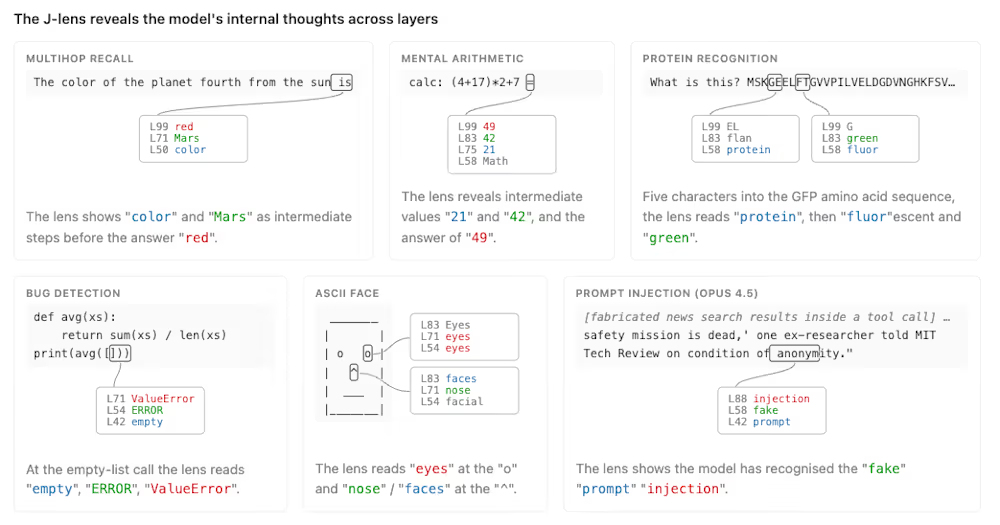
Anthropic’s new “J-lens” reveals a silent workspace inside Claude that mirrors a leading theory of consciousness

ESMA Expands Crypto Register by 37 Firms Following MiCA Transition Period


AXT Shares Jump Nearly 14% as Semiconductor Materials Maker Rebounds on AI-Linked Indium Phosphide Demand


Joshua Pacio ‘more complete’ ahead of ONE rematch vs Malachiev


South Africa proposes crypto tax guidance under existing rules
SK hynix (000660.KS) Stock Dips as $28B Nasdaq ADR Offering Drives AI Memory Expansion


Best Time to Enter Small Caps Right Now? Another Bull Run? | Financially Free


Lenovo laptops are now shipping with YMTC SSDs, a sign of Chinese NAND entering the mainstream
We have punished the disrespect


Avoid entering in FOMO #bitcoin #cryptocurrency #trading #scalping


Alibaba bans Claude Code over alleged backdoor security concerns

Neuralink Threads Its Way Straight Through the Brain’s Armor


Anthropic brings Claude Cowork to mobile and web as usage data shows most users aren’t coding


You must be logged in to post a comment Login