It’s a busy time for the reviews team and Engadget, and with Apple announcing new devices this week, we aren’t letting up any time soon. New products from Samsung, Dell, Google and ASUS headline the roundup this time, and we’ve got a few unique items to discuss as well. Read on to catch up on anything you might’ve missed, including the latest installment of Pokémon.
Samsung Galaxy S26 Ultra
Samsung / Engadget
While the S26 Ultra might not wow you with a ton of major improvements, it brings subtle upgrades across the board along with a new standout display for anyone who cares about privacy.
Pros
Advertisement
Superb Privacy Display
Great performance
Strong battery life
Wider aperture for main and 5x telephoto lenses
Cons
Expensive
S-Pen is unchanged
No built-in magnetic ring for Qi2 accessories
This year’s Samsung flagship phone may not impress you with a load of new features, but there’s one in particular that senior reporter Sam Rutherford was wowed by. “This goes double for the S26 Ultra, whose biggest upgrade — the Privacy Display — is something meant to stop other people from snooping at what you’re doing.,” he said. “When it’s on, you probably won’t even be able to tell, which is kind of the point.”
Samsung Galaxy Buds 4 and 4 Pro
Samsung/Engadget
The Galaxy Buds 4 Pro are the best earbuds for Samsung’s phones, due to device-specific features and the combination of great sound quality and capable ANC.
Pros
Refined design
Excellent audio
Lots of features
Cons
Design is still unoriginal
ANC performance is good, not great
Many features require a Samsung phone
Samsung went all-in with with AirPods mimicry last year, and that continues on the Galaxy Buds 4 and 4 Pro. However, despite big improvements to sound quality and the continued addition of new features, Samsung could certainly do more. “The company is really only lagging behind Apple in two areas: hearing health and heart-rate tracking,” I wrote. “Samsung currently offers the option to amplify voices on its earbuds, but it hasn’t built a hearing test or the hearing protection tools Apple has. The biggest update on the AirPods Pro 3 was the addition of heart-rate tracking last year, which would be a great foundation for a fitness-focused version of the Galaxy Buds.”
Dell XPS 14 (2026)
Dell
Advertisement
Dell’s revamped XPS 14 is lighter and more powerful than ever, but it’s hampered by an annoying keyboard.
Pros
Gorgeous and light design
Powerful Intel chips
Lovely OLED screen
Fixes previous design mistakes
Cons
Baffling keyboard issues
Expensive for beefy configs
Mediocre battery life
We review a lot of devices that are almost excellent, except for one big flaw. That’s the case with the new XPS 14, where senior reporter Devindra Hardawar had a hard time with very basic functionality. “If I were to judge the XPS 14 based purely on its specs and design alone, it would be my favorite Windows laptop available today,” he wrote. “Dell is so close to making a PC that’s a true MacBook Pro competitor, it’s a shame a simple keyboard issue holds the XPS 14 back from true greatness.”
Google Pixel 10a
Google / Engadget
Despite few upgrades, the Pixel 10a remains an excellent option for those looking for an affordable smartphone.
Advertisement
Pros
Bright, vivid 120Hz display
Great camera software
Satellite SOS included
Available in a handful of lovely colors
Cons
Slow wired and wireless charging
No Pixelsnap support
Google’s A-series devices have consistently been a great option if you’re looking to spend less on phone but still want a capable handset. Despite minimal upgrades on the Pixel 10a, that sentiment still holds true. “On the one hand, part of me wants to dock points because Google has added so few updates,” senior reporter Igor Bonifacic said. “On the other, the 10a is still a great phone for $500, and at a time when consumer electronics are becoming more expensive by the day, the fact it hasn’t gone up in price is a small miracle.”
ASUS ProArt GoPro Edition PX13
ASUS/Engadget
The ASUS ProArt GoPro Edition is the best Windows creator laptop on the market, thanks to the excellent blend of performance and battery life. However, it’s quite expensive at $3,000.
Advertisement
Pros
Excellent performance
Good battery life
OLED touchscreen with accurate colors and rich blacks
Good keyboard and trackpad
Cons
Display lacks brightness
High price
Fans are loud under load
Creators often need a combination of power and display quality in a laptop that would be overkill for most of us. For those who do need it, contributing reporter Steven Dent found the ASUS ProArt GoPro Edition PX13 nearly checked all the boxes. “ASUS is one of the few PC manufacturers trying to compete with Apple in the creator market, and with the ProArt GoPro Edition laptop, it has largely succeeded,” he said. “This model offers excellent performance and battery life, a huge amount of memory, a very nice OLED HDR display, a nice range of ports and an excellent keyboard and trackpad.”
Ambient Dreamie, Seattle Ultrasonics and more
We also recently reviewed a couple of off-beat gadgets, both of which earned high marks from our team. The Ambient Dreamie is a “bedside companion” that functions as an alarm clock with both bedtime and morning routines. Weekend editor Cheyenne MacDonald was so impressed by how it improved her sleep that she bought one for herself. And the Seattle Ultrasonics C-200 was dubbed “the future of kitchen knives” by Sam.
Sam also played a few hours of Pokémon Pokopia and he was charmed by the new take on gameplay for the series. Lastly, Devindra put the Falcon Northwest FragBox through its paces, discovering a powerful gaming rig in machine that looks a bit like a box of fried chicken
Attackers now rely on employees to unknowingly launch the malware themselves
Fake IT support calls transform routine troubleshooting into a full network compromise
Browser crashes become the opening move in carefully staged social engineering attacks
Cybercriminal activity continues to move away from direct software exploitation toward manipulating everyday user behavior within corporate environments, experts have warned.
New research by Huntress describes a campaign in which attackers intentionally crash a user’s browser and display alarming security messages that encourage a “repair.”
The tactic creates a false sense of urgency while allowing the attacker to initiate direct communication with the employee.
Attackers take advantage of employee confusion
In many observed cases, victims received phone calls from individuals claiming to be internal technical staff responsible for resolving the issue, giving the attacker credibility and creates pressure for the employee to cooperate with instructions that appear routine.
The entire chain begins with spam messages flooding a user’s mailbox. Soon after, a phone call arrives from someone claiming to represent “IT support”, who says the spam or browser malfunction requires immediate maintenance on the affected computer.
The deception works because victims are persuaded to perform the actions that trigger the compromise themselves.
Advertisement
Researchers explained that the attackers rely on manual user interaction rather than automated malware delivery, as victims are guided through steps such as approving remote access sessions or installing remote administration tools like AnyDesk.
Sign up to the TechRadar Pro newsletter to get all the top news, opinion, features and guidance your business needs to succeed!
In other cases, users are instructed to copy and paste commands into system prompts or execute scripts disguised as diagnostic fixes.
The attackers open a browser during remote sessions and direct victims to a fraudulent Microsoft-themed interface hosted on cloud infrastructure.
Advertisement
Victims were instructed to log into a fake “Outlook Antispam Control Panel” and download what was described as an “Antispam Patch”, but is actually a disguised archive file containing several components designed to initiate the next stage of the attack.
Once the so-called repair files were executed, the malicious chain reconstructed itself locally using a staged payload, unpacking files that appeared to resemble legitimate software components, including runtime libraries and executable utilities.
One binary named ADNotificationManager.exe triggers the next phase of the compromise after installation.
Advertisement
At this stage, attackers rely heavily on a technique known as DLL sideloading to run malicious code while legitimate applications continue operating normally.
Malicious dynamic libraries were placed beside legitimate files, allowing the malware to run without immediately triggering obvious alarms within the system.
The payload ultimately deployed a modified agent derived from the open-source command-and-control framework Havoc C2.
And “what once ended with a $300 gift card purchase now ends with a modified Havoc C2 framework burrowed into your environment.”
Advertisement
The activity is swift, in one case, the intruder expanded from the initial compromised computer to nine additional endpoints within roughly eleven hours.
Such rapid activity indicates direct operator control rather than automated malware spreading through vulnerabilities.
The attacker used remote management tools and scripted payloads to maintain persistence while moving through connected systems.
The researchers warn that the campaign reiterates how attackers increasingly depend on social interaction rather than technical flaws to bypass firewall defenses.
David Barnett has learned a lot since first launching PopSockets more than a decade ago.
As the tale goes, the former philosophy professor was looking for an easy way to hold his headphones and went on to create one of the most viral phone accessories of all time: A device that grips to the back of the phone and can be used as a kickstand or a handle — better known as the PopSockets.
Barnett sat down with Equity this week to talk about his journey building this company from his garage, why he decided to never take on traditional venture capital funding, and some of the lessons he’s learned while scaling the business.
“I was a philosophy professor, so I had no experience with manufacturing,” he recalled, adding that he also lacked experience in business, tax, accounting, and finance. “I burned through a lot of money with no revenue,” he continued, adding that he had “wave after wave of manufacturing defects” during the early days.
Advertisement
Still, he managed along and was able to land in a local toy store where he would often stop by to watch how customers interacted with his brand. “The sales were quite slow,” he said. He adjusted the Popsocket a bit, and that’s when everything started to take off. “That was the point where I thought, ‘Okay, this could work in retail.”
From there, he spoke about the hits and misses of entering retail (including a dispute he had with Amazon that briefly caused him to pull his product from the website). He spoke about adapting the product even more, protecting intellectual property, and when he knew it was time to step down as CEO and let someone else take the reins.
“The greatest lesson I’ve learned is that it’s all about the people,” he said, adding that he was looking for this trait in his successor. “I think that’s the most important skill one can have as a leader.”
UFC 326 live streams feature a headline bout that’s been more than a decade in the making. Max Holloway vs Charles Oliveira 2 is rematch from 2015 and the pair finally go head-to-head again in the Octagon at T-Mobile Arena, Las Vegas, on Saturday. The prize? To find out which one is the baddest mother in the UFC.
So much has happened in the careers of these two elite fighters since Holloway beat Oliveira via TKO on a Fight Night in Saskatchewan all those years ago. Both have enjoyed titles, taken part in infamous feuds and tasted their fair share of defeats, too, as the duo head towards the final acts of their careers. Now, Dana White has given MMA fans what they want and made this long-awaited rematch happen at last, with Holloway’s symbolic BMF title on the line.
Before the legendary lightweights go at it, there’s a typically jam-packed card gracing the T-Mobile Arena that features some of the organization’s hottest prospects. The 21-year-old Mexican Raul Rosas Jr, for example, has been tipped by some to become the UFC’s youngest ever champ. While Gregory Rodrigues and Brunno Ferreira will continue to make waves with an all-Brazilian clash in the middleweight division. You’ll find the full card at the bottom of this page.
Advertisement
Here’s where to watch UFC 326 live streams online and from anywhere with a VPN – including a clever way to watch UFC 326 for just $1.
How to watch UFC 326 live stream in the US
Exclusive US coverage of the full UFC 326 event is on Paramount Plus. It’s being headlined by Max Holloway and Charles Oliveira, which is expected to start at around 11pm ET / 8pm PT.
Plans start from only $8.99 a month with the Paramount Plus Essential Plan, or upgrade to Premium for $13.99 a month (see below for more details). You can also get a Paramount Plus trial with Walmart+ for $1 as with this sneaky trick we found.
Advertisement
While Paramount Plus will show UFC 326 in its entirety, CBS Sports will show two hours of coverage (excluding the headline bout) from 8pm ET / 5pm PT. And you can also watch the Early Prelims with the UFC Fight Pass.
This is handy piece of software that can make your device appear as if it’s back in your home country, thereby letting you unlock your usual service. The best VPN right now? We recommend NordVPN – it does everything and comes with a 74% discount and free Amazon Gift Card thrown in on some plans.
Advertisement
Using a VPN is incredibly simple:
1. Install the VPN of your choice. As we’ve said, NordVPN is our favorite.
2. Choose the location you wish to connect to in the VPN app. For instance, if you’re visiting the UK and want to view your usual US service, you’d select a United States server from the list.
Advertisement
3. Sit back and enjoy the action. Head to your usual local streaming service and watch the UFC.
How to watch UFC 326 live stream in the UK
The UFC 326 live stream is on TNT Sports 1in the UK.
You can get it by adding TNT Sports to your Sky, Virgin Media or EE TV package, or pay from £30.99 per month for a Discovery+ plan that includes TNT Sports.
Advertisement
The main card action is set to begin at 2am GMT on Sunday morning. UFC Fight Pass subscribers can also watch the Prelims and Early Prelims there.
If you’re abroad whilst the MMA live stream is on, a VPN like NordVPN can help you to access your home streaming services from anywhere.
How to watch UFC 326 live stream in Canada
There are a host of pay-per-view providers offering a UFC 326 live stream in Canada.
Advertisement
You can head to the likes of Sportsnet, Bell or the UFC Fight Pass to watch the whole event, where the PPV price is set at $69.99. Prelims will also be shown on Sportsnet and TVA Sports.
North of the border from the US? You can use NordVPN to watch your Paramount Plus subscription like you were back at home.
That means you can live stream UFC 326 via your web browser and devices like Android, iOS, Samsung TV, Apple TV, Android TV, Telstra TV and Chromecast.
You can also catch all the Prelims (but not the Holloway vs Oliveira 2 main event) via Paramount+ and free-to-air Network 10.
Downloading a VPN will help you access your subscriptions from anywhere if you’re abroad when the fight is on.
(Image credit: Getty Images / Chris Unger)
Can I watch UFC 326 for free?
Not quite. Other than the sneaky little Walmart+ for $1 trick described above in the US, there doesn’t seem to be any way to watch UFC 326 for free. It’s on Paramount Plus in the US, which no longer carries a free trial. And it’s on PPV in many other countries around the world.
Advertisement
TVNZ+ will also broadcast the early prelims for free in New Zealand if you are looking to catch the full card.
When does UFC 326 start?
The UFC 326 Main Card is scheduled to begin at 9pm ET / 6pm ET on Saturday, March 7. That’s 2am GMT or 1pm AEDT in the UK and Australia on Sunday, March 8.
Before that, the Early Prelims start at 5pm ET / 2pm PT / 10pm GMT and the Prelims at 7pm PT / 4pm PT / 12am GMT (Sun).
Can I watch UFC 326 on my mobile?
Yes. Most broadcasters have streaming services that you can access through mobile apps or via your phone’s browser – Paramount Plus, Discovery+ and Kayo Sports all have mobile apps, for example.
Advertisement
You can also stay up-to-date with the latest UFC news and plays on the official social media channels on X (@ufc), Instagram (@ufc), Facebook (UFC) TikTok (@ufc) and YouTube (@ufc).
UFC 326 full card
Main card Max Holloway vs Charles Oliveira (Lightweight) Caio Borralho vs Reinier de Ridder (Middleweight) Rob Font vs Raul Rosas Jr (Bantamweight) Drew Dober vs Michael Johnson (Lightweight) Gregory Rodrigues vs Brunno Ferreira (Middleweight)
Prelims Cody Garbrandt vs Xiao Long (Bantamweight) Donte Johnson vs Cody Brundage (Middleweight) Ricky Turcios vs Alberto Montes (Featherweight) Cody Durden vs Nyamjargal Tumendemberel (Flyweight)
Advertisement
Early prelims Sumudaerji vs Jesus Aguilar (Flyweight) Rafael Tobias vs Diyar Nurgozhay (Light Heavyweight) JeongYeong Lee vs Gaston Bolanos (Featherweight) Luke Fernandez vs Rodolfo Bellato (Light Heavyweight)
We test and review VPN services in the context of legal recreational uses. For example: 1. Accessing a service from another country (subject to the terms and conditions of that service). 2. Protecting your online security and strengthening your online privacy when abroad. We do not support or condone the illegal or malicious use of VPN services. Consuming pirated content that is paid-for is neither endorsed nor approved by Future Publishing.
There are some aircraft that will forever be associated with the U.S. Air Force. The formidable and hugely heavy C-130 Hercules transport and the swift, deadly F-22 Raptor are both iconic examples. The planes, as dramatically different as they are, each have a critical role to play in their operations for the world’s largest air force. Every model in the USAF’s repertoire is a fascinating work of aviation engineering, but there have also been some rather outlandish designs that never saw mainstream adoption.
Not every aircraft ever flown by the U.S. Air Force was intended to serve in its ranks full time. Some of these were just experimental efforts that were never intended to reach production. Others were ambitious endeavors that seemed workable on paper, but as the project continued and prototypes took to the air, it proved impractical to continue. In the interests of pursuing new technology and advancing the course of aviation, more experimental models are often flown from time to time; some of them have been truly peculiar, but despite their odd designs, have had an important part to play in the overarching story of U.S. aviation.
Advertisement
Some of the strangest aircraft the U.S. Air Force has ever flown include a Phoenix that was built to smell for nuclear attacks, a laser-wielding Boeing, and an aircraft with a unique, seemingly wingless design. Let’s take a closer look at some of these special aircraft, where they got some of their more outlandish qualities, and what ultimately happened to them. Sometimes, they were one-off curiosities that are largely forgotten, but others live on in current designs of aircraft that are still used today.
Advertisement
YAL-1 Airborne Laser Test Bed
It’s more jarring, perhaps, to see an aircraft that looks almost completely conventional, but which has one absolutely outlandish feature. As you’d probably guess, the YAL-1 Airborne Laser Test Bed has just that: The laser, which is unmissable there in the aircraft’s nose cone. That eye-catching facial feature, according to the Air Force Test Center, is “a megawatt-class chemical oxygen iodine laser,” and it’s built on the platform of a Boeing 747-400F. Military-grade lasers are being explored more and more today as means of tackling threats like drones, but in the early-2000s, the U.S. Air Force had different targets in mind: Missiles.
The laser on the nose of the YAL-1 went through an extensive program of experimentation at California’s Edwards Air Force Base. At the end of the testing in 2007, project manager John Kalita noted that it provided “an operationally significant range against all classes of missiles including intercontinental ballistic missiles.” It’s a unique approach to targeting these airborne threats, doing so in their post-launch boosting phase. Testing was performed using the laser within components of a 747 that were assembled at ground level; when operators were satisfied, the next stage was to incorporate the defensive weapon in a real, flying YAL-1A.
Though there were successes in flight tests, the program was abandoned in late 2011. Even so, the utility of laser weapons continues to be explored, with China claiming in 2025 that it had a new laser weapon that could outperform the U.S. Navy’s HELIOS laser system.
Advertisement
Boeing WC-135R Constant Phoenix
The Constant Phoenix, Boeing’s WC-135R, is an adaptation of the C135b Stratolifter, a mighty U.S. Air Force transport. Its role is entirely different to those models, though. The U.S. Air Force explains that its “modifications are primarily related to its on-board atmospheric collection suite, which allows the mission crew to detect radioactive ‘clouds’ in real time”; the Constant Phoenix comes with the ability to collect airborne particulates, as well as holding tanks for collecting air samples, for later analysis.
Flown by the 45th Reconnaissance Squadron, this aircraft has a role that’s as unique as it is crucial. Globally, it plays a part in ensuring that weapons tests are performed responsibly and accordingly to international standards. As WIOS reported when a Constant Phoenix landed in the United Kingdom in January of 2026, “the Limited Nuclear Test Ban Treaty of 1963 […] bans above-ground nuclear tests,” and so the aircraft’s appearance often coincides with efforts to detect whether this has been breached — hence the aircraft’s nickname of “nuke sniffer.”
Advertisement
There are just two of these aircraft currently active, which is why it made the news when it made a rare journey across the Pacific to the UK. Due to its unique purpose, it has had a historically significant role in global crises. This includes its use during the aftermath of the Chernobyl disaster in 1986 where it was able to monitor the movement of radiation released into the atmosphere, providing crucial data to the effort to mitigate the effects of the nuclear explosion. The WC-135R variant, a modified version of the aircraft that was fitted with a quartet of CFM International turbofan engines, showcases the U.S. Air Force’s continued efforts to modernize the aging airframe for future operations.
Advertisement
NT-43A RAT55
It’s easy to be wowed by speedy and deadly fighters. When it comes to military aircraft, though, the mighty workhorses that keep operations running often don’t get the appreciation they deserve. Support aircraft enable allies and help keep them safe, frequently becoming priority targets themselves in the effort. Elusive USAF planes like the RAT55 have their essential contributions to make too. These are modifications of the T-43A flight trainer (as shown here), fitted with all manner of advanced sensors.
Far from a small and subtle aircraft, this is actually a Boeing 737-200, one of the oldest still in service today. The RAT55 variant, though, has been extensively customized for a specific purpose. The War Zone dubs it “a grotesquely modified radar cross-section measurement platform.” Its origins as one of the long-lived commercial models are clear to see, but so too are its modifications. The nose and the tail sections bulge with the radar systems placed there, which allow the aircraft to serve its role of reading the radar signatures of stealth aircraft.
This data can be very difficult to acquire from aircraft in flight through more conventional means, which is why the single RAT (Radar Airborne testbed) still in use holds such value. The more information it can glean about the movements of a stealth aircraft and the radar signatures they leave in their wake, the easier it is for aviation engineers to design aircraft that can obfuscate them further. Meanwhile, the RAT55 is all the more intriguing because so little is known about it. What is confirmed makes it an even more fascinating USAF asset, such as the fact that it has operated in the region of the Tonopah Test Range Airport near Area 51 in Nevada,.
Advertisement
HL-10 Lifting Body
Even the most unconventional of modern aircraft have certain features that are typically all but non-negotiable, such as a pair of wings. Nonetheless, sometimes engineers defy such conventions; that’s how the USAF finds itself with extraordinary machines like the conspicuously wingless HL-10 “flying bathtub” in its back catalog.
The curious design, unsurprisingly, was created for a very specific role. NASA reports that its lifting body program, which also included models such as the X-24A and M2-F2, ran for almost a decade from 1966. Its goal was “to study and validate the concept of safely maneuvering and landing a low lift-over-drag vehicle designed for reentry from space.” Both NASA and USAF test pilots got behind the controls of the remarkable HL-10, which had a maximum weight of 9000 pounds, was just over 22 feet long, and was powered by a Chemical Reaction Motors Inc XLR-11 rocket engine. Flying it was surely a harrowing experience, beginning with release from a B-52 Stratofortress bomber, but it was all about testing for maneuverability and safety during a high-speed descent.
Advertisement
And speed was definitely on the menu. In the hands of USAF pilot Peter Hoag, the HL-10 reached velocities as high as Mach 1.86 during test flights. It would go on to have a considerable influence on the development of future craft. In “Wingless Flight: The Lifting Body Story” from NASA’s History Series of publications, authors R. Dale Reed and Darlene Lister referred to the model as one of the “configurations with high volumetric efficiencies, best suited for shuttle-type missions in deploying satellites and in carrying cargo and people to and from earth orbit.” In a world that reached the moon during the testing period of the HL-10, these capabilities would be important.
For most of gaming history, the deal between players and technology was refreshingly simple: save up, buy a machine, install a game, and that experience was yours for as long as the hardware kept breathing. Old consoles might collect dust, but they still booted up when nostalgia struck. A five-year-old gaming PC might wheeze at the latest AAA release, but it could still run older favorites just fine. Ownership wasn’t just a technical detail, but was part of gaming culture itself, whether that meant shelves stacked with discs or a lovingly assembled PC rig with mismatched RGB fans and a side panel that had been opened far too many times.
Unsplash
Unfortunately, that long-standing contract is quietly changing. Across the industry, hardware is increasingly being offered as a service rather than a product. Gaming laptops can now be rented through subscription programs, consoles are available on lease-style payment plans, and cloud gaming services promise high-end performance without requiring a powerful PC at home. The pitch is appealingly simple: skip the painful upfront cost and just pay a manageable monthly fee. But the catch is equally simple: when the subscription ends, the hardware goes back, the service stops working, and sometimes even access to the games disappears. What used to be something gamers owned is slowly becoming something they merely access.
The shift isn’t happening randomly either. Gaming hardware has become dramatically more expensive in recent years, largely because the same advanced chips used in gaming PCs are now in massive demand from AI companies and data centers. According to a 2026 outlook from Deloitte, spending on compute and storage hardware for AI deployments surged by 166 percent year-over-year in 2025, reaching roughly $82 billion. Those same fabrication plants produce the GPUs, memory, and processors that power gaming machines, meaning consumer hardware is now competing directly with enterprise AI infrastructure for supply. The result is predictable: prices stay high, availability tight, and suddenly the idea of renting a powerful gaming machine starts to look a lot more tempting. Especially for players who can’t justify dropping $1,500 or more on a PC just to play the latest releases.
Hardware as a subscription
Major hardware companies have begun experimenting with what’s often called Hardware-as-a-Service. Instead of selling a device outright, companies rent it to users through monthly subscriptions that include support, upgrades, and maintenance.
HP
HP, for example, recently launched the OMEN Gaming Subscription program. For a monthly fee ranging roughly from $50 to $130, depending on the tier, subscribers receive a gaming laptop along with technical support and the option to upgrade to newer hardware after about a year. The catch is straightforward: once the subscription ends, the device must be returned. Sony has explored a similar approach through its Sony Flex program in the UK. Through this service, players can lease a PlayStation 5 console, including newer variants, by paying monthly installments over a 12, 24, or 36-month period. While the total cost across several years may approach the price of buying the console outright, the key difference remains that the user does not retain the hardware at the end of the contract.
Nvidia
This hardware shift is closely tied to the growing rise of cloud gaming, too. Services like NVIDIA GeForce Now and Xbox Cloud Gaming aim to remove the need for local gaming hardware entirely by streaming games from powerful remote servers. In fact, market research firms expect the cloud gaming sector to grow rapidly, with projections suggesting a compound annual growth rate of over 40 percent through 2030. In other words, gaming companies are increasingly exploring models where the device in your living room matters less, or might eventually disappear entirely.
When access replaces ownership
From a business perspective, subscription ecosystems make perfect sense. Instead of relying on occasional hardware sales every few years, companies generate predictable recurring revenue. This strategy mirrors the broader shift seen across the tech industry, where music, movies, and software have largely moved from physical ownership to subscription access.
Advertisement
Nvidia
Industry leaders have acknowledged this transition. Microsoft CEO Satya Nadella has described Xbox Game Pass as central to the company’s vision of delivering gaming experiences across multiple devices through subscription services rather than relying solely on console ownership. NVIDIA CEO Jensen Huang has also emphasized the growing role of cloud computing, suggesting that powerful data centers can eventually deliver high-end gaming experiences remotely without requiring expensive GPUs in every home.
For players, however, the long-term implications are more complicated. Renting hardware may lower the barrier to entry, but it can also increase long-term costs. A gamer paying $100 per month for a high-end laptop over two years would spend $2,400. Yet, at the end of that period, there is no hardware to sell, reuse, or upgrade. The machine simply goes back to the manufacturer.
Crucial / Memory
There are also cultural implications, particularly for PC gaming enthusiasts. PC gaming has historically been built around customization and experimentation. Players upgrade GPUs, tweak cooling systems, replace memory modules, and modify their systems over time. Rental hardware, by contrast, often arrives sealed, and opening the device for upgrades or maintenance can violate service agreements. In that sense, a rental-first ecosystem could gradually push aside the tinkering culture that helped define PC gaming for decades.
Beyond financial and cultural concerns, the shift toward rental hardware and subscription ecosystems also raises questions about preserving gaming history. When games exist on physical media or are installed locally, they can survive long after the companies behind them disappear. On the other hand, subscription-based services change that dynamic by tying access to active servers and ongoing licensing. In fact, the video game preservation community has warned that this creates a growing risk for the medium’s long-term survival.
CD
Frank Cifaldi, co-director of the Video Game History Foundation, has described modern games as increasingly being treated as licensed services rather than permanent products that players actually own. Further, legal experts such as Dr. David C. Mowery have also noted that strict digital rights management and game-as-a-service models make it harder for archives and researchers to preserve titles for future generations, since both the hardware and the games themselves may only exist within controlled subscription platforms.
A hybrid future for gaming
Don’t get me wrong, none of this means rental-based gaming is inherently bad. In fact, it could make gaming far more accessible for players who cannot afford expensive hardware. Subscription access lowers the entry barrier and allows more people to experience high-end games without major upfront investments.
Bill Roberson / Digital Trends
Ideally, the future lands somewhere in the middle with a hybrid model. Subscriptions, cloud services, and rental hardware could continue lowering the barrier for casual players who want easy access to games without spending heavily on hardware. At the same time, the enthusiasts, the builders, collectors, and modders would still have the option to buy and own their machines outright. Gaming has always supported multiple ways to play, from smartphones to high-end PCs, so it would be great if the industry evolved to allow both access and ownership to coexist comfortably.
Still, the rise of rental hardware signals a significant philosophical shift for the industry. For the first time, gaming platforms are increasingly being treated less like products and more like ongoing services. If that model continues to expand, the future of gaming might not revolve around the machines players own, but the subscriptions they maintain. And for a hobby built on personal rigs, physical collections, and the joy of tinkering, that’s a change that can feel both exciting and a little unsettling.
We’ve been covering the ongoing saga of the Trump administration’s attempt to destroy Anthropic for the sin of having modest ethical guidelines around its AI technology.
The short version: Anthropic said it didn’t want its AI making autonomous kill decisions without human oversight. Defense Secretary Pete Hegseth responded by declaring the company a supply chain risk—a designation designed for foreign adversaries, not San Francisco companies with ethics policies—and ordering every federal agency to purge Anthropic’s technology. Now Anthropic is back at the negotiating table with the same people who just tried to kill it.
On Thursday, Anthropic CEO Dario Amodei published a new statement about “where things stand” with the Defense Department. And it is… something. It reads like what happens when a serious person at a serious company has to write a serious document in an environment that has gone completely insane—and the result is a press release that, under any previous administration, would have been recognized as deeply alarming corporate groveling, but which now just kind of… slides into the news cycle as another Thursday.
The statement is titled “Where things stand with the Department of War.” Not the Department of Defense. The Department of War. Yes, Trump and Hegseth have spent hundreds of millions of dollars renaming the Defense Department, but it’s not up to them. It’s up to Congress. According to the law, it’s still the Department of Defense, and anyone using the name Department of War is clearly sucking up to the administration. It’s all theater.
Advertisement
Amodei uses the fictitious name throughout his statement. Every single reference. “Department of War.” This is a company that six days ago was being praised for standing on principle, and its CEO can’t even bring himself to use the department’s legal name because the administration insists upon everyone using the cosplay version. Before you even get to the substance, the document has already bent the knee. He’s negotiating with people who branded him a national security threat, and he opens by adopting their preferred terminology like a hostage reading a prepared script.
From there, the statement proceeds through a series of passages that are individually rational and collectively dystopian. Take this section:
I would like to reiterate that we had been having productive conversations with the Department of War over the last several days, both about ways we could serve the Department that adhere to our two narrow exceptions, and ways for us to ensure a smooth transition if that is not possible. As we wrote on Thursday, we are very proud of the work we have done together with the Department, supporting frontline warfighters with applications such as intelligence analysis, modeling and simulation, operational planning, cyber operations, and more.
“We are very proud of the work we have done together with the Department”—the department that is currently trying to destroy the company over a contractual dispute. The department whose secretary called Anthropic’s stance “a master class in arrogance and betrayal” and “a cowardly act of corporate virtue-signaling that places Silicon Valley ideology above American lives.” The department that declared Anthropic a supply chain risk to national security—again, a designation designed for hostile foreign infiltration of military systems, not for a San Francisco company that said “maybe a human should be in the loop before the robot decides to kill someone.”
And here’s Dario, proudly listing all the ways Anthropic has served these same people. “Supporting frontline warfighters.” This is the language of a Pentagon press release. Six days. It took six days to go from “we have principles about autonomous weapons” to “we are very proud of supporting frontline warfighters with cyber operations.”
Advertisement
This may be a rational decision from a company trying to stave off a ridiculous fight, but the real story is that they feel the need to act this way.
Then there’s the apology. Earlier this week, an internal Amodei memo leaked in which he described OpenAI’s rushed Pentagon deal as “safety theater” and “straight up lies,” and noted that the key difference between the two companies’ positions was that OpenAI “cared about placating employees” while Anthropic “actually cared about preventing abuses.” It was blunt. It was competitive. It also appeared to be accurate—OpenAI subsequently rewrote its contract to address many of the concerns Amodei identified.
But accuracy is apparently a liability now:
I also want to apologize directly for a post internal to the company that was leaked to the press yesterday. Anthropic did not leak this post nor direct anyone else to do so—it is not in our interest to escalate this situation. That particular post was written within a few hours of the President’s Truth Social post announcing Anthropic would be removed from all federal systems, the Secretary of War’s X post announcing the supply chain risk designation, and the announcement of a deal between the Pentagon and OpenAI, which even OpenAI later characterized as confusing. It was a difficult day for the company, and I apologize for the tone of the post. It does not reflect my careful or considered views. It was also written six days ago, and is an out-of-date assessment of the current situation.
He is apologizing for the tone of an accurate description of events because the accurate description made the people trying to destroy his company unhappy. He notes it was “a difficult day for the company”—the day the President of the United States directed every federal agency to cease using your technology and the Defense Secretary branded you a threat to national security. Yeah, I’d call that a difficult day. And on that difficult day, Amodei accurately described what was happening, and now he has to say sorry for it because the accurate description “does not reflect my careful or considered views.”
Advertisement
Translation: the careful and considered view is that you don’t say true things out loud when the administration is watching and deeply focused on punishing you.
And then we arrive at the closing:
Our most important priority right now is making sure that our warfighters and national security experts are not deprived of important tools in the middle of major combat operations. Anthropic will provide our models to the Department of War and national security community, at nominal cost and with continuing support from our engineers, for as long as is necessary to make that transition, and for as long as we are permitted to do so.
Anthropic is offering to provide its AI models to the military at nominal cost—essentially a discount—while simultaneously preparing to challenge the supply chain risk designation in court. The company is saying: “We believe your action against us is illegal, we will fight it in court, and also here’s our technology at a steep discount, please don’t hurt us anymore.”
And the framing: “Our most important priority right now is making sure that our warfighters… are not deprived of important tools in the middle of major combat operations.” This is Anthropic fully adopting Hegseth’s rhetoric—the exact framing that was used to justify the attack on them in the first place. Hegseth’s entire argument was that Anthropic’s ethical guidelines were depriving “warfighters” of critical tools. And now Anthropic is echoing that language as though it were their own concern all along. The “warfighters” language is especially rich given that this administration keeps tap dancing around the question of whether we’re actually “at war” with Iran—apparently we have warfighters who aren’t fighting a war.
Advertisement
The statement closes with what might be the single most remarkable sentence:
Anthropic has much more in common with the Department of War than we have differences. We both are committed to advancing US national security and defending the American people, and agree on the urgency of applying AI across the government. All our future decisions will flow from that shared premise.
Remember, this company was founded by people who left OpenAI specifically because they thought AI safety was being treated as an afterthought. Their entire brand, their entire reason for existing, was the proposition that there are some things AI should not be used for without significant guardrails. “Anthropic has much more in common with the Department of War than we have differences” is the kind of sentence you write when survival has replaced principle as the operating framework.
Every individual decision in this statement is probably the rational play. Using the administration’s preferred name costs nothing. Apologizing for the memo reduces friction. “Warfighter” language signals alignment. These are survival tactics, and they’re being deployed by someone who appears to have no good options.
That’s the actual horror. This is what the “good” decisions look like in an authoritarian world.
Advertisement
Under any previous administration—Democrat or Republican—a company telling the Defense Department “we’d prefer our AI not make autonomous kill decisions without human oversight” would have been a mostly unremarkable negotiating position. It might have been a deal breaker for that particular contract. The two sides might have parted ways. What would not have happened is the Secretary of Defense going on social media to accuse the company of “betrayal” and “duplicity,” the President directing all federal agencies to stop using the company’s products, and the company’s CEO subsequently having to write a public groveling statement apologizing for having accurately described the situation while pledging free labor to the government that attacked him.
And every AI company watching this—every tech company of any kind—is absorbing the lesson. Tell the administration “no” on even the most modest ethical point, and this is what follows: a week of chaos, a supply chain risk designation, your CEO apologizing for telling the truth, and a press release pledging your technology to the military at cost while you simultaneously sue to stay alive.
As I wrote last year, authoritarian systems are fundamentally incompatible with innovation. They produce exactly this kind of environment—one where the rational move for a company is to grovel in public while fighting in court, to adopt the language of the people attacking you, and to apologize for having been right. The AI bros who supported Trump because Biden’s AI plan involved some annoying paperwork should take a long look at this statement and ask themselves whether this is the “pro-innovation” environment they were promised.
Because right now, the most “pro-innovation” thing happening in American AI is a hostage note written in business casual—and everyone pretending it’s just a press release.
Life EV announced Thursday that its court-approved asset acquisition had been completed as part of Rad’s bankruptcy process. The South Florida-based company was the highest bidder in a Jan. 22 auction for the Rad brand, intellectual property, inventory, and certain operating assets.
Life EV paid $13.2 million for Rad, the high-flying startup that was once valued at $1.65 billion and branded itself as one of the largest sellers of e-bikes.
“Rad Power Bikes has helped define the e-bike category in North America with its innovative products and passionate rider community,” Rob Provost, CEO of Life EV, said in a statement. “Respecting and preserving that legacy — its brand, vision, and leadership — is foundational to this acquisition. Together, we will build on that trust and create new opportunities for riders nationwide.”
GeekWire reached out to Life EV for details on the fate of remaining Rad employees in Seattle and the company’s operations in its hometown. We’ll update this story when we hear back.
Advertisement
Following the closing of the transaction, Life EV said it plans to expand “U.S.-based assembly initiatives, enhanced quality control, and an accelerated pipeline of innovative products.” The company also said that it will continue retail operations under the Rad Power Bikes brand in the U.S. and plans to expand the retail footprint in select key markets.
Rad has seven remaining stores, including its flagship headquarters store in Seattle’s Ballard neighborhood as well as Berkeley, Huntington Beach, Santa Barbara, and San Diego, Calif.; Denver; and Salt Lake City.
Life EV also said it intends to support Rad riders through post-closing customer programs, including honoring certain warranties and gift cards in accordance with the terms of the asset purchase agreement.
Deerfield Beach, Fla.-based Life Electric Vehicles was founded in 2018. The company assembles globally sourced bike components at its 31,000 square-foot production headquarters, according to its website.
Advertisement
In November 2023, Life EV acquired Serial 1, the in-house electric bicycle company originally started by motorcycle maker Harley-Davidson.
The company said it plans to transition Rad’s production to the U.S. through affiliated manufacturing operations utilizing a Foreign Trade Zone structure. Life EV called it an “integrated manufacturing approach” that reflects a long-term vision for “scalable operations, bringing component sourcing, assembly, quality control, inventory management, and distribution together through the broader Life EV platform.”
(Rad Power Bikes Photo)
Rad Power Bikes launched in 2015 with a direct-to-consumer model and sub-$2,000 e-bikes aimed at casual riders.
The company saw demand surge nearly 300% during the COVID-19 pandemic. Rad raised more than $300 million in 2021 and branded itself as North America’s largest e-bike seller.
But the momentum faded in 2022 as demand cooled and a series of missteps and macroeconomic challenges led to more than seven rounds of layoffs.
In its bankruptcy filing, Rad revealed a steady drop in gross revenue — from $129.8 million in 2023 to $103.8 million in 2024, and $63.3 million toward the end of 2025. The company reported total liabilities of nearly $73 million, more than double its assets of $32 million.
Nancy Guthrie, mother of Today host Savannah Guthrie, has been missing for over a month now. While the investigation remains active, with no new breaks over the past several weeks, the Pima County Sheriff’s Department in Arizona has returned some of its police officers back to their previous positions. The media circus outside of Nancy’s house left with them.
That isn’t the case for everybody, however. There are social media influencers still milling around the missing Guthrie’s home, waiting for a break in the case. And they’re not just waiting — but trying to actually solve the case. They’re looking for clues while their followers give their own theories that can verge into outrageous.
Slate’s Luke Winkie told Today, Explained co-host Sean Rameswaram that he “thinks people think that this case could be solved despite the fact that it’s not, and that has driven a lot of the speculation.”
Below is an excerpt of Winkie’s conversation with Today, Explained, edited for length and clarity. There’s much more in the full episode, so listen to Today, Explained wherever you get podcasts, including Apple Podcasts, Pandora, and Spotify.
Advertisement
Tell us where you went and tell us what it looked like.
I flew into Phoenix, Arizona, jumped in a rental car, took out my phone, and I tapped in Nancy Guthrie’s address. I drove to Tucson, about an hour and a half away, all pretty ordinary. And then I took this one right turn onto a street, and immediately, there were all these cars parked on the side of the road. There were drones overhead — media people just kind of wandering around. There’s people filming front-facing camera videos and talking to their streaming setups. There’s not a police barricade or anything. Anyone can just show up there to cover the case.
Is there something about this Nancy Guthrie case that is particularly potent for these true crime tribes? Is it just that her daughter’s super famous?
This is a galactically famous person, almost like in the subconscious of America. And we live in kind of a low trust culture right now, and I think people are maybe more eager to believe that maybe the sheriff doesn’t know what they’re talking about. Maybe the FBI has bungled this. So maybe you’re more inclined to think that a couple YouTubers might be getting to the bottom of something or are focusing on something that authorities out there have missed.
Advertisement
Did you get a sense being out there how much people wanted to solve this case versus how much they just wanted it to drag on for the views?
I can’t say that the influencers wanted it to drag on for the engagement, but I do think that the longer it went on, in some ways that was more validating for some of the influencers, in the sense that it let them kind of exist within this narrative, that I’m the one that’s going to be able to solve this. I remember there was this one guy, Jonathan Lee Riches, JLR, he goes by, and the longer I was out there, his content stopped being so much about Nancy Guthrie and started being about [the authorities]: “I understand people have to have health and fitness, but would you go — like if you’re the sheriff — would you go to the gym and work out, just like, the next day when Nancy goes missing? He’s been there for days, like working out in the morning.”
What’s funny about that is here we are a month and a couple of days out from Nancy Guthrie being abducted, and none of them have figured it out! What are the influencers doing out there?
“The top guy out there, JLR, was getting almost 80,000 concurrent views of people just staring at a static [shot] of Nancy Guthrie’s house.”
Advertisement
Most influencers are literally just setting up a camera in front of her house and talking to a chat box that is filled with people that are tuning in to basically stare at Nancy Guthrie’s house and wait for updates to trickle in, or to share random theories they saw on Twitter, or to pass along rumors.
And you might think, why would anyone tune into that? [But] clearly there is a market for this. The top guy out there, JLR, was getting almost 80,000 concurrent views of people just staring at a static [shot] of Nancy Guthrie’s house. I talked to another guy out there who’s from California; he drove out there and his reasoning [was]: No one was taking the night shift.
How different is that, I guess, from CNN being out there and not breaking any new news?
This is the thing I found myself thinking about a lot, because you are right. The engagement [from the audience] is really good; you were covering the biggest story in the world, and if you are in the game of true crime, this is where you want to be. You have kind of the veneer of giving the people what they want. I’m out here covering this story and piping it to the people that trust me on true crime.
Advertisement
I didn’t get a great sense that ultimately what these influencers were doing and what these cable news entities were doing were especially different. I think at the end of the day, everyone was sort of milling around Nancy Guthrie’s house waiting for the sheriff to show up to make their statements.
You could say they’re not hurting anyone, but they kind of are — because haven’t they gassed up certain theories to the detriment of alleged suspects who weren’t even suspects?
A good example is the sheriff, when I was out there, made a statement kind of reiterating that they had ruled out Nancy Guthrie’s immediate family as suspects in this investigation. And that’s because there’s been all this speculation that someone close to Nancy Guthrie might’ve been the person to abduct her.
And I talked to one guy out there who was a true crime streamer, and he told me, “Well, I go about things a different way. I like to have direct interaction with my viewers. So when the sheriff put out that statement, I put a poll in my chat saying like, Hey, do you believe the sheriff that her family had nothing to do with it? And in that poll everyone said that, No, I think their family still had something to do with it.”
Advertisement
It wasn’t like he was taking charge of saying, No, guys, listen, we can’t be talking about that, because the authorities ruled them out. They were still willing to kind of engage in that kind of speculation, which you could say is a little bit damaging and not necessarily helpful to solving the case.
It’s like doing your own research about vaccines, except you could ruin someone’s life, right?
I was talking to this guy who was an influencer, and we were talking about how streamers like him get accused of passing along misinformation. He had starred in an Inside Edition feature about how he and these other influencers were putting out these rumors, and how the police want them gone. I expected him to push back hard against the idea that he was spreading misinformation. And he did that a little bit, but that wasn’t really the thrust of his defense.
Instead, he told me that, Listen, I’m going to get things wrong. But I’m a true crime content creator, and that’s what makes true crime fun. To come up with a rumor and a theory and talk about that and explore it, and maybe it later [gets] debunked — that is kind of what we do here in true crime. The next day he was going to go investigate a golf course, because some of his viewers thought that Nancy Guthrie’s body might be stowed away in this golf course. I was chilled about how much I related to what he was saying, and how icky it felt, nonetheless.
Compal experiments with turning the laptop palm rest into a color E Ink display
The AI Book concept keeps displaying information even when the laptop is closed
A hinge flips the E Ink screen outward for quick external notifications
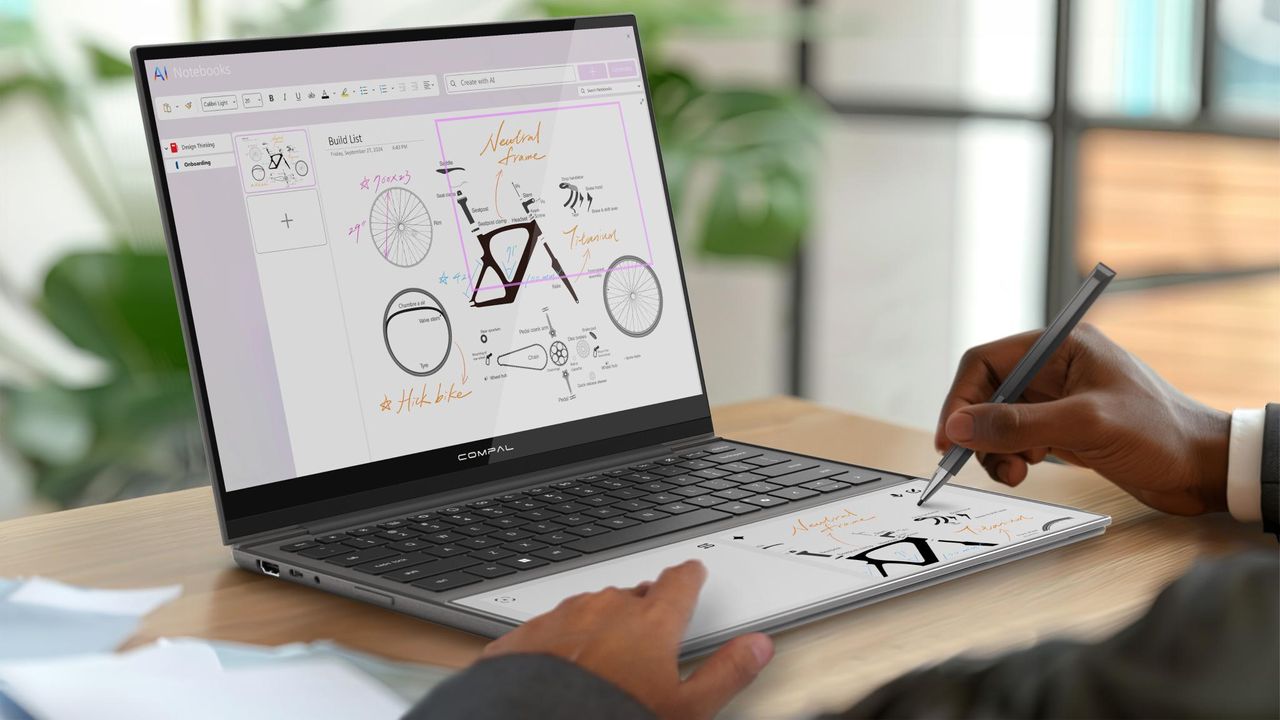
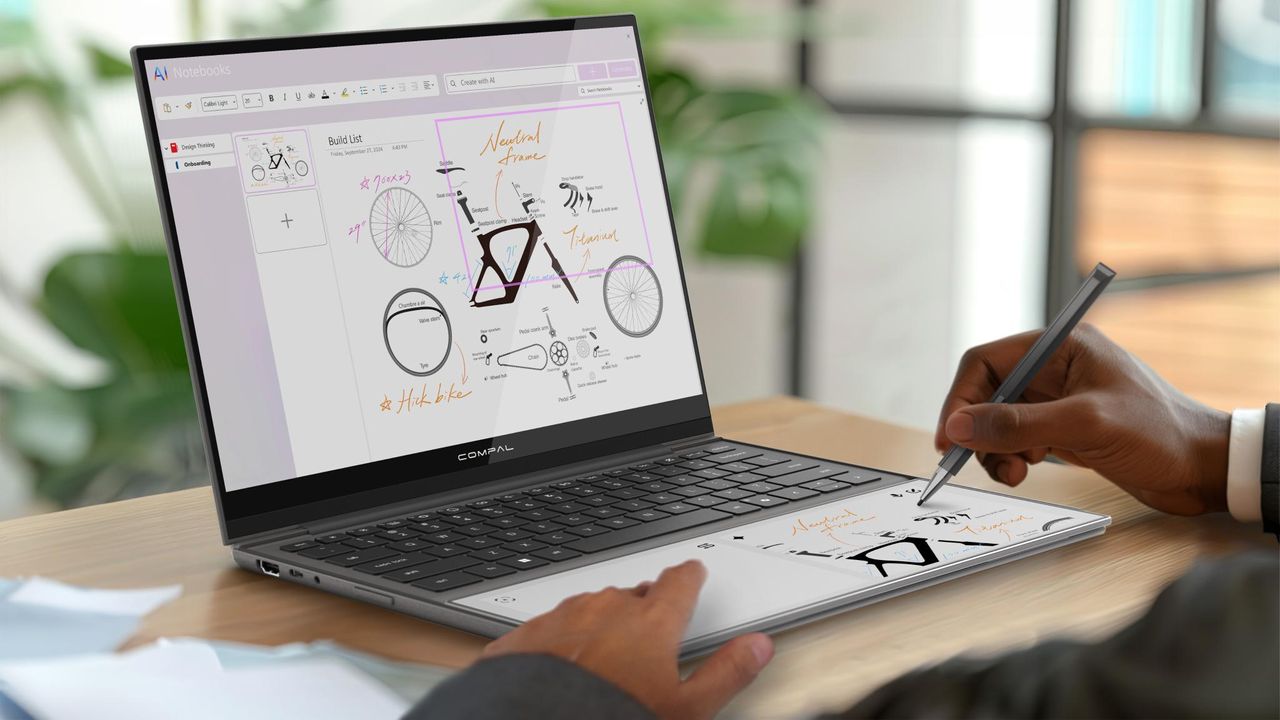
Compal Electronics has introduced a laptop concept which replaces the conventional palm rest and touchpad area with a color E-Ink touchscreen.
The AI Book design places the secondary display directly beneath the keyboard, creating an interactive surface where users can write notes, draw sketches, or view quick references using stylus input.
The concept attempts to turn an area normally reserved for passive hand placement into an active interface.
Interaction continues even when the laptop is closed
The E-Ink surface is different from a conventional LCD or OLED display because it can hold static images without constant power draw, and data can remain visible for extended periods without draining the battery.
This capability allows the laptop to display reminders, notes, or notifications even when the primary screen is inactive.
The layout introduces a form of dual-screen interaction that differs from typical structures found on other experimental laptops – as rather than adding a second large display above the keyboard, the design integrates a compact interactive panel where users normally rest their hands while typing.
Advertisement
This secondary display draws attention because it remains accessible even after the laptop lid closes.
Sign up to the TechRadar Pro newsletter to get all the top news, opinion, features and guidance your business needs to succeed!
A hinge mechanism allows the screen to flip outward so it becomes visible from the outside – and even before flipping outward, a narrow strip of the display remains exposed, providing glanceable updates without opening the system.
Notifications, notes, or other simple information could remain visible on the outer strip while the device stays closed.
Advertisement
The E-Ink display’s low power consumption makes this technically possible because static content can remain visible without active energy use.
Ambient lighting around the display adds visual cues that signal when information changes or when the system enters different states.
Compal Electronics is not known as a retail laptop brand – as it mostly makes devices for other major brands like Apple, Acer, Dell, Framework, and Lenovo.
Advertisement
It produces all kinds of gadgets, including laptops, tablets, smartphones, televisions, and wearables for other firms, and because of this, the company often experiments with unconventional hardware concepts, many of which never make it to market.
Most of its ideas surface during design competitions where brands submit prototypes or conceptual devices exploring different approaches to computing hardware.
The AI Book concept recently received recognition through an iF Design Guide award entry. However, this recognition does not guarantee a product will reach the market.
The most uncertain aspect of the concept is the use of E-Ink as a structural palm rest surface.
Advertisement
Laptops typically endure constant pressure from wrists and hands during long typing sessions, so it is not clear how the display panel will withstand the pressure.
Another questionable element involves the reference to AI-generated content appearing on the E-Ink panel.
Screens across smartphones, tablets, and laptops already show AI output without requiring specialized hardware, so this detail adds little distinction to the concept itself. For now, the design remains an intriguing demonstration of possibilities, but that’s it.
For many residential pool owners, the dream of a crystal-clear oasis often clashes with the reality of manual maintenance. Traditional cleaning methods involving heavy hoses and manual scrubbing are famously time-consuming and laborious. This is where the Talosbo C1 enters the frame as a professional-grade solution designed to automate the most taxing aspects of pool ownership.
As a smart pool robot engineered for both efficiency and ease of use, the Talosbo C1 aims to replace outdated equipment with a sophisticated, cordless experience. In this review, we examine how its technical parameters translate into real-world performance.
Technical Superiority: Enhanced Suction and Filtration
At the heart of any pool cleaning robot is its ability to move water and trap debris. The Talosbo C1 distinguishes itself through an upgraded triple-motor system that provides significantly enhanced suction performance compared to standard models. This increased power allows it to thoroughly scrub pool floors and navigate vertical walls with stability.
The cleaning effectiveness is further bolstered by a Dual High Efficiency Filtration system:
Advertisement
180 μm Filter Basket: This large-capacity component captures substantial debris, such as leaves, twigs, and bugs.
Fine Sponge Layer: Integrated to trap micro impurities like fine dust, sand, and silt, ensuring the water is left crystal clear.
When combined with its durable PVC brushes, the C1 provides a before-and-after comparison that reflects a deep, professional-level scrub of the entire pool surface.
Talosbo
The Cordless Advantage: Power and Auto Parking
One of the most significant pain points for pool owners is the danger and hassle of tangled power cords. As a cordless pool cleaner, the Talosbo C1 removes these physical constraints entirely.
Extended Battery Life: Equipped for the long haul, the robot offers up to 180 minutes of runtime in Eco mode.
Large Coverage: This allows it to cover expansive residential pools of up to 150 m² on a single charge.
Intelligent Auto Parking: To ensure retrieval is as effortless as the cleaning itself, the C1 is programmed with smart sensors that detect when the battery is low or the cycle is complete.
Edge Retrieval: The robot automatically parks near the pool edge, allowing for easy, dry hand retrieval without the need to “fish” for the device.
Intelligence at Your Fingertips: App Control and OTA Updates
The Talosbo C1 is not just a vacuum; it is a smart pool robot. Through the dedicated mobile application, users gain access to App One Touch Control, allowing one-touch control of the cleaning schedule and mode selection.
The app features 7 optional cleaning modes and multiple specialized cleaning paths. Whether you need a quick floor-only pass before a party or a comprehensive deep clean of the floor, walls, and waterline, the C1 adapts to your specific needs. The system also supports remote OTA (Over the Air) updates. This ensures that as Talosbo optimizes its algorithms and introduces new features, your hardware continues to evolve and improve over time.
Talosbo
Authentic User Experience: From Water Entry to Filter Cleaning
In actual use, the Talosbo C1 prioritizes a humanized design. The process is remarkably simple: drop the robot into the water, select your mode via the app, and let the device handle the rest.
Its wall-climbing ability is particularly impressive, maintaining stable contact with the pool surface even as it reaches the waterline to scrub away stubborn residue. Maintenance is equally streamlined, as the dual filtration basket is designed for quick removal and can be rinsed clean in seconds.
Feature
Capability
Suction System
Upgraded Triple-Motor (Enhanced Performance)
Runtime
Up to 180 Minutes (Eco Mode)
Coverage
150 m² Pool Area
Control
Smart App with 7 Cleaning Modes
Filtration
Dual system (180μm basket + fine sponge)
About Talosbo: Our Mission and Background
Talosbo Inc. was born out of one simple need: helping people reclaim their time from home maintenance. Specializing in innovative robotic outdoor care solutions inspired by the legendary strength of Talos, the brand’s mission is to provide efficient tools for pool, garden, and home maintenance.
By offering a full range of robotic outdoor care tools, Talosbo aims to become a comprehensive solution provider for outdoor maintenance, allowing people to spend more time with family and loved ones. The Talosbo C1 embodies this commitment to technological innovation and high-quality manufacturing, representing a smart investment for pool owners in North America and Europe who pursue a high-quality, convenient life.
Advertisement
Final Verdict
The Talosbo C1 Cordless Robotic Pool Vacuum Cleaner is a standout choice for residential pool owners and small commercial operators alike. Its combination of enhanced triple-motor suction, dual filtration, and intelligent app control effectively automates pool management. For more information on purchasing or to explore the full range of Talosbo smart equipment, visit the official Talosbo C1 Product Page or follow their Official Facebook Page