There’s still time to grab a last-minute ticket for GeekWire’s Agents of Transformation, a half-day summit in Seattle on Tuesday that will explore how agentic AI is redefining work, creativity, and leadership.
Keep reading for details about our speaker lineup, the schedule, logistical information and more.
This event builds on an ongoing GeekWire editorial series, underwritten by Accenture, spotlighting how startups, developers and tech giants are using intelligent agents to innovate.
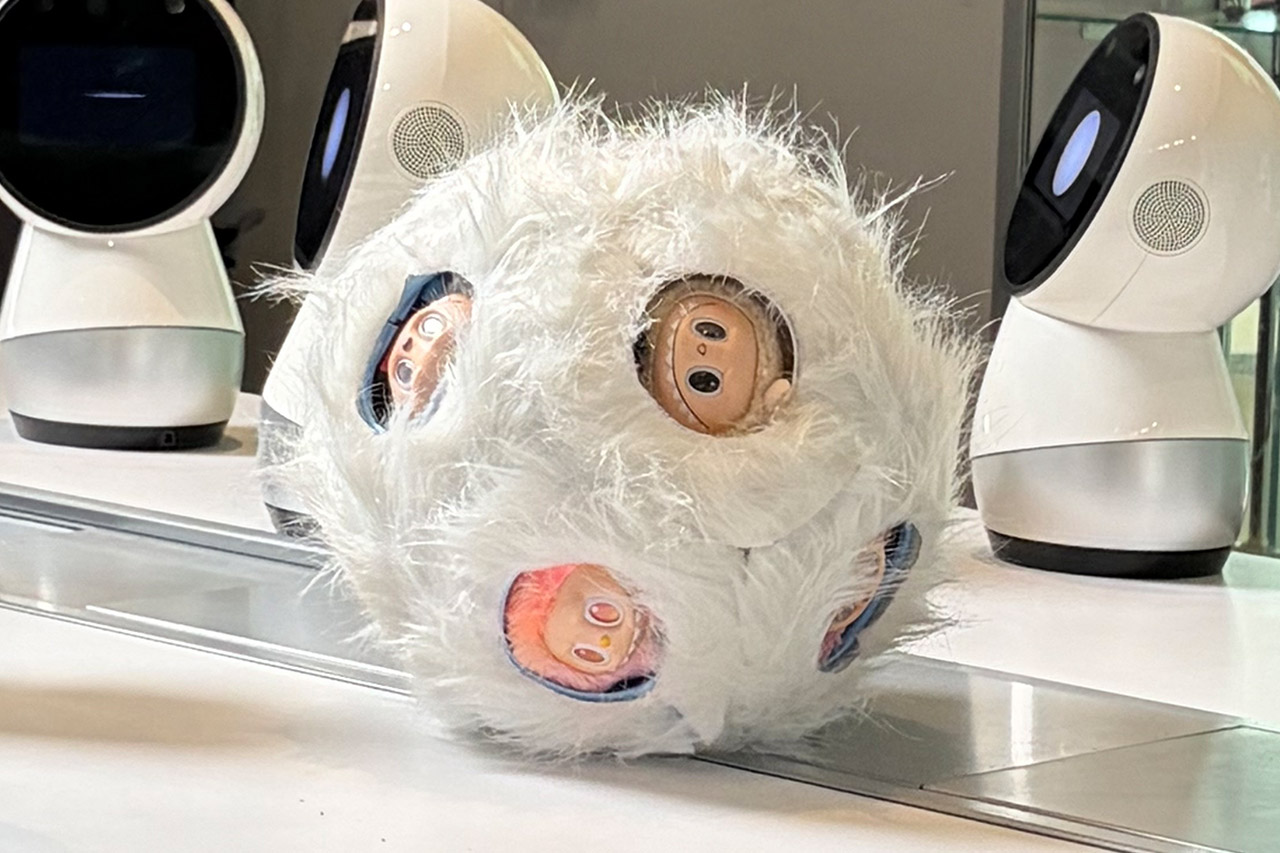
A dozen toothy grins stare out from every direction on a sphere the size of a beach ball. Soft fabric covers the outer shell while the heads shift and turn in coordinated waves. Labububot glides across flat surfaces, changes direction with a gentle tilt, and draws people closer just by moving.
Miranda Li, a graduate student in the Personal Robots group at the MIT Media Lab, spearheaded the research alongside Jake Read and Dimitar Dimitrov, both graduate students at the Center for Bits and Atoms. During a research residence in Shenzhen, China, all three of them collaborated. The goal was to create a robot that threw a wrench in our daily expectations about social robots and the types of things designers typically look for when creating them.
POP MART THE MONSTERS Big into Energy Series-Vinyl Face Plush Blind Box: The blind box contains a random figure from a specific series. Each blind box…
Random Design: Blind boxes are fully random and we cannot accept requests for specific items. There chances of getting the secret edition are usually…
Ideal Gift Choice: These figures are the perfect gift for any occasion, be it Children’s Day, Christmas, Halloween, Thanksgiving, or New Years. A…
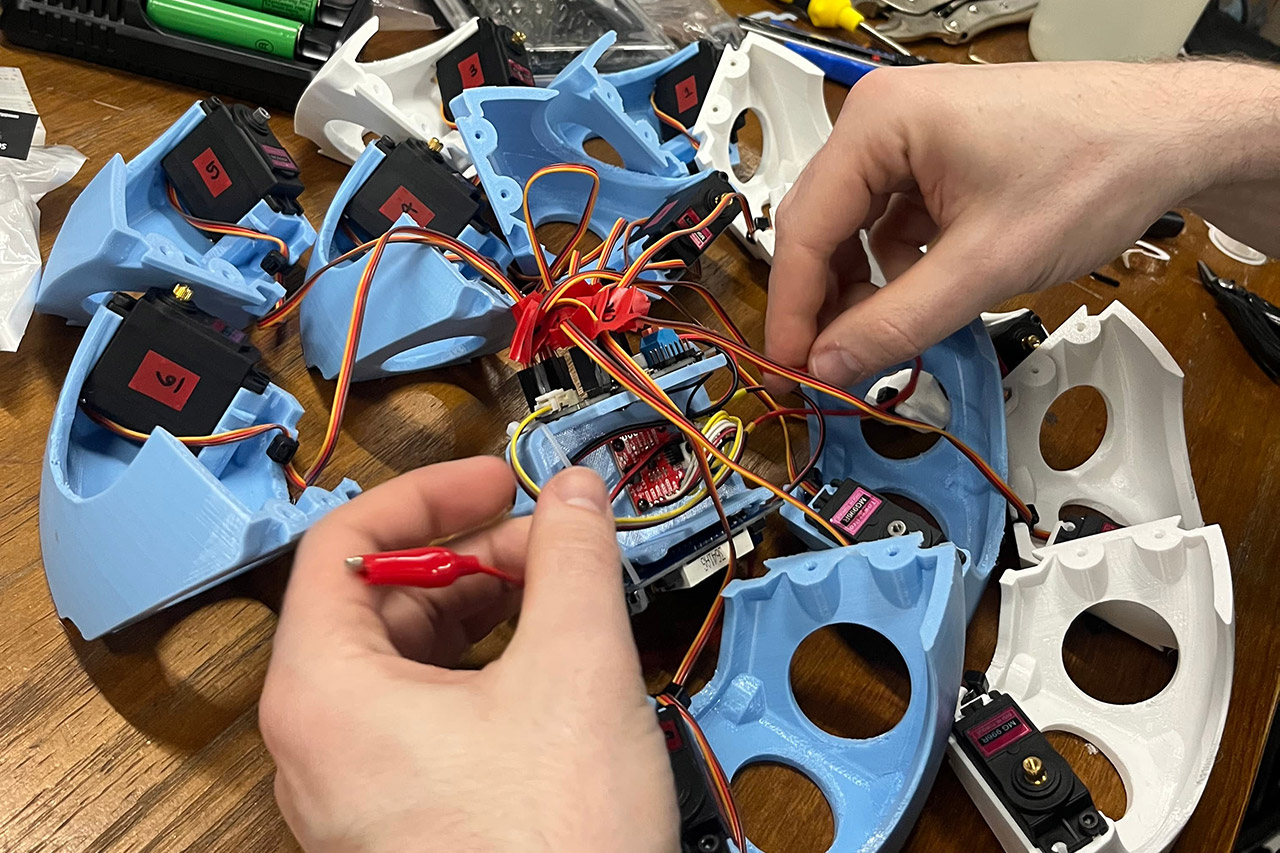
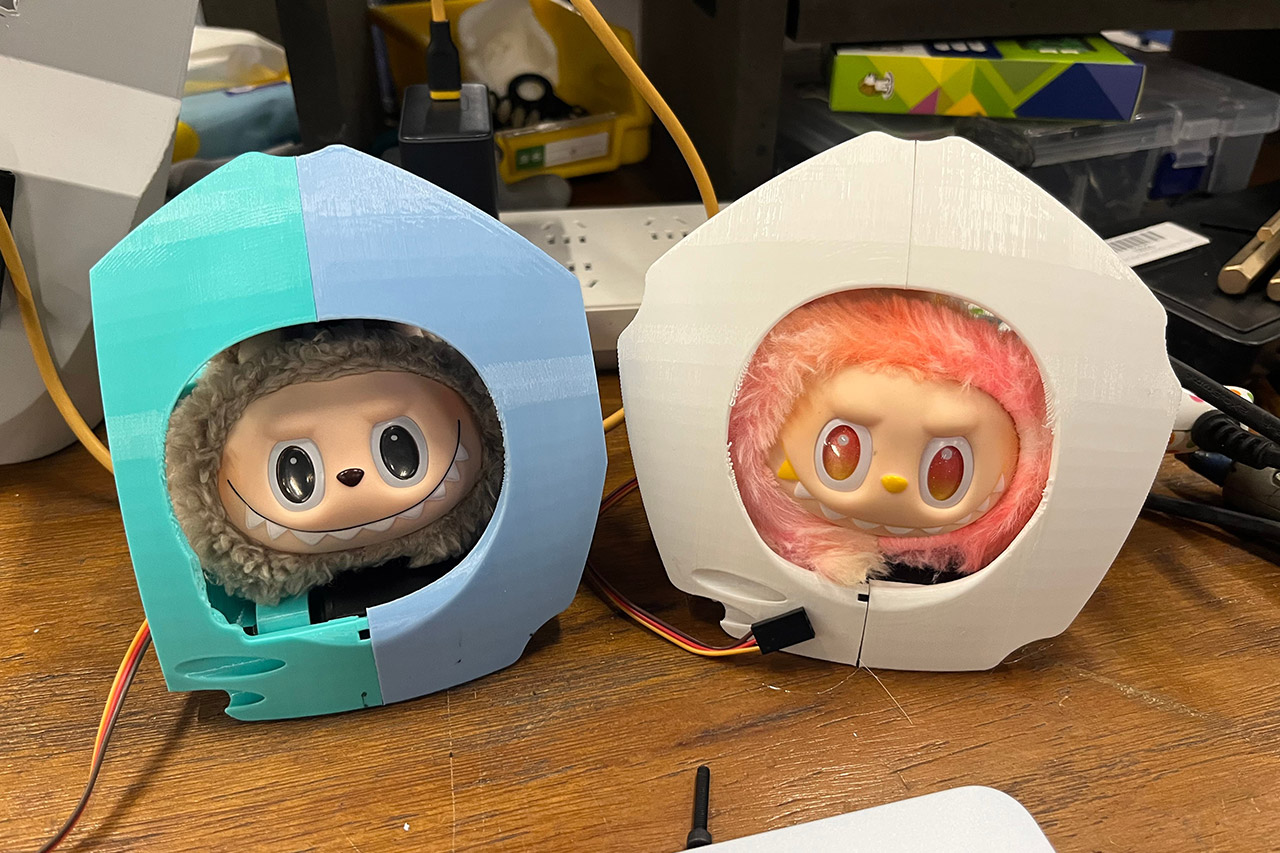
Labubu dolls happened to be the source of the parts. As it happens, they already have large eyes and pointy teeth in one face. The researchers removed the heads from a dozen of them and simply kept them, putting each on a short arm powered by its own servo motor. Two clamshell sections then cover the motors, cables, and other electronics, ensuring that there is adequate room for the arms to swing freely. The heads are then locked in place at the correct angle using hot glue and precise screws, ensuring that all of the ears and expressions line up perfectly.
Coordinated servo movement keeps the entire robot moving while the twelve arms extend or retract in patterns that spin, turn, or come to a complete halt. All while keeping an eye on its orientation, the robot is constantly assessing its tilt, rotation, and direction using an inbuilt sensor.Commands are transmitted wirelessly via a phone or laptop, and a web page may be used as a control panel, allowing users to trigger precise head motions or let the robot roam freely.
Inside the clamshell, an ESP32 board handles all of the day-to-day functions. However, it is the other board, the driver board, that sends all of the accurate signals to the 12 servos at the same time, followed by the sensor, which sends over all of the motion data in real time. The battery power keeps everything running for as long as you need it to. The code installed onto the board handles sensor readings, motor timing, and wireless signals, ensuring that the entire system reacts quickly and smoothly.
The early history of personal computers is stacked with systems such as the Apple II and the Commodore 64 that had the components living inside a keyboard. But as technology evolved, the keyboard became a peripheral and the PC itself was either in a separate box or the whole system was a laptop.
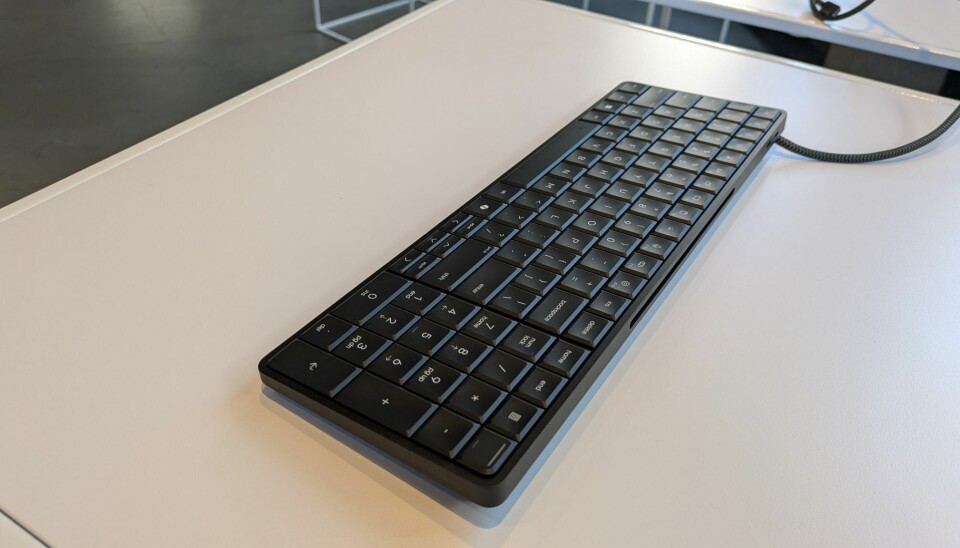
Now, HP has a new spin on this decades-old idea. It embeds a full-fledged AI PC inside a 101-key keyboard you can carry with you from the office to home.
Unlike ‘80s microcomputers or hobbyist-oriented products like the Raspberry Pi 500, the EliteBoard G1a is squarely targeted at business. The system is part of HP’s commercial lineup, alongside its EliteBook laptops, and, for better or worse, it comes with HP Wolf Security preinstalled. The company clearly hopes organizations will buy these in bulk. But to benefit from it, you really have to prefer a mobile keyboard to a traditional laptop, all money aside.
Who’s it for?
The EliteBoard G1a is trying to create a new niche.
Advertisement
When we talked with product managers at HP, they suggested IT departments would buy these computers for two types of workers.
The first group is so-called “dual deskers” – knowledge workers who have a desk with a monitor at work and another at home. The second group includes deep-pocketed call centers or environments where desk space is at a premium.
From time immemorial, dual-deskers have carried laptops and closed their lids when they docked to a monitor at work. With the EliteBoard, they could simply schlep the keyboard, which weighs a mere 1.49 pounds – about half the weight of a lightweight laptop. To make this situation work in companies with managed systems, we have to assume that either the IT department would give out monitors to use at home or offer some reason (a subsidy? a mandate?) for employees to buy their own for home.
The EliteBoard connects to monitors using its USB4 port, so its ideal monitor is one that has Thunderbolt or USB video connectivity built in. Less-expensive and older monitors don’t have this type of connectivity, but select configs of the EliteBoard come with an optional USB-to-HDMI adapter that you can use with other monitors, and it has a USB pass-through for power. That said, HP demonstrated the EliteBoard at numerous press events by showing how much desk space it saves by using a single USB cable to get power, video out, and connectivity to peripherals via the monitor. So if companies want employees to be able to take advantage of this scenario at home, that means shelling out another few hundred bucks for a modern monitor, or making employees do it.
Advertisement
Today, companies with limited desk space for a call center or another cramped work area could just buy a tiny desktop to sit behind the monitor or next to it. However, building all of the PC’s guts into the keyboard makes a lot of sense for space savers, because a keyboard is something every PC needs and a desktop chassis is not. If a company wanted to, it could give each employee their own EliteBoard, have them plug it into a monitor during work time and then have them stick it in a drawer when they go off shift and someone else comes on.
HP EliteBoard G1aAvram PIltch
The problem for call centers is that the HP EliteBoard G1a is much more powerful and much more expensive than what they need. At press time, the G1a was priced at $1,499 for the lowest end config. And most companies probably don’t need employees to each have their own PC that they lock away after they punch out.
“The call center angle is probably the stronger pitch, but those buyers are shopping entry-to-mid-market. They want something cheaper and simpler than a mini desktop, not a Copilot+ PC with up to 64GB of RAM,” Kieren Jessop, a research manager with analyst firm Omdia. “HP has built an impressive piece of engineering in search of a problem that most enterprises have already solved with a laptop — or will solve with a thin client.”
Configurations
HP makes the EliteBoard G1a in a variety of configurations that vary by market. Companies can get it with various AMD Ryzen CPUs, up to 64GB of RAM and an SSD up to 2TB in capacity. It comes with either a detachable or embedded cord, and optionally with a 32 WHr battery that promises up to 3.5 hours of endurance.
Advertisement
Why would you need a battery on a product that demands to be used at a desk and plugged in? The most likely reason is to let the keyboard go into sleep mode when it’s in your bag. Employees could also hook the EliteBoard G1a up to a portable monitor and use it unplugged that way, but then why not just buy them a laptop?
At press time, prices ranged from $1,499 to $3,423 in the US. The lowest-end config has a Ryzen AI 5 Pro 340, 16GB of RAM, an integrated cable, and a 256GB SSD. Fifty bucks more will get you the same configuration with a 512GB SSD, as per HP.com. The highest-end config listed comes with a Ryzen AI 7 Pro 350 CPU, 32GB of RAM, and a 512GB SSD, and sells for only $1,999 at B&H but a whopping $3,423 at HP.com.
Our review config, which sports 64GB of RAM, a Ryzen AI 7 Pro 350 CPU, and a 2TB SSD, has not been listed for sale in the US, and HP didn’t answer when we asked how much it would cost. However, we’d assume that it would cost a lot more than $1,999.
Price vs a Laptop
If all you do is dock your PC at home and at work, you might think, “why pay for a laptop when I don’t need a built-in screen?” But it’s hard to make that argument when the laptop is actually less expensive.
Advertisement
Right now, you can get an HP EliteBook 6 G1aN with the same AMD Ryzen AI 7 350 CPU, along with 24GB of RAM and a 512GB SSD, for just $1,299 – that’s actually less than the cheapest EliteBoard. A custom configured HP EliteBook 8 G1a with the Ryzen AI 7 Pro 350 CPU, 32GB of RAM, and a 512GB SSD is just $1,799.
If you’re comparing the total cost of ownership versus a laptop, also consider the price of a monitor if your users don’t already have one. While you could use an adapter, the ideal use case involves a USB-C monitor that transmits data and power over a single wire. The cheapest HP-branded USB-C monitor I could find at press time was the HP E27k 4K monitor, which was selling for $504. However, I saw a Dell-branded USB-C monitor, the S2725DC, on sale for just $236 at Amazon. If you’re an IT department and you’re kitting out someone for home and office use, you might need to buy them two monitors.
Design
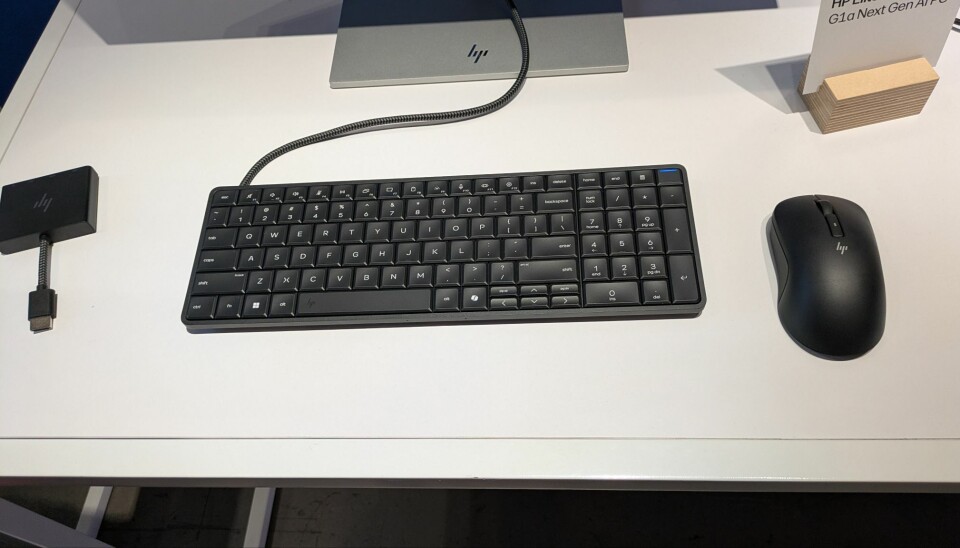
At 14.1 x 4.7 x 0.7 inches, the EliteBoard G1a is the size of a typical, full-size keyboard complete with numpad. It’s a boring but office-friendly dark gray color with a very thin bezel around the keys.
At first glance, there aren’t many ways to know that this is more than just a keyboard. There’s a power button / fingerprint reader that’s located in the upper right corner of the keyboard, though you might easily mistake it for just another key, until you press it and see the blue light turn on.
Advertisement
Turn the keyboard around and on the back lip and you’ll notice a thin vent for airflow. This computer definitely has a fan and you can hear it quite prominently at times. There are also two USB-C ports, a USB4 40 Gbps port and a 10 Gbps port, unless you have the embedded cable, in which case, you just have the 10 Gbps port. Clearly, the 40 Gbps port is the one you’ll want to use for docking, but you can use the 10 Gbps port to connect the dongle for the included wireless mouse or other peripherals.
HP EliteBoard G1aAvram Piltch
There’s also a security cable lock slot on the left side. So if you want to chain this to a desk, you can, but we’d argue that defeats the point of the machine.
But how well does it type?
Since this is a computer-in-a-keyboard, the most obvious question we need to answer is “how’s the typing experience?”
Pretty decent.
Advertisement
On the bright side, the EliteBoard G1a has a generous 2 mm of travel, which is more than you’ll find on most laptops, where even 1.5 mm is deep. The keys feel pretty snappy and are in the same feedback league as those on my Lenovo ThinkPad X1 Carbon, but the ThinkPad’s keys have a more curved shape, which is better than the flat tops on the EliteBoard.
HP EliteBoard G1aAvram Piltch
If you’re burning the midnight oil, there’s a built-in backlight which you can enable by hitting the F9 key. It has two different brightness settings so you can decide just how much you want it to shine through.
The layout is pretty standard for a full-size keyboard with a numpad. However, I don’t like how small the arrow keys are, and the Pg Up and Pg Dn are just tiny. There’s no empty space around these keys, which I use a lot when editing documents, so it’s far too easy to miss them. Even on most laptops, these keys are larger.
Another downer is the lack of flip-up feet on its bottom. I like to angle my keyboard up at a 15 to 30 degree angle, but this one is short and flat to the desk. To save my wrists, I always use a gel-filled wrist rest when I type and, without feet to elevate the keyboard, I’m typing down onto the keys because it’s so much lower than the gel pad. This won’t be as much of an issue for folks who don’t use wrist rests.
Advertisement
In short, if you’re used to laptop keyboards or the low-cost keyboards that come with most desktop computers, the EliteBoard G1a will probably seem like a nice step up. However, if you want the best possible typing experience, there’s an entire ecosystem of mechanical keyboards out there with much deeper travel and more feedback.
If you’re not a gamer and you want the best possible typing experience, I recommend a mechanical keyboard with either clicky or tactile switches. Unless you go for a low-profile keyboard, you’ll be getting between 3.6 and 4 mm of travel, so you won’t bottom out as easily when typing. I prefer clicky switches like the Kailh Box White (my favorite) or Cherry MX Blue, but those make some noise so, if you like quiet, Cherry MX Brown switches will do the trick.
To see the difference between my daily driver mechanical keyboard, an Akko 3098N with Kailh Box White switches, and the EliteBoard G1a, I performed the 10fastfingers.com typing test on both. On HP’s keyboard, I managed a strong 96 wpm, which is at the lower end of typical for me, with a six percent error rate. On my daily driver, the numbers were a better 101 wpm with a two percent error rate. Your mileage will vary.
Speaker and Microphone
The EliteBoard G1a has both built-in bottom-facing speakers and a microphone array. In our tests, the speaker was more than loud enough and it was clear enough for voice calls, though we wouldn’t recommend listening to music on it for too long. The drums in AC/DC’s Back in Black sounded a little tinny, though there was a clear separation of sound with the vocals appearing to come from one side while the percussion came from another.
Advertisement
The dual-array microphone was also passable, but not good enough for podcasts. When we talked to a coworker using the built-in mic, she said our voice was clearly audible but a little echoey.
In the box and preloaded
Depending on which config you get, your HP EliteBoard G1a may come with a variety of different accessories in the box. All versions come standard with an HP wireless 675M mouse that connects either by Bluetooth or by an included USB-C wireless 5-GHz dongle. It is not a particularly fancy mouse but it has a couple of side buttons and a scroll wheel. I found myself using my Logitech MX Master 3 mouse instead, because it’s ergonomically shaped and highly programmable.
My review unit also came with the optional soft canvas cover sleeve you can use to protect the EliteBoard G1a while you’re carrying it around. I found this add-on to be about as useful as a laptop sleeve. It might offer some protection and padding for when you stick the EliteBoard G1a in an existing backpack, but it’s not going to replace your briefcase or your backpack when you’re commuting.
I also got the optional HDMI multiport hub, which is a must-have if you don’t already have a Thunderbolt or USB4 docking station or a monitor with that kind of connectivity built in. The hub connects to the USB4 40 Gbps port on the EliteBoard and features two USB-C ports (one for power, one for connectivity), an HDMI out cable for connecting to a monitor, an Ethernet port for wired networking, and an HDMI-in port for a second monitor.
Advertisement
There’s an optional, slim 65W USB-C power adapter that’s helpful if you aren’t connecting to a monitor or docking station that supplies power. If you don’t get one in the box, it’s easy enough to find one for $15 to $30 on Amazon.
Also, if your EliteBoard does not have an embedded cable — mine did not — you get a braided USB cable in the box. The less-expensive configs of the EliteBoard all have embedded cables, but we recommend getting a model without one because it’s easier to carry around without a cable hanging off of it.
HP does not preload a lot of software onto the EliteBoard but it does come with a three-year subscription to HP Wolf Security, which normally costs $36 a year for individual subscriptions. HP Wolf has a malware/virus scanner, a threat containment feature, a secure browser, OS resiliency (for recovering from corruption and doing a reinstall), and application persistence, which prevents unwanted changes to security software like HP Wolf itself.
Since it has an NPU (neural processing unit) that’s capable of more than 45 trillion operations per second (TOPS), the EliteBoard G1a qualifies as one of Microsoft’s Copilot+ PCs. This means that it has some added local AI features that not every PC gets from Windows 11, including Cocreate image generation in Paint, Windows Studio Effects handled locally for your webcam, translated Live Captions from any audio input, and Recall, a controversial feature that takes screenshots of all your work to help you “remember” what you were doing at any given time. Fortunately, Recall is disabled by default.
Advertisement
Performance
Equipped with an AMD Ryzen AI 7 Pro 350 CPU, 64GB of RAM, and a 2TB SSD, our review configuration of the EliteBoard G1a handled everything I threw at it. I used the system on and off as my daily driver PC for work for a period of several weeks and it was always smooth and responsive, even as I had dozens of Chrome tabs open and Slack running across two 4K monitors I had connected via Thunderbolt 3 docking station.
I should note that, no matter what I was doing, the fan on the EliteBoard G1a was frequently running and was often quite audible. It’s no louder than most notebooks I’ve tested, but if you’re expecting total quiet, look elsewhere.
My editorial workload is not nearly as demanding as some folks’ day jobs so, to see how the EliteBoard G1a stacks up, I ran it through a series of benchmarks and compared the results to those from two laptops I had access to: a Lenovo Yoga Slim 7x with a Qualcomm Snapdragon X Elite X1E-78-100 CPU, and a Lenovo ThinkPad X1 Carbon with an Intel “Meteor Lake” Core Ultra 7 165U processor.
The Ryzen AI 7 PRO in the EliteBoard debuted in 2025 with 8 cores, 16 threads, and a maximum boost clock of 5 GHz. It features built-in AMD Radeon 860M graphics and a Neural Processing Unit (NPU) that’s capable of achieving 50 TOPS for better local AI. Its DDR5 RAM runs at 5,600 MHz.
Advertisement
Released in 2024, the Snapdragon X Elite X1E-78-100 has 12 cores and threads with a boost clock that goes up to 3.4 GHz, along with an NPU that does 45 TOPS. It’s an Arm processor so the laptop that runs it uses Windows on Arm. The Yoga Slim 7x laptop that we tested had 16 GB of LPDDR5x RAM running at 8448 MHz.
The oldest of our test group, vintage 2023, the Intel Core Ultra 7 165U has 12 cores and 14 threads, but only two of those cores are performance cores that can boost up to 4.9 GHz, while the others are a mix of efficient cores and low-power efficient cores that boost up to 3.8 and 2.1 GHz respectively. The ThinkPad X1 Carbon we tested with it had 64GB of LPDDR5x RAM running at 6400 MHz.
In our tests, the EliteBoard G1a always eclipsed the ThinkPad X1 Carbon, which is not a surprise considering its much-older processor. However, the Snapdragon-enabled Yoga Slim 7x outpaced it on some benchmarks.
Primesieve
Primesieve on the HP EliteBoard G1aAvram Piltch
This test counts the prime numbers under one trillion and returns a result in millions of prime numbers per second. The benchmark is particularly heavy on SIMD instructions like AVX-512 or Arm’s Neon and SVE vector extensions, making it a good proxy for some of the more workstation-centric tests we’ll look at shortly. It runs across both single thread and multi-thread workloads, with big performance boosts for parallel processing.
Advertisement
Using just a single thread, the EliteBoard edged out the competition with 415 million primes per second (MPS), compared to the Slim 7x’s 352. However, the Slim 7x slightly outperformed it when using multithreading, delivering 2,686 MPS to the EliteBoard’s 2,145. One thing to note is that, while the EliteBoard has more threads, it has fewer actual cores. The X1 Carbon wasn’t even in the same ballpark. This will become a theme across our test suite.
Blender
Blender on HP EliteBoard G1aAvram Piltch
3D rendering is always a challenge and, to be honest, it’s hard to imagine somebody buying an EliteBoard for this purpose. However, it’s always worth noting what the system can do.
We ran Blender, a very popular 3D modeling app, using three scenes: Monster, Junkshop, and Classroom. As you can see, the Slim 7x and its 12-core Snapdragon processor were anywhere from 34 to 75 percent quicker, depending on the content. Still, the EliteBoard turned in respectable scores on something you wouldn’t expect it to do.
Handbrake x265
Handbrake x265 on HP EliteBoard G1aAvram PIltch
Video transcoding is another resource-intensive task and one that occurs in many scenarios, including game streaming, video editing, and even video conferencing. To test how the EliteBoard handled video transcoding, we used Handbrake to convert a 4K 60 fps video to 1080p using an x265 encoder at the medium preset with a constant quality of 18. Our results are measured in frames per second (fps).
Advertisement
Again, the EliteBoard was far superior to the ThinkPad, but was a good 45 percent behind the Yoga Slim 7x. Still, this is solid performance that’s more than workable.
Llama.cpp
Llama.cpp on HP EliteBoard G1aAvram Piltch
One local AI task you might want to conduct is running an open-source model as a chatbot on your PC rather than sourcing it from the cloud. This will give you more privacy than using OpenAI, Claude, or Copilot on the web and it’s completely free.
So we ran the GPT-OSS 20B open weights model using Llama.cpp as our client and timed the amount of milliseconds it took to generate the first token. Here we see that the Snapdragon processor and faster RAM on the Yoga Slim 7x gave it a definite advantage, taking 39 percent less time than the EliteBoard to get there. The EliteBoard also generated about half as many tokens per second. However, it beat the pants off the ThinkPad X1 Carbon, getting to the first token more than twice as quickly while generating 30 percent more tokens per second.
It’s worth noting that these tests were run on the CPU cores and didn’t harness the chip’s integrated GPUs or NPUs.
Advertisement
Whisper.cpp
Whisper.cpp on HP EliteBoard G1aAvram Piltch
One common local AI workload a business person might use is transcription. Let’s say you had an audio file and you wanted to convert it into readable and editable text. You might use a tool based on Whisper, a popular free model from OpenAI.
For testing, we used Whisper.cpp, an implementation of Whisper written in C++, with the Whisper Medium EN model transcribing a 10-minute audio clip. Here, the EliteBoard transcribed the audio at 2.4x real-time speed, while the Yoga Slim 7x was faster at 3.4x. Those extra cores are doing a lot of heavy lifting here. That said, if you’re converting 10 minutes of audio in less than five minutes, that’s pretty good.
LLVM Compile
LLVM Compile on HP EliteBoard G1aAvram Piltch
For those using the EliteBoard for programming, compile times matter. So, we compiled the LLVM toolchain from its source and measured the time. This isn’t a trivial compile job and therefore represents a worst case scenario for developers considering the EliteBoard. Here it took a modest 19 minutes and 44 seconds, which was more than double the time it took the Yoga Slim 7x.
On high-end desktop workstation hardware, this same workload can be completed in under five minutes, so if your day job regularly requires compiling large projects, you might want to spring for something more capable, or perhaps not. “My code is compiling” is a pretty good excuse for taking a 20 minute break.
Advertisement
7-Zip
7-Zip LZMA Compression on an EliteBoard G1aAvram Piltch
7-Zip LZMA Decompression on an HP EliteBoard G1aAvram Piltch
Compression and decompression are very taxing on a CPU and are very common scenarios we see today. So we fire up 7zip and measure its ability to do both tasks in both single-threaded and multi-threaded scenarios.
With a single thread, the Slim 7x and the EliteBoard basically tie at compression, while HP’s computer holds the edge in decompression. However, when we move to multi-threaded scenarios, the Snapdragon X Elite’s 12 physical cores easily beat out the AMD Ryzen AI 7 Pro 350’s eight cores and 16 threads.
LibreOffice: ODT to PDF Conversion
LibreOffice: ODT to PDF Conversion on an HP EliteBoard G1aAvram Piltch
We tested how long it takes LibreOffice to convert 50 image-heavy ODT files into PDFs. This workload is lightly threaded so it favors higher clock speeds over more cores.
The results bear this out as the EliteBoard, with its Ryzen AI 7’s higher performing cores, beat out the Slim 7x by 22 percent. Despite its older processor, the ThinkPad actually manages to tie the Slim 7x in this test.
Advertisement
Repairability
The HP EliteBoard G1a is easy to repair.Avram Piltch
For IT departments that do their own service, the EliteBoard G1a has plenty to offer. Its back surface is held on by just four screws and pops off easily. Underneath, you get full access to the motherboard and a number of easily-removable components, including the DDR5 SODIMM RAM, the M.2 SSD, the WLAN card, the fan, the optional battery, and the speakers. You can even replace the keyboard itself and leave the computer part intact.
Bottom line
The HP EliteBoard G1a delivers strong performance in a unique and compact form factor that saves desk space and reduces the weight you carry back and forth. If you don’t want a laptop but do want a portable computer, this is your best choice. It provides a better typing experience than most laptops and a more space-efficient design than most desktops.
However, in the current marketplace, this device does not represent a significant savings over a similarly configured laptop. Depending on what laptop you choose to compare against, you might save a few hundred dollars, but when you add the cost of the monitors you need to pair with it – if you need to purchase those – it’s a wash.
HP has set out to make a unique product with the EliteBoard G1a and it has succeeded in building a very competent and capable computer-in-a-keyboard. If you’re an IT decision maker, you’d buy this device for folks who work out of one or two distinct locations (home and office or multiple offices) and never need to get online from the road or from a conference room. Whether that’s a common scenario in your workplace will determine if this product is right for you or your fleet. ®
Every serious gamer has an opinion on what makes the perfect mouse, but very few pieces of hardware actually earn that conversation at a professional level.
The case for that pedigree is not just marketing; in 2024, 61.5% of League of Legends championships were won by teams using Logitech G PRO partnered gear, which says something about what happens when hardware is shaped by players who cannot afford to lose.
Advertisement
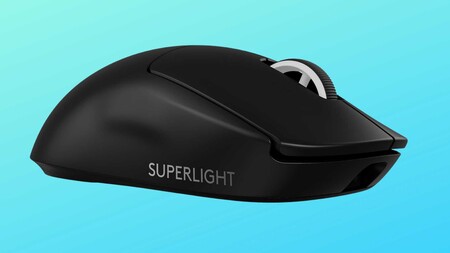
At 60g, the Superlight 2 sits at a weight where it disappears in your hand during long sessions, and the low-profile symmetrical shape is designed to enable fast movement and stable control rather than simply looking aggressive on a desk.
The HERO 2 sensor is what gives it its competitive edge, tracking at over 888 inches per second with up to 44,000 DPI and an 8kHz wireless polling rate, delivering zero smoothing, acceleration, or filtering so every movement registers exactly as intended.
Advertisement
Lightforce hybrid switches sit underneath the main buttons, combining the speed of optical actuation with the tactile feel of mechanical clicks, and zero-additive PTFE mouse feet mean the glide across any surface is as frictionless as the hardware itself.
Advertisement
Battery life also reaches 95 hours on a single charge, which covers even the longest gaming sessions without interruption, and USB-C charging means you are not hunting for legacy cables when you eventually need to top it up.
Whether you play competitively or simply refuse to compromise on your setup, the Logitech G PRO X Superlight 2 at below $120, puts genuinely professional-grade hardware within reach at a price that makes the decision straightforward.
We spend hours testing every product or service we review, so you can be sure you’re buying the best. Find out more about how we test.
I’m a nerd when it comes to monitors. And, a bougie, particular, and spoiled nerd at that. I have had the great honor of working with and owning some of the best-of-the-best for years now.
For this monitor, I’ll be honest, I expected it to be a subpar tool that I’d try and love, only to realize I would rather go back to what I know and love. I thought it would be one of those things where I think “ok, on paper it’s good, but I’ll just give it a shot to see if it’s any good in person.” Well, it’s been 128 days since I put this monitor on one of my heavily used setups, and now I can’t imagine ever taking it off my desk.
Advertisement
I spend 5+ days a week, around 45+ hours total, on-site at a larger church where I serve on staff. I sit or stand at my desk there for a good chunk of that time, pouring over whatever system I am working on at that given time. I’m pulling up documents, databases, programming tools, webpages, third-party tools, custom tools, web-developer tools, coding windows, and so much more.
All of it so far has been absolutely gorgeous on this panel. My desk is right next to a window too, and the nano matte panel doesn’t show much glare at all, which I am truly appreciative of, because otherwise I probably wouldn’t be able to have my desk in this perfect location.
This is the kind of monitor that is a jack of all business professional trades. It’s one of the best monitors for programming, but of course, that’s what it’s built for, but outside of that, it’s also just a really good productivity monitor. The 3:2 aspect ratio matters, offering more vertical space without compromising horizontal space.
I could go on and on, but let’s get to the review of this BenQ RD280UG panel.
Advertisement
(Image credit: Collin Probst // Future)
BenQ RD280UG: Unboxing and First Impressions
BenQ unboxings are all pretty much the same. A well-built box with a bit of origami to open it up, and then unfold the base, stand, monitor, cables, and documentation. Within the cables, there is an HDMI 2.1 cable, a USB-C Cable, a USB upstream cable, and an IEC power cable, which is a big deal since some monitors I see these days don’t have a standard IEC.
Sign up to the TechRadar Pro newsletter to get all the top news, opinion, features and guidance your business needs to succeed!
I put the monitor on the stand for about 12 seconds, and then chose to pop this display up on my monitor arms for this desk. Right away, I noticed the extra height from a standard 16:9 monitor, and I quickly got used to the chin. Sadly, this means that you won’t get to do some orientations you could with other monitors that have a standard chin, such as flipping this guy around to be vertical or stacked with this one on top, etc. however, if you plan to use this as a primary monitor or even side by side, or if you’re feeling crazy putting this as a top monitor but upside down in a stacked orientation, then you’ll be great.
Advertisement
Within the box, BenQ managed to fit in an HDMI 2.1 Cable, a USB-C cable, another USB-C to use if you want to connect your HDMI Device to the KVM, an IEC Power cable, and the documentation, in addition to the stand and panel, of course.
Right off the bat, this monitor screams business and professional. It’s like a utility truck, not a sports car. This is the kind of display you want to rely on for everything, not show off to all your friends. The three-tubed panel immediately changes how you work within the provided workspace, allowing significantly more content, even though there’s not much more screen. With how macOS scales, it feels significantly larger.
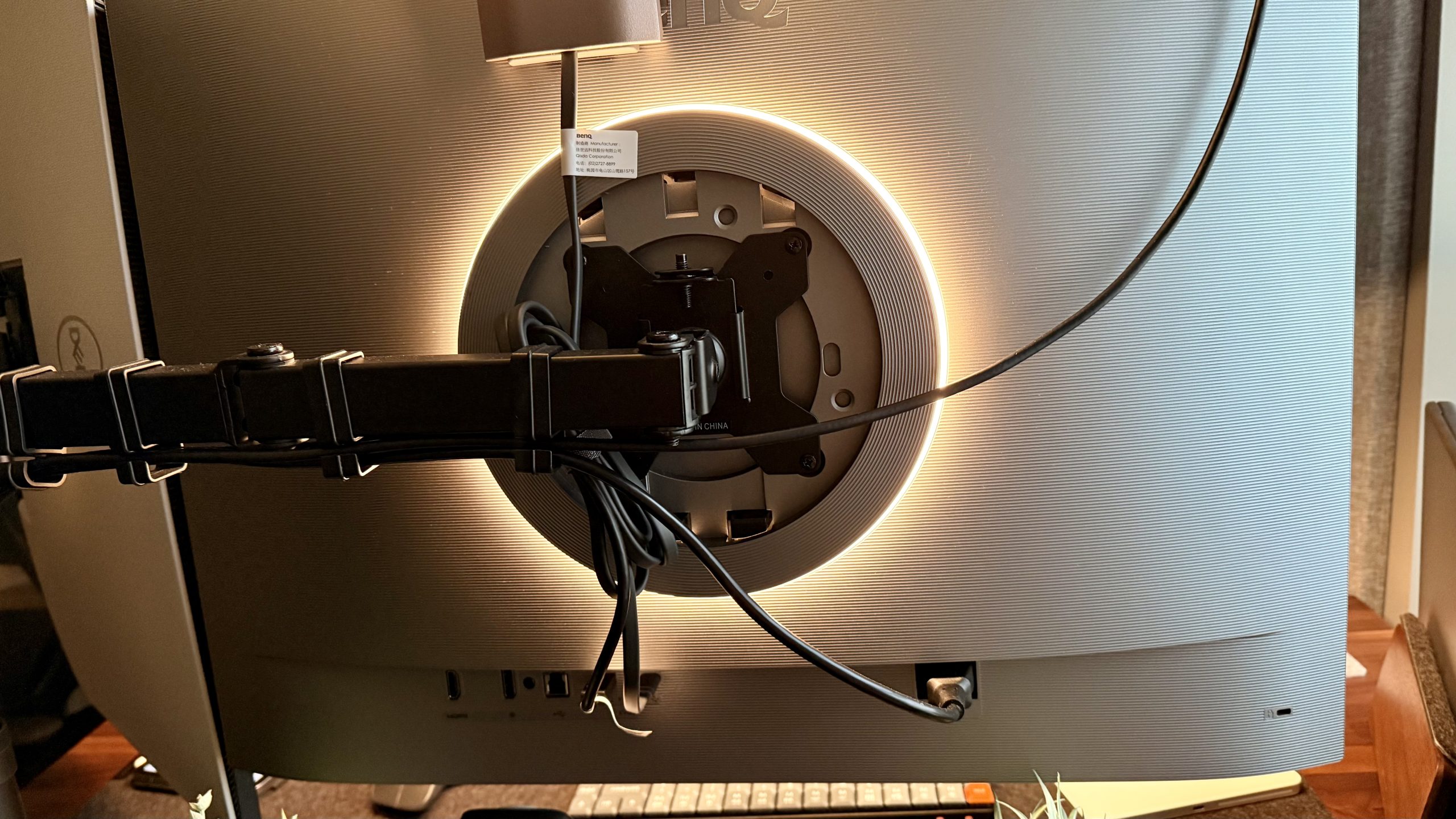
The last thing I’ll mention in this section is the Moon Halo bias lighting, which is the light ring around the back of the monitor. That is built into the center circle surrounding the mounting bracket’s face. This kind of bias lighting provides smooth, soft, diffused light across the entire back of the monitor. Just the top half or just the bottom half allows for both brightness and temperature changes. While it may seem like a small thing, it actually makes this monitor feel significantly more premium and far more enjoyable to use, especially in a dark environment or against a wall.
Advertisement
BenQ RD280UG: Design & Build Quality
I said it up above, but the 3:2 aspect ratio is the clear headline design choice for this kind of monitor. It’s what makes this one stand out from the others in its class, along with other elements that make this monitor great, but the aspect ratio is what stands out.
This panel also has a great 120Hz refresh rate, fantastic ports, 2000:1 contrast upgrade, and P3 color coverage. In short, this monitor feels like it has no compromises because for 99% of people, it does not. The only people who may feel limited in this are those who need a very specific monitor type, particularly those who need a specific color rendering or another niche specialty. For everyone else, this monitor feels like overkill — in the best way possible.
The last thing I’ll mention regarding the design and build quality of the fantastic RD28OUG is the ease of connecting to a single cable to a monitor or docking station. Sure, if you want to run through the other video ports, you are more than welcome to. But if you want a simple design or setup, you can charge your laptop with a single cable, 90W to your monitor, for full use.
Advertisement
BenQ RD280UG: In use
(Image credit: Collin Probst // Future)
I’ve had this monitor at one of my primary workstations for three months now. In that time, I’ve used it for an average of 8 hours a day, 4-5 days a week. And, I have not been able to say enough good things about it.
It has been spectacular for productivity, some light coding I have tested just to try it out, research, AI work, project management, web development, writing, AI tooling, and so much more. It has been my primary monitor for all of the many things I do at this desk, and I have loved using this panel.
The extra height makes a massive difference, especially if you switch back to a 16:9 right after using this, you notice that everything feels squatty and wide, not able to give you a full height understanding of the page.
Further, while it may not be the most color-accurate display on paper, I have found it to be wonderful to look at for some light photo work, light video work, and website work. This is made even better with the bias lighting created via the MoonHalo on the back.
Advertisement
I love how it automatically turns on and off and also, paired with my BenQ ScreenBar, I walk up to my workspace and plug in my machine to be then greeted by warm light that fills my space, and when I unplug and walk away, it turns off, almost making my workspace feel alive, ready to work with me.
BenQ RD280UG: Final verdict
(Image credit: Collin Probst // Future)
This display is premium, elegant, functional, and great for most. While it is absolutely overkill for many, if you want a no-compromise monitor with some fun functionality in the MoonHalo, KVM, and PD, then this is well worth the consideration. That’s even without discussing every key feature of this monitor.
Looking for the most recent regular Connections answers? Click here for today’s Connections hints, as well as our daily answers and hints for The New York Times Mini Crossword, Wordle and Strands puzzles.
Today’s Connections: Sports Edition is a tough one. The purple category requires you to find partial team names in other words. If you’re struggling with the puzzle but still want to solve it, read on for hints and the answers.
Connections: Sports Edition is published by The Athletic, the subscription-based sports journalism site owned by The Times. It doesn’t appear in the NYT Games app, but it does in The Athletic’s own app. Or you can play it for free online.
Hints for today’s Connections: Sports Edition groups
Here are four hints for the groupings in today’s Connections: Sports Edition puzzle, ranked from the easiest yellow group to the tough (and sometimes bizarre) purple group.
Yellow group hint: MLB numbers.
Advertisement
Green group hint: Zoom!
Blue group hint: Gridiron stars.
Purple group hint: Hockey teams, with a twist.
Answers for today’s Connections: Sports Edition groups
What are today’s Connections: Sports Edition answers?
The completed NYT Connections: Sports Edition puzzle for May 10, 2026.
NYT/Screenshot by CNET
The yellow words in today’s Connections
The theme is baseball stats. The four answers are errors, hits, runs and walks.
The green words in today’s Connections
The theme is moves fast. The four answers are bolts, races, scoots and sprints.
Advertisement
The blue words in today’s Connections
The theme is Hall of Fame running backs. The four answers are James, Riggins, Sanders and Sayers.
The purple words in today’s Connections
The theme is NHL teams, minus the first letter. The four answers are angers (Rangers), ruins (Bruins), slanders (Islanders) and tars (Stars).
Toughest Connections: Sports Edition categories
The Connections: Sports Edition puzzle can be tough, but it really depends on which sports you know the most about. My husband aces anything having to do with Formula 1, my best friend is a hockey buff, and I can answer any question about Minnesota teams.
That said, it’s hard to pick the toughest Connections categories, but here are some I found exceptionally mind-blowing.
Advertisement
#1: Serie A Clubs. Answers: Atalanta, Juventus, Lazio, Roma.
#2: WNBA MVPs. Answers: Catchings, Delle Donne, Fowles and Stewart.
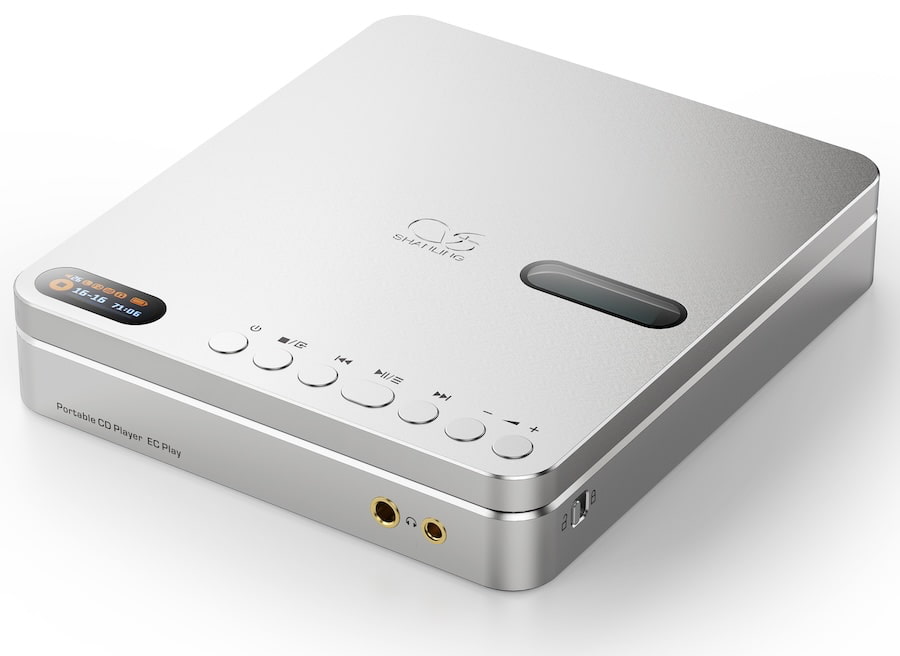
Shanling has launched the EC Play portable CD player, a compact modern CD player priced at $199 aimed at younger listeners rediscovering physical media and anyone else tired of paying monthly rent to access albums they supposedly “own.”
The timing is not accidental. CDs have been getting a second look from younger buyers who still stream all day, but also want ownership, artwork, liner notes, and a shelf that looks less like a Target endcap and more like an identity crisis with jewel cases. Shanling clearly sees the opening, and so does FiiO, which means we may be watching the early stages of a very specific hardware feud: the portable CD player war for a generation that gets its news from TikTok and might think the Straits of Hormuz is an influencer house in Dubai.
That is not a complaint. More support for physical media, better portable playback, Bluetooth connectivity, and internal headphone amplification are all good things. But with Shanling and FiiO both pushing new portable CD players into the market, the obvious question remains: how many modern Discman descendants does the market actually need before this becomes less “physical media revival” and more “somebody please take the launch calendar away from the product team”?
Shanling EC Play Gives Gen Z a CD Player With Bluetooth Training Wheels
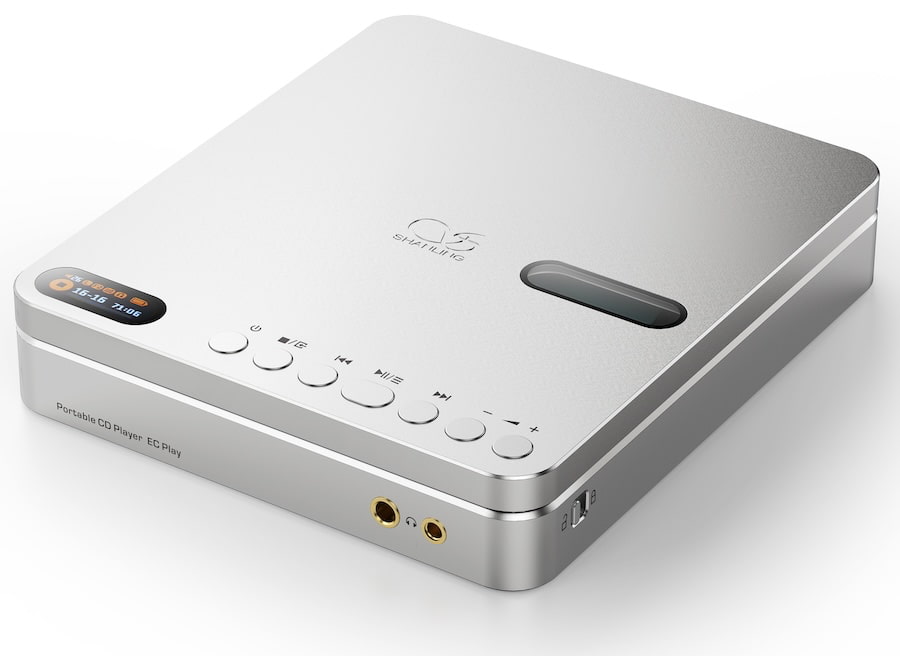
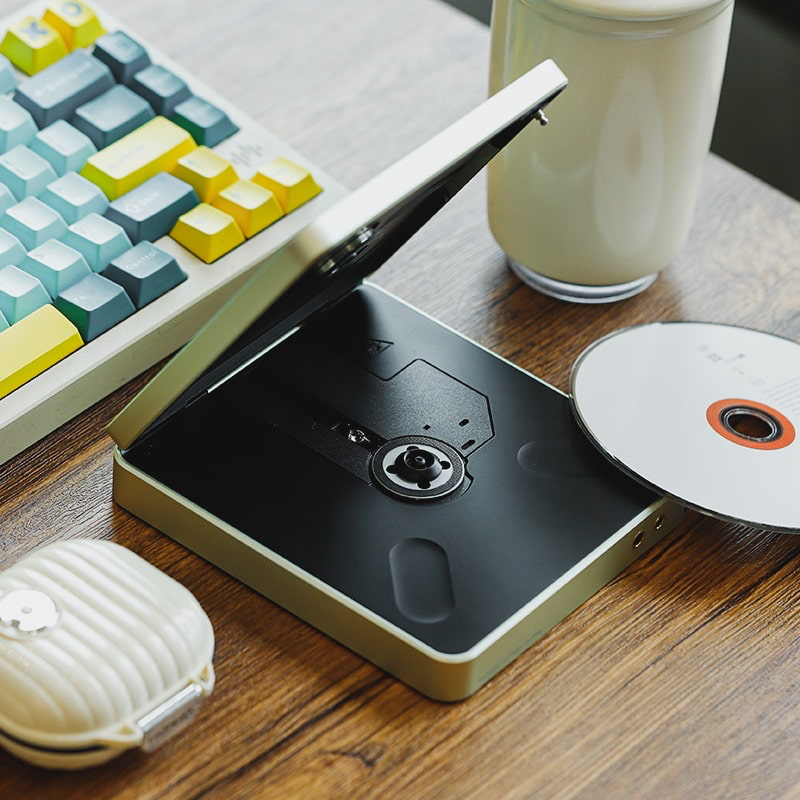
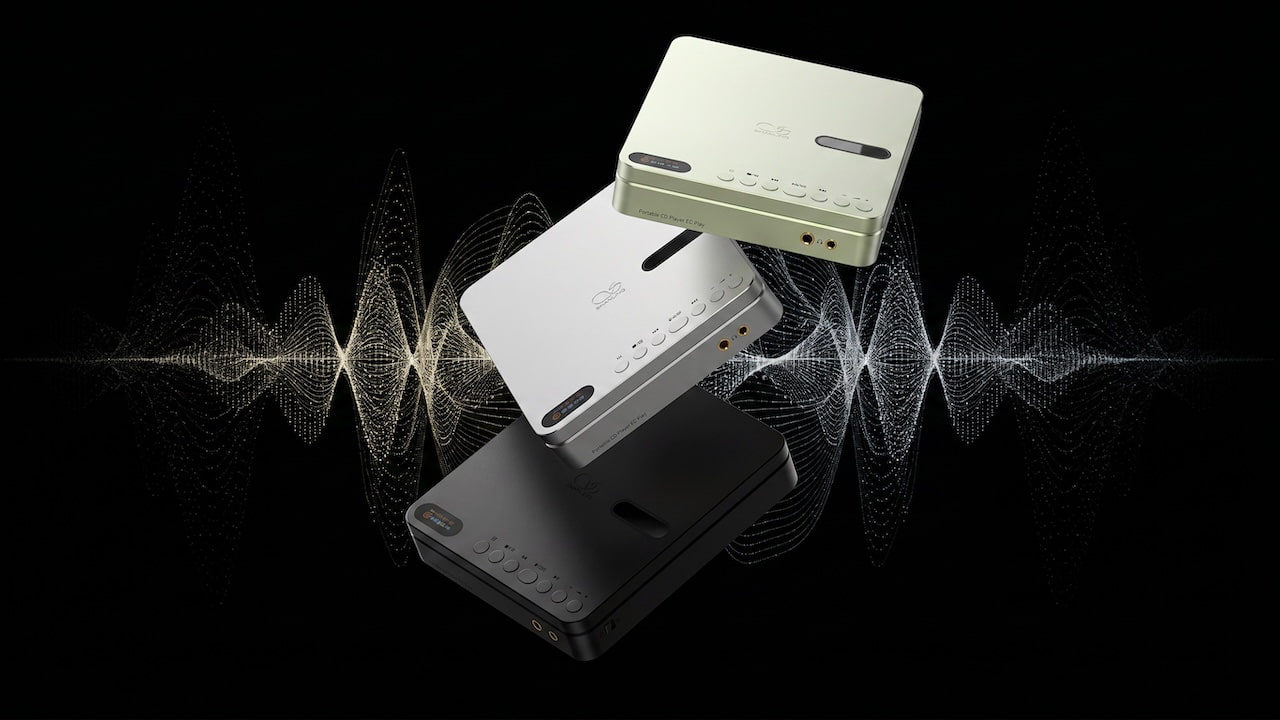
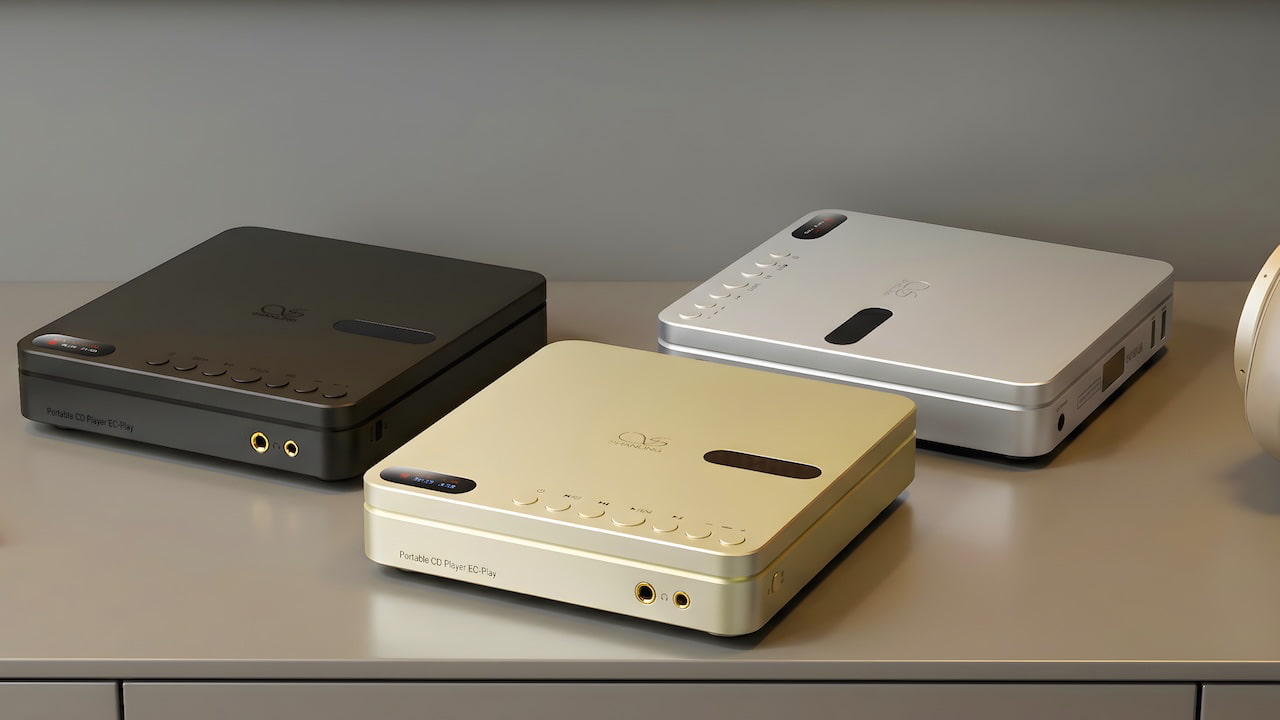
The Shanling EC Play is a compact portable CD player with an aluminum chassis, a weight of 418 grams, and dimensions of 142 x 125.1 x 26 mm. It is available in Feather Green, Onyx Black, and Moonlight Silver, and the design is clearly built around portability rather than making the user carry a small desktop component in a jacket pocket.
Advertisement
The disc mechanism is one of the more important parts of the design. Shanling uses an active magnetic clamp system adapted from its earlier EC models, which is designed to maintain disc stability by adjusting pressure and positioning during playback. The goal is to reduce vibration and mechanical noise, both of which matter in a portable CD player. The EC Play supports CD, CD-R, and CD-RW playback, along with gapless playback, which is useful for live albums, classical recordings, and albums where the tracks are meant to flow without interruption.
For digital conversion, Shanling uses the Cirrus Logic CS43198 DAC, paired with dual SGM8262 headphone amplifiers. The player includes both 3.5mm single-ended and 4.4mm balanced headphone outputs, with selectable gain settings for different headphones and IEMs. The 3.5mm output delivers up to 177mW at 32 ohms in high gain, while the 4.4mm balanced output reaches up to 700mW at 32 ohms. That gives the EC Play more flexibility than a basic portable CD player, especially for listeners who use wired headphones and want more output than a phone dongle.
Connectivity is broader than CD playback alone. The EC Play includes a 3.5mm coaxial SPDIF digital output, allowing it to function as a compact CD transport for a DAC, hi-fi system, powered speakers, or compatible soundbar. It can also operate as a USB DAC, supporting PCM up to 384kHz/32-bit and DSD256 when connected to a laptop or smartphone.
Wireless support is included through Bluetooth 6.0, with two-way operation. The EC Play can work as a Bluetooth receiver for streaming from a phone or tablet, or as a transmitter to wireless headphones and speakers. Receiver mode supports LDAC, AAC, and SBC, while transmitter mode is limited to SBC. That distinction matters: the better wireless codec support applies when sending music into the EC Play, not when sending CD playback out to wireless headphones.
Battery life is rated at up to 12 hours from the 3450mAh battery, making this Shanling’s longest-lasting portable CD player to date. At $199 the EC Play is not just a throwback device. It is a portable CD player, headphone amp, USB DAC, Bluetooth receiver/transmitter, and compact digital transport in one small package.
Advertisement
The real question is whether the growing number of modern portable CD players from Shanling, FiiO, and others reflects actual demand, or whether everyone in Shenzhen decided the Discman needed a 2026 reboot and a balanced output.
Specifications
Display: 1.12-inch screen
Disc Support: CD, CD-R, CD-RW
Playback: Gapless playback
Drive System: Active magnetic clamp system with custom CD drive
The Shanling EC Play is not just another cheap portable CD player with Bluetooth stapled on for marketing purposes. Its strongest selling points are the compact aluminum chassis, active magnetic clamp system, Cirrus Logic CS43198 DAC, dual headphone amps, 3.5mm and 4.4mm outputs, USB DAC mode, coaxial SPDIF output, and up to 12 hours of battery life. At $199, it sits in the sweet spot between basic CD nostalgia bait and the more expensive portable hi-fi players trying to turn a CD collection into a personality test.
Advertisement. Scroll to continue reading.
What is missing? The big one is better Bluetooth transmission codec support. EC Play can receive LDAC, AAC, and SBC, but when sending audio out to wireless headphones or speakers, it is limited to SBC. That means the best listening experience will still come from wired headphones, especially through the 4.4mm balanced output. There is also no mention of onboard CD ripping, which gives the FiiO DM13 an advantage for users who want to archive discs to USB storage. FiiO’s DM13 includes CD ripping and both 3.5mm and 4.4mm outputs, while Moondrop’s DiscDream models also compete in the compact hi-fi CD player space.
Who is this for? The EC Play makes the most sense for listeners who still buy CDs, want a small portable player with a real DAC and headphone amp section, and plan to use wired headphones or IEMs. It is also a useful option for someone who wants a compact CD transport for a desktop DAC, hi-fi system, powered speakers, or soundbar. For Gen Z buyers building a physical media shelf while still living on TikTok and Spotify, it offers the ritual without demanding total analog obedience. For older listeners, it is basically a Discman with fewer bad memories and a balanced output.
Advertisement
The real competitors are the FiiO DM15 R2R, Moondrop DiscDream 2 ($179 at Amazon), Shanling’s own higher-end EC models, and cheaper lifestyle players like the Syitren R300 ($99 at Amazon). The EC Play’s job is to prove there is room for another modern portable CD player in a market that is suddenly more crowded than anyone expected. The question is not whether physical media has appeal again. It clearly does. The question is whether enough people want a $199 portable CD player with serious headphone output when the FiiO and Moondrop camps are already handing out Gordie Howe elbows in the same aisle.
Alongside Google’s long-awaited Fitbit Air announcement, the brand unveiled its newly revamped health app.
Coined Google Health, the app has replaced the old Fitbit app and houses the new AI-powered Health Coach. Built with Gemini, Health Coach promises to offer genuinely personalised training plans that are designed specifically for individuals, rather than offering a one-size-fits-all policy. But how does Google Health Coach really work and where can you find it? Will you need to splurge to benefit from the feature?
We explain everything you need to know about Google Health Coach including what it really is, where you can find it and how much it’ll set you back.
Google Health Coach sits within the new Google Health smartphone app, but specifically behind the Google Health Premium subscription. This means to access Google Health Coach, you’ll need to be signed up to the monthly or annual plan – which will set you back $9.99 a month or $99.99 a year.
Advertisement
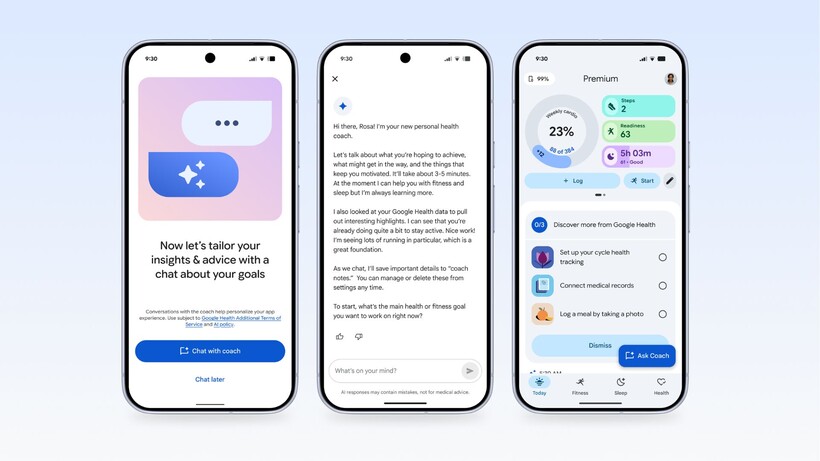
Google Health Coach is built with Gemini and is designed to provide users with the “most personalised, holistic, adaptive coaching possible”. When you first sign up, you’ll have an “onboarding conversation” which allows you to share specific goals, details about your daily routine, the type of equipment you have access to and other general lifestyle context that might be relevant with the Coach.
Onboarding with Google Health Coach via Google Health. Image Credit (Google)
Then, according to Google, the Health Coach will take these details and provide you tailored guidance and insights. Plus, Health Coach can update routines and plans according to your preferences too.
Aside from sitting across the Google Health app, the Coach is available at any time to answer questions, much like a typical AI-powered chatbot.
Advertisement
How much does Google Health Coach cost?
As mentioned earlier, Google Health Coach is part of the Google Health Premium subscription, and will cost either $9.99 a month or $99 a year. However, at the time of writing, all Fitbit Air purchases will come with three months of the subscription free.
In addition, Google AI Pro and Ultra subscribers will benefit from Google Health Premium at no additional cost too.
Advertisement
Fitbit Air. Image Credit (Google)
How can I find Google Health Coach?
Google Health Coach sits within the Google Health app, and can be found across the Today, Fitness, Sleep and Health tabs. Google explains the Today tab acts as the home for Coach’s insights, and provides an overview on your fitness and sleep metrics from the past day, alongside nutrition and cycle tracking and even environmental context like location and weather too.
Image Credit (Google)
The Fitness tab will house your tracked workouts and step count, but will also offer tailored workout suggestions and the ability to create entirely custom workouts via the Coach.
As its name suggests, the Sleep tab will explain your sleeping habits and help you understand your sleep consistency while offering advice on how to make improvements.
Advertisement
Advertisement
Coach within the Health tab can provide summaries of your personal health records and make them “easier to digest”. However, at the time of writing, only users in the US will be able to share their medical records with the Coach.
Finally, the Coach is launching first for eligible Fitbit and Pixel Watch users from May 19 to May 26, coinciding with the launch of the Fitbit Air. However, Google has promised that support for other devices is “coming soon”, though no firm date has been provided just yet.
Hackers who gained access to the databases of Spanish fast-fashion retailer Zara stole data belonging to more than 197,000 customers, according to data breach notification service Have I Been Pwned.
Zara has over 1,500 company-managed and franchised stores worldwide and is the flagship brand of the Inditex Group, one of the world’s largest fashion distribution groups, which also owns Bershka, Zara Home, Oysho, Pull&Bear, Massimo Dutti, Stradivarius, and Uterqüe.
As Inditex stated last month, when the data breach was widely reported, the compromised databases were hosted by a former tech provider and contained information about business relationships with customers in different markets.
However, Inditex noted that the attackers didn’t gain access to affected customers’ names, phone numbers, addresses, credentials, or payment information (such as bank cards).
Advertisement
It also added that its operations and systems were unaffected, but has yet to attribute the breach to a specific threat actor and to share the name of the hacked provider.
“Inditex has immediately applied its security protocols and has started notifying the relevant authorities of this unauthorized access, that stems from a security incident that affected a former technology provider and has impacted several companies operating internationally,” Inditex said.
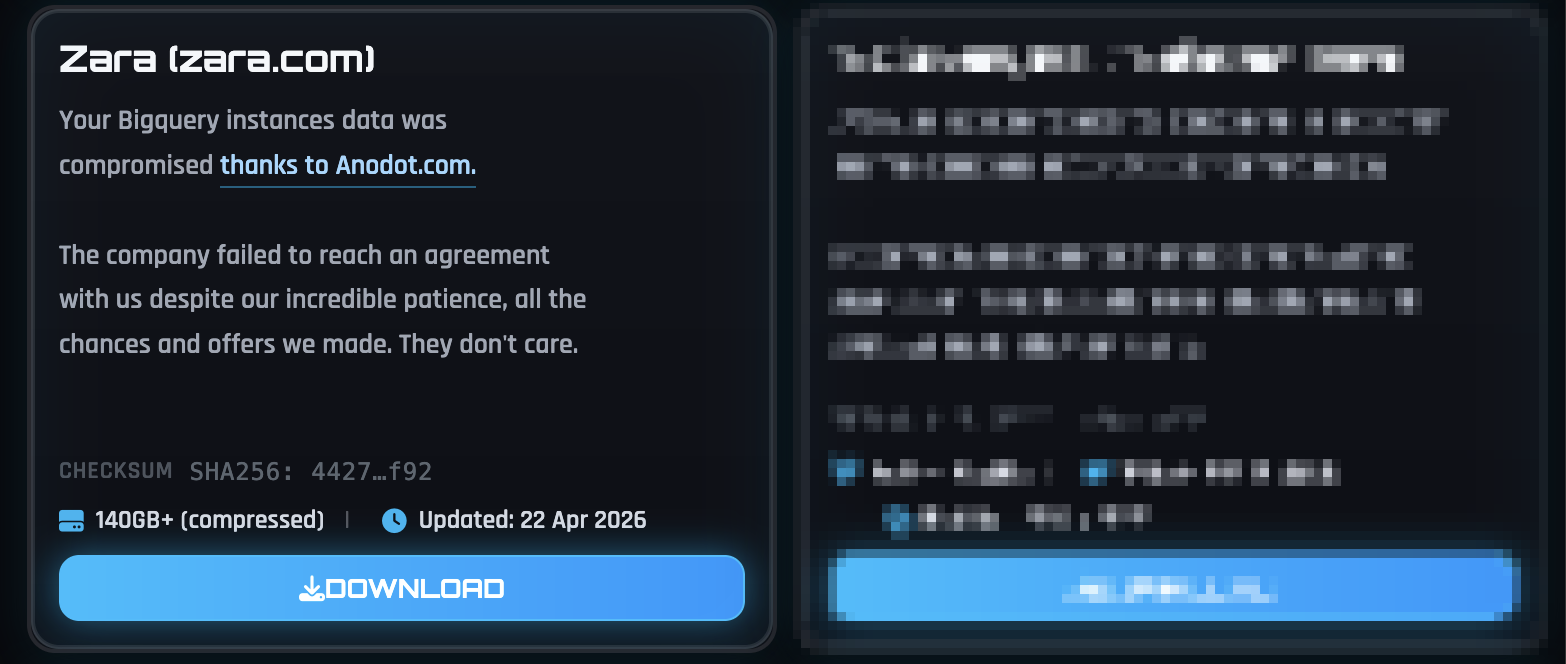
While Inditex and Zara have yet to disclose more details regarding the incident, including the total number of affected individuals, the ShinyHunters extortion gang has since claimed responsibility for the breach and leaked a 140GB archive containing documents allegedly stolen from BigQuery instances using compromised Anodot authentication tokens.
Zara entry on ShinyHunters’ data leak site (BleepingComputer)
Have I Been Pwned analyzed the stolen data and said today that the resulting data breach exposed the data of 197,400 people, including unique email addresses, geographic locations, purchases, and support tickets. “The data contained 197k unique email addresses alongside product SKUs, order IDs and the market the support ticket originated in,” Have I Been Pwned said.
Previously, the cybercrime gang told BleepingComputer that they had stolen data from dozens of companies using Anodot authentication tokens, adding that they were blocked by AI-based detection when trying to steal data from Salesforce instances.
Advertisement
The group has also been linked to a widespread vishing campaign targeting employees’ and Business Process Outsourcing (BPO) agents’ Microsoft Entra, Okta, and Google SSO accounts to steal data from connected SaaS applications (including Salesforce, SAP, Slack, Adobe, Atlassian, Zendesk, Dropbox, Microsoft 365, Google Workspace, and others) after breaching corporate SSO accounts.
More recently, ShinyHunters hacked education technology giant Instructure twice, the second time exploiting a security vulnerability to deface Canvas login portals for approximately 330 colleges and universities and threatening to leak data stolen in the earlier Instructure breach unless a ransom is paid.
MANGO, another Spanish fashion retailer giant, also sent notices of a data breach to its customers in October, warning them that personal data used in marketing campaigns had been compromised after its marketing vendor was hacked. However, no ransomware or extortion groups have claimed the MANGO incident, so the attackers remain unknown.
Advertisement
AI chained four zero-days into one exploit that bypassed both renderer and OS sandboxes. A wave of new exploits is coming.
At the Autonomous Validation Summit (May 12 & 14), see how autonomous, context-rich validation finds what’s exploitable, proves controls hold, and closes the remediation loop.
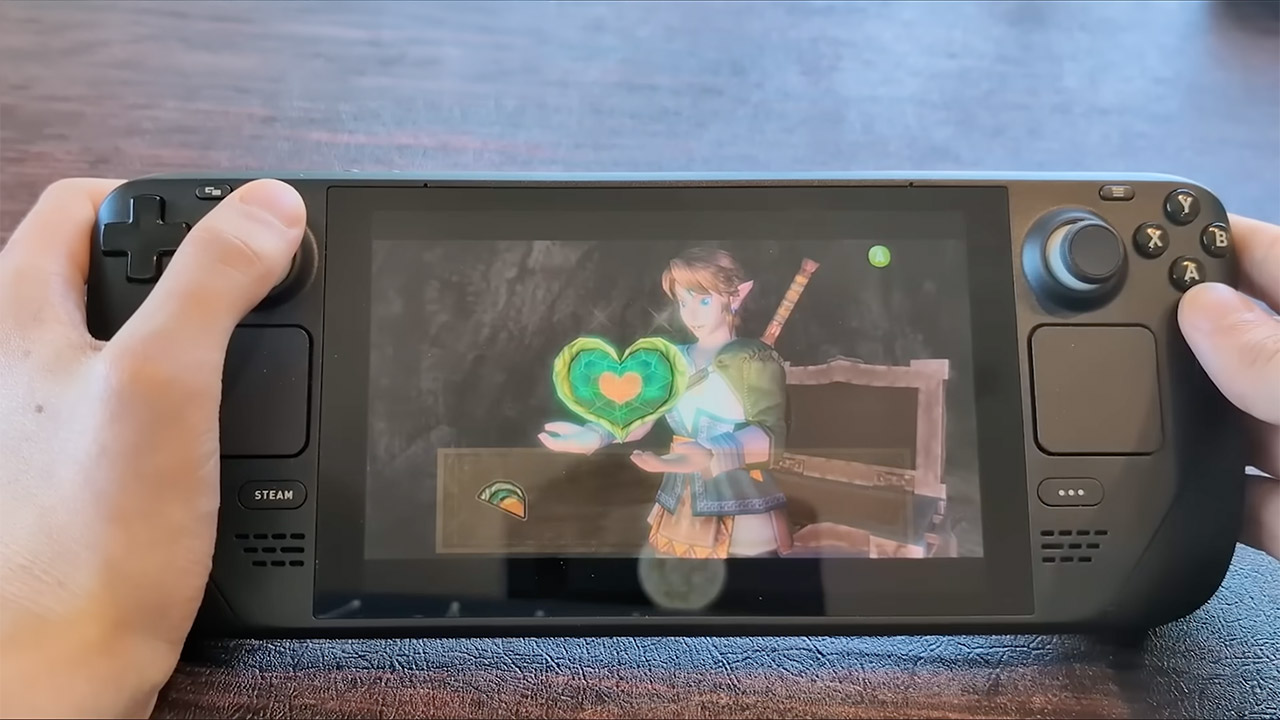
Zelda fans have long hoped for a way to play Twilight Princess on computers without dealing with emulators. Yesterday that hope became reality when the team at TwilitRealm released Dusk, a native port built from the ground up for modern systems.
Access starts by visiting twilitrealm.dev or the project’s GitHub release page. You download the files and then obtain a copy of the game’s Gamecube version, which might be either North American or European. Once everything is set up on your desktop or laptop, or even your phone or tablet, the journey begins.
XBOX EXPERIENCE BROUGHT TO LIFE BY ROG The Xbox gaming legacy meets ROG’s decades of premium hardware design in the ROG Xbox Ally. Boot straight into…
XBOX GAME BAR INTEGRATION Launch Game Bar with a tap of the Xbox button or play your favorite titles natively from platforms like Xbox Game Pass…
ALL YOUR GAMES, ALL YOUR PROGRESS Powered by Windows 11, the ROG Xbox Ally gives you access to your full library of PC games from Xbox and other game…
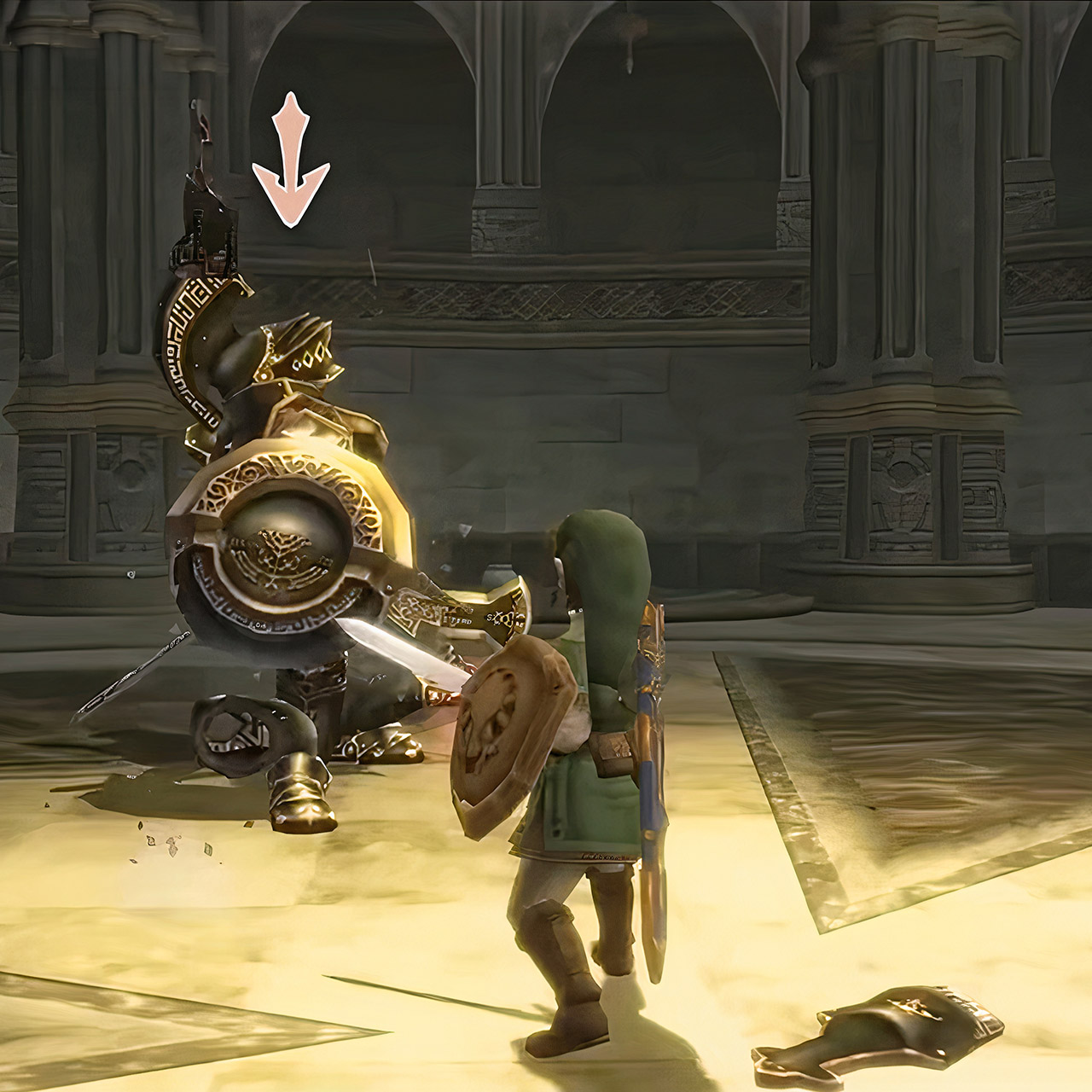
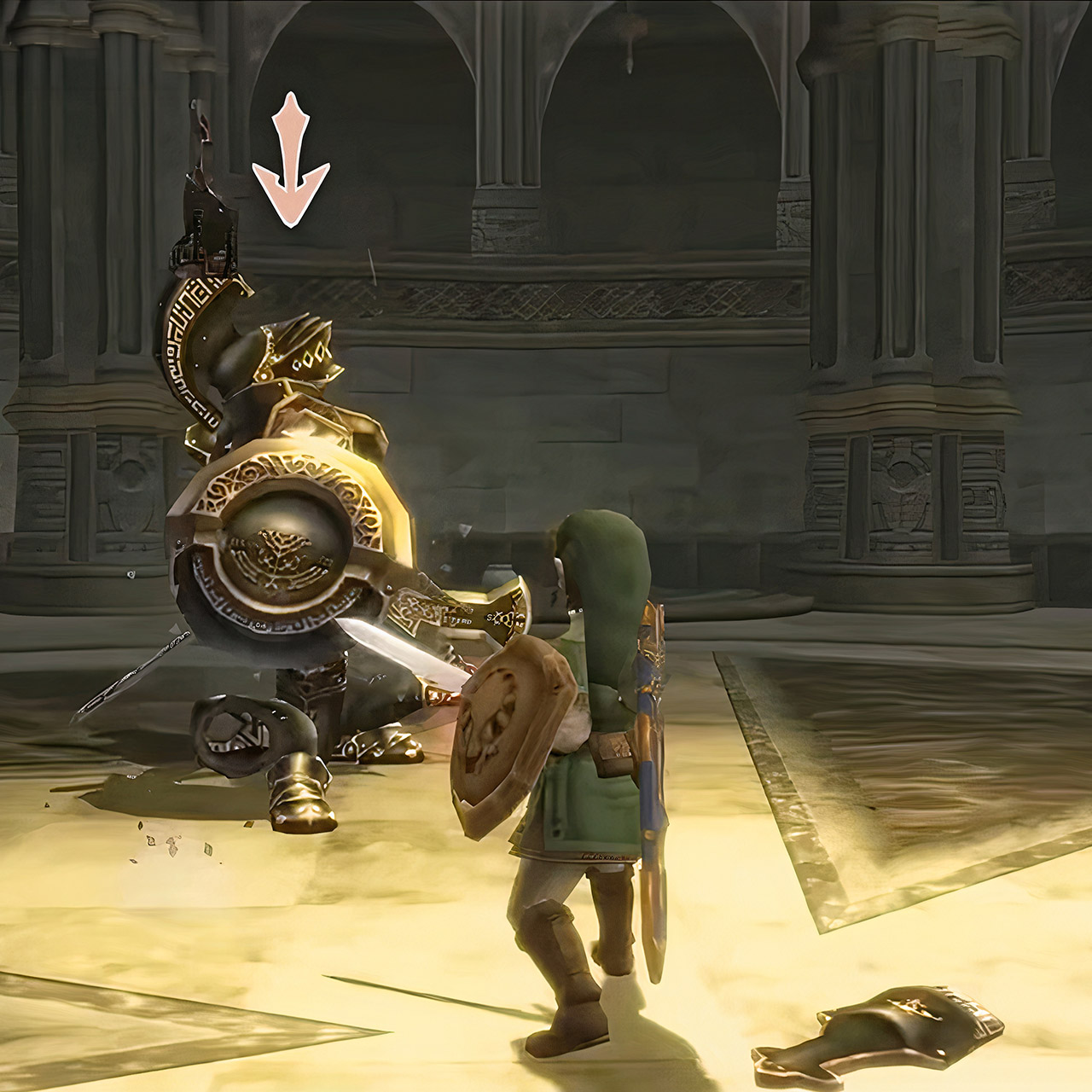
Visually, the game appears much sharper right away, as the port removes all of the constraints of the original hardware. Resolutions far above what the GameCube could handle, and frame rates increase to match. But here’s the thing: the game environment continues to refresh at the same rate as before, so you won’t notice any strange behaviour with jumps or puzzles. The port, however, fills in extra frames by estimating where objects will travel next, which is similar to how many large modern games do. The end effect is motion that’s as fluid as silk, with no need to think about the underlying gameplay.
In terms of controls, they feel spot on whether you’re using a keyboard or a gamepad. We’ve also added complete support for gyro aiming if you’re using a suitable controller, and Steam Deck owners will be pleased to know that the game is easy to play straight out of the box. There are additional options for adjusting the gameplay to your preferences. Some people will wish to speed up the climbing, while others will prefer to skip extended conversations or compress the transitions between being human and wolf. You can even change the time of day on the fly with the Sun’s Song.
If you’ve had any experience with PC gaming, getting everything set up is a piece of cake, and the port can now run pretty much anywhere because it’s no longer limited by console power. Cross-platform design ensures that the same files work on whichever device you’re using, thanks to something called Aurora. Mobile play is now on the table, which is fantastic news for anyone who enjoys playing on the go. Speedrunners will be pleased to know that the core timing is exactly the same as the console version, down to the last tick. [Source]
The U.S. Cybersecurity and Infrastructure Security Agency (CISA) has given U.S. federal agencies four days to secure their networks against a high-severity vulnerability in Ivanti Endpoint Manager Mobile (EPMM) that has been exploited in zero-day attacks.
Tracked as CVE-2026-6973, this security flaw allows attackers with administrative privileges to execute arbitrary code remotely on systems running EPMM 12.8.0.0 and earlier.
In a Thursday security advisory, Ivanti told customers they can secure their appliances by installing Ivanti EPMM 12.6.1.1, 12.7.0.1, and 12.8.0.1, and advised them to review accounts with Admin rights and rotate those credentials where necessary.
“At the time of disclosure, we are aware of very limited exploitation of CVE-2026-6973, which requires admin authentication for successful exploitation. We are not aware of any customers being exploited by the other vulnerabilities disclosed today,” it said.
Advertisement
“The issues only affect the on-prem EPMM product, and are not present in Ivanti Neurons for MDM, Ivanti’s cloud-based unified endpoint management solution, Ivanti EPM (a similarly named, but different product), Ivanti Sentry, or any other Ivanti products.”
Nonprofit security organization Shadowserver now tracks over 800 Ivanti EPMM appliances exposed online. However, there is no information on how many have already been patched against the CVE-2026-6973 vulnerability.
“This type of vulnerability is a frequent attack vector for malicious cyber actors and poses significant risks to the federal enterprise,” CISA warned.
In late January, Ivanti patched two other critical EPMM security issues (CVE-2026-1281 and CVE-2026-1340) that were exploited in zero-day attacks affecting a “very limited number of customers.” On April 8, CISA also gave U.S. government agencies four days to secure their systems against attacks targeting the CVE-2026-1340 flaw.
Advertisement
“If customers followed Ivanti’s recommendation in January to rotate credentials if you were exploited with CVE-2026-1281 and CVE-2026-1340, then your risk of exploitation from CVE-2026-6973 is significantly reduced,” the company noted on Thursday.
Ivanti provides IT asset management solutions to over 40,000 clients worldwide, supported by an extensive network of over 7,000 partners.
AI chained four zero-days into one exploit that bypassed both renderer and OS sandboxes. A wave of new exploits is coming.
At the Autonomous Validation Summit (May 12 & 14), see how autonomous, context-rich validation finds what’s exploitable, proves controls hold, and closes the remediation loop.



























.png)





































You must be logged in to post a comment Login