

It’s hard to imagine modern life without glycols. They are used in cosmetics, fog machines, and food. As you read this, you’re almost certainly wearing or drinking from something they were used to produce — polyester fabric or plastic bottles, for example. If you brush your teeth with toothpaste or top your salad with bottled dressing, you’ve come into contact with these manmade chemical compounds.
Tech
Glycol vapors could stop respiratory pandemics


Manufactured at industrial scales from crude oil and natural gas, glycols are a common antifreeze ingredient. They are also useful for refrigeration, allowing cooling systems to maintain colder temperatures than water alone allows.
But there’s something more they could do for us: When glycols are vaporized into indoor air, they rapidly inactivate viruses, bacteria, and fungal spores — even while the glycol vapors remain at low enough concentrations to be invisible, odorless, and tasteless. It’s a property that could reduce the spread of the seasonal flu, and maybe even help stop airborne pandemics before they begin. We’ve known about their disease-fighting properties for almost a century, and new research might allow us to deploy them at scale soon.

Chemically speaking, glycols are organic compounds that belong to the alcohol family. Propylene glycol (PG), dipropylene glycol (DPG), and triethylene glycol (TEG) vapors specifically seem safe for humans to breathe. TEG vapors in particular would be cheap to deploy — costing only about 10 to 50 cents per day to protect a 1,000-square-foot room. While it’s not exactly clear how they combat pathogens, they’ve been shown to inactivate both air- and surface-borne viruses and prevent respiratory disease transmission. According to Curtis Donskey, an infectious disease physician and researcher at the Cleveland VA Medical Center, glycol vapors are particularly effective against enveloped viruses — think SARS-CoV-2, influenza, and Ebola.
There’s a body of evidence supporting their use for infection prevention dating back to the mid-20th century. One study conducted over three winters between 1941 and 1944 in a pediatric hospital demonstrated a 96 percent reduction in colds in wards that were disinfected with glycol vapors, compared to those that weren’t. Patients in the glycol-treated wards also had 90 percent fewer total cases of tracheobronchitis, middle ear infections, and acute pharyngitis than the controls.
That research is many decades old, of course, and even similar studies would employ different methodologies today. “Different times [mean] different research standards,” Jacob Swett, the executive director and founder of Blueprint Biosecurity, a nonprofit focused on pandemic prevention, told me. “But I think this shows where the potential could be.”
People in the mid-20th century saw a market opportunity in glycol vapors’ ability to reduce disease transmission. Newspaper advertisements touted “glycolators” and “glycolizers” to protect homes and office spaces.
Interest in glycol vapors for disinfection peaked in the 1940s, falling off with the advent of widely available antibiotics. There was a spike in peer-reviewed papers on glycols in the 1980s, mostly focused on their use in cooling systems and antifreeze agents as disinfectants, but broader interest remained minimal.
The Covid-19 pandemic brought renewed interest in glycol vapors’ antimicrobial properties, and the Environmental Protection Agency (EPA) issued an emergency approval in six states for a TEG-based product series to disinfect occupied indoor spaces. But scientific research on the subject remained relatively limited. Public health agencies were often skeptical about using glycol vapors for disinfection during the Covid-19 pandemic, when the safety profiles of other mitigation measures were better understood. Public health bodies were working with the information they had — some of which turned out to be outright incorrect, like the insistence that SARS-CoV-2 was spread only by droplets rather than being airborne. Hence the stronger focus, especially in the early phases of the pandemic, on measures such as social distancing, practices that are less effective for diseases in which pathogens travel farther and remain suspended in the air.
But even if early speculation about droplet-based transmission of Covid had been correct, there would have been plenty of other good reasons to take the pathogen-negating properties of glycol vapors seriously. “Whether it’s tuberculosis, SARS-CoV-2, the seasonal flu [that] threatens us every year or the next pandemic, which is likely to be airborne, having this evidence around glycol vapors will put us in a much better position to be able to make informed decisions about countermeasures,” Swett told me. With that possibility in mind, Blueprint awarded $4.5 million in grants to the recipients of its Glycol Vapors for Infection Suppression: Efficacy and Safety Research (GlycolISER) program in March.
The grantees will study how glycol vapors inactivate pathogens, their effectiveness during emergency deployment, real-world efficacy in healthcare settings, and how the vapors interact with air filter media. The researchers will also study glycol vapors’ safety profile, especially with potentially sensitive populations, such as people with asthma.
“Being ready to fight the next pandemic means we need to robustly evaluate a wide range of possible interventions,” Brian Renda, a program director at Blueprint Biosecurity, said in a press release. “Through this program, we’re supporting multidisciplinary research to better understand the potential and limitations of glycol vapors as a tool to reduce airborne disease transmission.”
Initial findings are expected by early to mid-2027. “We want to know more about how well it works and we want to make sure that it doesn’t have unintended consequences,” Delphine Farmer, a professor of atmospheric chemistry at Colorado State University who is one of the grantees, told me. Her research will examine how best to get glycol vapors into the air in a quick and affordable way, and how much would come out in gases and particles once vaporized, since those factors impact how effective they are at removing and destroying different microbes that might be in the air. “We want to make sure that if people start adding glycol vapors to air, that this doesn’t cause unknown or new chemistry that might negatively impact people. So the third aspect of what we’re doing is to look at polyethylene glycol chemistry and see if it’s going to produce anything or react with surfaces in ways we should be concerned about.”
Donskey is another of the grantees, and his project has multiple aims. Using a commercially available glycol-based product currently approved for use in unoccupied spaces and for control of mold and mildew, his work will assess whether glycol vapors can reduce the concentration of pathogens in various healthcare settings with different degrees of ventilation. His research will also, among other things, examine whether glycol vapors can reduce airborne pathogen dispersal in medical procedure rooms. The researchers will start testing in unoccupied rooms and transition to populated spaces after the products receive EPA registration for use in occupied spaces.
As Swett suggests, the next pandemic will very, very likely come at us through the air, but there are already numerous other illnesses circulating that we could prevent before they take root. The potential benefits — for reducing work and school absenteeism, healthcare costs, and avoidable suffering — are enormous.
Why we need a multilayered arsenal against airborne disease
If the Covid-19 pandemic taught us anything, however, it’s that airborne disease is still a threat as long as we breathe. But six years on, it’s not clear if we took that lesson to heart. “It seems like we didn’t really learn much from Covid-19 and [as a society] are actively ignoring the ongoing effects,” Miles Griffis, the co-founder of The Sick Times, a publication covering long Covid, told me. “I think we could be in a much better place than we are now.”
A study from 2024 found that 400 million people around the world have had long Covid — almost certainly an undercount. In the next 10 years, long Covid could cost health systems $11 billion annually. Up to 35 percent of people infected by Covid-19 develop lingering symptoms that can be profoundly disabling.
And Covid is only one disease you can catch through the air, nor is it the only one that can have dire consequences. Influenza costs the US almost $29 billion in a single season from healthcare costs and lost productivity — and it kills up to 650,000 people worldwide every year. Childcare centers, schools, and workplaces would be significantly safer and more productive with better ways to prevent the spread of airborne illness.
It’s impossible to say how many cold or flu or Covid-19 infections glycol vapors could prevent. But, like other technologies such as germicidal ultraviolet light, they are notable in part because they don’t require people to “opt in” the way donning a mask does — their distribution mechanisms could be built into the environment itself. William and Mildred Wells, a husband-and-wife duo, were thinking along these lines in the 1930s, advocating for governments to install germicidal ultraviolet lights in public places to protect everyone from airborne pathogens. The Wellses saw that people were developing ways to purify water, pasteurize milk, and ensure food wasn’t contaminated, and asked “‘What about the air? Don’t we deserve pure air as well?’” Carl Zimmer, a science columnist for the New York Times and the author of Air-Borne: The Hidden History of the Life We Breathe, told me.
Blueprint Biosecurity thinks so, and is also advancing work on far-UVC light and better personal protective equipment to protect against airborne pathogens. Better ventilation and filtration could, of course, also improve indoor air quality, which would significantly reduce respiratory disease transmission.
“In many ways, the kind of changes to buildings today [compared to the 1940s and ’50s when earlier studies were done] potentially make them more amenable to glycol vapors where you have centralized HVAC systems,” Swett told me. “[And] depending on how the evidence comes back, there’s a number of environments where you could imagine deploying them.”

“I think we’ve got a little bit of testing to go before we know how well they work,” Farmer said. “As an atmospheric chemist, I always think about clean air…as the absence of any pollutant. So the moment I hear about adding anything to air, I have some notes of caution. But on the flip side, we do add things to our indoor air all the time, so it doesn’t necessarily mean it’s a dealbreaker.”
No matter how safe and effective glycol vapors prove to be, there’s likely to be resistance of one kind or another. People will be wary of adding substances to the air, and entering spaces where they don’t know if glycol vapors will be used. But Donskey doesn’t anticipate that this will be a major issue: “If a product has an EPA registration indicating that they believe it’s safe for use in occupied areas, I think most people will be comfortable. There may be some people who are less comfortable, but again, I think it’ll go through more safety evaluations.”
Once a regulatory agency says this is safe to use in occupied areas, the rest will follow. We would still need commercial products to disseminate them; people can’t just put glycol vapors into their home humidifier. “But if it’s EPA-registered, relatively inexpensive, easy to use, and doesn’t involve a lot of labor, I could easily envision a lot of healthcare facilities taking this up,” Donskey said.
There are many potential use cases for glycol vapors, and “we definitely need some good strategies that allow for safe indoor environments,” Farmer told me. After all, we spend about 90 percent of our time indoors, and we always have to breathe.

Continue Reading
Tech
Cloudflare cuts 1,100 jobs in agentic AI pivot despite beating Q1 2026 earnings as stock falls 24%

Cloudflare beat Q1 earnings estimates, cut 1,100 employees because AI agents now do their work, and saw its stock fall 24 per cent. It is the most explicit case of a company attributing layoffs directly to AI replacing human roles.
TL;DR
Cloudflare beat Wall Street’s revenue and earnings estimates on Wednesday, announced it would cut 1,100 employees because artificial intelligence agents now do their work, and watched its stock fall 24 per cent on Thursday. The sequence is becoming the template for the technology industry in 2026: record revenue, record layoffs, record doubt about what comes next.
First-quarter revenue was 639.8 million dollars, up 34 per cent year over year, beating the consensus estimate of 622 million. Adjusted earnings per share were 25 cents against expectations of 23 cents. Free cash flow was 84.1 million dollars. The company added a record number of customers paying more than five million dollars per year and saw a 73 per cent year-over-year increase in deals worth more than a million. By every traditional metric, the quarter was strong.

The 💜 of EU tech
The latest rumblings from the EU tech scene, a story from our wise ol’ founder Boris, and some questionable AI art. It’s free, every week, in your inbox. Sign up now!
Then the company said it was eliminating one in five jobs.
The model
CEO Matthew Prince and co-founder Michelle Zatlyn announced in a blog post that Cloudflare is transitioning to what they called an “agentic AI-first operating model.” The company said its internal use of AI had increased more than 600 per cent in three months. Staff across engineering, human resources, finance, and marketing are running thousands of AI agent sessions per day. The framing was not that AI would assist employees. It was that AI has made certain categories of employee unnecessary.
Prince was specific about which roles are disappearing. “A lot of the support roles” behind customer-facing and engineering staff “are not going to be the roles that drive companies going forward,” he said. The language distinguished between people who build the product, people who sell the product, and people who support the people who build and sell the product. The third group is being replaced.
GitHub froze new Copilot sign-ups last month because agentic AI workflows were generating costs that exceeded what users paid, a signal that the economics of AI tools are not yet stable. Cloudflare’s bet is that the instability is temporary and that the productivity gains from running thousands of AI agent sessions per day will more than offset the cost of eliminating 1,100 human roles and paying 140 to 150 million dollars in restructuring charges.
The numbers
The financial results that accompanied the layoff announcement were not the results of a company in distress. Cloudflare now has 4,416 customers paying more than 100,000 dollars per year. It estimates that approximately 80 per cent of leading AI companies use its products. Its Workers developer platform, which runs code at the edge of Cloudflare’s network across data centres in 330 cities, is positioned as infrastructure for the AI agent economy the company says is replacing the roles it just eliminated.
Full-year revenue guidance was 2.805 to 2.813 billion dollars, narrowly beating the consensus estimate of 2.8 billion. Full-year adjusted earnings guidance was 1.19 to 1.20 dollars per share, ahead of the 1.14 expected. Prince called AI “the biggest tailwind we’ve ever seen in Cloudflare’s history” and said the re-platforming of the internet around AI agents represents the company’s largest growth opportunity.
The stock market disagreed, or at least disagreed with the timing. Shares fell 24 per cent on Thursday, erasing billions in market capitalisation. The sell-off reflected not the earnings, which were strong, but the uncertainty about whether a company that just fired 20 per cent of its workforce can execute a business model transition while maintaining the growth trajectory investors had priced in.
The cuts
The 1,100 affected employees will receive base pay through the end of 2026, continued healthcare coverage through year end in the United States, and equity vesting extended to 15 August 2026. The restructuring is expected to be substantially complete by the end of the third quarter. Prince said, “Today is a hard day.”
The company’s headcount will fall from approximately 5,156 to around 4,000. The restructuring charges of 140 to 150 million dollars break down to 105 to 110 million in cash severance and benefits and 35 to 40 million in non-cash equity-related expenses. The savings are projected at a pace that Cloudflare expects to reinvest into the AI infrastructure and hiring it says will drive the next phase of growth.
Cloudflare framed the cuts as structural rather than cyclical. This is not a company reducing headcount because revenue is declining. Revenue grew 34 per cent. This is a company reducing headcount because it believes the work those employees performed is now performed by software. The distinction matters because it implies the jobs are not coming back.
The pattern
Meta and Microsoft between them cut 23,000 jobs while simultaneously increasing AI spending by tens of billions of dollars. Oracle eliminated up to 30,000 positions to fund AI data centres. Atlassian cut 1,600 in the name of AI adaptation. The tech sector has recorded more than 73,000 job cuts across 95 companies in the first four months of 2026, with projections that the full-year total will exceed the 124,000 eliminated in all of 2025.
Cloudflare’s announcement is notable because it was the most explicit in attributing the layoffs to AI replacing human work rather than AI requiring capital reallocation. Meta’s Zuckerberg said the layoffs were about freeing capital for AI infrastructure. Cloudflare’s Prince said the layoffs were about AI doing the work. The difference is between “we need your salary to buy GPUs” and “we no longer need you because the GPUs are doing your job.”
The human cost of the AI layoff wave is accumulating at a pace that the industry’s growth metrics do not capture. Google is turning Chrome into an agentic AI workplace tool, embedding AI capabilities directly into the browser that millions of knowledge workers use daily. ServiceNow projects 30 billion dollars in revenue by 2030, with a third of that coming from AI. The companies building the AI tools and the companies deploying them are both growing. The people whose work the tools replicate are not.
The tension
Cloudflare’s position is coherent but uncomfortable. The company reported its strongest quarter, told investors the AI opportunity is transformational, cut a fifth of its workforce to pursue it, and then saw a quarter of its market value disappear because investors were not sure the transformation would work. The 600 per cent increase in AI usage over three months is either evidence that the transition is already delivering results or evidence that the company is moving faster than it can manage.
Prince’s statement that certain support roles “are not going to be the roles that drive companies going forward” is a prediction about the entire industry, not just Cloudflare. If he is right, the 1,100 people losing their jobs at Cloudflare are early casualties of a restructuring that will reach every technology company and eventually every company that employs people to do work that AI agents can approximate. If he is wrong, Cloudflare just fired 20 per cent of its workforce during its best quarter, and the 24 per cent stock drop is the market’s way of saying so.
The earnings beat. The layoffs are real. The stock is down. The AI agents are running. The question Cloudflare cannot yet answer, and that no company in its position has answered, is whether a 600 per cent increase in AI usage produces a proportional increase in the value of the work, or whether it produces a proportional increase in the confidence that the work is being done without anyone checking whether it is being done well.


The music gear super-company inMusic is purchasing Native Instruments. This is a big deal for a number of reasons. First and foremost, the acquisition puts Native Instruments under the same umbrella as long-time hardware and software rival Akai. The US-based inMusic also owns Moog, M-Audio, Denon, Numark and several other high-profile brands.
Native Instruments owns several popular digital brands like Plugin Alliance, iZotope and Brainworx, all of which will now be run by inMusic. The acquisition also puts an end to the Native Instruments bankruptcy saga, which had left its future uncertain. The company will continue on, which is encouraging for those tied to NI’s ecosystem of products. This does, however, create a massive juggernaut in the industry.
The deal isn’t exactly unsurprising. Someone had to buy Native Instruments and inMusic had already partnered up with the company to bring some of its plugins to Akai devices. The acquisition will likely lead to more NI software popping up on stuff like the Akai MPC XL. Native Instruments makes some of the most respected software in the industry, as synths like Reaktor and Massive are regularly used in music across multiple genres.
There are some questions regarding hardware. Akai makes multiple standalone grooveboxes. We aren’t sure where Native Instruments’ standalone Maschine+ fits in there, if anywhere. There will also be some major product overlap in the world of MIDI controllers. Akai and Native Instruments both make popular controllers and the same goes for other inMusic-owned brands like M-Audio.
Native Instruments CEO Nick Williams wrote in a blog post that the business will continue to operate normally as the transaction completes in the coming weeks. The company did just launch Komplete 26, the latest iteration of its music production bundle. This includes over 190 digital instruments with 180,000 presets. The latest release features a new version of the popular Abysynth synthesizer, along with updated pianos, vocal soundscapes and more.
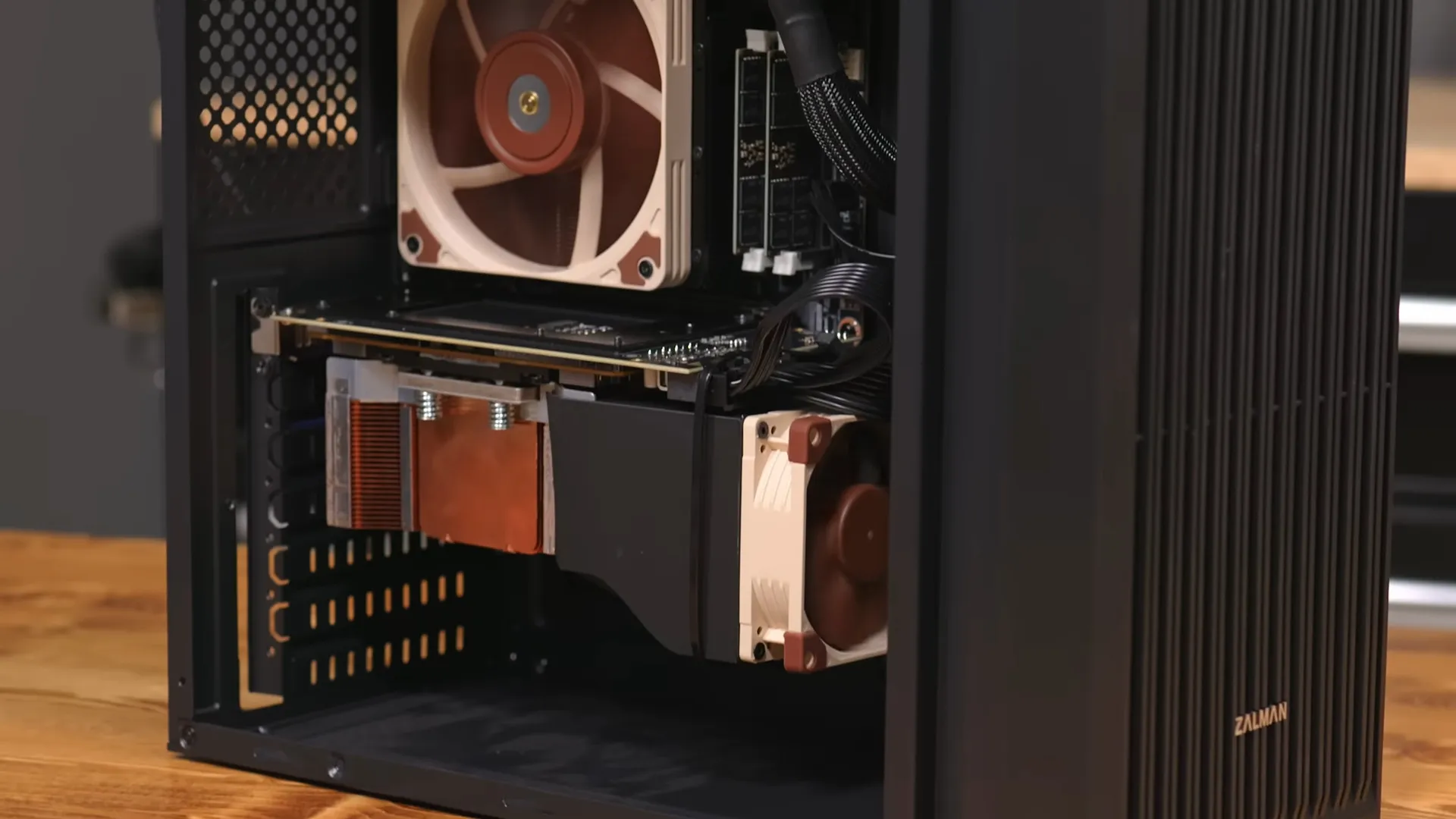
If you’ve been thinking of getting into self-hosting generative AI, but don’t have a big budget for hardware, you might want to check out [Hardware Haven]’s latest video on an unusually cheap GPU option — but you’ll have to do so quickly, before the market realizes the chance for arbitrage and prices rise accordingly.
He’s gotten a hold of a 16 GB NVidia V100 card for only about a hundred bucks, mostly because it’s not easy to plug in, being on an SXM2 socket rather than the PCIe bus. SXM is a server architecture, and not something you’re likely to get on your motherboard. Another hundred got him an adapter board to fit this enterprise GPU on a consumer motherboard. That’s still a lot less than the PCIe version of the same card, which will likely set you back a thousand or more unless you get very lucky on eBay.
It’s not the newest card, dating back from 2017, but that doesn’t mean it can’t run the latest open models. After 3D printing a fan shroud for the thing so it didn’t cook itself, adding very slightly to the build cost, [Hardware Haven] set to work seeing what it could do. Going head-to-head against an RTX 3060 12 GB, the older V100 delivered more tokens per second at a slightly higher efficiency — but much higher idle power.
Still, it’s nice to see a cheap way to get into local AI, even if it might not still be cheap by the time you read this. Once you have the hardware, you might want some easy software options so you don’t have to spend all day on setup. Of course you only need a hefty GPU to run larger models — you can get into hosting your own AI on a Raspberry Pi, if you’re patient.
Dario Amodei is not the kind of CEO who talks loosely about numbers. The Anthropic co-founder and chief executive, a former VP of research at OpenAI with a PhD in computational neuroscience from Princeton, has built a reputation for measured public statements — particularly around the financial performance of a company that, until recently, disclosed almost nothing about its business.
So when Amodei took the stage at Anthropic’s Code with Claude developer conference on Wednesday and offered a genuinely striking piece of financial candor, the room paid attention.
“We tried to plan very well for a world of 10x growth per year,” Amodei said during a fireside chat with Anthropic’s chief product officer, Ami Vora. “And yet we saw 80x. And so that is the reason we have had difficulties with compute.”
Anthropic had planned for tenfold growth. But revenue and usage increased 80-fold in the first quarter on an annualized basis, a rate Amodei described as “just crazy” and “too hard to handle.”
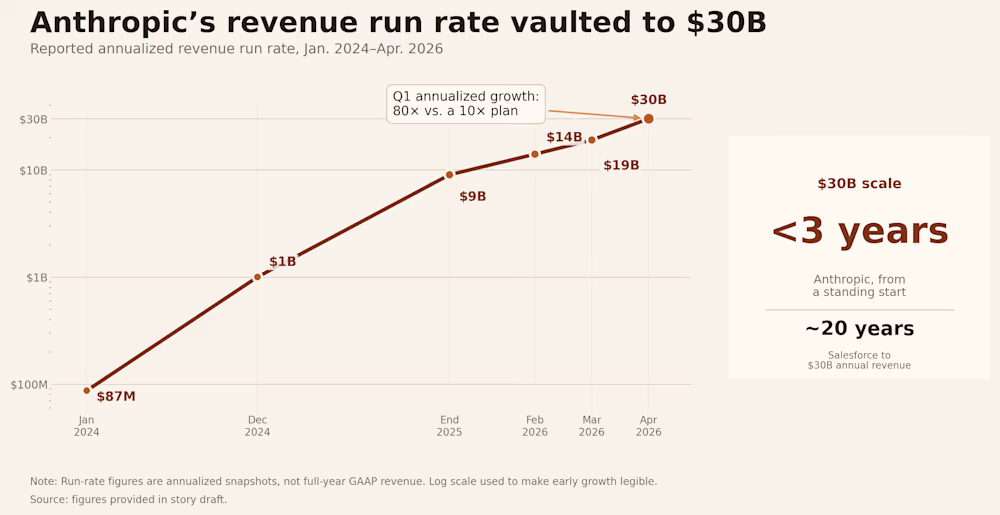
The number demands context. Annualized growth rates can overstate sustained performance — a single strong quarter, extrapolated across a full year, can paint a picture that doesn’t hold. Amodei knows this. But the underlying trajectory is not a mirage. Anthropic has crossed a $30 billion annualized revenue run rate, up sharply from roughly $9 billion at the end of 2025, and that growth is being driven largely by enterprise demand. The company’s revenue trajectory has been relentless: $87 million run rate in January 2024, $1 billion by December 2024, $9 billion by end of 2025, $14 billion in February 2026, $19 billion in March, and $30 billion in April.
For context: Salesforce took about 20 years to reach $30 billion in annual revenue. Anthropic did it in under three years from a standing start.

Claude Code became the fastest-growing product in enterprise software history
The growth story at Anthropic is, to a remarkable degree, a single-product story. Claude Code, the company’s agentic AI coding tool launched publicly in mid-2025, has become the fastest-growing product in the company’s history — and, by several measures, one of the fastest-growing software products ever built.
Claude Code hit $1 billion in annualized revenue within six months of launch, and the growth hasn’t slowed down. By February 2026, the product was generating over $2.5 billion in run-rate revenue. The company also said Claude Code’s weekly active users had doubled since January 1 and that business subscriptions had quadrupled since the start of 2026.
The mechanics of the product are straightforward. Claude Code is not a chatbot that suggests snippets. It reads a codebase, plans a sequence of actions, executes them using real development tools, evaluates the result, and adjusts its approach. The developer sets the objective and retains control over what gets committed, but the execution loop runs independently. The average developer using Claude Code now spends 20 hours per week working with the tool.
At Anthropic itself, the majority of code is now written by Claude Code. Engineers focus on architecture, product thinking, and continuous orchestration: managing multiple agents in parallel, giving direction, and making the decisions that shape what gets built.
That last point may be the most revealing detail Amodei disclosed at the conference: this is the first year Anthropic’s own internal pull requests have inflected upward due to Claude’s work on the company’s own codebase. The tool that Anthropic sells to developers is now a material contributor to Anthropic’s own engineering output. That creates a feedback loop that is almost impossible for competitors without a comparable product to replicate — the company is using its own product to build the next version of its own product.
The enterprise numbers tell the same story. The company now counts over 1,000 enterprise customers spending more than $1 million per year on Claude services, a figure that has doubled since February. Much of this increase has been fueled by a wave of corporate customers including Uber and Netflix.
Amodei framed the adoption curve in economic terms. “Software engineers are the ones who are fastest to adopt new technology,” he said on stage. “It’s a foreshadowing of how things are going to work across the economy, and how the economy is going to be transformed by AI.”
Anthropic’s 80x growth created a compute crisis it couldn’t solve alone
Hypergrowth creates its own category of problem. When demand outstrips supply by an order of magnitude, the constraint is not go-to-market strategy or product-market fit. The constraint is physics.
The company is growing so fast that its infrastructure has struggled to keep up, forcing Anthropic into what may be the most unexpected partnership in the current AI cycle. Amodei’s comments came hours after Anthropic announced a deal with Elon Musk’s SpaceX to use all of the compute capacity at his company’s Colossus 1 data center in Memphis, Tennessee. As part of the agreement, Anthropic will get access to more than 300 megawatts of capacity — over 220,000 Nvidia GPUs, including dense deployments of H100, H200, and next-generation GB200 accelerators.
The deal is remarkable for several reasons. Musk has been, until very recently, one of Anthropic’s most vocal critics. He has said Anthropic is “doomed to become the opposite of its name” and wrote in February that “Anthropic hates Western Civilization.” But on Wednesday, Musk changed his tune, saying he spent a lot of time with senior members of the Anthropic team over the past week and that he was “impressed.” “Everyone I met was highly competent and cared a great deal about doing the right thing. No one set off my evil detector,” Musk wrote.
The strategic logic on both sides is clear. xAI’s Colossus 1 ended up with capacity that Grok’s user base never grew into, while Anthropic needs compute immediately. Anthropic has been signing deals with Amazon, Google, Nvidia, and Microsoft for more compute capacity, but most of that isn’t expected to come online until late 2026 or early 2027. The SpaceX deal gives Anthropic a significant boost now — the key word being “now.”
As one industry watcher summarized the alignment: “Elon’s enemy is Sam. Dario’s enemy is Sam. Enemy of my enemy is a compute partner.”
Last month, Anthropic said demand for Claude has led to “inevitable strain on our infrastructure,” which has impacted “reliability and performance” for its users, particularly during peak hours. The company admitted in a postmortem from late April that three bugs had affected Claude Code since March 4, and that internal tests hadn’t caught them, leading to several weeks of degraded performance. Amodei said at the Code with Claude conference that the company is “working as quickly as possible to provide more” capacity and will “pass that compute on to you as soon as we can.”
A near-trillion-dollar valuation makes Anthropic’s IPO the most anticipated debut in years
The growth figures arrive at a moment when Anthropic’s valuation is itself becoming one of the defining financial stories of the AI era.
Anthropic has begun weighing a fresh funding round that would value the company at more than $900 billion, according to people familiar with the matter, potentially leapfrogging its longtime rival OpenAI as the world’s most valuable AI startup. The velocity of the escalation is difficult to overstate. From $61.5 billion in March 2025, to $183 billion by its Series F in September, to $380 billion in February, to, if the current discussions proceed, more than $900 billion in May. Anthropic’s shares were already trading at an implied $1 trillion valuation on secondary markets earlier this month.
Instead of cashing out, many existing investors are waiting to potentially exit during Anthropic’s anticipated IPO later this year. The company is raising what is likely to be its last private round before going public to fund its massive computing needs. Bloomberg has reported that the company is weighing an IPO as early as October 2026, with Goldman Sachs, JPMorgan, and Morgan Stanley already in early discussions.
Anthropic is also building out infrastructure on longer time horizons. Amazon has agreed to invest up to $25 billion in Anthropic, securing up to 5 gigawatts of compute capacity for training and deploying Claude models. Anthropic also secured 5 gigawatts of computing capacity as part of a separate deal with Google and Broadcom that will start to come online next year. The total commitment is staggering — tens of gigawatts of compute across three separate hardware ecosystems: Amazon’s Trainium chips, Google’s TPUs via Broadcom, and Nvidia GPUs through SpaceX and Microsoft Azure.
For perspective: Anthropic’s $30 billion run rate exceeds the trailing twelve-month revenues of all but approximately 130 S&P 500 companies. A company that was essentially pre-revenue in early 2024 now out-earns most of the Fortune 500.

That comparison comes with caveats. Private-market revenue run rate is not the same thing as audited GAAP revenue, gross margin, free cash flow, or public float. OpenAI has internally argued that Anthropic’s $30 billion figure is overstated by roughly $8 billion, pointing to questions about whether revenues from AWS and Google Cloud should be reported at gross value or net of the partner’s cut. The accounting question will ultimately be resolved when both companies file IPO prospectuses — but even on a net basis, Anthropic’s growth rate is unlike anything in enterprise software history.
Dario Amodei’s vision for AI extends far beyond coding — and he’s given himself a deadline
The financial story — 80x growth, a near-trillion-dollar valuation, a scramble to secure enough GPUs to meet demand — is dramatic on its own terms. But Amodei used his time on stage to place it inside a larger thesis about where AI is headed.
He described a progression from single agents to multiple agents to what he called whole organizational intelligence — from “a team of smart people in a room” to “a country of geniuses in the data center.” The framing is deliberately expansive. What Anthropic is selling today is a coding tool. What Amodei is describing is a future in which entire categories of knowledge work are performed by fleets of AI agents operating in parallel, supervised by humans who define objectives and review outputs.
He reiterated a prediction he made roughly a year ago: that 2026 would see the first billion-dollar company run entirely by a single person. “Hasn’t quite happened yet,” he said. “But we’ve got seven more months.”
The company has also been navigating political headwinds. The Pentagon declared Anthropic a supply chain risk in March, blacklisting it from work with the military. The company has warned the designation could result in billions in lost revenue, with over one hundred enterprise customers reportedly expressing doubts about continuing their relationships.
And yet — as that scuffle makes its way through the legal system, Anthropic is only getting more popular. Amodei said this week he’s eventually hoping for “more normal” expansion.
There is a temptation, when covering a company growing at this rate, to let the numbers speak for themselves. They shouldn’t. Growth at 80x annualized is not a business plan — it’s an emergency. It means demand has outrun infrastructure, that customers want something the company cannot yet reliably deliver at scale, and that every week of constrained capacity is a week during which competitors can close the gap.
The investors funding Anthropic — including SoftBank, Amazon, Nvidia, Google, a16z, Lightspeed, and ICONIQ — are making a specific bet: that compute costs continue to fall per unit of intelligence, that revenue keeps compounding faster than burn, and that whoever owns the AI infrastructure layer in 2029 will generate returns that make the interim losses irrelevant.
Amodei’s candor at Code with Claude was not a victory lap. It was a diagnostic — an admission that his company is running faster than it can steer. He planned for a world of 10x growth and got 80x instead. Now he has seven months to prove that the infrastructure, the organization, and the vision can catch up to the demand. The country of geniuses in the data center is getting crowded. The question is whether anyone remembered to build enough rooms.


According to insider sources, Microsoft engineers are working on a new feature called “Low Latency Profile” (LLP) aimed at improving Windows 11’s performance in certain critical, system-wide tasks. The change is already present in recent preview builds distributed to Windows Insider participants, meaning enthusiast users can enable and test it…
Read Entire Article
Source link


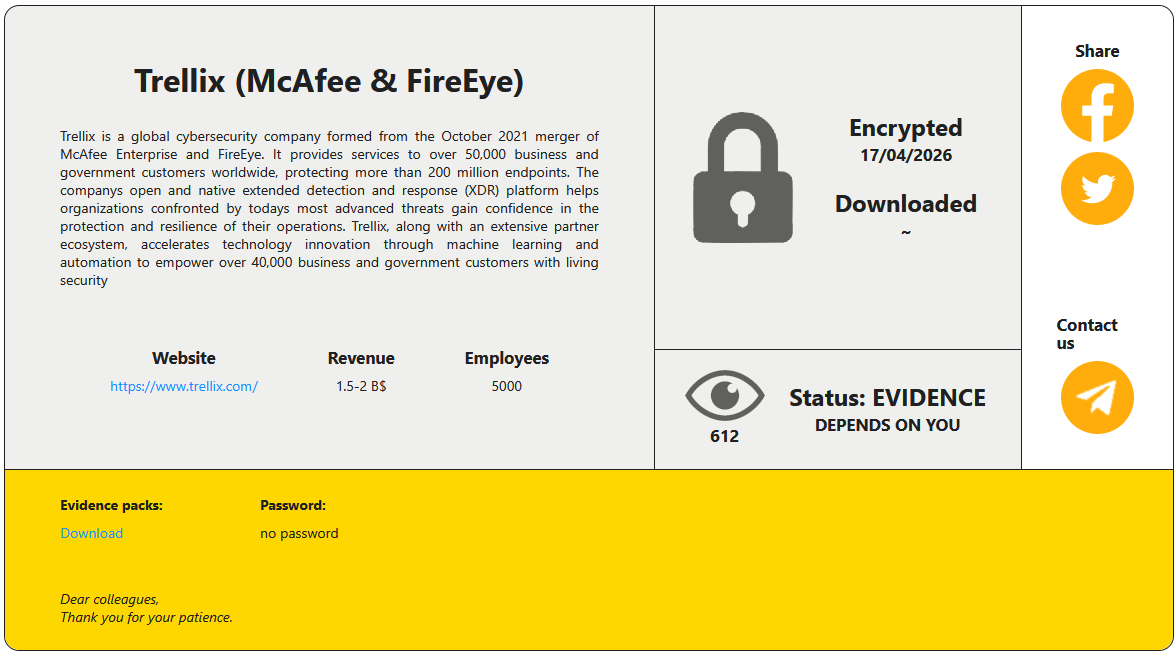
The attack on the Trellix source code repository disclosed last week has been claimed by the RansomHouse threat group, which leaked a small set of images as proof of the intrusion.
Yesterday, the threat actor published on their data leak site screenshots indicating access to the cybersecurity company’s appliance management system. However, BleepingComputer could not confirm the authenticity of the data.
Trellix is an international cybersecurity firm with global Fortune 100 customers. In 2025, the company had more than 53,000 customers in 185 countries and 3,500 employees.
The company confirmed the breach in a statement on May 1st and said that it was investigating the incident. “Trellix recently identified unauthorized access to a portion of our source code repository. Upon learning of this matter, we immediately began working with leading forensic experts to resolve it,” stated Trellix.
“We have also notified law enforcement. Based on our investigation to date, we have found no evidence that our source code release or distribution process was affected, or that our source code has been exploited.”
At the time, BleepingComputer’s request for details went unanswered, and the company did not disclose any information about the perpetrators.
Following a new request for comments after RansomHouse’s disclosure, Trellix told BleepingComputer that it was “aware of claims of responsibility for the attack and are looking into it.”
According to the threat actor, the intrusion occurred on April 17 and resulted in data encryption.
Source: BleepingComputer
RansomHouse is a cybercrime group that launched in 2022 as a data-extortion operation, listing victims on a darkweb portal and leaking or selling data stolen from their corporate networks.
Over time, the threat actor added more advanced encryption utilities to their toolkit, such as ‘Mario,’ which performs a dual-encryption pass with two keys on target files, and ‘MrAgent,’ which automates the deployment of encryptors on VMware ESXi hypervisors.
A recent high-profile case involving RansomHouse was that of Japanese e-commerce giant Askul Corporation, from which the threat group stole 740,000 customer records, among other sensitive information.
Trellix’s investigation is still underway, and the company previously promised to share more details once they become available.

AI chained four zero-days into one exploit that bypassed both renderer and OS sandboxes. A wave of new exploits is coming.
At the Autonomous Validation Summit (May 12 & 14), see how autonomous, context-rich validation finds what’s exploitable, proves controls hold, and closes the remediation loop.

EVERETT, Wash. — With just three years left on a hard deadline to prove its fusion approach works, Helion Energy is still wrestling with fundamental questions — and it’s building a new, smaller machine to help find answers faster.
Since launching more than a decade ago, Helion has built increasingly larger prototype devices to test and refine its fusion technology as it races to deliver a source of nearly limitless clean energy. But by 2028, Helion is contractually obligated to have a commercial facility producing energy from fusion reactions, essentially replicating the physics that power the sun.
So now it’s going small.
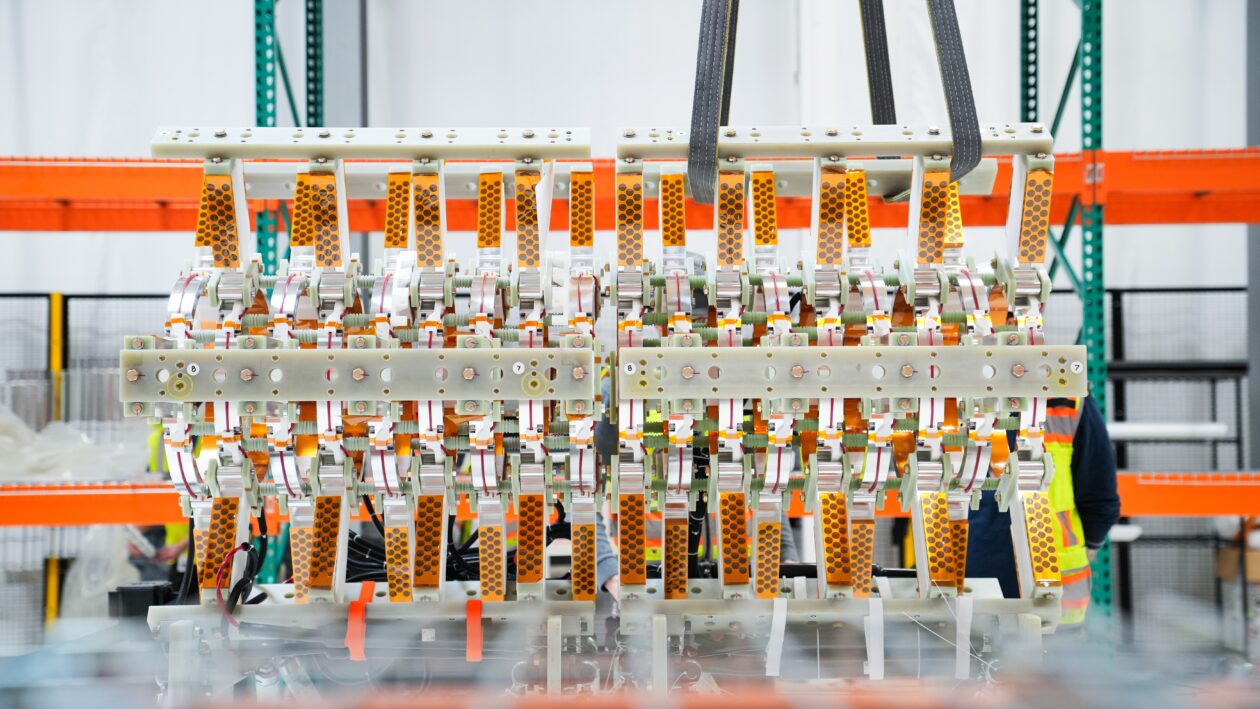
The company is building a downsized testbed device called “Tiny Merge,” a machine less than one-eighth the size of Polaris, its seventh-generation and final prototype. The decision reflects the reality that key issues remain that Helion’s larger, more expensive prototypes haven’t fully resolved. These concerns must be addressed before final designs for a power plant can be locked in.
“With this agile testbed, we will be able to test new ideas with much less energy and far fewer resource requirements, meaning we can iterate faster than we can on full-scale machines such as Polaris,” said Michael Hua, Helion’s senior director of radiation safety and nuclear science.
GeekWire got a sneak peek at Tiny Merge during a recent tour of the company’s sprawling R&D facility north of Seattle. Behind massive curtains in a cordoned-off section of the building sits the gleaming, tubular fusion device measuring roughly 8 feet long.
Running parallel to the machine are two rows of tall shelving — heavy-duty versions of what you’d find at a home improvement store — that will eventually hold hundreds of mini-fridge-sized capacitors to store power flowing into and out of the device. Helion plans to have Tiny Merge up and running by the end of the summer, leaving roughly two years to incorporate what it learns into final designs.
The stakes couldn’t be higher. Over in Eastern Washington, Helion has broken ground on Orion, a facility that it hopes will be the first to produce fusion energy at a commercial scale. It’s a feat no one has yet accomplished, though more than 45 companies are trying.
Helion has made the sector’s most aggressive timeline commitment through a deal with Microsoft to supply electricity from Orion for a data center development starting in 2028. Miss that deadline, and Helion faces financial penalties from Microsoft and partner Constellation.
The company is counting on Tiny Merge to help make that big bet pay off.
Fusion works by heating matter and compressing it into a plasma, a superheated state in which atoms are stripped of their electrons. In those extreme conditions, atomic nuclei collide, fuse and release energy. The process holds enormous promise for abundant clean power, but achieving it at scale remains a formidable scientific challenge.
The team’s first tests with Tiny Merge will focus on the formation and merging of plasma rings, said Manav Singh, Helion’s director of electrical engineering. The company has researched this with previous prototypes, Singh said, but new results have prompted further questions. “There’s a few much more deep investigations we want to do,” he added.
Helion and the broader fusion industry have made measurable progress in recent years, with devices hitting new records in temperature and pressure. Companies have poured significant funding into the pursuit, with Helion alone raising more than $1 billion from investors including OpenAI CEO Sam Altman.
But plenty of skeptics remain, arguing that grid-scale fusion energy is still many years away — if it ever arrives.
RELATED: Helion gives behind-the-scenes tour of secretive 60-foot fusion prototype as it races to deployment

While Google is helping Apple upgrade its AI, the search giant may have taken a little too much liking to the Apple Intelligence name. A new leak shared by Mysticleaks on Telegram seems to show “Gemini Intelligence” inside Google’s software running on what looks like a Pixel smartphone.
For now, it is best to take the leak with a grain of salt until there is something more concrete. But if the video is accurate, Google could be preparing the feature for the Pixel 11 series, which is expected to launch around August 2026.
Is Google really calling it Gemini Intelligence?
The irony is almost too rich. Apple Intelligence is Apple’s big bet on making Siri smarter, more personal, and actually useful in the AI age. And yet Apple has signed a multi-year partnership with Google to power next-gen Siri with Gemini models. So Google may simultaneously be fueling Apple Intelligence and launching Gemini Intelligence. That is either very efficient or very silly branding.

Google has already started expanding Gemini’s Personal Intelligence features. These allow Gemini to connect with apps like Gmail, Google Photos, YouTube, and Search to answer questions with a user’s own context. Instead of asking a generic chatbot for help, users can ask for information tied to their emails, photos, saved details, and activity across Google services.
Why would Pixel 11 make sense?
Pixel phones have long been Google’s test bed for AI features, including call screening and AI-powered photo editing tools. If “Gemini Intelligence” is real, Pixel 11 would be the natural place to introduce it as a deeply integrated, phone-level AI layer. We just hope that the name gets a second pass. Assuming, of course, that there’s a name to pass on at all.

Started more than 50 years ago, data storage company Western Digital is one of the world’s largest computer hard disk drive manufacturers, and produces solid-state drives (SSDs) and flash memory devices. Western Digital makes all the essentials for home office and business digital storage, whether you want to back up via cloud storage, easily take your presentation on a USB flash drive to your next important meeting, or upgrade your home security surveillance’s storage system, Western Digital has what you need—and we have promo codes to help you save.
Recycle and Save 15% Off With Western Digital Promo
One of the biggest issues of our modern life is how to responsibly recycle e-waste. That’s why Western Digital makes it easier to recycle your old, broken, or defunct electronics. With Western Digital’s Easy Recycle program, you can safely dispose of NAS systems and internal or external HDDs and SSDs. Plus, they recycle devices from any manufacturer—not just Western Digital products. And when you go green and recycle through their program, you’ll get a 15% off Western Digital promo code that counts towards your next purchase of $50 or more when you shop online at Western Digital.
Get 10% Off With a Western Digital Coupon Code
Right now, you can save 10% on your first order when you sign up to receive emails from Western Digital. All you need to do is head to Western Digital’s promo page, where you’ll input your email to sign up for special offers, promotions, and that Western Digital promo code for 10% off. The code will be sent to your inbox where you can use it to save on tech essentials.
Does Western Digital Have Free Shipping?
Western Digital has even more ways to save, with free standard shipping on eligible orders of $50 or more for non-members. Western Digital members receive free standard shipping on all eligible orders in the lower 48.
Additional Western Digital Deals
Western Digital has education discounts, where students and teachers can get up to 15% off purchases after verifying their status with Youth Discount. Once their identity is verified, they’ll get a voucher code sent to their inbox to use at checkout. Western Digital also has a 15% discount for seniors 55 years or older. Seniors just need to verify their status with Senior Discount. Once age is verified, folks will get a Western Digital promo code sent to their email to save.
In a commitment to sustainability, Western Digital has a program with Easy Recycle, where you can safely dispose of NAS systems and internal or external HDDs and SSDs. (They’ll also recycle devices from any manufacturer, not just Western Digital). As a token of appreciation for participating in their initiative for a greener future, participants can get 15% off their next purchase of $50 or more.
Choosing the Right Western Digital Product
It’s hard to know which is the right digital storage system for you—in fact, we even made a handy guide on How to Back Up Your Digital Life, and have a whole roundup of some of our favorite WIRED-tested external hard drives. In a similar vein, Western Digital created a FAQ webpage on how to choose the right storage drive for your needs, like budget and data. A Western Digital Hardrive is a budget-friendly option that delivers the capacity needed to store years of photos, videos, backups, workloads, and archives. While a Western Digital SSD offers fast and reliable responsiveness for more large-scale operating systems and active projects.

Why you can trust TechRadar
We spend hours testing every product or service we review, so you can be sure you’re buying the best. Find out more about how we test.
FlexiSpot continues to shine with great options across a wide range of pricing tiers, making it a bit difficult to pin down a higher-priced offering or a budget option.
The C7 Morpher leans towards the higher end of mid-tier – expect to pay around $800 / £800 when not on sale. It’s a nice enough ergonomic office chair, but it blends in a bit more than some of the best office chairs I’ve reviewed at this price, looking not too dissimilar from other ‘serious’ and ‘professional’ seats.
Depending on what you want and your own design and styling preferences, this may be preferred. I know I prefer simple black or dark grey chairs, unless it’s an accent or statement piece, but that usually comes with elegance. Some people prefer fun colors to liven up their workspace, while others prefer a specific color to match what they already have (or to avoid clashing).
The C7 Morper can fit that niche of looking nice and simple, but not cheap, but it’s still not going to be an elegant statement piece.
Flexispot C7 Morpher: Price and availability

The FlexiSpot C7 Morpher is available for $800 from FlexiSpot.com and £800 from FlexiSpot.co.uk. However, at the time of review, it’s discounted in the US to $650, and FlexiSpot generally run sales on all its office chairs – if you can wait a bit and watch the price, I’d suggest doing so.
Cost-wise, this is akin the excellent Steelcase Series 2, sitting at the upper end of mid-tier (arguably, it’s broaching the premium price-point). What it lacks in design style, it makes up for in comfort features.

Flexispot C7 Morpher: Unboxing and First Impressions
The C7 Morpher arrived in a single, unassuming box that weighed just under 80 lbs. Once we started unboxing we noticed that every piece was individually wrapped in foam to help make sure that the chair gets delivered in good condition, which is something I appreciate as some chair companies skimp on this and then the chairs can sometimes arrive damaged.
With a single person, setup took about 30 minutes from unboxing to fully assembled utilizing the included T-handle Allen wrench — though we didn’t utilize the included gloves this time.
Upon first inspection, my team and I agree that the materials for this chair are on the nicer quality side of the spectrum, especially for this price range. The wheel base and the arms are made from aluminum, while the chair frame is a durable plastic material. The chair seat and back are covered in a comfortable yet durable fabric mesh material that seems like it’ll be able to last quite a while without any signs of wear and tear.
As I’ve mentioned in the past for other chairs, I’m a big fan of mesh backs due to the increased airflow circulation and because I naturally run a bit warmer than the average individual, so I appreciated seeing that on this chair.
Flexispot C7 Morpher: Design & Build Quality
After years now of having leg rests available on chairs and having them become more and more common, I have noticed that I rarely end up actually using it.
However, that could very well just be a personal thing, as I don’t usually use these chairs for anything but work. I’m usually trying to be really intentional with my posture when sitting, but if you’re the kind of person who would utilize it, this is another one of the chairs that has a built-in one that slides underneath the seat when not in use.
Beyond the largest and materials, the other adjustability points are pretty standard for Flexispot chairs, and they’re still overall usually on the more adjustable side when it comes to ergonomic offerings for these office thrones.
Flexispot C7 Morpher: In use

I’ve put this chair through the test with a handful of my team members, some friends, some family, and several others who have walked past that have been interested in my ever-growing chair collection.
While I haven’t tested the capacity up to 380 lb, I have tested the height range with individuals ranging from 5’7″ to 6’2″, and there seems to be wiggle room on both ends for comfortable seating in this chair.
If you plan to use this on a low-pile carpet or a hard floor, the standard casters will be good enough. However, if you want a smoother ride, or if you are on a rougher surface or longer carpet, you will want to upgrade the casters. If you’re interested, FlexiSpot offers this at an additional cost, or you can pick some up on Amazon.
Flexispot C7 Morpher: Final verdict

If you’re looking for a simple chair that will still provide ergonomic comfort for all-day work, but you don’t want to spend an arm and a leg, then this is a chair that’s worth considering. But if you’re the kind of person who wants a more luxurious or elegant-looking chair that perhaps stands out a little bit more – especially at this price, then the C7 Morpher may not be the option for you.
Image 1 of 15


For more office furniture, we’ve tested the best standing desks.

Business3 minutes ago
Simple Ways to Prevent Truck Accident Injuries

Crypto World4 minutes ago
Chainlink (LINK) Hits 3-Month High: What’s Driving The Rally?

Politics5 minutes ago
Politics Home Article | Keir Starmer Appoints Gordon Brown And Harriet Harman Into New Roles

NewsBeat2 months ago
Manchester United reach agreement with Casemiro over contract clause amid transfer speculation

Politics4 weeks ago
US brings back mandatory military draft registration

NewsBeat1 month ago
Steven Gerrard disagrees with Gary Neville over ‘shock’ Chelsea and Arsenal claim | Football

News Videos8 minutes ago
YOU ONLY LOSE MONEY WHEN YOU SELL! – NEW FLARE XRP CATALYST! – NEW RIPPLE UAE HQ! – XRP NEWS!

News Videos14 minutes ago
Most Parents Accidentally Teach Their Kids Financial Fear #consciousparenting

News Videos21 minutes ago
New Podcast with Bhawna mam #podcast #thevikaspodcastshow #reels #shorts #money
-
 Crypto World1 day ago
HarrisX Poll Found 52% of Registered Voters Support the CLARITY Act
-

 NewsBeat6 days ago
Channel 5 – All Creatures Great and Small series 7 new post
-

 Crypto World2 days ago
Upbit adds B3 Korean won pair as Base token gains Korea access
-

 Tech5 days ago
Image AI models now drive app growth, beating chatbot upgrades
-

 News Videos6 days ago
AP Dhillon – Old Money (Official Audio)
-
 NewsBeat2 days ago
NCP car park operator enters administration putting 340 UK sites at risk of closure
-

 Fashion16 hours ago
Weekend Open Thread: Marianne Dress
-

 Sports6 days ago
Five killed in Texas plane crash identified as Amarillo pickleball players
-
Entertainment6 days ago
New Netflix Movies in May 2026 — My Top 3 Picks to Stream
-
 Crypto World7 days ago
Pi Network Mandates Protocol 23 Upgrade for All Mainnet Nodes Before May 15 Deadline
-

 Entertainment6 days ago
Melissa Joan Hart and More Stars Attend 2026 Kentucky Derby
-

 Crypto World6 days ago
Bitcoin mining equities rise in 2026 as BTC lags behind
-
Entertainment6 days ago
Anna Nicole Smith’s Daughter Attends 2026 Kentucky Derby
-

 Business6 days ago
Luka Doncic Injury Update: Doncic’s Hamstring Recovery Slows Lakers’ Hopes Against Thunder: Can He Run Yet?
-
Entertainment6 days ago
Venus Williams’ Best Met Gala Looks Over the Years
-

 Business7 days ago
Kuwait International Airport Resumes Operations After Closure as Regional Tensions Ease in 2026
-
 Entertainment6 days ago
Netflix’s 10-Part Miniseries Based on a True Story Is a Perfect Weekend Binge
-
Entertainment6 days ago
“Storage Wars” star Darrell Sheets' ex-wife breaks silence on his death
-

 Sports6 days ago
Is Man United v Liverpool on TV? Channel, streaming and how to watch Premier League fixture
-
Crypto World7 days ago
Q1 2026 Tech Layoffs AI Wave Hits 81,747 as Firms Shift to AI Infrastructure
You must be logged in to post a comment Login