Connect with us

Tech

Google launches Gemini 3.1 Pro, retaking AI crown with 2X+ reasoning performance boost

Published

on

Late last year, Google briefly took the crown for most powerful AI model in the world with the launch of Gemini 3 Pro — only to be surpassed within weeks by OpenAI and Anthropic releasing new models, s is common in the fiercely competitive AI race.

Now Google is back to retake the throne with an updated version of that flagship model: Gemini 3.1 Pro, positioned as a smarter baseline for tasks where a simple response is insufficient—targeting science, research, and engineering workflows that demand deep planning and synthesis.

Already, evaluations by third-party firm Artificial Analysis show that Google’s Gemini 3.1 Pro has leapt to the front of the pack and is once more the most powerful and performant AI model in the world.

A big leap in core reasoning

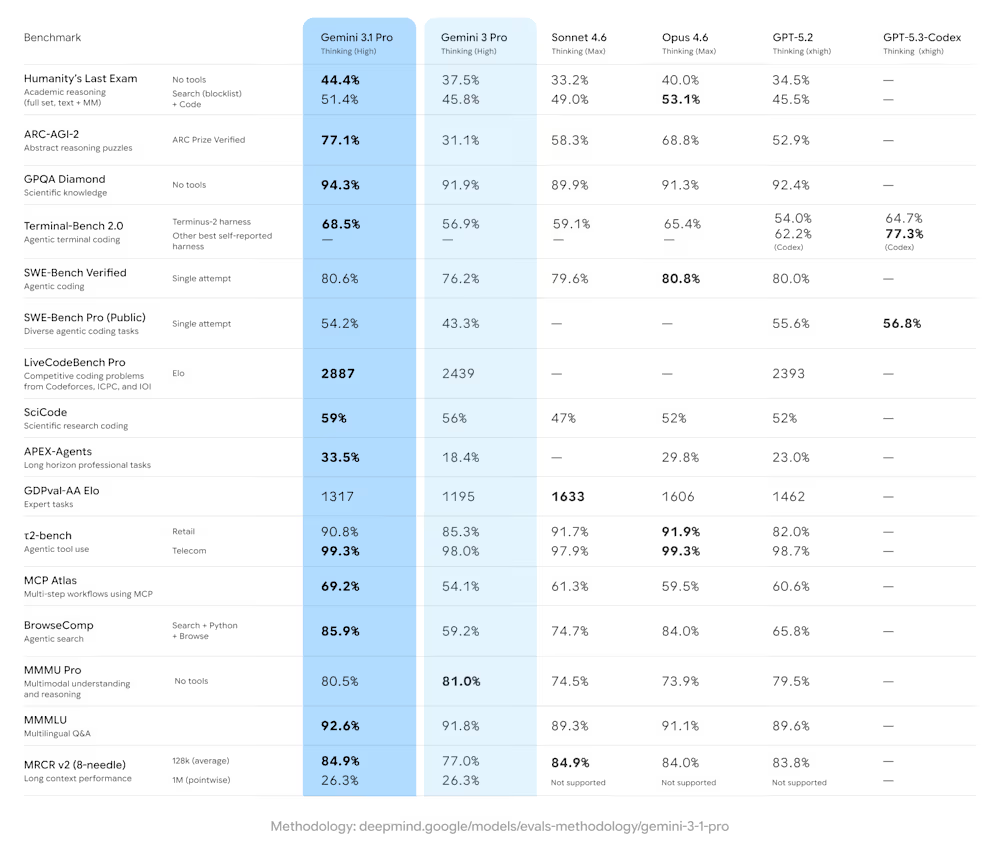
The most significant advancement in Gemini 3.1 Pro lies in its performance on rigorous logic benchmarks. Most notably, the model achieved a verified score of 77.1% on ARC-AGI-2.

Advertisement

This specific benchmark is designed to evaluate a model’s ability to solve entirely new logic patterns it has not encountered during training.

This result represents more than double the reasoning performance of the previous Gemini 3 Pro model.

Google Gemini 3.1 Pro benchmark chart

Google Gemini 3.1 Pro benchmark chart. Credit: Google

Beyond abstract logic, internal benchmarks indicate that 3.1 Pro is highly competitive across specialized domains:

Advertisement
  • Scientific Knowledge: It scored 94.3% on GPQA Diamond.

  • Coding: It reached an Elo of 2887 on LiveCodeBench Pro and scored 80.6% on SWE-Bench Verified.

  • Multimodal Understanding: It achieved 92.6% on MMMLU.

These technical gains are not just incremental; they represent a refinement in how the model handles “thinking” tokens and long-horizon tasks, providing a more reliable foundation for developers building autonomous agents.

Improved vibe coding and 3D synthesis

Google is demonstrating the model’s utility through “intelligence applied”—shifting the focus from chat interfaces to functional outputs.

One of the most prominent features is the model’s ability to generate “vibe-coded” animated SVGs directly from text prompts. Because these are code-based rather than pixel-based, they remain scalable and maintain tiny file sizes compared to traditional video, boasting far more detailed, presentable and professional visuals for websites and presentations and other enterprise applications.

Other showcased applications include:

Advertisement
  • Complex System Synthesis: The model successfully configured a public telemetry stream to build a live aerospace dashboard visualizing the International Space Station’s orbit.

  • Interactive Design: In one demo, 3.1 Pro coded a complex 3D starling murmuration that users can manipulate via hand-tracking, accompanied by a generative audio score.

  • Creative Coding: The model translated the atmospheric themes of Emily Brontë’s Wuthering Heights into a functional, modern web design, demonstrating an ability to reason through tone and style rather than just literal text.

Business impact and community reactions

Enterprise partners have already begun integrating the preview version of 3.1 Pro, reporting noticeable improvements in reliability and efficiency.

Vladislav Tankov, Director of AI at JetBrains, noted a 15% quality improvement over previous versions, stating the model is “stronger, faster… and more efficient, requiring fewer output tokens”. Other industry reactions include:

  • Databricks: CTO Hanlin Tang reported that the model achieved “best-in-class results” on OfficeQA, a benchmark for grounded reasoning across tabular and unstructured data.

  • Cartwheel: Co-founder Andrew Carr highlighted the model’s “substantially improved understanding of 3D transformations,” noting it resolved long-standing rotation order bugs in 3D animation pipelines.

  • Hostinger Horizons: Head of Product Dainius Kavoliunas observed that the model understands the “vibe” behind a prompt, translating intent into style-accurate code for non-developers.

Pricing, licensing, and availability

For developers, the most striking aspect of the 3.1 Pro release is the “reasoning-to-dollar” ratio. When Gemini 3 Pro launched, it was positioned in the mid-high price range at $2.00 per million input tokens for standard prompts. Gemini 3.1 Pro maintains this exact pricing structure, effectively offering a massive performance upgrade at no additional cost to API users.

  • Input Price: $2.00 per 1M tokens for prompts up to 200k; $4.00 per 1M tokens for prompts over 200k.

  • Output Price: $12.00 per 1M tokens for prompts up to 200k; $18.00 per 1M tokens for prompts over 200k.

  • Context Caching: Billed at $0.20 to $0.40 per 1M tokens depending on prompt size, plus a storage fee of $4.50 per 1M tokens per hour.

  • Search Grounding: 5,000 prompts per month are free, followed by a charge of $14 per 1,000 search queries.

For consumers, the model is rolling out in the Gemini app and NotebookLM with higher limits for Google AI Pro and Ultra subscribers.

Advertisement

Licensing implications

As a proprietary model offered through Vertex Studio in Google Cloud and the Gemini API, 3.1 Pro follows a standard commercial SaaS (Software as a Service) model rather than an open-source license.

For enterprise users, this provides “grounded reasoning” within the security perimeter of Vertex AI, allowing businesses to operate on their own data with confidence.

The “Preview” status allows Google to refine the model’s safety and performance before general availability, a common practice in high-stakes AI deployment.

By doubling down on core reasoning and specialized benchmarks like ARC-AGI-2, Google is signaling that the next phase of the AI race will be won by models that can think through a problem, not just predict the next word.

Advertisement

Source link

Continue Reading
Click to comment

Leave a Reply

Your email address will not be published. Required fields are marked *

Tech

The Best Chairs and Desks from Branch Are on Sale (We’ve Tested Them All)

Published

on

We’ve been rigorously testing work-from-home gear for years—even prior to the Covid-19 remote work boom—and that includes dozens of office chairs and desks. Branch furniture has made standouts that are highlighted in our guides over and over again. Its Presidents’ Day deals have been extended, bringing some of the better discounts we’ve seen on essentials we’ve tested like chairs and desks.

Check out our other deals coverage for additional discounts on gear we’ve tried and would recommend to a friend.

Branch Ergonomic Chair Pro for $449 ($50 off)

  • Photograph: Julian Chokkattu

  • Photograph: Julian Chokkattu

  • Photograph: Julian Chokkattu

Branch

Ergonomic Chair Pro

This price matches the best we usually see for our very favorite office chair. Out of the dozens we’ve tried, this chair strikes the best balance of features for the price. It’s comfortable, adjustable, and easy to dial in so you can get your perfect ergonomic fit. It also has a solid warranty and isn’t too terribly expensive compared to similar chairs. There are different fabric finishes and colors to choose from, all of which are on sale right now.

Advertisement

Branch Ergonomic Chair for $323 ($36 off)

An orange and aluminum modern designed chair

The best budget office chair is even more affordable right now thanks to this deal. It’s easy to assemble, it has some adjustable elements, it’s comfortable and breathable, and it looks nice with or without the optional headrest. The upholstery is available in several colors, though the fabric does pill and attract pet hair. We still think this is a chair worth checking out if you’re on a tight budget.

Branch Four Leg Standing Desk for $854 ($95 off)

Front view of Branch Four Leg Standing Desk with computer monitors, keyboard, microphone and other work items on top

Photograph: Julian Chokkattu

Branch

Four Leg Standing Desk

This is editor Julian Chokkattu’s favorite desk he’s tried. At first glance, it looks like a standard desk, but it’s actually a standing desk that can be raised or lowered with the little control panel. Assembly was easy, the controls are simple, and the shape is elegant. If you want a desk that looks great no matter how tall it is, this is worth checking out, especially at this price.

Branch Duo Standing Desk for $494 ($55 off)

Branch Duo Standing Desk with light brown top and white legs that has a small cabinet, black cutting mat, and lamp on the top

Photograph: Julian Chokkattu

We like this compact, affordable standing desk, which gets you a lot of value for how little you’ll pay. It’s compatible with a lot of add-ons, and the paddle controls are easy to use. There’s even a preset mode so you can press the paddle twice to raise it to your preset height. This desk is compact, but if you don’t need a ton of room for your working setup, it’s a good option even at full-price. (Luckily, right now, you can snag it for less.)

Advertisement

Power up with unlimited access to WIRED. Get best-in-class reporting and exclusive subscriber content that’s too important to ignore. Subscribe Today.

Source link

Continue Reading

Tech

From a mall booth to a $3B fintech: Matt Oppenheimer’s startup lessons from a 15-year journey with Remitly

Published

on

Matt Oppenheimer led Remitly for nearly 15 years as co-founder and CEO. He announced this week that he’s moving into the chairman role. (Remitly Photo)

Build with intentionality. Lead with authenticity. Prioritize customers over your ego. And focus on the problem you’re solving — with flexibility on the solution.

That’s part of the playbook Matt Oppenheimer followed as he helped grow a three-person Techstars Seattle startup into one of the world’s leading remittance platforms.

After nearly 15 years leading Remitly as CEO, Oppenheimer announced Wednesday that he’s stepping down as CEO and moving to a board chair role. He’s passing the baton to Sebastian Gunningham, a longtime tech and finance leader who previously led Amazon’s marketplace and payments businesses.

“I feel wonderful, honestly,” Oppenheimer told GeekWire on Thursday. “One thing that has always driven me from the moment I started the business 15 years ago is impact and purpose and doing things with a sense of intentionality. And I feel like that’s how we’ve done this succession planning.”

The Remitly story began more than a decade ago after Oppenheimer had just returned from Kenya, where he was working for Barclays and realized how hard it was for families to send and receive money overseas.

Advertisement

He teamed up with co-founders Josh Hug and Shivaas Gulati, navigating an early pivot before landing product-market fit and raising around $400 million. The company went public in 2021 at a valuation of nearly $7 billion.

Remitly’s mobile technology lets people send and receive money across borders, eliminating many of the forms, codes, and in-person agents traditionally associated with international transfers. It’s used by more than 9 million people. The company reported revenue of $442.2 million in Q4, up 26% year-over-year, and had its first full year of GAAP profitability in 2025.

We spoke to Oppenheimer about lessons learned from Remitly’s journey and his advice for entrepreneurs. Here are some key takeaways.

Fall in love with the problem, not your product

Oppenheimer remembers the frustration he saw and felt watching families struggle to send money across borders. That sparked the idea for Remitly. The key, he says, was locking onto that problem — not any one product idea. The danger is when founders apply their grit in the wrong place.

Advertisement

“If they channel that perseverance in the wrong area — the product or trying to force something into existence that customers don’t care about — they fail,” he said. “They run out of time, energy, or money.”

Remitly’s booth at Southcenter Mall served as a key customer feedback mechanism. (Remitly Photo)

Get close to customers

In the early days, Remitly set up a booth at Southcenter Mall near Seattle outside a legacy remittance location, complete with scotch-taped signage.

Oppenheimer referenced a phrase from Airbnb co-founder Brian Chesky: “find marketing channels that don’t scale.” The goal wasn’t growth, but rather insight.

They learned why customers weren’t using Remitly. That feedback drove a big pivot from mobile wallets to cash pickup, bank deposit, and door-to-door delivery.

“We had to follow customers,” Oppenheimer said. He added: “If we would have been stubborn about only doing mobile wallets — that’s what our pitch said — then we would have failed.”

Advertisement

Define culture as behaviors — and keep rewriting it

Oppenheimer said many companies stop at a short list of vague values. “Culture is how people in a company or institution interact to deliver for their customers,” he said.

Before Remitly launched its product, the founding team did an offsite to define the culture on a whiteboard. Early values like “relationships” were well-intentioned but too broad. Remitly refreshed its values every six months and now every couple of years, evolving them into more specific behaviors such as “be a compassionate partner,” “lead authentically,” and “constructively direct.”

Customer centricity sits at the top as the single overarching value. Oppenheimer said the test is whether values show up in concrete decision-making: “Once you’ve got it defined, [you embed it] into the interview process and the performance review process.”

Remitly co-founders Josh Hug, Matt Oppenheimer and Shivash Gulati. (Remitly Photo)

Find complementary co-founders

Oppenheimer said Remitly wouldn’t exist without his co-founders, pointing to Hug’s product skills and Gulati’s engineering chops.

“It’s important for all founders to surround themselves with complementary skills and respect those skills deeply,” he said.

Advertisement

In the very early days, his own contribution was often clearing obstacles: money transmission licenses, office leases, even taking out the trash. “My job was to help them build,” he said. Oppenheimer stressed the importance of shared values but different strengths.

Raise more capital than you think you need

Remitly raised hundreds of millions of dollars on its way to an IPO across multiple rounds. None were easy.

“It requires getting a lot of no’s,” Oppenheimer said. “It requires that grit, tenacity and perseverance that is critical for any entrepreneur to be successful.”​

He advised treating fundraising as a two-way conversation, not a one-sided pitch. “Investors can sniff desperation,” he said. Make sure investors are asking the right questions, and think about whether you want them on your board.

Advertisement

When the partner is right, Oppenheimer leans toward raising a bit more. “Things always take a little bit longer than you imagine,” he said. For companies pursuing bold visions, “if you’ve got the right partner, you can raise enough capital, then it’s worth the dilution to be able to make progress against accomplishing that vision.”

Oppenheimer on his first trip to the Philippines as Remitly’s CEO. (Remitly Photo)

Treat your own growth like a product, with reviews and roadmaps

As he focused more on management, Oppenheimer built a formal process for his own development as CEO, especially as Remitly grew from a handful of people to more than 3,000.

He started asking each new investor who joined Remitly’s board to run his performance review. “I’d like you to talk to all other board members. I’d like you to talk to my leadership team,” he’d tell them. “And then I’d like your insights.”

He turned that input into a written development plan, shared it with the company, and then found coaches and mentors to help him work on specific gaps. “It took a lot of intentionality to grow as a leader,” he said.

That work continues in his new role as chairman. “After mission and purpose, my second biggest motivator for me personally is growing as a human,” he said. “That’s what I’ve loved about the journey, and it continues in this next role.”

Advertisement

Don’t underestimate the role of community

Seattle is a huge part of Remitly’s story. Techstars Seattle helped launch Remitly (back when it was called Beamit Mobile); talent from the region’s tech ecosystem helped scale it.​

“The talent we’ve been able to recruit from some of the largest technology companies has been foundational,” Oppenheimer said. With fewer growth-stage companies in the city than in some other hubs, he believes Remitly could attract people looking to join a mission-driven startup with scale ambitions.​

Last year the company moved into a new headquarters in downtown Seattle. Oppenheimer said he and Remitly remain committed to Seattle, noting that he wants to make sure “that’s the case for the next decade to come.”

Source link

Advertisement
Continue Reading

Tech

Big Tech announces multibillion-dollar deals at India’s AI summit

Published

on

The summit is the fourth in an annual series that began in UK in 2023, before moving to Korea, and then France.

Global business leaders and heads of states all flocked to New Delhi this week to attend India’s AI Impact Summit 2026, which just concluded today (20 February).

The summit is the fourth in an annual series that began in UK in 2023, before moving to Korea, and then France last year.

India has huge aspirations to become a leader in AI – and overall, the billions in investments announced from Big Tech leaders this past week could mean that the fast-growing economy might be on the right track.

Advertisement

But as The New York Times puts it: “India brims with tech talent but not the companies that command it.” While slow to develop on the technology itself, India offers a very large AI user base (100m weekly ChatGPT users alone are from India) and huge under-employed workforce.

Outside the summit, however, disorganisation was rife. Blocked roads forced delegates to walk kilometres to reach the summit and wait in long queues. Meanwhile, dozens of New Delhi’s poorest accused state leaders of forcibly displacing their makeshift homes to ‘beautify’ the streets for the incoming international guests.

Though as that went on, AI leaders including OpenAI, Microsoft and Nvidia made some big announcements.

Microsoft’s $50bn ‘global south’ pledge

Microsoft said it is on its way to invest $50bn in the “global south” – a term used to refer to the world’s developing countries. Research from the company finds that AI usage in the “global north” is roughly twice that of the “global south”. The company said that the investment will be used to help increase AI usage in the region.

Advertisement

The Bill Gates-founded company wants to build the infrastructure needed for better AI diffusion in the country, help develop multilingual and multicultural AI capabilities, enable local AI innovations, and be able to measure AI diffusion better to guide future policies and investments in the tech.

Last year, the company announced plans for around $17.5bn worth of AI investments in India.

Adani adds $100bn to AI data centre pot

Billionaire business mogul Gautam Adani’s company, the Adani Group, announced direct investments of $100bn to create the “world’s largest integrated data centre platform” in India.

The new investment adds to AdaniConnex’s already existing 2GW national data centre, and expands it to a 5GW target. These AI data centres will be powered with renewable energy, the company claimed.

Advertisement

Its plans for the mega data centre comes with existing partnerships with Google and Microsoft. The company said it is discussing plans for more large-scale campuses in India with other major players.

According to the Adani Group, the $100bn investment is expected to generate an additional $150bn across manufacturing, advanced electrical infrastructure and sovereign cloud platforms in the country by 2035. Together, it projects to create a $250bn AI infrastructure ecosystem in India over the decade.

Telco leader drops $110bn for compute

Indian telecommunications giant Reliance Industries and Jio – its digital business – announced 10trn rupees (around $110bn) in new investments to build AI computing infrastructure in the country.

Owner Mukesh Ambani said that the investment would fund what he described as India’s sovereign compute infrastructure, which would include multi-gigawatt-scale data centres, a nationwide edge computing network and new AI services integrated with Jio.

Advertisement

“This is not speculative investment, this is patient capital to build India,” Ambani said at the summit in New Delhi.

OpenAI becomes a TCS customer

Tata Consultancy Services (TCS) announced that OpenAI will become its first customer in its recently announced data centre business, Hypervault, with an initial commitment of 100MW of AI capacity. The capacity, it said, can be eventually scaled up to 1GW.

The project is a part of OpenAI’s Stargate venture, a $500bn privately-funded initiative to build AI data centres across the globe.

Alongside infrastructure, the partnership will also deploy ChatGPT Enterprise across parent company Tata Group’s other subsidiaries over the next several years.

Advertisement

“Through OpenAI for India and our partnership with the Tata Group, we’re working together to build the infrastructure, skills, and local partnerships needed to build AI with India, for India, and in India, so that more people across the country can access and benefit from it,” OpenAI CEO Sam Altman claimed.

L&T teams up with Nvidia

Larsen & Toubro (L&T), on the other hand, claimed to be building India’s “largest gigawatt-scale AI factory” using Nvidia’s AI infrastructure, which includes its GPUs, CPUs networking and accelerated storage platforms.

The venture will scale Nvidia GPU clusters at the company’s data centres in Chennai and Mumbai.

“AI is driving the largest infrastructure buildout in human history – everyone will use it, every company will be powered by it and every country will build it,” said Jensen Huang.

Advertisement

Its venture with L&T is “enabling AI factories at national scale”, he added, “ready to serve global and domestic AI demand”.

Don’t miss out on the knowledge you need to succeed. Sign up for the Daily Brief, Silicon Republic’s digest of need-to-know sci-tech news.

Source link

Advertisement
Continue Reading

Tech

Why balance is needed when using AI in the creator economy

Published

on

CreationDose’s Alessandro La Rosa discusses AI and the creator economy, and why a balance between automation and humanity is needed to preserve authenticity.

The rise of social media and influencers into the mainstream – and the subsequent monetisation that eventually emerged out of the field – has made the ‘creator economy’ an extremely buoyant market in the last decade.

In fact, a Goldman Sachs report from 2023 predicted that the creator economy could be worth as much as $480bn by 2027.

As the creator economy continues to grow, one company is working on using artificial intelligence (AI) to help content creators and brands manage collaboration strategies and campaigns.

Advertisement

CreationDose, a media-tech company based in Sicily, Italy, has developed an AI-powered platform called Vidoser, which aims to help manage the collaboration life cycle between influencers and brands, assisting in tasks such as content production and marketing campaigns.

“I’ve always had a deep passion for communication and for the ways people express themselves through the media,” says founder and CEO Alessandro La Rosa. “When I realised that creators were redefining the language of brands, I decided to build a platform that put them at the centre.

“That’s how Vidoser was born – with the mission to unite technology, creativity and new generations.”

Risk and trust

‘Make sure your ambition is always greater than your fears.’

Advertisement

According to La Rosa, this is the best piece of career advice he has ever received, as it pushed him to “never stop in front of risk, to believe in my projects and to build something concrete even when conditions seemed impossible”.

La Rosa held this advice to heart when founding CreationDose in 2018 and launching Vidoser in 2019, which he describes as the biggest risks he has ever taken, as at the time, talking about the creator economy “still sounded almost utopian”.

“We started with a small team and a big vision in an environment where the start-up ecosystem was still underdeveloped,” he says. “Today, I can say it was the biggest – and most rewarding – risk of my life.”

As CreationDose’s CEO, La Rosa leads the company’s strategic direction, overseeing product development, revenue growth and partnerships, with his main focus being defining the company’s long-term trajectory, ensuring technological innovation remains at the core of its culture, and aligning all business units toward common objectives.

Advertisement

As a business leader, La Rosa says he believes in giving trust and responsibility to his team.

“I try to build an environment where people feel part of the vision and can express themselves freely. I focus more on results than on hours worked, promoting a culture of listening and continuous growth. When people understand that their contribution has real impact, they give their best.”

Balanced automation

The advent of advanced AI technology has sparked concern in multiple industries – especially creative industries such as art and entertainment.

In the aftermath of the rise of generative AI, kicked off by OpenAI’s ChatGPT, professionals from creative industries – ranging from film, TV and literature to music and video games – have voiced worry about the technology encroaching on their sectors and work without restraint.

Advertisement

La Rosa recognises the concern that creatives may have about the technology, and emphasises that a balance is needed between automation and the human in the process.

“It’s natural that people feel apprehensive about AI, especially in creative fields where personal identity carries great value,” he says.

“AI should be used as a creative partner, not a replacement. It can help improve quality, analyse creator performance, suggest optimisations, review content or speed up editing – but the final decisions should always remain in human hands.

“Transparency in the use of AI, data protection and respect for the intellectual property of creators are essential principles.”

Advertisement

La Rosa says that the speed at which the creator economy is evolving means that one of the biggest challenges is maintaining that balance between automation and humanity.

“On one hand, artificial intelligence allows us to scale and optimise content production; on the other, it’s essential to preserve the authenticity of creators and support the people behind this industry,” he says.

“The main advantages are the ability to analyse millions of data points, predict trends and optimise campaigns in real time. The downside is the risk of losing authenticity if everything becomes too automated.”

La Rosa believes that the right balance comes from combining AI with human sensitivity. “Data can guide decisions, but the relationship between brand and creator must remain deeply human.

Advertisement

“I believe AI represents an extraordinary opportunity to free up time, enhance productivity and make tools accessible that were once available only to a few,” he says. “The difference will always depend on how it’s used: as a lever to elevate human ingenuity, not to replace it.”

Don’t miss out on the knowledge you need to succeed. Sign up for the Daily Brief, Silicon Republic’s digest of need-to-know sci-tech news.

Source link

Advertisement
Continue Reading

Tech

Sam Altman claims ChatGPT’s adult mode will ‘be able to safely relax the restrictions’ of the chatbot, but firing a critic of the plan is a reason to be wary

Published

on

OpenAI is about to give ChatGPT an adults-only option. At almost the same moment, the company has parted ways in disputed fashion with one of the executives responsible for deciding how far the system should be allowed to go, as first reported by The Wall Street Journal. OpenAI CEO Sam Altman’s promise of a responsible, safe adult mode for ChatGPT is now at risk of looking hollow.

Ryan Beiermeister led product policy at OpenAI, shaping the rules and enforcement mechanisms governing ChatGPT’s behavior, at least until last month. The timing is notable as WSJ says it happened soon after she raised concerns about the adult mode plans.

Advertisement

Source link

Continue Reading

Tech

13-hour AWS outage reportedly caused by Amazon’s own AI tools

Published

on

A recent Amazon Web Services (AWS) outage that lasted 13 hours was reportedly caused by one of its own AI tools, . This happened in December after engineers deployed the Kiro AI coding tool to make certain changes, say four people familiar with the matter.

Kiro is an agentic tool, meaning it can take autonomous actions on behalf of users. In this case, the bot reportedly determined that it needed to “delete and recreate the environment.” This is what allegedly led to the lengthy outage that primarily impacted China.

Amazon says it was merely a “coincidence that AI tools were involved” and that “the same issue could occur with any developer tool or manual action.” The company blamed the outage on “user error, not AI error.” It said that by default the Kiro tool “requests authorization before taking any action” but that the staffer involved in the December incident had “broader permissions than expected — a user access control issue, not an AI autonomy issue.”

Multiple Amazon employees spoke to Financial Times and noted that this was “at least” the second occasion in recent months in which the company’s AI tools were at the center of a service disruption. “The outages were small but entirely foreseeable,” said one senior AWS employee.

Advertisement

The company and has since . Leadership set an 80 percent weekly use goal and has been closely tracking adoption rates. Amazon also sells access to the agentic tool for a monthly subscription fee.

These recent outages follow a more serious event from October, in which a like Alexa, Snapchat, Fortnite and Venmo, among others. The company for that one.

Source link

Advertisement
Continue Reading

Tech

Apple Set To Launch New Low-Cost MacBook & iPhone 17e At the March 4th Event

Published

on

Apple has scheduled its first product-focused event of 2026 for March 4, titled “Apple Experience.” The company has not shared any launch details yet, but speculation suggests updates to the Mac and iPad lineups, along with a potential debut of the iPhone 17e. The colourful logo in the invite is also being linked to a rumoured budget-friendly MacBook.

This time, Apple is not organising a large keynote-style launch. Instead, the company is hosting smaller, in-person media gatherings in New York, London, and Shanghai. Selected journalists and creators have been invited to attend these sessions. So far, Apple has not mentioned anything about a public livestream. This suggests announcements could be shared through press releases, with early impressions coming directly from those attending the sessions.

What Does “Apple Experience” Mean?

An Apple Experience is usually smaller than a big Apple keynote event. Instead of a long stage presentation, the company invites media and creators to try out new products in person. Announcements are often shared through press releases rather than a livestream. Apple has followed this format before in cities like Mumbai and London, so this time too, we may see updates shared online rather than on YouTube.

Colourful Invite Hints at a Low-Cost MacBook

Macbook photo
Image: Unsplash

The Apple Experience invite has caught attention because of its unusual design. It features a white background with a 3D Apple logo in yellow, green, and blue shades. These colours are significant because reports earlier suggested Apple was testing similar bright finishes for a rumoured lower-cost MacBook. The match between the invite artwork and those prototype colours has strengthened speculation.

The expected MacBook may feature an A-series chip to reduce costs and offer a lower starting price than the MacBook Air. With the Air currently priced at Rs 99,990 in India, a more affordable option could appeal strongly to students and budget-conscious buyers.

Advertisement

iPhone 17e Could Also Debut

Image: fpt.

Apart from Macs and iPads, Apple may also introduce the iPhone 17e at the Apple Experience. The device was earlier expected to launch separately this week, but recent reports suggest Apple may introduce it alongside new Macs instead. Expected upgrades include:

  • MagSafe support
  • A19 chip
  • C1X modem for faster 5G connectivity
  • N1 chip for Wi-Fi 7

Furthermore, reports indicate that Apple may bring performance upgrades to its Mac lineup with new M5-based machines. A MacBook Air with the standard M5 chip could debut, while the MacBook Pro may receive more powerful M5 Pro and M5 Max versions.

iPad Upgrades and Other Product Rumours

Apple could use this event to strengthen its iPad lineup. The iPad Air (8th generation) may get the M4 chip, improving speed and efficiency for work and entertainment. The entry-level iPad is likely to adopt the A18 chip, which would keep it competitive in the budget tablet segment. These upgrades suggest Apple wants to enhance performance without pushing prices too high.

In addition to the iPad updates, rumours point to other hardware launches. A refreshed Studio Display, a new Apple TV, and an upgraded HomePod mini are said to be in development. Some reports also mention a possible Apple home hub, though it remains uncertain if these devices will debut at this smaller gathering.

Source link

Advertisement
Continue Reading

Tech

Department Of Education Forced To Back Off Illegal Plan To Be Racist, Sexist Assholes

Published

on

from the illegal-and-ignorant dept

One recurring theme of this era: folks who actually choose to stand up to this bumbling kakistocracy of hateful failsons usually tend to win if they stick together. Those that prematurely bend the knee in abject cowardice (like say, CBS, countless law firms, or numerous university administrators) will hopefully be remembered for it.

It happened again this week, when the Department of Education (DOE) was forced to back off of their illegal effort to permanently enshrine intolerance and ignorance across U.S. education standards.

More specifically, the DEO was forced to suspend their “Dear Colleague” directive that sought to restrict diversity, equity, and inclusion (DEI) efforts in schools and higher education. That directive, initially implemented in February of 2025, threatened to cut funding for institutions practicing “DEI,” (falsely) claiming it violated the Supreme Court’s 2023 ruling on affirmative action.

One of its core claims, as we’ve seen at other agencies like the FCC, is that even acknowledging well documented systemic racism and sexism is somehow unfair to white men. It’s just the dumbest, lamest bullshit, from some of the shittiest human beings to ever govern (and if you’re well-versed in American history, that’s really saying something).

Advertisement

The American Federation of Teachers filed suit against the administration shortly thereafter, alongside an ACLU FOIA lawsuit forcing disclosure of documents highlighting the Education Department’s flimsy legal reasoning. Numerous court rulings subsequently found the Trump administration ignored the Administrative Procedure Act (APA) and tried to rewrite federal civil rights policy illegally.

While the Trump administration realized they’d been beaten and had given up the fight late last month, the U.S. District Court for the District of Maryland put the final nail in the coffin this week. As a result the DOE has been forced to formally shut down the initiative, a significant victory for Americans who aren’t ignorant assholes:

“Upon the U.S.’s concession that the directive and subsequent certification requirement are vacated – meaning they are formally nullified – the district court issued a final ruling today, permanently invalidating the directive and preventing the government from enforcing, relying on, or reviving it. As a result, the challenged guidance is no longer in effect and cannot be enforced against anyone, anywhere nationwide.”

It’s worth reiterating that a lot of University administrators were abject cowards (or avid supporters of intolerance) and immediately threw minority and marginalized populations under the bus at the first indication of a stiff breeze, causing no manner of disruption to grants and scholarships. I’m not sure it’s even possible to functionally calculate the read harm caused to people.

It’s something you’d like to think they might be held actually accountable for by their colleagues:

Advertisement

Despite the win, much of the harm is likely permanent. And there are certainly other avenues where the administration has done very similar things and hasn’t yet been held to account; such as Trump’s illegal dismantling of the Digital Equity Act — which stifled all manner of rural broadband investment to marginalized neighborhoods and Trump voters alike because the word “equity” gave a few idiots a sad.

Any way you slice it, the sheer hubris of believing you can permanently eliminate equality, kindness, and diversity through illegal mandate by a dim, half-insane king remains historically stupid and deserves bottomless historic ridicule and derision.

But as we keep seeing, if people want to organize and meaningfully challenge this pathetic and increasingly unpopular administration, they usually win. As Trump’s health and influence fades, hopefully we’ll see a corresponding jump in courage.

Filed Under: colleges, dei, department of education, racism, school, universities

Companies: aclu, american federation of teachers

Advertisement

Source link

Continue Reading

Tech

Razer’s new limited-edition Huntsman keyboard offers you a premium build at an equally premium price

Published

on

After launching the resurrected Boomslang mouse earlier this month, Razer is back with another limited-edition release. The company has unveiled the Huntsman Signature Edition, a premium tenkeyless mechanical keyboard that sits at the top of its Huntsman lineup. While not as outrageously priced as the Boomslang mouse, it still carries a hefty $499.99 price tag and will be sold in a limited run of just 1,337 units directly through Razer.

What sets the Huntsman Signature Edition apart is its build. Instead of featuring a plastic chassis like other Huntsman models, Razer has crafted this keyboard from CNC-milled anodized aluminum, giving it a more solid, premium feel. A mirror-finished back and a metallic snake keycap enhance the aesthetic, while foam and rubber dampening materials on the inside deliver a more satisfying, rounded typing sound and improved key feel.

Performance-wise, the keyboard is not entirely different from the Huntsman V3 Pro, featuring Razer’s second-gen analog optical key switches, a Rapid Trigger Mode, and an ultra-high 8,000Hz polling rate for near-instant input. Key actuation is adjustable from 0.1mm to 4mm, letting users fine-tune the feel for gaming or typing. The keyboard also includes full RGB lighting, on-the-fly macro recording, and supports both Mac and PC with a physical toggle to switch between the two systems.

The Huntsman Signature Edition only offers wired connectivity over USB-C and will go on sale through Razer’s website at 8 AM PT on February 22. In the box, you’ll get a vegan leather signature box, a vegan leather sound-dampening mat, a cleaning cloth, a keycap puller, additional keycaps, and a USB-A to USB-C Speedflex cable. Given how quickly the Boomslang pre-order sold out, you’ll need to act fast to get your hands on this premium mechanical keyboard.

Source link

Advertisement
Continue Reading

Tech

Apple’s upcoming smart glasses could get dual cameras and a touch of luxury

Published

on

Apple is accelerating work on its long-rumored smart glasses, and new reporting suggests the device is shaping up to be one of the company’s most ambitious entries in the personal AI era. Early prototypes point toward a premium, fashion-oriented wearable that blends compact hardware, advanced imaging capabilities and Apple’s upcoming generation of AI features.

Apple tests dual-camera smart glasses with a luxury-forward design

According to details shared with Bloomberg, Apple’s smart glasses are now in an advanced prototyping phase. The most striking development is the inclusion of dual cameras, a feature rarely seen in consumer eyewear. These cameras are expected to support depth perception, environmental scanning and real-world understanding – crucial for Apple’s next wave of AI-driven features that rely heavily on visual context.

The design itself leans toward a luxury eyewear aesthetic rather than a tech-heavy headset. Apple is reportedly testing multiple frame styles, including metal and glass combinations, with finishes that echo the premium sensibilities of its high-end Apple Watch models. Rather than positioning the glasses as an alternative to the Vision Pro, Apple sees them as a lightweight, all-day wearable that brings AI into everyday life without the bulk of mixed reality gear.

Apple’s strategy reflects a broader shift toward building an ecosystem of ambient, AI-enabled devices. The glasses would serve as a more discreet complement to Vision Pro, offering situational intelligence through the wearer’s natural perspective. This aligns with the company’s parallel development of camera-equipped AirPods and a pendant-style wearable, which together form a network of sensors designed to interpret the environment and enhance Siri’s contextual awareness.

The move signals Apple’s intention to make personal AI a seamless, constant presence – much like the transition smartphones once made from occasional tools to everyday companions.

Advertisement

Why the glasses matter for future Apple users

The appeal for users goes far beyond novelty. A glasses-based form factor has the potential to revolutionise Apple’s AI experience by allowing the system to actually see what the user sees. That unlocks capabilities like real-time translation, object recognition, hands-free note-taking, navigation cues and accessibility enhancements, all delivered without lifting a phone or speaking a command into thin air.

This is also a pivotal moment for Apple’s product roadmap. With smartphone growth slowing and wearables becoming a bigger revenue pillar, smart glasses offer a pathway into the next major computing platform. The device could appeal to users who want the advantages of AI-enhanced vision without adopting the fully immersive, and often socially awkward, experience of a headset.

What’s next as Apple refines its wearable AI ecosystem

Apple has not finalised a release window, and as with all of its long-term hardware projects, the glasses may still undergo substantial changes before entering production. The company is also evaluating battery placement, weight and optical comfort, which have historically been challenges for smart eyewear.

What’s clear is that Apple is steadily assembling the pieces of a multi-device wearable AI ecosystem – one that includes smart glasses, camera AirPods and sensors that work together to understand the world around you. As the company prepares major updates to iOS and its AI architecture later this year, these glasses could become one of Apple’s most influential steps toward a future where personal computing lives quietly on your face rather than in your pocket.

Advertisement

Source link

Continue Reading

Trending

Copyright © 2025